What this story does not mention is that Portland has an extensive LRT/streetcar network, a transit network designed to meet the needs of the transit customer.
Unlike Metro Vancouver where transit is built to meet the needs of land developers and land speculators, Bombardier and SNC Lavalin, all political friends with sitting councils.
Building with LRT enabled Portland’s suburbs to survive, unlike Metro Vancouver where the city is being torn apart by massive land development and almost eternal gridlock because of a definitely non-userfreindly public transit system. It seems many who move into those $1,000,000 or more condos prefer to drive, rather tan takeAi?? bus, then rapid transit and a bus again to go where they want to go.
SkyTrain has now given a new word to an ever expanding transit lexicon: “Demoviction“.
Both Vancouver and Portland started investing in rail transit about the same time, but Portland built LRT to meet the needs of transit customers, while Vancouver built proprietary light-metro to meet the needs of various political agendas, both civic and provincial.
Net result: Portland is a livable city where Vancouver has become a playground for the wealthy.
Premier Horgan please take note.
The initial LRT line in Portland cost less than a quarter to build than Vancouver’s SkyTrain, enabling the transit authority to build more lines, reaching more customers.
Portland, Ore., has a well-deserved reputation among urbanists for its sound design sensibilities, from pedestrian-friendly sidewalks to tasteful public squares to a downtown waterfront park that was once an overpass. One less-reported aspect of this aesthetic is its charming retail hubs.
Rather than concentrating all of its retail into a few corridors, as most cities do via strip malls, Portland has allowed it throughout its residential areas, particularly in its Eastside neighborhoods across the Willamette River from downtown. Some hubs are just a few blocks long and offer niche retail, while others are longer and include more practical features like grocery stores.
Take Sellwood-Moreland, where I lived recently. The neighborhood, at under two square miles, has about 12,000 residents and a half-dozen of these retail hubs, most just a few blocks apart from each other. The strip that I lived near, at the corner of 13th Avenue and Bidwell Street, was so diverse that I forewent countless car trips. It had a library, a bar, a convenience store, a coffee shop, various restaurants and even several food carts, which are common citywide.
These hubs reflect Portlandai??i??s history, says Tom Armstrong, a staffer for the cityai??i??s Bureau of Planning and Sustainability. Sellwood-Moreland and other Eastside neighborhoods, such as Irvington and Mt. Tabor, began as streetcar suburbs, later to be annexed by the city. This meant they each developed their own Main Street-style, pre-automobile retail centers, featuring narrow streets and apartments above storefronts.
The hubs remain thanks to what the city did — and did not — do. While Portland has its own ugly urban renewal history, many of these historic areas were spared in the post-World War II decades. Portland also did not insist as much as other cities did on separating its uses into residential and commercial. Starting in the 1980s, there were conscious efforts to protect and bolster these hubs in the cityai??i??s comprehensive plan. There are 23 of these so-called neighborhood centers mentioned in the current plan, along with a formal strategy to allow housing and amenities around them. Meanwhile, the zoning map also allows for dozens of additional autonomous retail spots that are either within or near these centers.
The result is that Portland, despite still being largely single-family residential in nature, has a much stronger retail presence than most U.S. cities with similar designs and histories. Walkability scores for its Eastside neighborhoods are generally in the 80s and 90s. At street level, this gives the city a spontaneous quality. One can meander through a quiet residential area and suddenly stumble upon a bakery or a micropub.
Perhaps more important, it has paid off for the city, showing the value of mixed uses. In other places, this kind of retail-residential mix has been hard to implement — often because itai??i??s a target of NIMBY resistance. But these urban-style amenties have made median home listing prices in Portlandai??i??s Eastside neighborhoods some of the highest metrowide. ai???Theyai??i??re very popular places,ai??? says Armstrong, ai???and we keep seeing redevelopment and new investment in those places.ai???
As I discovered, theyai??i??re convenient, placing Portlandians near charming, historic retail streets that provide whatever they could want.
One must plan on this scale as being done in the City of Surrey.
Let us just add a Vancouver to Chilliwack TramTrain, instead of LRT to Langley and one would now have 270km of rail transit in the Fraser Valley.
This is called “Vision”; this called planning for the future.
Too bad the City of Vancouver; TransLink; Metro Vancouver and the province lack this sort of vision.
I guess one can win more votes with “rubber on asphalt” and SkyTrain to everywhere, election promises than with sensible and affordable “light-rail” election promises.
City of Surrey envisions 140 kms of light rail transit on its streets
Light rail transit lines running the streets, everywhere.
That is the vision of Surrey’s city planners. It will be presented to City Council for consideration early next week. And they are certainly dreaming big.
It is part of the municipal government’s planned submission to influence TransLink when the public transit authority updates its Regional Transportation Strategy (RTS) beyond the current 10-year plan – after the Surrey Newton-Guildford and Fraser Highway light rail transit (LRT) lines are completed. This update to the RTS is expected to occur next year.
According to a City staff report, the municipal government wants between 140 km and 150 km of rapid transit, which includes the existing segment of the Expo Line terminating at King George Station. The rest of this rapid transit length, serving every district and neighbourhood of Surrey, is imagined as LRT, with a preference for building as much of the network as a street-level system.
“A LRT system is an effective way of facilitating connections between services because transfers are made at-grade without the need for escalators or elevators,” reads the report. “Cities also have an important role to play in ensuring multi-modal facilities are in place for walking and cycling, in and around stops, so people have easy access to the rapid transit network.”
Stops are spaced an average of 800 metres apart to maximize the population’s accessibility to the transit service, and the lines running along the streets would create a grid network.
“Grid networks provide service to a high number of people and have the ability to attract many new riders because they are simple, direct, easy to understand and useful to a broad range of people making a wide variety of trips,” continues the report.
“A grid network works best in a city that has many places of origin and destination (sometimes called polycentric) and a grid-based arterial road network. The City of Surrey has both a polycentric development pattern and a strong arterial grid-based road network. This makes a grid-based rapid transit network the right choice for the City of Surrey to serve existing development and help shape future development.”
The report includes maps of the proposed LRT lines under both the “Medium-Range” and “Long-Range” timelines of implementation.
Medium-Range Vision
City of Surrey’s draft concept of a medium-term vision for light rail transit expansion. (City of Surrey)
Long-Range Vision
City of Surrey’s draft concept of a long-term vision for light rail transit expansion. (City of Surrey)
By the end of the “Long Range” timeline, the City wants to see an extension of the Surrey Newton-Guildford LRT beyond the current planned terminuses at Newton Exchange and Guildford Exchange to White Rock and 160 Street, respectively. It also envisions new LRT lines running along 24 Avenue, 64 Avenue, 72 Avenue, 88 Avenue, 96 Avenue, 120 Street, 152 Street, and 192 Street.
No SkyTrain extensions are currently desired by the City of Surrey.
This is a potential LRT concept for Surrey when the city has a population of one million people and 500,000 jobs. Surrey has 520,000 residents today, and its population is expected to rise to 840,000 by 2046.
Rapid bus services such as the B-Line are expected to continue to be precursors to rail rapid transit.
Surrey’s first LRT line, the Surrey Newton-Guildford LRT, is expected to cost $1.65 billion for 10.5 kms of track and 11 stations. Construction is anticipated to begin in 2020 for an opening in 2024, with ridership levels estimated at 42,000 to 46,000 per day over the first year of operations. It will be operated privately initially.
Municipal governments across the region are expected to submit their own ‘wish list’ to TransLink ahead of the creation of the updated RTS.
There is a growing number of politicians who want to build with SkyTrain instead of LRT in Surrey. What they ignore at their own peril is that SkyTrain will not cost $1 billion more than LRT to build, but it will cost over $6 billion!
Why?
TransLink has neglected to add the $3 billion or so on refurbishments needed for SkyTrain before it can be extended to Langley.
Two questions:
“Why, after being on the market for almost 40 years, only 7 SkyTrain proprietary railways have been built and only three (soon to be 2) are seriously used for urban transport?”
“If LRT is so bad, why, during the same period, have now over 200 such systems been built, bringing the total to almost 600 LRT type systems in operation around the world?”
Transport Canada’s Operating Certificate for SkyTrain limits capacity at 15,000 pphpd. To increase capacity, the following must be done:
All stations must have platforms extended to 120 metres to allow for longer trains and have more entrances and exits added to cater to higher volumes of traffic.
The electrical supply must be renewed and upgraded, to handle capacities beyond 15,000 pphpd.
The automatic train control system must be upgraded to allow shorter headway’s with about 10,000 km of cable to be replaced, just on the Expo line.
All switches on the Expo line must be replaced with faster switches, in order to meet the new closer headway’s.
Sections of guideway on the old Expo Line may need to be repaired or replaced.
A new source for vehicles must be planned for as Bombardier may shut down the ART production line at any time.
The cost of refurbishment is now said to exceed $3 billion and no money is budgeted for this.
*
If the $3 billion Broadway SkyTrain subway is built, it will push back any thought of extending SkyTrain until the mid 2030’s, as the $3 billion refurbishment of the ALRT/ART lines must be done before any thought of extending SkyTrain in Surrey/Langley.
*
This also gives insight to why LRT is being built in Surrey, transit customers and taxpayers will get a far bigger bang for their transit buck with light rail.
*
So, politicians and taxpayers in Langley and Surrey must face a Hobson’s Choice: take LRT now or no transit improvements until the mid 2030’s at the earliest!
When TransLink CEO Kevin Desmond finally released the new, inflated costs for the Broadway subway and Surrey-Newton-Guildford light rail projects at the end of April, he refused to reveal the latest estimate for the delayed Surrey-Langley line.
Even though Desmond and his team at TransLink’s Sapperton headquarters had in their possession a July 2017 report by veteran SkyTrain cost estimator Anthony Steadman.
“At this time we haven’t done any business case, so like with these other projects until we really have a very detailed business case, it’s a number, it’s a ballpark figure,” Desmond said on April 30 when theBreaker pressed for the numbers. “We have to do a considerable amount of additional work, so there is a number back there but it’s not what I would consider particularly accurate.”
Sany Zein (left) and Kevin Desmond on April 30, when they refused to disclose the new Surrey-Langley cost estimates. (Mackin)
TransLink changed its tune this week and released a report to theBreaker under the freedom of information law that includes separate estimates for an LRT line and SkyTrain line to connect Surrey and Langley.
Steadman estimated the cost of an LRT project beginning work in 2022 would be $1,949,248,444 — $700 million more than the $1.22 billion figure put in front of voters before they rejected funding TransLink’s expansion in the 2015 plebiscite.
If the project goes ahead in 2022 with SkyTrain technology, it would be another billion at $2,914,798,721.
The LRT scenario contemplates 13.264 km of in-street guideway and 2.967 km of elevated guideway, using 19 articulated low floor LRT vehicles, each 40 metres long with a capacity for 250 passengers. The report identifies nine stations at King George, 140th St., .152nd St., 160th St., 166th St., 68th Ave., 64th Ave., 192nd St. (Willowbrook Exchange) and Langley Terminus.
A long list of 15 costs are excluded from the LRT scenario, such as: financing costs beyond the construction period; re-routing of existing transit services, either temporarily or permanently; street works beyond the transit routes; physical barriers at LRT street crossings; park and ride facilities; bus loops (other than street facilities at Willowbrook Mall and the Langley Terminus); work to the existing Serpentine River Bridge; operating costs; and GST.
A SkyTrain line from King George Station to Langley Centre would have eight elevated stations and a 15.737 km guideway. The report said it would require 55 vehicles, equivalent to fourth generation SkyTrain vehicles slated for the Expo and Millennium lines.
On April 30, Desmond and vice-president Sany Zein unveiled new cost estimates for the Broadway subway and Surrey-Newtown-Guildford LRT. They are now $2.83 billion and $1.65 billion, respectively — up from the 2015 estimates of $1.98 billion and $920 million. Desmond and Zein cited the rising costs of real estate, labour, materials and equipment for the huge increases.
For more than two years, theBreaker had sought the cost estimate updates, yet TransLink and the provincial government consistently denied FOI requests or censored the costs from documents that were released. Likewise, none of the officials would comment, even though the TransLink Mayors’ Council had been briefed on the numbers behind closed doors.
On June 28, the Mayors’ Council and TransLink board of directors approved a plan to build the Broadway and Surrey-Newton-Guildford projects. TransLink has $2.01 billion in federal commitments and $2.55 billion from Victoria. The remaining $2.71 billion for phase two of TransLink expansion is coming from fare increases and higher taxes on property, fuel, parking and condo development.
All of this, after the NDP government stepped-in and took over the $1.3 billion Pattullo Bridge replacement project from TransLink.
It is par for the course, according to the research of a prominent academic.
Bent Flyvberg, a business professor at Oxford University, has analyzed megaprojects around the world. “Overruns up to 50% in real terms are common, and over 50% overruns are not uncommon,” his research has found.
In his Iron Law of Megaprojects, Flyvberg says they are “over budget, over time, under benefits, over and over again.”
Why? Because architects want visually pleasing products and engineers are excited by building the longest-fastest-tallest. Politicians have a tendency to want monuments that benefit themselves and their cause. Business people and trade unions want revenue and jobs.
This what LRT is supposed to do – traffic calm, by providing a quality public transit alternative.
In Vancouver, light metro is built to increase density, thus increasing auto use.
The modern tram, provides transit, on the pavement, easy to use, just what the transit customer wants.
Maybe trams on Broadway will bring a Renaissance to that area?
No, not going to happen as the land speculators have come and will soon sell up to land developers, who will build high rise condos, adding more traffic onto Broadway.
As Toronto enters the Light Rail era, Vancouver descends into 1960’s style L.A. traffic hell.
St. Clair right-of-way draining cars from the neighbourhood, report says
Local Councillor hails an area ‘renaissance’ thanks to increased transit use, cyclists
Michael Smee · CBC News · Posted: Jul 18, 2018 6:00 AM ET
A new report seems to support what fans of the controversial St. Clair streetcar right-of-way have claimed all along: It’s been a boon for transit riders, cyclists and pedestrians.
But the report also notes a 10 per cent drop in the number of cars using the corridor during rush hours — a detail some local shop owners say is hurting business.
The dedicated, raised streetcar line runs from Yonge to Weston Road, and reduces traffic to one lane in each direction. It was completed in 2010 but some businesses say they continue to suffer because fewer drivers use the street.
“I’ve noticed a big difference in my bottom line,” Winston Hosang, the owner of Ellington’s Music & Cafe, told CBC Toronto.
“I really feel for the new businesses coming in on St. Clair, because if you haven’t been here for over 10 years, your chance of survival I would say is pretty slim.”
But Coun. Joe Mihevc, who represents a large swath of the territory the line passes through, called it a boon to the local economy.
“St. Clair has been part of a renaissance in the past 10 years,” he said.
“Fifteen years ago you would see businesses on month-to-month leases. Now you see two, three, five-year leases. By and large the street as a whole has undergone quite a dramatic transformation and made it a very hip and hopping street.”
The interim report, from an outside consultant, was released to the TTC board last week.
Mihevc, who’s been vocal in his support for the line from the start, called for the report to settle the debate over whether the right-of-way was good or bad for the community.
The report says public transit use has risen by about seven per cent since the line was completed in 2010. It also notes a three per cent increase in cyclists. The number of pedestrians is up too, the report found, by about four per cent.
But it doesn’t indicate whether drivers have switched to transit, or simply abandoned St. Clair for other streets like nearby Dupont Street and Davenport Road. It also doesn’t measure the economic impact on local businesses
These issues will be addressed in the final report, due out early next year, Mihevc said.
Local butcher Antonio Mazza, who’s owned the Macellaria Atlas for 50 years, said the line has hurt his business because of the reduced number of parking spaces on St. Clair.
But when asked about solutions, he shrugs.
‘We complained but nobody cares,’ butcher says
“We complained but nobody cares,” he said. “What are you going to do?”
Up the street, at The Wailer, a reggae bar, manager Gregory Taylor maintains that in addition to discouraging traffic, the raised streetcar line has effectively split the community.
“Now, this is north St. Clair and that’s south St. Clair,” he said. “It’s been more of a disruption. It’s taken away a lot from the businesses and it’s never come back.”
‘I think it’s better than before’
But there is some support for the line from local businesspeople.
“When they established this track, it closed down many businesses, but eventually it improved,” said Ali Babaei, the owner of ABR Rug Gallery for the past 20 years.
“We are getting more people coming into the store. I think it’s better than before.”
Although he has no evidence that the line is sparking a local economic renaissance, Mihevc said he’s convinced it will serve as an example to other developing neighbourhoods.
“You have nothing to fear on Finch Avenue, on Sheppard, on Eglinton East, on Eglinton West, streets that will have at-grade LRT,” he said.
“These projects will revitalize their communities. There’s nothing to fear in them,” Mihevc added.
After rereading the Greer Report, I see TransLink making the same unsubstantiated claims about SkyTrain.
Another decade has passed and TransLink is still the autocratic organization, as it was twenty years ago!
Who is not afraid to “Bell the Cat?”
The Greer Report – Review of Rapid Transit Project Claims. We didn’t need an American consultant to tell us TransLink is ‘off the rails’.
First posted by zweisystem on Thursday, September 17, 2009
Over twenty years ago the Greer Report, done by Greer Consulting Services, issued a scathing report on the Broadway/Lougheed Rapid Transit Projects, later to be know as the SkyTrain Millennium Line. The report found:
cost comparisons appear to have been contrived to favour SkyTrain over LRT
no ridership (demand) analysis was reported to justify the high capacity system
air quality and transportation benefits are unsubstantiated
accelerated construction advantages of SkyTrain were clearly unrealistic
risks associated with the SkyTrain car manufacture have not been assessed.
Fast forward to today, has anything changed?
Nada, nope, not a chance!
How can TransLink be trusted with any honest transit planning, especially when they want hundreds of millions more in taxpayers money to pay for ‘pie-in-the-sky’ light-metro planning based on contrived planning and phony studies? The RAV/Canada line is just a symptom of a major problem: TransLink refuses to plan for affordable light-rail and instead invents statistics to suit their in-house light-metro planning. The 100,000 passengers a day, quoted by RAV officials and Liberal politicians, needed so the RAV/Canada line will operate subsidy free is ‘stuff-and-nonsense’ as TransLink has absolutely no mechanism in place to apportion fares between SkyTrain, RAV/Canada line, Seabus, and the regular buses. TransLink doesn’t know what percentage of fares are full fares, concession fares, and the deeply discounted U-Pass, nor do they have a formula for allocating fares between bus, Seabus and metro.
Clearly TransLink hasn’t a clue about apportioned fares or even how the RAV/Canada line will determine what percentage will be paid to the metro and buses. What may happen is that TransLink will count all ridership on RAV as full adult cash fares and ‘fiddle away’ monies that rightfully should go to the bus system’s coffers.
What is known for certain is that the 100,000 a day claim made by TransLink, Kevin Falcon and Gordon Campbell is completely bogus!
(2018 update: The Canada Line is said to have 110,000 boarding’s a day, which equates to about 50,000 actual people using the system. There is also an agreement with West Coast Mountain Bus that all South Fraser buses must terminate at Brighouse Station, thus effectively forcing a transfer on all South Fraser customers. The stations only have 40m long platforms and can only operate two car trains, effectively limiting capacity to a little more than half of the ART/ALRT Innovia Lines. Translink pays the SNC Lavalin lead consortium over $100 million annually to operate the line.)
Certainly nothing has changed much at TransLink as American transit expert, Gerald Fox, stated in a Feb.2008 letter regarding the Evergreen line:
“I found several instances where the analysis had made assumptions that were inaccurate, or had been manipulated to make the case for SkyTrain. If the underlying assumptions are inaccurate, the conclusions may be so too.” And adding: ” It is interesting how TransLink has used this cunning method of manipulating analysis to justify SkyTrain in corridor after corridor, and has thus succeeded in keeping its proprietary rail system expanding. In the US, all new transit projects that seek federal support are now subjected to scrutiny by a panel of transit peers, selected and monitored by the federal government, to ensure that projects are analyzed honestly, and the taxpayers’ interests are protected. No SkyTrain project has ever passed this scrutiny in the US.”
Metro politicians take note, TransLink is about to take you and your taxpayers on a wild ride, “around, around, TransLink goes; where it will stop nobody knows!”
Many people who advocate for more SkyTrain extensions in the metro region, do not understand the costs associated with automatic train control or ATC, necessary for driverless operation.
The cost of resignalling just one subway line in Toronto is said to cost CAD $562 million.
TransLink’s problem is that to increase capacity on the Innovia SkyTrain Lines beyond its current maximum capacity of 15,000 pphpd, the current aging ATC system must be replaced on the entire system at a cost considerably higher than the cost of $562 million for one subway line in Toronto.
So TransLink’s way of dealing with the problem is not dealing with the problem.
For those advocating extending SkyTrain in Surrey, please add the Innovia SkyTrain’s cost of resignalling, please.
No? Thought so.
And I also forgot to mention, LRT does not have issues of the high cost of ATC.
The TTC has placed a crucial project to increase capacity on Toronto’s most crowded subway line under review, amid a staffing shakeup that has seen senior figures involved with the program either depart the agency or placed on leave.
TTC CEO Rick Leary revealed the consultant review of the $562-million automatic train control (ATC) system last week in a single paragraph in his 68-page monthly report to the board.
The signalling system, which the TTC is in the process of installing on Line 1 (Yonge-University), would allow the agency to run trains closer together, enabling more service during the busiest times of day.
In an emailed statement, TTC spokesperson Brad Ross said a decision to launch a review “should not suggest there’s a problem with a project,” but the agency would commission a review “to ensure a project will deliver what it has promised to deliver.”
He said the exercise will determine whether the installation of ATC will enable the promised capacity improvements without any additional work, or whether the TTC might also need to upgrade the subway line’s power supply, ventilation systems, and vehicle fleet in order to run the required additional trains.
It will also determine whether ATC infrastructure can be fully installed by the previously announced date of 2019, and after that, when the capacity improvements could be fully realized.
“If there are schedule issues, this review will inform that,” Ross said.
With regular ridership of 30,000 people per hour during morning peak periods, sections of the Yonge line south of Bloor station frequently exceed scheduled capacity of about 28,000 passengers per hour. High passenger volumes, particularly during subway delays, have recently sparked safety concerns.
According to the TTC, once ATC is operational it could increase capacity on the line by as much as 25 per cent, which is critical to relieving crowding on Line 1 until the proposed relief subway line can be built. The city estimates it could be until 2031 until the new subway is complete.
News of the review follows the departure of a number of TTC managers whose responsibilities included ATC work.
Zwei predicted years ago that current transit planning will compel South Fraser Municipalities to abandon TransLink.
Well, it has happened, like it or not a new political group, Proudly Surrey, has made leaving TransLink as part of their electoral platform.
The following is Proudly Surrey’s platform on transit.
Transit for Surrey
In 1994, Surrey signed the Greater Vancouver Transportation Authority agreement, along with the other cities in Metro Vancouver and the BC government, an agreement that ultimately created TransLink. While TransLink has made some good decisions and delivered some genuine improvements to our transit system, these have been outweighed by decades of bad management, poor decisions and provincial government interference. Over time TransLink has become just another body of faceless appointees collecting fat cheques, totally out of touch with the transportation needs of our cities.
Today, we are suffering with expensive white elephant fare collection systems which do not work effectively, and cost more money than fare evasion was ever costing us.
Today, Surrey residents who work in Vancouver pay the most in transit fare while getting worse service than the residents of Burnaby, Vancouver, New West and other cities where inter-urban fares are lower.
Proudly Surrey will retake control of our transit system and the gas taxes we pay to support it.
We will immediately begin negotiations and prepare a legal case for the BC Supreme Court to pull Surrey out of TransLink and create a local transit system in partnership with TransLink and adjacent cities, one that maintains fare transferability, rapid transit building and maintenance and interurban service
We will focus any new transit development on frequent bus service to all neighbourhoods to ensure that seniors, kids and night shift workers have a bus system that meets their basic needs
We will work with Whatcom County municipalities to create a break-even cross-border bus network connecting to Bellingham Airport, the Alaska Marine Highway terminal and other important US destinations
We will base any future rapid transit decisions on two main principles: cost-effectiveness at moving people and effectiveness at combating climate change; we cannot afford to engage in a transit politics of symbolism and style
This is a major problem for Metro Vancouver, Bombardier Inc. doesn’t give a damn about its rail products and this should make Metro Vancouver mayors and TransLink very worried.
Why?
Bombardier is the sole suppliers of the Innovia metro car used on the Expo and Millennium/Evergreen lines and if Bombardier were to stop production, new cars must be sourced elsewhere, driving up the cost of an already expensive vehicle. As the Innovia LIM powered metro car is a proprietary product, any new car would have to be designed, tested and safety cased before entering in revenue operation and this is very expensive.
This is the genius of a proprietary railway, you are stuck with only one supplier.
Bombardier just does not care about its rail product, late and defective deliveries to Toronto is a good indication that Bombardier Inc. just does not give a damn about its customer’s, as long as federal money keeps pouring into the company. For TransLink, Bombardier Inc. could cease Innovia production with little notice, leaving TransLink without a supplier and that would prove extremely costly for the BC taxpayer.
Most new TTC streetcars to be recalled to fix welding defect, Bombardier says
In a stunning setback for the TTC’s problem-plagued streetcar order, Bombardier now says most of the vehicles it has already delivered to the transit agency will have to be taken out of service and shipped to Quebec to correct a serious welding defect.
The Star has learned that after a lengthy investigation into long-standing welding problems with the vehicles, Bombardier has concluded the first 67 of the 89 cars it has supplied need to be fixed, or they could fail prematurely.
A TTC streetcar along Queens Quay. The Star has learned that after a long investigation, Bombardier has decided the first 67 streetcars it shipped to the city need to be fixed. (Randy Risling / Toronto Star)
The cars will be sent to Bombardier’s plant in La Pocatière, Que., and according to the company will each take 19 weeks to fix. The repairs to all 67 cars are expected to take until at least 2022 to complete.
A spokesperson for the company stressed the welding problem, which originated at Bombardier’s plant in Sahagun, Mexico, poses no safety risk to the public. Eric Prud’Homme described the work as “preventative maintenance” and said Bombardier made the decision to take the vehicles out of service for repairs because without the work they may not last their contractual 30-year service life.
Prud’Homme said such problems are “not uncommon in the industry.”
“The question you have to ask is how is it handled. The way Bombardier is handling it is fair, is transparent, and of course we’re assuming responsibility,” he said.
Prud’Homme couldn’t say how much the repairs will cost, but Bombardier has agreed to pick up the bill.
In an emailed statement Tuesday, Mayor John Tory expressed “extreme frustration” with the streetcar deal, which he noted “was signed by a previous city council back in 2009,” and criticized “Bombardier’s slow progress in actually delivering the vehicles bought and paid for by Toronto taxpayers.”
Tory added that he had asked acting TTC CEO Rick Leary to ensure Bombardier would compensate the transit agency if the repairs inconvenience transit riders.
Although the company says it has been meeting a revised schedule in the first half of this year, the TTC says the delivery delays have caused a shortage that has forced it to keep older streetcars in service past their intended lifespan, and replace some of its streetcar service with buses.
TTC spokesperson Brad Ross called the latest problem “incredibly disappointing.”
“We need these cars in service,” he said.
Ross vowed the agency “will ensure that there is little to any impact on our customers” by sending only a few cars for repairs at a time. He said the first car to be taken out of service would likely be sent to La Pocatière sometime in the fall.
According to Bombardier, the company first discovered the welding problem in 2015, but it took an 18-month investigation to discover the extent and the cause.
Company representatives said the problem is a “lack of fusion” in some of the welds on the car’s skeleton, particularly around bogie structures and the articulated portals where different sections of the articulated vehicle are joined. The company says it brought the issue “under control” last June and it won’t be repeated in future deliveries.
Ross said the TTC became aware last October the repairs would be required, but decided to accept the vehicles anyway on the assurance that Bombardier would perform the necessary maintenance.
“It was more important to us to have those cars available for service for our customers” than refuse cars with defects, Ross said.
He said the transit agency hadn’t made the issue public before now because it was working with Bombardier on a repair plan and “we needed to have as many details as possible before advising the public.”
Both the TTC and Bombardier said the problem shouldn’t affect the company’s ability to deliver the entire fleet of 204 cars by the end of 2019, as originally scheduled. In order to do so, the company will have to ramp up production to far exceed the rate it has accomplished to date. The company is opening a second production facility in Kingston, Ont. later this year to complement the factory in Thunder Bay, where the cars are currently assembled.
Even though the weld repairs will continue for years past the delivery deadline, the TTC believes there will be “no contractual impacts” to Bombardier as long as the company supplies the full fleet by the end of next year.
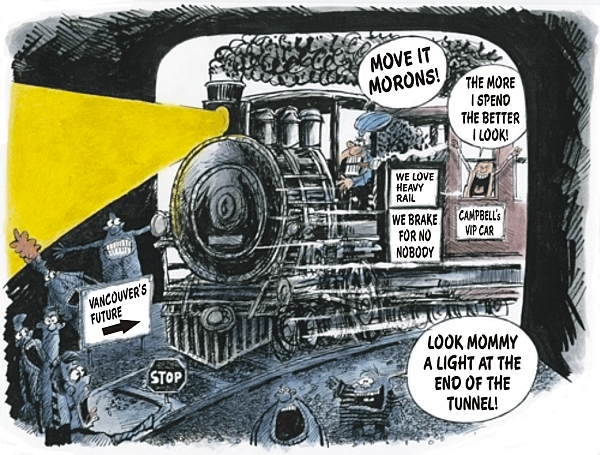
Something TransLink and the Mayors Council on Transit likes to keep hidden.
The cost of subway construction in Toronto is pegged at $580 million per km.
By comparison, the cost for LRT (not in BC mind) is pegged at $35 million to $50 million per km.
We can build 10 or more km of LRT for every km of subway built and LRT, at present, has a higher capacity than SkyTrain!
Or put another way, just two km. of the Broadway subway could fund a 30 minute Vancouver to Chilliwack diesel LRT service via the old BC Electric route and probably attract far more new customers to transit than the proposed Broadway subway!
Please tell Premier Horgan, no more FastFerry style transit projects and do what the rest of the world does, build with light rail.
Memo to Premier Horgan: A $580 million per km FastFerry style transit project, will trump a billion dollar or more Casino scandal any day in BC!
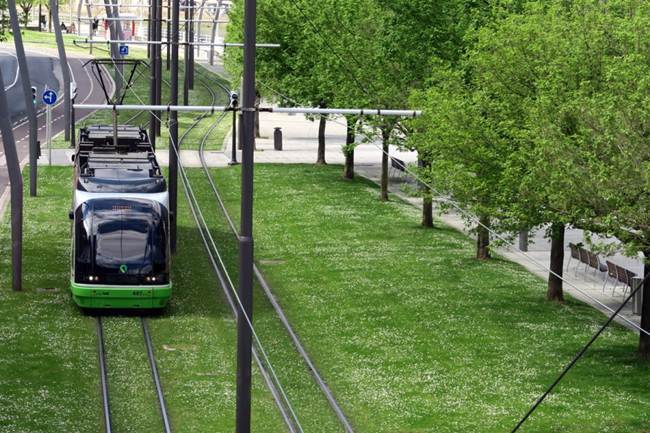
The modern Tram; today's transit choice by transit planners around the world.
Toronto: There’s a Ford in their future……..again !! The last one wasn’t enough. They had to elect another one.
Jeff Marinoff
LORINC: Breaking down Doug Ford’s impossible, ridiculous, scandalous subway to Pickering
Because we here in Spacing’s bustling newsroom like to provide informative and constructive analysis to politicians of all stripes, we felt it would be helpful to cost out the new premier’s plan to extend subway service to Pickering.
*
I will assume, for the purposes of Spacing’s initial feasibility study, that the Ford Extension™ will run from Scarborough Town Centre to Pickering Town Centre, which, truth be told, is really the only place for a subway to go in that part of the 905. According to Google maps, the distance between the two regional mall/mobility hubs is about 17.1 km, assuming the crow flies over Highway 401.
*
The route is traversed by no fewer than three of the GTA’s river/ravine systems – Highland Creek, the Rouge River and Duffins Creek, and would obviously have to dip under the 401 at some point. In short, it will have to run in an extraordinarily deep tunnel, just like the Scarborough Subway Extension does.
*
Speaking of which, the going rate for a kilometer of subway is about $580 million, which is based, of course, on the amount we’ll be spending in virtual perpetuity for the 6.2 km Scarborough line. Taxpayers have been repeatedly assured — by Mayor John Tory and others — that this monumentally wasteful boondoggle will cost $3.5 billion (although no one really believes that figure). The number would be higher if there were stations, but let’s not get into that.
*
If we round up to $600 million, that means a mostly stop-free straight-shot subway between STC and Pickering would cost about $10 billion, but that’s in 2014 dollars, which is when the extension funding was secured. In 2021 dollars, or whenever Doug Ford needs to remind voters in the east end of the GTA that he’s brung home the electoral bacon, the number will be, well… Don’t even bother.
*
It’s hardly worth mentioning, but I shall do it anyway, that GO currently offers express bus service from STC to Pickering Town Centre. It runs every 20 minutes. The cost is probably a gazillionth of what the subway will require, but the good people of Pickering deserve a subway, and so they shall have one.
*
Another point scarcely worth noting is that the outlay for the Ford Express™ would be about twice the amount the premier-designate claims he’ll cut from the province’s $150 billion+ budget. Anyway, I’ll leave it you to do the math.
*
Perhaps in the way that Donald Trump has emboldened racists and thugs, Ford will encourage more ridiculous transportation ideas to emerge from their richly-deserved hiding places. How else to account for the Toronto Region Board of Trade’s pitch to deck the busiest sections of Highway 401 – a proposal (see page 14) that caused John McGrath, my colleague at TVO’s The Agenda, to express a desire to end it all.
*
Packaged as one of three “bold” ideas to address bottlenecks and cargo movement around Pearson, the TRBOT document claims that, based on an elevated section of a highway in Texas, we could add six tolled lanes in the air above the 401 for somewhere between C$4 billion and $10 billion for 20 to 50 km.
*
The report is more than a little misleading. The Texas project – one in Austin, based on another in Dallas – envisions a three-level highway mainly through a relatively short stretch running through the downtown, with tolls at the lower levels. TRBOT neglects to mention that the I-35 through Austin is merely a six-lane highway with plenty of land on either side, whereas the 401 around Pearson is anywhere from 12 to 16 lanes across, with not much right of way left over at the edges. Decking it poses a far more formidable engineering and logistical feat, resulting in a gigantic object that would likely cost at least twice as much as what the State of Texas intends to ram through downtown Austin.
*
The blindingly obvious question is this: does Ontario really need to be taking its transportation planning cues from a jurisdiction that barely does land use planning, operates not a single kilometre of subway and venerates its highways?
*
To be honest, I shouldn’t even waste pixels writing about such matters, except to point out that previous schemes to add layers to various highways around the city have inevitably floundered because they make no sense, financially or structurally.
*
Senator Jerry Grafstein, for a while, shilled for a crazy private scheme to run a tolled tunnel under the Gardiner/Lakeshore corridor. And in the early days of the Toronto Waterfront Revitalization Corp., there was a more developed public plan to bury the Gardiner in a tunnel through the central core. Inevitably, these ideas died a deserving death because the sheer space and cost required to shift fast-moving vehicles up or down a level is so onerous as to render the whole scheme unworkable.
*
Then, four or five decades after it is completed, the damn thing begins to crumble like so much stale feta, just like the Gardiner did, except there will be a lot more salt-soaked rubble raining down on a far busier stretch of road.
*
Why TRBOT reached for this particular solution is totally beyond me, unless the organization — which in the recent past offered cogent and important advocacy on transportation planning — has been seized with an overwhelming desire to be ridiculed. Sure, it’s a bold idea. Mostly, though, it’s a bad idea.
*
Here’s a better idea: more transit! In recent weeks, I had to travel regularly down to the Distillery District for a project: the St Clair West streetcar in its right of way to the subway; the subway to King; a wonderfully speedy streetcar ride east along the freshly de-congested King, then jogging south on the new Cherry Street loop now serving the West Donlands. All excellently synchronized, in new vehicles with multi-door access, and transfers smoothed by Presto cards. For the first time in my life, I felt like transit in Toronto had become positively European in its seamlessness.
*
Oh yes, and at no point along this journey could I detect evidence that the sky had (as so many naysayers boldly predicted) fallen.
*
Imagine.
*
My wish is that when politicians, planners, advocacy groups and citizens talk about moving about in a city encumbered with world-beating congestion, they’ll focus on cost-effective solutions that have been thoroughly tried and tested in all those places in the world that no longer have world-beating congestion. My fear is that we will, instead, waste the next four years debating dumb ideas that burn through vast reserves of civic energy before finally exploding on the launching pad.
FastFerry fiascos tend to be common in BC, where politicians play the part of transit experts and squander the taxpayer’s money on prestige projects, that are great for ribbon cutting photo-ops, but little more.
That Translink’s American CEO applauds this only shows the Mayor’s Council on Transit picked nothing more than a “Useful Idiot” to oversee their grossly negligent transit planning that is nothing more than hugely expensive gift to political friends, the land speculators and land developers.
This transit plan is solely to move money, not transit customers.
Kiss good transit planning good bye as the region will suffer decades of congestion and say hello to an ever increasing tax bill to fund the gross incompetence associated with this plan. Also say hello to new highway construction in he region, which must happen, if there is no regional transit.
Better transit for the region, not going to happen, simply because there is no money to make it happen and this includes the Rail for the Valley’s TramTrain, linking Chilliwack, Abbotsford, Cloverdale to Vancouver.
Memo to Premier John Horgan: Stop this runaway money train; dissolve TransLink and start over again, because the Broadway subway and ill planned Surrey LRT will sink the NDP, like the Fast Ferry’s did almost two decades ago.
TransLink mayors, board to vote on $7b Metro Vancouver transit plan
TransLink’s Mayors Council and board of directors will meet Thursday to decide whether to approve the ambitious $7.3-billion second phase of a 10-year transportation plan for the region.
If the council and board vote in favour of the plan, then procurement for and implementation of the plan’s projects can begin as early as next month.
Projects include construction of the Millennium Line Broadway Extension and the first stage of the South of Fraser rapid transit in Surrey, more bus and HandyDart service, upgrades to the existing SkyTrain system, improvements to road, pedestrian and cycling networks, and planning for a proposed gondola on Burnaby Mountain.
The two major rail projects, with a combined cost of almost $4.5 billion, are expected to account for almost half of the total Phase 2 investment.
The federal government has committed to paying up to 40 per cent of the capital costs for major projects, and the province has agreed to pay for 40 per cent of all projects.
Regional funding sources include a two-per-cent transit fare hike, three-per-cent parking-tax increase, a property-tax increase of $5.50 for the average household and a development-cost charge on new development.
“I think this has been a long road for the Mayors Council to get approval and a funding arrangement for the mayors’ 10-year vision, and it’s been a difficult process over the past four years,” said New Westminster Mayor Jonathan Coté.
Coté said he can’t speak for other mayors on the council, but he plans to vote in favour of the Phase 2 plan.
“I have for years advocated for the need for us to take that next step and move on to investing in transportation infrastructure, and I can speak for myself that I feel comfortable the appropriate next step is to approve the plan and move us beyond the decade-long conversation about funding and actually start having conversations about implementing transport infrastructure in the region,” he said.
A recent public consultation on Phase 2 of the plan highlighted some concerns about individual funding sources, such as property taxes, and components of the plan, but Coté said he believes the public is generally supportive.
“I think that people are ready for us to stop debating investments into transportation and actually move on to getting on to building and investing in transportation infrastructure in the region,” he said.
Richmond Mayor Malcolm Brodie, who is also co-chair of the council and the board’s joint-finance committee, said he has supported the plan throughout the process and expects to continue to support it Thursday.
He said he hasn’t canvassed his colleagues, but guesses the council will approve the plan, seeing as it has expressed its support for Phase 2 on numerous occasions.
“I think that the federal government, the provincial government, the region are coming together to support a transportation plan — they’re coming together in an unprecedented way and I think the beneficiaries of the common approach will be the people of the region,” Brodie said.
The Mayors Council will also vote on the fare increase proposed in the funding formula for Phase 2. The council received an application from TransLink for the increase on April 20 and must make a decision by July 19.
 The initial LRT line in Portland cost less than a quarter to build than Vancouver’s SkyTrain, enabling the transit authority to build more lines, reaching more customers.
 Portland’s Sellwood-Moreland neighborhood (Wikipedia)By Scott Beyer Ai??|Ai?? Columnist

City of Surrey’s draft concept of a medium-term vision for light rail transit expansion. (City of Surrey)
City of Surrey’s draft concept of a long-term vision for light rail transit expansion. (City of Surrey)


Sany Zein (left) and Kevin Desmond on April 30, when they refused to disclose the new Surrey-Langley cost estimates. (Mackin)



/https://www.thestar.com/content/dam/thestar/news/gta/2018/07/03/most-new-ttc-streetcars-to-be-shipped-to-quebec-to-fix-welding-defect-bombardier-says/streetcar.jpg)





Recent Comments