First posted by zweisystem on Thursday, October 11, 2012
Subways & metros cost a lot of money to build and operate.
The proposed new mega bridge that will replace the George Massey Tunnel is back in the news, as there is a good chance that incoming Premier John Horgan will cancel the the hugely expensive vanity project.
Replacing the tunnel with a larger structure, bridge or tunnel will only send the gridlock to the next choke point, Steveston Highway and ultimately the Oak Street & Knight Street bridges, which will see massive congestion if traffic through the tunnelroute were to be expanded.
What is needed is a a rail transit solution the works and can be readily and affordably extended to meet the needs of the ever growing population South of the Fraser River.
The proprietary SkyTrain light metro system and the light metro philosophy of operation has done very little in attracting the motorist from the car and its high ridership can be attributed mostly to recycling of bus customers and over 130.000 $1.00 a day U-Passes issued to post secondary students in the region. SkyTrain has done little to ease congestion in the METRO Vancouver area.
The proprietary SkyTrain light-metro system is just too expensive to build and it just cannot be extended affordably into the outer suburbs to attract new customers. The extremely high cost to construct SkyTrain light-metro has made the blacktop option the cheaper option in improving regional transportation, as evidenced by the many highway expansion projects underway in the Metro Vancouver region. As new highways are built, auto use increases, with the only barrier against increased auto use being road capacity.
What we see is extremely myopic regional planning and shows Metro Vancouver’s complete ineptitude when it comes to regional transportation as the region’s transportation clock has been merely turned back some 50 years when light-metro and subway construction was all the rage.
Sadly, this short sighted and extremely dated planning, which fits in well with BC politics practiced by both the BC Liberal Party and the NDP, will only lead to more gridlock and traffic chaos.
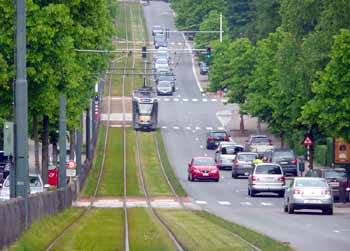
The Canada Line is in reality a heavy-rail metro, operating ROTEM’s heavy-rail electrical multiple Units (EMU’s), built as a light metro. The Canada Line’s automatic (driverless) operation and small stations, with 40 metre long platforms has roughly half the capacity of the ALRT/ART lines and much less than a quarter that was carried on the main tram (streetcar) line through Karlsruhe, Germany, before a subway was proposed. It now seems that automatic light-metro has hamstrung light metro capacity, making it somewhat obsolete for tomorrow’s transit demands.
To both increase capacity on the Canada Line (an estimated $1.5 billion alone) and to increase its reach into Richmond in an effort to attract more ridership, would cost about an additional $1 billion for a total of about $2.5 billion. By comparison, $2 billion would buy you about 80 km. (at about $25 mil/km.) of modern LRT!
That $2 billion would be put to better use by:
Converting the Canada Line hybrid heavy/light metro to light rail.
With the money saved by much cheaper LRT construction, extend the the new Canada line LRT across the Fraser river into Delta and beyond.
This is not fanciful musings, rather it very well may be a transit solution that TransLink or a future operating authority may seriously consider.
The Canada line is in a heavy-rail metro and most modern light rail vehicles would easily operate within the Rotem EMU’s Kinematic Envelope (Kinematic Envelope: the space that a rail vehicle could potentially occupy as it moves laterally and vertically on its suspension.), including the subway tunnels.
The expensive and complicated automatic signalling system should beAi??replaced with much simpler and more robust signalling system, doing away with the higher operating costs due to automatic signalling.
Retain third rail power pick on the elevated and underground portions of the line by equipping, as done before on other transit lines, the trams with retractable shoes to collect power from the third rail and using standard pantographs on non-guideway portions of the line. Simply, the first station the tram stops at on the guideway portion of the line the driver drops the pantograph and deploys the power collection shoes. Several tram varieties on the market today have dual pantograph/shoe for power pick up on APS ground level contact-less power supply.
By converting the Canada Line to LRT would make the cost of extending the Canada Line, first to Steveston and Ironwood Mall an affordable option. It would also be much cheaper to build with LRT for a new crossing of the Fraser River to serve both Ladner and South Delta; then onwards to South Surrey. As well, it would also be a viable option to extend the Canada Line, via at-grade operation to UBC a much cheaper option than bored subway tunnel.
The cost to extend the Canada line to Steveston and Ironwood Mall (about 11 .3 km.), should cost no more than $300 million and the CN rail line bisecting Richmond is up for sale for a reported $65 million, probably much cheaper if it was used for transit. It is conceivable that for the cost of the Canada Line extending to Steveston and the Ironwood Mall, we could build LRT to both Steveston and the Ironwood Mall, then through a tunnel under the Fraser River to Ladner and the Tsawwassen ferry terminal!
It is time for TransLink to start planning for light rail transit for the region and not just for a small cluster of municipalities that surround Vancouver. SkyTrain, with construction costs exceeding $130 million/km. just cannot be built economically into the burbs, but modern LRT, with construction costs as low as $6 million/km. (TramTrain) can. It is time for regional politicians declare that building with SkyTrain and/or light-metro has been a mistake and that we must plan future transit on the light rail model. The regional politicians who make up METRO Vancouver should tell TransLink either change their transit planning direction and for a start, seriously look at converting the Canada Line to LRT and extend it across the Fraser River to Delta and beyond.
Et tu Brute is a Latin phrase meaning “and you, Brutus?“, “even you, Brutus?” or “you too, Brutus?“, purportedly the last words of the Roman dictator Julius Caesar to his friend Marcus Brutus at the moment of his assassination. The quotation is widely used to signify the utmost unexpected betrayal by a person, such as a friend.
The choice to have Vancouver Vision Councillor Geoff Meggs to be incoming Premier Horgan’s chief of staff is a massive mistake and will cause an election by fall.
Geoff Meggs has played fast and lose with the truth concerning LRT and the proposed $3 billion Broadway SkyTrain Subway and he is unsuitable for any post within the NDP.
It is sad to see that the NDP have learned nothing about transit and remembered nothing about transit and still see it as a massive pork barrel for which to play.
The NDP are now firmly in the pocket of land developers, speculators AND SNC Lavalin, who happen to own the engineering patents for the proprietary ART railway (SkyTrain), with Meggs appointment.
The next election, spring of 2018, with the NDP losing badly, mainly by Megg’s questionable ethics!
Could it not get worse for BC taxpayers and transit customers.
Memo for Carole James: Meggs knows very little about Metro Vancouver, except how to enrich land speculators and land developers. You should have retired.
Vancouver Councillor Geoff Meggs to be John Horganai??i??s chief of staff
Geoff Meggs is a three-term Vancouver city councillor.
Three-term Vancouver City Councillor Geoff Meggs has resigned in order to take a job as Premier-designate John Horganai??i??s chief of staff.
Meggs was first elected to city council in 2008.
ai???WhenAi?? the [premier-designate] calls you and says Iai??i??d like you to work on the agenda that I ran on which included making B.C. more affordable, improving the province in so many ways ai??i?? itai??i??s very hard to say no,ai??? Meggs said of the transition.
MLA Carol James, who speaks for the transition team, said the former councillorai??i??s intimate knowledge of Metro Vancouver was a key asset.
ai???Having that mix is critical, no question.ai???
In the wake of the announcement, Vancouver Mayor Gregor Robertson issued a statement, thanking Meggs for his time on council.
ai???We have been fortunate to have Geoff Meggs on City Council over the last nine years, where he has been an effective and thoughtful City Councillor, demonstrating strong leadership on issues like affordable housing and transit,ai??? Robertson wrote, calling Meggs ai???immensely qualifiedai??? to serve as Horganai??i??s chief of staff.
It wonai??i??t be Meggsai??i?? first time inside the premierai??i??s office. He previously served as communications director in the office of former NDP Premier Glen Clark.
He has also served as executive director to the BC Federation of Labour.
The BC NDP made the announcement Tuesday, also revealing to other hires to key positions in Horganai??i??s inner circle.
NDP campaign director Bob Dewar, who had served as Horganai??i??s chief of staff in opposition, will stay on as special advisor to the premier.
And Don Wright willAi??serve as Deputy Minister of Executive Council, Cabinet Secretary, and Head of the Public Service, replacing Kim Henderson who has been let go.
Wright was BCIT president until he left to be Deputy Minister to Adrian Dix in 2013. When the NDP lost that election, he moved on to become CEO of Central One Credit union, a position he will resign on Friday.
Byelection imminent
A spokesperson for the Vancouver Mayorsai??i?? office said Meggsai??i?? exit will trigger a byelection for his council seat.
His departure will also leave big shoes to fill on council, said city hall watcher Mike Klassen, who notedAi??Meggs was often the spokesperson for Vision Vancouver when the mayor wasnai??i??t available.
ai???You know, the joke about Geoff was that he was the guy who would always do the media when there was bad news.ai???
Klassen added that Meggs was also the person who started the discussion about the removal of the viaducts.
ai???I think we remember Mayor Robertson asking for funding for that and it seems to me quite possible that the province will kick in for some of the removing of those viaducts that will cost a lot of money.ai???
But NPA Councillor and former colleague George Affleck says he doesnai??i??t expect having Meggs in the premierai??i??s office will change the cityai??i??s relationship with Victoria.
ai???Iai??i??m not sure if he would be allowed to have preferential treatment given to Vancouver, heai??i??s going to have a lot of things on his plate,ai??? Affleck said.
Despite Meggsai??i?? departure, Vision Vancouver will retain its majority on Vancouverai??i??s city council.
-With files from Liza Yuzda and Janet Brown
Ai??Ai??2017Ai??Global News, a division of Corus Entertainment Inc.
There is a plan in place, which has received international recognition, that could once again see an affordable passenger rail service from Vancouver, through the Fraser Valley to Chilliwack..
The Leewood Study has been ignored by most politicians, but not all and the time is right to put shovel to ground as regional traffic congestion in the Fraser Valley has become endemic and relief is needed.
Do not listen to the SkyTrain Lobby, as the aging gadgetbahnen is becoming extremely expensive to operate and maintain. No one has bought an ALRT/ART transit system in over a decade as it is too expensive not only to build, but to operate and maintain.
Do not listen to the light-metro lobby, as huge construction costs ($130 mil/km) make it unsustainable. Also, being elevated has not proven to be an advantage over at-grade LRT, in fact the opposite is true as at-grade transit is easier and cheaper to maintain and operate.
Do not listen to the subway lobby, as they live in a land of sparkle ponies and pixie dust. Subways are hugely expensive to build and hugely expensive to maintain, costing the operating authorities huge sums of tax money to operate. Due to their nature, subways do not attract ridership, in fact subways tend to deter ridership!
The former BC Liberal Government had absolutely no care for regional transit, except for building multi billion bridges and highways and has left good transportation planningAi?? to rot.
The Leewood Study even though seven years old, gives the region an affordable 21st century solution for transportation from downtown Vancouver to Chilliwack, connecting the population centres of Vancouver/Burnaby; North and South Surrey/Cloverdale; Langley; Abbotsford; and Chilliwack/Sardis.
Do not be left at the station with the baggage of unworkable or unaffordable solutions and board the train with a ticket for success!
The concept of freight trams has been around for a while, in fact the concept is quite old.
The success of Dresden’s freight tram was based on moving car components, via container, from one factory to another across the city. In St. Etienne, it’s the concept of moving smaller loads from one central distribution point outside the city centre to smaller ones inside the city, taking delivery trucks off congested roads.
Certainly in metro Vancouver, the concept of freight trams could find many good uses, from deliveries along Broadway to a fast “parcels” service from Chilliwack to Vancouver.
The ability for LRT to adapt to new situations, sadly, goes completely unrecognized by TransLink, regional politicians and the provincial government.
Thinking out of the box is just not comprehended by TransLink.
A French project to develop a concept for freight operations on light rail networks reached a milestone on the morning of June 13, when a tram was used to deliver merchandise to a retailer in St Etienne.
The trial delivery to the Casino store in Place Carnot was organized as part of the TramFret project, an initiative led by research and development institute Efficacity, which is being supported by St Etienne public transport operator Stas.
Special authorization was granted for the trial by STRMTG, the national agency responsible for tramway safety.
TramFret says the trial will enable it to optimize the system, begin industrial development of the concept, and study its sustainability.
If the first phase of the trial is successful further testing will be carried out in St Etienne in the coming weeks.
Well,Ai?? China’s miracle “straddling bus “; the bus that was going to solve urban transit woes with its revolutionary concept, has been deemed a scam!
Absolutely no surprise here.
What was sad to see and hear, was the number of politicians who got suckered by this. Anyone with a basic knowledge of transit operations would had called this bit of nonsense out, but no, they lauded it as revolutionary.
Since when scams become revolutionary?
I probably will not get an apology by the straddling bus crowd, even though they were very rude to me, including those in the mainstream media.
My only wish is the the MSM deal with real transit issues regionally and not ‘Tom Swift’ style transit fantasies.
Image copyright Photo by Imaginechina/REX/Shutterstock
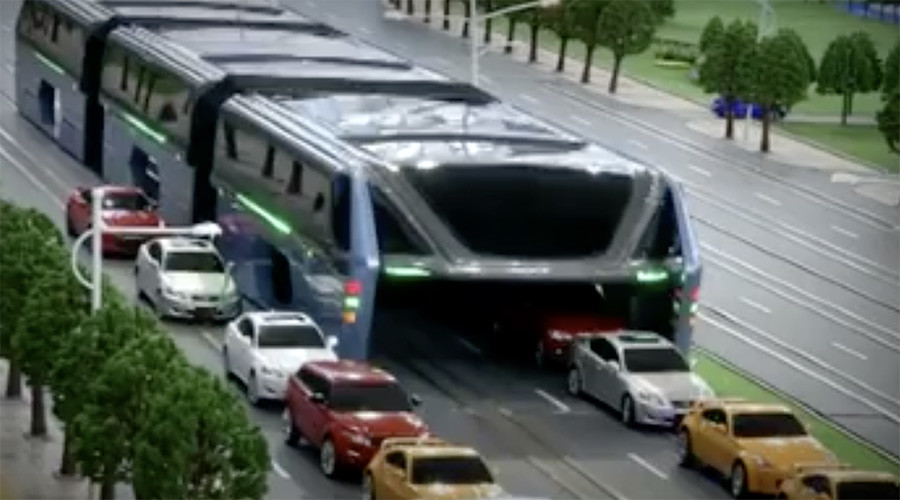
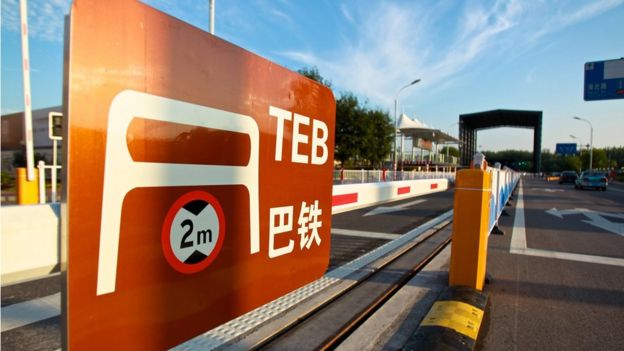
It seemed like a glimpse into the city of tomorrow – but China’s “straddling bus” was riddled by doubts early on and now is headed for the scrap yard.
The futuristic idea was a bus that would drive above traffic, allowing other commuter cars to pass underneath.
The project was announced last summer to much acclaim but soon ran into feasibility and investment problems.
Many of China’s cities suffer from chronic traffic congestion so there’s a strong hunger for ingenious solutions.
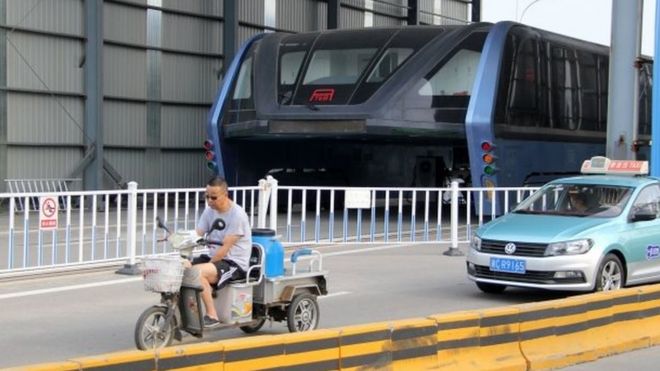
The project faced strong headwinds from the very beginning and according to Chinese media, the test site is now being demolished entirely.
Reports are saying that workers have already begun dismantling and removing the test track in Qinhuangdao.
Image copyright Getty Images Image caption The TEB was to zoom above traffic, elevated 2 meters above the daily gridlock
The idea of a traffic-straddling bus first appeared in China in 2010, but it didn’t make much impact until the model was presented at the 2016 Beijing International High-Tech Expo.
The so-called Transit Elevated Bus was touted as a revolution in public ground transportation, able to glide over traffic, literally lifting commuters from the daily grind of being stuck in their cars for hours.
Yet only a few days after its much-lauded test-run in Qinhuangdao city, Hebei province, all test-runs had been halted and doubts began to emerge.
Many doubted the vehicle would be able to manage curves or fit under footbridges in Beijing, and critics have asked how it will turn corners, whether it is strong enough to bear its own and passengers’ weight and how long its battery would last.
There was also confusion about whether the project had ever been approved by the local authorities and there was even suspicion it could be an investment scam.
But the widespread interest in the idea did show that there’s an appetite for ideas that could help big cities out of the grip of the daily traffic gridlock – even if this one appears to have hit a final roadblock.
Endemic gridlock, despite a now over $10 billion investment in SkyTrain. Do the same thing again and again, hoping for different results is insane.
After driving into Vancouver yesterday, it has hit home that despite a now over $10 billion spent on SkyTrain light-metro and the Canada line, congestion is getting worse.
After being an advocate for better transportation in the region for now over thirty years, I am still amazed by the “SkyTrain ennui” that prevails in most Metro Vancouver city halls. It is like regional planners and engineers just looked at picture books, instead of reading and learning from recent transit studies published across the pond. The exception is that TransLink is very good at implementing new tax schemes to pay for their questionable transit planning.
In Delta, where I reside, there is much support for a $12 billion, ten lane mega bridge, in the vain hope that it will cure gridlock. It won’t of course because as in all cases, more traffic lanes lead to gridlock at the next choke point, which in this case is the Oak and Knight Street bridges.
Today, trying to get to the airport (YVR) took an extra 20 minutes because of massive congestion at the Oak St. Bridge, backing traffic to number 5 Road! Add three more lanes going to Richmond on a new bridge and the #5 Road interchange will be the next major choke point.
The BC Liberals have left us with a legacy of extremely bad transit planning, with the “White Elephant” Canada Line being the hallmark of Liberal transit incompetence.
The Canada Line, with only 40 metre long station platforms and the ability to operate only 2-car trains, has effectively about one half the capacity of the Expo and Millennium/Evergreen lines.
It is time for some serious talk about regional transit, which means a lot of toes are going to be stepped on.
The major problem to overcome is to stop planning for SkyTrain light-metro and LRT designed as SkyTrain light metro.
We have to think about economy and user friendliness and not capacity and speed. We have to think regionally and not the current multi billion dollar nonsense that passes for transit planning in the region today. We have to think of light rail; converting the Canada line to light-rail; operating light rail on the Arbutus Corridor; we have to think LRT on Broadway and not a SkyTrain subway, from BCIT in Burnaby to UBC and Stanley Park in Vancouver and from White Rock to Vancouver, along the King George in Surrey; we have to think TramTrain from Vancouver to Chilliwack; we have to think 21st century transit planning and not 1970’s transit planning where transit is put in the the air or underground so not to interfere with vehicular traffic.
It can be done, the question is; “do our civic and provincial politicians have the moral fortitude to do it?”
The following is well worthAi?? read as it compares the French Approach to Modern LRT and the American and Canadian rather dated approach to the transit mode.
As SkyTrain ages, its equipment deteriorates and today, a fire has happened and apparently not caused by a pyrotechnic birds nest.
As mentioned many times by Rail for the Valley, about $3 billion needs to be invested in the ART/ALRT SkyTrain lines to both renew the mini-metro system and to increase capacity.
As TransLink’s CEO and executives desperately try to hide the expensive truth from the public and regional mayors remain ignorant of the pricey needs of the SkyTrain light-metro system, system failures will become more and more common.And politicians want more expensive SkyTrain!
The great fear is a major catastrophe will happen on SkyTrain, just like the recent deadly Grenfell Tower inferno in London, where years of neglect had created a fiery death trap.
Ennui, combined with hubris, by politicians and bureaucrats is the cause of many a deadly fiasco.
Sunday morning SkyTrain service disrupted by New West ‘equipment fire’
Patrick Johnston (Vancouver Sun)
Published: June 17, 2017
Updated: June 18, 2017 1:49 PM
Filed Under:
The Province > News > Local News
Area around the New Westminster SkyTrain station in a file photo.Photo by Gerry Kahrmann
Travellers using the Expo Line Sunday morning are facing delays because of an ai???equipment fireai??? at New Westminster Station.
Shuttle buses are operating between Edmonds and Columbia station.
The fire is now out; a Translink spokesperson said just before 11 a.m. that service would return to normal ai???any time now.ai???
There was no risk to customers and no impact on the Millennium and Canada Lines.
As hydrogen fuel cell technology improves, the application for ‘rail’ transit is close to become a reality.
The main problem for hydrogen fuel cell transit is that the cell tends to produce power at a steady rate, but poor in providing power at times of high demand, like accelerating out of stations. This has made fuel cell technology quite good for submarines but poor for transit – until now.
There is still a long way to go for a light H (Hydrogen) MU vehicle in the testing stageAi?? and heavy rail commuter train locomotives, but I think the future will be with the hydrogen powered train.
This will be good news for our efforts for the return on the interurban and the return of passenger service on the E&N.
Alstom today successfully performed the first test run at 80 km/h of the worldai??i??s only fuel cell passenger train Coradia iLint on its own test track in Salzgitter, Lower Saxony (Germany). An extensive test campaign will be conducted in Germany and Czech Republic in the coming months before the Coradia iLint performs its first passenger test runs on the Buxtehudeai??i??BremervAi??rdeai??i??Bremerhavenai??i??Cuxhaven (Germany) route beginning of 2018.
The four-week test runs currently undergoing in Salzgitter aim at confirming the stability of the energy supply system based on coordinated interaction between the drive, the fuel cell and the battery of the vehicle. The braking power is also being tested to check the interface between the pneumatic and the electric brake.
The Coradia iLint is the first low floor passenger train worldwide powered by a hydrogen fuel cell, which produces electrical power for the traction. This zero-emission train is silent and only emits steam and condensed water. Coradia iLint is special for its combination of different innovative elements: a clean energy conversion, flexible energy storage in batteries, and a smart management of the traction power and available energy. Based on Alstomai??i??s flagship Coradia Lint diesel train, Coradia iLint is particularly suited for operation on non-electrified networks. It enables sustainable train operation while maintaining high train performance.
ai???This test run is a significant milestone in environmental protection and technical innovation. With the Coradia iLint and its fuel cell technology, Alstom is the first railway manufacturer to offer a zero-emission alternative for mass transit trains. Today our new traction system, so far successfully proved on the test ring, is used on a train for the first time ai??i?? a major step towards cleaner mobility in Europeai???, said Didier Pfleger, Vice President of Alstom Germany and Austria.
The dynamic tests are performed at Salzgitter plant at 80 km/h and in Velim (Czech Republic) at up to 140 km/h, the maximum speed of the Coradia iLint. For the purpose of the tests, a mobile filling station has been erected in Salzgitter to pump gaseous hydrogen into the pressure tank of the Coradia iLint. The hydrogen used for the test runs is the by-product of an industrial process, which is reasonably reused as a waste product. In the long term, Alstom aims to support the hydrogen production from wind energy.
The vehicle has already successfully completed the static commissioning process. All electrical and pneumatic functions of the trains have been tested and verified at standstill. TA?V SA?d has certified the safety of the battery, the pressure tank system and the fuel cell for the coming test phases.
The Coradia iLint was designed by Alstom teams in Germany at Salzgitterai??i??s site, centre of excellence for regional trains and in France notably in Tarbes, centre of excellence for traction systems and Ornans for the motors. This project benefits from the support of the German ministry of Transport and Digital infrastructure. Alstom has already signed letters of intent for 60 trains with the German states of Lower Saxony, North Rhine-Westphalia, Baden-WA?rttemberg and the Hessian transport association ai???Rhein-Main-Verkehrsverbundai??i??.
Ministry of Transportation to conduct feasibility study of hydrogen trains, which are silent and emit only steam and water, as part of GO electrification assessment.
The provincial government has decided to pursue potentially groundbreaking clean train technology as part of its plans to electrify the GO Transit network, the Star has learned.
At an announcement Thursday morning, the province is set to officially launch the long-awaited study and public consultation process on electrifying GO lines under its regional express rail (RER) program.
The Ontario Liberals say the $13.5-billion RER expansion will introduce all-day, two-way GO service on the busiest parts of the GTHAai??i??s regional rail network by 2025. The assessment of the programai??i??s environmental impacts is part of the government-mandated transit project assessment process (TPAP) that must be complete before the expansion can go ahead.
In an exclusive interview with the Star on Wednesday, Transportation Minister Steven Del Duca confirmed that in conjunction with the electrification assessment, the province will also launch a feasibility study of hydrogen-powered passenger trains.
Passenger trains powered by hydrogen fuel cellshave yet to enter regular service anywhere in the world, but early models have reached advanced testing phases in Europe. Manufacturers say the trains are nearly silent, and produce no emissions besides steam and condensed water.
The feasibility study will help determine whether hydrogen trains might be a better option for the RER program than traditional electric vehicles.
ai???This is a decision that weai??i??re making that will have to last for a generation and beyond, so we want to make sure that weai??i??re at the leading edge of the technology,ai??? said Del Duca.
ai???It could be traditional electrification, it could be electrification by hydrogen fuel cell. It could be a combination of both.ai???
It seems Montreal taxpayers are being taken for a $9 billion Bombardier ride, with the proposed 67 km Montreal light metro project.
The proposed Montreal LRT is not LRT at all, rather it is a light-metro, using the Bombardier Innovia body shell, using conventional ‘squirrel cage’ electric motors.
Based on the cost of now over $130 million/km for a Vancouver style, automaticAi?? ART light-metro, the cost for a 67 km network would be almost $9 billion.
Even if real LRT were to be built, the cost, based on Surrey’s LRT, of over $100 million/km would mean the 67 km network would cost almost $7 billion.
Thus, the project, based on 2017 construction costs in BC will be easily $1 billion to $3 billion over budget.
What is really happening is another Bombardier/Federal Liberal project that will turn into a multi billion dollar boondoggle, which the Montreal, Quebec and Canadian taxpayer will pay dearly for, just like Olympic Stadium and the infamous Mirabel airport.
When it comes to Quebec, money is no object and the bigger the “White Elephant” it seems, the better for the Federal Government.
Federal government expected to make announcement in Montreal Thursday
CBC News Posted: Jun 14, 2017 6:54 PM ET Last Updated: Jun 15, 2017 6:22 AM ET
The price tag for the line, which would link downtown Montreal with the South Shore and the West Island, has risen to $6 billion. (Caisse de dAi??pA?t et placement du QuAi??bec)
Montreal’s light-rail train project to get $1.3B from Ottawa
Federal government expected to make announcement in Montreal tomorrow
CBC NewsAi??Posted: Jun 14, 2017 6:54 PM ETAi??Last Updated: Jun 14, 2017 6:54 PM ET
Following months of negotiations, the federal government will unveil $1.3 billion in funding for Montreal’s light-rail project on Thursday,Ai??Radio-Canada has learned.
Prime Minister Justin Trudeau, Quebec Premier Philippe Couillard, Montreal Mayor Denis Coderre and the head of theAi??Caisse de dAi??pA?t et placement du QuAi??bec,Ai??Michael Sabia,Ai??are expected to make the announcement in Montreal.
The decision comes a few months after the Trudeau government made no mention of funding the project in their spring budget, prompting concern from Couillard.
The price tagAi??for the 67-kilometre rail line (LRT), which would link downtown with the South Shore and the West Island, has risen to $6 billion in order to add more stations in the city’s downtown area.
Quebec has already committed around $1.3 billion to the project. The province’s pension fund manager, theAi??Caisse, has pledged close to $3 billion.
The LRT project now includes 27 stations. The first trains are expected to run in 2020.
 Subways & metros cost a lot of money to build and operate.
 route were to be expanded.
 power collection shoes. Several tram varieties on the market today have dual pantograph/shoe for power pick up on APS ground level contact-less power supply.

By Simon Little Digital Reporter Ai??CKNW



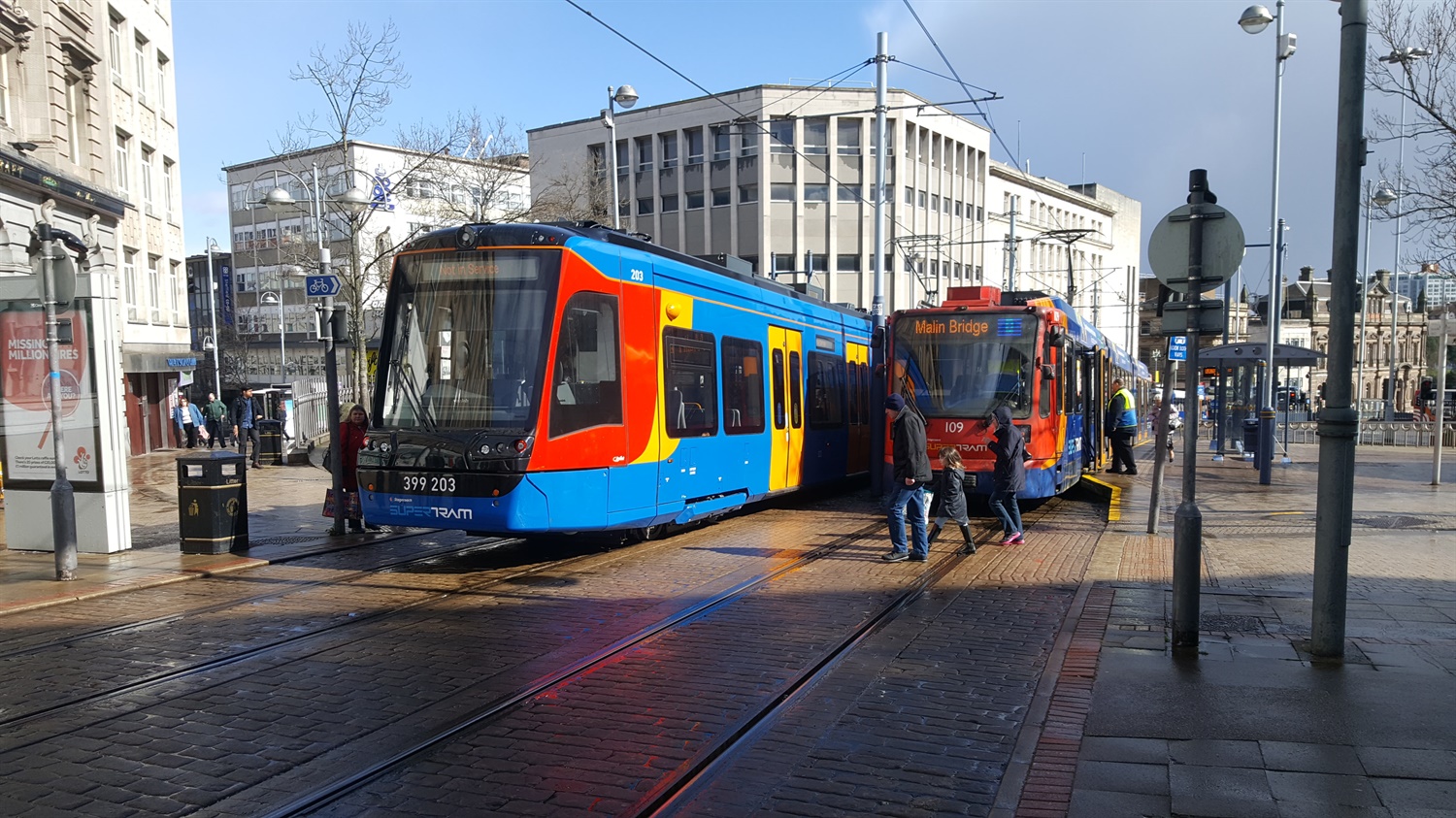 A TramTrain being tested in Sheffield, UK.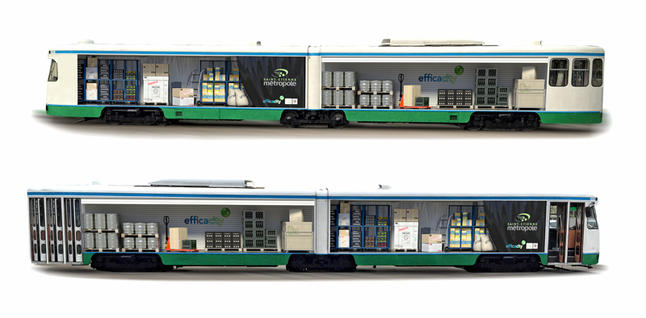
 TramFret




The price tag for the line, which would link downtown Montreal with the South Shore and the West Island, has risen to $6 billion. (Caisse de dAi??pA?t et placement du QuAi??bec)



Recent Comments