Bombardier’s rail division is a bit of an embarrassment with late deliveries of trams to Toronto and now something seems amiss with the new MK.3 cars, which are really MK.2 cars with fewer seats.
But what caught Zwei’s attention was this little quote”
Seven of the new Mark III cars have been budgeted at $91 million, with 28 in total expected over the next three years.
Now the questions I ask is: Do seven cars cost $91 million or do 28 cars cost $91 million?
Further, I thought Mk.3 came in 3 car sets, but seven is an odd number so another question I as is; “Are the MK.3 cars merely coaches, with no driving controls, gangwayed at both ends?”
SkyTrain car that broke down early Wednesday is one of the new trains: TransLink
( A note from Zwei: This of course is a Canada Line Train and it seems the CKNW news department doesn’t have a clue of the difference)
TransLink has confirmed that the SkyTrain car that broke down early this morning was one of the new Mark III trains.
That stall putting a damper to commuters at 6 a.m. which saw the car with its emergency lights flashing at the end of the SkyBridge near Scott Road station.
Earlier today TransLink said a train lost power on the sky bridge and had to be manually removed.
The trainAi??wasAi??one of the new models that was launchedAi??earlier this year.
No word yet on a cause of the stall, TransLink says more information is coming.
Seven of the new Mark III cars have been budgeted at $91 million, with 28 in total expected over the next three years.
The aging SkyTrain seems to be having a rough time lately, but it is to be expected as most proprietary transit systems age badly.
TransLink has a new word for its lexicon, “temporary” and lest us hope that the delays are not permanent.
The problem with SkyTrain breaking down is that there is no alternative service, no redundancy and is the hallmark of a very poorly planned transit system.
Now, if a Rail for the Valley TramTrain serviced Vancouver, at least there would be an alternative ‘rail’ service for customers to use.
What makes a transit system successful is goodAi?? customer service and TransLink’s management just cannot get their head around the term “user friendly“, which is a term not in their lexicon.
SkyTrain customers waiting at Scott Road Station in Surrey. (Photo via Twitter: @wetcoastlife)
Summary
Delays affected both Expo and Millennium Lines
TransLink investigating why a train broke down this morning
Ai??NEW WESTMINSTER (NEWS 1130) ai??i?? It took crews about half an hour to manually remove a train that was causing delays on the Expo and Millennium Lines this morning.
A train broke down on the Skybridge near Columbia Station in New Westminster just after 6 a.m. and immediately social media was being flooded with angry customers Tweeting their concerns.
Service was back up and running shortly after, although delays were still rippling throughout the system as things got back to normal. TransLink doesnai??i??t know yet why the train broke down.
Bigger and wider bridges and adding new lanes to existing highways will not reduce congestion, but do the opposite, increase it! Yet this is the BC’s governments big transportation plan.
TransLink continues to plan for a “Toonerville Trolley” for Surrey, instead of building useful LRT that will serve transit customers andAi?? a $3 billion subway under Broadway for the now obsolete SkyTrain light-metro. Both projects will not attract ridership and most likely deter ridership because of their ill design.
We are talking over $5 billion for two transit projects that will not reduce congestion, nor offer an attractive alternative to the car, so the province and MoT continue to try to blacktop our way out of congestion and gridlock.
Instead of planning for user friendly, easy to use and efficient transit for the Vancouver metro region, the taxpayer will be saddled with about $10 billion in debt for three vanity projects (Massey tunnel replacement, Vancouver subway and Surrey LRT) built to increase the electability of those in political office and not improve our miserable regional transit operation.
Until sane and realistic planning takes place in the metro Vancouver region, the taxpayer is being taken, blindfolded and gagged, on a long bumpy ride whether he/she like it or not.
Colorado spentAi??$1.2 billion to widen I-25, and all it got was more traffic and no congestion relief. Why does Governor John Hickenlooper think thatAi??widening I-70 will be any different?
In thisAi??chart, you can see why spending billions to widenAi??highways is a shortsighted, ineffective way to deal with peopleai??i??s travel needs. About two years after the widening wrapped up, I-25 was just as congested as it was when construction started, and within five years it was more clogged than ever.
The term for this is ai???induced demand.ai??? When cities make more room for cars, people drive more. Usually within a few years, any initial improvement in congestion levels has evaporated, and drivers start agitatingAi??for more lanes.
A stunning recent exampleAi??comes from Houston, where Texas DOT spent nearly $3 billion to take the Katy Freeway from eight lanes to 23 in some sections. Traffic was as slow as everAi??six years later.
In I-25, Denver has itai??i??s own (smaller)Ai??version of the Katy Freeway. Colorado DOT finished widening the highway by as many as four lanes in 2006 for theAi??project known as T-REX. In a few years,Ai??congestion on I-25 through south Denver reached pre-construction levels, according to a report by the Southwestern Energy Efficiency Project and the Colorado Public Interest Research Group.
ai???The state spent $1.2 billion on this road widening, with no long-term benefit in lowered congestion,ai??? the authors write.
With I-25, thereai??i??s proof right under his nose that highway widenings arenai??i??t worth the expense. And yet,Ai??under Hickenlooper Colorado DOT keepsAi??repeatingAi??the same mistakes.
Metro Mayors, with visions of federal cash dancingAi?? in their heads approved a draft transit plan part of their so called ten year plan.
Like all other transit ten year or twenty year plans that have come and gone, this one was drafted, probably on orders of the premier who is afraid of any negative transit spillage in the coming election year.
One has to remember, TransLink is run by the Premier’s Office.
A new SeaBus sounds good, but they are going to mothball one of the originals?
New SkyTrain cars sounds good, but again they are to replace the venerable MK.1’s, which now have seen thirty plus years of service?
A 10% increase of bus service sounds good, but how much will be squandered on non productive routes which operate as a social service to make local politicians sound good?
There is no mention of hiring new bus drivers, though and buses do not yet drive themselves.
Again, “Road Pricing” is raising its ugly head and unfortunately, most politicians seem to be illiterate on the subject because they see it solely as a revenue generator to fund over priced vanity projects to suit political agendas and not sound transit planning and execution.
It seems the regional mayors just do not come close in understanding transit and how a successful transit system works, instead throw more and more money at it, ever hoping for different results.
The problem the mayors have not even come close in dealing with is TranLink itself. The public hate TransLink and demonstrated that a year ago with a resounding NO vote in the 2015 plebiscite.
Until there are real reforms at TransLink and a new direction, the regional mayors will find themselves at the wrong end of a ballot come election time.
The present approved draft is a caretakers draft of what is needed to keep TransLink functional and to get federal cash flowing West and nothing more.
TransLink is claiming higher ridership, but could it be a flood of U-Pass post secondary students
commuting to university because they cannot afford local rents?
“This poses the question: Is TransLink losing money through the U-Pass program, even though ridership is claimed to be increasing?”
NEW WESTMINSTER (NEWS 1130) ai??i?? Metro Vancouver mayors have approved a draft plan outlining what transit improvements could be coming to our region.
The plan calls for increased bus, SeaBus and SkyTrain service.
Assuming the final plan is approved in November, bus service will see a 10 per cent increase beginning next year. The SkyTrain lines will get an extra 50 cars and another SeaBus will be added.
ai???We would be able to put out additional SkyTrain service, additional SeaBus service, probably as soon as January. The Canada line will probably lag a little bit as we work with the Canada line operator,ai??? says TransLink CEO Kevin Desmond.
As far as funding goes, youai??i??ll see fares go up by three per cent, each year for three years, and a property tax increase that averages $3 a year.
Canadian Taxpayers Federation says mayors have to make adjustments
ai???City mayors should commit to reducing their own property tax increases in their own cities by the same amount. That way the taxpayers arenai??i??t out any money. Cities can reprioritize their spending. Itai??i??s a good way to protect taxpayers.ai???
Road pricing could be in the works, too, in about three years.
ai???Road pricing must be voted on by the public before it can go forward, because it would be a new form of taxation and frankly a very bad form for most people. We already have a form of road pricing, and itai??i??s called gas taxes,ai??? says Bateman.
The problem with TransLink is that you can never believe what it says; TransLink never produces a report based on the same set of assumptions.”
Former West Vancouver Clr. Victor Durman, Chair of the GVRD (now METRO) Finance Committee.
Old habits die hard and with TransLink, old habits never die, they just hire a new manager to reinvent them.
Has anyone at TransLink been directed to investigate improving cost efficiency on heavily used bus routes?
No?
Why not?
Well that would involve modern light rail or variants of modern light rail and that just not agrees with the narrative of being cash strapped that TransLink and its spin doctors want the public and politicians to believe. TransLink just does not plan for cost effective transit solutions.
The cost to provide one hour of service varies, but runs at about $100 for a conventional bus and $959 for SeaBus. On rail, it costs $111 for the Expo and Millennium lines, $563 for the Canada Line ai??i?? which includes payments to the operator of the system ai??i?? and $512 for West Coast Express. (Van. Sun)
The preceding shows the cost per hour per mode, but one important calculation is not there and that is for light-rail. As LRT’s operating costs are about half of a bus on a transit route, it would be safe to assume that the cost per hour for light rail would be cheaper than a bus, but TransLink doesn’t operate LRT and the LRT it is planning has construction costs rivalingAi?? that of SkyTrain. It will be safe to assume there will be no benefit of cheaper operating costs with TransLink’s designed LRT!
Route performance is based on the cost of operating the buses, rail, SeaBus or West Coast Express per passenger. A higher number of people getting on and off transit makes a route more productive. In Vancouver, for instance, the median cost per boarded passenger is $1.05, compared with $1.30 for Burnaby/New Westminster, $2.72 for South Delta and $2.48 for Maple Ridge/Pitt Meadows. In the Northeast sector, which includes Coquitlam, the cost is $1.98 per passenger. (Van. Sun)
The preceding regional median calculation is a dishonest calculation used by TransLink to not just confuse the politicians, but to manufacture the case for getting more tax money. Every route should have a cost benefit analysis, including the number of passengers carried and the cost per passenger on the route. This gives transit managers a very good idea on which services are being used, over used or not used. TransLink used to do this sort of calculation annually, but stopped a couple of years before the Canada line opened. Now it does cost by region calculations which do not give any instructive statistics at all, except to bleat poverty.
Since the 2015 plebiscite, which TransLink and the regional mayors soundly lost, there has been no real change at TransLink and it is business as usual.
I am sorry to say, I believe we have now past the point of no return with transit and transportation in the region and now it is going to be a free for all, with billion dollar vanity projects taking the place of good transportation policy.
Some commuters are frustrated while others are shrugging it off as they deal with SkyTrain delays on their morning commute.
TransLink says a track issue is causing a service disruption to SkyTrain between Metrotown and Broadway Stations.
A shuttle bus is in place to connect them.
Expo Line is running from King George to Metrotown and from Broadway to Waterfront only.
Passengers headed downtown from Surrey are asked to switch at Columbia Station to the Millenium Line bound for VCC/Clark, where they can transfer to trains bound for Waterfront.
TransLink says it may be resolved by around 7:30 a.m.
No surprises here, where over 130,000 deep discounted U-Pass ‘cheap fare cards’ (unlimited travel for a $1 a day) issued to post secondary students comes into play.
As rental costs soar past the unaffordable, post secondary students must either commute from home or commute from areas of cheaper rent. This means more students, taking more transit at deep discounted prices and when the transit levels are not increased to meet the demand, overcrowding happens.
The real problem is bad management, not lack of funds, but TransLink will do everything in its power to provide bad service to give the impression of lack of funding to goad the taxpayer to demand more money for transit.
What is missing from this article is classic TransLink double-talk, no real ridership numbers per route or daily bus cancellation numbers. Again the reason is simple, real numbers will get people like Mr. Eric Chris to do some number crunching, which in the end will show that what TransLink is trying to hide is endemic bad management.
TransLink is not cashed strapped as it has a healthy inflow of money from multiple sources; the real problem is, TransLink has a spending problem, exacerbated by extremely poor management.
TransLink passengers facing overcrowded buses, trains and more time in traffic
A Translink bus drives along Kingsway in Burnaby on Wednesday afternoon. Gerry Kahrmann / PNG
Metro Vancouver transit passengers are facing chronic overcrowded conditions on bus, rail and West Coast Express ai??i?? and not just during peak commuting hours but all day, according to TransLinkai??i??s latest transit performance review.
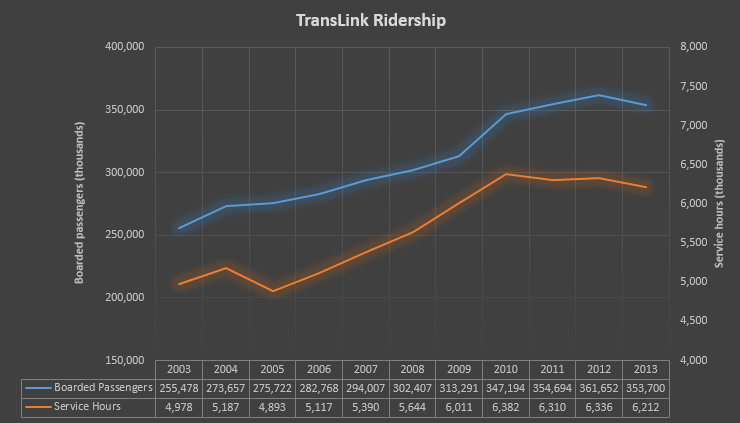
TransLink CEO Kevin Desmond said Wednesday that the cash-strapped transportation authority has witnessed record ridership in 2015 with 364 million boardings ai??i?? up 2.2 per cent since 2011 ai??i?? but has not been able to provide enough services to accommodate the regionai??i??s rapidly growing population. This has resulted in more bus pass-ups and increased waiting times for all transit users, including SkyTrain and West Coast Express. The additional volume is also being partly blamed for slower bus trips, as drivers are forced to stop more often to let people off.
ai???Weai??i??re not keeping up with population growth,ai??? Desmond said. ai???Weai??i??re slowly but surely falling behind and the trick, what we need to do to keep mobility, is to reverse that.ai???
The hitch is that all costs money. The cost to provide one hour of service varies, but runs at about $100 for a conventional bus and $959 for SeaBus. On rail, it costs $111 for the Expo and Millennium lines, $563 for the Canada Line ai??i?? which includes payments to the operator of the system ai??i?? and $512 for West Coast Express.
The review, which is used to guide planners on managing and adding transit capacity, comes as TransLink is in discussions with regional mayors and the provincial government on a new funding source to financeAi??transportation expansion across the region. The federal and provincial governments have each committed one-third of the first phase of the mayorsai??i?? 10-year transportation plan, but Desmond notes TransLink still requires funding for the second phase of the plan as well as money to operate the plan, which is expected to add more buses, a SeaBus and rapid transit lines in Vancouver and Surrey over the next 10 years.
The last major investment in the transit system occurred in 2009, with the opening of the Canada Line. Since 2010, transit service has dropped from 2.71 service hours per capita to just over 2.4, the review noted, and TransLink has been managing growth in the system by shifting buses from low-performing routes to higher-performing ones, such as the No. 49 Vancouver/UBC and the No. 106 Metrotown to New Westminster stations, which last year saw increases of 1.3 million passengers and 530,000 passengers, respectively.
Route performance is based on the cost of operating the buses, rail, SeaBus or West Coast Express per passenger. A higher number of people getting on and off transit makes a route more productive. In Vancouver, for instance, the median cost per boarded passenger is $1.05, compared with $1.30 for Burnaby/New Westminster, $2.72 for South Delta and $2.48 for Maple Ridge/Pitt Meadows. In the Northeast sector, which includes Coquitlam, the cost is $1.98 per passenger.
However, Desmond noted passenger numbers have jumped up all across the region ai??i?? not just in Vancouver and Burnaby/New Westminster ai??i?? which has resulted in overcrowding spilling over from the rush hour commutes into mid-day during the week and weekends. Overcrowding now occurs on 34 per cent of all weekday off-peak traffic, compared with 55 per cent during peak hours, the review found.
And with increased ridership across the system ai??i?? a route along Surreyai??i??s Fraser Highway, for instance, is consistently overcrowded despite two buses arrivingAi??every six minutes ai??i?? Desmond said there are fewer options to take buses from one area and move them to another.
ai???Weai??i??reAi??looking at options,ai??? he said. ai???Weai??i??ve got to move away from cutting services to getting more capacity in the system.ai???
The situation has been exacerbated by higher density development around SkyTrain stations, with some stations such as Olympic Village, Marine Gateway and Templeton seeing increases of up to 28 per cent since 2011, as well as a rapid uptake in east-to-west bus trips as people travel to the SkyTrain for recreation or shopping trips within their own communities. The North Shore, for example, has seen a huge jump in trips heading east or west, when previously most travel was toward downtown Vancouver.
ai???Intensive land development around station areas certainly is driving a lot of that. With this growth in the system, itai??i??sAi??obviously putting pressure on our system across the board,ai??? Desmond said. ai???That development will not stop whether thereai??i??s transit service or not. And if thereai??i??s no transit, they are going to drive.ai???
Desmond said itai??i??s crucial to come up with a service and funding options to expand transit as soon as possible to relieve the overcrowding as well as provide more service to areas, particularly south of the Fraser.
TransLink is proposing to take some of its buses out of retirement, he said, which could help boost service by 10 per cent over two years, while it has the capacity to increase service on both the Canada Line during peak hours and the Expo and Millennium Line off-peak.
ai???The big if is what these funding sources will be and when they come on board,ai??? he said.
To the Leader of the Official Opposition, John Horgan, Dear Sir;
As the NDP have been extremely weak with urban and metro transportation policies in the past two elections, may I offer a suggestion that the NDP take another look at the Rail for the ValleyTramTrain plan, providing a TramTrain service from Vancouver to Chilliwack, using the study done by Leewood Projects of the UK as a basis for the construction and operation of such a service.
The Leewood Rail for the Valley study, was released in September 2010 and though was well received internationally, with articles in two international transportation periodicals, it was ignored locally.
Today, with gridlock and traffic chaos now common place on Highway 1, especially from Chilliwack West, the Leewood TramTrain makes more sense than ever at providing a cost effective transit and transportation alternative for those who wish to travel up the Fraser Valley to destinations in Langley, Abbotsford and the burgeoning Chilliwack and Sardis communities.
The proposed TramTrain service is not commuter rail, far from it as unlike the West Coast Express, it will provide a regularly scheduled service from early morning to late in the evening, thus offering a scheduled service that would provide a viable and affordable alternative to the car.
The genius of TramTrain is that it can both operate on mainline railway lines or as a tram (LRT) on street or on a dedicated rights of way in town centres and by doing so, provide affordable transportation alternatives to areas deemed unserviceable by transit.
Why operate as a tram? The answer is simple because a tram service, on the pavement has proven to be the best way to attract ridership. This simple diktat is well understood in Europe, but evidently not so in Metro Vancouver, where transit investment has been tied into massive densification and the construction of the hugely expensive, yet obsolete SkyTrain light-metro system, which paupers the taxpayer while it makes land speculators and developers wealthy.
The NDP must forget any thought of a $3 billion subway under Broadway because it is nothing more than boondoggle vanity project to suit the needs of Vision Vancouver and their financial backers. There’s just not the traffic flows along Broadway to justify such an investment and like the billion dollar over budget Canada Line (the only heavy rail metro in the world built as a light-metro and has less capacity than a simple streetcar costing a fraction to build), future generations will view it as a “white elephant“, which hamstrung transit planning in the region due to the horrendous costs involved.
The NDP must also question the idea of the Surrey LRT because it is so poorly planned it will be next to useless and in fact the Leewood TramTrain plan would get Langley residents to Vancouver faster than SkyTrain.
The NDP must do a mea culpa on SkyTrain and light-metro altogether as the proprietary light-metro system is obsolete, made obsolete by LRT in the 1980’s. Since SkyTrain was first developed in the 1970’s, only seven so far have been built and not one has ever been allowed to compete against light rail, while TramTrain, a variant of light rail which first saw operation in 1993, has now over 18 such systems in operation and over 25 more in various stages of planning around the world.
It is an international embarrassment that the Metro Vancouver region still builds with light-metro, even though the mode is obsolete. As one European transit specialist emailed me over a decade ago regarding the regions fascination with light-metro, instead of modern light-rail; “Understand the X-Files were filmed in your local, maybe that explains it?“Why light rail?LRT is much cheaper to build; cheaper to maintain; cheaper to operate;can obtain higher capacities; and it is extremely flexible in operation. Contrary to what politicians want us to believe, that Vancouver has a “world class transit system”, no city in the world has copied the TransLink model, nor has any city has copied the exclusive use of light metro! Hardly world class, that.
The funding for the Leewood/RftV TramTrain could come from the proposed $3.5 billion Massey Tunnel replacement bridge, which is the current Premier’s big vanity project, which, in the end, move gridlock about 3 km. North to Steveston Highway in Richmond.
What could $3.5 billion buy?
A deluxe electric TramTrain service from Chilliwack to Vancouver and Richmond ($1.5 billion updated cost)
A new combined road and multi track rail bridge replacing the decrepit Patullo and Fraser River rail bridges ($750 million)
TramTrain service from Vancouver to Whiterock ($250 million)
A Victoria to Naniamo TramTrain service using the E&N railway ($500 million)
With money left over to fund other TramTrain initiatives!
It is time that the provincial NDP rise from their myopic and dated transit promises and instead support better and cheaper transit policies for Metro Vancouver and the province. The NDP must eradicate that aura of a betrayal of the public trust, which still lingers with Glen Clark and Joy McPhail dishonest flip flop from well planned LRT from Vancouver to the Tri-Cities to the hodge-podge of poor planning with SkyTrain resulting with the Millennium and yet unfinished Evergreen Lines. Let me remind you, that flip-flop, in part, cost the NDP dearly winning a two seat rump in that disastrous election after the betrayal. Today, a sound transportation policy just may win you seats in the Fraser Valley and Metro Vancouver, as well secure seats on Vancouver Island.
Almost every major transportation project in the past 40 years in Metro Vancouver, from the Expo Line to the Port Mann Bridge replacement, has been a political vanity project which has not reduced congestion, nor has it given the region good transit, as mode share by auto has remained at 57% for over two decades. Our endemic transit issues and traffic gridlock are a direct result of politicians spending billions of dollars on vanity projects to cut ribbons in front of at election time, instead of implementing sound regional transit polices and it is time that the NDP act to change this.
More wise words from Mr. ‘Haveacow’ who is an extremely experienced transit planner working on Ottawa’s new regional light rail line.
This was originally a post from the recent Calgary blog and contains a wealth of information that the powers that be don’t really want in the public realm.
What this boils down to is that the Expo and millennium Lines need a lot of investment for modernization, investment that will come from the expense of the Metro and Fraser Valley region.
As one transit expert told Zwei decades ago,”you can get any transit system to do anything you want , if you throw enough money at it.” The problem is, of course, the money thrown at the transit system generally comes from other transit projects.
This begs the question; “How much money is the taxpayer willing throw at SkyTrain”?
An Historical note: The initial ALRT line from Vancouver to New Westminster was originally designed to have a third “express line” through less well used stations, such as Royal Oak or 22nd Ave., to decrease travel time. Zwei was told by a retired GVRD planner some years ago that there were supposed to be five such stations along the route and the plan was to cut almost 10 minutes off the travel time in the peak hour, end to end. Cost constraints and signalling issues sidelined any thought of this type of operation.
Over to you, Mr. Cow!
Technically Skytrain can be expanded to do 28,000+ p/h/d. Actually any existing rapid transit system can be expanded to handle much greater passenger capacities. The real issue is how much you want to spend to do that.
Skytrain could with existing technology upgrade its signaling systems to a state of the art, high capacity multiple independent moving blocks signaling system with the newest version of Bombardierai??i??s City Flo 650 Automation System operating as the system governor. But thatai??i??s expensive and Translink is only and very begrudgingly doing some of this, mostly because of cost issues and the time required.
Problem/Issue#1:
The electrical handling capacity of the system needs to be upgraded. Meaning, the existing electrical transformers (hidden behind the doors at nearly every station and what is mostly responsible for the mysterious size of most stations on the ground floor) needs to be upgraded in capacity or new ones have to be built and the corresponding cabling replaced, as well as the replacement of many of the systemai??i??s third rails and third rail connecting joints with each other and the cabling (canai??i??t remember the technical name right now). Translink is trying to do this but its expensive and very time consuming however, it can easily be done at night when the system is closed and doesnai??i??t necessarily. This is the first step in signal upgrades.
Problem/issue #2:
Next spending at a minimum of $500-700 Million and about 2-5 years with multiple daytime shutdowns to completely replace all the existing signaling software and hardware as well as the signals themselves. Toronto is replacing its 60 year old signaling system on line#1 (Yonge-University Spadina-York Subway Line). Its taken 4 years so far with major portions of the line getting shutdown on the weekends. This weekend its Lawrence Station to Yonge and Bloor, (the busiest stretch of rapid transit line in Canada and 2nd busiest in North America during peak hours). But it must be done to improve the lines top capacity limit and to keep the overall network in good repair. The traditional time the TTC does maintenance projects, the 6.5-7 hours a week from closing time Saturday night/Sunday morning to the traditional late start Sunday morning at 9am is just not enough time. So every weekend or at least every second weekend a section of the line is taken out of service to replace the thousands of kmai??i??s of cables and signaling infrastructure. Fall 2017 is the expected completion date.
Next, add new centre platforms to existing stations and or adding centre tracks with new passenger platforms either side and move the existing tracks to the outside wall limit which is also expanded. Except for the highest use stations, this eliminates the need to lengthen platforms and is cheaper optioin when dealing with an above grade rapid transit system.
Problem/Issue #3:
Man this time consuming and expensive and you really have to do step 1 and 2 first but it can work. Translink is doing a station by station approach which means it may have most of the original stations on the Expo line upgraded by 2041. Time to do all the stations depends on budgets and assuming we survive the asteroid impact we will be subject to in 2048 (Iai??i??m a back yard astronomer each time a particular well know asteroid passes by us it keeps getting closer and closer, Iai??i??m not kidding). However, after several expected close fly bys in 2020ai???s and 2030ai???s due to gravitational sheer, may change the final date or it may cause it to miss us altogether, we will see. Anyway back to point.
There are other issues such as, as your above grade Skytrain lines age, the structure between the stations will need significant structural upgrade. The longer you wait the bigger the bill. Translink has no budget or plan to deal with this issue. As we (me and employees of the company I was consulting with at the time) asked during our visit to there control centre a few years ago while we presented to the staff pieces of concrete right of way we found around Metrotown Station. What is your long term plan to deal with Expo lineai??i??s above grade structural renewal proposals we asked? Their answers were polite and diplomatic but you could tell we caught them off guard. It all depends on budgets and the availability time capital was the answer, so no plan until they have enough cash I guess.
Lastly, as any rapid transit system gets bigger and bigger, the cheap and easy to build lines will generally get built first. Each extension or new line becomes relatively speaking more and more expensive (regardless of inflation). Its not Translinkai??i??s fault this generally happens on any system, you pick the low hanging fruit first! Many of the new lines like the Millennium Lineai??i??s Broadway extension to Arbutus and eventually UBC, are very expensive (because of the tunnel) and will only produce for now and even into the future, meager passenger numbers. In my humble professional opinion, the overly optimistic predictions of Translink will never produce the numbers really needed to justify a below grade Skytrain line that costs only 20% less per km than a late, over budget, subway line in Toronto that will daily handle twice the capacity of the planned Skytrain line, using the present 60 year old signaling system not the new one which is being installed on the rest of the line and that will be ready to go when this extension is complete. All these cost predictions for the Broadway Extension are based on 6 year old planning data which needs to be seriously upgraded and will most likely go up in cost per km as well.
There are very few other justifiable new line opportunities for the Skytrain System given current ridership and corridor passenger levels. There are some extensions planned or being discussed. One is the killing of the very poorly thought out LRT line in Surrey and replacing it Skytrain extension but it brings about another issue that is not thought about in Vancouver yet but Toronto and Montreal have been facing for a while, that is the geographic scale of the service area. You can extend the Skytrain in Surrey but even Skytrainai??i??s for Surrey, ai???Darylai???, missed this little issue. If you build the extension of the Skytrain as designed by Translink and Daryl you will have to sit for an hour just to get to the other side of the line, which is downtown. This still seems to be the largest passenger destination for the system. It will take an hour because of all the other existing stops you already have in between Surrey Skytrain extension and downtown Vancouver. You could have a local/ express train system operation but unless track infrastructure is severely upgraded, it just canai??i??t happen. So a change in operational technology is needed, more commuter rail/regional rail or Zweiai??i??s Tram Trains operation. Both Toronto and Montreal learned a long time ago you canai??i??t extend subway/metro lines outward until they are 30-40 miles long its just too expensive to build and operate. Not to mention there would be just too many stations stops between where people want to go and where they will be getting on. Adding express services is expensive and difficult and ultimately lowers capacity. Even heavier capacity LRT lines have a distance/travel time limit. So soon a new form of longer distance rapid transit will be needed for Vancouverai??i??s outer areas you canai??i??t keep building Skytrain further and further out its also way too expensive to build and you still suffer the distance/time penalty for potential passenger numbers. So yes a change in rapid transit operating technology, due to the geographic operating scale, for the outer portions of your region is most likely imminent.
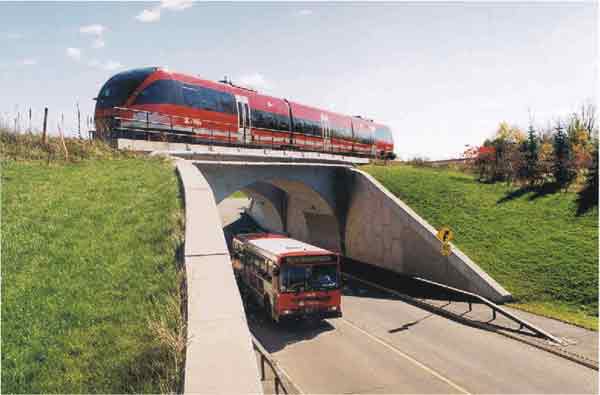
New Jersey’s River Line, using diesel light rail TramTrains, enables to provide a quality transit service on a predominantly single track rail line.
The River Line could be a template for several rail services, both in metro Vancouver and Vancouver Island, track-sharing with lightly used freight lines.




 Kelly Sinoski






Recent Comments