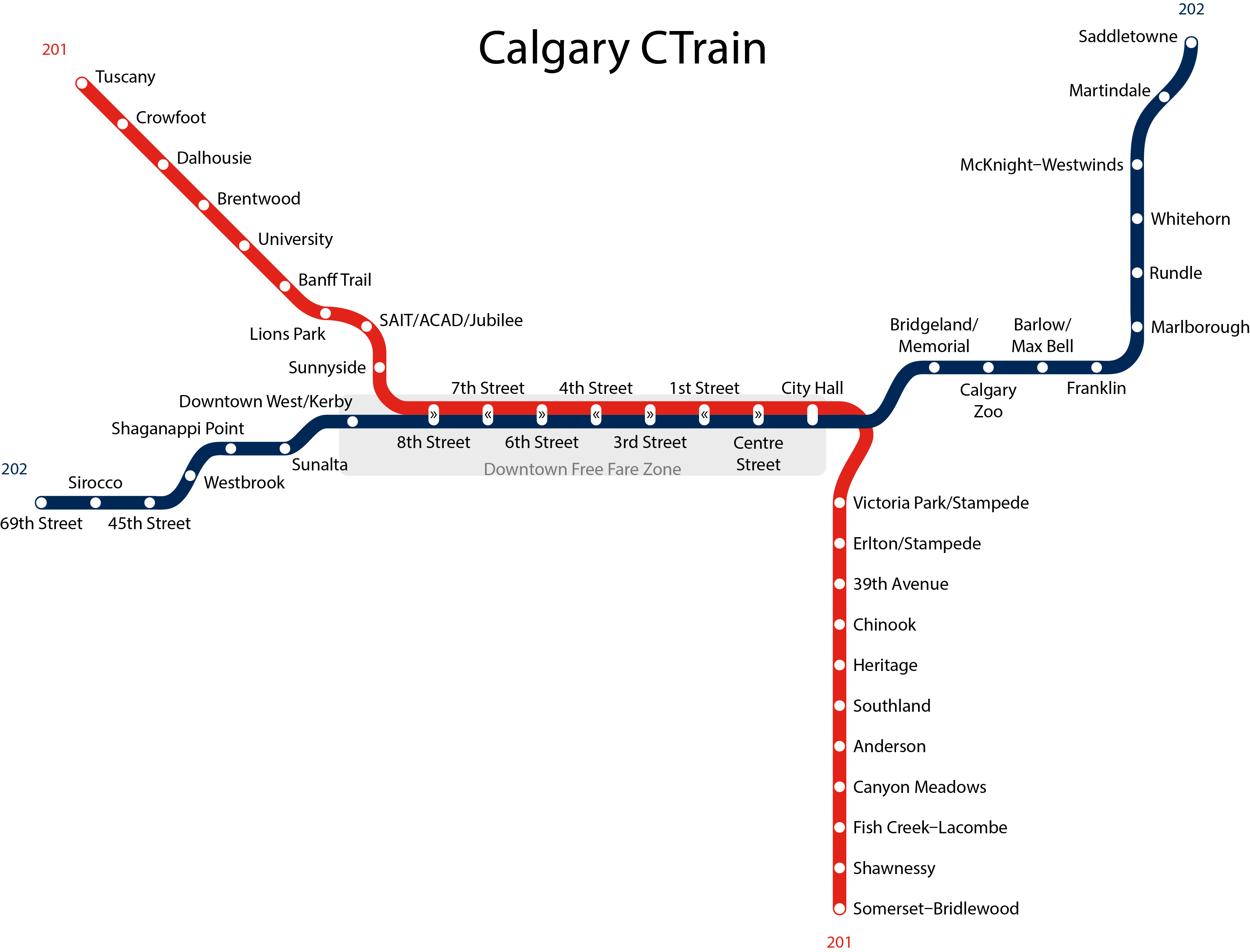
A note from Zwei: These costs were taken directly from Calgary Transit, which once had a fine web page giving accurate statistics about the C-Train, unlike TransLink and BC Transit, which hid the real costs in a baffle-gab of nonsense and phony news releases. One did not need a F.O.I. to get actual operating costs!
At the time the Calgary C-Train carried more customers daily than SkyTrain and that an “apples to apples” comparison showed that LRT was indeed much cheaper to operate than SkyTrain. It also goes a long way explaining why Bombardier Inc. refused to let SkyTrain compete directly against light rail and why no one builds with SkyTrain today!
C-Trainai??i??s Development and Operating Costs
Total system development costs to date: $548 M
Original cost of vehicle acquisition/unit: $1.2 M
Current vehicle replacement cost: $3.9 M
Total costs of track construction per meter:
above ground $30,000
below ground $35,000
at grade $15,000
What is interesting is that Calgaryai??i??s C-Train operating costs in, 2006, was nearly $33 million, while SkyTrainai??i??s annual operating costs during the same period was nearly $80 million (not including the $157 million provincial subsidy) and Calgaryai??i??s light rail system carried more passengers! The Interurban, by comparison would be far cheaper to operate on an annual basis.
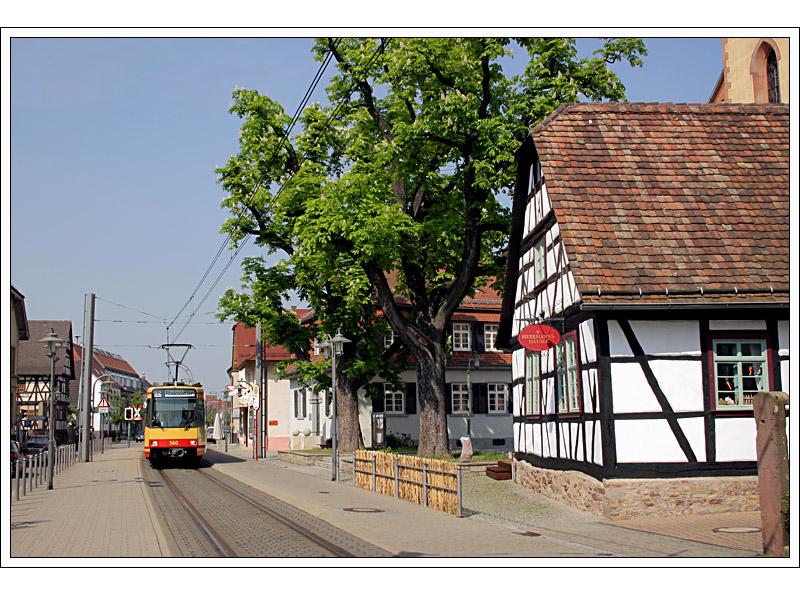
Classic single track TramTrain operation through a rural village.
I am updating this post due to a series of recent posts on Facebook and other transit oriented blogs.
Karlsruhe’s TramTrain 210 km route S-4 travels through the sparely populated Schwarzwald or Black forest region of Southern Germany. There are no musings about “not enough density” for the Karlsruhe TramTrain there! The (AVG) Albtal-Verkehrs-Gesellschaft GmbH- Karlsruhe’s longest tramtrain route – S4
The AVG’s longest run is now a 210km (130 mile) S4 service from Ohringen through central Karlsruhe to Achern, south-west of Baden-Baden. The TramTrain route uses DB mainlines, regional railway lines and on-street running in various cities.
The above map gives the various routes of Karlsruhe’s famous TramTrain network;Ai??largely in an area of comparable density and population of Vancouver and the Fraser Valley. This something to think about when planners and politicians claim: “There isn’t the density in the Fraser Valley to support ‘rail’ transit.”
This comment from Mr. Cow deserves a post of its own as there is so much information here, it deserves a wider audience.
As Mr. Cow is a Canadian Transit Engineer, his comments are well worth reading.
When SkyTrain ‘crapped-out’ in the Summer of 2014
there were no drivers or attendants to oversee the evacuation
Ai??of stalled trains, leaving it a free for all for transit customers.
This would not happen with an at-grade LRT with drivers.
********************************************
The point of whether what is more efficient in a study of metros vs light metros is really irrelevant when you are comparing LRT to Light metros. The real problem here is that regardless of how efficient the system is theory or another country with an entirely different operating regime, in Canada there are some realities that canai??i??t be ignored. The people who run Skytrain at Translink and the BC rapid Transit Co. canai??i??t just unilaterally decide to run trains at a greater frequency. They already run at the limit their Safety and Operations Certificate allows them. They have to apply to Transport Canada if they want to change the conditions on that Certificate. Its not just a certificate although there is one issued, its really a whole series of reports and safety test that they actually get tested on.
The last one and I know because my ex neighbor (advantages of living in Ottawa) was one of the people who put your transit people through their paces to allow their current limit of 109 seconds, said that to increase frequency or reduce your headway further Translink would have to correct the safety faults and concerns they found in their last report. There were many small ones, there usually is however, a few main ones were as follows. The lack of electrical current capacity on all lines to run more trains. This requires significant electrical upgrades, which were planned but there is currently no money for to implement, especially on the Expo Line. All the signaling software and hardware is in need of attention and upgrade, the last major one was in the 1990ai???s. That program was temporarily sidelined to provide capital funding for Translinkai??i??s Evergreen Line. The system that monitors track intrusions and restarts the basic computer operating systems after shutdowns, needs urgent upgrade. This was not only identified by Transport Canada but by the report investigating the shutdown and stopages on the system in 2015. That work is only beginning now because only a portion of the $10+ Million for electrical panel upgrades, track/diode hardware replacement and connectors, as well as a whole whack of new computer software and hardware plus other minor administrative improvements have been provided. Again budget issues and a backlog of other deferred maintenance and upgrades partly due again, to needing money for the Evergreen Line project. The report also identified several upgrades/replacement for 3 double track crossovers and a multitude of conversions of slow speed turnouts into higher speed turnouts. That will require more capital funding but also a great deal of extra maintenance time (as in extended shutdowns of certain track sections during normal operating hours).
The biggest part of Transport Canadaai??i??s long term concerns was the insufficient resources being spent on operational costs. Remember to get enough money in the budget to run trains during peak period at frequencies of up to 109 seconds, Translink had to cut back evening and late night service on those same lines. The reports from Transport Canada will a require a Freedom of Information Request to Translink. that is one for each report to access them. The report used to be available here in Ottawa but cuts made by the Harper government to stored information at Transport Canadaai??i??s Library and Report Storage System was cut to the bone and may or may not exist anymore. The operational reality is really quite different from reports and studies.
Actually, here is Ottawaai??i??s main reason for not adopting the Skytrain technology and choosing LRT which is from the 2009 Rail System Selection Report Executive Summary. It is very similar to what zwei said:
ai???The choice of technology determines the future flexibility of a transportation network within Ottawa. By developing a Light Metro style system, the core will meet its capacity prediction targets and have sufficient margin for growth beyond the prediction; but the report finds that the potential although very high, ultimately however, capacity within the core may not warrant such a systemai???.
Also:
ai???The implementation of a high capacity light metro style system may divide Ottawaai??i??s transportation network into a set of fragmented, unconnected and disparate transportation modes, which will multiply staff costs, overheads, maintenance and spares and maintenance facilities. This fragmentation will also cause numerous onward transfers between transport modes for daily passengers moving into the core from the suburbs. The choice of a Light Metro system will effectively increase transportation costs due to the much higher costs of segregation for the outlying suburbs, which will result in lower efficiencies of running and potentially higher ticket costsai???.
Finally:
Light Rail is recommended as the technology choice for deployment in Ottawa as it: ai??? Provides the necessary capacity for the ridership predictions in the main core, ai??? Can accommodate low passenger capacity in the extensions outside of the main core, ai??? Results in less fragmentation of the network, reducing the need for onward transfers, ai??? Has less impact on the urban fabric and allows the ability to build a non-segregated system in the Greenbelt, ai??? Has lower system capital costs with Light Metro, ai??? Has comparatively lower life time operating and maintenance costs with Light Metro, ai??? Allows better integration of technology for the Carling-Lincoln Fieldai??i??s corridor. ai??? Provides greater network flexibility and promotes development of the transportation network in the core, ai??? Is a proven design, and ai??? Is more suited for the climate in Ottawa.ai???
A final note from Zwei. There has never been a credible system analysis of light-metro (SkyTrain) and light rail in the region. All four light-metro lines were built by provincial diktat, by the then sitting premier.
Expo Line – Premier Bennett (Social Credit)
Millennium Line – Premier Clark (NDP)
The Canada Line – Premier Campbell (BC Liberal Party)
The unfinished portion of the Millennium Line, the Evergreen line – Premier Campbell/Premier ClarkAi?? (BC Liberal Party)
The often used quote; “You are going to get SkyTrain whether you like it or not.”
The Vancouver Sun is famous for its ‘puff'” stories about SkyTrain but with each “puff” story comes little slips and new information.
870 employees seems a lot for a “driverless” system, which was sold to the public that it had fewer employees, thus cheaper to operate than light rail. Somewhat inconveniently, SkyTrain costs about 40% more to operate than comparable light rail systems and is one of the main reasons no one buys it.
Loving the idea of driverless trains means higher subsidies must be paid to keep the driverless train in operation.
It seems Ms. King, a career bureaucrat and not a transit specialist, by loving driverless trains, also loves the idea of higher taxes to build and operate them!
The whole idea of the story is to lull the public to really like SkyTrain, as the Vancouver Sun has done for the past 35 years.
Funny that a far more useful story would be to find out why only seven of these proprietary railways have been built in almost 40 years? But then, that would mean investigative reporting and that Ms. Sinoski would actually have to some research into the subject. Not so with “puff” stories; easy to write and it pleases editors and advisors.
Somehow, I do not think that the public will be that easily fooled.
SkyTrain boss attempts to put human face on Metro Vancouver transit
She loves the idea of driverless trains, but new SkyTrainAi??boss Vivienne KingAi??is on a mission toAi??give transit a more human face.
She has already startedAi??by asking her 870 staff members ai??i??Ai??engineers, maintenance workers and SkyTrain attendants ai??i??Ai??to wear name badges as they go about their work. AndAi??next month, on Sept. 8, King, whoAi??also wears a badge, willAi??join SkyTrain attendants and her vice-president of engineering at Waterfront to greetAi??the travelling public before visiting other stations.
ai???They can come and say hello and tell me their worries if they want,ai??? sheAi??said.Ai??ai???Itai??i??s all about putting a face to this business. I want customers to know there are people running their railway. The first thing is that our staff is actually going to get out of the office and meet the people.ai???
She acknowledges it wonai??i??t be easy changing the perception. As the new president of TransLink subsidiary B.C. Rapid Transit Co. ai??i??Ai??the entity responsible for the SkyTrain, Canada Line and the new Evergreen Line ai??i??Ai??King will have to weather the persistent negativity surrounding the beleaguered transportation system.
Indeed, before she took the job, there were a series of shutdowns on the SkyTrain, and a failed transportation plebiscite, in which the public rejected a proposed 0.5 per cent sales tax that would have generated more funding for transit expansion. Most recently, King faced flak over an in-house commissioned analysis that flagged increasing risks on the SkyTrain system,Ai??mostly the 30-year-old Expo Line.
New SkyTrain boss Vivienne King is on a mission to give transit a more human face. Gerry Kahrmann / PNG
ai???I was very disappointed. That was a good report because it highlighted some things for us and they have all been modified,ai??? she said. ai???Itai??i??s aging but itai??i??s not unsafe.Ai??I remember when I first started, people would go on ai???Oh SkyTrain, it breaks down all the time.Ai??That comes from bad publicity, everything like that resonates with people.ai???
Much of itAi??comes down to improving customer service, which ultimately falls on the fleetai??i??sAi??262 full- and part-time SkyTrain attendants, she said. But thatAi??in itself is a challenge because most of the publicAi??donai??i??t know exactly what theAi??attendantsAi??do.
When KingAi??first arrived, for instance, she thought the attendants ai??i??Ai??wearingAi??black shirts ai??i??Ai??were security guards, and, more than once, has had to question workersAi??on their behaviour. In one case, she was curious why an attendant was standing at the end of a platform looking disinterested, only to learn he was ensuring the track was safe after an intrusion alarm. In another, she confronted a worker whoAi??was standing with his back to the transit passengers and staring out the glass of the station. He told her he was waiting for a visually impaired passenger.
She has since suggestedAi??the uniformsAi??be changed toAi??blue, andAi??thatAi??orangeAi??safety vests be wornAi??byAi??workers who are dealing with issues other than customer service. ai???I tell them ai???youai??i??re the front face of our organization so what you do is what the customers think of all of us,’ai??? King said.
King maintains theAi??attendantsAi??are the ai???eyes and earsai??? of the system,Ai??trainedAi??to do everything from helping passengers to resolving conflicts and manually resetting and driving stalled trains. King once pressed theAi??yellowAi??emergency strip in a train car when a manAi??was shouting, swearing and had wet himself, and then started harassing passengers. An attendant came on at the next stop and helped to remove the passenger.
ai???I was uncomfortable so I can imagine how my customers felt. It was a test for meAi??because I wantedAi??to see what would happen,ai??? sheAi??said. ai???If anyone says we should get rid of the SkyTrain attendants, the public should say no.Ai??They are our backup security system.ai???
King, who regularly travels the transit system, said itai??i??s important to let the public know whoai??i??sAi??behind the transit system, so they understand when stations have to be closed or bus bridges set up while work is being done to upgrade the rails. As one of her first measures, King has ordered a new inspection regime of the SkyTrain system that will see the entire line ai??i??Ai??rather than one-third at a time ai??i??Ai??inspected every year,Ai??while also seeking regular upgrades for the inner workings of the track, including the wires, electrical connectionsAi??andAi??switches.
ai???Iai??i??d been through the experience where trains were failing because they werenai??i??t maintained on time,ai??? she said. ai???This is the backbone of Vancouver, we mobilize this whole city.Ai??We have to be able to maintain it at a level thatai??i??s going to keep it running for the next 30 years. Keeping it in a state of good repair is critical to any good rail.ai???
It has been six years since the release of the Leewood Study,Ai?? yet to date most regional politicians do not even realize that it exists.
Internationally, the Leewood Study is a winner, featured in two international transportation magazines, locally though the Leewood Study has been ignored or discredited by neanderthal thinking municipal politicians.
There are various reason for this, but to sum up why, one word comes to mind; “inconvenient“.
The Leewood Study was inconvenient because it contradicted current transit planning dogma and the love affair with expensive light-metro vanity projects and its bastard child, densification.
The Leewood Study provided a term of reference for a 130 km Vancouver to Chilliwack rail service using with light diesel multiple units or TramTrain. The cost for such a service ranged from $750 million to $1 billion, which compares very badly with the cost of theAi?? $2.4 billion Canada line of a $1.4 billion and counting Evergreen Line.
Thus the Leewood Study was inconvenient for:
1) Transit Planning
The Leewood study contradicted current gold-plated transit planning for politically inspired ‘vanity’ projects.
Unfortunately too many engineers working on light rail projects (as distinct from light rail engineers) appear to be in total ignorance of the following:
“This ai???lightnessai??? of light rail ai??i?? a combination of flexibility, low impact, modest cost, and environmental softness ai??i?? is ephemeral. It must be carefully guarded. Ignorance or ineptitude during the planning, design, specification writing, engineering, or construction phrases of a project can lose the ai???lightnessai???. Light railai??i??s advantages can be diminished or even destroyed with overdesigned overhead; ugly, noisy, or difficult-to-maintain cars; poorly conceived alignments; or simply uneconomic applications.”
Light Rail Transit Special Report 221 United States Transportation Research Board National Research Council p 92Ai?? (1988)
2) The Broadway Subway
ai???Naysayers and nitpickers, get out of the way, because weai??i??re building a subway.ai???
The now $3 billion Broadway subway is being built strictly for political prestige and any thus proof against any sound tram argument.
3) Bus Rapid Transit
A critique of the Wellington (New Zealand) Public Transport Spine BRT Study came to the conclusion that:
The LRT option is very crudely dismissed through excessive costs and few benefits and the BRT option is highly inflated with benefits that cannot be justified from the literature. There is little science behind this study and a lot of politics as it appears to clear the way for motorway spending. I don’t think I have seen a study quite so crudely apparent in its anti-rail politics.
Sound familiar?
*
The same is true for Rapid Bus and anti-LRT planning on this side of the Pacific.
*
4) ALRT/ART & Light Metro
Even though our proprietary light metro carries a large ridership each day, over 80% are recycled bus customers forcibly made to transfer onto the mini-metro. Forced transfers are never good in attracting ridership and in fact may deter ridership. The collapse of South Delta bus ridership after the Canada line opened, where bus customers lost direct service to Vancouver and were forciblly made to transfer to the Canada Line,Ai?? is a dark dirty little secret that TransLink does not want to deal with.
*
Mode share by auto in the metro Vancouver Region has stagnated at 57% for almost twenty five years, another embarrassing secret of the failure of light metro to attract the motorist from the car!
*******
The Leewood/RftV Study is sound and after six years still holds up to real scrutiny as being a very cost effective transportation alternative to cars and highways. In 2016, an hourly version of the Leewood Study, using light diesel multiple unit trains, operating at hourly intervals from Chilliwack to Vancouver and visa versa, could be built for $750 million or slightly more than the retractable roof on BC Place!
*
Today, the region needs affordable ‘rail’ transit alternatives to the car, yet nothing is being planned for as TransLink, at over $80 million/km,Ai?? can’t even design an affordable streetcar for Surrey.
*
The question I pose for the Rail for the Valley group is, especially with a provincial election next year is: “Where do we go from here?”
Why would Quebec’s Caisse de dAi??pA?t et placement du QuAi??bec, invest in the obsolete SkyTrain?
Could the real reason be to help Bombardier out of its aerospace financial embarrassment, by buying ART?
At the current rate, the proposed 67 km Montreal ART light-metro system will cost well over $8 billion or more than $2.75 billion , more than the $5.25 claimed to be budgeted. Then there is the operating subsidy, probably in excess of $200 million annually.
Finally; has anyone told the Caisse, that ART does not operate in the snow very well, if at all?
No? Let caveat emptor rule!
The proposal at MONTREAL, Quebec’s largest city, for a new light metro system is drawing sharp criticism from a university professor and an urban consultant. They say the plan is hastily constructed and based on optimistic assumptions, according to an op-ed commentary posted by The Montreal Gazette. If it fails to materialize, it may be the last gasp for Canadian light metro. Any agency worldwide who wants it can buy it from Japan-based HItachi’s new subsidiaries AnsaldoBreda and Ansaldo STS. Honolulu is buying from them and the elevated light metro project now has escalated in cost to more than $8 billion, more than is available from city, state and federal funds. Honolulu may have to scale it back in some fashion.Vancouver Skytrain light metro requires a substantial subsidy, the op-ed authors say:
Opinion: Is the Caisse REM Montreal light-rail proposal really such a good idea?
Published on: July 26, 2016
Earlier this year, the Caisse de dAi??pA?t et placement du QuAi??bec proposed a 67 km system of light-rail transit (LRT) for Greater Montreal. However there are several potential problems associated with the RAi??seau Ai??lectrique mAi??tropolitain (REM) proposal that have not received sufficient attention. They include:
A note from Zwei -based on the current cost projection from TransLink, the cost to build ART SkyTrain is now $13o million/km which means a 67 km SkyTrain light metro would cost a minimum of $8.7 billion!
Accountability:Ai??The Caisse is a semi-private pension fund that answers to a board of directors and depositors, not the MontrealAi??electorate. Assigning responsibility for planning a new transit system to a financial institution rather than a transportation planning agency accountable to elected officials could lead to a system designed to meet the financial needs of the Caisse rather than strengthening the performance of transport in the Montreal region.
Subsidies: The Caisse would invest $3 billion USD $2.27 billion)in the project if the federal and provincial governments provide up to $2.5 billion (USD $1.89 billion) between them. Beyond this, the Caisse says it would not require any further public subsidies; it expects to recover its capital investment, pay for operating costs, and make a profit, mostly from the fare-box revenue. The Canadian average for the recovery of transit operating costs from fares is only 60Ai??per cent. And that doesnai??i??t take into account recovering capital costs. The Caisse says the systemai??i??s driverless technology would keep operating costs low. But the Vancouver LRT system ai??i??Ai??also driverless ai??i??Ai??requires a substantial subsidy even though it has 328,000 boardings per weekday, compared to the 150,000 per weekday projected for the REM.
A note from Zwei –
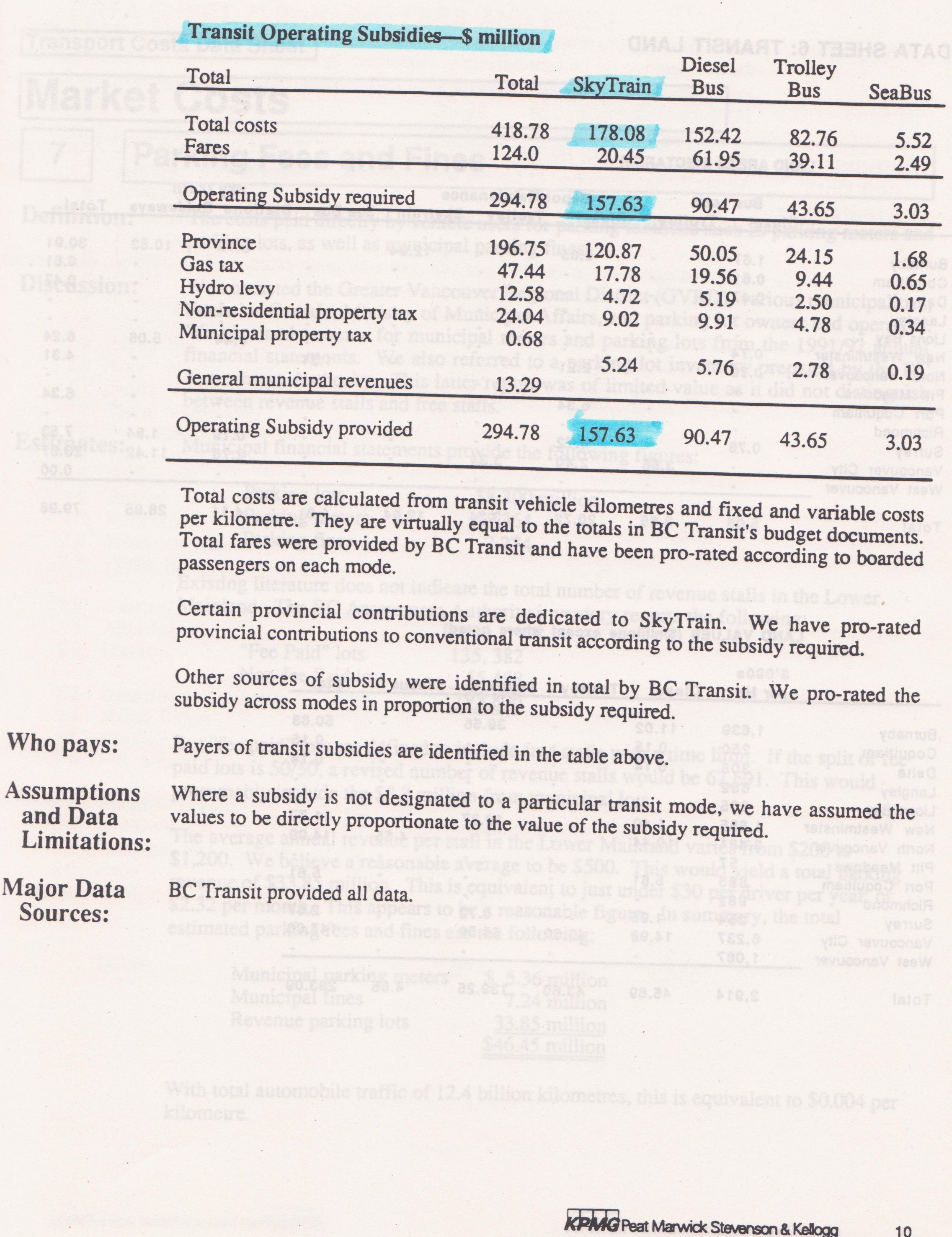
In 1993, the annual subsidy for just the Expo Line was $157.3 million annually!
Ridership: To achieve the Caisseai??i??s projections, stations on the REM network would have to attract on average twice the number of riders as the busiest station (other than Central Station) on the current AMT network. The REMai??i??s more frequent serviceAi??might convince some drivers to leave their cars at home, but residents have already invested in cars and single family homes in low density settings,Ai??and suburban bus may notAi??conveniently connect to the new system.
A note from Zwei – Over 80% of SkyTrain’s ridership first take a bus, then are forcibly transferred to SkyTrain. There has been no modal shift from car to SkyTrain in the past 25 years as mode share by car has remained at 57%.
Parking: The Caisse expects to profit from development of lands near the stations. However, West Island mayors have demanded copious amounts of subsidized parking, and the Caisse appears ready to oblige them. Expansive park-and-ride lots would be at odds with the vision of a tightly woven urban fabric around stations.
Impact on other transit systems: The proposed REM wouldAi??not integrate well with the mAi??tro; the two systems would overlap only at Central Station, a 10-minute walk to the Bonaventure mAi??tro station. The impact of the REM on the existing AMT system does not appear to have been thoroughly assessed. The REMAi??would swallow the Deux-Montagnes line, the backbone of the current AMT system, leaving less viable routes with the public operator. Riders on the recently completed Train de lai??i??Est linking downtown to Mascouche would have to transfer from an AMT train to an REM train at a new station near Highway 40, driving down ridership. The AMT lines to Candiac and Vaudreuil-Hudson would also take serious ridership hits. All told, it seems the impact of the new network on the AMTai??i??s existing operations could be highly detrimental, reducing use of infrastructure built with billions of public dollars.
The Caisse says it accepts the financial risk if the projected ridership doesnai??i??t materialize. But once in place, the province may well feel pressured to subsidize the REM, both to maintain the Caisseai??i??s financial return and the functioning of the regional transit system. Meanwhile, by using a finite sum of provincial and federal infrastructure dollars, the REM could set back other projects, such as the mAi??tro Blue Line extension to Anjou, that more logically build on existing transit facilities.
The Caisse proposal bears the hallmarks of a hastily put together plan based on many optimistic assumptions and projections. We encourage more critical scrutiny of this highly unusual proposal prior to handing over $2.5 billion of public funds to a semi-private pension fund that has acted as an armai??i??s length investor in infrastructure projects, but has no experience in the planning, building, operation, or ownership of transit systems.
Craig Townsend is an associate professor in theAi??Department of Geography, Planning and Environment atAi??Concordia University.Ai??Ray Tomalty is the principal ofAi??Smart Cities Research.
TransLink has become the “clown of transit planning” and now with with two very expensive vanity projects, the truncated Broadway SkyTrain subway and the Surrey LRT, which is being planned as a “poor man’s” SkyTrain, the clown is turning into a nightmare.
TransLink has had good teachers.
Now, all has become clear. The BC Liberal/ Gordon Campbell masterpiece, the Port Mann Bridge has become a massive financial black hole, sucking in millions of dollars so the BC Liberals could have a vanity project to cut ribbons in front of at the last election.
Cue to the Canada line, another Liberal boondoggle where after $2.5 billion spent, all we have to show for it is the worlds only heavy rail metro, built as a light metro and has less capacity than a simple tram costing a tenth to build! Oh yes, the Canada line is costing TransLink about $110 million per year to operate, three times that of a light rail line of comparable size!
Since toll revenue at Port Mann has covered only 39% of operating costs, means massive subsidies must be paid; subsidies which monies come from other much needed transit projects in Metro Vancouver, The Fraser Valley and BC!
Political vanity projects are driving the mad dash past the point of no return with congestion in the region and the Massey Tunnel Bridge will be the coup de gras to the regional transportation plan, as inept as it is.
Gridlock in Metro Vancouver will be endemic and the flight of families to more affordable realms are now making current transportation models obsolete.
Within a decade, Metro Vancouver will be almost unlivable due to huge tax increases on inflated property values; extremely expensive transit projects that do nothing in improving congestion; and incompetent municipal governments who kow-tow the BC Liberal’s harebrained vanity project schemes. Metro Vancouver will become the home of the very rich, fat cat bureaucrats, political elites and the very poor, who will live in subsidized housing.
Someone, please tell Delta Mayor Lois Jackson to change her stand supporting the bridge, to demand it not to be built (a complete game changer if she did), but I’m afraid in her declining years she only listens to Victoria now and not common sense.
It is sad to see that the key to metro Vancouver’s livability is held by one who is now past making rational decisions.
The only agency that can come close is assessing public transit systems in Canada is the Canadian urban Transit Association and they do a reasonable job at it.
The preceding graph is from C.U.T.A. and shows that the cost per revenue passenger in Metro Vancouver is about one third higher than Calgary, Edmonton and Toronto.
This makes a lot of people unhappy, especially folks who like the status quo.
The author of the study is a younger Langley civic politician, not a transit expert, unlike the Rail for the Valley group, who engage real transit experts to advise on policy.
A self promotingAi?? transit study to further ones political career should be taken with a grain of salt.
One tires of snap shot, headline grabbing transit report cards, which are meaningless, as we have serious transit issues to resolve. TransLink and regional transit planning is in trouble; the public have lost faith in TransLink and ridership is slowly eroding. Big problems indeed!
TransLink has continually hid costs, (it should not take a F.O.I to get the real cost TransLink pays to the SNC Lavalin lead consortium operating the Canada Line)Ai?? from the public and a thirty year hiatus from scrutiny by the mainstream media has exacerbated the situation tremendously.
This report card on transit is like getting an “A” in basket weaving and no more and will only hinder transit development in the region in the future.
An interesting note: With the Compass Card, TransLink should know almost immediately the daily ridership on the SkyTrain and bus system, yet they have been very quiet about it indeed. I wonder why?
Could it be that they greatly overstated ridership in the past?
TransLink ranks second in national report card of Canadian transit system
TransLink receives “A” rating, second only to Greater Montreal’s “A+++”
METRO VANCOUVER (NEWS 1130) ai??i?? TransLink is getting high marks in a national report card of Canadian regional transit systems.
Metro Vancouver received an ai???Aai??? rating, second only to Greater Montrealai??i??s ai???A+++ai??? while Calgary, Edmonton, Toronto, Hamilton and Ottawa trailed with ai???Bai??? grades.
Study author and Langley City Councillor Nathan Pachal says there are areas where TransLink comes out on top.
ai???It actually out-performs the Greater Montreal region when it comes to revenue kilometres per service hour. Thatai??i??s how far and how fast transit service travels. In other areas that it out-performs other agenciesai??i?? was the passenger trips per service hour [and] passenger trips per capita.ai???
Pachal says more investment may help Metro Vancouver take the top spot next year.
ai???We saw a huge increase in the beginning part of this century, when there was that massive investment, as we kind of reached up to the Olympics. That saw the huge increase in these performance metrics. Itai??i??s going to take things like that [to improve].ai???
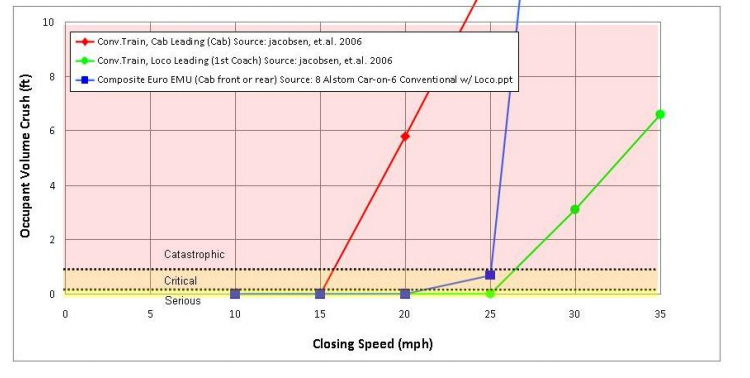
The FRA standards for rail cars in the USA also sets the standards for railcars in Canada and a change in crash worthiness of new cars is big news as it would make the realization of TramTrain much easier.
Is it not time to build ‘rail’ transit vehicles for the 21st century and not for the pre-jet age?
Wednesday, July 13, 2016
When Will the Feds Stop Outlawing Railcars Used By the Rest of the World?
The removal of 115 railcars from serviceAi??in Philadelphia last week was the latest example of the troubles American commuter railAi??agencies face whenAi??purchasing rolling stock. Thanks to cracks in a critical component ofAi??the railcars,Ai??riders are looking at severe service reductions for at least the entire summer. While U.S. DOTAi??floated a regulatory change that could prevent similar failures, itai??i??s been tied up in the federal bureaucracy for three years.
Philadelphiaai??i??s defective railcars highlight some of the problems with U.S. trainAi??safety regulations. Photo: SEPTA
SEPTA purchased the flawed railcars three years ago. The exact cause of the defect has yet to be determined, but itai??i??s clear that procuring rolling stock is riskier and more complex than it needs to be, due to Federal Railroad AdministrationAi??safety regulations.
An FRA rule dating back to 1945 requires trains to withstand 800,000 pounds of force,Ai??according to a report by David Edmondson for the Competitive Enterprise Institute [PDF]. This makes American trainsAi??much heavier than European and Asian models, as well asAi??more expensive to build and operate.Ai??Passenger railcars in the U.S. have been likened toAi??ai???a high-velocity bank vault,ai???Ai??as former Amtrak CEO David Gunn put it.
Because of these unusual standards, American rail agencies canai??i??t just acquire the same trains used in Europe or Asia. Instead, railcars here must be custom-designed for Americaai??i??s relatively small market, which drives up costAi??and risk. Philadelphiaai??i??s Silverliner V cars ai??i?? the ones with the defect ai??i?? were 10,000 pounds heavier than originally planned. The manufacturer, an American subsidiary of the South Korea-based Hyundai, had never designed stainless steel railcars to FRA standards.
For all the added expense, Americaai??i??s brand of rail safety carries its own hazards. ai???A heavier train takes longer to decelerate, which makes crashes more likely to occur,ai??? writesAi??Edmondson. Rather than building bank vaults on rails, European and Asian railAi??systemsAi??focus on preventing collisions in the first place, using technology like positive train control.
In 2013, after years of pressure from rail advocates, U.S. DOT finallyAi??issued a notice that it was considering a rule change to allow lighter, more efficient trains on American tracks.Ai??ButAi??the policy hasAi??advanced at a snailai??i??s pace. Later that year, the FRAai??i??s Robert Lauby said he expected the change to take effect in 2015, but it is still tied up in the federal rulemaking process.
An FRA spokesperson told Streetsblog the draft rule, which has yet to be published publicly, was just sent to the Office ofAi??Management and Budget this April. OMB can adjust the draft rule before it is presented for public comment, adjusted again by U.S. DOT, and enacted.
There is no noticeableAi??resistance to reform within the rail industry.Ai??The FRAai??i??s Railroad Safety Advisory Committee, which includes representatives from the American Public Transportation Association, Amtrak, NHTSA, and other industry groups, unanimously recommended the rule change, according to a source in Congress familiarAi??with the rulemaking process.
The only thing holding back progress, it seems, is the leisurely pace of bureaucracy at the White House and U.S. DOT.
As Fraser Valley mayors twiddle their thumbs and do nothing but invent excuse after excuse for not wanting a passenger rail service in the Fraser Valley, new TramTrain operations continue to expand elsewhere.
Our regional mayors are lost in a time capsule, wanting what will not work and ignoring what will.
The transit customer, as usual is left at the station, waiting for a train that will never come.
SPAIN: The AndalucAi??a regional government announced on July 7 that the first of seven vehicles being supplied by CAF for the CA?diz tram-train project had arrived at the new rolling stock maintenance facility in Chiclana de la Frontera.
Following delivery by road from the CAF Santana plant in Linares, the three-section LRV is now being reassembled with a view to commencing dynamic testing between Chiclana and San Fernando in September. Technical assistance for the trials is being provided by 2 IT and the operator of the Tenerife light rail network.
Each 1 668 mm gauge LRV is 38 m long and 2a?i??6 m wide. A further two vehicles are due to be delivered from Linares during July, followed by the two vehicles currently undergoing acceptance trials on the national network between IrA?n and Vitoria.
As well as using the 14 km of new tram route between Chiclana and San Fernando, tram-train operations will involve running over 10 km of ADIF infrastructure to reach CA?diz. Revenue operations are expected start during the second quarter of 2017, serving a total of 21 stops and a population of 234 000.


 Kelly Sinoski









Recent Comments