The February briefing note was prepared weeks before the Trudeau government signaled its intention to engage institutional investors, such as pension funds, to help raise money for public infrastructure projects.
Senior pension plan officials have said they are looking to invest in infrastructure projects with reliable, predictable returns that could include user fees ai??i?? like road tolls.
The Finance Department memo says user fees ensure that those who benefit most from infrastructure are the ones who pay for it.
But a case study contained in the secret briefing package warns that when it comes to road tolls, a significant proportion of lower-income Canadians could be forced to dig into their wallets.
The document says 77 per cent of taxpayers in the bottom fifth of all income earners commute to work in private vehicles.
Now do you beleive Zwei!

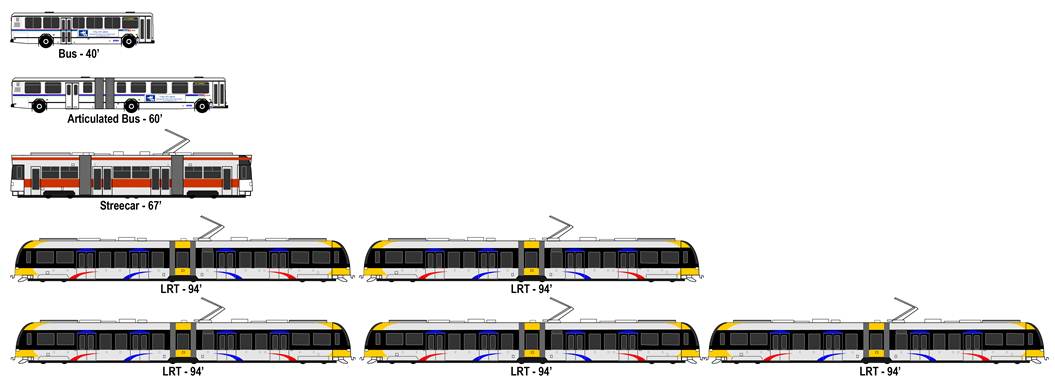
Zwei has stated over and over again, one modern tram and tram driver is as efficient as six to eight buses and six to eight bus drivers and for every tram or bus operated one needs a minimum of four people to drive, maintain and manage them. As wages account for 70% or more of operating costs; over a period of a twenty-five year business cycle, the savings in operational costs are huge!
Why do you think the bus union does not like light rail?
Modern LRT is just not a transportation tool, it is an economic tool to keep operating costs in check, something to think about when just the Expo Line costs about 60% more to operate than comparably sized LRT operations.
OC Transpo to cut 500-600 positions after LRT starts in 2018
Transit boss John Manconi met with three unions to ask for ideas to minimize layoffs
ByAi??Joanne Chianello
CBC News Posted: Jul 11, 2016 6:14 PM ET Last Updated: Jul 11, 2016 7:08 PM ET
Ottawa’s Confederation light rail line is set to open in 2018. (City of Ottawa)
OC Transpo’s largest union is “very disappointed” after the transit service revealed it is looking to cut between 500 and 600 positions once LRT comes online in 2018.
“I’ve been blindsided, absolutely, by the numbers,” said Clint Crabtree, president of Amalgamated Transit Union Local 279.
“I didn’t have anything in mind or have any ideas of the numbers ai??i?? not at this point ai??i?? but when I was presented the numbers, I was very disappointed.”
Transit boss John Manconi wrote in a memo to council that he met with three union leaders, including Crabtree, on Monday to discuss the cuts and ask for ideas to minimize layoffs.
‘I’ve beenAi??blindsided, absolutely, by the numbers.’ – ClintAi??Crabtree, ATUAi??Local 279
The city estimates that light-rail will take 170 to 180 buses off the road.
One light-rail train carries the equivalent riders as eight articulated buses. (Zwei replies: Put another way, 1 tram driver is as efficient as at least 8 bus drivers!)
That means fewer operators, maintenance and support staff will be needed.
As well, fewer fare inspectors will be required as fare gates will be installed at the LRT stations.
Manconi’s email said the city will look to retirements and attrition as ways to keep down the number of layoffs.
And some folks hired in dealing with detours in Phase 1 of the $2-billion (USD $1.52 billion) Confederation Line project could be re-employed in handling detours for Phase 2.
Crabtree said retirement is currently 60 to 80 people annually.
Also, Manconi points out that the city will need to hire additional workers for the light-rail system: 70 operators, 15 controllers and 10 support staff.
“The Confederation Line creates approximately 100 new positions, which reduces the overall reduction, and management is committed to making all the position available to our current employees by investing in training, facilities, equipment, etc. to create the opportunities for you to be successful in qualifying for these exciting new opportunities,” according to Manconi’s memo.
His email also states that all drivers hired since 2015 have been told that fewer operators will be needed by 2018.
CrabtreeAi??said he is “exploring all options” in the wake of the news but did not offer specifics.
“We’ll do everything to protect our members,” he said, adding that he will be meeting with OC Transpo management again in August.
For Whom The Toll Tolls
Not surprised at all about this as a similar issue arose in children sports.
Last year my child’s sports team saw a dramatic drop in players, from what was about 50 to less than 15. The team manager, upon inquiries, soon found the answer.
Because of the new toll on the Port Mann Bridge, was costing families upwards of $1,500 a year, many kids had to forgo joining a sports team because there was not the money to pay fees etc.!
It seems those advocating more and more taxes, seem to be either in politics or academia, all handsomely rewarded by the taxpayer, did not even think of the consequences of their actions on poor families, especially children.
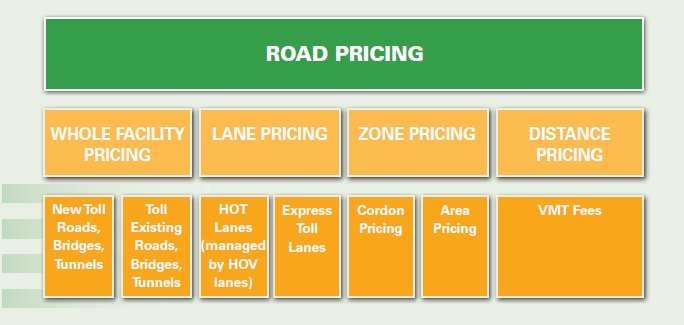
Zwei is not against “Road pricing” per se, but, there must be an affordable public transportation alternative for those driving.
The region does not, nor even planning for one and all road pricing and/or road or bridge tolls will do is further burden the poor with more and more taxes.
Amid talk of road tolls, federal memo says poorer commuters rely heavily on cars
by The Canadian Press
Posted Jul 6, 2016
OTTAWA ai??i?? An internal federal analysis says lower income Canadians are highly dependent on cars to get to work ai??i?? a finding that surfaces as Ottawa considers infrastructure investment models that could put more toll booths on the countryai??i??s roads.
PyrAi??nAi??es Line Reopens – How About The Same Quality of Servcie to Chilliwack?
Interesting news from France.
The cost to reopen this 25 km line, which was derelict for thirty-six years, was ai??i??102 million or CAD $146.5 million or put another way the cost to do the same with the former Vancouver to Chilliwack interurban line, which is still functioning for S.R.R. of B.C. freight traffic would be about $750 million. A bargain compare to other ‘rail’ transit projects being planned.
The same is true on the E&N railway on Vancouver Island or other lightly used rail lines in Metro Vancouver. Passenger service is affordable on existing railways if politicians really cared about regional transportation issues and not rely on multi billion dollar vanity projects announced around election time.

PyrAi??nAi??es line reopens
FRANCE: Celebrations were held on July 1 to mark the reopening of the 24Ai??7 km line between Oloron-Sainte-Marie and Bedous in the foothills of the PyrAi??nAi??es, where passenger services had resumed on June 26.
Taking part in the inauguration were SNCF President Guillaume Pepy, the President of infrastructure manager SNCF RAi??seau Patrick Jeantet, the President of RAi??gion Nouvelle-Aquitaine Alain Rousset, plus the President of Aragon Javier Lamban.
The revival after 36 years of closure is intended to improve access to the VallAi??e dai??i??Aspe and resorts in the PyrAi??nAi??es national park, easing pressure on inadequate roads. It also forms part of the long-planned revival of the former international link from Pau through the Somport tunnel to Canfranc in Spain, from where a Renfe DMU still runs twice daily to Zaragoza. Reopening to Canfranc is now scheduled for 2020, and a rolling motorway route has been proposed to link Bordeaux with Zaragoza.
Work to reopen the Bedous line began in 2014, with the ai??i??102m cost financed by the Aquitaine region (now Aquitaine-Poitou-Charente). The project involved upgrading 31 bridges and seven tunnels, laying new track suitable for 80Ai??km/h running and providing extensive protection against falling rocks. There are three new stations at Bidos on the outskirts of Oloron, Lurbe-Saint-Christau and Bedous, served by six daily trains to and from Pau with a journey time of 67 min for the 60 km. Upgrading between Oloron and Pau had been completed in 2010 following de-electrification.PyrAi??nAi??es line reopens

Metro Vancouver Rejectes Massey Tunnel Replacement Bridge
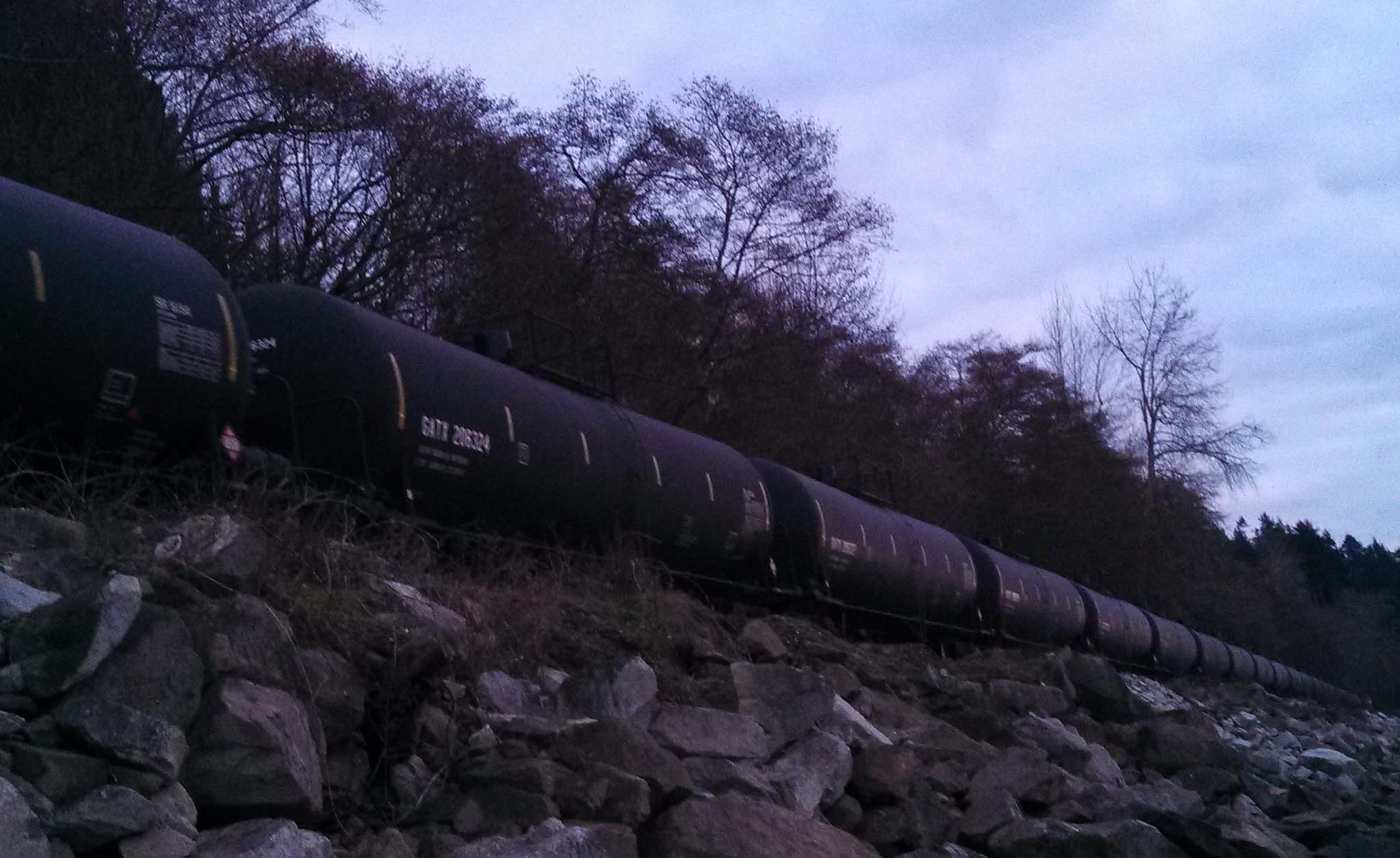 Bakken oil and thermal coal unit trains from the American mid west
are the big driver for the Massey Tunnel replacement.
As expected.
The real reason for the bridge is, of course nothing to do with the safety issues with the tunnel, rather Fraser Surrey Docks want to bring Panama Max. tankers and colliers to load extremely volatile Bakken oil and dirty thermal coal from the American mid west, from their facilities in Surrey.
The reason: Bakken oil and Wyoming Coal is coming to BC is that the Ports of Vancouver Washington and Tacoma. soon will not allow to ship such commodities.
What the proposed ten lane bridge will not do is alleviate traffic congestion on Hwy 99.
Delta mayor, Lois Jackson, is showing her age and lack of comprehension by attaching herself to this massive project and using it as her vanity project swan song in her waning career.
All this massive bridge will do is create massive gridlock on the Hwy 99 in Richmond, starting at Steveston Hwy as the present roads are at or near gridlock at peak hours and adding more traffic will create traffic chaos.
What this provincial bridge project does show, is that the $2.4 billion BC Liberal showcase p-3 rapid transit project, the Canada Line is a White Elephant and not even being considered to extend into South Delta.
So, to make this easy for the likes of Delta mayor to understand, the only reason that this bridge is being built, is that Fraser Surrey Docks, big donators to the BC Liberal party, wants the taxpayer to subsidize building a new $3.5+ billion bridge so the taxpayer can again pay for the removal the perfectly good George Massey tunnel and dredge the South Arm channel deeper to allow massive tankers and colliers (too big for the Panama Canal) up the Fraser to load cargo that Americans will not allow to be loaded in their country.
The proposed bridge has nothing to do whatsoever in relieving gridlock; it will just move it about 2 km North.
The cost to move gridlock 2 km.?Ai?? Over $1.75 billion/km. or put another way, enough build three Leewod/RftV TramTrains lines from Chilliwack to Vancouver.
Metro Vancouver opposes 10-lane Massey Bridge
 Rendering of 10-lane Massey Bridge.ai??i??Ai??image credit: Transportation Ministry
- byAi?? Jeff Nagel – BC Local News
- posted Jun 29, 2016
Metro Vancouver’s regional board says it can’t support the province’s $3.5-billion plan to replace the Massey Tunnel, at least not the proposed 10-lane bridge.
Regional district politicians have released an assessment critical of the project, arguing the proposed bridge will have a dramatic impact on regional growth, steer more people into cars instead of public transit, and ultimately increase not decrease congestion.
Metro utilities committee chair Darrell Mussatto said the regional government estimates it will be forced to spend $20 million to $340 million replacing or modifying water and other utility lines under the river because of the project, and the bill for Metro could rise to as much as $1 billion if the port authority seeks to dredge the Fraser River for increased shipping and underwater utilities must be dug deeper.
“We definitely disagree with a 10-lane bridge,” Metro board chair Greg Moore, adding something between four and 10 lanes might be more acceptable. “We know from experience around the world you can’t build your way out of congestion.”
Moore said regional planners are concerned such a huge expansion of the bridge and Highway 99 will increase pressure to develop farmland and undermine Metro’s regional growth strategy of containing urban development.
The region also cites concerns with ecological disruption to the Fraser estuary, air quality impacts if all 10 lanes end up clogged with idling traffic and impacts on Deas Island Regional Park.
Mussatto said the new Port Mann Bridge has sped workers further along Highway 1 but they slam into major congestion at the Ironworkers Memorial Bridge to the North Shore.
He predicts the Oak Street Bridge will also end up a “very big pinch point” after the Massey bridge is built, and possibly the Knight Street Bridge as well.
Letters from Rail for the Valley folk

Two letters from people who support, Rail for the Valley and improving transit South of the Fraser
Users and taxpayers lose with regional transit plan
Delta Optimist
June 29, 2016
Editor:
The recent $740 million photo-op with Prime Minister Justin Trudeau, his protAi??gAi?? for the next federal election, Vancouver Mayor Gregor Robertson, and B.C.’s premier, was nothing more than flim-flam to get regional taxpayers to ante up their portion for the very poorly thought out and grossly expensive 10-year plan that will benefit developers more than transit customers.
The two centerpieces of this plan, the Broadway SkyTrain subway and the Surrey LRT, are poorly thought out, expensive, won’t reduce congestion and will force more people to drive.
We have already invested $10 billion of the taxpayer money on rapid transit and mode share by car in the Metro Vancouver region has remained static at 57 per cent for a quarter of a century.
The real winners of the $740 million investment in regional transit:
1. Bombardier Inc., which will get $345 million for new West Coast Express cars and proprietary ART cars (SkyTrain).
2. TransLink’s bureaucrats, who will get $157 million so they can continue to “play trains” with the $3 billion Broadway subway and the $2.5 billion for Surrey’s poor man’s SkyTrain.
3. Land developers, who will get relaxed zoning at proposed rapid transit stations.
The big losers:
1. The transit customer, who will suffer more incompetent planning and not one new bus for south of the Fraser River was included.
2. The taxpayer, who has to pay for this questionable transit planning, for two grossly expensive transit projects that will do little or nothing to ease congestion.
I had hoped Trudeau would usher in a new era of fiscal prudence, but he has just telegraphed the federal Liberals are open for business, especially for Bombardier Inc., as they were a decade ago.
The Liberals have learned nothing and forgotten nothing, leaving the taxpayer vulnerable to their political excesses.
D. Malcolm Johnston
Hon Mayor Gaetz,*In response to your June 20 email to Myrtle Macdonald, I would like to point out that I have read the report issued by the FVRD on the first year of the FVX, which was glowing, except for one caveat. They pointed out that scheduling is an issue, due of course to the fact that those buses are required to use the terrible freeway section from just past Langley to Chilliwack.Ai?? The very fact that the ridership is 4x greater than expected points to the fact that the population and needs of Chilliwack residents are changing.Ai?? People are moving by the hundreds from points west because itai??i??s still affordable to live here and it is beautiful.Ai?? But they still have connections to the west in the form of jobs, family and friends and their pleasure living here will quickly sour when they realize they are spending 3 or more hours on the road every day.*I have been supportive of the Rail for the Valley organization for many years but have become quite passionate about it since the summer of 2014 when my daughter Tracy, and son in law Randy moved back here from Edmonton.Ai?? They bought a beautiful townhouse on Promontory and they love it.Ai?? However, Tracy works for Canada Revenue Services and her only two options were Surrey or Vancouver.Ai?? She picked Surrey of course, but only after trying to get a job here that pays as well, and now is one of those spending a good portion of her waking hours on that freeway.Ai?? She would love to take public transit, but the FVX does not work for her so she has no other option but to drive.*The rail line that could make life so much easier for folks like her already exists! Despite the fact that the West Coast Express is very successful from a ridership perspective, CP charges an exorbitant fee for the use of their tracks.Ai?? The rail line on this side is owned by us and itai??i??s mandate is passengers.Ai?? There would be no rental fee. I simply cannot understand why every Mayor and Council from Chilliwack to Surrey is not supportive of or fighting for the return to use of this line.Ai?? Perhaps you could explain why to me.*Ai??Thank you.Barb Lock
TransLink Vindictive & Incompetent? You Decide
Almost same thing happened to my wife who forgot her Compass Card at work only it cost her a big fine.
Hell of a way to keep your customer base. User friendly, TransLink is most definitely not.
The student had a valid U-Pass, TransLink get over it; there are over 130,000 issued this year.
It is instances like this, that make the people hate TransLink and why the taxpayer voted “NO” at last years plebiscite.
Zwei’s solution, fire everyone concerned who let this thing go to court.

TransLink petitioning student fare evasion decision
Vancouver, BC, Canada / News Talk 980 CKNW | Vancouver’s News.Posted: June 24, 2016
TransLink has filed a petition in B.C. Supreme Court to quash a judges decision that ruledAi??in favour of a student who was ticketed for fare evasion afterAi??she accidentally produced the wrong bus pass in November 2013.
Inna Danylyuk was ticketed by a TransLink officer for fare evasion because she produced another studentai??i??s U-Pass while on a bus in Burnaby.
Danylyuk disputed the ticket, on the ground she mistakenly switched her pass with her partnerai??i??s.
As part of her submission, she provided proof of her own pass that was valid at the time of the infraction.
In March of 2014 the matter went toAi??arbitration.
It escalated to a review, and assigned to a judge for an oral hearing.
This past March Judge Zahid MakhDoom sided with the student.
The judge chastised TranLink for engaging in quote, ai???administrative haddockry,ai??? noting it would have been better to demonstrate, ai???ai??i??diligence in its fiduciary duties to the people of the province and save a student likely in debt from incurring more debt,ai??? and wasting Danylyukai??i??s time with appeals.
Danylyuk was givenAi??two fines,Ai??each for $173 dollars.
The Costly White Elephant In The Room
While Vancouver mayor Pines for a SkyTrain subway under Broadway and Trudeau the Younger smiles at the cameras with promises of transit manna from heaven, no one is addressing the real subway issue: costs!
It is now estimated that the Millennium Line subway extension to Arbutus will now cost $3 billion or slightly higher, if construction started today.
It’s not.
There is no real timetable for construction and with more deserving transit investments needed elsewhere, the Broadway subway is more and more becoming an anachronism; dated by the Vancouver only philosophy that the only reason to build rapid transit is to greatly densify the transit corridor.
Political friends and insiders need to be paid off and academics need to save face until their retirements are only part of the problems with regional transit planning, but more and more, a Broadway SkyTrain subway is just becoming unaffordable.
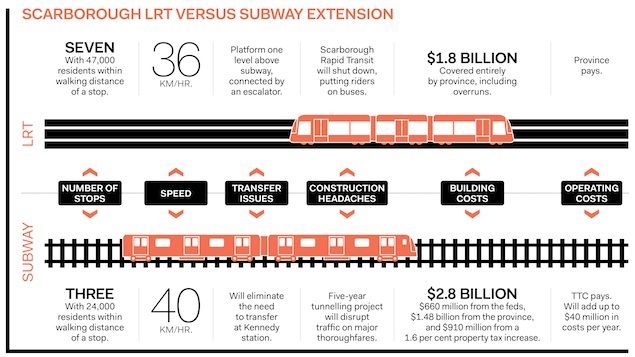
The Scarborough subway, which is replacing Toronto’s only SkyTrain line, is a good example of what happens when politicians hijack transit planning to suit their own political agendas.
Chief planner Jennifer Keesmaat says city council now needs to make the tough decisions on an “optimized” plan.
By Jennifer PagliaroCity Hall reporterTues., June 21, 2016The cityai??i??s chief planner says the question over how to build transit in Scarborough is one of ai???prioritiesai??? ai??i?? a dilemma now facing council.
A report released Tuesday on a future transit network for the city recommends moving ahead with plans for both a one-stop subway extension and an LRT along Eglinton Ave., despite updated cost estimates showing the subway alone would eat up nearly all of the available funding.
ai???The question is one of competing priorities, and that really is a decision for city council to make,ai??? Jennifer Keesmaat told reporters Tuesday night.
ai???The work that you see before you today is based on a recognition that there are critical decisions, and important decisions, that need to be made around funding, in order to continue to advance the livability of the city.ai???
Keesmaat had earlier proposed an ai???optimizedai??? transit plan for Scarborough, one that reduced the number of proposed subway stops from three to one, ending the extension at the Scarborough Town Centre. She said the estimated savings could fund an LRT line along Eglinton Ave. with up to 17 new stops.
The LRT was seen as a political compromise on a subway plan which has been described by critics as a political football being used by Scarborough councillors and Mayor John Tory to win votes.
With only $3.56 billion currently committed to the Scarborough projects from three levels of government, critics question whether a single subway stop costing $2.9 billion can be justified.
The German Transportation Fiasco
If one thinks German transit and transportation is a panacea, think again, as the countries transit infrastructure is beset with costly maintenance issues, the major one being under-funding.
We see the same on this side of the pond, with aging transit infrastructure in need of major maintenance, especially in Vancouver.

From the Guardian….
Why German trains donai??i??t run on time any more
For all the old cliches about Teutonic efficiency, much of Germanyai??i??s transport infrastructure is in a terrible state of disrepair, and many major works have been badly botched. A chronic lack of investment is to blame.
As the fireworks flew and the brass band played at the recent opening of the 57km-long Gotthard Tunnel under the Swiss Alps, Angela Merkel, who was on the first train to pass through it, could not resist the remark: ai???This is something we Germans still need to work on a littleai???.
The project was not only completed on time and within budget, she noted with admiration, but it will shave the best part of an hour off the regular journey time between Zurich and Lugano.
A joke heard quite regularly these days is: ai???If you want to see German efficiency, go to Switzerland.ai??? While it has German engineers squirming, most can only nod in agreement. It is certainly hard to imagine such a prestige project happening in Germany these days. Most of the countryai??i??s recent high-profile construction schemes have become great national embarrassments, beset by massive delays and huge cost overruns. A new Berlin airport, originally scheduled to open in 2010, is still years from being realized and billions over budget, while the Elbphilharmonie ai??i?? a concert hall in Hamburgai??i??s harbour city ai??i?? is seven years behind schedule and ai??i??550m (A?430m) over cost. Stuttgartai??i??s underground railway station is in a similarly shambolic state. Thatai??i??s not to mention the collapse of Cologneai??i??s city archives a few years ago, thanks to the botched construction of a new underground line.
So what happened to the famed German traits of efficiency, accuracy and punctuality? The number 174,630,000 was used to rub further salt into the wound this week. Thatai??i??s the number of minutes German passenger and goods trains have been losing every day over the past year, with train delays said to have risen by almost a third since 2009. The reason is an extensive wave of very overdue repairs and modernization taking place across the 33,000km (20,500 mile) rail network, from replacing ageing tracks and 19th-century signalling stations to repairing crumbling bridges and platforms, some of which are so old they are said to be close to collapse.
Now for the rest of the story…………….
Error Code 404 – Sums Up Regional Planning to a “T”.
Well, is this a sign of things to come error code 404?
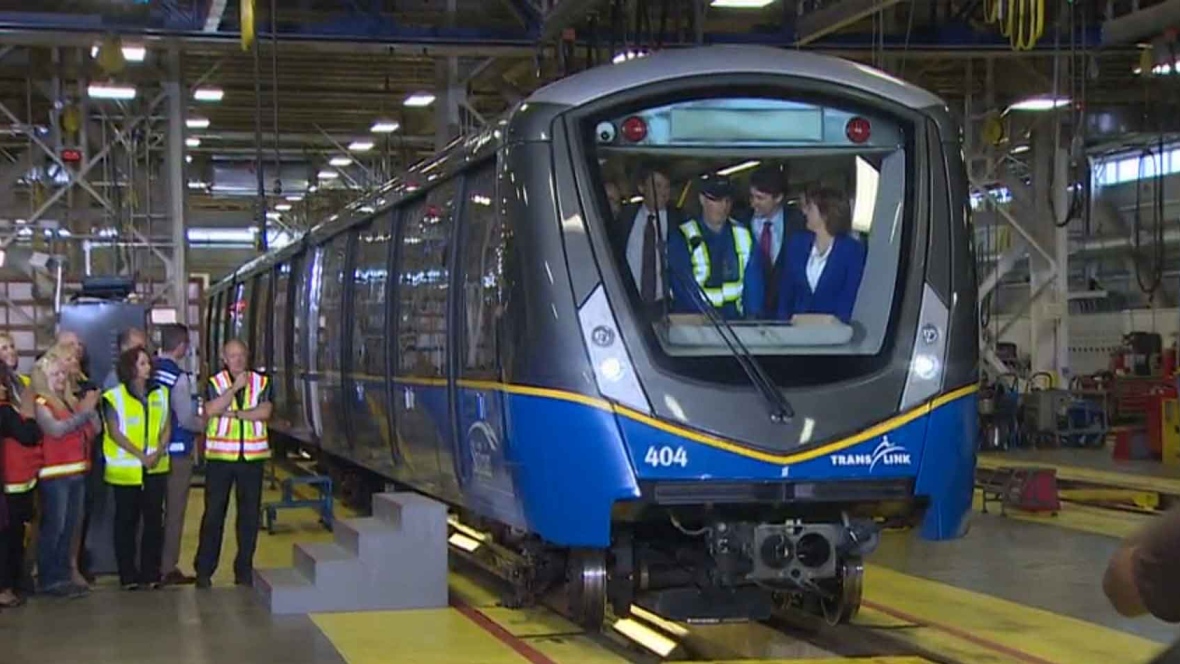
The three amigos got together on ART car 404 for a photo op and one can read into it as one wishes.
Evergreen Line Woes – How Much Over Budget?
The Honolulu light-metro is $1.4 billion over budget.
Toronto’s Scarborough subway is already $900 million over budget.
Then it should not come as a surprise that the Evergreen Line is over budget.
The question is, by how much?

Evergreen Line delay costs lead to mediation, B.C. government hiding info on costs, changes and challenges
SNC-Lavalin and the provincial government are in mediation over cost overruns at…
By Bob Mackin
SNC-Lavalin and the provincial government are in mediation over cost overruns at the Evergreen Line rapid transit project, Business in Vancouver has learned.
SNC-Lavalinai??i??s infrastructure and construction division took a nearly $27 million hit in 2015ai??i??s second quarter, and it laid part of the blame on ai???challenging soil conditions.ai??? Tunnel boring was stalled for five months last year, delaying plans to complete the $1.43 billion Millennium Line extension from summer 2016 to fall 2016. Last November, the Ministry of Transportation and Infrastructure said it would open in early 2017.
ai???SNC-Lavalin does not comment on ongoing mediation or litigation,ai??? said Louis-Antoine Paquin, the companyai??i??s media relations manager, who referred BIV to the Ministry of Transportation and Infrastructure.
Amanda Farrell, the governmentai??i??s project manager, did not respond for comment, but an emailed statement from the Ministry claimed the project is on budget and said EGRT Construction, the SNC-led consortium, is responsible for any costs associated with schedule delays.
ai???As with any ongoing contract of this size and complexity, we remain in discussions with the contractor during the project in order to ensure the taxpayersai??i?? interests are represented and the project follows the contract,ai???Ai??according to the statement, which was sent by spokeswoman Trish Rorison.
The B.C. government hired the troubled Montreal engineering and construction firm in 2012 on an $889 million fixed-price contract after SNC-Lavalin accepted the risk of geotechnical conditions in the tunnel. The project geotechnical report in 2011 by Golder Associates said there were variable soil conditions, clays, minerals, boulders and groundwater on the route.



Recent Comments