“Skytrain in Vancouver” by Micheal Chu is licensed by CCBY
The connection between public transit and urban sustainability is significant;Ai??public transportation has been shown to reduce air pollution and GHG emissions,Ai??positively enhance urban densification, and drive economic growth in communities.
In light of Prime Minister Justin Trudeau and Premier Christy Clark’s multimillion dollar transit funding announcement, we sat down with Patrick Condon, Chair, Urban Design, and Professor of Landscape Architecture to get his perspective out what this development means for the future of urban design and public transit in Vancouver.
Q. What is the significance of this announcement?
This announcement presents nothing new, it only certifies what was previously announced: The Federal government is willing to pay 50 percent of the cost of new transit projects, up from the traditional 33 percent. Unfortunately the funding levels are far far below what is needed to build out the 7.5 billion dollar Mayor’s Council transit plan. At only 250 million per year combined total from local, provincial, and federal resources it would take 30 years to finish this “ten year plan”.
Q. How will these investments affect Vancouverai??i??s urban design?
The Mayor’s Council ten year plan will affect regional urban design in a number of ways. The most hopeful part of the plan, and the easiest to achieve, are the rapid bus improvements proposed for new “frequent transit corridors” in all parts of the region. These new “B-line” type services could catalyze new medium density development on many major corridors, especially if provided in dedicated lanes. Such systems have dramatically improved the number of transit users and urban quality of life in many cities, including Curitiba BrazilAi??and Bogota Columbia. On the other hand, more expensive subway systems are only logical if accompanied by very high density development within a ten minute walk of transit stations. This model of development is now manifest at Metrotown and Brentwood town centres. High rise construction brings with it a number of social, economic and sustainability costs which IAi??have enumerated in the past, including susceptibility to earthquake damage, high per square foot construction costs, heavy use of GHG emitting concrete, and the disappearance of small scale local commercial activity.
Q. Is this sufficient to address Vancouverai??i??s transit issues?
WIth the funding formula and amounts we now know, we can calculate that it will take 30 years to build the Mayor’s Council’s ten year plan. By that time the region will likely be home to 3.5 to 4 million people. Most of this number will be located in currently suburban locations. The ten year plan is thus already out of date and will not serve our future region well. It would be wise to start over and generate a new, more affordable plan – a plan more in keeping with what we now know are the likely financial resources and the growth trends expected over the next three to four decades.
Q. What will the legacy of this investment be?
The political culture of our region is deeply committed to the plan as proposed and unlikely to re-evaluate it to reflect this new financial and temporal reality. My hope is that the much cheaper parts of the proposal, the rapid bus network, will be the first to be built, and that this system will be a sustainable armature for future regional transit oriented development.
Patrick Condon has over 25 years of experience in sustainable urban design: first as a professional city planner and then as a teacher and researcher. He has distilled his 20+ years of experience designing sustainable communities in his recent book ai???Seven Rules for Sustainable Cities, Design Strategies for a Post Carbon Worldai??? (2010 Island Press). He is now the Chair of the Masters of Urban Design Program at UBC.
Ah, such a photo-op for our new PM; oh, such an announcement, but really, this just a rehash of old news releases tarted up for a photo-op so PM Trudeau can claim that BC has not been left out of the Liberals game plan of shoveling money off a back of a truck. The stumbling block of course is that regional mayors must ante up to pay for this lemon and that will be a hard sell.
The public spoke loud and clear last spring about the Mayor’s plan, but regional politicians remained deaf to the taxpayer’s wishes.Ai?? They will have a very hard time to convince the regional taxpayer to ante more money in what is fundamentally a very bad transit plan.
The big winner it seems is Bombardier Inc. who are the only makers of the proprietary ART cars and Bombardier Inc. also produce the bi-level commuter cars for the West Coast Express.
More cars for the Canada Line is rather silly as the small stations preclude operating longer trains and it seems nothing more than a sop to SNC Lavalin who heads the Canada Line’s mock P-3 operating consortium.
Trudeau did not mention that when a new Seabus is delivered, one of the two older ones will be taken out of service.
The $157 million for pre planning the daft Broadway subway and badly planned Surrey LRT, is a delight for our inept gang of planning bureaucrats who will make sure the money will be spent promoting their incompetence.
Sorry, Trudeau the Younger seems you belong to the “lets throw more money at it” club, in the vain hope that just by throwing money at transit, things are bound to improve, especially at election time.
As for the transit customer, that train has long past, as money spent on transit is to win elections.
Prime Minister Trudeau announces $934 million transportation investment for B.C.
Prime Minister Justin Trudeau calls it ai???very good news B.C. has been waiting for.ai???
Speaking in Burnaby, he says his government has completed negotiations on an agreement with the province to provide federal funding to support public transit.
ai???So today, I am very happy to announce that our government will be investing four hundred and sixty million dollars in public transit in British Columbia, including three hundred and seventy million for public transit right here in Metro Vancouver.ai???
With contributions from the province and the cities, it will be a total of $934 million to be invested in public transit across the province.
This will cover, among other things, additional SkyTrain and West Coast Express cars, a third Seabus, and planning and pre-construction of the rapid transit line to UBC and the South of the Fraser light railAi??system.
$3.4 billion was previously pledged nation-wide for transportation.
Our not so friendly SkyTrain Lobby would have us believe that light-metro is being built in quantity in China.
Not so fast, as China’s huge city populations would demand large metro operations, not capacity constipated light-metro like our SkyTrain.
At the other end of the public transit scale, China is also building tramways or light rail and the new Silkworm tram has been unveiled.
Tram line ai???Silkwormai??i?? unveiled
By Ruby Zhang | June 15, 2016
THE new train that will be used on the T1 and T2 tram lines in suburban Songjiang District was unveiled at a local railway fair yesterday. The lines will be put into operation next year.
The new train, which is the first of its kind to be used in the city, has no step between the carriages and the platform, which will make it easier for passengers with disabilities or those carrying heavy luggage to get on and off.
The five-carriage train, which is 33 meters long and 2.65 meters wide, has been one of the highlights of the exhibition Rail + Metro China 2016 at the Shanghai New International Expo Center.
Because of its streamlined design, the yellow train has been dubbed ai???Silkworm.ai???
The train was entirely designed and manufactured in China, according to the manufacturer, Shanghai ALSTOM Transport Company.
ai???The localization will greatly lower the cost of the tramsai??i?? maintenance in future,ai??? said the company.
The Federal and Provincial governments along with Metro Vancouver mayors have come to some sort of deal to move forward on partAi??of the 10 year transit and transportation plan.
Sources tell CKNW that an announcement is imminent that would allow the three levels of government to at least get started on parts of the mayorai??i??s ten year plan.
Prime Minister Justin Trudeau will be in town tomorrow and will be appearing alongside provincial and regional officials for the announcement.
However, while the plan can apparently get started, Ai??how to pay the regionai??i??s full 17 per cent share is still a question needing answering.
Sources say any deal on funding the regionai??i??s full 17%Ai??is still very much a work in progress.
The federal government has put $370Ai??millionAi??on the table for phase one of the plan while the province has kicked in $246Ai??millionAi??over three years.
A deal to cover the regionai??i??s share is required to unlock the full funding.
One can now tell how dysfunctional TransLink is when it blames the messenger and not itself; in fact TransLink is scared of the messenger.
Again, instead of spending time and energy in providing a good transit service, TransLink spies on media reports and organizations who disagree with this ossified bureaucracy.
It must be getting very lonely in their expensive new “ivory towers”.
Itai??i??s clear TransLink keeps a fairly close eye on what the media reports about the organization.
Documents obtained through Freedom of Information show following a TransLink media availability back in January about the new Compass Card, there was a backdown back at transit headquarters with an ai???analysis of coverage.ai???
That included which media outlet was at the availability, what they reported and even the ai???toneai??? of the stories.
Most times reporters were rated as ai???factual, with a neutral tone.ai???
There was also a breakdown of what media had the most comprehensive coverage.
According to the FOI documents, TransLink felt radio missed the mark on key messages.
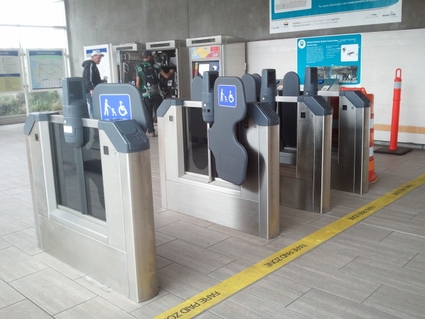
So, where is the massive fare evasion that warranted over $200 million spent on the Compass Card and Fare Gates for the SkyTrain light-metro system?
No massive amounts of fare evasion you say?
Maybe it was all those U-Pass holding students that confused everyone?
Who was the lobbyist for Cubit Industries again?
So, $63,000 more in fares were paid in the first quarter of 2016 than 2015 or put another way, TransLink spent well over $200 million on a fare gate and Compass Card system on SkyTrain, costing well over $10 million a year to operate and TransLink will only recoup about $250,000 a year?
The entire SkyTrain Board and senior management should be fired on the spot, as would be done by any other transit authority.
SkyTrain fare gates havenai??i??t reduced cheating, says Langley City Councillor
A Langley City Councillor says Translinkai??i??s new Compass Card system is not cracking down on fare evasion.
Langley City Councillor Nathan Pachal says Translink recently released its first quarter results in which the Compass Card system has been fully operational.
He says transit fare revenue was up $63,000, a marginal increase of 0.1% from a year ago, when fare gates werenai??i??t in operation.
ai???There should be several million dollars per year, 10-million, even even more from savings from fare evasion, if this is what they claim.ai???
Pachal says fare gates cost upwards of $10 million per year to operate.
He says itai??i??s likely that the fare gates costs more to operate than they save.
Attention Metro Vancouver transit planners, it seems the Honolulu light-metro is now $1.1 billion (CAD $1.41 billion)over budget.
As TransLink aggressively pursues light metro for regional transit planning, alarm bells are sounding in Honolulu.
The trouble is, Factbender and the regional Mayors are not listening,Ai?? wanting prestigious transportation vanity projects, in the guise of SkyTrain light-metro and light rail, masquerading as SkyTrain light metro.
Until both parties show some maturity with transit planning and plan transit to cater to the needs of customers and not the election schedule, extra taxes in the guise of mobility taxes and road pricing, will be the order of the day.
The HONOLULU rail transit board is advising the city on Oahu Island how much light metro elevated transit can be constructed with the $6.8 billion now projected as the project cost, the “Hawaii News Now” site reports. The agency estimates it will need $7.9 billion to build the full 20 miles with 21 stations so a shorter route might be constructed with bus connections. The rail board has two months to present options to federal transit officials.
Rail board given options on how much rail can be built for $6.8B
(Image: Hawaii News Now)
HONOLULU (HawaiiNewsNow) –
The Honolulu Authority for Rapid Transportation said the city’s proposed rail route will likely be shorter or have fewer stations with the revenue it expects to have.
According to HART projections, the rail line would end at Kapalama near Honolulu Community with the money it expects to have — $6.8 billion. HART estimates it will cost more than $7.9 billion to build all 20 miles of rail with 21 rail stations.
Memo to TransLink, the city of Vancouver, the Mayor’s Council, and Mr. Factbender, subways need a large mass of ridership to justify construction.
Quote: “This is way less than the 15,000 riders used as the benchmark for justifying subway service, and about half the ridership projected when Toronto City Council approved the subway in 2013.”
So where have we heard this before?
Oh yes, Zwei has been say this for years, despite being insulted by the so called SkyTrain experts that this is not so.
Subway construction is extremely expensive and one needs huge traffic flows to justify construction of a subway.
TransLink should know this as the Cost of the Canada Line almost doubled to over $2.4 billion to build; but, oh wait, it is only managing to carry about 7,500 pphpd in the peak hours of service. No wonder TransLink is shelling out over $100 million annually to the charade of a P-3 operating it.
Broadway is even worse as peak hour traffic flows are less than 5,000 pphpd and TransLink wants to build a $3 billion subway To Arbutus?
Is insanity contagious? No, just the city of Vancouver, Factbender, and TransLink playing the taxpayer for rubes, funding a “Subway to Nowhere“, and they even have hired an American CEO, who favours light metros and subways from Seattle to oversee this farce.
If Scarborough subway ridership canai??i??t be improved, cancel it
Metro’s Matt Elliott tackles the new, underwhelming ridership projections for the Scarborough subway.
If the city is going to replace the Scarborough RT with an underground subway, it will need to find ways to boost ridership along the line, says Matt Elliott.
By:Ai??Matt ElliottAi??MetroAi??Published onAi??Mon Jun 06 2016
Having carefully reviewed theAi??updated ridership numbersAi??for the Scarborough subway project provided last week by Torontoai??i??s planning department, I am prepared to offer this bit of qualified journalistic analysis: these numbers suck.
This is way less than the 15,000 riders used as the benchmark for justifying subway service, and about half the ridership projected when Toronto City Council approved the subway in 2013.
The suck doesnai??i??t stop there. The extension is projected to attract just 4,500 new daily transit riders. With a total project budget of just over $2 billion, thatai??i??s an absurd cost of acquisition.
And the extension offers few other benefits. It doesnai??i??t provide relief to the existing subway network. It doesnai??i??t bring transit any closer to people without service.
What it does, mostly, is cost money. A lot of money. The subway represents a 1.6% charge on every residential property tax bill for three decades. When it opens it will, like the similarly underused Sheppard subway, require millions in annual operating subsidy.
My position on the project remains the same. It should be cancelled. All existing project plans should be burned to ash. Those ashes should be shot into space. No one should speak of this ill-advised, politically-engineered subway extension again. Build a light rail network instead.
But after years of fighting this fight, Iai??i??m cynical. It doesnai??i??t seem to matter how low ridership projections sink or how big the budget grows, Torontoai??i??s political establishment ai??i?? led by Mayor John Tory and a gaggle of Liberal MPPs in Scarborough ai??i?? seems dug in. Scarborough will get a subway.
If that really is the outcome, then Tory and council at least owe it to residents of Toronto to ask planning and TTC staff to explore strategies to increase ridership.
That might mean adding more express bus service to create better linkages to the subway from areas like Malvern. It might mean increasing operating subsidies so the cost of a monthly Metropass isnai??i??t out of reach for many.
It might mean scaling back Toryai??i??s SmartTrack plan, so it doesnai??i??t compete for Scarborough ridership.
It might mean encouraging super dense, high-rise development in the wide are around Scarborough Town Centre, even if that meansAi??expropriating more homes.
Many of these ideas wonai??i??t be popular, but all options must be on the table. Approving construction of the Scarborough subway with these ridership numbers would be an act of gross irresponsibility. Either find ways to honestly improve the numbers or cancel this misbegotten project. There should be no middle ground.
For a $5 billion, 12 km subway to UBC, under Broadway….
…..one could build a tram network in Vancouver and North Vancouver!
Zwei been advocating for trams on Broadway since the 80’s, well more and more people are now seeing that instead of a $5 billion plus subway to UBC, one gets way more bang for your buck investing in tram/LRT for Vancouver.
Because TransLink doesn’t have the bucks to build a SkyTrain subway to UBC, this ossified bureaucracy deems that it need be only a subway to Arbutus; a subway to nowhere.
No wonder TransLink and indeed Vancouver are international laughingstocks, when it comes to transit; no wonder the TransLink plebiscite failed.
He makes his money by assembling properties, having the municipal council up-zone the assembled properties to allow higher densities to build his condo’s.
Bob Rennie is not a transit expert.
Bob Rennie loves expensive rapid transit because he can use it as a selling point for his expensive condos.
As we have seen in Burnaby, where renovictions are the order of the day, transit dependent elderly and financially constrained people who live near transit hubs are being evicted so developers can up-zone modest apartments to extremely expensive high rise condominiums.
There is an old Hungarian saying; “If gypsies knock on ones front door, rush out to the back and count the chickens.”
In context, if Bob Rennie wants more rapid transit for, “affordable home ownership“, best make sure it is not just to sell overpriced condo’s.
Vancouver’s “condo king”: better transit is the key to affordable home ownership
Metro Vancouver is ready to embark on a large transit expansion if it gets funding, but will that come in time to stimulate the economy in the short term? THE CANADIAN PRESS/Jonathan Hayward
VANCOUVER (NEWS 1130) ai??i?? We have to stop talking about affordability only in Vancouver and broaden our vision to include the region, but to do this, we need better transit. Thatai??i??s the message from marketer Bob Rennie as he gives his final annual address to the Urban Development Institute.
ai???Condo Kingai??? Bob Rennie says Vancouverai??i??s population would have to increase by nearly 200,000 people if everyone who works in the city were to live there as well. ai???If everybody that works in Vancouver wants to live in Vancouver, we would have to increase our population by 197,000. We have 25 per cent of the regionai??i??s population, but we have 33 per cent of the regionai??i??s jobs.ai???
Not everyone is excited by the idea of living farther from their workplace. The argument from many priced out is theyai??i??re not interested in spending hours in a car each day or cramming onto the transit system.
Rennie says the way to allow for people working here to own their homes is to get them to move out of the city limits into other parts of the region. Heai??i??s calling for a real investment in transit, no matter the cost.
ai???When we do the Broadway line, itai??i??s getting as much density there as you can. I donai??i??t care if itai??i??s rental with no parking. There is no affordability here. Main Street is breaking $900 per square foot. There is no affordability in the City of Vancouver, so letai??i??s look to the region.ai???
Rennie is calling on the politicians holding up a funding model for transportation to see this crisis for what it is and get moving now.
Surrey Mayor Linda Hepner agrees with Rennie whole heartedly. Hepner says fixing this needs a regional, network approach to get people moving. ai???Transportation, especially when you have the geography the size of Surrey, is critical.ai??? She says itai??i??s a usable network that makes it possible to live in Surrey and work in Vancouver.
Metro Vancouver mayors have sent their latest proposed funding formula to the province. They want a $3 per year property tax increase and regional tolling among other things to raise their share of the money. The provincial government says it needs to discuss the ideas with the Mayors Council, but it is offering $246 million to immediately improve transit across Metro Vancouver.


 “Skytrain in Vancouver” by Micheal Chu is licensed by CCBY


(Image: Hawaii News Now)
 For a $5 billion, 12 km subway to UBC, under Broadway….
 …..one could build a tram network in Vancouver and North Vancouver!
 Metro Vancouver is ready to embark on a large transit expansion if it gets funding, but will that come in time to stimulate the economy in the short term? THE CANADIAN PRESS/Jonathan Hayward


Recent Comments