A Blast From the Past – Zwei Was Advocating the Stadler GTW in 2009!
I seems Zwei has had it right all along with the Stadler GTW! Here is a repost from October 2009!

The Stadler GTW ai??i?? A new generation of Diesel light rail.
Posted by zweisystem on Wednesday, October 14, 2009
The Stadler GTW Diesel light Rail car
The Stadler GTW, sold by Stadler Rail, Switzerland, is one of the best-selling articulated local transport railcars in Europe. The name GTW stands for Gelenktriebwagen (articulated railcar).
Description
More precisely, Stadler GTW is actually a whole family of vehicles which differ externally, in the various designs of the head of the vehicle (from angular to streamlined), and also in the different designs and power units that drive them. They also come in different gauges and as rack railway vehicles. The basic version is the ai???GTW 2/6ai???, a railcar which conforms to UIC standards. ai???2/6ai??? means ai???two of six axles are poweredai???. The GTW 2/6 is used for example by Deutsche Bahn as ai???Baureihe 646ai??? (Series 646) and by Swiss railways as ai???RABe 526ai???.
The basic concept is rather unconventional: the car is driven by a central ai???power moduleai???, also known as a ai???powerpackai??? or a ai???drive containerai???, powered on both axles. Two light end modules, each with a bogie, rest on the power module, which produces useful traction weight on the driving axles. The end modules also use the space very effectively, although the railcar is divided into two halves by the power module. Some units have a path through the drive container. The end modules can be delivered with standard pulling devices or buffer gears, or with central buffer couplings. They are built with a low-platform design except above the bogies and at the supported ends (more than 65% low-platform). All of the usual comforts to be expected in a modern local network railcar are provided, such as air conditioning, a multi-purpose room, vacuum toilets (in a washroom suitable for the disabled) and a passenger information system. The GTWs can be diesel or electric-powered (via overhead wires or third rail).
Propulsion
There are diesel propulsion modules with 550 kW (since 2003) with 2Ai??375 = 750 kW power available, and electric propulsion modules with 600 kW to 1,100 kW. All drive modules work with IGBT pulse inverters. The converter plant stems from ABB and Turgi manufactured at the site.
By inserting a middle car (also with only one bogie) on one side of the propulsion module, the GTW 2/6 is expanded to GTW 2/8. Instead of the middle car, another drive module can also be inserted. Between the two modules are then either a trailer passenger car (GTW 4/8) or two medium cars and partitions (GTW 4/12). For operational flexibility up to four GTWs of the same pattern can be operated as a multiple unit.
North American application
New Jersey Transit uses 20 GTW diesel light rail vehicles on the 34 mile River LINE (New Jersey Transit) service between Trenton and Camden. The diesel LRV offers a tighter turning radius than typical main line light rail vehicles (i.e. Siemens Desiro, Bombardier Talent, etc.) and thus is capable of street running. The basic GTW is the 2/6 which indicates that two of the six axles are powered. The vehicle is more than 65% low floor. The GTW is available in electric and diesel-electric versions. 390 units have been sold to date and are in use in Italy, the Netherlands, and Switzerland. The Austin, Texas Capital Metro is expecting delivery of six vehicles in the fall of 2007 for its new transit rail service. In Texas, the diesel-electric units will provide service on a 32 mile route between Austin and Leander starting in January 2008.
The River LINE in New Jersey was opened in May 2004. The service is operated by the Southern New Jersey Rail Group (SNJRG), a consortium of Bechtel Group and Bombardier. The 20 stations on the line include PATCO SpeedlineA?ai??i??ai???s Broadway Station, which allows for transfers to service to Philadelphia. The River LINE uses a proof of payment system with a flat fare of $1.35. Service is offered on a 15 minute peak headway and 30 minute off peak headway. Much of the line is single track with passing sidings.
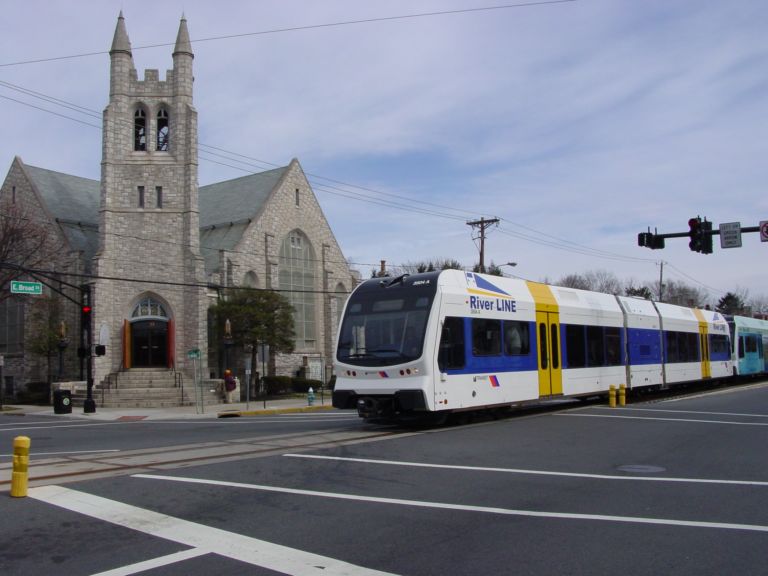



Stadler’s GTW family of light railway vehicles are some of the most under rated rail cars on the market today. Solid and well built, the Stadler GTW rail cars can bring an affordable passenger service to even the smallest towns on a rail line.
Diesel LRT or diesel powered light rail cars, especially in North America have not been well promoted by transit and transportation planners, who instead want to plan for grand metro or tube style transit, instead of affordable transit solutions. The result is overbuilt light rail lines, which look more like heavy rail metro lines and an empty bank account.
Providing a rail based passenger service, using existing infrastructure is always preferable than going ‘greenfields’ with expensive tunnels and viaducts.