Used DMU’s for RftV?
Even though our local politicians haven’t a clue about the ‘Rail for the Valley’ project, European professionals are, as evidenced by the following letter.
Dear Sir and Madam,
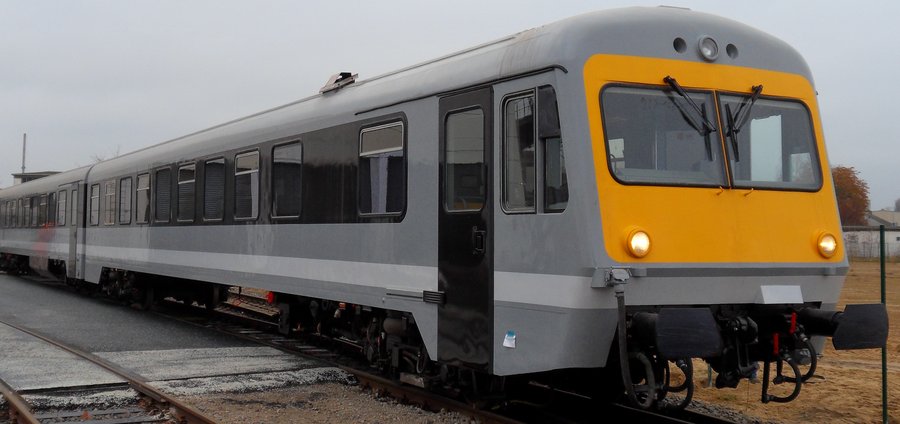
HEROS would be able to provide used DMU’s (diesel tram function without toilet but higher platform required) or DMU for regional service (with toilets and steps for entrance from low platform level).
I think it could be a helpful to have an “evolutional concept” for such an idea.
The investment in the infrastructure is a must, but you may start with refurbished rolling stock in reasonable condition and quality to reduce the total cost for the taxpayers at the beginning of such a project.
Our available types of rolling stock provided are in Europe still in service and could allow a significant reduction of the necessary investment at least for the first 10 years, if this would be required.
The advantage of our available rolling stock is the low axle weight and the low fuel consumption due to the lower weight in comparison to DMU’s from North America.
The rolling stock could not run on the railway line used by ai???class Aai??? freight operators, but does also not require the infrastructure for operation with very heavy rolling stock (bridges, rail, etc.). I think the idea is to use an existing but not used line or a completely new line, is that assumption correct?
Our available rolling stock could be used for a bridging operation on an infrastructure tram/LRV-systems.
Best regards
Uwe Sauer
CEO
HEROS Helvetic Rolling Stock GmbH
Pfingstweidstrasse 102b, 8005 ZA?rich-CH
Tel. + 41 (0)44 268 69 29,
Fax. +41 (0)44 268 69 28
It makes perfect sense to use used DMU stock for the initial phase of a Vancouver to Chilliwack line, especially when there is no street running.
Using used DMU’s on an hourly Vancouver to Chilliwack 60 minute service or an hourly Vancouver to Abbotsford/Huntington service, with 120 minute service to Chilliwack, would make the start-up service a bargain when compared to other transit projects in the region at, a cost less than $750 million.
Over to you Mr. Cow – A View From a Canadian Transit Expert
Haveacow is a Canadian public transit specialist and what he says deserves to be listened to. As he is active in the transit profession in Canada, he would like to keep his real name out of the media.
The following is his reply to a post about BRT and contains so much importantAi?? information that it deserves a post of its own!
The following diagram may help explain the capacity issue comparing bus and LRT.

Guided Bus-ways have a big issue, capacity. The reason you have a guided bus-way is that, surface vehicles like buses can sway side to side quite a bit on a roadway. One of the reasons most Bus-way lanes are a minimum of 4 metres wide is to allow for that side to side sway that occurs naturally at higher speeds when we drive. Guided Bus-ways are fixed to their ai???Trackai??? or Concrete Guideway or fixed using a laser/optical system that electronically locks them into a right of way so no side to side sway occurs at all. Optical systems also have an additional issue in that they are highly weather dependent and are very costly to service. The advantage for the guided bus-ways is that, your right of way can be considerably less wide much like a rail line right of way. Unless you design a complex concrete guideway bypass at Bus-way stations or an electronic one using optical guided equipment, the buses are forever trapped behind the buses in front of them. This severely limits system capacity.
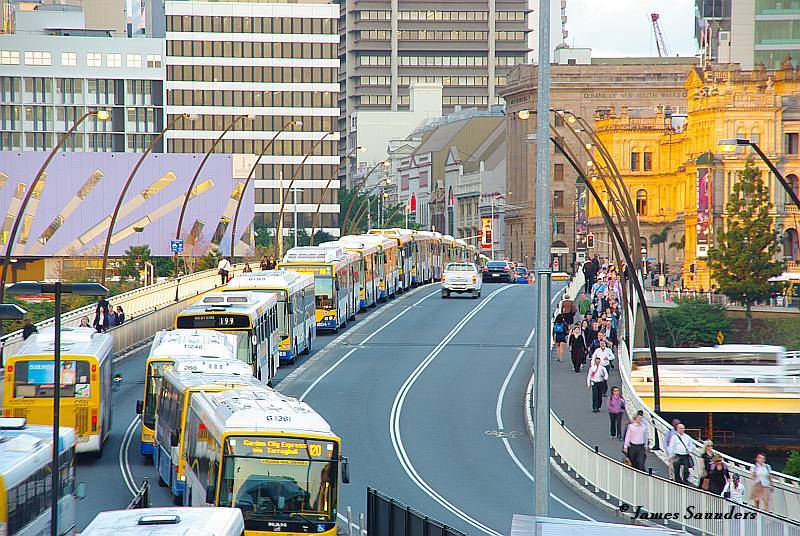
The real problem common with BRT is the operating cost of carrying the large amount of passengers, only using buses, once the passenger levels become very high. That level is different for every city and is dependent on the exact nature and characteristics of the right of way. The picture Zwei used of the Brisbane Busway is another common occurrence on successful Bus-ways, bus back ups at choke points or stations. The company MMM Consulting (nee McCormik Rankin Consulting) was the main designer and developer of both Ottawaai??i??s Transit-way System and its child, the Brisbane Bus-way Network, the subject of the articleai??i??s main picture.
The main differences between the two are the fact that Ottawaai??i??s Transit-way System was designed and mostly built in the 70ai???s, 80ai???s and 90ai???s whereas, Brisbaneai??i??s was designed and built in the 90ai???s, 00ai???s and 10ai???s. The other major difference is that unlike Ottawa, Brisbane was able to build a fully segregated right of way through its downtown which comprised below grade tunnels and above grade viaducts and a physically segregated surface route. Ottawa has painted bus lanes on a couplet of downtown one-way streets with signal modification which allow Transit-way (east-west traffic) almost the legal limit of signal priority over the north-south traffic at intersections. The difference between the two, using roughly the same number of vehicles about 185-200 buses/hour/direction at peak the Ottawa Transit-way can move 10500 people/hour/ direction and Brisbane about 14,000p/h/d.
Both however, have the same issue, massive back ups of buses primarily at downtown or major bus-way stations because the size and handling capacity of the actual stations has been grossly under built. The issue is that, to handle these kind of crowds and move them with 12 and 18 metre single articulated buses (23 metre long, double articulated and 30 metre long triple articulated buses are not street legal in Canada or Australia and even in the USA for that matter) you must construct monster sized, at the least full metro sized or larger bus station platforms that are or exceed 150 metres in length. The stations also have to be 4 lanes wide, 4 metres per lane, not including station platform width. Most downtown businesses would not want to be located near one of these stations for obvious reasons. One of Brisbaneai??i??s bus-way stations was enlarged to this standard, the bus back up picture Zwei used for this article is the que of buses entering that station.
The other main issue is the operational cost of having to use that many bus drivers and buses. Buses in general have far too little capacity for these high traffic BRT operations. In China and Latin America drivers cost much less as a proportion of the total operating cost of each bus 50-60% in Latin America and 30-45% in China. In the northern 2/3 North America, Western and Central Europe, Australia/New Zealand, Japan Taiwan, basically most of the so called developed world, the cost of the bus driver is 70-80% of the total cost of operating the bus. Using 185-200 buses/hour/direction to move people becomes a great financial drain on the operating bus system as a whole and makes it almost impossible to get extra buses to other non bus-way routes that need them. In Ottawa, several suburban routes that have needed many more buses to handle their high passenger levels canai??i??t get them and havenai??i??t been able to for more than a decade because so many buses are tied up on the Transit way, either on it or at the stations during peak hours. There are barely enough extra buses left to handle individual bus breakdowns let alone provide extra service on other routes. Buying more buses was not an answer because Ottawaai??i??s bus fleet was already near 1100 vehicles this is a pretty big fleet for a city and area of at most, 1.2 million people. This would put the operational budget into a serious deficit. We already had the most expensive per taxpayer transit portion on our tax bills of all Ontario municipalities it really does not need to go higher. The bus options had run out of time. Ottawaai??i??s answer was LRT. Brisbane continues to maintain their heavily used portions of busways. Ottawa is building more Transit ways but in suburban areas with much lighter passenger traffic levels.
The Transit-way was designed to be converted to rail however, the cost to convert the first part would be an eye popping $2.1 Billion. The reason was no one ever figured how much extra work there would be like, having to build parallel temporary bus rights of way so that, all those buses didnai??i??t totally clog city streets during conversion of the Transit-way to rail and the fact that, they waited till much the original Transit-way infrastructure was in desperate need of replacement due to age. Some Transitway right of way also was only temporary and not rail friendly. These temporary rights of way lasted for over 30 years and now have to be either totally rebuilt and or abandoned at high cost. The kicker about the high operational cost of servicing bus-ways at high passenger demands was that, even with Ottawa being forced to build a 2.5 km tunnel, with 3 very large underground stations at a cost of $715 Million under downtown for the LRT line (surface operation would have simply exchanged heavy surface bus traffic and passenger crowds for heavy surface LRV traffic and passenger crowds) operationally, Ottawa was going to save a minimum of $60 million a year, switching to LRT technology.
The take away from this is that, building ai???Real BRTai??? can be a very good way of building up ridership and up to a certain point, a less costly way, compared to a lot of rail systems, to move people in a North American low density environment. The problem now even in Canada is that, politicians are building express bus systems like B Lines, Bramptonai??i??s Zum (pronounced zoom) and many comparable systems in the US and calling it BRT, which it really is not. Those politicians love doing it because this false BRT is much cheaper to build and operate than real BRT and they still get a ribbon cutting ceremony. The problem is that, the amount you spend with these systems generally is comparable to the systems effectiveness in moving passengers. VIVA, (York Region Transit) for example, started with the faux BRT or what I like to call ai???BRT Liteai??? but, had definite designs and plans to build physically separate BRT rights of way that can be converted to a high capacity LRT system in the future and has carried through on it. York Region just didnai??i??t have the passenger count to build LRT at the beginning. But they have designed in the ability to easily convert the BRT system to LRT technology when needed. Brampton (which is part of Peel Region) just to the west of York Region has no definite plan or design to convert its Zum system to a real BRT standard now or in the future. However, the Zum System has built up Bramptonai??i??s transit ridership. I am not saying that, these ai???BRT Liteai??? systems arenai??i??t useful but they are not real BRT and should be labeled as that because they can confuse people into not building anything in places that need improved transit but canai??i??t afford to build or operate LRT and or support LRT with enough passengers. As a planner it is quite common to hear comments like this at public meetings,ai??? I saw BRT in Brampton and it gets stuck in regular traffic all the time. BRT sucks!ai??? Then you have to explain what real BRT is and is not, by then most people fall asleep or stop listening.
Then you get into a half technical half ethical problem with BRT and or any other transit operating technology for that matter. How do you study the differences between operating technology so that you are being fair as well as being accurate in the final choice of technology? The best recent example of what not to do is right here locally in Vancouver, South of the Fraser River, to be exact.
Trying to convince people in Surrey that, their LRT plan is useful, TransLink used a SkyTrain option as well as a surface BRT option to compare to LRT capability, pointing out the superiority of LRT in this case. The SkyTrain option had many problems cost and general usefulness being the main ones. The BRT example they used is actually an LRT line using buses operating on a layout and design which is not even close to what a real BRT line in a on-street environment would or should be using. Its not even close to the best Canadian practices, let alone best practices used in the rest of the world, with BRT systems in a on-street environment. Did the staff doing this know enough to do this purposely or were they ignorant of the differences of what good BRT design is or is not. Their example of LRT also displays a either a serious lack of knowledge about best surface LRT operating practices in the US and Canada. More importantly it shows to me, how committed or in this case not committed, TransLink staff really are to studying LRT technology at all. In fact, I donai??i??t blame the people who supported SkyTrain technology for this area, like Daryl from SkyTrain for Surrey, he had a point, on the surface this study definitely made it look like that to me that the SkyTrain Light Metro was the superior technology choice. The difference as a professional is that, I know the real differences in all the technologies that were studied. I also have no belief that, I am the be all and end all of studying these things in the world and would also ask for much help in studying these technology choices from other friends and companies I am familiar with, whom are experts at it. To me a whole new study should be done using the actual best practices for all technologies not just the preferred LRT technology, you should seriously question major aspects and assumptions that were made in this particular TransLink study.
The Fiscal Realities of Subways Surface
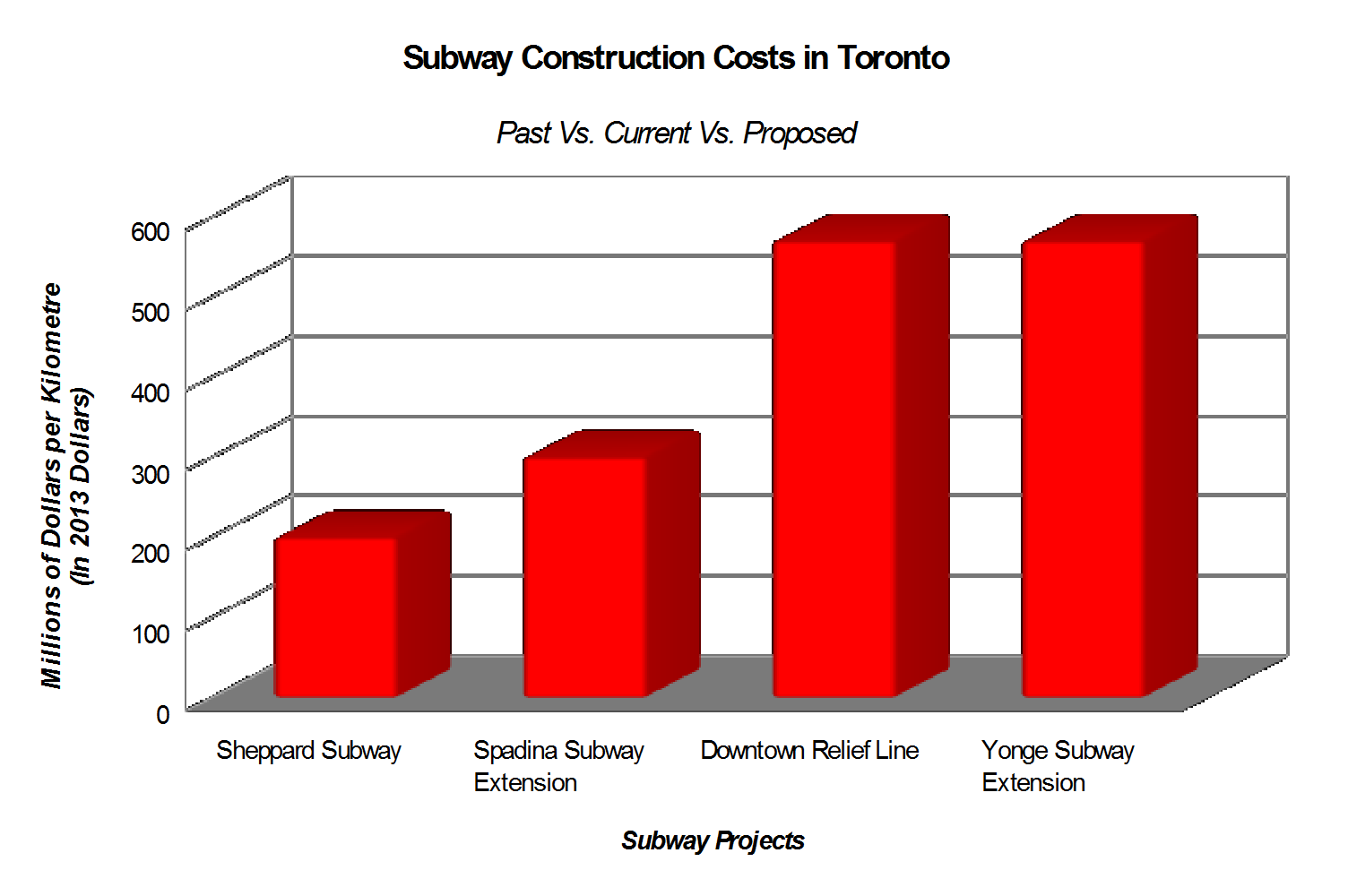
Taxpayers in Ontario are slowly awakening up to the fiscal realities of modern subway construction, just as their European counterparts did in the 1970’s and 80’s.
Little known on this side of the pond, is that subway construction in Europe has almost bankrupted public transit en mass and by the 1990’s subways were only considered as a last resort when ridership on a transit route demanded grade separation.
This has given birth to the Light Rail Renaissance, which has seen a massive resurgence of the modern tram.
In North America the financial reality of subway construction has not been recognized, leading planners on this side of the pond planning LRT as a light metro and trying to make “streetcars” a separate transit mode.
In about two decades we will be singing the European tram tune as today’s subways will become tomorrow’s money pits. Vancouver taxpayer’s please take note.
Wavering public support puts cracks in political subway deal: James
ALEX CONSIGLIO / TORONTO STAR Order this photo
The Scarborough RT has never been upgraded – unlike the SkyTrain system in Vancouver that uses similar technology.
By:Ai??Royson JamesAi??Toronto Politics, Published on Wed Aug 05 2015
Premier Kathleen Wynne and Mayor John ToryAi??(open John Tory’s policard)Ai??no doubt share a common unease about their stubborn, unsubstantiated faith in the proposed Scarborough subway. But the doctrine of political expediency helps them keep the faith.
Even as they mouth support for the project that is essentially a $2-billion over-build of transit infrastructure, both political leaders know the justification is non-existent.
Oh, the payback in political support is demonstrable.
Link the current east-west subway terminus at Kennedy Station to the Scarborough Town Centre, and enough Scarborough residents are ecstatic enough to vote for you. It worked for Mitzie Hunter of the provincial Liberals. As a member of a study team, she advocated an LRT for the corridor. Then, reading the political tea leaves as a Liberal candidate, Hunter became a subway convert. And won the riding.
Politicians being politicians, they canai??i??t help themselves when their strategists point out the direct link between public policy and vote buying. But on this scheme, the link weakens with every revelation about its shaky foundations.
Further evidence that, perhaps, Torontonians want a second look comes with a Forum Research poll that shows nearly half the city wants city council to re-examine the project. Nearly one in five respondents donai??i??t know what to think and one-third want the subway.
Some think the downtown relief line demands higher priority. Others want an LRT because it covers more neighbourhoods and costs less. Still others feel the subway runs too closely to the mayorai??i??s SmartTrack line ai??i?? a multi-billion-dollar project shoe-horned into existing plans and treated as if itai??i??s a fait accompli.
By now, the subway proponents should be comfortably ahead in the public opinion game. The subway extension has $660 million promised in federal money. Premier Wynne sticks by her $1.48-billion contribution. The city has approved a dedicated property tax hike for some 40 years. New mayor John Tory doesnai??i??t want to upset pro-subway councillors and potentially lose their votes on his SmartTrack scheme, so he hides behind the claim that city council has already voted ai??i?? the train has left the station, he says.
So, why is such a significant cohort of residents uneasy about the project? Why is support falling, not building?
Because approval and survival of the Scarborough subway is based on deception, faulty data, poor analysis, political opportunism and hubris.
The more residents learn about the Scarborough subway, the more they are convinced that the ridership is not there; the line runs where the fewest riders are and where the development potential is restrained; the projected ridership numbers that gave cover to councilai??i??s support in 2013 have not been tested, were done hurriedly and may be fictional; more cost-effective and appropriate alternatives exist and have been offered for decades; and other transit proposals now gaining steam (see SmartTrack) will only aggravate the waste.
Worse, citizens realize their city council is not working in the cityai??i??s interest. Councillors have voted, and will continue to vote, with the mayor ai??i?? so long as they feel they can get plum appointments and support for pet projects. These alliances are deaf to reason. Councillors literally put their fingers in their ears and vote ai??i?? whipped into action, they are, by the mayorai??i??s henchmen.
This condition is not unique to the current John Tory administration.
For decades the TTC urged the politicians to fix and upgrade the Scarborough RT into a modern system. The technology is the same one running well in Vancouver. Itai??i??s just that ours has never been upgraded. In 2006, TTC estimated the fix at $360 million.
Instead of acting, the transit commission and council let the RT go to ruin. Instead, Mayor David Miller proposed Transit City ai??i?? a light rail system. Then Rob FordAi??(open Rob Ford’s policard)Ai??bellowed ai???subways, subways, subways.ai??? Then, cynical politicians mined the idea that anything other than a subway in Scarborough is akin to dismissing borough residents as second-class citizens. And the pro-subway political juggernaut was born.
Truth has punched some cracks into that bedrock doctrine. But it will take something tectonic to crumble the foundations of this ruinous adventure.
In the fall, city council is to decide on the actual route of the subway. That provides an opportunity to reconsider and, maybe, change technology. It wonai??i??t happen. The entire weight of the mayorai??i??s office is arrayed to ensure its survival. Itai??i??s not that Tory cares about the project; he doesnai??i??t. Heai??i??s got a bigger fish to fry.
Tory needs votes to keep on track his transit pet project ai??i?? SmartTrack. That idea to run trains from Markham, through downtown and out near the airport at a cost of $8-, $9-, $10-billion is entirely untested. But it is the central plank in Toryai??i??s election campaign. It must proceed or the mayor loses credibility.
As such, Tory supports the Scarborough Subway to secure six or so crucial votes of city councillors politically invested to deliver the subway. The alliance is formidable ai??i?? never mind the wasted billions of taxpayersai??i?? dollars.
![[?IMG]](http://www.thestar.com/content/dam/thestar/news/city_hall/2015/08/05/wavering-public-support-puts-cracks-in-political-subway-deal-james/scarborough-rt.jpg.size.xxlarge.letterbox.jpg)
What the Bus Boys Don’t Tell About BRT
BRT – BRT is the clarion call from many politicians in the region, yet very few really have a clue what BRT is.
Real BRT or bus Rapid Transit is a bus which operates on an exclusive roadway or on a guideway. BRT costs about 70% of that of light rail to install, yet does not have many of the benefits of light rail. Buses cannot operate in multiple units, thus higher capacities require much higher operating costs.
What is being passed off as BRT in BC is nothing more than express buses, with limited HOV lane access. Though express buses reduce commute times, they don’t even come close in matching modern LRT.
Beware of those experts (?) who champion BRT as a transit solution; in reality, all they are offering is limited bus services with high operating costs.
ai???Deterioratingai??i?? Cambridgeshire guided busway may need to be ripped up
10 April 2015

Guided bus,
The guided busway may need to be ripped up and re-done, a county council official has warned.
The busway, which runs between Cambridge and Huntingdon, has had 11 million passengers since it opened four years ago, but it has been plagued with defects.
A technical report six months ago said the busway, which was built by contractor BAM Nuttall, had A?31 million worth of defects – in some places the track has risen four inches – which need to be addressed to tackle the ai???deterioratingai??? ride quality.
Next weekend, the section from Addenbrookesai??i??s Hospital to Trumpington will be shut for maintenance.
Speaking to BBC Radio Cambridgeshire, Bob Menzies, service director for strategy and development at Cambridgeshire County Council, said they may be forced to put rubber pads under every beam of the track.
ai???The ride quality has deteriorated since it opened, and the joints are moving. The last thing we want to do is to have to do this work. But on the other hand we have to make sure itai??i??s maintained and kept safe,ai??? he said.
ai???Itai??i??s a real shame we have this problem, that weai??i??re having to close it over a weekend, having to divert the buses round, and we many have to do more of this in the future.
ai???Our expertsai??i?? view is that eventually weai??i??ll need to fix it all. And itai??i??s a real shame.
ai???If we (the county council) have to weai??i??ll lift every beam up and put these rubber pads back under each one of them as they should have been done properly in the first place.ai???
Replacing beams cost several thousand pounds at a time, so replacing 6 million joints could add up to a ai???very big figureai???, Mr Menzies admitted.
The council has already spent A?1 million on legal action against Bam Nuttall in a bid to get them to take responsibility over the repairs, Mr Menzies added.
He said: ai???What we believe should happen is Bam Nuttall should come back and fix it all, and get the ride quality back to where it should have been.
ai???Theyai??i??re quite clearly defects. It quite clearly doesnai??i??t comply with the terms of the contract. Iai??i??m absolutely clear about that, and so are our lawyers. Thereai??i??s six thousand joints along the busway – that could add up to a very big figure if you have to fix every one over the course of a number of years. Thatai??i??s why weai??i??re taking legal action against Bam Nuttall.
ai???Iai??i??d like Bam Nuttall to come clean and accept their responsibilities. But I suspect it wonai??i??t. In effect it will take a lot longer than that, knowing the previous history.ai???
FACTFILE
The initial contract between Cambridgeshire County Council and BAM Nuttall was for 130 weeks of work, with the completion date on February 27, 2009.
But the busway construction was not completed until April 2011 and not open for use until August of that year as the council raised concerns about defects along the guideway.
The council instigated the review into the contract after the project ran into problems and delays, resulting in BAM Nuttall, repaying A?33million of the A?147m costs to settle a long-running dispute about who should pay for the overspend for the concrete route.
The report found BAM Nuttall did not think the design was as complete as it expected it to be when the contract was awarded.
Involving a consultant to review the design was not value for money and removed responsibility from the contractorai??i??s designer, the report added.
Is Compass Card Really the first Step to Privatization?

Long predicted, TransLink’s buses will all be “one-zone” fares, leaving those who ride the SeaBus and SkyTrain, pay premium fares.
Zwei sees this as the road to privatization, where money losing, politically designed and heavily subsidized bus routes (especially the trolleybuses routes) will be operated by Translink, and the mini-metro system and SeaBus will charge premium fares for those people wishing to complete their journey’s by SeaBus and/or metro.
If the SeaBus and SkyTrain portions of the transit system are privatized, the new operators will be free to charge what they wish, with the Compass Card automatically apportioning the correct fares. Private operators could raise fares without affecting TransLink’s bus fares.
Zwei does not like coincidences and TransLink’s claim that 130,000 compass Cards have been issued begs the question, has the 130,000 Compass Cards been issued to 130,000 people who qualify for the expanding U-Pass deep discounted fare program for post secondary students.
TransLink announces all bus routes to be one-zone fares starting Oct. 5
Ai??VANCOUVER SUN August 6, 2015
TransLink has announced that all bus routes will remain or be reduced to one-zone fares this fall, as part of the Compass card roll out.
Photograph by: Ric Ernst, PNG
METRO VANCOUVER – TransLink has announced that all bus routes will remain or be reduced to one-zone fares this fall, as part of the Compass card roll out.
Starting Oct. 5 until further notice, riders will be charged the current one-zone fare of $2.75 on buses and HandyDart regardless of how many zones they travel.
TransLink currently has three zones on buses, except Sundays, when customers pay only the one-zone fare. That fare will now be in effect at all times of day, every day, TransLink said Thursday.
TransLink also says starting this month, Compass Vending Machines will be activated in a phased manner at SkyTrain stations and SeaBus terminals. Single-use Compass tickets will be available from the machines to start, and by late October the machines will be stocked with Compass Cards.
About 130,000 TransLink customers have switched to Compass, according to the transit authority.

Oh Dear, the Scarborough R/T Replacement Again

Interesting news from Toronto, with the ongoing debate over the replacement of the Scarborough R/T.
One would think our Toronto cousins believe that money grows on trees, wanting a a $3 billion, three stop subway line instead of a more convenient $1.8 billion seven stop LRT line.
What I find so sad is the absolute absence of the European LRT Renaissance and instead, following the American practice of designing LRT as a very expensive light metro.
I wonder, like BC, what schools and hospitals will be closed to fund hugely expensive subway dreams?
Many want another look at Scarborough subway: poll
A firm majority ai??i?? 61 per cent ai??i?? want a downtown relief line before the Scarborough extension, a Forum phone poll has founds.
MARCUS OLENIUK / TORONTO STARAi??Order this photo
What will replace the aging Scarborough RT? A subway or an LRT? The answer still divides the city,a new Forum poll suggests.
By:Ai??Tess KalinowskiAi??Transportation reporter,Ai??Published on Wed Aug 05 2015
Mayor John ToryAi??(open John Tory’s policard)Ai??and Premier Kathleen Wynne have said theAi??matter is closed. But nearly half of Torontonians think city council should reopen the hot-button Scarborough subway debate, according to the latestAi??Forum Researchpoll.
Forty-eight per cent said they would like council to reconsider its approval of a $3-billion, three-stop subway extension from Kennedy Station over the abandoned plan, which promised a $1.8-billion, seven-stop LRT.
Thirty-four per cent donai??i??t want the topic reopened, the poll found, while nearly one in five respondents said they didnai??i??t know whether it should be discussed again.
Public opinion likely wonai??i??t be enough to persuade council to reconsider its position, said Forum president Lorne Bozinoff.
The public has had time to think about other transit projects that havenai??i??t achieved their ridership projections, including the Sheppard subway, he said. But ai???itai??i??s a done deal politically for Tory and Wynne. Even if they donai??i??t like it, theyai??i??ve got to go with it now.ai???
The appetite for reopening theAi??Scarborough transit debateAi??is somewhat surprising given that the public is anxious for results, he said.
ai???John Tory, to his credit, has really been pushing these achievements. He was talking about the (completed) island airport tunnel. There is real hunger for getting things done, and heai??i??s reflecting that,ai??? said Bozinoff.
The poll also shows that voters are split on whether a subway or LRT would best serve Scarborough. Forty-four per cent favour the subway, while 39 per cent like the LRT.
A majority of the respondents ai??i?? 61 per cent ai??i?? believe that the downtown relief line should be built ahead of the Scarborough subway extension. Overall only 28 per cent want the Scarborough line built first.
Among Scarborough residents, however, only 35 per cent considered the relief line the priority, compared to 74 per cent of downtowners who want that relief line built first.
On another transit front, ForumAi??found most TorontoniansAi??ai??i?? 70 per cent ai??i?? think the new airport train from Union Station should operate as part of the TTC with lower fares and more stops.
ai???In Metrolinxai??i??s mind this is like a business service, a premium service. But I donai??i??t think thatai??i??s how some people are perceiving it,ai??? he said.
The idea has spread that theAi??Union Pearson ExpressAi??(UPX) should be part of the TTC, said Bozinoff.
Forum also found that dissatisfaction with UPX fares is on the rise again, with 68 per cent saying the costai??i??s too high. An April poll on the topic had suggested that the sticker shock of the regular $27 one-way fare was fading. Then only 58 per cent of residents thought the train was too costly, down from 69 per cent in Dec.
Asked what would be an appropriate one-way fare for a TTC express commuter service on the UPX and 64 per cent of respondents said between $5 and $14. Thirteen per cent said the fare should be less than $5 and 17 per cent suggested $15 to $19 would be a fair price.
Only 25 per cent thought it was priced right already. Nine per cent of residents said they had already tried the new service, which opened in June; the uptake was about the same across the city and across most income groups.
Among those who havenai??i??t used the train, 58 per cent said they were not very likely or not at all likely to try it. Only 39 per cent said they were likely or somewhat likely to ride.
Forum Research polled 892 Toronto residents last Saturday and Sunday (Aug. 1-2) using an interactive voice response telephone survey that is considered accurate within 3 per cent 19 times out of 20.
Portland Streetcar spurs $4.5 billion in new real estate development

Funny that the city of Vancouver preaches that only a SkyTrain subway will spur investment along Broadway, while at the same time, treats light rail as an economic leper.
Well streetcars in Portland, Oregon prove otherwise.
Rail News: Passenger Rail
Portland Streetcar spurs $4.5 billion in new real estate development, study saysSince 1998, the Portland Streetcar corridor has brought in $4.5 billion in new real estate development, according to new data released by the group that oversees the city’s streetcar system.
Portland Streetcar Inc. tapped ECONorthwest to conduct the analysis, which evaluated economic development data outcomes since construction began on the streetcar line in 1998.
Since that time, real estate development has increased by 22.9 million square feet along the streetcar corridor, which is defined as the area within a quarter mile of either side of the tracks.Additionally, the market value of both new and existing properties along the route has increased by $11.63 billion since 1998, Portland Streetcar officials said.
Of the 7.7 million square feet of commercial real estate that has been developed along the corridor, 35 percent is attributable to the proximity to the streetcar, the study found. Forty-one percent of the approximately 18,000 residential units were built due to the presence of the streetcar.
Additionally, 25 percent of all apartments along the corridor are subsidized affordable housing units.
“While there are plenty of factors that influence investment decisions, weai??i??ve seen that the streetcar has had a positive impact on economic development in the central city,ai??? said Portland Streetcar Executive Director Dan Bower. ai???By providing affordable, accessible, and reliable service, the streetcar is a key part of what makes Portland such a livable city.”

Light Metro Woes in Hawaii
All is not well with Honolulu’s new light metro system.
A classic “I told you so” situation has occurred as the fiscal realities of light metro are hitting home very hard. I hope taxpayers have very deep pockets.
With proprietary light metro systems, politicians purposely forget that you can also build light rail as a light-metro if you want to throw more money at it, but with LRT you retain the ability to operate on lesser rights-of-ways in the future.
This is certainly a lesson not learned in Vancouver.

City Council sets aside $150K for rail consultant
Posted: Jul 30, 2015 11:20 PM PST
HONOLULU (Hawaii News Now) –
The City Council has set aside $150,000 for their own independent consultant. But according to the council chair, the new hire is less concerned with future obstacles and more about past problems.
The Honolulu Authority for Rapid Transportation got a first glimpse on Thursday of a scale model of the driverless trains that will be running along Honolulu’s rail line when the project is complete.
The first full size train is expected to be delivered to Hawaii by Spring 2016.
Former Congresswoman Coleen Hanabusa was sworn in on Thursday as the newest board member of HART, as selected last month by Honolulu Mayor Kirk Caldwell.
The Mayor’s new rail consultant met HART’s board for the first time Thursday.
“The project has no shortage of challenges. Many of those challenges have been overcome — however, there will be many more requiring resolution in the future,” explained Independent rail consultant Michael Burns. “I hope to provide constructive input toward meeting those challenges.”
City officials were quick to address the perception that the appointment reflects concerns about current leadership.
“It’s not a comment on the organization, their competence and their ability to do their job, it’s simply a desire by the mayor that we have somebody who looks over the mayor’s shoulder — looks at our processes and our policies, our governance,” said Department of Transportation Services Director Michael Formby.
But one vocal community advocate raised other questions about the independent consultant’s hire — in light of word the city council would hire its own.
“Rail is going to become and probably already has become a new political football that is going to figure very prominently in the next mayoral election,” said community advocate Dr. Jim Anthony.
Council Chair Ernie Martin is believed to be considering a challenge against Mayor Kirk Caldwell in 2016.
His office confirms a budget has been approved to hire a rail consultant — whose job it will be to determine how the project fell short nearly 1 billion dollars.
The mayor’s appointee — who has 40 years experience in the rail industry — says he’s well-versed in dealing with highly politicized environments and will focus on the work itself.
“I’m not carrying anybody’s water,’ Burns said. ” I am coming in as an independent — sort of a peer review type of a role, to see if there are ways that the project can look at things differently and in the end, make the project better.”
Officials also voted today on a new chair — Don Horner will now head HART’s board of directors.
Copyright 2015 Hawaii News Now. All rights reserved.
Nelson streetcar museum opens Monday
Streetcar news from Nelson BC.

Nelson streetcar museum opens Monday
- Contributed – Nelson Star
- posted Jul 28, 2015
The Nelson Electric Tramway Society is ready to officially open their latest project, the Car Barn Museum. On Monday they are inviting the entire community to come on down from 11 a.m. to 4:30 p.m. with free streetcar rides and museum admission. At 1 p.m. there will be a special grand opening ceremony with ribbon cutting, tours, cake, refreshments, classic cars and special guests.
The tramway society has been working toward this goal ever since they rolled out Streetcar 23 in 1992.
The idea was to create a working museum of Nelsonai??i??s history. The first phase of this project was to get Nelsonai??i??s original streetcar operational and then over time create additional opportunities to enrich and educate the community. The goalAi?? was to create a dedicated space for displays and historical artifacts.
Over the past two years the car barn, with the help and love of volunteers, has been renovated to include a dedicated museum space and displays throughout the barn.
Over the years, many artifacts and photos have been entrusted to the society by community members who wished to keep Nelsonai??i??s streetcar heritage alive for future generations. The museum project has given the society an opportunity to present these items to the public.
The artifacts are now housed in a dedicated museum space with additional equipment displayed throughout the car barn.
ai???The Car Barn Museum will have many benefits for the community, from keeping our history fresh and accessible to tourists and students, to giving retired people an opportunity to still be engaged with the community,ai??? says Jim Robertson, the project manager.
ai???The best thing about this project is that it will always be growing and developing, we are looking forward to helping keep Nelsonai??i??s history alive.ai???
For more information call 250-352-7672, email info@nelsonstreetcar.org or come on down and visit the car barn in Lakeside Park, right beside the soccer fields and next to the Nelson Rowing Club.
Crossing the Fraser
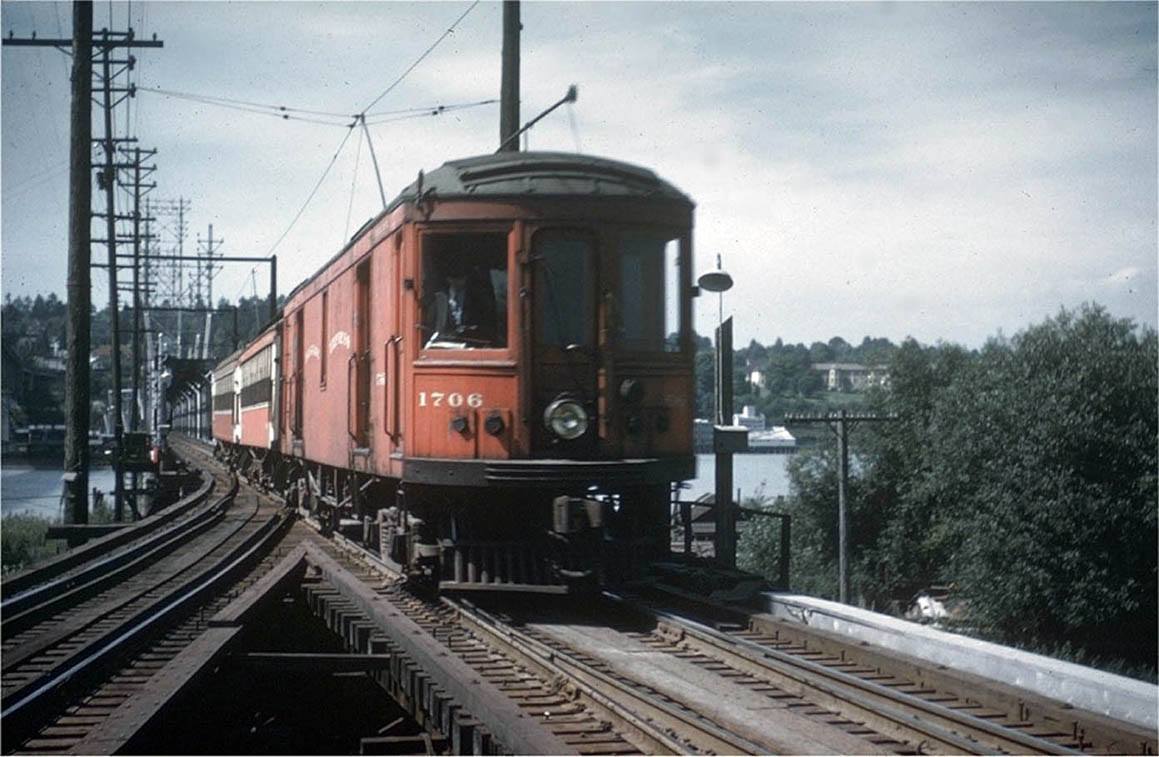
In answer to a private email, yes indeed the Chilliwack interurban did cross the Fraser River, using the then Great Northern Railway Fraser River Bridge. The photo is a Chilliwack bound train in the late 1940’s.
And yes, the proposed TramTrain could use the same bridge today.



Recent Comments