Another suicide on SkyTrain
A touchy subject but it must be addressed.
A medical emergency is TransLink speak for someone killed by a Skytrain, either by accident or suicide. In most cases some poor soul has decided to end their days by throwing themselves in front of a driverless SkyTrain.
For those contemplating suicide, their twisted thinking is that a driverless train is the perfect killing machine and in Europe, screens and sliding doors are now the norm on major subway systems, to prevent “machine killing” by automatic metros.
Light Rail doesn’t have the same type of problems, because drivers are trained to look for potential suicides and the tram design itself, prevents people being run over, with modern design “lifesavers”.
SkyTrain service restored following medical emergency
A train on the SkyTrain Expo line. The Burrard Street SkyTrain service has been temporarily shut down because of a medical emergency.
Photograph by: Ward Perrin, Vancouver Sun
VANCOUVER – The Burrard Street SkyTrain service has resumed after it was shut down this morning because of a medical emergency.
TransLink says riders should allow some extra travel time as service returns to normal. A shuttle bus had been operating between Main Street and Waterfront stations, but that will end now that the Expo Line is operational.
TransLink has not released any details of the emergency.
Ai?? Copyright (c) The Vancouver Sun

TransLink wants $23 billion to expand transit system
From your wildest dreams department: TransLink wants 23 billion dollars over the next three decades to improve transit.
Ha, ha, ha; and this from an organization who has been less than honest about transit since their inception.
Really boys & girls, do you still want the public to believe that subways will attract more new ridership than a modern streetcar? Then show us the proof. Oh, I see, there is no proof and you want more money for this type of bumf?
Starting with the best of intentions, TransLink has devolved into an inept organization, which can’t even run the buses properly and if the bureaucrats spent more time in operating an efficient transit service, instead of spin doctoring for expensive light metros like SkyTrain and the Canada Line, and even more expensive subways for Vancouver maybe the taxpayer would agree to ante up a few more pennies for better transit in the region.
For the cost of a Broadway subway to UBC, is about $4 billion, we could build a BCIT to UBC LRT; a new Fraser River Rail Bridge; a White Rock to Surrey Central and Vancouver LRT; and the full build Vancouver to Chilliwack TramTrain.
As it stands, the regional taxpayer does not want to spend a penny more for transit, mostly spent on prestigious subways in Vancouver and maybe it is time to disband TransLink and start anew.

TransLink wants $23 billion to expand transit system
the money would be delivered over three decades
VANCOUVER (NEWS1130) ai??i?? Itai??i??s a plan some are already calling unrealistic, while others argue it is much needed.
TransLink wants to spend as much as $23 billion over the next three decades to improve and expand the transit system.
The transportation authority is appearing in front of the Mayorai??i??s Council debating the dollar figure.
Burnaby Mayor Derek Corrigan is not in favour of the request. ai???The idea that the property taxpayer is a bottomless pit of money is over. The reality is that weai??i??re seeing, in every one of our communities, blow back from the public.ai???
Vancouver Mayor Gregor Robertson is arguing itai??i??s going to take billions of dollars to help people move around and itai??i??s silly to think transit investments arenai??i??t needed.
SkyTrain service disrupted on Millennium Line Monday
No mention of this major disruption Monday in the Sun and Province today and it was the Georgia Straight that printed the news.
The computer glitches are becoming far too common on the SkyTrain and Canada line light metros.
Who said that SkyTrain was more reliable than light rail?

SkyTrain service disrupted on Millennium Line
by Stephen Thomson on Jun 17, 2013
SkyTrain service has been halted on much of the Millennium Line because of a computer problem, TransLink says.
TransLink plans to operate bus bridges between VCC-Clark and Lougheed stations, and between Braid and Lougheed stations.
All SkyTrain stations between VCC-Clark and Lougheed are being closed until the problem is fixed, TransLink says.
The service disruption has not affected the Expo Line or Canada Line.
From a blog post:
Jun 18, 2013 at 12:08 amAlthough there were bus bridges to take passengers, translink didn’t have staffs to guide the passengers to take which bus. It was in a mass and was seen that staffs doing nothing but gathering in the entrance of Braid Station.
The Great Capacity Debate – The USA Versus the World

For the past few weeks, there has been a bare knuckle debate on the LRPPro blog about light rail capacity and it seems in the USA, there is an independent view of capacity.
The industry standard for light rail vehicle capacity is all seats occupied and standees @ 4 persons per metre/2.
Crush load capacity has been put at all seats filled and standees@6 persons per metre/2.
Theoretical maximum loading, to test brakes, etc has been put at all seats taken and standees@8 persons per metre/2.
Thus a transit line with 6 minute headways (10 trains per hour), operating LRV’s with a capacity of 200 persons per car is said to have a hourly capacity ofAi?? 2,000 persons per hour per direction. Capacity can be increased either by decreasing headways or operating LRV’s in coupled sets. For simplicity, capacity is a function of headway.
No so.Ai?? From our American friends, who quote from Prof. Vukan R. Vuchic, a transit guru from South of the boarder,Ai?? has come up some time ago with a unique formula for calculation vehicle capacity.
The USA, has now taken a different path and instead of Offered Capacity (vehicles, seats or places per hour), American planners use Utilized Capacity (passengers per hour) to determineAi?? line capacity and they absolutely will not accept any other calculation for capacity.
Utilized’ capacity’ level for rail transit calculates total capacity as being 4 to 5 passengers per meter of gross vehicle length. As an example, a 14 metre Mk1. SkyTrain carAi?? has 36 seats and room for 44 standees for a total of 80 persons per car. Using the American method, the capacity of the very same car would be 48 to 60 persons. As one well knows, Zwei is not a fan of SkyTrain, but for anyone who travels via SkyTrain during the peak hours, those Mk. 1 cars carry far more than this number.
By using the American or the Vuchic method, capacity drops considerably and this drop in potential capacity is being used by opponents of LRT in the metro Vancouver Region.
By using the industry/world standard for SkyTrain and comparing it with the American/Vuchic standard for light rail, means that the advertised capacity of LRT is greatly reduced, so much so, that even BC’s auditor General’s Department may have been mislead.
In the USA, it is taken as gospel that LRT can’t carry more than 9,000 pphpd, which then puts modern LRT in a very weak position, especially on routes with large traffic flows such as Broadway in Vancouver. By coincidence, Vancouver city Engineers and Translink are saying that LRT can’t cater to, due to low capacity, traffic flows in excess of 9,000 pphpd.
Of course, the SkyTrain boys and girlsAi?? ignore that many LRT systems cater to much higher traffic flows such as Calgary, which offers 12,000 “seats” per direction in peak hours and Karlsruhe, Germany, where the tram route on Kaiserstrasse sees 80 trains per hour per direction in peak hours, offering a conservative capacity of over 33,000 pphpd!
The danger is simple, those wishing to continue building with SkyTrain will cite the international standard for capacity, while at the same time citing the American standard for capacity for LRT. Sadly, the USA has been fertile ground for Bus Rapid Transit and other gadget or gizmobahnen, while the planning and construction of new light rail lines will be hamstrung with questionable statistics from a monolithic advocacy group that has lost all sense of reality and has retreated behind a wall of 1980 vintage transit studies.
The message is clear for Rail for the Valley and other local transit groups, we must be wary of US consultants, who use 1980’s transit studies as a basis for projects in the 21st century.
Addendum:
The following from Wikipedia, gives the capacity of the four variants of TransLink’s mini-metro cars.
ModelAi??Ai??Ai??Ai??Ai??Ai??Ai??Ai??Ai??Ai??Ai??Ai??Ai??Ai??Ai??Ai??Ai??Ai??Ai??Ai??Ai??Ai??Ai??Ai??Ai??Ai??Ai??Ai??Ai??Ai??Ai??Ai??Ai??Ai??Ai??Ai??Ai??Ai??Ai??Ai??Ai??Ai??Ai??Ai??Ai??Ai??Ai?? Seats/carAi??Ai??Ai??Ai??Ai??Ai??Ai?? Capacity/carAi??Ai??Ai??Ai??Ai??Ai?? Cars/trainAi??Ai??Ai??Ai??Ai??Ai??Ai??Ai??Ai??Ai?? Length/trainAi??Ai??Ai??Ai??Ai??Ai??Ai??Ai??Ai?? Capacity/train
ICTS Mark I (1984ai??i??1993)Ai??Ai??Ai??Ai??Ai??Ai??Ai??Ai??Ai??Ai??Ai??Ai??Ai??Ai??Ai?? 36Ai??Ai??Ai??Ai??Ai??Ai??Ai??Ai??Ai??Ai??Ai??Ai??Ai??Ai??Ai??Ai??Ai??Ai??Ai??Ai??Ai??Ai??Ai?? 80Ai??Ai??Ai??Ai??Ai??Ai??Ai??Ai??Ai??Ai??Ai??Ai??Ai??Ai??Ai??Ai??Ai??Ai??Ai??Ai?? 4 or 6 carsAi??Ai??Ai??Ai??Ai??Ai??Ai??Ai??Ai??Ai??Ai?? 48 or 72 mAi??Ai??Ai??Ai??Ai??Ai??Ai??Ai??Ai??Ai??Ai??Ai??Ai??Ai?? 320 or 480
ART Mark II (2002)Ai??Ai??Ai??Ai??Ai??Ai??Ai??Ai??Ai??Ai??Ai??Ai??Ai??Ai??Ai??Ai??Ai??Ai??Ai??Ai??Ai??Ai??Ai??Ai??Ai??Ai?? 41Ai??Ai??Ai??Ai??Ai??Ai??Ai??Ai??Ai??Ai??Ai??Ai??Ai??Ai??Ai??Ai??Ai??Ai??Ai??Ai??Ai??Ai??Ai?? 130Ai??Ai??Ai??Ai??Ai??Ai??Ai??Ai??Ai??Ai??Ai??Ai??Ai??Ai??Ai??Ai??Ai??Ai??Ai??Ai?? 2 or 4 carsAi??Ai??Ai??Ai??Ai??Ai??Ai??Ai??Ai?? 34 or 68 mAi??Ai??Ai??Ai??Ai??Ai??Ai??Ai??Ai??Ai??Ai??Ai??Ai??Ai?? 260 or 520
ART Mark II (2009/2010)Ai??Ai??Ai??Ai??Ai??Ai??Ai??Ai??Ai??Ai??Ai??Ai??Ai?? 33Ai??Ai??Ai??Ai??Ai??Ai??Ai??Ai??Ai??Ai??Ai??Ai??Ai??Ai??Ai??Ai??Ai??Ai??Ai??Ai??Ai??Ai??Ai?? 145Ai??Ai??Ai??Ai??Ai??Ai??Ai??Ai??Ai??Ai??Ai??Ai??Ai??Ai??Ai??Ai??Ai??Ai??Ai??Ai?? 2 or 4 carsAi??Ai??Ai??Ai??Ai??Ai??Ai??Ai??Ai?? 34 or 68 mAi??Ai??Ai??Ai??Ai??Ai??Ai??Ai??Ai??Ai??Ai??Ai??Ai??Ai??Ai?? 290 or 580
Hyundai Rotem EMUAi??Ai??Ai??Ai??Ai??Ai??Ai??Ai??Ai??Ai??Ai??Ai??Ai??Ai??Ai??Ai??Ai??Ai??Ai??Ai??Ai??Ai??Ai??Ai?? 44Ai??Ai??Ai??Ai??Ai??Ai??Ai??Ai??Ai??Ai??Ai??Ai??Ai??Ai??Ai??Ai??Ai??Ai??Ai??Ai??Ai??Ai??Ai??Ai?? 167Ai??Ai??Ai??Ai??Ai??Ai??Ai??Ai??Ai??Ai??Ai??Ai??Ai??Ai??Ai??Ai??Ai??Ai??Ai??Ai?? 2 carsAi??Ai??Ai??Ai??Ai??Ai??Ai??Ai??Ai??Ai??Ai??Ai??Ai??Ai??Ai??Ai??Ai??Ai??Ai??Ai??Ai?? 42 mAi??Ai??Ai??Ai??Ai??Ai??Ai??Ai??Ai??Ai??Ai??Ai??Ai??Ai??Ai??Ai??Ai??Ai??Ai??Ai??Ai??Ai??Ai??Ai?? 334
The same capacity using the American method of 4 to 5 passengers per meter of gross vehicle length.
ICTS Mark 1 – max. 120Ai?? persons per married pair – 4 or 6 car train, max capacity 240 to 300 persons.
ART Mk. 2 (2002) – max. 167 persons per married pair – 4 car train, max capacity 334 persons.
ART Mk.2 (2009/10) – max. 167 persons per married pair – 4 car train 334 persons.
Hyundai/ROTEM EMU – max.Ai?? 200 persons per married pair.
The World’s Top 10 Tram Rides
Taken from the National Geographicai??i??s Journeyai??i??s of a Lifetime ai??i?? 500 of the Worldai??i??s Greatest Trips
http://shop.nationalgeographic.com/ngs/browse/productDetail.jsp?productId=6200125&categoryId=A026&addFacet=9004:A026&navAction=jump
Melbourne’s route 96 tram has been named in National Geographic’s “Journeys of a Lifetime” coffee table book as one of the planet’s top 10 “trolley car” rides.
http://www.onlymelbourne.com.au/melbourne_details.php?id=13776
Ai??
Budapestai??i??s Tram Route No 2 is awarded 7th place, being the best European line on the list, beating Lisbon and Amsterdam tram lines:
http://welovebudapest.com/en/n-a/articles/2012/10/15/tram-no-2-among-the-top-10-tram-rides
Ai??

Torontoai??i??s Route 501 is awarded
http://www.citynews.ca/2007/12/29/t-o-streetcar-line-named-one-of-worlds-top-10-trolley-rides/
Ai??
The full list is:
1.Ai??Ai?? Hong Kong
2.Ai??Ai?? Melbourne Tram No 96
3.Ai??Ai?? New Orleansai??i?? St. Charles streetcar tour
4.Ai??Ai?? Budapest Tram No 2
5.Ai??Ai?? Berlin Tram No 68
6.Ai??Ai?? Lisbon Tram No 28
7.Ai??Ai?? Toronto `Queenai??i?? Route 501
8.Ai??Ai?? Amsterdam Tram No 2
9.Ai??Ai?? San Franciscoai??i??s Streetcar F
10. Ai??Seattleai??i??s George Benson waterfront streetcar
Trams & Streetcars make city’s, this is what the National Geograhical magazine award is all about. I can’t quite see a future Surrey Skytrain making the same impact, can you?
Why do some governments see Metros as more prestigious than Light Rail?
A pertinent question posed on one of the Light Rail discussion groups, particularly relevant in relation to Skytrain & the City’s of Surrey and Vancouver.
A selection of answers:
1) Very simple. Because it is more expensive. There is nothing as prestigious as money.
And then there is the tendency of: “The neighbouring community have one. I want one too” The skill is to choose the right system for the right purpose. Metro and Light Rail should not be competitors. They are meant for different purposes.
2) Light & Heavy Metro’s[MRT, MMTS & RTR], Subways & ART LRT systems are built underground or above ground on grade separated alignments. Thus not competing with at-grade road space with the private automobile.
This is seen by the politicians as not only prestigious but a vote winner, specifically with the road lobby. Think Toronto’s Rob Ford; `ending the war on cars’
At-grade Light Rail, LRT, Tramways, Trams & Streetcars compete for road space with other users even if they run on a dedicated tram-bahn alignment.
Factor in population density, planned journey time & projected/actual passenger boardings/loadings and Light Metro whether ART or classic, is more suited to the higher traffic loadings that you get in London, Paris, Moscow and many Asian city’s
3) Like Skyscrapers, Underground is seen as being more prestigious, more of the look at how much money we have.
However in Dublin Ireland the difference between a Metro & a Light Rail Tram System is not simply underground v trams. Dublin currently has 2 Light Rail Tram lines. Dublin also has plans for 2 Metro Projects.
Only one of these Metro Projects is in fact underground this being Metro North, the other one is at grade or grade seperated and called Metro West.
So in Dublin what is the difference between Metro & Light Rail Trams?
Simply the capacity of the system.
4) We have documentation that LRT is almost as fast as Metro in Copenhagen (+/- 1-2 min.) if you count door-to-door and not stop-to-stop.
The fact that LRT generally cost about 1/7 of underground metro systems should only enhance LRT, – but maybe it is other mechanisms at work.
“Mine is more expensive than yours”…
5) Ai??I am still amazed by the knee-jerk ant-LRT reaction in some quarters. One is caught between the proponents of the ‘prestigious’ metro and the ‘bus-can-do-everything-a- LRT can…and a fraction of the price’ headbangers.
There is the fact that a Metro is percieved as something that can be delivered without the political necessity to reallocate road space to walking, cycling and LRT and take it away from the inefficient private motor transport. We all know that this is the way to go, but it is politically difficult to sell the concept to democratic politicians – or the general public.
There is also the political concept that a city has ‘arrived’ when it gets a metro, it has joined the select list of Great World Cities. Indeed under the old, discredited, Soviet system a city with 1m+ inhabitants had to have a metro and the letter instructing you to start the planning process arrived when the population passed 900,000.
I know the arguments about capacity, but given that a full performance LRT only costs about 10% of a metro (except in Edinburgh…) having a metro with double the capacity of an LRT line, rather than having 5+ LRT lines in the conurbation, plus money to spare, would seem to be a better deal.
It all seems to come down do an irrational attitude, proponents of LRT are accused of being ‘blinkered’, whereas the metro, gizmo-bahn and BRT people are ‘rational’. In fact the evidence supports LRT as being the best overall fit in a wide range of circumstances and the data supports this. We need to be far more willing to promote LRT with robust arguments.

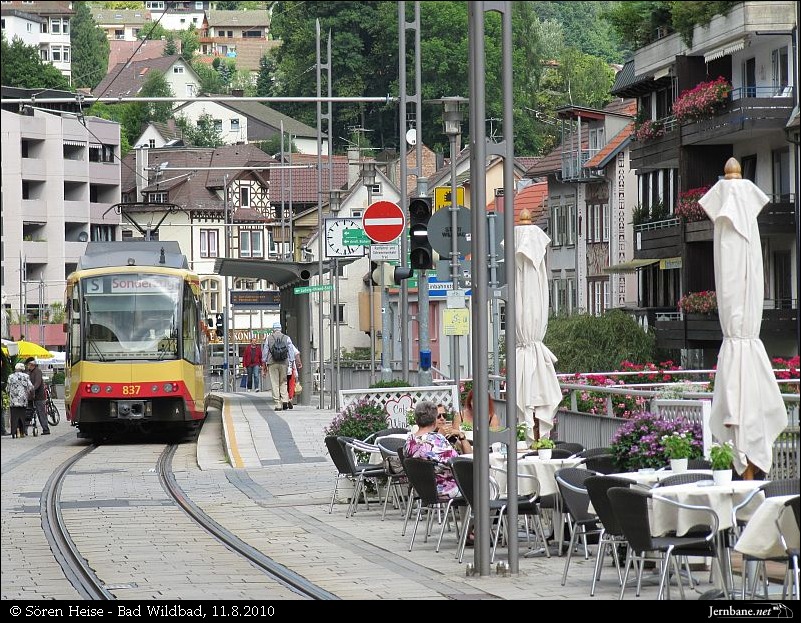
Coffee and Trams in Bad Wildbad.
Here we have a Karlsruhe TramTrain at a station or stop in BadAi?? Wildbad in Germany.
It seems the closeness of the tram line, winding through the town doesn’t seem to excite the locals, including the folks have a coffee at the track side cafe!
One wonders, could such an idyllic scene be possible in Surrey?
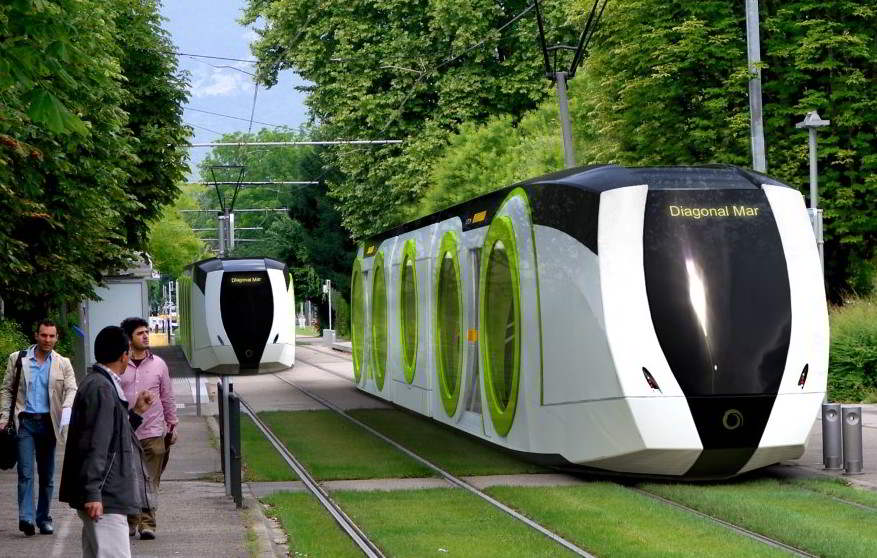
French Trams Of The Future Could be Surrey’s Too!
I found this Alstom tram of the future quite striking!
Designed by Alex Nadal, the tram is a tramtrain, able to operate both on tram (LRT) lines and on the mainline railways.

A New Patullo Bridge Must include A Fraser River Rail Bridge Replacement.
 Though, not combined with an auto bridge, the modern railway lift bridge
at Dordrecht, Netherlands is a good example of a modern railway lift span.
The GVRD in the late 1970’s got it right; the replacement for the Patullo Bridge, must also include a new, multi track rail Fraser River Rail Bridge, replacing the current elderly rail bridge.
The 70’s GVRD’sAi?? rapid transit study for the metro Vancouver region included a high level 6 lane car bridge with two LRT lines and a twin track lift span, replacing both the aged Patullo and Fraser River Rail Bridges.
A flip flop by the then Social Credit government, forcing a Skytrain transit solution on the region, combined with a one seat government majority and a temper tantrum by then Delta Social Credit MLA and House Speaker Walter Davidson, who threatened to resign his seat in the legislature and force an election if the proposed Fraser River crossing was not built in North Delta, sent the Patullo road/rail replacement bridge plans to the shredder. This literally happened and there are very few references today about a combined road/rail bridge replacement!
Crass political decisions of the day forced the abandonment of a Patullo road/rail Bridge replacement for over thirty years as the new Fraser River crossing was built from North Delta, across to Richmond, via Annicis island. Today, a new replacement bridge is being proposed, but not including the replacement of the more important Fraser river Rail Bridge.
With the advent of TramTrain (trams that can operate on the mainline railways) means that light rail can track-share with the mainline railways, without the need of a crossing for its exclusive use, unlike the SkyTrain Sky Bridge which can only accommodate the proprietary SkyTrain light-metro system. A new Fraser river Rail Bridge could provide the impetuous needed for improved public transit across the Fraser River at an affordable cost, especially with the RftV/Leewood, Vancouver to Chilliwack TramTrain and the RftV inspired Whalley, King George, Whiterock LRT.
A three track (one east bound, one west bound and a reverse use track) lift span must be included in any proposed replacement scheme and failure to do so, would only show how short sighted and inept TransLink, its management, and its planners are.
Pattullo Bridge replacement options all come with tolls
By Jeff Nagel – Surrey North Delta Leader
Published: June 03, 2013A new Surrey-Coquitlam bridge bypassing New Westminster is one of six recommended options TransLink has unveiled to replace the aging Pattullo Bridge that could profoundly change traffic patterns.
They were released Monday as part of a new round of public consultation this month.
And no matter which option is chosen, TransLink’s review of them suggests the replacement span will be tolled.
“Costs of $1 billion would be recoverable through user fees,” the report says, while adding a crossing costing more than that would need senior government contributions as well.
The most unusual option studied was a possible new four-lane Tree Island crossing well downstream of the Queensborough Bridge.
It would have offered a more direct Delta-Burnaby connection that would have taken traffic from the Alex Fraser Bridge in a near straight line over the Fraser’s north arm, instead of splitting either left to Richmond or right to Queensborough.
But TransLink’s screening review found it wouldn’t serve the existing Surrey-New Westminster traffic and Burnaby and Richmond fear more agricultural and industrial land would be lost.
It would act more as an alternative to the Queensborough Bridge than the Pattullo, the review said, but most motorists won’t pay the tolls to cover the $825-million cost of a bridge there if the Queensborough is free.
Two of them don’t call for a new bridge at all, but rehabilitating the existing PattulloAi?? for safer three- or four-lane use at a cost of $330 to $400 million, still funded by tolls.
Both would improve seismic and structural safety but risks of head-on crashes would continue as there’d be no median barrier either in the three-lane counterflow or four-lane configuration.
An all-new bridge near the existing one ai??i??Ai??either four, five or six lanes ai??i??Ai??would better resist a moderate quake, river scour or ship collision, all of which could knock the existing 75-year-old span out of service.
Those three options range from $820 million for four lanes to $1.1 billion for six. An eight-lane option was ruled out as attracting too much traffic and running counter to goals to move more people by cycling, walking and transit.
The five- and six-lane options may spur more auto-oriented development than four lanes, it said.
A last option recommended for more study offers a new four-lane Surrey-Coquitlam bridge, while also rehabilitating the old Pattullo for two- or three-lane use.
That would cost an estimated $1.4 to $1.5 billion, running from King George Boulevard through Surrey’s Bridgeview neighbourhood across to Braid Street and Highway 1’s Brunette interchange.
It lets traffic bypass New Westminster, going the farthest to address concern there about worsening congestion.
“Travel times and reliability would improve for most users,” the report said. “Goods movement would likely benefit overall, given more direct connections to Highway 1, United Boulevard and the northeast sector.”
TransLink’s review recommends against simply dismantling the current bridge or converting it to either a two-lane bridge or one for cyclists and pedestrians only. Doing so would cause much heavier truck congestion at other crossings, it said.
Also panned were four-lane tunnel scenarios on the existing route ($2.9 to $4.8 billion) and four or six-lane bridge options at Sapperton Bar ($1.7 billion to $3.1 billion.)
Spokesperson Patricia MacNeil said the issue of tolling isn’t yet settled and TransLink wants public feedback on all studied options, not just the recommended ones, to see if “we are on the right track.”
Public open houses are set for June 6, 11 and 15 in New Westminster and June 8, 12, and 13 in Surrey, with additional small group meetings also scheduled in both cities. For more details see pattullobridgereview.ca.


The Whalley, King George, White Rock Light Rail line Revisited

It has has been two years year since this post was printed and what TransLink has planned for Surrey are three “poorman’s” SkyTrain type designed light rail lines feeding SkyTrain.
TransLink designs new transit lines to increase density; to increase property values for land developers who are generally friends of the government and not to efficiently and affordably move people.
The same is true for LRT/streetcar planning for Surrey. Having TransLink plan for LRT is a major mistake, as the lumbering bureaucracy has no experience with modern light rail, nor has it shown any desire to gain experience, preferring to plan for much more prestigious SkyTrain and/or light metro. TransLink‘s desire to build with SkyTrain is clearly evident with the proposed Broadway subway, in Vancouver, where TransLink’s planners are designing a $4 billion subway to UBC on a route with average traffic flows below 5,000 persons per hour per direction!
What Surrey needs is a bold new vision for modern LRT and I believe the Whalley – King George – Whiterock or KWKAi?? LineAi?? would provide the vision to implement a strategic and affordable light rail network for Surrey and communities south of the Fraser river. Failure to plan and build sustainable light rail and to continue to plan and build with the hugely expensive SkyTrain light-metro, will beggar the region with ever escalating taxes, driving out business and residents alike, leaving Metro Vancouver a ghetto for the wealthy and the poor.
LIGHT RAIL FOR SURREY ai??i?? The Whalley ai??i?? King George ai??i?? White Rock (WKW) Line
First posted by zweisystem on Wednesday, May 4, 2011
Surrey wants light rail, but where will the first LRT line go and what line would attract the most customers to the new light rail line?
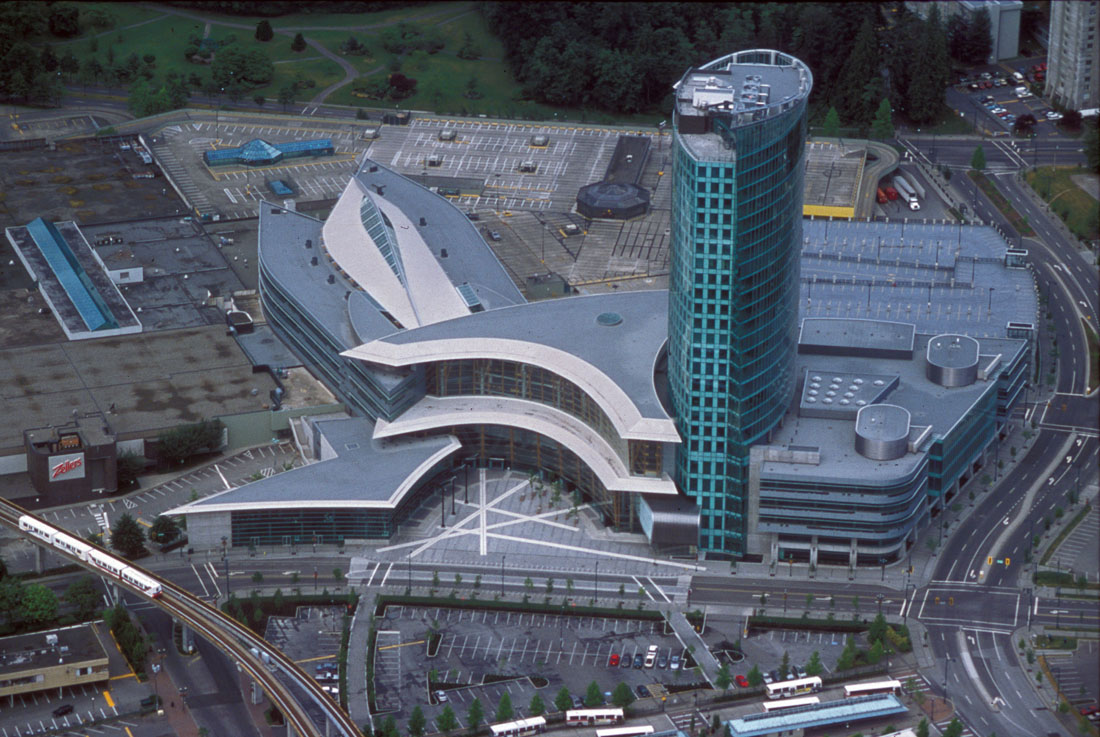
If the goal of the new light rail line is to serve customer needs and offer the ability to provide an attractive alternative to the car, it must serve a multitude of destinations. Those presently planning for LRT doAi??not much expertise and tend to treat the mode as a poor manai??i??s SkyTrain. Building LRT as an extension of the SkyTrain light-metro system will fail to meet expectations as LRT will not be designed to its best advantage. It is not ai???rocket scienceai??i?? to design a transit line to be an attractive alternative to the car and the following plan may prove useful.
The Light Rail Line
The 22 kilometer Whalley ai??i?? King George ai??i?? Rail for the Valley ai??i?? White Rock line (WKW Line for short) would be the foundation for an attractive light rail system in Surrey. The proposed light rail would be a classic LRT, operating on a ai???reserved rights-of-wayai??i?? (RoW) in the median of the roads involved.
The route of the WKW Line would start at at 108th Ave. & the King George Hwy., with a future connect along 108th to Guildford. From the terminus at108th St & the KG-V Hwy, the KWK Line would travel South (7.5 km) to the Southern RR of BC (formerly the BC Hydro R.R.), running in the median of the KGV highway. This portion of the route would service the Central City shopping district; Surrey Memorial Hospital; Queen Elizabeth Secondary School; Bear Creek Park; and the Newton shopping district.
The WKW Line would then network south-east along 4 km of the former BCE interurban and proposed Valley Rail Vancouver to Chilliwack TramTrain route to 152nd (4 km). Traveling mainly through industrial lands, which would provide the ideal location for the Light Rail storage and maintenance yards. The 4 km. of track involved would be double tracked and adequately signaled for safe freight/Interurban/tram operation.
There is the possibility of futureAi??joint operation with the RftV/Leewood interurban, enabling South Surrey and White Rock transit customerai??i??s to continue on the Scott Station or even into downtown Vancouver, if the ai???full buildai??? RftV/Leewood Interurban project is built.
From 152nd Street, the KWK Line would go straight south to White Rock (10.5 km) crossing the Nicomakle /Serpentine River valley basin. Along here the line must be raised above flood plain and three new bridges across the Superport Railway Line, and the Serpentine and Nicomakle rivers must be built. It is this portion of line that will be the most expensive.
Rising out of the small river valley the KWK Line would continue south along 152nd Ave., terminating in downtown White Rock.
Map of South Surrey & the City of White Rock

In the summer, the light rail line would bring congestion relief to White Rock by providing a quality transit alternative for the many thousands of people who come in cars to the popular beaches. Also close to the KWK Line is the South Surrey Athletic fields, which many fields and arenas are constantly busy with hockey, baseball, soccer, rugby, and football games, twelve months of the year. The KWK Line would also provide an excellent transportation access for the burgeoning housing estates in South Surrey and White Rock.
The Cost
The the total cost of the KWK Line, including bridges and/or viaducts should cost no more than $770 million, based on an average of $35 million/km to build (updated 2013). The high cost of major engineering in the Nicomakle/Serpentine valley, would be mitigated by simple on-street construction on 152nd and the King George Highway and track sharing for 4 km on the Southern Railway of BC Line bisecting Surrey .
It is interesting to note that the total cost for the 98 km RftV/Leewood Chilliwack to Scott Road Interurban using Diesel LRT and the 23 km KWK Line would be under $1.3 billion or put another way we could build 121 km of modern LRT lines in the Fraser Valley cheaper than the 11 km Evergreen Line!
Unlike present light rail planning, where development is encouraged to take place along a LRT/SkyTrain route, the KWK Line can pass through sensitive agriculture and ecological areas, without the need for land development. Building the KWK Line would provide a potential capacity of 20,000 persons per hour per direction on the route, well able to handle future passenger demands, yet still can be built much cheaper than its Skytrain/light-metro competitors. The cost for a SkyTrain along the KWK Line? About $2.3 billion at a conservative cost of $100 million per km to build!
A modern LRT Line in Madrid, Spain ai??i?? A template for the WKW Line?

Using low-floor trams, with convenient stops, ensures an obstacle free journey for all transit customers including the mobility impaired, without the need of expensive stations and equally expensive to maintain elevators and escalators.
The KWK Line can provide traffic calming where needed, yet still supply ample capacity for future transit needs. By providing a regular and efficient transit service from White Rock to Surrey Central and by servicing many destinations along its route the proposed LRT line would attract ample ridership, including the all important motorist from the car. The KWK Line would also easily integrate with the RftV TramTrain interurban service from Vancouver to Chilliwack and could provide in the not too distant future a direct White Rock to Vancouver TramTrain service, faster than the present bus and Canada line service.
The WKW Line would bring 21st century transit solutions to Surrey, transit solutions that are too long overdo.