Cost Canadian for new light rail construction.
Zwei has always challenged the Skytrain lobby that modern LRT was much cheaper to build than Skytrain, yet the SkyTrain Lobby still tries to make the cost new LRT construction in the Vancouver Metro area much more expensive than is should be. This intentional ‘gold-plating‘ of modern light rail by the City of Vancouver and TransLink has been so successful in that the SkyTrain lobby fooled the auditor General’s Office with the erroneous claims that SkyTrain can provide more capacity than LRT for about the same cost!
Note to AG’s Office – Capacity is a function of headway and not investment in infrastructure.
In Kitchener Ontario the “starter” 11.8 mile (19 km) long light rail line is estimated to cost CAD $536 million. Put another way, the 19 km starter line will cost about CADAi?? $28.2 million/km to build, which falls right into the cost range of $25 mil./km to $35 mil/km of most recent new built light rail line; except those lines which have been deliberately over-engineered, such as Calgary’s recent construction and Seattle’s expanding hybrid light metro/rail system.

The Waterloo regional government voted Tuesday to invite construction proposals for its 11.8-mile starter light rail line in southern Ontario between Waterloo and Kitchener at an estimated cost of $536 million (USD $514.7 million) and it’s to be built under a public-private partnership [3P], according to The Record, a Kitchener-based newspaper:
http://tinyurl.com/q92obpv
“Paige Desmond, Record staff
Tue May 28 2013 16:40:00
Regional council OK’s call for light rail transit proposalsWATERLOO REGION ai??i?? Regional councillors approved issuing a request for proposals to build light rail transit Tuesday ai??i?? but the vote was not unanimous.
Councillors Jean Haalboom and Jane Mitchell voted against.
The request for proposals is the final leap in choosing one of three construction consortia for the estimated $536-million (USD $514.7 million) contract to build light rail in Kitchener and Waterloo.
But Haalboom is still uncomfortable with the region’s decision to pursue a public-private partnership for the project.
“I have always been against the public-private partnership and I’ve seen the reports in London, England, where they get halfway through the projects and private companies walk away from the deal,” Haalboom said.
“Are we the taxpayers in this region left holding the bag to make this up?”
Thomas Schmidt, commissioner of transportation and environmental services, said the deal is set up to protect the region.
Up to 25 per cent of project costs will be held back from the chosen team, to ensure they get the job done.
“If they don’t complete it we will be holding funds back from them,” he said, adding there are provisions built into the contract to protect taxpayers.
Coun. Sean Strickland said while he shares Haalboom’s concerns, he’s confident in the project’s direction and the contract to design, build, finance, operate and maintain light rail that will be awarded.
“I think this is an excellent model,” he said. “I would not question it whatsoever.”
Mitchell has lingering concerns about construction and engineering giant SNC Lavalin being a main partner in one of the consortia.
Two former Lavalin officials are currently facing charges related to bids in North Africa and Montreal.
In April, the company was barred from bidding on Canadian foreign aid projects for a decade. The ban was the result of World Bank sanctions the company agreed to because of the allegations, which have not been proven in court.
Mitchell had previously asked council to have another look at the three consortia because of the SNC controversy.
She said for that reason, she could not support issuing the request for proposals.
“I could not vote for it,” Mitchell said. “I want us to go back to have another look at them but obviously that’s not going to happen.”
The successful construction team will build the 19 kilometres (11.8 miles) of light rail track from Conestoga Mall in Waterloo to Fairview Park mall in Kitchener.
The request for proposals will go out in June.
Unlike the request for qualifications, this document will not be made public until the deal closes sometime next year. It will be censored when it is released.
The region expects it will take about six months to complete the proposal process.
Construction of the light rail system is expected to begin in 2014.
The province has committed $300 million (USD $388.1 million) to help fund the rapid transit project.
The federal government will pay up to $265 million (USD $254.4 million) and the region has budgeted $253 million (USD $242.9 million).
Canada Line Fizzles

The Canada Line is seeing major problems with a “stalled” train on the tracks. Now new EMU’s are not supposed to stall, but in Vancouver problems with the three mini-metro lines are glossed over by the mainstream media and of course LRT causes traffic chaos every day it is operation, if one wishes to believe the SkyTrain Lobby.
Today’s morning commute fiasco, brought to you by TransLinkAi?? is only “the shape of things to come” if we keep on the same transit path by building more automated mini-metro lines.
To add salt to the wound so to speak, a stalled tram can be easily pushed or pulled to the next refuge siding, with little delay in service. But then, TransLink doesn’t do trams and many people are beginning to wonder if TransLink doesn’t to transit at all.
Major Canada Line delays
News1130 Staff May 28, 2013
VANCOUVER (NEWS1130) ai??i?? You could see more cars on the road if you commute in from Richmond and South Vancouver because of problems on the Canada Line.
Northbound trains are being turned around at Marine Drive, southbound trains are stopping at King Edward Station, and a bus bridge has been set up between the two.
ai???[With the] morning rush hour, there are going to be delays on the Canada Line; some pretty significant delays,ai??? advises Derek Zabell is with TransLink.
This is all due to a stalled train between Langara and Oakridge.
Itai??i??s unclear if the problems are going to last all through the morning commute.
“Even your Auditor General seems to have done his sums on the back of envelopes.”

The above quote came from a European transit expert, when I asked him to comment on BC’s Auditor General’s claim that “SkyTrain and not light rail was the best option because of its greater capacity at similar costai??i??.ai???. I apologize for again questioning the AG’s findings, but the AG’s Department is so far off the mark, so wrong that, clarification is essential.
When a blunder is so vast, it must be pointed out and dealt with and quickly.
Capacity is a function of headway and a modern light rail car cost less than a married pair of SkyTrain cars and if LRT can be built at one half, or one third, or one quarter of that of SkyTrain, modern light rail can provide more capacity than SkyTrain, at a cheaper cost!
It is that simple!
British Columbia’s Auditor General’s Department, must readdress this issue because, the AG’s department erroneous calculations and claims about SkyTrain seems to have been done on the back of an envelope.
The Benefits of Light Rail – Canada Style
Ottawa Light Rail
Transforming our Nation’s Capital
http://www.ottawalightrail.ca/media/pdf/The%20Benefits%20of%20Light%20Rail%20-%20Web.pdf
Hamilton, Ontario
TheAi??academics view,
Advantages of Light Rail Transit
http://www.banekonference.dk/sites/default/files/Advantages%20of%20Light%20Rail%20Transit%202012.pdf

Regional Politicos Play Russian Roulette With the Province
The regional cities and municipalities are digging the financial spurs into the province to come up with a new TransLink deal, the problem is, the province may go along with this and let the regional mayors hoist themselves on their own petard and let the regional mayors decide how to pay for major regional transit upgrades.
Until the regional mayors and TransLink come to grips with the real financial drag on transit, the SkyTrain and Canada Line mini-metro’s, financial chaos will follow TransLink.
Zwei doesn’t see any realistic comment from regional politicians on the subject and transit hubris continues; just spend more money and transit will improve…….well maybe………we sort of promise……in the next few years…………hopefully…………..um.

Metro mayors aim to siphon federal gas tax from TransLink
By Jeff Nagel – Surrey North Delta Leader
Published: May 22, 2013Metro Vancouver politicians are vowing to take back direct control of the flow of federal gas tax money that for years has been automatically funnelled to TransLink.
The federal 10-cent-per-litre fuel tax collected by Ottawa ai??i??Ai??different from the 17 cents per litre TransLink levies directly ai??i??Ai??is returned to the region and used by TransLink, with the consent of Metro cities, mainly to buy new buses.
That flow of $120 million per year may now be cut off as a tactic to press the provincial government to agree to major reforms of TransLink.
With the B.C. Liberals back in power in Victoria and less willing than the NDP to bend to demands for reform, some local mayors see the gas tax fund as a lever to apply more pressure.
“It’s the only place where we have any control mechanism,” said Burnaby Mayor Derek Corrigan, one of the mayors seeking to regain control over the transportation authority and its spending priorities.
The federal gas tax agreement to return and disburse the funds is up for renegotiation and Metro has notified the province it wants direct control back.
When the original gas tax agreement was struck in 2005, TransLink was still run by mayors and councillors appointed through Metro, rather than the unelected board that has ruled TransLink since 2008.
“We should not be giving up one of the few chips we have,” Corrigan said. “We want to be able to control the funds.”
If TransLink was cut off from gas tax transfers, the money could instead go to Metro projects such as new sewage treatment plants, a new waste-to-energy plant or water infrastructure projects.
Those items are expected to cost taxpayers billions of dollars in the coming years.
Corrigan said the regional district’s board could still authorize disbursement of funds to TransLink on a project-by-project basis.
Delta Mayor Lois Jackson said she’s not sure if the money should be left in the hands of Metro Vancouver or TransLink.
“I’d like to keep the money in my own municipality,” Jackson said, voicing support for an alternate scenario of dividing up the gas tax funds between each local city.
Over the past seven years, the gas tax fund has financed the purchase of more than a thousand new buses or SkyTrain cars at a cost of $676 million.
It has also funded two SeaBus replacements and contributed money to the Compass smart card and faregate system as well as Evergreen Line construction and Expo Line SkyTrain station upgrades.
Over the next several years, TransLink proposes to use $768 million from the fund for another 500 conventional buses, 400 community shuttles, 620 HandyDarts, another SeaBus, refurbishment of 114 SkyTrain cars, construction of the new Hamilton transit centre, smart card readers on buses and another Expo Line upgrade.
Denying gas tax money for bus purchases could also put TransLink under more pressure to find new funding sources ai??i??Ai??also the focus of difficult negotiations between area mayors and the province.
TransLink officials say the gas tax transfers are only spent on projects that are part of a supplemental plan that has been proposed by the TransLink board and approved by the region’s mayors’ council. Project specifics must also be approved by the Union of B.C. Municipalities.
Mayors contend the supplemental plans crafted by TransLink’s board are take-it-or-leave-it packages that are difficult for them to reject without crippling the transit system. They want a line-item control over the projects contained in a supplemental plan.
Letters to the Editor: Daryl versus Malcolm
Tit for tat department.
Last Thursday SkyTrain lobbyist Daryl Dela Cruz had the following letter printed in the Surrey Leader.
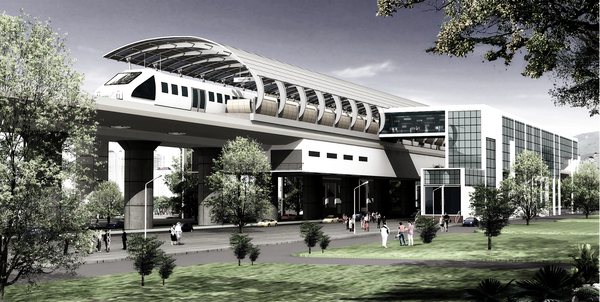 An elevated metro station, as envisioned by Mr. Dela Cruz. Expensive to build and to maintain
which translates into higher operating costs.
Light railai??i??s downsides
Published: May 15, 2013Re: ai???Letai??i??s not get soaked by poorly planned transit,ai??? Letters, The Leader, May 14.
I think that many advocates like the Light Rail Links coalition are misleading people into supporting them, because they are hiding the downsides to at-grade, on-street light rail transit.
Some of those downsides are:
ai??? Light rail is slower transit; it is limited to at-grade speed limits of 50-60 km/h.
ai??? Light rail can be closed off completely by accidents. Disruptions at high-accident intersections in Surrey like King George Boulevard and 88 Avenue will mean that an LRT line will close down several times a week.
ai??? Less speed and reliability means less ridership. Less ridership means less fare revenue.
ai??? Even with both a light rail system across Surrey and transportation demand management to raise the cost of driving, 65 per cent of commutes will still be by car.
ai??? No Surrey light rail options will meet 2041 transportation modal shift goals from the car set by TransLink.
In my view, light rail is simply not an investment that will be worth the cost. Surrey residents should consider supporting SkyTrain expansion instead. SkyTrain has some downsides like its visual profile, but I support SkyTrain because:
ai??? SkyTrain actually generates more monetary transportation benefits than cost, unlike light rail.
ai??? SkyTrain has worked in Vancouver to increase transit mode-share and reduce motor vehicle use.
ai???Ai??SkyTrainai??i??s lower operating costs per hour can mean more frequent off-peak and weekend transit service compared to light rail.
ai??? SkyTrainai??i??s grade-separated right-of-way means consistent 96 per cent on-time reliability.
ai??? SkyTrain is the best catalyst for transit-oriented urban growth and slum revitalization when compared to other cities around the world.
Daryl Dela Cruz
Campaign Director
Better Surrey Rapid Transit
This, prompted a reply from long time light rail advocate Malcolm Johnston.
We now see that Mr. Dela Cruz, a high school student, is the campaign director for Better Surrey Rapid Transit, which makes Zwei wonder if BS Rapid Transit (just gotta love it) has any professional input at all? Rail for the Valley has the Leewood Report, a professional transit study done by a real consultant, you know, someone who makes a living by planning real transit projects for real customers.
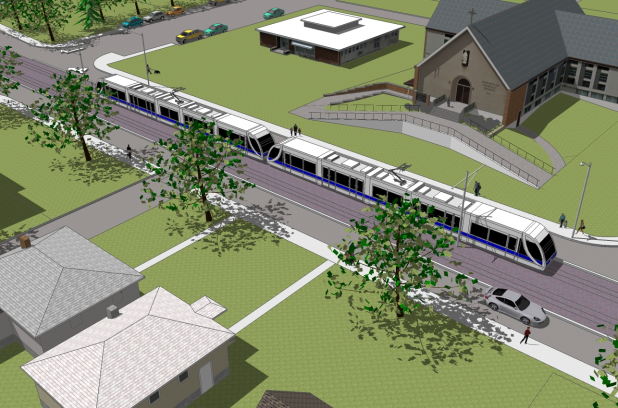 At-grade/on-street LRT has very inexpensive stations, which translates to much cheaper maintenance costs
and being at street level, are far more convenient for the transit customer.
Light rail makes SkyTrain obsolete
Published: May 21, 2013
A letter by a Mr. Daryl Dela Cruz grossly misinforms the public about modern light rail (LRT).
The difference between modern LRT and a streetcar is the concept of the ai???reserved rights-of-wayai??? or a R-o-W for the exclusive use of a streetcar ai??i?? in laymanai??i??s terms, a HOV lane with rails. The reserved R-o-W enables the modern streetcar to operate as fast as and carry as many or more transit customers than an elevated light-metro like SkyTrain, The fact is, modern LRT made SkyTrain obsolete almost two decades ago.
Modern LRT can operate at speed of 80 km/h to 90 km/h at grade on a reserved R-o-W in complete safety and does in hundreds of cities around the world.
Accidents do happen on LRT lines when car drivers disobey signals, but when a rare accident does occur, only a portion of the line affected is closed and in most cases the streetcars can be easily switched to the unaffected line to continue their journey.
At-grade LRT actually is better in attracting new ridership than grade-separated mini-metros like SkyTrain, simply because stations or stops are handier and easier to use. LRT is far more convenient than SkyTrain and convenience attracts customers.
Since TransLink has no experience in planning and building with LRT, I would question any transit plan presented by TransLink, but since modern LRT can handle higher capacities than SkyTrain, future customer demands would be of little problem.
Today, in Karlsruhe Germany, the main tram (streetcar) line on Kaiserstrasse is dealing with peak -hour capacities in excess of 40,000 persons per hour per direction. This is 10,000 persons per hour per direction more than the maximum theoretical capacity of the SkyTrain mini-metro.
SkyTrain does not have lower operating costs than LRT; instead the opposite is true. SkyTrain costs about 40 per cent more to operate when compared to modern LRT.
Since SkyTrain was first marketed in the 1970s, only seven systems have been built and not one was allowed to compete against LRT. During the same period, over 160 new LRT systems have been built, with a further 30 under construction.
It seems knowledgeable transit planners around the world do not support the Dela Cruzai??i??s SkyTrain hype and hoopla.
D. Malcolm Johnston
Rail for the Valley
Delta
A Comparrison Of Operating Costs – SkyTrain & Light Rail

380. Fraud
380. (1) Every one who, by deceit, falsehood or other fraudulent means, whether or not it is a false pretence within the meaning of this Act, defrauds the public or any person, whether ascertained or not, of any property, money or valuable security or any service,
(a) is guilty of an indictable offence and liable to a term of imprisonment not exceeding fourteen years, where the subject-matter of the offence is a testamentary instrument or the value of the subject-matter of the offence exceeds five thousand dollars; or
(b) is guilty
(i) of an indictable offence and is liable to imprisonment for a term not exceeding two years, or
(ii) of an offence punishable on summary conviction,
where the value of the subject-matter of the offence does not exceed five thousand dollars.
COMPARISON OF OPERATING COSTS
The total 1988/89 budget for SkyTrain:
Calgary C-Train 1990 Operating Budget
Mr. Harcourt, Shut the H*ll Up.
Former one term wonder as BC’s Premier, Mr. Harcourt suffers the same sort of dementia as do most other regional and provincial politicians, he firmly believes he is a transit expert. Both Harcourt’s term as Vancouver mayor and BC Premier, was much ado about nothing. A notable fence sitter, Harcourt waxed and waned as the public opinion wind blew.Fast forward a decade and Harcourt championed the Canada Line, the only heavy rail metro in the world designed and built to have less capacity than a streetcar. Instead of of much cheaper light rail, Harcourt joined the SkyTrain bandwagon and trumpeted the virtues of subways to anyone who cared to listen.Strangely, he remained deaf to the pleas of one Susan Heyes who was nearly bankrupted by cut-and-cover subway construction and years of litigation, but former Premiers have always remained deaf to the pleas of the small person whose rights are being trampled by the thugs of big government.Well Harcourt is back at it again, build a gondola to SFU; build a subway under Broadway; and let Surrey build LRT – the man just hasn’t a clue about transit, transit mode, and transit finance, but he is a media favourite and most of his ill-thought out musings is given airtime.
Well Mr. Harcourt, chew on these apples:
- For the cost of our three mini-metro lines, we could have today a light rail network stretching from Chilliwack to UBC.
- If we had built LRT on the Arbutus corridor, we would be carrying more passengers at a far cheaper cost.
- If we had built with LRT instead of light-metro, TransLink would not be in a financial crisis.
- Subways are notorious expensive to maintain and lead many operating authorities to financial chaos, cities that build with light rail do not have the same financial distress.
- Modern LRT has a higher capacity than SkyTrain or light-metro, yet can be built at a fraction of the cost of a SkyTrain or light-metro.
The folly of Mr. Harcourt and his inane musings is that people (especially those of the NDP persuasion) listen to him.
So Mr. Harcourt, until you actually understand what you are talking about, do everyone a favour and shut the hell up!
 The tram (streetcar) line on Karlsruhe’s Kaiserstrasse, sees peak hour headways
of 45 seconds, offering peak hour capacities in excess of 40,000 persons per hour per direction.
Newly-elected govai??i??t needs to improve transit: former premier
Mayors of Vancouver and Surrey have made their cases
Jesse Johnston May 17, 2013
LOWER MAINLAND (NEWS1130) ai??i?? One of BCai??i??s former premiers says the Lower Mainland needs better transit service and the newly-elected government needs to make that happen.
Mike Harcourt feels there are three areas in particular that should be priorities.
ai???There are three lines in Surrey, the line out to UBC, and the gondola up to SFU,ai??? Harcourt tells News1130. ai???Get them all done. Give people a really good transit system.ai???
There has been much debate in Metro Vancouver over which is a bigger priority: The line out to UBC or expanding transit routes south of the Fraser River. The mayors of Vancouver and Surrey have each made cases for their own cities.
Buses to UBC are stuffed with students every day and Vancouver Mayor Gregor Robertson wants to see a subway line to the university.
Surrey Mayor Dianne Watts says her city has waited patiently with no significant transit upgrades while major projects, such as the Evergreen Line and Canada Line, have been built in other communities. Her cityai??i??s transportation committee is eying light rail transit down 104th Avenue and Fraser Highway toward Langley as possible solutions.
Council is also looking at possibilities to serve South Surrey.
Harcourt says both mayors should get their wish. ai???We have to finish the transit system. We got three quarters of it done; letai??i??s finish the rest.ai???
He adds improving relationships with First Nations groups and making housing more affordable should also be on the new governmentai??i??s to-do list.
A Liberal Victory Means “No Transit For You!”

The BC Liberals have won yesterday’s election which means the transit status quo will remain, no new transit for south of the Fraser River.
Regional transit issues were ignored by both the BC Liberals and the NDP and for good reason, TransLink is in a financial mess and unless new revenue streams are forthcoming, there will be the start of a gradual reduction of bus service, especially South of the Fraser. SkyTrain desperately needs an expensive shadow bus service to make the mini-metro viable, which means loads of empty or near empty buses in operation during all hours of operation and translates in reduced service hours elsewhere.
A good example is South Delta, where bus service has been reduced to pre Canada Line days because the projected ridership did not materialize (it is also note worthy that South Delta has elected and has now reelected an independent) and with basic bus service, transit becomes unattractive to potential customers.
What the Liberals will try do now is create new and higher taxes to fund new SkyTrain expansion, which maybe the big election issue in the 2017 election and may lead us into the world of ‘road pricing‘ or a user fee (in addition to bridge tolls and gas taxes) to drive on public roads. The question is; “Will the nightmare of the HST debacle derail any road pricing initiative.”
What has all been ignored by both political parties is the RftV/Leewood Report for a TramTrain service from Vancouver to Chilliwack. The RftV/Leewood Report could provide the framework for an initial Vancouver to Chilliwack interurban service, using diesel LRT, which could be installed for about $600 million, with trains running every 90 minutes or so to start with.
Sadly, lobbyists for major engineering firms and cement manufacturers are already grooming newly elected MLA’s to support more and more SkyTrain construction, especially the $4 billion or more Broadway SkyTrain subway, so they can make more and more money off the BC taxpayer.
BC politics, it has been ever thus.
New Surrey coalition to push for light-rail transit south of the Fraser
Ai??Dianne Watts gets it, but Daryl Dela Cruz doesn’t.
Rail for the Valley gets it, but TransLink doesn’t.
The rest of the world gets it, but the SkyTrain lobby doesn’t.
Financial managers in most major cities around the world gets it, but BC’s Auditor General doesn’t.
Isn’t interesting that while the rest of the world plans and builds with modern LRT, a cadre of elites in our little niche in the world want much more expensive mini-metro instead and they don’t give a damn about the taxpayer.
Welcome to “Lotus Land“, where ‘Lucy in the Sky with Diamonds’ planning seems to be the order of the day.
New Surrey coalition to push for light-rail transit south of the Fraser
Surrey Mayor Dianne Watts would like to see light rail connect transit corridors in Surrey. Above, a Bombardier Flexity Light Rail Vehicle or tram
Photograph by: City of Surrey, PROVINCE
Surrey business and community groups are launching a new campaign to get light-rail transit on track for south of the Fraser.
The Surrey Board of Trade announced a new coalition ai??i?? Light Rail Links ai??i?? which is joining the call for an LRT solution to the regionai??i??s lack of rapid transit infrastructure.
Mayor Dianne Watts has been pushing for years without success for approval of an LRT line rather than a SkyTrain option. She wants to see three light-rail corridors connecting Surrey town centres: one between City Centre and Guildford, along 104th Avenue; one connecting City Centre to Newton, along King George Boulevard; and one connecting Surrey to Langley along the Fraser Highway.
Without new transit investment in the near future, Board of Trade CEO Anita Huberman said, ai???our ability to attract businesses to Surrey will be compromised. If we donai??i??t have good transportation, which is the foundation of our economy, it will suffer.ai???
Increased traffic in Surrey as the population grows is a very real threat, she added, noting it took her 50 minutes by car to get from South Surrey to the Board of Trade office at 104th and 144th Avenues.
Light Rail Links stressed that Surrey ai??i?? the fastest-growing municipality in the region ai??i?? is expected to grow 50 per cent to 750,000 residents by 2041. Yet it has not had any significant transit infrastructure in almost 20 years. Less than seven per cent of the $6.6 billion spent on rapid transit in the Lower Mainland has gone south of the Fraser.
Surrey residents are fed up with the lack of action on transit, said Elizabeth Model, CEO of the Downtown Surrey Business Improvement Association.
ai???Everyone is frustrated. Weai??i??re the last one in the pecking order [to get transit upgrades], but weai??i??re the largest economic engine in the region.ai???
The bus-based system is unworkable for residents without cars, said the Surrey Crime Prevention Associationai??i??s Karen Reid Sidhu.
ai???Youth are struggling to get around the city,ai??? Sidhu said, noting her 240 youth volunteers find it hard to make it to their commitments via transit. It takes some up to 1A? hours by bus to get from Central City Shopping Mall to Cloverdale.
Mayor Watts said it was time for city residents to speak up.
ai???They need to let their voices be heard,ai??? she said in an interview.
From government and TransLink, Watts said, ai???there needs to be a recognition that in Surrey, we are building a city. Seventy per cent of growth is coming from south of the Fraser and we need that infrastructure.ai???
Scott Olson, a realtor and past president of the Fraser Valley Real Estate Association, said light rail was also the cheaper option.
ai???For the price of one extension of SkyTrain, we could create a complete infrastructure with LRT.ai???
Fleetwood Community Association president Rick Hart said commuters and seniors in his neighbourhood were poorly served: the Fraser Highway B-Line is often full when gets to Surrey via Langley, and buses and SkyTrain pose mobility and safety issues for seniors.
ai???LRT is something that will assist those people and help them age in place,ai??? he said.
Other citizensai??i?? groups have already been working on the issue. The Rail for the Valley Society has been advocating for a light-rail passenger train system running on the existing Interurban line out to Chilliwack.
But not all Surrey community member endorse light rail.
The citizenai??i??s group Better Surrey Rapid Transit makes a case for SkyTrain as the better option for the region, arguing LRT will get half the ridership of a new SkyTrain line and will continue to cause congestion as it runs along existing roads.
ai???Current options look forward to this cityai??i??s transportation needs to 2041 … but do not look forward to what the needs will be in 30 to 50 years and beyond,ai??? Better Surrey Rapid Transit member Daryl Dela Cruz said in an email.
ai???We want to tell Mayor Watts and TransLink that the solution that Surrey needs is bigger than what everyone wants, and weai??i??re advocating for that bigger solution that Surrey needs ai??i?? an expansion of SkyTrain.ai???
Learn more about Light Rail Links at www.lightraillinks.com.
Learn more about Surreyai??i??s light rail plans visit surrey.ca/RapidTransitNow.
Ai?? Copyright (c) The Province




Recent Comments