Regional Transportation and the Provincial Election – The NDP’s & BC Liberal’s Dirty Little Secret

What has been ignored by both major political parties, vying for the electorate’s vote, is the thorny question of regional transportation and TransLink. In fact the silence has been deafening.
It seems both the NDP and the BC Liberals have bought into the TransLink and SkyTrain Lobby’s ‘kool-ade‘ that the region needs to come up with ways to gouge massive new taxes from the motorists to pay for SkyTrain heaven; or more pointedly, Vancouver’s $4.5 billion Broadway/UBC SkyTrain subway.
BC Auditor General, Ken Doyle, gave the City of Vancouver and the SkyTrain lobby a gift, with his “back of an envelope” calculations that; “SkyTrain and not light rail was the best option because of its greater capacity at similar costai??i??.ai???.
It seems no one had told the Auditor General’s Office that “capacity was a function of headway” and that light rail could be built for about one half to one quarter of the cost of SkyTrain, yet obtain higher capacities if need be.
The damage has been done and SkyTrain, which has been on the market for over 35 years and has been made obsolete by modern LRT, with its cheaper costs, yet superior capacities, is now the miracle transit system’ in the Metro Vancouver Region.
Whoever mislead the Auditor General’s Office, with misleading and erroneous information did a good job, because it is this false claim of SkyTrain superior capacity that will ensure planning for a $4.5 billion SkyTrain subway under Broadway and continue TransLink’s wild ride into financial oblivion.
Planning for SkyTrain means higher property taxes in the near future and the spectre of road pricing being forced on the region to build more of the obsolete proprietary SkyTrain mini-metro, will hang over the beleaguered taxpayer’s heads. Both the NDP and the BC Liberals know this and is the reason they are keeping quiet during the election campaign because SkyTrain construction brings massive profits to friends of the government because of the huge amount of the public’s money spent on SkyTrain mega-projects.
What is so galling is that Vancouver will demand and get a $4.5 billion Broadway subway on a route that has peak hour traffic flows under 5,000 pphpd, about a quarter of that would justify subway construction in the real world! South of the Fraser cities and municipalities, as usual, will get nothing but transit crumbs, but will be expected to pay forAi??Vancouver’s expensive subway construction and this is the NDP’s and the BC Liberal’s dirty little election secret.
A switch problem causes rush hour chaos on the Canada Line
A switch problem caused rush hour chaos on the Canada Line Thursday night, but not reported that if a switch fails on a LRT/tram line, the problem is local and can be dealt by locally by a (in the English vernacular) a temporary ‘pointsman’. The failed switch can be operated manually, until it can be repaired after the line ceases operation for the night, causing little or no customer delay – simple.
Customer delay or inconvenience is a concept that the SkyTrain lobby never address because they just do not care.

Canada Line problems fixed after delays leave rush-hour riders fuming
Ai??By Mike Hager, Vancouver Sun
METRO VANCOUVER — A switch problem at Bridgeport Station marred thousands of commuters’ rush-hour journey back home along the Canada Line Thursday.
People travelling on the popular subway route were told to budget an extra 30 minutes or board shuttle buses at Bridgeport that were taking commuters further south into Richmond before service was restored around 7:20 p.m. TransLink estimated it would take another 45 minutes before trains and buses began running normally again.
Frustrated straphangers took to Twitter to vent about the crowds and report hour-long delays to their daily commutes.
Twitter user Jen in Ladner said it took her 45 minutes to travel a distance that usually takes her 15 and she still was ai???nowhere close to home.ai???
Chris Golden tweeted, “First words heard when we pull into Yaletown-Roundhouse outbound, “Oh my God! Fifth full train and I just need to go one stop.” #CanadaLine”
Twitter user Neil M. wrote, “Gong show.”
Ridership on the Canada Line has grown steadily since an explosion of traffic during the 2010 Olympics and now has a daily ridership of over 120,000.
www.twitter.com/MikePHager
Power rail problem halts SkyTrain service in New Westminster
As metro lines age, maintenance problems come into the fore. With automatic or driverless transit systems, this means complete shutdowns of sections of track or an entire route.
Last night, a reported failure of the power rail caused chaos all Thursday night for transit customers. Failures do happen, but a failure of a power rail is unacceptable and points to shoddy maintenance practices by TransLink. Even more disturbing is shoddy maintenance practices, will lead to more SkyTrain disruption as the system ages.
This means scarce transit monies will have to be diverted from South of the Fraser municipalities to fund expensive SkyTrain maintenance and renovation in Vancouver, Burnaby and new Westminster.
This is not to say light rail does not suffer increasing maintenance as the system ages, but the inherent robustness and simplicity of LRT means maintenance costs are simpler, easier, and much cheaper to do and in many cases can be done on the fly, without greatly affecting schedules.
Those who support more SkyTrain construction are in fact supporting huge maintenance and operational costs onto future generations of taxpayers.
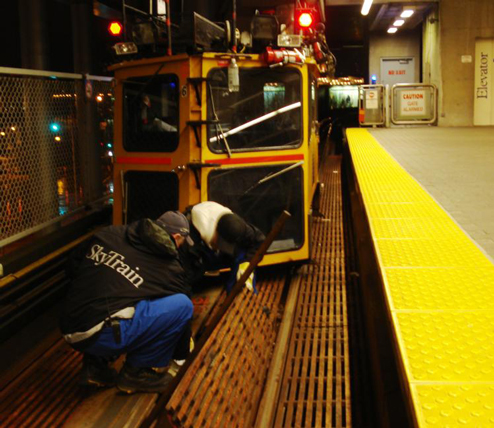
Power rail problem halts SkyTrain service in New Westminster
Ai??By Mike Hager, Vancouver Sun
SkyTrain service on the 30-year-old Expo line was disrupted by a broken power rail support post as thousands streamed in and out of downtown Vancouver for the last Canucks home game of the regular season Thursday night.
The broken section may have originally been laid just before Expo 86 ai??i?? the lineai??i??s namesake ai??i?? and disrupted service between New Westminster and 22nd Street stations, according to TransLink spokeswoman Jennifer Siddon. Repairs were expected to last through the night, but be completed in time for rush hour this morning, she added.
Meanwhile, riders fumed online while dealing with the delays that saw them either board buses between disrupted stops or take the long way around to Surrey through the Millenium Line.
Twitter user AurAi??lien Grangeret wrote, ai???Spending 2h30 in the skytrain is a great way to make new friends but itai??i??s a lot of effort to end up in Surrey. #beautifuldayinvancouverai???
Jon Jennings added, ai???Well, after watching a guy go crazy and try to break out of the skytrain carriage, at least I know the doors donai??i??t open.ai???
Since last year, the transit authority has been working to replace the 30-year-old tracks and will continue with planned maintenance this weekend that will see trains moving slower between Edmonds and 22nd Street stations on Saturday and Sunday mornings, Siddon said.
The Canada Line was unaffected by the disruptions.
http://www.vancouversun.com/sports/Power+rail+problem+halts+SkyTrain+service+Westminster/8297144/story.html
Ottawa LRT
CFRA News-Talk Radio posted this report on April 22nd about a possible alignment for the leg of the Ottawa starter light rail line west of downtown.
http://www.cfra.com/News/Ottawa-Regional-News/City-likes-tunnel-under-Richmond-Road-for-next-pha
The route dubbed Richmond Underground is the favourite of city officials for the second phase of the light rail transit route that would link Tunney’s pasture to the Baseline Station.
Deputy city manager Nancy Schepers called it an “elegant solution” that would run west from Tunney’s to Dominion station, and follow the former Canadian Pacific Railway line, then continue via a shallow trench parallel to the Sir John A Macdonald Parkway, before eventually running under Richmond Road via a tunnel.
It would cost $900 million (USD $877.4 million). That’s considered a Class D estimate, and the final cost could be as much as 25% higher or lower.
“It is the shortest, it is cost effective investment, and it improves community and network service.”
The city studied more than 15 options, but several of those drew sharp criticisms from neighbourhood groups, including Kitchissippi residents.
This option keeps trains off the Sir John A Macdonald Parkway and doesn’t cut through the Bryon Linear Park (a stretch of land popular with pedestrians and cyclists).
Councillor Katherine Hobbs represents the ward containing the latter and she’s happy with the new option.
“This is an area that been poorly served by rapid transit in the past, they will get that as a result of this.”
Schepers made it clear that light rail along Carling Avenue is not a favourite of the different options.
It’s the most expensive at $2.3 billion, would add up to 13 minutes per ride for passengers, and certain parts of the route, mainly through major intersections, would have to be elevated.
The cheapest option comes via the Sir John A Macdonald Parkway at $630 million. But after repeated refusals by NCC executives, the city acknowledges that it infringes too much upon the green space and water front.
The western section wouldn’t be built for a decade, and a final decision on the preferred route will be made by council in June.
An open house for the public is scheduled for Thursday [April 25th] at city hall starting at 6:30 p.m.


Limiting in Honolula
The Honolulu High-Capacity Transit Corridor Project (HHCTCP) is the official name for the plan to construct an elevated rapid transit line serving the City and County of Honolulu on the island of Oahu.
http://www.honolulutransit.org/
The line will use 128Ai??ft (39Ai??m) trains carrying about 390 passengers each, similar in weight to light rail systems elsewhere in the United States (such as the MAX in Portland, Oregon, as opposed to heavier, and thus more expensive, lines found on rapid transit systems like the subways and elevated systems of Chicago and New York City.[9] Physically, the Honolulu system will have a good deal in common with light rapid transit systems such as SkyTrain in Vancouver, British Columbia or the Copenhagen Metro.
Rolling stock for the line will initially include 80 cars in 40 two-car consists, built by a joint venture between AnsaldoBreda and Ansaldo STS named Ansaldo Honolulu. (AnsaldoBreda and Ansaldo STS previously collaborated on the construction and operation of vehicles for the Copenhagen Metro.)
It is a proprietary package that has been purchased from AnsalsoBreda including cars, electrification, automatic train control, as in KA?benhavn.Ai??You will not be able just to buy someone elses metro cars and put them on the Honolulu system,Ai?? just likeAi??Ai??Vancouver’s Ai??Canada Line.
We wait for the protests from the Skytrain juveniles, Rico, De La Cruz & Richard on the comparison with Skytrain
A Tale of Two Letters
 Despite well over $8 billion spent on three mini-metro lines
Dear Susan Lazaruk, Province reporter,Why it is so easy to get around without transit for 86% of the population in Metro VancouverIt takes me 32 minutes to cycle 10 kilometres to work in Vancouver, and I have no trouble getting where I want to go.Ai?? When I really have to get there fast and conveniently – I drive and rarely if ever take transit.Ai?? I and many others would never live in Coquitlam or Surrey, for instance, to commute hours on transit for work or school in Vancouver.You are being presumptuous in your assertion that it is hard to get around in Metro Vancouver and you selected two very atypical transit users to quote in your story – Ms. Julienne Cajes living in Coquitlam and taking arts at UBC and Mr. Daryl Dela Cruz living inAi?? Surrey and dreaming of attending Kwantlen College one day.Car pooling or living near Kwantlen College doesnai??i??t appear to be an option for Mr. Daryl Dela Cruz.Ai?? Taxpayers must therefore pay for his ride on transit as far as Mr. Daryl Dela Cruz is concerned, and by the way, to employ executives making big salaries at TransLink to serve Mr. Daryl Dela Cruz, letai??i??s not forget that.Ai?? TransLink employees who are all overhead at the TransLink headquarters and who donai??i??t do any real work to make the buses and trains run – drink plenty of premium coffee and donai??i??t come cheap.
Mr. Daryl Dela Cruz in your story laments at possibly not being able to attend college because there is currently no transit [sky train] to take him to Kwantlen College – so sad, makes me want to weep listening to the melancholy song on the web radio from Munich operating high quality trams using much less electrical energy than the crappy, inefficient and costly elevated trains operated by TransLink.Ai?? Germans arenai??i??t stupid and have no use for sky train.Sometimes the 99 B-Line lineups extend all the way up the escalators proclaims cheery faced Ms. Julienne Cajes in your story.Ai?? If TransLink operated express and articulated buses on West 4th Avenue every two minutes like it does along Broadway served by the 99 B-Line articulated buses – to provide an alternative for students, Broadway would no longer be the busiest bus route (by design) in North America.Ai?? Ms. Julienne Cajes would be able to get to UBC without the lineups giving her the (occasional) excruciatingly long five minute or slightly longer wait (what TransLink terms 2,000 pass-ups daily) for the next available 99 B-Line bus at Commercial Drive.Both Ms. Julienne Cajes andAi?? Mr. Daryl Dela Cruz represent the insignificant faction of transit users traveling exceedingly long distances, and the median travel distance in Metro Vancouver is a mere seven kilometres.Ai?? Their travel plights on transit are self-imposed and sky train to UBC would not be sustainable – it promotes longer transit commutes while doing nothing to reduce vehicle traffic.Ai?? Both Ms. Julienne Cajes andAi?? Mr. Daryl Dela Cruz are captive riders who are stuck on transit due to personal and financial reasons and giving them long distance transit to travel farther to work or school only increases carbon emissions and transit costs.Ai?? Transit for them does not remove cars from the roads as they are unemployed students and are not potential drivers in any case.As Jordan Bateman says in your story, we already pay far too much in taxes for transit ai??i?? over $500 annually for most residents in Metro Vancouver when you add up the property, gas, parking and other taxes paid to TransLink ai??i?? for TransLink executives doing nothing useful for their pay to live the good life.Ai?? TransLink has no incentive to cut down on waste when it can just raise taxes to continue to be inefficient.Look at the 99 B-Line today on Sunday April 21st, for instance – all the express 99 B-Line buses have few people on board and TransLink is still operating mostly empty regular trolley buses as well along side the 99 B-Line diesel buses, anyhow.Ai?? There is lots of fat to cut at TransLink and cutting the express 99 B-Line service on weekends would be a good start in a few days when transit demand drops even further to almost nothing after UBC students stop attending UBC for the next four months.Eric Chris, Vancouver
I would like to comment on yesterday’s article on transit in Sunday’s paper.Both Ms. Julienne Cajes and Mr. Daryl Dela Cruz are typical of today’s transit customer, students who use or will use, deep discounted fares on a very expensive transit system, thus depriving the transit system the full fare revenue it needs to maintain service. If one has not slept through their school maths classes, it is easy to see why, buses and the mini-metro full of students traveling with deep discounted fares, deter full fare paying passengers, who generally drive instead.
The real problem with regional transit is, of course, our SkyTrain mini-metro system and the massive costs associated with the now obsolete mode.
SkyTrain, first conceived in the mid 70’s, was supposed to bridge the gap between what a Toronto PCC streetcar could carry and that requiring a metro. During the same period, the streetcar was evolving into light rail by using articulated vehicles and operating the ‘new’ streetcars on reserved rights-of-ways or R-o-W’s reserved for the exclusive use of the tram or streetcar. Almost instantly, the new light rail or LRT made SkyTrain obsolete because LRT could carry more people at a far cheaper cost. This is why only 7 SkyTrain type systems have been built since the late 70’s (only two are seriously used for regional transit, Vancouver and Kuala Lumpur), which compares very badly with the over 160 new LRT systems built and over 30 more under construction. It also explains why SkyTrain has never been allowed to compete against LRT.
Today, LRT can be built much cheaper than SkyTrain ($7 mil/km for TramTrain or a streetcar that can operate on the mainline railway) or $15 mil/km for on-street operation or $25 mil to $35 mil/km for LRT operating on a reserved R-o-W.
Contrary to what many people would have us think, modern LRT, operating as a streetcar or LRT can obtain very high capacities if needed. The simple streetcar or tram line on Kaiserstrasse, in Karlsruhe Germany, is seeing trams catering to traffic flows in excess of 40,000 persons per hour per direction during peak hours, which is almost double what SkyTrain can carry without spending billions of dollars more for station and track upgrades.
This also puts a lie to the BC Auditor General’s Department claims that “SkyTrain and not light rail was the best option because of its greater capacity at similar costai??i??.ai???.
I sent the AG’s comment to several transit experts overseas for their feedback and the replies I got were blunt and to the point and can be summed up as The Auditor General’s findings were contrary to established facts and findings.
The reply from a German transit specialist was striking.Two embarrassing factual errors (mistakes or lies) in one sentence.
As anyone whoai??i??s not dyslexic can find out in just a few minutes.
Wow. Corporate communications spokesdroids in action.
1. Greater capacity:
http://www.evergreenline.gov.
bc.ca/documents/Review/090504_ Project_Description.pdf states:
ai???4.9.5 Operating Capacity
The system will be capable of delivering a peak hour capacity of 10,400
passengers in 2021.ai???Calgary C-train has a capacity of 12,000 *seats* phpd *today*. Which can
easily be upgraded to 15,000 *seats* phpd by additional rolling stock.
Capacity including standees is in excess of 30,000 pphpd.Try to match that capacity with any system that requires grade-free
stations (with stairwells, escalators, etc.) and you will see that
the stations are *the* major chokepoint of such systems. As can be seen
from the requirement for expensive reconstruction of certain stations
at Vancouver. Low-floor light rail rolling stock allows for side
platforms at level with sidewalks etc., so there is *no* such
chokepoint.2. Similar cost:
http://www.evergreenline.gov.
bc.ca/documents/ ProjectUpdates/090929_ ProjectUpdate.pdf states:
ai???Estimated Cost: $1.4 billionai???
for a line of 11km in length. Thatai??i??s $127 mio per km.
Calgaryai??i??s South Line extension to 210 Avenue is projected at $180 mio
for 3.5 km. Thatai??i??s $51 mio per km. Which I would still consider as
outrageously expensive, but itai??i??s still just a fraction of ART.Sincerely, Wolfgang
Here we have the real problems of TransLink’s continued financial chaos:
- Deep discounted student tickets (over 110,000 U-passes have been issued), chasing away full fare customers.
- A reliance on the now obsolete, yet very expensive SkyTrain mini-metro for regional transit.
- Lysenkoism. Lysenkoism: describes the manipulation or distortion of the scientific process as a way to reach a predetermined conclusion as dictated by an ideological bias, often related to social or political objectives. In local terms, Lysenkoism is the manipulation and distortion of transit planning to favour SkyTrain over modern light rail. So successful has been SkyTrain Lysenkoism, that it has even fooled the Auditor Generals Department!
Until we deal with the real problems with TransLink, the bureaucratic edifice will always remain a financial sinkhole, sucking in vast amounts of the taxpayer’s monies, yet providing little in the way of improved service.
Malcolm Johnston
Postscript:
The term Lysenkoism was used by a German transit specialist, when I asked him to give a succinct answer to TransLink’s transit planning.
A Question of Capacity – A Transit Primer For BC’s Auditor General
A Question of Capacity ai??i?? A LRTA Topic Sheet

Contrary to the COV and TransLink, modern LRT can obtain high capacities, on transit routes, by being able to operate
at close headways.Ai??Today, the main tram route through the city is being relocated in a subway because the line was
seeing 45 second headways during peak hours, giving an nominal capacity exceeding 40,000 persons per hour per direction!
A repost from 2009 & 2013.
British Columbia’s Auditor General, claim that, “SkyTrain and not light rail was the best option because of its greater capacity at similar cost….” has raised eyebrows with bona fide transit planners in the UK and Europe, with one UK transit expert stating, “Does BC’s Auditor General do his sums on backs of envelopes?“, An European transit specialist commented, “seems another bureaucrat who slept through his math classes.“
So for John Doyle and the rest of the BC Auditor General’s Office, a primer on capacity.
A Question of Capacity ai??i?? A LRTA Topic Sheet
Maximum capacity is only likely to be required for a few hours during peak hours, and even here there are likely to be variations both day by day and within each hour. The capacity required originates from the routeai??i??s social characteristics.
As for the vehicles, buses have a comfort capacity equal to the number of seats, and a maximum capacity equal to seats plus standing load.
In the case of trams, it is more complicated. The nominal maximum capacity is calculated at four passengers per square metre of available floor space (a reasonably comfortable level), plus the number of seats.
As trams are designed to carry a large standing load, the ratio of standees to seats is quite high. The standing area is also important for the carrying of wheelchairs, pushchairs, shopping and sometimes bicycles. Some manufacturers quote maximum capacity using 6p/m2 while a figure of 8p/m 2 is used as a measure of crush capacity. This last figure is also employed to determine the motor rating of the vehicle.
A further complication is that even when there are seats available, some passengers prefer to stand. This may be because they are only travelling for a few stops, that they want to stretch their legs, or may just prefer to stand.
A tramai??i??s comfort capacity can therefore be considered as the number of seats, plus the voluntary standees who may amount to up to 10-15% of the nominal maximum number of standing passengers.
ELASTICITY
It is the difference between the average passenger load for any particular time and the crush load which gives light rail its Elasticity Factor, allowing it to cope with variations in conditions such as sudden surges or emergency conditions.
Standing is made more acceptable by the design of track and vehicle, reducing the forces acting on the passenger to a minimum. This makes for a smooth ride, as well as ensuring ease of access, good support and the ability to see out without having to stoop.
Where a route is mainly urban with short journey times, the number of vehicles required should be calculated on the nominal maximum. On longer journeys outside the central area, a lower level may be more appropriate, dependent on the routeai??i??s characteristics. Even on rural sections, there are likely to be a a number of short distance riders, and the loading factor will increase nearer to the urban area.
COMPRESSIBILITY
While it might be thought desirable to offer every passenger a seat, it is in fact the ability to carry high loadings in a confined area (the Compressibility Factor) which enables light rail to achieve many environmental benefits, allowinglarge numbers of people to be carried withoutharming, and often improving, the features of a city.
It is city centres where several routes combine that the most capacity is required. A typical situation could be a pedestrian street with six routes operating at 10-minute headway giving 36 double coupled trams per hour each with a capacity of 225. This gives a nominal capacity of16 200 passengers per hour which can be increased to 25 200 pph in extremis without extra vehicles. Light rail is unique in this ability to operate on the surface with its capacity without detracting from the amenities which it serves.A further factor in setting the resources required is the need to lure motorists out of cars. The more difficult the traffic conditions, the higher the loadings will be acceptable. It is however important that crush loads are not allowed for morethan the shortest of periods on an infrequent basis, both to maintain customer satisfaction and prevent elasticity of the system being compromised.
It is vital that public transport can cope with sudden changes in demand, such as extreme inclement weather or air quality violations which can cause private traffic to be halted. This is where the elasticity inherent in light rail is so beneficial in enabling an instant response in an economical fashion. A tram may be crowded, but its infinitelybetter than having to wait in the snow of smog untilextra vehicles are brought into service.
It is this unique combination of Capacity, Compressibility and Elasticity rather than capacity alone which makes light rail so successful as an urban transport mode.
Note Statistics are based on Karlsruhe, using GT/8 cars
Referendum New Transit funding For TransLink – BC Liberal Election Platform
Interesting, election gimmick from the BC Liberals which just may resonate with the regional taxpayer.
For 33 years, the regional taxpayer has been shut out of the regional transit debate, but expected to shell out serious coin for mega transit projects without question. Already the SkyTrain lobby are squealing like stuck pigs with any hint of real public involvement with transit issues and our lot of ‘wannabe‘ transit experts are giving the idea a big thumbs down. Why?
Could it be that real taxpayer scrutiny with transit planning and transit funding will expose 33 years of mismanagement, very bad planning, and Lysenkoism.
Lysenkoism: describes the manipulation or distortion of the scientific process as a way to reach a predetermined conclusion as dictated by an ideological bias, often related to social or political objectives.
It seems that those who are against a referendum on transit funding are those who may be afraid of the truth.

Referendum on new TransLink taxes has fans, foes
By Jeff Nagel – Surrey North Delta Leader
Published: April 15, 2013The BC Liberals’ surprise pledge of a referendum in November 2014 on any new taxes or tolls for TransLink is getting mixed reaction from transportation watchers.
Canadian Taxpayers’ Federation B.C. director Jordan Bateman said the election promise unveiled Monday would give local voters the power to block any new revenue tool for transit expansion they decide is unjustified.
“That will really change the tenor of the discussion around TransLink,” Bateman said.
“From my point of view, that’s great. Direct democracy is always the best democracy.”
Metro Vancouver mayors have asked the province for new funding sources ai??i??Ai??a vehicle levy, a share of carbon tax, a small regional sales tax or some form of road pricing ai??i?? to give TransLink the money for a massive transit expansion that would include rapid transit through Surrey to Langley and west on Vancouver’s Broadway corridor to UBC.
But some Metro Vancouver mayors are critical of the promised referendum, saying it threatens to dumb down the important debate over the future expansion of transit and put the long-term future of the region at risk.
Surrey Mayor Dianne Watts warned it could divide the region, with voters in cities that already have SkyTrain lines refusing to vote for the higher taxes needed to build new lines in the remaining underserved parts of the region.
“There are going to be people who don’t want to have any expansion in the region whatsoever and that leaves the communities that are growing that have had no investment in rapid transit at a disadvantage,” Watts said.
“Surrey has paid for significant amounts of infrastructure north of the Fraser,” she said. “Now that we’re looking to expand south of the Fraser, where 70 per cent of the region’s growth is coming, we just really need to stop playing politics and get the job done.”
Watts said the debate over funding for TransLink has dragged on for years and waiting until November 2014 would keep the region at a standstill until then.
“Not to be able to do anything for another two years for us in Surrey is simply unacceptable,” said Watts, who questioned why there isn’t a referendum on Liberal plans for changes to income tax levels or the sale of Crown land.
Watts also said the Liberal platform wrongly calls rapid transit for Surrey a “new” proposal, noting it was promised in the Provincial Transit Plan more than five years ago by then-premier Gordon Campbell.
Mayors’ council chair Richard Walton doesn’t reject the idea of a referendum but said he’s concerned 2014 may be too soon to have an informed public debate on a complex issue like road pricing, which could see motorists charged to drive on major routes.
That public discussion would need to address not just what residents would pay in extra charges, but what they would get for the investment and the downside if it was rejected.
“Saying no is easy,” Walton said. “But people don’t necessarily understand the repercussions of saying no.”
Both he and Watts said the referendum idea came without any warning despite months of meetings with Transportation Minister Mary Polak.
The timing of the vote for November 2014 is to coincide with the next civic elections, saving money.
SFU City Program director Gordon Price said a referendum could be a disaster for the region, blocking transit upgrades needed for the livability of the growing region.
“It’s an excruciatingly bad idea,” he said, pointing to transportation funding referenda in U.S. states, where he said good policy is often sacrificed to craft an initiative that might pass.
“It just invites everything to be framed as part of a cynical political exercise that’s put through the grinder of ideology, partisanship and parochialism. It becomes what will sell. Not what’s right or how do we make the tradeoffs that need to be made.”
Price said the move reflects a continuing provincial government bias against transit and in favour of bridge and freeway projects that appeal to drivers but ultimately undercut the aim of more transit use and lower emissions.
“Why is only one part of the transportation system up for a referendum?” Price asked. “I want to vote on the [replacement of the] Massey Tunnel. And why didn’t they do that with the Port Mann Bridge?”
Price said he believes the referendum promise is designed so the Liberals can dodge responsibility for whatever deal may be struck with Metro mayors.
“Everything is framed so they have an out,” he said. “This just sounds like a way to avoid making the really tough decisions.”
Karlsruhe
TramTrain in a cityscape.
This is a picture that the city of Vancouver and the city of Vancouver Engineering Department do not want the public to see; user friendly trams.
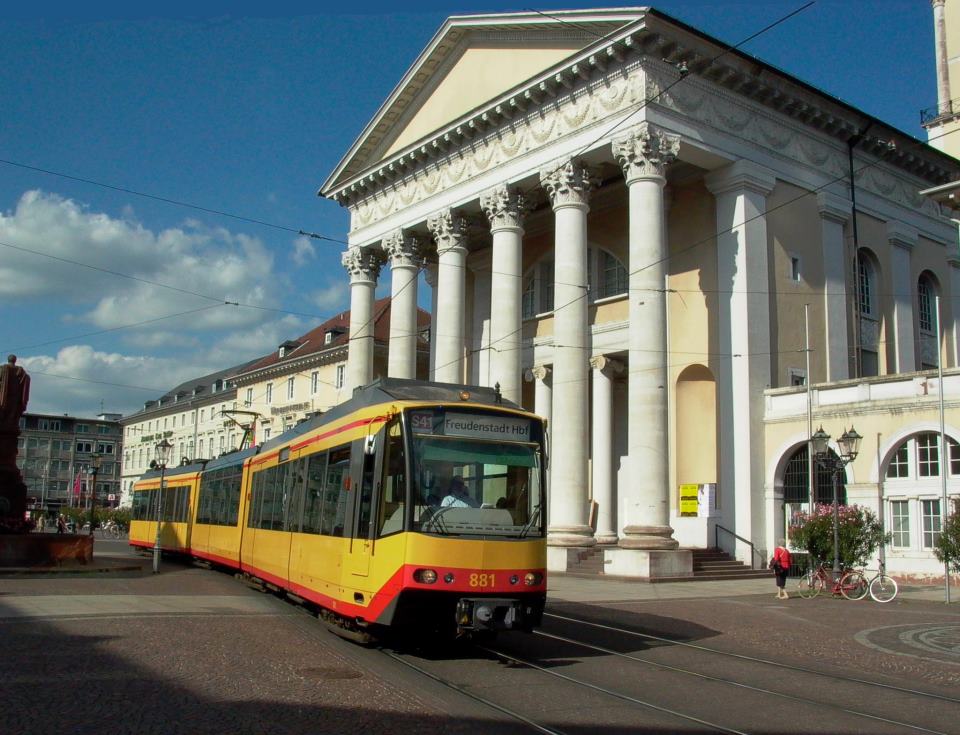
A Karlsruhe TramTrain S-41 service (Eutingen im GAi??uai??i??TullastraAYe / VBK Eutingen im GAi??u ai??i?? Freudenstadt ai??i?? Baiersbronn ai??i?? Forbach ai??i?? Rastatt ai??i?? Durmersheim ai??i?? Hauptbahnhof ai??i?? Marktplatz ai??i?? TullastraAYe / VBK)Ai?? on Marktplatz, in Karlsruhe, Germany.
This TramTrain is classified as a GT8-100D/M 2S. These 8-axle trams are powered by motor bogies in the lead and trailing positions while the two centre bogies are unpowered. These cars can seat 97 to 100 and accommodate up to 150 standing passengers. TheAi?? GT8-100D have a top speed of 90 km/h, 56 mph, enabling them to operate on the mainline railways. There are rated at 560 kW, 750 hp. All of the Siemens built units feature Panorama windows in the centre section.
TransLink, The City of Vancouver, and the SkyTrain Lobby Practice Lysenkoism
 The SkyTrain Lobby Is Watching You!
Lysenkoism: describes the manipulation or distortion of the scientific process as a way to reach a predetermined conclusion as dictated by an ideological bias, often related to social or political objectives.
IgnoringAi?? the fact that the proprietary SkyTrain mini-metro system has been rejected by transit planners around the world as being extremely expensive for what it does and just being poorly designed, many local planners and engineers still hail SkyTrain as a ‘wonder system‘ despite the fact that only seven such systems have been built in 33 years and only two are seriously used for urban transport.
Ignoring facts has been the mainstay of TransLink, countless provincial ministers of transportation, professional engineers, planners and academics, in transit debates and regional transit planning in general. Why have so many people have stained their reputations, supporting a proprietary mini-metro, when the rest of the world has moved on, relegating SkyTrain as a historic footnote?
There are two reasons for so many so-call professional and academic people remain willfully blind on regional transit issues.
- Many people have made small fortunes by supporting SkyTrain and the SkyTrain planning and building process. Making large sums of money by doing very little is a very hard habit to give up, especially when the taxpayer is footing the bill.
- Many people have just been bamboozled by the SkyTrain lobby and are embarrassed to acknowledge it. Like sheep, they continue to baa, baa, the SkyTrain line for fear that they would be shown ignorant of transit issues.
Greed, ignorance and fear are the main ingredients of our regional transit planning and until that changes, the powers that be will still plan for SkyTrain and as building and operating SkyTrain is bankrupting TransLink, taxes will continually rise, further feeding greed, ignorance and fear.
This is called Lysenkoism and it is being practiced daily in metro Vancouver.



Recent Comments