The Bus Lobby Uses the SkyTrain Lobby’s Tacticts
 A bus jam in Ottawa. One modern tram would be as efficient as 6 buses.
If there is any doubt that the bus lobby misrepresents the truth, the following will dispel it immediately.
The Vancouver Observer ran an item by Eric Doherty entitled, Humble trolley bus reborn as climate superhero, which the truth is so distorted that it leaves the reader with the impression that modern LRT is all but obsolete. What is even more distressing, Doherty is advising the NDP on regional transit issues
Zwei takes great exception with the following excerpt,
The comparison to light rail vehicles is important when considering what routes are busy enough to justify the capital cost of building light rail. There is an overlap in the size of modern trams (streetcars and light rail vehicles) and modern buses. Smaller trams have capacities of around 150 people, whereas the largest buses carry up to 200. There is a large potential labour saving in utilizing much larger rail vehicles carrying over 500 people on very busy routes. But on less busy routes there is now little or no labour cost saving to going to rail vehicles. Frequency of service is one of the most important factors in attracting transit riders, so running large light rail vehicles infrequently is not much of an option.
The modern tram has capacities of 200 to 350 people, the smaller trams mentioned are either heritage vehicles or operate on routes that demand a smaller vehicle. Today, the tram is made of modular construction and a smaller tram can economically ‘grow’ with ridership demands on a transit route, by adding a new module, something that is impossible for buses to do.
The three sectioned articulated buses mentioned in the piece are illegal to operate on Canadian streets unless they operate on a dedicated rights-of-ways or busways, which dramatically increase the cost of construction and operation.
http://www.railforthevalley.com/latest-news/zweisystem/eric-chris-on-bi-articulated-buses-for-the-99-b/
The author makes an impression that trams can’t operate at close frequencies (which they can and more efficiently when headways are less than 60 seconds) and his larger bus compared to small tram is just dishonest.
But I will leave it with a German transit expert, Wolfgang Keller, to put things in a proper perceptive.
Ai??Quote; “In Europe, many transit agencies no longer differentiate between Bus Rapid Transit and Light Rail lines“
What?! BRT isn’t an issue in Germany, Austria, or Switzerland. What is common, however, is that buses use reserved streetcar lanes as bus-lanes.There is one BRT network I know of in the Netherlands and a few lines in France. I have no clue of the UK though.
A regular contributor to “Stadtverkehr” (Harry Hondius) has somewhat advocated BRT recently, based on the excessive cost per km (up to 60 mio EUR iirc) of some new networks in France. But that excessive cost was not really rail-related, since the municipal authorities charged a lot of “urban refurbishment” works on the streetcar budget.
The TVR/GLT was a total disaster and it’s no longer marketed by Bombardier, just like all previous attempt at guided buses (Translohr is a streetcar, legally, it’s bidirectional and can run in MU, besides units over 24m). Caen has decided to replace it with actual streetcars. Nancy has decided to refurbish the TVR trolleybuses for something like 750,000 EUR (!) per piece to allow them to live for another 10-15 years, since they have never been really “fit for service”. There were not only numerous derailments, but also safety issues with the electric isolation of the traction equipment (Bombardiers had never built trolleybuses before and the electric equipment of trolleybuses is pretty special for safety reasons).
The region Lorraine seems to have a taste for screwing up public transit imho, since Nancy’s neighbour city Metz is planning to build a “BRT” line with double-articulated hybrid buses at 855,000 EUR (!) per piece (not including VAT). *gasp*
There’s also been an EU-funded research project about “future” BRT, but the results they presented were imho not actually new and don’t fundamentally change the fact that BRT is essentially the union of the (high) fixed (capital) cost of streetcars with the (high) variable (operation) cost of buses. I don’t see where there would be a “window
of opportunity” in the passenger volume vs. total cost diagram where BRT could reach a financial “break even” compared to streetcars.If there were significant differences in construction cost per km in some french cities between streetcar and BRT infrastructure, that’s imho essentially due to different “scope of budget”.
TVR/GLT is technically already a mis-concept. The guiding system simply doesn’t work even half-reliably.
Quote: “Bus Rapid transit is typically a bit faster than light rail, and has about the same maximum capacity.“
Yet another “leader” who slept through his math classes in primary school.
Buses can at most be 24m in length in Europe, streetcars 75m (in Germany). The maximum frequency is the same, since both operate “on sight” and dwell time at stations are the limiting issue.
And so far, 24m buses have not really convinced the operators. They are not built by any of the major bus builders (Neoman, Evobus, Irisbus…), but by small “niche” manufacturers (Van Hool, Hess…). Thus, they are aliens in the fleets, expensive to maintain and due to their “swept envelope” they can’t go everyhwere within the street network.
With electric propulsion (a strolleybuses), they are not really significantly cheaper than streetcars, considering the lifespan.
Anyone who has not slept through their math classes in elementary school can easily draw up a comparison table for the capacity of streetcars vs. BRT:
“Front door only” boarding for buses for fare collection by the driver makes things even worse because then the dwell times are far longer and consequently the maximum frequency is far lower for buses, but that would be “unfair” imho, since I assert “all other conditions being equal”, i.e. POP for buses as for streetcars.
Does Vancouver or the province of BC have such an important car/bus/oil industry?
The last time I checked, the Canadian oil industry is located in Alberta, and Alberta happens to have two of the best urban transit systems in North America.
Sincerely,
Zwei would hope that the provincial NDP would consult with real transit experts and not bus lobby windbags, who, like their SkyTrain brethren cannot honestly debate transit issues and simply make it up as they go along.
New Rail for the Valley brochures are ready
The Friends of Rail For the Valley Society has come out with some nice brochures ahead of the provincial election! Much credit goes to Robbin Yager for designing these brochures.
RFV1FAi??-Ai??This is a one-fold brochure, 11×17 inches, B&W
RFV1FcmykAi??-Ai??This is the same one-fold brochure, 11×17 inches, COLOUR (quantities limited)
RFV2FAi??-Ai??VOTE FOR CANDIDATES WHO SUPPORT LIGHT RAIL, a special pre-election brochure. 2-fold, 8.5×11 inches, B&W
RFVflysheet1Ai??- Facts vs Myths, and some specific arguments for Light Rail
We have printed out a bunch of these. If you would like some to distribute, please let us know: society@railforthevalley.com.
We can get them to you if you can get them out there!
If you want to further support our efforts, please donate by clicking here.

A Letter To BC’s Auditor General John Doyle
Long time light rail advocate, Malcolm Johnston, has sent a letter to John Doyle, BC’s Auditor General regarding the recent Evergreen Line audit.
To the point, if LRT vehicles have higher passenger capacities than Skytrain cars; are cheaper to supply than Skytrain cars and LRT can be built on much cheaper rights-of-ways and operate at comparable headways, how then can SkyTrain be the best option based on providing more capacity at a similar than LRT?
Of course the answer is “Skytrain can’t” and as Mr. Johnston points out “only seven SkyTrain type systems have been sold in 33 years, compared to over 160 new LRT lines built during the same period.“, demonstrates that transit planners have rejected SkyTrain almost completely.
Maybe because modern LRT can provide higher capacities than Skytrain at a cheaper cost.
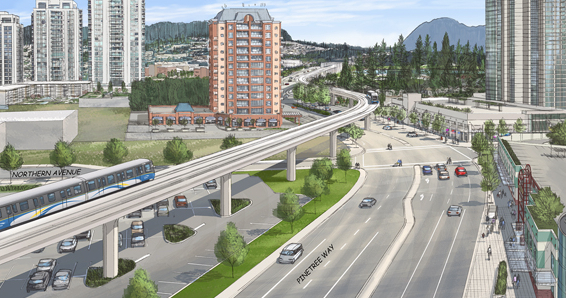
The Auditor General of British Columbia, John Doyle, dear sir,
The just released Audit of the Evergreen Line contains a factual error that “SkyTrain and not light rail was the best option because of its greater capacity at similar costai??i??.ai??? Today, modern LRT has proven to have a somewhat higher capacity than SkyTrain and to date not one of the seven SkyTrain type systems built around the world has yet to obtain the capacity that modern LRT has obtained in revenue service.
“Capacity is a function of headway” and given equal Skytrain or light rail vehicle capacity, operating at same headway’s, would give comparable capacities, but because LRT is cheaper to build, LRT would be able to provide the same capacity as Skytrain, at a much cheaper cost.
One modern light rail vehicle has a maximum capacity of about 250 persons (all seats occupied and standees @ 4 persons per metre sq.) and costs in the range of $4 million to $5 million per unit.
One Mk. 1 Skytrain car has a capacity of 75 persons and had a cost of about $2.5 million a car. One Mk.2 Skytrain car has a capacity of 110 persons and costs just over $3 million per car. Please note, that Skytrain cars operate in married pairs thus the cost per unit must be doubled when compared with a light rail vehicle.
The Canada Line is not Skytrain and the Canada Line metro cars are not compatible with Skytrain operation and thus are not included.
To come near to matching the capacity of a light rail vehicle, at least two Mk. 2 cars SkyTrain cars would be required, in the end, costing more than one modern LRV!
As modern LRT can obtain the same headway’s than Skytrain on a far cheaper rights-of-way and using less cars than SkyTrain is is a matter of logic that modern LRT can obtain the same capacity as Skytrain, but at a far cheaper cost!
Skytrain was first marketed in the late 1970’s, only seven type systems have been built, during the same period, over 160 new light rail lines have been built and a further 36 are under construction or are obtaining final approval. Strange then, if SkyTrain can provide a superior performance than LRT, that it has done so poorly on the international market.
In 2008, responding to a letter from a Victoria (BC) transit group, American transit expert Gerald fox, gave a candid view of the Evergreen Line’s business case, summing up stating:
It is interesting how TransLink has used this cunning method of manipulating analysis to justify SkyTrain in corridor after corridor, and has thus succeeded in keeping its proprietary rail system expanding. In the US, all new transit projects that seek federal support are now subjected to scrutiny by a panel of transit peers, selected and monitored by the federal government, to ensure that projects are analyzed honestly, and the taxpayersai??i?? interests are protected. No SkyTrain project has ever passed this scrutiny in the US.
It is my belief, that the Auditor General and the Auditor General Department have been mislead with erroneous claims about Skytrain and light rail and if an independent audit of the Evergreen Line were to be undertaken, these erroneous claims would be exposed.
Malcolm Johnston
The following is the full text of the Gerald Fox letter:
From: A North-American Rail Expert
Subject: Comments on the Evergreen Line ai???Business Caseai???
Date: February 6, 2008 12:15:22 PM PST (CA)
Greetings:
The Evergreen Line Report made me curious as to how TransLink could justify continuing to expand SkyTrain, when the rest of the world is building LRT. So I went back and read the alleged ai???Business Caseai??? (BC) report in a little more detail. I found several instances where the analysis had made assumptions that were inaccurate, or had been manipulated to make the case for SkyTrain. If the underlying assumptions are inaccurate, the conclusions may be so too. Specifically:
Capacity. A combination of train size and headway. For instance, TriMetai??i??s new ai???Type 4ai??? Low floor LRVs, arriving later this year, have a rated capacity of 232 per car, or 464 for a 2- car train. (Of course one must also be sure to use the same standee density when comparing car capacity. I donai??i??t know if that was done here). In Portland we operate a frequency of 3 minutes downtown in the peak hour, giving a one way peak hour capacity of 9,280. By next year we will have two routes through downtown, which will eventually load both ways, giving a theoretical peak hour rail capacity of 37,000 into or out of downtown. Of course we also run a lot of buses.
The new Seattle LRT system which opens next year, is designed for 4-car trains, and thus have a peak hour capacity of 18,560. (but doesnai??i??t need this yet, and so shares the tunnel with buses). The Business Case analysis assumes a capacity of 4,080 for LRT, on the Evergreen Line which it states is not enough, and compares it to SkyTrain capacity of 10400.!
Speed. The analysis states the maximum LRT speed is 60 kph. (which would be correct for the street sections) But most LRVs are actually designed for 90 kph. On the Evergreen Line, LRT could operate at up to 90 where conditions permit, such as in the tunnels, and on protected ROW. Most LRT systems pre-empt most intersections, and so experience little delay at grade crossings. (Our policy is that the trains stop only at stations, and seldom experience traffic delays. It seems to work fine, and has little effect on traffic.) There is another element of speed, which is station access time. At-grade stations have less access time. This was overlooked in the analysis.
Also, on the NW alignment, the SkyTrain proposal uses a different, faster, less-costly alignment to LRT proposal. And has 8 rather than 12 stations. If LRT was compared on the alignment now proposed for SkyTrain, it would go faster, and cost less than the Business Case report states!
Cost. Here again, there seems to be some hidden biases. As mentioned above, on the NW Corridor, LRT is costed on a different alignment, with more stations. The cost difference between LRT and SkyTrain presented in the Business Case report is therefore misleading. If they were compared on identical alignments, with the same number of stations, and designed to optimize each mode, the cost advantage of LRT would be far greater. I also suspect that the basic LRT design has been rendered more costly by requirements for tunnels and general design that would not be found on more cost-sensitive LRT projects.
Then there are the car costs. Last time I looked, the cost per unit of capacity was far higher for SkyTrain. Also,it takes about 2 SkyTrain cars to match the capacity of one LRV. And the grade-separated SkyTrain stations are far most costly and complex than LRT stations. Comparing 8 SkyTrain stations with 12 LRT stations also helps blur the distinction.
Ridership. Is a function of many factors. The Business Case report would have you believe that type of rail mode alone, makes a difference (It does in the bus vs rail comparison, according to the latest US federal guidelines). But, on the Evergreen Line, I doubt it. What makes a difference is speed, frequency (but not so much when headways get to 5 minutes), station spacing and amenity etc. Since the speed, frequency and capacity assumptions used in the Business Case are clearly inaccurate, the ridership estimates cannot be correct either. There would be some advantage if SkyTrain could avoid a transfer. If the connecting system has capacity for the extra trains. But the case is way overstated.
And nowhere is it addressed whether the Evergreen Line, at the extremity of the system, has the demand for so much capacity and, if it does, what that would mean on the rest of the system if feeds into?
Innuendos about safety, and traffic impacts, seem to be a big issue for SkyTrain proponents, but are solved by the numerous systems that operate new LRT systems (i.e., they canai??i??t be as bad as the SkyTrain folk would like you to believe).
Iai??i??ve no desire to get drawn into the Vancouver transit wars, and, anyway, most of the rest of the world has moved on. To be fair, there are clear advantages in keeping with one kind of rail technology, and in through-routing service at Lougheed. But, eventually, Vancouver will need to adopt lower-cost LRT in its lesser corridors, or else limit the extent of its rail system. And that seems to make some TransLink people very nervous.
It is interesting how TransLink has used this cunning method of manipulating analysis to justify SkyTrain in corridor after corridor, and has thus succeeded in keeping its proprietary rail system expanding. In the US, all new transit projects that seek federal support are now subjected to scrutiny by a panel of transit peers, selected and monitored by the federal government, to ensure that projects are analysed honestly, and the taxpayersai??i?? interests are protected. No SkyTrain project has ever passed this scrutiny in the US.
Victoria
But the BIG DEAL for Victoria is: If the Business Case analysis were corrected to fix at least some of the errors outlined above, the COST INCREASE from using SkyTrain on the Evergreen Line will be comparable to the TOTAL COST of a modest starter line in Victoria. This needs to come to the attention of the Province. Victoria really does deserve better. Please share these thoughts as you feel appropriate.
Sorry Mr. Doyle, You Are Wrong!
Sorry to say, BC’s soon to be departing Auditor General, John Doyle has got it wrong about SkyTrain and LRT capacity, but then in BC, what is true elsewhere tends not to true here.
“John Doyle’s latest audit concludes SkyTrain and not light rail was the best option because of its greater capacity at similar cost….” is simply not true. In fact the opposite is true, modern LRT light rail has proven to have the same or more capacity than Skytrain at a far cheaper cost and that is one of the reasons why LRT made SkyTrain obsolete some two decades ago! I wonder if Mr. Doyle has noticed that no one builds with SkyTrain anymore and the SkyTrain system is considered an “Edsel” transit system. Only 7 Skytrain type systems have been built in over 30 years, with two being mere demonstration lines and three airport or theme park people movers certainly points to the fact that SkyTrain has failed to be an affordable transit system.
TransLink likes to pretend that SkyTrain will attract more ridership than LRT but has never produced a study to substantiate this.
One wonders where Mr. Doyles sources came from or did he use TransLink’s own figures for the audit?
One hopes Mr. Doyle will have another look at his sources that claim that “SkyTrain has a greater capacity at a similar cost”, because it is simply not true!
I would like to remind everyone that just two years ago, the City of Karlsruhe began relocating its main tram line on KaiserstraAYeAi?? in a subway because; “of the phenomenal success of its regional tramtrain network, which was seeing peak hour headways of 45 seconds.“
About 70% of trams and traimtrain operate in coupled sets in peak hours, thus peak hour capacity on the KaiserstraAYe tram (streetcar) line was over 40,000 persons per hour per direction, which is 10,000 pphpd more than the maximum theoretical calculation for SkyTrain if it ran 8 car trains of MK.1 stock, which it can not do because the stations can only accommodate 6 car trains of MK.1 stock.
I’m sorry Mr. Doyle, you got it wrong.
SkyTrain right call for Evergreen Line: audit
http://www.southdeltaleader.com/news/200467101.html
Jeff Nagel – The Tri-City News
Published: March 28, 2013The provincial government was right to choose SkyTrain technology to build the Evergreen Line to Coquitlam, but it did so with incomplete information, according to B.C.’s Auditor General.
John Doyle’s latest audit concludes SkyTrain and not light rail was the best option because of its greater capacity at similar cost, its easy integration with the existing rapid transit system and because it’s well understood by transit users.
But he also found the 2008 and 2010 business cases for the 11-kilometre line left out information needed to understand the cost, benefits and risks of comparing SkyTrain, light rail and bus rapid transit options.
“They also did not explain that the SkyTrain ridership forecasts were based on assumptions that placed them at the upper end of the estimated range,” Doyle said.
“Omitting this information meant government did not have the opportunity to understand these risks and endorse actions for protecting and enhancing the benefits of the Evergreen Line over its useful life.”
While the $1.4-billion Evergreen Line is already under construction, the findings may influence the debate underway in Surrey and Vancouver over whether rapid transit extensions in those cities should be done with grade-separated SkyTrain or street-level light rail.
If the province takes the same approach with future lines, Doyle’s audit said, it runs the risk of making different decisions than if it understands all costs, benefits and risks.
Among the concerns raised by Doyle, is that information presented to the Treasury Board didn’t meet the government’s own Capital Asset Management Framework guidelines, and ridership projections were at the top end, and assumed “extensive” investments in other parts of the transit system.
The higher range ridership forecasts for use of SkyTrain in part assumed Broadway and Surrey SkyTrain extensions would be built by 2021, very frequent bus service to Evergreen Line stations and that owning and running a car will be much more expensive in the coming years.
The report noted TransLink does not yet have committed funding for broader transit expansion.
Nor, it said, has the provincial government yet decided to increase the cost of car use ai??i??Ai??the province assumed the cost of driving would jump 70 per cent between 2021 and 2031 to 23.5 cents per kilometre, spurring more motorists to take transit.
Despite the information gaps, Doyle said he was “satisfied” the cost estimates for using light rail were in line with comparable North American light rail systems ai??i?? addressing a key complaint of SkyTrain critics who believe light rail estimates are routinely inflated here due to pro-SkyTrain bias.
The audit also noted the Evergreen Line will carry many more riders to the big SkyTrain pinch points at Broadway-Commercial and Main Street stations.
“Not effectively addressing these capacity issues means Evergreen ridership is likely to suffer as downtown commuters face more crowded and less reliable journeys.”
Parking capacity is also a risk not adequately considered in the business plans, although a decision was later made to add 500 stalls for Evergreen Line users.
Doyle backed the use of a short-term P3 partnership to build the new line but not operate it, as happened with the Canada Line. Instead TransLink will maintain and run the northeast sector line.
Meanwhile, the province has accepted the results of the audit, and will take steps to carry out the recommendations.
“The Evergreen Line has been studied and reviewed extensively for years by multiple levels of government and transit experts,” Transportation Minister Mary Polak said in a statement.
“We are confident that the Evergreen Line can achieve ridership projections as we have seen with the popularity of the Millennium Line and Canada Line where ridership has met or exceeded projections.”
ai??i?? with files from Diane Strandberg
An Important Message From Malcolm Johnston – A 30 Year Veteran Advocating for LRT

The South Fraser transit customers and taxpayers are about to get shafted again with regional transit investment, as South Fraser politicians are sleeping walking into a well laid trap set by TransLink and the City of Vancouver. The trap is simple, agree to build a $4 billion subway under Broadway now and promise ‘rapid transit‘ for the South Fraser sometime later, decades later!
The Broadway SkyTrain subway, which has become the mantra of Vision Vancouver, its mayor Gregor Robinson and councilor Geoff Meggs, close confident of BC premier in waiting Adrian Dix, that will pauper TransLink and curtail transit development south of the Fraser.
With all the hype and hoopla of sideshow ‘pitchmen‘, TransLink and the City of Vancouver are practicing the fine art of Goebbelesque propaganda, by repeating ad nauseum, anti light rail rhetoric to such a degree, the public are believing the nonsense, that pretends to be facts.
ai???If you tell a SkyTrain or subway lie big enough and keep repeating the SkyTrain or subway lie, people will eventually come to believe it. The SkyTrain or subway lie can be maintained only for such time as the TransLink and the City of Vancouver can shield the people from the political, economic and/or transit consequences of the SkyTrain or subway lie. It thus becomes vitally important for TransLink and the City of Vancouver to use all of its powers to repress dissent, for the truth is the mortal enemy of the SkyTrain or subway lie, and thus by extension, the truth is the greatest enemy of TransLink and the city of Vancouver.ai???
With a compliant mainstream media and co-opting of special interest groups such as the bicycle lobby, the public are being fed a growing list of misinformation, which if done in other jurisdictions, could lead to criminal action.
TransLink and the city of Vancouver are now armed with several ‘cheapie‘ consults, including one from KPMG, who are not transit consultants and the Sauder School for Business at UBC, which again not transit consultants, calling for a subway under Broadway. In the real world, a proper transit consultation on the scale of Broadway would cost several millions of dollars, not thousands of dollars and done by firms with a demonstrated proficiency in urban transit design and planning, as well with LRT and light metro.
Why focus on Vancouver’s proposed Broadway subway instead of LRT and the RftV/Leewood report?
In a province with limited financial means, a $4 billion or more subway under Broadway would mean no major ‘rail‘ transit investment South of the Fraser River for at least twenty years! The large operating and maintenance costs of a subway would also greatly hamper any investment in public transit South of the Fraser as all financial resources would be poured into transit infrastructure supporting the existing metro lines to desperately try to funnel as many transit customers as can to give the impression of tax monies well spent. In the end, TransLink will collapse under the shear weight of financial distress and political and bureaucraticAi?? incompetence.
What to do?
RftV members must ‘grill‘ upcoming provincial candidates on regional transit and South Fraser transit issues. RftV members must not and I repeat must not give a free ride to NDP candidates as the close relationship between Geoff Meggs and premier in waiting Adrian Dix means the NDP will bend towards a metro solution for Broadway. We have to remember that the NDP in the 1990’s, flipped flopped from LRT to SkyTrain for the Millennium Line, due to political pressure from friends and finical backers. The NDP still refuse to believe, this flip-flop on Broadway – Lougheed Rapid Transit Project helped propel the NDP into a two seat ‘rump‘ after the 2001 provincial election.
This is a message that must be delivered to the NDP and the BC Liberal Party candidates in the upcoming election;
For the cost of a bored subway under Broadway to UBC we can build:
- A BCIT to UBC/Stanley Park LRT/tram system, using the Lougheed Hwy., Broadway, 10th Ave., Main St. and Hastings.
- A Whiterock to Surrey Central LRT, using 152nd St., the SRR of BC and King George Hwy.
- The ‘full build’ RftV/Leewood interurban (which would enable Whiterock transit users direct access to downtown Vancouver via the interurban.
- A brand new Patullo road/rail bridge, replacing the present decrepit river crossings.
(Please cut and paste the preceding and email it to every regional politician and bureaucrat who work in Delta, Surrey, the Langleys and Abbotsford.)
In theory such a network could provide UBC with direct rail service to Whiterock, Surrey, Langley, Abbotsford and Chilliwack. Such a network would attract far more new transit customers than a Broadway subway by providing an attractive alternative to the car.
This is the type of vision needed for the Metro Vancouver area, not the self indulgent Vancouver attitude that; “I wanna subway because other world-class cities have a subway and I will hold my breather until I get one.”
Write letters, phone radio stations, demand answers from out politicians, bureaucrats, let us not snatch transit defeat from the jaws of victory.
Finally, beware of people calling themselves transit experts and transit analysts – especially if they seem to be of high school age. In BC, anyone can call themselves a transit expert and many who do, seem to be working at TransLink or surrogates of TransLink. A real transit expert never advertises the fact.
HELP! RAIL FOR THE VALLEY VOLUNTEERS NEEDED
MEETING THIS WEDNESDAY
This is a pre-election call-out. We’re going to do a big push to get light rail back on the agenda for this election. Join us! Regardless of whether or not you can make it to the meeting this Wednesday in Chilliwack, please email us if you want to help: railforthevalley@gmail.com
RAIL FOR THE VALLEY NEEDS YOUR HELP
Light Rail is our future Now!
Rail for the Valley is having a planning meeting to make Valley Passenger Rail an issue in the next provincial election andAi??
we need your help.Ai??
We have lots of work to do!Ai??We want to hear your ideas too.Ai??Abbotsford volunteers especially wanted!!
Help with tasks such as:
**Volunteer Coordinator**
– hand out brochures
– help with our displays
– posters
– letter writing
– telephoning
– help with all candidate meetings in various communities up and down the valley
– we badly need to develop a Facebook page
– we need a web master
-Ai??and more…
MEETING NEXT WEDNESDAY AT 7PM MARCH 20TH
Chilliwack – 8533 Broadway Street
In the Club House – centre of parking area
For information contact Juanita
rednats2@gmail.comAi??Ai?? Ai??Ai??Ai??Ai??604-792-0839
*******************
Light Rail Vehicle & Tramcar orders – 2013
The following table gives the totals for Trams/LRV’s on order + options, as at February 2013
Source Tramways & Urban Transit No 904 April 2013
| Manufacturer | City’s | Orders | Options | Sub-Total | Orders Pending | |
| Ai?? | Ai?? | Ai?? | Ai?? | OrdersAi?? | Options | |
| Alstom | Bordeaux, Dubai, Nottingham, Ottawa, Paris, Toulouse | 188 | 91 | 2701 | 792 | 587 |
| AnsaldoBreda | Genoa, Firenza | 68 | 7 | Ai?? | Ai?? | Ai?? |
| Astra | Arad | 24 | 51 | Ai?? | Ai?? | Ai?? |
| Belkommunmash | St. Petersburg | 15 | 0 | Ai?? | Ai?? | Ai?? |
| Bombardier | Antwerp, Basle, Berlin, Brussels, Essen, Frankfurt, Gent, Karlsruhe, Manchester, Melbourne, Moscow, Toronto, Waterloo-Kitchener, Vienna | 1134 | 147 | Ai?? | Ai?? | Ai?? |
| Brookville | Dallas | 2 | 2 | Ai?? | Ai?? | Ai?? |
| CAF | Birmingham, Besancon, Cincinnati, Freiburg, Houston, Stockholm, Sydney, Tallinn | 199 | 151 | Ai?? | Ai?? | Ai?? |
| CNR Dalian | Shenyang | 20 | 0 | Ai?? | Ai?? | Ai?? |
| CSR Tangshan | Samsun | 5 | 0 | Ai?? | Ai?? | Ai?? |
| CSR Zhuzhou | Izmir | 30 | 0 | Ai?? | Ai?? | Ai?? |
| Durmazlar | Bursa | 14 | 0 | Ai?? | Ai?? | Ai?? |
| Inekon | Almaty, Olomouc, Seattle, Tashkent | 70 | 41 | Ai?? | Ai?? | Ai?? |
| Kinkisharyo | Los Angeles | 78 | 157 | Ai?? | Ai?? | Ai?? |
| PESA | Kaliningrad, Pavlodar, Szczecin, Warsaw | 195 | 0 | Ai?? | Ai?? | Ai?? |
| Siemens | Atlanta, Den Haag, Doha, Houston, Minneapolis, Munich, Portland, San Diego, Vienna | 196 | 0 | Ai?? | Ai?? | Ai?? |
| Solaris | Braunschweig, Jena, Olztyn | 38 | 0 | Ai?? | Ai?? | Ai?? |
| Ai??koda | Konya, Miskolc, Prague | 241 | 0 | Ai?? | Ai?? | Ai?? |
| Stadler | Bergen, Croydon, Potsdam, Stuttgart | 41 | 0 | Ai?? | Ai?? | Ai?? |
| Vossloh | Chemnitz, Hannover, Karlsruhe, Leeds, Rostock, Santos, Wuppertal | 25 | 50 | Ai?? | Ai?? | Ai?? |
| Transtech | Helsinki | 40 | 95 | Ai?? | Ai?? | Ai?? |
| United Streetcars | Tuscon, Washington | 11 | 0 | Ai?? | Ai?? | Ai?? |
| Ust-Katav | Moscow | 67 | Ai?? | Ai?? | Total Orders | 4080 |

The Broadway Follies Part 1 – From April 2010

Going even further back in the ‘way-back machine’, here is a re-post from April 2010, concerning the Broadway Corridor.
In three years nothing has changed, except for the volumes of anti-LRT rhetoric from TransLink and the City of Vancouver and the City of Vancouver’s love for subways is now revealed for all to see …. for all to pay for, that is.
************************************************************************************************************************
The Broadway Follies ai??i?? TransLink does the Gong Show
Posted by zweisystem on Monday, April 26, 2010
Here we go again, TransLinkai??i??s famous planning exercises that in the end will please no one and achieve very little. There is no bold ai???grand planai??i?? but more of the same, a little BRT here; a little SkyTrain there, with a hint of LRT thrown in to keep the trolley-jolly types happy. With all the information available today, with all the examples of modern LRT, TransLink goes back to its dated and questionable planning practices which are a blend of distortions and misinformation.
The present six alternatives, save for one, are expensive and unworkable and begs the question: ai???Does TransLink have the revenue streams to fund any of them?ai???
The one alternative, the sixth and last, the Best Bus Alternative is probably the only doable option, which then poses the question: ai???Why waste the public’s time with five expansive and unworkable transit solutions?ai???
The Light Rail Committeeai??i??s 1990ai???s plan, the BCIT to UBC and Stanley Park LRT is simply a much superior plan, which had a vision for Vancouverai??i??s transit needs for the next half century. Alas, not in Vancouver, where tunnel vision, subway tunnelai??i??s that is, still rules how TransLink bureaucrats still plan for transit.
If TransLink is to have any credibility, it must ai???think out of the boxai??i??, they have not and what they present as transit planning is the ai???same old song and danceai??i??, with TransLinkai??i??s patented ai???dog and pony showai??i??. Transit customers and regional taxpayers deserve better.
The following are the six transit alternatives presented by TransLink.
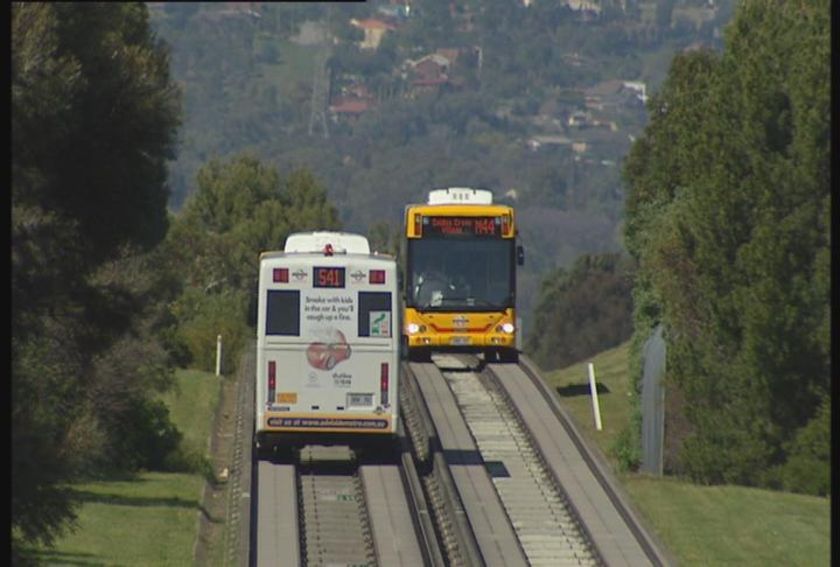
BRT Alternative
Buses are not ai???rapid transitai??i?? as the definition for ai???rapid transitai??i?? is a heavy-rail metro installation. BRT in North America is really express buses or buses operating on a busway. For buses to truly compete against ai???railai??? they must be guided, either curb guided or rail guided (optical guidance has been proven far too troublesome), which requires a ai???reserved rights of waysai??? or a route used exclusively by transit. Guided bus has proven to be a third less costly to build than light rail, but has proven disappointing in operation, by not attracting new ridership. For many a bus, is a bus and perceived as a second rate transit mode and remain taking their cars.
BRT, if built, would prove only slightly cheaper to build than LRT, with none of the operating benefits.
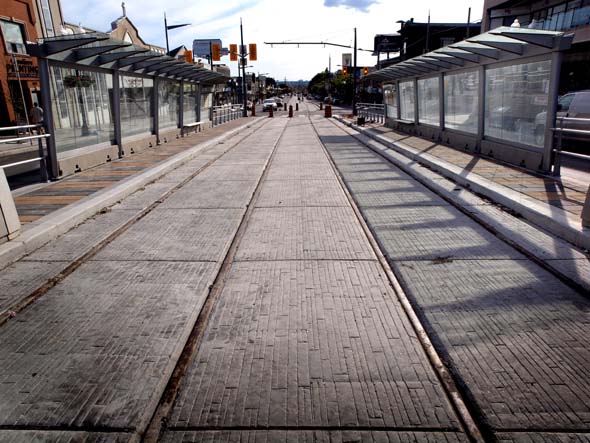
LRT Alternative 1
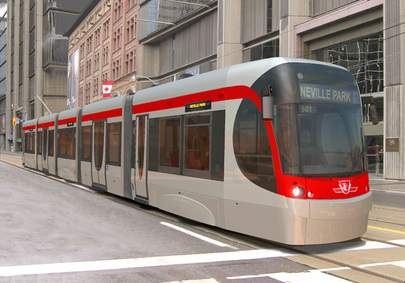
Like BRT, LRT is by definition not ai???rapid transitai??i??, but is light rail a separate ai???railai??i?? mode built to solve different transportation problems. What makes LRT different from a streetcar is the concept of a ai???reserved rights-of-waysai??i?? (RRoWai??i??s), where the streetcar operates on an exclusive route free from traffic, add in preemptive signaling at intersections and LRT operation can rival its much more expensive cousin heavy-rail metro, in operation. Modern LRT has all made light-metro such a as VAL and our SkyTrain obsolete.
Clearly,Ai?? TransLink has only dusted off BC Transitai??i??s Broadway Lougheed ai???rapid transitai??i?? planning from the early 90ai???s and cobbled together this loser. No thought has been made to provide a customer friendly transit service and again TransLink planners prove that they plan for LRT as a ai???poor manai??i??sai??i?? SkyTrain.
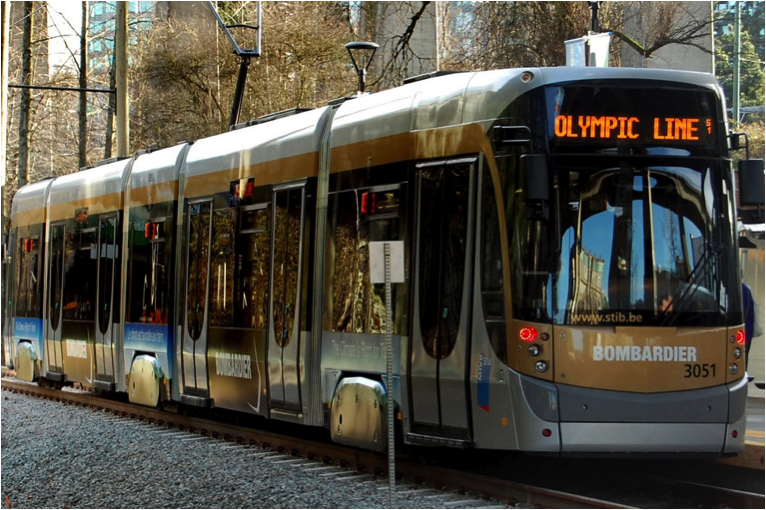
LRT Alternative 2
The second LRT alternative, feeding a second line to the Olympic Line, seems to have been planned on a back of an envelope to take advantage of the recent success of the now closed Olympic Line. Another daft TransLink plan.
RRT Alternative
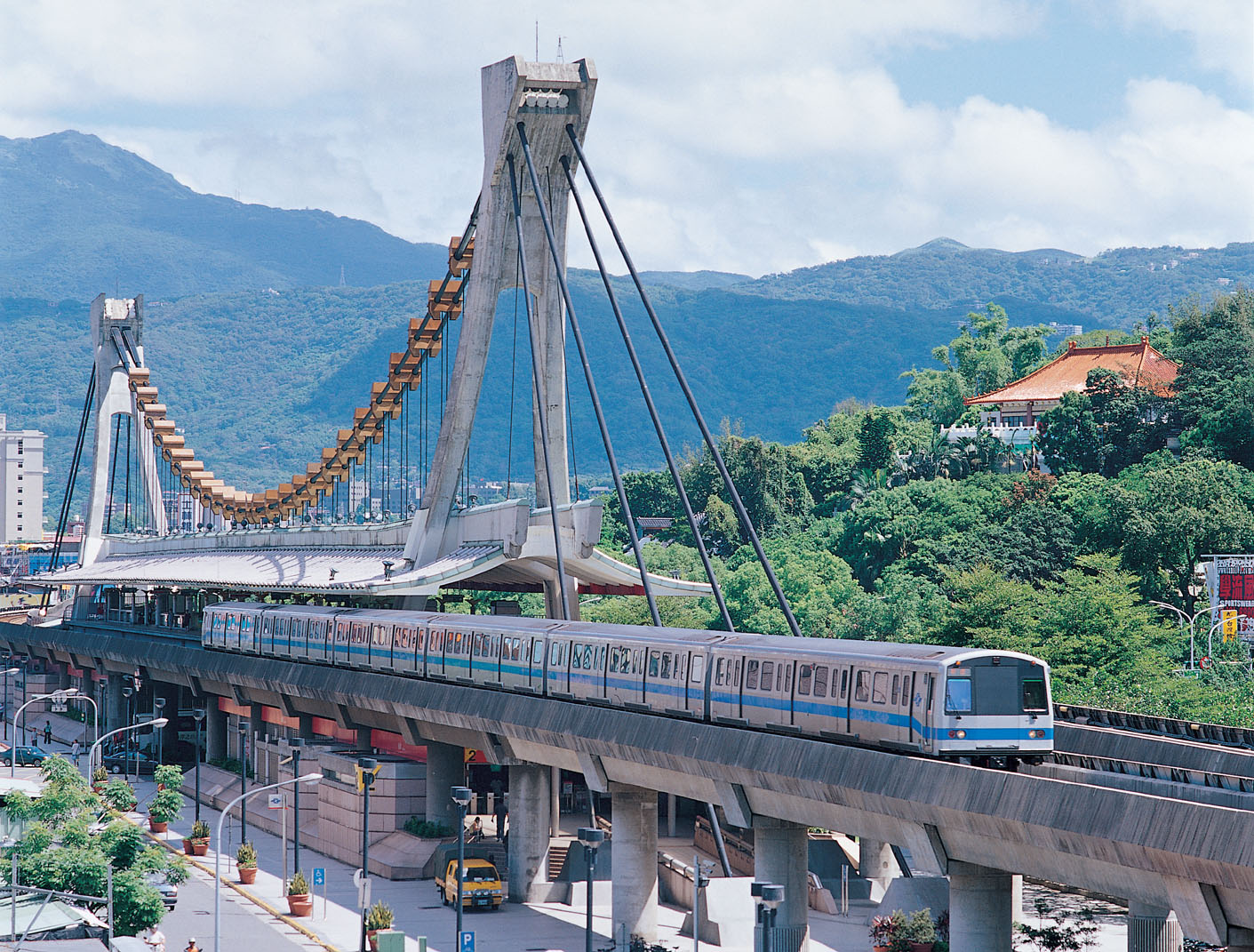
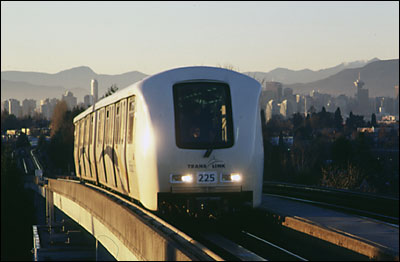
It seems that TransLink is scared by the term subway or metro and use the very strange term Rapid Rail Transit, more to confuse people than anything else. The name is to infer that it is fast and for TransLink, the speed of a transit line is their mantra. But the higher speed from a metro comes from grade separation and fewer stations, which means an expensive ai???shadowai??i?? bus operation to try to feed the metro. Metros are very expensive to build and are not very good in attracting new ridership and guess what, SkyTrain is a metro, yet has seemed very poor in attracting the motorist from the car. Strange to, that SkyTrain was first conceived to be elevated to mitigate the massive cost of subway construction.
Rail Rapid Transit or metro is only built if ridership demand (15,000 pphpd or more) warrant the huge expenditures required to build and operate the mode.
Combo Alternative
This is truly bizarre and it seems TransLink is trying to please Bombardier, by having a ai???railai??? option for both their LRT/tram line of vehicles and SkyTrain. Really, what has been proven over and over again is that transfers deter ridership, yet TransLink loves to force transfers on transit customers. This option is expensive and extremely poorly thought out.
Best Bus Alternative
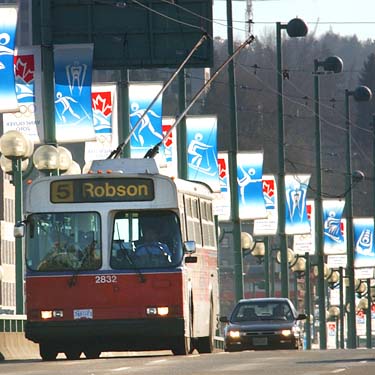
It would save TransLink a lot of grief and money by promoting an European style of bus service with stops every 400m to 500m,Ai?? with faster commercial speeds and better productivity. The Best Bus is well past its ai???Best Byai??i?? date but probably will be the winning option due to TransLink horrendous financial problems.
The Broadway Gong Show Revisited
Back by popular demand, the Broadway gong show.

Broadway Transit Follies ai??i?? TransLink Does The Gong Show ai??i?? Part 2
Posted by zweisystem on Thursday, March 31, 2011
Want to know how TransLink spends taxpayer’s hard earned money? It is easy, TransLink studies transit options for Broadway. TransLink’s Broadway “Rapid Transit” (which means metro) study for Broadway is dated and extremely misleading, but what else would one expect from an organization that has done little, but to waste time, justifying their existence. TransLink’s seven options are studies in mediocrity, nothing more. It is time TransLink get out of the planning business and let real transportation experts have go at it, at least we would get something resembling a 21st century public transit.
Memo to South Fraser Politicians: Dump this turkey called TransLink and form a new South Fraser Transportation Authority,Ai??asAi??TransLinkAi??couldn’t even plan for an outhouse, let alone understand its function.
The following are the seven transit options offered by TransLink with Zweisystem’s comments added.
Option 1: Street level Bus Rapid Transit ai??i?? cost $350 million to $450 million

The problem with Bus Rapid Transit or BRT, is that to be truly rapid, it must operate on either a guideway or a dedicated bus way. If the proposed BRT is to be BRT, it will cost almost the same for a simple streetcar or tramway to install. As there is much more benefits that come with a streetcar/tramway than BRT, it is natural to spend a little more and get a far greater bang for your buck.
Here lies the Achilles heel of BRT.
Option 2: Street level LRT- Cost $1.1 billion

Here we see TransLink at its finest, loading costs onto LRT to make it more expensive than it should be, but then by not doing so, it would make the SkyTrain and Canada line metros (they are two completely different metro systems) look like bad bargains. Modern LRT, either as a basic streetcar/tramway or light rail can handle capacities exceeding 20,000 persons per hour per direction, with just a basic there and back track design. The real costs for a light rail option:
- Streetcar/tramwayAi??(not including vehicles and using existingAi??electrical overhead): ai??i?? $6 mil/km to $10 mil/km.
- LRTAi??(not including vehicles and using existingAi??electrical overhead) with 60% reserved rights-of-ways and priority signaling at intersections: $15 mil/km to $25 mil/km.
- Light Rail Vehicles: Used staring under $1 million to new (depending on size) $3 million to $6 million each.
Option 3:Ai?? LRT #2 ai??i?? Cost $1.3 to $1.4 billion

This LRT variant is just puzzling and one must ask the question why? Why go via the Great Northern Way? It seems TransLink is just up to its puerile games, not knowing what to do and hoping someone will come along and fund a SkyTrain subway under Broadway.
Option 4: Bored tunnel Rail Rapid Transit ai??i?? Cost $2.9 to $$3.2 billion

Here is the meat of the matter; here is what TransLink really wants to build ai??i?? a SkyTrain subway to UBC. The real cost for a bored SkyTrain subway to UBC is nearer to $4 billion and there isn’t the ridership today or in the future that would justify such an expenditure. To reduce costs, revisiting cut and cover construction would be a real option, but will the memory of the ruined Cambie Street merchants, still linger when the final decision is made?
Option 5: Street level LRT ai??i?? bored tunnel RRT ai??i?? elevated RRT ai??i?? Cost $2.4 billion

Here we have a plan to keep the LRT and SkyTrain types happy, silly and unprofessional, but then I would expect nothing lessAi??from TransLink. A planned forced transfer for UBC bound passengers at ArbutusAi??defies modern public transit philosophy of providing a seamless or no transfer journey.
Option 6: Street level BRT/Tunnel Elevated RRTAi??- CostAi??$1.9 billion

Here we have real silliness by TransLink, a plan to keep the bus boys and SkyTrain types happy. It’s not quite April Fools Day, but TransLink’s bizarre BRT planning could fund over 60 km of streetcar/LRT for the city of Vancouver.
Option 7: Best bus ai??i?? Cost $325 million

Here we come to the transit plan that will probably be implemented, the Best Bus option ai??i?? it is what TransLink can afford.
I try not to be tooAi??hard with my comments about TransLink, but really, when such rubbish is presented at public meetings it is hard to contain ones self. Not one of the plans addresses real transit problems, rather they seem to be a continuation of the Expo Line in one form or another and those bureaucrats in those ivory hall on Kingsway should hang their heads in shame. Not one plan will offer an attractive alternative to the car. Buses, in their various guises, have singularly failed to attract the motorist from the car and haphazard and meandering light rail lines will do likewise. forced transfers are well know to deter ridership and in Europe transit is so designed to minimize or eliminateAi??transfers altogether.
Why doesn’t TransLink use the simple term metro or subway, instead of using Rail Rapid Transit or RRT. Could it be that TransLink wants to play the old SkyTrain shell game once again by claiming that RRT is faster and carries more customers than LRT? Sad to say, TransLink played this game with the Evergreen Line, until US transit expert Gerald fox caught them out!
In 2008, noted AmericanAi??transit expert Gerald Fox, statedAi??in a letter to a Victoria transportation group,Ai??shredded TransLink’sAi??Evergreen Line business case, stating; “I found several instances where the analysis had made assumptions that were inaccurate, or had been manipulated to make the case for SkyTrain. If the underlying assumptions are inaccurate, the conclusions may be so too.”Ai??
FoxAi??later said; It is interesting how TransLink has used this cunning method of manipulating analysis to justify SkyTrain in corridor after corridor, and has thus succeeded in keeping its proprietary rail system expanding. In the US, all new transit projects that seek federal support are now subjected to scrutiny by a panel of transit peers, selected and monitored by the federal government, to ensure that projects are analyzed honestly, and the taxpayersai??i?? interests are protected. No SkyTrain project has ever passed this scrutiny in the US.”Ai??
Over 15 years ago, during the Millennium Line fiasco, Zweisystem had a long chat with a transit professional from Asea Brown Boveri, regarding the application of a successful light rail line on Broadway. His comments still ring true and show how dated TransLink’s present day efforts are.
He stated that a BCIT to UBC line with a second line from Main Street, through Vancouver’s downtown to Stanley park, would more than double present bus ridership on the two routes in two to three years, creating the ridershipAi??which fares would not only pay for the operational costs, but the capital costs of the new LRT. With such revenue, we could find an operator that would design, build and operate the new transit line at no cost to the taxpayer.
Maybe this is why TransLink has done so poorly in planning for transit, they are afraid that the private sector would show what TransLink really is, a ponderous bureaucracy whose only efforts is to create jobs for itself to pretend that it is actually accomplishing something. But then, there is no money for any of this, except for the last Best Bus option and what is planned for today, will be stale-dated by future events, when what ever option is implemented.
It is time that civic and provincial politicians put this expensive gong show out of its misery.
TransLink’s numbers challenged
Long time transit advocate Malcolm Johnston has scored a direct hit on TransLink.
For too long TransLink has manipulated planning to favour SkyTrain and with so many new light rail lines being built, it is hard for TransLink to hide from the truth any longer.
One only wonders, how TransLink will reply or will they just ignore the letter and hope that it will be soon forgotten.

TransLink’s numbers challenged
Published: March 12, 2013Editor: I have read with dismay TransLinkai??i??s continued campaign to deliberately misinform the public about modern LRT or light rail, while at the same time championing the very expensive proprietary light metro system that is known as SkyTrain. I am not surprised, as this is just a continuation of TransLinkai??i??s deceitful method of transit planning, where the truth has become so twisted it is barely recognizable.
I have been advocating affordable public transit since 1986. During that time, I have made scores of contacts with professional engineers and transit planners in North America and Europe. This has guided my knowledge on the subject of urban transportation.
To date, not one of these professionals has favoured SkyTrain, nor recommended its use. It is easy to see why. The SkyTrain system has been on the market for over 35 years, and gone through at least four official name changes (ICTS, ALRT, ALM, ART).
Only seven such systems have been built, and only two are seriously used for urban transit. The other five systems are short demonstration lines, or airport/theme park people movers.
It is strange that TransLink never broadcasts the following facts:
1. SkyTrain is not faster than LRT ai??i?? TransLinkai??i??s planners have deliberately designed LRT to be slower. Some LRT vehicles are designed to travel at 100 kph on the mainline railways.
2. To date, only seven SkyTrain-type systems have been built. During the same period, 156 new LRT/tram systems have been built, with another 36 on the way.
3. Speed of a transit system does not itself attract ridership, rather it is the speed of the overall commute. SkyTrain with its widely spaced stations will mean longer overall journey times, when compared to LRT.
4. TransLink has yet to offer a credible study which shows that SkyTrain attracts more transit customers than LRT. Elevated transit systems and especially subways tend to deter ridership.
5. To date, no SkyTrain system has matched the capacity offered by LRT or even a streetcar. The main tram route through the City of Karlsruhe is seeing peak hour headways of 45 seconds, catering to traffic flows in excess of 40,000 persons per hour per direction.
6. No SkyTrain system built to date was ever allowed to compete directly against modern LRT. All SkyTrain systems built to date have been sold in private deals or forced on the operating authority by senior governments.
7. The Canada Line is not SkyTrain, rather it is a conventional heavy rail metro, built as a light metro and as such has less potential capacity than a streetcar. Canada Line cars cannot operate on the SkyTrain system and visa versa.
8. SkyTrain is a proprietary transit system and only SkyTrain-made cars are able to operate on SkyTrain. TransLink is tied to one supplier and if SkyTrain goes out of production, there will be no supplier. LRT is a generic transit system and is able to operate cars as a generic transit system. There can be cars from scores of suppliers. The Portland LRT operates vehicles made by Bombardier and Siemens, and the Skoda- built streetcars can also operate on the MAX LRT system.
9. Driverless transit systems are not cheap to operate. In fact, small driverless mini-metro systems like SkyTrain and the Canada Line cost much more to operate than comparable LRT systems with drivers. TransLink has never produced an ai???oranges to orangesai??? comparison between LRT and SkyTrain.
TransLink has deliberately over-engineered proposed LRT lines, for the purposes of making it look less affordable than SkyTrain. A general rule of thumb is that underground (subway) construction is about twice that of elevated construction and elevated construction can be up to 10 times more expensive to build than at-grade construction.
What TransLink is practicing, with the many sham studies it produces and the erroneous claims it makes, is simple.
If one repeats a lie over and over again, eventually the public perceives it as truth.
I would recommend South Fraser councils do the following:
1. Demand that TransLink have its ai???rapid transitai??? plans reviewed by a credible transit expert, someone who has both planned, built and operated modern light rail and light metro.
2. Fund a second study by a someone who has expertise in designing, building and operating modern LRT.
3. Secede from TransLink altogether and form a South Fraser Transit Authority.
Some years ago, a Victoria transit group asked noted American transit expert, Gerald Fox, to review the Evergreen Line business case. The following was his conclusion and sadly, it still holds true for TransLink today.
ai???It is interesting how TransLink has used this cunning method of manipulating analysis to justify SkyTrain in corridor after corridor, and has thus succeeded in keeping its proprietary rail system expanding. In the U.S., all new transit projects that seek federal support are now subjected to scrutiny by a panel of transit peers, selected and monitored by the federal government, to ensure that projects are analyzed honestly, and the taxpayersai??i?? interests are protected. No SkyTrain project has ever passed this scrutiny in the U.S.ai???
D. Malcolm Johnston,
Delta
http://www.langleytimes.com/opinion/letters/197461681.html



Recent Comments