With global warming and climate change begin to cast a fiery shadow over the province this summer, what is the provincial government planning?
Three guesses and the first two don’t count: building more highways.
Our politcal “rubber on asphalt” mentality will be the death of this province as the provincial government continues to promote car use instead of investigating alternatives.
There are three regional railway projects, that the government must take a serious look at.
Rail for the Valley’s Marpole to Chilliwack restoration of a modern interurban service on the former BC Electric line.
Restoration of passenger service on the E&N railway.
A Salmon Arm to Kelowna, regional railway, on the former CNR railway route.
If we are to mitigate the pollution caused by cars and commercial vehicles on our roads and highways, we must provide an affordable alternative and rail is that alternative.
Each of these regional railways, service population centres, airports, business parks, and post secondary institutions.
Regional railways are also affordable, using established Rights-of-Ways greatly reduces costs.
What are the cost estimates?
Marpole to Chilliwack – 130 km – under $2 billion.
E&N restoration – 230 km – $3 billion to $4 billion
Salmon Arm to Kelowna – 140 km – $2 billion to $3 billion
Considering that the provincial government is spending over $11 billion to extend the Expo and Millennium Lines a mere 21.7 km, An estimated $7 billion to $9 billion for 500 km of new regional railway seems to be a very good investment.
If government is serious about Global Warming and if the Carbon Tax is more than just a government tax grab, the government must invest in regional railways as an alternative to using the car.
For those who believe that, what we call SkyTrain, is a great Canadian invention, will be sad to hear it is not, not even close; it is a mix and match transit system, using largely discarded 1960′s and 70′s German technology.
Krauss-Maffei’s Transurban was a 12-passenger automated guideway transit (AGT) mass transit system based on a MAGLEV guideway. Development started in 1970 as one of the many AGT and PRT projects of the age. Its selection as the basis of the GO-Urban system in Toronto in 1973 made it well known in the industry; it would have been the basis of the first large-area AGT mass transit network in the world.
The suspension used attractive magnetic levitation, lifted on two upside-down T-shaped beams.
Technical problems cropped up during the construction of the test track, and the sudden removal of funding by the West German government led to the project’s cancellation in late 1974.
Given the technical problems including problems turning corners, the Ontario government decided to abandon the MAGLEV concept. Instead, they took the basic train design, linear motor, SEL (Standard Electric Lorenz) control system and other features of the Transurban, and redesigned it to run on conventional steel wheels. The result was the “ICTS” system. Announced in June 1975, the government formed the new Urban Transportation Development Corporation, in partnership with five industrial firms.
Today known as the Movia Automatic Light Metro (MALM), ICTS/ALRT/ART/Innovia is the basis for only seven such systems built in the past 40 years, of which only three are seriously used for urban transit.
Today, only six are in operation with Toronto’s SRT now abandoned.
Some Vancouver transit riders are alleging an increase in disruptions to TransLink service.
Over the past couple of months, we’ve seen a few periods of frequent incidents, whether police or medical, impacting thousands and bringing service to a halt.
In February, Daily Hive Urbanized reported at least eight incidents on SkyTrain over three weeks, resulting in disruptive shutdowns.
Many shared their concerns and frustration in a Reddit thread on Thursday in response to another disruption limiting service between Braid and Lougheed. We’ve also received comment from TransLink about the concerns, which come just months before transit fares will be increased, impacting all fare zones.
There are a lot of folks who are traveling from the Lougheed area who are impacted by some service changes.
“The whole Expo Line service reduction for the new rail yard near
Braid has been brutal. I feel like there must have been a better way to
branch a track without a two-year-long service disruption,” one user
said via the Reddit thread.
Another user said, “SkyTrain’s been terrible lately.”
Some have elected to switch to using rideshare services.
“I’m literally in an Uber right now ’cause I ain’t dealing with that s**t.”
Drivers or people using other means to commute offer their condolences to Metro Vancouver transit riders.
“I feel for anyone that has to rely on SkyTrain to get to work.
Absolutely ridiculous the number of outages that have been happening
lately, I seem to get an alert every day, sometimes multiple a day.”
Some sound more forgiving, comparing SkyTrain service to other transit systems in North America.
Interesting news from the other side of the country.
Cape Breton Island Population: 93,700
So, a population of 93,700 warrants a study to see if light rail is feasible?
How about Vancouver Island and the E&N?
How about restoring a passenger service on the former BC electric interurban route to Chilliwack?
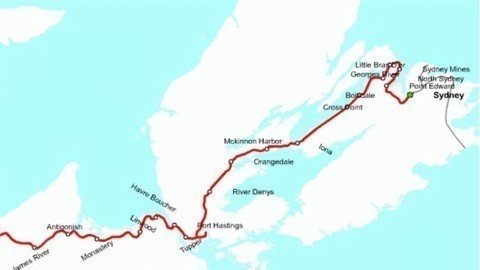
The distance between Port Hawksbury to Sydney, on Cape Breton, is about the same length (130 km) as the Vancouver to Chilliwack Rail for the Valley route, to reinstate a hourly diesel TramTrain service would cost around $1.5 billion to $1.75 billion, somewhat more than the Fraser Valley project, due to the unknown condition of the track.
TransLink and the provincial NDP really have to get with modern transit planning as their dated light-metro planning is both far too expensive and almost next to useless in reducing car use in the region.
For those living on Cape Breton, I sincerely wish them luck and see if their politcans are more enlighten than our lot on far side of the country.
Nova Scotia to fund feasibility study of Cape Breton light-rail line
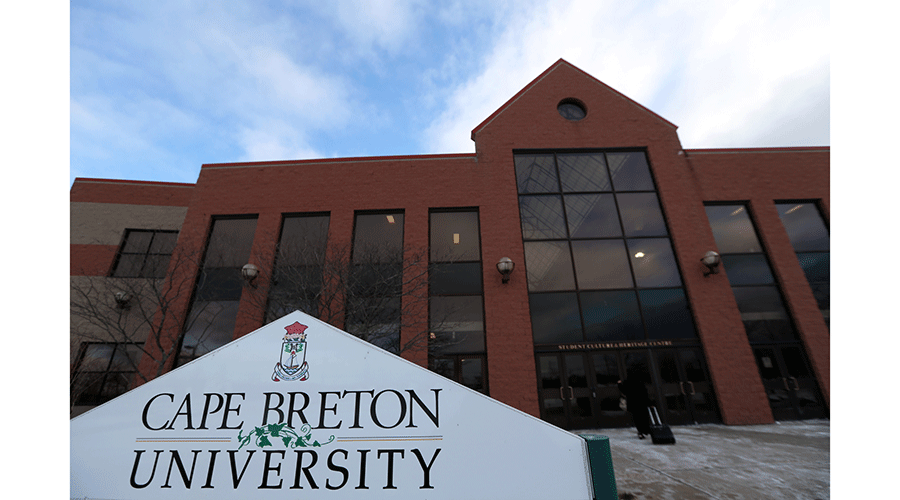
Cape Breton University is proposing Atlantic Canada’s first light-rail line, with support from the province of Nova Scotia.Photo – Communications Nova Scotia
advertisement
The province of Nova Scotia is awarding CA$610,000 to support a study of whether to introduce light-rail service to Atlantic Canada.
Cape Breton Regional Municipality (CBRM) is experiencing significant growth after years of population decline. Because of that, access to reliable transportation and housing near Cape Breton University has presented challenges, CBRM officials said in a news release.
Nova Scotia is earmarking funding for the university’s study of the potential for developing a battery-powered light-rail service in CBRM. The light-rail line would build on existing infrastructure and the rail corridor, CBRM officials said.
“Over the past five years, CBRM transit has done an exceptional job managing growth, but they need new options. For years, Cape Bretoners have seen the railway sit idle,” said Nova Scotia Premier Tim Houston. “Now they’re seeing the population grow and the need for more efficient transportation. This project is something to get excited about.”
The study will include consultation with community members. Work is expected to begin immediately.
The estimated cost to rehab both the Expo and Millennium Lines is now topping $4 billion (now, not including rail, OHE, stations and cars) and with already $1.47 billion spent on resignalling the proprietary automatic railway, the cost now seems to be well over $5 billion for 16 km of new line!
Compare to the under $200 million that may be spent rehabbing the Minneapolis Blue Line LRT.
What is disturbing is the work needed on the Bombardier built trams, where, “work to address rust from 27 of Metro Transit’s first generation light rail vehicles, made by Bombardier Transportation, is underway in Tallulah, Louisiana. Though the agency started addressing rust on those cars in 2017, when they had been in service for around 13 years, they later found the cars had rusted to where its maintenance staff could not handle the workload“.
Rust? This either means a lack of maintenance by the operator or poor metal preparation by the manufacturer, Bombardier!
As further proof that light rail is much cheaper to build, operate and maintain is the following graph fro MetroLinx.
Metrolinx is a Crown agency of the Government of Ontario that manages and integrates road and public transport in the Greater Toronto and Hamilton Area (GTHA), which comprises much of Ontario’s Golden Horseshoe region. Headquartered at Union Station in Toronto, the agency was created as the Greater Toronto Transportation Authority on June 22, 2006. The agency adopted its present name as a brand name in 2007 and eventually as the legal name in 2009.
According to the graph, the 50 year costs of at-grade LRT is about one fifth cheaper than our SkyTrain light metro system.
This lesson has not been learned by the Premier, the Minister of Transportation; TransLink, and the Mayor’s Council on Transit and both the transit customer and taxpayer are left to pay the bills for our politicians ignorance and largess.
Where is a modern day Robin Hood when you need one?
Metrolinx 50 year cost comparison of different transit modes. Vancouver’s SkyTrain light metro system would be much more expensive, approaching that of a heavy-rail metro, than elevated LRT over a 50 year period.
Metro Transit will rebuild old Blue Line while pondering its extension
Everything from stations and train cars to tracks and signals need upgrading 20 years after the Blue Line’s debut.
A Metro Transit first-generation light rail vehicle being trucked through New Prague on its way to Louisiana. Credit: MinnPost photo by H. Jiahong Pan
Cesar Rodriguez uses the Lake Street/Midtown Station, but only if he needs to go to the nearby Target or the Planet Fitness.
“That’s the only reason why I use it. The way it’s set up, you have to go around to go up the stairs. Out of sight, out of mind. Some people take advantage of it,” said Rodriguez, referencing the drug use at the station, one Friday as he took the Blue Line to the Mall of America.
The station layout may soon change. As Metro Transit contemplates extending the Blue Line through north Minneapolis and the northern suburbs, they are about to embark on a project to rebuild some pieces that make up much of the original Blue Line that could cost around $120 million.
At least $8.75 million will go toward a near-complete rebuilding of the Lake Street/Midtown station, according to the agency. Another $101 million is budgeted toward rebuilding the tracks and signals between Cedar Riverside and Bloomington Central stations, and another $12 million may go toward removing rusted structural members from 27 of its oldest light rail trains.
Since it opened in 2004 as the Hiawatha Line, the Blue Line has carried over 170 million passengers, according to data the agency published overthe years. The original segment, from Hennepin Avenue to the Mall of America, cost $715.3 million to build and was serviced by up to 24 light rail vehicles operating in pairs. With ridership exceeding 2020 expectations by its first year, over the next decade, Metro Transit expanded its platforms to handle three-car trains, expanded the size of its two park-and-rides serving the route, built a new light rail station, and bought 20 more light rail vehicles from two different vendors.
To keep the route and service in shape, Metro Transit has been gradually replacing some of the rail, switches, and signals that tell a train operator where it can go. Metro Transit completed the first part of that work in downtown Minneapolis in 2017, as well as rail replacement and signal work between Bloomington Central Station and Mall of America in 2022.
Later this spring, they plan to replace rail and signals between Bloomington Central Station and Terminal 2 station at a cost of $18.6 million. Next year, they plan to do the same work between Cedar-Riverside and Terminal 2; the agency has not released an exact cost figure for that work to ensure a “fair procurement process.”
Next year’s rebuild will cause disruptions on Blue Line service, but how it will be disrupted is not clear. “Prior to construction, Metro Transit will launch a communication campaign using its website, social media, text/email alerts, station and vehicle signage, and station ambassadors to promote when and where replacement bus service will be needed,” said Metro Transit spokesperson Drew Kerr. Metro Transit staff expect to present more details to Met Council members at their Transportation Committee meeting on April 8.
While the track and signal work is underway, the agency also plans to completely rebuild the Lake Street-Midtown Station. “It sees a lot of foot traffic, combined with we’ve had sort of an increase at the station of repairs, replacement and damage and vandalism over the past few years,” said project manager Christina Morrison at a November Met Council Transportation Committee meeting.
The elevators and escalators at the station constantly break down. The agency and some riders are also concerned with people congregating at the station doing drugs. “It’s a terrible place,” said Rodriguez, citing drug use. Agency staff are also worried about harassing behavior, as well as how the station design can contribute to it.
The agency envisioned removing the shelters on the platforms and encompassing the entire station under one giant canopy. They may also replace the elevators and escalators with stairways and a ramp, and re-orient the stairways so they face Lake Street, as opposed to being accessed from side doors as they are today.
It’s unclear if the station will be retrofitted with faregates. “A study exploring how existing light rail stations could be improved through a variety of investments, including fare gate systems, will be completed later this year,” Kerr said. Design work by St. Paul-based 4RM+ULA architects through a $3.5 million contract began last month.
The agency anticipates construction beginning in 2025 and lasting until the following year. In the meantime, Metro Transit is halfway through a contract with Allied Universal to provide security services at the station. The agency also replaced the wall panels with repetitive floral pieces designed by Nickyworks Studio in northeast Minneapolis that also has an anti-graffiti coating. “It has reduced graffiti dramatically. You wipe it right off the surface,” Metro Transit Public Art Administrator Mark Granlund said at a March Met Council Transportation Committee meeting.
Transit rider Craig Warner has mixed opinions about what a renovation might mean for the Lake Street/Midtown Station. “It might help out the situation currently taking place right now, high drug use,” he said as he rode the Blue Line home from shopping at the Mall of America.
But Warner also wonders if a rebuilt station will be enough to quell drug use. “I’m sure they’ve done all that they can at the moment, there’s not much more they can do than to have more police officers ,” added Warner.
Meanwhile, work to address rust from 27 of Metro Transit’s first generation light rail vehicles, made by Bombardier Transportation, is underway in Tallulah, Louisiana. Though the agency started addressing rust on those cars in 2017, when they had been in service for around 13 years, they later found the cars had rusted to where its maintenance staff could not handle the workload.
The union representing Metro Transit maintenance staff says that could have been prevented. “The work should have been done a lot earlier, which would have made it a lot more easier, a lot more efficient,” said Amalgamated Transit Union (ATU) Local 1005 president David Stiggers.
Amid opposition from ATU, who did not want the work to be outsourced, the Met Council awarded an up-to-$12 million contract to RailCar, a rail engineering and accident investigation firm, in late 2021 to work on the rail cars. The Met Council also pledged to remove rust from light rail vehicles more often, every seven or eight years, moving forward.
Meanwhile, three of the first-generation light rail vehicles were trucked out to RailCar’s Louisiana facilities in 2022. The agency expects for them to return this spring with new rust-free structural members. Some of the trains will also have new flooring and wall paneling.
John Lehman, a junior at Roosevelt High School, is a fan of riding the Blue Line, particularly the Bombardier trains. “I like how they look and how they sound,” said Lehman as he sat close to the front of the train on his way to the Mall of America one Friday afternoon.
If all goes well, the work being done by Metro Transit will allow people like Lehman to enjoy the trains for at least 20 more years, when Metro Transit expects to retire them.
As all levels of government pretend they are fighting Global Warming and Climate change, via the much hated Carbon Tax, real solutions such as TramTrain and regional railways are ignored.
Germany has been a forefront in the fight against Global Warming and Climate change and part of that fight is reopening abandoned rail routes and improving their public transit infrastructure to be extremely user friendly.
In Canada we have the Carbon Tax that goes into general revenue and funds mostly new highway and bridge construction, which politicians believe will win their reelection. This is classic Canadian blacktop politics in action.
The Carbon Tax has become a placebo for politcal inaction with government pretending it is doing something to fight Global Warming, but in reality they are not!
The following is what Germany is currently doing to improve regional transportation by installing user-friendly transit. The TramTrain, which has been in operation since 1992 has revolutionized public transit, by providing literally one stop (no-transfer) service to destinations over 120 km away!
TramTrain
The following are just three of the twelve TramTrain Statbahn routes offered by the transit authority, the Karlsruhe Stadtbahn is operated in co-operation by Albtal-Verkehrs-Gesellschaft (Alb valley transport corporation, AVG), Verkehrsbetriebe Karlsruhe (Karlsruhe transport authority, VBK) and Deutsche Bahn (DB).
Not bad for a city with a population of just over 300,000!
Comparison of ridership before and after the first TramTrain line in Karlsruhe, Germany.
Regional Railways
Lint DMU’s
The following links are for the Siegen to Bad Berleburg regional railway in Germany. The local line was built to accommodate small 6-axel tank locomotives hauling 4-axel passenger and freight cars and 4-axel rail;buses. Lots of flange squeal from the non articulated Lint DMU’s on the tight curvatures.
BROADWAY IS NOT THE BUSIEST TRANSIT ROUTE IN CANADA
It seems trouble is brewing on Broadway, buildings are sagging and media keeps repeating the TransLink and City of Vancouver’s nonsense that Broadway is the busiest transit route in North America.
Well it isn’t and never was and my guess is that TransLink, the provincial NDP and the CoV are softening up the taxpayer for some bad fiscal news about the now $2.7 billion, 5.7 km Broadway Subway.
The clincher is this; according to Thales News Release announcing thew $1.49 billion re-signalling contract;
The government of Canada, the government of British Columbia, and the region have committed to investing $C 1.47bn ($US 1.1bn) in the Expo and Millennium Line Upgrade Programme until 2027.
When the programme is fully implemented, the Expo Line will be able to accommodate 17,500 passengers per hour per direction, and the Millennium Line will be able to handle 7500 passengers per hour per direction, a 32% and 96% increase respectively.
A maximum capacity of only 7,500 pphpd on the Millennium Line (Broadway subway) supposedly busiest transit corridor in North America? Is Broadway the busiest transit corridor in North America, I think not.
For the past several years, the SkyTrain Lobby, politicians and academics have all said, almost in unison, that Broadway was the busiest transit corridor in Canada, if not North America.
The old Joseph Goebbels quote is true; “If you tell a lie big enough and keep repeating it, people will eventually come to believe it.”
Thus for the past several years the big Broadway lie, enabled by TransLink has ingrained the notion that Broadway is the most heavily transit route in Canada.
Fact Check!
According to the TTC’s Fall 2022 data, these routes are busier than Broadway 99B Bus Route:
(data is from Translink and the TTC)
99 B 35,800 Boardings (Fall 2022)
King 514 A&B Streetcar: 48,900 Boardings (Fall 2022)
Queen 501Streetcar: 37,400 Boardings (Fall 2022)
Finch West 36 Bus: 36,900 (Fall 2022)
Lawrence West 52: 36,100 (Fall 2022)
In a letter to several news organizations, all metro mayors and other interested parties, I laid the foundation that Broadway was not the busiest transit route in Canada .
Stung by this, TransLink wrote a letter to myself and in a round about way claimed that Broadway “is our region’s most overcrowded bus route.”
No apology and not even a hint of remorse, TransLink continues to boast about Broadway!
Finally, on January 31, 2019, you contacted several news organizations and this Secretariat raising concerns over TransLink’s assertion that the 99 B-Line is the busiest bus route in the US and Canada. TransLink is confident in its data collection and peer comparisons, noting that the 99 B-Line route on the Broadway Corridor moves 60,000 customers per day on articulated buses running every three minutes at peak times. This is our region’s most overcrowded bus route. Pass ups are already common, as our regular riders on that route are fully aware. TransLink projects that the 99 B-Line from Arbutus to UBC will be at capacity in the peak when the Millennium Line extension from Commercial-Broadway to Arbutus opens.
Just a minor footnote, according to TransLink the 99B moves about 70,000 customers a day, but of course that is both ways, as TransLink slyly tries to once again inflate the real ridership on Broadway.
Why?
The big prize is the now $2.7 billion Broadway SkyTrain subway to Arbutus and TransLink does not want the truth to upset the subway bulldozer!
Our friend Mr. Haveacow, predicted this some years ago and there were many who pooh-poohed this. I even had a local politician warning me not to spread misinformation, with a hint of legal proceedings.
Why so touchy on the subject?
It looks like TransLink and the Mayor’s Council on Transit are trying to hide the fact that part of the Expo line extension to Langley, includes increasing capacity of the Expo Line from 15,000 pphpd to 17,5000 pphpd. Part of this capacity upgrade includes new signalling for the Expo Line ($1.49 billion contract with Thales) and as Mr. Cow has mentioned many times, all the switches on the Expo Line must be changed to higher-speed switches or turnouts. A longer switch is needed to reduce the radius of the curvature of the switch needing the concrete guideway be altered to accommodate the new switches and this is going to be very, very expensive.
Multiply the cost of this one switch replacement project, with the number of switches on the Expo Line and one will see instantly that this will be extremely costly, yet the NDP Government, TransLink and the Mayor’s Council on Transit will not include this cost with the advertised cost of $4.01 billion, 16 km, Expo line extension to Langley!
The question I ask is; “What will be the real cost of Surrey – Langley Expo Line extension, because it is certainly not $4.01 billion?”
Maybe $5 billion and counting! No wonder TransLink is on the stump begging for more tax money!
King George SkyTrain Station closing for 6 weeks
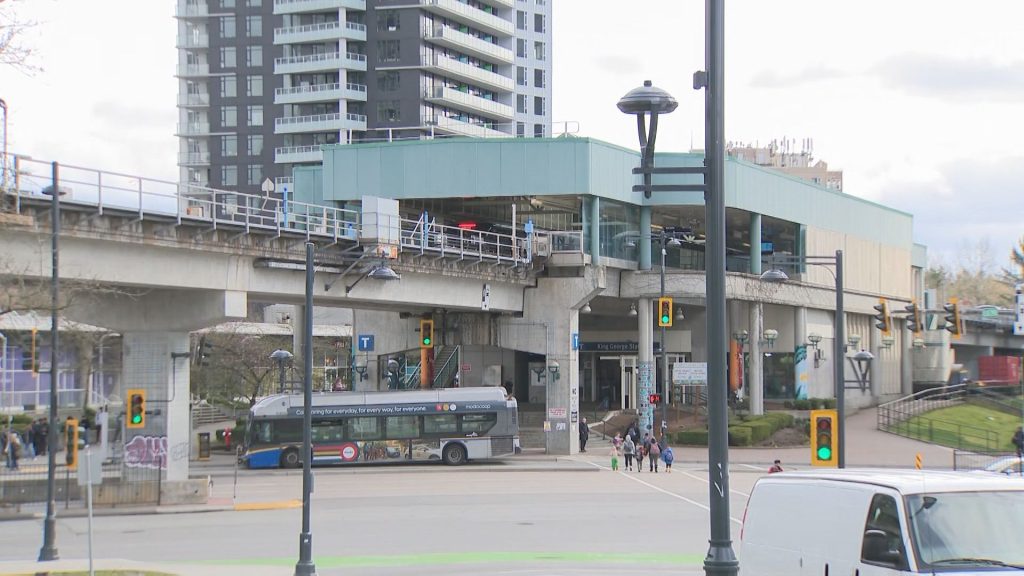
King George Station in Surrey, B.C. on Monday March 25, 2024. (CityNews Image)
Essential maintenance work is forcing the closure of the King George SkyTrain Station in Surrey for six weeks beginning at the end of April.
TransLink explains the station will close to passengers starting Saturday, April 27.
During the six weeks of repairs, there will be no SkyTrain service to or from King George Station, TransLink says. The Expo Line will temporarily end at Surrey Central Station.
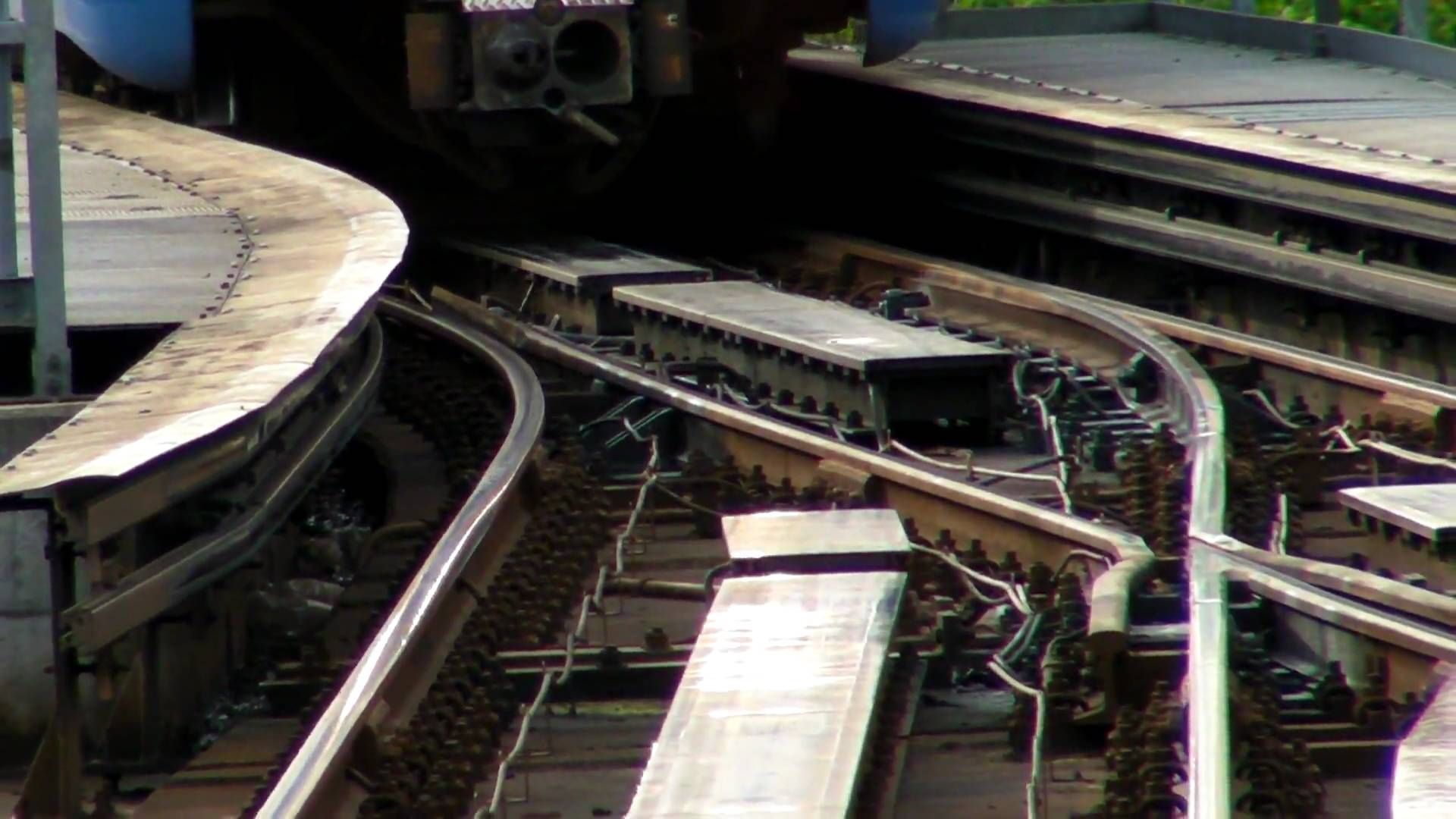
“Some of the work will includes removing parts of the rail to replace what’s called a turnout, and that’s a mechanical device that helps guide the trains from one track to another. Over time, these components, over the years, need replacement, and this section of the track, actually, has been in use since the station itself first opened 30 years ago. So, it’s in need of some maintenance and some repair and some upgrades,” TransLink spokesperson Thor Diakow explained Monday.
He says the full-station closure is “required to complete these important upgrades as efficiently and safely as possible.”
“In addition to the turnout work, we’re also doing some multiple infrastructure upgrades in and around King George Station while this work’s happening so we can make the most efficient use of the time,” Diakow explained.
“This includes things like cable installations, elevator inspections, doing some asset repairs around the station, and also some deep-station cleaning.”
The station is expected to reopen in mid-June.
“We just don’t have a firm date because sometimes these things, they can get delayed. But we just want to give people enough of an advanced notice. That’s why we’re sending the bulletin out today, even though the work doesn’t start for just over a month,” Diakow told CityNews.
Bus service to, from King George Station
Buses will continue to serve King George Station, TransLink explains, but with some changes; Additional buses will run every 15 minutes between King George and Surrey Central stations from 6 a.m. and 9 a.m. on weekdays, and routes that normally end at King George will stop at the station and then extend northbound to terminate at Surrey Central.
TransLink says buses that include a stop at King George will maintain their regular stops and routes.
“Obviously people still rely on carsharing and the parking lot there — the parking lot will be open but there will be some delays in the area because of the proximity to the construction. So we’re working very closely with the City of Surrey and carsharing companies to make sure we can accommodate people during that time. So there will still be access to Whalley Boulevard off that area, the taxis will still be present there,” Diakow said.
Staff will be available to help passengers at King George Station, TransLink says, and signage for bus bay changes will be installed.
“We’ll have staff present to assist travellers if they need help to know where they’re going,” Diakow explained.
“Customers who normally travel on the SkyTrain between King George and Surrey Central stations should build in about 15 minutes of extra travel time.”
The straw man fallacy is an informal fallacy, which means that the flaw lies with the arguer’s method of arguing rather than the flaws of the argument itself. The straw man fallacy avoids the opponent’s actual argument and instead argues against an inaccurate caricature of it.
When dealing with arguments against Rail for the Valley’s regional railway project, most arguments tend to be man of straw fallacy’s in an attempt to demonize the concept of a regional railway.
The following are the six common “man-of-straw” arguments made against the Valley Rail project.
Cannot operate a viable rail service on single track railway lines.
Freight and passenger services cannot operate on the same line.
Road/rail crossings will slow service.
It is faster by car.
It is better option to run rail on the median of Hwy.1.
Will not attract ridership.
I will deal with each one of the the top six fallacies.
Cannot operate a viable rail service on single track railway lines.
This has been dealt with in the previous post as many passenger rail lines operate wholly or on portions of single track. In Ottawa, 15 minute headway’s will be achievable, with properly placed passing loops.
Road/rail crossings will slow service.
This old saw has been around for decades and it is one of the favourites of the anti rail lobby. Level crossing, both protected by a gate with lights, or with lights, does not slow the rail service and for auto traffic, the wait times are the same as for a regular light controlled intersection.
Freight and Passenger services cannot operate on the same line.
Another old saw that is trundled out at almost every public meeting, again has no validity. Modern electronic signalling has all but eliminated operational conflicts between freight and passenger services, providing safe “pathways” for each service on sections of line. These “blocks” allow for safe operation. In some jurisdictions, freight service is only allowed to operate after the cessation of passenger service each day. In Germany, TramTrains (streetcars that can operate on the mainline railways) coexist with both passenger and freight services on the mainline!
It is faster by car.
This is almost always true for transit, as a transit route is designed to maximize ridership, while providing a timely and user-friendly service. What is not included is congestion and gridlock. The idea that saving 15 minutes in travel time driving the car, dealing with traffic, idiot drivers and more is a worthwhile trade-off to take transit.
It is better option to run rail on the median of Hwy.1.
This is becoming the great refrain of people especially the SkyTrain Lobby. building a transit line along Hwy.1 would be hugely expensive and it would not service many destinations, four or five at best.
Rail for the Valley’s Marpole to Chilliwack services at least 13 major destinations, including three KPU campuses (Cloverdale, Langley, Abbotsford) and Trinity Western University.
Cost is another factor. The 130 km RftV/Leewood study would cost under $2 billion, while a 90 km, Lougheed Mall to Chilliwack would cost a minimum of $28 billion
Will not attract ridership.
As mentioned previously the RftV/Leewood plan would service:
South Vancouver (15 minute transfer to YVR via the Canada Line)
New Westminster
North Delta
Central Surrey
Cloverdale (front door service to KPU and the new hospital being constructed)
Langley
KPU Langley
Trinity Western University (front door service)
Gloucester Business Park
Downtown Abbotsford
Hunntington/Sumas (easy walking distance (150m) to the US Border)
Sadris/Vedder (minutes away from Cultus lake)
Chilliwack
When it comes to defending SkyTrain, all the SkyTrain Lobby has is “Man of straw arguments“, and in the real world, this does not pass as facts.
Catching a local radio last week, the old saw about capacity and that SkyTrain had a higher capacity than Light Rail, again was used as a example why light rail was not as good as SkyTrain.
Sadly, there was no fact check, just blind acceptance of fake news.
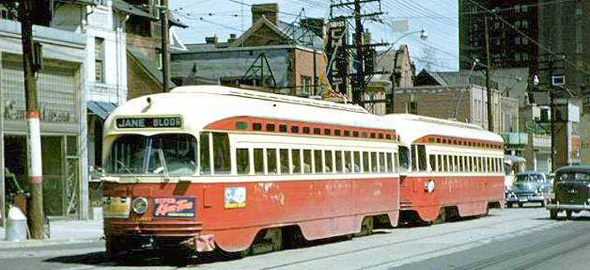
Really, after the $1.49 billion resignalling contract, the maximum capacity of the Millennium Line will be a mere 7,500 pphpd. I just shake my head, as Toronto was operating coupled sets of PCC cars on select routes providing a peak hour capacity in excess of 12,000 pphpd!
The following was first published in 2009 and it remains as pertinent today as it did 15 years ago.
A coupled set of PCC cars in the early 1950’s in Toronto.
A QUESTION OF CAPACITY
The Light Rail Transit Association
THE CAPACITIES of different modes of transport are generally quoted as 0-10 000 passengers per hour for bus, 2000-20 000 for light rail, and 15 000 upwards for heavy rail.
Maximum capacity is only likely to be required for a few hours during peak hours, and even here there are likely to be variations both day by day and within each hour. The capacity required originates from the route’s social characteristics.
As for the vehicles, buses have a comfort capacity equal to the number of seats, and a maximum capacity equal to seats plus standing load.
In the case of trams, it is more complicated. The nominal maximum capacity is calculated at four passengers per square metre of available floor space (a reasonably comfortable level), plus the number of seats.
As trams are designed to carry a large standing load, the ratio of standees to seats is quite high. The standing area is also important for the carrying of wheelchairs, pushchairs, shopping and sometimes bicycles. Some manufacturers quote maximum capacity using 6p/m2 while a figure of 8p/m 2 is used as a measure of crush capacity. This last figure is also employed to determine the motor rating of the vehicle.
A further complication is that even when there are seats available, some passengers prefer to stand. This may be because they are only travelling for a few stops, that they want to stretch their legs, or may just prefer to stand.
A tram’s comfort capacity can therefore be considered as the number of seats, plus the voluntary standees who may amount to up to 10-15% of the nominal maximum number of standing passengers.
ELASTICITY
It is the difference between the average passenger load for any particular time and the crush load which gives light rail its Elasticity Factor, allowing it to cope with variations in conditions such as sudden surges or emergency conditions.
Standing is made more acceptable by the design of track and vehicle, reducing the forces acting on the passenger to a minimum. This makes for a smooth ride, as well as ensuring ease of access, good support and the ability to see out without having to stoop.
Where a route is mainly urban with short journey times, the number of vehicles required should be calculated on the nominal maximum. On longer journeys outside the central area, a lower level may be more appropriate, dependent on the route’s characteristics. Even on rural sections, there are likely to be a a number of short distance riders, and the loading factor will increase nearer to the urban area.
COMPRESSIBILITY
While it might be thought desirable to offer every passenger a seat, it is in fact the ability to carry high loadings in a confined area (the Compressibility Factor) which enables light rail to achieve many environmental benefits, allowinglarge numbers of people to be carried withoutharming, and often improving, the features of a city.
It is city centres where several routes combine that the most capacity is required. A typical situation could be a pedestrian street with six routes operating at 10-minute headway giving 36 double coupled trams per hour each with a capacity of 225. This gives a nominal capacity of16 200 passengers per hour which can be increased to 25 200 pph in extremis without extra vehicles. Light rail is unique in this ability to operate on the surface with its capacity without detracting from the amenities which it serves.A further factor in setting the resources required is the need to lure motorists out of cars. The more difficult the traffic conditions, the higher the loadings will be acceptable. It is however important that crush loads are not allowed for morethan the shortest of periods on an infrequent basis, both to maintain customer satisfaction and prevent elasticity of the system being compromised.
It is vital that public transport can cope with sudden changes in demand, such as extreme inclement weather or air quality violations which can cause private traffic to be halted. This is where the elasticity inherent in light rail is so beneficial in enabling an instant response in an economical fashion. A tram may be crowded, but its infinitelybetter than having to wait in the snow of smog untilextra vehicles are brought into service.
It is this unique combination of Capacity, Compressibility and Elasticity rather than capacity alone which makes light rail so successful as an urban transport mode.
Note Statistics are based on Karlsruhe, using GT/8 cars













Recent Comments