I am recovering from a classic “heart attack” and after four stents and severe lectures from the surgeons, it was made amply clear, I had it all wrong.
Three days in bed at Royal Colombian Hospital, gave me much time to think.
That time on my back also made it amply clear, that we are doing it all wrong transit wise as well.
The same denial, the same lies, the same arrogance was on open display.
We are doing transit all wrong and their will be no medical crisis to make one rethink, one’s potion, instead it will be a financial crisis, that will compel government to rethink what they are doing and that is still some time ahead.
The symptom’s are there, like the former Vancouver bureaucrat who was the lead champion of the Broadway subway, now earning over $700K as CEO of Metro Vancouver or the current Premier’s density crusade, destroying livable and affordable housing for pre election photo-ops at high rise development sites.
The ICBC “dumpster fire” continues, only with the present premier stoking the fires.
One of the key phrases for the next election will be “Transit Oriented Development” or TOD and will be used by the NDP to sell their hackneyed schemes, yet I doubt any one who speaks about TOD, has any clue about the meaning.
When our politicians spend more money on spin doctors and not on real experts in transportation, you know they are in denial.
When the mainstream media, both print, electronic, and social, ban people’s peoples letters and/or comments on transportation issues, you know they are in denial.
When politcans force people to buy electric cars as the real cure for global warming, you know they are in denial.
It is interesting that Ontario is reinstating the Northlander Passenger service in Ontario, yet the BC government ignores reinstating, at least three regional railways.
The prediction that the service would see 40,000 to 60,000 passengers a year; three BC regional railways could easily reach the same passenger loads a day, per line!
Rail for the Valley’s Marpole to Chilliwack regional railway, using the existing and still in use former BC electric interurban line, could easily reach 40,000 passengers/day by 2041.
The E&N railway, again, with proper planning, could surpass 40,000 passenger a day, connecting cities from Victoria to Courtney and Port Alberni.
The proposed Salmon Arm (or even Kamloops) to Kelowna regional railway, could again, with proper planning see over 40,000 passengers/day.
What is lacking in BC is the political will to plan for regional railways simply because rubber on asphalt solutions are deemed politcal winners and rail, except for SkyTrain are politcal losers.
In an age of global Warming and climate change, political cowardice reigns supreme.
CANADA: The government of Ontario has awarded contracts for infrastructure works to enable the reinstatement of Ontario Northland’s Northlander passenger service between Toronto Union station and a new Timmins-Porcupine station.
Enseicom is to design and manufacture shelters with seats, lighting and heating for the stations at Matheson, Kirkland Lake, Temiskaming Shores, Temagami, South River, Huntsville, Bracebridge, Gravenhurst and Washago. Ontario Northland CEO Chad Evans said these would be ‘safe, comfortable and accessible, providing a consistent, modern passenger experience’.
Remcan is to undertake track improvements to enhance safety and decrease maintenance requirements.
X-Rail will complete warning system upgrades along the corridor north of North Bay.
Track upgrading and the construction of station platforms, car parks and paths is to begin this summer.
The previous Northlander service was replaced by buses in 2012, however a business case for a revival was published in 2021 with traffic predicted at 40 000 to 60 000 passengers/year by 2041.
In 2022 Siemens Mobility was awarded a C$139·5m contract to supply three loco-hauled trainsets. Manufacturing began this May.
The future service will operate four to seven days a week, according to seasonal demand.
‘People and businesses in northern and central Ontario deserve the same access to safe and reliable transportation as the rest of the province’, said Associate Minister of Transportation Vijay Thanigasalam on May 31. ’Reinstating the Northlander will not only support our northern industries and resource sectors, but it will also pave the way for a more integrated transportation network that connects communities from the north to the south.’
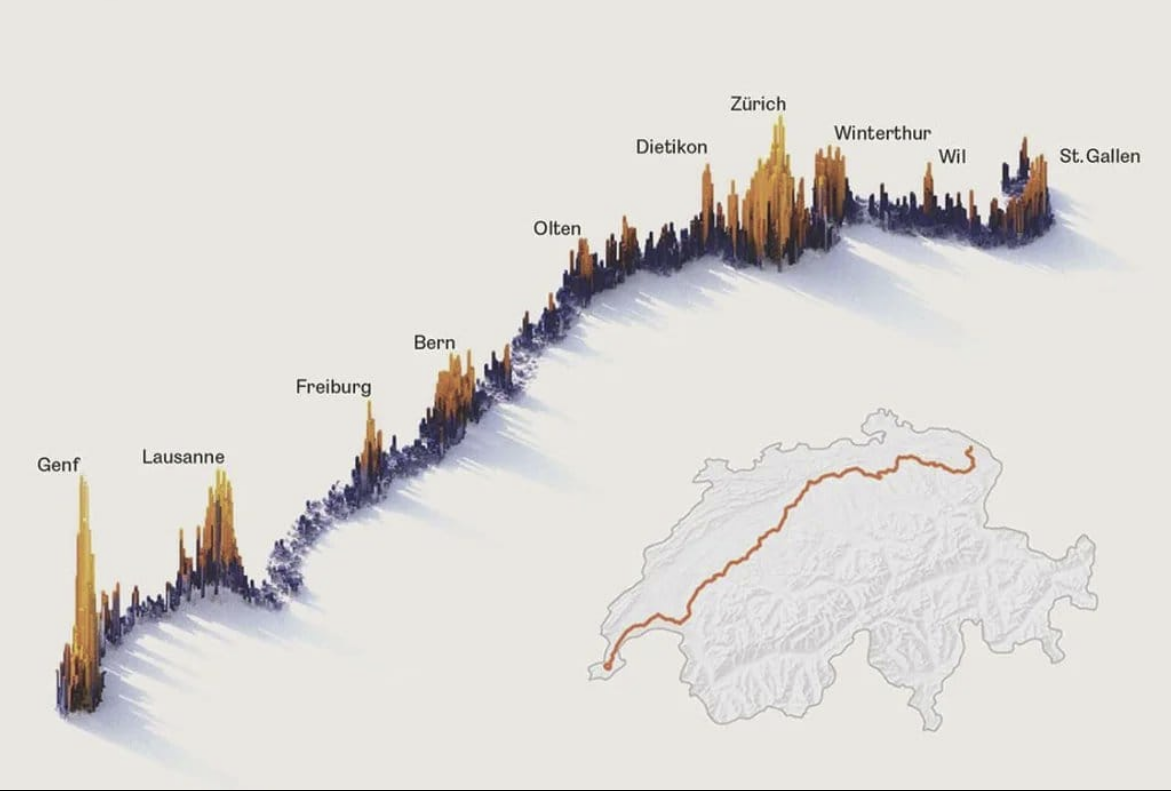
The fastest trains from St. Gallen to Geneva take around 3 hours and 49 minutes, covering a distance of approximately 280 kilometres. One third of the population (3 million) of Switzerland lives within 5 kilometers of the main train line crossing the country.
Something to think about.
A Marpole to Chilliwack passenger service, either light rail or a light DMU service would certainly see living up to 5 km of the line, very desirable. Cloverdale, Langley, Abbotsford, Sardis/Vedder and Chilliwack residents would find reasonable travel times to various local city centres, post secondary campuses and business parks.
A recent reconnoiter of the former interurban line, from surrey to Chilliwack sees much new residential development along the line but ill served by a user-friendly transit alternative
A Marpole terminus would give give valley residents an almost direct service to YVR and downtown Vancouver. A good incentive to take the train instead of fighting traffic and endemic gridlock in Metro Vancouver.
The very same is true for Vancouver Island and the E&N Railway, where established population centres, created by the railway, would ensure a well patronized service from Victoria to Courtney.
In an age of global warming and climate change, both passenger services would be a popular addition for those who wish not to or cannot drive. The term “no-brainier” would be applicable here.
It is time our politcans and the planning bureaucracy actually plan past “20 minutes into the future” and plan for generations to come.
The current round of pre-election vague promises for more SkyTrain, abetted by incompetent planning, anti-car tirades and ‘puff’ stories in the media are growing tiresome. The provincial and Federal governments uses the “Carbon Tax” as a revenue generator and has nothing to do with climate change.
One only has to look at the St. Gallen – Geneva mainline to see how rail transit works and how government properly spend tax monies. It is time to copy success instead of our hackneyed doing the same thing over and over again, ever hoping for different results.
Continues from my previous post. Zwei sent the following Email to the North Shore Mayor’s and Councils one week ago.
I would also like to thank Mr. Cow for info used.
Interestingly I have been in communication with one of the North Shore Mayors who wants more information.
In this day and age, with so much information about light rail available, this study reverts back to the Evergreen Line’s business case, which American Engineer, Gerald Fox, easily shredded. In a SkyTrain only bubble of metro Vancouver, honest transit studies are few and far between.
Please Deliver to Mayor and Council;
The North Shore Rapid Transit Study reminds me of the earlier Evergreen Line Business Case, manipulated and slanted to favour the continued expansion of the now obsolete SkyTrain light-metro system.
I find it astounding, with all the material available about modern transit planning, that the study merely copied the earlier Evergreen Line Business Case’s pro SkyTrain hype and Hoopla and tried to pass it off as a credible study.
Translink and the provincial government have already said, “BRT first, Skytrain later”. This is government-speak for, “WE CANNOT AFFORD THIS AT ALL, NOT NOW ANYWAY, AND MAYBE NEVER!
The Evergreen Line Report made me curious as to how TransLink could justify continuing to expand SkyTrain, when the rest of the world is building LRT. So I went back and read the alleged Business Case (BC) report in a little more detail. I found several instances where the analysis had made assumptions that were inaccurate, or had been manipulated to make the case for SkyTrain. If the underlying assumptions are inaccurate, the conclusions may be so too
Gerald Fox’s (a noted American Engineer who oversaw the construction of several US transit systems) opening paragraph of his 2008 review of the Evergreen Line Business Case.
Reviewing the District of North Vancouver recently commissioned and funded studies for a North Shore Rapid Transit Plan, I too found The analysis had made assumptions that were also inaccurate, or had been manipulated to make the case for SkyTrain. If the underlying assumptions are inaccurate, the conclusions may be so too
Capacity: A combination of train size and headway. For instance, TriMet's new Type 4 Low floor LRVs, arriving later this year, have a rated capacity of 232 per car, or 464 for a 2- car train. (Of course one must also be sure to use the same standee density when comparing car capacity. I don't know if that was done here). In Portland we operate a frequency of 3 minutes downtown in the peak hour, giving a one way peak hour capacity of 9,280. By next year we will have two routes through downtown, which will eventually load both ways, giving a theoretical peak hour rail capacity of 37,000 into or out of downtown
From Gerald Fox’s review of the Evergreen Line Business Case
The maximum capacity of light rail in the Rapid Transit Study is wildly inaccurate.
The capacity of modern light rail can exceed 20,000 persons per hour per direction (Light Rail Transit Association) and ignores the singular fact that in the late 1940’s until opening of the first subway in Toronto, the Toronto Transit Commission operated coupled sets of PCC cars on select routes, obtaining peak hour capacities between 12,000 to 12,500 pphpd and that, operating in mixed traffic with no transit priority!
A two car Alstom Citadis LRV train used in Ottawa is 98 metres long and 2.86 m wide, has a larger capacity than Skytrain’s MK.5, 5-car train-sets width of 2.65 and 88 metres long. The Citadis LRV is 10 metres longer, has a 600 passenger capacity at 4 passengers per square metre. Operating at 5 minute headways, the 2-car Citadis LRV’s would have an hourly capacity of 7,200 pphpd and at 2.5 minute headways, would have a capacity of 14,400 pphpd.
Confederation LRT LIne Versus Skytrain 2.0.jpg A comparison of Ottawa’s confederation Line and Vancouver’s light metro system.
The stated capacity of modern LRT in the study of only 4,500 pphpd is not just wrong; it borders on professional misconduct.
Ridership. Is a function of many factors. The Business Case report would have you believe that type of rail mode alone, makes a difference (It does in the bus vs rail comparison, according to the latest US federal guidelines). But, on the Evergreen Line, I doubt it. What makes a difference is speed, frequency (but not so much when headways get to 5 minutes), station spacing and amenity etc. Since the speed, frequency and capacity assumptions used in the Business Case are clearly inaccurate, the ridership estimates cannot be correct either.
From Gerald Fox’s review of the Evergreen Line Business Case.
Another assumption is that light rail is slower and will carry fewer customers.
Again, inaccurate. Light Rail Transit is a modern tram or streetcar which operates on dedicated or reserved rights of way, with priority signalling at intersections and having no traffic interference. Only if the tram or streetcar operates in mixed traffic, the commercial speed would be slower, defined by the road speed limit, but LRT does not operate on the road, but on its own dedicated route. Thus a modern light rail with comparative Rights-of-Ways, with equal stations, would have comparative travel times. Another factor not considered is that dwell times for light rail vehicles are much less when compared to the driverless SkyTrain light metro cars and the cumulative savings with shorter dwell times do add up over a longer trip.
A modern Paris Tram on alawned reserved or dedicated R-o-W.
What is true is that LRT, because of it operating on much cheaper R-o-W’s has more stations or stops, thus attracting more ridership than elevated light-metros, which stations tend to be much further apart and mainly assccable by customers first taking a bus. More stations along a transit route will achieve slower commercial speeds but will attract more ridership.Over 80% of SkyTrain’s ridership first takes a bus and by taking a bus, increases door to door travel times, not reflected in the study.
Innuendos about safety, and traffic impacts, seem to be a big issue for SkyTrain proponents, but are solved by the numerous systems that operate new LRT systems (i.e., they can't be as bad as the SkyTrain folk would like you to believe)............................ But, eventually, Vancouver will need to adopt lower-cost LRT in its lesser corridors, or else limit the extent of its rail system. And that seems to make some TransLink people very nervous.
Gerald Fox’s review of the Evergreen Line Business Case.
The SkyTrain Light Metro system operates two very different railways. The Canada Line is a conventional heavy-rail railway, operated as a light metro and the Expo and Millennium Lines operate the proprietary and last called Movia Automatic Light Metro (MALM) system, now owned by Alstom. The SkyTrain name for the light metro system was chosen in a radio contest (CKNW) in 1985. The study did not consider this and as each light metro system (conventional or unconventional/proprietary) has different costs and operating parameters and any reference to SkyTrain is based solely on assumptions and not fact.
As MALM is a proprietary railway and powered by Linear Induction Motors, it is incompatible in operations with any other railway, except its current family of 6 systems.
As Alstom is the sole supplier of the proprietary MALM cars and only seven such systems have been built in almost 50 years with only six remaining in operation; if Alstom ceases production, there will be no supplier of MALM compatible cars and parts.
Planning for MALM (SkyTrain) that may be built decades in the future, is a fool’s errand because there may not be a supplier for MALM cars in the future and vehicles will have to be custom built.
It is interesting how TransLink has used this cunning method of manipulating analysis to justify SkyTrain in corridor after corridor, and has thus succeeded in keeping its proprietary rail system expanding. In the US, all new transit projects that seek federal support are now subjected to scrutiny by a panel of transit peers, selected and monitored by the federal government, to ensure that projects are analysed honestly, and the taxpayer interests are protected. No SkyTrain project has ever passed this scrutiny in the US.
Gerald Fox’s review of the Evereen Line Business case
It is interesting that the North Shore transit plan still opts for a “SkyTrain solution, even though no city has copied Vancouver’s exclusive use of light-metro and no transit authority has copied using the now called proprietary MALM system. In the realm of modern public transport, success is copied and failure is ignored; except in Metro Vancouver!
It is interesting that the North shore transit plan has either deliberately or for a lack of due diligence, had the capacity of light rail so low, that one wonders why over 420 light rail/tram systems are in operation around the world, operating well over 16,000 km of line.
What would be the cost of 19.5 North Shore to Metrotown MALM Line?
The current cost of the 16 km. Expo Line extension is $4.01 million, but that cost was from 2021 and accounting for inflation that cost is now $4.59 billion and it is interesting that the most recent news release regarding the Langley extension was the $4.01 billion was a firm cost for the guideway only and did not include the electrical supply, signalling and stations which were “still under negotiation”. The cost does not include the rail compatible Bridge replacing the current Ironworkers Memorial Bridge; the cars needed to operate the extension; nor the $500 million to $1 billion Operations and Maintenance Centre #5, which will be needed, especially for the 5 car MK.V stock.
If a SkyTrain extension to the North Shore is planned a similar cost OMC #6 will have to be built.
It is a fair estimate that the true cost of the 19.5 km SkyTrain extension from the North Shore to Metrotown will be around $10 billion!
Light Rail is not only cheaper to build, it is cheaper to operate and maintain; it has a higher capacity; it has many suppliers and it has operational flexibility, which MALM Skytrain does not have.
From MetroLinx (Ontario) showing the 50 year costs of various transit. As MALM (SkyTrain) is a four rail system, its fifty year operating costs are higher than elevated LRT.
It is clearly apparent that the North shore Rapid Transit study is of little or no value because it includes erroneous assumptions and even worse, false claims for modern light rail. It also ignores the singular fact that the current 21.7 km, $11 billion expansion of the Expo and Millennium Lines has literally sucked all transit monies off the table for the next decade, at least.
There will be no rapid transit from the North shore across the Burrard Inlet in the foreseeable future.
If I were the Mayor of the District of North Vancouver, I would demand a refund!
Addendum:
The whole study believed that LRT can only operate in curb or median road lanes like this.
Transit studies are a “dime a dozen” in metro Vancouver, yet few are ever used for the simple fact that rapid transit is built for strictly politcal reasons and not for the needs of the transit customer.
Kennith Chan and the Hive is pro SkyTrain, yet he know very little about the local transit system, transit financing, which makes his reporting extremely questionable.
What is the cost?
What is the cost of SkyTrain to the North Shore?
$5 billion? $10 billion, including trains, bridges, complete?
The cost of the proposed 16 km Expo Line Langley extension is now fast approaching $5 billion and that is not including the cars, electrical instillation and stations and not includingthe Operations and Maintenance Centre #5.
The cost of a 19.5 km extension to Metrotown including new cars, and a new OMC #6, including a new bridge will top $10 billion!
NOT GOING TO HAPPEN.
The other blunder or intentional misinformation (take your pick) is that Light Rail’s Capacity is a mere 4,500 persons per hour per direction.
WTF!
Sorry about that but really, this absolutely idiotic claim tells me the study is not worth the paper it is printed on.
Modern light rail has a capacity of in excess of 20,000 pphpd,. In the late 1940’s, Toronto operated couple sets of PCC trams on selected routes obtaining capacities of 12,000 to 12,500 pphpd! to say a modern tram or light rail vehicle has only a capacity of 4,500 is professional misconduct on a vast scale.
The preceding graphic compares Ottawa’s Confederation LRV’s to both MK.1 ALRT UTDC cars and MK.2 Bombardier ART cars.
When a study is so fundamentally flawed, so ill researched, one can only surmise that this is nothing more than a crass politcal exercise for pre-election photo-ops and 10 second sound bytes. As a transit study, it fails badly.
As for North Shore civic politicians and residents you have been played.
The use of SkyTrain technology for the North Shore rapid transit line is the clear winner in terms of potential ridership and speed, exceeding the figures of Bus Rapid Transit (BRT) and street-level Light Rail Transit (LRT).
The District of North Vancouver recently commissioned and funded two highly technical studies exploring the ridership potential of various modes of rapid transit, and the possibility of a multi-modal replacement of the aging Ironworkers Memorial Bridge.
In 2023, on behalf of the municipal government, transportation consultancy firm McElhanney completed an updated ridership study that compared the potential of SkyTrain, BRT, and LRT, while Spannovation Consulting performed an analysis of the optimal options to replace the existing Highway 1 bridge in the Second Narrows.
McElhanney’s latest study builds on their previous 2021 analysis of the Burrard Inlet Rapid Transit initiative jointly led by the North Shore’s three municipal governments and two First Nations, which was a process that identified the “Gold” and “Purple” lines. Some of Spannovation’s most recent major works entail contributing to the planning efforts of the new replacement Pattullo Bridge
For each of the SkyTrain, BRT, and LRT scenarios examined, the same rapid transit route was used — a 19.5-km-long route beginning at Park Royal in West Vancouver, which then runs west-east across the North Shore along Marine Drive, 3rd Street, and Main Street.
Upon reaching Phibbs Exchange near the northern end of the Ironworkers Memorial Bridge, the route turns south across the Second Narrows and reaches Hastings Park/PNE in Vancouver. It then briefly runs along Hastings Street before turning south along Willingdon Avenue for the remaining journey to Metrotown.
Screenshot
Route and station map of Burrard Inlet Rapid Transit between Park Royal in West Vancouver and Metrotown in Burnaby. (Spannovation)
Side-by-side twin cable-stayed bridges concept to replace the Ironworkers Memorial Bridge, including space for SkyTrain/LRT. (McElhanney)
In each of the three scenarios, there would be a total of 10 stations located in the general vicinity of Park Royal, Lions Gate (at Capilano Road and Marine Drive), Capilano Mall (on Marine Drive), Lonsdale (on 3rd Street), Moodyville (on 3rd Street), Phibbs Exchange, Hastings Park/PNE (on Hastings Street), Brentwood Town Centre Station (connecting with SkyTrain Millennium Line), BCIT Burnaby campus (on Willingdon Avenue), and Metrotown Station (connecting with SkyTrain Expo Line).
Travel time of 23 minutes on SkyTrain
By 2050, BRT would have a ridership of 41,000 boardings per day — equivalent to the present-day ridership of the 99 B-Line, Metro Vancouver’s busiest bus route. It would have an end-to-end travel time of 58 minutes and an average operating speed of 20 km/hr, based on frequencies similar to TransLink’s existing B-Line and RapidBus routes and the use of articulated buses. Its maximum capacity is about 1,300 passengers per hour per direction.
Street-level LRT would have a ridership of 100,000 boardings per day, with an end-to-end travel time of 47 minutes and an average operating speed of about 25 km/hr. With frequencies of up to every four minutes during peak periods and six minutes during mid-day periods, using LRT trains that can hold about 300 people, the maximum capacity of LRT is about 4,500 passengers per hour per direction.
To achieve BRT or LRT on the North Shore, the vast majority of the Marine Drive and 3rd Street corridor would be reduced to one general traffic vehicle lane in each direction to accommodate the bus-only lanes or LRT right-of-way.
Similarly, there would also be lane reductions for the roadways of Hastings Street and Willingdon Avenue.
As BRT or LRT would not have its own fully separated right-of-way, running through intersections, its maximum travel speed is limited to the same speed limits of general vehicle traffic.
After all the raspberries that came my way about the Broadway Subway, I have been somewhat vindicated.
The construction delays also translates into increased costs and with an election around the corner, the current government will wait until after the election to give the bad news.
It also explains the puff piece in the Tyee (the feisty one that now has lost all its feist!) last week, exhorting the virtues of the subway.
No wonder they banned Zwei from commenting.
The Broadway subway will remain a subway to nowhere, which will generally increase travel times because of inconvenient transfers and driving up the cost of transit. The last laugh is so clearly evident, as TransLink is only going to signal the Millennium Line to have a maximum capacity of 7,500 pphpd, about half of what is normally considered the minimum capacity needed for building a subway.
Even TransLink thinks the subway is nothing more than an expensive White Elephant and this is for what the city of Vancouver has been all who would listen that Broadway is the busiest transportation corridor in North America.
Sadly the joke is on BC taxpayers as TransLink, The city of Vancouver and David Eby’s NDP have “Trumped” everyone with not only the Broadway subway but regional transportation as well!
The B.C. government has announced delays to two major infrastructure projects in the Lower Mainland.
In a release Friday, the province says commuters can expect months of delays on both the Pattullo Bridge Replacement and Broadway Subway projects.
The release said design and construction activities on the Broadway Subway Project have “taken longer than originally expected, including work to relocate major utilities and install traffic decks, while keeping traffic moving along Broadway.”
he province claims that the most technically complex part of the process is over with the completion of the tunnel boring under Broadway, but that progress was delayed in part due to a five-week concrete strike in 2022.
While the subway line was once slated for 2026, the province now says it will open in fall of 2027.
Meanwhile, the release said the main tower for the new bridge — and now the tallest bridge tower in B.C. — connecting Surrey and New Westminster, is complete. But the replacement for the Pattullo bridge, which started in 2020, has also reportedly faced challenges like global supply issues.
“Despite facing significant global challenges, we’ve seen tremendous progress on both of these projects,” said Rob Fleming, B.C.’s minister of transportation and infrastructure. “These projects will move people and goods more quickly and safely around the Lower Mainland.”
As a result, the ministry says the new bridge is expected to open in fall of 2025.
“On projects of this size, delays have the potential to affect other construction activities,” the ministry said. “While mitigation efforts were made to recover both project schedules, it wasn’t always possible.”
Ottawa’s Trillium Line is often miscaptioned by the media as LRT, it is not. The Trillium Line is a DMU service. The Trillium Line is a good example of providing quality transit at a much lower cost than more expensive tramways and unrealistic and hugely costly light-metro.
Monthly operating costs of the 24 km line is $3.5 million ($42 million annually), including the $2.1 million paid to TransitNext, the project-specific group run by SNC-Lavalin which was chosen to build and maintain it.
This should give pause for those who claim that Rail for the Valley Marpole to Chilliwack proposal would cost more than SkyTrain to operate. In 1993, just the Expo Line was subsidized $157 million (GVRD) annually which amounts to almost $300 million in 2024 dollars!
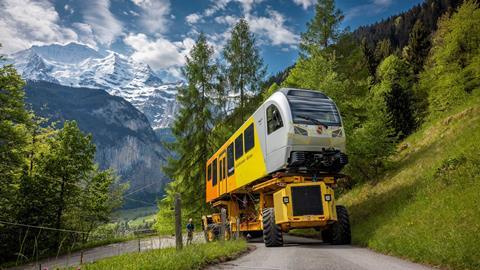
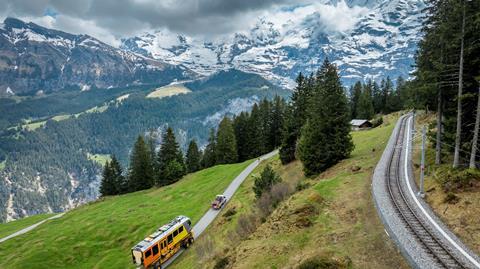
SWITZERLAND: Stadler is delivering new rolling stock as part of the final stage of a programme to increase capacity and accessibility on Bergbahn Lauterbrunnen-Mürren’s metre-gauge railway.
Jungfraubahnen company BLM operates a cable car from Lauterbrunnen to Grütschalp, where passengers change to a 4 km adhesion railway running to Mürren via Winteregg. Freight is also carried.
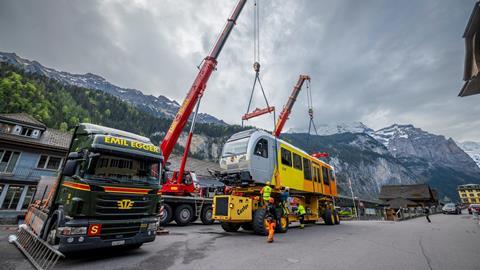
The first of three new two-car EMUs arrived in November 2023 for what Stadler described as ‘extremely challenging’ winter testing at 1 600 m above sea level. The second was delivered on May 13, and the third will follow shortly.
Stadler said delivery is running behind schedule because several of its suppliers are struggling with supply bottlenecks as a result of the war in Ukraine and the pandemic, as well as limited track capacity at testing and stabling facilities.
From July the new EMUs will run in mixed operation with the existing BDe4/4 railcars from 1966-67.
‘The new multiple-units not only offer maximum comfort with spacious panoramic windows and comfortable seats, but also a modern passenger information system’, said CEO of Stadler Bussnang Dennis Laubbacher.
The introduction of the EMUs will complete a project lasting more than four years and costing SFr63m for the total renovation of the railway. This will increase the maximum speed from 30 to 50 km/h, reducing journey times and enabling more frequent services. The stations have also been modernised to meet federal accessibility rules.
‘We are delighted that we can offer locals and guests even more comfort and quality on this important and unique panoramic connection to the car-free village of Mürren’, said Jungfraubahnen director Urs Kessler.
With Covid-19, this becomes more important than ever.
Right now we have a Hobson’s choice for regional rail transit, extend the Millennium and Expo Lines and continue using the proprietary Movia Automatic Light Metro or nothing.
This must change and change soon, or the hugely expensive SkyTrain light metro system will become largely irrelevant; a museum piece dedicated to political corruption, professional ennui and public hubris.
The public just cannot afford throwing billions more at rapid transit for so little return.
First posted by zweisystem on Thursday, October 11, 2012, updated May, 2024
Subways & metros are very expensive to build and operate.
The proposed new tunnel that is planned to replace the George Massey Tunnel is on the back burner. Premier John Horgan cancelled the Liberal vanity project and a more reasonable solution has been made.
Replacing the tunnel with a larger a larger tunnel will only send the gridlock to the next choke point, Steveston Highway and ultimately the Oak Street & Knight Street bridges. This will cause massive congestion if traffic through the tunnelwhen highway traffic is expanded.
What is needed is a a rail transit solution that works and can be readily and affordably extended to meet the needs of the ever growing population South of the Fraser River.
The proprietary SkyTrain light metro system and the light metro philosophy of operation has done very little in attracting the motorist from the car. The light-metro’s high ridership can be attributed mostly to recycling of bus customers who are forced to transfer from bus to metro to complete ones journey to Vancouver/Burnaby.
SkyTrain has done little to ease congestion in the METRO Vancouver area, with the sad fact that the percentage of regional population using transit is falling!
The proprietary SkyTrain light-metro system is just too expensive to build and it just cannot be extended affordably into the outer suburbs to attract new customers. The extremely high costs of rapid transit has made rubber on asphalt solutions cheaper than improving regional transportation, as evidenced by the many highway expansion projects underway in the Metro Vancouver region. As new highways are built, auto use increases, with the only barrier against increased auto use being road capacity.
Extremely myopic regional planning, shows Metro Vancouver’s complete ineptitude when it comes to regional transportation as transit planning is based on 70 year old concepts, when fanciful monorails, metros and subways were all the rage.
What was “de rigor” in 1960 is not just passe in 2020, it is obsolete.
Sadly, this short sighted and extremely dated planning, will only lead to more gridlock and traffic chaos.
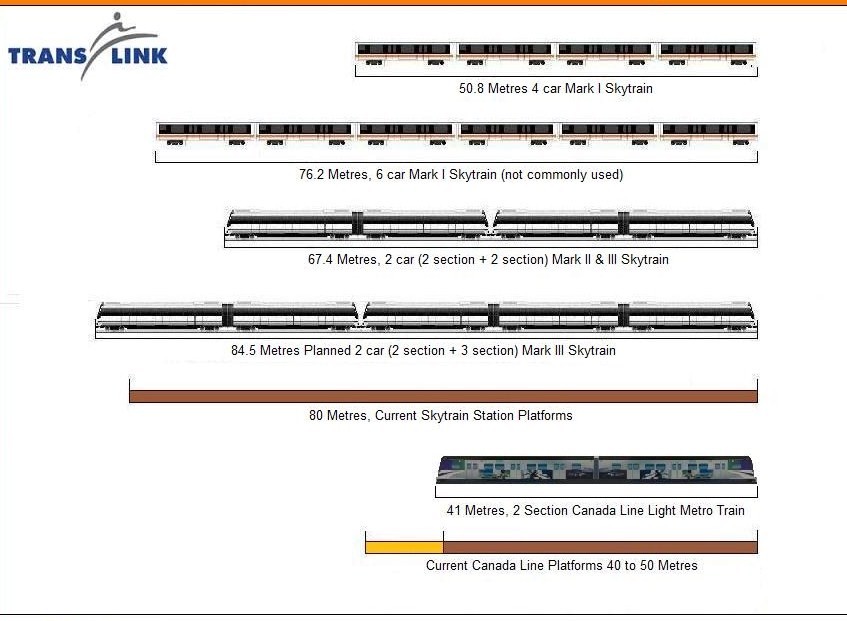
The Canada Line is a heavy-rail metro, operating ROTEM’s electrical multiple Units (EMU’s), but built as a light metro, with very limited capacity. The Canada Line’s automatic operation, complete with small stations and 40 to 50 metre long platforms gives roughly slightly more than half the capacity of the Expo and Millennium Lines, which stations have 80 metre long platforms. The capacity constrained Canada Line has hamstrung future attempts capacity to meet tomorrow’s transit demands.
To both increase capacity on the Canada Line and to increase its reach into Richmond in an effort to attract more ridership,would cost a minimum of $2.4 billion.
$2.4 billion would buy you about 65 km. (at about $35 mil/km.) of modern LRT!
That $2.4 billion would be put to better use by:
Converting the Canada Line hybrid heavy/light metro to light rail.
Increasing North/South capacity by using the Arbutus Corridor.
With the money saved by much cheaper LRT construction, extend the the new Canada Line LRT across the Fraser river into Delta and South Surrey.
This is not whimsical musings, rather it very well may be a transit solution that TransLink or a future operating authority may seriously consider.
The Canada line is in a conventional railway and most modern light rail vehicles would easily operate within the Rotem EMU’s Kinematic Envelope.
(Kinematic Envelope: the space that a rail vehicle could potentially occupy as it moves laterally and vertically on its suspension.)
The expensive and complicated automatic signalling system should be replaced with much simpler and more robust signalling system, doing away with the higher operating costs of automatic signalling.
Retain third rail power pick on the elevated and underground portions of the line by equipping, as done before on other transit lines, the trams with retractable shoes to collect power from the third rail and using standard pantographs on non-guideway portions of the line. Simply, the first station the tram stops at on the guideway portion of the line the driver drops the pan and deploys the power collection shoes. Several tram varieties on the market today have dual pantograph/shoe for power pick up on APS ground level contact-less power supply.
By converting the Canada Line to LRT would make the cost of extending the Canada Line, first to Steveston and Ironwood Mall an affordable option. It would also be much cheaper to build with LRT for a new crossing of the Fraser River to serve both Ladner and South Delta; then onwards to South Surrey.
The cost to extend the Canada line to Steveston and Ironwood Mall (about 11 .3 km.), should cost no more than $400 million and the CN rail line bisecting Richmond is reported up for sale for $65 million, probably much cheaper if it was used for transit. It is conceivable that for the cost of the Canada Line extending to Steveston and the Ironwood Mall, we could build LRT to both Steveston and the Ironwood Mall, then through a tunnel under the Fraser River to Ladner and the Tsawwassen ferry terminal!
To increase capacity of the capacity limited trunk line to downtown Vancouver, the Canada Line can branch onto the existing and seldom used former interurban route, owned by the CPR to New Westminster, To access downtown Vancouver, using the Arbutus corridor and Granville Street bridge, which was designed for trams. This could be done quite cheaply for under $35 million/km.
It is time for TransLink to start planning for light rail for the region. SkyTrain, with construction costs exceeding $200 million/km. just cannot be built economically into the burbs, ( the estimated cost of the 16km guideway, alone, to Langley is $4.01 billion) but modern LRT, with construction costs as low as $10 million/km. (TramTrain) can. Regional politicians must be made to understand that building with SkyTrain and/or light-metro has been a mistake and that we must plan future transit on the light rail model. The regional politicians who make up METRO Vancouver should tell TransLink either change their transit planning direction and for a start, seriously look at converting the Canada Line to LRT and extend it through Richmond, with plans to build it across the Fraser River to Delta and beyond.
After a post in Facebook, where I stated some facts about the SkyTrain light-metro system in Vancouver, I was reported to Facebook for spreading fake news.
Really!
So, just set the record straight about Vancouver’s proprietary and non proprietary SkyTrain light metro system, here are some random facts.
SkyTrain is not the name of the vehicles used on the SkyTrain light metro system, but the system itself. The name was chosen via a radio contest in 1985.
The first trains used on the Expo Line were marketed as ALRT or Advanced Light Rail Transit system. The name was changed from ICTS or Intermediate Capacity Transit System for the sale to Vancouver which was originally planning for a Edmonton or Calgary style light rail. ICTS/ALRT were powered by Linear Induction Motors or LIM’s and were incompatible to operate with any other railway except their own family of trains.
ALRT was forced on the GVRD by the then Social Credit provincial government, with then premier Bennett stating, “You will get SkyTrain whether you like it or not”, after some disturbing news surfaced about the proprietary light metro system.
The ARTs Study in Toronto found that “ICTS (ALRT) could cost up to ten (10) more to install than LRT, for about the same capacity.”
Only three (3) ICTS/ALRT systems were built.
Lavalin purchased the Ontario Crown Corporation the Urban Transportation Development Corporation (UTDC) which owned and produced ICTS/ALRT and promptly went bankrupt trying to build the renamed ALRT, which Lavalin renamed Automated Light Metro (ALM) in Bangkok Thailand. SNC later amalgamated with Lavalin and became SNC Lavalin.
Bombardier bought the remains of the UTDC and ICTS/ALRT/ALM and promptly redesigned the system using their universal “Innovia” body shell and called the finished product Advanced Rapid Transit (ART)
Studies showed that the Expo Line, using the proprietary ALRT/ART system cost about 40% more to operate than Calgary’s LRT, both carrying the same passenger loads.
Only four (4) systems were built: Youngin Korea; Kuala Lumpor, Malaysia; JFK Airport, USA and Beijing, China. All four sales were fraught with scandal, with criminal legal cases in Korea and Malaysia (SNC Lavalin Scandal); the American government refusing to underwrite the JFK line because it failed a peer review and China built one to gain technology.
The then BC NDP government flip flopped from LRT to ART for what is now known as the Millennium Line, again with then premier Clark stating “you are getting SkyTrain, whether you like it or not”.
A sports bag with $1 million cash was found in a garbage can in Clinton park, by an off duty policeman in the late 1990’s. After an extensive investigation and court battle the off duty police man was awarded the $1 million as “found goods”.
As there were no further sales of ART, the proprietary system was folded into the Innovia line of light metros with the LIM propulsion package being a “free” add-on”. The conventional Innovia light metros used 4/5 car trains with open vestibules.
As there has been no sales of the proprietary LIM powered Innovia light metro, the Innovia Line of light-metros were folded into Bombardier’s Movia Metro system, with the former ALRT/ART/Inniovia system being called Movia Automatic Light Metro or (MALM).
The Canada line, was a provincial BC Liberal project using a P-3 to cover the high cost of construction. The Canada Line is a conventional railway and is the only heavy-rail metro in the world, built as a light metro, having less capacity than a modern tram or streetcar, costing a fraction to build!
Bombardier reconfigured the 5-car Innovia trains to accept the LIM powered trucks or bogies as part of the replacement package for the aging MK.1, ALRT fleet.
A fact finding group from Ottawa, was sent to Vancouver to investigate the SkyTrain light metro system for a possible construction in Ottawa but found that SkyTrain was more expensive to build; more expensive to operate; more expensive to maintain; lacked capacity; lacked flexibility than a conventional light rail system. Instead Ottawa built a hybrid LRT/light-metro system using Alstom light rail vehicles.
The John Horgan NDP government agreed to flip flop a $1.65 billion light rail project into an almost $5 billion, 16 km SkyTrain project in Surrey/langley.
Bombardier’s rail division was sold to Alstom.
Alstom is not actively marketing MALM.
Former premier John Horgan is now Ambassador to Germany.









Recent Comments