SkyTrain’s many ills are all but ignored by our local media, yet almost every or breakdown that happened on Ottawa’s Confederation Line was reported nationally.
I call it the “MAGA Effect”, where the media ignores problems with our SkyTrain and grossly overstates issues with other transit systems, such as Ottawa’s hybrid light metro/rail system.
Our local media have also ignored REM and its less than stellar performance in Montreal.
Montreal’s light metro system is having many issues with its operation, yet the Ottawa system is still demonized, especially with our local media.
This dichotomy is all the more clearer when on considers the concessionaire of Montreal’s REM, is a Quebec institution.
The REM P-3 is almost a direct copy of the Canada Line P-3, especially the revenue stream from the P-3, I would think the powers that be would not want any unseemly news about REM or light metro or how lucrative the Canada line is for the concessionaires, the Caisse du Depot and SNC Lavalin .
But not all is well with ridership on the Canada Line from my vantage point, peak hour ridership from South Delta transit customers has all but collapsed. Once full express buses are now operating quarter full and with less service.
I predicted this 15 years ago that forcing a transfer onto customers from a previously no-transfer service would deter ridership and it has. The other big problem is demographic change, where many people want to go to Richmond and where was once a direct service from the Ladner loop to get to Richmond now, one must take a bus to Bridgeport Station and double back to Richmond Centre via the Canada line.
Taking the car is just easier.
Montreal’s REM operating on the highway median. lack of seating (64 seats for a 2-car train-set) will deter ridership.
The majority of the readers who responded to the call to all on the REM in the wake of the chronicle of Michel C. Auger 1 said they were dissatisfied with the service. Some have even switched to another mode of transportation. Here is some of the feedback we have received.
*
TAXI FEE
REM is often down during rush hours. It’s very inconvenient when you have to be on time at the office. I’m often in an Uber to make things better. Whether it be in the morning or late evening. I end up spending a lot in a month The shuttle takes 45 minutes to 1 hour and it’s winter. What would suit me would be to have front buses to go downtown during rush hours.
Rose Carrefe, Brossard
*
I GOT MY CAR BACK
My spouse had to change jobs completely. She changed for a job on the South Shore. Whenever there were problems in the REM, she would arrive late and the employer would lower her pay. After a few days the stress set in as she left even earlier without knowing if the REM would work. For me, I could take the REM to my office downtown, especially for team meetings, once or twice a week. However with all the breaks down and uncertainties I ended up getting my car back Monday through Friday.
Daniel Araneda, Brossard
*
I’M NOT GOING TO MONTREAL ANY MORE
Retired, I often took the bus shuttle to Montreal, but since the REM, I don’t go there anymore. Can’t park at Panama station, too many steps and stairs for my old knees, breaking down on repeat. What pisses me off is that the REM has come to completely mess up the excellent transport service of the South Shore.
Christine Marchitello, Brossard
*
FULL TIME TELE WORK
I have a damn good boss! Efficiency and productivity are two different words. Ever since REM arrived, my boss quickly realized that my yield was the same, but productivity was not. Conclusion ? Five days out of five teleworking, as long as my productivity is on the appointment. Good method of retention!
Gilbert Ouellet, Saint Alexander of Iberville
*
I HAVE ADOPTED HER
I used to drive the car from far south shore all the way to downtown. Now it’s the car to the Brossard REM station and then the REM. As traffic is more predictable, I can afford to leave about 45 minutes later from home and in total travel time I gain at least 20 minutes per way. I use REM three times a week. I had two slow downs that cost me a few minutes And finally a full stop last week that took me about an hour. Is this dramatic ? Not at all. I have adopted this means of transportation for good.
Patrick St-Onge, Henryville
*
PLANS B
Since putting the REM into operation, I’ve found myself on a spare route: bus to the metro in Longueuil. I avoid REM in the morning at all costs, because I can’t afford to be late. Even better my commute is faster. The only fuss: I have to leave the house early, but it’s worth it! Back then I take REM when I can’t do otherwise, having a plan B for someone to go get my kids if I’m unlucky.. In my case, commuting to work in Montreal was more efficient, quick and reliable before REM while a bus would get me to my destination quickly.
Geneviève Bélanger, Candiac
*
PLUS LONG
I live in saint julie Tested the REM once to find out my commute to downtown increased by 20 minutes per ride. Taking other bus routes or my car
Michel Lamoureux, Saint Julie
*
TESTED BUT NOT ADOPTED
My husband and I simply gave up on the idea of taking REM. We’ve tried it and there’s no benefit to adding 35 minutes bus ride to our journey. We forget the Longueuil metro, also long by bus and its parking is out of price. The suburban train, even with low frequency, is our best option when we have to go to work in the city. You’ll understand that we prefer teleworking now. We had, in the “good old days”, the bus across the street from us that would take us directly downtown every day. Is downtown empty ? Bring back common sense public transportation and we’ll go back!
Isabelle Roy, Saint-Hubert
*
LACK OF SEATS AT TEN 30
One point that hasn’t been raised, but that raises a bit of grumble on my part, is the lack of incentive parking of the DIX30. After 8:30 am on weekdays, you often have to use a paid seat. Not very encouraging…
Eric Lepage, La Prairie
*
CAR AND TRAIN SUBURBAN
I am a student at the University of Montreal and live in the South Shore. Of course, I use public transportation to get to university, and I found myself carpooling to the Candiac suburban train in the morning (where service delays and slowdowns are less frequent) to make sure I’m on time. Taking the REM to go home tonight later.
Felix Cormier, The Prairie
*
LACK OF COMMUNICATION
Breakdowns, I can deal with them, provided the REM sets up buses quickly. For me, the big problem experienced during the outages where I was in the REM is the lack of communications made by and for humans. Because a robotic message is not what customers expect to receive every five minutes. A human giving us recovery time would be the answer. REM must not forget that we are clients and, by purchasing our title, we are entitled to be adequately informed.
The train has an accessibility carriage and passengers in wheelchairs should be accompanied by an attendant to facilitate the boarding process.
We offer free tickets for:
Wheelchair-accessible seating
Attendants for guests with accessibility needs
Stroller parking is also available.
So whats the issue?
Miniature railways due to their nature have difficulty offering accessibility to the mobility impaired and with some with track gauges of 7 1/2 inchesor less it is near impossible, but the Stanley Park Railway has a larger track gauge and has an accessibility carriage.
There is no issue, as the miniature railway “has an accessibility carriage and passengers in wheelchairs should be accompanied by an attendant to facilitate the boarding process.”
Thus the very people who want to get rid of the Parks Board and run the operation as well do not have a clue that the Stanley Park miniature Railway has wheelchair access.
This current crop of Vancouver Councillors could not even operate a Christmas trainset, let alone understand its function!
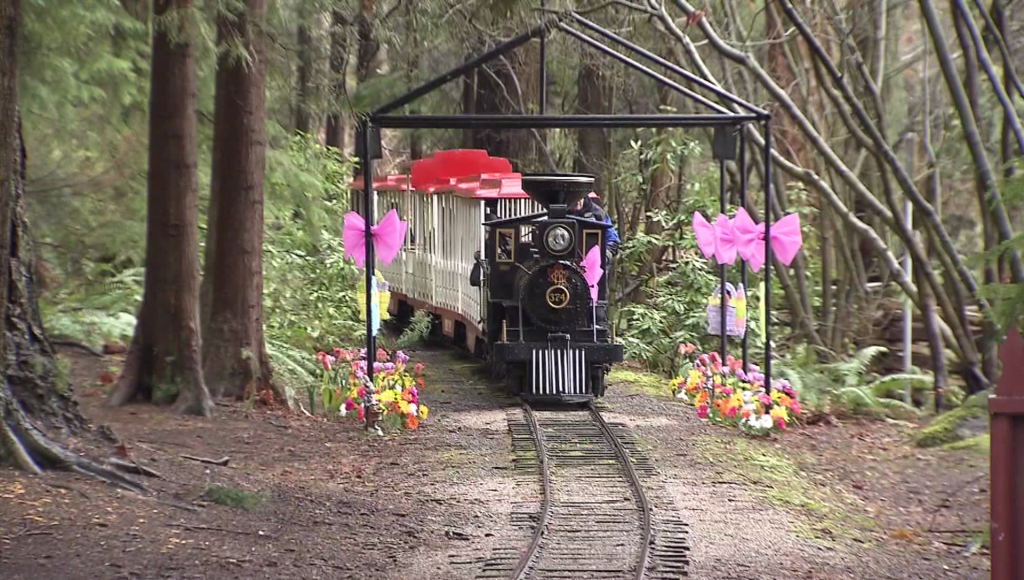
The Stanley Park Train, pleas note the accessibility carriage, third car, with ramp visible.
A better view!
‘New low’: Advocates upset as Vancouver council waters down motion to ensure Stanley Park Train accessibility
The Stanley Park Railway will be running over Easter Long Weekend, the Vancouver Parks Board has announced. (CityNews Image)
A disability advocate says she’s shocked and upset after Vancouver city council heavily amended a motion meant to ensure the Stanley Park Train is accessible to those who use wheelchairs and other mobility devices.
Gabrielle Peters, a disabled writer and policy analyst, says she’s bewildered that the city couldn’t pass the motion — which already had its language couched — without the significant amendment.
“Perhaps it was naïve, but I was surprised,” she said. “I feel that this is a new low in local municipal politics.”
Coun. Pete Fry, who brought forward the motion on behalf of the Vancouver City Planning Commission, says the motion lost its “teeth and intention” when an amendment by Coun. Peter Meiszner was passed by the eight ABC councillors present. Fry and fellow Green Coun. Adrienne Carr voted against it, while Coun. Christine Boyle was absent.
Fry’s motion, which aimed to have the city “commit to making all efforts” to maintain or improve previous levels of accessibility during renovations or upgrades, was voted on Wednesday. The amendment by Meiszner changed the majority of the motion’s text and removed a call to amend the city’s Accessibility Strategy to prevent a loss of existing accessible infrastructure.
Originally, the motion’s text read, in part: “THAT Council direct staff to amend the Accessibility Strategy to include a requirement that all efforts be made to prevent any loss of existing accessibility in any of the City’s programs, services, communications, events, environments, or spaces…”
Per Meiszner’s amendment, the passed motion read, in part: “FURTHER THAT Mayor and Council affirm the City’s commitment to accessibility and the rights of persons with disabilities to take part and fully participate on an equal basis with others in the cultural life of the city…”
Fry says he thought the original motion was a “very reasonable ask” in terms of the city’s Accessibility Strategy.
“And to ignore that is insulting for folks who have really been advocating in the disability community,” Fry added.
Another part of the motion that was struck down included requiring organizations working with the city to adopt the same responsibility of preventing any loss of existing accessibility infrastructure during changes or upgrades.
These sections of the motion were replaced with a suggestion that mayor and council acknowledge the collective disappointment regarding the Stanley Park Train’s inaccessibility and affirm their commitment to accessibility. The motion also states that mayor and council “continue to remove, identify and prevent barriers” to children with disabilities.
Peters says she’s completely lost on why Meiszner chose to specify children in this part of his amendment.
“So it’s okay to have barriers for adults with disabilities?” she questioned. “You’re either creating accessibility or you’re not creating accessibility. These things are not (age-based).”
Motion language already watered down
The rewrite of the motion is disheartening for Peters because it had already been altered from the Vancouver City Planning Commission’s original proposal, passed unanimously on Feb 24. Before it was brought to council by Fry, Peters says it underwent revision by a lawyer, who recommended the motion be changed from calling for a “ban on any loss of existing accessibility” in city infrastructure, to simply requiring “all efforts be made” to prevent the same loss.
“They couldn’t let that stand, that even, all you have to do, not even a ban, you just had to agree to make all efforts,” Peters said.
“Then ABC thought, ‘How could we dare to expect this of people? We can’t expect this of organizations, we can’t expect this of businesses. We can’t give our city funds to people and then put a condition on them that they not discriminate against disabled people. That would be just outrageous.’”
Fry adds the choice of the word “effort” in the motion he ended up bringing to council was a “pretty low bar” to agree to.
“It certainly wasn’t a binding piece,” he said. “It was just like, ‘Make every reasonable effort you can to ensure that we don’t roll back accessibility.’”
He adds the commitment to anything tangible was entirely missed with this amendment, as was the opportunity to acknowledge and make amends for the fact that people with disabilities were left out of the excitement surrounding the Stanley Park Train at Christmas when its accessible carriage was out of commission.
“Honestly, it’s not a great look when we, as a council of able-bodied people, just miss the lived experience and advocacy of people with disabilities,” he said.
“I would have hoped that through this motion, we would be thinking about how we can do better. And instead, it’s been flipped on its head and the message is clear that we don’t value the input of people’s lived experience.”
Fry adds he’s unsure of what the resolution will be on whether or not the Stanley Park Train will be accessible when it runs for Easter 2024, since the suggestion to offer free tickets to individuals who missed out at Christmas time, was wiped out.
At Christmas, Peters says it felt like the city was throwing a party that people with disabilities weren’t invited to.
“It was as if the city sent out an invitation that read ‘We are having a party, everyone is invited, come join us,’” she said. “And then they forgot to tell you the fine print and it only came out a couple days later and it said ‘Oh, we didn’t mean you. You’re not invited.’”
Federal accessibility legislation not consistent with amendment
In the U.S., it’s enshrined in Section 504 of the country’s Rehabilitation Act of 1973 that no person with a disability “shall, solely by reason of his or her disability, be excluded from the participation in, be denied the benefits of, or be subjected to discrimination under any program or activity receiving Federal financial assistance or under any program or activity conducted by any Executive agency or by the United States Postal Service.”
Peters says she’s astounded a city council couldn’t pass something with similar wording to a federal act in the States.
“So, here we are now, in 2024 in Vancouver, and we can’t do what they did in 1973 in the United States,” Peters said.
In Canada, the Accessible Canada Act was adopted by the federal government in 2019 and states all federal organizations must provide barrier-free access to everyone. In B.C., the Accessible British Columbia Act received royal assent in 2021 and enforces a similar message.
This council motion was important, Peters says, because it goes beyond the Stanley Park Train and addresses the greater, systemic issue that cities aren’t built for people with disabilities.
“Inaccessibility happens because it already exists, because it was built inaccessible to start with, because things are replicated based on that being the normal or the right way to do something,” she said.
“And because when people go to make repairs, maintenance, adjustments or renovations it just slips off their radar.”
Now, Peters says she’s fed up with her efforts to advocate for people with disabilities being ignored by the current city council.
“I’m really quite upset because, as a disabled person, I live in poverty. I have been volunteering for the city since about 2017. I’ve given hundreds and hundreds of my hours as a volunteer, and with very little success, ” she said.
“I will hold myself accountable to the people of the city, not to (Mayor Ken Sim) and I wish he would do the same.”
This post was released on Wednesday, February 11, 2009,under the title, “Five reasons Why Gordo and his ‘Falcon’ don’t want the “Return of the Interurban”. It is still relevant today, only the names have been changed.
Under the NDP, nothing has changed.
So, with a little tweaking here and updating there, we have the following……..
Five reasons Why the NDP don’t want the “Return of the Interurban”.
It is all too simple, the tracks are there from Vancouver to Chilliwack, the diesel light-rail vehicles are available from many manufacturers and have been proven in revenue operation, and the precedent of the Karlsruhe two-system or zweisystem LRT, with over 32 years of safe operation track-sharing with mainline railways, makes the return of the interurban an almost shovel-ready project. Why then does Premier David Eby and his Minister of Transportation, Rob Fleming, not want the “return of the interurban” for the Fraser Valley.
Here are five main reasons.
1) The interurban is not seen to be a Metro Vancouver rapid transit project. The monied ‘West-side types’ (locally known as the creme de la creme) who run and finance the provincial and federal NDP, see the interurban as a non-vote getter, thus not essential – not needed. It’s the same Liberal ‘West-side types’ that forced the now $2.5 billion (over $1.2 billion over budget) RAV/Canada line subway on TransLink because they did not want LRT operating on the former interurban rapid transit route, the Arbutus Corridor.
2) Because LRT is much cheaper to build, there is less chance of ‘friends of the government’ or ‘ ‘friends of the bureaucracy’ getting contracts to work on the project. Simply put, light rail is too cheap to build for political or bureaucratic benefit. The NDP would be very embarrassed if a 130 km, under $2 billion rail route from Marpole to chilliwack would attract more new customers than a Almost $5 billion, 16 km SkyTrain extension from Surrey to Langley.
3) Over 40 years of the SkyTrain myth has ingrained itself on planning in the region; transit is no longer built to move people affordably, rather it is built to facilitate land development. For developers, the bigger and more expensive a transit project is, the better it is. Building SkyTrain in the region has been like forcing round pegs into square holes.
4) The NDP have all but written off‘ valley‘ seats in Parliment as most are safe seats, in a largely conservative farming region, the same time ignoring the explosive population growth along the former interurban line. The NDP don’t care about any transit improvements because they think Fraser Valley voters, like sheep, will always return non NDP MLA’s to the legislature.
5) The trucking industry and the Road Builders Association are big supporters of the the NDP and the NDP’s ‘rubber on asphalt’ transportation policies favour theses two groups. Rail, unless there is political benefit, is not even on the radar screen. ‘Rubber on Asphalt’ is the credo of the Transportation Ministry.
There are many more reasons why the Liberals do not want the ‘return of the interurban’ to the valley, but here are the top five. It is up to ‘rail’ advocates to make ‘Rail for the Valley’ an election issue, to force both the BC Liberals and the NDP, to come out of the closet with real (not empty promises) plans for the return of passenger rail service from Vancouver to Chilliwack. The clock for the next election election is ticking down……………………………..
I sent this to the CBC in Montreal, which they will take no action. The CBC’s accuracy on transit projects or just reporting on transit issues has greatly declined over the past decade and much of what they report has not been researched.
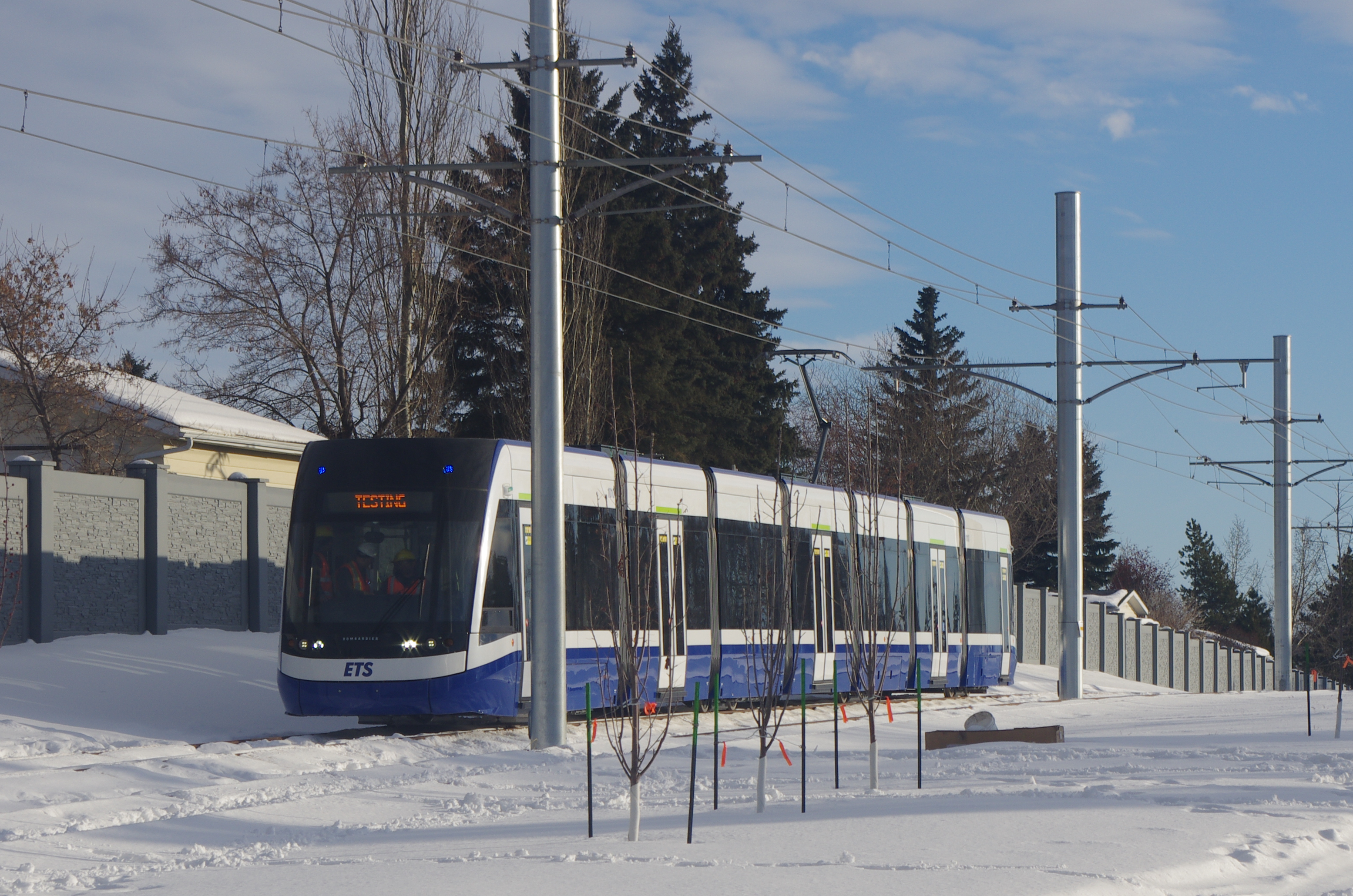
A modern tram or streetcar on a light rail route in Edmonton.
Please deliver to the CBC News Department;
*
I find that the CBC still refers to Montreal’s REM as light rail, when in reality it is a light-metro.
*
Driverless transit systems cannot be light rail because part of the definition of light rail is that it can operate in mixed traffic (on-street), which REM cannot.
*
Vancouver operates two light-metro systems under the umbrella of SkyTrain. Vancouver’s Expo and Millennium Lines operate the proprietary Movia Automatic Light Metro System (MALM) which is now owned by Alstom and the Canada Line which operates ROTEM Electrical Multiple Units or EMU’s.
*
Please note: The cars used on the Expo and Millennium Lines are erroneously called SkyTrain which is the name of the light metro system, with the name being chosen by a radio contest on CKNW Radio in 1985. The name SkyTrain has been trademarked by a Brazilian company for their own proprietary people mover. SkyTrain tends to be a common name for elevated railways.
*
The modern tram or streetcar, which light rail is based on, is an extremely flexible transit mode as it can operate as:
*
A tram or streetcar, operating on-street, in mixed traffic
As light rail, operating on a dedicated or reserved right-of-way
As a light metro on a grade separated right-of-way
As a passenger train (TramTrain) on a mainline railway
Can carry freight in containers on special built cars
And, it can do this on one transit route, negating the need for passengers to transfer. This is called flexibility which is extremely important for 21st century public transport.
*
A good example is the Ottawa light rail line which is actually a light-metro and is fully automatic in operation, except that it does have drivers because in the future, the system will also operate on reserved rights of ways, or on street as light rail, making it much cheaper to extend off the main trunk route.
*
This is important because Vancouver’s Expo Line is being extended 16 km to Langley and will cost almost $5 billion, where as LRT can be built for around $35 million to $45 million/km complete (the Surrey Langley extension cost does not include cars or signalling/electrical rehabs needed) or around $15 million/km for tramtrain, complete!
*
Calling REM light rail is nothing more than a politcal, bureaucratic, and corporate ruse to confuse the public because modern light rail made light metro obsolete decades ago. As the old adage goes, repeat a lie often enough and the public will begin to believe it.
Lots of bad news around the NDP this week so including Selina Robinson’s resignation letter, which claimed antisemitism among her colleagues and indifference, so why not a SkyTrain announcement, as everyone loves SkyTrain.
The key point in this story is “the province remains in final contract negotiations…..”, so it is obvious the claimed cost from 2021 of $4.01 billion, isn’t $4.01 billion in 2024.
Accounting for inflation that $4.01 billion in 2021 is now $4.57 billion in 2024.
So the negotiations are probably about increased costs due to inflation and more.
Meanwhile TransLink is on the stump pleading for more money and is getting short shrift from the taxpayers.
Until there is a signed contract, stating the full cost, this is just another example of out mainstream media citing government press releases as real news.
Early work to start on Surrey-Langley SkyTrain line as guideway build team named
The Surrey-Langley SkyTrain project is inching closer to construction.
On Thursday, the province revealed it had selected SkyLink Guideway Partners as its preferred proponent to design, build and finance the project’s elevated guideway and associated roadworks and utilities.
The consortium includes Dragados Canada, Ledcor Investments, Ledcor Mining and SYSTRA International Bridge Technologies.
The province remains in final contract negotiations with the group, but the Ministry of Transportation said the consortium is already set to begin early work preparing for major construction.
That work includes geotechnical investigations, identifying utilities and clearing vegetation.
The project will be built under three separate contracts.
The province remains in talks over bids to build eight new stations along the line and to install electrical systems and trackwork.
When complete, the 16-kilometre extension to the SkyTrain Expo Line will link King Goerge Station to Langley City Centre.
The $4.01-billion extension is slated to open in 2028.
Update: The preceding news story has been scrubbed from the website. 2024-03-08 8:50 AM.
Lysenkoism: describes the manipulation or distortion of the scientific process as a way to reach a predetermined conclusion as dictated by an ideological bias, often related to social or political objectives.
Transit is about moving people, not building high rise condos and towers!
Really, not in Vancouver, where the SkyTrain light metro system is designed to shape land use, ensuring big profits for politcal friends and insiders.
Ignoring the fact that the proprietary SkyTrain mini-metro system has been rejected by transit planners around the world as being extremely expensive for what it does and just being poorly designed, many local planners and engineers still hail SkyTrain as a ‘wonder system‘ despite the fact that only seven such systems have been built in 44 years and only three are seriously used for urban transport.
Ignoring facts has been the mainstay of TransLink, countless provincial ministers of transportation, professional engineers, planners and academics, in transit debates and regional transit planning in general. Why have so many people have stained their reputations, supporting a proprietary mini-metro, when the rest of the world has moved on, relegating SkyTrain as a historic footnote?
There are two reasons for so many local so-called professional and academic people remain willfully blind on regional transit issues.
Many people have made small fortunes by supporting SkyTrain and the SkyTrain planning and building process. Making large sums of money by doing very little is a very hard habit to give up, especially when the taxpayer is footing the bill.
Many people have just been bamboozled by the SkyTrain lobby and are embarrassed to acknowledge it. Like sheep, they continue to baa, baa, the SkyTrain line for fear that they would be shown ignorant of transit issues.
Greed, ignorance and fear are the main ingredients of our regional transit planning and until that changes, the powers that be will still plan for SkyTrain. The continued building and operating SkyTrain is bankrupting TransLink, taxes will continually rise, further feeding greed, ignorance and fear.
Lysenkoism is the doctrine and it is practiced by the provincial government, Metro Vancouver and TransLink.
……….. or cutting through the BS about Light Rail, SkyTrain and BRT.
The following is a guide plus definitions.
ALM: Automatic Light metro, the fourth marketing name given for the SkyTrain family of light-metros, when Lavalin briefly owned SkyTrain before going bankrupt.
ALRT (1): Advanced Light Rail Transit, the second marketing name after ICTS for the trains used on the Expo Line. erroneously called SkyTrain.
ALRT (2): Advanced Light Rapid Transit, the third marketing name for SkyTrain, when Advanced Light Rail Transit failed to find a market.
ART: Advanced Rapid Transit, the fifth marketing name for SkyTrain, used by its then owners, Bombardier Inc.
Alstom: The forth owner of the proprietary SkyTrain light-metro system (MALM).
Automatic (Driverless) Operation: A signaling system that permits train operation without drivers. Contrary to popular myth, automatic operation does not reduce operating costs. Instead of no drivers, attendants must be hired instead to permit safe operation. Automatic signaling was designed to reduce signaling staff, not operation staff.
Bombardier: The third owner of the proprietary SkyTrain light metro system (ART & Innovia)
Bus Rapid Transit (BRT): Generally means Express Buses, a true BRT needs a very expensive and land consuming busway or highway or be guided.
Bored tunnel: A tunnel boring machine also known as a “mole”, is a machine used to excavate tunnels with a circular cross section through a variety of soil and rock strata. They can bore through anything from hard rock to sand.
Busway: A route needed for BRT. Busways can be conventional HOV lanes or exclusive roads for buses. Busways can be equipped with raised curbs or rails for bus guidance.
Canada Line: Vancouver’s third light metro line which is a grade separated EMU operation and is not compatible with the rest of the SkyTrain light metro system in operation.
Capacity: A function of headway multiplied by vehicle capacity, which in turn is dependent on station station platform length measured in persons per hour per direction (pphpd).
Community Rail: a government strategy supported by the rail industry. It engages local people in the development and promotion of local and rural routes, services and stations. Community Rail routes remain connected to the national rail network, and train operating companies run the trains and stations.
Consultation: To sell a transit decision to the public after the decision has been made.
C-Train: The Calgary light rail system, modeled after German Stadtbahn.
Cut and cover: A method of building a tunnel by making a cutting, which is then lined and covered over. (Civil Engineering) designating a method of constructing a tunnel by excavating a cutting to the required depth and then backfilling the excavation over the tunnel roof
DMU: Diesel Multiple Unit – A diesel multiple unit or DMU is a multiple–unit train powered by on-board diesel engines. A DMU requires no separate locomotive, as the engines are incorporated into one or more of the carriages. Diesel-powered single-unit railcars are also generally classed as DMUs.
EMU: Electrical Multiple Unit – An electric multiple unit or EMU is a multiple–unit train consisting of self-propelled carriages using electricity as the motive power. An EMU requires no separate locomotive, as electric traction motors are incorporated within one or a number of the carriages.
Evergreen Line: The 11.4 km newly finished portion of the old Broadway/Lougheed Rapid Transit Project. When the NDP forced the SkyTrain Millennium Line onto TransLink, there was not the money left order to complete the line to the Tri-Cities. Now completed. The Evergreen Line is now known as the Millennium Line.
Expo Line: The first SkyTrain line built, completed in late 1985. The Expo Line was built in three sections. The Waterfront to New Westminster section (cost a much as LRT from Vancouver to Whalley, Lougheed Mall and Richmond Centre), the Skybridge, section across the Fraser river to Scott road Station, and the final section to Whalley in Surrey.
Grade: The vertical rise of a railway track, normally given in a percentage (1% grade = a 1 metre rise in 100 metres). Industry standard grade for LRT is 8%; Sheffield’s( LRTA) operates on 10% grades; the maximum grade for a tramway is located in Lisbon, where the streetcars operate, unassisted, on 13.8% grades.
Flip-flop: Make an abrupt reversal of policy. Common with Light Rail/SkyTrain planning in MetroVancouver.
Garage Sale: The Detroit ICTS People Mover operators went to the TTC Garage Sale to get cars and parts to keep their system in operation.
Goebbels Gambit: The fine art of repeating a lie often enough that it is perceived as the truth, TransLink is very good at!
Guided Bus: A BRT that is physically guided by either a raised curb or a central rail. Some guided buses are considered monorails.
Headway: The time interval between trains on a transit route.
Hybrid: A transit system that is designed operated as a LRT/light metro mix. Generally very expensive as it uses the most expensive features of both modes.
Innovia: The sixth name SkyTrain was marketed by (no buyers).
ICTS: Intermediate Capacity Transit system, the first name of what was renamed ALRT, erroneously called SkyTrain was marketed by.
Interurban: An early streetcar which operated at speed on its own R-o-W connecting urban centres.
Lavalin: The second owner of the proprietary SkyTrain light metro system. Went bankrupt building a system in Bangkok. Later amalgamated with SNC to become SNC Lavalin.(ALRT, ALM) Siemens built a conventional metro system for Bangkok, also known as SkyTrain, but there is no relation.
Light Rail Transit (LRT): A steel wheel on steel rail transit system that can operate economically on transit routes with traffic flows between 2,000 pphpd to over 20,000 pphpd, thus bridging the gap on what buses can carry and that which needs a metro. A streetcar is considered LRT when it operates on reserved rights-of-ways or R-o-Wa’s for the exclusive use of the streetcar/tram. Number of LRT/tramways in operation around the world over 500; light railways (many use LRV’s) and over 120; heritage lines over 60.
Light Metro: A transit mode, generally a proprietary transit system, that has the same or less capacity of LRT, at the cost of a heavy-rail metro.
Light Rail Vehicle (LRV): A vehicle that operates on a LRT or streetcar line. Also called a streetcar, tram, TramTrain or interurban.
Lysenkoism: used metaphorically to describe the manipulation or distortion of the scientific process as a way to reach a predetermined conclusion as dictated by an ideological bias, often related to social or political objectives.
Mass Transit: A generic term for heavy-rail metro. See rapid transit.
MAX: The Portland Tri-Met LRT system.
Metro: An urban/suburban railway that operates on a segregated R-o-W, either in a subway or on a viaduct, due to long trains (5 cars+) and close headways. There are 174 heavy/light metros in operation around the world.
Millennium Line: The second SkyTrain Line built, using the new Bombardier ART cars.
Medical Emergency:TransLink Speak for a suicide.
Monorail: A transit mode that operates on one rail. There are two general types of monorail: 1) hanging monorail and 2) straddle beam monorail (not a true monorail). Some proprietary BRT systems are also classed as monorail.
Movia Automatic Light Metro: The seventh and last name that SkyTrain has been Marketed under, with Linear Induction Motors a customer add on.
Priority Signaling: A signaling system that gives priority to transit vehicles at intersections.
Proprietary Transit System: A transit system who rights are exclusively owned by one company. Transit operations who operate proprietary transit systems must deal with only one supplier.
Rapid Transit: A generic term for metro. See mass transit. Rapid Transit is not Light Rail Transit.
Reserved Rights of Way: An exclusive R-o-W for use of transit vehicles, can be as simple as a HOV lane (with rails for LRT) or as elaborate a a lawned boulevard or a linear park complete with shrubs.
SkyTrain: An unconventional proprietary light-metro, powered by Linear Induction motors, marketed by Bombardier Inc. Currently there are now only 6 SkyTrain type transit systems in operation (Toronto closed theirs down) around the world. ICTS (2); ALRT (1 ) 1; ART (4).
Streetcar: A steel wheel, on steel rail electric (also can be diesel powered) vehicle that operates in mixed traffic, with little or no priority at intersections. Also known as a tram in Europe. Streetcars become LRT when operating on reserved R-o-W’s.
Subway: An underground portion of a rapid transit line. Subways may either be bored or cut and cover or a combination of both construction methods.
TTC: The Toronto Transit Commission.
Tram: European term for streetcar, as the Europeans do not use the term LRT.
TramTrain: A streetcar that can operate on the mainline railways, operating as a passenger train.
TransLink Speak: The lexicon used by TransLink to mask problems.
The Urban Transportation Development corporation (UTDC): A former Ontario Crown corporation responsible for the development and sales of ICTS and ALRT, Sold to Lavalin.
Viaduct: A viaduct is a bridge composed of several small spans.
The birth of what we call TramTrain or a streetcar that can operate on the mainline railways, came about after much research and public consultation, to provide the the city and region of a ‘user-friendly’ public transit system. In the 1980’s cities with trams or streetcars were seeing a steady decline in patronage and seemed doomed to the history books. With tram management being given a simple diktat: “Get people to use the ream system or loose it“, much time was spent consulting with transit users on what type of service would bring the customer back to public transit.
Zwei notes that in Vancouver, the transit customer is seldom consulted with, nor is the customer listened too. Light metro is built with the provincial government telling the taxpayer, “You are getting SkyTrain whether you like it or not!” Added to this, the region has invented a pseudo science of densification which is a smokes screen for government to inflate property values to reward land speculators and land developers. This ‘Densification‘ pseudo science or Lysenkoism has proven not to attract much new ridership to the public transit system.. Ridership on the public transit is kept seemingly high, with over 130, 000 of U-Pass deep discount ‘ride at will’ tickets for students in post secondary institutions, which flood the transit system at peak hours.
Meanwhile back in Germany, the public wanted a ‘no-transfer‘ service, with reasonable travel times and the TramTrain was conceived to provide a doorstep to downtown service, omitting a 20 minute transfer from commuter train to tram.
A city tram with a TramTrain in the rear.
The success of the TramTrain operation in Karlsruhe was an instant success as the following table shows. In seven months ridership on the new TramTrain service, replacing a commuter train, providing a direct, no transfer service to downtown Karlsruhe saw 479% increase in ridership, from5 33,600 to 2,554,976 customers a week.
Compare to our $11 billion, 21.7km extension of SkyTrain, where TransLink is all but hiding the fact that there will be little or no increase in ridership on both the Expo Line extension to Langley and the Broadway subway.!
Well, TransLink and the provincial government are not the only ones misleading the public on rapid transit costs.
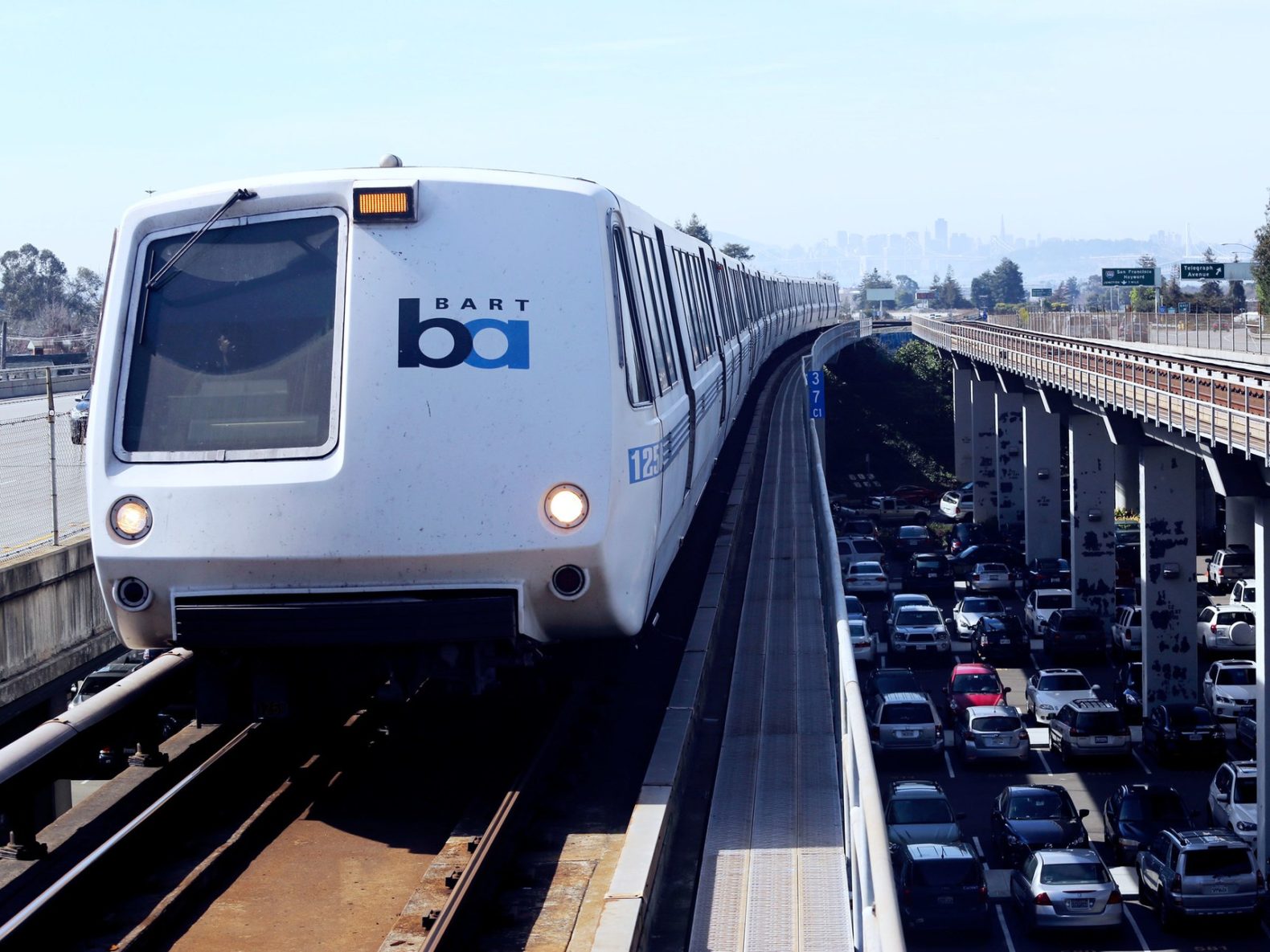
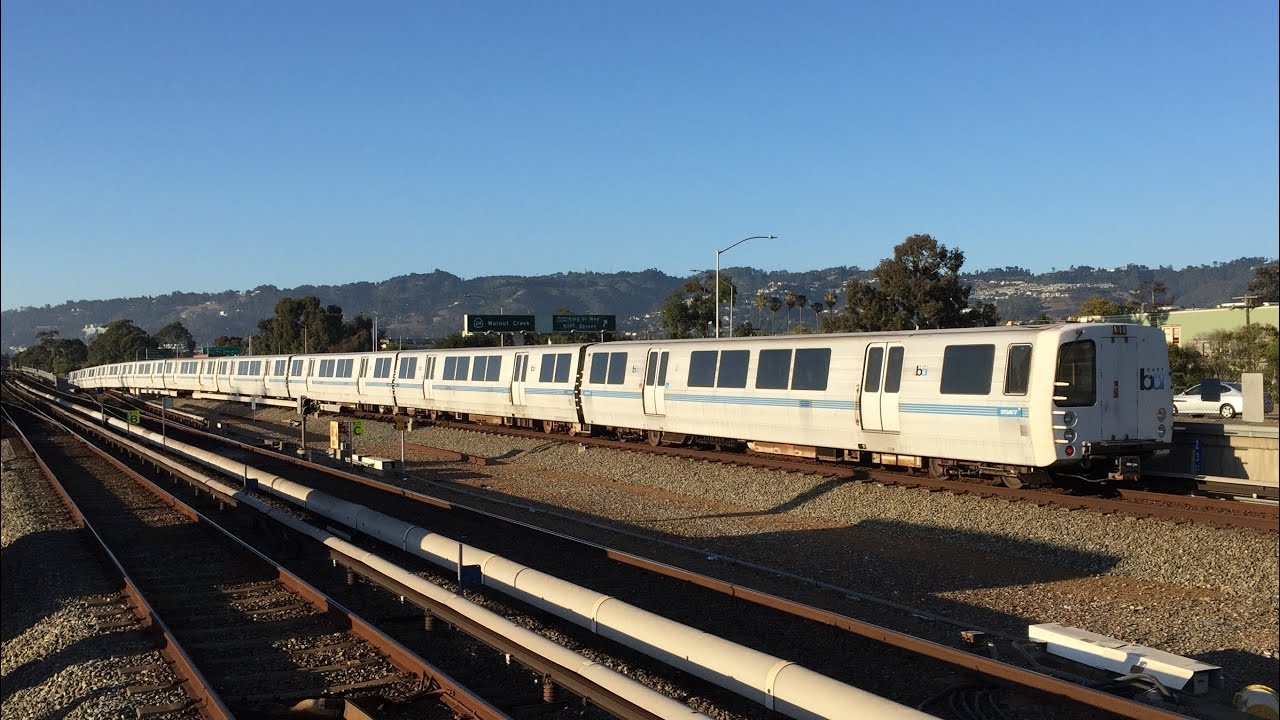
The Bay Area Rapid Transit (BART) is a rapid transit system serving the San Francisco Bay Area in California. BART serves 50 stations along six routes and 131 miles (211 kilometers) of track, including a 9-mile (14 km) spur line running to Antioch, which uses diesel multiple unit vehicles, and a 3-mile (4.8 km) automated guideway transit line serving Oakland International Airport. With an average of 164,500 weekday passengers as of the third quarter of 2023 and 41,286,400 annual passengers in 2022, BART is the seventh-busiest heavy rail rapid transit system in the United States.
BART has an unusual broad track gauge of 5′ 6″, making it incompatible in operation with other railways.
BART
Exclusive: VTA officials misled public, governing board on cost for San Jose BART project
Auditor found VTA staff engaged in ‘breach of transparency’ and ‘misleading’ communications to its governing board and public about the project’s cost
A scathing report by the Valley Transportation Authority’s auditor general criticizes the agency’s handling of the San Jose BART extension — already beset by major cost increases and timeline delays — finding that staff engaged in a “breach of transparency” and “misleading” communications about the project’s cost.
The assessment, conducted by VTA’s Scott Johnson, says the agency internally applied for grant money using price projections that they were publicly brushing off — and that staff were long “dismissive” of federal estimates that showed the transit extension’s costs were rising sharply.
Scott’s inquiry focused on earlier cost projections in the single-digit billions that now seem like small potatoes — VTA estimates the extension will now cost a whopping $12.2 billion (CAD $16.46 billion), making it one of the most expensive transit proposals in the country.
“What we found is that the (VTA) project team and the administration need to do a better job of keeping the board and public informed,” Johnson said in an interview. “There were instances of long gaps of time where critical information was not shared with the board.”
When they announced the latest revised cost and completion estimate in October, VTA leaders blamed inflation and skyrocketing construction costs for a price tag more than twice the original cost set in 2014 — and a finish date of 2036, a decade behind schedule. The news sparked VTA’s Board of Directors to launch a watchdog committee that included San Jose Mayor Matt Mahan to investigate the exploding cost and delays.
In his assessment, Johnson found that VTA applied for the “New Starts” grant in October 2022 using the federal government’s own cost estimate of the project at the time — $9.1 billion (CAD $12.28 billion), with an additional $200 million in added financing costs from the agency.
But while applying for the grant, and even after it was approved in December 2022, the transit agency was publicly stating that their own $6.9 billion estimate of the project was still accurate.
Johnson found that it wasn’t until April 2023, months after federal funding was approved, that the VTA informed its board that the $9.1 billion figure — plus the added financing costs — was now the price they thought the project would reach.
Johnson also found VTA officials ignored the rising cost estimates from the federal government’s independent monitor assigned to the project, known as a PMOC, which informed the agency in July 2021 — citing a 65% “confidence rate” — that the transit extension would cost $9.1 billion (CAD $12.28 billion).
“As early as December 2021, VTA was dismissive of PMOC concerns,” Johnson writes in the assessment. “For example, in the December 2021 Board meeting, the Chief BART Delivery Officer at the time explained that the assessment value of $9.1B (CAD $12.28 billion) was not an official cost estimate and was based on risk and ‘what if’ scenarios.”
Johnson writes that the federal monitor continued to “remain concerned” about VTA’s own cost estimates throughout 2023, pointing out that the PMOC repeatedly wrote in reports that the agency was “under-representing” the project’s cost. The federal government is set to release an updated risk assessment of the project in February.
Tom Maguire, VTA’s chief megaproject officer, said in an interview that the agency “genuinely” did not know whether the federal government’s $9.1 billion (CAD $12.28 billion) figure “was quite right.”
When asked why VTA would apply for federal money with that estimate — instead of their own, which they were stating publicly — he said the figure was “more credible to the (Federal Transportation Administration’s) audience.”
“What we did know is that we had to go to the federal government with a credible number,” he said. “There was no option to go back to the federal government with a number like 6 billion dollars.”
Maguire said that he is committed to the auditor general’s recommendations, which include better communication.
“The first thing is that we are here in the spirit of transparency, and that is very important for me and my team,” he said. Johnson said VTA officials have acknowledged to him that “missteps” were made — and he said he’s hopeful communication will improve.
In a statement, Mahan said the VTA needs to “course correct with urgency — expanding BART into the San Jose metro area is simply too important to make mistakes that take on additional financial risk. I look forward to hearing the General Manager’s plan for improving communication with the board and the public.”
The transit extension will run from San Jose’s Berryessa Transit Center to downtown through a 4.7-mile subterranean tunnel and up north to Santa Clara, totaling six miles. The project will add a total of four stations and create a ring of transit running around the Bay Area. The new underground stations will be located at 28th Street/Little Portugal, Downtown San Jose and Diridon Station — while an aboveground platform will come to Santa Clara near the city’s Caltrain terminal.
The preceding cliche is all but forgotten by current premier Eby and the provincial NDP as they spend billions of tax dollars on dubious transportation projects. “Shoveling money off the back of a truck”, is the NDP’s answer to transportation woes, but the feds now seem to be parking their shovel!
This is not the 1980’s as global warming and climate change has changed how we move people and freight and an end should be put to BC’s famed “Blacktop Politics”.
Both the federal and provincial governments should be putting passengers and freight back onto the rails, investments should be made reopening disused or abandoned railways for both freight and passenger use.
Climate change placebo’s like the Carbon Tax should be abandoned or monies derived from the Carbon Tax be directly invested in rail projects.
The federal government is all but broke and with storm clouds of a bellicose Russia and a fascist American Trump/MAGA politic, Canadian politcans must adapt to a new reality in transportation as the old ways will become an anchor around the Canadian taxpayer’s neck.
So Mr. Eby, stop building politically prestigious transit projects like the Expo Line extension to Langley, the UBC Subway and the SFU gondola and start investing in real transportation solutions, such as the E&N and the RftV Marpole to Chilliwack regional railway for a start. For the cost of the subway to UBC, you can build almost 400 km of rail that can carry both passenger and freight.
One can rebuild build a Salmon Arm to Kelowna regional railway for less than half the price of the Expo Line extension to Langley.
Premier Eby, if you really cared about global warming and climate change, it is not new roads that must be built, but new railways, but instead you and the NDP are still addicted to rubber on asphalt solutions and if the NDP adhere to yesterday’s “rubber on asphalt” and “blacktop politics”, your party will go the way of the Dodo bird.
‘Made a lot of us very nervous’: B.C. premier on Guilbeault’s infrastructure comments
Many of Metro Vancouver’s roads are currently undergoing significant upgrades but there is now some concern the federal government might not be a partner in those projects.
Environment Minister Steven Guilbeault told a crowd in Montreal on Monday that “our government has made the decision to stop investing in new road infrastructure,” according to quotes published in the Montreal Gazette.
The reaction to Guilbeault’s comments was swift. B.C. Premier David Eby said, “The province is not waiting for the feds. You’ll see the early work that is already going on out there.”
In B.C., the federal government has already promised funds to upgrade Highway 1, the Massey Tunnel project and repair work and infrastructure needed in the Sumas Prairie following the devastating flooding in 2021.
Eby said Highway 1 is a national trade corridor, not a simple road project.
“We need the federal government to be onside for the Highway 1 expansion, we need them here for the preventative work we have to do,” he said.
When pressed by reporters two days later, Guilbeault said he “should have been more specific.”
“Of course, we’re funding roads,” he said Wednesday. “We have programs to fund roads, but we have said — and maybe I should have been more specific in the past — is that we don’t have funds for large projects like the trosième lien.”
The trosième lien, or third link, refers to a highway tunnel connecting Quebec City to Lévis.
However, moving goods around B.C. remains a big component of roads and infrastructure upgrades.
The Port of Vancouver is Canada’s busiest port and connects Canada with approximately 140 to 170 countries annually.
It enables the trade of approximately $305 billion in goods every year, sustains more than 115,000 jobs and generates nearly $12 billion in annual GDP across Canada.
Bridgette Anderson, president and CEO of the Greater Vancouver Board of Trade told Global News that B.C. has experienced unprecedented population growth.
“We need infrastructure for the unprecedented population growth we have in this region,” she said. “Three hundred thousand people in the last two years with many, many more expected to come.
“We need federal funding dollars for infrastructure for the movement of goods and people.”
Eby said Prime Minister Justin Trudeau needs to clarify the comments made.
“I understand the federal environment minister has tried to clarify his comments,” Eby said. “It would be good to understand from the federal government and to have some clear commitments, a recommitment to the promises they made to us around this essential infrastructure because these comments have obviously made a lot of us very nervous.”
Trudeau said his government’s policy on contributing to infrastructure projects remains unchanged.





On Thursday, the province revealed it had selected SkyLink Guideway Partners as its preferred proponent to design, build and finance the project’s elevated guideway and associated roadworks and utilities.


 Bus Rapid Transit (BRT): Generally means Express Buses, a true BRT needs a very expensive and land consuming busway or highway or be guided.
 C-Train: The Calgary light rail system, modeled after German Stadtbahn.
 Grade: The vertical rise of a railway track, normally given in a percentage (1% grade = a 1 metre rise in 100 metres). Industry standard grade for LRT is 8%; Sheffield’s( LRTA) operates on 10% grades; the maximum grade for a tramway is located in Lisbon, where the streetcars operate, unassisted, on 13.8% grades.
 ICTS: Intermediate Capacity Transit system, the first name of what was renamed ALRT, erroneously called SkyTrain was marketed by.
 Light Rail Transit (LRT): A steel wheel on steel rail transit system that can operate economically on transit routes with traffic flows between 2,000 pphpd to over 20,000 pphpd, thus bridging the gap on what buses can carry and that which needs a metro. A streetcar is considered LRT when it operates on reserved rights-of-ways or R-o-Wa’s for the exclusive use of the streetcar/tram. Number of LRT/tramways in operation around the world over 500; light railways (many use LRV’s) and over 120; heritage lines over 60.
 Monorail: A transit mode that operates on one rail. There are two general types of monorail: 1) hanging monorail and 2) straddle beam monorail (not a true monorail). Some proprietary BRT systems are also classed as monorail.
 SkyTrain: An unconventional proprietary light-metro, powered by Linear Induction motors, marketed by Bombardier Inc. Currently there are now only 6 SkyTrain type transit systems in operation (Toronto closed theirs down) around the world. ICTS (2); ALRT (1 ) 1; ART (4).
 Streetcar: A steel wheel, on steel rail electric (also can be diesel powered) vehicle that operates in mixed traffic, with little or no priority at intersections. Also known as a tram in Europe. Streetcars become LRT when operating on reserved R-o-W’s.
 TramTrain: A streetcar that can operate on the mainline railways, operating as a passenger train.
 Viaduct: A viaduct is a bridge composed of several small spans.
 A Karlsruhe tram at night
 A city tram with a TramTrain in the rear.
Compare to our $11 billion, 21.7km extension of SkyTrain, where TransLink is all but hiding the fact that there will be little or no increase in ridership on both the Expo Line extension to Langley and the Broadway subway.!





Recent Comments