BRT – A View From a Canadian Transit Expert – A Repost from 2015
Today’s post is a re post from 2015 and 2023, is an an interesting piece offered by Mr. Haveacow, a transit specialist from Ottawa who has good knowledge of Canadian public transit. He wishes to be anonymous because of Canada’s arcane attitude for those who dare to deal in facts and he wishes not to be blacklisted, which is common practice in Canada.
TransLink is telling all who will listen about the virtues of BRT (mainly it is cheaper than light rail), yet many issues arise from Bus Rapid Transit.
True, BRT is only a little cheaper to install than light rail but does have higher operating costs; as well, BRT does not have the advantages of scalability, that a modern tram has, such as operating two or three car sets.
The big, big problem I see with TransLink’s BRT is that it is designed to feed SkyTrain, which again, maybe not such a good idea because the the 1980’s SkyTrain proprietary light metro system is ill equipped to deal with businesses and commuter flows relocating from very expensive Vancouver to cheaper areas in the Fraser Valley.
Public transit is an “apple pie and motherhood issue”, with many people failing to understand that by throwing money at Transit projects, sometimes does not improve transit service, but instead does the opposite.
Guided Bus-ways have a big issue, capacity. The reason you have a guided bus-way is that, surface vehicles like buses can sway side to side quite a bit on a roadway. One of the reasons most Bus-way lanes are a minimum of 4 metres wide is to allow for that side to side sway that occurs naturally at higher speeds when we drive. Guided Bus-ways are fixed to their ‘track’ or Concrete Guideway or fixed using a laser/optical system that electronically locks them into a right of way so no side to side sway occurs at all. Optical systems also have an additional issue in that they are highly weather dependent and are very costly to service. The advantage for the guided bus-ways is that, your right of way can be considerably less wide much like a rail line right of way. Unless you design a complex concrete guideway bypass at Bus-way stations or an electronic one using optical guided equipment, the buses are forever trapped behind the buses in front of them. This severely limits system capacity.
The real problem common with BRT is the operating cost of carrying the large amount of passengers, only using buses, once the passenger levels become very high. That level is different for every city and is dependent on the exact nature and characteristics of the right of way.
The picture Zwei used of the Brisbane Busway is another common occurrence on successful Bus-ways, bus back ups at choke points or stations.
The company MMM Consulting (nee McCormik Rankin Consulting) was the main designer and developer of both Ottawa’s Transit-way System and its child, the Brisbane Bus-way Network, the subject of the article’s main picture.
The main differences between the two are the fact that Ottawa’s Transit-way System was designed and mostly built in the 70’s, 80’s and 90’s whereas, Brisbane’s was designed and built in the 90’s, and 20o0’s. The other major difference is that unlike Ottawa, Brisbane was able to build a fully segregated right of way through its downtown which comprised below grade tunnels and above grade viaducts and a physically segregated surface route. Ottawa has painted bus lanes on a couplet of downtown one-way streets with signal modification which allow Transit-way (east-west traffic) almost the legal limit of signal priority over the north-south traffic at intersections.
The difference between the two, using roughly the same number of vehicles about 185-200 buses/hour/direction at peak the Ottawa Transit-way can move 10500 people/hour/ direction and Brisbane about 14,000p/h/d.
Both however, have the same issue, massive back ups of buses primarily at downtown or major bus-way stations because the size and handling capacity of the actual stations has been grossly under built. The issue is that, to handle these kind of crowds and move them with 12 and 18 metre single articulated buses (23 metre long, double articulated and 30 metre long triple articulated buses are not street legal in Canada or Australia and even in the USA for that matter) you must construct monster sized, at the least full metro sized or larger bus station platforms that are or exceed 150 metres in length. The stations also have to be 4 lanes wide, 4 metres per lane, not including station platform width. Most downtown businesses would not want to be located near one of these stations for obvious reasons. One of Brisbane’s bus-way stations was enlarged to this standard, the bus back up picture Zwei used for this article is the que of buses entering that station.
The other main issue is the operational cost of having to use that many bus drivers and buses. Buses in general have far too little capacity for these high traffic BRT operations.
In China and Latin America drivers cost much less as a proportion of the total operating cost of each bus 50-60% in Latin America and 30-45% in China. In the northern 2/3 North America, Western and Central Europe, Australia/New Zealand, Japan Taiwan, basically most of the so called developed world, the cost of the bus driver is 70-80% of the total cost of operating the bus.
Using 185-200 buses/hour/direction to move people becomes a great financial drain on the operating bus system as a whole and makes it almost impossible to get extra buses to other non bus-way routes that need them. In Ottawa, several suburban routes that have needed many more buses to handle their high passenger levels can’t get them and haven’t been able to for more than a decade because so many buses are tied up on the Transit way, either on it or at the stations during peak hours. There are barely enough extra buses left to handle individual bus breakdowns let alone provide extra service on other routes. Buying more buses was not an answer because Ottawa’s bus fleet was already near 1100 vehicles this is a pretty big fleet for a city and area of at most, 1.2 million people. This would put the operational budget into a serious deficit. We already had the most expensive per taxpayer transit portion on our tax bills of all Ontario municipalities it really does not need to go higher. The bus options had run out of time. Ottawa’s answer was LRT. Brisbane continues to maintain their heavily used portions of busways. Ottawa is building more Transit ways but in suburban areas with much lighter passenger traffic levels.
The Transit-way was designed to be converted to rail however, the cost to convert the first part would be an eye popping $2.1 Billion. The reason was no one ever figured how much extra work there would be like, having to build parallel temporary bus rights of way so that, all those buses didn’t totally clog city streets during conversion of the Transit-way to rail and the fact that, they waited till much the original Transit-way infrastructure was in desperate need of replacement due to age. Some Transitway right of way also was only temporary and not rail friendly. These temporary rights of way lasted for over 30 years and now have to be either totally rebuilt and or abandoned at high cost. The kicker about the high operational cost of servicing bus-ways at high passenger demands was that, even with Ottawa being forced to build a 2.5 km tunnel, with 3 very large underground stations at a cost of $715 Million under downtown for the LRT line (surface operation would have simply exchanged heavy surface bus traffic and passenger crowds for heavy surface LRV traffic and passenger crowds) operationally, Ottawa was going to save a minimum of $60 million a year, switching to LRT technology.
The take away from this is that, building “Real BRT” can be a very good way of building up ridership and up to a certain point, a less costly way, compared to a lot of rail systems, to move people in a North American low density environment.
The problem now even in Canada is that, politicians are building express bus systems like B Lines, Brampton’s Zum (pronounced zoom) and many comparable systems in the US and calling it BRT, which it really is not. Those politicians love doing it because this false BRT is much cheaper to build and operate than real BRT and they still get a ribbon cutting ceremony.
The problem is that, the amount you spend with these systems generally is comparable to the systems effectiveness in moving passengers. VIVA, (York Region Transit) for example, started with the faux BRT or what I like to call “BRT” but, had definite designs and plans to build physically separate BRT rights of way that can be converted to a high capacity LRT system in the future and has carried through on it. York Region just didn’t have the passenger count to build LRT at the beginning. But they have designed in the ability to easily convert the BRT system to LRT technology when needed. Brampton (which is part of Peel Region) just to the west of York Region has no definite plan or design to convert its Zum system to a real BRT standard now or in the future. However, the Zum System has built up Brampton’s transit ridership. I am not saying that, these “BRT” systems aren’t useful but they are not real BRT and should be labeled as that because they can confuse people into not building anything in places that need improved transit but cana’t afford to build or operate LRT and or support LRT with enough passengers. As a planner it is quite common to hear comments like this at public meetings, “I saw BRT in Brampton and it gets stuck in regular traffic all the time. BRT sucks!” Then you have to explain what real BRT is and is not, by then most people fall asleep or stop listening.
Then you get into a half technical half ethical problem with BRT and or any other transit operating technology for that matter. How do you study the differences between operating technology so that you are being fair as well as being accurate in the final choice of technology? The best recent example of what not to do is right here locally in Vancouver, South of the Fraser River, to be exact.
Trying to convince people in Surrey that, their LRT plan is useful, TransLink used a SkyTrain option as well as a surface BRT option to compare to LRT capability, pointing out the superiority of LRT in this case. The SkyTrain option had many problems cost and general usefulness being the main ones. The BRT example they used is actually an LRT line using buses operating on a layout and design which is not even close to what a real BRT line in a on-street environment would or should be using. Its not even close to the best Canadian practices, let alone best practices used in the rest of the world, with BRT systems in a on-street environment. Did the staff doing this know enough to do this purposely or were they ignorant of the differences of what good BRT design is or is not.
Their example of LRT also displays a a serious lack of knowledge about best surface LRT operating practices in the US and Canada.
More importantly it shows to me, how committed or in this case not committed, TransLink staff really are to studying LRT technology at all. In fact, I don’t blame the people who supported SkyTrain technology for this area, like Daryl from SkyTrain for Surrey, he had a point, on the surface this study definitely made it look like that to me that the SkyTrain Light Metro was the superior technology choice. The difference as a professional is that, I know the real differences in all the technologies that were studied. I also have no belief that, I am the be all and end all of studying these things in the world and would also ask for much help in studying these technology choices from other friends and companies I am familiar with, whom are experts at it. To me a whole new study should be done using the actual best practices for all technologies not just the preferred LRT technology, you should seriously question major aspects and assumptions that were made in this particular TransLink study.
The 50 year costs of bus, BRT and LRT from Ontario’s MetroLinx Study comparing 50 year costs of various transit modes.
A bit of news from Surrey, the Surrey Board of Trade did a survey and like all board of Trade survey’s, it point ts to widening roads, but the following caught my eye.
The survey also found that more people were driving their own vehicle to get to work in 2023 compared to the year prior, with more than 84 per cent driving compared to 79 per cent.
From those surveyed, just over one per cent used transit and one per cent walked to work. More than 11 per cent of respondents worked from home.
Just over one percent surveyed used transit!
Surrey, soon to become metro Vancouver’s largest city sees only about one percent of the population use transit is one hell of an indictment of Ministry of Transportation, TransLink, regional transit planning and the city of Surrey!
If the above thinks that a $5 billion to $7 billion (remember all those add-ons that the Premier, TransLink and the Mayor’s council on Transit refuse to come clean with the public), 16 km Expo Line extension is going to solve the problem, I have shares in Boeing Airlines to sell them.
My observation is this, if the Premier, Ministry of Transportation, TransLink, and the Mayor’s Council on Transit really want to improve transit use in the city of Surrey, they must design a user-friendly public transit system and refrain from planning for very expansive, very grandiose rapid transit lines, strictly for photo-op value at election time.
For the cost of the 16 km Expo line Extension, we could build instead the full Chilliwack to Marpole Rail for the Valley line (under $2 billion), a new multi track rail bridge across the Fraser, replacing the current decrepit rail bridge (under $2 billion) and at least 20 km of a new tram/LRT network in Surrey ($1 billion).
New survey highlights Surrey choke points, suggests improvements for commuters
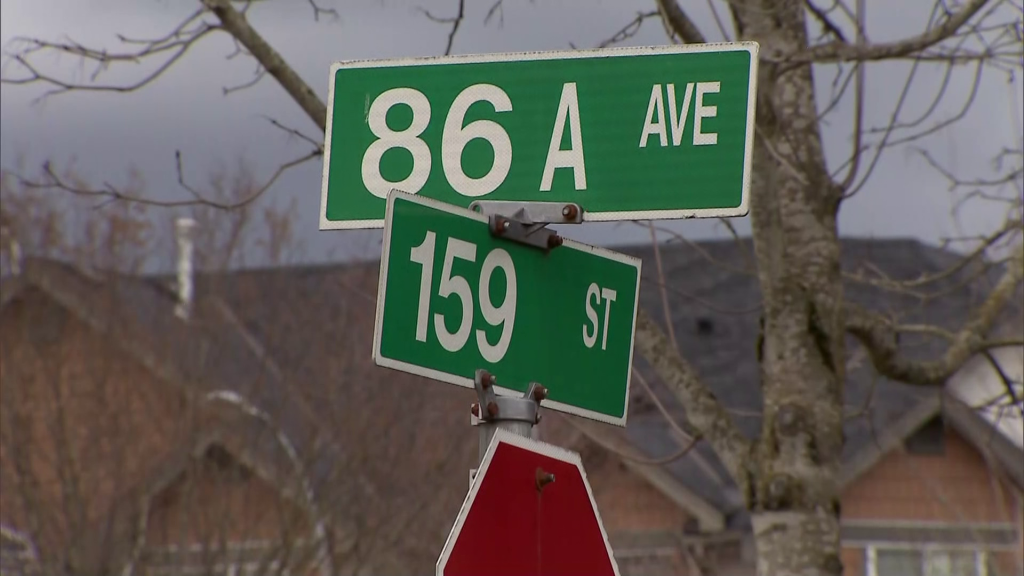
The area near 159 Street and 86A Avenue just North of Fraser Highway in Surrey, B.C. (CityNews Image)
Getting around Metro Vancouver isn’t always easy but a new report is highlighting the pain that commuters in Surrey go through daily.
The Surrey Board of Trade (SBoT) is out with its latest Surrey Roads Survey which highlights some of the problem areas.
The SBoT’s survey found widening 132 Street between 72 and 96 avenues, widening 88 Avenue between 156 and 176 streets, and blowing up the 152 Street overpass over Highway 99, are those at the top of the list.
It also suggests widening 88 Avenue between the city’s Fleetwood and Cloverdale neighbourhoods.CityNews traffic anchor Ryan Lidemark says it’s a no-brainer, as it’s a major east-west-connector for commuters in the region.
“It’s a good shortcut,” he explained. “At 88 Avenue you go through a bunch of farmland. The problem is that when you’re on 88 and you’re going through Fleetwood, once you get east of 156 [Street] it goes down to one lane each way.”
The survey also found that more people were driving their own vehicle to get to work in 2023 compared to the year prior, with more than 84 per cent driving compared to 79 per cent.
From those surveyed, just over one per cent used transit and one per cent walked to work. More than 11 per cent of respondents worked from home.
“We noted that the majority of respondents spend between 15-45 minutes in traffic during their average commute one-way,” the SBoT explained.
However, it wasn’t just vehicular transport the board of trade looked into. They also looked at active transportation, however found that Surrey residents don’t usually feel safe enough to use it as their main transportation.
“Surrey is spread out geographically, and the ability for commuters to use bicycling as a transportation option is not efficient to get to and from work. More respondents were willing to bicycle to work if given safe infrastructure,” the board of trade continued.
The survey respondents also showed support for more rapid transit and curbside pullouts for buses.
Again TransLink tries to hide the truth from the public, just by saying “an issue”.
Well that’s bloody obvious sunshine, what issue?
Stay tuned for another episode of “Automatic (driverless) light-metro systems age very poorly, especially the P-3 variety!
Another day, another disruption.
Canada Line issue leads to delays Friday
FILE – A SkyTrain station sign in Metro Vancouver. (Allan Chek, CityNews Image)
By CityNews Staff
Posted February 2, 2024 2:39 pm.
Last Updated February 2, 2024 7:31 pm.
TransLink says an issue that was creating delays on the Canada Line Friday has been resolved.
In an update just after 6:30 p.m., TransLink announced that single tracking had cleared. It warned people to still expect delays until trains returned to their regular frequency.
The issue started with a stalled train near Olympic Village, per a social media post from the transit provider earlier in the day.
Listen to CityNews 1130 LIVE now!The problem affected service through Vancouver. TransLink had set up train shuttle service between Bridgeport and Oakridge, YVR, and Brighouse as crews worked to remove the train.
A bus bridge was also in place in an effort to ease congestion.
It’s unclear what caused the initial train to stall.
In Metro Vancouver, publishing the following is considered heresy by the SkyTrain lobby, yet today, SkyTrain shows very little benefits to the community, rather it creates barriers to transit.
All the SkyTrain Lobby, the mayor’s Council on Transit, TransLink and the provincial government can show is that SkyTrain drives up property values, creating demovictions for the less wealthy, and a general un-affordability of housing. TransLink can’t even show an independent analysis of light metro operation because internationally it is considered obsolete and is unsalable, except that is, to the rubes in Victoria, metro Vancouver, TransLink, and the Mayor’s Council on Transit.
I think the consequences of the $11 billion needed to build 21.7 extension to both the Expo and Millennium Lines will come back to haunt them.
A study from Bath England
The installation of trams drives city regeneration by making access cheap, easy, fast, pleasant and convenient.
Above: Higher economic acitivty near a tram line due to trams
Croydon Tram at Reeves Corner, doing everything that TransLink claims trams cannot do!
Croydon Tram Link – Academic analysis of benefits of Croydon Tram:
Extract from Economic and regeneration impacts of Croydon Tramlink
1.14 Impact on businesses:
The majority of businesses in the Croydon area regard Tramlink as having a positive impact on their business, helping to raise their profile, increasing
customer numbers and business activity.
*
Tramlink is most visible in Croydon and has brought renewed confidence to the area. It is evidence that major changes can occur at a local level and
represents a strong marketing tool to convey Croydon as a place with drive, ambition and a “Can do” philosophy. Major developments are now taking
Tramlink into account and high profile office based employers have recently moved in, quoting high accessibility as a key factor in their choice.
*
Whilst the retail sector was negatively impacted during the construction period, footfall in Croydon centre was supported by Tramlink during major retail
redevelopment. In addition contrary to initial fears, it has not generated a drift of shoppers to Croydon at the expense of other centres along the route.
*
1.15 Conclusion and lessons for future systems. As expected Tramlink’s impacts as perceived by stakeholders are varied and very difficult to quantify. However it is clear that it has had the following impacts:
*
• Radically improved orbital access across South London;
• Markedly raised the profile of Croydon but not other centres served by the system;
• Assisted in attracting high profile inward investors to Croydon;
• Facilitated some commercial development along the route;
• Attracted young professionals to the area leading to a slight increase in property prices;
• Made recruitment marginally easier and improved productivity through better punctuality;
• Improved the job prospects of the unemployed residents of New Addington;
• Improved the accessibility of the mobility impaired and socially excluded especially in New Addington and to a lesser extent at Phipp’s Bridge;
• Maintained footfall in central Croydon during major retail redevelopment;
• Enabled the upgrading of a number of retail outlets within Croydon; and
• Benefited the residents of the areas it served broadly in line with their age and gender, that is, the benefits have not been biased towards any particular
group. It has, however, had less of an impact on other centres such as Wimbledon but it has not led to the downturn of smaller centres which was a concern when
the system was being planned and built. To maximise the benefits of future systems, besides ensuring that it offers a high quality transport service and integrates to other transport systems, the areas to be served need to ensure that:
• They use the goodwill and feel good factors generated by new light rail/tram schemes to aggressively market their areas;
• Training schemes are put in place to enable residents to take up the employment opportunities that become available to them through improved accessibility;
• The system is highly visible and associated stops are of a high quality; and
• Planning policies facilitate appropriate residential and commercial developments around tram stops.
Sadly, there has been another suicide on the SkyTrain light metro system, as in TransLink’s lexicon, “medical emergency” means suicide or attempted suicide.
In Europe, EEC rules demand station doors must be installed on all automatic (driverless) transit systems, not so in Canada.
Not so in Canada, especially in Vancouver, where politicians and transit authorities just do not seem to care.
SkyTrain station closed in New Westminster, causing delays on Expo Line
FILE – A SkyTrain on the Expo Line. (Kelvin Gawley, CityNews Image)
The Expo Line has suspended its service between Edmonds and New Westminster stations Tuesday morning due to a “medical emergency.”
TransLink says the incident is at 22nd Street Station, and that station is closed.
A bus bridge has been requested to help move people during the morning’s commute, however, the transit provider has not provided an estimated time of reopening.
TransLink says people travelling west on the Expo Line will have to transfer to a bus at New Westminster Station, while customers heading east will have to transfer at Edmonds.
The Millennium Line and the Canada Line are unaffected, TransLink says.
From TransLink’s web site, time 11:23 am Tuesday Jan. 30 2024:
Critical Alerts
2 Alerts
Station Closure SkyTrain: Expo Line
In Effect30-Jan-2024 10:27 am — Ongoing
Expo Line 22nd Street Station is closed due to medical emergency. Expect delays. M-Line and Canada Line unaffected. Updates to follow.
Expo Line trains will be traveling through 22nd St Station without stopping.
Bus Bridge is in place to assist between New Westminster, 22nd St Station, and Edmonds Station.
Some trains may terminate at Edmonds Station and others may terminate at New Westminster Station. Please watch destination signs to ensure you are boarding the correct train.
Updated34 minutes ago
Bus BridgeSkyTrain: Expo Line
In Effect30-Jan-2024 9:29 am — Ongoing
Bus Bridge is supplementing Expo Line service between Edmonds Station and New Westminster Station due to medical emergency at 22nd St Station.
Bus Bridge Locations:
Edmonds Station – Bay 5 – Stop # 52605
22nd Street Station – Both Directions – Stop # 58322
The following is an Email I sent to metro Vancouver mayor’s and Councils. Yes I know it is long and from the response I got, such as lectures by Mayors for not crafting long Emails indicates I hit a nerve. I also copied it politcal leaders and the Mayor’s Council on Transit.
Why?
I want to leave a record, that things are being done wrong and maybe a decade or so from now, when TransLink’s planning becomes untenable, the letter will be seen as a “I told you so”.
I also received an email from one Metro mayor, applauding my efforts as he did not know the history of our SkyTrain light metro system as it is referred to as a Cadillac transit system in “in camera” meetings with TransLink. “The best transit money can buy!”, is also a common refrain at meetings.
To be blunt, we are planning our regional “rapid transit” all wrong; the government blunders along, doing the same thing over again ever hoping for different results.
Metro Vancouver has become an “island” unto itself, where real transit solutions are ignored and the taxpayer is treated as rubes with deep pockets, by both politicians and bureaucrats to pay for fantasy projects, being built mainly for photo-ops and ten second sound bites for the evening news at election time.
The exclusive use of light metro and especially a proprietary light metro has limited the effectiveness of our regional transit system, which is very bad news for the future. The 1980’s “hub and spoke/density” transit philosophy, designed specifically for the SkyTrain light-metro system has failed as the daily gridlock on our roads and highways is testament to this unpleasant fact.
In the 2020’s, it is user-friendliness that will attract new customers, but with our current transit system, it is near impossible to operate a user-friendly transit system.
Rapid transit does not take cars off the road; it is light rail transit that has a proven record of modal shift from car to transit and there is one reason why this is so.
Light rail takes up road space, creating a “push/pull” effect, where the convenience of LRT will pull car drivers to transit and the lack of road space and congestion will push car drivers to transit! In Metro Vancouver, TransLink compels bus customers to transfer to the light-metro system to pretend more people are using the system than actually are.
Putting transit on viaducts or in subways is user-unfriendly and does not attract the motorist from the car, yet no one, not the provincial government, not the regional government, not civic government will admit to this and continue to plan the region like it was still the 1980’s. The result, the regional transit system is toxic to the majority of the population.
The Expo Line extension to Langley and the Broadway subway will destroy any coherent transit planning for the next three decades, literally turning metro Vancouver into a third world of high rise tenements, endemic gridlock, and tent cities. This is happening as I write this, yet the provincial and metro governments point fingers blaming each other, demanding more and more money, to do the same thing over again, when all the politicians have to do is look into a mirror and see who is at fault.
Metro Vancouver is the prime example of how not to plan and build transit, especially rapid transit. No one copies Metro Vancouver’s transit planning and no one copies the exclusive use of light-metro.
The provincial government and TransLink, with tacit support of regional mayors are paving paradise, putting up towers and parking lots,at the same time increasing property values and demanding more tax money, making the region too expensive for the average family to live in. The quest for ever higher densities and punitive taxes is making Metro Vancouver unlivable for the average resident.
Enough already! It is time to admit that we have got it all wrong. It is time to do it right, because time is running out as global warming and climate change demands drastic changes to our current multi billion dollar tax and spend, rapid transit planning.
“If you tell a SkyTrain lie big enough and keep repeating it, people will eventually come to believe it. The SkyTrain lie can be maintained only for such time as the provincial government, TransLink and the Mayors Council on Transit can shield the people from the political, economic and/or environmental consequences of the SkyTrain lie. It thus becomes vitally important for the provincial government, TransLink and the Mayors Council on Transit to use all of its powers to repress dissent, for the truth is the mortal enemy of the SkyTrain lie, and thus by extension, the truth is the greatest enemy of the provincial government, TransLink and the Mayors Council on Transit.”
The region needs a complete rethink on how our public transit system is being planned, yet politicians and bureaucrats seem afraid to admit they have made a huge forty-four year mistake with our regional planning and our regional public transit system.
Who is not afraid to put a wooden stake through the heart of current transit planning?
I sent the following to several professionals in Canada, the USA and Europe, giving them a somber update of our local transit scene, as a thank you for all the help and encouragement they have given for Rail for the Valley’s quest to do the right thing, advocate for a Marpole to Chilliwack, “return of the interurban” a 130 km, modern regional railway for a cost of under $2 billion, which will attract more new ridership than the $11 billion, 21.7 km extensions to the Expo and Millennium Lines.
Apologies to Charles Dickens.
A SkyTrain Carol
STAVE 1 – The Ghost of SkyTrain Past
TransLink still plans for SkyTrain even though it is almost universally known that it is a very expensive piece of kit and provides far less “transit” and “capacity”, than modern trams costing 1/2 to 1/10 to install.
The old cliche, “follow the money” comes to mind with the sad and ignored history of Vancouver’s light-metro network.
The Province of Ontario’s former Crown Corporation, the Urban Transportation Development Corporation (UTDC) had a problem, its flagship proprietary mini-metro was a dud and no one wanted it.
For most, this is old news. The Intermediate Capacity Transit System (ICTS) was a proprietary light-metro which was not only poorly built, but it was both expensive to operate and maintain. No one wanted it and of the three built, Vancouver’s and Toronto’s systems (Detroit was the third) were forced upon the operating authority by the provincial government. To fool the locals in Vancouver the name, ICTS, was changed to Advanced Light Rail Transit (ALRT).
It Worked!
The name SkyTrain is a local name only and was chosen in a radio station contest before the Expo Line opened and the name SkyTrain is used by many transit systems, unrelated to our proprietary SkyTrain light-metro.
Not well known is that Bill Bennett and the Social Credit did a horse trade with the Ontario government for Vancouver’s new “rapid transit” system, which was originally planned to use light rail, a la Calgary and Edmonton. The Bill Bennett government bought the unsalable ICTS (renamed ALRT for the deal) and in return got the services of the then famed “Blue Machine”, to win the next provincial election as the Social Credit Party had a one seat majority in Parliament, in Victoria.
The CBC did a full documentary of this, but then Prime Minister Mulroney got wind of it and ordered the CBC not to air it and in fact had it shredded or “reduced to produce”. The reporter who interviewed me and the late Dez Turner (who was the most informed transit advocate in the 90’s), as well as others told me the report was explosive as there were hints of plain brown manila envelopes changing hands everywhere.
The reporter was soon made redundant and the last time I heard from her in the late 1990’s, she was unemployed and seeking work down south.
Every extension of the Expo Line was designed to meet with a Social Credit election window, which was about every three years until former Premier Van der Zalm broke the construction/election window.
STAVE 2
Lavalin purchased the UTDC, which was basically the ICTS/ALRT light-metro system from the Ontario government and promptly went bankrupt trying to build the system in Bangkok, Thailand. The UTDC was returned to the Ontario government, which quickly sold the remains to Bombardier at a fire-sale price. SNC amalgamated with the bankrupt Lavalin to become SNC Lavalin and SNC Lavalin retained engineering patents for ICTS/ALRT from Lavalin.
STAVE 3
Soon Bombardier Engineers soon found that ICTS/ALRT was (quoting a former Bombardier engineer) a piece of (to be polite) horse pucky. Bombardier rebuilt the cars using their universal Innovia light-metro body shell and redesigned the steerable axle trucks to support the longer and heavier Innovia body-shells.
The ICTS/ALRT system was rebranded as Advanced Rapid Transit (ART).
Only four were sold:
1) Korea, where Bombardier paid success fees to both bureaucrats and politicians to ensure a sale. The fallout from this was lawsuits and criminal investigations with the result of irreparable damage to Canadian Industries trying to do business in Korea with the scandal.
2) Malaysia, where Bombardier and SNC Lavalin paid success fees to bureaucrats and politicians including the prime minister to ensure the sale of ART for Kuala Lumpur for their second rapid transit system. This scandal started the SNC Lavalin and Bombardier bribery scandal, with hints that the Prime minister of Canada was involved.
3) The third system was built in New York, but in the USA all rapid transit systems being built, using federal funds must be peer reviewed and the JFK AirTrain was duly peer reviewed and it failed badly, being far too expensive to build and not well designed. To keep Bombardier from “losing face” internationally with this fiasco, the Canadian Prime Minister authorized the Canadian Overseas Development Bank to fund the system.
4) China bought one strictly to obtain Linear Induction Motor technology and has never built another. Hint, ICTS/ALRT/ART use attractive LIMs, while Maglevs use repulsive LIMs and there is a technological void between the two forms of LIM’s.
STAVE 4
Both BC Transit and Metro Vancouver soon found out how expensive the ALRT system was to operate and was supported by a massive subsidy of $157.7 million annually or $296 million annually in today’s money, just for the Expo Line to New Westminster. The next Rapid Transit project was the Broadway Lougheed Rapid Transit project and BC Transit and Metro Vancouver did everything to plan for light rail.
The BC Government (NDP) did everything in its power to derail the project, first by hiring an international engineering firm with little interest in light rail (they were pushing for a proprietary personal rapid transit or PRT pod sort of thing) and finally forced Advanced Rapid Transit (ART) onto BC Transit and Metro Vancouver and in the process creating TransLink to exit BC Transit from the debate and making Vancouver Councillor George Puil, Chair of Metro Vancouver, the Chair of Translink to make sure.
But why the flip flop by the provincial government?
From my many conversations with professionals and as well as former NDP types, many untoward ‘things’ happened.
TransLink became a partner of Bombardier to sell SkyTrain abroad, which further isolated Metro Vancouver from other successful transit applications.
Bombardier and SNC Lavilin contributed to UBC and SFU to pave the way for their support of SkyTrain. Example: The Bombardier Chair of Regional Transportation Planning at UBC.
Then there is the strange case of $1 million dollars found in a duffel bag in Clinton Park, in the late 90’s by an off duty police officer. The million dollars was not a ransom for a kidnapping (the first investigation), nor wasn’t drug money, as there was no trace of drugs on the money, and in the end the money was successfully claimed by the police constable who found the money, after much legal angst.
Who leaves a duffel bag full with a million dollars in a park?
As the now called Millennium Line, using ART, was so expensive to build, it had to be built in two sections, the present Millennium Line and the later Evergreen Line which became the Millennium Line upon completion. Thus the original Broadway Lougheed R/T project cost about one half to one third the cost of the completed SkyTrain Millennium and Evergreen Lines.
STAVE 5 – The Ghost of SkyTrain Present
From 2005 to 2018 there was absolutely no interest in SkyTrain light metro and the ART system was folded into the Innovia family of transit with the LIM’s being a FREE add-on and still no interest and finally the Innovia line of light metros was folded into the Movia heavy-rail metro line. The official name was changed to Movia Automatic Light Metro or MALM. Alstom, which purchased Bombarider’s rail division, now owns MALM.
Now, we come to Surrey’s flip flop from light rail to SkyTrain (MALM) and the former Surrey mayor’s outrageous claim that SkyTrain, could be built to Langley for only $1.63 billionand no one challenged him; no one fact checked him and the NDP government, with mainstream media support, did everything it could to continuing to build with the now obsolete proprietary light-metro system.
The last cost estimate for just the 16 km guideway from Surrey to Langley was $4.01 in 2021, but accounting for inflation, the cost is now estimated to be over $4.42 billion for 2023 and with structural cement now topping $450 m/3 and including inflation, the cost just for the guideway will be almost $5 billion! This does not include the cost of cars, the cost of the operations and Maintenance Centre #5; the $1.47 billion re-signalling of the Expo and Millennium Lines or the estimated and much needed $2 billion electrical rehab of the E&M Lines to operate the higher capacities of the light-metro system.
A very important question must be asked: Will the federal government contribute any more money for the almost extra $1 billion in construction costs for the guideway or will local taxpayers face ruinous tax increases to satisfy the Premier, the Ministry of Transportation and TransLink forcing an obsolete and proprietary light metro system onto the region, which by all accounts is the wrong sort of system to build to the suburbs as light-metros are for strictly urban use!
A word on the $2.7 billion 5.7 km Broadway subway to nowhere. The Broadway subway is being built to replace the Broadway 99B Bus which has a maximum peak hour capacity of 2,000 pphpd, catering to traffic flows under 3,000 persons per hour per direction, The North American standard for building a subway is to cater to transit routes with traffic flows in excess of 15,000.
Two interesting facts:
1) Modern light rail, even a streetcar can cater to traffic flows of 20,000 pphpd or more.
2) According to Thales News Release about the $1.47 billion re-signalling of the Expo and Millennium Lines, the Millennium Line (Broadway subway) will be re-signaled for a maximum capacity of only 7,500 pphpd!
From Thales July 2022 News Release:
The government of Canada, the government of British Columbia, and the region have committed to investing $C 1.47bn in the Expo and Millennium Line Upgrade Programme until 2027.When the programme is fully implemented, the Expo Line will be able to accommodate 17,500 passengers per hour per direction, and the Millennium Line will be able to handle 7500 passengers per hour per direction, a 32% and 96% increase respectively.
This certainly indicates TransLink knows full well that even future ridership does not justify a $2.7 billion subway under Broadway!
Why did former premier Horgan agree to this and why is Premier Eby continuing this spending over-kill with an obsolete light metro system? That is a question that should be answered!
STAVE 6 – The Ghost of SkyTrain Yet To Come
Today, Alstom owns the MALM system and all technical patents, but SNC Lavalin still owns engineering patents for the proprietary railway. Alstom is not actively marketing the system and by all appearances will phase out production altogether when the last paid for cars are completed for Vancouver.Vancouver is now the only customer as no other transit authority wants the dated light-metro system.
By my calculations, by the end of 2024 the taxpayer will have spent over $15 billion more for continued SkyTrain planning and construction, than if we built it with light rail as originally intended in the late 70’s.
A bigger problem is that the MALM system is a proprietary railway and no one, except Alstom, produces compatible vehicles or specialty parts. If Alstom pulls the plug on MALM production and probably will because the system is now dated and is deemed obsolete!
This also brings another strange case, the “the MK.5 train bidding process”, where Bombardier won the bid from a phantom bidding process (mock auction?) as no other company had a ready to run train that could operate on the Expo and Millennium Lines. TransLink is very reluctant with information on this salient point!
What is TransLink afraid of?
Will Alstom continue to produce a transit vehicle nobody wants and has such a checkered history, except for Vancouver?
I doubt it.
Thus comes the end of this tale, but unlike the more famous Charles Dickens ‘ “A Christmas Carol”, our ending is very unhappy because the taxpayer, playing the part of Tiny Tim, continues to be royally Scrooged by the government in Victoria, Metro Vancouver, and the Mayor’s Council on Transit.
Why the need for a bus bridge and huge inconvenience for light-metro customers?
The real problem is this, automatic (driverless) transit systems, for all the expensive kit, cannot deal with problems unlike a system with a driver.
The real problem is that the train may hit a person or animal causing damage to the automatic train control (inductive loops between the tracks) causing hours long delays.
This is one reason that in Europe, transit systems maybe driverless but they still have an attendant for just such an event.
Not in Vancouver because having an attendant on board each train would, of course, expose the myth of SkyTrain being cheap to operate because of driver free operation.
Failure to have attendants on board leads to haphazard emergency customer evacuations as happened in the past.
‘Track intrusion’ delaying SkyTrains heading to downtown Vancouver
FILE – A SkyTrain on the Expo Line. (Kelvin Gawley, CityNews Image)
The Expo Line is seeing delays Friday morning after a “track intrusion alarm” went off at Stadium-Chinatown SkyTrain Station.
TransLink says SkyTrains are running from King George Station to Commercial-Broadway Station, but commuters must get off at that station and jump on a bus.
SkyTrains are also running between Waterfront and Granville Street stations, but the Stadium-Chinatown and Main Street-Science World stations are closed until further notice.
A bus bridge has been set up for those going between Granville and Commercial-Broadway stations.
I have not reprinted this for a while, but I see a rise of anti-LRT cods-wallop on local and social media and a reply must be made.
Every year I reprint this post to remind everyone of the ability to move large amount of people at an affordable cost.
There is an ongoing debate today that LRT can only carry a limited number of riders and that the magic number for a subway is about 100,000 riders a day on a transit line. This may have been true in the 197’s, but not the 21st century, where modern multi-articulated low-floor light rail vehicles (tram is much easier to say!) are able to easily carry three or four times this number, thus negating the need for expensive subway construction, except on the most heavily used routes. The LRTA shows that modern LRT can carry over 20,000 pphpd in 1986 and in 2010, in Karlsruhe Germany, one tram or LRT line on Kaisserstrasse was seeing traffic flows over 35,000 pphpd.
Karlsruhe also shows what the threshold for traffic flows necessitating subway construction in Germany, after many very expensive lessons with subways built on lesser routes.
Those who demand a SkyTrain Broadway subway should take note.
The 1986 LRTA Study: Bus LRT Metro Comparison
Toronto Strteetcar
A Vienna tram on a simple reserved rights-of-way.
The following is from the Light Rail Transit Associations hand book Light Rail Transit Today, comparing the operating parameters of bus, light rail, and metro on an unimpeded 8 kilometre route with stations every 450 metres. Using real data based on acceleration, deceleration, dwell time, etc., the study gives real time information for the three transit modes.
Please note: This study has been abridged for brevity and clarity.
The study assumes a vehicle capacity for a bus at 90 persons; LRT 240 persons (running in multiple unit doubles capacity); and metro at 1000 persons.
The time to over the 8 km. route would be:
Bus 22.4 minutes
LRT 18 .6 minutes
Metro 16.3 minutes
The Round trip time, including a 5 minute layover:
Bus 54.8 minutes
LRT 47.2 minutes
Metro 42.6 minutes
The comparative frequency of service in relation to passenger flows would be:
At 2,000 persons per hour per direction:
Bus 2.7 minute headway’s, with 22 trips.
LRT 7.5 minute headway’s, with 8 trips.
LRT (2-car) 15 minute headway’s, with 4 trips.
Metro 30 minute headway’s, with 2 trips.
At 6,000 pphpd:
1 Bus 0.9 minute headway’s, with 67 trips.
LRT 2.4 minute headway’s, with 17 trips.
LRT (2-car) 4.8 minutes, with 13 trips.
Metro 10 minute headway’s with 6 trips.
At 10,000 pphpd:
Bus 30 second headway’s, with 111 trips (traffic flows above 10,000 pphpd impractical).
LRT 1.4 minute headway’s, with 42 trips.
LRT (2 car) 2.8 minute headway’s, 21 trips
Metro 6 minute headway’s, 10 trips.
At 20,000 pphpd:
LRT 0.7 minute headway’s, with 83 trips.
LRT (2 car) 1.4 minute headway’s, with 42 trips.
Metro 3 minute headway’s, with 20 trips.
Comparative Staff Requirements on vehicles in relation to passenger flows. Station staff in brackets ().
At 2,000 pphpd:
Bus 21 (0)
LRT 7 (0)
LRT (2 car) 4 (0)
metro 2 (up to 38)
At 6,000 pphpd:
Bus 61 (0)
LRT 20 (0)
LRT (2 car) 10 (0)
Metro 5 (up to 38)
At 10,000 pphpd:
Bus 110 (traffic flows above 10,000 pphpd impractical) (0).
LRT 34 (0)
LRT (2 car) 17 (0)
Metro 8 (up to 38)
At 20,000 pphpd:
LRT 69 (0)
LRT (2 car) 34 (0)
Metro 15 (up to 38)
Though the study is 38 years old and completed before the advent of low-floor trams (which decreased dwell times), it still give a good comparison of employee needs for each mode. Metro, especially automatic metro systems do require a much larger maintenance staff than for bus or LRT and when one factors in the added high cost of subway or viaduct construction plus higher operational costs, Metro only become a viable proposition when traffic flows exceed 16,000 pphpd to 20,000 pphpd on a transit route.
Claims from other blogs that automatic metros can operate more frequent headway’s than LRT are untrue; automatic metros can not operate at higher frequencies than LRT, but if Metro is operated at close headway’s in times of low traffic flows, they do so with a penalty in higher maintenance costs and operational costs.
Taking into account the almost universal use of low-floor trams, operating in reserved rights-of-ways, combined with advances in safe signal priority at intersections; given an identical transit route with equal stations or stops, LRT operating on the surface (on-street) would be just as fast as a metro operating either elevated or in a subway at a fraction of the overall cost grade separated R-o-W’s. Also, automatic (driverless) metros, though not having drivers have attendants and station staff, which negate any claim that automatic metros use less staff than light rail.
The LRTA study does give good evidence why LRT has made light-metros such a as SkyTrain and VAL obsolete.
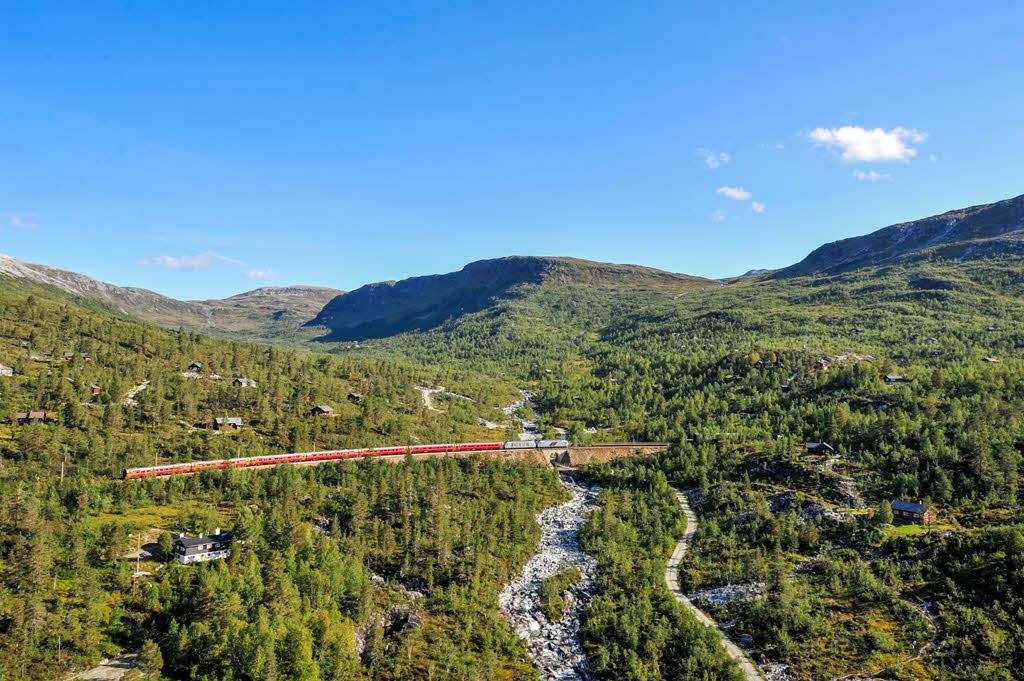
The Bergen Line or the Bergen Railway (Norwegian: Bergensbanen or Nynorsk: Bergensbana), is a 371-kilometre (231 mi) long scenic standard gauge railway line between Bergen and Hønefoss, Norway. The name is often applied for the entire route from Bergen via Drammen to Oslo, where the passenger trains go, a distance of 496 kilometres (308 mi). It is the highest mainline railway line in Northern Europe, crossing the Hardangervidda plateau at 1,237 metres (4,058 ft) above sea level.
The railway opened from Bergen to Voss in 1883 as the narrow gauge Voss Line. In 1909 the route was continued over the mountain to Oslo and the whole route converted to standard gauge, and the Voss Line became part of the Bergen Line. The line is single track, and was electrified in 1954–64. The Bergen Line is owned and maintained by Bane NOR, and served with passenger trains by Vy Tog and freight trains by CargoNet. The Flåm Line remains as the only branch line, after the closure of the Hardanger Line. The western section from Bergen to Voss is also served by the Bergen Commuter Rail, and was shortened following the 1966 opening of the Ulriken Tunnel.
The Bergen line.
The scenery is spectacular and this video is worth a watch.












Recent Comments