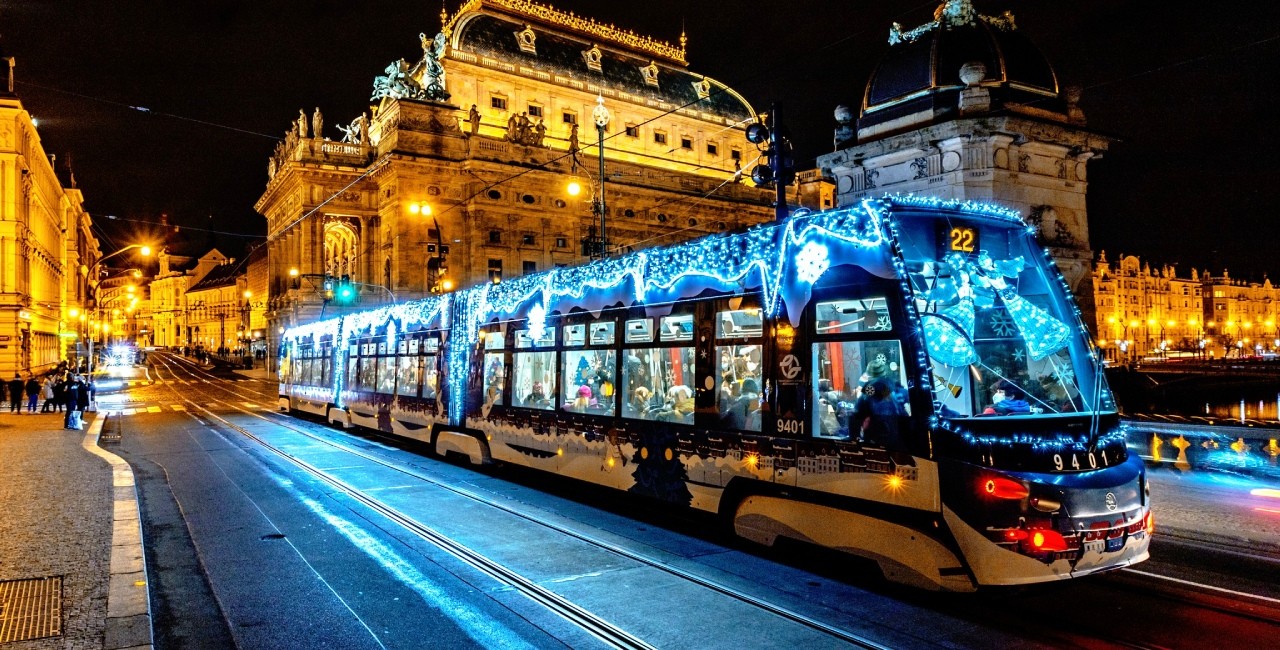
The Prague tramway network is the largest tram network in the Czech Republic, consisting of 144 km (89 mi) of track, 882 tram vehicles (one of the largest fleets in the world) and 26 daytime routes, 2 historical and 10 night routes with a total route length of 518 km (322 mi). It is operated by Dopravní podnik hlavního města Prahy a.s., a company owned by the city of Prague. The network is a part of Prague Integrated Transport, the city’s integrated public transport system.
The value of the full contract for a total of 200 cars 16.602 milliard Czech Karuna translates to CAD $954.2 million for 200 trams and this would also include parts, etc.
What is interesting is the amount of new technology that is included with the tram, the most important being the anti collision tech.
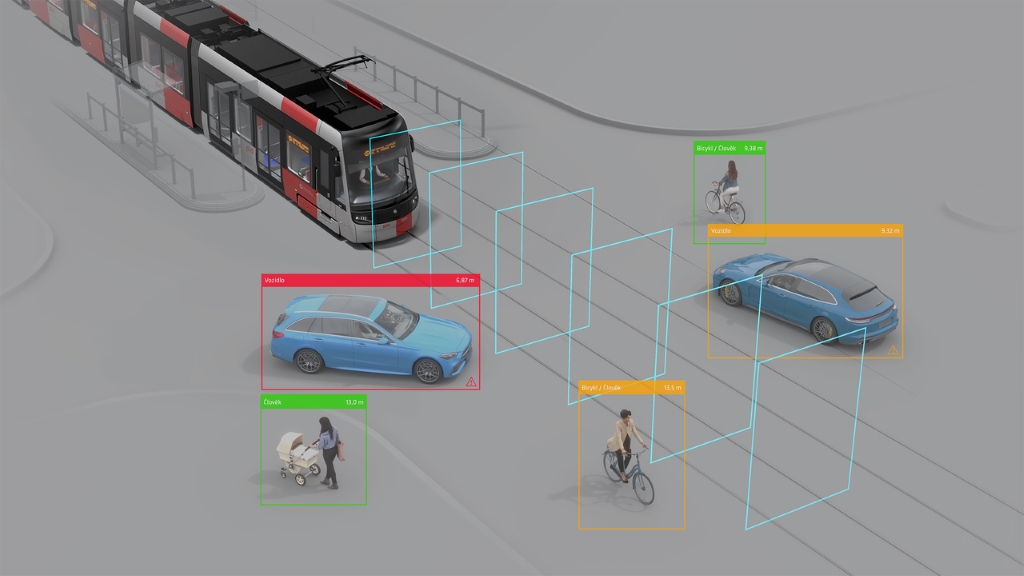
Due to increasing demands on safety, each new tram will be equipped with a Škoda anti-collision system to reduce the likelihood of collisions in traffic. To do this, it uses a combination of dual LiDAR and HD-camera technology and precise localisation using off-line recorded HD maps and odometry. This set-up allows the system to create a virtual driving tunnel in which the tram can detect obstacles within 10 cm, provide early warnings, minimise false positive warnings, and activate the emergency brake in time. The anti-collision system will thus help prevent major accidents and damage to health and vehicles.
As the new trams are modular, new sections can be added in the future to meet growing demand without the expense of buying a complete new tram.
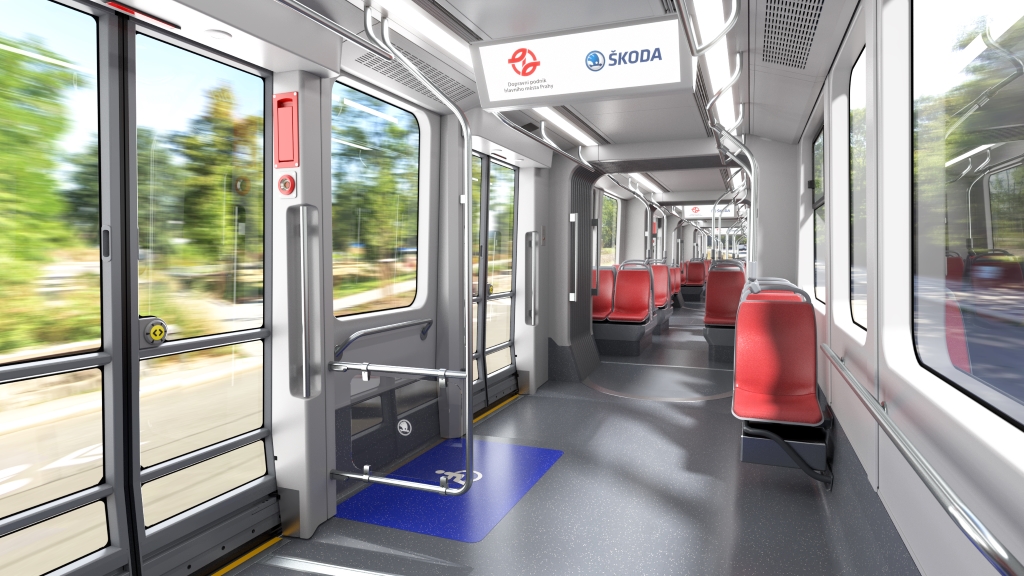
Technical parameters of the tram Škoda ForCity Plus Praha 52T:
Vehicle length over bumpers: 31.99 m
Vehicle width: 2.5 m
Total vehicle capacity: 243 at 5 persons/m2 (Zwei comments – a more realistic vehicle crush capacity would be around 200 persons)
Number of standing places: 173 (Zwei comments – a more realistic number would be 130 persons standing)
Number of seats: 70 in total, of which 44 in the direction of travel = 62% (PID Quality Standards require a minimum of 60%) and 26 in the opposite direction = 38%
Low-floor section: 100% (all seats accessible without landings and stairs)
Total number of chassis: 4 traction bogies (2 pivoting and 2 partly pivoting)
New trams for Prague revealed: the first Škoda ForCity Plus Praha 52T will start running in the capital in less than two years
The capital of the Czech Republic can look forward to up to 200 modern, 100% low-floor Škoda ForCity Plus Praha 52T trams. The Prague Public Transit Company (DPP) has signed an eight-year contract with the winner of the public tender, Škoda Group, for the purchase of 40 trams and an option to deliver up to 160 more. The total value of the contract is nearly CZK 16.602 milliard, and it is one of the largest investments in new trams in the modern history of DPP. The first 20 new trams are expected to arrive in Prague in December 2025, and another 20 vehicles a year later, by the end of December 2026.
I have become somewhat addicted to the HD driver’s view cams of Scandinavia, especially Norway and Sweden. The Ofoten Line is a must see video! The scenery is stark, rugged and awe inspiring. The single track Ofoten Line sees tourist trains, regular passenger trains, freight trains and twenty-four or more ore trains use daily!
The following is from Wikipedia.
The Ofoten Line (Norwegian: Ofotbanen) is a 43-kilometre (27 mi) railway line in Narvik, Norway. It runs from the Port of Narvik to Riksgränsen on the Norway–Sweden border, where the line continues as the Ore Line via Kiruna and Gällivare to Luleå. The Ofoten Line is single track, electrified at 15 kV 16.7 Hz AC and has seven stations. The line only connects to the rest of the Norwegian railway network via Sweden. The main traffic is up to 12 daily freight trains operated by Malmtrafik that haul iron ore from Sweden to Narvik. In addition, CargoNet operates container trains, branded as the Arctic Rail Express (ARE), and Vy Tåg operates passenger trains, including a night train to Stockholm.
Construction of the Ofoten Line started in 1898 along with the Ore Line from Riksgränsen to Kiruna. They were completed in 1902, allowing LKAB to haul ore from their mines in Kiruna to the ice-free Port of Narvik. Operation and ownership of the line was held by the Norwegian State Railways. The line was electrified in 1915 and Norwegian State Railways (NSB) started using El 3 and El 4 locomotives. During World War II, the ore traffic stopped because of the Battles of Narvik and the bombing of the town. In the following decades, NSB introduced El 12 and El 15 locomotives. In 1996, operation of the ore trains was taken over by Malmtrafik, which was controlled by and now is a subsidiary of the mining company LKAB. The same year, ownership of the railway line was transferred to the newly created Norwegian National Rail Administration. The line has been upgraded to 30 tonnes (30 long tons; 33 short tons) axle loads, allowing the new Iore locomotives to haul 8,600 tonnes (8,500 long tons; 9,500 short tons) trains.
If you want to reduce auto use, you must provide a affordable and user -friendly alternative.
The Irish government believes that and is rebuilding a former rail line as a cheaper and more environmentally friendly way to provide affordable and user-friendly transportation. The cost is €104 million (CAD $152 million) for 42 km of reinstated rail line!
This works out to about $10.75 million/km to reinstate the Foynes Line as a passenger carrying railway.
Rail is that affordable and user-friendly alternative.
Using existing railways and railway formations is a lot cheaper than building “greenfields”.
Estimated cost for Rail for the Valley’s “Return of the Interurban”, around $1.75 billion for over 130 km.
Cost of Broadway subway, $2.7 billion, for 5.7 km.
E&N Railway, 230 km, plus, estimated cost $3 billion.
Cost of the Langley extension of the Expo Line, 16 km $4.42 billion (includes inflation from the 2001 estimate).
For the cost of 21.7 km extensions of the Evergreen and Millennium Lines, we could build the Valley Interurban and rehab the E&N Railway and still have $2.7 billion to improve transit in metro Vancouver!
Foynes before.
Irish Rail starts works on Foynes-Limerick rail line
Works will include the removal of the old track and deployment of new rail track.
November 14, 2022
Iarnród Éireann (Irish Rail) has commenced works on the Foynes-Limerick rail line as part of a €104m overhaul programme.
The rail operator has already begun the clearance of vegetation along the 42km track, reported RTÉ.
Irish Rail will start key construction work on the rail line in the coming weeks.
Works will include the removal of the old track, followed by the deployment of new rail track and sleepers, as well as the upgrading of road infrastructure at level crossings.
Other works will consist of rehabilitating bridges and culverts, along with renewing the lineside fencing.
Designed to serve the Patrickswell, Adare, Askeaton and Foynes regions, the Foynes-Limerick rail line was first opened as a passenger line in 1858. It was closed in 1963.
The 2009 study by UBC Professor Patrick Condon, the James Taylor chair in Landscape and Livable Environments at the University of British Columbia’s School of Architecture and Landscape Architecture and the founding chair of the UBC Urban Design program can be read by clicking on the title.
Though the SkyTrain light metro line may have a lower operating cost (TransLink does a wonderful job of manipulating numbers), the total Costs per Passenger-Mile are exceedingly large. As the SkyTrain light metro system ages, so do the total passenger-mile costs.
It is also worth remembering that TransLink was in partnership with Bombardier to sell SkyTrain abroad!
In 2009 one US Dollar was worth approximately CAD $2.80 (based on a $1.05 exchange rate) and in today’s money $3.86.
What is even more telling is the cost per trip of USD $12.34 per passenger mile or CAD $12.95 or $17.02 in today’s money.
This study tends to be the studies which transit authorities read before making a choice of mode and product and as one can see, SkyTrain is extremely expensive for what it does. also it is wise to remember that light rail has a higher capacity than SkyTrain, something Toronto’s TTC found our in 1982!
The title quote by Joseph Goebbels, famed Nazi propagandist, aptly describes the SkyTrain lobby’s and BC Transit/TransLink’s thirty year long propaganda campaign to sell SkyTrain and discredit modern light rail. The many pro-SkyTrain blog sites that offer little in fact, but much unfounded rhetoric. All the bumf spewed hides one singular fact; that SkyTrain has been rejected by transit planners around the world.
If you tell a SkyTrain lie big enough and keep repeating it, people will eventually come to believe it. The SkyTrain lie can be maintained only for such time as the provincial government, TransLink and the Mayors Council on Transit can shield the people from the political, economic and/or environmental consequences of the SkyTrain lie. It thus becomes vitally important for the provincial government, TransLink and the Mayors Council on Transit to use all of its powers to repress dissent, for the truth is the mortal enemy of the SkyTrain lie, and thus by extension, the truth is the greatest enemy of the provincial government, TransLink and the Mayors Council on Transit .
Why is it important for Rail for the Valley to expose the SkyTrain myth for what it is? Simple, it’s all about money. SkyTrain consumes up to ten times or more the money to build, per route kilometre than light rail; put another way, the taxpayer may get up to one tenth, or less,, transit by building with SkyTrain instead of LRT! For any chance of a Valley interurban service, Rail for the Valley must put a ‘wooden stake’ through the heart of SkyTrain and give no quarter to its adherents. It’s ugly business, but for the future of the region, it must be done.
Zweisystem will make two predictions:
1) If the province forces TransLink to build a SkyTrain subway to UBC, there will be NO interurban for the valley.
2) If a SkyTrain subway is built, the municipalities without SkyTrain may secede from TransLink and form their own transit authority or rejoin with BC Transit. (If that happens, watch for $1000.00 to $1,500.00 property tax hikes for the remaining, SkyTrain and metro served cities, including Richmond, Vancouver, Burnaby, Tri-Cities, New Westminster and North Surrey).
The Rail for the Valley blog follows the course of modern public transit development as reported in the transit press and what we are told by experts. And one must remember, SkyTrain is sponsored by the Province through the Premier’s office and TransLink and unfortunately those who support light rail and not SkyTrain are seen as enemies of the provincial government, TransLink and the Mayors Council on Transit!
The choice for future transit in the region should be this:
SkyTrain metro, with costs starting at $250 million/km.
or
Light rail with costs as low as $10 million/km (tramtrain)
The Vancouver Sun has always shilled for SkyTrain. They repeat government hype as factual news.
What this huge infomercial in the Vancouver sun tells me that Eby and the NDP are extremely worried that their agreement for the flip flop from originally planned LRT to extending the Expo Line 16 km to Langley will not do as promised, but only create more traffic chaos, more congestion and endemic gridlock.
Sorry folks, most of what is being presented is politcal diarrhea and like the other SkyTrain lines, which under preforms, the $4 billion to $5 billion extension will not take many cars off the road, but will all but destroy any sound transit planning for decades to come.
It has all been said before.
“If you repeat a SkyTrain lie often enough, the people will come to believe it”
Zwei sent a letter to the Sun, but it probably will not be published because the Sun has a history of not printing letters that are negative to continued SkyTrain light metro expansion.
The Editor;
*
SkyTrain to Langley has to work? Well I can save a lot of money and not bother because it will not.
*
What we call SkyTrain is actually the name of the regional light-metro system, a name chosen by a contest by a local radio station. The current name for the trains operating on the Expo and Millennium Lines, is the proprietary Movia Automatic Light metro (MALM) system, currently owned by Alstom.
*
Being a light metro, it is the wrong transit system to deal with regional transportation issues, but there is worse to come: MALM is obsolete.
*
The proprietary railway has been on the market for over 40 years, with only seven built, now with only 6 in operation. The system has had four owners, including Bombardier and now is deemed unsalable. The current owners Alstom, is not actively marketing the train, as it is far too expensive compared to their in-house light-metro systems.
*
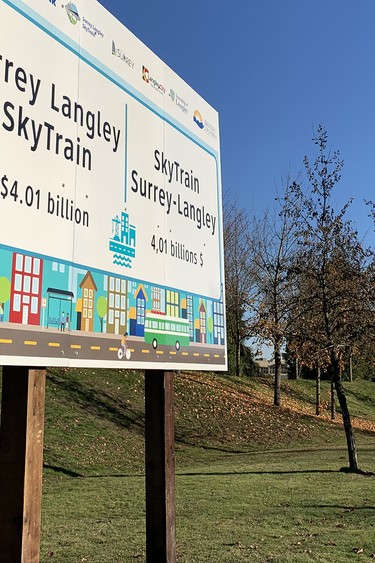
The advertised cost $4.01 billion for the 16km Langley extension does not include the cost of new cars; the $1.47 billion rehab of the signalling system that is needed to carry 17,500 pphpd; the yet to be tendered estimated $2 billion rehab of the electrical system also needed to to carry the increased capacity and the replacement of all the switches to high speed switches, again needed to carry the higher capacities. The Operations and Maintenance Centre #5 with an estimated cost of $500 million to $1 billion is also not included.
*
Including the $2.7 billion 5.7 km Broadway subway, the total cost of building 21.7 km of SkyTrain, the real cost is over $11 billion! A figure that TransLink, the Premier, and the Mayor’s Council on Transit is hiding from the public.
*
What is even more outrageous is that the $11 billion SkyTrain will not attract much new ridership if any!
*
The question that must be asked; “Why is the Premier and TransLink again forcing an obsolete proprietary light metro onto the region that has an extremely chequered past: a light metro system that no other transit authority in the world wants?”
*
Only a Judicial inquiry will find the answers and due to the strictly politcal nature of rapid transit construction in BC, will never happen.
*
Rail for the Valley
*
Memo the Editor: 150 words cannot do any justice to the ills of the continued use of SkyTrain. Vancouver is the only city in the world that continues building with the MALM system, a system that is one of the most studied transit systems in the world and the result is: SkyTrain is too expensive to build; too expensive to operate; too expensive to maintain; lacks capacity and in the 21st century lacks any flexibility in operation when compared to other transit modes, especially light rail.
‘This has to work’: Why all eyes are on the coming SkyTrain extension from Surrey to Langley
A look at the promises — and potential pitfalls — of the coming $4 billion SkyTrain extension, which some say is key to accommodating the 500,000 people expected to move into the area by 2050
King George Station in Surrey’s now-bustling city centre has been the last stop on SkyTrain’s Expo Line since the station opened in 1994.
The line’s tracks though run a hundred metres or so beyond the station and end abruptly over a patch of green space, next to an abandoned strip mall that housed an appliance store, pharmacy and Sri Lankan grocer, hinting at future ambitions for expansion.
Article content
Article content
If things go to plan, that future will start in 2024.
B.C.’s Transportation Investment Corp. is finalizing bids to start construction on a $4 billion, 16-kilometre, aboveground extension of the Expo Line along Fraser Highway, past parks, strip malls, car dealerships, trailer parks and Agricultural Land Reserve lands to a new terminus at 203rd Street in the City of Langley.
The project will be heavily scrutinized. It comes at a time when B.C.’s housing crisis is being felt acutely across Metro Vancouver and planners are scrambling to find ways to accommodate 500,000 additional residents south of the Fraser River by 2050.
The stakes are high. This will be the first major expansion of transit south of the Fraser in 30 years. A failure to concentrate not just population growth but new also jobs along the Surrey-Langley SkyTrain corridor will hinder progress toward building affordable housing, constraining suburban sprawl and taking cars off the road.
“When you get a major rapid transit line coming in like that, it certainly does adjust how we expect the population (to grow) around the region,” said Don Luymes, general manager for planning and development for the City of Surrey.
This SkyTrain extension replaces a light-rail rapid transit proposal that would have linked Surrey’s city centre with Newton to the south and Guildford to the east with at-grade trams. The pivot, Luymes said, has “caused an adjustment in our thinking about how density will unfold across the city.”
Article content
Luymes said it won’t mean delaying growth in other areas to focus on Fraser Highway, but the higher-capacity SkyTrain creates “a higher-density scenario than we would have anticipated 10 years ago.”
There is pressure on the eight new SkyTrain stations to not just accommodate high-density housing development but also housing that remains affordable, particularly for new immigrants and refugees who have been finding homes and establishing communities in the region.
Making sure “transit-oriented development doesn’t become transit-oriented displacement” is the catchphrase that urban-planning expert Andy Yan uses to describe the challenge ahead for the province, Surrey, the City of Langley and the Township of Langley as property values have skyrocketed.
Since 2017, home prices across Surrey soared 60 per cent or more, with detached-home values approaching $1.6 million and townhomes $865,000, according to an analysis by Landcor Data Corp.
Landcor’s analysis generally didn’t identify outsized increases in land values around future stations, except for the proposed 152nd Street location. However, that could be due to the fact there had been few sales of commercial properties and signs of speculation could easily be lost in the overall noise of the market.
Article content
The SkyTrain line comes to an abrupt end just outside Surrey’s King George Station.Photo by Doug Quan
“(Displacement) is a fair concern, and I think that this is where the development element of TransLink is supposed to help mitigate,” said Yan, an adjunct professor and director of Simon Fraser University’s City Program.
In 2022, the provincial government empowered the B.C. Transportation Financing Authority to acquire land for the provision of affordable housing and public amenities.
Before that, the province could only buy land directly related to the infrastructure, such as station locations or maintenance facilities, according to a statement from the Ministry of Transportation.
The province “currently owns parcels of land that could be used for transit-oriented development,” according to the statement, though it didn’t say how much.
“We want to be strategic about our land acquisition, so we don’t want to advertise it necessarily too loudly,” Transportation Minister Rob Fleming said Dec. 1 at the announcement naming the extension’s new stations.
The project will be able to tap $394 million the province set aside over the next three years for the purpose of buying land and “we want to get a good price, because (acquiring) lands is critical to deliver thousands of affordable housing units,” Fleming said.
Article content
Surrey Mayor Brenda Locke welcomes the province’s participation in transit-oriented development, but her rapidly growing city is looking for more support from the province on a lot of fronts.
“The province better get ready to put some investment in the city of Surrey,” Locke said. “They are far behind when it comes to infrastructure, especially our school infrastructure and health care.”
B.C. Minister of Transportation and Infrastructure Rob Fleming (left photo) and Langley City mayor Nathan Pachal and Surrey mayor Brenda Locke at a press conference announcing the names of the eight Surrey-to-Langley SkyTrain stations on Dec. 1, 2023.Photo by Jason Payne /PNG
Before construction starts, however, the development market in Surrey, the City of Langley and Langley Township has hit a standoff between buyers and sellers, particularly over the last 18 months, according to realtor Justin Mitchell of Frontline Real Estate Services.
“It’s been a staring contest between the vendors of land and the developers,” Mitchell said.
Developers don’t want to buy properties until zoning along the route is finalized and they know exactly how many units they can build at stations, Mitchell said. With higher interest rates on financing, the cost to hold properties has become prohibitive.
Property owners along the route mostly hold revenue-generating commercial development in an area of low vacancy.
“Unless there’s a compelling reason for someone to sell their land, they won’t,” Mitchell said.
Article content
Yan said the province and city have compelling reasons to acquire land, though: to ensure that community amenities, such as parks, libraries and schools — which are already beyond capacity in Surrey — keep up with development.
“You’ve got to remember, households south of the Fraser are larger. Larger, with children.”
The Surrey School board estimates that in Fleetwood, the string of neighbourhoods along Fraser Highway from 152nd Street to 166th Street where a revised land-use plan suggests development will bring an additional 8,000 to 12,000 students, an additional high school and six to eight new elementary schools will be needed.
A view of Fraser Highway at 148 Street.Photo by Doug Quan
“Certainly we’re working closely with the school district to figure out this challenge,” Luymes said. Doing so will mean considering more urban forms for schools than typical suburban schools spread over several acres of buildings and school fields.
Fleetwood is emblematic of the scale of change SkyTrain is expected to bring.
The community’s stretch of Fraser Highway has been in the shadow of development pressures since the Trans Canada Highway was built, said Dean Barbour, executive director of the Fleetwood Business Improvement Association.
Article content
Now, however, it is in the spotlight with expectations for highrise and high-density development, not the mid-rise and less-dense construction residents were expecting with light-rail rapid transit.
“This has to work and it’s got to get done right,” Barbour said of the multi-billion-dollar infrastructure project.
“Or else the south of the Fraser is not going to see a transit project here for a lifetime if this goes sideways.”
Article content
A SkyTrain station is planned for 160th Street (pictured), and another for 166th Street intersection.Photo by Jason Payne /PNG
How SkyTrain could turn low-rise Fleetwood into a major town centre of skyscrapers
In Fleetwood, a development proposal — three towers ranging from 14 to 40 storeys that would rise above what are now used-car lots — offers residents the first inkling of how the arrival of SkyTrain might change their community.
“I would say that the Fleetwood Community Association was a little surprised by that desire on behalf of the city as well (as the developer) to zone in that direction of extremely high peaks,” said Brian Woudstra, a director with the community association, about the proposal along Fraser Highway just east of 160th Street.
There was a time when the community association envisioned that Fleetwood, one of Surrey’s slower-growing communities, would eventually become a bit of a destination — more like “a bit of a small town” — once street-level light-rail rapid transit arrived, Woudstra said.
However, the switch from light rail to higher-capacity SkyTrain means that the new Surrey-Langley SkyTrain corridor will have to attract significantly more of the expected population and job growth to achieve the regional goals of building more affordable housing, reducing suburban sprawl, and getting cars off the road.
It’s not that Fleetwood remains undeveloped, but it has been filling in with small-lot subdivisions and townhome complexes around the strip malls, car dealerships and auto shops along Fraser Highway.
However, the 2018 decision to scrap LRT in favour of SkyTrain along Fraser Highway prompted a major rewrite of Fleetwood’s community plan. It now contemplates Fleetwood becoming a community of more than 147,000 residents over the next 30 years, from the current 47,000.
Growth would be concentrated in the areas around three future SkyTrain stations — at 152nd Street (152 Street Station), 160th Street (Fleetwood Station), and 166th Street (Bakerview-166 Street Station) — with towers of 30 stories, and higher in the case of a proposal from longtime Lower Mainland developer Bucci Developments.
The community association did take part in crafting Surrey’s Stage 1 land-use plan, the one that would allow for those taller towers.
Woudstra said it was still startling to see “these little mountains (with) extremely high peaks” emerge in the Bucci proposal, which fall down toward low-rise apartments and townhouses within a few blocks.The association isn’t opposed to increasing density, especially if redevelopment results in the corresponding construction of better pedestrian paths and cycling infrastructure, but Woudstra said their preference would be to lower building heights and spread that density over a wider area.
“So all the concentration is going to be at 152nd (Street) and 160th (Street), and 156th Street will (probably) die as a commercial area,” Woudstra said. “Which is not the end of the world, but it’s kind of weird.”
Surrey’s land-use document still needs to be refined to finalize densities and building heights before being approved as a Stage 2 plan, sometime in 2024.
Luymes cautions that change is a long-term proposition, particularly in Fleetwood.
“The key thing here is that growth will not happen overnight,” Luymes said. “It will happen over many decades, particularly in Fleetwood, as properties redevelop.”
The station intersections at 152nd Street and 160th Street are already surrounded by low-rise commercial development, Luymes said, and it is often a hard sell for developers to build before the new transit infrastructure is already in place. And SkyTrain, tentatively, won’t be complete until 2028.
Dean Barbour, executive director of the Fleetwood Business Improvement Association, across the street from a recently built four-storey mixed use building on 160th Street that was ideal for the light-rail rapid transit Surrey was expecting, but will likely be quickly redeveloped as part of a residential tower on the site now that full-scale SkyTrain is to be built.Photo by Derrick Penner /Postmedia News
Members of Fleetwood’s Business Improvement Association have already felt the headwinds of change, according to Barbour.
Businesses renewing leases face substantial rent increases with soaring land values, and more of those leases are coming with demolition clauses — unheard of when Barbour started his job several years ago.
“Everyone’s getting them now, (some) as short as 30 days,” Barbour said. That is forcing more businesses to contemplate alternate plans, especially those that know they will be displaced by the new SkyTrain stations or will have to make way for the towers of its elevated guideway.
Chiropractor and massage therapist Clifford Thai, who has built a thriving practice in a single-storey storefront on the northwest corner of Fraser Highway and 160th Street over the last 11 years, is bracing for his own upcoming lease renewal and is considering alternatives.
“As a business owner, we’re apprehensive about the disruption to local businesses because of the construction,” Thai said.
His building, for example, is across the street from the future Fleetwood Station, so “more than likely at some point, it’s going to be levelled” and replaced by a highrise.
“We’ll have to find a place to go, and where will we go? Will we be able to come back, will we be priced out of the market? That’s a concern for the future.”
In the meantime, Thai’s initial search for potential locations has shown real estate is “very expensive and … very scarce.”Other Fleetwood property owners in the position to redevelop remain in limbo until the Stage 2 land-use plan is approved, said Jon Lopes of Surrey-based Lineage Properties.Lineage owns a handful of sites at the intersection of Fraser Highway and 88th Avenue, including one that housed a Fountain Tire outlet and a Speedy Auto Glass shop in a building lost to an arson fire in 2019.Lopes said the company could rebuild, but the new Fleetwood land-use plan would eventually rule out future automotive-related tenants.In the meantime, Lineage’s revised plans to redevelop with 15- and 21-storey mixed-use buildings on the site can’t go ahead until the Stage-2 plan is complete.“It’ll work out in the long run, but it’s nailing us right now,” Lopes said. “Because they would only let us redevelop the site to what their existing (plan) will support, (but) that’s not what will be supported when it’s done in six months time.”Barbour knows how high the stakes are for Fleetwood businesses that the province minimize disruption. He worked for the Cambie Village Business Improvement Association during construction of the Canada Line in the late-2000s, where 85 per cent of businesses moved or folded during the process.
People driving along Cambie today would never notice a difference, but Barbour contends the village “lost a lot of its soul.”
“So that’s one of the things we’re working really hard (to avoid in Fleetwood).”
The HyperLoop Lobby, like the Bicycle and SkyTrain lobby’s, was very persistent with their claims, but very short on actual history and lived in a sort of “Tom Swift” fairy tale bubble.
Tom Swift is the main character of six series of American juvenile science fiction and adventure novels that emphasize science, invention, and technology. Inaugurated in 1910, the sequence of series comprises more than 100 volumes.
Short on transit history, they rode the coattails of multi billionaire Elon Musk and his hyperbole and now it has come to an embarrassing end.
At first glance, I knew HyperLoop would not fly as there was no means of emergency egress, unless one used a hollow charge blasting a hole in both the vehicle and the large vacuum tube it traveled in. Transit based on a vacuum soon comes to grief and has done historically.
Atmospheric railways have been around a long time, since 1824, yet when built, proved almost unworkable. The longest operating atmospheric railway was the Dalkey atmospheric railway in Ireland, which operated from 1843 to 1854 on a 3 km line with steep gradients. As soon as locomotives were powerful enough to use thee line, it was abandoned.
Zwei’s adage has proven true: Beware of salesmen selling atmospheric railways.
Hyperloop One, the futuristic transportation startup that promised to whisk us through nearly airless tubes at airline speeds, is shutting down, according to Bloomberg.
The company is selling off its assets, closing down its offices, and laying off employees. It will formally close at the end of the year, at which point all of its intellectual property will shift to its majority stakeholder, major Dubai port operator DP World. Whoever buys the test track in the Nevada desert will have one hell of a Slip ‘N Slide if they want it.
Since its founding in 2014, the company raised around $450 million in venture capital funds and other investments. While there is still a small smattering of startups trying to build hyperloops, the demise of one of the biggest hyperloop companies signals the end of the dream that originated with Elon Musk’s so-called “alpha paper” in 2013.
Whoever buys the test track in the Nevada desert will have one hell of a Slip ‘N Slide if they want it
Musk theorized that aerodynamic aluminum capsules filled with passengers or cargo could be propelled through a nearly airless tube at speeds of up to 760mph. These tubes, either raised on pylons or sunk beneath the earth, could be built either within or between cities. He called it a “fifth mode of transportation” and argued it could help change the way we live, work, trade, and travel.
The most eye-catching scenario he proposed was a trip from Los Angeles to San Francisco in only 30 minutes. The idea captured the imaginations of engineers and investors across the world.
Virgin Hyperloop was originally founded as Hyperloop Technologies before changing its name to Hyperloop One in 2016 and then again to Virgin Hyperloop One after being acquired by Richard Branson’s company. The company came out of the gate strong, with tens of millions of dollars of funding and a bold vision of hyperloop systems all around the globe.
In 2017, the company settled a lawsuit with one of its co-founders, Brogan BamBrogan, over competing claims of harassment and sabotage. A year later, another co-founder, Shervin Pishevar, was ousted amid allegations of sexual assault and misconduct.
The company was also perpetually strapped for cash. Branson helped secure a new $50 million investment from two existing investors, which helped meet payroll obligations. The company raised $172 million in new funding in 2019, $90 million of which came from DP World, which has previously invested $25 million in the company and already has two seats on the startup’s board of directors.
The company made several important strides, including building a test track in Nevada to test out the safety and feasibility of the technology. In 2020, it conducted its first — and only — test with human passengers. The pod only reached a top speed of 100mph, far short of the original promise of seven times that amount.
Critics said that while the hyperloop may be technically feasible, it still only amounts to vaporware. It’s been called a “utopian vision” that would be financially impossible to achieve. It’s one of those technologies that is also “just around the corner,” according to its boosters — despite outwardly appearing to still be years away from completion. In 2017, Virgin Hyperloop’s top executives told The Verge they expect to see “working hyperloops around the world… by 2020.” That deadline was later pushed to 2021.
During the pandemic, nearly all of the top executives and founders left Hyperloop One, which also shed the Virgin from its name after the company decided to eschew passenger trips in favor of cargo.
Today, no full-scale hyperloops exist anywhere in the world. Musk’s test tunnel in California is gone. The man himself has become more enamored with endorsing antisemitic theories than solving the problem of car traffic.
The Boring Company, Musk’s tunneling operation, is still digging underground passageways in Las Vegas — but for Teslas, not hyperloops. The future, it would seem, is nearly the same as the present.
In my Email yesterday there was a season’s greetings from TransLink, or was it?
It seems the six figured salary types who work in ‘communications’ are a lazy bunch and didn’t think it is important to actually mean “Season’s Greetings”.
Keep the peons happy.
The photo attached to the email was an American Thanksgiving wreath, full of autumn colours. Maybe, just maybe TransLink’s American CEO and chief spin doctor doesn’t care what a Canadian Christmas wreath is, so here is a little cross boarder lesson for him.
First photo: American Thanksgiving wreath.
Second photo: Canadian Christmas wreath.
If anyone thinks TransLink really cares, simple answer they don’t and it is time for the Mayor’s Council on Transit realize this!










Recent Comments