I am reposing this from 2013 because I just heard on the radio, the often repeated nonsense, that SkyTrain has a greater capacity than light rail.
The SkyTrain light metro system doesn’t and it never did.
From Thales News Release concerning the $1.47 billion signalling upgrade of the Expo and Millennium Lines.
When the programme is fully implemented, the Expo Line will be able to accommodate 17,500 passengers per hour per direction, and the Millennium Line will be able to handle 7500 passengers per hour per direction, a 32% and 96% increase respectively.
I would like to remind everyone that the Toronto streetcar system in the 1940’s and early 50’s, operating coupled sets of PCC cars offered capacities of over 12,000 persons per hour per direction on selected routes! Modern light rail lines can handle 20,000 pphpd or more.
Fast backward to 1983: from an article in Modern Tramway.
It was known since 1983, that ALRT, a renaming of ICTS for the sale to Vancouver (locally called SkyTrain) had less real capacity than modern light rail at the time!
The advent of the modern articulated tram has increased this capacity by more than double and in Ottawa there light rail vehicles are operating on a system that will offer a capacity of 24,000 pphpd!
The above quote came from a European transit expert, when I asked him to comment on BC’s Auditor General’s claim that “SkyTrain and not light rail was the best option because of its greater capacity at similar cost. I apologize for again questioning the AG’s findings, but the AG’s Department is so far off the mark, so wrong that, clarification is essential.
When a blunder is so vast, it must be pointed out and dealt with and quickly.
Capacity is a function of headway and a modern light rail car cost less than a married pair of SkyTrain cars and if LRT can be built at one half, or one third, or one quarter of that of SkyTrain, modern light rail can provide more capacity than SkyTrain, at a cheaper cost!
It is that simple!
British Columbia’s Auditor General, must readdress this issue because of the erroneous calculations and claims about SkyTrain, which at first glance, seems to have been done on the back of an envelope.
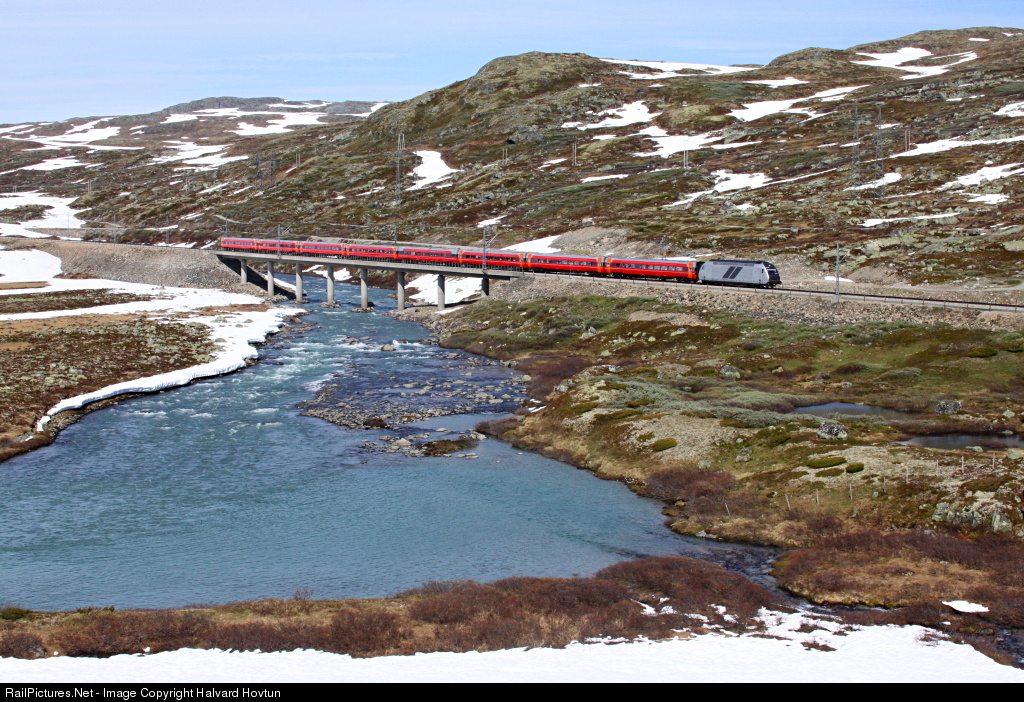
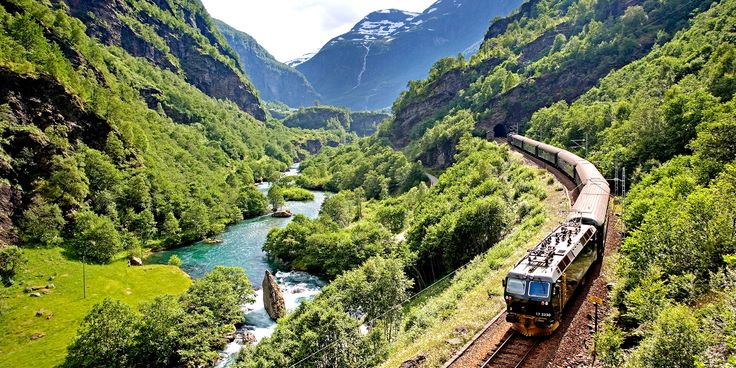
Having become somewhat addicted to Driver’s View videos on YouTube I was more than a little surprised at the major engineering required.
Norway, population – 5.3 million
The Norwegian railway system comprises 4,109 km of 1,435 mm (4 ft 8+1⁄2 in) (standard gauge) track of which 2,644 km is electrified and 274 km double track. There are 697 tunnels and 2,760 bridges.
The Norwegian Railway Directorate manages the railway network in Norway on behalf of the Ministry of Transportation. Bane NOR is a state enterprise which builds and maintains all railway tracks, while other companies operate them. These companies include Vy and subsidiaries Vy Gjøvikbanen and CargoNet, Flytoget, Go-Ahead, SJ Norge, Green Cargo, Grenland Rail and Hector Rail.
Now BC has roughly the same population but getting railway info is very hard indeed.
I would recommend everyone to watch the drivers view videos I am posting from YouTube and compare their passenger services to ours.
Well, ours is almost nonexistent.
What Norway can do, offering regional passenger services, we can do too, if there was the politcal will to do so.
The videos also challenges the the often repeated myth that one cannot operate freight and passenger services on the same line and one cannot operate a viable passenger operation on single track.
Here is a story which, reported in the Breaker News which was ignored by the mainstream media, which panders to TransLink, which has now been revealed by Bob Mackin.
But what I want to point out is something different.
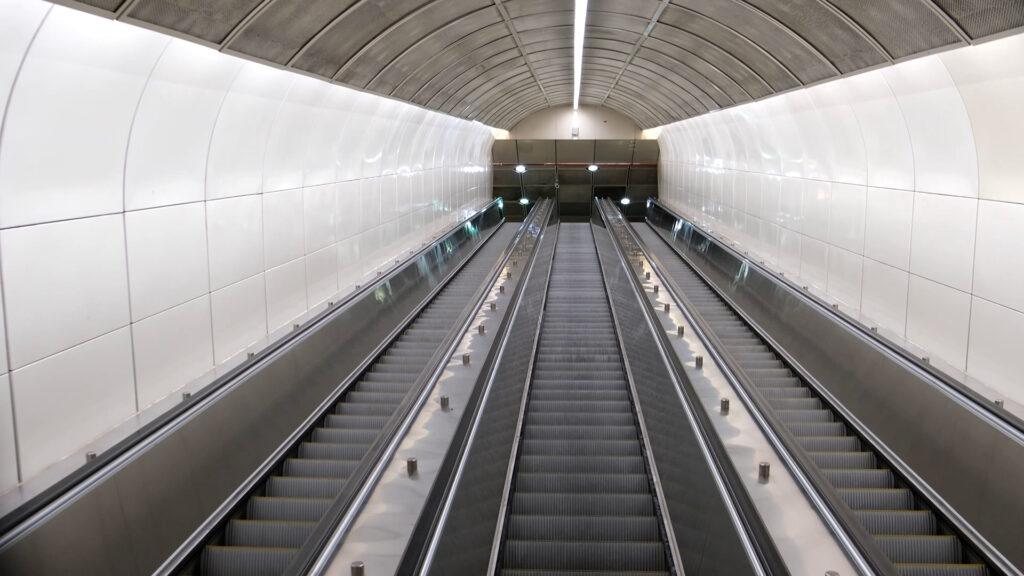
I lived in London England in 1980 and took the ‘tube’ regularly (even supped a few pints on the last Tube platform Pub’ and I was never bothered by the long escalators for the deep tube stations.
The longest escalator is descends 60 metres and is located at Angel Station.
Angel Station
If one notices, the escalator is so designed to prevent any sort of disorientation while using it.
The Broadway Station escalator descends a mere 35 metre but the design invites vertigo.
If an issue with the escalator causes problems, as it evidently did at the Broadway station, the design of the panels would invite disorientation at the exact moment, when one wants to avoid any sort of disorientation.
During the RAV/Canada Line era, I was told by one of the engineers bidding for the P-3, how badly designed the escalator was and a simple remedy, which would pay for itself through advertising would be of great benefit in an emergency.
After
Broadway Station
The panels on the escalator are not level but are placed at the angle of descent. This causes disorientation, akin to a pilot flying in a fog.
In the UK, advertising panels are placed on “plumb level” to avoid any sort of disorientation or vertigo by customers, so important in an emergency.
during the RAV/Canada Line P-3 bid, I was told by an European engineer, working on his company’s bid, at how badly designed the Broadway station’s escalators were. Just a simple solution, using revenue generating advertising to prevent disorientation and/or vertigo, especially in an emegancy, may prevent serious injury.
I even sent a letter to TransLink on the subject, but never heard back.
Makes one wonder if the ill designed Broadway escalators contributed to the accident?
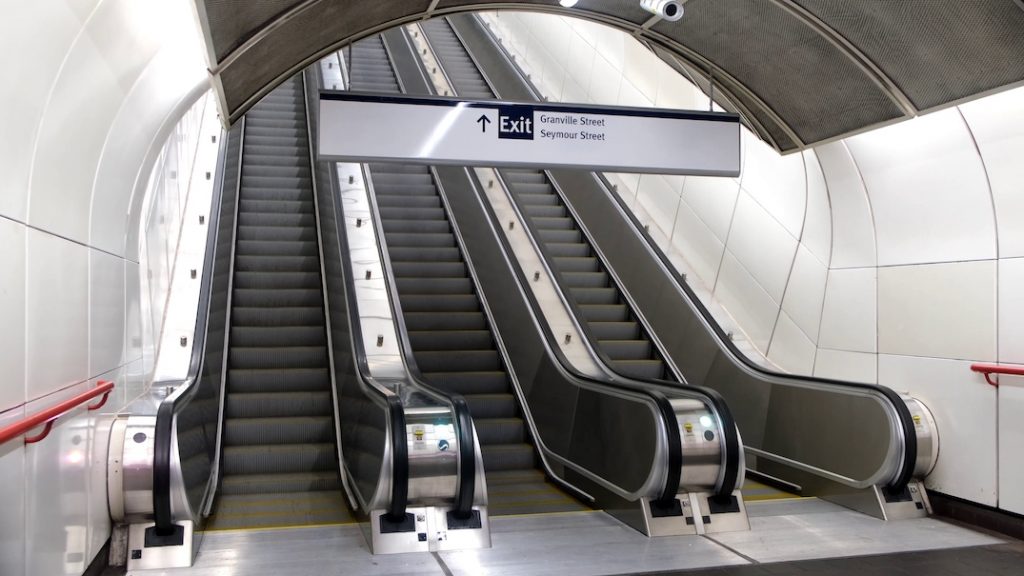
One of the three people hurt in a Granville Station escalator pileup Sept. 29 was a 71-year-old woman who suffered head, shoulder and knee injuries.
That is according to a SkyTrain attendant’s incident report, obtained under the freedom of information law.
The second and third persons “did not wish to wait for medical attendant and exited the station after giving their account of the occurrence and contact information,” said the report by attendant Greg Thomas.
A SkyTrain engineering assets technical investigation report said that Granville escalator number three had a “runaway condition where the handrail was stopped but the steps kept speeding down with passengers on the escalator. Many passengers fell on and at the bottom of the escalator.”
A timeline said the problem began at 2:54 p.m. when the escalator briefly sped up, causing passengers to run or jump off when they reached the bottom.
Two minutes later, it appeared to speed up with medium passenger loading and slow down when passengers exited the escalator. The cycle repeated at 2:57 p.m. and 2:58 p.m.
At 3 p.m., the steps started to briefly speed up and the handrail appeared to be going slower or at normal speed. Again, passengers were running and jumping off when they reached the bottom.
At 3:01 p.m., however, it sped up again. “The handrail stops but the steps appear to be speeding out of control.”
A customer pressed the emergency stop at the top, but passengers continued to go down the now-stopped escalator at 3:02 p.m.
“With 16 passengers on the escalator, it starts to move very fast down and dumps all the passengers in a pile at the bottom,” the report said.
“Customer that pressed the [emergency] stop is now keeping passengers from getting on the escalator and used a nearby sandwich board to block the top of the escalator.”
At 3:05 p.m., a SkyTrain attendant arrived and barricaded the top and bottom of the escalator and began taking witness statements. A service request was made to escalator contractor Kone at 3:15 p.m. A Kone technician arrived at 6 p.m.
Kone later sent a service operations technical support team from the U.S. to “bolster the efforts” of Kone’s local team.
The initial visual inspections of the drive revealed no irregularities, but a detailed disassembly was undertaken for a closer look from Oct. 6-10 and a new drive assembly installed Oct. 13. The old one was handed over Oct. 18 to testing and engineering consultant Acuren to determine the root cause.
Meanwhile, the other two escalators continued to operate “smoothly based on ongoing visual assessments.”
TransLink said Dec. 7 that repair costs are covered by Kone.
“Following repairs, the Granville Station escalator was put back in service on Oct. 27. The cause of the incident is still being determined by the manufacturer and Technical Safety BC.”
In July 2020, TransLink finished a $14.52 million project to replace the Granville Station escalators. The “big three” escalators, the longest in Metro Vancouver, are 35 metres long each, with 500 steps.
Granville Station was the start of a 13-station program to replace 37 Expo Line and West Coast Express escalators that are more than 30 years old. Last year, TransLink began to replace five escalators at Burrard Station in a project that is scheduled to be completed in spring 2024.
In its 2022 statement of financial information, TransLink reported paying escalator and elevator company Kone Inc. $6.65 million. The B.C. Rapid Transit Co. (BCRTC) rail division paid $1.3 million.
According to the TransLink website, the new escalators are supposed to provide smoother operation and braking for passenger safety, a variable speed option to save energy, LED step lighting and improved accessibility for maintenance so as to reduce downtime.
TransLink’s safety report does not separate onboard and off-board injuries. The customer injury rate on the Expo and Millennium lines have fluctuated above and below the rate of one customer injury claim per million boardings since 2018.
Granville Station had 4.8 million boardings in 2022 and was the fifth busiest station of the year. TransLink reported 83 million riders in 2022 on the two lines. In 2019, before the pandemic, it was 115 million.
On Sept. 27, just two days before the Granville Station escalator incident, BCRTC president Sany Zein reported to the TransLink board meeting that during the second quarter of 2023, there were 27 incidents reported by customers. Over half were slips, trips and falls on “elevating devices.”
TransLink, the Mayors council on Transit and the provincial NDP have tried to whitewash the fact that the Movia Automatic Light Metro, used on the Expo and Millennium Lines is not a proprietary railway. TransLink has deliberately mislead local politicians that SkyTrain is not a proprietary railway and in the past threatened a hint of legal action if RftV continue to claim that MALM is.
The following photo from a recent Mayor’s Council meeting certainly tells the tale that MALM is a proprietary railway and that past warning of supply issues increase as the system ages, especially if very few actually operate.
Only six of the seven MALM systems are still in operation, with one more soon to be consigned to the history books (Detroit) bodes ill for the proprietary system.
Please read the last line as it sums up the problems associated with proprietary railways.
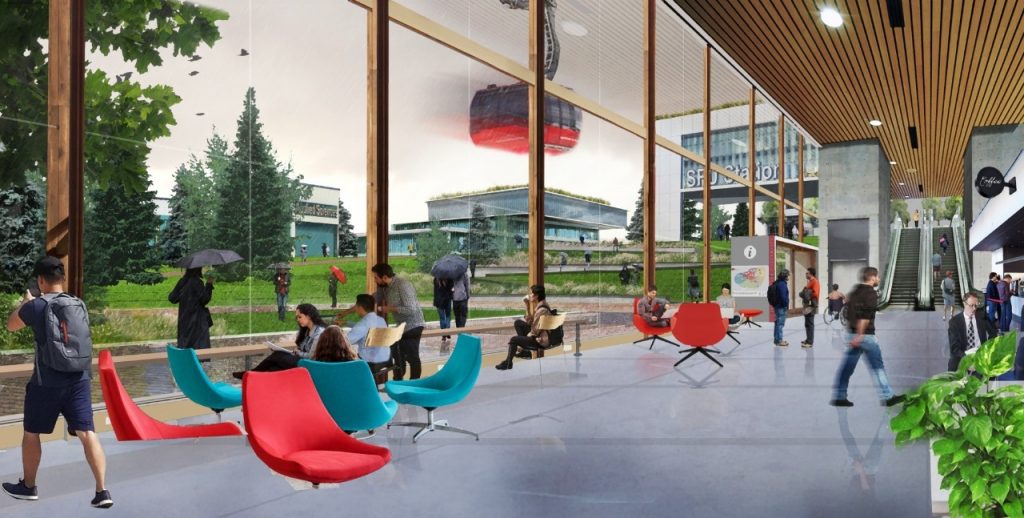
The realities of a gondola going to SFU are beginning to hit home.
Simple fact is, there is no need for a gondola to SFU and the project is a “quid pro quo” for Burnaby’s support for Vancouver’s subway project and the now former mayor of Surrey’s flip flop from light rail to MALM. It is also a reward to Simon Fraser university for their continued support endorsing TransLink’s questionable projects.
Contrary to the hype and hoopla, the SFU gondola will cost in excess of $300 million and will be a maintenance hog.
But, what does cost mean when the gondola will make such a nice backdrop for photo-ops and ten second sound bytes for the evening news, with the expected provincial election next year.
Hopefully the “hacksaw terrorist” doesn’t live near!
The gondola will not take cars off the road and will reduce on-pavement transit services in the region.
The last sentence in this article; “The next step for this project is the business case, which is currently under development.“, is more farce than anything else.
In BC business cases are politcal documents masquerading as technical one.
Proposed SFU gondola popular, but not among some who’d live under it
A proposed gondola from to the top of Burnaby Mountain is now receiving public feedback, and some aren’t happy with the transit option. (Translink / SFU Image)
Getting up and down to Simon Fraser University can be a real slog, and the proposed Burnaby Mountain gondola is being sold in some quarters as a fun solution to the traffic and transit challenges in that area.
But with public engagement underway, some people who live in the city’s Forest Grove neighbourhood are pushing back.
Jim Bowen is worried about a gondola going over his home — he’s concerned about the potential of tree removal and what it could mean for the value of his property.
He’s part of a group called Stop SFU Gondola and says the group has more than 150 members.
“The emotional toll it can take on you — after 14 years of having this literally hanging over your head, with these people pushing it through,” Bowen said, referencing earlier proposals for a gondola over the years.
“The gondola would go directly over our houses. Not beside them. Not close to them. Over them.”
In recent weeks, TransLink has held a series of meetings with people in Forest Grove and UniverCity — the neighbourhood on top of Burnaby Mountain beside SFU.
“That meeting — there were 35 of us … I admit to being opinionated, it didn’t go that well for them,” Bowen said, referencing a public engagement meeting on November 23. “They were a little bit surprised by things, and how hostile we were.”
TransLink says the feedback provided by people at those meetings will be included in what it calls an “engagement summary.”
In a statement to CityNews, it notes the project is not currently funded, but is included in TransLink’s ten-year Access for Everyone plan.
“This is the third engagement that’s been conducted for the Burnaby Mountain Gondola project and we’ve found that the project has broad support from the region — with more than 83% of respondents supportive or very supportive of the gondola in the first two rounds of engagement,” a TransLink spokesperson wrote when requested for comment on this story. “The engagements included direct consultation with residents of Forest Grove and UniverCity and all engagement results will reflect their unique interests in the project.”
The proposed route would see the gondola’s lower terminal placed beside the Production Way-University SkyTrain Station, running up to the vicinity of the SFU Transit Exchange.
Getting up the mountain on buses now can be highly unpredictable, with people often complaining about full buses passing them by.
If built, the gondola would get people up to the top in about seven minutes, in contrast to the 15 to 45-minute trip TransLink suggests people usually endure. In terms of capacity, the gondola could transport as many as 3,000 people per hour.
The next step for this project is the business case, which is currently under development.
This bodes ill for the Expo Line extension to Langley.
Transportation Minister Rob Fleming attributes the delays to soil and geotechnical issues.
These are the same geotechnical issues that the Langley extension also must face.
The following quote is also of interest:
This is in addition to the previously approved budget of $2.34 billion for widening work on this stretch of the highway, between 264 Street and Mount Lehman Road.
For under $2 billion, we could have a 130 km Vancouver (Marpole) to Chilliwack regional railway also know as the Leewood study.
As always in BC, blacktop political trumps good public transport.
Highway 1 widening project delayed, costs continue to climb
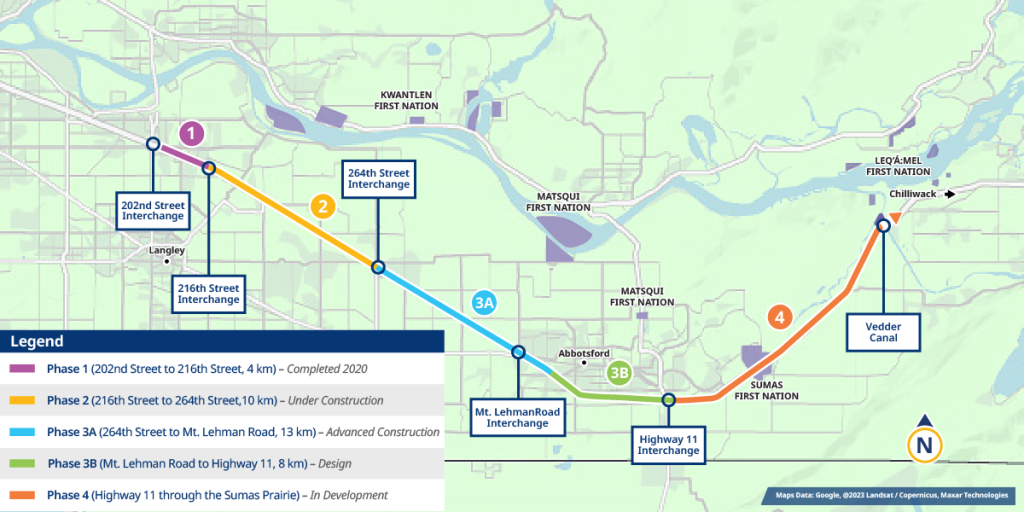
A map shows the projected work on Highway 1 occurring in B.C.’s Fraser Valley, as of Dec. 2, 2023. (Ministry of Transportation and Infrastructure image)
The cost of the Highway 1 widening project in B.C.’s Fraser Valley is climbing, and with it, come substantial delays.
According to a new sign that sits along the highway, the project will now cost an extra $140 million and won’t be complete until 2026.
This is in addition to the previously approved budget of $2.34 billion for widening work on this stretch of the highway, between 264 Street and Mount Lehman Road.
Transportation Minister Rob Fleming attributes the delays to soil and geotechnical issues. He adds there is a lot to complete within the project, including adding designated transit lanes.
“We’re getting a lot out of this highway, especially for the commercial trucking community,” Fleming said. “Better rest stops… brand new interchanges that will allow for more housing, mixed-use development, industrial land strategies and things that bring economic benefits to it.”
The project’s goal is to relieve traffic congestion and accomodate sustainable transportation options in the valley.
The province says a new HOV lane will be one of several upgrades made to the highway, which is currently only two lanes in both directions through this stretch.
The B.C. government says more than 80,000 drivers use Highway 1 between Langley and Abbotsford, and through the Sumas Prairie and Chilliwack, daily. It adds more than $65 billion worth of goods is transported on this stretch each year.
One wonders if Premier Eby is going to call a snap election in January or February?
Surrey will be hotly contested as the police, flip-flop, issue is hurting the NDP MLA’s there.
Nothing like “good news everyone” photo ops and 10 second sound bytes for the evening news, to try to steer the voter away from the police issue.
I still see TransLink and the provincial NDP are still deliberately misinforming the public about the cost of the project, by quoting, “………the line is expected to be around $4 billion, the province says.”
I think not.
The cost of the guideway is now $4.01 billion for 16 km. of line, but wait, that estimate was from a few years back and the cost of cement and structural steel have been badly affected by inflation.
So here are the current costs associated with the Langley extension.
Cost of guideway, estimated in 2021 – $4.o1 billion, funded by TransLink, the provincial and federal governments.
Resignalling of the Expo and Millennium Lines, needed to operate the Langley extension – contract for $1.47 billion, signed with Thales.
UNFUNDED – The Operations and Maintenance Centre #5 needed before the Langley extension opens. Estimated cost $500 million to $1 Billion.
UNFUNDED – The electrical rehab of the E & M Lines, needed before the Langley extension opens. Estimated cost $1.5 Billion to $2 Billion.
UNFUNDED – All switches on the Expo Line need to be replaced with high speed switches, before the opening of the Langley extension, which also requires structural rebuilding. Cost is piecemeal and not included in the finding package. Estimated cost $800 million to $1 billion.
NOT INCLUDED – The fleet renewal which includes a minimum of five 5-car train-sets. Cost @ $3 million/car – $75 million.
NOT INCLUDED – Station rehab, cost unknown.
Added up the true cost of the 16 km Langley extension and the 5.7 km Broadway subway, pegged at $2.7 billion, will be around $11 billion to $12 billion! And that is for a mere 21.7 km extension to the Expo and Millennium Lines!
Where is the money coming from?
Well, Premier Eby and TransLink are not saying, especially before a snap election. Announcements of tax increases do not win elections.
Well you know the old politcal saying; “If a politician repeats a lie often enough, the media and the public will tend to believe the it”.
Surrey-Langley SkyTrain station names, locations announced
FILE – A SkyTrain station sign in Metro Vancouver. (Allan Chek, CityNews Image)
We’re getting closer to the Surrey-Langley SkyTrain extension project becoming a reality, as eight new station names were announced Friday.
The SkyTrain to Langley is part of the province’s plan to extend the Expo Line from King George Station in Surrey to the city.
Once complete, it will be the first rapid expansion south of the Fraser River in 30 years, the Ministry of Transportation and Infrastructure adds. Commuters will be able to travel on transit from Langley city to downtown Vancouver in just over one hour.
The eight stations along the 16-kilometre track will include:
Green Timbers Station (140 Street and Fraser Highway)
152 Street Station (152 Street and Fraser Highway)
Fleetwood Station (160 Street and Fraser Highway)
Bakerview-166 Street Station (166 Street and Fraser Highway)
Hillcrest-184 Street Station (184 Street and Fraser Highway)
Clayton Station (190 Street and Fraser Highway)
Willowbrook Station (196 Street and Fraser Highway)
Langley City Centre Station (203 Street and Fraser Highway)
The ministry notes over 50,000 new residents are expected to move into Metro Vancouver every single year. It says this project aims to help with the increase in population.
In addition to the new stations, there will be more bus exchanges, park-and-ride spaces, 30 more SkyTrain cars, an operations and maintenance centre, and system upgrades.
“Once complete, this extension will connect people to jobs, to friends to businesses and to opportunities throughout the south of the Fraser region and beyond,” said John Aldag, member of parliament for Cloverdale-Langley City.
The cost to build the line is expected to be around $4 billion, the province says.
“This is another important step in moving this project forward from concept to reality,” said Rob Fleming, minister of transportation and infrastructure. “The stations we are naming today will become community landmarks and will be recognized for decades to come.”
He says this project will mark a 27-per-cent expansion to the original SkyTrain network.
“That’s huge. That is unprecedented in Canada right now to make those kinds of investments in public transit — 16 kilometers, the new alignment. And it will bring incredible opportunities.”
Construction on the Surrey-Langley SkyTrain project is expected to begin in 2024, with a slated opening of 2028.
Lewis N. Villegas has over 35 years of experience working as an urban design specialist in Canada and the U.S. He completed revitalization projects in British Columbia, and New Urbanism projects in California, Utah, Oregon and Alaska. In Vancouver he designed Chinatown Square, and provided the Concept Plan for the Olympic Village pro bono to the City. Lewis is working on a book detailing how to end housing crises by building human scale urbanism, out next spring, “The Death and Life of Human Scale Urbanism.”
Just a note: The name SkyTrain came from a radio contest before the Expo line was opened and was not the name of the proprietary transit system was marketed by. MK.1 cars were the UTDC’s ICTS/ALRT cars and the MK.2 were Bombardier’s rebuild using their Innovia bodyshell. Mk. 3 and Mk.5 cars are Translink’s in-house name for the trains to pretend they are a new design; they are not as the basic Innovia design goes back to the late 1990’s.
When Alstom bought Bombardier’s rail division, they were known as Movia Automatic Light Metro.
Both Bombardier and Alstom cannot use the SkyTrain name for the cars because that trademark is owned by a Brazilian company with their SkyTrain system which is not related to Vancouver’s. In fact there are several proprietary and non proprietary transit systems that use the name SkyTrain.
Provincial Government Wants On the Towers-and-Skytrain Milk Train
The provincial legislature is voting on a bill to give developers the right-to-build-towers inside a 10-minute walking radius from every Skytrain station.
It’s just so Vancouver. We build a 5 km tunnel, and call it a ‘subway’. We pass blanket approval for spec buildings, and call it ‘good urbanism.’ Thegovernment of non-elected Premier David Eby, a lawyer from Point Grey, is about to vote on this wacky proposal: Pre-approve at the provincial legislature in Victoria—sight unseen —building towers at each of 69 Skytrain stations on the Lower Mainland.
*
Worse yet, even if the towers build, and real people move in—which is typically not the case, 50% of tower product is dark, or empty—they won’t be able to ride the Skytrain, no matter how close they live to the station.
*
Reason? The Skytrain is full
*
The system is operating at maximum capacity. It cannot take on any new riders because it cannot add any more trains, or any more cars. Five car (Mk. 5) trains are the limit—Period. Because there is no space on the Skytrain Loop to support Langley trains crossing the Fraser River, the Langley extension will be built with crossover track switches allowing turn backsat Surrey
*
Here’s the provincial proposal:
• 20-storey towers within a 3 minute walking distance of any Skytrian station;
• 12-storey towers within a 5 minute walking radius; and
• 8-storey towers within a 10-minute walk
*
Ultimately, this means towers will build next door to single family bungalows. Meanwhile, adding more product risks exerting upward pressure on house prices, rather than fixing the problem.
*
Here is even more wackiness: The 10-minute walking radius describes an area measuring 500 acres, or 2 square kilometers. A footprint equal to…
• Vancouver’s West End (bounded by Georgia , Burrard, Stanley Park and English Bay), or
• Half the size of Stanley Park (1,000 acres).
*
In other words, Eby is looking to fund his government, and purportedly End the Housing Crisis, by building 69 more Vancouver West Ends. To understand this madness we must enter the Skytrain-and-Towers rabbit hole.
(1) ‘WE NEED MORE SKYTRAIN STATIONS’
Speaking at an audience microphone, at an SFU Housing Affordability lecture, Coquitlam Mayor Richard Stewart put it this way: “What was [it] that was causing this challenge that we are facing now? Is it a shortage of land? I don’t think so. I think it is actually a shortage of Skytrain stations.”
[SFU Continuing Studies, April 21, 2017, Housing Affordability Redux Lecture Series, at 1 hr 41 mins.
https://www.youtube.com/ watch?v=mRexc_XABqw].
Stewart would solve the Housing Crisis by building more towers. Yet, the real reason the mayors want skytrain stations is to “extract” revenues from tower developers using Community Amenity Charges (in Vancouver), or Development Cost Charges (in Metro).
*
In 2012, the City of Vancouver ‘extracted’ $5.4 million from the 21-storey Rize tower at Broadway and Main. It became the basis for the new Broadway Corridor Plan: A tower zone 5-miles long, and 1 mile wide, stretched over the Broadway Skytrain tunnel. The plan’s sole purpose is to attract towers and extract revenues. Community making cannot be found on its pages.
*
In the Bizzarro world of Skytrain-and-Towers urbanism, revenues flowing to government are driving the trains. This would appear now to the case in Victoria—where all other considerations will be given short shrift.
(2) THE STREETCAR|LRT—SKYTRAIN COMPARISON
What if the Skytrain turned out to be the less optimal transportation choice? For example, modern Streetcar|LRT—demonstrated during the 2010 Olympics—is now operating in Kitchener-Waterloo and Edmonton. Costing 13-times less than the Broadway tunnel, its passenger capacity is double:
Broadway Tunnel • $600 million per km • 6,852 pphpd.[1]
Langley Extension • $300 million per km • 7,538 pphpd.[1]
Flexity Streetcar|LRT • $54 million per km (Kitchener-Waterloo) • 71,400 pphpd (Edmonton, 5-car).[3]
Above, the most expensive systems top of the list, while the greatest passenger capacity obtains at the bottom. Represented is the total inversion of transit goals and social values.
(3) PUTTING OUT THE FIRE WITH GASOLINE
Priced 10-times over a median income household’s ability to finance, houses in Vancouver are now beyond the reach of most Canadians. Meanwhile, the Skytrain reaches less than 9% of Metro:
• 49,900 pphpd—combined passenger capacity of the Expo, Millennium, Canada Line, WCE and Langley extension.
• 21,600 pphpd—total passenger capacity exiting the Lower Mainland on 10 highway lanes and one HOV lane.
• 71,500—total mobility per hour, in-or-out of the regional core.
The bitter lesson learned after 45 years of building the Skytrain is this: Restricting the reach of transit has the effect of constricting the land supply, thus triggering land price inflation.
Economists agree: Ending the housing crisis lies in the opposite direction—expanding supply by extending the reach of transit. It’s ‘good urbanism’ 101.
(4) THE GAHP IN THEIR THINKING
Given overheated markets, adding product around Skytrain stations won’t lower prices, yet risks having the opposite effect. According Canada’s banker, CMHC: “[T]he only way to ensure that units retain affordability over time” is to restrict resale values by putting contracts on title.
*
Essentially, we apply the co-op formula to individual houses, row houses, courtyard houses, and walk-ups. The units sell, rather than rent, as ‘guaranteed affordable houses in perpetuity (GAHP).’ With the condo developer—the middle man—out of the picture, prices will normalize:
*
Without contracts on title limiting resale values, “The first purchaser; having bought affordably, receives a financial lift on resale. Without [resale] price restrictions, the benefit of an affordable unit to the community is lost.”
A Guide for Canadian Municipalities for the Development of a Housing Action Plan, CMHC 2011, p. 16.
(5) UNMASKING THE CRISIS
The choice between Streetcar|LRT and Skytrain is crystal clear: in one, exorbitant costs restrict operations inside a constricted area of service, triggering crises in housing affordability; in the other, GAHP doors build in sufficient quantity to meet or exceed demand, crises in housing affordability end as neighborhoods infill, and new tram-towns build along 200 km commuter corridors—every new GAHP door hardwired to the regional core.
*
Here are three possible Streetcar|LRT lines delivering 3 million GAHP doors:
(1) Horse Shoe Bay to Hope (197 km) • $8.9 billion • 1 million GAHP supported;
(2) North Shore to Chilliwack (136 km), including a Burrard Street subway, and a Burrard Inlet tunnel) • $9.3 billion • 1 million GAHP supported;
(3) YVR to Whistler (120 km) • cost hinges on track lease/use from the province(!) • $1 million GAHP supported • GAHP Winter Olympics supported.
In the new math, adding supply increases ridership, putting downward pressure on prices. Furthermore, significant economic synergies result from hardwiring three regions, and 3 million Canadians:
• Squamish-Lillooet Regional District • 6,300 sq. mi. • 51,000 population
• Fraser Valley RD • 5,150 sq. mi. • 296,000 population
• Metro Vancouver RD • 2,880 sq. mi. • 2,643,000 population
Today, the Skytrain has reached optimum capacity, and will continue to serve as a world-class People Mover inside the regional core. However, moving forward, all efforts at extending the Skytrain will cost billions. That treasure will be better spent elsewhere. Streetcar|LRT is by far the better option for adding local trips (Streetcar), and regional capacity (LRT). Expect ballooning ridership as GAHP inventories rise, and house prices fall. Packing Canadians like sardines into ill-conceived Skytrain station precincts is inhuman, anti-social, and much less productive.
* NOTES
[1] Surrey Langley SkyTrain Business Case Update—Ridership Report—Revision#2, 15 Mar 2022, p. 19.
[2] All about SkyTrain expansion: Interview with TransLink’s head of SkyTrain. Kenneth Chan, Urbanized, Sep 27 2023, 6:50 pm.
[3] Flexity Freedom Brochure. Bombardier, 2011
There is a belief in North America that subways are the great panacea for urban transit.
This poses a question, what is exactly meant as a subway in North America?
Generally, the term subway is used to denote heavy or light metro traveling in a tunnel under the city, with stops every km or so apart.
This is both very expensive and not user-friendly.
Today, in Europe, subways are only considered if traffic flows on a transit (tram) route exceed 20,000 persons per hour per direction. It is the last resort in catering to transit customers.
Last resort?
Yes, because Europe had a post war subway craze, especially in Germany, where it was though subways were the answer to congestion and provide bomb shelters in case of war.
Problems arose, including the high costs of subway construction, which meant smaller transit networks and studies showed that a subway would become a vast “charnel house” in a nuclear war.
Then the mid life rehabs happened, bankrupting many local transit authorities that opted for subways, which in turn degrade transit services.
Metro Vancouver taxpayers are being kept in the dark with the Expo and millennium Line’s mid life rehabs as the signalling, electrical and track rehabs will cost over $4 billion. Not to mention the replacement of the ALRT cars with ART/MALM cars costing $717.5 million.
Added to the $2.7 billion subway under Broadway and the $4.1 billion Expo Line extension to Langley (and let us not forget the $500 to $1 billion Operations and Maintenance Centre #5) the real cost to the taxpayer to extend the SkyTrain Light Metro line a mere 21.7 km is a staggering $12 billion+!
Why does America have such terrible transit?
Simple answer is, the politicians what gold plated transit systems costing billions of dollars more to build than cheaper, yet more effected transit options. The result: it is too expensive to build a full network, making the very expensive ‘rapid transit’ line to cumbersome to use.
Soon, politicians and planners on this side of the pond will soon discover the lessons of bloated, over built transit projects, that were taught to their European counterparts 40 years ago.
Those who do not read transit history are doomed to repeat the very same expensive mistakes.
‘Unique in the world’: why does America have such terrible public transit?
A new book looks back at the mass transit histories of 23 major cities in both the US and Canada, detailing the routes to where we are today
“North America really is unique in the world in the lack of good public transit,” the author Jake Berman told me while discussing his new book, The Lost Subways of North America. The oversize, map-laden volume is a slickly designed deep dive into the mass transit stories of 23 major cities in the US and Canada. Packed with fascinating histories and tons of absorbing information – ever wonder why elevated trains went out of style, or why monorails just don’t work? – the book is a lively and compelling examination of how mass transit has succeeded and failed across the continent.
The last stop: what happens when a US city’s subway starts to die?
“European cities never decided to build the kind of copy-and-paste suburbs that we built in North America,” said Berman, explaining why transit has fared so much better across the Atlantic. “The other part of that is, American cities do not make particularly good use of the land near their transit systems. For instance, many stops on [the Bay Area’s Bay Area Rapid Transit] Bart is surrounded mostly by strip malls, or single-family homes or gigantic parking lots.”
While talking with Berman, the misuse of land around transit hubs was a recurrent topic, a common pitfall that undermined the design of subways, light rail and streetcars in many major cities. In one of multiple examples, Berman shared that Dallas’s many miles of light rail doesn’t necessary equal a valuable transit system. “It’s crazy to think that Dallas has about as many miles of rail as Barcelona,” he told me. “The difference is, there’s not a whole lot near Dallas’s rail stations, whereas in Barcelona there’s apartments, there’s stores, there’s businesses, there’s churches – basically everything that you need for daily life.”
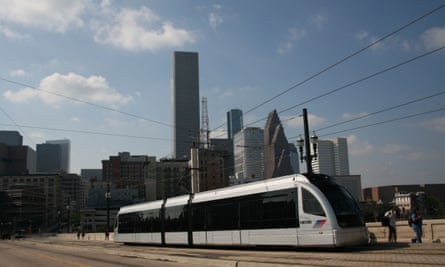
Surprising winners emerged from Berman’s research for Lost Subways of North America. While Dallas may conform to stereotypes about gas-guzzling Texans and their lack of good mass transit, the neighboring city of Houston proved to be one of the locations that is doing transit right. As Berman explains, Houston’s light rail within the city’s core took advantage of reforms in laws reducing mandatory parking lots and increasing housing density – the result is that transit in the city’s core functions far better than similar light rail in places like Dallas and Los Angeles, which don’t give access to major infrastructure and employment hubs, and which don’t supply adequate housing.
Metrorail train with Houston skyline. Photograph: Stephen Finn/Alamy
In addition to commenting on contemporary situations, Berman’s book is also a rewarding look into the history that informs our contemporary transit mess. For instance, he does an apt job of retelling the oft-told defeat of Los Angeles’s streetcar system by freeway – including a strange moment in which an LA monorail almost took hold. This retelling makes for the perfect prologue to Berman’s discussion of LA’s decades-long pursuit of a viable light rail system, which continues to this day. The idea of such a venture took hold because of a rivalry with San Francisco’s Bart in the 1960s. “It really is an interesting thing seeing how municipal rivalries played out in the transit space,” he said. “LA put a subway system on the ballot in 68 because the Bay Area had approved Bart six years prior.”
LA’s light rail would remain a dream for decades, but eventually that city did come to develop about 110 miles of track (favorably comparing to the Bart’s current 131 miles). Unfortunately, Berman laments that all those Southland metro miles are for naught, as the city still conceives of itself as “a horizontal city, not a vertical one”. With the failure of LA to pursue high-rise housing developments around metro hubs, Berman argues the city’s mass transit system will remain unsuccessful.
While LA is widely talked about as a mass transit hard case, lesser known is Berman’s treatment of Rochester, New York, at 211,000 inhabitants the “smallest city to ever build a subway” and “the only city in the world to build and operate a full-blown subway system, then abandon it entirely”. Completed in 1927, the problem with Rochester’s subway was that, in the words of a city newspaper, “it starts nowhere and goes nowhere”. After some successful years, the system fell into insolvency after the second world war, eventually entering a ridership death spiral that saw it shut down in 1956, making way for freeways.
Whether it’s Rochester or Los Angeles, Berman argues that making a successful mass transit system isn’t overly complicated, as most successful systems are so for the same reasons. “There’s that line from Anna Karenina,” he said, “all happy families are alike, and every unhappy family is unhappy in its own way. And the adage definitely applies to transit. There are a whole lot of things that cities with good transit systems do correctly, and most of those things need to come into place for the system to work.” That would include building apartments and businesses around stations, as well as other kinds of amenities that people would be willing to ride transit to reach. “There’s been a sort of forgetting that transit doesn’t exist in a vacuum,” he said.
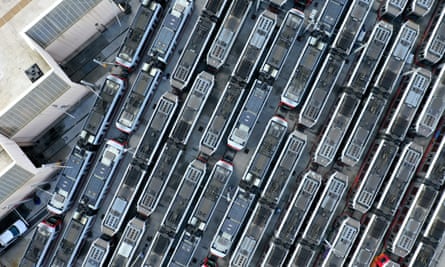
San Francisco Muni Metro trains sit parked at the Curtis E Green Light Rail Center.
Photograph: Justin Sullivan/Getty Images
If there are common factors in mass transit success, there is also at least one common factor in mass transit fails – bureaucracy, which often prevents the creation of transit routes, as well as the creation of the necessary amenities to make said routes thrive. Berman writes that in San Francisco, along the major transit corridor Geary Street, “it took from 2000 to 2011 to replace the bankrupt Coronet Theater with rent-controlled senior apartments … All the while, San Francisco keeps adding more jobs.” Berman argues that the continued creation of jobs throughout the Bay Area – without a similar rise in housing stock – is one of the key drivers of the homelessness crisis.
He contrasts the current failure to create housing in a timely manner to the can-do attitude that originally made San Francisco’s Muni bus system develop many key routes quickly and efficiently. “A lot of what I talk about in the book is related to very deep questions about transit planning and why cities can’t build infrastructure quickly,” Berman said. “The Geary Boulevard subway in San Francisco has been planned since the 1930s. It’s very hard to get things done these days like they could in the old days. When Muni built the Geary Boulevard streetcar in 1912, it took six months to do it. There is a lot to be talked about regarding making the perfect the enemy of the good.”
Although Berman sees much to critique in contemporary transit, he remains hopeful that a book demonstrating everything that was once done right – and those things that still are being done correctly – might inspire a transit turnaround. One of the reasons he wrote Lost Subways of North America is to share his belief that it’s not too late for cities across this continent to get with the program. “I would hope that people have a certain sense of optimism that we were able to do this once and we can do it again. Back in the day it was normal for people to build apartment buildings near train stations. We can do this. Providing perspective of the past is what I hope to give to the reader.”
Like children playing with their Christmas morning train sets, the Mayors council on transit blunders on wanting more and more, without any care as to the cost.
Not one of the mayors has any knowledge about public transit, nor seems to care about the onerous tax burden TransLink’s user-unfriendly service has become.
If any of the mayors had any moral fibre they would ask for a fully independent review of TransLink to see if the taxpayer is getting good value for their money.
I would wish that the mayors would contact the Baltimore MTA about their former and now TransLink’s CEO. I did and here is what I received in a Email.
you are about to get a new CEO of Translink in the person of Kevin Quinn. this is a good news/bad news situation. good news is we are rid of him, bad news you are getting him.
Mr Quinn may be the nicest yes man you will ever meet. he is very personable and friendly but have yet to actually see him in 6yrs have an opinion of his own. and if he has any use for light rail he has kept it well hidden.
hopefully you will have better luck than Baltimore, ridership is off (before pandemic) 2% year over year since he took over.
Hardly reassuring!
Like most Canadian politicians, the regional mayors think the taxpayer has deep pockets and will keep on paying for mediocre planning and even more mediocre transit service.
The lesson of the 2015 transit plebiscite, which showed that 61.7% of the regional population rejected TransLink’s transit planning and tax increases, has been ignored.
With the next round of civic elections in 2026, just in time for new taxes being loaded on the already over taxed taxpayer, the Mayor’s Council on Transit, “Lotus Land’s Ship of Fools”, may find themselves clinging to a sinking ship, with their politcal fortunes sinking with them.
Addendum: Trying to find out what the Mayor’s council on transit get paid for attending meetings. After 15 minutes of perusing Google, no can find.
In my book it is money poorly spent.
TransLink Mayors’ Council unveils funding wish list for transit improvements
Local politicians are hoping the federal government plays Santa.
The TransLink Mayors’ Council detailed its wish list Thursday for federal funding to help pay for a litany of transit improvements across Metro Vancouver.
The funding requests include supporting the building of new Bus Rapid Transit (BRT) projects, giving $375 million for an expanded bus fleet, $1.4 million for additional bus depot capacity, $70 million for active transportation and road safety projects, as well as $120 million for the Golden Ears Way BRT readiness project.
“Transit-oriented development is a key component of the province’s and region’s plan to respond to the housing affordability crisis, but without federal financial support and a sustainable funding model to help deliver additional transit into the future, we won’t be successful,” said Port Coquitlam Mayor Brad West, chair of the Mayors’ Council.
He adds that this funding is important as Metro Vancouver’s transit services are “essentially frozen at 2019 levels even as the region’s population has grown by almost 200,000 between 2019 and 2023.”
The announcement came a week after TransLink unveiled plans for three new BRT routes in Metro Vancouver. The “priority corridors” will be King George Boulevard from Surrey Centre to White Rock, Langley Centre to Haney Place, and Metrotown to the North Shore.
The timeline, however, isn’t as quick as some might hope. TransLink says potential services on these routes could roll out in 2027.
The ask from the council also came before work on the multi-billion dollar Surrey Langley SkyTrain is set to begin in 2024. The province previously said it expected to start awarding contracts in the first few months of the year.
Earlier this month, the Mayors’ Council pushed for an injection of cash for local transit projects after the B.C. government announced it had tabled legislation to densify housing near transit hubs.
“The fact is, you can’t have transit-oriented development without transit, and TransLink’s current system is unable to keep up with growing public demand for services across this region,” said West.
“With transit in Metro Vancouver currently frozen at 2019 levels, we need to see both the provincial and federal governments commit funding to dramatically expand public transit service. This legislation represents one of the most significant changes to land use and zoning policy that we’ve ever seen in this province, but it won’t succeed unless our three levels of government work together to deliver better transit in this region.”














Recent Comments