Transit News From Eastern Canada
 An Artist’s rendering of the Laval aerial tramway
Well, TransLink isn’t the only transit authority toying with the idea of an aerial tramway….
http://lavalnews.ca/article/Laval-PSC-leader-calls-aerial-tram-gimmick-192307
…….and I do believe an aerial tramway is a gimmick. Aerial tramways may prove to provide a transportationAi??solution for a unique transit problem, but they may cause more problems than they solve and areAi??no substitute for modern light rail.
 BRT gridlock in Ottawa today
Ottawa transit planners are beginning to learn that if one dumps all their transit money into a politically prestigious subway, that does little to enhance the transit experience, it comes at the expense of a larger user-friendly light rail network. Ottawa has already learned that BRT didn’t really work (that’s why they planned for LRT)Ai??but when precious construction money is spent on needless subways, BRT becomes the only affordable solution for a larger transit network.
http://www.cfra.com/?cat=1&nid=83160
It seems transit planners must relearn the lesson that BRT has not proven to attract new customers, especially the all important motorist from the car.
 Proposed monorail for Montreal
The silly season has arrived in Montreal, where the monorail lobby are spinning their tales of cheap transit to any and all who will listen.
Ha, ha, ha!
Just where has this particular monorailAi??been used?
Don’t know?
Well transit planners had better ask some very pointed questions, soon, lest politicians jump on the monorail bandwagon and compel transit planners to plan for gadgetbahnen type transit that may cost the taxpayer a whole lot more than advertised, just like the Vancouver SkyTrain mini-metro.
Believe this and I have some Bre-X shares to sell you!
Le coAi??t du monorail inversAi?? par kilomA?tre
CaractAi??ristiques du projet de monorail
 The Scarborough ICTS/ALRT
Meanwhile in Toronto, Mayor Ford has turned into a transitAi??Edsel, with his extremely expensive and half bakedAi??subway onlyAi??plans.
Instead of LRT being built in time for the the phase out of the Scarborough SkyTrain ICTS/ALRT line, transit customers may face four years or longer for a transit replacement for the aging mini-metro.
A Tram Runs Through It!
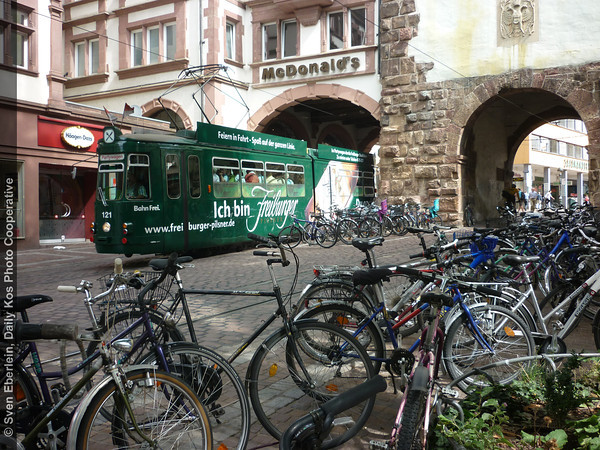
IAi??couldn’t resist. In Freiburg Germany, trams co-exist with bicycles and buildings, without the doom and gloom and general transportation chaos predicted by the SkyTrain (a.k.a. metro) lobby.
So sad when on this side of the pond, many regional politicians equate modern LRT as an anachronism from years gone by and not as a viable and affordable transit mode in daily use in well over 400 cities around the world. In the Vancouver Metro Region, designing “rail” transit to be customer friendly instead of beingAi??’engineering’ friendly is still at least a generation away.
Light Rail and Streetcar Construction

The following is a series of photos showing tram construction in the French city of Tours.
http://www.lineoz.net/forum/viewtopic.php?f=1&t=17564&p=345099#p345099
The French city of Tours (population 137,000) tram project is a transit is closely related to modern light rail with most of its route located in aAi??reserved rights-of-way. Work on the new tramway started in 2010, with completion of the line expected by September 2013.
The first tam line is replacing an existing bus serviceAi??which willAi??spearhead a reorganizing of theAi??existing bus network. The project was entrusted to the group which includes the City Tram Company
Facilities Touraine (SET) and the company Transdev. A second tram line is not in the planning stage.
TramTrain Through Town and Country

Here we have a Karlsruhe ‘streetcar’ operating as a Elzug or local passenger train on its way to Heilbronn.
Two video’s that show that the “density question” doesn’t exist with TramTrain and that TramTrain is both user friendly and non-user friendly.
TramTrain through the Black Forest and in a deep snow, something to think about when winter snows isolate Chilliwack and the upper Fraser Valley due to heavy winter snows closing roads and highways.
The second video is a TramTrain going through a town centre and through a cafAi??’s serving area, which gives a new meaning to dine and dash!
Road Pricing Coming To Surrey?
It seems that local bureaucrats are trying to persuade regional politicians to agree to a road-pricing or road toll scheme, to both ensure their incomes and pensions by increasing the transit and planning bureaucracies – OOPS, I meant to sayAi??increase funds for transit.
For road pricing or road tolls to work, the region needs a viable public transit alternative, the region doesn’t and if road pricing forced onto the public, it will mean the end of the political careers of those supporting the scheme.
The current SkyTrain and or light-metro planning needs major cash infusions, but the nature of light-metro means that it can never be built to provide an alternative to the car.
TransLink certainly has read the book on how to gouge the taxpayer for more coin, but it hasn’t read the book on providing good transit. Like a 70 year old on Viagra, TransLink’s bureaucrats crow about ridership on the light metro system, like recent conquests with a 20 year old,Ai??but they fail to mention any figures of modal shift. With 80% of SkyTrain’s ridership coming from buses, points to the fact there has been little or no modal shift at all! Added to the ridership mix is over 100,000Ai??dollar a day U-Passes forciblyAi??sold to students (students are compelled to buy U-Passes) going to universities and colleges in the region and how transit ridership has increased because of multiple trips made by this group.
What I see is an ever increasing spiral of transit costs in the region, with little real benefit to the transit customer. Giving TransLink more money, by implementing a road pricing scheme is like giving a child the keys to a candy store.
Want affordable transit, then we must starve TransLink of cash and force them to plan for affordable alternatives or even, perish the thought, get rid of TransLink and its highly paid yet ponderous bureaucracy altogether and hire consultants to plan for individual transit plans when needed. Come to think of it, this is exactly what Rail for the Valley did with the RftV/Leewood Study.
Report recommends fees on driving, more transit
Surrey should consider backing a Metro Vancouver transportation improvement fee of $65 to $165 per vehicle to support sustainable transportation, according to a report commissioned by the Downtown Surrey Business Improvement Association.By Jeff Nagel – Surrey North Delta Leader
Published: November 23, 2011 9:00 AM
Updated: November 23, 2011 10:01 AMThe City of Surrey is being urged to support a TransLink vehicle levy as one way to fund transit while making driving more expensive.That’s one of the recommendations in a report commissioned by the Downtown Surrey Business Improvement Association, which hired consultant David Hendrickson to analyze Surrey’s transit needs.His report says Surrey should consider backing a Metro Vancouver transportation improvement fee of $65 to $165 per vehicle to support sustainable transportation, provided there are hardship concessions for low-income motorists.It also suggests Surrey push ICBC to allow distance-based insurance, where car owners pay premiums based on how far they drive, encouraging them to use alternatives more often.And Hendrickson says a share of the provincial carbon tax should also go to transit, rather than income tax relief under the current revenue-neutral model.Road pricing could be another more equitable solution compared to continued property tax increases, he found, but noted Canada’s car-oriented culture makes higher fees on cars and drivers “politically charged and contentious.”Hendrickson’s report, Leveling the Playing Field, argues road expansion capital costs tend to be under-scrutinized compared to transit spending, and driving in general enjoys “perverse subsidies” that must be overcome if transit costs and benefits are to be fairly considered.“User fees that help diversify transit funding can include additional fees on single-occupancy vehicles to better reflect full costs of driving.”Elizabeth Model, executive director of the Downtown Surrey BIA (left), said the organization hasn’t taken a position on the vehicle levy or other revenue options, such as more tolls.“They’re only suggestions,” she said, but added the BIA is pleased with the report and agrees improving transit is “hugely” important to Surrey developing an energetic, vibrant and successful downtown core.Hendrickson suggested the city work to “make public transit faster than driving” to increase the use of transit, which has risen from four to six per cent of all local trips but still trails the region.The city should create a network of HOV lanes open only to buses and ride-sharers, his report said.“Low-cost investments in queue-jumping lanes, transit-only lanes and intersection priorities for transit, particularly during rush hour, can significantly reduce transit trip times and generate increased ridership.”Bypass lanes or timing traffic lights to hold at green for approaching buses can help cut travel times five to 15 per cent, he said.Those measures are critical, Hendrickson argued, because adding more buses will yield diminishing benefits if they and all other vehicles become increasingly stuck in congestion.TransLink’s South of Fraser area transit plan calls for an extra 600 buses to be added here.TransLink is also preparing to add a B-Line express bus service on King George Boulevard in the next year.Transit service levels in Surrey remain “considerably lower” than other Metro cities north of the Fraser, the report said.Residents’ dependence on driving and the lack of a viable transit alternative is a big problem, Hendrickson said, because by 2031 one in three Surrey residents won’t be able to drive a vehicle due to age or mobility challenges.Surrey residents contribute $160 million a year to TransLink through gas tax, property tax and transit fares, he found.But TransLink only spends $135 to $146 million on transit service in Surrey, or about 90 to 95 cents out of every dollar it collects here.Hendrickson endorses the city’s push for light rail lines that are more “appropriate” for connecting town centres, potentially on the old Interurban corridor.To serve more local residents, he said, transit needs to better connect neighbourhoods and cities South of the Fraser, not concentrate on taking passengers to Vancouver or elsewhere in the region.He noted 55 per cent of trips from Surrey to downtown Vancouver are already taken on transit.He also notes Surrey’s lower density overall A?ai??i??ai??? sometimes used to justify less transit investment A?ai??i??ai??? is deceptive because much land is in the Agricultural Land Reserve, making Surrey’s non-farmed lands actually denser than the regional average.He suggests rideshare vehicles get preferred parking places or pay parking discounts and more secure bike parking be added near transit, along with improved cycling routes.Hendrickson also outlines a series of tax reform and development strategies that can foster transit-oriented growth that is both more efficient to serve by transit and feeds more riders into the system.Split-rate taxation A?ai??i??ai??? where land is taxed more than a separate rate for buildings A?ai??i??ai??? can be used to encourage densification and discourage speculators from sitting on bare land.

The Ottawa Light Rail Tunnel Questioned
At least someone in the media in Ottawa gets it; building transit tunnels does very little, except reduce the scope of a transit system. Unless a transit line ridership exceeds about 15,000 persons per hour per direction, only then should a tunnel/subway be considered. It is to be remembered that the city of Karlsruhe Germany is relocating its city’s main tram line in a subway because the surface tramway was catering to well over 40,000 pphpd, with coupled sets of trams operating at 45 second headways! Canadian planners and engineers, routinely over-engineer transit projects to the point of unaffordability, with needless tunnels and viaducts, with Vancouver’s SkyTrain mini-metro being a very good example (the driverless mini-metro needs grade separation at all times, thus enforces subway and viaduct construction). To this end they have ill-advised politicians as to the need for tunnels and viaducts, to the point of professional misconduct! Why? The only reason I see is to ensure that taxpayers dollars flow to themselves and associates with deliberate and extremely expensive transit over-engineering. It is time for regional politicians "to bell the cat", so to speak and engage real transit professionals who have a contemporary knowledge of urban and public transit to plan and build regional transit. In a commentary for The Ottawa Citizen, contributor Ken Gray says the city’s mayor should eliminate the light rail tunnel from the $2.1 billion starter LRT project and use the savings to extend surface rail as far as possible:
http://blogs.ottawacitizen.com/2011/11/23/\ watson-must-dump-the-light-rail-tunnel/ "Watson Must Dump The Light-Rail Tunnel November 23, 2011. 12:01 am Posted by: The Bulldog by Ken Gray So the theory behind the current light-rail plan for Ottawa is the short line between Tunney’s Pasture and Blair Road is just the beginning. That the tunnel will speed transit traffic through downtown eventually all the way to and from the suburbs. Well, and I can’t say this strongly enough, it’s very unlikely that the line will be extended anytime soon. Economist Don Drummond, who runs a commission on public service reform, says health-care costs will devour the provincial budget before two decades are up. That’s because of the huge demographic of aging baby boomers who will demand at our hospitals and ballot boxes they get the best of care. The boomers are unlikely to be happy with not getting enough treatment to keep them from dying. People are like that. Suddenly, projects such as light rail seem insignificant when the grim reaper is staring the boomers in the eye. Already, Premier Dalton McGuinty has dumped any idea of a bullet train between Montreal, Ottawa and Toronto, citing the dicey provincial fiscal situation. So sorry to play this record yet again, but Mayor Jim Watson must dump the downtown tunnel, create a surface rail, bike and pedestrian corridor through the core, and extend the light-rail line as far as it can go because, given the cost of health care, the chances of getting more light-rail money to extend the line beyond Tunney’s and Blair after the current project is completed in 2017 is extremely unlikely. And the current planned line is not long enough and creates too many cumbersome transfers to be of much use at all. It’s big, wasted money with the possibility of huge cost overruns. Surely the mayor understands that.
Light Rail runs in inclement weather
Trams and Streetcars "Stuttering & Crapping out" not a chance brother!
As in the winter of 2010/2011 when Light Rail & Trams continued to run across Europe as well as in Calgary, despite heavy snow falls, when Skytrain ground to an ignominious halt, likewise recent floods in Europe & Australia haven't stopped the Trams!
Montpellier, France
http://dorsetgirlabroad.blogspot.com/
Melbourne, Australia
http://www.youtube.com/watch?v=E1kvQN5jSTA
Budapest, Hungary
http://www.youtube.com/watch?v=iQhVJKvhWIg
SkyTrain “Stutters” – Craps Out Again
I only thought people stutter, but evidently not as TransLink claims "stuttering" has caused SkyTrain to shutdown periodically.
Metro Vancouver hit by windstorm; SkyTrain, West Coast Express, ferries all facing disruptions
Vancouver Sun
VANCOUVER – The heavy rain and fierce windstorm that struck Metro Vancouver overnight is wreaking havoc with the commute on Tuesday morning.
As of 6 a.m., transit services around the region have almost all be delayed by the weather. West Coast Express had to cancel its first train this morning after a tree fell onto the tracks at Albion. Delays are expected for the second train, as well.
Meanwhile, spot traffic outages are disrupting traffic lights at some locations, leading to generally slower traffic flows.
SkyTrain is faring no better – the rain and wind is causing the train system to stutter, causing significant delays.
B.C. Ferries has also cancelled two sailings on the Tsawwassen to Duke Point route – the 5:15 a.m. leaving from Tsawwassen and the 7:45 a.m. leaving from Nanaimo.
© Copyright (c) The Vancouver Sun
VOTE THIS SATURDAY
Does Translink’s wet leaf excuse hold water?
At first glance, TransLink’s excuse for SkyTrain going kaput last Saturday, may explain why the mini-metro stopped dead in its tracks. But there is a problem – SkyTrain is an unconventional railway, powered by Linear Induction Motors or LIM’s and there is no power transmitted to the wheels at all, thus no wheel slip.
It is true that the oily paste caused by Autumn’s leaf fall causes havoc with many transit systems, causing annual headaches for operating staff. The oily leaf sludge causes wheel-slip with powered wheels, which SkyTrain does not have.
Added to this mix is that SkyTrain’s automatic train control counts wheel revolutions as part of its automatic train control system, but again SkyTrain’s wheels are not powered and the chances of wheel slip is almost nil.
It is my opinion that TransLink is still in the dark why the Expo Line failed on Saturday and for want of a better excuse is using the annual leaf fall season to cover-up the real problem, a problem that TransLink refuses to acknowledge or is still completely in the dark as to what has happened.
Wet leaves blamed for Saturday’s shut-down of SkyTrain’s Expo line
By Kelly Sinoski, Vancouver SunServices on the Expo and Millennium lines were completely restored by Saturday afternoon following disruptions that lasted several hours. Bus bridges remain in place in several places to deal with passenger backlog.
Photograph by: Arlen Redekop, PNG files
METRO VANCOUVER — An unusually heavy buildup of leaves is being blamed for a lengthy shutdown of the SkyTrain system last weekend.
The Expo line was closed for six hours on Saturday morning, following a heavy storm Friday night that brought rain, hail and wind gusts of up to 100 kilometres an hour to Metro Vancouver, disrupting ferry service and sending leaves and other debris into the air.
Fred Cummings, president and general manager of B.C. Rapid Transit Co. (BCRTC), which operates the Expo and Millennium lines, said the high winds deposited a large volume of leaves on the SkyTrain guideway. The weight of the trains turned some of the leaves on the tracks into a oily paste, causing the wheels on some trains to skid, and prompting the SkyTrain system to shut down automatically for safety reasons.
“It was an unusual combination of events: high winds driving leaves into the guideway, and then heavy rains soaking them into a mass that collected on the cars’ wheel assemblies,” Cummings said.
Cummings said this is the first time in 26 years that a buildup of leaves has caused such a major disruption to the transit system. “It’s like they all come down at once,” he said.
The system has experienced smaller events in the past, he said, particularly on the stretch between Royal Oak and Edmonds before the trees there were cut back.
BCRTC had initially thought the shutdown was caused by a software glitch, before an analysis determined that the oily substance on the wheels was crushed leaves.
Cummings apologized to passengers for the lengthy delays, and said BCRTC will be looking for ways to better respond to similar situations in the future.
He noted that if another windstorm hits, the company may have employees manually inspect the tracks or run trains all night long A?ai??i??ai??? similar to what’s done now in a snowstorm A?ai??i??ai??? to ensure there’s no accumulation of leaves.
“It’s one more thing we have to watch for,” he said.
Cummings noted it’s also been determined that all SkyTrain safety systems, including the automatic train communications software, had operated “normally and appropriately during the incident.”
Coast Mountain Bus Company provided a bus bridge to carry passengers between Surrey and New Westminster and between Commercial-Broadway Station and downtown Vancouver. The Millennium Line operated between VCC-Clark and Sapperton stations.
The company estimated the cost in overtime and extra part-time hours was about $15,200 A?ai??i??ai??? approximately $12,000 for BC Rapid Transit Company and $3,200 for Coast Mountain Bus Company.



Recent Comments