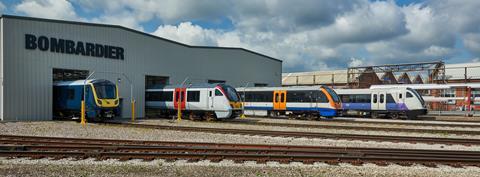
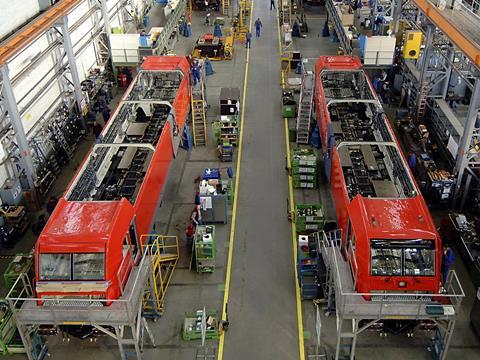
This is big news as Bombardier is the sole supplier of the proprietary, linear induction motor powered Movia Automatic Light Metro system used on the Expo and Millennium Lines. Alstom may or may not continue the production of the now stale dated Movia Light Metro and give notice to its customers that they will wind down production.
As Alstom will own the patents, the cost for MALM vehicles and spare parts may increase significantly.
The aged Movia family of light metro is now more expensive when compared to more modern transit mode, including light rail and only seven of the LIM powered light metros have been built since the late 70’s; with only three seriously used for urban transport.
So unpopular is MALM that its marketing name has been changed at least six times, over the past 40 or more years it has been on the market.
Vancouver is now the sole customer for MALM and if Alstom abandons production future planning for SkyTrain extensions will not be possible.
Does TransLink have a plan B? Do they really care?
2021 maybe the trigger that puts the carnival ride, called SkyTrain, into the history books.
Alstom-Bombardier deal to complete in January
INTERNATIONAL: Alstom and Bombardier announced on December 1 that they had received ‘all necessary regulatory approvals’ required to complete the sale of Bombardier Transportation to Alstom.
As a result the two companies expect the transaction to close on January 29 2021.
Alstom announced its intention to acquire 100% of Bombardier Transportation from Bombardier Inc and Caisse de Dépôt et Placement du Québec on February 17.
After Alstom offered a number of product and factory divestments to ensure competition in key market segments, the deal was approved by the European Commission on July 31.
Signing of the formal sale and purchase agreement was announced on September 16, when Alstom said the terms had been ‘adapted to the current situation’, reducing the anticipated price range to between €5·5bn and €5·9bn.
Under the deal, the acquisition is to be funded through a mix of cash and new Alstom shares. Around €2bn is being raised on the market, with CDPQ contributing €2·6bn to €2·8bn through a reserved capital increase. The Canadian investor currently holds 32·5% of Bombardier Transportation, and would become the largest shareholder in the enlarged Alstom group with a stake of approximately 18%.
TransLink, the Mayor’s Council on Transit and the provincial government should take serious note of the following, but they won’t. Riding in their cars, subsidized by generous car allowances and more, politicians remain oblivious to current issues and pretend nothing has happened.
For politicians it is “Do as I say, not as I do.”
In the spring, Zwei wrote a letter to the Premier and Ministers for Transportation about how Covid is changing ridership habits of people and that there would be better uses to spend $4.6 billion than for 12.8 km of rapid transit.
Zwei got no answer.
$4.6 billion to build 12.8 km of light metro won’t take cars off the road, will not reduce greenhouse gas emissions and will not be “green” transit.
Vancouver’s public transit system is just average; there is nothing special about it and now with Covid, people are changing their commuting habits.
Remote working from home is now growing in popularity, as well as staggered work hours and, of course, driving is the safest way to commute in our Covid stricken world.
My big fear is that there will be little money for transit fro the next decade and when the current Broadway subway and Fleetwood extension are finished, there will be little appetite for further transit improvement, as the taxpayer just will not have the money to pay for it.
Sadly, political ennui and political prestige have become the raison d’être for transit planing and not customer satisfaction and with public transit, as with any other consumer protect, if the customer thinks he/she gets good value for money, he/she will use it, but if the customer thinks that the transit product is substandard, he/she will avoid it. Former customers are avoiding our regional transit system in droves.
The transit customer is voting with their feet and the politicians remain blind, deaf and dumb at the results.
From the BBC
Why our reliance on cars could start booming
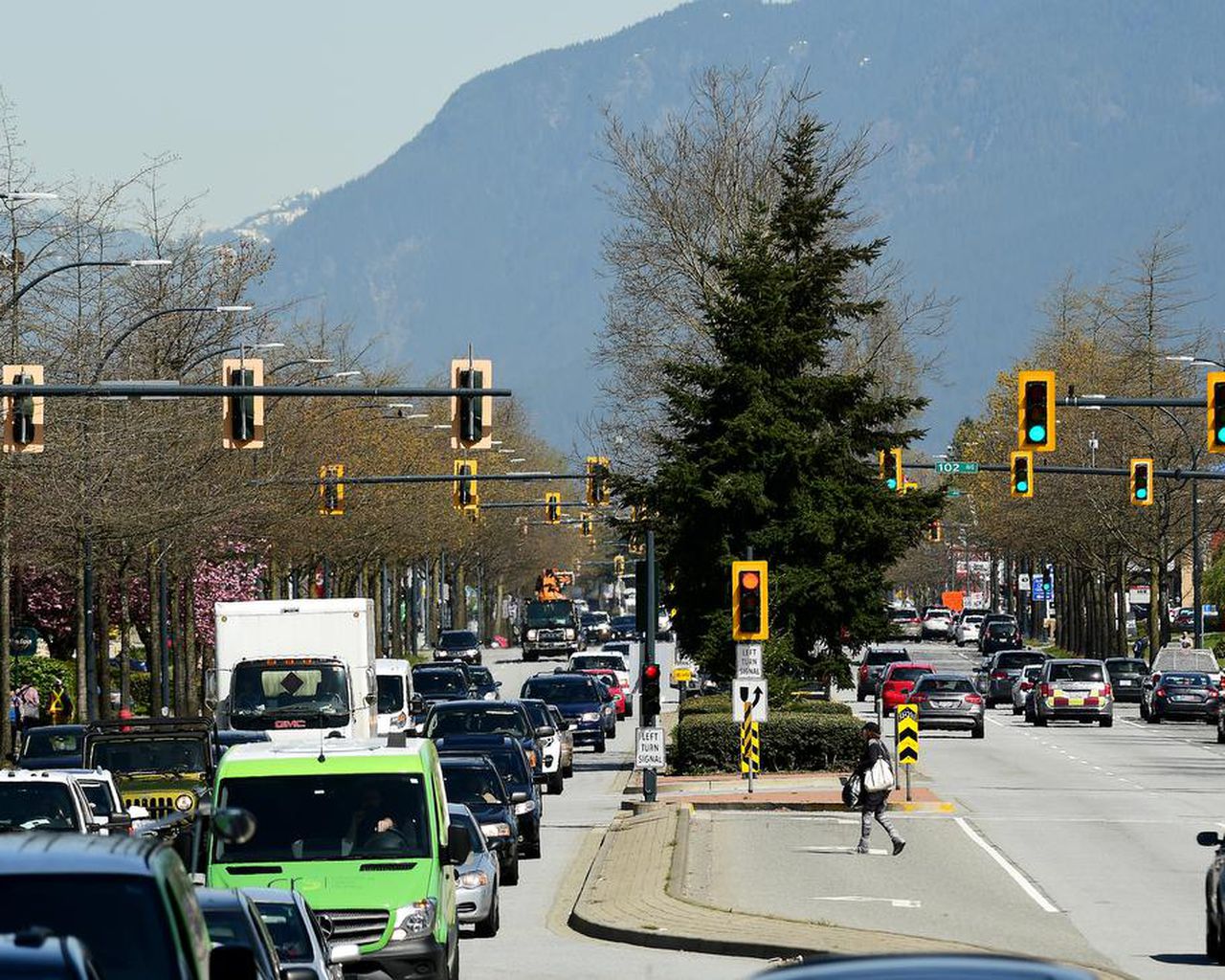
Although many have been off the road during lockdown, research is showing that the desire to drive may surge in a post-pandemic world.
Until earlier this year, Alley Vandenbergwas a regular bus rider. She’d wake up each morning and take line 15 from her apartment in the City Park neighbourhood of Denver, Colorado, to her office at a financial institution in the bustling Civic Center Plaza. Because the commute was just 2.5 miles (4km), the investment supervisor left her car at home so she could avoid the hassle of driving through the heart of downtown at rush hour. It also saved her the $200 cost of monthly parking. Then, the pandemic threw a major wrench into her seamless commute.
“In May, when my office started asking people to return, my bus route had been cut to fewer runs, and capped at 15 riders per bus,” she says. Pre-Covid-19, the bus was always standing room only by the time it got to her, “so I knew I would just end up sitting at the bus stop for an hour or two, watching buses go by because they were already at capacity”.
This, coupled with news of riders not following guidelines for mask-wearing and social distancing, led her to swallow the additional costs and commute to work by car.
She’s hardly alone in making the change. Ridership on public transport has plummeted to historic lows both in the Americas and Europe, including on the London Underground and New York City Subway. Meanwhile, recent reports suggest that, despite our apparent embrace of biking and walking during the pandemic, many people can’t wait to get back into their vehicles. And they might even use them more after Covid-19 passes. Transport planners warn that this rapid shift back to the comfort of cars may be setting the stage for post-pandemic gridlock that could hamper economic recovery in cities across the globe.
A November report by automotive-services company RAC claims that the pandemic may have set the UK back decades in attitudes of driving versus taking public transport. Out of the 3,000 car owners surveyed, 68% considered their vehicles essential for daily errands, up from 54% last year.
The pandemic had the effect of making drivers who already had cars realise that they would depend on them more – Rod Dennis
Reluctance to use public transport was at its highest in 18 years. Some 54% of respondents said safety was a top consideration, but only 43% agreed that they would use their cars less if public transport was improved, which was the lowest figure since 2002. “The pandemic had the effect of making drivers who already had cars realise that they would depend on them more than ever,” says Rod Dennis, a data-insight spokesperson for RAC. “The million-dollar question is whether or not this is a deep-rooted change.”
The generation that has been historically least interested in car ownership, Gen Z, may offer some clues. Auto Trader, a digital marketplace for cars, says 15% of its website audience in the UK between June and September was aged 18 to 24, compared to just 6% during the same period in 2019. Rory Reid, Auto Trader UK’s YouTube director, noted that “the pandemic has shifted young people’s views of car ownership and gotten them to hit the road earlier than usual, as they look to rely less on public transport and try to minimize risk of spreading coronavirus”.
The technology is coming, whether we acknowledge it or not.
The “Green” challenge is not taxing people out of their cars or airplanes, rather it is providing a reliable and user friendly “Green” transportation alternative.
Our politicians have not done that, on the contrary they still opt for “rubber on asphalt” politics, including hugely polluting light metro (the pollution from cement manufacture) and ignore using existing railways.
Currently the provincial NDP, Liberals, and Green parties and their civic acolytes are not “Green” at all, using the “Green” moniker as an election gimmick and tax grab.
What political party or politician is up for the challenge to make truly BC Green?
As it stands all we have talking heads: all talk the talk, but none walk the walk.
The future is friendly, sadly in BC, our politicians and bureaucrats cannot see 20 minutes into the future.
Fuel cell Mireo Plus H to be trialled in Baden-Württemberg
26 November 2020
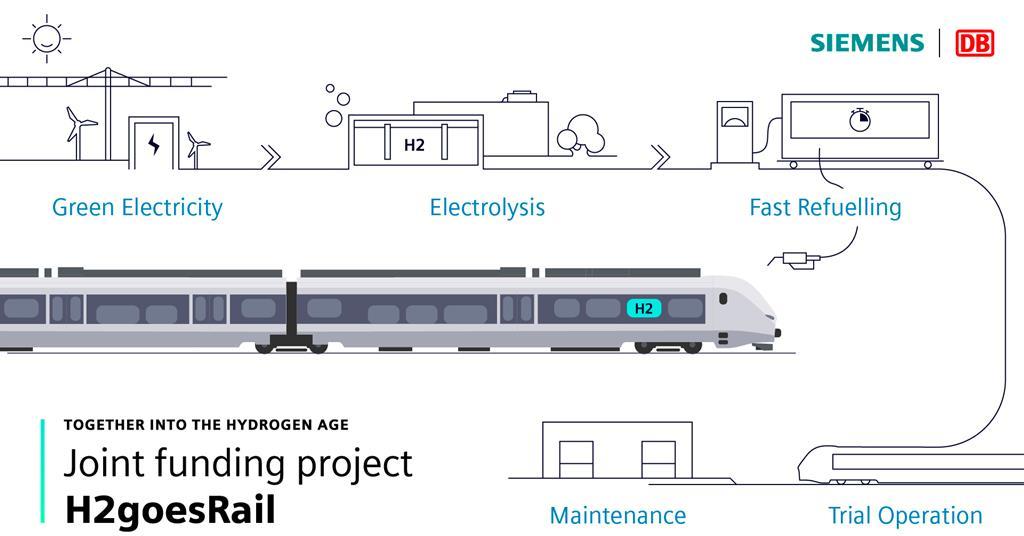
GERMANY: Deutsche Bahn and Siemens Mobility are to trial a fuel cell powered regional trainset in revenue service between Tübingen, Horb and Pforzheim in 2024, along with a green hydrogen fuelling plant.
Siemens and Deutsche Bahn plan trial of hydrogen-powered train in Germany
Published Thu, Nov 26 2020
Siemens Mobility and Deutsche Bahn have laid out plans to develop and trial a hydrogen fuel-cell train, in the latest example of major firms turning to a technology which could have a significant effect on the environmental footprint of transportation systems.
According to a joint announcement issued earlier this week, the trial is slated to commence in 2024 and will see a train travel between Tübingen, Horb and Pforzheim in the southwest German state of Baden-Württemberg.
The prototype train, known as Mireo Plus H, will use a fuel-cell and lithium ion battery. Made up of two carriages, its range will extend to as much as 600 kilometers, or a little under 373 miles. It will boast a top speed of 160 kilometers per hour.
When the year-long pilot gets underway, the hydrogen train will take the place of a diesel one. It’s hoped the trial will save approximately 330 tons of carbon dioxide.
The collaboration will also look to work on the associated infrastructure the train will need.
To this end, Deutsche Bahn is to partially refit one of its maintenance shops to service the train and will also develop a fueling station for the vehicle.
Using electrolysis, water will be split into oxygen and hydrogen, with the latter compressed then stored in a mobile unit. The electricity used in this process will come from renewable sources.
Support for the initiative is coming from the state government of Baden-Württemberg. Funding is due to come from Germany’s Federal Ministry for Transport and Digital Infrastructure.
At the moment, Deutsche Bahn has approximately 1,300 diesel-powered trains being used on regional routes. In addition, around 40% of its sprawling 33,000 kilometer network is not yet electrified.
“Especially on non-electrified routes, hydrogen fuel cell propulsion can become a climate-friendly alternative to diesel propulsion,” Winfried Hermann, who is Baden-Württemberg’s minister of transport, said in a statement Monday. “Whether powered by overhead line electricity or hydrogen – the decisive factor is that the energy comes from renewable sources,” he added.
One of many projects
The partnership between Siemens Mobility and Deutsche Bahn comes at a time when a number of projects focused on hydrogen-powered transport are taking shape.
In comments sent to CNBC via email a spokesperson for Transport & Environment, a campaign group focused on clean transport, emphasized the need to ensure hydrogen was used in a mixture of transport options.
“Rail in Europe is already largely electrified, so it is not where the big environmental gains are to be made,” they said.
“We need hydrogen in transport where batteries aren’t possible,” they added. “First and foremost, that means shipping and aviation. For long-haul trucks, the race is wide open.”
The spokesperson went on to state: “The biggest obstacle facing us is making sure that hydrogen is made from clean electricity. Producing hydrogen from fossil gas is not clean. We need to make sure it’s based on additional, renewable electricity.”
Interest in green hydrogen — a term used to refer to hydrogen that’s produced using renewable sources such as wind and solar — has started to increase in recent years.
A number of major players such as Orsted and BP are undertaking projects looking at the sector, while the European Union has laid out plans to install 40 gigawatts of renewable hydrogen electrolysers and produce as much as 10 million metric tons of renewable hydrogen by 2030.
To put the EU’s goals into context, the International Energy Agency says global hydrogen production currently amounts to roughly 70 million metric tons per year.
As the technology for hydrogen fueled trains continues to develop, the technology will become cheaper. Electric trains without the large cost of OHE.
Very Green, isn’t it.
Not in BC, where the government is OK building with prestigious light-metro and willing to spend $4.6 billion, to build a mere 12.8 km of line.
For $4.6 billion, we could rehab the E&N Railway, providing a modern regional rail service for Vancouver island. We could rehab the former Vancouver to Chilliwack interurban route and operate a modern regional rail service and we could rebuild the rail line from Salmon Arm to Kelowna, providing a modern regional rail service for the Okanagan.
Please tell me which would be more “Green”?
Hydrogen fuel cell train to be developed with EU funding
4 November 2020
EUROPE: The FCH2RAIL consortium’s €14m project to design, develop and test a prototype hydrogen fueled train has been awarded a €10m grant from the European Commission’s Fuel Cells & Hydrogen Joint Undertaking as part of the Horizon 2020 Program.
FCH2RAIL aims to produce a zero-emission train offering an operating performance which is competitive with existing diesel trains, using technology which could be applied to both new and refurbished vehicles. The overall budget is €14m, of which 70% would come from EU funds, and the remainder from the project partners.
The consortium is led by CAF, which has experience with fuel cell technology through its recently acquired Solaris bus subsidiary. The other members are German aerospace research centre DLR, Spanish national operator RENFE and infrastructure manager ADIF, car maker Toyota Motor Europe, Portuguese infrastructure manager IP, Spanish national hydrogen centre CNH2 and rolling stock component supplier Faiveley Stemmann Technik. Each consortium member will be allocated specific tasks by the end of the year, enabling work on the four-year project to begin in January 2021.
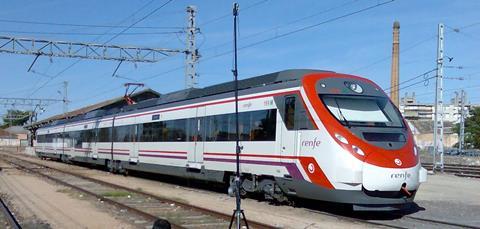
The prototype will be produced by modifying a CAF Civia Class 463 three-car EMU, a type which is found on many Spanish commuter networks. This will be equipped with a hydrogen fuel cell system and lithium-titanate batteries, giving the ability to operate through from electrified routes onto non-electrified lines.
Testing and authorisation is to take place in Spain, Portugal and a third country still to be determined.
The project will explore the use of waste heat from fuel cells to improve energy efficiency. The work programme also includes the drafting of new and updated European technical standards to ensure the interoperability of future hydrogen trains.
Light-metro, a 1970’s solution for a 1950’s transit problems and made obsolete by light rail by the early 90’s. Why oh why do politicians love gadgetbahnen.
The total cost of Honolulu’s 20-mile (32 km) rail line and 21 stations is $9.862 billion. If the add-ons approved by the board Friday are included in the final budget next year, the construction budget for rail will total $10.2 billion, not including about $1 billion in financing costs.
Remember, in Vancouver, we are spending $4.6 billion for 12.8 for light metro extensions to the Expo and Millennium Lines.
Then there is the issue of Private Public Partnerships or P-3’s, which were so designed to mitigate cost overruns. They don’t!
It is interesting to note that the Honolulu rapid transit project, was Bombardier’s last gasp to sell their proprietary Advanced Rapid Transit (ART) light metro (erroneously called SkyTrain in Vancouver), but the added cost for LIM operation, saw Bombardier pipped at the post by AnsaldoBreda and Ansaldo STS .
The desire for a mythical fast and driverless operation comes at a cost and politicians are finding that cost adds billions to the final price tag, P-3 or no.
‘How Do We Go Forward?’ Honolulu Rail Leaders Kill P3, Confront Unknown Costs
Officials will start a fourth attempt to find a way to finish the final four miles while adding hundreds of millions of dollars to the overall budget.
The quest to finish building Honolulu rail and run it for 30 years with a public-private partnership is officially over, two years after project leaders embarked on that path hoping to get the price and schedule under control.
Instead, the beleaguered multibillion-dollar transit project currently faces more runaway budget costs, a schedule delay of as much as 13 years compared to the original 2020 service date, and a future more uncertain than ever.
On Friday, Honolulu Authority for Rapid Transportation Executive Director Andrew Robbins announced his agency would take immediate steps to cancel the long-touted P3 effort after his last-ditch attempt earlier this week to convince city leaders to rejoin that procurement failed.
“This is not a moment to celebrate,” Kirk Caldwell, the city’s outgoing mayor, said Friday after a two-hour meeting with Robbins.
When the city withdrew from the P3 effort “it was a very sad and depressing moment for me,” Caldwell said. “Since then, it’s how do we go forward?”
HART rail guideway columns stand near the Keehi Lagoon Beach Park pedestrian walkway as rail snakes toward Middle Street. The city still hasn’t been able to award a contract to build the line past that area.Cory Lum/Civil Beat
HART will now start its fourth attempt since the rail project’s inception to award a contract to build the elevated rail line into town.
With the city once again short on funding, the next procurement may not include all of the transit line’s remaining four miles and eight stations to Ala Moana Center. Both Robbins and Caldwell have separately suggested a “phased” approach will be needed to eventually get that far.
Robbins said Friday it will probably take another couple of months for HART to issue the next request for proposals — and then it will take another year or so to award the construction contract that has proven so difficult.
Precisely what caused the P3 pursuit’s failure hasn’t been disclosed, although one of the companies competing for the contract shared in an earnings call this summer that its proposal was hundreds of millions of dollars more than what HART and the city had budgeted for the remaining construction.
One must have an affordable and user friendly public transit alternative.
Metro Vancouver doesn’t, nor is planning for one. Instead metro Vancouver is planning for politically prestigious mega transit projects and like all megaprojects, they cost a lot of money and government, whether it be civic, provincial or federal, has only one taxpayer to source income.
Metro Vancouver’s and the NDP’s addiction to the hugely expensive, yet extremely dated light metro, for the sheer rapture of cutting ribbons and laying plaques means the car must be singled out to pay for political largess.
Bent Flyvberg’s Iron Law of Megaprojects specifically addresses why politicians are obsessed with infrastructure at any cost.
…the “political sublime,” which here is understood as the rapture politicians get from building monuments to themselves and their causes. Megaprojects are manifest, garner attention, and lend an air of proactiveness to their promoters. Moreover, they are media magnets, which appeals to politicians who seem to enjoy few things better than the visibility they get from starting megaprojects. Except maybe cutting the ribbon of one in the company of royals or presidents, who are likely to be present lured by the unique monumentality and historical import of many megaprojects. This is the type of public exposure that helps get politicians re-elected. They therefore actively seek it out.
The die has been cast, with the NDP’s political promise to extend the obsolete SkyTrain light metro to Langley, Vancouver needs money to help pay for an extremely costly transit system woefully unsuited for the job it is supposed to do.
The sad fact, for almost $10 billion in investment to extend the dated SkyTrain light metro to Arbutus in Vancouver and to Langley, including much needed rehab and upgrades to the aging Expo Line, will probably not take a car off the road.
Vancouver’s mobility pricing debate dominates council’s approval of emergency climate plan
VANCOUVER (NEWS 1130) — A debate over charging Vancouver drivers a fee in a bid to reduce congestion and emissions dominated city council ahead of its approval of the Climate Emergency Action Plan, on Tuesday.
Council voted 6-4 to adopt the plan, including an amendment to have staff report back in two years with a feasibility plan on road pricing for all of the downtown peninsula and part of the central Broadway corridor.
“The already insufficient and unstable gas-tax revenue will decrease further as we continue to encourage an uptake of electric vehicle use, whose drivers currently pay little toward the roadway network,” the report says in arguing the need for a new revenue source.
“The number one issue we’re hearing about from the public was the City of Vancouver advancing a transport pricing framework without any coordination regionally,” says Dominato, adding it’s critical to coordinate with other municipalities and TransLink to invest potential revenue back into public transportation.
“But it has to be a regional approach because we’re so interconnected in our economies across Metro Vancouver,” Dominato says.
Mayor Kennedy Stewart acknowledged last week that the city lacks the power necessary to tax roads and the law would require changes before the city can go-it-alone on charging drivers.
Councillor Rebecca Bligh says she’s happy her amendment to separate the road/mobility/congestion vote from the rest of the plan was accepted, adding she heard loud and clear that more stakeholder engagement is necessary.
“We’re in the middle of a pandemic and in two ears we’ll still be feeling the effects of a pandemic, financially, for sure, and so we need to take all that into account while we study mobility pricing,” she says.
Bligh says she believes in the long run a system can be designed that will reduce congestion and accomplish a fair and equitable tax while reducing city expenses overall.
New focus on climate initiatives
With the adoption of the Climate Emergency Action Plan comes a commitment to add electric vehicle charging stations and city-wide residential parking permits. It also includes a plan to grow walking, cycling and alternative transportation methods.
Another large focus will be on using more sustainable building materials and reducing the use of natural gas, which accounts for 54 per cent of the city’s emissions, according to staff.
In an op-ed in the Georgia Straight this week, Councillor Christine Boyle made her case for parking fees and surcharges on high-emission luxury vehicles.
“Transport pricing and parking permits need to have fairness and equity at their core. We need to incorporate discounts or exemptions for low-income people and people with disabilities, and to consider the needs of precarious and low-wage workers,” she wrote.
Dominato and others have criticized the inclusion of additional parking fees and permitting, saying the COVID-19 pandemic has put too much strain on people’s wallets and the economy already.
“I really didn’t see a strong business case for that in terms of affordability,” says Dominato
Haveacow is an avatar of a very knowledgeable chap from back east who works with public transport.
In the arcane world of transit in Canada, speaking one’s mind or even being truthful can send one to Coventry.
To send someone to Coventry is an English idiom meaning to deliberately ostracize someone. Typically, this is done by not talking to them, avoiding their company, and acting as if they no longer exist. Victims are treated as though they are completely invisible and inaudible.
Mr. Cow’s insights and vast experience makes him a person to be listened too and indeed, Zwei does.
When one reads the following, which is a comment he made on a previous post, the first thing that comes to mind is that Broadway is not the busiest transit corridor in Canada or the USA. Far from it, it is rather average.
Of course this manipulation of the facts, repeated over and over again so the public tended to believe it, was and is the basis for the justification to build the Broadway subway.
Even TransLink, grudgingly admitted to this in a letter, when they thought they were to be faced with a possible judicial inquiry.
TransLink is confident in its data collection and peer comparisons, noting that the 99 B-Line route on the Broadway
Corridor moves 60,000 customers per day on articulated buses running every three minutes at peak times.
This is our region’s most overcrowded bus route.
Please note, this includes all bus routes that use Broadway, including the number 9, 8, 14, 16, 17, and of course the 99B. It should be noted that the only bus route which the subway will replace is the 99 B-Line and only from Commercial Drive to Arbutus!
Not only has this sham planning been approved by regional mayors, it has been approved by the province!
For the common person, this would lead to investigation and criminal charges, but not our transit planning, where six figured salaries and bonuses are the order of the day.
Sadly inaccurate and manipulated data, repeated over and over again, swayed civic, provincial and federal politicians to fund a 5.8 km almost $3 billion subway under Broadway!
The frustrating thing about the way TransLink measured the capacity ranges for the various types of rapid transit technologies was because it was based on how they believed they would run the particular transit operating technology. It wasn’t based on how other more experienced regional transit properties ran their facilities or even close to the best-known Canadian or international operating practices of each type. This pretty much guarantees the results you want. The choice of SkyTrain on Broadway was highly manipulated by this kind artificially low operational capacity and standards and practices that were poor choices for any comparison. I used Bus Rapid Transit as an example here not because I thought it was the best option on Broadway but as an example to show how poorly TransLink’s BRT option really was compared to what could have been used in their report.
The Bus Rapid Transit norms used were inferior and far from the superior practices used by Ottawa and other cities.This absolutely shoddy choice of BRT infrastructure and operating practices shows the limited understanding TransLink officials had on the subject. Thus it’s not surprising that the capacity limits believed for their BRT comparison were more than a little artificially low, especially compared to where and how they planned to operate the SkyTrain.
How TransLink Defined and Would Operate Bus Rapid Transit
I remember reading what TransLink defined as Bus Rapid Transit in many of their past reports and giggling. Ottawa has operated real Bus Rapid Transit on our bus transitway Network since 1983. Ottawa still has the most extensive network of BRT lines in North America, even with 12.5 km of BRT lines already converted to LRT and about 25 km more being converted presently. Many of the operating details of what TransLink defined under BRT would be laughed at by longtime Ottawa Transitway passengers and not considered BRT but really, a glorified express bus with nice bus stops.
Professionally, many of the operating practices presently used or what TransLink planned to use as BRT operational practices in their reports, showed at best an inexperienced operator and a lack of understanding about what you can really do with BRT. If you are going to measure BRT against SkyTrain in a given corridor to determine the most useful operating technology, actually measure a real functioning line that is working within a real BRT operation. Not the joke TransLink used to compare against the SkyTrain. What was obvious from the start was that TransLink doesn’t either understand or wouldn’t acknowledge that there are 2 main types or extremes, of BRT operations, open or closed systems. Choosing to mainly concentrate on either one has real operating advantages depending and different issues that very much effect what gets put in reports. Unfortunately the same lack of understanding can be said for their LRT and just general standard bus operating comparisons as well.
The example of BRT system TransLink used was a mostly closed system which by their nature purposely limits operational capacity and bus numbers to preserve the infrastructure’s theoretical capacity. It greatly lowers cost as a result but TransLink’s own documents downplayed the cost reality. It mainly concentrated on the capacity argument. The examples below are mostly open BRT systems which greatly increase operational capacity.
Before the conversion to LRT, during the height of both the AM and PM peak period, Ottawa’s Transitway would have a passenger level of 10,700 passengers per hour per direction. This was done using 185 to 200 buses per hour per direction on 85 separate bus routes. During the day the Central Transitway would average between 4,000 to 6,000 pass/hr/direction using 60 to 80 buses/hr/direction.
Currently, during both peak periods Gatineau’s Rapi-Bus Transitway moves 4600 to 5000 pass/hr/direction using 90 to 100 buses/hr/direction.
Brisbane, Queensland, Australia “Brisbane Transport Agency known as “Translink” operates a successful BRT “The Busway Network” moves at peak 14,000 pass/hr/direction using 225 buses/hr/direction.
Pitsburgh’s Busway Network during both peaks sees 4500-4800 pass/hr/direction using 90-95 buses/hr/direction
Capacity and Cost is Important Here
The capacity of TransLink’s BRT example in the report shows a service level of only a marginal improvement over the current bus system. Each one of these BRT examples I used uses far greater levels of buses than was currently planned for the Broadway Corridor, but their capacity far exceeds stated capacity levels of Bus Rapid Transit in the reports. The truly laughable BRT capacity used by TransLink here can’t be realistically compared against a full Light Metro line operating in a tunnel. Especially if operating costs aren’t considered important. For example, data out of various projects in Montreal, Toronto and Ottawa all showed that a full scale BRT line is lower in cost per passenger and 30 year operating costs than a Light Metro line if that particular line is moving less than 134,000 people a day. Broadway has quite a while before it will consistently break that service level.
Compare Apples to Apples and Oranges to Oranges
The BRT example used in the Broadway report was mostly operating in a painted bus lane with some physical segregation. Painted bus lanes can be easily entered by other vehicles, they are almost impossible for any police service to regulate if it is more than a kilometre long, are highly effected by parking lanes, driveways and laneways, block lengths, the number, size, frequency of and types of intersections. Different types of intersection signaling and control and the sheer number of other lanes. Painted bus lanes have a very low numerical capacity 3000 to 5000 pass/hr/direction depending on many physical conditions. Lastly, the amount of external traffic is desperately important as well for the operating effectiveness of a painted bus lane. Unless the bus lane is a non painted, physically segregated from other traffic, the comparison of this bus lane to any train in a tunnel is meaningless.
To be fair, if you are going to measure a BRT lane against a SkyTrain operating in a tunnel, the BRT lane needs to be in a tunnel as well!
The type of BRT operations used needs to have the capacity maximized to compete fairly against any type of train. The position of the BRT lanes also needs to be considered as well given other surface road conditions.
A mostly closed BRT system operating along mainly painted bus lanes, operating in the open, along with other mixed traffic lanes and having to enter signalized intersections will never compare favourably against the SkyTrain operating below grade in a tunnel.
Stations become critical here because the report had fairly numerous bus stops that could only hold two articulated buses 18 to 20 metres long each. The SkyTrain station platforms were 80 metres long. There were also more BRT stops than SkyTrain Stations. That’s just not an equal comparison!
It verifies what we all knew: that TransLink underestimated the capacity of surface rail by 150% and the time penalty by infinity.
Professor Patrick M. Condon, James Taylor Chair in Landscape and Livable Environments, UBC
Yes we all knew; American Transportation Expert, Gerald Fox told us in 2008:
The Evergreen Line Report made me curious as to how TransLink could justify continuing to expand SkyTrain, when the rest of the world is building LRT. So I went back and read the alleged Business Case (BC) report in a little more detail. I found several instances where the analysis had made assumptions that were inaccurate, or had been manipulated to make the case for SkyTrain. If the underlying assumptions are inaccurate, the conclusions may be so too.
We were also warned about ALRT (SkyTrain) back in the early 1980’s!
Our politicians, academics, and the mainstream media knew, but did not heed, either blinded by gadgetbahnen envy or were too easily bought and thus continues the planning charade that has so distorted our regional transit planning today.
Tram Capacity to UBC has been grossly understated:
Given the characteristics of the tram’s exclusive lane corridor listed above, a 2.5 minute headway is achievable. This is roughly 60% more practical capacity than a 4 minute headway.
Let us also remember:
The Millennium Line’s legal capacity, as per Transport Canada’s Operating Certificate is 15,000 pphpd.
In the 1940’s and 50’s Toronto’s Bloor Danforth streetcar line operate coupled sets of PCC cars, offing a capacity of 12,500 pphpd.
In Karlsruhe Germany, because of the success of TramTrain was seeing peak hour capacity of in excess of 30,000 pphpd.
Who says, LRT has less capacity than SkyTrain?
The Gelbe Wand or Yellow Wall of trams in Karlsruhe, Germany
As Gerald Fox summed up:
It is interesting how TransLink has used this cunning method of manipulating analysis to justify SkyTrain in corridor after corridor, and has thus succeeded in keeping its proprietary rail system expanding. In the US, all new transit projects that seek federal support are now subjected to scrutiny by a panel of transit peers, selected and monitored by the federal government, to ensure that projects are analyzed honestly, and the taxpayer interests are protected. No SkyTrain project has ever passed this scrutiny in the US.
******************************************
Background
In the Jan 2019 UBC transit report1, we see the demand forecast for transit options of Bus Rapid Transit (BRT), Light Rail Transit (LRT or street-running tram) and RRT (skytrain or ‘light-metro’). It is clear from the two pictures below, that RRT is the ‘winner’ or preferred option (as represented in the Jan 2019 report):
As an explanation to the charts immediately above, the 2019 report explains:
“ LRT ridership is forecast at about 60% that of RRT, partly because of slower travel times and the transfer penalty, but also because of capacity limitations. The increased speed, reliability and capacity of RRT attracts more ridership from latent and suppressed demand and better serves total demand along this corridor.”
According to the Jan 2019 study1, because of the following, RRT is the only suitable option for transit to UBC..
Travel times,
Transfer penalty
Capacity
It will be shown that the largest of these factors affecting LRT ridership is capacity. For this reason, this paper discusses the capacity limitation newly introduced by the 2019 study1, that was not a limiting factor in the 2012 study2 and why it is not correct.
If you build with light-metro, make damn sure you don’t build LRT anywhere near it
In Quebec, Montreal’s REM Lobby, including the Caisse and city, provincial and federal politicians could not afford to have LRT interfere with their light metro propaganda campaign and made sure Quebec City’s $3.3 billion transit plan was nixed. This is exactly what happens in Metro Vancouver when any LRT plan is put forward.
A quick reminder of the Quebec City plan; for $3.3 billion one got 3.5 km of tunnel, 23 km of LRT, 2 lines totaling 15 km of electric powered BRT, 16 km of fully segregated Bus Lanes and a massive update and upgrade to Quebec City’s Express Bus Network.
In Vancouver $4.6 billion buys you 12.8 km of light metro.
If one does build with LRT near a light-metro one would find very quickly:
Light metro costs much more to build than LRT
Light metro costs more to operate and maintain than LRT.
The long term (50 year) costs are more than double than LRT.
Light metro lacks the all important flexibility in operation that makes LRT successful.
LRT has a proven ability to attract the motorist from the car.
The good burghers of Quebec City just found out with their failed attempt to build with light rail, if light metro is being built in their province, in no way LRT will be built.
A proposed $3.3-billion tramway plan for Quebec City roads has gone off the rails.
Although “desirable,” the plan in its current state “should not be authorized,” concludes a 441-page report released Tuesday by Quebec’s Bureau d’audiences publiques sur l’environnement (BAPE), which conducts environmental assessments of major projects in the province.
BAPE hearings were held this summer to seek public comment on the ambitious plan for Quebec City’s tramway project.
“We are not going to (approve) the project,” Quebec Transport Minister François Bonnardel told reporters on Tuesday. “Can it be improved? I say yes,” he said, promising “the best project for the people of Quebec City.”
Bonnardel added he’ll be meeting with Quebec City Mayor Régis Labeaume to discuss changes to the plan, which won’t cost more than the $3.3 billion already budgeted for it.
By easing urban congestion, reducing greenhouse-gas emissions, and maybe helping politicians win elections, the tramway is seen in Quebec as a better way to move people around.
But the BAPE evaluation found that fewer than 10 per cent of trips taken in Quebec City are on public transit.
As well, transit use dropped by 4.2 per cent between 2011 and 2017, while in the same period, car trips rose 12.9 per cent.
Furthermore, with more people working at home during the pandemic, the report suggested that transit options be re-evaluated.
The BAPE report recommends more frequent bus routes, and a subway line with two cars per train, due to the city’s small population.
The greater Quebec City region has a population of about 800,000.
A tramway may be appropriate in the city centre, the report said, but in outlying areas, where the population is less dense, buses might be better.
The BAPE report also said planners considered a monorail.
Some people who attended the BAPE hearings said building the tramway would involve removing or trimming more than 5,000 trees in a city with just 32 per cent tree coverage, less than the desired 40 per cent.
In August 2019, in the lead-up to the Oct. 21 federal election, Liberal Leader Justin Trudeau announced in Quebec City that Ottawa would contribute $1.2 billion of the $3.3-billion cost of the provincial capital’s proposed tramway project.
That investment, along with Ottawa’s assurances of more federal contracts for the Chantier Davie Canada shipyard in the nearby town of Lévis, may have helped Treasury Board President Jean-Yves Duclos win re-election in his Quebec City riding in a tight race with a resurgent Bloc Québécois.
Of Quebec City’s seven federal ridings, two are Liberal, three Conservative, and two more are Bloc Québécois, making it a likely election battleground.
After the federal election, in his first meeting with Prime Minister Trudeau, Quebec Premier François Legault asked for federal funding of four more tramway projects in: Montreal’s east end; Gatineau, across the river from Ottawa; the Montreal suburb of Longueuil, and south of Montreal between Chambly and St-Jean-sur-Richelieu.
Ottawa has also committed $1.3 billion to the $4.5-billion extension of Montreal’s blue Métro line.
The Legault government considers the electrification of transit, powered by Hydro-Québec’s surplus electricity, key to meeting its commitment to a 37.5 per cent reduction in greenhouse-gas emissions by 2030, compared to 1990 levels in the province.
Mayor Labeaume, meanwhile, sees a successful tramway project as the signature achievement of his mandate, overshadowing the $400 million spent on a National Hockey League arena, which was finished in 2015 and still doesn’t have an NHL home team.
Labeaume dismissed the BAPE evaluation as “erroneous, biased, short-sighted, and filled with incoherence.” While 68 per cent of briefs presented at the hearings were favourable to the plan as it was presented, the evaluation sided with its opponents, he said.
The mayor called the evaluation a “back to the future” document, because it called for more frequent bus routes, an approach he rejected in 2017.
“Quebec City is the only city in the country with over 500,000 inhabitants that does not have a rapid transit system,” Labeaume said.
He ridiculed the BAPE suggestion for monorail, as it’s not consistent with the city’s historic character. And building a subway for two-car trains, as one study suggested, would require the same tunnelling as for a six-car train, he added.
The NDP’s refusal to give Metro Vancouver’s transit planning an independent review has condemned the region to congestion and gridlock for generations. The billions of dollars spent on rapid transit and the future billions of dollars to be spent expanding rapid transit has and will utterly fail to attract the driver from his/her cars.
The continued planning and building of obsolete light-metro, especially the now called Movia Automatic Light Metro (MALM) system, used on the Expo and Millennium Lines, has condemned the taxpayer to ever increasing ‘transit’ taxes, high fares and onerous user fess.
Breaking News: Mobility or congestion charging is now back on the table to pay for TransLink’s and the Mayor’s Council on Transit’s largess.
The continued use of the now obsolete light-metro, means that the region has now past the point of no return for transit being effective in moving people and the family chariot becomes essential for urban mobility.
How the hell did we get here?
The Broadway Subway
The Broadway subway to Arbutus, is based on the 1990’s Broadway – Lougheed Rapid Transit Project, which saw a planned LRT line being built from Arbutus in Vancouver, east to the Tri-Cities. At the time, the plan was to use light rail on the Arbutus Corridor, giving a direct Richmond to downtown Vancouver light rail service and having the proposed Broadway light rail connecting would give many advantages to transit customers.
The NDP flip-flopped from LRT to Bombardier’s new proprietary Advanced Rapid Transit (ART) system, which was a rebuild of the older Advanced Light Rail Transit (ALRT) system used on the Expo Line. Bombardier Inc. purchased the Ontario Crown Corporation’s Urban Transit Development Corporation (UTDC) at a fire sale price after Lavalin, which originally bought the UTDC, went bankrupt trying to sell the again renamed Advanced Light Metro (ALM), in Bangkok, Thailand. Lavalin returned the UTDC to the Ontario Government and then amalgamated with SNC, to become SNC Lavalin. The Ontario government quickly sold the remains of the UTDC to Bombardier Inc.
The NDP naively purchased ART and forced it onto the GVRD, when Bombardier promised to build an assembly plant in Burnaby for ART cars, with promises of major international sales and many union jobs.
Union jobs, you say? The NDP were all over that!
To sell a ART light metro to the GVRD, the NDP government promised to sweeten the deal by paying to two thirds the cost of ART only construction West of Commercial Drive. The City of Vancouver passed a by-law banning elevated construction and the only option for the driverless light metro was to place it in a subway. Then GVRD Chair and Vancouver Councilor, George Puil, was then offered to be Chair of the newly formed TransLink as a further inducement to build with the proprietary ART light-metro.
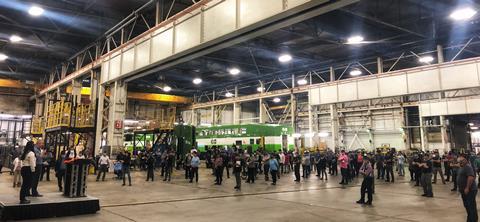
The international sales for ART did not materialize; the fabrication plant has been abandoned; union jobs gone; but subway planning continued.
Premier Horgan’s chief advisor; big subway booster and former Vision Vancouver Councillor Geoff Meggs, ensured the Broadway subway was made a transit priority. The problem it’s being built on a route with not even close to the ridership numbers that would demand a subway.
Broadway is not the busiest transit route in Canada, rather according to TransLink, it is their most congested route, which sounds more like a management problem than anything else.
The Broadway subway is now an integral part of the NDP’s election strategy and the City of Vancouver’s desire to be seen as world class, yet being part of the Millennium Line will offer no real advantages to transit customers, except making transit more cumbersome to use. The subway, when built will be force fed bus riders from many routes to pretend the subway is carrying high numbers , just as the Canada and Expo Lines do.
The subway will not reduce congestion.
The Fleetwood Extension
As the potential ridership numbers in Surrey did not warrant a “SkyTrain” extension TransLink was forced kicking and screaming to plan for light rail for BC’s second largest city. TransLink did everything in its power to increase costs, delay planning and in the end, designed the Surrey LRT not as a true tram system, rather a “poor man’s” SkyTrain, doomed to fail in the public’s mind.
Then enter the the 2018 civic elections and the former mayor of Surrey running again for mayor, claimed he was some sort of transit guru and ran on a platform of doing a flip flop from LRT to SkyTrain, and he won.
Shades of the Broadway Lougheed!
Building driverless light metro at grade creates the "Berlin Wall" effect.
His claim about building SkyTrain for the same cost of LRT soon turned out to be ‘porkies’, but TransLink, the provincial and federal governments all approved and SkyTrain it was for Surrey, but not to Langley, but just to Fleetwood, a mere 7 km extension.
The funded costs for the Broadway subway and the Fleetwood extension is $4.6 billion and if there is any money left over, an aerial tramway in Burnaby going to Simon Fraser University.
The problem is for the NDP and Metro Vancouver is that SkyTrain is a classic light metro
Light metro was a 1960’s/70’s transit innovation, before the 1980’s light rail renaissance and was an attempt to to build a small metro type system, much cheaper than a heavy rail metro. The main characteristics were elevated construction (about half the cost of subway construction), small trains operating a close intervals, and automatic (driverless) operation.
Light rail could achieve everything a light metro could do at a cheaper cost and more. By the 1990’s, light metro was deemed obsolete and as most light-metro’s were proprietary, such as Vancouver’s ALRT and later rebranded ART, obsolescence has come quickly.
With light metro, came light metro ‘philosophy’, the raison d’etre for building it.
Many academics at UBC and SFU provided one; densification. Rapid Transit (no one in Metro Vancouver calls our light metro system, light metro) is to be built on routes where densification is to be allowed.
Rapid transit was to be a driver for land development, by up-zoning land to build high rise condos and towers.
Rapid transit ceased to become a cost effective and user friendly transportation tool, rather it was built as a harbinger of densification. And with densification, came land speculation, land assembly and land development. Politicians soon jumped on the bandwagon for rapid transit and light-metro because it made their political friends and insiders very happy and very rich.
The transit customer, not so much, as to pretend that rapid transit was successful, bus customers, were forced to transfer to rapid transit and the vast majority, over 80% of SkyTrain’s ridership, first take the bus and that translates into boarding’s as the average transit commuter makes 4 to 6 boarding’s a day!
The Ghost of Transit Costs to Come
What has been ignored by TransLink, the SkyTrain Booster Club, politicians and academics is that rapid transit comes at a cost.
Funded:
– $4.6 billion for 12.8 km of R/T Line
Unfunded:
– $1.6 billion+ To complete the Expo Line to Langley.
– Up to $3 billion to rehab the aging Expo Line (needed before the Langley extension is completed).
– $1 billion+ – New SkyTrain cars to replace the aging MK.1 stock.
Wish List:
– $4 billion+ – Completion of the Broadway subway to UBC
– $5 billion+ – Sending R/T to the North Shore.
– $2 billion+ – Rehab of the Canada Line to increase capacity beyond its current limit of around 9,000 pphpd.
Honourable Mention:
$70 million+ in extra annual operating costs for the funded subway to Arbutus and Fleetwood extension.
Pandora’s Box of Costs:
The 50 year rehab, finance, operational and capital costs of the SkyTrain light-metro system.
The 50 year costs for SkyTrain are never mentioned and for good reason, they are huge.
The NDP, by supporting further light-metro construction has condemned the region to a very small and very expensive light metro system, ill designed for suburban use.
The small network will mean that it will not be a competitive option for car drivers, nor will it be user friendly. The small light metro cars will be expensive to maintain, uncomfortable for longer journey’s and definitely not user friendly; and that is to be expected because rapid transit has been designed to meet the needs of politicians and their political friends and not for the transit customer.
The result of the NDP’s transit hubris will be more cars on the road, more congestion and more gridlock at classic choke points, such as bridges. More car use will bring demands of more roads and highways, only creating more gridlock and the vicious circle will continue because at a minimum cost of $200 million per km to build, the taxpayer will only be able to afford a short light-metro line every decade.
Rail for the Valley offered a decade ago a viable transportation solution for the Fraser Valley, to reinstate the Vancouver to Chilliwack interurban service, using modern vehicles such as TramTrain or light diesel multiple units. The cost in 2020, around $1.5 billion for over 135 km of route mileage, connecting Vancouver to north Delta, Cloverdale, Langley, Abbotsford, Sardis and Chilliwack, and also connecting the many post secondary institutions and business parks along the route.
For less than the cost of the Expo line extension to Fleetwood, we could have had a much longer passenger line, connecting to many destinations; a transit service that would attract more new ridership than a 7 km SkyTrain extension or a 5.8 km subway under Broadway.
Sadly, for the NDP, just like the BC Liberals, rapid transit is being built to meet their political needs and not the transit customer needs and by doing so, ensuring that the auto is the prime transportation mode in the region.
Don’t it always seem to go
That you don’t know what you’ve got ’til it’s gone?
The NDP have paved paradise



HART rail guideway columns stand near the Keehi Lagoon Beach Park pedestrian walkway as rail snakes toward Middle Street. The city still hasn’t been able to award a contract to build the line past that area.Cory Lum/Civil Beat





Recent Comments