As the regional mayors are gung-ho on the $200 million SFU gondola, I went back to my files and found some more interesting information on using gondolas or aerial tamways.
*
I see one very big problem, the aerial tramway is a transit system and must adhere to Transport Canada’s rules and one big problem is the gondolas never fully stop in stations.
*
This means a minimum of two operators must be on duty at the stations during operation and as wages are a large percentage of operating costs, there is no real economic advantage for an aerial tramway, especially on a route where the vast majority of customers will use the $1.00 a day U-Pass.
*
Another heavily subsidized transit vanity project from TransLink!
*
$200 million seems to be a lot of money because TransLink does not want to properly chain buses during the few weeks of snowy weather at SFU.
Capacity is listed as 4100 passengers per hour, with 22 out of 28
passengers per cabin seated, that’s ~3200 seats phpd.
Calgary offers ~12,000 seats phpd, with the possibility to extend it to
15,000 seats phpd by adding a fourth car per trainset.
The ropeway with the highest capacity ever built was (is?) at Koblenz,
Germany, passing over the Rhine for the “Federal Horticultural Show”
in 2011. It can carry 7,600 passengers phpd. The ropeway was chosen
because it doesn’t require a bridge over the river and one end is on a
fortress high above the river.
Speed: At most 10 m/s (= 36 km/h = 22.5 mph). Light rail/streetcars
achieve twice that when running in the street, and up to three times as
much, when running on private right-of-way, for station distances over
~1 mile.
The “peak 2 peak” gondola runs at 7.5 m/s (=17 mph, that’s *top* speed).
Accessibility: The gondolas never fully stop in stations, they keep
moving. Try to board such a thing if you have difficulties walking,
with a wheelchair, a baby buggy or significant amounts of luggage.
Besides, such a system can’t be integrated as well into a city as
low-floor light rail/streetcars, from the perspective of the feet of the
passengers. Just like anything that requires full grade separation,
such as e.g. “Skytrain”.
It’s the old story in metro Vancouver, Transit is not built to better public transit, it is built for land development. To sell it to very gullible and uninformed politicos you dress up the transit as a gadgetbahnen, all glitzy and nice. The politicians all act if they got their very first electric train set to play with.
From 2011……
It seems there is interesting political connections with SFU and TransLink, with the gondola project. TransLink Board member, Howard Nemtin, President, Nemtin Consultants Ltd., is also a member of the The SFU Community Corporation board. Could it be that the Trust’s real estate development arm, UniverCity will use the gondola as a sales tool for their development on the mountain; of course paid for by the regional taxpayer through TransLink?
Other coincidental connections on the SFU Corporation Board include TransLink Board Chair, Nancy Olewiler, who also is the Director of the School of Public Policy in the Faculty of Arts and Social Sciences at Simon Fraser University and a blast from the past, Jane Bird, who is famous for her obfuscation with the Canada Line debacle.
Let us not forget that TransLink subsidizes transit for over 900 Burnaby Mountain residents, with a community transit pass that gives them unlimited access to the regional buses and trains for just $30 a month, a perk that seems only to pertain to SFU and its environs.
It seems like again we have foxes in the hen-house, when it comes to the planning for the SFU gondola project and one wonders if the fix is in for a now $120 million (up $50 million from the original $70 million) gondola to SFU.
The proposed $120-million Burnaby Mountain gondola project poses a dilemma for a group maintaining trails in the environmentally sensitive area.
According to Ron Burton, president of the Burnaby Mountain Biking Association, the construction and operation of a gondola system that would link the Production Way University SkyTrain station to Simon Fraser University could have serious ecological impacts.
They will have to cut and they could cut up Burnaby Mountain in order to put up the gondola and service the towers, Burton, who is also a Burnaby school trustee, told the Straight in a phone interview.
Burton pointed out that the gondola infrastructure would slice through the Burnaby Mountain Conservation Area, which includes wetlands, streams, and woods that serve as habitat to various wildlife.
However, Burton noted that the project appears to make some economic and environmental sense.
According to material put out by TransLink, the gondola system could eliminate 35,000 to 55,000 hours of diesel bus operations going up and down Burnaby Mountain. The transportation authority also claims that the project would save up to two million hours of transit and car travel time by 2021.
Our position is a wait-and-see, Burton said, adding that his organization wants to see more details.
For residents of the Forest Grove community on the lower slopes of Burnaby Mountain, the time has come for action.
Resident Christian Rarinca, a spokesperson for the Citizens Opposing the Gondola, will address members of the Metro Vancouver regional planning committee in a meeting on Friday (June 17).
According to Rarinca, the gondola system would cut across the neighbourhood. They propose to have at rush hour a gondola leaving every 40 seconds, leaving from both sides of Production Way and SFU, which gives us an average of 20 seconds and a gondola will go over our heads, Rarinca told the Straight by phone. It is really something that not only destroys the character of the neighbourhood but also it has no benefit for us. The gondola doesn’t stop at Forest Grove to take passengers.
COG prepared presentation to the Metro Vancouver planning committee also raises concerns about safety risks. A copy of the paper provided to the Straight by Rarinca states that the construction of towers for the gondola may affect pipelines operated by energy company Kinder Morgan, and this could lead to explosions.
The public has until June 30 to submit comments on the proposed gondola project. TransLink spokesperson Ken Hardie didn’t return calls from the Straight before deadline.
The NDP have now blundered in approving the Broadway subway and photo-ops by Premier Horgan attributed what LRT is very good at and light-metro which is not very good at. Wrong script, wrong mode.
LRT has a proven record of modal shift, attracting motorists from the car. SkyTrain has no such record.
LRT has a proven record attracting new customers to transit, SkyTrain has a very poor record of attracting new customers as over 80% of SkyTrain’s ridership first take the bus and buses are extremely poor in attracting new ridership.
LRT has a proven record of attracting customers to businesses along its route. Subways, due to their nature of being underground has no such record as customers underground to not see the businesses on the street.
The Broadway subway will achieve nothing, except to show how dishonest and corrupt our regional transit planning is. Shame on everyone on this travesty of planning.
And now, a final insult. The following is a comment by Haveacow …….
A former head of Translink’s maintenance operations suggested that, removal of the 4th rail and purchasing cheaper, and most likely larger LRV’s would save 40% – 45% in operating costs compared to Skytrain. Simply removing the 4th rail and switching to standard electric motors alone would save 25%. The LRV’s would have to be converted to 3rd rail power pick-ups but that’s not too difficult or expensive. Keep in mind he said this as he was retiring, so the big wigs couldn’t fire him.
This makes absolute, those who say Movia Automatic Light Metro (MALM), a.k.a, SkyTraion; a.k.a. Advanced Light Rail Transit; a.k.a. Advanced Rapid Transit; is cheaper to operate than light rail are telling “porkies” very big Porkies!
From 2015.
Despite a growing number of supporters, such as the business community, the City of Vancouver; most of the regional mayors, the provincial NDP and their combined sundry of shills clamouring for a SkyTrain Broadway subway, many serious questions remain unanswered. The following op-ed commentary published by The Toronto Star questions whether the concept of building a heavy rail subway to replacing the aging Scarborough light metro amounts to a subway a billion-dollar boondoggle?
The key phrase in the article is; “An expert panel established by city council found an LRT superior to a subway on all counts: funding, economic development, transit service, sustainability and social impact.”
It is strange that the likes of Mayor Greggor Robinson, Geoff Meggs, various business groups and Chamber’s of Commerce have come to an opposite conclusion about a Broadway subway, but then, real transit experts have never been asked.
A no value-for-money case can be made for the Scarborough subway extension, yet Toronto’s Mayor John Tory and Ontario Premier Kathleen Wynne continue to support it.
Back in BC, TransLink has not even done such a study for the proposed Broadway SkyTrain subway, yet actual planning is under way.
The Broadway subway could be Vancouver’s billion dollar boondoggle which offers the taxpayer, no value for money, unless the taxpayer is assembling land along Broadway for major development!
By: R. Michael Warren Published on Sat Jan 03 2015
Is the Scarborough subway another billion-dollar boondoggle?
Tory ducks the Scarborough subway controversy by saying the decision has been taken by council. And he doesn’t want to put a stick in the eye of the Liberal government.
This is political pandering to Scarborough voters and the Wynne Liberals. Tory has neglected to make the case for a three-stop subway link that will cost $3.56 billion (USD $2.02 billion) $1.6 billion (USD $1.35 billion) more than a modern seven-stop light-rail transit line.
Tory chose this political strategy despite knowing that three highly qualified and independent groups had already recommended an LRT.
Metrolinx favoured replacing the aging RT with a modern LRT link that would cost $1.8 billion (USD $1.52 billion).
An expert panel established by city council found an LRT superior to a subway on all counts: funding, economic development, transit service, sustainability and social impact.
The Pembina Institute also supports an LRT for Scarborough. They maintain it would deliver twice as much service for every dollar invested.
By any measure, the subway option shouldn’t even be on the table.
The 30,000 riders per hour subway capacity is overkill.
Peak ridership is expected to grow to only 9,000 by 2031.
The subway option will cost about twice as much and, according to Pembina, attract only 23 million riders a year compared to 31 million for an LRT.
By supporting a subway, Tory is placing a $910-million (USD $772.2 million) tax burden on the shoulders of Toronto taxpayers.
Fully $745 million (USD $632.1 million) of this has to come from a property tax surcharge, which amounts to $41 a year (USD $34.79) for 30 years for the average homeowner.
That’s on top of the tax hikes that will inevitably flow from the rest of Tory’s election agenda.
But when it comes to Tory’s own SmartTrack plan, he stresses it will not burden local taxpayers and must go through a rigorous examination process.
He said recently, The express purpose of what we’re doing here is to move forward with a fact-based, transparent process.
This begs the question: why does SmartTrack get a comprehensive fact-based analysis while the Scarborough subway doesn’t?
Part of the answer rests with Wynne, who backed the subway option in an effort to win seats in vote-rich Scarborough.
Tory went along in pursuit of Liberal support for his mayoralty bid and for future favours.
Wynne compromised sound transit planning while chasing the 2013 byelection seat in Scarborough-Guildwood and more recently in the June provincial election.
She committed the $1.4 billion (USD $1.18 billion), originally meant for an LRT, to the subway link, knowing it was not the best financial or operating option.
During the last election Wynne promised all future transit infrastructure investments would be based on a rigorous business case analysis.
She still hasn’t explained why this decision-making process isn’t being applied to the Scarborough transit link.
Her political strategy worked.
The Liberals won all five Scarborough seats.
But if the subway link is built, these seats will cost taxpayers an additional $1.6 billion (USD $1.35 billion) and saddle Scarborough with a transit solution that’s inferior to an LRT.
Does all this have a familiar ring?
Surely by now Wynne has developed the ability to see a billion-dollar boondoggle coming down the track.
Building a subway extension into Scarborough has all the hallmarks of a spending scandal.
It’s unlikely that Wynne or Tory will still be around for the opening in 2023.
But tax-weary Toronto and provincial voters will be.
And by then they’ll still be paying for an overbuilt and underused transit white elephant.
There’s still time for Wynne and Tory to put the Scarborough transit link through the same rigorous value-for-money analysis they say is being applied to every other transit investment.
It would go a long way toward showing they’re serious about making transit decisions based on costs and benefits rather than wasting money on parochial politics.
R. Michael Warren is a former corporate director, Ontario deputy minister, TTC chief general manager and Canada Post CEO. r.michael.warren@gmail.com
……….. or cutting through the BS about light rail, SkyTrain and BRT.
The following is a guide plus definitions.
ALM: Automatic Light metro, the fourth marketing name given for the SkyTrain family of light-metros, when Lavalin briefly owned SkyTrain before going bankrupt.
ALRT (1): Advanced Light Rail Transit, the second marketing name for SkyTrain.
ALRT (2): Advanced Light Rapid Transit, the third marketing name for SkyTrain, when Advanced Light Rail Transit failed to find a market.
ART: Advanced Rapid Transit, the fifth marketing name for SkyTrain, used by its current owners, Bombardier Inc.
Automatic (Driverless) Operation: A signaling system that permits train operation without drivers. Contrary to popular myth, automatic operation does not reduce operating costs because there are no drivers, because attendants must be hired instead to permit safe operation. Automatic signaling was designed to reduce signaling staff, not operation staff.
Bus Rapid Transit (BRT): Generally means Express Buses, a true BRT needs a very expensive and land consuming busway or highway or be guided.
Bored tunnel: A tunnel boring machine also known as a “mole”, is a machine used to excavate tunnels with a circular cross section through a variety of soil and rock strata. They can bore through anything from hard rock to sand.
Busway: A route needed for BRT. Busways can be conventional HOV lanes or exclusive roads for buses. Busways can be equipped with raised curbs or rails for bus guidance.
Canada Line: Vancouver’s third metro line which is a grade separated EMU operation and is not compatible with the rest of the SkyTrain light metro system in operation.
Capacity: A function of headway multiplied by vehicle capacity, which in turn is dependent on station station platform length measured in persons per hour per direction.
Community Rail: a government strategy supported by the rail industry. It engages local people in the development and promotion of local and rural routes, services and stations. Community Rail routes remain connected to the national rail network, and train operating companies run the trains and stations.
Consultation: To sell a transit decision to the public after the decision has been made.
C-Train: The Calgary light rail system.
Cut and cover: A method of building a tunnel by making a cutting, which is then lined and covered over. (Civil Engineering) designating a method of constructing a tunnel by excavating a cutting to the required depth and then backfilling the excavation over the tunnel roof
DMU: Diesel Multiple Unit – A diesel multiple unit or DMU is a multiple–unit train powered by on-board diesel engines. A DMU requires no separate locomotive, as the engines are incorporated into one or more of the carriages. Diesel-powered single-unit railcars are also generally classed as DMUs.
EMU: Electrical Multiple Unit – An electric multiple unit or EMU is a multiple–unit train consisting of self-propelled carriages using electricity as the motive power. An EMU requires no separate locomotive, as electric traction motors are incorporated within one or a number of the carriages.
Evergreen Line: The 11.4 km newly finished portion of the old Broadway/Lougheed Rapid Transit Project. When the NDP forced the SkyTrain Millennium Line onto TransLink, there was not the money left order to complete the line to the Tri-Cities. Now completed.
Expo Line: The first SkyTrain line built, completed in late 1985. The Expo Line was built in three sections. The Waterfront to New Westminster section (cost a much as LRT from Vancouver to Whalley, Lougheed Mall and Richmond Centre), the Skybridge, section across the Fraser river to Scott road Station, and the final section to Whalley in Surrey.
Grade: The vertical rise of a railway track, normally given in a percentage (1% grade = a 1 metre rise in 100 metres). Industry standard grade for LRT is 8%; Sheffield’s( LRTA) operates on 10% grades; the maximum grade for a tramway is located in Lisbon, where the streetcars operate, unassisted, on 13.8% grades.
Flip-flop: Make an abrupt reversal of policy. common with transit planning in MetroVancouver.
Goebbels Gambit: The fine art of repeating a lie often enough that it is perceived as the truth.
Guided Bus: A BRT that is physically guided by either a raised curb or a central rail. Some guided buses are considered monorails.
Headway: The time interval between trains on a transit route.
Hybrid: A transit system that is designed operated as a LRT/light metro mix. Generally very expensive as it uses the most expensive features of both modes.
Innovia: The sixth name SkyTrain was marketed by (no buyers).
ICTS: Intermediate Capacity Transit system, the first name SkyTrain was marketed by.
Interurban: An early streetcar which operated at speed on its own R-o-W connecting urban centres.
Light Rail Transit (LRT): A steel wheel on steel rail transit system that can operate economically on transit routes with traffic flows between 2,000 pphpd to over 20,000 pphpd, thus bridging the gap on what buses can carry and that which needs a metro. A streetcar is considered LRT when it operates on reserved rights-of-ways or R-o-Wa’s for the exclusive use of the streetcar/tram. Number of LRT/tramways in operation around the world over 500; light railways (many use LRV’s) and over 120; heritage lines over 60.
Light Metro: A transit mode, generally a proprietary transit system, that has the capacity of LRT, at the cost of a heavy-rail metro.
Light Rail Vehicle (LRV): A vehicle that operates on a LRT or streetcar line. Also called a streetcar, tram, TramTrain or interurban.
Lysenkoism: used metaphorically to describe the manipulation or distortion of the scientific process as a way to reach a predetermined conclusion as dictated by an ideological bias, often related to social or political objectives.
Mass Transit: A generic term for heavy-rail metro. See rapid transit.
MAX: The Portland Tri-Met LRT system.
Metro: An urban/suburban railway that operates on a segregated R-o-W, either in a subway or on a viaduct, due to long trains (5 cars+) and close headways. There are 174 heavy/light metros in operation around the world.
Millennium Line: The second SkyTrain Line built, using the new Bombardier ART cars.
Monorail: A transit mode that operates on one rail. There are two general types of monorail: 1) hanging monorail and 2) straddle beam monorail (not a true monorail). Some proprietary BRT systems are also classed as monorail.
Movia Automatic Light Metro: The seventh and last name that SkyTrain has been Marketed under, with Linear Induction Motors a customer add on.
Priority Signaling: A signaling system that gives priority to transit vehicles at intersections.
Proprietary Transit System: A transit system who rights are exclusively owned by one company. Transit operations who operate proprietary transit systems must deal with only one supplier.
Rapid Transit: A generic term for metro. See mass transit. Rapid Transit is not Light Rail Transit
Reserved Rights of Way: An exclusive R-o-W for use of transit vehicles, can be as simple as a HOV lane (with rails for LRT) or as elaborate a a lawned boulevard or a linear park complete with shrubs.
SkyTrain: An unconventional proprietary light-metro, powered by Linear Induction motors, marketed by Bombardier Inc. Currently there are 7 SkyTrain type transit systems in operation around the world. ICTS 2; ALRT (1 & 2) 1; ART 4.
Streetcar: A steel wheel, on steel rail electric (also can be diesel powered) vehicle that operates in mixed traffic, with little or no priority at intersections. Also known as a tram in Europe. Streetcars become LRT when operating on reserved R-o-W’s.
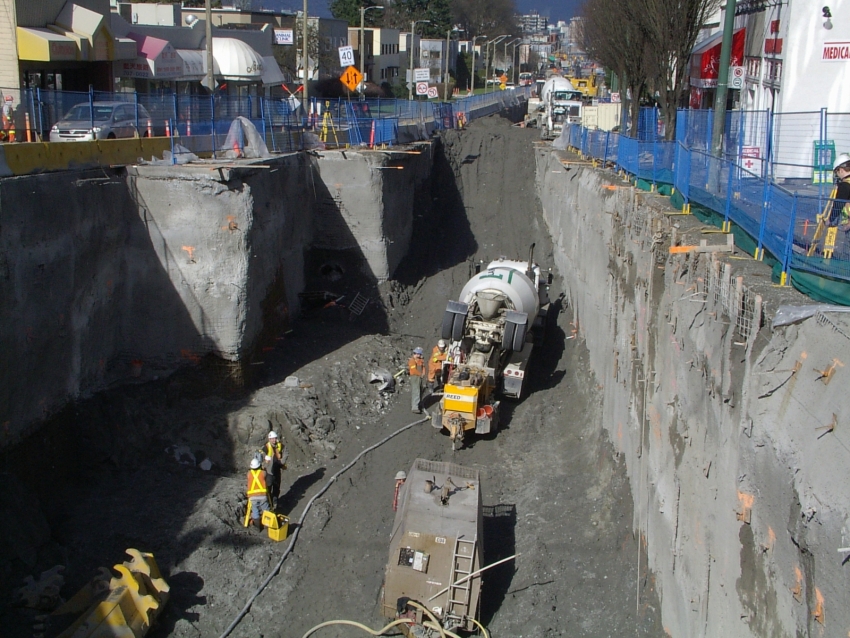
Subway: An underground portion of a rapid transit line. Subways may either be bored or cut and cover or a combination of both construction methods.
TTC: The Toronto Transit Commission.
Tram: European term for streetcar, as the Europeans do not use the term LRT.
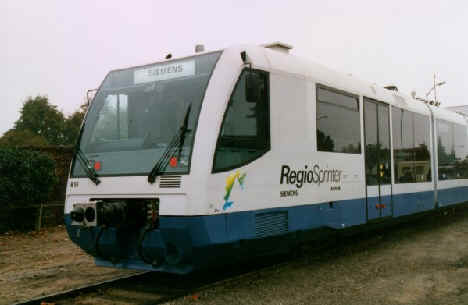
TramTrain: A streetcar that can operate on the mainline railways, operating as a passenger train.
TransLink Speak: The lexicon used by TransLink to mask problems. Example: medical emergency on SkyTrain means a suicide.
Viaduct: A viaduct is a bridge composed of several small spans.
What we are getting is a $3 billion subway, which will operate a capacity limited proprietary railway, which will drive up TransLink’s operating costs and will not take a car off the road nor improve businesses along the route.
Oh yes, how do forced transfers reduce travel times?
Well they don’t, but Horgan reading from the same “song and dance” script as other premiers before him repeats the same very misleading information.
This is the real story of the Broadway subway.
This subway will now retard all transit initiatives for the next decade, but do not tell Premier Horgan and the NDP this because they refuse to listen because they hope what few union jobs this will bring will keep them in office.
As always, the South Fraser gets royally screwed.
So this Presser/photo-op probably means a provincial, if not federal election is just around the corner. It better be for the NDP because the bad news, like the ever more costly site -C dam will soon show the NDP’s penchant for FastFerry style transit projects comes at an ever increasing cost to the taxpayer.
The ship of fools has sailed…………….
Addendum:
Acciona’s key consultant for its B.C. bid wins since the NDP came to power?
* None other than former SNC-Lavalin B.C. EVP Jim Burke, who would have been called to testify had the corruption trial not ended in a plea bargain.
* Acciona is also behind the North Shore Wastewater Treatment Plant debacle.
Vancouver’s Broadway subway line from Commercial to Arbutus set to be built by 2025
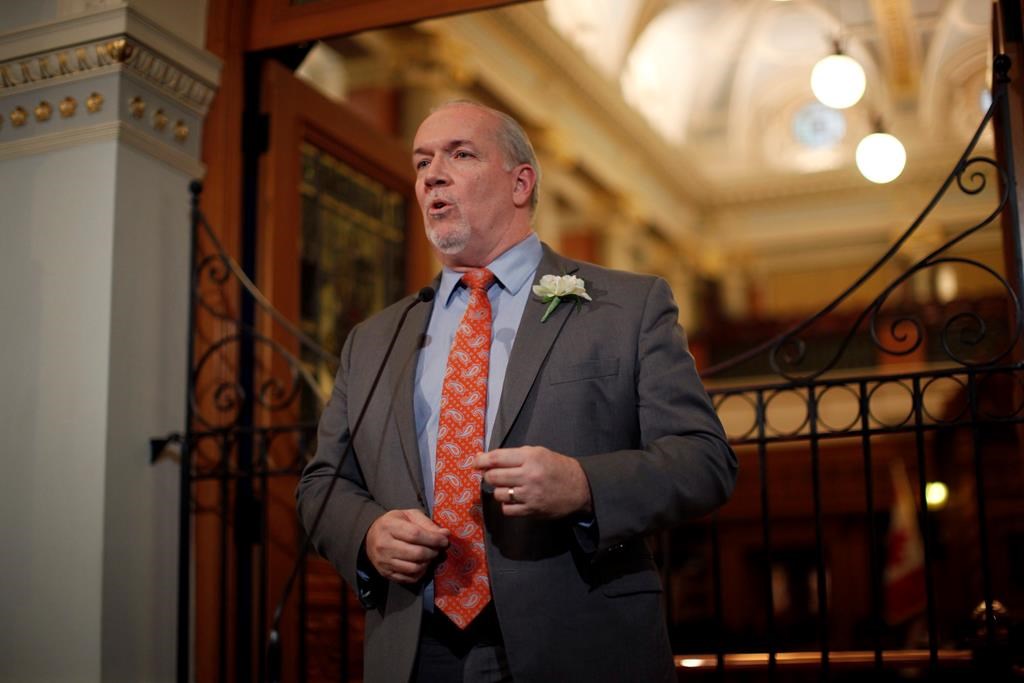
Premier John Horgan says British Columbia boasts Canada’s strongest economy but growth is threatened by a shortage of affordable housing for workers and their families. Premier Horgan answers questions from the media during a press conference following the speech from the throne in the legislative assembly in Victoria on Tuesday, Feb. 12, 2019. THE CANADIAN PRESS/Chad Hipolito. THE CANADIAN PRESS/Chad Hipolito
Shovels are set to be in the ground this fall for the much anticipated Broadway SkyTrain extension from Commercial station all the way to Arbutus Street in Vancouver.
B.C. Premier John Horgan says the project is expected to be completed by 2025. The construction contract has been awarded to Acciona-Ghella Joint Venture.
The contract to fund the 5.7 kilometre extension is valued at $1.729 billion and covers the design, construction and partial financing of the project.
The cost estimate for the Millennium Line Broadway expansion has now gone up from $1.98-billion in 2015 up to $2.83 billion.
“As we restore the economy through B.C.’s Restart Plan, major infrastructure projects like the Broadway Subway line will be key to our recovery,” Horgan said.
“When completed, the Broadway Subway will transform how people get around in Vancouver. It will mean faster travel to work and school, better access to local business and fewer cars on the road.”
The avatar, “Haveacow” is used by a very knowledgeable Canadian transportation specialist. He knows what he is talking about and Zwei greatly respects his input.
Since SkyTrain was first foisted on the taxpayer, one of the many false claims for building with it, was that it was fast.
There are problems with this claim, including:
1. The initial Expo Line had less than half the amount of station/stops than comparable LRT at the time, thus the Expo Line was indeed fast; but, if an “apples to apples” comparison was made, with both having the same amount of station/stops, LRT would have been slightly higher due to having less dwell time, as demanded for driverless transit systems.
2. Speed alone does not attract ridership but many factors that make transit user friendly, including user friendliness. If over all comute time was counted (including transfers, etc., travel time for SkyTrain is not superior to light rail.
The SkyTrain Lobby, ever promoting fast transit are also promoting a small transit network, higher taxes and fares, and a transit system that is only fast because it is not user friendly.
From Mr. Haveacow!
I Understand People Want Speedy Transit.
Folks, Speedy Transit Has Huge Hidden Costs!
I remember the debate around the Sheppard Subway in Toronto, mainly because the house I grew up in was a 3 to 5 minute walk from Sheppard Ave. East in Scarborough. It didn’t matter to the supporters, including me at the time, how many passengers there should be, for a subway to exist. What was important wasn’t that the surface bus routes along Sheppard at the time moved about 6000 passengers/hour/direction or that the roughly 65 to 75 buses per hour at the time were mostly packed, even outside peak periods.
What was important was that even with express buses it took 20 to 30 minutes of traveling along Sheppard Ave. East, just to get to the Yonge Street Subway. I was spending, depending on the time of day, 1 hour, 10 minutes to 1 hour 30 minutes to get home in Scarborough or go to downtown to school. If I took the other quickest route downtown to school, south on Warden Ave. to Warden Station, then the Bloor-Danforth Subway to the Yonge Line at Yonge and Bloor Station, then transferring to the Yonge Line to finish the trip to either Dundas or College Stations, opposite if I was going home, it still took me roughly the same time. (So passengers stuck on crowded express buses along Broadway, I UNDERSTAND AND GET IT ,THE TRIP ISN’T A FUN TIME!)
GO Transit’s Stouffvile Commuter Rail Line from Agincourt Station was considerably faster, around 40 to 45 minutes, but the GO Trains on that line only traveled during morning and afternoon rush hour. THANKFULLY TO THE GO RER
PROJECT, THIS WILL SOON CHANGE. The peak hour only line was nearly useless for a University student whom had 25+ hours a week of classes, labs and official architectural studio time which depending on the day, had classes that started as early as 8 a.m. or as late 1 p.m. Depending on the day, I could be in class until 10 p.m. on certain evenings (at least 2 times a week). Endless hours of group work just added to this dilemma.
My point is for most people, a train of some sort traveling through a tunnel is often the only way most non transit people (people who don’t work in the industry) can honestly visualize there being any time savings when dealing with the combination of heavy surface traffic and way too many car centric, traffic light controlled intersections.
Whereas people who do work in the industry know that, with good design, modern surface LRT routes and or modern surface mainline railway lines controlled by modern signaling can easily come close to or equal the travel times of below grade train tunnels. At a fraction of the cost.
ZWEI, what would be most helpful to the cause are multiple articles about how modern surface mainline railways and LRT signaling combined with good design can be almost or just as efficient with travel time savings as overly expensive tunnels.
My 2 Cents Worth.
Look folks, the concept of rail rapid transit tunnels going everywhere is just not affordable or helpful. An almost completely tunneled Skytrain route from V.C.C. to U.B.C. is desired by the public however, many other cheaper options were just never considered or effectively looked at by Translink. I read all your planning reports on the subject, many things that could have been done to better manage bus flows as well as other rapid transit operating technologies, scenarios and plans were never considered. Unfortunately Zwei, MAY have a point when he believes that the Broadway Line as currently designed, was a fix for developers right from the beginning.
Given the actual pre-Covid transit passenger numbers for Broadway (65,000-100,000 passengers a day depending on how wide a corridor you choose), a mostly tunneled Skytrain line 12 to 14 km long, costing anywhere from from $5.7 to $7.5 Billion (depending on length, number of stations and tunnel design), taking anywhere from 10 to 14 years to build both stages, is frankly, JUST NOT WORTH IT, FOR NOW. It is also a project that will tie up a huge amount of transit capital funding for a better part of a decade. There will be little money for anything else, especially extensions of the Canada Line or a rail transit line to North Vancouver.
Keep in mind as well, if you want significantly more passengers on the Expo Line, expensive repairs and upgrades must be done. An increase of 10 to 20 % in daily passengers is possible but anything more will require hugely expensive and time consuming work. The line is at its limit and it is getting older by the day, you can make the trains longer but little else is possible without big spending.
Citizens of Langley, by not implementing LRT and forcing an overly expensive above grade Skytrain line, you just guaranteed that, not only are you building fewer km’s of Skytrain compared to how many km’s of LRT you could have had (16 km of Skytrain vs. of 27 km of LRT). You have also made certain the fact that, no Skytrain or any rail rapid transit line will be going to the centre of Langley, until long after 2030. Considering the competition with other line extensions, once the Broadway Line to UBC is complete. It may be well into the 2040′s before construction of any rail line into Langley is finished. The moral of this story, tunnels cost not only a lot of money but time as well.
First, before any discussion about rail transit, including Light Rail Transit, we must define LRT and other transit modes. The following is a brief descriptions of various transit modes advocated as solutions for transit in the region.
Commuter rail:
Locomotive hauled rail coaches or diesel or electric multiple unit trains, catering specifically to peak hour transit demands.
Passenger rail:
Any regularly scheduled passenger rail service.
Light Rail Transit:
A rail mode, that economically bridges the gap between what passenger loads that can be economically carried by bus and that of a metro, between 2,000 and 20,000 persons per hour per direction. Comes from the English term light railway or a railway light in costs. LRT is able to operate in mixed traffic on city streets, its own reserved rights-of-way, or on mainline railways. LRT can be built as a simple streetcar or as a light metro, and can combine any and all of the previous examples on one route.
The metro family, including light metro:
A rail mode that operates on segregated rights-of-ways, due to longer rakes of passenger vehicles operating at close headways. Metros generally operate on elevated guideways or in subways and has more intensive signaling, sometimes including driverless operation. Metros are built to cater to large passenger volumes, in excess of 300,000 or more passengers per route (line) per direction per day.
Bus rapid transit (BRT):
Any limited stop bus service including guided bus and buses using busways.
The problem:
The population of the Fraser Valley is growing at an unprecedented rate, roads and highways are congested and pollution in the upper regions of the valley is increasing rapidly. The provincial government in 1980, forced the proprietary SkyTrain light metro system upon the GVRD instead of previously planned for light rail. For the cost of LRT going from downtown Vancouver to Lougheed Mall, Whalley, and Richmond Centre, the region got SkyTrain from downtown Vancouver to New Westminster. Some $5 billion later we have SkyTrain to Whalley and the Millennium line, the only metro in the world that goes nowhere to nowhere. The annual subsidy for SkyTrain is now over $200 million annually and has given rise to the myth that “we do not have the density for rapid transit“. We have plenty of density for LRT, we never did have the density for metro.
The provincial government has again forced another, now $2.5+ billion, metro system onto TransLink, on a route without sufficient density to provide the ridership needed to justify its construction costs, which in turn will further increase the annual subsidy for metro in the GVRD.
TransLink, with absolutely no experience with modern LRT is planned for a hybrid light metro/rail line costing well over $100 million per km to build, later fiddled………..
……….. a business plan to support SkyTrain light-metro; again on a route that doesn’t have the sufficient ridership to justify the line and again will further increase the annual subsidy for the GVRD’s grand railway projects.
Because of the huge cost for TransLink’s rail transit, the provincial government claims that there isn’t the density for rapid transit in the Fraser Valley and has embarked on a $4.5 billion “Gateway” highways and bridge program. Problem is new highways and bridges only attract more traffic and soon highways become congested – again!
A Note on Density:
Many people, including TransLink confuse density with ridership. Density is the number of people living per square km. in a region and ridership is the number of people using transit. People only will use public transit if the public transit services their travel needs and if transit doesn’t serve where “I” want to go, “I” will not use it.
What TransLink and the GVRD are trying to do is increase density near a SkyTrain routes and hope that the sheer numbers brought by higher density will provide the ridership for their metro. Sadly what has happened is that yes, more people are using SkyTrain, but even more people are using the car! One can densify all one wants but if public transit doesn’t serve the needs of the population, people will not use it.
Many smaller European cities operate extensive light rail networks and carry large volumes of customers because the public transit services where people want to go.
The key is build more rail transit, serving more destinations, but built it cheaply!
The Karlsruhe Solution
Karlsruhe, Germany, with a regional population on par with the Fraser Valley has become famous in the urban-transportation field for its pioneering dual-system Stadtbahn “tram-trains” that run both on city streetcar tracks and on railroad lines shared with normal passenger and freight trains, in what is now known as the Karlsruhe Model.
The first step in this development came with the extension of the previously-existing Albtalbahn, an electric suburban light-rail line that runs southward from Karlsruhe to Bad Herrenalb and Ittersbach. In 1979, it was extended through the center of Karlsruhe on city streetcar tracks, then northward to Neureut, where it shares tracks with freight trains on a lightly-used branch of Deutsche Bahn (DB). Further track-sharing allowed the line to be extended to Hochstetten in 1989. This DB branch uses diesel power, so the shared sections were electrified with 750V DC to accommodate the light-rail (Stadtbahn) trains.
The success of this project stimulated interest in converting some of the DB’s regional passenger services to Stadtbahn lines and running them into the city on streetcar tracks also. This would have significant advantages for passengers:
They would no longer have to transfer between trains and streetcars at the main railroad station (Hauptbahnhof) or other stations on the fringes of the city, such as at Durlach.
Because light-rail trains can accelerate more quickly than conventional trains, running time could be reduced. Alternatively, more stops could be made, so that fewer passengers would have to drive or take connecting buses to reach the outer stations.
The first dual-system Stadtbahn service began operation in 1992, between Karlsruhe and Bretten, on what is now part of route S4. It was a huge success, with ridership increasing a whopping 475% in a few weeks. New routes and extensions have followed . The total length of the AVG’s routes is now about 470 km (291 miles), making it one of the largest passenger rail operators in Germany after DB. The “tram-train” longest run is now a 210km (130 miles) service from Ohringen through central Karlsruhe!
So successful is the Karlsruhe “tram-train” or interurban, the DB now operates with trams in the region!
Will Karlsruhe work here?
The answer is yes, but the federal and provincial governments must take the lead in passing legislation to compel regional railways to allow such operation, just as what happened in Germany. If we want to reduce congestion and pollution, we must build a viable transit alternative, the Karlsruhe model provides an extensive rail network at a far less cost, tens of billions of dollars, than the Vancouver RAV or SkyTrain metro models. To build 100 km of SkyTrain would cost about $9 billion dollars but with the Karlsruhe “tram-train” concept, 100 km. could cost as little as $800 million! Much less if diesel light rail is used!
In an era where European transit planners are continually trying to reduce the cost of new rail transit schemes, TransLink’s planners do the opposite, reveling in the idea that rail transit becomes better as one throws more money at it! Economy is not in TransLink’s lexicon.
Kevin Falcon’s TransLink Mk. 2 will continue to plan for hugely expensive subways in Vancouver and just leave transit crumbs for the rest. Vancouver now has nearing completion, a $2.5+ billion subway on two transit routes (98-B and Cambie St.) that could muster less than 40,000 customers a day. Now the City of Vancouver wants a multi-billion dollar subway under Broadway and what Vancouver wants, Vancouver gets! To fund Vancouver’s next subway, TransLink needs the tax base of the Fraser Valley to Hope and as far as Squamish.
There are affordable rail options for the Fraser Valley and it’s time for Valley politicians convey the message to Victoria and Ottawa that we do have the density for light rail; we can afford light rail; we want light rail; and no, no more hugely expensive metro’s and subways for Vancouver and its neighbours!
A decade later and the same same ills plague transit planning in the Metro Vancouver region. The strangle hold that Vancouver and Surrey have on the region is causing much fiscal mismanagement, as it is deemed, what is good for Vancouver and Surrey politicians is good for the region.
The provincial government seems OK with this regional dictatorship and do nothing.
Democracy, not in Metro Vancouver where “strongmen rule”.
Updates:
The Broadway Subway to Arbutus is budgeted to cost slightly under $3 billion and to continue it to UBC, another $4 to $5 billion must be found.
The Expo Line extension to Langley is now running at about $200 million/km to build and the $1.5 billion earmarked for that project will only build about 7 km, thus extending the Expo line to Fleetwood and not Langley.
Vancouver’s downtown Eastside or DTES has only got worse, far worse, yet Vancouver politicians pander to land developer/speculators, by building a subway on a route without near enough the ridership to sustain it.
The province and Metro Vancouver still do not recognize the Leewood Study.
Sadly, Rick Green and Dianne Watts are no longer mayors and no longer in politics.
I find it strange that Vancouver politicians, past and present, still view themselves as the centre of the universe and whatever is built or done in Vancouver is considered immediately as being good or the delightful local phrase, “world class“. Of course, Vancouver’s internationally notorious downtown Eastside is conveniently forgotten by everyone, throw away people are always conveniently forgotten. This myopic view is leading the region down a dangerous road of high debt and questionable planning practices, yet very little is done and everyone carries on as if they were “the best place on earth“. Those who question the status quo are instantly labeled naysayers and derided. Because of this, those who live outside Vancouver and its environs, refer to the city and its citizens as “Lotus land“.
“In the afternoon they came unto a land In which it seemed always afternoon. All around the coast the languid air did swoon, Breathing like one that hath a weary dream.”
— Tennyson, “The Lotus Eaters”
The unelected METRO Vancouver Regional Board and the similarly unelected TransLink Board, both dominated by Vancouver politicians, have insulated themselves from public scrutiny which has greatly eroded the regional publics faith in the two institutions. What support is there for both METRO and TransLink is swiftly eroding.
There are solutions to alleviate the problems associated with METRO and TransLink, but politicians, ever fearful of loosing political power, reject reform out of hand. In BC, according to the local spin, public involvement diminishes democracy.
Where is this leading………
On September 21, 2010, Rail for the Valley released a ground breaking report for ‘rail’ transit for the Fraser Valley.
Despite wide media exposure, the response from TransLink has been deafening; there has been no response – no acknowledgment of the report by TransLink. This speaks volumes about the planning bureaucrats in their insulated ivory towers on Kingsway; they do not want to address any transit plan other than their own, especially the RftV/Leewood TramTrain Report.
TransLink, which can’t find the $400 million to pay its share for the yet to be started Evergreen SkyTrain light-metro line, is busily planning for a $4 billion subway under Broadway to UBC and a $2 billion plus SkyTrain light-metro extension to Langley! TransLink, refuses to recognize that the same amount of money spent on a light rail construction program would provide about five to ten times more route mileage that what can be had with SkyTrain!
Without public oversight, TransLink’s planning managers refuse to address real transit and transportation problems that have beset the region and spend countless hours, days, weeks (and spending countless taxpayers dollars as well) in the arcane world of light-metro planning and trying convince the public with outright propaganda that the TransLink way is the right way; the only way!
Even TransLink’s ‘trolls of war’ are finding harder and harder to bamboozle the public on various blogs, etc.
Until TransLink is made to plan for affordable transit options, the ponderous bureaucracy will carry on producing one SkyTrain plan after another and the METRO Vancouver region will wallow in traffic chaos, expensive public transit and ever higher property taxes and transit fares without any light at the end of the tunnel.
What politician in BC, civic or provincial, is not afraid to bell the TransLink Cat!
None it seems, except for Mayors Dianne Watts of Surrey and Rick Green of the Township of Langley!
The time has come to speak of many things and leave the city of the Lotus, to dream dreams of SkyTrain and subways; it is time for the South Fraser region to leave TransLink.
Rail For the Valley completes Analysis of Fraser Valley Transit Study
*
After years of delays the B.C. Ministry of Transportation (MoT) recently released its Fraser Valley Transit Study, which examined future transit options for the Fraser Valley. The study is the second major study to be released this fall, the first being the Leewood-Interurban Report. That study, performed by an experienced light rail firm, found an Interurban passenger service could be achieved in the Fraser Valley at relatively low cost due to the already existing track, and recommended early implementation.
*
Rail For the Valley founder Dr. John Buker was outspoken about the new study:
“The Ministry of Transportation may have thought they could fool the media and public, but they still haven’t provided the promised study of a light rail system for the Fraser Valley. They have looked at a heavy rail model and excluded the critical regions of Surrey and Langley. As a result, most of their data on the Interurban is highly inaccurate and of little value. The Leewood-Interurban Report remains the only study of a Valley-wide light rail system, and the ministry’s dressed up report really doesn’t compare to it.”
The most critical flaw in the new Ministry report is that it draws largely on an older 2006 DRL Heavy Rail Commuter study for the majority of its rail data, including cost estimates. This is not at all surprising since BC lacks a light rail industry, and Provincial studies have relied on Heavy Rail consultants who are simply not qualified to undertake a major study of a light rail system. Rail For the Valley recently contacted the independent Light Rail Firm Leewood Projects of Great Britain for their professional opinion, and to quote:
*
“The 2006 DRL report has not considered light rail in its evidence, the rail option is very firmly based on the Heavy Rail/Heavy DMU mode.” -David Cockle, Leewood Projects Ltd.’
*
The Ministry report extrapolates costs from the 2006 DRL Commuter Rail report to arrive at a rough capital cost estimate of $18.6 million/km for track repairs and upgrades needed for a light rail service.
The DRL analysis on which these capital costs are based include extensive re-working, double-tracking and other elaborate expenditures on a small section of Interurban track in Surrey to make it suitable for a West Coast Express-style Heavy Rail service. The study crudely extrapolates this cost to the entire 98 km length of track, without any actual analysis of the track, and assumes falsely the light rail cost to be the same as the DRL estimate, resulting in a grossly inflated cost. The independent Leewood-Interurban report of September 2010 in fact did perform a track analysis, and made it very clear the DRL options were unncessary for light rail and that a far more affordable system achieving the same basic level of service can be built. The Leewood report found capital costs for an Interurban light rail service would be about $5 million/km including vehicles, a quarter the cost assumed in the Ministry report. This is similar to an earlier UMA Report by the City of Surrey estimate of $6 million/km.
The capital cost of initially building the system was included in the annual cost analysis for Rail options as a yearly repayment amortized over 30 years. In contrast, road construction and maintenance costs are not included in the analysis of bus options, resulting in a completely misleading comparison between the two modes of transport.
The total Capital cost of the entire project would be cost-shared by all three levels of government, with about a third of the cost shared by the affected municipalities (Delta, Surrey, Langley, Abbotsford, & Chilliwack). It is extremely misleading to compare the total capital cost of the project without cost sharing to the annual Abbotsford-Chilliwack FVRD transit budget.
The report exhibits an extreme bias in making the case for ‘Express’ Buses over Light Rail.
A stark example of this bias: Projected boardings per day for daily Interurban service between Abbotsford and Chilliwack is put at a maximum of 250 passengers. [6800 daily boardings for a hypothetical Chilliwack-Surrey Interurban service, minus 6550 boardings for the same shorter Abbotsford-Surrey service, gives an upper bound on the number of passengers travelling between Abbotsford and Chilliwack, Table 3.17, Foundation Paper #4]
*
However, when the report looks at the equivalent “Express Bus” service between Abbotsford and Chilliwack, with the same travel time (30 minutes) and the same frequency of service as the Rail service (30/60 minutes peak/off-peak), a very different number is arrived at: 800 boardings. [Table 3.6, Foundation Paper #4]
*
Buker summed up the comparison:By digging a little under the surface, one discovers shockingly that the report is actually assuming a regional bus service would attract more than triple the number of passengers of an equivalent light rail service. That’s more than a little hard to believe given that there are few cases where buses attract equal let alone greater ridership. If the Fraser Valley can support hourly bus service, or even half-hourly bus service, it can also support light rail, whose operating costs over the lifetime of the vehicles tend to actually be lower, when all costs are taken into account.”
While there are positive ideas presented of enhanced local bus service within the study, the hard truth is ridership will not be high enough to sustain these types of services without a light rail backbone, particularly in places where just 1% of the population uses bus transit. The Ministry study is reactive “rubber tire” planning that in fact promotes urban sprawl, while light rail encourages sustainable growth along the corridor and attracts new riders who choose to leave their cars at home or at a station.
The many errors in the data and conclusions of this report are simply too numerous to list. For the most part, the new study is exactly what was always expected, highly polished and designed simply to discredit light rail, and push Victoria’s agenda for rapid bus implementation for the Fraser Valley.
Although the study claims to look at the long-term plans of municipalities in the Valley, these long term plans will naturally be adjusted when Interurban rail is implemented. Surrey Council has already passed a resolution (Dec. 13 Council meeting, Section C.5.b) adding the Interurban to their Official Community Plan as a long-term growth corridor in anticipation of a passenger service. Other Councils are expected to follow, but the study crucially does not take any of this into account.
*
“Despite the findings of this report, the momentum toward Interurban light rail continues to build.”
Gordon Campbell is gone, due to his less than honest performance with the combined GST/PST, which cost him the Premiership. The public had enough and wanted him gone.
But, Gordon Campbell echoed then and what still echoes today with the Mayor’s Council on Transit, TransLink and in Victoria, that somehow SkyTrain is superior to light rail. The sad fact is, those who believe it is superior don’t have a clue what SkyTrain is, that it just the name for the regional light-metro system.
His performance with the Canada Line was not honest. Judge Pittfield, overseeing the Susan Heyes lawsuit against TransLink over cut-an-cove subway construction on Cambie St., devastating local business’s, called the bidding process for the Canada Line, with SNC Lavalin bidding against SNC Lavalin a “charade”.
Details, details……….
Is cut and cover subway construction coming to Broadway?
From 2010:
Mr. Campbell Responds to the Rail For The Valley/Leewood Report With Deciet
Posted by zweisystem on Saturday, September 25, 2010
Gordon Campbell has a very bad reputation for not telling the truth, in fact he is a habitual teller of very tall tales.
The Premier’s statement in the following article, ” But you know the operating costs of the SkyTrain are about 50 per cent a year less than with light rail. And the ridership is two and a half times greater with SkyTrain is a complete falsehood!
A 1996 comparison with Calgary’s C-Train LRT shows that the Expo Line costs 40% more to operate than Calgary’s LRT (both about the same length), yet the C-Train carries more passengers!
“Mr. Campbell, to restore your credibility, please provide the same type of – accurate – data for SkyTrain as can be found on the Calgary Transit website for its light-rail system.”
A 2009 study done by UBC Professor Patrick Condon also showed SkyTrain as being very expensive to operate and in his study, SkyTrain had the highest cost to operate than any other transit mode in the study, which reflects much higher operating costs.
Mr. Campbell’s other statement that ridership is two times and half a much as LRT’s is pure fiction, both SkyTrain and LRT have the same potential capacities. To remind everyone, capacity is a function of headway & train length. This comment from the Toronto Transit Commissions 1980′s ART Study sums up SkyTrain potential capacity:
“ICTS (which SkyTrain was called at the time) costs anything up to ten times as much as a conventional light-rail line to install, for about the same capacity; or put another way, ICTS costs more than a heavy-rail subway, with four times its capacity.”
There is no independent study that shows that SkyTrain attracts more ridership than LRT, in fact at-grade/on-street light rail tends to be very good for attracting ridership.
There are other erroneous claims being made in the article and they will be dealt with later.
Mr. Campbell demeans himself with such claims, as he continues to demonstrate that truth is not in his lexicon. SkyTrain was built and will be built for reasons of political prestige and not what is best for the transit customer or the taxpayer. SkyTrain has failed to find a market domestically,in the USA and in Europe because it is both more expensive to build and more expensive to operate than its chief competitor modern LRT.
Mr. Campbell, Rail for the Valley demands honest debate for the future of transit in the region, not your half baked statements based on fiction, to pursue your political aims.
“Oh, what tangled webs we weave, when we first practice to deceive“, Mr. Campbell your tangled web of anti-LRT propaganda stops here, next time, deal in fact.
Burnaby News leader
By Jeff Nagel – BC Local News
SkyTrain detractors should consider the benefits of the technology and not focus solely on the lower cost of building new rapid transit lines with at-grade light rail, Premier Gordon Campbell said.
“It does cost less in capital it costs about $150 million less,” the premier said in an interview with Black Press, referring to price estimates for the Evergreen Line to Coquitlam.
“But you know the operating costs of the SkyTrain are about 50 per cent a year less than with light rail. And the ridership is two and a half times greater with SkyTrain.”
The decision to make the Evergreen Line a SkyTrain extension rather than a separate light rail line will ultimately move more people, faster at lower long-term costs, he predicted.
Campbell spoke Thursday, two days after the release of a new study from advocates who say a 100-kilometre light rail line from Surrey to Chilliwack can be opened on existing railway tracks for less than $500 million, compared to $1.4 billion for the 11-kilometre Evergreen Line.
Several mayors, including Surrey’s Dianne Watts, have lobbied for light rail for future lines.
Also critical to any transit expansion in the Lower Mainland, the premier said, is to ensure cities concentrate growth along transit corridors to support use of new lines while also making neighbourhoods more livable for walking and cycling.
“You can’t have an urban transit system at rural densities,” he said. “You have to actually give yourself a chance for transit to make ends meet.”
Campbell signed an accord with Metro Vancouver mayors Sept. 23 promising to explore a multitude of methods to raise more cash for transit expansion.
He said mayors are free to put on the table even contentious options like a vehicle levy or forms of road pricing, which the agreement notes can help shape how people choose to travel.
But he cautioned the key is to deliver good transit services that work and not merely try to use tolls or other fees to deter driving.
“You can’t punish people into transit,” he said. “People use the Canada Line because they love it. It meets their needs.”
Asked about public concern over the potential tolling of all three Fraser River bridges out of Surrey, Campbell downplayed the issue, saying the province determined in advance residents supported tolling the new Port Mann Bridge to deliver congestion relief.
“There’s always going to be someone who says ‘I don’t want to do it,’” he said, but cited the time savings for users of the Golden Ears Bridge.
“Think of the opportunities for connecting families, for moving goods.”
He said an “adult conversation” is required on the options to fund TransLink for the future.
Other parts of B.C. need transportation upgrades too, he said, adding the province will be hesitant about steering money to TransLink that deepens B.C.’s deficit or makes it harder to fund health care.
“If there was a simple answer it would have been done a long time ago.”

 From 2011……


 Bus Rapid Transit (BRT): Generally means Express Buses, a true BRT needs a very expensive and land consuming busway or highway or be guided.
 Grade: The vertical rise of a railway track, normally given in a percentage (1% grade = a 1 metre rise in 100 metres). Industry standard grade for LRT is 8%; Sheffield’s( LRTA) operates on 10% grades; the maximum grade for a tramway is located in Lisbon, where the streetcars operate, unassisted, on 13.8% grades.
 ICTS: Intermediate Capacity Transit system, the first name SkyTrain was marketed by.
 Light Rail Transit (LRT): A steel wheel on steel rail transit system that can operate economically on transit routes with traffic flows between 2,000 pphpd to over 20,000 pphpd, thus bridging the gap on what buses can carry and that which needs a metro. A streetcar is considered LRT when it operates on reserved rights-of-ways or R-o-Wa’s for the exclusive use of the streetcar/tram. Number of LRT/tramways in operation around the world over 500; light railways (many use LRV’s) and over 120; heritage lines over 60.
 Monorail: A transit mode that operates on one rail. There are two general types of monorail: 1) hanging monorail and 2) straddle beam monorail (not a true monorail). Some proprietary BRT systems are also classed as monorail.
 SkyTrain: An unconventional proprietary light-metro, powered by Linear Induction motors, marketed by Bombardier Inc. Currently there are 7 SkyTrain type transit systems in operation around the world. ICTS 2; ALRT (1 & 2) 1; ART 4.
 Streetcar: A steel wheel, on steel rail electric (also can be diesel powered) vehicle that operates in mixed traffic, with little or no priority at intersections. Also known as a tram in Europe. Streetcars become LRT when operating on reserved R-o-W’s.
 TramTrain: A streetcar that can operate on the mainline railways, operating as a passenger train.
 Viaduct: A viaduct is a bridge composed of several small spans.
 Addendum:






 http://thetyee.ca/News/2010/09/16/StreetcarToBeDesired/


Recent Comments