The Fruit of the Poisonous Tree – From 2010
Now, a decade later, the City of Vancouver’s Engineering Department still claims that LRT is limited to a capacity of only 7,000 to 8,000 pphpd!
Yet the very same CoV department has never mentioned that the Canada Line, with 40 metre long station platforms can, only allow 41 metre, 2 car trains, which limits capacity of the Canada Line to slightly more than half the maximum capacity of the Expo and Millennium Lines which is limited to a maximum of 15,000 pphpd!
 For comparison, the longest tram now operating in the world, in Budapest is 56 metres long and has a capacity of over 350 people. Thus at a 3 minute headway or 20 trips per direction per hour (same as the current B-Line bus service, which offers a maximum capacity of around 2,000 pphpd), the CAF 56m Urbos tram has a capacity of over 7,000 pphpd; at a 2 minute headway or 30 trips per direction per hour, has a capacity of over 10,500 pphpd; and at a 90 second headway (which is common in Europe in peak hours) a maximum capacity of over 15,750. Or put another way, more capacity than the current maximum capacity of the Expo and Millennium Lines.
Mind you, the Broadway B-Line express bus offers a maximum capacity of around 2,000 pphpd, they why is the C0V and TransLink wasting billions of dollars on an expensive subway providing so much expensive unused capacity? If ridership demand doubled or tripled, a tram could easily handle the traffic at the current 3 minute headway’s offered by the B-Line bus route.
It really does make one go hmmm.

From 2010
The Fruit of the Poisonous Tree – TransLink’s Regional Transit Planning
Posted by zweisystem on Wednesday, October 13, 2010

Fruit of the poisonous tree is a legal metaphor in the United States used to describe evidence that is obtained illegally.The logic of the terminology is that if the source of the evidence (the “tree”) is tainted, then anything gained from it (the “fruit”) is as well.
TransLink’s planning officials still maintain that modern light rail has a limited capacity of about 10,000 persons per hour per direction and refuse to entertain the fact that they are wrong. All of TransLink planning, including the RAV/Canada Line, the Evergreen line, the Broadway/UBC rapid transit line, and Fraser Valley transportation have assumed LRT’s seemingly inferior capacity, despite the fact that modern LRT can carry in excess of 20,000 pphpd. TransLink and the media have portray LRT as a poorman’s SkyTrain.
Update, 2020: Transport Canada’s Operating Certificate limits the Expo and millennium Line to a maximum of 15,000 pphpd.
The assumption that light rail has only a capacity of 10,000 pphpd is wrong.
The Light Rail Transit Association [ www.lrta.org ], which can trace its history back 63 years, which has continually campaigned for affordable and efficient public transit, defines light rail transit as:
“a steel wheel on steel rail transit mode, that can deal economically with traffic flows of between 2,000 and 20,000 passengers per hour per direction, thus effectively bridging the gap between the maximum flow that can be dealt with using buses and the minimum that justifies a metro.”
The following study from the LRTA, shows that even in 1986, it was generally understood that modern LRT could carry 20,000 pphpd.
http://railforthevalley.wordpress.com/2010/05/20/the-1986-lrta-study-bus-lrt-metro-comparison/
More recently, (2006) Calgary Transit LRT Technical Data page claims that the maximum theoretical capacity of the C-Train is 30,700 pphpd!
Maximum THEORETICAL single direction capacity (pass./hr/dir) at 256 pass./car and 2 min. headway:
3-car train 23,040
4-car train 30,720http://www.calgarytransit.com/html/technical_information.html
If TransLink’s basic assumption about light rail (including streetcar) is wrong, then TransLink’s entire planning history, regarding bus, LRT, and SkyTrain is wrong and is not worth the paper it is printed on. Yet TransLink, without any public scrutiny and very little political oversight, continues to plan for hugely expensive SkyTrain light-metro projects, which supposed support for, has been heavily biased by questionable studies and even more questionable tactics – all fruit from the poisonous tree!
Noted American transportation expert Gerald Fox, summed up his observations on the TransLink business case for the Evergreen line;
“It is interesting how TransLink has used this cunning method of manipulating analysis to justify SkyTrain in corridor after corridor, and has thus succeeded in keeping its proprietary rail system expanding.”
Has TransLink’s regional transit planning over the past ten years nothing more than “Fruit of the poisonous tree?”, based on the fact that TransLink’s bureaucrats desire that light rail (LRT) be seen inferior to SkyTrain, on paper, to ensure further planning and building of their cherished light metro system?
Rail for the Valley would welcome TransLink’s clarification on this issue!
From September 15, 2010 – A Decade later, Nothing Has Changed
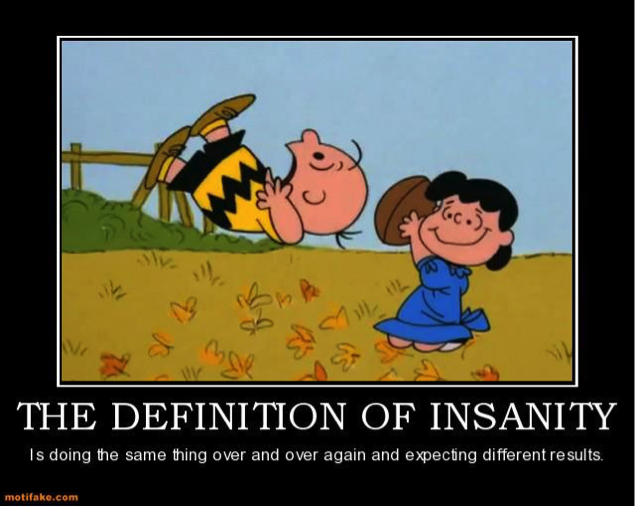
What I find amusing is that policy on regional transit has not changed as politicians do the same thing over and over again, ever expecting different results.
It’s easy and they just don’t have to waste time dithering over details and anyways; “the taxpayer has deep pockets and will ante up to pay for our largess“.
That was pre covid-19, things have changed.
As taxes increase, and they will, to pay off the covid-19 emergency measures, the taxpayer will be keenly aware of expenditures and demand the same of elected officials and the bureaucracy.
In the near future, doing the same thing over and over again might just be a hard sell to over taxed voters and that is sending shivers up the spine of elected officials everywhere.
Mayors, Premier and Transportation Minister to meet next week – The Blind Leading the Blind
Posted by zweisystem on Wednesday, September 15, 2010
Talk about the blind leading the blind.
BC Transportation Minister, Shirley Bond (who knows little or nothing about transit), the besieged premier (who knows that building glitzy metro lines buys votes), and regional mayors (who are equally unread on transit) are going to have a private meeting regarding TransLink’s ongoing financial crisis. The first hing that must be done is to invite the public, simply because the public is public transit’s customers and politicians should value their input. Secondly, TransLink and the Premier must understand that TransLink’s perennial financial malaise is due mainly to the SkyTrain light-metro system and our perverse penchant to build very expensive to build and operate light-metro lines instead of modern light rail!
To date the taxpayer has unknowingly spent over $8 billion for our metro system, yet for less than one half the cost, by building with modern LRT we could have had almost double the route mileage – more trams, serving more destinations providing more incentive for people to use transit!
Now there is a clever thought!
Added to TransLink’s woes, is the singular fact that the SkyTrain light-metro system has failed to attract the motorist from the car and it is just far too expensive to extend in lighter populated areas and has not proven to be a credible transit alternative for the car. The current hype and hoopla about the Canada Line is merely self serving window dressing to sell the public on building more metro, but in real terms, for about $2.4 billion costs to date, the new metro has attracted only about 4,000 to 5,000 new riders (which is about normal for a new ‘rail’ line) and the new riders are mainly the elderly going to the River Rock Casino or Asian shops in Richmond, with most using discounted concession fares and students using $1.00 a day U-Passes! The RAV/Canada line has yet to show that it has attracted the motorist from the car.
Yes, the airport is also garnering new ridership, but do not forget the 15 minute service Airporter bus the Canada Line metro replaced.
TransLink is in a conundrum; there is no money for new metro expansion and the bureaucracy refuses to plan for much cheaper light rail. There is no way out, either taxes must increase to pay for metro construction or the transit system stagnates and becomes even more unattractive product for customers.
Next week, Rail for the Valley will present an affordable alternative to TransLink’s present grandiose metro and subway plans, the problem is: Will the premier, Ms. Bond and regional mayors listen!
 In BC Rubber on Asphalt Rules!
Mayors, Premier and Transportation Minister to meet next week
By Frank Luba, The Province – September 14, 2010 4:02 PMA closed-door meeting between Metro Vancouver mayors, Premier Gordon Campbell and Transportation Minister Shirley Bond next week is expected to go a long way toward settling TransLink’s financial woes.Langley City Mayor Peter Fassbender, chairman of the Metro mayor’s council on transportation, can’t presume to say exactly what will come out of the meeting.
But he and TransLink CEO Ian Jarvis will both speak at the Tri-Cities Chamber of Commerce luncheon that follows the meeting. Cambell and Bond will also be in attendance.
When asked if there will finally be some news about TransLink’s long-standing cash crunch, Fassbender replied: We will at least be demonstrating where we need to go and how we are going to get there together.
My hope is that Thursday will be a major step forward in finding the answer specifically to the question people have of; “How are you going to do this?” said Fassbender
“These are not easy answers”, he said There isn’t a quick fix here?
The situation has come to a crossroads.
Are we either going to move ahead or is it clear we can’t work together” said Fassbender. “But you know what? I believe we can.”
The problem of TransLink funding was highlighted again Monday night when transportation commissioner Martin Crilly gave his seal of approval to the transportation authority’s 2011 plans.
Crilly pointed out that TransLink doesn’t have the money to do what its own long-range plans to 2040 call for or what the region needs according to Metro Vancouver.
To gain ground on the background growth of the region, a greater portion of the region’s wealth will need somehow to be devoted to providing that [transportation] capacity”, said Crilly in a release.
TransLink has yet to solve the conundrum of funding for capacity expansion, and cannot do so alone”, said Crilly.
From 2010 – Late Friday Night’s Musings For Saturday Reading
From July 2010
Late Friday Night’s Musings For Saturday Reading
Posted by zweisystem on Saturday, July 3, 2010
Zwei, with a cup of tea in hand, has been reading the various transit blogs and answering emails from interested parties around the world, trying to get a read on what direction public transit is going in the near and not so near future. Sadly, I see a trend in North America towards supporting building hugely expensive heavy-rail subway metro systems,
without any consideration for the cost of such a venture. This unrealistic view has tainted our transit planning on this side of the pond to such an extent, that tens of billions of dollars will be wasted on gold plated, over engineered transportation projects, when far cheaper and just as efficient transit solutions would have worked just as well.
The silliness I see from professionals supporting hugely expensive, to install and maintain, automatic train control signaling on new rapid transit (LRT is
not rapid transit) lines, demonstrates a gross naivety on the subject of railway signaling. Has anyone who promotes or supports automatic train control (ATC) ever talked to a signaling engineer? I don’t thinks so by the endless cheer-leading for ATC.
Has anyone compared the operating costs of Vancouver’s SkyTrain with Calgary’s LRT? If they had, they would have found that just the SkyTrain Expo Line costs 60% more to operate (2006) than the Calgary’s C-Train LRT, yet the C-Train carried more customers!
Has anyone thumping the desk for ATC ever stopped and considered that transit systems which include ATC are seldom built and ATC is only used on the heaviest used metro lines where automatic (driverless) operation does save operating costs over older manually operated block signaling?
LRT’s Renaissance started in France in the mid 1980′s, when modern low-floor cars, operating on dedicated or Reserved Rights of Ways, were found to be cheaper to build and
operate than France’s home grown automatic VAL mini-metro. In the 1970′s France only had a handful of elderly tram or streetcar systems, but in 2010, the country boasts 16 operating tram/LRT systems; 9 more under construction; and 5 in later stages of planning!
In the mid 1980′s, metro or subway construction was bankrupting scores of transportation authorities in many countries and at one time, there was over 100 km of uncompleted or semi-abandoned subway tunnels throughout Europe! The Chaleroi in Belgium being a good example. Though building subways on heavily used transit routes still continues and rightly so, European transit planners have reduced public transit,construction costs by building new LRT/tram systems. The Germans take top prize for cost efficient public transit with the very successful TramTrain concept.
TramTrain, where streetcars are so designed to track share with mainline railways, see total construction costs well under $10 million/km., a fraction the cost of subway or metro construction, where in some cases see construction costs exceed $500 million/km.!
Yet this is all lost by the many blogs and bloggist who support ATC and denounce LRT as some sort of 19th century folly. What is really sad, is that those supporting subways and ATC, seem completely removed from the real world of finance and financing expensive public, transit schemes. The fairy tale land of subway planning always include new and higher taxes, yet proponents of subways fail utterly to understand that there is precious little money to fund their ever costlier transit plans.
In the end, those supporting automatic metros and their kin, may see a line built, but with little chance of much needed expansion in the near or not so near future, while at the same time, much derided Portland keeps expanding its LRT network by about two lines every decade. In an age of peak oil, global warming, and massive urban congestion, it is completely foolish to keep advocating ‘pie in the sky’ metro projects that in the end, may build one or two line at most (three lines in Vancouver), financially exhausting the taxpayer and not providing a credible alternative to the car.
Those who spend hours condemning LRT with “Lies, Damned Lies, and Statistics“, fail to grasp historic lessons with light rail and have invented their own little world, where Tom
Swift style $250 million/km. or more, driverless, elevated railways or subways, with all the whistles and bangs, are easy to come by and the taxpayer is only too happy to pay more tax to fund transit mega projects.


Updates:
-
The cost of the Expo line light-metro extension has now surpassed $200 million/km.
-
France now has 29 tram systems in operation.
-
There are now over 30 TramTrain systems in operation with over 30 more either under construction or in advanced (funded) stages of planning.
-
The cost of the Broadway subway is now estimated at $488 million per kilometre to build.
PRT – Gadgetbahnen on Steroids.
From August, 2010.

PRT – Gadgetbahnen on Steroids.
Posted by zweisystem on Monday, August 23, 2010
Every few years, much is made of PRT or Personal Rapid Transit, as being the new way to move people. Except for a few specialized installations, such as Morgantown USA, PRT has proven to be both expensive for what it does and esthetically unappealing.
For a PRT system to actually work, one would need elevated PRT lines every 500 metres or so crisscrossing, grid like, to provide the network that would make PRT attractive to the customer.
In an age where even putting simple tram tracks on a city street may lead to years of public debate, PRT would lead to a public revolution.
Vancouver is the perfect example: After the first elevated SkyTrain was installed Vancouver City Council passed a bylaw outlawing elevated transit systems being built in the city, which helped Vancouver to get the $2.5 billion RAV/Canada line built as a subway in Vancouver.
PRT maybe applicable in specialized locations, but as a comprehensive public transportation system, I rather think not.
The following is the latest in “building a new mousetrap“.


STOP PRESS – Another Transit Study For The Fraser Valley. In Time For The Next Election?

Zwei is going to reserve comment, except for the fact that Rail for the Valley’s Leewood Study, lays the groundwork for a viable regional rail service for the Fraser Valley.
The Leewood Study, please click here.
Transportation planning study launches in Fraser Valley
As part of BC’s Restart Plan, the Province is examining a range of possibilities to support growth in the Fraser Valley to help ensure the development of affordable, liveable communities.
“We know that more and more people are choosing the Fraser Valley to live, work and raise their children,” said Claire Trevena, Minister of Transportation and Infrastructure. “Traffic congestion in the Fraser Valley continues to be a problem for people. We need to develop transportation networks and invest in solutions that support the successful growth of the Fraser Valley for the people who live and work there, now and in the future.”
This broad transportation and development study is underway. It will look at traffic congestion and travel demand in the fast-growing region and examine and evaluate options for new transit and transportation initiatives in the Fraser Valley.
“We are working together with local government and Indigenous partners on this study, and we will also be talking to local residents and business owners to get feedback,” said Selina Robinson, Minister of Municipal Affairs and Housing. “Findings will inform transportation and development projects that consider trade corridor needs. We want to focus on continuing to create a good quality of life for citizens in the Fraser Valley, and we are asking what solutions will contribute to this in a positive way.”
Nearly 60% of B.C.’s population lives in Metro Vancouver and the Fraser Valley – nearly three million British Columbians. Decisions on transportation and development in this region have consequences for every part of the province in terms of economic recovery, trade network resilience and housing opportunities. The purpose of the study is to look for opportunities to help reduce future traffic congestion, such as worker mobility, shorter commutes and managing traffic demand.
Improvements to transportation infrastructure are a critical piece of economic recovery – ensuring people have more opportunities for well-paying jobs, shorter commutes and more time to spend with their families.
The ministry also continues to support local, regional and inter-regional transit, and will continue to work with TransLink on its Transport 2050 plan, as well as BC Transit, local governments and their communities to investigate ways to more efficiently move people within and through the region.
Quotes:
Bob D’Eith, MLA for Maple Ridge-Mission –
“When we build new infrastructure, we want to build intelligently and with people at the forefront of these decisions. I am excited about this work and how it will help to promote liveable communities for British Columbians. We are focused on building strong transportation networks that will serve our communities, whether people are driving their vehicles, taking the bus or riding their bikes.”
Henry Braun, mayor, City of Abbotsford –
“One of the most significant challenges facing the City of Abbotsford and for the Fraser Valley region continues to be transportation. We know that effective and efficient transportation systems generate employment and economic development, as well as job creation for local communities. This study will provide useful information as the growth of our economy relies on a safe, reliable and efficient multi-modal transportation network; especially as communities look to expand markets for our key local sectors, such as manufactured goods, agri-foods and aerospace.”
Learn More:
More information about the Fraser Valley Transportation Study is available here: www.gov.bc.ca/transportation/fraservalleystudy
Flexibility
Flexibility: Susceptible of modification or adaptation; adaptable.

Dresden’s successful freight tram, carried car parts from one factory to another in the city.
Modern light rail is very flexible; it can operate as a tram, operating on-street; it can operate as a light-railway, operating on a dedicated rights-of-way; it can operate as a light-metro, on viaduct or in a subway; it can operate as a commuter train, operating on mainline railways; and it can operate as all four on one transit route!
Now, the next logical step is to carry freight.
The key is flexibility and no one at TransLink, the regional mayors and the province has considered when planning for rail transit. That would be thinking “twenty minutes into the future”, something seemingly impossible today.
SkyTrain light-metro, built to strict kinematic envelope (The outline of the space occupied by a rail vehicle when in motion, including the effects of tilt, sway, track cant, etc.) and with automatic (driverless) operation, light metro lacks the all important flexibility that has made light rail a success.
Flexibility has been changed to “density” for metro Vancouver, as a reason for building rail transit, yet flexibility would allow LRT to more better service a densely populated area than a light metro.
I think it would better serve those wanting the return of the interurban, from Vancouver to Chilliwack; the return of passenger service to the entire E&N railway and those wishing to stop the Broadway subway, demand adding flexibility into the debate, something SkyTrain/subway/bus/rail to trail competitors cannot do.
From the Railway Gazette:
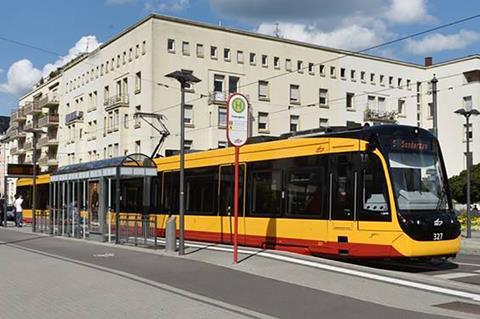
GERMANY: Trials with a prototype freight tram or tram-train are to start in Karlsruhe and the surrounding area in 2022. The concept is being drawn up with a view to improving urban life by reducing road traffic and the emissions it generates.
Known as ‘regioKArgo’, a pilot operation is proposed to demonstrate the concept, possibly on the 50 km Karlsruhe – Rastatt – Achern route, which has been studied in detail by the project’s promoters.
regioKArgo brings together operators Verkehrsbetriebe Karlsruhe and Albtal-Verkehrsgesellschaft with freight shippers, logistics companies and research institutes to develop alternative forms of local goods transport to replace lorries and vans.
Increasing use of the internet in recent months to order goods has led to an increase in package delivery traffic, in turn leading to congestion and other problems such as a shortage of staff and delivery vehicles.
Freight trams or tram-trains would operate between consolidation centres, set up at locations outside Karlsruhe and surrounding towns, and ‘city-hubs’ in the central area of each town. From there goods would be distributed to the end customer using emission-free methods such as cargo bikes. Studies are in hand to determine where city-hubs could be located.
One option would be to use modified trams that would be dedicated for passenger duties during peak times but would carry both passengers and cargo during less-busy periods. A team of researchers and industry experts is working on the design of a demonstrator tram under the LogIKTram project, the results of which will be fed into the regioKArgo scheme.
Organisations involved in the project other than operators include DB Engineering & Consulting, the Karlsruhe Institute for Technology, the FZI IT Research Centre, Marlo Consultants and Automotive Engineering Network.
The project team is in the process of estimating the likely cost, the aim being to apply for funding under the ‘Regio-Win’ project which promotes Karlsruhe as a technology development centre. Research by Offenburg University suggests that users would be willing to pay for the service if it fits sustainability and environmental goals.
Freight trams would form the centrepiece of a holistic concept which will entail rethinking the existing freight transport delivery model, according to Ascan Egerer, Technical Director at AVG. Explaining that the whole process was being examined to ensure that it would function economically, this entailed looking at what happens before and after the rail leg of a consignment’s journey. ‘That’s why we have partners from all sectors round the table’, he said. ‘It’s not something that can be solved by a transport operator alone. And we are talking about going beyond the city limits into the region’.
Egerer suggested that the idea was to replicate for goods the tram-train concept for passengers that was pioneered in Karlsruhe in the 1990s. ‘The Karlsruhe model offers the best conditions for bringing about a switch for goods transport too’, he said.
The ‘father’ of the Karlsruhe tram-train concept was Dr Dieter Ludwig, who believed that it was necessary to ‘take the train to the people’. Dr Ludwig, who died on July 16, was CEO of AVG and VBK for 30 years, during which the Karlsruhe model became famous – the first route between Karlsruhe and Bretten opened in 1992, leading to spectacular growth in the use of public transport in the area.
Disappearing Act
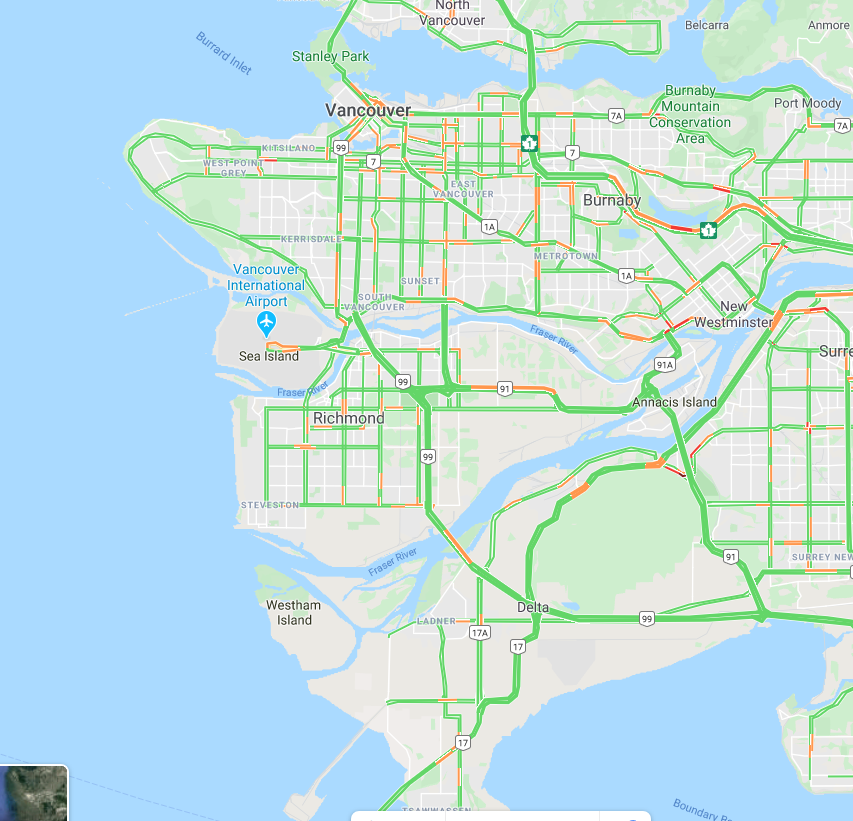
The following Google screenshot was made on Wednesday, August 9, 2020, at 7:50 AM.
All major crossings in metro Vancouver show little or no congestion.
Pre Covir-19, there would be bright red at the tunnel, Oak Street, Knight Street, Alex Fraser, Patullo, Iron workers, and the Lions Gate bridges.
In “normal” times, major congestion would rule metro Vancouver but now, commuters have done a disappearing act.
This bodes ill for TransLink, as their income, in part, comes from commuters and their boated ridership statistics come from forced transfers by commuters from bus to SkyTrain, back to bus.
Provincial and Civic politico’s, who haven’t a clue they are being bamboozled by TransLink’s bureaucrats, keep anteing up more money to this bloated and inept organization.
Here is TransLink’s big problem:
Transit customers, except the poor, the elderly and students (who all use deep discounted fares and passes) have abandoned transit for six months and with no timetable to getting back to normal, if there is a return to normal, they may never return; finding new modes to get to where they want to go.
TransLink and the Mayor’s Council on Transit should completely rethink how transit is provided and should institute cost saving measures now.
One cost saving measure would reduce bus stops to a minimum of one every 300 to 400 metres, effectively cutting stops by one third or more. This would both reduce travel times and increase service, without costing the taxpayer more money.
This is but one of several measures that could be implemented during Covid pandemic, to provide a far more cost efficient transit service.
Of course, rethink the $3 billion Broadway subway because there is absolutely no passenger demand to warrant such an investment.
But no, TransLink and the metro mayors insist doing the same thing over and over again, hoping for different results and then expect the taxpayer to again bail them out when it doesn’t.
Memo

I know it is preaching to the converted, but we must get serious about regional transit. $4.6 billion to build 12.8 km of light metro is not spending money wisely.
Spending $4.6 billion to build 12.8 km of light metro is based on dated thinking; dated engineering; dated planning; dated transportation philosophy; as well as never dated political and academic corruption.
SkyTrain is a political gravy train for land speculators; land developers; cement manufacturers and all those union jobs building it. For the transit customer it is a slow train the convinces many to take the car.
Isn’t time to end the travesty?
From the Light Rail Transit Association
Trams for a Healthier Future
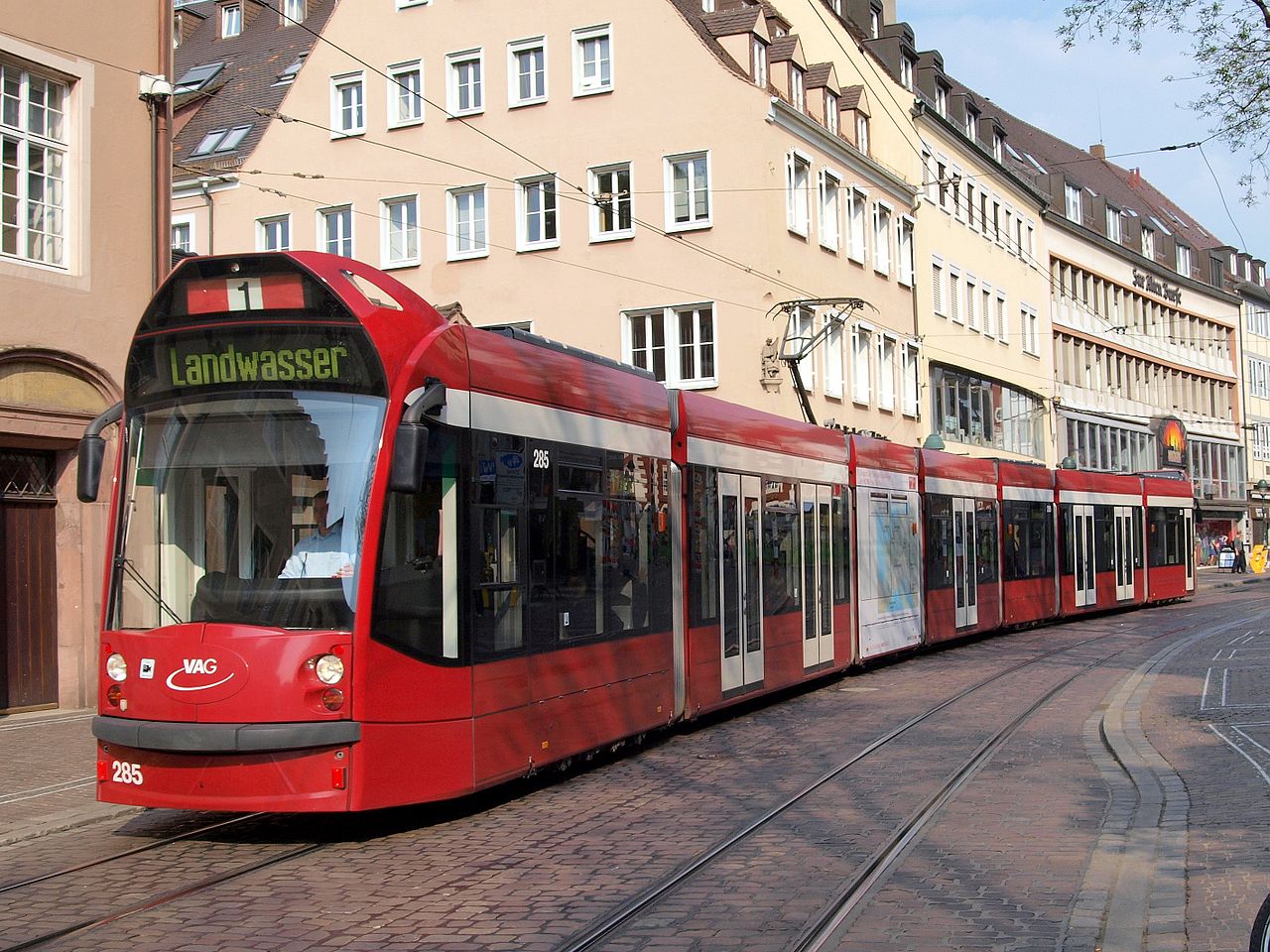
TramForward welcomes the House of Commons Select Committee on Transport’s Inquiry into Reforming public transport after the pandemic. Whatever the eventual changes in work and leisure patterns resulting from the current pandemic, there will continue to be a need for mass transit to bring people into the centres of towns and cities. With the current gradual revival of public transport use, it is a suitable time to consider how public transport might adapt to meet not only the health requirements of the current situation but also of any future health emergencies that might arise.
Traffic-generated air pollution, from non-exhaust emissions (NEE) caused by tyre and road surface wear as well as exhaust emissions, is not only a major health risk in itself but also a contributory factor in the severity of respiratory diseases such as Covid 19. Trams are free from both types of emissions, as well as having a proven track record in effecting significant modal shift from cars to public transport, and TramForward continues to advocate the development of tram systems as a primary transit mode on major transport corridors.
Trams are relatively easy to adapt to social-distancing requirements, with larger circulating areas than buses and fewer seats in proportion to total capacity, and can be coupled together to increase capacity. They typically have multiple entrances which not only facilitate distanced boarding and alighting but provide regular ventilation. Ventilation could also be enhanced by simple roof to floor forced air circulation. Trams also provide a superior ride quality without the sudden dynamic events which can throw bus passengers into each other.
In its response to the Transport Committee’s Inquiry, TramForward will be calling for increased investment in steel wheel on steel rail urban transport systems, particularly tramways. While trams cannot be expected to replace all other forms of road passenger transport, they can make a significant contribution to the improvement of air quality on the most heavily trafficked urban routes where pollution is highest.
Jim Harkins, Chair of the Campaigns Group of the Light Rail Transit Association said “It is time for the government to show faith in public transport and to increase investment in tramways to create a safer and healthier future for our cities and towns”.

Instead of “Heavy” Rail, Let’s Try “Very Light” Rail
Interesting news from the Light Rail Transit Association – Very Light Rail.
Very Light Rail is a LRT variant where smaller and lighter vehicles are used on routes that cannot support operation of larger vehicles.
The costs for Very Light Rail is something to consider, especially when Vancouver is spending $2.8 billion to build 5.8 km of subway or when modern LRT costs about $50 million/km or more to install.
Maybe its time to think out of the box!
The concept of ‘Very Light Rail’ (VLR) has been developed as a way of creating a light rail system at a much lower cost and with much reduced construction times than traditional tramway or light rail systems. The main features of VLR are lightweight vehicles which will be able to hold 50-70 people, which will be battery powered, so avoiding the need for expensive overhead line equipment, these vehicles are proposed to eventually become autonomous, the first test vehicle is due to be manufactured by the Coventry based RDM Group by mid-2020.
Something to consider for start up tram operations.

TramForward welcomes funding for West Midlands Very Light Rail schemes.
TramForward welcomes the news that the West Midlands Combined Authority has obtained Government funding for two Very Light Rail projects.
They are among eight ‘shovel ready’ projects in the West Midlands which will benefit from £66 million from the Government’s Getting Building Fund, aimed at projects which can be started quickly and completed within 18 months, creating jobs and driving investment to aid economic recovery following the Coronavirus lockdown.
The list was confirmed on Tuesday 4th August by the Secretary of State for Housing, Communities and Local Government, Robert Jenrick, during a visit to the site of the planned National Brownfield Land Institute at the University of Wolverhampton.
The two VLR schemes are: the Very Light Rail Innovation Centre in Dudley (£12.4m – CAD $21.5 million), where new modes of transport which are both green and cheaper and quicker to deliver than traditional tram or rail are being developed; and Coventry’s Very Light Rail project (£1.8m – CAD $3.12 million).
Jim Harkins, Chair of the Light Rail Transit Association’s Campaigns Group, said “we welcome this support for these innovative schemes which have the potential to revolutionise public transport provision in our smaller and medium-sized towns and cities”.
Image: Stourbridge Shuttle VLR Scheme. Labelled for reuse on Google Images.

Cut And Cover Subway Construction, Coming to Broadway?
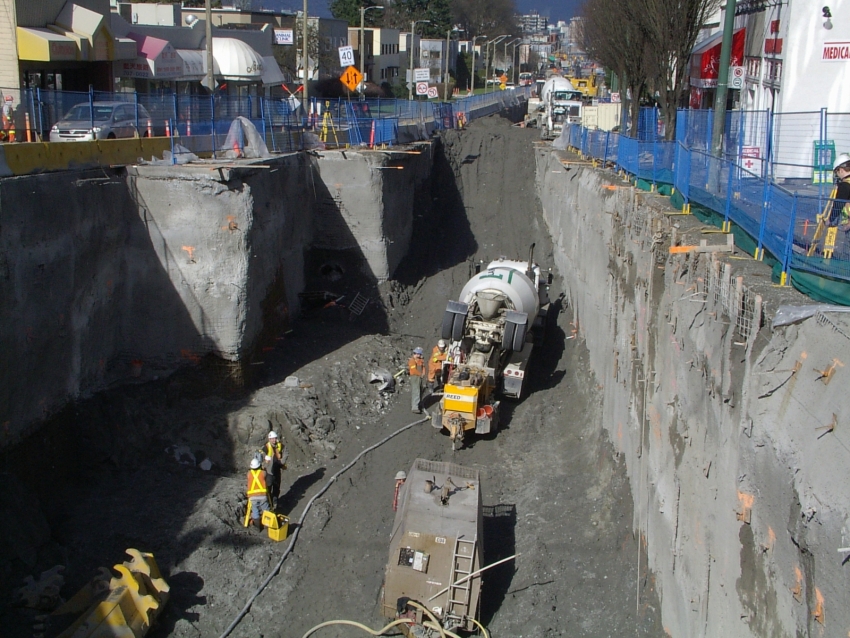
Is cut and cover subway construction coming to Broadway?
The following was sent to Zwei this week and it poses some interesting questions, but first a comment from our friend Mr. Haveacow, responding to the comment in the April 2, 2019 post; “Toronto’s 6.2 KM Scarborough Subway Costs Soar To $3.9 Billion – What Will be The Real Cost Of The BS Line?”
One of the problems with cost reporting is Apple to Orange comparisons. In the report that @Stephen Wickens highlighted, many of the costs he thought were the same are not. The report mentioned legal issues, but what even he didn’t realize is that, many of the subway cost components could only be estimated and many are overestimated because the project timeline length under P3 bidding required certain component costs to be considered non-public information and secret due to bidding and copyright issues for up to a decade after the project is finished.
Other problems like the concrete used in today’s projects is considerably different than the concrete used in earlier projects. Due to strength/safety, longevity and air pollution issues, today’s concrete is much more expensive than concrete used in the past. In fact, there are certain popular concrete formulations used in the 1970′s for example, legally speaking, just can’t be used today. These kind of comparisons make something like a construction cost project database proposed in the report, very difficult if not out right impossible and even unfortunately, possibly, slightly illegal.
Station to Station Why Have Subway Costs Soared in the Toronto Region
Zwei is just sounding the alarm that subways are a very expensive game, that politicians love to play. The more unscrupulous politicians are claiming that a subway will cure our transportation ills; “just build it and they will come“.
Sadly for the taxpayer, subways built on routes without the ridership to sustain them, tend to be a gift that keeps on taking: higher taxes; higher user fees; higher fares; while regional transit services suffer because the subway tends to be a black hole for money.
Notice no one at TransLink or on the Mayor’s Council on Transit, and Metro Vancouver have stated the real operating costs or annual subsidies needed just for the Broadway Subway.
The true cost of the Canada line subway is hidden withing the 35 year P-3 agreement with the province and the SNC Lavalin lead consortium operating the line. Last year TransLink paid over $110 million to SNC Lavalin for operating the line.

The real costs for "rapid transit" (subways and light-metro) are far higher than TransLink or the regional mayor's are telling the public and for good reason, because if the public knew the real cost of "rapid transit" they project would lose public support.
As the cost of the Broadway subway increases and it will, TransLink and the Mayors Council on Transit will look for ways to reduce the scope of the project. With the the Canada Line, cut and cover saved over $400 million in construction costs, especially when no compensation was in the budget for s,adjacent surface businesses.
B.C. Supreme Court documents related to lawsuits brought by Cambie Street merchants show SNC-Lavalin’s decision to employ cut-and-cover rather than boring tunnels for about one-third of the 19.2 km line cut costs by more than $400-million, or 16%, enabling the project to hit its fixed $2.1-billion budget.
Please note: Documents from the Susan Heyes lawsuit against TransLink showed that the actual cost of the Canada line could be higher than $2.6 billion, as these costs hidden in the generous P-3 arrangement, which being a private contract is immune from public scrutiny.
The Broadway subway, like the Canada Line, will probably be cut and cover; the political costs for the NDP and Vancouver politicians supporting the subway, could be akin to political suicide.
Postscript from Mr. Hacveacow.
The one stop subway project ended in, when the Conservatives under Doug Ford were elected. The new project which is fully funded and has almost finished its EA process and engineering work, it is expected to start construction in 2024-2025 and be open around 2029-2030. The extension is now 7.8 km to Sheppard and McCowan Ave. and has 3 stations. This is from one of the Metrolinx Reports.
Scarborough (Bloor-Danforth/Line#2) Subway Extension
The Scarborough subway extension will finally deliver the three-stop subway connectivity that residents of Scarborough deserve.Runs From: Kennedy station to Sheppard/McCowan
Length: 7.8 km
Stations: 3
Cost: $4.8 Billion – $5.5 Billion



Recent Comments