McCallum’s $2.9 Billion Question

From the 2017 Steer Davis Gleave – HATCH report, the total cost for SkyTrain, including fifty-Five new cars is $2,914,798,721.00. As 2019 nears, the cost is rising.

Memo to Doug McCallum: we are not building SkyTrain to 1980’s cost of construction.

Memo to Gord Lovegrove: I think you need to join the Light Rail Transit Association and learn about LRT.

Memo to Steer Davis Gleave – HATCH: What we call SkyTrain is now known as ART or Advanced Rapid Transit, which patents are owned by SNC Lavalin and Bombardier Inc.. ALRT was repackaged as ALM the early 1990’s, when the UTDC patents for ALRT were sold to Lavalin, which promptly changed the name to Automated Light Metro. When Lavalin amalgamated with SNC to form SNC Lavalin, they retained the engineering patents and sold the technical patents to Bombardier Inc.

Question for Doug McCallum, how do you calculate that the ART Line to Langley will only cost $165 million?

Let’s see your math sunshine or has that envelope been thrown in the incinerator?

Experts weigh in on the costs of SkyTrain vs. LRT in Surrey

Studies and past projects don’t seem to support mayor-elect’s SkyTrain cost estimates

 October 29, 2018

A decision to ditch light rail transit plans in Surrey in favour of a SkyTrain extension would give up on a vision to grow the city and come with a price tag that is ‘magnitudes higher,’ experts say.

Doug McCallum, that city’s mayor-elect, told Postmedia News this weekend that a SkyTrain extension from King George station to Langley City could be completed for $1.65 billion — the same price as a planned LRT system that would connect Surrey City Centre to Guildford and Newton.

But that figure is far lower than a $2.9 billion estimate engineering firm Steer Davies Gleave & Hatch provided to TransLink in a July 2017 study. That estimate, in 2022 dollars, covered an eight-station, grade-separated, 16-kilometre rail line that would run cars consistent with those designed for the Expo and Millennium Lines.

McCallum has previously stated the project could be done for far less than that $2.9 billion if about half the SkyTrain line was at grade. It is unclear if McCallum’s $1.65 billion SkyTrain figure is supported by any reports, but he cited the roughly $1.4 billion spent on the 11-kilometre Evergreen Line in reaching that number. McCallum did not return a request for comment Monday.

Gord Lovegrove, an associate professor at the University of B.C.’s School of Engineering, said the last time he checked, each kilometre of SkyTrain line could be expected to cost around $150 million to build.

His per-kilometre estimate is not far off the 2011 dollar costs of the Evergreen line once they are adjusted for inflation. It is also consistent with an estimate in 2016 dollars that Steer Davies Gleave & Hatch provided for the Surrey to Langley SkyTrain extension.

“You have order of magnitude differences in costs” between LRT and SkyTrain systems, Lovegrove said.

He said the problem North Americans tend to have with light rail, which is relatively new on the continent, is that “we want to have our own exclusive right-of-way. We’re not willing to take the risk safety-wise, timetable-wise or schedule-wise to have it run with traffic.”

But Lovegrove said exclusive right-of-ways need not be the case any longer, citing Hamburg’s system as proving you can run at grade in traffic.

“I would just recommend maybe take a second longer look. Otherwise, if you’re spending an order of magnitude more, then you’re just not able to do as much with that same taxpayer dollar.”

Anthony Perl, a professor of urban studies and political science at Simon Fraser University with a focus on transportation, said that in every category he could think of, SkyTrain “costs more and does less.” Among other things, the automated system demands separated infrastructure, he said.

For Perl, part of the problem with SkyTrain is that it creates “development deserts” between stations. In contrast, the LRT system would have encouraged more density, he said.

“If the City of Surrey goes ahead and cancels the LRT plan, it’s going to set public transit back by 20 years south of the Fraser River,” Perl said.

Peter Hall, an associate professor in SFU’s Urban Studies Program, said swapping LRT through Surrey for SkyTrain to Langley was not just a change in transportation technology.

“It seemed to me that light rail was an attempt to give something to Newton as a node and give something to Guildford as a node, while at the same time building up the central area,” he said.

“You’re giving up on a vision on how you want to build Surrey as a place with a strong core and a set of well-developed successful sub-centres. I don’t get it. I don’t get why they’re so keen to turn their back on this.”


An Idiot’s Delight In Surrey

Delusional, is all what Zwei can say.

The LRT in Surrey is not a Surrey project, it is a TransLink and Metro Vancouver project and Metro Vancouver has shown no signs that it will cancel LRT as of yet.

The Money earmarked for the LRT is not transferable, so if Surrey manages to stop light rail, the funds will be withdrawn.

TransLink, some years ago, estimated the cost to extend SkyTrain to Langley, was about $2.9 billion. The problem is, the cost of cement and steel are rising at three times that of the rate of inflation, thus the cost to build SkyTrain to Langley, after a further five years of planning will be very much higher, with the added danger that there may not be any cars available to operate on the new line if and when it is built.

Then there is the $3 billion or so rehab of the Expo and Millennium Lines or the Innovia Lines before any extensions to SkyTrain can be made.

So Mayor McCallum, where are you going to to get over $6 billion in funding for your grossly ill informed, if not delusional promise to switch from LRT to SkyTrain?

One wonders if Surrey voters would have been so eager to switch from LRT to SkyTrain, knowing the real costs and the massive tax hikes required for extending SkyTrain anywhere?

The SkyTrain roller coaster ride is just beginning

McCallum breaks his silence, says Surrey’s LRT project will be cancelled at first council meeting

LRT will be replaced with SkyTrain for the same $1.65-billion price that LRT was estimated to cost, all of which is funded by three levels of government, McCallum said.

Surrey mayor-elect Doug McCallum broke his silence with Postmedia News on Sunday and emphatically hammered home the point that light rail will be spiked as soon as the new council first meets Nov. 5.

It will be replaced, McCallum said, with SkyTrain for the same $1.65-billion price that LRT was estimated to cost, all of which is funded by three levels of government.

“I think that most of the region, this is what they want,” McCallum said Sunday. Postmedia had previously left messages with the mayor-elect since the municipal elections Oct. 27. Sunday was the first time he replied.

“A large majority of people in Surrey want SkyTrain,” he said. “Voters wiped out the whole previous council. The new team is solidly with residents who want SkyTrain and not light rail.”

McCallum beat Surrey First challenger Tom Gill by 17,000 votes, ending a decade-long dynasty for the party in the city. McCallum’s Safe Surrey Coalition elected seven councillors, while Surrey First elected just one, and she is new to council.

“I think the reaction to the election in B.C., and to a certain degree nationally, was a bit of a shock,” McCallum said. “But the people of Surrey are in complete agreement they want a change and they showed up at the ballot box.”

There has been $50 million already spent on LRT in Surrey, according to TransLink, and Surrey has spent $20 million in pre-construction costs.

Some other regional mayors on the Mayors Council, such as Richard Stewart in Coquitlam and Malcolm Brodie in Richmond, have expressed their opposition to McCallum’s plans, while Kennedy Stewart, Vancouver’s mayor-elect, said he would do what he could to help Surrey get SkyTrain.

Critics of switching at this late date say SkyTrain would cost another $1 billion to $1.5 billion, but McCallum scoffed at that figure, saying based on what it cost to complete the Evergreen Line, SkyTrain could be built along the Fraser Highway to Langley for the same $1.65 billion already given the green light.

“All we ask is that they change the technology from light rail to SkyTrain and apply the money to SkyTrain,” McCallum said. “I don’t think (up to $1.5 billion in estimated added costs) is very accurate, TransLink has a history of not having costing right.

“I think we can build SkyTrain along the Fraser Highway for that $1.65 billion.”


Surrey’s Hobson’s Choice – A Choice Of Taking What is Available (LRT) or Nothing At All.

First posted April 18, 2018

Updated

Surrey has a big transit and transportation problem, and now with the announcement by mayor elect, Dough McCallum, now leaves the LRT project in doubt.

The cacophony of the SkyTrain Lobby with their half truths, cherry picked data, and intimidating innuendo are demanding a change from light rail to the proprietary Innovia SkyTrain.

With their campaign of deceit and deception now ended, one fact remains for Surrey, either build LRT now or wait twenty or more years for a SkyTrain Line; which will be assuredly out of production and will end up building with LRT in the long term!

Surrey faces a classic Hobson’s Choice: Either build LRT now, or get nothing.

Why?

The problem with SkyTrain, is SkyTrain itself. Extending the Expo Line means a $3 billion refit of the Innovia system must take place. This refit or rebuilding is to increase capacity; increase the electrical supply; a host of track and switch replacements: and expand the station platforms on all stations on the entire Innovia network.

This means a $2.5 billion (current budget for LRT – 3 lines) SkyTrain expansion in Surrey could cost $5.5 billion or more for one line and there is no money budgeted for that!

There is no money for an elevated Light Metro SkyTrain line to Langley or any money for one down the King George. The existing federal funds are not transferable and are program specific because all federal government transit money is done using a Private-Public Partnership or 3P structure. Money for basic design, planning and engineering has already been spent by contractors to the LRT project. Even though the main build, design, finance, operate and maintain consortium holder hasn’t been chosen yet! Both Translink and the Feds have to pay the contractors because as per the 3P agreement, they the early contractors, went out and got private money from Banks to complete their early design planning and engineering work in good faith and now await payment. This early work is already in the 10′s of millions of dollars. As soon as Translink and Surrey accepted federal money, they were committed legally to LRT!

Remember ALL FEDERAL TRANSIT MONEY IS PROJECT SPECIFIC, it’s been that way since 2009 and the alternative finance model or 3P structure is the only way you can get their money for transit! The era of just getting a certain dollar amount of federal money for transit and you can do whatever you want with it, is dead and gone forever! If you take the federal money, the project is set in stone! If you change your mind and plan to change the scope of the project you have to give the money back and wait for new funding for your new project! McCallum will find that unfortunately, at the end of a very long line.

The region can only afford one rapid transit project every decade ans even with a windfall of federal money, a change from LRT to SkyTrain may prove to be too expensive and the project deferred. This will be a bonus for the now $3.5 billion  Broadway subway as politicians may divert Surrey’s LRT money to complete the politically prestigious subway project – even to UBC.

This will leave Surrey with no money for SkyTrain unless road pricing and congestion charging is in place and that will not happen any time soon.

Surrey Mayor Doug Mc Callum and Council should take heed. You will have a Hobson’s choice with light rail;

“Either build with LRT or build with nothing at all.”

An Idiot’s Delight In Langley

Idiots, what can I say, complete idiots, the pair of them.

SkyTrain is an obsolete proprietary light metro system, made obsolete by light rail! This has been known by all competent transit planners since the late 1980’s!

The proprietary SkyTrain system patents are owned by both Bombardier Inc. and SNC Lavalin. Again, well known by transit specialist around the world.

Today only 7 SkyTrain systems have been built, in the past 40 years and of these 7, only 3 are used seriously for urban transit. Not one new build SkyTrain has bee built in the past decade.

During the same period, over 200 new build LRT have been built and many more are under construction.

In revenue service, SkyTrain has proven to be not only more expensive to build, it is more expensive to operate and maintain. As well SkyTrain is extremely limited in capacity as Transport Canada’s Operating Certificate allows a maximum capacity of only 15,000 pphpd. To increase capacity, which is needed to extend SkyTrain to Langley, over $3 billion must be spent rehabbing the existing lines.

The latest rejection of SkyTrain came from Ottawa, where their politicians did due diligence and sent a fact finding committee to Vancouver to research SkyTrain.

Langley mayoral candidates Peter Fassbender and Val van den Broek, by wanting SkyTrain built to Langley, are going to  increase taxes, to build with an obsolete light-metro that may be out of production by the time the planning is done.

Langley mayoral candidates Peter Fassbender and Val van den Broek are going to delay any sort of transit to Langley until the late 2030’s.

Langley taxpayer’s are being advised by dishonest political wannabes.

Peter Fassbender says plans for LRT along Fraser Highway aren’t ‘based on reality.’

Jesse Johnston · CBC News ·

City of Langley mayoral candidates Peter Fassbender and Val van den Broek both prefer SkyTrain to LRT. (Atomic Taco, via Wikimedia Common)

There are plenty of issues that Langley mayoral candidates Peter Fassbender and Val van den Broek don’t agree on, but they’re on the same page when it comes to the biggest transportation project in the city’s history.

Fassbender and van den Broek agree that when rapid transit is built from Surrey to Langley, it should not be light rail.

“I will take LRT if it comes down to it and that’s all TransLink is going to go for, but I am definitely pushing for SkyTrain,” van den Broek said.

“We’ll have to talk to whoever is elected in Surrey because that’s going to be a huge, huge item right off the bat.”

In 2014, the Metro Vancouver Mayors’ Council laid out its 10-year vision for transportation projects in the region.

LRT in two phases

The first phase of the plan calls for an LRT line that will run in an ‘L’ shape from Guildford to Surrey City Centre along 104 Avenue and then proceed along King George Boulevard to 72 Avenue.

The second phase includes a second LRT line that will run for 16.5 kilometres along Fraser Highway between Surrey and Langley.

Former Surrey mayor Dianne Watts and outgoing mayor Linda Hepner both advocated for LRT.

Fassbender says SkyTrain is a better option, even if it is much more expensive.

“Mayor Watts and then mayor Hepner both were passionate about at-grade rail and I don’t think it was based on reality but based on a vision that they had for the downtown core of Surrey,” Fassbender said.

“I didn’t agree with them now and I don’t agree with that direction now.”

The Subway To Stupidville

Patrick Condon is the James Taylor chair in Landscape and Livable Environments at the University of British Columbia’s School of Architecture and Landscape Architecture and the founding chair of the UBC Urban Design program.

Prof. Condon is worth listening to, as he gets it about transit, which is a rare commodity with Metro Vancouver’s academia .

Building with SkyTrain, has turned into the Canadian version of Lysenkoism, where there has been a grand distortion of the transit planning process, to favour pre determined political, academic and bureaucratic biases.

Definition of Lysenkoism: metaphorically describes the manipulation or distortion of the scientific process as a way to reach a predetermined conclusion as dictated by an ideological bias, often related to social or political objectives.

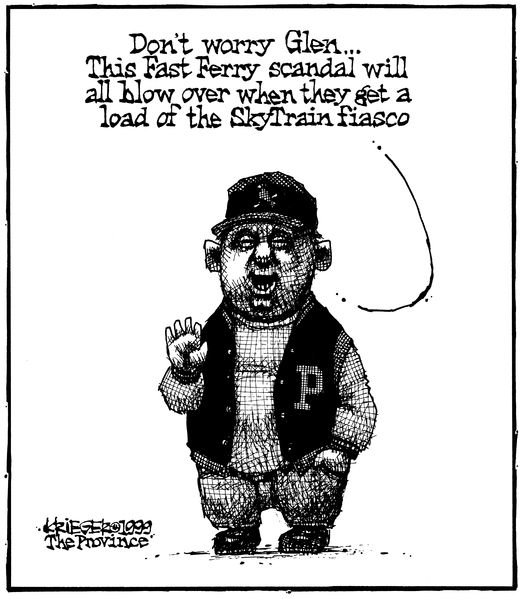
The Broadway subway may turn into a FastFerry style fiasco, where it would be just cheaper to operate buses. The Charleroi metro in Belgium is a good example of building a subway, but never used because operating costs were such, it was cheaper to operate buses on the route. The subway lays derelict, never used, waiting for trains that will never come.

Subway to UBC? What No Mayoral Candidate Dares Say

They’re all aboard. But here’s why we should pull the emergency brake.

By Patrick Condon Today | TheTyee.ca


condon-drawing.png
View of proposed UBC Stadium Area development and proposed 30-plus-storey high-rises. From UBC Stadium Neighbourhood Phase 3 Planning Consultation website.


You might think a mega-project with huge cost risks would become a major issue dividing candidates who aim to be mayor. Not this time in Vancouver, where all four of the so-called leading candidates give at least weak support to extending all the way to the UBC, a Broadway subway that so far is slated just to run to Arbutus Street.

Some candidates are more fully on board than others. Mayoral candidate Shauna Sylvester seems the most wildly enthusiastic, saying that, “Once we start digging… we need to connect to (UBC)… you don’t start and stop again.”

Sorry, yes you do, if the gamble is too great, the price tag is too high, and the supposed reason for the project doesn’t add up.

The price tag. The already-slated stretch of the Broadway subway, which would start at Commercial Drive and end at Arbutus Street, was supposed to cost $2.1 billion but now is pegged at $2.8 billion. Running it out to UBC could add $4 billion more, as we elaborate below. Perhaps a lot of Vancouverites aren’t worried because they figure the feds or province are certain to cover almost all of it. They should worry.

The gamble. Three sources of funding are earmarked for the Broadway subway to Arbutus: federal, provincial and local — local meaning a combination of money from local taxpayers and TransLink, according to press reports. But as mayoral candidate Kennedy Stewart recently acknowledged, the precise mix of funding for the Broadway subway to Arbutus is not yet a done deal. Ottawa’s share is not guaranteed until the federal budget is passed this spring. Even less certain is how the province and local funders might chip in. That’s because we remain in the dark about who can lay claim to the region-wide transit focused development tax approved by the province. Is that development tax revenue money going to be credited to the local share or the province’s share? We don’t know.

For the rest of the story, click.

Game Changer, The Autonomous Tram


This will be a game changer for transit and especially for Vancouver, where politic ans love driverless transit.

What this means is that the concept of driverless transit systems must be put on expensive elevated guideways or even more expensive subways, will fade to the history books as the autonomous tram will have the same advantages as automatic transit systems but at a lesser cost.

Unlike driverless cars or buses, driverless trams will be confined to their route, via the tracks, making the extremely safe light rail, even more safe.

Driverless Tram Will Get Debut Spin in Berlin

By Sandy Smith | September 6, 2018

Siemens’ autonomous tram will get a run in Berlin this month. (Credit: Siemens AG, Munich/Berlin)

Our weekly “New Starts” roundup of new and newsworthy transportation stories worldwide.

Driverless Light Rail Vehicle to Make Demonstration Run in Potsdam This Month

Driverless rapid transit trains have been around for decades. But driverless streetcars, like driverless cars, remain a technology in development. And now, as has been taking place for a little while with driverless cars and buses, the technology has advanced to the point where it’s ready for some real-world testing.

The International Railway Journal reports that railcar manufacturer Siemens and the transit authority of Potsdam, Germany, will put an autonomous light rail vehicle (LRV) through its paces on a four-day demonstration run during InnoTrans, the biennial international transportation technology trade fair that takes place at the nearby Berlin ExpoCenter this year Sept. 18-21.

According to a Siemens press release, the vehicle is a Siemens Combino LRV that has been outfitted with multiple cameras, radar and lidar sensors that will deliver information about the vehicle’s surroundings to an onboard computer that functions as the vehicle’s “brain.” The computer performs complex algorithms that spot hazards in the vehicle’s path and determine the appropriate response, such as stopping for a wayside signal, stopping at a platform to pick up or discharge passengers, and braking for crossing pedestrians and vehicles.

The LRV will make its debut test runs in mixed traffic on a 6-km (3.73-mile) stretch of Potsdam’s tram network. A longer report on the trial on the news site Smart Cities Dive states that the vehicle, which was built solely for testing purposes, builds on existing autonomous train technology Siemens has developed. The longer reaction times and stopping distances trains require have slowed the development of autonomous vehicle technology on the rails, according to the report.

A Matter Of Perspective

What is interesting with this story is the matter of perspective comparing Vancouver and Toronto.

In Toronto, the 504 streetcar servicing carries around 80,000 riders a day in 2018.

In Vancouver, where a subway is being proposed for Broadway, as far as Arbutus and with some promoters wanting it to terminate at UBC; in 2012 75,000 risers a day used all the bus services to UBC!

The most heavily used service was the Broadway 99B express service, seeing 25,800 riders a day!

Allowing for a moderate increase in service, the 99B still operates every three minutes (20 trips per hour) during peak hours, limiting hourly capacity to about 2,200 pphpd.

In Vancouver, we are spending $3.5 billion for a subway that will only go half way to UBC, which realistically will carry under 30,000 pphpd, while in Toronto, on streetcar route is carrying 80,000 plus people a day.

Even if ridership doubles with the subway (which is doubtful when one considered that subways have a poor record in attracting ridership) in the first years of operation, there will still be less people carried that what Toronto’s 504 streetcar route does today, in revenue service.

TORONTO Transportation Commission [TTC] has dropped the route 514 streetcar route on King Street as part of a plan to speed travel and reduce confusion by riders, CTV News reports:TTC King St. streetcar

Image result for toronto route 514 streetcar<https://tinyurl.com/y7raxg6p>

TTC makes changes to King streetcar, discontinues service on 514 Cherry routeChris Fox, CTV News Toronto

Published Sunday, October 7, 2018 10:12AM EDT 
Last Updated Sunday, October 7, 2018 11:24AM EDT

The TTC is discontinuing service along one streetcar route and splitting another into two new routes.

The 514 Cherry streetcar, which travelled along King Street from Dufferin Gate loop to Distillery District loop, has been taken out of service as of today.

In its place, the TTC is splitting the 504 King streetcar into new branches. The 504A King streetcar will travel from Dundas West Station to the Distillery District loop and the 504B King streetcar will travel from Broadview Station to the Dufferin Gate loop.

“We have gotten rid of the 514 in name only, the service to the Dufferin loop and the Distillery loop continues with the 504 A and B,” TTC Spokesperson Stuart Green told CP24. “Over the summer we had to do some rerouting for construction and we found that changing the routing and doing these shorter routes actually improved the reliability. You will now have in the morning rush hour a streetcar every three minutes or while still servicing all the areas served by the old 504 and the old 514.”

In a press release, the TTC said that the change will reduce the need to shorten streetcars as “a delay on one end of either branch is far less likely to affect service throughout the entire route.”

The TTC also said that the move will provide more clarity to riders, as all streetcars travelling along King will have the same number associated with them.

About 80,000 riders use the 504 King streetcar every weekday. That’s up from an estimated 72,000 daily riders when a pilot project prioritizing the movement of streetcars along the busy corridors began last November.

The TTC says that during the morning rush hour, there were will be 22 new streetcars assigned to the 504A route and 20 assigned to the 504B route.

The time to travel along the full route during the morning rush will be about 108 minutes on the 504A and 98 minutes on the 504B, the TTC says.

If the SkyTrain News Fits, the Globe & Mail Will Print It.

So, where are the important stories about SkyTrain and transit Ms. Bula?

Any mention that Transport Canada’s Operating Certificate for the Innovia SkyTrain system (Expo and Millennium Lines), limits capacity to 15,000 pphpd?

No?

Have you ever penned a story about how the Expo line is worn out and much of it’s existing infrastructure needs outright replacement. Have you ever explored the fact that the cost will be between $2.4-$3.1 billion to do what is required to rehab the line and increase capacity?

No?

Have you investigated that there is no money budgeted to do the vast majority of the work?

No again?

Have you inked a story about the ridership on a transit route needed to justify a subway?

No?

Have you interviewed the the Two senior planners at TransLink who were fired because they dared to say there was not enough ridership on Broadway to justify a subway?

No again?

have you written on the fact that the Innovia SkyTrain Lines capacity limit is 15,000 pphpd, which will include the proposed subway, until that extremely expensive and unfunded rehab takes place?

No?

In Surrey, have you bothered to write that mayoralty candidate, Bob McCallum’s threats to stop LRT and build with SkyTrain instead is nothing but hot air, as all federal transit money is project specific, it’s been that way since 2009 and the alternative finance model or 3P structure is the only way you can get their money for transit?

No?

Have you included in your stories that the era of just getting a certain dollar amount of federal money for transit is gone forever! If you take the federal money, the project is set in stone?  (With thanks to Mr. Cow!)

Non-news, puff stories is what coming from the Globe and Mail, with the real news, SkyTrain unfriendly news, ignored!

Vancouver
Special to The Globe and Mail

A SkyTrain commuter train travels out of Downtown on a guideway alongside the Dunsmuir Viaduct, in Vancouver, on March 22, 2017.

DARRYL DYCK/The Globe and Mail

Metro Vancouver politicians have maintained a united front on regional transit plans for the past five years.

But the civic election campaign is cracking open differences in support for different future lines, which could result in significant changes when a new crop of politicians is installed in November.

In Vancouver, the main candidates are split on their enthusiasm for extending the Broadway subway line from the planned first phase that stops partway across the city’s west side at Arbutus, before the University of British Columbia.

But Ken Sim, the Non-Partisan Association’s mayoral candidate, and Green Party councillor candidate Pete Fry are far less gung-ho about extending the subway.

Although neither will say they oppose the subway flat out, both talk about the need for more study and more discussion with other partners to determine whether it is really needed.

“What we’re waiting for is for TransLink and UBC to tell us what their plans are,” Mr. Sim said. “It would be reckless to say let’s build a line, if all the partners are not there.”

He cited TransLink statistics that two-thirds of the riders on the existing B-line on Broadway get off by Arbutus. Mr. Sim’s teammate, Colleen Hardwick, has also said at all-candidates’ meetings that the subway is like an oil pipeline that the city doesn’t need.

Mr. Fry sounds the same kind of cautionary note. “The idea of a subway sounds great but we need to balance the needs of the entire city,” he said. “It is a lot of money.”

Green Party councillor Adriane Carr has frequently expressed concerns about the cost of a subway line and the possibility that it will lead to massive increases in density along Broadway. The party has typically supported an expanded bus system or streetcar lines instead.

In between those views are candidates who support the extension in the next phase of the region’s transit plan, without holding out hopes that it can happen quite as quickly as Ms. Sylvester says.

Independent Kennedy Stewart, Coalition Vancouver’s Wai Young, Yes Vancouver’s Hector Bremner and Vision Vancouver’s Tanya Paz all say a subway extension is needed for the future city.

And that will mean change.

“You can’t really preserve your neighbourhood and live in $10-million homes and expect workers to come in from Mission,” Mr. Stewart said.

The important thing, he said, is to leverage the increases in property values that will happen along the line and use that to provide affordable housing on the west side near transit.

Mr. Bremner said he would push to get a commitment from other levels of government for money as soon as possible, so that construction on the extension could happen fairly quickly after the line to Arbutus was finished.

And Ms. Young said the line is needed because the university is going to keep growing. “We need to build for the future.”

In the meantime, it’s now unclear what will happen with the streetcar-type lines planned in Surrey, which have already received funding.

Integrity Now candidate Bruce Hayne said the public hasn’t been consulted enough about whether they support the LRT technology.

Surrey First mayoral candidate Tom Gill said it’s too late to change now and delaying will only result in Surrey losing hundreds of millions in federal money.

In Surrey, the party that broke away from the ruling Surrey First is now saying the $1.65-billion light-rapid-transit line, whose construction is about to start after five years of studies, should be paused until more study is done.

And, in North Vancouver, some politicians are saying they will fight to have SkyTrain extended across Burrard Inlet, while others say improved bus service is the more immediate solution.

All of that could come into play as city councils decide on the region’s next 10-year transit plan during their terms.

Vancouver independent candidate Shauna Sylvester insisted there’s money and support to extend the Broadway subway line, now scheduled to end at Arbutus, to UBC right away.

“I know the Musqueam and UBC are willing to contribute resources,” Ms. Sylvester said. The original regional transit plan envisioned running the line all the way to the university, she said, but that got curtailed because Vancouver politicians didn’t push hard enough for it.

“What happened? Vancouver dropped the ball on leadership.”

She claimed the federal government is waiting to spend more infrastructure money in advance of the next national election and Vancouver will be in a prime position to get that, if it pushes aggressively for the extension.

The SkyTrain MK. 3 – The End of an Era?


MK. 3 SkyTrain, gangwayed throughout.

The new Mk.3 car is really a tarted up Mk.2 car, with one noticeable difference, the MK.3 sets now include a powered “saloon” vehicle, gangwayed at both ends.

This will enable TransLink operate 3-car trains.

The problem with the proprietary SkyTrain is that they cannot operate larger cars than the present MK.2’s do to the constraints of the Expo Line. The MK.3 cars have about as much in common with the Canada Line’s Hyundai’s metro cars as a Ford Edsel compared to Hyundai built SUV.

This news item is a good example of the media “puff” piece, reporting non news as real news, because the MK.3 trains have been in operation since 2016!

So now here is the real story: When production of the MK.3 cars are completed, sometime in 2019, there is a very good chance that Bombardier Inc. will mothball or even dismantle the SkyTrain production Line due to lack of sales, as not one new SkyTrain system has been built in the past decade and of the remaining  six SkyTrains in operation, not one is asking for new orders.

TransLink takes possession of ‘Marky’ – the new SkyTrain cars

  • Chris Campbell / Burnaby Now September 19, 2018
    marky

    ‘Marky’ waiting to be unloaded.
    Photograph By TRANSLINK

    One of the most common complaints I hear about train on social media are the conditions of the older SkyTrain cars.

    Usually it involves the lack of air flow, the smell, the crowded feel and the noise.

  • Ugh, the noise of the older cars – it’s like fingernails on a chalk board, only if you were crammed into a tiny space with 100 strangers all staring at their phones while somebody scraped their fingernails down the chalkboard.But help is on its way.TransLink recently took delivery of “Marky” – the newest Mark III SkyTrain — which, according to the transit authority’s Buzzer Blog, arrived in Metro Vancouver on Sept. 12 after a week-long trek across Canada.
  • “Marky’s the first four of 56 cars (no. 429, 430, 431 and 432) for the Expo and Millennium Lines, built by Bombardier Transportation, to arrive,” said the blog. “Twenty-four additional cars will arrive early next year and another 28 by the end of the same year, for a total of 56 cars for the Expo and Millennium Lines.”The cars will be more like the ones on the train to Richmond – which after leaving some of the old Expo line cars feels like the flight attendant pulled back the drapes and let you sit in first class.What happens next is “Marky” will be put through a battery of tests to make sure it can withstand the rigours of life on the SkyTrain.

The Sum of Zwei’s Fears – Part 3 The New FastFerry Fiasco

It is interesting indeed that Vancouver Sun columnist, Vaughn Palmer is writing about transit and the two massively expensive rapid transit projects, the Surrey LRT and the Broadway subway.

With both federal and provincial backing, these two ill conceived projects will cripple transit planning for the next quarter century. In the long term at least, Surrey’s LRT id flexible enough to have much cheaper extensions added, unlike the propitiatory SkyTrain light-metro.

Vancouver, wants a subway as a driver for major property development along Broadway, as in the city of the rich and famous, transit is strictly for the lower classes, students and the elderly.

But back to the Vancouver Sun, the great champion of SkyTrain and the Canada Line; why allow negative stories?

The answer I think, the media barons back east smell another FastFerry type fiasco that they can hang on the NDP.

The question I ask is; “Where was Palmer and the Sun , two, three, four years ago when the travesty of public consultations was taking place, complete with the Vision Vancouver goon squad threatening or shouting down all those questioning both transit projects?”

Yes, where were you then?

Oh yes, the Liberals were in power and reporters treating Liberal news releases as news!

Vaughn Palmer: SFU research flags costs, scrutiny, merits for B.C. transit projects

The overall impression from the SFU research is the two B.C. projects, Surrey light rail and the SkyTrain extension in Vancouver, are the most expensive in the country.

VICTORIA — As Gregor Robertson prepares to leave office after a decade as mayor of Vancouver, the timing underscores the soaring cost of his enthusiasm for extending transit across the west side of the city to the University of B.C.

Back on the eve of the 2013 provincial election, Robertson, then in his second term, released a study — jointly funded with UBC — that made a jobs and economic development case for extending SkyTrain by subway along the Broadway corridor and out to the Point Grey campus.

What is currently a powerhouse for jobs will suffer and be choked off” by “gridlock and over-stretched transit,” Robertson told reporters as city officials distributed a report showing employment and population along the corridor would grow by 150,000 over 30 years.

Cost estimate for the entire project was $2.8 billion, which at the time seemed like a sobering amount.

Today, as Robertson comes to the end of his third term, three levels of government are preparing to spend roughly that amount — $2.83 billion — just to construct the first phase of the extension, from  Clark Drive to Arbutus, a distance of 5.7 kilometres.

To get SkyTrain all the way out to UBC would mean constructing another seven to eight kilometres of line, depending on the chosen route and number of stations on campus.

Published estimates for covering the remaining distance are on the order of $2.6 billion. But I would treat that number as wishful thinking, given the cost of inflation over the last five years and the likelihood that construction won’t start until after Phase 1 is completed in 2025.

So in the space of five years, the estimated cost of getting SkyTrain to UBC has at least doubled and maybe tripled. 

Yet the provincial government has provided no specific justification for the escalation, other than vague generalities about inflation and the cost of materials, labour and land, none of it backed up with detailed breakdowns.

Raising additional doubts is an email I received this week from Stephan Nieweler, a transportation instructor and doctoral researcher in the geography department at Simon Fraser University.

He and his students have produced some telling cost comparisons between transit projects elsewhere in Canada versus the Broadway SkyTrain extension and the recently approved Surrey-Newton-Guildford light rail project.

The numbers for the Metro Vancouver projects are shocking compared to those in other cities,” wrote Nieweler.

By way of example, he sent along several pages from a power point presentation showing how transit was being built for less money and/or over greater distances in Ontario (Waterloo, Ottawa, Toronto), Alberta (Calgary, Edmonton), Manitoba and Quebec.

There were differences between the types of systems and schedules for completion, making precise comparisons difficult.

Still, the overall impression from the SFU research is the two B.C. projects, Surrey light rail and the SkyTrain extension in Vancouver, are the most expensive in the country.

He also sent along details from a second research project that weighed the merits of an 11-kilometre light rail line along the North Vancouver waterfront, stretching from Capilano University in the east past Park Royal and into West Vancouver.

In terms of population and employment density along the route, Nieweler concluded there’s a better case for the North Shore light rail project than either Surrey light rail or extending SkyTrain to UBC.

He presented those findings to the integrated North Shore planning project, chaired by North Vancouver NDP MLA Bowinn Ma. In light of that, he lamented the diluted enthusiasm for North Shore light rail in the panel report released last week.

He went on to speculate that senior government officials and TransLink planners had discouraged the panel from making any recommendations on light rail that would compete with the just-approved projects in Vancouver and Surrey.

The point being, that our governments are not engaging in performance-based investment,” wrote Nieweler, citing the “mantra” that was prevalent at TransLink when he worked for the regional transportation authority several years back.

I think the public needs to know how these decisions are made, and why our leaders have chosen to proceed with the costliest surface light rail and Metro projects in Canadian history without the scrutiny that they deserve.”

He makes a good case for proper scrutiny. But who would undertake it at this late date, other than perhaps the independent auditor-general, is not at all apparent.

As noted here earlier this week, neither TransLink nor the provincial government is inclined to share any detailed rationalization for why it is costing half a billion dollars a kilometre to tunnel under Broadway and $160 million a kilometre to build on the surface in Surrey.


When Prime Minister Justin Trudeau and Premier John Horgan made a joint announcement on the Vancouver and Surrey transit projects earlier this month, more than a few observers noted it was not, in fact, news because both governments had endorsed those projects before.

Rather their purpose seemed to be to declare the projects a fait accompli in advance of the Oct. 20 civic elections.

We’ve locked in this funding for the next 10 years,” declared Trudeau.

This is about locking this down,” echoed Horgan. “This is happening. This is not being revisited. The cheque is in the mail. We are going to be building.”

The debate is over, so far as the politicians are concerned. But for taxpayers, the ordeal is just beginning.