Massey Tunnel Facts – Facts That No One Wanted The Public To Know
The alternative facts and fake news spewed by the BC Liberals, especially sitting MLA and still Delta Councillor, Ian Paton, Delta Mayor, Lois Jackson and the hoi polloi of car and truck drivers wanting a new $3.5 billion to over $5 billion mega bridge to replace the perfectly good George Massey Tunnel, have been shown for what they are: falsehoods or grand economies of the truth.
The bridge was proposed for two reasons:
1) To allow Panama and Cape Max. colliers and tankers to travel up the Fraser River to load, dirty Montana Coal; volatile Braken Oil; and LNG at Fraser Surrey Docks, with the coal and oil delivered directly by the BN&SF.
2) To divert billions of taxpayer’s monies to political friends via multi billion dollar mega projects. This is called “Pay to Play”.
The new American Trump administration doesn’t care for environmental concerns, thus the American coal and oil will be loaded in the USA and LNG; LNG is as dead as a Norwegian Blue parrot; and BC new NDP Government, hopefully will stop “Pay to Play” mega projects.
The proposed Fraser River mega bridge was never about traffic and transportation, it was all about political deals, cut by the BC Liberals with big business.

Meeting with ministry gave former Liberal government tunnel options
Delta Optimist January 10, 2018
Much has been said by the former Liberal government and its representatives about getting the facts for the replacement of the George Massey Tunnel.
Transportation and Tunnel Engineering Consultants (TEC) of the Netherlands to update the ministry on the state of the art of immersed tunneling.
The content of the 60-page presentation included introduction of TEC worldwide tunnel projects both recent and proposed, and cost effective options for the George Massey Tunnel. Special attention was given to tunnel safety, earthquake resistance design and comparison with bridge solutions.
The following are quotes taken from that presentation:
1.Tunnels are more suited for various and poor soil conditions.
2. Tunnels are shorter in length than a bridge and have a smaller footprint.
3.Tunnels can be built parallel and close to existing tunnels.
4.Tunnel construction is capable of dealing with severe seismic conditions.
5.Tunnel construction where 80 to 90 per cent of the work could be done by local contractors.
6.Tunnels can be built safer than an open highway.
The last 14 pages of the presentation dealt with TEC’s selection of appropriate options, possible cross sections, layouts and options for future use of the George Massey Tunnel.
TEC recommended the following:
1. To assess the structural integrity and durability of the present tunnel.
2. Increase river depth by replacing riprap with an asphalt mattress.
3.Introduction of longitudinal ventilation and use current ventilation ducts as escape cell and for passage of pedestrians and cyclists.
4.Move ballast concrete to ventilation ducts and increase internal height of tunnel.
The entire report is available, on request, from me.
The report from TEC was not made available to the public and was not appropriately considered by the former Liberal government. A freedom of information request (FOI) to the Liberals yielded a response of “no records”. A recent FOI request has released the buried report which reveals viable, safe, cost effective options of upgrading the existing tunnel and adding a second tunnel beside it.
This report has now been made available, by the public, to new Transportation Minster Claire Trevena.
So, you see, the former Liberal government never revealed the true facts or alternatives to the public. Instead, it followed the demands of the Port of Vancouver and wrote fear mongering reports that suited its agenda of removing the George Massey Tunnel and deepening the lower Fraser River to suit present and future industrial interests.
This would destroy not only a perfectly good river crossing, but a bog land and a marshland, known the world over as vital component for a continued healthy ecosystem that supports a migratory food source for all marine and wildfowl life from the headwaters of the Fraser River along migratory routes of the Pacific Coast.
May the true facts be known.
Douglas George Massey
Adios The Evergreen line?
While researching for a magazine article, came across this on Wikipedia and I am not surprised.
It seems TransLink has jumped the gun in abandoning the Evergreen line name and instead the entire VCC/Clark Dr. toAi?? LaFarge Douglas as the Millennium Line.
Makes sense to me as the Evergreen Line was the unfinished portion of the Millennium Line in the first place.


- Waterfront ai??i??ai??i??ai??i??ai??i??
- Burrard ai??i??
- Granville
- Stadiumai??i??Chinatown
- Main Streetai??i??Science World
- Commercialai??i??Broadway ai??i??ai??i??
- Nanaimo
- 29th Avenue
- Joyceai??i??Collingwood
- Patterson
- Metrotown
- Royal Oak
- Edmonds
- 22nd Street
- New Westminster
- Columbia ai??i??
- Scott Road
- Gateway
- Surrey Central ai??i??
- King George ai??i??
| Lougheed branch |
|---|
Millennium Line Ai??
- VCCai??i??Clark
- Commercialai??i??Broadway ai??i??ai??i??
- Renfrew
- Rupert
- Gilmore
- Brentwood Town Centre
- Holdom
- Sperlingai??i??Burnaby Lake
- Lake City Way
- Production Wayai??i??University ai??i??
- Lougheed Town Centre ai??i??
- Burquitlam
- Moody Centre ai??i??
- Inlet Centre
- Coquitlam Central ai??i??
- Lincoln
- Lafarge Lakeai??i??Douglas
Canada Line Ai??
Airport branch
Perils of a Proprietary Railway – The End of SkyTrain
Zwei has often warned of the perils of a proprietary railway.
Our friend Mr. Cow has warned of the perils of a proprietary railway.
And now, Bombardier’s current fiasco supplying 21st century trams of a proven European model, may be the final straw in the collapse of Bombardier’s rail division.
If and when the production line for Mk.2/3 SkyTrain cars cease, it will in all probability not be restarted.
What then?
There is a slight hint, TransLink is ordering Mk.2/3 cars now, using funds that should have been spent of regional transportation.
Could it be that TransLink has been given the ‘heads-up’ that SkyTrain vehicle production may soon cease?
No wonder the SkyTrain Lobby is so anxious for a Broadway subway and SkyTrain in Surrey because by the end of 2018, there maybe no cars to run on future new lines.
It is like building a railway and the cars never arrive!


Any hopes Bombardier, Inc. (TSX:BBD.B) had of passing quietly into 2018 with resolutions of meeting deadlines received a dose of reality this month, as the TTC?s new acting CEO has begun to draw up alternative plans if Bombardier fails to deliver on the massive $1 billion streetcar contract that is rapidly approaching its end date.
Bombardier?s deal with the TTC
Bombardier signed an agreement with Toronto several years ago that called for the Montreal-based manufacturer to deliver 204 new streetcars to Toronto Transit by the end of 2019. Those streetcars were intended to replace the aging fleet of streetcars that areai??i??
Any hopes Bombardier, Inc. (TSX:BBD.B) had of passing quietly into 2018 with resolutions of meeting deadlines received a dose of reality this month, as the TTCai??i??s new acting CEO has begun to draw up alternative plans if Bombardier fails to deliver on the massive $1 billion streetcar contract that is rapidly approaching its end date.
Bombardierai??i??s deal with the TTC
Bombardier signed an agreement with Toronto several years ago that called for the Montreal-based manufacturer to deliver 204 new streetcars to Toronto Transit by the end of 2019. Those streetcars were intended to replace the aging fleet of streetcars that are still in use by the city, many of which are operating well past their intended lifespans.
The problem with the deal, like many other Bombardier deals, is delivering on time. Bombardier has repeatedly blown off key milestone delivery dates and has so far delivered only 59 of the 204 new streetcars promised. The contract had originally called on Bombardier to have delivered 148 new streetcars at the start of 2018.
The prolonged delays have soured relations between Bombardier and Toronto. The 89 streetcars that were intended to be already up and running by now has meant that the city has been forced to refurbish and keep the older fleet running at a significant cost to taxpayers.
While Bombardier is still confident that it can complete delivery on time, thereai??i??s a growing belief that the company will fail to deliver the remaining streetcars to the city. Part of that belief stems from a series of delivery window misses, and not just from the TTC contract.
Bombardierai??i??s Metrolinx contract gets revised
Bombardier also has a contract with Metrolinx, the regional transit authority of the Greater Toronto Area. That contract initially called for 182 new LRT vehicles to be built by Bombardier for several new transit lines under construction in Toronto.
Bombardier fell behind in that schedule too, resulting in a revised contract that calls for just 76 vehicles to be built by Bombardier announced last month, with the remaining vehicles to be built by a Bombardier competitor, France-based Alstom.
The revision lowers the contract from $770 million to $392 million and imposes financial penalties on Bombardier if the company fails to deliver.
Irrespective of whether Bombardier can deliver or not, the $5.3 billion new Crosstown LRT is currently under construction with a scheduled go-live date of 2021. If Bombardier is still unable to deliver the reduced order of vehicles, Alstom could ramp up production to meet the needs of Metrolinx.
What does this mean for Bombardier?
Bombardier has established a superior record of providing transit authorities across the world with their subway, LRT, and heavy rail needs that spans decades, but those contracts have often been plagued with delays and cost overruns; the company has largely escaped being held accountable either in the form of damages or a reduction on scope of the contract.
The Metrolinx deal change is significant, as it finally paints a dire picture for Bombardier of what could happen if the company continues to miss delivery windows.
Those ramifications are even more prevalent in the aerospace sector, where Bombardierai??i??s innovative CSeries jet is facing its own delays.
If Bombardier were ever to address this perennial delivery issue, the company would represent a unique investment opportunity that could pose promising over the long term, but in its current capacity, there are far more promising and better investment opportunities on the market to consider.
The Pursuit Of European Ideals In Toronto
As expected, upgrade a heritage streetcar line to a light rail standard and ridership increases dramatically.
By making King St. an exclusive route for trams, increased both commercial speed and ridership, so much so, it overwhelmed the servcie.
This is old news as our European friends knew his decades ago and the question must be asked: “Why has this taken so long for it to be done in Canada?”
The power of the simple reserved rights-of-way, brings metro like servcie at a fraction of the cost.
Now, if only we can get that other very successful European transportation option, TramTrain, into servcie in BC, it will revolutionize how we offer public transport in the province. Pursuing European ideals is not a bad thing at all.
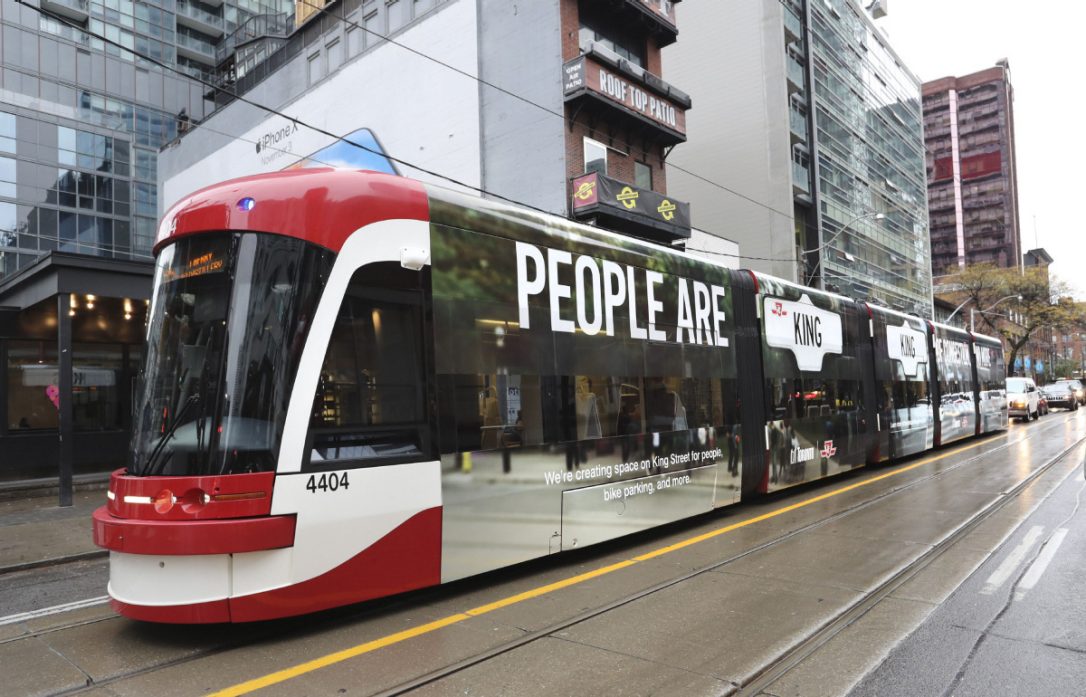
Toronto’s King streetcar sees ai???spectacularai??i?? rise in ridership
URBAN TRANSPORTATION REPORTERTORONTORidership on the King streetcar has surged 25 per cent during the busiest times of the day in the wake of efforts to speed up transit on the key downtown roadway, according to the Toronto Transit Commission.
The rise has been so abrupt that TTC acting CEO Rick Leary said in a report released Thursday evening that the agency is “a bit of a victim of our own success,” with crowds of passengers exceeding vehicle capacity.
“The rationale to do this [change] is to move transit more quickly and get people on transit, and this shows that in spades,” TTC chair and councillor Josh Colle said in an interview.
Mr. Colle called the rise “spectacular” and said that streetcar ridership has not dropped on nearby Queen Street, which suggests that these additional passengers are people new to transit.
The TTC plans to address crowding by using buses on both College and Dundas and redeploying those streetcars to “routes, like King Street, where demand is critical,” Mr. Leary wrote.
Evidence of the rising ridership, which came as part of the monthly report by the CEO of the TTC, emerged amid rising anger by business owners who say that their bottom lines have been hurt badly by the project. Many of them are expected to meet Friday with Toronto Mayor John Tory to argue for rolling back some of the transit changes.
In early November, the city started a pilot project that included a number of adaptations to King Street, between Bathurst and Jarvis, chief among them ending curb parking and forcing drivers to turn off at most intersections. The goal was to preserve vehicle access to all parts of King, while preventing it being used as an auto thoroughfare.
Bronwen Clark, the general manager of Rodney’s Oyster House, a bit west of Spadina, reported dramatic declines in business since then and said that poor attendance has prompted them to close part of their restaurant. She is hoping city leaders can be convinced to relax the driving restrictions in the evening.
“We want the street opened up,” she said. “Then people can be encouraged to go out for dinner.”
Advocates of the project counter that the streetcar sees substantial use outside of rush hour, and that the city failed the last time it tried to have time-based restrictions on King. A quarter-century ago the city reserved the centre lanes of parts of King to streetcars and taxis at certain times of day. Signs mandating this still hang in places over the roadway but the tactic proved ineffective. This failure eventually prompted the current pilot.
TransLink Fined $607,000 – The Breaker News
This is significant on two accounts.
First: Why was TransLink doing electrical repair during operating hours at the station and why wasn’t proper procedure followed?
Second: Why is it that the Breaker News scooped the mainstream media on this?
This is important as the mainstream media has a “hands off” policy on TransLink and regional transportation and only prints stories that they have no option but to report on and news releases from TransLink.
This bodes ill for any logical debate on major transit issues in the region, as TransLink spin is taken for fact.
With public transit, the public’s safety is first and foremost with transit operations, yet this accident happened during operational hours.
Hats off to Bob Mackin and the Breaker News, researching the stories that the Sun and Province will not!

Exclusive: TransLink slapped with huge fine after SkyTrain electrician injured
Bob Mackin & The Breaker News.
Less than a week before Christmas, TransLink was fined more than $607,000 because a worker was seriously injured in an electrical explosion at a SkyTrain station last spring, theBreaker has learned.
theBreaker has also learned thatAi??SkyTrainai??i??s director of health, safety, training and environment was terminated on Jan. 8.
WorkSafeBC found B.C. Rapid Transit Company (BCRTC), the division that operates SkyTrain, broke two Occupational Health and Safety regulations, regarding de-energization and lockout, and the section of the Workers Compensation Act that requires employers to train, instruct and supervise workers to ensure their safety.
Nanaimo SkyTrain Station (Google)
During passenger operating hours around 11:30 a.m. on May 26, 2017, an electrician was pulling a circuit into the main panel at Nanaimo Station when a mishap occurred and an arc flash was created. A source told theBreaker it was extinguished by BC Hydro fuses blowing. The worker suffered burns, but has fully recovered.
WorkSafeBCai??i??s Dec. 19, 2017 administrative penalty order for $607,497.56 said BCRTC failed to take sufficient precautions for the prevention of work-related injuries; has not complied with sections of the Act and Regulation; has not maintained a safe workplace or safe working conditions; and did not exercise due diligence to prevent the incident.
The fine was, unofficially, the fourth-biggest levied by WorkSafeBC in 2017.
theBreaker sought comment from SkyTrain general manager Vivienne King. In an emailed statement, TransLink told theBreaker that it has filed a request for a review of the fine.
The SkyTrain division, according to the prepared statement, ai???immediately reviewed and adjusted relevant practices and procedures, and ensured staff were made aware of the changes.ai???
The statement said power technicians were briefed about the incident and the changes to policies and procedures. They were also provided a reminder of hazards control hierarchy, step back and hazard awareness.
ai???[We] are continuing to assess safety procedures department-wide, as well as enhancing our written and documentation procedures,ai??? the statement said. ai???BCRTC is committed to continuing to work with WorkSafeBC to make sure a high standard of safety is achieved for all staff.ai???
It was not the first incident involving an electrician working on a system critical panel during passenger operating hours.
During midday July 21, 2014, the Expo and Millennium lines suffered a massive outage for five hours after an unsupervised electrician used a non-insulated screwdriver on a panel.
ai???Although standard operating procedures did not restrict this from occurring during operating hours, they also did not state that it could occur during operating hours,ai??? said a report on the two July 2014 service outages.
Natalia Skapski, the director of health, safety, training and environment, was replaced Jan. 8 on an interim basis byAi??Eva Kaczmarczyk, who was Ai??manager of safety, environment and emergency management.
Neither King nor TransLink CEO Kevin Desmond responded to theBreakerai??i??s email. The media relations department would not answer questions about the reason for the shakeup or the severance amount for Skapski.
ai???As this is an internal personnel matter, we are unable to provide any comment at this time,ai??? said an emailed statement from TransLink.
Support theBreaker.news for as low as $2 a month on Patreon. Find out how. Click here.
2000 Posts!
When John Buker asked me to post items for the rail for the valley group, I accepted, thinking it would be fun to write a few items on TramTrain. Well it is now 2017 and I am still writing about trams and TramTrain
Nothing has changed and my very first post is still pertinent today. The only difference today is that the tracks on the Vernon/Kelowna line have been ripped out and sadly so seems the fate of the E&N.

Zwei’s first post from Dec. 12, 2008..
What is Light Rail Transit or more commonly known as LRT? According to the Light Rail Transit Association (www.lrta.org) Light rail is a mode that can deal economically with traffic flows of between 2,000 and 20,000 passengers per hour per direction, thus effectively bridging the gap between the maximum flow that can be dealt with using buses and the minimum that justifies a metro. But there is more, by track-sharing with existing railways on their rights-of-ways, means that LRT can effectively and affordably service less populated areas, with public transport. Streetcars are also light rail, but operate on-street, in mixed traffic, with little or no signal priority at intersections. The main difference between LRT and a streetcar is the quality of rights-of-way, where a streetcar operates on-street, LRT operates on a reserved rights-of-way or a route that is reserved for the sole purpose of the light rail vehicle. A reserved rights-of-way can be as simple as a HOV lane with rails, to a lawned park like route with trees, hedges and flowerbeds. LRT, in it’s various forms is used in over 600 cities around the world and is the first choice of transit planners for affordable, customer friendly public transport.
The German city of Karlsruhe (City population 275,285) has taken light rail to a new standard, by track sharing with mainline railways and operating, what is called tramtrains. In Karlsruhe, one can board a tram, on-street, on the pavement and alight, on-street in Ohringen some 210km (130 mile) later, with the tram acting as a streetcar, light rail vehicle and a passenger train! Karlsruhe’s light rail network now extends over 400 km. (250+ mile) of route, servicing scores of small towns and villages with high quality public transit at very little cost simply because the tram can use existing railway tracks.
In British Columbia, tramtrain can be a useful tool for implementing a high quality ‘rail’ transit service, not only in Vancouver and the Fraser Valley, but in Victoria (E & N Railway) and the Kelowna/Vernon rail corridor as well.
The question is: Why does TransLink and the BC government reject modern LRT out of hand and continue to build with dated SkyTrain light metro?
What grieves me more than anything is the absolute reluctance to plan with modern light rail by TransLink, Metro Vancouver and the province. The still cling to the notion that transit is the “reelection express” and transit be designed to suit political needs rather than customer needs.
The SkyTrain Cult Is Today’s Version Of The Cargo Cult
The Cargo Cult is a millenarian movement first described in Melanesia which encompasses a range of practices and occurs in the wake of contact with more technologically advanced societies. The name derives from the belief which began among Melanesian’s in the late 19th and early 20th century that various ritualistic acts such as the building of an airplane runway will result in the appearance of material wealth, particularly highly desirable Western goods (i.e., “cargo”), via Western airplanes.
Millenarianism has been found through history among people who rally around often-apocalyptic religious prophecies that predict a return to power, the defeat of enemies, and/or the accumulation of wealth. These movements have been especially common among people living under colonialism or other forces that disrupt previous social arrangements.

The SkyTrain Cult is obsessed with SkyTrain and almost have attributed magical powers to the proprietary railway. The SkyTrain Cult refuse to face facts, but rather live in a world of fake news and alternative facts.
SkyTrain is just a railway, albeit an expensive railway.
The following is rather elegantly presented, but is full of misinformation, false assumptions and down right exaggerations of the truth..
To lay one’s cards on the table, I found the Surrey LRT ill planned and not sustainable, but to build SkyTrain instead is nothing more than insanity.
The following is from a person who is naive of modern public transit philosophy and has thrown his lot in with the SkyTrain Cult.
Only seven SkyTrain systems built in forty years, speaks volumes on the subject, but Millenarians pray to false gods and it is very hard to get someone out of a cult, just ask former members of Scientology.
And those European ideals? Providing an affordable and user-friendly transit service that will attract the motorist from the car, is what the Europeans strive for.
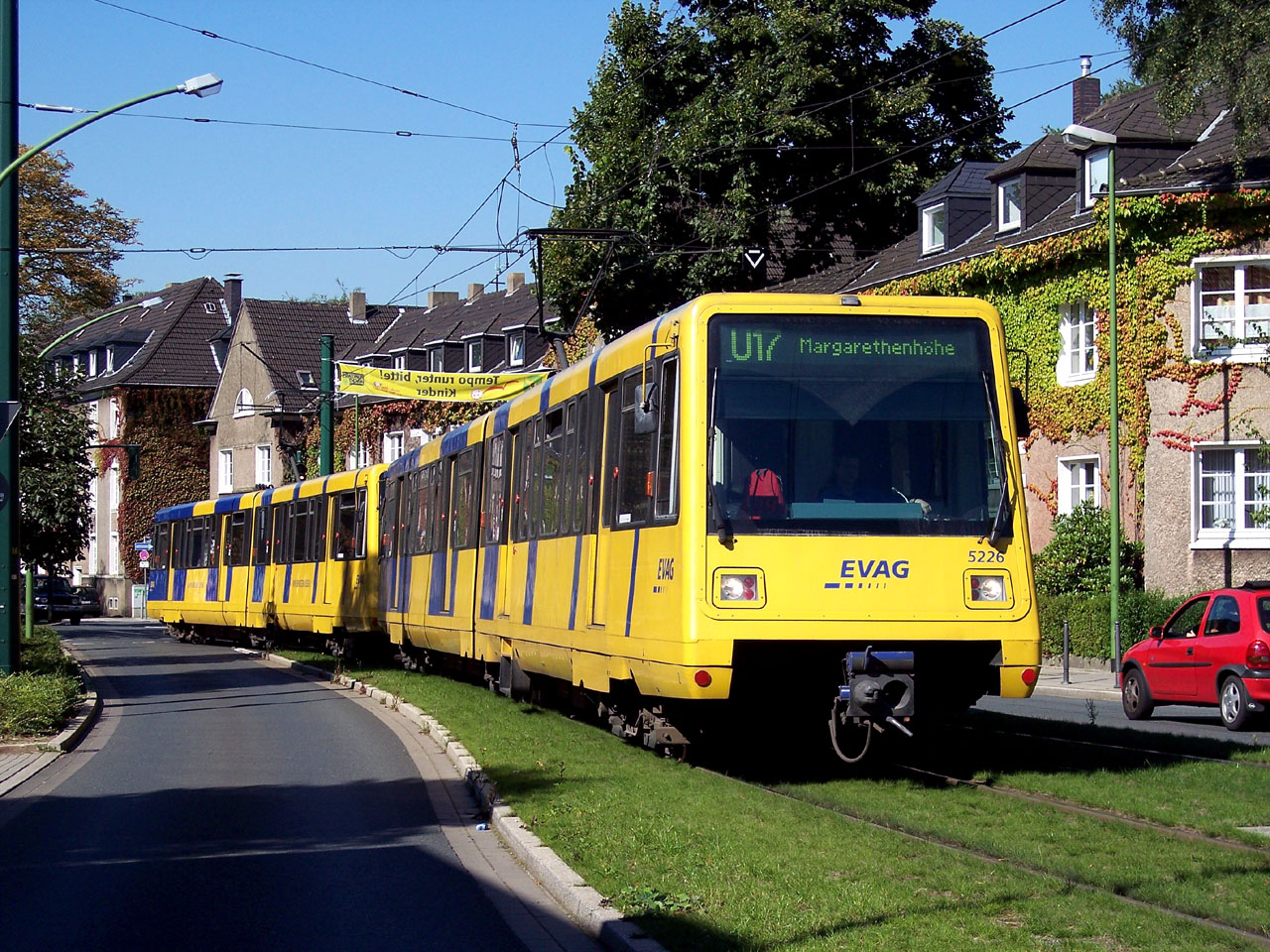
Opinion: Surrey’s obsession with light rail is a misguided pursuit of European ideals
Guest Author Jan 04, 2018
Written for Daily Hive by Sam de Groot, a lawyer in Vancouver with a longstanding interest in urban design and transport.
Itai??i??s time to call time out on Surreyai??i??s light rail transit (LRT) plan. In 2012, TransLink studied the costs and benefits of the various transit expansion options in Surrey, and LRT was found to be the worst option.
We need to heed that pivotal study that clearly identifies the gross shortcomings of the LRT option.
First of all, LRT is not that much cheaper than SkyTrain over the longer term because LRT has higher operating costs and lower fare revenue due to the forecast of lower ridership from its slower speeds through city streets. For instance, LRT on King George Boulevard to Newton, 104th Avenue to Guildford and Fraser Highway to Langley would have a net present cost of $1.63 billion.
SkyTrain along Fraser Highway to Langley with bus rapid transit (BRT) on King George and 104th would have a net present cost of $1.67 billion. And a pure BRT system on King George, 104th and Fraser Highway would have a net present cost of $0.82 billion.
This is all in 2010 dollars, with the project facing significant cost increases ever since these initial estimates.
Both LRT projects combined are now expected to far exceed $2 billion.
Secondly, LRT provides the least transportation benefit. The same 2012 study estimated that the LRT plan outlined above would result in 5.7 million hours of travel time savings per year, the BRT plan would result in 6.5 million hours per year, and the SkyTrain-BRT plan would result in 12.6 million hours per year. The dramatic superiority of the SkyTrain-BRT plan is due to both higher speeds and higher ridership.
It is no surprise then that the estimated cost-benefit ratio of the LRT option is a dismal 0.69 compared to 1.30 for the BRT option and 1.45 for the SkyTrain-BRT option.
A number below 1.0 means that for every dollar invested in the project, less than a dollar of benefit is realized including all the non-cash benefits like travel time savings and environmental benefits. Calculating cost-benefit ratios is no exact science, but it is useful for comparisons, and clearly LRT is the worst option.
“We do not have to watch reruns of Monty Python for our amusement, we just have to tune in to Vancouver’s transit planning for our entertainment”
It is now 2017 and the transit year is off with a dull thud.
The title comes courtesy of an old transit acquaintance from the UK who was badly burned by his Canada Line experience.
With the planned Pattullo Bridge replacement bridge having only 4 traffic lanes; the Surrey Hawthorne Park road debacle (where a new road is needed due to LRT taking up two traffic lanes); the ongoing Broadway Subway silliness and TransLink’s oppressive ongoing public relations program, 2018 will be a make or break year for transit.
My money is on a complete transit fiasco, as the amateurs planning the Surrey LRT; TransLink’s/City of Vancouver’s denial with subway costs (TransLink fired its best planner because of his opposition to the subway) and Burnaby mayor, Derek Corrigan, now head of the mayor’s Council on Transit, it will be a most explosive mix.
The main stream media both in Vancouver and Toronto, who have never honestly reported on transit in the region and rely on a blather of News Releases and ‘Yellow Journalism’ for their transit articles are firmly on side with TransLink, as they rely on TransLink’s largess with advertising revenue. If the news fits, they will print!
Then we have Kevin Desmond, the new American born CEO of TransLink, repeating the old saw that “SkyTrain pays its operating costs”.
Really?
But Desmond never mentions the annual subsidies paid to SkyTrain and the Canada line.

In 1992, the subsidy for SkyTrain (just the Expo Line) was $157 million! How much the subsidy for the three SkyTrain Lines and the Canada line remain a secret!
Subsidies you say? But how can a transit system pay it operating costs, yet receive a subsidy?
Fancy book work, Mr. Desmond.
So much more including the bad habit of giving percentage increases, without giving the actual numbers.
It is like listening to a used car salesman, selling a lemon.
After the fiasco’s of 2015 and 2016, I hoped TransLink for once, would travel a more honest road. Well, I guess you cannot teach a bad old dog new tricks.
Memo to Mr. Horgan: Clean up this vile and expensive mess called TransLink.
A Question Of Capacity Reprinted from the Light Rail Transit Association
A QUESTION OF CAPACITY
THE CAPACITIES of different modes of transport are generally quoted as 0-10 000 passengers per hour for bus, 2000-20 000 for light rail, and 15 000 upwards for heavy rail.

* Maximum capacity is only likely to be required for a few hours during peak hours, and even here there are likely to be variations both day by day and within each hour. The capacity required originates from the route’s social characteristics.
* As for the vehicles, buses have a comfort capacity equal to the number of seats, and a maximum capacity equal to seats plus standing load.
* In the case of trams, it is more complicated. The nominal maximum capacity is calculated at four passengers per square metre of available floor space (a reasonably comfortable level), plus the number of seats.
* As trams are designed to carry a large standing load, the ratio of standees to seats is quite high. The standing area is also important for the carrying of wheelchairs, pushchairs, shopping and sometimes bicycles. Some manufacturers quote maximum capacity using 6p/m2 while a figure of 8p/m 2 is used as a measure of crush capacity. This last figure is also employed to determine the motor rating of the vehicle.
* A further complication is that even when there are seats available, some passengers prefer to stand. This may be because they are only traveling for a few stops, that they want to stretch their legs, or may just prefer to stand.
* A tram’s comfort capacity can therefore be considered as the number of seats, plus the voluntary standees who may amount to up to 10-15% of the nominal maximum number of standing passengers.
ELASTICITY
* It is the difference between the average passenger load for any particular time and the crush load which gives light rail its Elasticity Factor, allowing it to cope with variations in conditions such as sudden surges or emergency conditions.
* Standing is made more acceptable by the design of track and vehicle, reducing the forces acting on the passenger to a minimum. This makes for a smooth ride, as well as ensuring ease of access, good support and the ability to see out without having to stoop.
* Where a route is mainly urban with short journey times, the number of vehicles required should be calculated on the nominal maximum. On longer journeys outside the central area, a lower level may be more appropriate, dependent on the route’s characteristics. Even on rural sections, there are likely to be a a number of short distance riders, and the loading factor will increase nearer to the urban area.
COMPRESSIBILITY
* While it might be thought desirable to offer every passenger a seat, it is in fact the ability to carry high loadings in a confined area (the Compressibility Factor) which enables light rail to achieve many environmental benefits, allowing large numbers of people to be carried without harming, and often improving, the features of a city.
* It is city centres where several routes combine that the most capacity is required. A typical situation could be a pedestrian street with six routes operating at 10-minute headway giving 36 double coupled trams per hour each with a capacity of 225. This gives a nominal capacity of16 200 passengers per hour which can be increased to 25 200 pph in extremis without extra vehicles.
Light rail is unique in this ability to operate on the surface with its capacity without detracting from the amenities which it serves. A further factor in setting the resources required is the need to lure motorists out of cars. The more difficult the traffic conditions, the higher the loading’s will be acceptable. It is however important that crush loads are not allowed for more than the shortest of periods on an infrequent basis, both to maintain customer satisfaction and prevent elasticity of the system being compromised.
* It is vital that public transport can cope with sudden changes in demand, such as extreme inclement weather or air quality violations which can cause private traffic to be halted. This is where the elasticity inherent in light rail is so beneficial in enabling an instant response in an economical fashion. A tram may be crowded, but its infinitelybetter than having to wait in the snow of smog untilextra vehicles are brought into service.
* It is this unique combination of Capacity, Compressibility and Elasticity rather than capacity alone which makes light rail so successful as an urban transport mode.
* Note Statistics are based on Karlsruhe, using GT/8 cars
Christmas Eve in Trondheim
Christmas eve and the dependable tram is ready to take one to Christmas festivities.
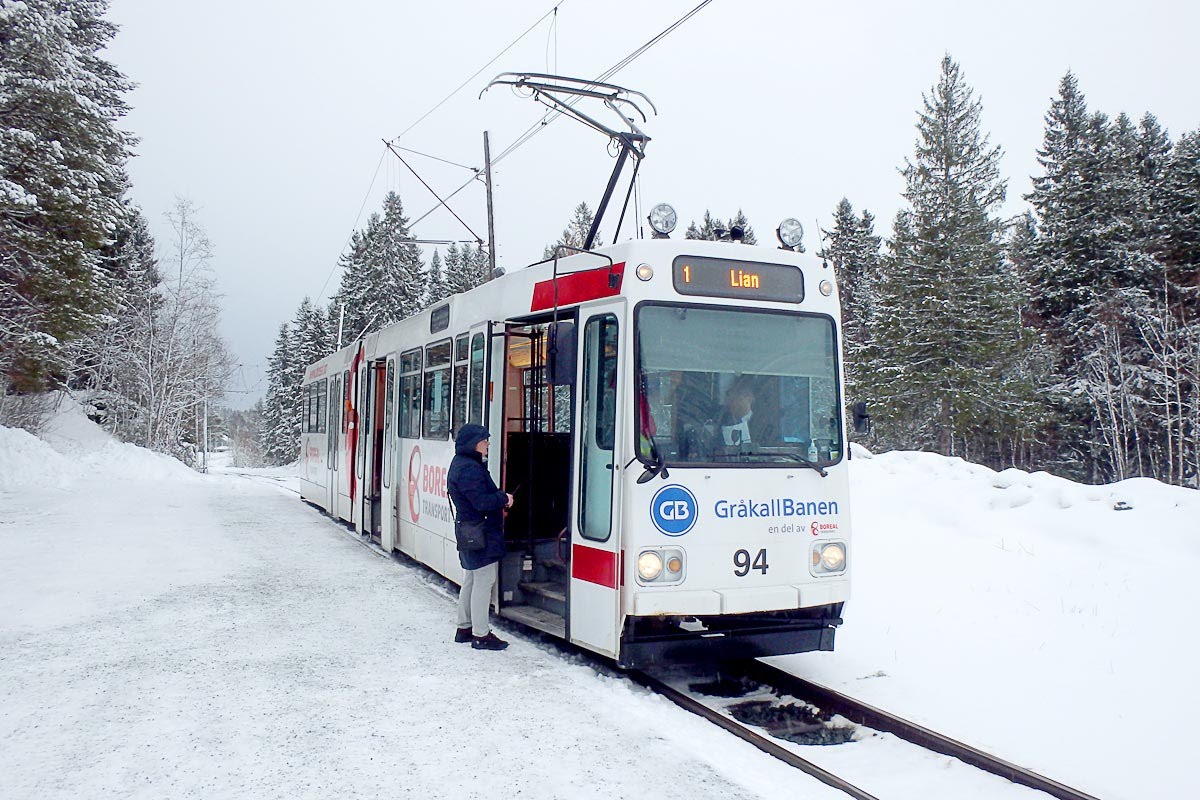
Numbered Line 1, it is operated by Boreal Bane, a subsidiary of Boreal Norge and is often simply called the GrA?kallen Line (GrA?kallbanen). GrA?kallbanen operates five tram cars, out of a total rolling stock of nine articulated tram cars built by Linke-Hofmann-Busch in 1984. In addition heritage cars from the Trondheim Tramway Museum are available for chartered tours.
The tram operates at 15 minute headway in the daytime on weekdays, and partly on Saturdays, otherwise at 30 minutes headway. The line has 21 stations remaining in use. The tram service is integrated into the city bus system with free transfers. The overall responsibility for public transport in Trondheim is managed by SA?r-TrA?ndelag county municipality, who subsidize the operations.
Previously there were three lines in Trondheim, including Ladelinjen to Lade and Singsakerlinjen to Singsaker in addition to tracks to Ila, Elgeseter, Trondheim Central Station and Lademoen. The line to Singsaker was closed in 1968 while the rest of the network was closed in 1983 and 1988, though the line to Lian was reopened in 1990.
Since 2004, the tramway has been the most northern in the world, following the closure of the Arkhangelsk tram system on 21 July 2004.Trondheim is also unique in that it is one of two rail lines in Norway built to metre gauge 1,000 mm (3 ft 3 3a?i??8 in) (along with the heritage railway Thamshavnbanen) and in that the tramway is one of two in the world (along with the Cairo tramways) to use 2.6 m wide cars in combination with metre gauge.



Recent Comments