The Return Of The Tram!
One of the recurring themes for the SkyTrain types is that big cities have subways and little cities have trams.
Well Berlin, the Capital of Germany with a population 3.7 million, is now investing in trams in the former “West” portion of the city as the old Communist “East” section retained the pre-war tramways.
This could be a lesson for Vancouver, in providing user-friendly transit, instead of politically prestigious and user unfriendly subways.
The subway isnai??i??t necessarily ideal for short trips………… Getting on a tram at street level is easier for people with limited mobility………
This is something TransLink and Vision Vancouver planners have failed to realize, transit that is easier to use is user-friendly and user friendliness is the prime reason people use public transport.
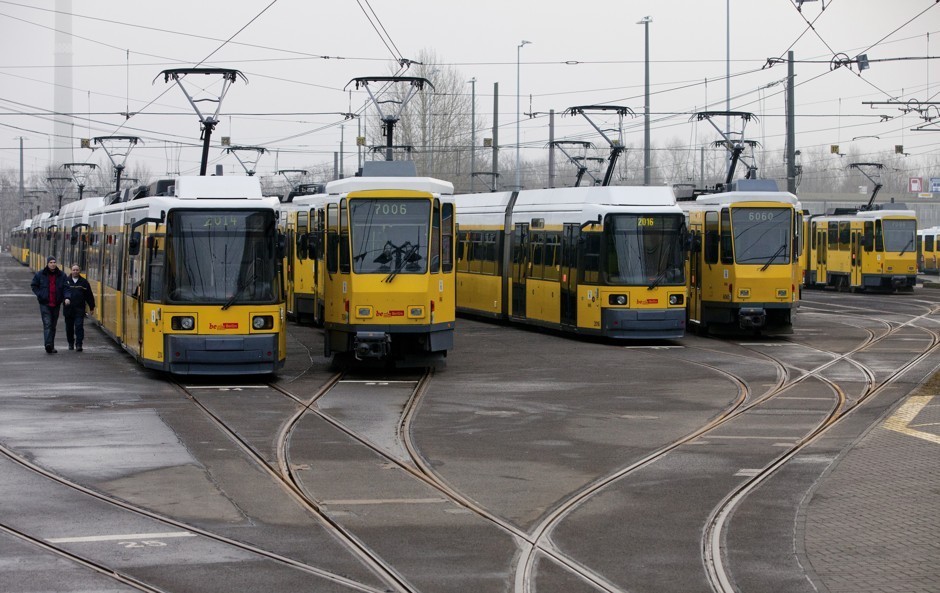
While East Berlin’s streetcars soldiered on under communist rule, West Berlin tore up the tracks. Now, the city is correcting its mistake.While East Berlin’s streetcars soldiered on under communist rule, West Berlin tore up the tracks. Now, the city is correcting its mistake.This spring, Berlin agreed to correct a 50-year-old mistake.Back in 1967, in a city divided between the powers of the Cold War, West Berlin canceled its last streetcar services, focusing its transit network on trains, subways, and buses. Meanwhile, East Berlinai??i??s streetcars soldiered on, resulting in a tram system that today is largely nonexistent in the cityai??i??s former western sector.But 28 years after reunification, the city has realized its error. Between now and 2026, the German capital is set to greatly expand its streetcar network, with the western region receivingmost (if not all) of the new connections. Starting in 2021, streetcars will roll back out along the western streets, with officials hopeful that they will streamline the local transit, and maybe even reduce crime in some areas.A quick visit to eastern Berlin makes clear why the western sectorai??i??s rejection of streetcars was a bad idea. European streetcars have never developed the bad reputation they often have in the U.S., and what survives of Berlinai??i??s longstanding pre-division network is still exemplary. Usually fully segregated from motor traffic, itai??i??s fast and clean, linking up well with the subway without duplicating its routes. Jump out of the subway at some key stations and youai??i??ll often find a carefully timed streetcar waiting there to whisk passengers away. Recent modest enlargements to the network have also proved popular. When the streetcar was extendedto Berlinai??i??s Central Station in 2015, the city expected 20,000 passengers per day. The current number of passengers is actually twice that.The new lines will follow this model, extending from the existing network far into the west, to connect the Kreuzberg, NeukAi??lln, SchAi??neberg, Moabit and Charlottenburg districts to the cityai??i??s (formerly eastern) heart. None of these areas are poorly served for transit links, but the streetcars will certainly come in handy. Berlinai??i??s buses can get snarled in traffic at peak hours, while the sheer variety of routes mean that people tend to stick to the two or three lines they know well, or even avoid buses entirely. The subway isnai??i??t necessarily ideal for short trips, even if Berlinai??i??s system is often considerably closer to ground level than in London or Paris, resulting in trains that are quicker to reach from the street. Getting on a tram at street level is easier for people with limited mobility, while it could also take some weight off an overburdened subway in a fast-growing city.Some drivers wonai??i??t be happy, however. Berlinai??i??s streetcars donai??i??t mingle with traffic, so they will take some space from existing car lanes along key routes. Still, the plan has some potential support from an unexpected source: users of a park that will likely get a new tram line through it.The current plan is to thread rails across Kreuzbergai??i??s GAi??rlitzer Park, a long sliver of parkland that covers the former platforms and sidings of a long-demolished railway station. Using parkland as a transit site might sound controversial, but in recent years the park has become a notorious sitefor drug dealing. Bringing the streetcar through the park might make it more difficult for dealers to use the park as shelter, meaning that so far, locals seem to be giving the plan cautious approval.The new trams should ultimately join up with other pending transit projects, including a new bike highway network. Berlinai??i??s drivers may be looking at less road space in some areas, but the cityai??i??s transit network could end up proving so effective that few will mourn the loss.
Their NDP May Do, What Our NDP Should Do!
The Scarborough subway soap opera continues.
What is interesting is that the NDP in Ontario may very well kill the now $3.45 billion, 5 km., one station subway for a much cheaper light rail line.
“There is a tipping point beyond which the unjustifiable becomes unsustainable.” and as TransLink and the Mayor’s Council on Transit are deeply afraid in releasing current cost estimates, one must be assured that the tipping point for the Broadway SkyTrain subway has already been past.
Memo to Premier Horgan; show some moral fortitude and kill the project, before the project kills TransLink.

Could the NDP stop the Scarborough subway in its tracks?
The Ontario Liberals and PCs are dug in deep on the transit plan but on the eve of an election what better way for the NDP to resonate with Toronto than by reverting to the original LRT plan, Martin Regg Cohn writes.
By Martin Regg CohnOntario Politics ColumnistWed., Dec. 20, 2017Itai??i??s not every day ai??i?? nor even every year ai??i?? that Toronto opens six new subway stations. More like every other decade.
Thatai??i??s a long wait for harried commuters. And an eternity for politicians in a hurry.
None of the politicians cutting the ribbons this month were in power all those years ago to cut the cheques. A timely reminder that they only ever benefit from the short-term election cycle, and rarely remain for the long-term investment horizon required to build subways.
Against that backdrop, the back and forth trajectory of transit construction in the GTA is easier to explain. Politicians come and go every few years, while their pet projects zigzag to their final destination:
Former finance minister Greg Sorbara drove the much-needed York University extension all the way to his own riding of Vaughan, a dubious terminus; ex-mayor Mel Lastman gave us the little-used Sheppard stub; the late Rob Ford begat the overbuilt Scarborough subway, with funding from his federal pal, then-finance minister Jim Flaherty; and Dalton McGuinty bankrolled much of it before bailing as premier.
A supporting role goes to Brad Duguid, the Scarborough cabinet minister who warned that any subway changes would be ai???over my dead body.ai??? Like other transit contortionists and extortionists, Duguid isnai??i??t running again, so he will be long gone by the time his legacy becomes our albatross. Two public servants who have danced around the Scarborough debate are also out of the picture ai??i?? chief planner Jennifer Keesmaat has quit, and the TTCai??i??s nimble CEO, Andy Byford, is New York-bound.
Who then will cut the next set of ribbons years from now?
A new cast of characters is driving the transit debate ai??i?? Premier Kathleen Wynne, Progressive Conservative Leader Patrick Brown, the NDPai??i??s Andrea Horwath and Mayor John Tory. Despite their disparate ideologies, they have a shared allegiance to the dubious Scarborough subway extension that defies logical transit planning and fiscal prudence.
A VERY MERRY CHRISTMAS TO ALL!

RAIL FOR THE VALLEY WISHES ALL A VERY MERRY CHRISTMAS

Complete with a fireplace to hang one stockings with care.
AND A HAPPY NEW YEAR
Fear of Subway Costs Grips Mayors Council
As our friend, Haveacow indicated some time ago, the Broadway subway is going to cost a lot more than many think.
Some years ago, Zwei entered into correspondence with a German transit Engineer, Wolfgang and he warned of subway construction and operating costs, which hobbled German transit authorities and also lead to the rebirth of the tram in Germany.
In Toronto, the TTC estimates that the cost to operate and maintain a one station 5 km subway is $40 million annually.
The last post now sees Vision Vancouver and the mayor, rushing ahead with subway plans, yet the very same council is afraid to release the estimated costs for the subway.
Memo to Premier Horgan: Enforce a moratorium on all subway planning until TransLink releases:
- Total construction costs for a SkyTrain subway.
- Ai??The annual maintenance costs for a SkyTrain subway.
- Present passenger flows on the 99B buses on Broadway.
Planning by stealth never works and fear now grips the mayor’s Council on Transit as they are afraid of releasing the real costs of subway construction.
Thank you to Bob Mackin and the Breaker news!

Fear of huge costs of the Broadway subway has scared TransLink and the Mayors Council on Transit. There is a long dark tunnel of escalating subway costs.
Exclusive: Mayors got secret update last year on TransLink megaproject costs, but kept public in the dark
Bob Mackin
Internal TransLink documents obtained by theBreakerAi??strongly suggest the estimated costs for three Metro Vancouver transportation megaprojects have skyrocketed and the agency is grappling with how and when to break the news to the public.
Document obtained by theBreaker confirms TransLink and Metro Vancouver mayors are keeping secrets about megaproject costs.
The 2015-adjusted estimates were $2.53 billion for light rail transit in Surrey, $2.28 billion for a subway under Broadway and $1.1 billion to replace the 80-year-old Pattullo Bridge. Documents released to theBreaker on Dec. 11 under the freedom of information law confirm that the costs were further updated in 2016 and given secretly to the Mayorsai??i?? Council, ai???but not publicly released.ai??? Further estimates were crafted this year.
A March 9, 2017 communications plan said the cost pressures include rising real estate prices, inflationary pressures on contractors and a Canadian dollar that is lower in value than when the estimates were made for the regional mayorsai??i?? $8.08 billion, 10-year plan in 2014.
Specifically, the Broadway project is feeling increased pressure because of geotechnical assessment. The cost of an operations and maintenance facility is adding pressure to the Surrey-Newton-Guildford phase of Surrey LRT, along with utility relocation and the rising cost of land to accommodate corridor widths.
The communications document indicated that TransLink was planning to hold media briefings to provide in-depth information about the projects, business cases and updated costs. It contemplated holding a major media event in conjunction with the B.C. and federal governments. Development was underway on project websites and social media content, it said, was shared with mayors and the province.
Project cost estimates were censored from January updates to the Public Transit Infrastructure Fund steering board. The documents did show that more than $11.6 million had been spent on the Broadway project and $15.2 million on Surrey. Other documents warn that every year of delay adds $300 million to $500 million to capital costs.
An April 2 email from Sany Zein, TransLinkai??i??s infrastructure management and engineering vice-president, to TransLink CEO Kevin Desmond did not show dollar figures, but it said ai???the project inflation numbers are higher than recent GDP growth and higher than general recent inflationary growth; so some level of ai???hot marketai??i?? inflation is accounted for.
ai???The contingency percentages have been getting lower as the design definition improves.Ai??If interest during construction and internal labour charges are excluded from the gross total, the contingency value would represent a higher percentage.ai???
Inflation was estimated at 3.5% per annum for construction and 2.5% for systems prior to contract award, 2.5% for construction and systems during construction and 2.5% for management and professional services.
Donald Trapp, the ParternshipsBC project director, wrote April 7 to Zein that contingency estimates for construction costs ranged from 19% for Surrey-Newton-Guildford to 25% for Pattullo. Trapp also offered some optimism.
ai???Cost inflation for heavy civil does not follow residential/commercial domestic market trends,ai??? Trapp wrote. ai???Major projects attract contractors and consortia from around the world, and some areas (think Europe) the outlook is not secure; our projects will be very attractive.
ai???Cost control is achieved through proper management of the scope and schedule throughout the project from inception to substantial completion.ai???
TransLinkai??i??s Sany Zein
Final business cases were supposed to be completed and submitted for approval to the NDP government this fall. The documents estimated that, pending funding confirmation, construction work on all three projects could be underway by 2019. Pattullo and Surrey-Newton-Guildford could be completed in 2023 and Broadway in 2024.
An update on major capital projects is on the agenda for the Dec. 14 board of directors meeting at TransLink headquarters in Sapperton. It will be the swansong for Vancouver Mayor Gregor Robertson and Surrey Mayor Linda Hepner, who were replaced as the Mayorsai??i?? Council-appointed directors last week.
The regionai??i??s mayors chose Burnabyai??i??s Derek Corrigan to replace Robertson as chair and North Vancouver Districtai??i??s Richard Walton to replace Hepner as vice-chair.
Corrigan, a pragmatic, longtime NDP member, suggested that smaller municipalities are growing anxious.
ai???Both Gregor Robertson and Linda Hepner were very much focused on the big projects in their cities, so I think there was a feeling that maybe there would be a little more regional perspective if they got people in that were from more neutral ground,ai??? Corrigan told the Burnaby Now.
Vancouver’s Dirty Subway Politics Continue
A Vancouver reader to this blog received the following letter today from the City of Vancouver.

The gentleman received the letter one day past the RSVP Date and the city evidently got the bus route numbers mixed up, as well.
This continues the dirty subway politics practiced by Vision(less) Vancouver and with a former Vision(less) Councillor, now advising the Premier, more bad and expensive transit decisions may soon be coming from the Premier’s Office.
Why the hurry?
Could it be that the CoV and Vision Vancouver want to ramrod this $3 billion+ subway through before sticker shock becomes an issue in the region?
Dirty politics abound with transit issues and only the Premier and the Minister of Transportation can change this.
I am not holding my breathe.
The Big Shake Up
Good news everyone, there has been a shake up at TransLink and Burnaby Mayor Derek Corrigan is at the helm of the Mayor’s Council on Transit.
Mayor Corrigan is the only mayor who actually has knowledge of transit and transit operation as he was a former CEO of BC Transit. The rest of the metro mayors haven’t a clue and have supported building massively expensive transit projects that will not alleviate congestion in the region at the behest of special interests. Special interests I must say, that did not care about proving an affordable ans user-friendly transit system.
Under Vancouver Mayor, Gregor Robertson, transit planning was Vancouver centric with multi billion dollar vanity projects, with the proposed Broadway subway being at the top of the list!
The Broadway SkyTrain subway, with costs now rumoured in excess of $3 billion, will not take a car off the road, yet pile on massive debt onto TransLink.
The badly planned Surrey’s LRT is being designed as a poor man’s SkyTrain and again offering little or no advantage to transit customers and/or the taxpayer.
The so called experts still pining for the Broadway subway demonstrate a complete lack of knowledge on transit and still believe in the old adage that;
“the more money you spend on a transit project, the better it will be.”
Not experts they!
Simple math kills the Broadway subway as current traffic flows along Broadway are less than 4,000 pphpd in the peak hour and the bare minimum traffic flows recommended for a subway is at least 15,000 pphpd!
Toronto’s much debated Scarborough Line replacement subway is suffering from the same issues of not enough traffic flow to justify a now $3.6 billion $5 km. one station subway. The proposed Broadway subway will be 5.5 km long and have six stations.
As mentioned before, an European transit specialist once told me that Metro Vancouver’s mayors are not mature enough for LRT, well maybe some maturity is now being shown.

Some fear shakeup at mayor’s council could doom Broadway subway, Surrey light rail
Published on: December 8, 2017
Transit watchers are offering different takes on what this weekai??i??s regional transportation leadership shakeup means for major projects on Metro Vancouverai??i??s horizon.
On Thursday, Burnaby Mayor Derek Corrigan replaced Vancouver Mayor Gregor Robertson as the chair of the Mayorai??i??s Council on Regional Transportation after the council held an election, while District of North Vancouver Mayor Richard Walton replaced Surrey Mayor Linda Hepner as vice-chair.
The mayors of the regionai??i??s two largest cities were ousted at a time when those leaders are hoping to get major transportation projects built in their municipalities: Vancouverai??i??s Broadway subway and Surreyai??i??s light-rail line. Corrigan has been an outspoken critic of both projects, citing them as the reasons that,Ai??in 2014, he was the councilai??i??s only dissenting member to vote against the 10-year transportation plan.
Despite that, former Vancouver councillorAi??Gordon Price believes itai??i??s unlikely that the Burnaby mayor taking over as council chair will seriously jeopardize the Broadway subway or Surrey light-rail.
ai???That would really surprise me,ai??? said Price, who believes both projects as well as the Pattullo Bridge replacement are critical priorities for the sake of the region. ai???That would just raise a lot of antagonism, needlessly. ai??i??Ai??I donai??i??t think Corrigan is going to go there, I just canai??i??t see that kind of fight.ai???
ai???Here is Corriganai??i??s chance to establish his big-picture legacy, beyond Burnaby,ai??? Price said. ai???And I think he will go with it, I think heai??i??ll take it.ai???
ButAi??Patrick Condon, a professor in UBCai??i??s School of Architecture and Landscape Architecture, disagrees.
Condon said Price ai???has been a strong advocate for the subway despite its costs, so itai??i??s no surprise he would put a hopeful spin on it.ai???
Following this weekai??i??s change in the mayorsai??i?? council leadership, Condon said, ai???The tea leaves suggest a reconsideration of what will get built and where the money will go and what comes first, second and third.ai???
Some have speculated, Condon said, that the ai???Broadway subway might end up going to the back of the line.ai???
And, he added: ai???With a mayorsai??i?? council which hasAi??shifted dramatically in its power base away from Surrey and Vancouver, you might see some big changes, or at least a delay for the big projects, and at the most, potentially, a reconsideration.ai???
Other municipal politicians reacted to Corriganai??i??s election with concern Thursday: Langley City Coun. described Corrigan as ai???anti-TransLink,ai??? while New Westminster Coun.Ai??Patrick Johnstone tweeted: ai???TransLink finally has a (provincial government) ready to work with them; mayors put the most transit-regressive mayor in charge.ai???
Thursdayai??i??s vote result also means a change in the composition of TransLinkai??i??s board of directors, as the mayorsai??i?? councilai??i??s chair and vice-chair sit on the board, said TransLink spokesman Chris Bryan. The next TransLink directors meeting is scheduled for next week, which Robertson and Hepner are expected to attend, Bryan said, and then Corrigan and Walton will replace them in those positions starting in January.
Corrigan and Robertson were not available for comment Friday.
But in an October interview about TransLink governance, Corrigan told Postmediaai??i??s Jennifer Saltman the regionai??i??s mayors want to know theyai??i??re represented by mayors who areAi??ai???looking at the broad interests of the whole of the region.ai???
Robertson and Hepner ai???like where they areai??? on the TransLink board, Corrigan said in October.
ai???Both of them have a vested interest in being on the board because both of them have major projects that theyai??i??re pushing forward,ai??? he said in October. ai???So they see the ability for them to get what they want as a high priority, while the rest of us are saying: ai???Sure, itai??i??s nice that you can advance your big projects, but the rest of us donai??i??t have any voice.ai??i??ai???
 Dan Fumano
Commuter Rail Is Passe – It Is The Age Of TramTrain!
The anti-rail brigade is hard at it on Vancouver Island and there is a good reason why.
The author of the piece, consults with SNC Lavalin (a major red flag there)Ai?? and SNC Lavalin only wants high profit projects.
Example 1: The Canada line faux P-3 consortium, lead by SNC Lavalin,Ai?? receives about $110 million annually from TransLink for operating the mini-metro. Put another way, SNC Lavalin receives more on an annually than what is needed to get the E&N operational.
Example 2: The $100 million needed to renovate the E&N would buy you less than 250 metres of the proposed Broadway SkyTrain subway.
But is is the love affair with commuter rail that is worrisome. Despite the hype and hoopla, commuter rail, with long rakes of bi-level cars is a rather dated concept and indeed would be a failure on the E&N Railway.
The West Coast Express, is regarded as a success, but its extremely limited service, five trains in and five trains out, has not reduced congestion, rather it has exacerbated it by allowing an almost unchecked development of the North Shore of the Fraser as far as the City of Mission. Massive amounts of new housing has brought massive population increase, which has lead to massive congestion. All commuter rail has done is allow politicians to rezone lands for housing, making good profits for political friends.
For many, the WCE is not a transit option.
A regional rail servcie is a far better investment than commuter rail because it offers a daily scheduled service, which will offer a realistic transportation alternative for the car driver.
There is not much profit to be made by large corporations on regional railways because the tracks are in situ and all that is needed is an operating agreement, diesel multiple units, a maintenance facility, and a few employees.
Here is the issue, the simpler the transit the cheaper it is to operate.
All the the Times Colonist article states the obvious, that a commuter rail line on the E&N, will not work.
A regional passenger servcie, operating a regular timetabled service from downtown Victoria to downtown Nanaimo hasAi?? yet to be studied.
For SNC Lavalin and those who work for SNC Lavalin, there is no profit in a regional railway and they will make damn sure their consultants will see that none are built!
 An Alstom diesel tramtrain operating on a railway portion of route.
Comment: Economics show E&N rail line is a lost cause
Times Colonist December 2, 2017
Noting that the E&N Rail corridor is again drawing media attention and our current provincial poohbahs are launching yet another study of the entire rail line, I was taken with the photograph in the Nov. 26 edition of the Times Colonist, which shows a gentleman walking his dog along the rail line.
It is beyond my imagination that some people believe that this 19th-century junk pile has any future as an operating railway. The E&N was built in the 1880s as a resource railway to haul coal and timber. The former is unlikely ever to be mined on Vancouver Island in any quantity again, and the lumber industry abandoned rail transport on both the E&N and the Canadian National by the early 1970s. No railway in a lightly populated area such as Vancouver Island is ever going to thrive on passenger traffic alone.
At best, there were only a few hundred carloads of freight over the entire line, most of it between Port Alberni and Nanaimo, when the Canadian Pacific Railway surrendered ownership of the E&N. The now-departed Via Rail passenger service carried no more than 40,000 passengers in any year, was massively subsidized and then abandoned more than six years ago because of the unsafe condition of the entire railway between Victoria and Courtenay.
The costs of rehabilitating the E&N were in excess of $100 million when I was engaged as a consultant to the CPR in Calgary in the late 1990s. That figure has more than doubled today, and the deficiencies to bring the line up to current railway standards are lengthy ai??i?? substrate, ballast, ties, rail, bridges, signals and the list goes on and on.
Donai??i??t forget rolling stock ai??i?? Via Rail had three Budd rail diesel cars on the Island that are long gone, not to mention that they were built between 1956 and 1958. Donai??i??t forget the 180-plus grade crossings on the system, which are major hazards in themselves.
It was definitely to the CPRai??i??s advantage to ai???give the railway back to the peopleai??? for a tax receipt rather than to attempt to rebuild it, given no meaningful freight revenue, the associated cost of upkeep and a once-a-day Via Rail passenger service that was a giveaway. Why our provincial government would spend money on yet another study raises the question ai???why?ai??? butAi??this is an NDP/Green government.
I can fully understand the merits of a high-speed commuter rail service in areas of large, dense populations. To be safe, systems need to completely separate rail from pedestrian and vehicle traffic, and the Skytrain system in Vancouver is an excellent case in point. Does anyone really want to contemplate running a commuter-rail transportation system at grade level through Admirals Way and Goldstream Avenue with the frequency necessary to maintain a viable system?
To operate safely and efficiently, a system needs to be dual track and connected to the heart of the urban centre it serves. If one really wants to consider seriously a commuter-rail system, envision an elevated line using the Galloping Goose Corridor, which would serve a population base as far west as Sooke and connecting it to the heart of downtown Victoria, noting that connection was cut at the time theAi??Via Rail service was discontinued.
Until the day comes that economics justify a commuter-rail system that can be operated safely and efficiently, the best use of the E&N corridor is exactly what was illustrated in the photograph, a place to walk your dog or perhaps ride your bicycle.
James P. Crowley has been a consultant to Canadian National Railways, B.C. Rail and the Canadian Pacific Railway, specializing in heritage rail projects and working extensively on commuter-rail development with SNC-Lavalin and its predecessor companies, including portions of the Vancouver Skytrain system. He is the outgoing board chairman of the Victoria Airport Authority.
Scarborough Subway Sticker Shock
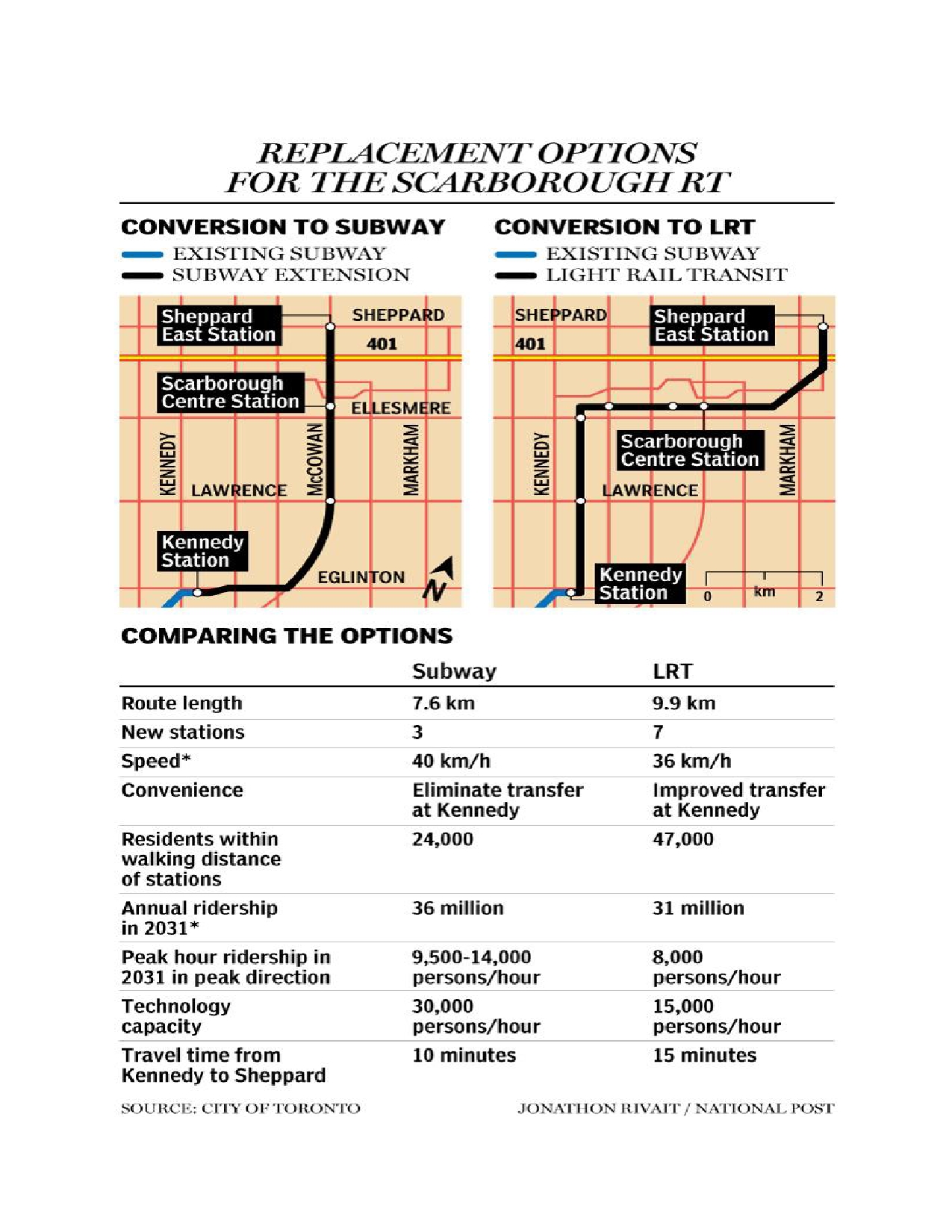
More info on the Scarborough controversy.
First, modern LRT can carry more than 15,000 pphpd, in fact modern LRT can carry well over 20,000 pphpd. In Karlsruhe Germany, one tram line carried over 35,000 pphpd in the peak hour! Toronto’s old Bloor Danforth streetcar line, using coupled sets of PCC cars were known to move about 12,000 pphpd!
The 15,000 limit for LRT in Toronto, is probably a holdover from the old streetcar days and as Toronto is finding out, belatedly with King Street, transit priority on tram routes greatly improves productivity, which translates into higher ridership.
The big, bigAi?? problem is sticker shock for subway constriction. The same sticker shock is now echoing in TransLink’s ‘Ivory Towers”.
By Jennifer PagliaroCity Hall reporterTues., Dec. 5, 2017

Is the Scarborough subway good value for money?
Council has never seen a comparison of the options when deciding how to spend $3.56 billion for Scarborough transit as critics decry a single-stop subway plan as a ai???white elephantai???
ByAi??JENNIFER PAGLIAROCity Hall reporterTues., Dec. 5, 2017
Ontario PC Leader Patrick Brown, outgoing TTC CEO Andy Byford and transit activists sporting a ai???white elephantai??? costume and masks all had something in common this week.
All expressed support that council get a value-for-money analysis of the controversial Scarborough subway extension so it can be compared to the light-rail alternative.
Whether to request that study, will again be up for debate at council on Wednesday after it was deferred at a meeting last month.
ai???I think residents want council to be sure that they are providing as much transit to as many people as possible with every dollar that theyai??i??re entrusted with,ai??? said Councillor Josh Matlow, who will move a motion that his colleagues direct the cityai??i??s auditor general to do that work.
ai???And if council doesnai??i??t have that basic relevant information then theyai??i??re making decisions in the dark and thatai??i??s not responsible nor acceptable.ai???
On Monday, both Brown and Byford told the CBCai??i??s Matt Galloway they supported such a study.
ai???I support a value-for-money audit on every aspect, on everything the government spends taxpayer dollars on,ai??? Brown said when asked specifically about Scarborough transit on Metro Morning.
In a separate interview, outgoing TTC CEO Andy Byford said he has ai???no objectionai??? to that analysis being carried out.
As a debate, characterized by political rhetoric and often missing and misleading information, resumes hereai??i??s what you need to know:
What is the subway plan?
Council has endorsed a one-stop subway extension of the Bloor-Danforth line that currently ends at Kennedy Station to a new station adjacent to the Scarborough Town Centre. It will replace the existing and aging six-stop Scarborough RT that runs from Kennedy Station to McCowan Station.
Wait, I thought there were going to be three new stops?
An earlier plan replaced the existing SRT with a three-stop subway from Kennedy Station to Sheppard and McCowan Aves. But last year, city staff presented a plan to build more transit, they said, within the $3.56-billion envelope of available funding. City staff said that by removing two subway stops, a 17 to 18-stop LRT along Eglinton East could also be paid for. But as costs of the subway ballooned, that LRT line has been left largely unfunded. A cash-strapped city council would have to find hundreds of millions of dollars to pay for any addition subway stations.
What was the LRT plan?
LRT stands for ai???light-rail transitai??? which is different, more modern technology than is currently whatai??i??s used on the SRT line and what is used in many other North American and European cities. The city originally approved a seven-stop LRT in the same corridor as the SRT, separated from traffic, that would have run from Kennedy to Malvern at Sheppard Ave. and Markham Rd.
The plan had already been studied, was agreed to by the province and city, and was just three months away from going out for contractor bids to do the construction work when in October 2013, council, under former mayor Rob Ford, voted to scrap that plan in favour of a subway that was then estimated to cost $2 billion more.
How much does the current subway plan cost? Is that the final cost?
The one-stop subway extension is currently estimated to cost $3.35 billion, but since that figure is based on very preliminary design work, it could climb by as much as 50 per cent, city staff say, putting the upper end estimate at just over $5 billion. There are also significant and necessary costs not included in that figure, including the cost to finance construction of a project of that size, City Manager Peter Wallace told council in July 2016. The former chief financial officer said that financing could cost the city an additional $200 million for every $1 billion in project costs, or roughly $670 million for a $3.35 billion project.
What does the LRT plan cost?
The province, according to a still-signed master agreement, is committed to fund the entire project, what was estimated at $1.48 billion in 2010 dollars. Since then, the design of Kennedy Station has changed to accommodate other connections and would require redesign. Since staff stopped studying the LRT in 2013, that cost has not been estimated. Though a controversial briefing note produced by the TTC put the updated cost of the LRT on par with a subway, a recent investigation by the auditor general found that cost estimate could be off by at least $570 million.
Has council ever seen a comparison of those plans?
No. That kind of study has never been requested by council and therefore never produced. Matlow moved a motion in March 2017 to request that study, but the motion lost 17-27. A buried draft report from the provincial transit agency Metrolinx found the subway was ai???not a worthwhile use of moneyai??? when compared to the LRT.
Can the cityai??i??s auditor general perform a value-for-money audit of the two options?
Yes. The auditor general, Beverly Romeo-Beehler, in her recent investigation, said she was considering conducting such an analysis. She does not need council direction to do so. However, Romeo-Beehler later told the Star she has decided against doing such a study, saying it isnai??i??t her role to re-open council decisions. Requesting the auditor general to add that study to her 2018 work plan, as Matlow will attempt to do, requires a two-thirds majority of council to pass, or 30 votes.
Will I get where Iai??i??m going faster on the subway?
Not necessarily. The one-stop subway extension would improve the time it currently takes to get from Scarborough Centre to Kennedy Station on the SRT by five minutes, according to city staff. When considering the elimination of a transfer at Kennedy Station the time saved is eight minutes at most. But that time savings does not consider the extra time most Scarborough residents will spend on the bus getting to the one new subway station or that residents like those in Malvern would see their travel times cut in half by an LRT. An analysis by Ryerson University found most transit users would spend on average of 6.8 minutes more on the bus to get to the subway stop compared to the closest LRT station, and 3.6 minutes longer than they do now to get to the existing SRT.
Transit plan for Malvern residents does not improve travel times
OPTION TRAVEL TIME TRANSFERS BEYOND KENNEDY Bus + Scarborough RT 35 min 2 Scarborough LRT 16 min 1 Eglinton Crosstown East 33 min* 1 Bus + Scarborough Subway Extension 30 min 1 (Source: Scarborough LRT Environmental Assessment, 2010; Scarborough-Malvern LRT EA, 2009; Scarborough Subway Extension updated business case, 2017)
*The original design for the Eglinton Crosstown East (then called the Scarborough-Malvern LRT) considered an extension terminating at Sheppard and Morningside Aves., not the Malvern Town Centre, so travel times would be longer
Wonai??i??t an LRT be crammed full of people? Isnai??i??t a subway needed?
Not according to city data. By 2031, the number of people expected to ride the subway in the busiest direction at the rush hour is 7,300 people. That is less than half the 15,000-person capacity of an LRT and would leave subway trains, which have a 25,000-person capacity, at least 70 per cent empty at rush hour. The LRT was earlier projected to carry 8,000 people at rush hour in the busiest direction in 2031, well within an LRTai??i??s capacity.
Isnai??i??t that still pretty busy for one stop?
When you factor in that this will be the longest single gap between stops in the TTCai??i??s entire system ai??i?? 6.2 kilometres of tunnel ai??i?? this subway stop does not rank anywhere near the busiest comparable stretches that exist today. While the extension would carry 64,000 passengers daily by 2031, the stretch between Museum and Bloor-Yonge stations sees station usage of 755,750. The Sheppard subway, which is almost six kilometres and has been considered to be a ai???white elephantai??? because it must be heavily subsidized by taxpayers to operate, has a daily ridership of 98,150.
How much would the LRT impact traffic?
Not at all. The LRT replacement for the SRT was planned to run in the same corridor, separated from all vehicular traffic.
Iai??i??ve heard LRTs donai??i??t work well in the winter. So, isnai??i??t it a bad idea to build an LRT in Toronto?
ai???LRT is a proven technology that is used around the world including extremely cold places such as Edmonton, Minneapolis, Stockholm and Bergen,ai??? a fact sheet from Metrolinx reads. The city is currently building a 19-kilometre LRT through the heart of midtown called the Eglinton Crosstown, and nine kilometres will run at street level.
Would I have to get off the LRT to transfer onto the Bloor-Danforth subway at Kennedy?
Yes. An LRT means riders would still have to transfer at Kennedy, but the station was originally designed to significantly improve that transfer ai??i?? just a single flight much like the transfers that already exist in the subway system such as at St. George, Bloor-Yonge and Sheppard-Yonge stations. That connection would have to be moved if council went back to the LRT. As part of a redesign of Kennedy Station, itai??i??s likely the LRT platform would be on the same level as the subway, requiring passengers to just walk across a platform.
But havenai??i??t they already agreed to build a subway?
Council still has to vote to approve construction for a subway once staff provide a more accurate cost figure, which is now not expected until 2019. Though Mayor John Tory and others have pointed out the number of votes the subway has already faced, most were part of the regular approvals process and the others were the result of the subway being modified from a three-stop plan to todayai??i??s single-stop proposal under Toryai??i??s administration.
TransLink CEO No Better Than A Cheap Carny Huckster
In Metro Vancouver, local journalists remain largely ignorant of transit issues and believe, without reservation, what they are told by TransLink.
There is no investigative journalism with TransLink and its favourite, SkyTrain.
This “puff” piece is nothing more than softening up the public for both the Broadway subway and Road Pricing, which is needed to finance the subway.
Many of those 34,000 people a day claimed by TransLink using he Evergreen Line previously took the bus to Lougheed Mall and then transferred to metro. What is important is how many of those 34,000 a day are new to transit?
Silence.
It is also interesting that bare minimum customer flows for a modern LRT line to be built is about 30,000 persons a day. In the real world, but not TransLink’s world, LRT costs up to a quarter to build than light-metro. Thus the $1.5 billion Evergreen Line seems grossly overbuilt, to deal with such weak passenger flows.
But the business case for SkyTrain was badly tainted.
TransLink CEO Kevin Desmond acts as a cheap carny huckster, desperately trying to sell one “puff” story after another, while at the same time ignores the truth.
The Evergreen Line, grossly overbuilt for what it does translates to higher subsidies for the mini-metro system and higher subsidies mean transit elsewhere suffers.
 The Evergreen Line – Very expensive for what it does.
Evergreen sees more than 8.6 million boardings over last year
Average weekday ridership hits 34,000, a 13% increase over the early 2017 figures.
Tri-City NewsDecember 2, 2017
More than 8.6 million boardings have occurred since the Evergreen Extension opened and TransLink officials said the line is poised for further ridership increases.
On Friday, exactly one year since the opening, TransLink CEO Kevin Desmond said transit use in the northeast sector has seen significant growth over the last 12 months. He cited numbers released this week showing that average weekday boardings has hit 34,000, a 13% increase from early 2017.
“It’s clear that the Evergreen Extension has been a catalyst for a boost in transit use in the Tri-Cities,” Desmond said, adding that 51% of all transit journeys in the Tri-Cities begin on Evergreen. “The growth we’ve seen since the launch of Evergreen is nothing short of astounding, and demonstrates the kind of impact that this kind of transit infrastructure investment can have.”
Desmond said he believes there is significant ridership growth still to come, noting the pace of development that has been occurring around the Evergreen stations.
According to TransLink, there is currently $3.8 billion in real estate projects in development or under construction on land next to the rapid transit corridor between Lougheed and Lafarge Lake-Douglas stations. That includes approximately 9,800 future housing units.
With that growth in development, TransLink said it will move closer to its goal of 70,000 Evergreen riders per day.
“The heightened interest for commercial and residential development around the stations is an indication there is much more demand,” said Port Moody Mayor Mike Clay, adding: “With immediate accessibility to transit providing increased affordability and a major attractant for employers.”
gmckenna@tricitynews.com
The Ignorance Of Light Rail Knows No Bounds – Distinctly In Vancouver
It is sad that anti-tram journalist, Francis Bula, writes such tawdry articles about transit and by doing so, demonstrates that she does little or no research and repeats the anti-tram myth.
Citing Jarret Walker as a renowned transit expert is stretching it a bit, as he is a bloggist, catering to the anti-tram crowd. He is merely a planner and lacks that core knowledge which a European degree in Urban Transport would bring and offers yesterday’s solutions to try to solve today’s problems.
Zwei has never liked the term “streetcar” as it it brings visions of clanky and rattlely vehicles trundling down city streets, while trams give a vision of modern low-floor articulated vehicles, operating mostly on dedicated rights-of-ways.

The modern tram; designed to grow with ridership, giving affordable transit solutions to cities in the 21st century.
It is the modern tram that has rejuvenated transit planning in the past 30 years and bringing livability to the 21st century city.
As early as 1984, it was recognized that the simple and flexible tram was a good solution for congestion and pollution in major cities. Mature city planners opted for transit systems that had a good record of providing efficient servcie and rejected the expensive and gimmicky “gadgetbahnenn” style light-metros or monorails.
Vancouver’s SkyTrain is a good example. An over hyped proprietary mini-metro with limited capacity, extremely expensive to build, operate and maintain,Ai?? has bamboozled local politicians, planners,Ai?? and most journalistsAi??for almost 40 years and continues today!
The mythical “rapid transit’ again raises its ugly head from the swamps of ignorance, as the great solution for transit, but there is no definition of “rapid transit’ other than it is not light rail and that is good.
Really?
Mr. Bracewell, at the city engineering department, said
Ai?? “We see the need for rapid transit to UBC. A streetcar is not rapid transit.”
Sorry Mr. Bracewell, the modern streetcar or tram, operated as light rail has a greater capacity than our so called rapid transit and is far more user friendly than our Rapid Transit, which I guess is SkyTrain and costs a fraction to build. What don’t you get?
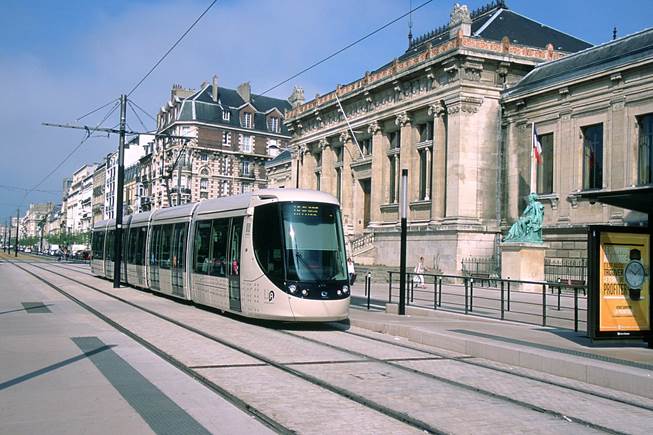
The modern tram on a dedicated R-o-W.
That our universities are turning out engineers and planners so ignorant about modern public transport is appalling, but the very same engineers and planners remain so ignorant about LRT is equally appalling.
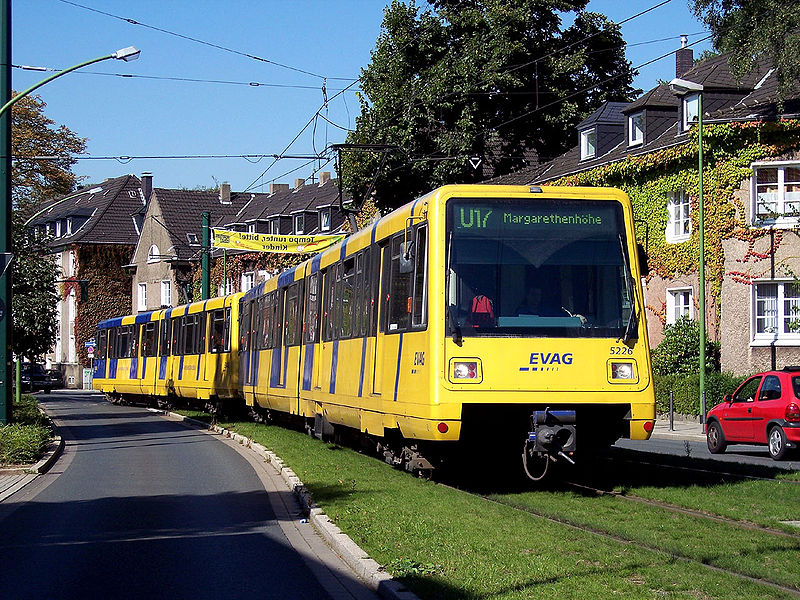
Vancouver mulling streetcar network despite problems in some other cities
The City of Vancouver is studying ways to ensure it keeps its options open for a network of streetcars in the future, despite the irritation the vehicles have generated among travellers in some cities.
The transit vehicles operating on electricity have been maligned by some in Toronto for slowing traffic, but in Vancouver, the city is about to hire outside consultants to study what needs to be done to ensure that no new building projects or road changes shut the door to a future streetcar line.
The line would run down Arbutus Street and around False Creek to Yaletown, Chinatown, the central waterfront and Stanley Park. A streetcar line likely wouldn’t appear on Vancouver streets inside of a decade. The line would need to be approved by regional mayors in the next 10-year plan of the regional transportation authority.
“There are places in the city where something higher capacity than a bus would be good,” said Dale Bracewell, the city’s manager of transportation. Powered by electricity, streetcars are better for the environment and quieter than buses, he said.
Streetcar fans also argue that they are great additions to the city, because people like taking them and they tend to attract new development around them.
“Streetcars are place makers. They are an urban benefit,” said Anthony Perl, an urban-studies professor specializing in transportation at Simon Fraser University. They’re not the magic solution for all transit problems, Prof. Perl said, but they’re a part of a complete system in mature cities.
Streetcar systems, which were once common throughout North America, almost disappeared in the 1950s as cities chose to hand over road space to cars. Only a few cities, such as Toronto, New Orleans, La., Boston and San Francisco retained some lines.
But they’ve become popular again with civic authorities in the past two decades, with new lines being installed in places as diverse as Atlanta, Detroit, Phoenix, Minneapolis-St. Paul, Minn., and Portland, Ore.
But those new lines have sparked some public backlash, as the ridership has not met expectations in many places, with Portland’s successful system being a notable exception.
Renowned U.S. transit expert Jarrett Walker has said that cities need to examine the case for streetcars more carefully. He argues that, even when streetcars attract more riders than the bus lines they replaced, it’s often because cities make huge improvements to the streets they’re on.
Toronto went through a debate earlier this year about its streetcar system, after a city hall committee suggested keeping the line on Queen Street closed for an extra two weeks beyond a planned shutdown for renovations to study whether buses would be more effective.
Drivers often gripe about being stuck behind the streetcars, while riders sometimes complain that the streetcars get so slowed down by traffic that walking is faster.
Toronto just started a pilot project with its King Street line that gives the streetcar priority and limits car drivers to being able to travel for one block on the street. That has significantly improved travel times.
In Vancouver, the proposed study for a future streetcar, whose bid deadline closes on Tuesday, is meant to update work that has been going on since the early 1990s in streetcar planning in the city. The city is asking for consultants doing the new study to look at a possible connection between the streetcar line and the planned Broadway subway.
It’s something that the city’s most ardent streetcar advocate welcomes. “This could be the beginning of a network,” said University of British Columbia professor Patrick Condon. “And to put this system in, which is greenhouse-gas-zero, is a good direction. It’s a promising direction.”
He said streetcars do much more than just transport local residents. “Studies show a million tourists a year are likely to use it.”
Prof. Condon hopes that Vancouver engineers will also study the feasibility of streetcar lines that have been suggested in the past. One is along the Fraser River from Arbutus to the city’s eastern boundary. The other is from Arbutus Street, where the first phase of the Broadway subway now being planned is scheduled to terminate, out to UBC.
But Mr. Bracewell, at the city engineering department, said neither of those is part of the current study. “We see the need for rapid transit to UBC. A streetcar is not rapid transit.”



Recent Comments