If there is to be a new passenger service on the former BCR route
VIA Rail would be the operator.
The return of the North Vancouver to Prince George passenger rail service is a good idea, both for travelers and for tourists. Leaving from downtown Vancouver would, I think, seal the deal.
The Gordon Campbell BC Liberal Party sold BC Rail in a sweetheart deal to the CNR, whose CEO just happened to be the party bagman! The Railway was sold, in part, to kill the passenger rail service so another political friend who owned the Rocky Mountaineer could operate expensive tourist trains on the run.
As the CNR is a federally mandated railway and, VIA Rail would operate the passenger service and those who want passenger service must petition their MP’s.
How a Talgo ’tilt’ train on the run or even a TramTrain service to Whistler?
Maybe a Talgo ’tilt’ train would be a ticket operating on the former BCR route.
ai??i??This letter went out to all the usual suspects, MP’s, MLA’s, and Mayors and Council.
There is a general naivete about Light Rail Transit or LRT in the media, due in part to TransLink’s and previously BC Transits thirty five year war on LRT, with their well advertised preference for light-metro.
Today, except for “niche transit” solutions, public transport is divided into three modes, bus, tram, and metro; with each mode built to economically deal with traffic flows on an individual transit route. Transit is to move people, not to subsidize development, a grand mistake being made by TransLink, the Ministry of Transportation and the Mayors Council.
Generally, buses can deal with traffic flows up to 6,000 to 7,000 persons per hour per direction; trams (LRT) can economically cater to traffic flows from 2,000 pphpd to over 20,000 pphpd; and metro with traffic flows exceeding 15,000 pphpd.
Though some pundits point to Bus Rapid Transit (BRT) in South America, as a solution, to obtain the high capacities needed, the BRT travel on multi-lane highways, many using three section articulated buses (greatly restricted use in Canada due to Transport Canada rules) and are sustained by very cheap wages.
LRT is built as an economic solution on heavily used transit routes because one modern tram (1 tram driver) is as efficient as four to six buses (4 to 6 bus drivers) and for every bus or tram operated one needs four or more people to drive, manage and maintain them. The modern tram can remain in service for over forty years, while the average bus lasts about fifteen years in revenue service; the scale of savings can easily seen in a long term business plan.
Modern LRT is nothing more than the modern tram (the European term for streetcar), which today has a capacities of 250 persons or more, operating on a dedicated or “reserved” rights-of-ways. A “reserved” rights-of-way can be as simple as a HOV lane with rails or as elaborate as a lawned, park like route. Properly built, light rail greatly reduces the operating costs of a transit system.
ai??i??Ai??Ai??Ai??Ai??Ai??Ai??Ai??Ai??Ai??Ai??Ai??Ai??Ai??Ai??Ai??Ai??Ai??Ai??Ai??Ai??Ai??Ai??Ai??Ai??Ai??Ai??Ai??Ai??Ai??Ai??Ai??Ai??Ai??Ai??Ai??Ai??Ai?? From Siemens, a 1980’s graphic, still pertinent today.
ai??i??
Currently, TransLink operates both unconventional and conventional light metro, which needs scores of bus lines to feed it customers. This drives up costs because light-metro is much more expensive to build, maintain and operate, when compared to LRT, plus the many extra buses needed to feed the light-metro passengers..
The SkyTrain light-metro system operates “driverless’, which also increases operating costs. There are over 170 full time attendants to maintain trouble free operation, as well as TransLink’s use of very expensive transit police, specifically to oversee fare protection. The automatic train control and signalling system needs constant and expensive maintenance to keep it in operation. Light-metro stations are also expensive to operate, with extra power needed to operate escalators and elevators which themselves are very expensive to maintain, with annual maintenance costs now over $6 million annually.
Subway stations even cost more to operate due to constant lighting and ventilation; and regular cleaning to ensure safe operation.
Just the Expo Line costs about 60% more to operate than comparable LRT operations.Since the ALRT/ART SkyTrain light metro was first marketed, only seven have been built, with only three seriously used for regional public transit; Vancouver, Toronto, and Kuala Lumpor. One, the Detroit (mugger) people mover is a 1908’s ICTS demonstration line; two, JFK and Beijing are airport people movers and one in Korea is a theme park people mover which has the ability to run only single car trains. Toronto’s life expired ICTS system is going to be torn down in the near future and replaced by a metro or LRT or a combination of both.
Expensive ongoing maintenance is needed to keep the automatic system operating, as stoppages are catastrophic to the transit customer.Light metro drives up the cost of transit.
There is a myth, often, repeated that SkyTrain pays its operating costs out of fares. This is false, as GVRD’s 1993 study “The Cost of Transporting People in the BC Lower Mainland“, clearly shows a $157.63 million subsidy paid to just the Expo Line, with more SkyTrain having been built since, this subsidy has greatly increased.
It is no surprise to the astute observer that LRT made light-metro obsolete decades ago.
ai??i??From the Cost of Transporting People in the BC Lower Mainland – GVRD
Metros are only built when traffic flows along a transit route exceed 15,000 pphpd, where long trains and stations with long platforms make at-grade operation very difficult and/or impossible with the transit line needing to be grade separated either in a subway or elevated on a viaduct. By their very nature, metro are extremely expensive to build, operate and maintain.
There is really no such thing as “rapid transit” or “mass transit” as they are a catch phrases used by unknowledgeable people to describe anything other than a bus. Beware of those who say rapid transit can do this or mass transit can do that because, in most cases the transit line is built to suit political and bureaucratic needs and not the customer needs and achieves very little.
A good example is our own light-metro network that despite around $10 billion now being invested, mode share by car in the region has remained at around 57%, for over 20 years.
In Europe, a new LRT or tram line is not built unless many conditions are met, including a minimum modal shift of about 20% from car to transit, thus it is imperative that new tram line must meet a transit customer’s needs.
Today, there are close to six hundred transit systems around the world that are in the light rail family and the mode is the first choice of transit planners in providing affordable transit solutions for mobility troubled cities.
ai??i??Ai??Ai??Ai??Ai??Ai??Ai??Ai??Ai?? Modular trams can grow with ridership
Today, modern trams are extremely versatile:
Low-floor trams are 100% accessible by the mobility impaired without the need of expensive lifts, elevators, and escalators to operate and maintain.
The industry standard for trams climbing grades is 8%, though trams can easily handle 10% grades. In Lisbon, their heritage trams climb grades of 13.8%.
Modern modular trams can grow with ridership, thus saving on initial start up costs and new modules can be added when needed
The “reserved” rights-of-way and priority signalling at intersections enables trams to obtain commercial speeds near of that of a metro.
Today, trams can operate as streetcars in mixed traffic; as light rail on dedicated rights-of-ways; and regional commuter trains, operating on mainline railway tracks, all on one route.
Trams are interchangeable, as one companies tram will work with another companies tram in a coupled set, which is impossible with light-metro.
Historic or heritage trams, restaurant trams, or special use rental trams (weddings, etc.) can be used in with regular service, which is a boon to the tourist industry.
In Dresden, German, special cargo trams are used, carrying standard containers, which helps keeping commercial trucks off city streets.
Construction costs range from as low as $5 million per km. for TramTrain or as high or higher than SkyTrain if the tram is built as a light metro like in Seattle, Washington, which over 70% of its route is grade separated either on viaduct or in tunnels.
Lawned rights-of-way and simple station,
the hallmark of a modern European tramway.
Both of TransLink’s major transit projects in the Metro Vancouver are “vanity” projects and both will be very expensive for what they will do. The Broadway subway is being built on a route with traffic flows well under 5,000 pphpd, less than one third the traffic flows needed for a subway, which makes Broadway a candidate for LRT and not a subway.
Surrey’s proposed LRT is nothing more than a poor man’s SkyTrain, designed to feed the already at capacity SkyTrain light-metro system and seemingly being designed for failure!
Both projects, the Broadway subway at about $360 million/km and the Surrey LRT at an astonishing $80 million/km to build are hugely expensive, yet as planned will not reduce traffic congestion, while at the same time drive up the cost of transit in the region!
If the chief goal of LRT development in Surrey is to extend to Langley, there is a much cheaper way in connecting Langley to the Expo Line and that is a diesel multiple unit (DMU) service from Langley to Scott Road Station (via Cloverdale, Johnston Road; King George Highway; and Scott Road) to Scott Road Station. Such a service could be had for under $10 million/km., using Transport Canada approved DMU’s.
This of course makes many at TransLink nervous as it comes very close in duplicating the Rail for the Valley group’s Leewood Study for the reinstatement of the Vancouver to Chilliwack interurban, only using modern signalling and vehicles. As per the 2010 Leewod study, we could connect. Scott Road Station to Chilliwack, providing a three train an hour both ways, service for about $500 million; a Vancouver to Chilliwack service would cost about $1 billion.
ai??i??
The Kassel Regiotram TramTrain, enables quality public transit to reach lightly populated areas.
I find that many of the people who complain about light rail are ill informed and I find it shocking that many who plan for LRT in the region are equally ill informed about the mode.
The five faux arguments against modern LRT are:
LRT is slow. No, LRT operating in urban areas has stops or stations every 500 metre to 600 metre apart, optimizing customer demand and as such, tends to have lower commercial speeds than comparable light-metro stations which has stops about twice as far apart, which generally increases total commute times, due longer times to access stations. The maximum speed that LRT or light-metro can operate is around 90 kph.
LRT causes havoc at intersections. No, LRT must adhere to all signals pertaining to intersections and if a tram driver passes a red light and causes an accident, he/she would be charged criminally and lose his/her job, while a car driver who ignores a red light and causes an accident, merely gets his wrist slap and maybe a moderate fine. Adding ‘red light cameras’ to LRT/road intersections will greatly reduce accidents. U.S. studies show that LRT/road intersections are about ten times safer than road/road intersections.
LRT is expensive to operate. No, the opposite is true, it is light-metro that is expensive to operate.
You need more density to build with LRT. No, this argument is based on the B.C. Crown Corporation’s Secretariat’s appraisal of SkyTrain light-metro and erroneously classified LRT as the same as SkyTrain, as rapid transit. Density & LRT are not an issue, it is about traffic flows on a transit route.
LRT does not have capacity. No, light rail is able carry more people than light-metro. Presently the Expo Line is at capacity, carrying around 15,000 pphpd in peak times; the Canada line, with trains and platforms half the length of the Expo and Millennium Lines, has effectively half the capacity. Light rail, as noted above can handle over 20,000 pphpd if need be.
ai??i??
A comparison of Ottawa’s new LRT and Vancouver’s SkyTrain.
If the Metro Vancouver region wants an affordable public transit alternative to the car, it must abandon all planning for subways and light-metro, as the huge costs involved to build, operate and maintain light-metro greatly increases the cost of ‘rail’ transit, while at the same time, giving the region and transit customer a smaller, expensive and user unfriendly transit system that will do little to alleviate traffic congestion and pollution in the region. It is the failure of light-metro, in part, that is driving the province into building new bridges and highways to accommodate the expected traffic increases, because the regional transit system is deemed little more than a conveyance for the poor, the elderly and students.
The following quote from American transportation consultant and transit expert, Gerald Fox, sums up TransLink’s planning dilemma; ” But, eventually, Vancouver will need to adopt lower-cost LRT in its lesser corridors, or else limit the extent of its rail system. And that seems to make some TransLink people very nervous.”
Why nervous?
TransLink is deathly afraid of a local “apples to apples” comparison between LRT and light-metro, A.K.A SkyTrain.
When it comes to subways, unless there is no other alternative, Zwei firmly believes they are a vanity project, which only drives up the cost of transit.
The same thing happened in Victorian England, where several railways bankrupted themselves by building needless tunnels, because they thought; “a railway isn’t a railway without a tunnel”. The same frame of mind is also present with many transit planners; “it ain’t rapid transit without a subway.”
But Ottawa’s new LRT line has a subway under the streets of the Capital City and being the nation’s capital, I guess they are allowed.
Mr. “Cow” has kindly provided a news item, about the ongoing subway adventure…..
The train is coming: City says LRT tunnel excavation on schedule
Unless youai??i??re living on top of it, the work going on beneath the downtown core on Ottawaai??i??s Confederation line LRT tunnel could easily go unnoticed.
Much of whatai??i??s happening, as machines mine a 2.5-kilometre tunnel 15 metres underground, remains far from the view of a curious public.
There are three downtown stations planned for the LRT. ExcavationAi??at the Lyon station was complete some months ago. Work is nearly doneAi??at Parliament station, but progress atAi??Rideau station continues to inch along.
Why is theAi??Rideau station excavation taking longer?
It was to be expected, said Gary Craig, the cityai??i??s head of LRTAi??design and construction.
ai???Thereai??i??s nothing thatai??i??s happened to date that would cause us any concerns at all with respect to the work in Rideau station,ai??? he toldAi??Postmedia.
Digging in that areaai??i??s soft ground calls for a different tunnel design, different temporary support structures and even the hiring of a special adviser.
ai???That was the station where the lower productions were expected to happen,ai??? said Humberto Ferrer, the deputy project director for OLRT Constructors, the group that is building the $2.1-billion Confederation line,Ai??which opens in 2018.
ai???Lower productionsai??? is Ferrerai??i??s way of saying it would be slower, and that engineers like himAi??knew as much at the outset.
ai???It seems that it is taking longer, but we started much, much later at Rideau,ai??? he added.
About six months later, in December 2014, to be specific, and the station cavern itself, once completed, will be larger in length and volume thanAi??the other two downtown stations, he explained.Ai??Rideau will be about 50,000 cubic metres (compared to 38,000 cubic metres), while the cavern ai??i?? the entire area that must be dug out in order to build the station ai??i??Ai??will be 180 metres long (compared to 165 metres).
And yet, Ferrer expects the Rideau cavern to be completed in a total of 18 months, while Lyon and Parliament each took 20 months from start to finish.
What are the different techniques for hard-rock and soft-ground excavation?
Much of the tunnel excavation must go through limestone, but a 110-metre stretch of soft clay and sand near the future Rideau station requires a different technique.
In rock, crews use a 135-tonne roadheader,Ai??a 20-metre-long machine with a spiked fist at the front that punches away at the rock,Ai??to hollow out the upper sides of the cavern, followed by the middle section, then the bottom. The upper portions, which are called drifts, take longer because workers also have to install an umbrella, a temporary, cone-shaped support structure comprised of steel pipes thatAi??hold the tunnel up.Ai??Itai??i??sAi??about 18 to 20 metres wide from side to side.
In clay and sand, crews use a smaller excavator with an arm that rotates, so the bucket can scoop like a traditional excavator but also twist to dig out the sides of the cavern. They complete one side of the cavern, reinforce it temporarily with a layer of concrete, then move to the other and finish by clearing out the middle and bottom.
Openings in soft-ground excavation are about one-fifth the size of openings in rock because the excavator takes smaller bites and more reinforcements are required in soft ground, while the roadheader just smashes the rock.Ai??This helps explainAi??why progress is somewhat slower in soft-ground than it is in bedrock.
Long before putting the LRT project up for tender, the city did its homework, Craig said. ItAi??paid forAi??geotechnical work to understand the challenges posed by the formation known as the Rideau Valley and provided that information in advance to interested bidders.
ai???We wanted to understand what we were potentially facing but, more importantly, we wanted the proponents to understand, so that when they were pricing it out, they had good information, they didnai??i??t have make assumptions about what the conditions might be,ai??? Craig said.
The soil encountered so far is ai???pretty much what we expected,ai??? Ferrer said, adding OLRT conducted further geotechnical work once it was awarded the contract.
What else is happening underground?
In Lyon station, crews are busy pouring concrete for the walls and floor of the cavern, upon which the tracks will eventually be laid. In the tunnel between Lyon and Parliament stations, work on the final concrete lining of the tunnel arch is ongoing.
In Parliament station, crews are nearly finished digging out the station cavern, while excavation to the east has reached as far as the National War Memorial and will soon hit the Rideau Canal.
At Rideau station, the focus is on digging out the middle, which is called the central pillar.
Work at either ends of the tunnel (from an entrance near LeBreton Flats to Lyon station in the west and from an entrance at the University of Ottawa to the future home of Rideau station in the east) is finished.
What happens when theAi??tunnel goesAi??under theAi??canal?
Surprisingly little, actually.
Thatai??i??s because the tunnel will be nowhere near the Rideau Canal,Ai??a UNESCO world heritage site. There will be 20 metres of rock between the bottom of the canal and the top of the tunnel when a roadheader starts rumbling below the waterway in April.
Ferrer expects it will take seven to 10 days to pass under the width of the canal as workers dig toward Rideau station.
Whatai??i??s the timeline?
Ferrer and Craig said crews will hopefully finish pouring concrete in the sections of tunnel between stations and on the lower half of stations by the end of this year, so that track installation and work on the mechanical systems can begin over the winter and into next spring.
Station construction at Lyon will begin in July, followed by Rideau in September and Parliament in October.
Dream of light rail from Chilliwack to Surrey isn’t dead
The idea of creating light rail on the old interurban line from Chilliwack to Surrey may have faded in recent years, but proponents still want to see it happen and Coun. Sam Waddington says it’s inevitable.
Friends of Rail for the Valley have stayed the course, still on track after seven years.
Last week, the group had its most recent meeting at the Sardis Library to exchange views on what was once a fairly contentious issue. The society, started in 2009 as part of the larger movement to repurpose existing inter-urban lines in the Fraser Valley for passenger rail, has fallen into routine as the issue lost visibility.
While their attendance has dipped from several hundred to a handful, their cause isnai??i??t a lost one. In attendance at the March 24 meeting was city councillor Sam Waddington, who said that, in 2016, a light-rail solution has renewed viability.
Part of this is due to the success of the Fraser Valley Express (FVX), which celebrates its first birthday on April 6. BC Transit reports the FVX, which makes stops in Chilliwack, Abbotsford and Langley, drew four times its expected ridership in its first year.
ai???The FVX is going to be a model for anything in the future,ai??? Waddington told a roomful of long-time Rail for the Valley supporters. ai???I have no doubt thereai??i??s going to be light-rail, the question is, is it going to be 60 years from now?ai???
According to Waddington, BC Transit is looking for success and ridership from bus routes servicing the same locales as a proposed inter-urban line before it is willing to consider investing in anything beyond buses, and the threshold of riders per day necessary to bring the province to the table hasnai??i??t been reached yet.
ai???This year has been the biggest push towards this since the rail line closed, because weai??i??ve shown a bus doing basically the same thing has been successful,ai??? Waddington said.
ai???To give you an idea of the political climate, when Fraser Valley Express was launched there was a lot of talk, why donai??i??t we just do light rail? It was a risk mitigation decision, [in case] the buses didnai??i??t work out.ai???
The idea that buses may be the way towards getting the province on board with passenger rail is a bit of a twist of fate for the Rail for the Valley camp who, at the height of their popularity, had their idea essentially vetoed in 2011 by the Fraser Valley Transit Study (FVTS), a much called for analysis of transit options from the Ministry of Transportation that framed additional bus service as the only option they were willing to support.
Rail for the Valleyai??i??s proposal hasnai??i??t changed substantially. Their suggestion is that the already existing inter-urban line between Chilliwack and Surrey, to which the province owns the right of way, could be upgraded to accommodate passenger rail.
Graham Dalton, one of the founding members of Rail for the Valley, was enthusiastic about Waddingtonai??i??s input.
ai???It was a tremendous insight to see him. Everything he said was wonderful, it was like, wow, we have a chance here.ai???
Itai??i??s Dalton who has continued to organize meetings through all five years since the FVTS was released.
ai???It was about statistics. My statistics say Iai??i??m right, your statistics say youai??i??re right, and thatai??i??s what happened. There were two sets of studies, and one study said it definitely isnai??i??t feasible, the ridership isnai??i??t there, and the other said, look, itai??i??s a gem itai??i??s going to work forever,ai??? says Dalton, referring to the FVTS and to the Leewood study, an independent paper from a British consultant.
While Dalton drew small crowds with flier campaigns on his own, the idea really took off when John Buker, a professor at University of the Fraser Valley, took up the cause. With expertise on specifics like construction costs and with initiatives like a Rail for the Valley blog, launched in 2008, Buker got people engaged.
During the peak of Rail for the Valleyai??i??s popularity, in 2009, banners and demonstrators lined every overpass on Highway 1 between Chilliwack and Abbotsford, where weather conditions and traffic accidents often cause long delays for commuters.
Compared to Buker, Dalton describes his vision for the valley in less than scientific terms.
ai???The rail has to be in communities, where you can walk to it or ride a bike to it or take a bus to it,ai??? he said. ai???If you look at the line thatai??i??s existing there today, all thatai??i??s there. Itai??i??s not a straight line, but it goes to every place in the valley except Aldergrove, itai??i??s the only one it doesnai??i??t go to.
ai???What weai??i??re going through is a revival now, now we have more objectives we can look at. There is hope, thereai??i??s always hope, otherwise I would have given up long ago.ai???
The $370 million pledged to TransLink in the federal budget is starting to arrive in Metro Vancouver.
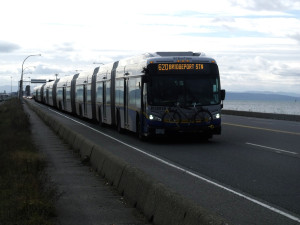
The first of three ultra-articulated, block-long buses will make its debut today after a series of late night and early morning tests near the Tsawwassen ferry terminal this week.
TransLinkai??i??s congestion-clearing super-bus.
At 200-metres long, the B.C. Bus Train can hold 500 passengers. The 14-wheeled accordion bus, which runs onAi??natural gas, is like six buses in one. It even comes with free wifi, space for an on-board bike mechanic, a barista stand and disc jockey.
The surprise addition to the Coast Mountain Bus Company fleet could go a long way to solving the problem of 1,000-plus passengers left behind every week by full buses around the region.
The bus will be christenedAi??shortly before noon on April 1Ai??by new TransLink CEO Kevin Desmond and Coast Mountainai??i??s chief driver Larry Aprilscherz at Broadway and Commercial. First 500 passengers ride for free. The bus will run rush hours on the route to the University of B.C.Ai??A second vehicle will arrive next month to serve the Fraser Highway in Surrey.
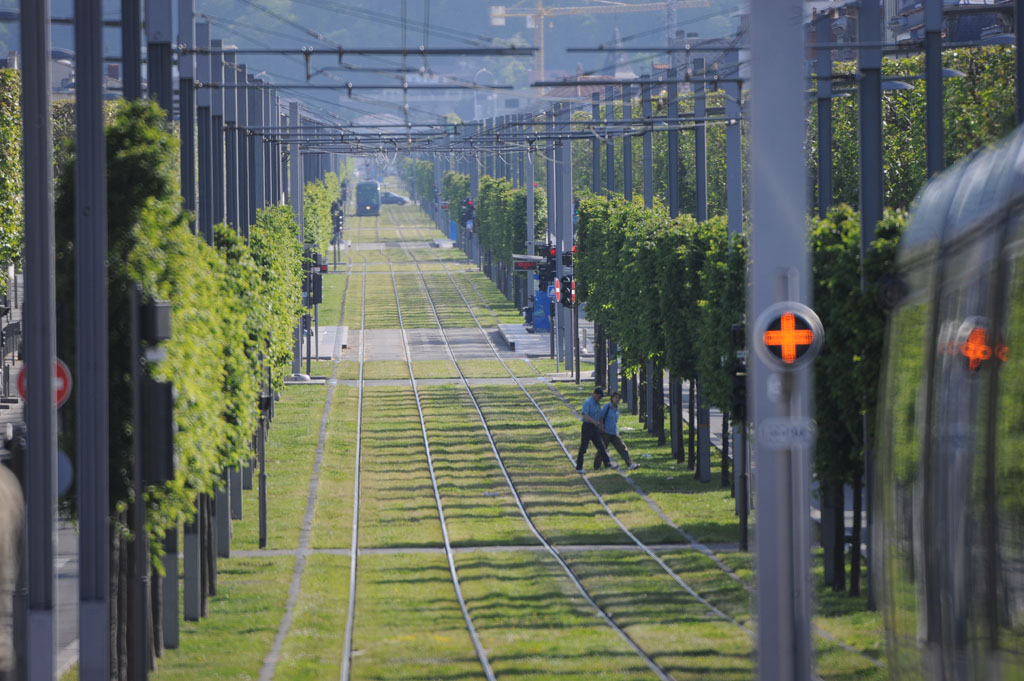
Modern lawned tramway in France, will be also be used in Liege.
What I wish to illustrate that the 11 km, 21 stop Liege tramway, including 19 Citadis trams, will cost about CAD$51 million/km to build.
As well, P-3’s are not a transit funding panacea.
The $51 million/km to build is based on a very low Canadian dollar and in US currency the cost is about USD$39 million/km to build.
The proposed tramway would be built, as with current European practice, on lawned rights of ways.
By comparison, the proposed Surrey LRT is said to coast a minimum of $80 million/km, built, as per North American practice on cheap tarmac or ballast rights-of-way. This is nothing more than a gold plated transit project, built at a minimum engineering standard at the maximum cost.
Ai??Ai??Ai??Ai??Ai??Ai??Ai??Ai??Ai??Ai??Ai??Ai??Ai??Ai?? LiA?ge tram PPP to be retendered
30 Mar 2016
BELGIUM: The Wallonie regional government has announced that its transport agency SociAi??tAi?? RAi??gionale Wallonne du Transport is to re-tender the DBFM concession to build and maintain the planned 11 km LiA?ge light rail line.
In December 2014 SWRT selected the MobiLiA?ge consortium of Alstom, BAM PPP PGGM and DG Infra to finance and build the 12Ai??km line linking Sclessin and Bressoux via the city centre, including a fleet of 19 Citadis 405 trams. The consortium would be responsible for maintaining the infrastructure and rolling stock, although services would be run by regional bus and tram operator TEC.
Work on the project was suspended in March 2015, after the EU statistical office Eurostat objected to the financial structure of the PPP concession. Based on the level of state participation in the DG Infra partnership between GIMV and Belfius, Eurostat ruled that the ai??i??380m (CAD $561 million) financing package should be designated as public funding and counted within the Wallonie budget. However, given the state of its finances the regional government was not willing to countenance this requirement.
According to Minister of Transport & Mobility Carlo Di Antonio, after the financing proposals were rejected by Eurostat for a third time, ai???several scenarios were analysed in terms of timing, legal risks and financial impactai??i??. The regional government remains committed to the tram project, he insisted, but it has to remain neutral in terms of financing.
Wallonie has therefore decided to abandon the DBFM contract and invite new proposals for a restructured concession. This would lengthen the time allowed for construction, and is expected to delay the completion of the line until at least 2022.
The city of LiA?ge has already spent around ai??i??33m (CAD$ 48.7 million)on preparatory works, including engineering design, road remodelling and utilities diversions. SWRT is contractually required to pay an indemnity of ai??i??1Ai??6m (CAD $2.4 million) to MobiLiA?ge for cancelling the award, but it remains to be seen whether the consortium will seek additional compensation for its work on the project over the past year.
Five Generations of Toronto Streetcars,Ai??a little history: The Peter Witt was the first streetcar class purchased by the then brand new TTC in 1921 and ran in TorontoAi??until 1963. The PCC streetcar ran in Toronto from 1938 to retirement in 1995. The TTC had the largest fleet of PCC’s in North America operating up to 745 at one point (203 second hand). The PCC’s replacement the CLRV (Canadian Light Rail Vehicle) has been running in Toronto since 1979 and its longer stable mate the ALRV (Articulated Light Rail Vehicle) began its TTC carrier in 1983. The Flexity Outlook from Bombardier just startedAi??serving TorontoAi??in 2014. The Flexity will replace all of the CLRV’s but it appears quite a few ALRV’s are going to be updated and will continue to be in service for some time.
Aging metro systems are a big problem in North America and the more complicated the transit system, the more costly it is to maintain.
Unlike TransLink, BART’s (Bay Area Rapid Transit) bureaucrats are far more forthcoming with system ills and for that they must be congratulated for their candor.
We see none of this with TransLink where costly infrastructure such as subways and grade separated R-o-W’s are all the rage, yet silence on the massive maintenance costs to keep the system running.
The last CEO to tried to be honest, Tom Penderghast, was sent to Coventry by senior staff and was ultimately forced out.
Last years failed TransLink plebiscite was another pointed message for honesty at TransLink, yet even a resounding defeat by the taxpayer fell on deaf ears and except for cosmetic changes (enough to fool the mainstream media), nothing has changed.
We must demand honesty from TransLink, the Mayors council, Metro Vancouver, and the Ministry of Transportation, yet all seem to deathly afraid to be honest, especially about future maintenance costs.
Faced with a flood of complaints during a messy commute last week, the officialAi??Twitter account of BART got frank about the system’s woes. Taylor Huckaby, who manned the account that day, explains why he started tweeting truth bombs, and why public transportation in America must be saved.
Major delays system-wide. Rising anger. Endless frustration. That was the all-too-familiar theme of last Wednesday evening’s commute on BART (Bay Area Rapid Transit), the sprawling regional rail system here in the San Francisco Bay Area.
Since mid-morning, BART had been suffering anomalous electrical problems that were burning out thyristors on our train cars, one by one, at the end of one of our lines. By the time the evening finished, 50 damaged cars had to be taken out of service.Ai??A busy weekday couldn’t have been worse timing for a mess of this magnitude. Providing roughly 430,000 weekday trips on a system that initially served a mere 100,000 people per week, BART simply doesn’t have any extra bandwidth to absorb losses.
Interesting tidbit from the news which has been overshadowed by the tragedy in Brussels.
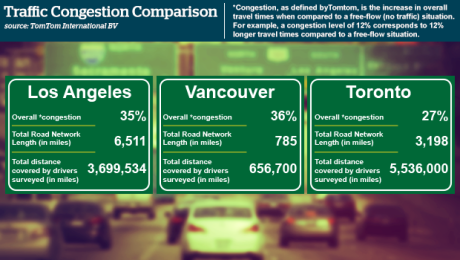
Traffic congestion is down in Metro Vancouver and this begs the question:
“If there is less traffic on the roads, then should we not waste money to plan and build $3 billion SkyTrain subway under Broadway and a $3.5 billion bridge replacing the Massey tunnel?”
I can think of far better ways in spending $6.5 billion like a combined road/rail bridge replacing the decrepit Patullo and Fraser river rail bridges, the Leewood/RftV TramTrain from Vancouver to Chilliwack; A White Rock to Surrey Central/downtown Vancouver LRT/TramTrain and a BCIT to UBC and Stanley Park tram.
And they say that Zwei has not conception of good transit.
Traffic congestion down in Metro Vancouver: survey




 Matthew Pearson, Ottawa Citizen










Recent Comments