Massey Tunnel Mystery – Solved!

Ah, the truth comes out. It’s not congestion or traffic gridlock that is driving the $3.5 billion Massey Tunnel replacement, it is Port Metro Vancouver and Fraser Surrey Docks, as they want a massive subsidized bridge to replace the Massey tunnel so Panama max and Cape max vessels can venture up the Fraser River to their docking facilities.
No rapid transit; no extension of any rail transit, as it is rubber on asphalt all the way, as the taxpayer dances to the tune of Port Metro Vancouver and Fraser Surrey Docks.
Well, I say if Port Metro Vancouver and Fraser Surrey Docks want to replace the Massey Tunnel, with a ten lane, $3.5 billion bridge, let them pay for it!
The B.C. government decided in September 2013 to remove the George Massey tunnel and replace it with a $3.5-billion toll bridgeBy Kent Spencer, Postmedia News March 9, 2016
Traffic moves in and out of the George Massey Tunnel in Richmond. Richard Lam/PNG files
Photograph by: RICHARD LAM, PNG
METRO VANCOUVER — Richmond politicians want to know how a tunnel under the Fraser River that was deemed ai???good for 50 yearsai??? is to be filled in and replaced with a 10-lane bridge.
Coun. Harold Steves said council has sent a letter to the provincial government seeking all documentation around its September 2013 decision to remove the George Massey tunnel and replace it with a $3.5-billion toll bridge.
The request comes after Freedom of Information documents showed Port Metro Vancouver and the Fraser Surrey Docks company lobbied hard in favour of scrapping the tunnel, a move that would allow larger ships to ply the south arm of the Fraser River.
ai???This bridge decision caught us totally unawares,ai??? said Steves. ai???We had a lot of meetings with (former) Transportation Minister Kevin Falcon in 2006 when he told us the tunnel was good for 50 years.ai???
Steves said FOI documents show messages from Port Metro Vancouver and Fraser Surrey Docks to government planners in 2012-13, at a time when the bridge-vs.-tunnel debate was taking place in Christy Clarkai??i??s government.
A memo from the port in March, 2013 ai??i?? six months before Clarkai??i??s announcement ai??i?? showed the portai??i??s preferred option and noted officialsai??i?? sensitivity to premature disclosure of their choice: ai???Option No. 2: Replacing the tunnel with a new bridge in the same location. Not publicly confirmed yet, but this is (Port Metroai??i??s) preference.ai???
A month later, port president Robin Silvester wrote ai???established terminals upriver of the tunnel (like the Fraser Surrey Docks) are at risk of becoming obsolete.ai??? His letter was addressed to Geoff Freer, provincial director for the tunnel replacement project.

City of Vancouver Buys the Arbutus Corridor
Well kiss any thought of affordable transit goodbye, as the City of Vancouver will never agree to have trams operating on the former interurban line, the Arbutus Corridor.
They may talk the talk, but will never walk the walk.
The Canada Line is extremely capacity constipated and light rail on the Arbutus would be a good deal cheaper to build than the estimated $1 billion to $1.5 billion needed to upgrade and increase capacity on the subway!
In fact it would be cheaper to build a stand alone LRT, from Vancouver to Steveston and Ironwood Mall, using the Arbutus Line, than just upgrading the Canada Line light-metro and extending it!
If Vancouver uses the Arbutus corridor for anything except but for transit, Metro Vancouver mayors should withhold any approval of all transit monies for the city, including the large subsidies needed for the trolleybus system.
 LRT with a lawned rights-of-way would make the Arbutus corridor a real greenway
while providing an affordable transit option.Ai??
Vancouver buys Arbutus corridor for urban greenway, ending dispute with CP Rail
By Matthew Robinson, Vancouver Sun March 7, 2016 6:26 PM
Pedestrians walk along the Arbutus corridor. The City of Vancouver and CP Rail have reached a deal — $55 million for the strip of land from milton Street near the Fraser River to 1st Avenue near False Creek, in Vancouver, BC., March 7, 2016.
Photograph by: NICK PROCAYLO, PNG
VANCOUVER ai??i?? The City of Vancouverai??i??s $55-million purchase of the Arbutus Corridor from Canadian Pacific Railway has put to rest a long-standing battle, but its intention to use the route for transit could reignite a dormant fight.
The deal was filed Monday and before it was even announced, city staff had a new purpose for what theyai??i??ve already dubbed the Arbutus Greenway. The cityai??i??s plan is to turn the 9-km route from Kitsilano through the west side into a transportation corridor featuring walking and cycling paths as well as light rail or streetcars.
Mayor Gregor Robertson said final purchase price was a fair market valuation because the land is committed to be an active transportation corridor in the future.
ai???Thereai??i??s no question thereai??i??s an enormous city benefit here,ai??? Robertson said.
ai???Itai??i??s impossible to acquire a strip of land like this through basically anywhere else in the city, east or west, where rapid transit could be installed at a very reasonable cost.ai???
City staff plan to set up a new project office to oversee the design of the greenway and public consultations.
The Arbutus Corridor cuts through a few pricey neighbourhoods including Arbutus Ridge, Shaughnessy and Kerrisdale. Counted among the residents are dentists, doctors, lawyers, professionals and chief executive officers of companies, ai???the crA?me de la crA?me in Vancouver,ai??? as Pamela Sauder, a member of the Arbutus Corridor Residents Association, infamously stated in a 2000 protest of a plan to run rapid transit through the corridor.
The quote, which Sauder later apologized for, made for an explosive and memorable moment in the debate, but it was far from the only utterance residents have opposing the idea. The fight helped sway the decision to instead run rapid transit from Vancouver to Richmond underground along the Cambie Street corridor.
But the 17 hectares of now public land remains a tempting option for at-grade rapid transit.
Under the terms of the deal, any ai???excess landai??? in the corridor that is not needed for the greenway can be repurposed or sold, Robertson said. But he stated there is no development envisioned at this time and most of the space is expected to be taken up by transportation.
If any land is sold, CP Rail gets a share of the take. According to a complicated schedule provided by the city, the railway company would get 75 per cent of the first $50 million in profit, 50 per cent of the second $50 million, and 25 per cent of the third $50 million. Any profit beyond $150 million goes directly to the city.
But the deal also leaves CP the chance to exercise option on lands between West 1st and 5th avenues. Under that alternate scheme, the city would get 50 per cent of any proceeds CP raised beyond $75 million, and CP would cease to share in the profits from any corridor land sold outside of those few blocks.
CP pressured the city in 2014 in the midst of discussions over the sale of the land when it brought in work crews to dismantle community gardens that had sprouted along the unused line. The railway claimed it intended to store railway cars along the corridor. The city filed an injunction to block the railway from reactivating the line, but that bid was dismissed in B.C. Supreme Court.
The city had offered the railway $20 million for the land, but CP wanted an undisclosed amount more, reported to be a figure five times higher.
The mayor and Keith Creel, president and chief operating officer of CP, announced the agreement together Monday morning with the rail line and a community garden in the background.
When asked if the company ever had any serious intention to store railway cars in the corridor, Creel said it did.
ai???Actually, we were serious,ai??? he said. ai???Thereai??i??s just a shortage of locations to store cars today, and so it is definitely something we would have used had we not come to this agreement.ai???
ai???We certainly regret any inconvenience that was caused,ai??? Creel said, adding he was elated a deal was reached.
As part of the deal, CP agreed to remove its railway lines and ties from the property within two years.
The mayor described the deal as a ai???fair agreementai??? and a ai???historic development that will create a destination greenway from Vancouver coming off of our world-renowned seawall.ai???
Robertson asked community gardeners to hold back on expanding their plots of land.
ai???Itai??i??s up to the community engagement to decide whether some more gardening space could be allocated somewhere along the corridor. Obviously it has to work with the transportation and the walking and biking paths.ai???

Is It Time To Get Back To Basics?

Perusing many transit oriented blogs, there seems to be a common thread appearing, we are changing our travel and commuting habits. This poses a very important question; “Is it time to get back to basics with transit planning?”
This is a valid question because as driving and commuting habits change, expensive transit infrastructure just may become redundant infrastructure or monuments of gross over expenditures political vanity project. We cannot afford another Canada Line White Elephant; Even the much touted Evergreen Line is far to expensive for the job it will do.
Many European cities have kilometres of disused tramways, because as demographics change, peoples travel habits change too. The rails are kept in situ because travel habits may change again and what was a disused tram route, is again a functioning route.
A few cities have abandoned subway lines and/or stations because travel habits change and the route is abandoned; which is a far more expensive proposition, than with tram tracks.
We must rethink the Broadway subway altogether, even if traffic flows double within twenty years, traffic flows won’t even be near the traffic flows that requireAi?? a subway.
An European style tram service from UBC to BCIT, would be a fraction the cost to build and would attract more ridership than a stub Millennium Line subway only to Arbutus.
The proposed LRT in Surrey, estimated to cost $80 million/km to build is far too expensive for current or future traffic flows along the route.
Instead of “head in the sand” TransLink planning for light rail, would it not be better to actually hire professionals who have experience building with LRT, Even an European style tram service, with lawned rights-of-ways, would be far cheaper than what is being planned!
Regional transit planners should dust off the the Leewood/Rail for the Valley transit study and implementAi?? A starter route from Langley to downtown Vancouver, with two trains an hour each way would cost around $10 million/km. and would provide a faster trip to Vancouver than using the present SkyTrain!
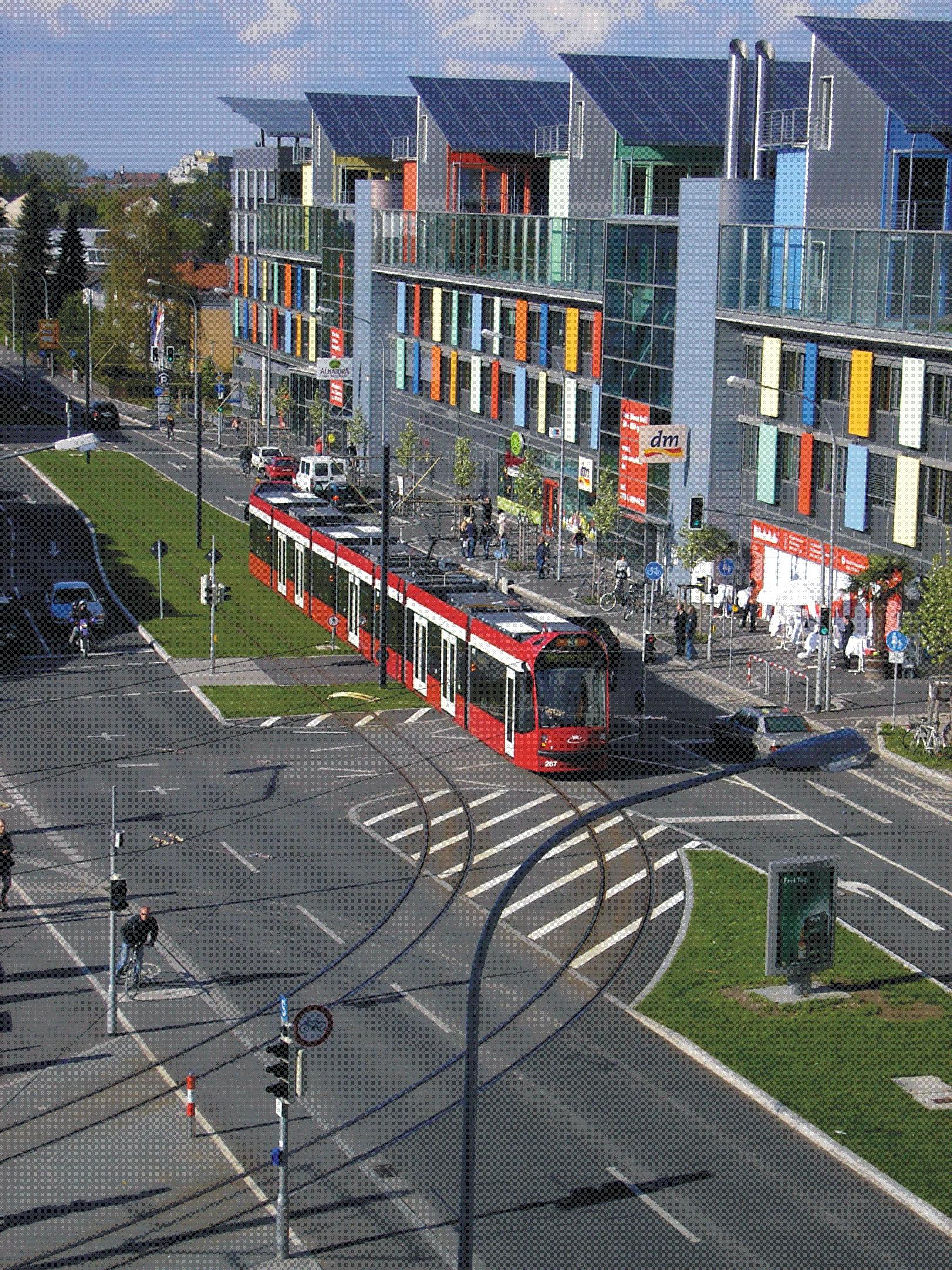 Lawned rights-of-way makes traffic calming
an easier sell to local residents.
It’s time to get back to basics and build affordable transit on transit routes.
Example:
Traffic flows 0 to 5000 pphpd – bus.
Traffic flows 2,000 to 20,000 pphpd – tram.
Traffic flows exceeding 15,000 pphpd – metro.
Apologies to the SkyTrain light-metro crowd because as we all know, light-metro is all but obsolete in today’s transit world and building light-metro is building a vanity project.
It is no good planning transit as we would have in the 70’s and 80’s, with the advent of new technology, would it not be better to build viable transit network, rather than a very expensive vanity project here and an equally expensive gadgetbahnen there.
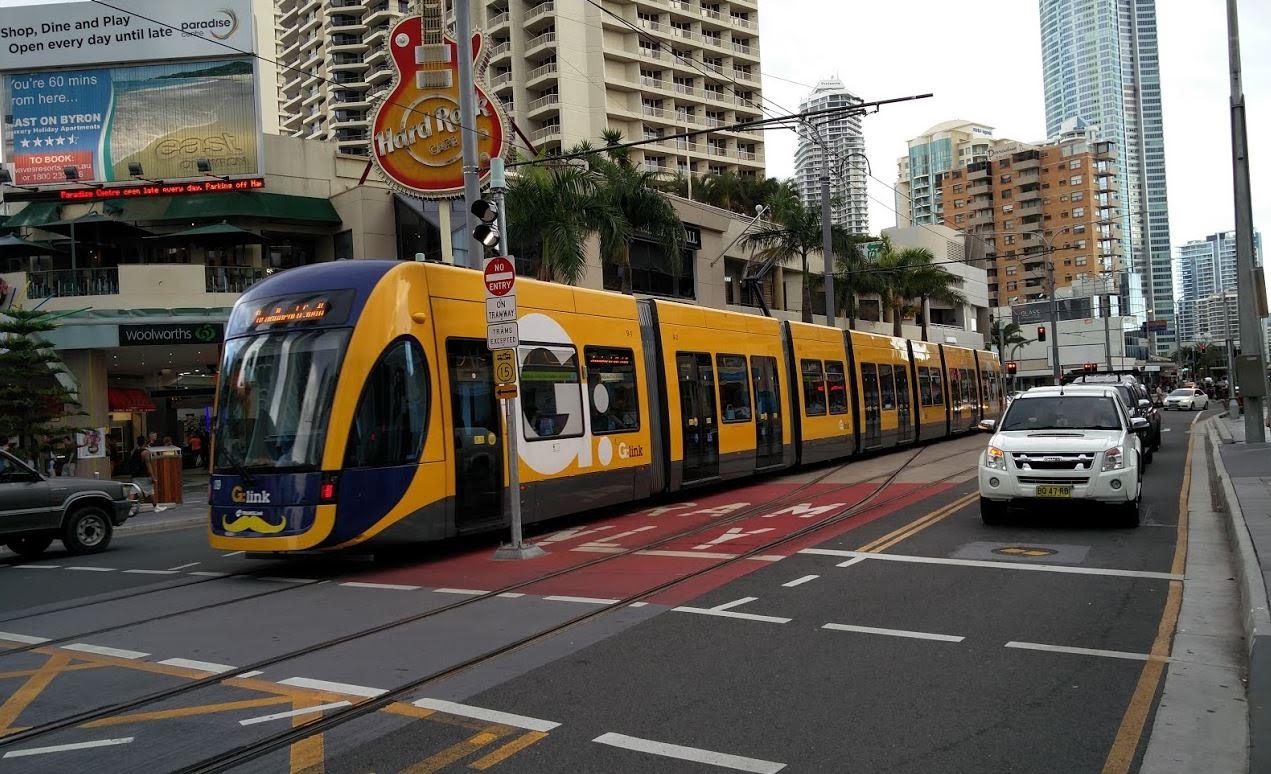 On-street operation may not please motorists, but it makes transit very handy and easy to use.
Toronto council lacking critical transit information ahead of key decisions
Sound familiar?
Vancouver Councillors utterly clueless about subways and transit in general.
Surrey Councillors completely naive about light rail.
TransLink blunders along, without a clue what they are doing.
Bureaucrats kowtowing to political whims, with no thought about the negative effects on the taxpayer.
“We’re OK Jack, coz we all have six figure salaries.”
Yet over $6 billion has been earmarked for a Vancouver SkyTrain subway and Surrey’s LRT.
One word sums up current transit projects – fiasco!
Toronto council lacking critical transit information ahead of key decisions
Staff released 369 pages worth of studies on Thursday night ahead of requesting council endorse a new multibillion dollar plan to build out a transit grid.

Marcus Oleniuk / Toronto Star file photo
Some key information is expected to be provided to Toronto council just two weeks before they are set to approve a multibillion-dollar network of new transit.
Toronto city council is being asked to endorse a network of new transit lines worth billions of dollars without essential information needed to justify those plans.
On Thursday night, city staff posted 369 pages worth of studies about the new network which mostly deal with how many people are projected to ride those lines.
But the studies consider a transit map thatai??i??s already been redrawn. Updated numbers arenai??i??t expected until June ai??i?? just two weeks before council will be asked to approve building that map, to be built out over the next 15 years, and long after public consultations have already wrapped up.
Councillor Josh Matlow said itai??i??s not good enough that those numbers will be provided at the ai???11th hour.ai???
ai???Thatai??i??s not a responsible way to plan transit, to spend billions of dollars, and itai??i??s not fair to councillors or the public we serve,ai??? he said.
Ottawa’s new LRV’s Are Arriving

News from Ottawa.
The picture is of the front end of the new 49 metre trams arriving in Ottawa.

SkyTrain for Surrey Implodes
Being an advocate for better transit in the region is no easy task, made all the harder by those who pretend they know better.
Zwei has spent thirty years in the transit wars, starting with the aborted Vancouver monorail scheme in 1986. Since then I have consulted with real transit experts from companies such as Siemens, AdTranz, ABB, and with transit operators in Toronto, Calgary, Edmonton, Portland and overseas, about various transit issues in Metro Vancouver. I also have been a thirty-two year member of the Light Rail Transit Association, drawing on the expertise of the many professionals who belong to that organization.
I was mentored by the late Des Turner, a retired chemical engineer who returned to university and earned a Masters degree in Planning and who, by dogged research, got to the bottom of many transit issues.
From my knowledge and connections, I was able to get the Leewood Study for the Rail for the Valley group in their quest to reinstate the former Vancouver to Chilliwack interurban.
I have been a supporter of light rail using fact and current news and much to many people’s dismay, able to dispel many erroneous assertions that have been made about LRT. So much so that it has not earned me many friends, especially with civic politicians and bureaucrats.
To this end I have been threatened with libel in two instances. The defense for libel is “truth” and with the facts at hand, those threats disappeared very rapidly.
I find the following very disturbing.
Daryl Cruz: And the end of the day, we are here as a voice for citizens to raise.
Reporter: So, you do not think it’s irresponsible of you to put out information that’s just not true without double checking your facts?
Daryl Cruz: Well, we are an advocacy group.
To be a credible, an advocacy group needs to be honest, not only with the public and media, but with themselves.
Unlike Rail for the Valley, SkyTrain for Surrey has lost all credibility.
Surrey transit blog shares misinformation on LRT and B-Line plans
Vancouver, BC, Canada / News Talk 980 CKNW | Vancouver’s News. Vancouver’s TalkPosted: February 25, 2016
You can not always believe what you read on the internet.
A blog titled SkyTrain for Surrey has been getting a lot of attention after claiming that plans for bus rapid transit to South Surrey and White Rock have been axed.


Blog claims untrue
Maps featured in SkyTrain for Surrey blog. City says map used has title cropped, and meant to only show LRT stations.
Surrey’s Rapid Transit Manager Paul Lee says plans for a B-Line are still there.
He says it may be confusing for readers of the blog, because it uses a map of the city’s light rail plan NOT the regional rapid transit plan.
The map that we have seen has been cropped, and the title of the map is missing so when people look at it with no context, they simply see those lines on the map.
Lee says the map was just never intended to show all the other portions of the regional transit plan, like the B-Line to South Surrey and White Rock.
When asked if the map, as presented in the blog, is misleading, Lee says it would appear to be.
The original map that was cropped, can be found here.
Blogger defends right to make claims
For his part, the blogai??i??s creator, transit activist Daryl Dela Cruz says itai??i??s not his job to double check the facts he publishes on his website.
And the end of the day, we are here as a voice for citizens to raise.
ai???So, you donai??i??t think itai??i??s irresponsible of you to put out information thatai??i??s just not true without double checking your facts?ai???
ai???Well, weai??i??re an advocacy group.ai???
The City of Surrey says the current plan for rapid transit in the area continues to include LRT and a B-Line, and has not changed since it was approved by the Mayorai??i??s council in 2014.

Medical Emergancy – TransLink Speak For Another Death
On Monday last, another suicide another death on SkyTrain, yet the media and TransLink hides the fact, with the utility phrase; “medical emergancy”.
The hypocrisy of the mainstream media makes me upchuck, as if they treated suicides on SkyTrain, like the fare evasion issue, maybe TransLink would ‘lift a finger’ and do something.
One of the reasons that SkyTrain has failed to find a market is that automatic (driverless railways) are suicide generators.
This dirty little secret, kept from the public by TransLink and abetted by the media, is utterly dishonest and it is time to have a frank discussion on the issue which the powers that be are loath to do.
In the public mind, saving a few dollars is more important than a persons life.
 It seems the public is more concerned about fare evasion
on SkyTrain than suicide prevention.
Medical emergency disrupts SkyTrain near Brentwood Station
By Bethany Lindsay, Vancouver Sun February 29, 2016 12:20 PM
SkyTrain service was disrupted during the Monday morning commute following a medical emergency at Brentwood Station.
Photograph by: PNG, Files
METRO VANCOUVER – SkyTrain service was disrupted during the Monday morning commute following a medical emergency at Brentwood Station.
Full Millennium line service resumed shortly before noon, a few hours after the emergency halted trains between Holdom and Gilmore. Shuttle buses transported passengers in the affected areas during the shutdown.
Ai?? Copyright (c) The Vancouver Sun

The Sad Fate Of Gadgetbahnen

Build a better mousetrap, and the world will beat a path to your door.
Build a more expensive and complicated transit system and politicians, bureaucrats, and academics will fall all over themselves beating a path to your door; so is the sad story of proprietary transit systems.
What many people, who advocated for unconventional or proprietary transit systems do not tell you is that many fail because they cost too much to operate or maintain and/or embarrassingly did not attract the ridership as promised.
The allure of a “different”Ai?? transit system is one of political, bureaucratic, and academic prestige, where it is perceived that to have something different and more expensive transit system operating in “our” city is better than transit systems in “their” city.
Sometimes it just not works out that way.
The Short Life of the Abandoned Sydney Monorail
In Abandoned & Urbex / By Tom /
 (Image: Hpeterswald; defunct steel guide way on the abandoned Sydney Monorail)
Monorail systems are staples of amusement parks and rapid transit between airport terminals. Along with suspension railways, they can also be found weaving their way through the streets and blocks of major cities. The single rail transportation system, which often straddles an elevated guide way, can trace its roots back to 1820s Russia. But as our recent article coveringAi??11 Abandoned Monorails, Suspension Railways, Railplanes & Hovertrains suggests, their popularity has been mixed. One recent example is the abandoned Sydney Monorail in Australiaai??i??s most populous city.
TramTrain Gains Favour In The UK
TramTrain development in the UK is gaining momentum as the Yorkshire Post reports that a study indicates a tram-train link between MANCHESTER and its airport in north-central England would be a better choice than passenger rail because of grades along the route.
Victoria and Metro Vancouver are candidates for TramTrain, yet the powers that be remain deaf to this very affordable transit option.
How long will transit customers on this side of the pond have to wait until even the word TramTrain enters Translink’s and BC Transit’s lexicon?
“Study rules out airport rail link in favour of tram-train
The tram-train due to be tested in South YorkshireJAMES REED, POLITICAL EDITOR17:12Friday 26 February 2016
BUILDING a conventional rail line to Leeds-Bradford airport would be technically impossible and alternatives could cost hundreds of millions of pounds, according to a new report.The findings from consultants suggest the gradients around the airport are too steep for conventional trains although tram-train technology might be able to provide a new link to the airport but at a cost of up to A?360m.
And their report also argues that the airport will need improved road connections regardless of whether alternative links are developed.
Critics of proposals to upgrade existing roads or build a new road to the airport have previously argued that a rail link should be considered as an alternative.
Coun Keith Wakefield, chairman of West Yorkshire Combined Authorityai??i??s transport committee, said: ai???This study has confirmed tram-trains linking to the existing rail network at Horsforth could be the best solution to overcoming challenges presented by the airportai??i??s location and topography and locating a station close to the existing terminal building.
ai???Tram-trains are light-rail vehicles similar to trams that can run on exclusive lines but also share main-line railway lines with conventional trains. They are widely used in Europe and in North America and West Yorkshire Combined Authority sees them as a way of achieving its ambition of developing an integrated Metro-style transport system for West Yorkshire and the City Region.ai???
A trial of tram-train technology is due to begin in South Yorkshire 2017 where the same vehicles will run on conventional rails from Rotherham to Meadowhall before joining the Supertram network to go into Sheffield city centre.
A public consultation on improving road links to the airport closed yesterday. Options included the building of a new road and upgrading the existing A65 and A658 at costs of between A?15m and A?75m
ai??i?? (USD $20.8 million and $104.0 million).ai??i??.
The airport is the highest in England and its location and limited links to the wider transport network have long been regarded as major obstacles to its growth.
Plans for the airport are expected to create 5,500 jobs over the next 25 years with passenger numbers also expected to grow from the current 3.3m a year to more than 7m.
It faces intense competition from Robin Hood Airport in South Yorkshire and Manchester which is served by a direct rail link.

Subways Are Very Expensive
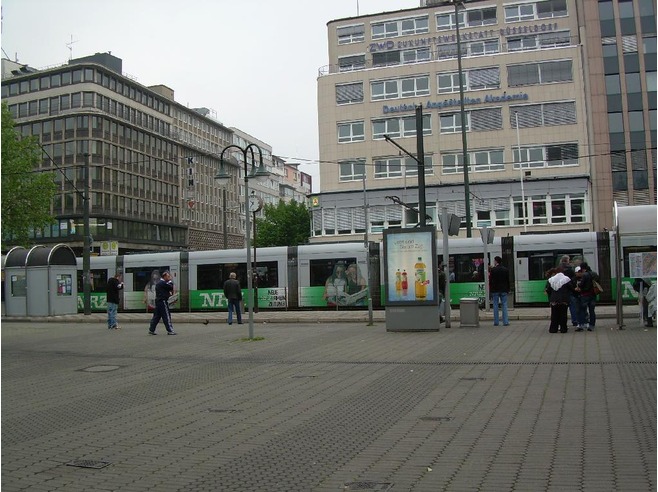
DUSSELDORF, the seventh largest city in Germany situated in the west-central part of the country with an urban population of 1.2 million, has opened a new USD $960.6 million, 2.11-mile light rail subway, the “international railway journal” reported Monday. It replaces street running tramway sections which will be removed. Here is the system map (scroll down for rolling stock photos):Under “Recent History” this site notes: “20 Feb 2016:Ai??so-called “Wehrhahn”-Line – a cross-city tram tunnel, between S-Bahn stationsAi??WehrhahnAi??andAi??BilkAi??(3.4 km with 6 underground stations), replaced some surface lines through city centre”“Monday, February 22, 2016DA?sseldorf opens ai??i??843.6m underground Wehrhahn lineWritten by Keith Fender
DUSSELDORF’s ai??i??843.6m underground Wehrhahn Line light rail line opened on February 20. Regular operation and closure of the previous on-street route followed overnight with services starting via the new route on February 21.
The 3.4km route from the S-Bahn station at Wehrhahn in the north to the S-Bahn station at Bilk in the south has six intermediate underground stations equipped with 90m-long platforms suitable for use by low-floor trams and LRVs.
The line was built by the City of DA?sseldorf with funding from the state of North Rhine Westphalia and the German federal government. It replaces former tram street running on the core section through the city centre, providing connections with existing underground light rail lines at Heinrich Heine Allee station. The tram street running sections replaced by the new line will be removed.
The Wehrhahn Line was planned as part of a network of new underground routes for DA?sseldorf in the 1970s and the first construction work – the 200m station box below the other underground light rail routes at Heinrich Heine Allee station – was built in the early 1980s. Final planning approval for the construction of the line was granted in 2007. Tunnel boring machines were used to excavate the single-bore tunnel under the city centre from 2008 to 2012.
More than 53,000 passengers are expected to use the new line daily. Siemens has supplied 76 NF8U trams to operator Rheinbahn to replace older vehicles and these will also operate elsewhere in the city. The light rail network serving DA?sseldorf has been revised as a result of the new line opening: four U-Bahn lines replacing former tram routes will use the Wehrhahn line.



Recent Comments