More Port Mann Woes
When replacing a perfectly good bridge, with a mega billion dollar “vanity” bridge, common sense seems to have been thrown out with the bath water.
We could have twinned the Port Mann Bridge and have enough money to build the proposed Leewood/RftV Richmond/Vancouver to Chilliwack TramTrain.
We could have good transit and transportation in Metro Vancouver if our politicians stop building expensive vanity projects to cut ribbons for photo-ops at election time, just like the massive vanity bridge that will replace the perfectly good Massey Tunnel starting, you guessed it, 2017 election year.
Instead, build what is needed and what is affordable.

Port Mann Bridge not driving traffic
By Kelly Sinoski, Vancouver SunFebruary 22, 2016 4:54 PM
Numbers from the provincial budget released earlier this month show the Port Mann Bridge lost $86 million last year.
Photograph by: Ric Ernst, PNG
METRO VANCOUVER — Drivers using the $3.3-billion Port Mann Bridge are being offered a $10 incentive to sign on to electronic toll billing as part of a move by the Crown corporation that operates the span to reduce its overhead and save up to $750,000 per year.
The move follows the release of provincial budget numbers that show the bridge lost $86 million last year, followed by projected losses of $100 million in each of the next three years, pushing its total debt to $3.68 billion by 2018. The losses are significantly higher than what was predicted in 2012-13, when it was forecast the net loss for 2014-15 would be $28.3 million.

Try Asking TransLink To Do The Same!
Imagine TransLink changing their schedule to suit a customer, imagine TransLink doing anything to help a customer?
Russian Railways adjusts timetable so girl didnai??i??t miss dancing class
Ai?? Alexandr Kryazhev / SputnikOne lucky Russian girl obviously has a golden ai???ticket to rideai??i??. Russian Railways adjusted its commuter train service to cater for the needs of a single passenger, a young and aspiring dancer.In October last year, Boris Nalimov, the girlai??i??s father, wrote to the local railway administration about the difficulties his 13-year-old daughter had getting to her dance club on time. The club is in Zelenograd, one of Moscowai??i??s satellite towns.

A good read
There is an interesting article making its rounds, “5 lessons from Los Angles on transforming transportation (and coming after Portland)”,Ai?? in the various transit blogs and I believe it is well worth a read.

Zwei is going to comment briefly on each of the five lessons and how they would apply to Metro Vancouver.
Aim high, but be targeted.
In the previous plebiscite, well paid transit bureaucrats were trying to sell two very expensive transit plans that were, for the most part, vanity projects for the cities of Vancouver and Surrey. The public largely saw through this, especially the $3 billion Broadway subway and joined the “NO” vote with the NO campaign spearheaded by the No TransLink Tax campaign and Jordan Bateman.
There was no real long term plan but a continuation of a SkyTrain light-metro built every decade or so.
If you want to build a successful campaign, build a coalition.
Last years failed transit plebiscite is a very good indication that TransLink failed to build a successful coalition, which Jordan Bateman did, which lead to an embarrassing defeat. What has been noticeably left out of transit planning is the transit customer and until the transit customer is treated with respect and included in the planning and operation of public transit, TransLink will be continually held in high odor by the public and taxpayer.
A broader coalition is a stronger coalition.
TransLink relies on political friends and insiders for approval and has ignored small transit oriented groups such as “Friends of the Olympic Line”; “VALTAC”; and “Rail for the Valley”.
Today, TransLink has few friends, except for the SkyTrain Lobby and 130,000 students enjoying the $1 a day U-Pass.
Connectivity creates new opportunities.
TransLink is moribund with its light-metro style of planning, long rejected by transit planners around the world. The organization cannot see out of its very small box.
Learn from other models and create your own.
Since TransLink is wedded to light-metro an almost unique position, it refuses to learn from other models, except of course how to creatively tax people, such as road pricing and road tolls.
The real problem of course is that TransLink is run by the Premier’s Office and does what it is told to do and until that changes, bad transit planning and expensive political deals involving transit will be the order of the day and to hell with the transit customer and taxpayer.
Flexibility
This will get the SkyTrain boys knickers in a knot!
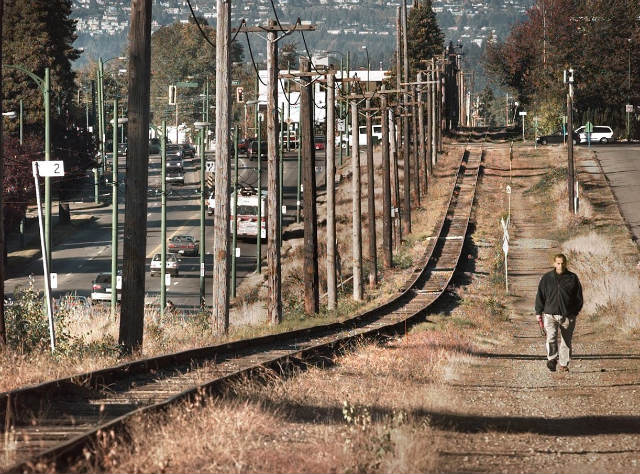
The Arbutus Corridor, the classic dedicated or reserved rights-of-way.
LETTER: Flexibility makes light rail the clear choice for Surrey

- posted Feb 18, 2016
The Editor,
There is myth being repeated in the media that light rail is slow. Some are saying it is slower than SkyTrain ai??i?? and even as slow as road traffic.
This needs to be corrected.
Studies have shown that street cars operating in mixed traffic are about 10 per cent faster than buses ai??i?? but street cars, or trams, are not quite light rail. Modern light rail is a street car or tram that operates on dedicated or reserved rights-of-ways, with priority signalling at intersections. The reserved rights-of-way enables modern LRT to obtain commercial speeds of that of a metro, with commercial speed largely determined by the number of stations per route kilometre.
The optimum station spacing for LRT in an urban setting is about every 500 metres to 600 metres but with light-metro stations (SkyTrain) being so expensive, station spacing for metro tend to be further apart ai??i?? 1 km to 1.5 km apart. This does give faster commercial speeds but it deters ridership because door-to-door travel times are longer because the transit customer must travel much further to get to transit than he/she would with light rail.
Modern LRT can obtain actual speeds equal to or faster than our present SkyTrain, if need be. In many cities today, modern LRT can also act as a passenger train operating on the mainline railways at mainline speeds.
It is the inherent flexibility of modern LRT, which can operate as a street car (in mixed traffic), as light rail on its own dedicated routeAi?? and a passenger train ai??i?? often on the same route ai??i?? that made light metro such as ALRT/ART SkyTrain (only seven built in 40 years) and the French VAL obsolete.
Those who continually dismiss modern LRT with one excuse or another are not telling the truth and they never explain why only seven ALRT/ART SkyTrain systems have been built in 40 years and why none have ever been allowed to compete directly against modern light rail.
Could it be that transit authorities around the world do not want to invest in expensive ai???Edselai??? style transit, such as SkyTrain?
Malcolm Johnston, Delta
An Open Letter To The Minister of Transportation
To whom it may concern:
Cutting ribbons is not the main function of the Minister of Transportation, but in BC it seems it is.
Trying to justify the Premier’s (or should I say Fraser Surrey docks/SNC’s) $3.5 billion Massey Tunnel vanity bridge replacements is seemingly taking a lot of your time. I understand your many challenges, rewriting history and distorting the truth and hiring shills to make the case.
The Gateway highway project is givingAi?? headaches of late, with the road slowly buckling due to poor engineering, but maybe the money was spent instead on the grossly overbuilt theAi?? three overpass (one is gated) Hwy 17 & 99 interchange. At the Tsawwssen end of things, Hwy. 17Ai?? is so ill designed and needlessly overbuilt, it boggles the mind.
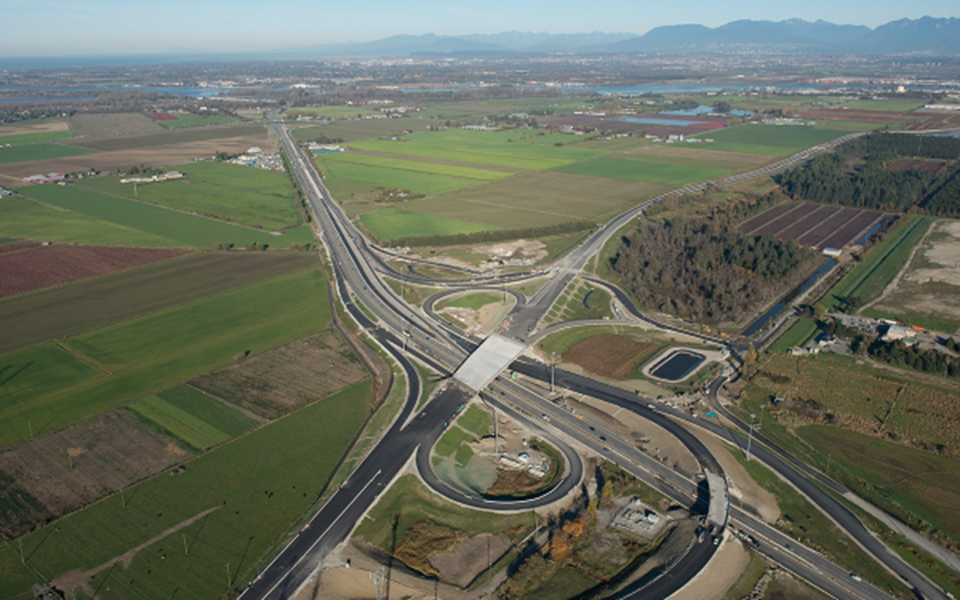
Simplicity and economy just was not in the lexicon
of the engineers mind when they designed this ‘spaghetti junction’
at Hwy. 17 & 99!
Who’s in charge, the MoT or the Road Builders Association?
I know that inAi?? BC, politicians love to build new highways because their political friends in the Road Builders Association and the trucking industry just love taxpayers money being spent on them. You will make many new friends, until of course, the government stops building highways, as one can only blacktop so much scarce farmlands.
The Premier is ultimately responsible for our little gem called TransLink and all what it entails. I understand this but there is one problem that must be dealt with and that is regional transit.
Regional mayors are tired of anteing up more money for the BC governments cherished light-metro system and are balking at increasing property taxes to pay for gold plated schemes which are dictated from the Premier’s Office. The Evergreen Line will now open in 2017 because the boss, Premier Cristy Clark (a.k.a. Premier Photo-op) desperately wants to cut ribbons for the new line before the next political election.
At the same time, South Fraser politicians are mulling over leaving TransLink because of their taxpayer’s dollars are spent on other peoples transit projects. The grossly expensive SkyTrain Broadway subway maybe the catalyst for a South Fraser rebellion,Ai?? that is why you have installed Mr. Factbender, sorry Fassbender to oversee transit.
Forget about bogus “Business Cases” for both the Broadway subway and the poor man’s SkyTrain (a.k.a. LRT) in Surrey; remember in 2008, American Transit expert Gerald Fox, shredded TransLink’s Evergreen Line’s business case. Mr. Fox stated;
“I found several instances where the analysis had made assumptions that were inaccurate, or had been manipulated to make the case for SkyTrain. If the underlying assumptions are inaccurate, the conclusions may be so to“. Fox later said; “TransLink has used this cunning method of manipulating analysis to justify SkyTrain in corridor and corridor and has succeeded in keeping the proprietary rail system expanding. In the US all new transit projects that seek federal support are now subject to scrutiny by a panel of transit peers, selected and monitored by the federal government, to ensure that the projects are analysed honestly, and the taxpayers” interests are protected. No SkyTrain project has ever passed this scrutiny in the US.”.
Hardly reassuring, isn’t it, as dealing with TransLink is like dealing with a Pandora’s Box of myth, bad planning,Ai??and ineptitude.
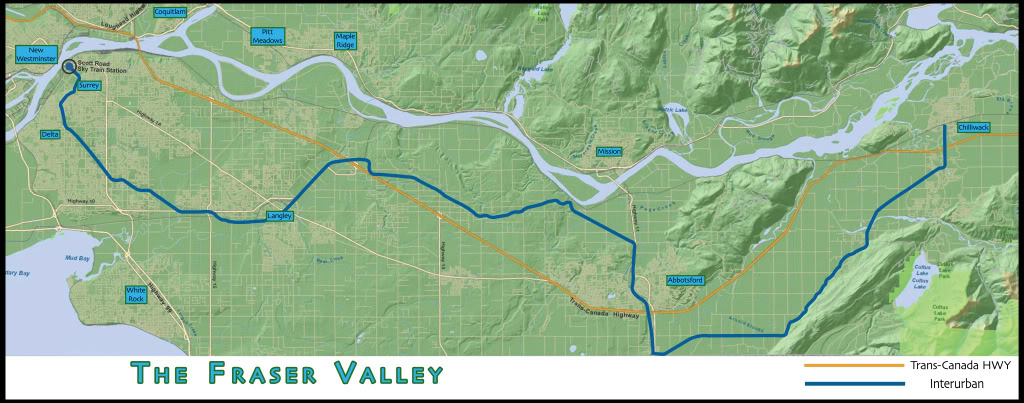
There is one South Fraser rail project that could unite the Fraser Valley with a credible transit line, the Rail for the Valley TramTrain or Interurban initiative for the old BC Electric route. Backed by the Leewood Projects Study, which shows that a TramTrain project is financially viable, the return of the interurban has been seen by South Fraser politicians as an economic and doableAi??project. That was until a diktat from the Premier’s office informed BC Liberal leaning mayors and councilors that it would be unwise to support such a project, especially if they wanted to run under the party banner in upcoming elections.
Maybe the Premier’s friends at SNC Lavalin, didn’t want any distractions interfering with the $3 billion Broadway SkyTrain subway to Arbutus?
By the way, $3 billion is a lot of money, considering that the BC Liberals sold the entire BC Rail railway for a mere billion dollars, in a deal reminiscent ofAi?? Bre-X! But hey, that is a different issue, or is it?
The “Full Build” 2011nRftV/Leewood TramTrain is 13 km. long, costing just under $1 billionAi??and would service Vancouver, Richmond, to Chilliwack Chillwack. Compare this to the 11 km. $1.4 billion, now over budget and two year delayed Evergreen line and it is easy to see one gets a lot more bang for your buck with a TramTrain
TransLink and the BC government also have their own, rather dated studies, which focuses on a bus based transit system for South Fraser Communities. Other than the fact that buses do not attract the motorist from the car, there is no evidence that TransLink or the BC Transportation ministry clearly understand Bus Rapid Transit. To be truly BRT, a bus needs to be guided or operate on an independent rights-of-way, which in most cases costs only slightly less than a LRT solution, with many more drawbacks. There is clear evidence that the recent provincial government Valley transportation report was done, like a similar study for the E & N Railway, to downplay any rail transit solution for South Fraser municipalities. The RftV/Leewood Study makes a mockery of the provincial government’s efforts.
It is howAi??the Ministry of TransportationAi??responds to the many important transportation issues South of the Fraser River, that will decide the fate of TransLink, where present municipal unhappiness with current transit taxation, planning and implementation will later translate into out right rebellion and a succession from TransLink, just in time for the next provincial election in 2017.
Then there is TransLink itself. This ponderous bureaucracy which forever wants more and more tax money, with no public oversight. TransLink is so ill loved that the public rejected paying any more taxes to fund it by an overwhelming no vote in last years plebiscite.
TransLink has failed to offer a transit system that is both efficient and affordable. TransLink’sAi?? six figured salaried bureaucrats have convinced themselves of the opposite,Ai??that their hugely expensive light-metro only policy, leaving Vancouver and TransLink aAi?? laughing stock in international circles. Just last year, TransLink let go two senior planners that dared to mention that building LRT on Broadway would be about $2 billion cheaper and carry more people.
The major problem with our transit system can be summed up with a comparison with Calgary’s LRT system. To date, the 59.9 kmAi??Calgary’s LRT system has cost the AlbertaAi??taxpayer just over $2 billion, yet carries over 333,000 customers daily. By comparison, Vancouver’s 68.7 km SkyTrain carries a claimed ridership of just over 390,000 customers a day yet light-metro system has cost the taxpayer now over $10 billion to date!
A complete reappraisal of our regional transit system is a must. Alas the Minister of Transportation, like the many before him, has put his headAi?? likeAi??the proverbialAi??Ostrich, in the sand and ignores the many problems plaguing TransLink.
The public is so very tired with the transit issue that it may lay blame, not on regional mayors, but the Premier in her run up to election year.
Pity……
80% Support For Light Rail In Surrey

80 per cent of Surrey residents support light-rail transit: poll
Vancouver, BC, Canada / News Talk 980 CKNW | Vancouver’s News. Vancouver’s TalkPosted: February 15, 2016

A new poll suggests 80 per cent of Surrey residents are in favor of light-rail transit.
Ipsos Public Affairs surveyed 600 residents between Jan. 25 and 29 of this year.
Besides overall support for the project, the poll also suggests residents believe LRT will have a number of community benefits.
Ninety per cent believe LRT will improve transportation options for Surrey, 88 per cent believe it will help connect communities in Surrey, and 86 per cent agree it would help create more jobs.
The city estimates the project would create 45,000 jobs ai??i?? 30,000 of those in construction and 15,000 in maintenance.
About 1,000 people move to Surrey each month, and it is expected to be the largest city in B.C. by 2041.
The light-rain line is expected to take 12 years to complete once started.
LRT was a key focal point in the recent failed Transit Referendum. Surrey has been working on bringing LRT to the city for several years.
What about the Patullo Bridge?
 Both the Patullo and the Fraser River rail bridges have well past their “best by” dates
and desperately are in need of replacement.
In 1978, the GVRD were poised to install a three leg light rail system on the region and to cross the Fraser river a new bridge would have to be built.
Demonstrating the forward thinking of the era, so sorely lacking today,Ai?? GVRD planners conceived a multi-use bridge tp replace both the aging Patullo Bridge and the single track and down right decrepit Fraser River rail bridge, to service:
- Mainline railways (2 track lift span)
- LRT (two tracks)
- Ai??Cyclists (two cycle paths)
- Vehicles (four lanes)
The envisioned bridge, includingAi?? a ‘fast’ lift span for the railway line, would have given ample capacity, including a Vancouver to Chilliwack rail service which was envisaged at the time.
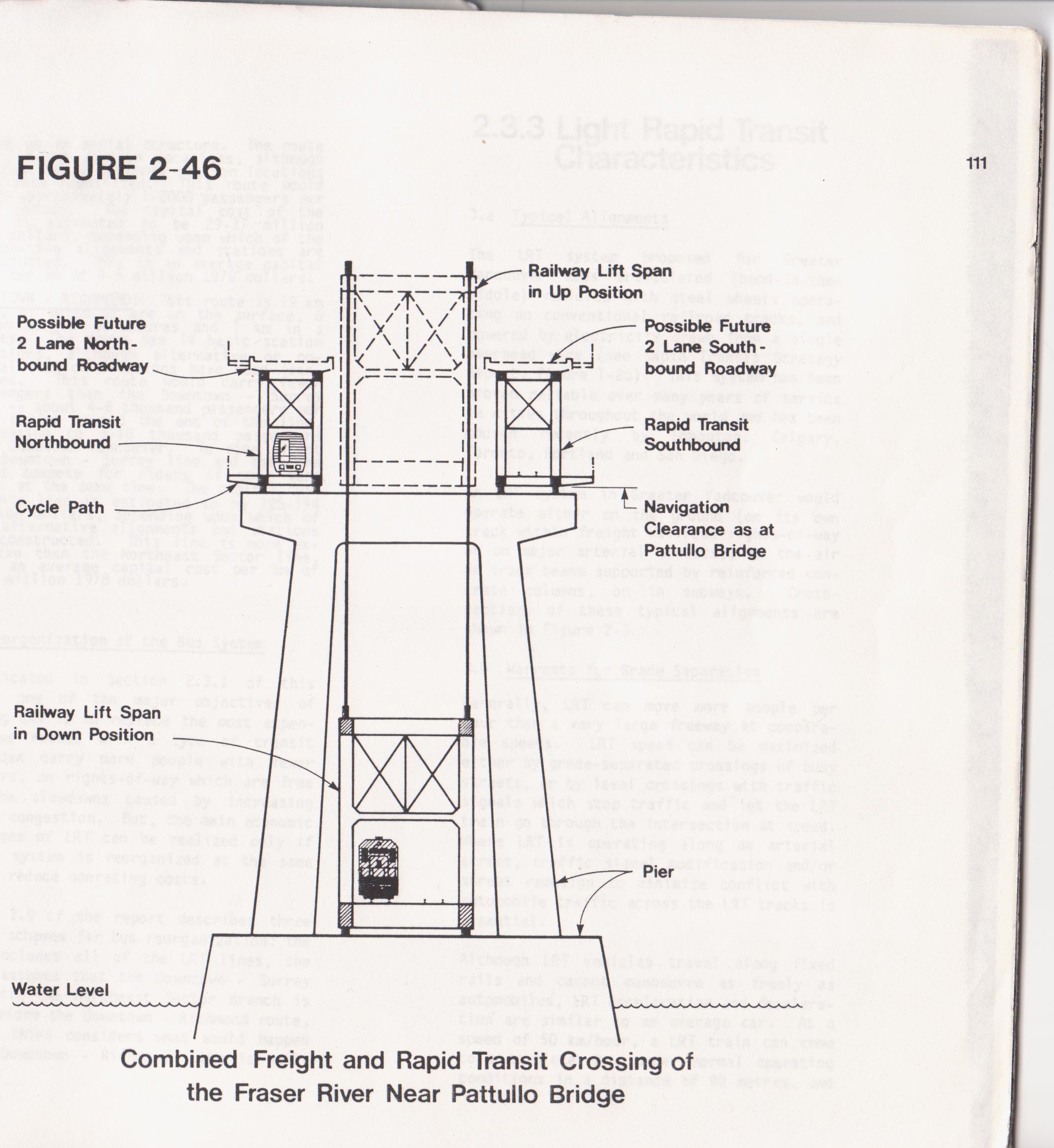 It is now history, as the provincial government imposed SkyTrain on the region and a stand alone SkyTrain, Sky Bridge was built instead and a replacement for the badly aging Pattullo Bridge is about a decade away and a replacement for the absolutely decrepit Fraser River Rail Bridge is no where in sight.
Today, the provincial Liberal government is going to spend $3.5 billion or more on a single ten lane “vanity” bridge to replace the recently refurbished Massey Tunnel, while at the same time, the Patullo and Fraser River Rail bridges rot away.
Would it not be better to invest the $3.5 billion on a new tube to complement the existing Massey Tunnel and a new multi use bridge to replace the previous aging road and rail bridges, while at the same time bring transit improvements to South of the Fraser?
Maybe metro Vancouver should dust off the 1978 rail/road bridge and build it to replace both decaying bridges?
Maybe regional mayors should set aside their political allegiances and do what should be done?
I am not holding my breathe!
Common Sense From Aus
Metro Vancouver is not alone with transit ills and this item from the Australian – Sydney Ferry Blog certainly fits with our transit woes.
When it comes to transit and commonsense, TransLink’s planners and senior bureaucrats, as well as metro politicians, academics, the Ministry of Transportation and the Premier, seam to lack any at all, preferring vanity projects for personnel, political or bureaucratic prestige!
I would add the Engineering Profession as well, which many think they are experts in everything!
The following two quote sums up TransLink problems;
- “Often the proponents are urban planners or architects who practice the art of professional imperialism – extending the reach of their particular discipline to subjects about which they have no real expertise.”
- “…….a public transport network which focuses primarily on moving commuters to work will fail to compete with the private car.”
ai???Common sense is not so common.ai???
Voltaire

Ideas for improving Sydney’s ferry network
Does NSW transport need a big new idea or just clearer purpose?
NSW Minister for Transport and Infrastructure, Andrew Constance, announced yesterday he was “calling on the world’s brightest tech minds to find the next big idea that would shake up transport in NSW”.
It is good to seek ideas from elsewhere – I’ve done it myself – but technology is not a substitute for purpose. If you don’t know what port you’re sailing to, no wind is favourable.
Building new infrastructure, introducing smartcards or changing the fare structure do not of themselves constitute a purpose. They may be beneficial in some way, but what precisely are they directed towards achieving? Australian public transport planning has long failed to articulate a purpose or set of guiding principles for achieving it.
This shortcoming is puzzling. There is an established “science” of public transport which is taught in tertiary institutions across Australia, often assisted by funding from transport departments. Ai??Many overseas countries practice this science assiduously (the Swiss do it best). But strangely, in this country, the science rarely seems to percolate to the surface of public policy. More often than not, a public transport “solution” is proposed in the context of individual urban developments. The bigger picture of providing better mobility for city and suburbs as a whole seems to fall below the radar.
One particular mode – say a Metro or Light Rail – are frequently advocated as “solutions”. Often the proponents are urban planners or architects who practice the art of professional imperialism – extending the reach of their particular discipline to subjects about which they have no real expertise.
Economists are the great masters of professional imperialism, but a kit bag of arcane econometric models is a poor substitute for in depth operational knowledge of transport systems. This has not stopped the Independent Pricing and Regulatory Tribunal (IPART), an agency blissfully unencumbered by knowledge of the complex science of public transport, from being given the task of redesigning NSW’s public transport fare structure.
So what are the main features of the science of “good” public transport, which seems so curiously hidden and poorly understood? This blog post can’t do it justice, but here are a few pointers.
Public Transport objective
To be effective, public transport must compete with the private car, not just for travel to work or travel to the central business district, but for all journeys – shopping, social and recreational travel. Public transport can only compete with the car if it enables the user to:
- get from wherever they are
- to wherever they need to go
- at a time that suits them.
In other words, a city’s public transport network must be multi-destinational. As only 15% of all journeys in Sydney, for example, are trips to and from work, a public transport network which focuses primarily on moving commuters to work will fail to compete with the private car. It won’t accomplish its purpose.
How to achieve this objective
1. Good network design
If people are to get from wherever they are to wherever they need to go, it is not practical or efficient for the network to connect all origin-destination pairs with single, direct trips. The best public transport networks are high frequency grids, where users can make transfers at connecting nodes with short waiting times – like the London Underground or the Tokyo Metro. Ai??But it doesn’t have to be a metro system. It may be a combination of modes, including suburban trains, buses, light rail and ferries.
The key is quality network design. The mode selected for individual corridors is based on technical, geographic and cost considerations, which are contextual and pragmatic. So no one mode can be said to be better than any other.
In areas of lower demand, where high frequency services can’t be justified, the network should be designed as a pulse timetable, so waiting times are short at nodes even if service intervals are 30 or 60 minutes.
Well designed networks are also highly legible – stopping patterns are consistent and timetables are clockfaced. It is easy for passengers to figure out how to use the system.
2. Network design guides infrastructure
The Swiss Federal Railways design timetables 20 years in advance. This allows them to prioritise infrastructure projects needed to achieve improvements in the timetable. This is the most efficient way of planning and building infrastructure because it ensures that what is built – and the technology used – is only what is necessary.Technology has a role to play, but it should never lead. Technology should be the servant of network design.3. Fare structures that encourage public transport travel
The fare structure needed for successful public transport systems is the opposite of what mainstream economists think we should have. Economists like “pay as you go” fares, because then users have the tendency to ration their use of taxpayer subsidised services. Many users also like the idea of only paying for what they use.But if our objective is for public transport to compete effectively with the car, the fare structure should provide an incentive to people to use public transport for as many trips as possible, including shopping, social and recreational trips. This is best achieved with highly discounted periodical fares (weekly, monthly, quarterly and annual travel passes), so every additional trip taken appears to the user to be free.

TransLink names Kevin Desmond new CEO
Is this just changing the chairs on the Titanic, or will Mr. Desmond actually achieve?
I am not holding my breathe, as a far better former CEO, Tom Prendergast soon understood the root cause of TransLink’s ills and was promptly sent to Coventry by senior bureaucrats. The result, he left TransLink.
Building subways and ill planned LRT, in Surrey, will not restore the TransLink brand nor increase ridership, which is a message Mr. Desmond must convey sooner, rather than later if he has any hopes of improving transit.
Having a former King County Metro “light-metro” general manager running TransLink certainly points to a safe choice by the TransLink Board to find someone to glad hand SkyTrain expansion, especially when former CEO Tom Prendergast opined that SkyTrain was just too expensive to build.
The real question of course has nothing to do with the new CEO, rather; “Has the failed plebiscite, mortally wounded TransLink?” Vancouver mayor Robinson and Surrey’s mayor Hepner are hoping it has not.
TransLink names Kevin Desmond new CEO
Desmond is currently the general manager for King County Metro Transit in Seattle
By Kelly Sinoski, Vancouver SunFebruary 10, 2016 3:43 PM
New TransLink CEO Kevin Desmond (right), beside Vancouver Mayor Gregor Robertson.
Photograph by: Michael Mui, 24 hours
METRO VANCOUVER — When TransLink’s new CEO Kevin Desmond starts his job next month, he will have a tough task ahead of him: to restore the transit authority’s beleaguered and battered brand and boost ridership.
But how he plans to do that is still anyone’s guess, as Desmond says he has yet to develop a game plan to tackle the issue.
“I understand TransLink has suffered a bruise to its brand and the last couple of years have been challenging …,” he said Wednesday at a news conference. “Restoring the public trust and confidence in the transportation system I believe to be No. 1.”

Subway Blunders in Europe ai??i?? Can “Old Dog” TransLink Learn From Otherai??i??s Mistakes?

Subway Blunders in Europe ai??i?? Can TransLink Learn From Other’s Mistakes?
From a September 2012 post. Unfortunately, many of the links no longer work and have been omitted for brevity.
Herr Keller is a German transit specialist from Germany and gives wonderful insight to the pitfalls of building new subways for the sake of building new subways. The following mail shows theAi??problems and counter productiveAi??resultsAi??of building subways and metros, where ordinary trams would do just fine. There are lessons to be learned, but Iai??i??m afraid TransLink is an ai???oldai??? dog that just canai??i??t be taught new tricks!
 Nuremberg has both a driverless metro and trams (streetcars).
Muenchen and Nuernberg show pretty well how Europeans fail at transit system design, too.
In Muenchen, at the beginning of the 60s, experts had recommended to extend the existing streetcar system out to the periphery on new lines built on separated row, even with grade-free road crossings where possible at low expense. Work on this had already been started in the 50s and got pretty far. The result was an excellent, extensive and
dense network, attractive for both passengers and the operator.For the city center, the experts had recommended building a few tunnels under the main choke points and especially under the entire area which is today pedestrian zone. After municipal authorities had taken over planning of these tunnels, however, they got more and more extensive, eventually creeping into a plan to replace the entire streetcar network by a full-blown subway. This plan was decided nearly 50 years ago.Today, after ai???investingai??? a few billion EUR, the subway network does not cover a larger area than the streetcar network around 1965-1975 and it doesnai??i??t allow to travel significantly faster, if travel time is measured from door to door. In fact on lots of (especially tangent) relations where the streetcar network offered a direct connection, today you are forced to make detours and change trains, losing time.
Another issue is that the dense surface network was replaced by just three trunk lines (which are split up into branch lines towards the ends), which resulted in hopeless overcrowding of some stretches during rush hours and especially of the connecting stations. Besides, the subway network offers less stations, so walking distances have been
significantly increased for the passengers. When living in Muenchen, I almost always preferred to go by bicycle because it was faster than the subway.In the end, the streetcar network has never been entirely replaced, some lines that had been closed, but without replacement by subway, even had to be reopened because buses were inefficient in handling the volume of passengers who stubbornly refused to take a detour underground.
Today, the streetcar network is slowly being revived and new lines are being planned. One streetcar extension line that had been planned in the early 60s and for which the row had already been reserved, eventually got opened in 2011. One streetcar line that was closed without replacement by subway in 1983 got reopened the next year after protests by the citizens flooded the town hall, closed again in 1993 and might be reopened again in the near future.
For the north and the southwest of the city, there are now plans for the construction of entire new streetcar sub-networks, including some stretches of extension lines built in the 50s/early 60s which were closed in the 80s/90s.
One important short tangent connection, which was planned as part of a loop line around the entire city before WW1, never got built due to WW1, depression and then WW2, and it was the only segment of that loop line that was never completed. Today, the only thing that prevents it from finally being built is the county government whose opposition to the city councilai??i??s decision is nominally based on the false pretension that the streetcar line would wreak havoc to park it has to pass through. On a row where currently diesel busses operate, the tarmac would be replaced with grassed tracks. A few hundred meters north of this row, a six lane ai???highwayai??? passes through the same park. The real reason of course is just that the county government is in the hands of a different political party than the city council and is has been like this for decades now.
The ai???tunnel maniaai??? of the subway planners gave some ai???interestingai??? results. For example, when the technical university of Muenchen moved some of the engineering faculties to a new campus outside the city in the middle of nowhere, it took roughly a decade to built a subway line there. This line passes underneath a place named Garching, essentially a tiny village, they have a maypole on their village square with a subway station underneath. Next to this village, the tunnel passes even below a potato field (or is it a cow paddock?) before reaching the campus.
During the decades of subway tunnel construction, suburbanisation has progressed further outward, creating more traffic. With the result that the suburban commuter network (ai???S-Bahnai???) got overloaded, especially on its main trunk line which passes in a tunnel under the city. Plans for adding two separate tracks for commuter trains and connecting stations with the urban network to an existing surface bypass line south of the immediate city center have been put aside by the politicians. They could have been implemented by now, at comparatively low cost.
Instead, a new tunnel parallel to the existing one was planned, with connection to the existing urban network at stations which are already hopelessly overcrowded. The cost for the tunnel, as usual, rose during the planning stage and in the end financing could not be warranted so the project is stalled.
So while a foreigner coming to Muenchen might think this city has an excellent transit network, as someone who has lived there for a few years I beg to differ. After decades of tunnel construction with >10 billion EUR (CAD 15.6 billion) wasted, large areas of the city still have no decent connection while the subway and the commuter network are overcrowded and unable to handle more traffic. Besides the fact that tangent connections are missing and buses (not only on these relations) arestuck in gridlock during rush hours.
In Nuernberg, which mostly imitated the system at Muenchen, they built a single-track (!) subway tunnel to the airport, which before was served by 12m buses every hour or so. Right before arriving at the airport, the tunnel passes underneath paddocks, community gardens and a small forest.
The Nuernberg system is really a ai???niceai??? example how to screw up an outrageously expensive transit system. One false pretense for building the subway was, among others, that it would provide a higher capacity than the streetcar. But actually, the subway was built with stations only for 75m train sets, very narrow platforms at some stations and few and narrow staircases.
As it happens, one of the most cramped stations is the one that has to handle the most passengers, during the annual Christmas market, which is *the* touristic event in this city.
Sincerely,
W.




Recent Comments