Perils of a Proprietary Transit System
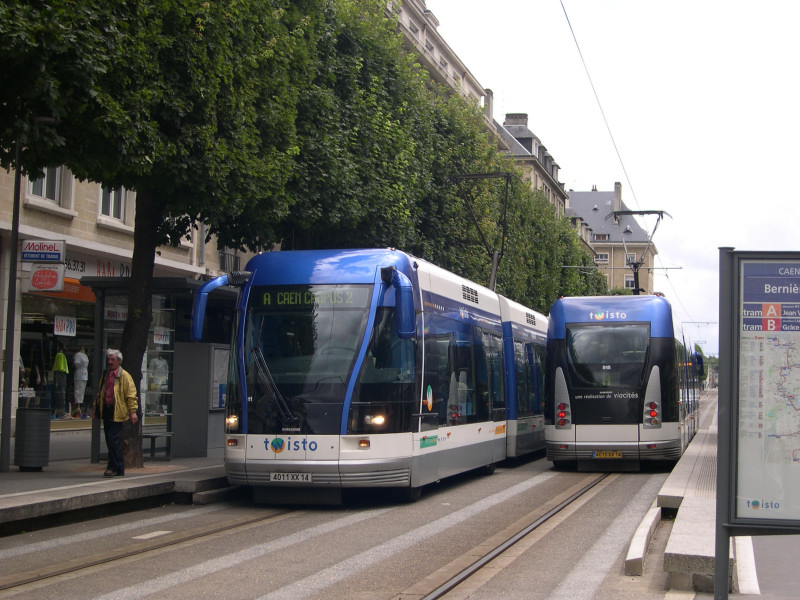
Bombardier Inc. loves proprietary transit systems, because of the “gotcha” factor. Once a transportation authority purchases a proprietary transit system, they are stuck with one manufacturer and if problems arise, too bad.
This is what happened in Caen, where in 2002, the city’s transportation authority purchased the proprietary Guide Light Transit guided bus system or GLT but after the parent company stopped their support of the transit system, the city of Caen, was left out in the cold and are now replacing GLT with a tram.
GLT is legally defined as a bus in France, but is guided by a double flange wheel on a single rail, thus not needing steering on a transit route but still retains the ability to be steered manually if need be and by all accounts, this happened more often than not.
From Wikipedia:
Critics of the system also point out that, unlike a conventional tramway, GLT is a proprietary system, meaning that once having installed it, a city would face difficulties in purchasing vehicles from any manufacturer other than Bombardier. A standard tramway, by contrast, can easily accommodate vehicles from multiple suppliers; Nancyai??i??s neighbour Strasbourg, for example, has chosen the Citadis tram from Alstom to supplement its existing Bombardier Eurotram fleet.
Because of the significant problems encountered by the cities which have opted for the Bombardier Guided Bus, one of which has demanded compensation for the costs it has had to pay for the GLT, Bombardier will not sell any more GLT systems, at least until all the issues have been resolved.
Another new tram line in France is in the offing, bringing with it a cautionary tale of the “perils of a a proprietary transit system.”
Another Suicide
In Europe, EEC Health and Safety rules mandate that all driverless or automatic passenger transit systems must have platform gates to prevent suicides or accidental falls onto tracks. Not so in Canada, as “Death by SkyTrain” continues unabated.
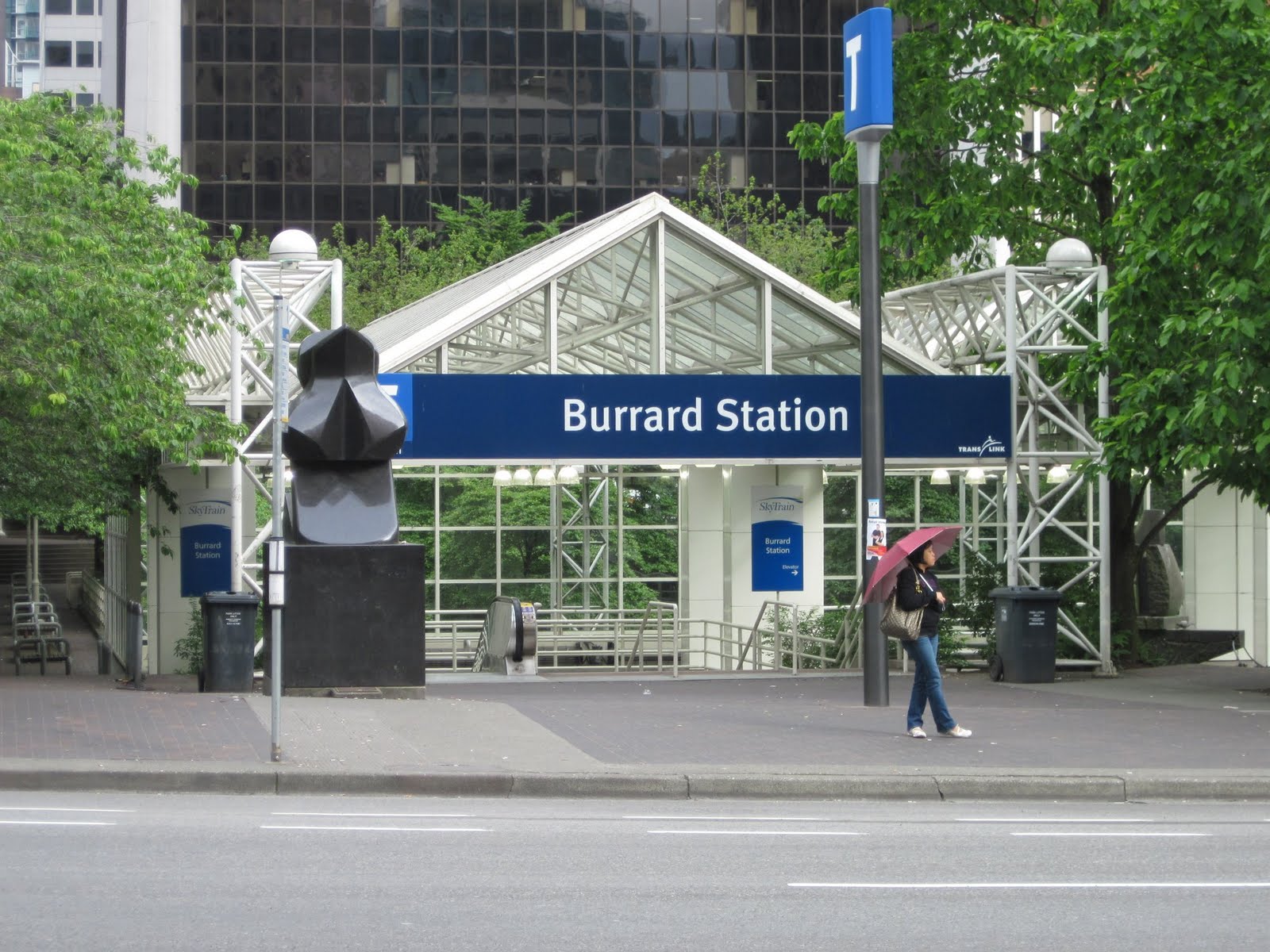
UPDATED: Massive delays after SkyTrain medical emergency
February 02, 2016
Crowds pack SkyTrain platform / Stanley Lai – Twitter
UPDATED: SkyTrain service should resume by about 6:45-7 p.m.
Commuters across Metro Vancouver are reporting transit chaos, after a medical emergency at Burrard Station set SkyTrain delays in motion.
The issue affects both the Expo and Millennium Line.
Trains are still running, but only single track.
Offficials have also set up shuttles between Waterfront and Main Street stations, and passengers coming into downtown on SkyTrain will need to switch trains at Stadium Station.
With rush hour in full swing, thatai??i??s meant major delays and lineups at many stations.
Attendants on site tell CKNW there is no timeline yet for resumption of regular service.
Professor Condon on CBC Radio
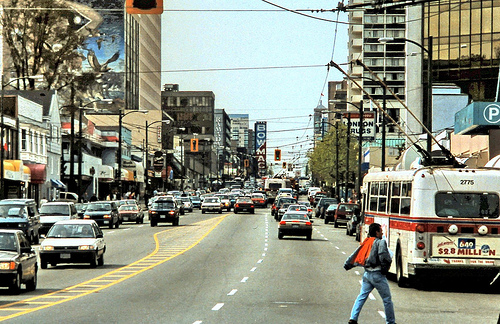
- A BCIT to UBC surface light rail line would reduce traffic congestion, while at the same time allow cars to access merchants along Broadway
UBC Planning Professor Patrick Condon was on CBC Radio on Jan. 29, echoing the growing concern about the proposed Broadway SkyTrain subway sucking away federal monies from other local transit needs.
Interesting, that the good professor, states that TransLink’s two top planners were fired because of their support for light rail, which would cost a third to build than a subway!
Listen to the broadcast here.
The White Elephant Line

A white elephant is a possession which its owner cannot dispose of and whose cost, particularly that of maintenance, is out of proportion to its usefulness.
To recap, the Canada Line is not a true P-3, rather a mock P-3, where SNC Lavalin/Bombardier, bid against, SNC Lavalin/ROTEM. Judge Pittfield who resided over the failed Susan Heyes lawsuit against TransLink, called the bidding process a “charade”.
The Canada Line is the only heavy-rail metro built in the world as a light-metro and being only able to operate 41 metre long, two car trains, has much less capacity than a modern tram costing a fraction to install!
At a minimum of $83.4 million to operate annually, calling the Canada line a “White Elephant” is too kind!
Surrey urged not to repeat Canada Line P3 mistake
 Passengers wait to board a Canada Line train to Vancouver from Bridgeport Station in Richmond.ai??i??Ai??image credit: Black Press file photo
- byAi?? Jeff Nagel – BC Local News
- posted Jan 29, 2016
Burnaby Mayor Derek Corrigan says Surrey must avoid repeating the costly mistakes made when the Canada Line was built as a P3 partnership now that the city is clamouring to build new light rail lines.
Corrigan has been pushing TransLink to disclose details of the Canada Line arrangement, which he says forces the transit authority to pay the private partner not just a higher interest rate than if it had borrowed directly but also additional inflationary and other adjustments.
Those payments cover the cost of operating the line as well as the $721 million in private capital ai??i?? nearly one third of the $2.1-billion rapid transit line ai??i?? that was fronted by the partners after direct contributions from TransLink and senior governments.
The deal to secure and repay the “magic money” through the P3 has financially hobbled TransLink, leaving it unable to afford better transit service in the years since the Richmond-Vancouver line opened in 2009, Corrigan told the Metro mayors’ council Jan. 27.
Lund Sweden – New TramWay to Cost $23.3 Million/km to Build
Contrary to TransLink’s habitual gold-plating of its LRT projects, modern light rail can be built reasonably cheaply, when compared to other modes of transit.
The cost of the 5.5 km. starter tram line in Lund Sweden, with seven trams is estimated to be CAD $128.1 million or about $23.3 million/km to build.
Not bad considering that Surrey’s planned LRT is said to cost a minimum of $80 million/km. to build!
Maybe the City of Surrey should forget about TransLink and hire the same people designing Lund’s new tram line to design LRT for Surrey.

The city of LUND at the southern tip of Sweden with a municipal population of nearly 111,000 has begun the tendering (Request for Proposals – RfP) process for construction of the city’s first light rail (modern tramway) line, the “railway gazette international” site reports. The starter 3.41 mile (5.5 km) route would require seven trams and would cost USD $91.1 million (CAD $128.1million):
“Lund tram tendering begins 27 Jan 2016
SWEDEN: The city of Lund has begun the tendering process for a design-build contract for the cityai??i??s first tram line, following city council approval on December 17.
Due to open in 2019, the 5Ai??5Ai??km (3.41 mile) route would connect Lund Central station and the science village with nine stops.
Trams are to run every 7A?Ai??min.
Regional public transport authority SkA?netrafiken has called tenders for seven trams with a capacity of around 130 passengers each.
The contract would include 10 years of maintenance and an option for three further trams.
SkA?netrafiken and the Region of SkA?ne are to fund both the rolling stock and construction of the depot.
Central government transport body Trafikverket is funding 38% of the SKr776m (USD $91.1 million) infrastructure cost.
Although less than the 50% for which the city council applied, the city expects to cover this shortfall from private sources, including developer contributions.
Professor Patrick Condon: Dear PM: Don’t Waste Billions on Bad Transit Projects
I see the good professor is taking the same track a Zwei, with my earlier letter to the PM.
Expensive vanity projects like the Broadway subway drive up transit costs, yet provide negligible transit improvements.
The only benefit a Broadway subway will bring is excessive profits to land speculators and developers, who are now assembling land on Broadway.
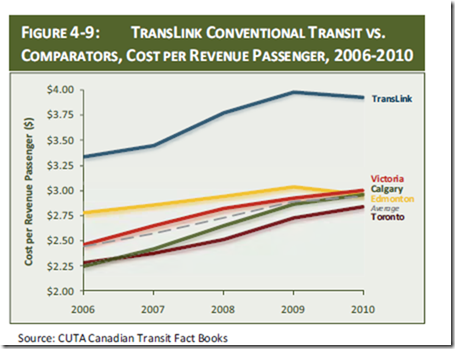
SkyTrain’s expensive costs has driven up TransLink’s Cost per revenue passenger
over one third higher than Toronto, Calgary and Edmonton. A Broadway subway would greatly increase
TransLink’s cost per revenue passenger numbers.
Dear PM: Don’t Waste Billions on Bad Transit Projects
Toronto and Vancouver subway wrong for taxpayers, riders and planet.
ByAi??Patrick M. Condon, Today, TheTyee.ca
The Scarborough RT system could have been upgraded for only $500 million. Instead,
Toronto council opted to scrap it for an expensive subway extension.
Dear Mr. Trudeau,
Congratulations on your recent victory. I was happy to see that you support infrastructure investments, particularly in transit. Good on you! I was even happier to see that you want to spend your extra $6 billion a year on transit, green infrastructure and housing.
But I have a concern: You only have about $2 billion a year to spend on transit. Not much.
And the talk is that the money will go to “shovel ready” projects. That worries me, because it means you could spend all the money and more building a few kilometres of subway lines in Toronto and Vancouver each year. Not much benefit in a country this big!
I’m worried about the money disappearing into two specific holes in the ground: $2 billion for the 5.7-kilometre Broadway subway line in Vancouver, and $3.6 billion for the 7.6-kilometre Bloor subway line extension in Toronto.
Wow, I thought the Broadway line was expensive at $350 million per kilometre, almost three times the per-kilometre cost of the Canada Line. But the cost of the Scarborough extension of the Bloor subway line in Toronto will be pushing $475 million a kilometre!
Good News Everyone – Valley Rail One Legal Step Closer

The following is from our friend Mr. Haveacow, from Ottawa, who is a transportation engineer.
Zwei has always stressed that for modern LRTAi?? and TramTrain to operate in BC, the legalities of both must be dealt with.
For trams and LRT, the rules of the the road must be addressed, such as who has the legal rights-0f-way and laws concerning the motorist and trams, must be updated to 21st century standards; just what is happening now with driverless cars.
For TramTrain, the rules and legalities must be addressed for track-sharing.
If TramTrain is being allowed to operate in the UK, then it should be of little problem to do the same here as the UK has some of the toughest railways rules and regulations on the planet.
As Ontario’s transit needs are being met, by updating Transport Canada’s rules and regulations, so shall B.C.’s
Over to you Mr. Cow!
Photo: A TramTrain under trials in Sheffield, U.K.

Just a little note about the release of the possible Smart Track Line Reports in Toronto. If you didn’t know about this lineAi??and its connection to where your interests are is this:*1. Smart Track is a surface Heavy Rail/Subway/Metro type operation that plans to use existing GO Transit Lines and or available railway track and their rights of way. The reports were very positive for the proposal except in the western section which also happened to mirror the planned phase 2 section of the Eglinton LRT. Well surprise, surprise the experts agreed, keep the western section an LRT line, its cheaper and will attract more people. So two lines one surface Metro/Heavy Rail line running on railway corridors and a surface LRT line as well. A total of 53km of service in all, for about $8 Billion.*2. GO Transit is building part of its RER (Regional Express Rail) System along the same set of lines (Cost: $13.5 Billion over the next 10 years). The Ontario portion of the Smart Track proposal is actually the major infrastructure improvements required in the RER program.*3. This is the important part for you, I’m only 1/3 of the way into the new reports released yesterday but, it has been identified that legally speaking, to allow surface running Metro/Subway type trains to operateAi??on GO Transit owned,Ai??main line railway rights of way, the Transport Canada rules which actually forbid it, have to be changed. The Federal Liberals have already said they plan to honor the election promise for $2.6 Billion in fundingAi??for the line. The clarification was needed because it was originally a Conservative Election promise and yes, it is confirmed,Ai??Toronto will get its cash and soon.Ai??Since the Feds are behind it, I sense a growingAi??desire for change suddenly appearing at Transport Canada.Ai??This makes your Tram-Train for the first time, really for the first time buddy, an affordable real alternative to certain Skytrain lines.Ai??*As I pointed out yesterday, the Broadway Line from VCCAi??to Arbutus, length 6.5 km is set to cost between $2.1-$2.5 Billion to build. That is, $323-$390 Million per km. The over budget, full scale subway extension (not a Light Metro operating technology) to the SpadinaAi??SubwayAi??in Toronto, can currently handle slightly more than twiceAi??the theoretical peak load of the Skytrain System using the existing 60 year old signaling system, not the new updated one that is currently being installed across the whole Yonge University Spadina Line. The new signaling system, whichAi??is being installed asAi??the basic signal system on the Spadina Subway extension isAi??expected toAi??increase the peak load anywhere from 15-25%. TheAi??over budget and late, Spadina extensionAi??costs only $373 Million per km. The next extension to the Montreal Metro’s Blue Line from St. Michel to Anjou which also greatly surpasses the peak capacity of the SkytrainAi??system, is only expected to cost $250-$300 Million per km!*If you are going to put something in a tunnel it better be really worth it.*Sincerely,
One Tram Line Moving 250,000 Daily

On the radio last week I heard one of the SFU types go on and on about the Canada Line and how successful the mini-metro was.
Really?
Again, I have to remind everyone that the Canada Line has station platforms only 40m to 50m long and can operate 41m coupled sets of EMUs.
The official capacity of a Hyundai EMU is 163 persons per car or 326 per two car set.
At 3 minute headway’s, the Canada Line can handle traffic flows around 6,500 pphpd, roughly half of that of the Expo and Millennium Lines, which have 80m long station platforms.
Now let us compare with the six module Combino LRV, the longest single LRV’s in the world at 54 metres long. Each bidirectional tram with a welded stainless steel (!) frame, is capable of transporting 350 passengers. Due to the specific nature of route 4/6, where they will be used (250,000 passengers daily, with a rush-hour headway of 1.5 minutes), the vehicle has only 65 seats, and lots of standing space.
At 3 minute headway’s, the 54m long super Combino can carry 7,000 pphpd.
For added insult, it is cheaper to buy one long tram than two EMU’s.
So when you hear, self important types pontificate about SkyTrain, capacity and headway’s, just remember that in Budapest, one tram line, operating at 90 second headway’s during peak hours can move 250,000 passenger daily!

Parting Shots From Former TransLink CEO Doug Allen
Really?
Sorry Doug, your diatribe has fallen on deaf ears.
If TransLink really cared about the customer, like other transit agencies do, TransLink would not be held in such high odor by the taxpayer.
TransLink has had over a decade to improve service, but no, all you guys did was to blindly bleat on and on on wonderful TransLink is, while turning a blind eye to customer needs.
TranLink hated its customers and in turn, its customers greatly disliked TransLink.
It is not news that TransLink’s ridership is declining, your service is poor, your new fare system discriminatory and user unfriendly, and forced transfers from bus to mini-metro irksome.
I know you were in shock when the plebiscite failed, I wasn’t because I knew how out of touch you and your cabal running the show were.
Your self serving nonsense doesn’t fool anyone, if you really thought that mixing roads and bridges with transit was a bad thing, why didn’t you do anything about it?
You are the epitome of TransLink ponderous, out of touch and arrogant. The regional mayors areAi?? equally out of touch and remain ignorant about modern public transit practice, but you did nothing to educate them, instead catered to their insipid demands.
Adios Doug, you have left TransLink adrift in a sea of debt and not a whimper from you until now. It is one hell of a legacy.
TransLink driving away ridership: former CEO
Doug Allen says passengers should be priority, not roads and bridges
By Kelly Sinoski, Vancouver SunJanuary 18, 2016
Doug Allen, former interim CEO of TransLink, said in a report written upon his departure last August that more needs to be done to increase ridership on public transit. Allen is pictured speaking to media last July.
Photograph by: Wayne Leidenfrost, PNG
TransLink does not focus enough on boosting public transit ridership across Metro Vancouver because it is too distracted by road and bridge projects.
Thatai??i??s the crux of a confidential report written by former interim CEO Doug Allen when he left the transportation authority after a six-month stint last August.
The report, released under Freedom of Information, covers everything from TransLinkai??i??s tarnished reputation to its ai???confusingai??? governance structure and the controversial Compass card.
ai???TransLink is not focused on increasing ridership,ai??? Allen writes. ai???In recent years, ridership has been declining and this is a critical issue for a transit system that is planning expansion for a growing population.ai???
Allen said TransLinkai??i??s decision to focus on road and bridge improvements has created a ai???conflicting mandateai??? for the board, noting that as vehicle travel becomes more efficient, transit becomes less appealing. The Golden Ears Bridge, parking fees at park-and-ride lots and other decisions have deterred transit users, he said.
Even the Compass card was touted as a way to reduce fare evasion rather than boost ridership.
ai???The attempt to reconcile these conflicting mandates has resulted in an enterprise with vague goals about producing regional transportation plans,ai??? Allen said. ai???Because growing ridership is not currently identified as the organizational priority there are no projects, initiatives or strategies designed to increase ridership. Many decisions are actually counterproductive to this goal.ai???
TransLink has acknowledged it has seen a rolling decline in ridership over the past two years, partly because of a 2013 fare increase. A move last fall to make all bus fares one zone as part of the Compass card rollout did result in a 1.1-per-cent boost in bus ridership, TransLink said, but it is forecasting a $1.1-million decline in revenue next year as the Compass card takes full effect and the number of cash fares ai???dramatically drops.ai???
TransLink plans to review its fare structure for the first time in 30 years, which could potentially see its three-zone system replaced with a flat fare across the region or a distance-based fee, to boost ridership.
The move was recommended in a core services review by Allen, which also suggests that TransLink use mobility pricing, such as tolling all bridges, to get people out of their cars. It also suggests drawing up a business case to transfer its roads and bridges to another agency.
Regional mayors have touted mobility pricing as a way to fund transportation across the region, but Greg Moore, Port Coquitlamai??i??s mayor and chairman of Metro Vancouver, said he doesnai??i??t agree TransLink should hive off its roads and bridges. This would whittle down the long-range vision of getting more people walking, cycling or taking transit to work, he said.
ai???I feel a lot of effort goes into moving goods and people through the system,ai??? Moore said. ai???When you look at other organizations around the world, TransLink is the envy, in the sense that one authority is looking after transit and transportation. In most cases, there are multiple groups looking after roads and bridges. At TransLink, we have the best of all of it going on.ai???
Allen maintains the TransLink system is ai???safe, reliable, efficient and affordableai??? but insists roads and bridges shouldnai??i??t be included in core operations. He also maintains TransLink could improve its customer service, noting the public has been left with an impression of ai???detached indifference to their experience, opinions or requests.

ai???Customers need attention and TransLink as a service organization must respond,ai??? Allen writes. ai???For example, more proactive customer communications by SkyTrain attendants would set a positive tone for riders. Lessons can be learned from leading customer service organizations such as Disneyland or Nordstrom.ai???
He noted TransLink doesnai??i??t sell its good points. During the recent plebiscite, for example, the mayorsai??i?? council told TransLink to remain quiet and out of the public eye, which was ai???the worst possible approach,ai??? Allen said, as it resulted in more negativity around the agency and a ai???bunker mentalityai??? among employees.
TransLink is in the midst of developing a ai???customer service guarantee,ai??? Allen noted, but it must also look at realigning its structure, which consists of multiple boards for buses, SkyTrain and the Transit police who all report to the main TransLink board. This makes the system confusing, especially as it is overseen by TransLink, Metro Vancouver and the provincial government.
He suggests the TransLink board should be responsible for running the transit agency and making decisions around fares and operations, and be appointed in a similar fashion to those at YVR and BC Ferries.
The province should also show more support for TransLink, he said. ai???Openly criticizing a public agency on a regular basis simply reinforces uninformed views, particularly if the party doing the criticizing is responsible for the creation of the agency in the first place,ai??? he said.
At the same time, he maintains Metro mayors should step back and only focus on regional and long-term investment.
Moore argues this runs contrary to Metroai??i??s views that it have more authority, not less, over TransLink operations.
TransLink board chair Don Rose said in an emailed statement that TransLink appreciated Allenai??i??s ai???observations and advice.ai???
Broadways Subway – A Boondoggle In The Making
Subways are very expensive items and only built when there is no other alternative available.
SkyTrain ICTS/ALRT/ART, was supposed to mitigate the high cost of subway construction, but it didn’t as it proved to almost as expensive as a heavy-rail metro to build, with the capacity of modern light-rail.
The result: No one builds with SkyTrain anymore, in fact nobody ever really built with it except for Vancouver and six other cities.
Toronto is getting a “real time” education on the pitfalls of subway construction and Metro Vancouver politicians should take heed, subway construction is a Pandora’s box of financial troubles waiting to happen.
As always, in the real world, transit is built to economically deal with traffic flows on a transit route; ) to 5,000 pphpd – bus from mini bus to express bus; 2,000 to 20,000 pphpd – LRT/tram, from simple streetcar to modern light rail; 15,000+ heavy rail metro (subway). Light metro has been relegated as a niche transit mode not as a urban transit mode.
Traffic flows on Broadway are less than 5,000 pphpd, barely justifying modern LRT and certainly not a subway.
Those supporting a Broadway subway are supporting a financial boondoggle.
Please share with your local politicians and the mainstream media. Toronto’s reporters are doing their work it seems, certainly not Vancouver’s!
 The cost of the Spadina subway is now in excess of $400 million/km.
Chris Selley: Spadina subway extension a classic Toronto transitAi??screwup
National Post, Chris Selley | January 16, 2016

 Tyler Anderson/National PostTTC CEO Andy Byford: ai???The good news is, the TYYSE is 80-per-cent complete. The track is virtually all in, the tunnels were completed back in 2013, the six stations are well advanced,ai???
ai???Look over there!ai??? TTC CEO Andy Byford pointed and shouted to reporters aboard a chartered city bus early Friday afternoon. He was jokingly averting our eyes from a disabled TTC bus being towed away. But it was basically what he had been doing in earnest all morning, as he and site manager Peter Boyce toured us around York University station, midway point on the late and over-budget six-stop Toronto-York Spadina Subway Extension (TYYSE).
What we saw was a loud, muddy, freezing-cold construction site, but one in which an objectively impressive subway station ai??i?? if you like that sort of thing ai??i?? is taking shape. It has a nifty wavy roof. It has a grand entrance through which natural light will filter down to the platform. Passengers will ostensibly look up and marvel at the ai???waffle slabai??? concrete roof.
All very nice, but we were there because of bad news. As we bussed northward, the project officially got considerably more expensive: A staff report anticipates up to $400-million extra will be needed to settle what Byford says are routine disputes with contractors ai??i?? 60 per cent to be borne by the city and 40 per cent by York Region. That brings the total price to around $3.2 billion for a subway line scheduled to open by the end of 2017 ai??i?? a significant departure from an original budget of $2.6 billion and an original deadline of 2015.



Recent Comments