A Letter to the Prime Minister – Transit Issues in Metro Vancouver
Congratulations on your recent electoral success and now a fresh wind sweeps across Canada.
I have been an advocate for better public transit in the Metro Vancouver region for over 30 years. I have seen three major rapid transit projects built during this time and can honestly say all were built for political and/or bureaucratic prestige.
In the late 1970s, instead of the originally planned-for light rail transit (LRT) from downtown Vancouver to Whalley, in Surrey; Lougheed Mall in East Burnaby and Richmond Centre, the then Social Credit provincial government forced the propriety SkyTrain mini-metro system onto the region.
Later that turned out to be a shady deal between the BC government and the Ontario. The owners of the proprietary mini-metro system, the Urban Development Transportation Corporation was an Ontario Crown corporation that had great problems selling its ICTS/ALRT product, which we call SkyTrain. No one wanted it, including the Toronto Transit Commission.
Despite the hype and hoopla about ICTS/ALRT a 1982 TTC study found; “ICTS cost up ten times more to install than light rail, for about the same capacity…….” Yet for the cost of the proposed 1970’s LRT network to Surrey,Richmond and Lougheed Mall, taxpayers received a SkyTrain from downtown Vancouver to new Westminster!
The1982 study showed that, although modern LRT was then still in its infancy, had made ICTS/ALRT SkyTrain obsolete! This fact has been well covered up by both the media and by various governments who spent a lot of editorial and political credibility supporting ICTS/ALRT.
Later the UDTC was sold to Lavalin, which went bankrupt, in part, trying to sell the proprietary mini-metro, now called Advanced Light Metro or ALM, to Bangkok, Thailand. then Bombardier purchased the rights to ICTS/ALRT/ALM at Lavalin’s bankruptcy sale, but the newly-formed SNC Lavalin retained the engineering patents.
The mini-metro was again renamed Advanced Rapid Transit or ART, with Bombardier designing a larger new car, commonly known as the Mk.2.
Back in Vancouver, the shortfalls of the original ALRT/SkyTrain Line had become apparent and great work was done to ensure the next major transit project, the Broadway-Lougheed Transit project would use modern light rail. Alas, that was not to be. Instead, the governing NDP, in a private deal with Bombardier, again forced SkyTrain onto the region in what as now known as the Millennium Line. So expensive was ART/SkyTrain, that the planned route to Port Moody had to be abandoned and the Millennium Line eventually petered out at a station between Glen and Clark Drives in Vancouver.
The nearly-completion Evergreen Line is but the originally abandoned portion of the original Broadway-Lougheed LRT project to Coquitlam.
The BC Liberals, wanting their own vanity transit project, forced through the Canada Line, which uses conventional electrical multiple units, operating either on elevated guideways or in a subway in Vancouver. The cost of building the subway portion greatly escalated from the original cost of the project at $1.3 billion to about $2.4B. To reduce costs the scope of the project was significantly reduced. That was achieved by employing cut-and-cover construction on Cambie St. (with devastating results for local merchants) and by reducing station sizes with platforms lengths that vary between 40 metres to 50 metres, which can only accommodate two-car trains, 41 metres long.

ai??i?? The Canada Line station platforms are half as long as the Expo and Millennium Line stations, effectively giving the $2.4 billion Canada Line half the capacity! Embarrassingly, the Canada line is the only heavy rail metro in the world that was built as a light metro, having less capacity than a simple streetcar line costing a fraction to build! For added insult, the Canada Line, not being ALRT/ART SkyTrain is incompatible in operation with the the Bombardier proprietary mini-metro system.

ai??i?? The above graphic illustrates Ottawa’s LRT line (presently under construction)Ai?? with longer station platforms, will have a greater capacity than our current SkyTrain system. It is worth noting that two modern light rail vehicles (approx. $5 million each) can carry more customers than 5 Mk.2 vehicles (MK.1’s are no longer in production) costing over $3 million each.
To date, only seven ICTS/ALRT/ALM/ART systems have been built. Toronto will be tearing down their life-expired ICTS system in the near future. During the same period that ICTS/ALRT/ALM/ART has been on the market, over 200 new LRT systems have either been built; are nearing completion; or are in advanced stages of planning.
Metro Vancouver’s much troubled TransLink operation wants to build two more transit lines; a Broadway SkyTrain subway to Arbutus and Surrey’s ill-designed LRT. The problem with both projects is that they are being built on routes that do not have the customer flows to justify construction. If built, they will suck-up much needed funding from regions that desperately need improved transit in order to to fund overbuilt vanity projects that satisfy the whims of the mayors in both Vancouver and Surrey.
The Broadway subway is really the unfinished Western portion of the originally-planned for Broadway-Lougheed light rail project. The Arbutus and Broadway terminus and the creation of TransLink was an NDP inducement for then GVRD Chair and Vancouver Councillor George Puil to agree to fund the NDP’s switch from LRT to ART, with the added sweetener that the province would pay two thirds of the cost of SkyTrain only construction west of Commercial Drive.
Today, even with the B-line buses, peak hour traffic flows along Broadway are less than 5,000 persons per hour per direction (pphpd), which is about two thirds less than the bare minimum of 15,000 pphpd that would justify subway construction. You can build a subway, but expect to pay huge subsidies to keep it in operation; subsidies that will erode transit operations elsewhere.

ai??i??
Modern LRT can easily handle such traffic at one half to one third the cost to build and costing about half to operate than the current buses on that route. Modern LRT can handle traffic flows of 15,000 pphpd, the maximum capacity the current ALRT/ART SkyTrain can handle. An unpleasant fact is, a Broadway subway would have potentially less capacity than surface light rail, unless about $3 billion is spent to upgrade the current ALRT/ART system. New electrical and upgraded electrical installations would be required to handle more trains and major station upgrades, like extending platform lengths on the entire system, to accommodate longer trains needed for increased capacity!
The Surrey LRT is just more bad planning.
TransLink has not planned the Surrey LRT as a stand-alone light rail operation, rather, as a poor man’s SkyTrain, feeding the already at capacity Expo Line! Operating on routes that do not have the customer flows to justify LRT construction, it seems chosen for political reasons only.
Two more badly planned and expensive transit projects will only drive up the cost of transit, which already has made the cost per revenue passenger one third higher in metro Vancouver than Edmonton, Calgary and Toronto.

There is another way.
In September 2010, Rail for the Valley released their privately-commissioned study,prepared by Leewood Projects of the UK, which saw that a TramTrain service between Vancouver and Chilliwack, using the existing former BC Electric interurban route was viable and could be built, depending on the amount of money one wished to invest, between $500 million to $1 billion dollars for the 136 km. route.
The Leewood Study.
TramTrain is a variation of LRT which has trams or streetcars, operating on both trams/streetcar tracks and main line railway tracks. First operated in Karlsruhe Germany in 1993, TramTrain has proven very successful and today over 25 TramTrains are operating in Europe and North America and many more are being planned.
Using TramTrain on existing railway tracks greatly reduces costs, while providing quality transit services to areas which otherwise would go without.
TransLink and the provincial government have remained blind deaf and mute to The RftV/Leewood TramTrain and instead want to see a hugely expensive subway built under Broadway, which will not reduce congestion plus an equally expensive LRT in Surrey, which again will do little to reduce congestion.
Why are subways and light rail built?
In the real world, LRT is built on heavily used bus routes because one tram (1 tram driver) is as efficient as up to six buses (6 bus drivers) and because for every bus or tram used, one needs to hire a minimum of three people to manage, maintain and operate them. LRT becomes the better investment over a standard business cycle.

Subways are only built when ridership demands long trains needing large stations accommodating long station platforms, that at-grade would be problematic. The threshold for subway construction are traffic flows in excess of 15,000 persons per hour per direction. In many European cities peak hour ridership on sections of tram routes exceed 25,000 pphpd!

ai??i??
One can build subways on lesser routes, but the huge operating and maintenance costs means monies for other transit operation must be diverted to pay for the subway.
Solutions are needed for today’s transit needs.
- Fund new Faculties of Urban Transport and Transportation, granting degrees at major Canadian Universities. Unlike Europe, Canada does not have a School of Public Transportation and many planning for “rail” transport have little notion of the science or history of public transportation. Vancouver is a very good example of this.
- All major public transit projects that receive public financing must be subjected to scrutiny by a panel of ‘arms-length’ transit peers. In the U.S. all new transit projects that seek federal support are now subjected to scrutiny by a panel of transit peers, selected and monitored by the federal government, to ensure that projects are analyzed honestly, and that taxpayersai??i?? interests are protected. No SkyTrain project has ever passed this scrutiny in the U.S.
- Federal laws pertaining to railway operation must be changed to accommodate regional transit needs. Unlike Europe, where the mainline railways tend to be owned publicly, in Canada, the railway companies must be legislated to accept either regional rail or TramTrain. If Canadian law allows one-man operation of dangerous cargoes like volatile oil, then the law can be changed to accommodate regional transit needs.
- For Metro Vancouver, instead of giving monies to the Broadway Subway Project or the Surrey LRT, money would be better spent in funding the replacement of the decaying Patullo Bridge and the decrepit Fraser River Rail Bridge with a combined road/rail bridge. A high level road bridge and a three track lifting span would give ample capacity for both motorists and freight, passenger and local suburban train service in the region. A combined road/rail bridge across the Fraser River would do more in alleviating congestion in the region than a short subway line in Vancouver and a poor man’s SkyTrain being proposed for Surrey.
It is my hope and wish that transit planning is again done for the benefit of the transit customer and not for political or academic vanity. Metro Vancouver politicians love to boast about Vancouver and its transit system, but no one has copied Vancouver or its use of light metro. Transit planners and politicians come to Vancouver; they see SkyTrain; and they go home and build with light rail!
Sincerely;
The 1986 LRTA Study: Bus ai??i?? LRT ai??i?? Metro Comparison
I thought I would again reprint this post from May 20, 2010 as it may clear up some major misconceptions about LRT capacity, since many in Metro Vancouver are very confused about modern light rail.
There is an ongoing debate today that LRTAi??can only carry a limited number of riders and that the magic number for a subway is about 100,000 riders a day on a transit line. This may have been true in the 1970ai???s, but not the 21st century, where modern multi-articulated low-floor light rail vehicles (tram is much easier to say!) are able to easily carry three or four times this number, thus negating the need for expensive subway construction, except on the most heavily used routes. The LRTA shows that modern LRT can carry over 20,000 pphpd in 1986 and in 2010, in Karlsruhe Germany, one tram or LRT line on Kaisserstrasse was seeing traffic flows over 35,000 pphpd.
Karlsruhe also shows what the threshold is for subway construction in Germany, after many very expensive lessons with subways built on lesser routes.
The 1986 LRTA Study: Bus ai??i?? LRT ai??i?? Metro Comparison

The following is from the Light Rail Transit Associations hand book Light Rail Transit Today, comparing the operating parameters of bus, light rail, and metro on an unimpeded 8 kilometre route with stations every 450 metres. Using real data based on acceleration, deceleration, dwell time, etc., the study gives real time information for the three transit modes.
Please note: This study has been abridged for brevity and clarity.
The study assumes a vehicle capacity for a bus at 90 persons; LRT 240 persons (running in multiple unit doubles capacity); and metro at 1000 persons.
The time to over the 8 km. route would be:
- Bus ai??i?? 22.4 minutes
- LRT ai??i?? 18 .6 minutes
- Metro ai??i?? 16.3 minutes
The Round trip time, including a 5 minute layover:
- Bus ai??i?? 54.8 minutes
- LRT ai??i?? 47.2 minutes
- Metro ai??i?? 42.6 minutes
The comparative frequency of service in relation to passenger flows would be:
At 2,000 persons per hour per direction:
- Bus ai??i?? 2.7 minute headways, with 22 trips.
- LRT ai??i?? 7.5Ai?? minute headways, with 8 trips.
- LRT (2-car) ai??i?? 15 minute headways, with 4 trips.
- Metro ai??i?? 30 minute headways, with 2 trips.
At 6,000 pphpd:
- 1 Bus ai??i?? 0.9 minute headways, with 67 trips.
- LRT ai??i?? 2.4 minute headways, with 17 trips.
- LRT (2-car) ai??i?? 4.8 minutes, with 13 trips.
- Metro ai??i?? 10 minute headways with 6 trips.
At 10,000 pphpd:
- Bus ai??i?? 30 second headways, with 111 trips (traffic flows above 10,000 pphpd impractical).
- LRT ai??i?? 1.4 minute headways, with 42 trips.
- LRT (2 car) ai??i?? 2.8 minute headways, 21 trips
- Metro ai??i?? 6 minute headways, 10 trips.
At 20,000 pphpd:
- LRT ai??i?? 0.7 minute headways, with 83 trips.
- LRT (2 car) ai??i?? 1.4 minute headways, with 42 trips.
- Metro ai??i?? 3 minute headways, with 20 trips.
Comparative Staff Requirements on vehicles in relation to passenger flows. Station staff in brackets ().
At 2,000 pphpd:
- Bus ai??i?? 21 (0)
- LRT ai??i?? 7 (0)
- LRT (2 car) ai??i?? 4 (0)
- metro ai??i?? 2 (up to 38)
At 6,000 pphpd:
- Bus ai??i?? 61 (0)
- LRT ai??i?? 20 (0)
- LRT (2 car) ai??i?? 10 (0)
- Metro ai??i?? 5 (up to 38)
At 10,000 pphpd:
- Bus ai??i?? 110 (traffic flows above 10,000 pphpd impractical) (0).
- LRT ai??i?? 34 (0)
- LRT (2 car) ai??i?? 17 (0)
- Metro ai??i?? 8 (up to 38)
At 20,000 pphpd:
- LRT ai??i?? 69 (0)
- LRT (2 car) ai??i?? 34 (0)
- Metro ai??i?? 15 (up to 38)
Though the study is 30 years old and completed before the advent of low-floor trams (which decreased dwell times), it still give a good comparison of employee needs for each mode. Metroai??i??s, especially automatic metro systems do require a much larger maintenance staff than for bus or LRT and when one factors in the added high cost of subway or viaduct construction plus higher operational costs, Metro only become a viable proposition when traffic flows exceed 16,000 pphpd to 20,000 pphpd on a transit route.
Claims from other blogs that automatic metros can operate more frequent headway’s than LRT are untrue; automatic metros can not operate at higher frequencies than LRT, but if Metro is operated at close headway’s in times of low traffic flows, they do so with a penalty in higher maintenance costs and operational costs.
Taking into account the almost universal use of low-floor trams, operating in reserved rights-of-ways, combined with advances in safe signal priority at intersections; given an identical transit route with equal stations or stops, LRT operating on the surface (on-street) would be just as fast as a metro operating either elevated or in a subway at a fraction of the overall cost grade separated R-o-Wai??i??s. Also, automatic (driverless) metros, though not having drivers have attendants and station staff, which negate any claim that automatic metros use less staff than light rail.
The LRTA study does give good evidence why LRT has made light-metros such a as SkyTrain and VAL obsolete.
http://www.railforthevalley.com/latest-news/zweisystem/the-1986-lrta-study-bus-lrt-metro-comparison/
Global News Spotlights SkyTrain’s Ills
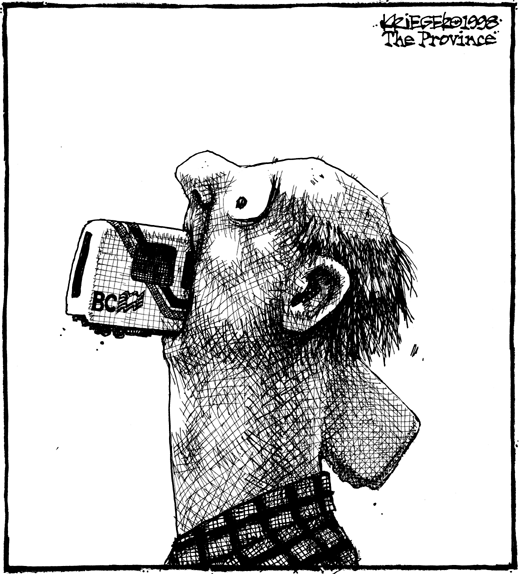
To say I am gobsmacked is an understatement, Global News actually had a rather negative story about SkyTrain, which convinces me some pointed questions about the proprietary railway are circling in Victoria.
Everything about SkyTrain, from it being forced onto the region in the early 80’s, the NDP flip-flop of the Millennium Line and forcing through the Canada Line (though not ALRT/ART SkyTrain) has come directly from the Premier’s office. Bennett, Harcourt, Clark, Campbell and now Christy C., have seen the benefits of ribbon cutting in front of multi billion dollar transit projects at election time and now with the Evergreen Line’s opening delayed until 2017, again shows that politicians build transit win elections, not affordably move people.
Global News has opened a chink in SkyTrain’s Teflon armor and SkyTrain’s future has just become less assured in the region.
How Do You Spell Rotten – T-R-A-N-L-I-N-K

Local independent reporter has been tearing into TransLink and the TransLink story seems to go from bad to worse.
Where is the Vancouver Sun? The Province? Her Majesty’s Loyal Opposition?
With Transit, there are so may rotten apples in the barrel, it is time to throw it all out.
From Business in Vancouver……
TransLink should report supplier payments, says political watchdog
Business in Vancouver investigation reveals inventory of contractors and suppliers that includes brother of former TransLink boss
A company owned by the brother of Ian Jarvis was paid more than the ex-TransLink CEO was in 2014, but you wonai??i??t find that in TransLinkai??i??s list of suppliers obtained by Business in Vancouver.
The Financial Information Act Return shows TransLink paid Ian Jarvis $483,625 in 2014. The report does not show the $676,000 in payments to Trevor Jarvis Contracting Ltd. from the subsidiary that operates SkyTrain.
TransLink media adviser Chris Bryan said thatai??i??s because subsidiaries like BC Rapid Transit Corp. (BCRTC) are not subject to the act, which requires public organizations to annually list suppliers of goods and services worth $25,000 and up.
Bryan said Trevor Jarvis Contracting performs landscaping and maintenance at 90 sites, including SkyTrain stations, transit centres, bus loops, park and rides, rectifier stations and HandyDart locations. It is also contracted for snow and ice removal.
In Toronto Developers Want Light Rail and Not A Subway!
Something new.
In Toronto, developers want light rail and not an expensive subway to replace their life expired SkyTrain Line, the Scarborough R/T. What should be of interest is that the ridership on the proposed LRT/subway route, is more than the proposed SkyTrain subway under Broadway.
Maybe Vision(less) Vancouver would rethink their grand Broadway subway plans, especially if their developer friends had to foot the bill for the $3 billion subway.
Subways are easy to plan for, especially if you are not paying for it.
Developers challenge Scarborough subway with OMB appeal
The organization representing developers is fighting the city at the Ontario Municipal Board over the controversial Scarborough subway

Marcus Oleniuk / Toronto Star file photo
The Scarborough subway would replace the aging Scaborough RT.
By: Jennifer Pagliaro City Hall reporter, Published on Thu Nov 26 2015A powerful organization representing developers and builders says the city should scrap plans to build the Scarborough subway because the number of potential riders doesnai??i??t justify the $3.56 billion price tag.
The Building Industry and Land Development Association, better known as BILD, is taking on the city at the provincial body that handles land and development disputes, the Ontario Municipal Board, the Star has learned, a move that could cost the city millions.
The Real Evergreen Line Story
 The Evergreen Line, with only seven stations will do very little
for local residents, who will find the car the only practical means of transportation.
The Evergreen Line is the unfinished portion of the old Broadway-Lougheed rapid transit project, but to true BC standards, all transit lines must have a media savvy name and the Evergreen line was chosen.
What is so disturbing is the influence of the somewhat disgraced former Vancouver mayor and Premier, Mike Harcourt in forcing SkyTrain, instead of light rial for Evergreen Line. As noted before, Mr. Harcourt meddling in transit affairs is akin to a child trying to play electric trains for the first time, without reading the instructions first.
With the former Social Credit government forcing SkyTrain onto the region, instead of light rail and the NDP flip-flop from LRT to SkyTrain for the Broadway Lougheed project has probably forced the taxpayer to spend easily $5 billion more for SkyTrain, than modern light rail.
The article also demonstrates, that the Georgia Straight, a weekly entertainment newspaper, has never been afraid to print the real story about rapid transit in the region, unlike the Vancouver Sun and Province!
What Bob Matkin’s news item does show is that where SkyTrain is built, SNC Lavalin is soon to follow and where SNC goes, trouble follows.
The real Evergreen line story:
Evergreen Line surprises delay rapid transit to Port Moody and Coquitlam
by Bob Mackin on November 26th, 2015
The Evergreen Line is being built with a tunnel-boring machine named Alice, but sheai??i??s experiencing a great deal of difficulty in reaching her destination.
When Premier Christy Clark christened the Evergreen Line tunnel-boring machine ai???Aliceai??? on March 7, 2014, she honoured Canadaai??i??s first female geologist.
Alice Wilsonai??i??s legacy includes the 1947 childrenai??i??s textbook The Earth Beneath Our Feet, but whatai??i??s going on with the rapid-transit project above and below Port Moody and Coquitlam recalls another Aliceai??i??one who fell down another hole in the ground into a bizarre ai???wonderlandai???.
Like the White Rabbit, who was late for a very important date, the government revealed late one Friday afternoon last February that Alice was tunnelling slower than the advertised eight metres per day. The summer 2016 opening was delayed to fall 2016. At this yearai??i??s September 25 board meeting, TransLinkai??i??s vice-president of engineering and infrastructure management, Fred Cummings, revealed that Alice had been stalled for five months and finally restarted the previous week.
Asked if he knew when the $1.43-billion Burnaby-to-Coquitlam Millennium Line extension would open, Cummingsai??i??s reply might have flattered Aliceai??i??s Adventures in Wonderland author Lewis Carroll himself: ai???Depending on how the boring goes, that will determine when the service date is. We donai??i??t have a date for that yet.ai???

Vancouver Blunders Ahead With Its Vanity Project.

Well, Vision(less) Vancouver is blundering ahead with its much cherished $3 billion subway under Broadway and our feckless politicians South of the Fraser remaining willfully blind to this billions of dollars boondoggle. One would think they would be more in tuned with the costs of this massive project.
Surrey has been bought off with its own vanity project, the poor man’s SkyTrain masquerading as light rail; Delta with the promise of a massive new bridge to replace the Massey Tunnel and good Liberal city councilors tow the provincial line in the Langleys, Abbotsford and beyond.
What is so sad is no one is thinking three minutes into the future, where road congestion and gridlock will reign supreme, forcing politicians to build more highways because the cost of transit is so high to build, based on the cost of current rapid transit vanity projects, that will do little to attract ridership or alleviate congestion.
Rail for the Valley offered another and cheaper way to provide quality transit to the South Fraser region, but politicians just love cutting ribbons in front of expensive vanity projects at election time.
Subway stops prepared along Vancouver’s Broadway corridor
by Carlito Pablo on November 25th, 2015
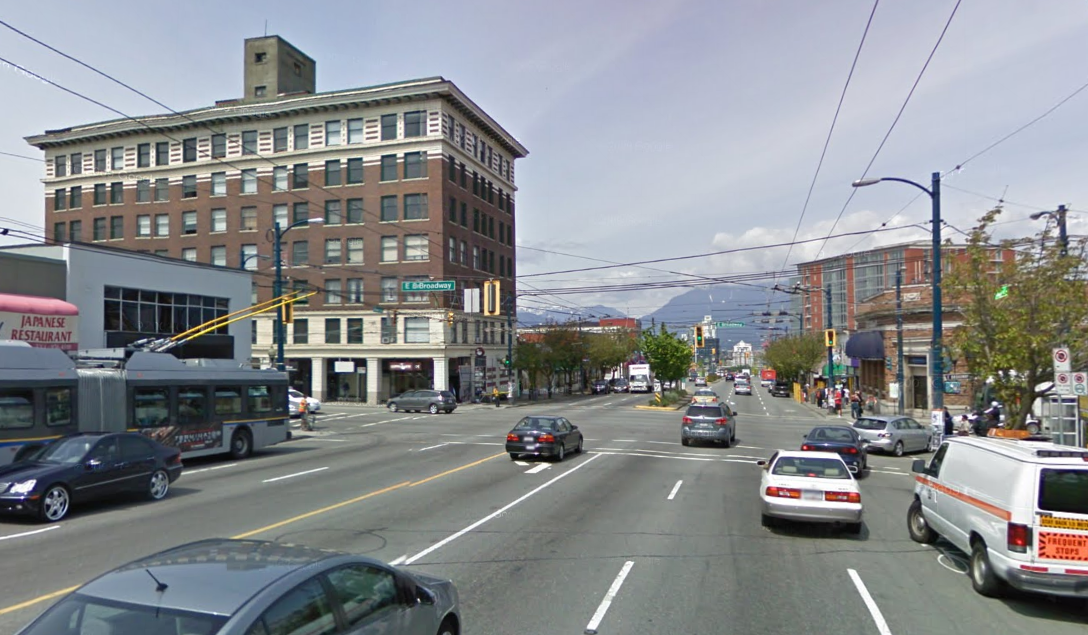
The strip mall on the southeast corner of Broadway and Oak Street is deserted.
ai???Weai??i??ll be starting demolition here pretty quick,ai??? Wayne Vickers, development manager of Bosa Properties, told the Georgia Straight in a phone interview. ai???Iai??i??d say December, with excavation in January, February.ai???
BlueSky Properties, a Bosa family company, is constructing a 10-storey office and retail building on this spot, which the City of Vancouver has chosen to be the location of one of the stations for a proposed subway line along Broadway.
According to Vickers, his company and the city have agreed to designate an area in the new building to serve as a connection to an underground transit station. ai???We got the plan. We have the design for it,ai??? Vickers said.
According to a city staff report, similar arrangements have been made for two other sites. One is near Arbutus Street at 2080 West Broadway, where the Pinnacle Living on Broadway condo building is located. The other is at 525 West Broadway, the site of Crossroads, a mixed-use residential, commercial, and office building kitty-corner to the Canada Lineai??i??s Broadwayai??i??City Hall Station.
A rapid-transit line along Broadway is one of the projects in a 10-year plan for Metro Vancouver released in June 2014 by the Mayorsai??i?? Council on Regional Transportation.
The $1.9-billion project involves extending the Millennium SkyTrain Line from VCC-Clark Station to Arbutus Street, connecting along the way with the Canada Line at Broadwayai??i??City Hall. Two-thirds of its cost would consist of funding from the provincial and federal governments.
In a referendum this year, Metro Vancouver voters rejected a proposed 0.5-percent increase in the sales tax to help fund major infrastructure projects in the $7.5-billion transportation plan prepared by regional mayors.
During the federal election campaign, Liberal Leader and now Prime Minister Justin Trudeau promised to work with the province and the city to extend rapid-transit service along Broadway to Arbutus.
Until the subway is built, Bosaai??i??s BlueSky Properties will use the future subway-connection space for retail.

Mr. Haveacow – The Ridership Question
Christopher MacKechnie Transit Expert is a transit planner and lawyer and writes for the About.Com website as their go to guy on public transport. The About Public Transport.Com site answers some basic questions and issues in transit operation and planning in an easily understood accessible way. Most of his articles, are pretty basic and are unfortunately, a little biased towards the American transit funding and planning regime, so not all of his answers apply in all situations to Canadian cities. However, he is quite good at explaining basic problems that often public transit is heavily and in my opinion often unfairly criticized for. He occasionally though, really hits one out of the park. This article is an excellent example when he nails it 100% and he could have gone on for a hundred or more pages. He shows the many ways that data about transit can be misleading or is poorly understood by people whom donai??i??t work in or around the transit industry and worst of all manipulated by just about anyone so that people who really donai??i??t understand what is being said can draw incorrect or overly exaggerated conclusions. His main beef is the recent trend for top 10 lists on just about anything, including transit.
Four Ways That Top Ten Lists in Transit Can Be Misleading
Like many aspects of life, transit is amenable to ai???Top Tenai??? lists and fairly frequently you see news articles proclaiming the ai???Top Tenai??? transit cities or less often the ai???Bottom Tenai??? transit cities in the United States, Canada, or the world.Ai?? Often these are misleading because the rankings are based on only a few criteria, and the criteria chosen may not even be that useful.
Here are a few of the criteria used and how they could be misleading:
1)Ridership ai??i?? Upon first glance, ridership would seem to be an effective way to gauge transit success, since every person who rides a bus or train could be considered a ai???saleai??? by the transit agency.Ai?? There are several caveats we must keep in mind when considering ridership, however.
First, in the United States we measure ridership by ai???unlinked passenger tripsai???.Ai?? What this means is that a person who takes a bus and train to work is considered two passengers by the transit agency even though only one trip was taken ai???a complete or linked tripai???.Ai?? As a result, transit agencies that have a lot of people transferring between lines will have higher reported ridership than those who do not, even if all other variables are the same.
Ai?? Second, some cities are served by only one transit agency while others have several.Ai?? While likely more than 95% of transit trips in New York City are taken on a vehicle operated by the New York MTA, in Los Angeles the corresponding agency (Metro) may only carry 70% of total transit trips, with a large number of other transit providers picking up the rest.
A true accounting of transit in Los Angeles would require the summation of ridership of more than twenty separate transit systems, an effort that may be too daunting for the casual examiner.
Ai?? Third, ridership is of course very correlated with population.Ai?? We would expect Houston (metro area of 6.18 million) to have more transit ridership than Eugene, OR (350,000); that does not mean transit is better in Houston.
Ai?? A better statistic would be ridership per capita, which controls for population size, and results in 22.9 annual transit trips per person in Houston and 39.7 in Eugene (2012 NTD data).
2) Number of Bus Stops ai??i?? One review stated that Modesto, CA had the best bus system in the United States because it had the highest percentage of residents within A? of a mile of a bus stop.Ai?? However, just because there is a bus stop does not mean that the bus service is usable ai??i?? in Modesto, buses run every thirty minutes and stop at around 8:30 PM on weekdays and around 7:00 PM on weekends.
3)Jobs Available Within a Certain Time Period on Transit ai??i?? Another popular ranking variable is the number of jobs available within a certain time period on transit, usually thirty or sixty minutes.Ai?? This favors smaller urban areas that are not big in geographic area, especially smaller urban areas with a dominant employment district (often college towns).Ai?? Does anybody believe New York does not have a great transit system because it takes too long to ride the ai???Aai??? train from Far Rockaway to Morningside Heights?Ai?? No, because New Yorkers would believe you were an idiot if you lived in Far Rockaway but worked in Morningside Heights.Ai??Ai??Ai?? Despite anecdotal reports on extreme commutes, the average trip on city bus systems average around five miles ai??i?? a distance that can be covered in less than thirty minutes even on the lowly local bus.
4)Safety ai??i?? Recently I noticed an assessment of transit that included safety as one of the variables.Ai?? Considering how safe transit as a whole, makes safety a curious choice indeed.Ai??Ai?? Transit agencies that operate fixed guideway systems and have extensive mileage in suburban areas are likely to do well in this category since their vehicles will not get into as many accidents.Ai?? Ridership also plays a role, with crowded conditions forming the perfect opportunity for a pickpocket.Ai?? The combination suggests that a very safe city for public transportation would have lightly ridden trains and buses in a low density suburban area.Ai?? In fact, in this list San Jose, CA comes out as the sixth best transit system in the country even as its far lower than expected light rail ridership (caused by the massive job loss in the dot.com meltdown) has made it the number one case study for American anti-rail advocates.
Because the United States has not chosen to devote enough resources to provide comprehensive transit options through all parts of our nationai??i??s urban areas, cities often fall into one of two categories.Ai?? In the first category, the central city is filled with excellent transit options with the suburbs often having relatively little service.Ai?? Chicago and Los Angeles are two cities that immediately come to mind in this category.Ai?? I applaud Seattle, which has excellent transit options in the central city, for trying to improve suburban transit.Ai?? In the second category, a uniformly relatively low level of service is operated throughout the metropolitan area.Ai?? Phoenix, with a grid-based route system operating routes with mostly thirty minute headways and covering almost all the developed area, is a good example of this category.
Since the complete lack of resources means that quality transit service can often be provided in only a small subset of a metropolitan area, it makes more sense to compare these areas rather than the overall region.Ai?? Which cities do the best job in offering bus and train service to these so-called ai???transit-supportive areasai??? ai??i?? areas that are considered capable of supporting transit due to some combination of population density, trip generators, and other things?Ai?? As of November 2015 I have not seen any study that can answer that question.
From Haveacow
Just to add my two cents about ridership being tracked in unlinked passenger trips instead of linked trips. Many treat this as a conspiracy by the transit agency or by the people who run them to falsely bump up statistics to make them look better. This is really a ai???red hearingai??? issue to me. The lack of ridership data in certain forms that make for easier comparison when agencies do it or more problematic when they donai??i??t, is frankly, just annoying it is not a conspiracy. It really comes down to the cost of doing things for the Transit Agency. You know a transit agency can’t win whether they provide the data to the public or not. In most cases the data is used for something negative by an outside group orAi??individual to explain why their agency isn’t deserving of anything but criticism or its complete destruction. My favorite last year was a report that graded the largest Canadian transit operations by City Region or Metro Area. The point was, every local newspaper or blogger used information from this study to show why their agency was the worst and should be “blown up and started again” regardless how good or bad they performed in the actual survey
Many agencies do provide ridership in both linked and unlinked trips, Translink included. If you look hard you will find it. Or you can pay for it, like I do, you can get it from the Canadian Urban Transit Association (CUTA). Even some provinces like Ontario, provide it free however, you do have to ask very nicely for it from the Government of Ontario and it is only in digital form. It is the Ontario Urban Transit Fact Book, a joint government of Ontario and CUTA product. The point is, without a separate professional nationally based transit organization crunching the numbers and putting it in a readable, scientifically accurate format, it would just be too expensive and or time consuming to do for most transit operators.
Ai??The acceptance of digital fare cards by transit operators or through Smart Phone Apps, makes this type of data retrieval a lot cheaper because the system tracks the location of each vehicle through GPS and keeps statistics on whether a fare is being paid or whether it is a transfer. This gives an individual transit operator solid reliable passenger data, as it is actually happening, probably for the first time in history. This means a lot fewer of those seriously time consuming and very expensive after the fact, passenger surveys. If you have ever taken one you understand, it forces passengers to break down their daily trip segment by segment and ask 50 or so annoying questions about this daily trip. These surveys can be so onerous a process that, some transit agencies (GO Transit being one of them) offer prizes if you fill it out. On paper or on line via the internet.
Many Thanks,
Haveacow
SkyTrain Gadgetbahnen Goes Ka-Put……Agian!

From our photo file: It would be a cold walk
on the guideway tonight.
The aging SkyTrain shows once again shows the pitfalls of building with a proprietary light metro and TransLink’s ‘hub to hub’ transit planning. There is no redundancy, no plan B, except for buses that are promised but never come, and the transit customer, armed with his or hers expensive Compass Card, is once again left waiting at the station.
It seems no one at TransLink or in the provincial government gives a damn, just roll out those bonuses for a job poorly done!
SkyTrain ‘power issues’ halt service in downtown Vancouver
Vancouver Sun November 24, 2015 – 5:03 PM
The Waterfront station in downtown Vancouver: Service on a key length of the SkyTrain went down just before rush hour Tuesday, leaving commuters scrambling to get in and out of downtown Vancouver.
Photograph by: Juanita Ng, Vancouver Sun
METRO VANCOUVER — Service on a key length of the SkyTrain went down just before rush hour Tuesday, leaving commuters scrambling to get out of downtown Vancouver.
TransLink shuttered its Expo Line and Millennium Line stations from Waterfront to Main Street-Science World and told customers to use shuttle buses to bypass the problem section.
Long lines outside downtown stations awaited those taking that advice as TransLink slowly bolstered its bus service.
Anne Drennan, a TransLink spokeswoman, said additional Transit Police were sent to the stations “to ensure passenger safety and crowd control.
“Our crews are working hard to restore full service, but passengers should expect delays and allow extra travel time,” Drennan said.
The transit authority first blamed the service outage on a problem train near Stadium-Chinatown Station, then narrowed it down to “power issues” at that and the Main Street-Science World stations.
Service between Commercial-Broadway and King George stations continued with delays, and trains kept running from VCC-Clark and Columbia stations, according to TransLink.
The Canada Line was running as normal, Drennan said.
A year ago TransLink committed to spend $71 million over five years to fix system faults identified by an independent review.

In The International News

Some interesting news items from abroad.
An interesting Australia Government paper on long term trends in public transport.
Some interesting comments have been made by an Australian observer:
It can be clearly seen that the Sydney tramways were the all-time record-holding giant of any Australian public transport system and never bettered since by any mode, including heavy rail. This explains why their techniques were so polished and way ahead of Melbourne’s – they had to be in order to do the job.*
Note that the SE lines in Sydney were carrying 45 million ppa in 1960 just before the end. The initial projection for CSELR is 30 million, twice as many as Melbourne’s busiest, the 109. It’ll be a big one again if they can do it properly.
Meanwhile back in Los Angeles, The “Forbes” magazine site has posted an op-ed commentary that poses the question of whether LOS ANGELES can solve its well-publicized traffic congestion woes by building more roads.
Anyone who has visited Los Angeles doesnai??i??t need statistics to confirm its traffic problems, but here they are anyway. Americaai??i??s 2nd-largest metro area suffers the most congestion overall, theAi??7th-longestAi??commute times, and theAi??2nd most hours spent in traffic per resident. The reason for this has been because of the cityai??i??s sprawling yet semi-dense built pattern, which forces people to drive. The solution proposed by urban planners has been to build more mass transit, so driving is no longer the only option. But a new Reason Foundation study argues that road expansion is the most cost-effective solution for L.A.ai??i??s congestion, thus countering the long-standing dogma…………..
Back in Australia a new toll road in Brisbane was sold for $2.8 billion (AUD) less for what it cost to construct. This should give some food for thought for those advocating a $3.5 billion mega toll bridge to replace the Massey Tunnel.
What is interesting is that is seems the same players behind the failed tollway are involved with the Massey Bridge project! Zwei thinks that Premier Christy Clark and her cabinet are playing with sharks and like LNG, are about to get eaten alive!
Brisconnections’ unhappy history
The deal rules off a very unhappy history for the Brisconnections consortium and its backers.
The consortium – put together by investment bank Macquarie Group and contractors Thiess and John Holland – won the right to build the tollway in 2008.
The heavy reliance on debt, financial engineering and use of equity from private – so-called “mums and investors” – led to one of the most controversial and calamitous floats in local market history.
On the first day of trading, the first $1 per share instalment in the $1.2 billion float lost 60 per cent of its value.
Within months, instalments were trading at 0.1 cents per share, the lowest possible price on the ASX.
Even before the price collapsed large institutional investors, who were becoming increasingly anxious about the GFC, bailed out, well aware of the damaging effects of debt and leverage in the financial environment.
The share price plummeted.
At the same time retail investors soaked up shares at what appeared to be a bargain price.
They were also often unaware that there was an obligation to buy two more $1 per share instalments down the track.
In 2009, more than 70 per cent of shares defaulted on the second instalment payment, prompting Brisconnections to sue and leaving many small investors facing financial ruin………….



Recent Comments