City ordered to address railway-crossing safety
It seems the City of Abbotsford can’t deal with a simple rail crossing in the city and is hiring flaggers at a cost of $500 a day to control the railway crossing. This is something reminiscent of 1820’s England where a man on a horse waving a red flag had to precede early trains.
My first question is, who are the flaggers and what are their relationships with Abbotsford City Hall? My second question is, why not install a simple stopAi??light at the intersection?
The Vye Road rail intersectionAi??is a CPR and a Southern R.R. of BC crossing, consisting of just two tracks, just North of a CPR/SRR of BC interchange yard. I understand part of the problem has to do with switching at the yard, as there can’t be many daily rail services along this line.
An overpass, would certainly address the situation and with the ‘Gateway project’ throwing billions of dollars around for railway overpasses along the Supperport railway, maybe some money should be thrown at the Vye Street railway crossing. As for Rail for the Valley’s take on all this, a railway overpass over the former interurban route is just one less rail crossing to worry about for a reinstated interurban service.
In the end, just how many times a day do trains cross Vye St. and does it warrant upgraded, grade crossing protection? I do not know the answer for the first question, but the answer to the second is obviously yes.
City ordered to address railway-crossing safety
By Kevin Mills – Abbotsford News
Published: May 01, 2012Abbotsford will now provide flag people at the Vye Road railway crossing.
The move comes after Transport Canada issued an order to the city to maintain a flagging crew there until public safety can be ensured.
The city received the notice on April 19, which indicated a risk to public safety due to excessive road traffic, ineffective traffic control and traffic ignoring posted stop signs. The order states Abbotsford must either provide traffic safety measures at the crossing through traffic control flagging, Monday through Friday from 8 a.m. to 4 p.m., or completely close the crossing during the same time period.
City manager Frank Pizzuto said the flagging crew costs the city $500 per day.
ai???Flagging it is a really short-term solution,ai??? he said.
A more cost-effective solution is being sought, including the installation of railway crossing arms which would alleviate many safety concerns.
Pizzuto said there is a cost-sharing program for railway arms which the city has applied for.
The Vye Road crossing has been an ongoing concern for years. A proposed overpass has been on the cityai??i??s priority projects list for years, but funding has never become available.
Pizzuto said another option being discussed for the future is to open up McConnell Road, by Costco, north of Vye Road. Railway arms could be placed on both roads and, potentially, one road could be open if the other was closed.
ai???The railway intersection would have to be reworked.ai???

Adios South Fraser Rapidbus
One has to laugh at the mind games being played by TransLink. First, they call express bus service Rapidbus, then theAi??so called rapid bus isn’t so rapid as one would think as South Fraser transit users will be dumped onto the Skytrain Line, reminiscent of South Delta and South Surrey express bus passengers are dumped onto the Canada Line. Such planning is so outdated it is laughable and it seemsAi??what hasAi??found not to work elsewhere is claimed revolutionary by TransLink.
The birds who call themselves transit planners at TransLink just haven’t a clue what they are doing and the only expertise they have is to squander the taxpayers monies on more obsolete transit infrastructure.
The sad part is that mayor Fassbender is completely out of his league when he discusses transit, as he has been ill advised on the issue. Certainly his provincial Liberal party credentials also are playing a part in this fiasco with his past, all too inept, pandering to TransLink, supporting higher taxes and user fees to pay for the politically inspired Evergreen SkyTrain Line.
As yea sows, so shall yea reap.
Scrapped bus route a sore point for Langley mayors
Ai??The RapidBus project will be running eventually, Langley’s mayors insist
Ai??By Matthew Claxton, Langley AdvanceMay 3, 2012
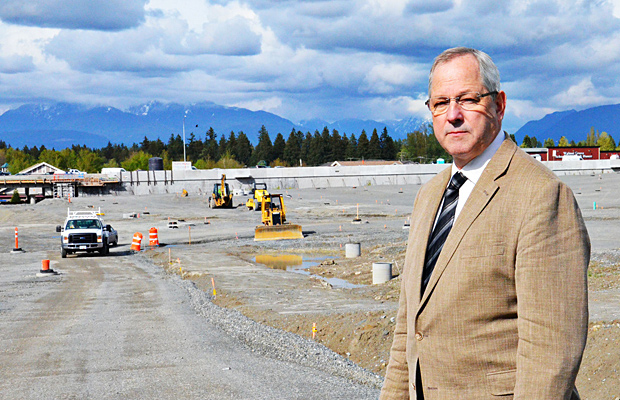
Langley’s mayors are expected to pull together to try and prevent the Carvolth Park and Ride from becoming a white elephant project.
Township Mayor Jack Froese said he will soon meet with City Mayor Peter Fassbender and both Langley MLAs about the scrapped plans to run RapidBus service from the facility.
“This is our only real link to TransLink,” Froese said this week at the site of the future park and ride, under construction on 86th Avenue east of 200th Street.
The park and ride was envisioned as a new transit hub that would serve both Willoughby and Walnut Grove, as well as providing a key transit service not seen in more than a generation. In 2008, the provincial government announced that Langley would get a RapidBus service, buses that would run from Langley down the widened TransCanada Highway and over the new Port Mann Bridge, connecting to SkyTrain service in Coquitlam. With new bus lanes and a special underpass to allow fast access to the highway, the province promised that the route would take less than half an hour.
The RapidBus service was in TransLink’s plans, but last month the mayors’ council voted not to increase property taxes to pay for that route, among other projects. The Langleys and White Rock voted in favour of the property tax increase, as much of the new service it was to pay for would have come to the under-serviced South of the Fraser region.
“This is vital to Langley,” Froese said. “This is not just a bus route that they’ve taken off.”
Fassbender described the RapidBus as “non-negotiable” and said that the program hasn’t been cancelled, merely put on hold.
Meetings with the minister for transportation and others will be held to talk about the problem, Fassbender said.
He and most other mayors were adamant that the province had a role to play in funding TransLink, but earlier this year the B.C. government ruled out virtually any source of new funding, from tolls to carbon tax transfers.
With the $54 million park and ride to be finished soon, along with an underpass that is being built to connect it to Walnut Grove, the project is too big to let go to waste, Fassbender said.
In addition to its transportation implications, the project was to be a growth generator and was intended to allow for a denser neighbourhood in northern Willoughby.
The Township has planned the area as “transit oriented development” Froese noted.
Without RapidBus and its connection to SkyTrain, a block of housing directly connected to the Park and Ride may not go forward as quickly, and it could even disuade developers from building nearby, Froese worried.
Along with Froese and the mayor of White Rock, Fassbender said there have been a lot of discussions with other mayors about getting the money from somewhere to pay for the project.
The Carvolth Park and Ride will open sometime next year, and is expected to be part of the region’s transit system even without the RapidBus money, according to TransLink spokesperson Drew Snider.
Six bus routes will serve the hub, including the 595 route that heads over the Golden Ears Bridge and connects with the West Coast Express train. The new underpass will allow buses to avoid congestion at the 200th Street highway interchange.
In addition, there will be the 388 to 22nd Street Station, the 595 to Haney Place, and the 501, 509 and 590, all travelling to Surrey Central. The C62 will serve Langley Centre and Fort Langley.
Connected Cities Ai?? Light Rail Transit or LRT
The Cardinal has posted details on the Connected Cities project before.
Connected Cities is a European Union [EU]Ai??investigation into the question of how we can provide unrestricted but sustainable transport and mobility to cities and regions in such a way that it will strengthen their territorial cohesion and improve the quality of life of its citizens.
http://connectedcities.eu/
The link is to the Connected Cities Project showcases index:
http://connectedcities.eu/showcases.html
Light Rail Transit, LRT & Tram-Trains feature highly
The following is an excerpt from theAi??showcase on Tram-Train in France, Germany & the Netherlands,
click on the link at the end of the passage
Tram-train | FranAi??ais
Regiotram | Deutsch
Light Rail | Nederlands
Tram and train used to be two entirely different public transport systems. Tram served shorter (read: urban) distances. Train served longer (read: regional) distances. But the difference between city and region has disappeared in much of Europe. The difference between tram and regional rail is blurring as well. A new generation of light rail transit vehicles can play the role of both tram and train. By doing so LRT offers an important breakthrough in the thinking on sustainable urban and regional mobility.
The Karlsruhe model

Karlsruhe’s Stadtbahn
The German city of Karlsruhe is where it all began. In the early nineties the municipal public transport authority or KVV managed to claim the right to use a number of regional rail lines, owned by the state. The use of these regional lines enabled the rapid expansion of the local light rail network. By that time such a move was unheard of. Transport theory told that tram and train systems were incompatible. Vehicles could not cross over from the one to the other network. It were the users of these systems that had to bridge the gap. But transferring between systems meant walking, waiting and too often loosing connections. The Karlsruhe model showed that technical differences and differences in management could be overcome. It also showed that combining the two networks in one operation leads to a significant increase of its use.
The regional tram
Some have interpreted the ‘Karlsruhe Model‘ mainly as a technical advance since the Karlsruhe Stadtbahn vehicles were adjusted to both low and high voltage systems as it combined both light and heavy rail. Some saw in the Karlsruhe example evidence that an above ground light-rail system could be a preferable alternative over an underground metro or S-Bahn. But its true significance is that Karlsruhe showed there is a regional future for the tram. The ‘Karlsruhe model’ showed that a tram can successfully operate over far greater distances than the 5-10 kilometre that most textbooks considered to be the maximum.
http://connectedcities.eu/showcases/lrt.html
The following URL links to an EU INTERREG report:
Light Rail & Metro Systems in Europe;
Current market, perspectives and researchAi??implications
http://connectedcities.eu/downloads/showcases/lrt_and_metro_in_eu.pdf
Ai??
Karlsruhe – More fuel on the fire
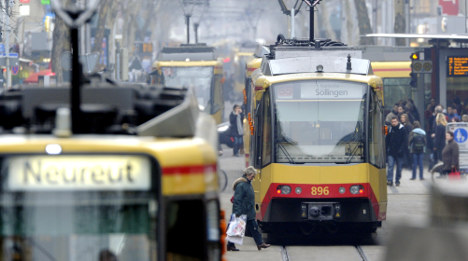
A few weeks back, Zwei created a firestorm of denial by the anti-tram crowd, when I reported that the main tram route in the city was being replaced by a subway; “because of the success of Karlsruhe’sAi??regional tramtrain service, the main tram route through the city was seeing 45 second headways“. All Zwei did was calculate the capacity offered by Karlsruhe’s trams and tramtrain and came up with a figure of over 40,000 persons per hour per direction, with 45 second (90 trips per hour) headways, using coupled stes.
Impossible screamed the SkyTrain crowd; Karlsruhe can’t operate couples sets of trams, claimed a planner from TransLink.
Yet, 45 second headways, with a mix of single cars and coupled sets could give peak hour capacities in Karlsruhe well in excess of 40,000 persons per hour per direction.
Well the following quote from the Light Rail Transit Associations Topic Sheet No 5 – A Question of Capacity tells a different story.
THE CAPACITIES of different modes of
transport are generally quoted as
0-10 000 passengers per hour for bus,
2000-20 000 for light rail, and 15 000
upwards for heavy rail.
It is city centres where several routes combine
that the most capacity is required. A typical
situation could be a pedestrian street with six
routes operating at 10-minute headway giving 36
double coupled trams per hour each with a
capacity of 225. This gives a nominal capacity of
16 200 passengers per hour which can be
increased to 25 200 pph in extremis without extra
vehicles. Light rail is unique in this ability to
operate on the surface with its capacity without
detracting from the amenities which it serves
Note Statistics are based on Karlsruhe, using GT8-l00c/2 cars.
A recent spike: Canadaai??i??s abandoned railway lines given second life by search for cheaper transport
An interesting article from the National Post. Of course, Rail for the Valley has been advocating for this for the past four years!
A recent spike: Canadaai??i??s abandoned railway lines given second life by search for cheaper transport
Tristin Hopper Apr 27, 2012
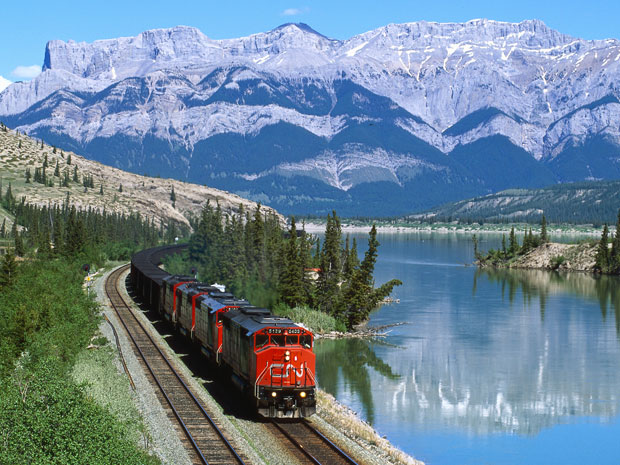
One hundred and 26 years after Sir John A. Macdonald drove its last spike, Vancouver Island is bringing the E&N Railway back from the dead.
Laid down as one of the final links in Macdonaldai??i??s transcontinental lifeline, the railway initially provided a critical link to the coal mines and logging operations of the mid-Island. By the 1990s, though, the antique track had been upstaged by new highways and was left carrying an occasional slow-moving propane car or a rusty single-car ai???daylinerai??? shuttling tourists over the mountains to Courtenay. Last year, VIA Rail even pulled the dayliner out of service, saying that ai???significant infrastructure improvement will be required before passenger rail service can resume.ai???
But now, led by the non-profit Island Corridor Foundation, which picked up the rail line for $1 in 2006, a campaign is underway to use the antique railway ai??i?? one of the oldest pieces of infrastructure in the region ai??i?? as a foundation of the islandai??i??s future growth.
E&N tracks pass through Langford, a community that was little more than forest when the railway was first built ai??i?? but is now one of the fastest-growing communities in Canada. By 2013, after the completion of a $15-million upgrade using federal and provincial funds, Langford residents will be able to make the trip to Victoria by commuter train. Soon, say planners, the tracks will be rumbling with trainloads of rock and gravel for the construction sector, loads of paper from island mills and even train cars of coal bound for Asian freighters.
ai???When youai??i??re looking at the growth of the [Victoria region], it only makes sense to look at this corridor, which you already own,ai??? said Graham Bruce, executive director of the foundation.
Canada is cloaked in abandoned rail. Trains settled the Prairies and united the coasts, but of late, almost every Canadian community is home to at least a few kilometers of abandoned or neglected rail line ai??i?? that is, if it has not already been ripped up to make way for cycling trails. But increasingly, as booming industries and cash-strapped governments cope with gridlocked highways and skyrocketing transport costs, many are discovering that the cure may be rusting away just over the back fence.
Before Eugene Hretzay came to Alaska, there were few who saw the White Pass and Yukon Route as anything more than a tourist attraction. Completed in 1900, the 177-kilometre railroad was hammered into hills that only months before had seen thousands of stampeders ai??i?? famed author Jack London among them ai??i?? dodging con men and enduring the elements in a desperate bid to reach the Klondike Gold Fields.
Until the Alaska Highway was pushed through B.C. during the Second World War, the railroad was a key link between ocean liners from San Francisco and the paddlewheelers of the Yukon River. After being completely decommissioned in the 1980s, a small portion of the railway now operates seasonally, using vintage cars to carry the thousands of passengers that flood into Skagway every summer.
But when Mr. Hretzay became the railwayai??i??s president two years ago, he quickly turned his attention to the ai???cornucopiaai??? of new mines opening in the Yukon ai??i?? and shipping their ore into the Skagway port by truck. With about $50-million in upgrades, he figured his railroad could do it cheaper.
ai???We estimate that the ton per kilometre is about 50% lower than that by truck,ai??? said Mr. Hretzay. With the backing of town officials, state representatives, unions and the resource sector, he figures it is only a matter of time before ore cars are once again rolling through White Pass. ai???Thereai??i??s a physical imperative; One hundred years ago, it was the shortest way to the Lower 48 and the Far East and it still is,ai??? said Mr. Hretzay.
Developments in the oil patch have already breathed life back into the aging railroads of Northern Alberta. In 1995, a newly privatized Canadian National Railway was only happy to sell off its Athabascan holdings. Less than nine years later, however, CN ai??i?? now the most efficient railroad in North America ai??i?? returned.
ai???They bought the whole shebang back,ai??? said Herb Dixon, president of the Alberta Pioneer Railway Association.
In one year, the railroad snapped up the Mackenzie Northern Railway, the Lakeland & Waterways Railway, Savage Alberta Railway, Inc., and the Athabasca Northern Railway ai??i?? and immediately sent in crews to outfit the old lines for fast, heavy freight trains, at a cost of $400-million.
ai???Theyai??i??re increasing the number of cars to Fort McMurray, theyai??i??re even talking about a pipeline by rail,ai??? said Mr. Dixon.
Of course, by CN terms, the northern Alberta railways were still ai???very small transactions,ai??? according to spokesman Mark Hallman. Following up on a 10-year, $8-billion buying spree, CN is similarly sprucing up hundreds of kilometres of track throughout Quebec, British Columbia and Illinois.
In Prince Rupert, B.C., the CN-funded track may be new, but developers are still working from a very old blueprint, first drawn up by a man who died 100 years ago on the Titanic.
In 1910, rail baron Charles Hays, president of the Grand Trunk Railroad, had pegged the tiny B.C. community as his Western terminus. It was 800 kilometers closer to Asia than any other Canadian or American port and Hays aimed to make it into a city that, in the words of Prime Minister Wilfred Laurier, would be ai???one of the great cities of North America.ai???
When Hays froze to death in the North Atlantic on April 15, 1912, soon after sending off his wife, daughter and maid in a lifeboat, his vision for Prince Rupert died with him. A century later, the city has just finished a $170-million upgrade to its port facilities, complete with $25 million of new CN infrastructure. Four hundred ships a year pull into Prince Rupert, knowing that a container dropped off in the remote island city can be shuttled to Chicago 1.5 days faster than cargo unloaded in Vancouver or San Francisco.
ai???We are entering a very exciting period of time and itai??i??s all thanks to the foresight of an individual named Charles Hays,ai??? port boss Don Krusel told Postmedia last week.
From the 1950s onward, railroaders had to watch as governments spent millions on paved, well-maintained roadways ai??i?? clearing the way for trucks and passengers to surge into the marketplace.
Austere government, coupled with high fuel prices, are the windfall they have been waiting for. ai???The times are not so bullish anymore,ai??? said Bruce Burroughs, a vice president with the Railway Association of Canada. ai???Governments are not so flush with money that they can afford to slap down asphalt and suck traffic off the rail system.ai???
It is why, when Mr. Burroughs meets with provincial or municipal representatives, he usually encourages them to ai???bankai??? their rusting rail lines for future use.
In Ottawa, officials have mulled using an abandoned rail bridge across the Ottawa River to open a commuter rail line to Gatineau, Quebec. In Peterborough, Ont., local MP Dean Del Mastro has been pushing to retrofit existing CP Rail freight lines to carry high-speed commuter trains into Toronto. One hundred years ago, when Vancouver was a logging port with barely 100,000 people, a Vancouverite could step aboard an electric tram near the cityai??i??s downtown and get off 90 minutes later in Chilliwack, a farming community nearly 100 kilometres from the coast. With the 1950s completion of Highway 1, however, the rail lineai??i??s fate was sealed.
ai???Letai??i??s face it; who would want to sit on a rickety old train for an hour and a half when you could do it in less than an hour in your car ai??i?? when cars were cheap and fuel was inexpensive?ai??? said John Vissers with Rail for the Valley, a group looking to resurrect the old commuter line.
Sixty years ai??i?? and several million new residents later ai??i?? getting to Vancouver in rush hour traffic can take upwards of 90 minutes, all fuelled by some of the most expensive gasoline in Canada.
For Mr. Vissers and others, the conditions are perfect for bringing back a service most Vancouverites never even knew existed.
ai???We could have this entire system up and running, serving a quarter million people, for approximately the same cost as two kilometres of SkyTrain,ai??? said Mr. Vissers. ai???Weai??i??ve got a little train that could.ai???
National Post
thopper@nationalpost.com
Canucks Don’t Do Light Rapid Transit
Certainly, Canada doesn’t do urban, interurban & regional rail based LRT,
It used to be that the US was the most intransigent, obdurate & reactionary nation in the western world as far as transit, but the past ten years have seen a massive expansion of Light Rail, LRT, Tramways & Streetcar systems in America
From the Light Rail Transit Association – LRTA http://www.lrta.org/index.html
and the USAi??Light Rail Now http://www.lightrailnow.org/index.htm
Boston (legacy surface electric railway upgraded to modern LRT)
Buffalo (modern semi-metro LRT)
Charlotte (modern interurban LRT, heritage streetcar)
Cleveland (legacy surface electric railway upgraded to modern LRT)
Dallas (modern interurban LRT, heritage streetcar)
Denver (rapid interurban LRT)
Houston (rapid LRT)
Hudson-Bergen (rapid interurban LRT)
Kenosha (heritage streetcar)
Little Rock (heritage streetcar)
Los Angeles (rapid interurban LRT)
Memphis (currently heritage streetcar; modern LRT planned)
Minneapolis (interurban LRT in operation, streetcar proposed)
Newark (legacy surface electric railway upgraded to rapid LRT)
New Orleans (heritage streetcar)
Philadelphia (legacy surface electric railway upgraded to modern LRT, heritage streetcar)
Phoenix (rapid LRT)
Pittsburgh (legacy surface electric railway upgraded to rapid LRT)
Portland (rapid interurban LRT)
Sacramento (rapid interurban LRT in operation, heritage streetcar proposed)
St. Louis (rapid interurban LRT in operation, heritage streetcar proposed)
Salt Lake City (rapid interurban LRT in operation, heritage streetcar proposed)
San Diego (rapid interurban LRT in operation, heritage streetcar proposed)
San Francisco (legacy surface electric railway upgraded to rapid LRT, heritage streetcar)
San Jose (modern interurban LRT, heritage streetcar)
San Pedro (heritage streetcar)
Seattle (modern streetcar, modern semi-metro LRT)
Tacoma (modern LRT streetcar)
Tampa (currently heritage streetcar; modern LRT planned)
5#
Austin (diesel mutliple-unit light railway)
Camden-Trenton (diesel mutliple-unit light railway)
Galveston (fuel-motor-powered heritage streetcar)
Oceanside-Escondido (diesel mutliple-unit light railway)
Savannah (heritage streetcar powered by fuel motor and supercapacitors)
23#
Albuquerque
Atlanta
Baltimore
Boston
Camden
Chicago
Cleveland
Dallas
Ft. Lauderdale
Ft. Worth
Los Angeles
Miami
Minneapolis
Newark
New York City
Oakland
Philadelphia
San Diego
San Francisco/Bay Area
San Jose
Seattle
Trenton
Washington
Heritage Trolley Systems
Colorado Springs
Ft. Collins
Ft. Smith
Seattle
Tucson
US – 74NoAi??New Rail Transit Systems Proposed, Planned, or in Development
Edmonton, Calgary, Toronto, Waterloo; not counting Vancouver cos’ Skytrain is not LRT
Could do a lot, lot better Canada but probably will not because its not politicallyAi?? expedient.
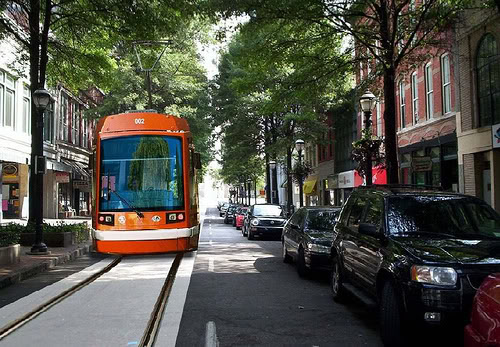
TramTrain – A lesson in Urban, Interurban and regional transportation implementation
Quality integrated public transportation planning & implementation is an eminence which is in short supply in Vancouver, the Fraser Valley And BC as a whole, due in part to the narrow vision of Translink & the BC government.
Translink & their advocates, exhibit a worrying arrogance;
-
Vancouver-centric planning
-
Blind determination to continue the expansion of Skytrain, further into Metro Vancouver and Surrey
-
Discriminatory treatment of the lower Fraser Valleyai??i??s residents, with a promise of merely an updated bus service.
Vancouver & Translink refuses to see or listen to contemporary developments in Europe & the US, so it seems relevant to promote the concept of European Tram Train operations on this Blog.
Regrettably Vancouver & specifically Translink planners, would appear not to recognise what constitute economic transport planning even if it bit them on the arse and continue to parrot the mantra:
Density and Speed
as if thatai??i??s all that matters:
From the mid-nineties there has been a real boom period regarding TramTrain feasibility studies. Many cities and regions with a regional railway network, with or without an urban tramway and of similar size as Karlsruhe have been asking if the concept is transferable to their situation. Most of these projects have not proceeded or at least been heavily delayed and not given high priority.
The reasons differ, but we question whether asking the right basic questions early enough would have avoided big studies which went straight into the archives.
Despite the flexible and context sensitive nature of TramTrain our aim is to identify at least some generic TramTrain characteristics, since we feel that a clear view of these will enable promoters to recognise a new set of (potential) applications or to revise earlier schemes which may have been reviewed before under narrower conditions.
While in the early days of TramTrain one spoke of the “Karlsruhe model”, “track sharing” or “joint running” it is necessary today to distinct between different groups.
-
Classic light-rail/tramway operation
-
Conversion
-
Single-Mode Track-sharing
-
TramTrain-operation
-
Dual-Mode Electric/Electric
-
Dual-Mode Diesel/Electric
-
TrainTram-operation
-
Existing tramway network
-
No existing tramway network
Conversion projects are schemes, which make use of former railway infrastructure converted for light rail for a considerable part of the network. There is no mix between tramway and railway operation. Infrastructure is taken over usually, so no track access charges apply.
Single mode (electrification 600/750V) track sharing schemes also involve the use of railway infrastructure, but in track-sharing mode with freight trains or other non-electric trains (thus the railway is still used by other railway traffic). This is how Karlsruhe started with the Albtalbahn. In most cases infrastructure is also owned by the light rail operator and track access charges do not apply.
TramTrain-operation involves both track-sharing light rail/heavy rail and dual- or multi-mode operation (Heavy rail voltage / Light rail voltage). The track-sharing sections may also include main line heavy rail infrastructure. Usually infrastructure (tracks and stations) is owned by the railway infrastructure owners (DB Netz, RFF, Prorail, Network Rail etc.) and track access and station use charges apply for the light rail operator.
TrainTram-operation is reversing the tram-train idea; direct access from the region to city centres is not achieved by bringing the tramway out onto the railway, but by bringing heavy rail vehicles onto the urban tramway or onto a tramway-like alignment. The heavy rail vehicles being used under urban conditions follow tramway regulations. Usually TrainTram will not involve a through-running of railway vehicles from one end of a city to the other, but access the city centre from one side only.
Ai??Karlsruhe:
The name “Karlsruhe” all around the world is used as a synonym for success. However, the scheme demonstrates a number of features which are difficult to sell elsewhere!
The Karlsruhe compromise of running high- and medium floor light rail vehicles through an urban “low-floor” network has to be seen as a killer argument for TramTrain in France and likely in all other countries, where the full accessibility of public transport is an absolute requirement. Therefore level access for TramTrain in all sections of a planned network is of high importance.
Karlsruhe is certainly a good example of a railway (main) station at a distance to the city centre where through-running TramTrains result in a considerable gain in attractiveness. With a regional scheme however, involving several TramTrain-lines operating through the city centre, often in coupled units and with relatively heavy rolling stock, Karlsruhe is virtually witnessing the “return of the railway station” into the city centre after having moved it before WWI to the southern edge. At the moment it is planned to solve this new problem by an underground section of the network which would also mean taking out the “normal” surface trams from the pedestrian zone.
Nevertheless Karlsruhe’s passenger number increases have proven the usefulness of through running in the case of medium-sized cities owning a remote railway (main) station or the benefits of a centrally located railway station.
Ai??http://connectedcities.eu/downloads/conferences/paris_tram_train_karlsruhe.pdf
Ai??Kassel:
http://www.railway-technology.com/projects/kasseltramtrains/
Ai??Ile-de-France:
Ai??http://en.wikipedia.org/wiki/%C3%8Ele-de-France_tramway_Line_4
Ai??Mulhouse:
http://www.railway-technology.com/projects/mullhouse/
Ai??RandstadRail:
http://www.railway-technology.com/projects/randstadrail/
and
http://connectedcities.eu/showcases/randstadrail.html
Ai??TramTrain projects are complicated and therefore they need a strong and high quality regulation. Almost all of these projects cover regional corridors, so some regional government or body, or at least a sustainable form of regional co-operation and tough political support is an absolute necessity for success.
-
Powerful regional and local government
-
Existing regional and local support
-
Planning processes associated with creating transport infrastructure are complicated without exception, for TramTrain even more. For this reason success is almost synonymous with a streamlined planning process. Moreover, justification of many TramTrain proposals is strongly interconnected with considerations of urban planning and land use. Therefore integration of urban planning generally and land-use particularly is highly recommendable.
-
Approach to planning process
-
Degree of integration of land use and urban planning
-
Step by step implementation
-
Complementary to existing/adapted public transport network
-
Quality and capability of public transport authority, both formally and functionally, to integrate responsibility for the entire network
-
Distribution of responsibilities
-
Generally construction and operation of public transport infrastructure are financed from various sources. The money needed to build and operate TramTrain infrastructure should be balanced as much as possible on the local and regional level, as this type of public transport is important locally and regionally. In this respect local and regional funding sources are of great importance and state government contributions should not be decisive
-
Methods to cover construction and operating costs Local/regional financial balance and sources
-
TramTrain utilisation presupposes the use of heavy rail infrastructure. The responsibilities for railways are usually under national authority as legal powers are. In many countries the National Railways are very powerful. Therefore success of a TramTrain project is highly dependent on the degree in which national legal and functional competences are used efficiently for local and regional purposes or delegated to local/regional agencies. TramTrain projects become more transparent and easy-going when heavy railway infrastructure is used which is under the control or even better owned by the local/regional authority. Another option is a private control and ownership of the railway. Germany for instance has an ongoing private railway tradition.
-
Ai??TRAMTRAIN: THE 2ND GENERATION Ai??Ai??NEW CRITERIA FOR THE ‘IDEAL TRAMTRAIN CITY’
http://www.lightrail.nl/TramTrain/tramtrain.htm#Summary
http://www.youtube.com/watch?v=y_75ulzq5YU&feature=autoplay&list=PL7CA6D96931798C88&playnext=2

Myth: Viable public transport requires high population densities
Common Urban Myths About Transport
This is probably the most widely believed myth about public transport, and therefore the most dangerous. It’s an old story that, like current transport policy, originates in the first major American freeway study:
The conditions of land use and density….are the major determinants of the travel market. If demand is constrained by these factors, it is unlikely that changes in supply will have any great impact on the number of users.
—Chicago Area Transportation Study 1956Public Transport Users Association
http://www.ptua.org.au/myths/density.shtml
There was no alternative to freeways in Chicago, the road planners said, because the city was too spread out and low-density. The road lobby and its supporters have been using the ‘spread-out city’ as an excuse for freeway building ever since. The story has been repeated so often in Melbourne that many urban planners, commentators, and even some environmentalists believe it.
In the 2000s the density myth became the centrepiece of the Bracks/Brumby Government’s Melbourne 2030 planning strategy. Apparently, in order to encourage public transport, vast tracts of inner Melbourne would have to be rebuilt at higher densities. As The Age put it:
The deal implicit in urban consolidation is that people forgo private space, backyards and cars for a more compact lifestyle…. [instead] Melburnians are opting for ever bigger, more energy-consuming homes. They need to spare a thought for the environment in which their children will be brought up…. The compact city vision is also under pressure from knee-jerk resident groups and councils in established suburbs…. Unreasonable opposition to higher-density housing in existing streets only adds to the pressure for car-dependent fringe estates.
—The Age (editorial), 5 January 2007The implication was that we must give open slather to developers to build high-rise towers throughout the inner suburbs because, we were told, this is the only way to achieve higher rates of public transport use. The problem, of course (apart from the fact that public transport use doubled of its own accord between 2005 and 2010), is that although many Melburnians are open to the idea of forgoing at least some car use, the idea of forgoing private space and backyards is much less popular.
Pretexts and Fabrications
Many of the contemporary supporters of higher densities are perfectly well-meaning, and speak from genuine concern with the sustainability of Melbourne’s urban form. But not everyone’s motives are so benign. It’s always been the case that many Australian transport planners and economists, and their allies in the media, want to convince us that Melbourne is the most decentralised, low-density city in the world because they have an implacable ideological hostility to public transport (especially rail) and a love affair with roads (especially motorways). No-one sums up this attitude better than the neo-liberal Institute of Public Affairs, who to their credit have held to this position consistently for three decades:
In spite of public transport benefiting from massive subsidies, the coverage of its ability to carry people to their destinations quickly is highly restricted…. It can only operate effectively in urban conditions and only really effectively in urban areas with high densities and concentrated origin and destination points. A rule of thumb is that, to be commercially viable, rail-based systems require [400 people per hectare] and express bus systems [250]. Melbourne has an average density of [15]….
For the main part….cities should adapt to the car and the truck. Road systems are far and away more important than fixed track systems, and buses can make good use of them…. It is therefore vital that the road system be upgraded to keep pace with the demand for car transportation.
—Alan Moran, “The Public Transport Myth”, Institute of Public Affairs, October 2006Density, shmensity: it’s all about service
Despite not sharing in Melbourne’s extensive rail infrastructure and supportive urban form, even low-density North American cities have, or are planning, viable alternatives to the car. In Toronto, for example, where the average citizen makes more than twice as many public transport trips as in Melbourne, the official transport plan has long aimed to
enhance the attractiveness of travel by transit in the Greater Toronto Area for a variety of trip purposes including, but not limited to, journey to work, and decrease reliance on the private automobile.
—Transit 2020, Toronto, 1993Vancouver, where public transport use per capita is 37% higher than in Melbourne, is on target to triple patronage by 2021 from its 1991 level. As in Toronto, this is being done by providing fast, frequent, integrated, safe and cheap public transport.
Both Toronto and Vancouver are spread-out cities, but are not using that fact as an excuse for car-dominated transport policies.
Melbourne Toronto Vancouver Population density in 1991 (per hectare) 16.8 24.1 14.0 Share of total jobs in Central area 25% 23% 21% Share of office space in Central area 78% 47% 63% Share of retail sales in Central area 11% 10% n/a Annual public transport trips (per capita) 94 240 129 Low-density Vancouver also gives the lie to the assertion that public transport in spread-out cities comes only at high cost. Its entire budget for roads and public transport corresponds to just $180 per resident, compared with $430 per resident in Melbourne.
Unfortunately, many transport planners have completely failed to make the link between quality of service and patronage. The connection is obvious to anyone who checks the statistics, and holds true in low-density cities as much as in high-density cities. As a result, low patronage on public transport is too frequently excused as being residents’ fault for wanting big backyards, rather than a fairly obvious result of lousy service provision. So when Portland (a US city with modest public transport use, though fairly good by US standards) was forced to cut some low-patronage services in the 2008-09 recession, one prominent transport planner wrote:
Four routes are to be eliminated completely, and three of these (27, 154, and 157) are outer-suburban feeders…. All serve relatively low density areas but not especially affluent ones, a reminder that density determines ridership much more than wealth does. There’s not much of an alternative for residents of the areas served…. but if good transit service were really important to you, you wouldn’t live there.
—Gareth Jarrett, Human Transit, 11 February 2010As Jarrett well knows, residents of these Portland suburbs do have an alternative – private cars. And their decision to use them in preference to the cited bus routes was, it turns out, entirely rational. Of the three routes he named, two were ‘commuter’ routes that ran five trips a day on weekdays, while the third operated once an hour with the last bus at about 6:30pm. None of them ran on weekends. In short, they were equivalent to some of the worst Melbourne suburban bus routes. Blaming density merely serves to excuse poor design and false economies, and lets the planners off the hook when poor service fails.
If density were the key to use of sustainable transport, then of course you wouldn’t live in Portland at all – you’d live in high-density New York, which rates highest in the US for public transport use. But you might just as well consider living in Los Angeles, Miami or Las Vegas: all cities with much higher urban density than Portland. Los Angeles even has a higher density than New York when entire urban areas are compared – a fact not widely known or believed until very recently. The problem is these cities, all ‘high density’ as they are, all have lower mode shares for public transport than even Portland does!
The table below gives the overall urban density and the public transport mode share for journeys to work in a selection of US and Australian cities. There is some relationship evident between density and public transport use, but it is weak and unconvincing, to say the least. Some other factor must be at work to explain why Brisbane, for example, has three times the rate of public transport use as LA despite being just one-third the density. That factor is good-quality service, which is present in Brisbane (at least in peak hour) but virtually absent in LA. Although we haven’t included Canadian cities, they do even better: Ottawa with 17.2 people per urban hectare has almost the same density as Miami, but differs from Miami in having one of the highest-quality bus systems in the world. Its 21.2% of journeys to work by public transport exceeds that in Miami more than fivefold!
City Overall
density (/ha)Travel to work by
public transport (%)Los Angeles 27.3 4.7 New York 20.5 24.8 Las Vegas 17.7 4.1 Miami 17.0 3.9 Denver 15.4 4.4 Chicago 15.1 11.5 Sacramento 14.6 2.7 Phoenix 14.0 1.9 San Diego 13.2 3.4 Washington DC 13.1 9.4 Portland 12.9 6.0 Boston 8.9 9.0 Sydney 20.4 21.2 Melbourne 15.7 13.9 Adelaide 13.8 9.9 Perth 12.1 10.4 Canberra 10.6 7.9 Hobart 10.3 6.4 Brisbane 9.2 13.8 Source: Extracted from Mees, Transport For Suburbia (2010), Table 4.1
This does not mean, of course, that sensitively applied encouragement of medium density housing is not worthwhile. Vancouver certainly introduced more ‘medium density’ housing under its Liveable Region strategy – but by this they meant the one-sixth-acre blocks that have been traditional in Melbourne for over a century. (What our developers have called ‘medium density’ would be recognised as ‘high density’ overseas.)
So carefully targeted land-use measures will help, albeit marginally. But the real challenge lies elsewhere.

Some Facts To Counter The Myths About Higher Density
 Ai??Reconnecting America
http://reconnectingamerica.org/
A 2005 report “Some Facts To Counter The Myths About Higher Density,” authored by theAi??Urban Land Institute along with the National Multi Housing Council, Sierra Club and the American Institute of Architects, has been added to the Resource Center best practices database.
The authors of the report explain: “The purpose of this publication is to dispel the many myths surrounding higher-density development and to create a new understanding of density that goes beyond simplistic negative connotations that overestimate its impact and underAi??estimate its value.”
The report takes on these myths:
-
Higher-density development overburdens public schools and other public services and requires more infrastructure support systems.
-
Higher-density developments lower property values in surrounding areas.
-
Higher-density development creates more regional traffic congestion and parking problems than low-density development.
-
Higher-density development leads to higher crime rates.
-
Higher-density development is environmentally more destructive than lower-density development.
-
Higher-density development is unattractive and does not fit in a low-density community.
-
No one in suburban areas wants higher-density development.
-
Higher-density housing is only for lower-income households
Ai??
Transit corridor will be easily reached by walkers and cyclists, planner says
Not for the first time, the Cardinal has had to question the decisions ofAi?? provincial transit planners; BC & now Ontario.
In the Record.com http://www.therecord.com/
David Fields, a transit-planningAi?? consultant with Nelson\Nygaard Consulting Associates, told a daylong workshop in Kitchener Tuesday the experience with other light rail lines clearly demonstrates that people are willing to walk for five or 10 minutes, or ride a bicycle for four or five kilometres, to get to a station. I’m sorry Mr Fields but your going to have to do better than that, experience shows that especially in North America the public will baulk at walking more than two blocks to a transit stop and will grab their car keys.
It is imperative that a newAi??train, Tram/LRT, bus or BRT transit
is designed to serve all key trip generators and residential centres reducing walking & cycling durations and times to as little as possible.
http://www.therecord.com/news/local/article/711621–transit-corridor-will-be-easily-reached-by-walkers-and-cyclists-planner-says

WATERLOO REGION ai??i?? The $818-million rapid transit system that will run along the urban spine of three local cities can be quickly accessed by the overwhelming majority of people in the region by walking or cycling, says a New York City transit planner.
David Fields, a transit-planning consultant with Nelson\Nygaard Consulting Associates, told a daylong workshop in Kitchener Tuesday the experience with other light rail lines clearly demonstrates that people are willing to walk for five or 10 minutes, or ride a bicycle for four or five kilometres, to get to a station.
ai???We can just about get everybody to the corridor if we think in those terms,ai??? Fields said.
Fieldsai??i?? firm has helped prepare strategies for community building around major investments of public transit in Portland, Seattle, San Francisco and New York City. Nelson\Nygaard is among a trio of consulting firms the region has hired to develop a strategy for the local light rail project.
Fields and other transit planners find residentsai??i?? willingness to walk and bike exciting because it means the central transit corridor is not just for people living just a few blocks away. With better infrastructure for pedestrians and cyclists, the majority of people living in Waterloo, Kitchener and Cambridge will be able to access the stations.
ai???The best cities are the ones where people donai??i??t think about their transportation,ai??? Fields said.
Sidewalks need to be installed in some areas leading to and from stations. The streets must be well lit at night, pleasing to look at and take the most direct route, Fields said.
On-road bike lanes, off-road bike trails, secure storage areas, air pumps, water fountains and smooth ramps beside stairs for rolling bikes up are good ideas too, Fields said.
The bus system needs to change from doing loops through suburban areas, to a grid system that includes several high-frequency corridors that cross the rail corridor.
Other connections are needed as well, the workshop heard. Daisy Arseneault is a strong supporter of light rail transit but she wants to see connections between the Walter Bean Grand River Trail and the central transit corridor before trains start rolling in 2017.
ai???A big criticism of the LRT coming in is that it does not connect us to these beautiful trails,ai??? Arseneault said at Tuesdayai??i??s workshop on how the new transit system can improve mobility in the region.
For the planners and transit supporters at the workshop, mobility is all about freely using several ways of getting around ai??i?? walking, cycling, riding transit or driving a car.
Arseneault, a Waterloo mother of three young children, would like the light rail line connected to the riverside trails by buses, bike lanes, bike trails or pedestrian walkways.
She was among the more than 25 participants, including planners, cyclists, transit supporters and residents who talked about what needs to be done to help people walk, cycle, ride buses or drive to one of the 23 stations that will dot the 36-kilometre long corridor.
Arseneault also noted RIM Park, the biggest recreation complex in the region, is isolated from the transit corridor.
The workshops continue Wednesday with invited stakeholders, but on Thursday members of the public can drop into the storefront office set up at 220 King St. W. in front of Kitchener City Hall from 3 to 7 p.m. to share ideas.
There are six stations that will need special attention, because multiple modes of travel converge there, including Conestoga Mall, Fairview Park mall, Sportsworld and the central station at King and Victoria streets.
By 2017 the region plans to have light trains running from Conestoga Mall to Fairview Park mall. Rapid buses will run from Fairview Park mall into Cambridge. The system will cost an estimated $818 million, and the mobility workshops are part of planning how to use that investment to strengthen the communities along the central transit corridor.
Melanie Hare, an urban planner leading the development of the community building strategy, said there are some important questions all residents can think about ai??i?? and then share their answers ai??i?? by going online to the centraltransitcorridor.ca in the coming months.
Those questions include: What destinations are important to you? How do you get there now? Is there traffic congestion, disconnected trails or no bus service? What are the key routes? What are the opportunities?
ai???We want to enhance downtown Hespeler, the Cambridge Business Park and Conestoga College with mobility options connected to light rail transit,ai??? Hare said. ai???This is really about how do we make communities healthy, walkable.ai???
Some of the biggest challenges are at key points long the corridor ai??i?? Conestoga Mall, Fairview Park mall, Sportsworld and the power centre on Hespeler Road.
The owners must be persuaded to put in place infrastructure to support cyclists and pedestrians getting to and from the stations, said Alain Pinnard, head of planning at the City of Kitchener.
Jason Schreiber, a transit consultant with Nelson\Nygaard, said those properties will see tremendous increases in value as a result of the transit plan and that should be incentive enough for them to make improvements. If not, the region may have to consider other incentives or land swaps, Schreiber said.
The business parks that will be serviced by the transit corridor currently have little or no infrastructure for pedestrians and cyclists. That will have to change if workers are expected to ride the light trains and buses to the Sportsworld station, and then walk or cycle into the Cambridge Business Park.



Recent Comments