4 light rail lines expected to be running by 2020
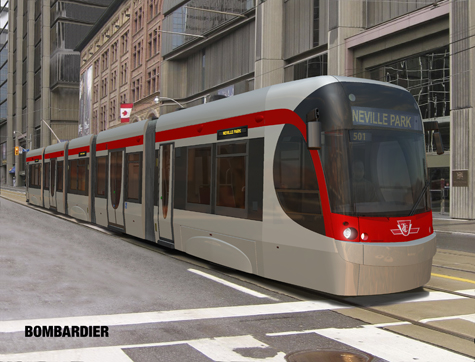 Metrolinx favours provincial body taking control of projects
posted: Apr 24, 2012 1:23 PM ET
http://www.cbc.ca/news/canada/toronto/story/2012/04/24/toronto-light-rail659.html
Four new light-rail lines could be up and running in Toronto by 2020, as a modified version of the Transit City plan that Mayor Rob Ford has vigourously campaigned against comes to fruition.
The provincial agency, Metrolinx, revealed the details in a report released Tuesday. The Metrolinx board will vote on the report’s recommendations Wednesday.
The agency has outlined a number of target dates for construction and completion of the four lines:
- Construction on the the Sheppard East LRT line, which will run from Don Mills subway station to east of Morningside Avenue, is slated to begin in 2014. That was when it was supposed to be completed under the old Transit City plan championed by Ford’s predecessor, David Miller. The line is expected to be in service by 2018.
- Construction on the Finch West LRT line, which will run from the still-to-be-completed Toronto-York-Spadina subway extension to Humber College, will commence in 2015. The line is expected to be up and running by 2019.
- Construction on the Scarborough RT line replacement is to begin in 2014, with the line in service by 2019.
- Construction on the Eglinton Crosstown LRT line, which will run from Keele Street to Kennedy Road on Eglinton Avenue, has already commenced. The line will be in service by 2020. HOV lanes will be removed to accomodate the line.
Coun. Joe Mihevc, a staunch supporter of Transit City, said the Metrolinx plan “great news.”
Provincial body Infrastructure Ontario, and not the Toronto Transit Commission, would be responsible for delivery of the project, Metrolinx has recommended.
Infrastructure Ontario will also try and secure federal money from a public-private partnership fund to build the projects. The bill for construction of all the light rail lines is expected to total $8.4 billion.
Political uncertainty looms
None of the construction ai??i?? with the exception of the Eglinton Crosstown line and a storage facility for light-rail vehicles ai??i??will begin before 2014, when the next municipal election is scheduled. And the minority Liberal government, which survived a confidence vote earlier Tuesday, could fall before construction on any of the new lines.
Ford has repeatedly argued against the construction of the lines, saying that Torontonians want subways, not light rail. But he lost a number of key transit votes in council after refusing to budge on his commitment to bury the Eglinton line. Under the current plan, only the central portion of the line will be underground.
Led by TTC Chair Karen Stintz, a majority of councillors rejected Ford’s call for a buried Eglinton line and a Sheppard subway extension and coalesced around the plan that Metrolinx is now moving ahead with.
Stintz says Metrolinx is moving in the right direction.
ai???Yeah, I think the timelines are aggressive and Iai??i??m pleased that Metrolinx is moving as quickly as it is to bring this transit to areas of the city that most need it,ai??? Stintz said.
Under Ford’s plan, the entire Eglinton line would be buried. He struck a deal with the Ontario government that would have sent $8.4 billion in provincial funds to bury the line. Any leftover funds would have been allocated to a proposed eastward subway extension on Sheppard Avenue East.
However, that agreement was contingent on securing council support. Ford was not able to woo his opponents on council, with many of them criticizing Ford for not having a plan to fully fund the Sheppard subway extension.
Eric Chris on Bi-Articulated Buses For The 99-B
A bi-articulated bus or double-articulated bus is a higher-capacity type of articulated bus. It is an extension of a conventional or single-articulated bus, in that it has three passenger compartment sections instead of two. This also involves the addition of an extra axle and a second articulation joint. Due to the extended length, bi-articulated buses tend to be used on high-frequency core routes or bus rapid transit schemes rather than conventional bus routes.
One of their main advantages is that they reduce the number of drivers needed to run a service for a specific number of people ai??i?? i.e., it is usually much more cost-efficient to run a bi-articulated bus with one driver, than, for example, to run two smaller rigid buses providing the same total number of seats.
Disadvantages include difficulties in traffic, the need to have bus stops catering to the extended length, and the fact that two buses with the same capacity can be used more flexibly, such as having one bus arrive every five minutes, instead of one of the larger articulated buses every ten minutes (as an example providing the same service capacity, but different frequencies).
An electric bi-articulated trolleybus in Zurich, Switzerland. Please note tram tracks, as the city also operates trams.
A very interesting letter from Eric Chris about a proposal to use bi-articulated buses on the 99-B to increase capacity on the route.
Bi-articulated buses are mainly designed for guided-bus lines or for routes with busways and if bi-articulated buses are to be used on Broadway, then some very expensive work must take place before their operation. Bus stops must be lengthened and roads must be rebuilt and strengthened to accommodate the heavier and award bi-articulated buses.
The ride of bi-articulated buses are not as smooth as regular buses and this may lead to ridership drift, where transit riders will change from the Broadway/99 route to other bus routes that do not operate bi-articulated buses.
The real answer to Broadways transit problems is the reinstatement of the streetcar, only upgraded to light rail practice with at least 40% of its route operating on a “reserved rights-of-ways” or R-o-W’s reserved for the exclusive use of the tram. Reinstating a Broadway streetcar/LRT could be as cheap as $10 million a km for pre-fab track (the supports and span-wires are already in place); $30 million to $50 million for shops and a car barn; and $4 million to $5 million per car, depending on the size of the vehicle.
A Vancouver/UBC/BCIT streetcar/LRT network could be had for under $600 million and would offer a viable transit solution for the next 40 to 50 years at an operating cost much less than buses. Less than 20 modern trams could do the work of all the buses being used on Broadway. Of course light rail or streetcar is not in the lexicon of TransLink or the City of Vancouver (COV), who rather use fancy bi-articulated buse upgradesAi??or subways, especially if taxpayers South of the Fraser are paying the tab.
The letter………
Councillors George Affleck and Geoff Meggs,
Are we able to discuss the proposed bi-articulated buses (25 metre long) over the telephone or perhaps in person in Point Grey near Tolmie Street on the 99 B-Line route?Ai?? I read the article in The Vancouver Courier about the proposal by the COV to increase capacity on the 99 B-Line route.Ai?? It is a fantastic idea provided that the 25 metre articulated buses are ai???electricai??? bi-articulated trolley buses (see attached picture) or possibly streetcars to replace the diesel and hybrid-diesel buses operating on the 99 B-Line route:
http://www.vancourier.com/City+hall+longs+longer+buses+Vancouver/6481007/story.html
http://www.tbus.org.uk/health.htm
Many residents in Point Grey (four out of five) favour the removal of the 99 B-Line diesel buses operating on the #9 trolley bus route (2007 WPG Community Visions Choices Survey).Ai?? In Vancouver, the 99 B-Line service impairs the health of individuals due to the high concentration of particulate matter emitted by the 99 B-Line diesel buses and is an an extreme nuisance to residents due to the incredible noise levels and vibrations produced by the 99 B-Line diesel buses.
For the COV to establish a transit division and to operate 25 metre articulated trolley buses, the capital cost would be expected to be $112 million for 55 bi-articulated trolley buses with five of the bi-articulated trolley buses as spare to allow for break downs and maintenance ($100 million for the 55 bi-articulated trolley buses, $10 million for 10 kilometres of dedicated trolley lines from downtown Vancouver to UBC and $2 million for the rectifier sub-station).Ai?? Operating and maintenance costs would be expected to be approximately $17.9 million annually ($0.5 million for power, $4.3 million for maintenance and $13.1 million for drivers).Ai?? Storage and maintenance of the 25 metre articulated trolley buses could be done at existing COV facilities with minor upgrades costing little.
Daily, it would only require 12,300 riders making two trips and paying a convenient toonie or $2 per trip for the COV transit division to recoup the ai???entireai??? operating and maintenance costs for the fleet of 25 metre articulated trolley buses traveling from downtown Vancouver to Point Grey and Kitsilano.Ai?? The $2 COV transit fare is much less than the pending $2.75 single zone fare by TransLink and would appeal to budget conscious riders who are looking for affordable transit to downtown Vancouver.Ai?? Financing the COV transit would not even require charging students traveling to UBC.Ai?? Students would only pay what TransLink already charges and would ride the 25 metre articulated trolley buses operated by COV transit for free.
How would the COV afford $112 million for the fleet of 25 metre articulated trolley buses?Ai?? Easily, taxpayers provide TransLink $690 million annually to move about 300,000 transit users, and COV transit would rightfully be entitled to $28 million annually from taxpayers for absorbing 4% or 12,300 of TransLinkai??i??s riders who would travel independently on COV transit from Point Grey and Kitsilano to downtown Vancouver (4% * $690 million = $28 million).Ai?? Riders transferring from the TransLink network and wanting to go to UBC would either have the choice of staying on the TransLink network to take any one of the 10 or more bus routes traveling to UBC or paying to use the 25 metre articulated trolley bus operated by COV transit (excluding UBC students traveling for free on COV transit).
Zero emission and non-polluting 25 metre articulated trolley buses operated by COV transit would be replacing the polluting 99 B-Line diesel buses costing TransLink about $15 million in operating and maintenance expenses annually and would be saving many transit users money to ride transit.Ai?? So, it would be very difficult for TransLink to object to the COV taking over transit to UBC in order to replace the over crowded and much despised 99 B-Line diesel buses operated by TransLink.Ai?? The City of Edmonton runs transit very well.Ai?? The City of Vancouver can run transit, too, and the COV has many talented engineers who can do a much better job of running transit than TransLink ai??i?? obviously.
Iai??i??ve been a professional chemical engineer for 22 years.Ai?? Iai??i??ve not only designed and modeled gas, slurry, and water pipeline networks, which are very analogous to transit networks operated by TransLink, but also refinery, power and mining facilities.Ai?? My masters thesis is in air dispersion modeling.Ai?? Iai??i??ve lived in Point Grey near UBC and on the 99 B-Line route for 13 years.Ai?? Iai??i??ve had the opportunity to observe transit to UBC and know just about as much as anyone when it comes to fixing the ai???over crowdingai??? on the 99 B-Line route.Ai?? So, as Iai??i??m at this moment being unnerved by the wailing 99 B-Line diesel bus as it rumbles down West 10th Avenue at night without a single passenger on board, here are my thoughts on transit to UBC – by TransLink.
B-Line Crowding
TransLink has botched transit service to UBC.Ai?? TransLink canai??i??t fix the over crowding on the 99 B-Line because TransLink is causing it either wittingly or unwittingly.
To illustrate: at 7 am, there is a 10 minute wait to catch the #9 trolley bus taking 38 minutes to reach UBC, for a 48 minute possible trip duration, while there is only a two minute wait to catch the 99 B-Line taking 32 minutes to reach UBC, for a possible 34 minute trip duration. Of course, few students want to take an extra 14 minutes to get to UBC, and many #9 trolley buses have few riders, as a result. The same can be said for most other bus routes to UBC.
If there were only a two minute wait time for the #9 trolley bus, the possible trip duration on the #9 trolley bus would only be 40 minutes and if there were a 10 minute wait for the 99 B-Line, the possible trip duration on the 99 B-Line would be 42 minutes. This would eliminate the artificial advantage in trip duration created by TransLink for the 99 B-Line route (at the expense of ridership on other routes to UBC).Ai?? If TransLink ensured about the same trip duration for all bus routes to UBC, over crowding on the 99 B-Line route would disappear and transit demand to UBC would be uniform amongst all bus routes to UBC.
B-Line Route
TransLink intentionally created the 99 B-Line route to build up ridership for an east to west expansion of the SkyTrain from Commercial Drive to UBC.Ai?? Unfortunately, the whole east to west 99 B-Line route-concept which by-passes downtown Vancouver is flawed by design.Ai?? It goes against good engineering practice and defies traditional transit wisdom.
Transit demand in Point Grey and Kitsilano is predominately to and from downtown Vancouver.Ai?? In the morning in particular, few residents in Point Grey and Kitsilano wish to travel east 10 kilometres or more on the 99 B-Line to board jam packed SkyTrain cars at Cambie Street or Commercial Drive and then to continue their journey north into downtown Vancouver.Ai?? Consequently, what you see in the morning are some stuffed 99 B-Line diesel buses and some not so stuffed 99 B-Line diesel buses traveling from east to west (destined to UBC) with almost 100% of the 99 B-Line diesel buses empty or out of service traveling from west to east (destined to Commercial Drive).
This is not efficient and it isnai??i??t smart.Ai?? It is typical and foolish transit by TransLink.
Instead of 99 B-Line transit by TransLink, bi-articulated trolley buses or streetcars from UBC through Point Grey and Kitsilano to downtown Vancouver would be well used -Ai?? workers and others from Point Grey and Kitsilano would ride the bi-articulated trolley buses or streetcars downtown and students would return to UBC in Point Grey on the bi-articulated trolley buses or streetcars.
While the 99 B-Line diesel buses have occasional periods of over crowding, there are over 10 bus routes traveling to UBC and three-quarters of the seats on all buses including the 99 B-Line buses are empty.Ai?? Over crowding on the 99 B-Line is due to poor transit scheduling by TransLink and not due to a lack of buses.Ai?? This might be shocking to some; it isnai??i??t if you live in Point Grey where absolutely empty or nearly empty #9 trolley buses are the norm.
B-Line Time
For anyone who is on a limited income and who relies on transit, affordable transit is more of a consideration than saving a few seconds or minutes on the express 99 B-Line service to UBC.Ai?? In any case, time saved with the express service on the 99 B-Line route is a red herring. Time saved on any bus route is primarily determined by the frequency of service which is wholly within the control of TransLink doing the scheduling of the buses.
Along Broadway, there are traffic lights every few blocks and the 99 B-Line is forced to stop almost as often as the #9 trolley bus.Ai?? The express component of the 99 B-Line saves very little time over regular trolley bus service and is simply an excuse for TransLink to operate diesel buses which TransLink prefers to operate at the detriment of residents whose health and peace of mind suffers in Vancouver (lung cancer and noise stress).
The 99 B-Line is operating entirely along the #9 trolley bus route. Therefore, the #9 trolley bus route could be converted into an articulated trolley bus route and the existing 99 B-Line route could easily be eliminated.Ai?? Currently, TransLink is forcing transit users off the #9 trolley buses by cancelling the #9 trolley bus service on weekends and at night and by making the wait time for the #9 trolley bus much longer than the wait time for the 99 B-Line.
Final Thoughts
Unless the COV steps in to take over transit to UBC, nothing will improve and the 99 B-Lines will be in operation for another decade, at least.Ai?? Without spending billions of dollars on a very expensive and inefficient SkyTrain extension to UBC, the masterminds with borderline down syndrome at TransLink do not have the wherewithal to solve the overcrowding on the 99 B-Line route.
Inept executives at TransLink are not ethical and competent ai???engineersai??? and do not have the requisite understanding to properly ai???designai??? an efficient and affordable transit service to UBC.Ai?? TransLink is purely a politically motivated organization with little merit.Ai?? Bureaucrats at TransLink are bumbling along to provide mediocre transit to UBC.Ai?? With the COV operating transit to UBC, engineers at the COV can make transit to UBC, exceptional.
Ultimately, the 99 B-Line service is not only destroying the environment and increasing carbon emissions but also increasing health care costs as diesel exhaust leads to higher rates of cancer and asthma for residents in Vancouver.Ai?? TransLink does not have to operate 99 B-Line diesel buses on the #9 trolley bus route at all if it means impairing the health of residents with high particulate matter concentrations and if means harassing residents with horrendous noise levels.
Engineers have duty of care to protect the public, and surely Peter Judd (Chief City of Vancouver Engineer) copied agrees ai??i?? the 99 B-Line diesel buses harming residents and harassing residents have outlived their welcome and have to go, now, even if the COV has to eject TransLink from Point Grey and Kitsilano to run streetcars or 25 metre articulated trolley buses to protect the public.Ai?? Moreover, councillors at the COV have a moral obligation to end the harmful and unethical use of 99 B-Line diesel buses operated by TransLink on the #9 trolley bus route.
TransLink is truly an abomination.Ai?? The City of Vancouver can operate 25 metre articulated trolley buses (quiet and zero emission electric) in a much more economical and sustainable manner than TransLink can operate cheap, noisy, polluting and noxious 99 B-Line diesel buses.
The efficiency review by the TransLink Commission last month recommends less frequent transit service to increase the utilization of buses and to reduce transit costs.Ai?? Completely disregarding this recommendation, TransLink starting on Monday April 23rd, 2012 is inexplicably increasing the frequency of the 99 B-Line service from midnight to 2 am (every 15 minutes from every 30 minutes) just when UBC is out for the summer.Ai?? Hopefully the COV does not allow the spectacle of unnecessary 99 B-Line diesel buses on the #9 trolley bus route to continue any longer.
What would transit users prefer in Vancouver, paying $2 to ride in an air-conditioned and spacious 25 metre articulated trolley bus operated by COV transit or paying $2.75 to ride in a crappy and crowded 99 B-Line diesel bus operated by TransLink?Ai?? Iai??i??m looking forward to your early reply.
ec
A Canuck expat in Geneva on the virtues of light rail
 from Now Toronto
http://www.nowtoronto.com/news/story.cfm?content=186287
In the flap over Torontoai??i??s transit future, we have to recognize that few have had any kind of exposure to light rail. For most of us, subways are our only experience of public transportation that works well and doesnai??i??t get bogged down in traffic.
I can see why thereai??i??d be a tendency to associate light rail with old-fashioned, slow and unpredictable streetcars. But believe me, light rail is nothing like that.
As a Canadian expatriate living in Geneva, Switzerland, Iai??i??ve experienced first hand the wonders of a light-rail-based system thatai??i??s fast, efficient and dependable. In fact, I take a light rail ai???tramai??? to work every morning.
When I arrive at the stop where I change connections, a convenient automated screen shows when the next tram is coming and where itai??i??s going. When the vehicle arrives, the doors open only briefly. You hurry on and they automatically lock behind you. This results in some dramatic scenes of frustrated people rushing to the tram, banging on the doors and making hysterical gestures, but it definitely speeds things up.
Thereai??i??s no turnstile at the front; instead, you buy a ticket or a monthly pass. ai???Controllersai??? make random checks and impose hefty fines on those who canai??i??t produce a ticket. Once you board, your tram flies past cars; itai??i??s in its own lane.
Everybody from young families to bankers, middle-class professionals and visiting diplomats takes the tram. If you live downtown, itai??i??s much easier and faster than driving.
In Geneva, public transit isnai??i??t something you use only if you canai??i??t afford a car or want to make a green political statement. Itai??i??s a practical way to get from A to B. Everybody does it. People depend on it, and they donai??i??t accept bad service. It has to work well, and it does.
Waiting more than five minutes for a tram feels like an eternity, and people complain loudly to the city when this happens. This winter, unseasonable cold caused a water main break and a two-day transit meltdown. People were incensed. It was front-page news locally; waiting 10 minutes was simply unacceptable. I canai??i??t imagine what this population would make of the TTC.
Of course, this is Switzerland, the gold standard for transit. But it proves that a workable system is out there. Perhaps Torontonians have been living so long with transit mediocrity that they simply canai??i??t imagine anything better.
Trust me, it exists, and Toronto deserves it.
TransLink eliminates planning VP – The Sacrificial Lamb
It seems that transit planning is/was not aAi??TransLink forte, in fact the move to remove the VP of Planning certainly indicates that the Premier’s office is in full control of Metro Vancouver transportation planning and no encumbrances from the TransLink bureaucracy is needed.Ai??TransLink’s VP of planning has been determined to be the sacrificial lamb with the Premier’s sideshow audit of TransLink!
Transit planning was never a TransLink strong point, rather TransLink’s planners played lick-spittle with provincial politicians with their own transit diktats. What this move proves is that TransLink is nothing more than an arm of the provincial governmentAi??with its wants and wishes. If there was any more credible evidence for South Fraser municipalities to withdraw from TransLink the time is now, the province has shown its hand and it is time to act.
It is also suspicious that the then Minister of Transportation, a one Kevin Falcon, is now the Minister responsible for the Ministry of Finance, the very same ministry undertaking the audit of TransLink! The fear that BC’s Auditor General would audit TransLink is so great; that he would uncover many politically unpleasant things, such as ill-found Liberal government inspiredAi??P-3 transit projectsAi??prior to the next election, the Premier had to have her people undertake the audit so she and her government could control the outcome.
AdiA?s TransLink, your time has come.
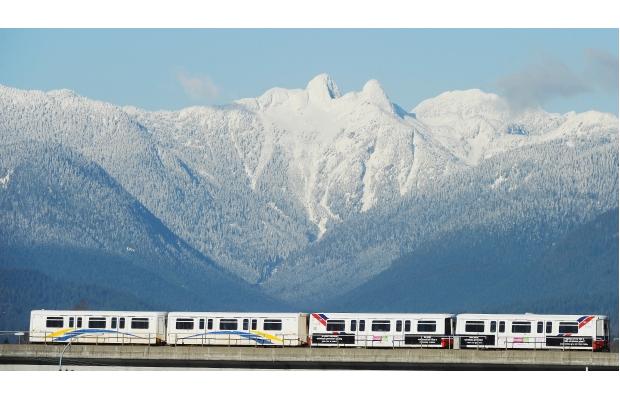
TransLink eliminates planning VP as part of restructuring
TransLink has shuffled its many departments and eliminated its executive vice-president of policy and planning.
By Mike Hager, Vancouver Sun April 20, 2012
TransLink has shuffled its many departments and eliminated its executive vice-president of policy and planning.
In a memo to employees sent yesterday, CEO Ian Jarvis announced the company was permanently eliminating Michael Shiffer, who left a teaching job in Chicago to come to TransLink three years ago, and his planning position.
The move is part of a wider restructuring of departments, by folding them into one another TransLink hopes to save more money after a $20-million fare hike proposal was denied by commissioner Martin Crilly.
“I recognize this restructuring is significant in scope, and there will be many questions from team members as we adjust,” wrote Jarvis in the memo. “I am confident that the changes will help us respond to the current environment and realize our commitment to delivering quality service for the millions of rides on our network each day in the most cost-effective and efficient way possible.”
TransLink on Tuesday announced it will postpone its scheduled transit expansion plans, including a B-Line bus service along King George Boulevard and a rapid bus on Highway 1 over the Port Mann Bridge, until it can find alternative funding sources to pay for them.
Jarvis said the decision was made after the mayorsai??i?? council on regional transportation announced that it would not increase property taxes next year for the planned transit services. A temporary property tax had been promised in TransLinkai??i??s supplementary funding plan as a backup plan for 2013-14 to generate $30 million annually if the province and mayors couldnai??i??t come up with alternative funding sources.
But the mayors last week voted to scrap the temporary property tax after the provincial government rejected its proposed revenue sources, which included a vehicle levy and regional carbon tax. The province instead said it would look for cost-saving measures within the organization.
Where’s The Density? Oh, I Guess Density Is Not An Issue With TramTrain.

Ever wanted to see what the Rail for the Valley/Leewood tramtram ride would be like, well the following video from U-Tube gives the feel of what a Vancouver to Chilliwack servcie would be like. The following is a cab-eye view of a German regional railway, not unlike the former BC Electric line from Vancouver to Chilliwack.
Density?
Not a great issue for a regional rail line in Germany, then why should it be in the Fraser Valley.
Click the following for a regional rail ride in the German countryside.
FA?hrerstandsmitfahrt auf der Odenwaldbahn
Montpellier opens new lines – A lesson unlearned for TransLink!
What is very interesting about this news item from the Light Rail Transit Associations web siteAi??( www.lrta.org ) is that the cost for Montpellier’s two new light rail/tram lines 3 & 4 (28.2 km) is about CAD $688.8 million or about $24.45 million/km. to build!
The cost of Montpellier’s two new tram lines are less than one half of the cost of the Evergreen line, yet almost three times longer! This means LRT can reach more destinations, cheaper than SkyTrian light-metro, with light rail offering more people a good public transit option than we can with SkyTrain. No wonder TransLink is in financial chaos asAi??we are spending about three times as much to provide the same sort of service with SkyTrain, than we could with modern light rail!

Montpellier opens new lines : Lines 3 and 4 of the Montpellier light rail network entered public service on April 7 after an inauguration ceremony at 17.00 on 6 April, Line 3 runs for 19Ai??8 km with 20 stops from Juvignac in the west of the city to PAi??rols-Etang de l’Or in the southeast, with a spur to Lattes-Centre. It is operated with a fleet of 19 Alstom Citadis cars, Each 40m trams are liveried to a maritime design. Line 4 is 8Ai??4 km long and runs partly on sections of lines 1, 2 and 3 from Saint-Denis to Place Albert 1er, serving 17 stops. It is operated with a fleet of 12 Alstom Citadis cars, each 32m long in black livery
In addition Line 1 has been extended from Stade de la Mosson to a new interchange with Line 3 at Mosson, Line 2 has been rerouted to take a more direct route through the Centre running from Corum to the SNCF station at Saint-Roch via ComAi??die.
The Montpellier network now totals 56km compared with 15.2km when the cityai??i??s first line opened in June 2000 and has 12 Park + Ride sites. The new lines have cost a total of EUR530m (CAD $688.8 million).Ai?? A pdf version of the new route map can be found on the TAM site (Transports de l’Agglomeration de Montpellier).
TransLink postponing some expansion plans – Take that you bad old taxpayer!
As expected, TranLink’s brass is postponing transit projects to punish those nasty people who don’t want to be gouged by new taxes to keep TransLink’s bureaucrat’s pensions and bonuses well funded. That the Evergreen Line light-metro line (the main cause of TransLink’s financial problems) is allowed to continue, demonstrates an utter ignorance by TransLink and the provincial government of the financesAi??of public transit and transit mode. The financial burdens of SkyTrain and Canada line light-metro is a direct cause of Translink’s long predictedAi??fiscal woes.
The mayors South of the Fraser River are seen to be TransLink’s enemies, as punishment, major transit expansion south of the Fraser is all but halted, but dear me, let’s spend $171 million on faregates and not at the busiest stations, so friends of the government can reap whirlwind profits at the expense of the taxpayer.
The problems at TransLink are staggering and the CEO Ian Jarvis, seems completely out of touch with reality. There is only one course of action, fire Jarvis and eliminate TransLink and start anew.
Postscript: TransLink has announced that faregates will not be built at Metrotown and Mainstreet stations. Though it is common practice not to put faregates on lesser used stations on large metro networks, not having faregates at two of the busiest stations on the SkyTrain network is just plain daft. This shows that the faregate program was not to control revenue collection, rather it was a political program and should have been resisted by CEO Ian Jarvis. That he has just acted as a Liberal puppy makes him unfit for the job.
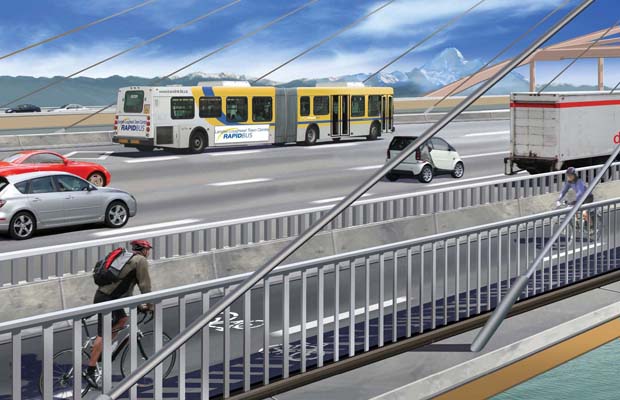 Part of the postponed transit projects is the Express Bus service across the Port Mann Bridge.
One doubts such a service wouldattract much ridership, especially if one would have to make two or three
tedious transfers to reach UBC, SFU, or just about any other destination.
TransLink postponing some expansion plans due to lack of funding
By Kelly Sinoski, Vancouver Sun April 17, 2012
METRO VANCOUVER – TransLink will postpone its scheduled transit expansion plans, including rapid bus across the Port Mann Bridge, and along King George Boulevard in Surrey, until it can find alternate funding sources to pay for them.
CEO Ian Jarvis said the decision was made after the mayors’ council on regional transportation announced last week that it would not increase property taxes next year for the planned transit services.
“We don’t have surety of that revenue,” Jarvis said, noting TransLink will now have to consider the impact of the decision. “The prudent thing is to place that expansion plan on hold.”
The mayors council last year passed a supplementary plan for TransLink that would see $70 million generated annually transit expansion through a two-cents-a-litre increase in the gas tax and another form of funding such as a regional carbon tax, vehicle levy or road pricing. A temporary property tax had been promised in the plan as a backup plan for 2013-14 to generate $30 million annually if the province and mayors couldn’t come up with alternative funding source.
But the mayors last week voted to scrap that plan after the provincial government nixed its revenue-source proposals.
TransLink’s decision doesn’t affect the Evergreen Line, which is covered by the gas tax increase, or bus service between White Rock and Langley because those projects have already been started. But it will delay plans for rapid bus along Highway 1 over the Port Mann, which would link Langley with the Lougheed SkyTrain Station, as well as a B-Line on King George Boulevard and plans to increase service on SeaBus by 15 minutes on evenings and weekends, Jarvis said.
Upgrades for several SkyTrain stations, including Main Street, Surrey Central and Metrotown, as well as Lonsdale Quay, to provide more capacity and to install faregates as part of TransLink’s $171-million faregate system, which will roll out next year, are also affected. Jarvis noted two stations — Metrotown and Main Street — won’t have faregates when the program starts next year because they require significant upgrades and there’s no money available, although he said this was intentional.
‘The stations, which will be upgraded when the money is available, will, however, have readers for the Compass cards, which can be used to access all transit services including buses, SkyTrain, West Coast Express and SeaBus.
The fare gates are expected to help TransLink combat rampant fare evasion on the system, which costs TransLink $7.2 million annually in lost revenue. “We will look at the financial situation before making a final decision on those stations,” Jarvis said.
Plans on designing a new Pattullo Bridge won’t be affected because it’s already included in the base plan. But Surrey Mayor Dianne Watts said the move will still have a significant effect on Surrey and other communities south of the Fraser, which are expected to welcome 70 per cent of the region’s growth in the next 30 years, and renewed calls for a sustainable funding model.
North Vancouver District Mayor Richard Walton, chairman of the mayors’ council, agreed that until a new funding source is found “we’re in a holding pattern.”
He said the mayors’ decision to withhold the property tax was not a “statement [those services south of the Fraser] are not important or not needed … but TransLink and local governments have to live within their means.”
He noted TransLink welcomes a provincial audit and is already addressing some of the recommendations suggested by TransLink Commissioner Martin Crilly, who rejected a 12.5 per cent fare increase last week. Crilly challenged the transportation authority to cut costs by about $20 million per year, to cover the lost revenues from the proposed fare increase.
Jarvis said the transportation authority has already been aggressive in cost-cutting and there will be trade-offs in trying to balance the need for service with the funding situation. TransLink is developing new targets for efficiency, officials said, including reducing bus service in areas where the demand isn’t that high and using taxis to supplement the HandyDart system.
Jarvis added TransLink is looking at smaller buses or vans for HandyDart but maintains “we’re not prepared to compromise service to those people.”
He maintains it’s imperative the province and the mayors come up with alternate sources of funding for the future. “To simply rely on the prospect of potential cost-savings in the future is not fiscally sound,” he said.
Transportation Minister Blair Lekstrom said he’s optimistic that although there are some “difficult decisions” ahead, that a solution can be found.
“There is a great deal of need for enhanced transit in Metro Vancouver. We have a world class transit system today but when you look to the future there is investments that are going to have to take place,” he said. “The issue is how do we fund those? How do we do it cooperatively with all levels of government at the table? I’m an optimist. I think we can get there.”
Lekstrom added that putting the projects on hold doesn’t mean they’re not moving forward. “What it means is, look, we have to make sure that we find our financial ability to fund the programs that we have to deliver.”
with files form Jonathan Fowlie
Ai?? Copyright (c) The Vancouver Sun
Utterly ignorant about transit, come to Vancouver and join the club!
The authorAi??of the following article in the Toronto Sun is utterly ignorant of transit mode and operation and would make a great addition to the Vancouver Sun newspaper.
The very nature of modern LRT with the concept of “reserved rights-of-ways” or RoW’s that are exclusively for the use of streetcars or trams, has made modern LRT very competitive with metro and has made expensive light-metro such as SkyTrain (also used on the Scarborough Line in Toronto) obsolete. By operating on reserved RoW’s, enables a streetcar or tram to obtain commercial speedsAi??near that of a subway at a much less cost.Ai??The commercial speed of a transit routeAi??is largely determined by the number of stations or stops per km., the more stations with LRT the lower the commercial speed, but with more stations per km. the higher customer convenience and ridership.
The fact that LRT has reduced gridlock where it has been built and it’s proven ability to attract the motorist from the car, has made modern LRT a very useful tool in city planning and extremely expensive subways are only built when ridership on a transit line demands full grade separation. As mentioned in earlier posts, the threshold in Karlsruhe Germany for putting a tram line in a subway is around 35,000 to over 40,000 passengers per hour per direction, so there is plenty of scope for modern light rail in Toronto and in Vancouver.
TheAi??columnist for The Toronto Sun says the city is doomed to permanent traffic gridlock because there is no money to build new rapid transit subway lines, yet offers no proof that one subway line will cure the very same traffic gridlock.
 The ability for light rail to carry large ridership on cheaper rights-of-ways has made more
expensive transit modes, such as SkyTrain (light-metro) obsolete.
“End of the line for subways, Scarborough had to accept an LRT, so there’s no cash forAi??Downtown Relief Line either”
By Christina Blizzard ,QMI Agency
First posted: Saturday, April 14, 2012You knew it had to happen.
No sooner had city council gleefully voted to foist LRTs instead of subways on Scarborough, over the vigorous objections of suburban residents, then the cry went up from all the smug downtowners.
They want the Downtown Relief Line.
How to explain it to all those self-entitled, Starbuck-swilling snobs?
Oh, this might work: Not a friggin’ chance.
If there’s not enough cash for Scarborough’s subways, there’s not enough for downtown.
Get on your bikes, guys. It’ll be a cold day in Hell, Ont. before this city ever builds another kilometre of subway system.
What planet are these folk living on?
They didn’t just tell Scarborough to get lost.
They’ve sealed this city’s fate. We’re doomed to gridlock forever.
Council’s decision is akin to that of former premier Bill Davis’ cancellation of the Spadina Expressway in 1971.
That move ensured no other expressway would be built in Toronto, including the Scarborough Expressway.
So Scarborough has the worst of all possible worlds. No subways, no decent highways.
This city, indeed, the GTA, is grinding to a halt because of half-baked plans gone awry.
Spadina was the first. It begat the Allen Expressway, which begat the Allen Road when Davis stopped construction.
It now ends at Eglinton Ave., creating a massive bottleneck.
Other transportation disasters include the cancellation of four subways by Mike Harris.
Shovels were already in the ground for the Eglinton Ave. West line when the Harris government filled it in, citing a lack of funding.
It would be up and running by now if it had gone ahead.
Then there’s the Union Station to Pearson Airport direct rail link.
It took years to get any progress on that line. While other cities had multiple transit links to their airports, drivers here sat fuming in traffic, often missing flights when highways jammed up.
No sooner had work started when the protests began.
Local residents complained about the noise. Hello? Do you have any idea how much the value of your property has increased?
Another group popped up saying diesel trains would kill their children. They wanted electric trains, despite the hundreds of millions of dollars in extra costs that would add.
Diesel trains on the entire GO Transit system don’t kill babies, but watch out when it’s in their backyard.
Now, some politicians are urging Metrolinx to put more stops along the line. Not quite sure which part of “direct” and “link” they don’t get.
Politicians don’t have the vision to set out a plan for the GTA and follow through with it, no matter what.
They’re meek, timid and too easily cowed by noisy special interest groups.
It’s not just transit.
Look at what happened with the gas-fired plants the provincial government cancelled in Misissauga and Oakville.
The Mississauga one was almost finished when Premier Dalton McGuinty pulled the plug during last October’s election.
Now the government is being sued for $300 million by the financing company associated with the plant.
That doesn’t even take into consideration the estimated $1 billion it will cost to scrap the plant and move it elsewhere.
And McGuinty has the nerve to ask NDP leader Andrea Horwath to tell him where to make $1 billion in savings?
Here’s some ideas: Don’t build $1 billion gas-fired plants and then pull them down. Don’t squander $1 billion on an eHealth boondoggle that benefited Liberal insiders. And don’t waste more millions on an Ornge Air Ambulance fiasco.
If this city had the billions of dollars they’ve put into not building highways, not building gas plants and in fighting any development that does manage to slip past the eagle eyes and slow wits of politicians, who like to nix every worthwhile project, we could build a subway to the moon.
Or at least to Scarborough.
The Canada Line is on the fritz again
Well it seems the $2.5 billion Canada Line gadgetbahnen is on the fritz again, so much for the myth that driverless transitAi??are more dependable than light rail.
The problem is a signalling problem and the sort of problem that bedevils automatic metros around the world, it is also a problem that doesn’t greatly effect light rail operations and trams/streetcars with drivers can operate “line of sight” if the signally system fails.
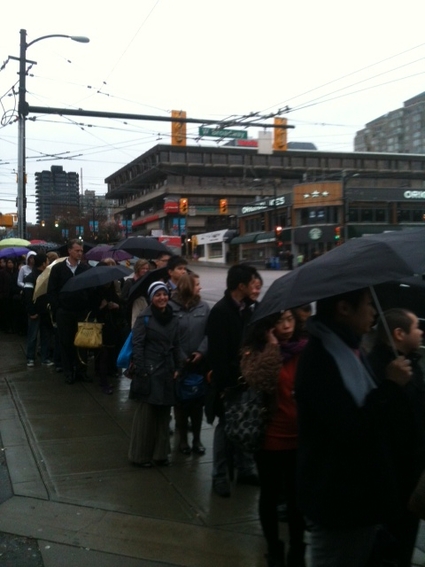 Long lines for the Canada Line at Olympic Village station. And we are building more driverless mini-metros?
Delays remain on the Canada Line
Trains are doing turn backs at Olympic Village station
VANCOUVER (NEWS1130) – Last week it was the Expo Line, today it’s the Canada Line.Expect delays if you’re planning on taking the Canada Line as there is some kind of problem preventing the trains from communicating with the main control centre.The Canada Line is still doing turn back trains at Olympic Village. Some of you will have to transfer trains going either north or southbound. TransLink says the problem is still being worked on so you can expect delays.To help deal with the back-up of passengers, TransLink is keeping a bus bridge in place to get you between the Broadway-City Hall and the Waterfront stations. The buses will stop at every Canada Line station.This woman admits to News1130 that she is not impressed. “It’s a little bit frustrating because now I’m looking at options and I know I’ll be late.”“I’m actually presenting at a conference and I’m most likely going miss my presentation because of the train and all the issues with the buses being last too,” says this woman.
For up to the minute updates on the Canada Line, you can follow us on Twitter @News1130Traffic. You can also listen live to traffic reports every 10 minutes on the ones.
The Vancouver Sun, As Usual, Gets It Wrong On TransLink
Today’s editorial in the Vancouver Sun, regarding TransLink, gets it wrong, but this comes as no surprise, the Vancouver Sun had got it wrong about transit ever for the past 32 years and it’s so hard to each an old dog new tricks. The problem with TransLink is simple and can be summed up in one word, “SkyTrain“.
SkyTrain or light metro has been the darling of transit planners in the Greater Vancouver Region, ever since it was forced on the taxpayer by the provincial government. By building with Skytrain or light metro, means the region is paying up to ten times more than it should for “rail” transit, which in turn means higher taxes to be paid to support the mode, which leads to a smaller but more expensive transit system, exactly what we have today with TransLink.
The Vancouver Sun, an erstwhile supporter of SkyTrain and the Canada Line is a wee bit disingenuous when it plays the blame game with our transit funding woes and refuses to acknowledge the real problem; “transit planning that is far too expensive for the taxpayer.”
If the taxpayer can’t afford the transit planning, then the transit planning must be altered to suit the taxpayer, which is simple stuff that TransLink and the Vancouver Sun chooses to ignore!
The current financial fiasco with transit planning has been long predicted by real experts, when Vancouver built with SkyTrain and with the province forcing more and more light metro on the region, funding woes with transit will continue. The Vancouver Sun is oblivious to this and plays the blame game with TransLink, yet the Sun is as guilty as the rest by supporting unaffordable SkyTrain on the region.
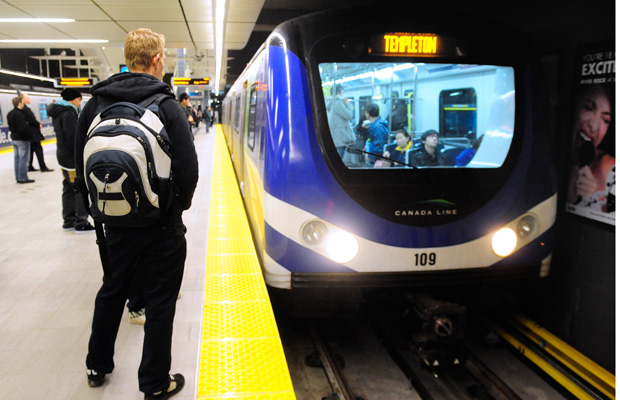 The $2.5 billion Canada Line, even though it is a P-3 project is costing the taxpayer $100 million annually
which bring the total taxpayer funded annual subsidy for light-metro wellover $250 million annually. Here starts theAi??finacial woes with Translink.
McInnes: Provincial meddling derails TransLink planning
By Craig McInnes, Vancouver Sun April 15, 2012TransLink has the air of a hockey team that didnai??i??t make the playoffs these days.
The abysmal record is there for everyone to see. The suspense and the jockeying now are just about who gets fired and who will get to carry on and try to clean up the mess before the next season starts.
As it stands now, carefully laid expansion plans are in jeopardy because of a revolt by the Mayorsai??i?? Council. Management has a budget with a big hole in it that TransLink Commissioner Martin Crilly wonai??i??t allow them to fill with a fare increase. And the province ai??i?? which might be considered the team owner in this scenario since it has the ultimate power ai??i?? has been operating more like a wrecking ball than a relief valve.
It was the province that set up TransLink and gave it responsibility for planning and operating the transit and regional road network 15 years ago. It also tasked TransLink with raising the money to pay for it. But while paying lip service to the notion that local politicians should be in charge of local transit, it never completely let go of the wheel.
First under the New Democrats, then under the Liberals, the provincial government killed proposals for new ways to raise funds ranging from a vehicle levy to road pricing and regional tolling.
At the same time, it refused to help TransLink solve the multi-million problem of fare evaders as it could have by linking unpaid tickets to the renewal of car insurance or drivers licences. Transportation Minister Blair Lekstrom said last week that heai??i??s willing to look at such a solution now, but as far back as 10 years ago only one in 10 riders who were issued a ticket ever bothered to pay the fine.
Five years ago, the Liberal government declared TransLink dysfunctional after it nearly refused to build the Canada Line, which had become a provincial and federal priority because of the 2010 Olympics.
It took much of the responsibility for operating TransLink away from local politicians and put it in the hands of professional management.
That hasnai??i??t worked out so well. An efficiency report that Crilly used as the basis of his refusal last week to allow a requested 12-per-cent fare hike found that while ridership had increased over the previous five years, costs had gone up faster. Compared to other cities, TransLinkai??i??s productivity is lagging and it has a bloated management structure.
While not a big number overall, the cost of policing jumped by 112 per cent, a galling rise given the lack of attention paid to the fact that most people issued tickets are simply throwing them away.
On Friday, the Mayorsai??i?? Council announced that it had decided not to ask homeowners for another $30 million from their property tax. That puts in jeopardy a number of planned improvements to the system, including bus service across the new Port Mann Bridge.
The mayors were responding to the way Lekstrom and Premier Christy Clark had dealt with their proposals to raise the money. The provincial politicians wanted any additions to be on property taxes rather than from new tolling or other new taxes.
So what happens next? TransLink management said Friday they need time to study the twin blows to their financial plan.
Of the two, the Crilly report should be the easiest to deal with, since while denying a revenue increase, it also delivered a road map for cutting operating costs.
The challenge posed by the mayors is more difficult, since it is rooted directly in the ongoing problem of political meddling by provincial politicians. That meddling breaks the accountability chain, which requires that tax increases be made by politicians who can be held accountable by the voters who have to pay them.
So Clarkai??i??s preference for property taxes is understandable. So too is the mayorsai??i?? reluctance to raise them, since they are the ones, not Clark, who will have to face any backlash from unhappy ratepayers.
Meanwhile, another dismal season lies ahead.
Ai?? Copyright (c) The Vancouver Sun



Recent Comments