For Those Who Wish To Take The Famous Trans Siberian Express – Google Offers a Video Trip

The following is a real time trip on the Trans-Siberian Express. Enjoy!
http://www.google.ru/intl/ru/landing/transsib/en.html
FRASER VALLEY FORMS
Preamble:
Distance, to paraphrase,Ai??Ai??is Nature’s way of keeping everywhere from being in the same place. Hence we need transportation.
While Zweisystem is taking a breather, I’ve been asked for some thoughts. Rail for the Valley takes on a broader meaning if we use “rail” in the sense of “argue vociferously”. I’d like to do a little railing. Think out loud about moving people and stuff from place to place in the Fraser Valley.
In 1998 or thereabout a rascal named Jim Wallace raised the prospect of revitalizing the Fraser Valley Interurban during a meeting of the Surrey Heritage Commission, which I was chairing at the time. The next weekend, with my grandson as navigator, we traced the tracks from Brownsville, on the Fraser River to Chilliwack. It was obvious. The track was there and used for freight. It would be dead easy to reinstate Passenger traffic.
During the intervening years, a lot of material has been collected. I’d like to pass it along to this forum, together withAi??Ai??occasionalAi??Ai??thoughts. Here goes.
Making the Valley
Might as well start at the beginning. Visualize the Fraser Valley:
 This triangle of green is clearly visible from space; a distinct fertile, flat form. An ideal place for people to settle. Where people settle, semi-paradoxically, they need to move around.
The map below shows the mouth of the Fraser River at the end of the last ice age, an ice choked fjord dotted with islands. For 15,000 years, the Fraser River has conveyed silt from the Interior to the Salish Sea. Think of Sumas Mountain as a valve.
Originally the river ran south of Sumas Mountain with a main stem following the alignment of the Nooksack River through a delta.
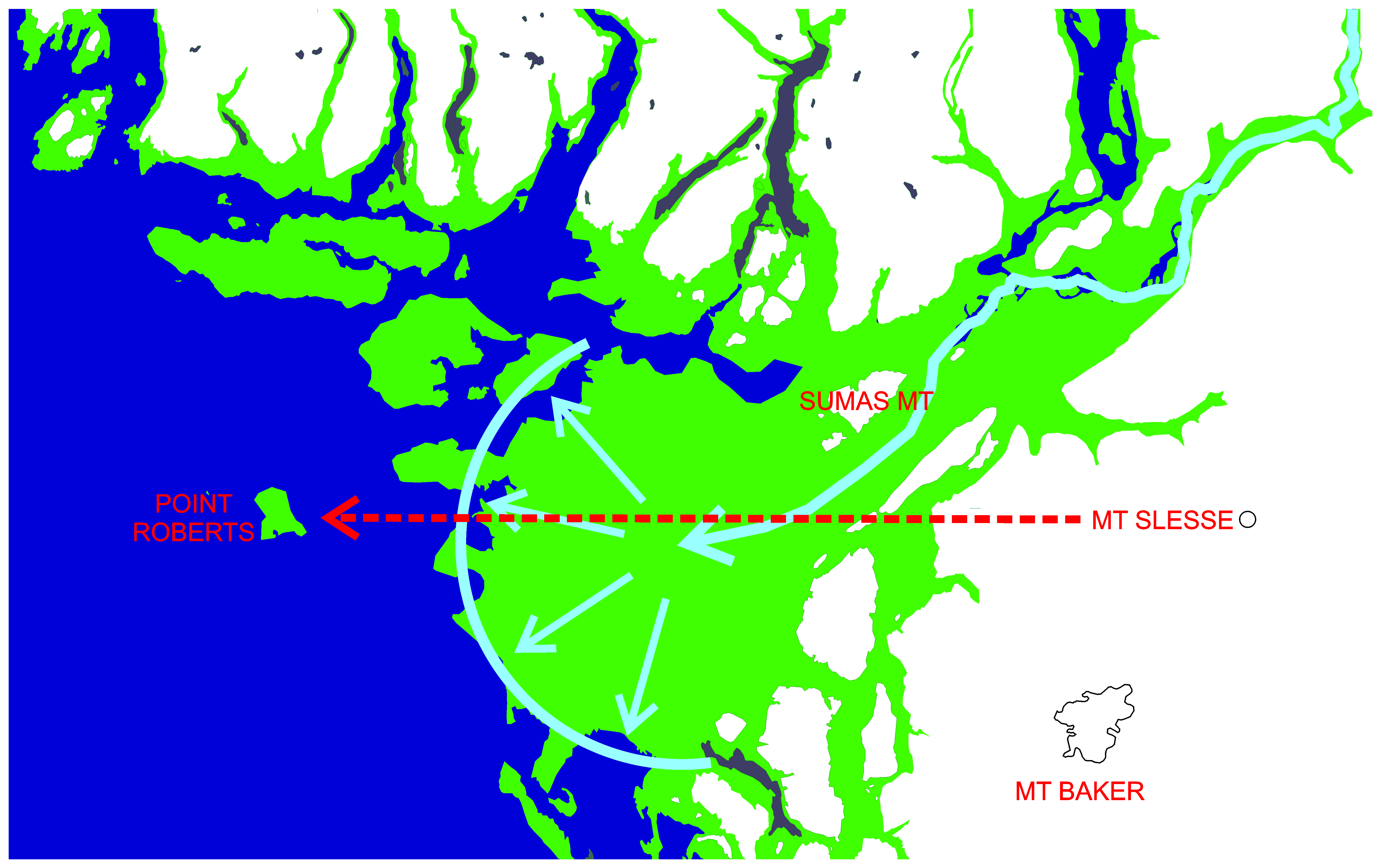
The early Fraser Valley formed as a delta south of Sumas Mountain.
The oral tradition of the Tswwassen people tells of their ancestors standing on Mount Sleese and seeing their future Point Roberts home as an island across an inland sea.
The maps show water in dark blue, elevations above 300 metres in white and green is the A?ai??i??Ai??bottom landA?ai??i??A? of the Fraser Valley.
The soil of the valley was pushed here by glaciers and deposited, particle by particle, by the river. The result is a tumultuous series of soil profiles. Glacial till offers firm bearing and resists erosion in some places, while soft alluvial deposits underlie marshes in others. As the delta developed, life, including people, advanced westward with the edge of the land.
At some point the channel south of Sumas mountain silted up or an ice dam melted and the main stem flipped to the north side. A new delta began forming.
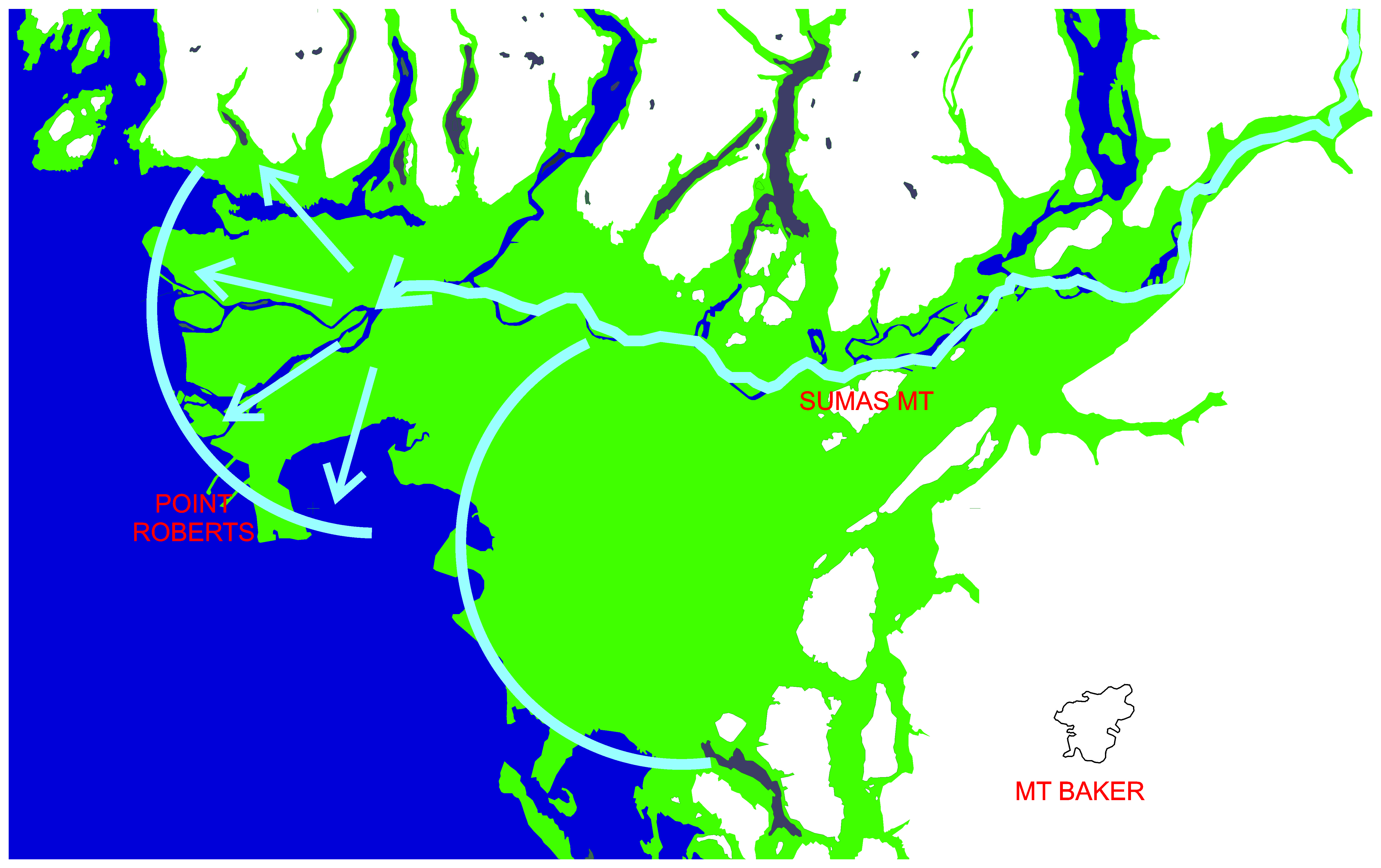
Later the main stem of the river switched to the north side of Sumas Mountain and the delta was pushed west.
Here is our basic land form, a V-shaped alluvial valley about 140 kilometres long, set in a wedge of mountains with salt water to the southwest. Because the whole landscape had been depressed by the weight of ice several miles thick, there was rebound. The old delta to the south (now mostly in the United States) is higher than the new delta. Glacial rebound continues.
This is a very simple version of the story. The Geological Survey of Canada provides more detail at: Ai??Ai??http://gsc.nrcan.gc.ca/urbgeo/geomapvan/geomap3_e.php
For at least 10,000 years, the Fraser Valley has been an ideal place for people to settle. And where people are settled as noted above, they are going to want to move.
Respectfully Submitted
Terry Lyster
Study reveals travel and transport trends – From the United Kingdom
An interesting study from the UK.
From the Independent website
Study reveals travel and transport trends
By Peter Woodman, Press Association
Tuesday, 16 February 2010
The number of motorists with large-engined cars has almost doubled over the last decade, figures showed today.
Ai??Ai??The number of licensed vehicles with engine capacity of more than 2,000cc increased from 2.3 million in 1999 to 4.0 million in 2008, data from the Office for National Statistics (ONS) showed.
Ai??Ai??The figures also showed that the number of licensed cars with engine capacity of less than 1,000cc has declined by 19 per cent over the same period.
Ai??Ai??The figures, part of the latest social trends publication from ONS, also revealed:
Ai??Ai??Ai??Ai??* Between 1989-1991 and 2008, the proportion of 5-10 year old children traveling to school by car has risen from 27 per cent to 43 per cent;
Ai??Ai??* In 2008, transport and travel costs accounted for 16 per cent of all household expenditure in the UK and this proportion has remained relatively stable since 1998/99;
Ai??Ai??* Between 1998/99 and 2008, the largest increase in motoring expenditure was on petrol, diesel and other oils – at 24 per cent – with expenditure rising 11 per cent between 2007 and 2008;
Ai??Ai??* In Britain in 2008, people took 992 total journeys – including walks – compared with 972 in 2007;
Ai??Ai??* Of the 992 journeys, more than 600 of them were either as a car or van driver or passenger;
Ai??Ai??* On average, each Briton took 27 rail journeys in 2008, compared with 25 in 2007 and only 19 for the period 1995 to 1997;
Ai??Ai??* The number of journeys made by localAi??Ai??bus rose slightly in 2008/09 compared with 2007-08 but was still only around a third of the number made in 1955;
Ai??Ai??* Only 22 per cent of households had no car in 2008 compared with as many as 86 per cent in 1951;
Ai??Ai??* 7 per cent of households had three cars in 2008, while 27 per cent had two cars.
Hamilton Looks to Europe for Light Rail Plans – How About Vancouver?
The good Burghers in Hamilton have realized that it isn’t the amount of money you spend on transit, rather how you plan andAi??Ai??build rail transit, that makes it successful. This is a lesson that BC politicians and TransLink fail to acknowledge and continue to plan for expensive light metro.
The Canada line is a good example: withAi??Ai??the hype and hoopla withAi??Ai??claims that ridership isAi??Ai??hitting the 135,000 passengers a day mark, the light-metro lobby ignores the fact that subways need daily ridership of about 400,000 to justify construction. The SkyTrain lobby also refuses to admit that the Canada line’s ridership is largely made up of a ‘captive ridership’, where former bus users, who once enjoyed a direct no-transfer service, are now compelled to transfer on to the metro. The other ugly fact emerging is that the Canada Line fares are largely made up of concession fares and deep discounted U-Pass student fares.
This bodes ill for TransLink, despite higher ridership, income is not matching passenger use and there is no evidence of a modal shift from car to transit. The result, the taxpayer must ante up the difference.
In Hamilton, a more affordable and user friendly European model for transit is being investigated and it is time that TransLink do the same.

City Looks to Europe for Light Rail Plans
Meredith Macleod – The Hamilton Spectator
City planners don’t want to follow in the tracks of other North American cities when it comes to light rail.
The consultant hired to figure out how Hamilton should move forward with a hoped-for rail line will be expected to have experience in designing a modern European-style rapid transit system.
That’s a clear indication of the direction city planners intend to take with a proposed LRT corridor stretching 16 kilometres from Eastgate Square to McMaster University.
The vision is to emulate the way European cities built their LRT systems.
That means:
* giving priority to transit, pedestrians, cyclists and service vehicles rather than cars;
* making LRT fit the existing streetscape and adapting the design to fit each neighbourhood;
* having minimal or no property acquisition;
* putting the transit line close to buildings and sidewalks.
Jill Stephen, Hamilton’s acting director of strategic planning and rapid transit, says the typical North American approach has been to try to give priority to both traffic and transit and drastically change the streetscape. Often LRT lines have been built on abandoned rail corridors or greenfield space at the periphery of the city.
“We have a lot of similarities to European cities,” Stephen said. “We don’t have a greenfield corridor or an old highway or a rail corridor like some North American cities have used.”
Instead, Hamilton must contend with a set right-of-way and a streetscape built alongside. In some areas of the proposed route along Main and King, the corridor is narrow.
“European cities have used what they had available and maximized it,” Stephen said. “There are models for making this work.”
The tendering for the year-long planning, design and engineering study to lay out the details of an east-west LRT line will close Monday.
A team of city and Metrolinx staff will choose a consultant based on a scoring system and bid price.
Metrolinx, the provincial agency charged with transportation planning in the Greater Toronto and Hamilton Area, is expected to make a recommendation about whether Hamilton should get LRT or bus rapid transit Feb. 19.
Stephen says Hamilton’s transit team has studied transit systems from around the world.
“We’re trying to get a sense of what has worked, what hasn’t and what lessons can apply to Hamilton.”
A delegation from Hamilton visited Portland, Ore., Charlotte, N.C., and Calgary about 18 months ago to see transit systems in action and talk to the people who built and use them.
The team is studying the types of vehicles in use elsewhere, how they’re powered, the routes they take, and how other municipalities have built ridership and consulted with the community.
Stephen said a goal of the Hamilton system will be to reflect the character and history of individual neighbourhoods through the design of vehicles and stations and the use of public art.
“This is a chance to celebrate Hamilton,” she said.
“It gives people a sense of ownership.”
Light-rail ‘vision’ elevated track would run along I-405 – From the Seattle Times
It seems the hoary old elevated, tunnel, or at-grade debate continues in Bellevue Washington, which is across the lake from Seattle.
The success of LRT is to be able to penetrate into city centres cheaply, on-street, where the transit customer wants to go, which is something that a certain rookie Bellevue councilor doesn’t want to admit. Elevated transit is an eyesore and is built only if there is no other alternative for construction and we don’t have to go very far to understand this, with the elevated SkyTrain light-metro shows us every day. Lack of sales of Vancouver’s orphaned SkyTrain metro system certainly points to the fact that being elevated makes SkyTrain as popular as an ‘Edsel‘.
Even stranger is that SkyTrain, first designed to be elevated to mitigate the cost of subway construction is being touted for a subway to UBC!
What tunnel/subway and elevated advocates seem to forget is that at-grade/on-street LRT attracts the most customers because it’s convenience. It is the convenience factor of light rail that has made it so successful and elevated light-metros, like SkyTrain, obsolete. Sadly these lessons take a very long and expensive time to be learned.
In the end, the ‘vision’ for elevating LRT in Bellevue probably has nothing to do about speed of of transit service or customer convenience, but the quaint custom of locating new stations near daddy’s land.

Light-rail ‘vision’ elevated track would run along I-405
Rookie Bellevue City Councilman Kevin Wallace is proposing an elevated light-rail track along Interstate 405 rather than a tunnel or surface track into downtown Bellevue.
By Mike Lindblom – Seattle Times
Trains on downtown Bellevue streets would delay cars. A tunnel costs more and requires ripping up streets during construction.
Rookie Bellevue City Councilman Kevin Wallace believes he can solve both problems.
Wallace proposes the “Vision Line,” an elevated track that would run alongside Interstate 405, with a stop not in the heart of downtown but on its east fringe, near Meydenbauer Center.
But the council’s first choice is a tunnel, something it officially endorsed last year, Mayor Don Davidson said. The underground option would run through the epicenter of downtown, stopping at Bellevue’s bus center before the tracks elevate toward the hospital district, east of the freeway. Other options include surface routes that turn from Main Street north into the office district.
“The interest in the Vision Line is more of a fallback, if it [a tunnel] doesn’t work out,” said Bellevue Councilwoman Claudia Balducci, newly appointed to the Sound Transit governing board.
It’s not a fallback for Wallace, who joined the council after its endorsement of a tunnel.
“From my perspective, the goal is to provide good light-rail service, but in a way that protects Bellevue businesses from construction impacts, as well as its roads,” Wallace said from his office near the freeway.
Wallace, 38, is the son of longtime Bellevue businessman Robert Wallace, who owns an office near the proposed I-405 station, as well as property in Bellevue, Seattle and other cities. The councilman is president of Wallace Properties, the family business, which owns property where the proposed trackway entering the station would sit.
Sound Transit and Bellevue leaders will meet Thursday to discuss light-rail route issues. Voters in 2008 approved the $2.8 billion route from Seattle’s International District to Mercer Island, Bellevue and Overlake, as part of a three-line regional system. Service to Bellevue is scheduled to begin in 2020.
The upside to Wallace’s Vision Line is an estimated savings of $430 million compared with a tunnel, says a study to be published Monday by Sound Transit.
The downside is a likely loss of ridership.
The freeway station would cut the predicted 2030 Eastside ridership by 2,500 A?ai??i??ai??? there would be 51,000 daily boardings with a tunnel, and only 48,500 with the Vision Line, the Sound Transit study says.That’s mostly because fewer workers and condos would be within a five- to 10-minute walk of the station.
A surface or tunnel route does the best job of reaching downtowners but would be a slightly longer ride for regional commuters, the study says.
A surface or tunnel option would collect and drop off light-rail riders next door to the Bellevue Transit Center. But a walk from the proposed Vision Line station to the west end of the transit center is four blocks, or about 460 steps. The distance is similar to the passageway from Sound Transit’s SeaTac / Airport Station to the terminal, but it’s up a hill that gains 60 feet of elevation.
So the station would need a moving walkway to downtown, Wallace said.
Councilman Grant Degginger said he’s concerned that a thick, 70-foot-high trackway called for in the Vision Line plan would look like the Alaskan Way Viaduct. “Is that the look we want for the gateway to downtown?”
Changing his mind
When voters approved the $18 billion regional plan for light rail, cost estimates in Bellevue were based on elevated tracks through downtown. Bellevue officials immediately denounced that idea, but Sound Transit staff warned that a tunnel could require $500 million extra. Microsoft endorsed a cheaper surface route A?ai??i??ai??? to conserve money and improve the odds that construction will continue to Redmond.
Just last summer, Wallace was pro-tunnel, insisting money could be saved or found. Now he says: “The fact is Bellevue already has a $100 million deficit in the capital budget,” so city funding for rail would drain money from roads and other public works. And the recession has eroded Sound Transit’s sales-tax forecasts.
Equally important, he seeks to keep tracks and a tunnel entrance away from the residential Surrey Downs area south of downtown, which supported his campaign last fall.
Instead of a Main Street station that would uproot businesses next to Surrey Downs, he favors a second freeway station where Southeast Eighth Street meets I-405, with an expanded park-and-ride facility.
Wallace Properties owns office buildings and parking lots in the Vision Line route. Because Sound Transit would condemn that area, he says, other alignments actually are better for the family business. Taxpayers would reimburse property owners, including the Wallaces, at market value, as determined by appraisals, negotiations or by the courts.
Looking in
Wallace says transit should promote or serve redevelopment. Some Seattleites raised the same point to justify the South Lake Union streetcar, to locate Rainier Valley light-rail stops, and to propose shifting the future First Hill Streetcar east to 12th Avenue in central Seattle.
In Bellevue’s case, the Auto Row just east of I-405 has been designated for mixed-use retail and dense housing. A footbridge across the freeway would reach those areas, he said.
This amounts to drifting a few blocks from Bellevue’s proven transit market to chase a prospective transit market. Wallace replies the redevelopment is likely to come sooner than the trains do. Sound Transit’s study did not include a footbridge over I-405, which would add cost. It likely wouldn’t affect the ridership stats much because the east-of-405 users would gravitate to the Hospital Station anyway, said East Link project director Don Billen.
Several bus riders interviewed at the transit center Friday were unaware of the political debate over a four-block difference.
“They’re going to bring light rail here? Cool!” said Qin Xiaochuan, awaiting the 550 bus to Seattle. “Walking is very healthy, as long as it doesn’t take half an hour or more.”
Some people laughed at questions about where they’d prefer a station that’s a full decade away.
Next to freeway
Wallace’s concept has taken a pounding in pro-transit blogs. Dan Bertolet at Publicola.net argues that a freeway station is unwise because I-405 prevents development and access from the east.
Balducci says the new Sound Transit study reinforced to her that to reach the most downtown employees, “it’s far better for a station next to the transit center, than for a station along I-405.”
Bellevue Square developer Kemper Freeman, a longtime rail opponent, supports Wallace’s concept. Freeman is part of a group suing to block Sound Transit from putting trains on I-90. Bruce Nurse, a vice president of Kemper Development, said that nonetheless, the firm realizes voters backed light rail. So Freeman now is looking to the Vision Line as a way to avoid tracks or construction that would block downtown roads and businesses.
Sound Transit’s study says that Bellevue traffic will be so congested anyway by 2030 that, if traffic signals are timed for trains, a surface line would slow east-west travel by less than one minute.
http://seattletimes.nwsource.com/html/localnews/2011011433_visionline08m.html

A Tram in the Black Forest
This U-Tube of a Karlsruhe TramTrain, goingAi??Ai??about its businessAi??Ai??in Germany’s Black Forest certainly makes a mockery of the ‘needAi??Ai??for density’ claim by those opposing the Fraser Valley interurban. By utilizing existing railway infrastructure, LRT can penetrate into unpopulated areas very cheaply, thus creating a larger tram network, as well servicing far flung transit destinations.
Karlsruhe’s TramTrains are 21st century public transit philosophy of building large light rail networks, cheaply there by servicing both where people live and where people want to go in a simple no transfer journey.
Even though the following is in Germany’s Black forest, it could also be in the Fraser Valley!
[youtube=http://www.youtube.com/watch?v=aJsU5-rbDmo]
The (AVG) Albtal-Verkehrs-Gesellschaft GmbH- Karlsruhe’s longest tramtrain route – S4

The AVG’s longest run is now a 210km (130 mile) S4 service from A?ai??i??hringen through central Karlsruhe to Achern, south-west of Baden-Baden. The TramTrain route uses DB mainlines, regional railway lines and on-street running in various cities.
The above map gives the various routes of Karlsruhe’s famous TramTrain network;Ai??Ai??largely in an area of comparable density and population of Vancouver and the Fraser Valley. This something to think about when planners and politicians claim: “There isn’t the density in the Fraser Valley to support ‘rail’ transit.”

More Financial Woes For TransLink
Instead of doing what most other ‘rail‘ transit projects have done, offer compensation packages to affected merchants and residents along the construction route, TransLink did nothing and now has to pay the ‘piper’s price’.
Not only will future awards drive up the RAV/Canada Line’s price tag, the legal costs alone will take money away from much needed transit services, which ultimately will translate into even higher TransLink taxes. TransLink, RAVCo., and the provincial governmentAi??Ai??tried to hide the true cost of the metro line and as costs spiraled out of control, the scope of the project was downsized, including adding cut-and-cover subway construction without paying affected people compensation.
Cambie St. merchant ,Susan Heyes’s $600,000.00 award for “Nuisance” for years of business disruption for subway construction, took the smirk of the faces of TransLink’s officials (who thought they pulled a fast one)Ai??Ai??and now seeing that TransLink is liable, hundreds of merchants are now going to sue!
Would not have it been easier just to offer compensation packages to affected merchants in the first place?
It is Zweisystem’s belief that ‘Judicial Inquiry’ must be held on the RAV/Canada Line and all its sordid financing, much of it hidden from the public who have to subsidize this massivly expensive, politcally prestigious edifice.

From Radio News CKWX 1130
Cambie Street merchants given go ahead to file class action suit against Canada Line
CVBA would like to settle out of court
Jim GoddardAi??Ai?? Feb 05, 2010
VANCOUVER (NEWS1130) – Cambie merchants and property owners who claim they suffered huge losses during Canada Line construction have received permission from the courts to pursue their class action suit.Ai??Ai?? Leonard Shein with the Cambie Village Business Association says 216 merchants and 67 property owners are part of the class-action.
However he says they would prefer to settle out of court.Ai??Ai?? “We would like to negotiate a fair settlement rather than TransLink and us spending all this money on lawyers and court.”
Shein says the $600,000 Hazel and Co. owner Susan Hayes was awarded from the courts for the Canada Line disruption to her business shows his members have a good case.Ai??Ai?? He says a negotiated settlement makes sense since it cost the Canada Line a million and a half dollars to fight just the one lawsuit from Hayes.
He also points out originally Cambie merchants had offered to settle for five million dollars but that was rejected by the TransLink Board.Ai??Ai?? Shein now believes any settlement will be much larger than that whether it’s negotiated or comes from the courts.
‘AmfibusA?ai??i??ai??? gets tryout on the Clyde – You Think TransLink Will Order Some?
From the lighter side of transit, an amphibious bus.
Maybe TransLink doesn’t need SeaBus anymore and will buy a fleet of Amphibious buses for a no transfer journey from the North Shore to Vancouver and no more worries about traffic gridlock at the tunnel or the Alex Fraser Bridge, just drive down a boat ramp and………………….
Hey ………… just kidding!
 Ai??Ai??
Ai??Ai??
‘AmfibusA?ai??i??ai??? gets tryout on the Clyde
From the Times On Line
Angela Jameson
James Bond might think it old hat, but a vehicle that can travel across both roads and water is proving to be something of a licence to thrill for Brian Souter, the boss of Stagecoach.
The Ai??A?700,000 A?ai??i??Ai??amfibusA?ai??i??A?, borrowed by Stagecoach from a Dutch company that plans to operate five of them around Rotterdam, begins tests next week as a possible replacement for the Clyde ferry in Glasgow.
Based on a bus chassis, the amfibus incorporates a hull to allow the vehicle to float.
On the roads, it operates like a standard coach, but in the water it is driven by twin water jets and can reach up to 8 knots.
An excited Mr Souter said: A?ai??i??Ai??Passengers can use the amfibus to travel over road and water without having to leave the comfort of their seat to change from a bus to a ferry.
A?ai??i??Ai??It shows the potential of ScotlandA?ai??i??ai???s rivers and estuaries to be links rather than barriers to travel.A?ai??i??A?
StagecoachA?ai??i??ai???s larger-than-life founder and chief executive might well be excited by it all, but for him it will not be a hands-on project.
Mr Souter, who has a PSV licence and has been known to drive StagecoachA?ai??i??ai???s buses, would not be able to drive the amfibus until he has a boatmanA?ai??i??ai???s licence.
A Dutch driver has been recruited for next weekA?ai??i??ai???s trial.
http://business.timesonline.co.uk/tol/business/industry_sectors/transport/article7015824.ece
Of Transit, Funding, TramTrain, and a Sustainable Future.
 Zwei first met Brendan Read in 1986, while traveling to Abbotsford on the BR Pacer unit that ran three return service to New Westminster each day during the Expo 86 Worlds Fair. It was during this trip that the idea of the “return of the interurban” was conceived. It was all there, track, vehicle(s), and popular support.Ai??Ai??Though some efforts were made to continue the Pacer service, it was not to be and the idea of a Fraser Valley interurban remained a quiet dream until John Buker founder of Rail for the Valley and VALTAC took up the cause.
We are at a crossroads with transit planning for the region. Either we continue with building hugely expensive metro lines that take about a decade to plan and build, higher fares and subsidies, or go the light rail route with cheaper construction and operating costs and the ability to service areas deemed “not to have the density” to warrant SkyTrain construction. The looming ‘global warming’ fiasco, combined with peak oil, means we should be building as much alternative transit as possible, but we are not, as planners and politicians still twiddle their thumbs waiting for the economy to return as in happier days.
Talk of $4 billion UBC subways and the Evergreen Line fog the real issues including can the taxpayer afford to keep building hugely expensive metro lines on routes that do not have the ridership to sustain them. We live in a finite world and a finite economy and its high time politicians invest in sustainable and affordable public transit and be adult enough to abandon any thought of building any more politically prestigious metro projects in the region.
It’s time we start building with 21st century transit to cope with 21st century problems.

From Mass Transit
A Funding Crisis of Olympic Proportions
Ai??Ai??Posted by Brendan B. Read
On Thursday Jan.21, two Bombardier Flexity Outlook streetcars, borrowed from STIB, the Brussels transit agency, started rolling on the Olympic Line, a demonstrator addition to Vancouver, B.C., CanadaA?ai??i??ai???s transit system built for the 2010 Winter Olympics that begins Feb.12. The two A?ai??i??E?tramsA?ai??i??ai??? will operate free of charge until March 21 from the Olympic Village Canada Line rapid transit station 1.1 miles to the popular (and traffic-congested) shopping and entertainment hub of Granville Island, on the south shore of False Creek near the cityA?ai??i??ai???s downtown.
BombardierA?ai??i??ai???s participation in the project has already been paying off. Company officials report that Seattle streetcar representatives have already visited the line. The city of Seattle with Sound Transit, is building a $132 million streetcar route from the International District to First Hill and Capitol Hill in conjunction with the Link light rail extension to the University of Washington. The key selling point is the FlexityA?ai??i??ai???s 100 percent low-floor layout, unlike the partial low-floor Skoda/Inekon streetcars in service on the cityA?ai??i??ai???s South Lake Union line.
Whether the Olympic Line continues service after March 21 and is extended beyond its present endpoints A?ai??i??ai??? the city of Vancouver is envisioning a network linking the downtown core, Stanley Park and the north shore of False Creek A?ai??i??ai??? depends on funding. With federal and provincial government representatives politely smiling on the same stand, Mayor Gregor Robertson made the pitch for money at the event. In the audience was former TransLink CEO Tom Prendergast who had flown in for the opening.
VancouverA?ai??i??ai???s transit has been facing the milder but still impacting version of an Olympic-sized funding crisis that has gripped transit agencies continent-wide. Prendergast left TransLink amidst financing disputes between local governments and the province that put the long-promised Evergreen Line SkyTrain extension to the northeast plus new bus routes to the growing but atrociously underserved areas in the southeast on hold, with fare hikes on the way. He became president of MTA New York City Transit just as the agency is planning service cuts as well as eliminating fare discounts and slicing administration costs to close a $383 million budget gap.
New York City is in the same rattling subway car as Chicago, Cleveland, San Diego and Salt Lake City to list just a few names on the growing list of transit agencies facing making cuts and as a last alternative raising fares A?ai??i??ai??? even as many of them receive ARRA money to buy equipment, renovate stations and maintenance facilities, and build new lines.
If it sounds strange that service is being chopped and fares are being hiked while new buses and railcars are being bought and bus and rail rapid transit projects are being constructed it is. And thatA?ai??i??ai???s precisely whatA?ai??i??ai???s wrong with American transit financing. There is no linkage between capital (federal) and operating (state/local) cost coverage.
Where the rubber literally meets the road is maintenance, which has been a local responsibility. Yet the billions in federal money invested on infrastructure and equipment risks going to waste if there is no money allocated to keep the assets in a state of good repair. The ARRA has some money for it but nowhere is it enough to meet transit agency needs.
The federal government has to step up to the plate here because the states and cities have boxed themselves in by relying on downturn-vulnerable sales taxes; it is next to impossible at this point for them to shift to more stable property taxes, which Canadian systems rely on, and which have dampened though not eliminated cuts and hikes there.
Washington should start financing transit system maintenance costs. In turn it should require applicant agencies and states to develop more stable operating support financing plans, including real estate transfer taxes where new transit services have boosted property values, plus have proven land-use policies that limit transit-killing and environment-damaging sprawl.
This last measure is being advocated in Canada in efforts to get transit-dedicated revenue from the federal gas tax. While the Canadian government streams money from it to local governments they have the discretion to spend the cash as they wish, which means in smaller communities, transit, outweighed by the road interests, gets little if anything and sometimes nothing.
Resolving todayA?ai??i??ai???s transit financing crisis will take an effort akin to competing in the Olympics. Yet the needs and the outcomes: increased greener, energy-secure mobility, healthier cities and towns, and a stronger economy, merits the toil and the dollars.
Brendan Read is a freelance journalist living in Vancouver.



Recent Comments