Where is the almost $1 billion in funding needed to make the Expo Line extension to Langley a go?
Second Question:
Mr. Horgan and the Mayor’s Council on Transit, what taxes have to be increased to pay the estimated $1 billion in outstanding funding?
Now, the story in question.
Not even a week has gone by and Surrey council has shown what their real SkyTrain agenda is all about.
It is all about development and rubber on asphalt. This is what Prime Minister Trudeau and Premier Horgan are supporting, as the province is burning around them mainly due to climate change.
These guys want more of the same!
The City of Surrey and the two Langley’s, by acting as the ultimate spoiled child and now have got the SkyTrain toy so their city’s can be just like Vancouver.
The $3.95 billion, 18km SkyTrain is a showcase of dated thinking, tinged with corruption, yellow journalism and gross politcal malfeasance.
Back in the 1970’s 80’s, Vancouver was just like any other city with rush hours in the morning and afternoon, taking workers to and from the city from the suburbs. Ridership was assured and new public transit philosophies were quietly ignored, as the good burghers “knew best.
Today public transit has changed dramatically; the old rush hour in and out philosophy doesn’t work as well anymore as the demographic shift in downtown Vancouver has changed from offices to high rise condo’s and towers. Business have relocated to the outer reaches of Metro Vancouver and beyond, up the Fraser Valley, where the car is needed to access them.
A good example is Molson’s Breweries, which was an icon on Burrard in Vancouver, has now relocated to Chilliwack.
Surrey’s new land rush along the $3.95 billion, 18 km Expo line extension has begun, with new highway construction through the ecologically sensitive Green Timbers. The one question that is ignored is that where are the commuters commuting too? Again, demographic change tells me, more are going east than west.
For all the angst, duplicity getting a $3.95 extension to the Expo line, the City of Surrey and the two Langley’s are getting a dated piece of kit, designed for 1980’s transit solutions and not for transit in the 2020’s, where flexibility in operation is key attracting new ridership. In essence, they are buying an Edsel
When completed, by 2030, Metro Vancouver will be in endemic gridlock; the war on the car will see wholesale change in councils to more car friendly politicians and SkyTrain will continue to suck scarce transit monies, subsidizing a museum piece.
Not only are the NDP paving paradise and turning it into a parking lot, so is Surrey Council!
SkyTrain line through Surrey’s Green Timbers forest involves four-lane Fraser Highway
‘Optimized’ project plan OK with president of Green Timbers Heritage Society, but not others
Now that prep work for Surrey’s SkyTrain line extension has been given the green light, attention has turned to the road through Green Timbers Urban Forest where tracks will be built.
The city plans to four-lane Fraser Highway to “optimize” the rapid-transit project, in one of the city’s most congested road corridors.
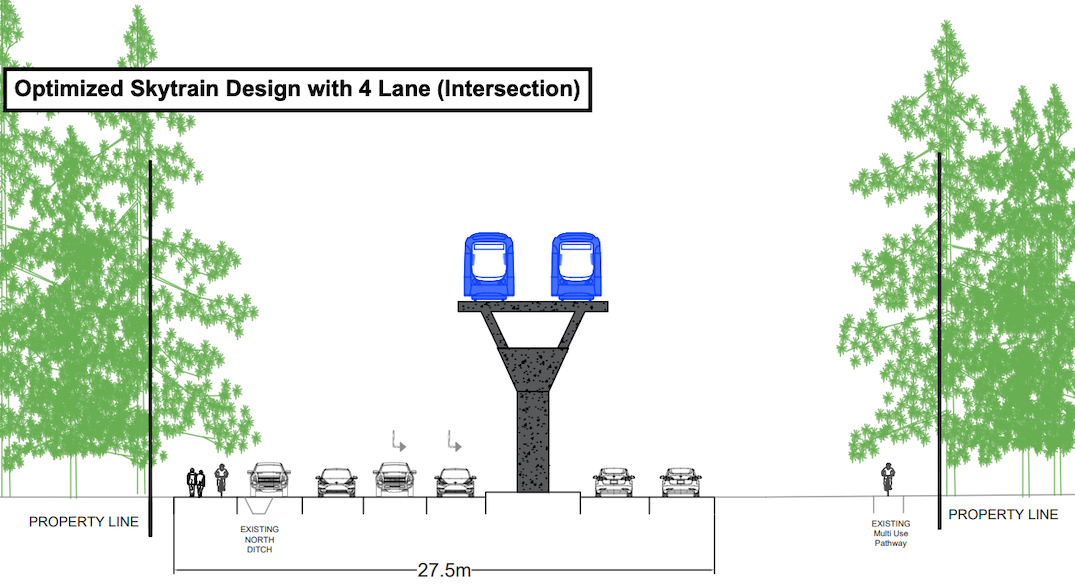
“Staff have worked with TransLink to optimize the project design,” concluded Scott Neuman, Surrey’s general manager of engineering, “including the ability to complete SkyTrain plus four-lane widening using an approximate (27.5-metre) optimized cross-section through GTUF (Green Timbers Urban Forest) entirely within the road allowance, with no impact to GTUF and only an incremental increase in tree loss compared to TransLink’s original two-lane design.”
Don Schuetze, president of Green Timbers Heritage Society, says there’s been talk of widening that stretch of Fraser Highway since the 1990s. “I’ve got a folder just filled with discussion about it – lots of ink spilled on it, and blood and sweat and tears,” Schuetze told the Now-Leader.
“My understanding is they’re going for a more minimal concept now, and that’s important,” he added.
“A few years ago they were talking about 45 metres across, for LRT. They’ve obviously done some thinking about how they did it with 100th Avenue, which they widened a couple years ago – and I think they did a good job. It was, ‘How narrow can we make this so that we impact the forested area the least amount?’ I think they’re following that same line of thinking with Fraser Highway.”
(Story continues below)
Drawing of SkyTrain line and four-lane Fraser Highway from 144 Street to 148 Street with eastbound view, from a report to Surrey city council. (Image: surrey.ca)
Schuetze said “it’s not a great idea to encourage more traffic through a forested area like that, just like it’s not a good idea to encourage more in a school zone, for example. But if you’ve got to do it, then I think they’ve put some thought into it. They’re asking for opinions and are being as reasonably sensitive as they can, given the constraints they have.”
On Monday (July 12), Surrey council awarded a $5,384,600 contract to B&B Contracting Ltd. to widen Fraser Highway from 96th Avenue to 148th Street in preparation for construction of the Surrey-Langley SkyTrain expansion.
Surrey heritage advocate Jim Foulkes questions the need for four lanes on that highway section.
“The only congestion on Fraser Highway is caused by the light at 144th (Street). You go out there and look, that’s what causes the backup into Green Timbers, it’s not the two lanes through Green Timbers that’s backing things up.
“With SkyTrain,” he added, “it’s gone from rails on the ground to putting the monstrous noisy thing up in the sky. So why would you build a wider highway for cars when you have rapid transit? Make up your mind. Why do we need four lanes there? You know, in Vancouver on Cambie Street they put the whole damn SkyTrain underground, they tunneled it. Why don’t do they do that in Surrey? Why are we a second-rate cousin like that?”
Fraser Highway has become the busiest two-lane road in Surrey, with more than 28,000 cars per day, according to the city report.
The “optimized design” on the stretch through Green Timbers aims to reduce the road footprint and protect high-value trees along the north side of Fraser Highway, the report says.
The 22.5-metre, four-lane design “only slightly impacts additional Bylaw Trees, relative to TransLink’s base two-lane design, requiring tree removal to accommodate SkyTrain. All of these trees are within the existing road allowance, and there are no trees within GTUF being impacted by the optimized design. Furthermore, staff’s optimized design is a significant improvement from the original 40m wide, four-lane LRT design, as it prevents approximately 300-350 Bylaw Trees from being removed within the road allowance.”
Despite the churlish comments who oppose Zwei’s views on transit, claiming that I somehow invent issues and more, the following comment came via a chap I was corresponding with in Ontario and I just cannot help but agree.
Canadian transportation is now so hideously politicized that I just don’t see how we can bring any common sense and fiscal responsibility back into the issue.
In Metro Vancouver, when you have major universities resorting to a transit version of Lysenkoism ……….
Lysenkoism is a term that identifies as any deliberate distortion of scientific facts or theories for purposes that are deemed politically, religiously or socially desirable.
……….. to promote a transit mode, once supplied by Bombardier Inc. and actively promoting hugely expensive mega projects, the Broadway subway and the Expo Line extension to Langley, such planning boarders on professional and academic misconduct.
*
Only in Vancouver, with the backing of graduate planners and engineers, the SkyTrain light metro system is extended and not just ignoring light rail, they actively condemn the mode through dubious claims and grossly misleading information.
*
The grossly overstated density issue is one of these issues and the SkyTrain light metro network is not being built to provide better transit, instead it is to promote densification of properties along its route. This densification sees the replacement of affordable housing and replaced with unaffordable high rise condos and towers, which translates to big profits by land speculators and land developers.
You folks need to get soothing, worthwhile hobbies. If you’re going to keep bashing your heads against the Canadian transportation brick wall in your spare time, you’ll all be coronary cases before long. Fixing this situation is now an impossible task thanks to generations of politicians operating on behalf of their corporate bagmen, who are the ultimate profiteers.
*
Our formerly semi-credible and affordable public transportation system is gone and I don’t see it returning thanks to, as Captain Renaud says in Casablanca, “the usual suspects.”
It is a no-brainer why SkyTrain light-metro is being extended to Langley and it is the same for the Broadway subway, with a combined cost of $7 billion.
Three guesses and the first two don’t count.
It all about land speculation and land development.
SkyTrain acts as a driver for municipal councils to relax zoning (up-zone) properties along the light-metro route. Assembled lands that are up-zoned for development means huge profits for land speculators and developers. Huge profits for developers means large politcal donations for the “right sort” of civic politicians at election time.
Those who support SkyTrain expansion are amply rewarded.
So the tiresome circle of building SkyTrain → land speculator profits → developer profits → demovictions → politcal contributions → higher fares → reduced transit service → more SkyTrain planning → building SkyTrain → land speculator profits → developer profits → demovictions → politcal contributions, and so on, and on, and on.
And to think the taxpayer and the transit customer is paying for this $7 billion grift!
Better transit for the Fraser Valley? Er no, just new condos at Whistler, Mexico or Hawaii for the privileged few, paid courtesy of the taxpayer.
It’s difficult to compare how land prices in areas around the Surrey to Langley line will increase compared to what happened in other SkyTrain corridors.
Joanne Lee-Young
Jul 14, 2021
Presale condo sales near the proposed Surrey-to-Langley SkyTrain corridor are growing faster than in surrounding areas, according to real estate experts.
“We have noticed some additional activity in the City of Langley, where the line will terminate, as well as along parts of the line in Surrey,” said Michael Ferreira, managing principal at Urban Analytics, which tracks presale condo projects.
The tricky part, he said, is figuring out what can be attributed to the SkyTrain as opposed to the lift of the “crazy pandemic” real estate market.
Based on Urban Analytics’ own data, said Ferreira, there has been “an approximate 15- to 20-per-cent increase in sale values of condos and townhomes in these areas from 2020 to 2021 compared to a 10- to 15-per-cent increase in neighbourhoods of Surrey and Langley not influenced by the SkyTrain line.”
When it comes to land sales, the interest is more stark. Connor Edinger, manager of land and asset data at Urban Analytics, looked at sites with multi-family development potential along that future Surrey-to-Langley SkyTrain corridor.
He compared the average price per square foot land prices from 2016 to 2019 for these properties with 2020 to May 2021, and found that prices for lots designated for medium- and high-density multi-family development, such as apartments up to and above six storeys, increased 24 per cent while prices for low-density sites, such as townhomes and row houses, rose 32 per cent.
Total sales for multi-family development sites sold in Langley City in 2021 are on pace for about $73.4 million, based on sales of $30.6 million between January to May, said Edinger.
That would be slightly down from the $90.1 million in 2020, although still a significant jump from $33.8 million in 2019 and $35.2 million in 2018 — and even from the boom years of 2017 and 2016, when sales were $57.4 million and $31.9 million, respectively.
Last week, the federal government officially committed $1.3 billion to fund the SkyTrain extension from the King George station in Surrey along Fraser Highway to 203rd Street in the City of Langley.
For now, it is a corridor marked by a lot of older car dealerships, some vacant land and strip malls in the Surrey portion, with more patches of bare land as it heads into Langley.
It is impossible to predict how surrounding land values will escalate compared to the way they did for commercial properties and single-family home lots when the Canada Line was built along Cambie Street in Vancouver or the Millennium Line by Brentwood Mall in Burnaby.
“It’s quite difficult to quantify,” said Kevin Murray, a senior sales associate at CBRE’s national apartment group. “Even the Broadway corridor (in Vancouver) is still up for speculation. Ultimately, the driving factor for land value is the rezoning potential and the change in the official community plan allowing for increased density due to the planned SkyTrain. If a property is in close proximity to the SkyTrain, but it doesn’t allow for an upzone, the value won’t change all that much.”
He said only properties that allow for major development potential, such as building a high-rise, will see a significant increase.
He pointed to the properties on Fraser Highway that have been owned by Bucci Developments since the mid-1970s. One is assessed at around $6.5 million and the other at $9.6 million, but they are “worth a lot more based on their density and development potential.”
In recent years, Bucci has been planning a major redevelopment just east of what is being presented by TransLink as a future SkyTrain station near 160th Street. The vision includes condo towers that are 30 storeys high and an extensive, mixed-use hub. But for now, the Bucci sites are occupied by a pair of small, low-slung, used-car dealerships.
“Overall, any properties that are on the corners of the SkyTrain stops will probably see the largest increase and demand from prospective investors/developers,” said Murray.
Bucci Developments hopes to get shovels in the ground in two years, said Peter Kiidumae, Bucci Investment Corp.’s director for asset management.
“There is no doubt (the SkyTrain) will impact real estate values and encourage more intensive development as evidenced by the increased interest of investors and developers enquiring about purchasing our properties.”
Langley City Mayor Val van den Broek said a final draft of its new official community plan and zoning bylaw updates was signed off in June, and these will go to a third reading for approval.
“This will be an entire revitalization,” she said. “We want (our transit-oriented developments) to be pre-planned. We want to say to developers, ‘This is what we want here.’”
As the SkyTrain light metro system is mostly constructed with concrete and what we see is only about 25% of the concrete used, with the rest underground, all with classic rebar construction, it is safe to say;
SkyTrain’s billion dollar concrete bill is coming due sooner than one thinks.
All that concrete!
America’s trillion-dollar concrete bill is coming due
Concrete construction no longer lasts thousands of years, like the Pantheon in Rome. Instead, its lifespan is roughly 50-100 years, thanks to the way in which modern concrete is reinforced.
Why it matters: That means a multi-trillion-dollar bill is coming due right around now, in the form of concrete construction that needs noisy, dirty, expensive repair.
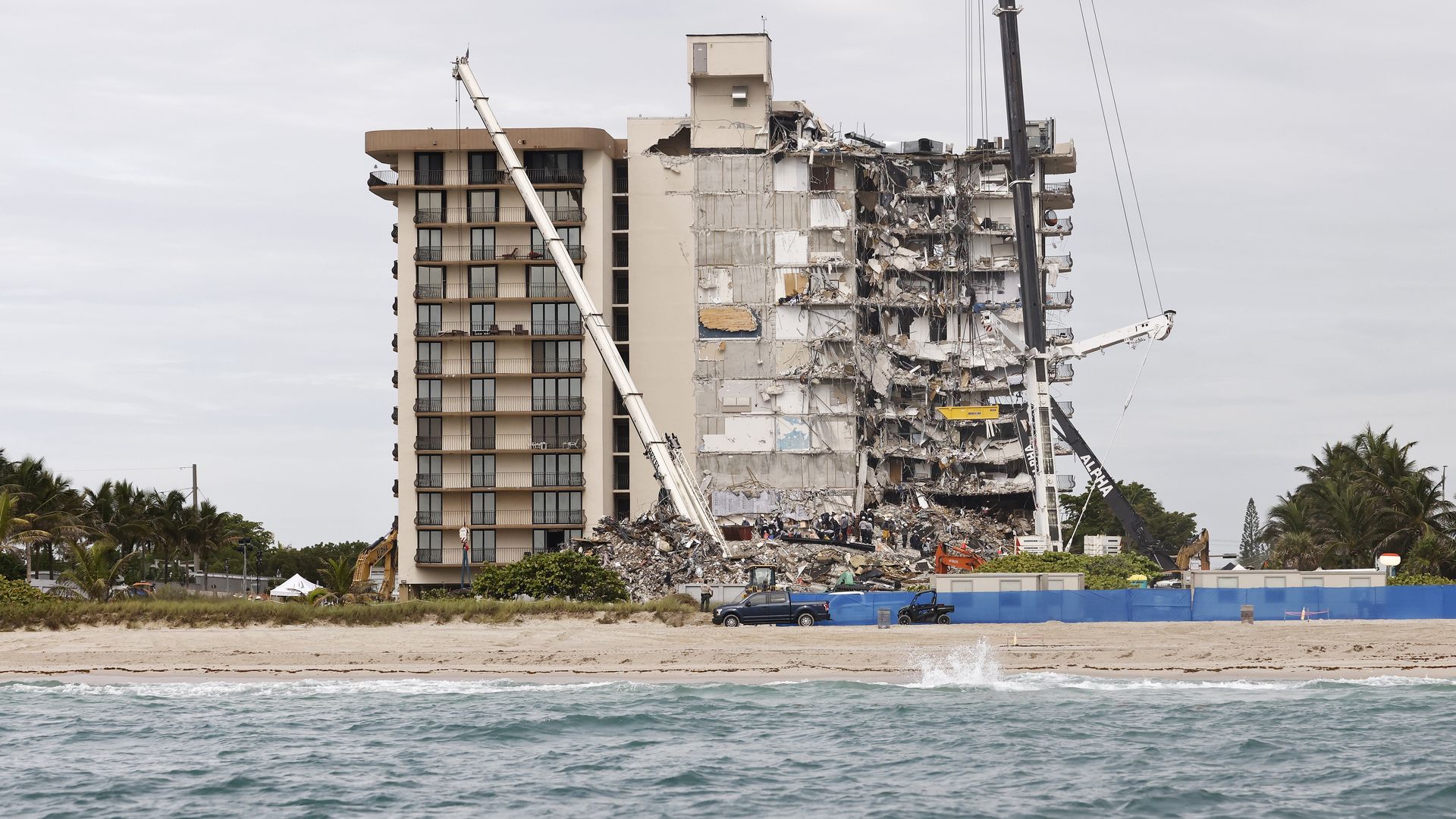
The collapse of a residential tower in Surfside, Florida, is a stark reminder of how catastrophically concrete can fail.
Just as the collapse of the Morandi Bridge in Genoa caused Italy to start paying much more attention to remedial infrastructure projects, the Surfside tragedy might help focus America on the urgent need to fix buildings that are nearing the end of their initial lifespan.
The big picture: As Robert Courland explains in “Concrete Planet,” modern concrete is poured around steel rebar, which gives it tensile strength. But tiny cracks — found in all concrete — cause water to start rusting the steel, which then expands, cracking the concrete.
Photos of the Surfside basement taken before the collapse show steel rebar breaking all the way through the concrete to the point at which it is fully exposed to the salty and humid Florida air.
By the numbers: One of the most famous concrete buildings in America, Frank Lloyd Wright’s Fallingwater, cost $155,000 to build in 1936 — about $2 million in 2001 dollars. The cost of repairs in 2001 came to $11.5 million.
Similarly, repairs to Wright’s concrete Unity Temple are estimated at roughly 20 times the original construction costs, even after adjusting for inflation.
How it works: Once rebar starts corroding, the standard fix involves jackhammering the concrete to expose the steel, brushing the steel to remove the rust, reinforcing the rebar as necessary, and then covering it all back up again with carefully color-matched new concrete.
That labor-intensive extreme noise and dust is actually the green, environmentally sensitive solution. The only alternative is demolition and replacement with an entirely new building — something that involves a much greater carbon footprint.
Between the lines: Because concrete fails from the inside out, damage can be hard to detect. And because concrete looks so solid and impregnable, necessary maintenance is often skipped, causing massive bills later on.
Local governments are in charge of ensuring building safety, but their willingness and ability to do so varies widely. The owners and residents of concrete buildings often try very hard not to think about corrosion, just because the costs of fixing it are so enormous.
The bottom line: The amount of money needed to fix existing infrastructure (nearly all of which is concrete, in one way or another) stands at roughly $6 trillion, according to the American Society of Civil Engineers. That number does not include homes, offices and other private buildings.
If you live in a concrete building that’s more than 40 or 50 years old, it’s an extremely good idea to check carefully on just how well it’s been maintained, lest you find yourself with an unexpected seven-figure repair bill — or worse.
You just got to love the NDP, as this hapless crew love budget breaking FastFerry style mega projects. Remember the FastFerries? The financial stench from that fiasco hung around the neck of the NDP as a fiscal Albatross for over twenty years and you would have thought that they would have learned…………..but no, they are at it again!
The Site c dam is another brazen example example as spiraling costs which has now topped $16 billion, which wind completed, its power will cost far more than wind or solar power. Now the 18 km Langley Expo line extension has escalated from $3.1 billion to $3.95 billion and I know, small potatoes by today’s standards, but it will be regional taxpayer’s feeling Prime Minister Trudeau’s and Premier Horgan’s financial largess.
The Langley Expo line extension will cost a whopping $247 million per kilometre to build!
In comparison, the full build, 130 km Leewood Projects, Leewood Study, for a reinstated passenger rail service connecting Vancouver to North Delta, Cloverdale, Langley, Abbotsford, Vedder/Sardis anf Chilliwack, with a maximum of three trains per hour per direction is $1,207,692,027.00) or $8.71 million per km in 2021 dollars.
The Leewood Study would give 122 km more of a transportation route for less than one third the cost of building SkyTrain from Surrey to Langley!
The Horgan government seems to want to top the previous 90’s Glenn Clark, NDP government with mega project cost overruns for vote getting, politically prestigious projects.
Zwei received the following Email from our friend Haveacow, who has done some quick research on the funding issue.
According to an unnamed source of your Vancouver Sun newspaper, the total cost of the project is, get this, $3.95 Billion! (UNCONFIRMED)
*
That price does include 6 new 5 section trainsets (30 cars), a new large capacity yard (The mysterious Yard#4) and I’m assuming integration costs.
*
Keep in mind the new business case has yet to be written. The new federal funding is part of the Covid-19 relief package. The province of B.C. still has to put in its share and Translink’s 10%- 20%
*
$1.65 Billion in existing funding from Translink’s 10 year vision plan
*
$1.3 Billion in new Federal funding.
*
That leaves around a $1 Billion hole for the Province and Translink to fill.
*
The new business case has to be written and the project must still go out to tender.
*
If the $3.95 Billion price tag is true this line now costs with everything included, this line costs $246,875,000 per km, for how many new riders in 2035? That’s a big bill for 62,000 passengers.
*
All being loaded on to a 35 year old line, in desperate need for major ($3) billion dollar upgrades.
*
The Expo Line (prepandemic) was at capacity. Translink has currently only entertained one option to respond to this issue, to buy bigger trains 82 metres long (5 sections long or in layman’s terms 5 cars long) to increase its capacity to just 18,000 p/h/d from its current 15,000 p/h/d.
*
Unfortunately, none of the big upgrades needed are funded. Your downtown tunnel Dunismuir Tunnel is leaking by the way.
Regarding leaking infrastructure the, “………. Dunismuir Tunnel is leaking …………”, should raise red flags, as that horrific condo collapse in Miami was preceded by large leaks, as far back as two years.
More on the perils of modern cement construction in the next post.
An election is coming and time to bribe the voters with their own money.
So the the PM, needing cheap politcal points, helps our the premier with $1.3 billion announcement to fulfill his politcal promise made in the last election to Langley voters to extend the Expo line to their city.
Whether this is new funding or just reannounced funding is anyone’s guess, but it makes for a nice photo-op.
The announcement is a long term disaster for the region, brought to you by two very fiscally irresponsible politicians.
*
To recap:
*
The Expo and Millennium lines are an unconventional (powered by Linear induction Motors or LIM’s) proprietary railway, operating the recently rebranded Movia Automatic Light Metro (MALM). Using Linear Induction Motors (LIM’s), the proprietary system cannot operate with any other railway except it small family of seven systems.
MALM is the 6th rebranding of the proprietary railway, first marketed as ICTS and quickly rebranded ALRT for sale to the BC Government because ICTS was deemed as obsolete as an Edsel!
The sale of ALRT to Lavalin, meant another rebranding, ALM and when Lavalin went bankrupt trying to build ALM in Bangkok. Bombardier picked up the remains of ALM at a fire sale price and quickly found how bad it was and by giving it a quick makeover, using their own Innovia body shell to try to make the system salable. Rebranded again as ART and after only four sales (with two having Bombardier and SNC Lavalin involved in corruption charges, ART was included in the Innovia Line with the LIM being a customer add-on.
*
After 15 years of no sales of the LIM powered Innovia model, it was finally rebranded as MALM.
MALM is an orphan system, obsolete by today’s standards, which is now owned by Alstom after they purchased Bombardier’s troubled rail division.
MALM can cost up to 10 times that of LRT to construct; costs a minimum of 45% more to operate and being proprietary means maintenance costs are much higher than LRT. Sky/train also lacks capacity and the all important flexibly which is important in the 21st century. Almost 1,000 employees work on the Expo and Millennium Line light metro system. The Canada Line has separate employees being a P-3, lead by SNC Lavalin!
*
A conservative estimate is that SkyTrain light metro network has cost the taxpayers three times more than if LRT was used. In other words, we could have at a light rail network three times larger than the present SkyTrain light metro network.
The announced extension will be a financial albatross around the taxpayer’s necks for generations as higher operational and maintenance costs at the Surrey/Langley end will erode present bus services.
SkyTrain also causes more pollution than LRT because of the vast amounts of CO2 produced for making the concrete for the elevated guideway, are more than any pollution savings over the life time of its operation.
*
There is no proof, even after 35 years of service in metro Vancouver, that SkyTrain actually attracts the motorist from the car as any hint of modal shift is non existent as mode share by Transit in Metro Vancouver has been around the 15% mark for almost 50 years!
In an age of unprecedented investment in rail transit systems around the world, not one city has copied Vancouver and not one city has copied Vancouver’s exclusive use of a proprietary light metro system for regional transit.
And the damned thing doesn’t run in the snow!
The $3.1 billion cost for the line to Langley is almost twice McCallum’s campaign estimate of $1.65 billion.
What we have witnessed by Trudeau’s announcement is a crass politcal bribe to voters by continued building with an obsolete light metro system, which has connections to SNC Lavalin, that will cost the taxpayer dearly and completely deny Metro Vancouver and the Fraser Valley of any meaningful transit for at least 3 decades.
Prime Minister Trudeau and Premier Horgan have announced endemic gridlock in the Fraser Valley for decades to come. Well done!
Feds pledge $1.3B to finish Langley SkyTrain extension, funding to plan UBC extension
Prime Minister Justin Trudeau has announced federal funding for the Surrey to Langley SkyTrain project.
Speaking in Surrey, B.C. on Friday, Trudeau said the federal government will provide up to $1.3 billion dollars for the Surrey to Langley SkyTrain extension.
This includes an elevated extension of 16 kilometres and eight stations.
“This will cut commute times and make your lives easier,” Trudeau said.
He also said the federal government will invest up to 40 per cent for the SkyTrain extension from Arbutus to UBC.
Joining Trudeau was Minister of Infrastructure and Communities Catherine McKenna, British Columbia Premier John Horgan, British Columbia Minister of Transportation and Infrastructure Rob Fleming, British Columbia Minister of Environment and Climate Change Strategy George Heyman, Surrey Mayor Doug McCallum, City of Langley Mayor Val van den Broek, and TransLink Interim CEO Gigi Chen-Kuo.
This federal funding was the third piece of the project needed. Provincial and TransLink portions of the SkyTrain project have already been committed.
Current funding for the Surrey-Langley SkyTrain expansion will only take the line six stops from King George Station to 166th Street in Surrey’s Fleetwood neighbourhood.
Langley Mayor Val van den Broek said in June the final piece of the puzzle to get the trains out to 203 Street in her city is a funding commitment from the federal government.
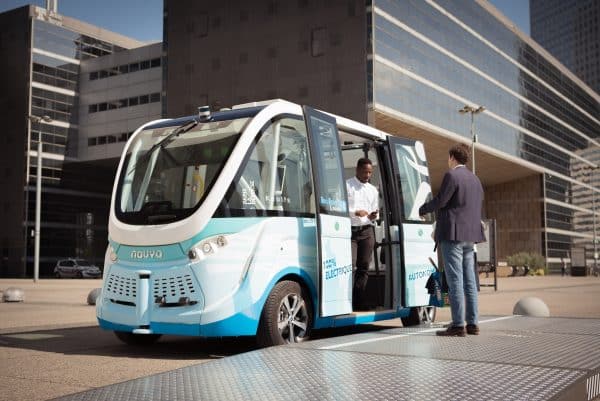
Ah, the poor futurists, their utopia of driverless buses have had a major setback, as a three year test in Vienna has ended with a;
Unsuitable for use in practice.
Paris also had an unsuccessful trial that ended in 2019.
For all those clamoring for autonomous buses, cars and trucks, please take note, the proverbial, rain, snow and sleet, combined with fog, wind and even daisies caused the buses to be driven in manual.
From Zwei’s point of view, would not the investment in autonomous buses be better spent in designing better and more unfriendly buses?
Autonomous bus does not prove itself in Vienna After three years, Vienna ends its project with autonomous buses from NAVYA. Conclusion: Unsuitable for use in practice.
The state of the art in self-propelled shuttles is not sufficient for use in everyday life. This is the conclusion drawn by Wiener Linien, the largest public transport operator in Austria’s capital, after three years of test operation: “The project has shown that the road to autonomous driving in local passenger transport is still a long one.” On Wednesday, the autonomous buses of the navya company rolled for the last time through the young district of Seestadt north of the Danube. Since April 2018, the two shuttle buses have been used first in a garage and on a university campus and then from June 2019 in public passenger test operation in Seestadt. More than 12,000 kilometres were driven at a maximum of 20 km/h and more than 8,000 passengers were transported. Without the coronavirus pandemic, even more people would certainly be driving, even if autonomous driving can lead to nausea.
Wiener Linien diplomatically calls the result “mixed”: “Both in summer and in winter there are still weather-related problems. Strong winds as well as light snowfall, heavy rain or fog ensure that the e-buses have to be controlled manually. For the continuous use of the vehicles on a regular basis, the market still has to cope with numerous tasks.” The project website has already been removed, a follow-up project is not planned. Ideal test field The Seestadt would be ideal for the slow autonomously driving buses. Urban planners have deliberately left a lot of space and at the same time given cars little space. “The use case in Seestadt was a perfect environment for NAVYA to test the autonomous buses,” said NAVYA Sales Manager Jean-Michel Boëz, “Our buses are ideal for new neighborhoods where there is a need for public transport and space for cars is deliberately reduced.”
*
However, a young district brings with it that something is constantly changing. Therefore, NAVYA had to constantly re-record the route used and even try to predict new conditions. “The environment itself was a challenge, as it was constantly changing due to construction work, etc., causing our team to continuously adapt the route, as well as predicting future work to ensure the smoothest possible operation,” boëz explained. No flowers, more asphalt The extent of the problem was already evident during the first autonomous test drives in April 2018: the track had been mapped in March, when it was still cold in Vienna. Two weeks later it was warm, and the buses always stopped automatically in the same place. Only after some searching was the “obstacle” found: Daisies had grown from a column in the road surface. This disturbed the artificial intelligence of the autonomous vehicle.
Zwei knew all would not be happiness with Alstom’s acquisition of Bombardier Inc. Lingering court cases, lawsuits and other criminal intrigue with the Yongin and Kuala Lumpor ART systems (that is SkyTrain in TransLink Speak) and other issues pertaining to the now called Movia Automatic Light Metro System (erroneously called SkyTrain), must be causing acute indigestion with the new owner.
One wonders is the proprietary MALM light metro is one of those skeletons? With only one customer for the aging light-metro and no sales for over 15 years, one wonders if Alstom will “cut and run” and abandon production, freeing up production space for more lucrative transportation products.
It certainly fits the reason why TransLink hired a glorified spin doctor from the USA and not a person with credible transportation credentials as the new CEO.
When I asked a transportation engineer in Baltimore, where Translink’s CEO last worked, about his stint with the MTA, I got this reply.
You are about to get a new CEO of TransLink in the person of Kevin Quinn. This is a good news/bad news situation. good news is we are rid of him, bad news you are getting him.
Mr Quinn may be the nicest yes man you will ever meet. he is very personable and friendly but have yet to actually see him in 6yrs have an opinion of his own. and if he has any use for light rail he has kept it well hidden.
Hopefully you will have better luck than Baltimore, ridership is off (before pandemic) 2% year over year since he took over.
Good luck!
Skeletons indeed!
Lingering Bombardier ‘skeletons’ draining cash from Alstom in rocky integration
Expects costly and painful months ahead to turn Bombardier rail operations around
Jul 05, 2021
Alstom SA Chief Executive Officer Henri Poupart-Lafarge expects costly and painful months ahead as the rail-equipment maker works to turn around the flagging operations of the Canadian rival it acquired.
Alstom is set to detail on Tuesday a path for improving profitability for the combined group after the Bombardier deal was sealed in January. Alstom is forecasting a cash drain in the first half of this year and a return to pre-acquisition margin levels only in the 2024-2025 fiscal year, according to a statement.
The shares fell as much as 8.2 per cent in early trading in Paris, the steepest intraday drop since March last year, and were down 4.3 per cent at 11:53 a.m. local time.
There will be “no more skeletons” going forward, he said in an interview, saying provisions for problematic contracts related to Bombardier have been capped at the roughly 1.08 billion euros ($1.3 billion) already announced. “The key element is to turn around Bombardier.”
Alstom has won major large train orders in recent months, benefiting from a wave of investment in carbon-free transport. But integrating Bombardier’s business has been a rocky process.
Alstom is forecasting negative cash flow in the first half of this fiscal year of between 1.6 billion euros and 1.9 billion euros, according to the statement. This will lead to “significant” negative free cash flow for the full year.
This is due to higher spending to make up for delivery delays and mismanagement related to ex-Bombardier orders, Poupart-Lafarge said. These are in countries like the U.K. and Switzerland and will require Alstom to raise train deliveries by 35 per cent.
On the brighter side, Alstom is looking at additional spending in the U.S. on infrastructure under the Biden administration as “upside potential,” he said.
In Europe, the biggest markets will be Germany along with Italy, Spain and Portugal — southern countries set to spend under the region’s stimulus package.
Key highlights
Alstom sees significant negative free cash flow this fiscal year including between negative EU1.6 billion and negative EU1.9 billion in the first half.
“Stabilization” of Bombardier legacy contracts in two or three years.
Adjusted EBIT margin to reach between 8 per cent and 10 per cent from 2024-25 onwards vss 5 per cent pro forma.
Interesting article and well worth reading; not all is happiness in transit land.
From Zwei’s almost 40 years advocating for better transit and more affordable transit planning in the region, it seems those in charge are afraid of change. The same thing is done over and over again, ever hoping for different results, because that is the way it always has been done. TransLink’s near religious faith in light-metro is testament to that.
Despite many shortcomings of light-metro, especially the costs involved, TransLink advises politicians with questionable studies that light metro is the only way to go. Sadly local politicos have little knowledge on transit issues and have been walked all over by the entrenched “SkyTrain Lobby”.
Europe faced the same sort of transit crisis in the 1970’s and 80’s, but with modern light rail, low floor cars, modern operating procedures and very user friendly operation the tide turned and good public transit is seen as a necessity of a modern city. Indeed the most successful public transit systems in Europe are very user-friendly because planners and politicians make sure that the transit is built to satisfy customer wants. Karlsruhe’s famed TramTrains are result of planners designing transit to meet customer needs.
Planning for affordable user-friendly transit is unheard of in metro Vancouver.
A Karlshrue TramTrain, winding through Bad Wildbad. TramTrains were first conceived to overcome a troublesome transfer at the main rail station, by providing a direct service; a true seamless journey.
It is also interesting that TransLink’s announced their new CEO, Kevin Quinn, with all the hype and hoopla they could muster.
Quinn is currently the Administrator and Chief Executive Officer of the Maryland Transit Administration (MTA), overseeing one of the largest multi-modal transit systems in the United States including subway, bus, and paratransit modes.
He has served as CEO of the MTA since 2017, focusing on customer experience and employee engagement, overseeing the development of customer-facing real-time tracking technology for local bus and commuter rail service, and introducing the agency’s first mobile payment app. Prior to his role as CEO, Kevin was the Director of Planning and Programming for MTA, responsible for implementing a complete overhaul and rebranding of the core transit system, including the introduction of new, high-frequency bus lines.
Kevin holds a Master’s Degree in Public Policy from Johns Hopkins University. He is a member of the American Institute of Certified Planners (AICP).
What TransLink and it’s rather inept board did not say was Baltimore’s transit operations has been hemorrhaging ridership. Zwei has been told from sources within the MTA, that pre covid, ridership is off 2% per year for some time.
Zwei received the following email from a planning engineer in Baltimore;
You are about to get a new CEO of TransLink in the person of Kevin Quinn. This is a good news/bad news situation. good news is we are rid of him, bad news you are getting him.
Mr Quinn may be the nicest yes man you will ever meet. he is very personable and friendly but have yet to actually see him in 6yrs have an opinion of his own. and if he has any use for light rail he has kept it well hidden.
hopefully you will have better luck than Baltimore, ridership is off (before pandemic) 2% year over year since he took over.
Good luck
Getting a John-Hopkins trained spin-doctor as TransLink’s new CEO, , instead of someone who understands transit and transportation issues is hardly reassuring.
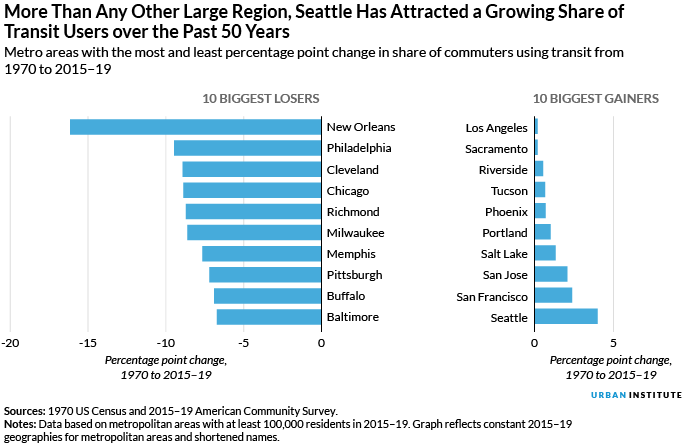
The Complex 50-Year Collapse of U.S. Public Transit
A new analysis of a half-century of transportation patterns in U.S. cities shows how the share of transit commuters has plunged in most — but not all — metro regions since 1970.
Back in 1970, 77 million Americans commuted to work every day, and 9% of them took a bus or a train. By 2019, the number of U.S. workers had nearly doubled, to more than 150 million. But the vast majority of these new workers chose to drive: The number of public transit riders increased by only around 1 million during those years, and their share of the country’s overall commuters collapsed to 5%.
That historic shift reflects several broad trends in U.S. life, including suburbanization patterns and urban highway expansion, the growth of the car-friendly Sunbelt, and the depopulation of once-robust industrial cities. But fundamentally, the fading usefulness of public transit is a result of the fundamental lack of integration between federal transportation and land-use authorities, says Yonah Freemark, a senior research associate with the Urban Institute.
“In a number of other countries, the Department of Transportation and the Department of Housing and Urban Development are combined in one entity,” he says. “In the United States, we ended up with two different entities.” As a result, housing and mobility needs have been poorly aligned; the landscape is laden with housing that lacks access to public transportation, light rail lines that course through sparsely settled areas, and too many cities whose transit networks can’t connect riders with jobs.
But as Freemark’s new analysis of commuting data shows, based on his database of long-term trends in U.S. metros, regional patterns reveal a more complex story. Some cities have bucked national trends and gained transit commuters over the last 50 years. Coastal cities like New York City, Washington, D.C., San Francisco, Seattle, and Boston saw an increase of hundreds of thousands of transit commuters between 1970 and 2019. Pre-pandemic, 3 million New Yorkers commuted by bus, subway and train daily — 500,000 more than in 1970 — and the region’s share of transit commuters held relatively steady.
The flip side of the pattern can be seen in Philadelphia, Chicago, Detroit and Cleveland, which lead the list of cities — many in theRust Belt or the South — that have shed tens of thousands of transit commuters.
This unequal pattern of transit commuting is even more acute when the share of commuters is taken into account. In New Orleans, for example, nearly a quarter of residents got to work via bus and streetcar in 1970. By 2019, only about 5% did. Similar drops are seen in smaller industrial cities like Buffalo, Richmond, Cleveland and Milwaukee. “In the 1970s, use of public transportation was really common in cities all across the country no matter their size,” says Freemark. Now, widespread transit commuting is a phenomenon limited largely to large coastal metropolitan areas. “Other regions don’t have realizable public transportation people can depend on.”
Cities where transit use has seen massive reductions tend to be those that have endured deindustrialization and suburbanization during the last 50 years, with a concurrent rise in investments in highways designed to shuttle car-driving commuters in and out of town. “These used to be places that had really successful downtowns, but now most of their workforce has suburbanized,” says Freemark.
The profoundly unequal geography of U.S. transit reflects — and contributes to — the economic gaps that have grown between cities; as struggling metros have shed jobs and wealth, their ability to maintain useful transit systems has likewise declined. “Most money that goes for transportation comes from state and local governments, and their ability to invest is based on their resources,” says Freemark. Poorer regions don’t have enough income to invest in transit, which in turn hampers economic growth even more. “It’s a negative spiral, a vicious cycle; there’s a trap situation going on.”
here are lessons to be learned from the handful of cities — all in the western U.S. — that have managed to grow their share of transit commuters since 1970, Freemark’s analysis concludes. In Seattle and San Francisco, for example, the city has made efforts to centralize jobs in downtown areas, and they boast extensive rail networks that can reach a larger share of commuters in the region. Seattle has also invested heavily in upgrading its bus service, while San Francisco reduced fares for people with low incomes. In Salt Lake City, housing growth in neighborhoods around transit has been prioritized; Portland’s urban growth boundary has been effective in limiting car-centric sprawl.
Not every region has the means to make the kind of transit investments that would be needed to bring riders back to their 1970 levels, and there’s no question that reversing the effects of a half-century of transit-unfriendly land-use decisions is a tall order. But it’s also increasingly urgent, given the role of car-centric planning in boosting greenhouse gas emissions. “The federal government could play an important job filling the gap” between wealthy and struggling cities, says Freemark. “But they haven’t done that yet.”
Our mainstream media always over-hypes the latest gadgetbahnen, or transit miracle from elsewhere, which turns out to be a yesterday’s failed transit experiment that was sold off on the cheap to let someone else try to sell it to rubes. This sensationalist reporting seldom, if ever reports that the very same transit miracle, in reality is a repackaged and rebranded proprietary transit system, from 20 years ago, reappearing like Marley’s ghost.
Case in point, the trackless tram or optically guided bus.
Years ago, when TransLink was extremely unhappy with my letters in the local newspapers regarding their planning of the day, I was summoned to TransLink’s golden towers for a session in their “Star Chamber”.
The Star Chamber (Latin: Camera stellata) was an English court which sat at the royal Palace of Westminster, from the late 15th century to the mid-17th century (c. 1641). The Star Chamber became synonymous with social and political oppression through the arbitrary use and abuse of the power it wielded.
I was shown videos of rapid bus as the way of the future. The videos showed an optically guided bus from the Netherlands and several guided buses, including the German O-Bahn. Being an almost 20 year member of the LRTA, I was was more than familiar with the modes shown and much to the astonishment of the chap who was supposed to dictate to me, I gave him a lesson about each mode. Unhappiness prevailed, but I do remember that with the subject of optically guided buses, a recent article I read pointed to the problems of optically guided buses operating in rain and snow.
Rains and snows in Vancouver, doesn’t it?
TransLink ceased communications with me since.
China has been acquiring obsolete or unmarketable transit modes to gain technology on the cheap and when such modes are built, they would like to sell them to recoup the initial investment. The trackless tram or optically guided bus is one of these, but after 25 years the same problems persist, they operate poorly or not at all in snow and heavy rain and of course it is a bus and suffers from the problems associated when comparing a bus to a tram.
The trackless tram scam is more about “locking in” an operator with a proprietary transit mode, just what the UTDC and Bombardier did with ALRT/ART/MALM on the Expo and Millennium lines, than offering an affordable and user friendly public transit alternative.
Caveat emptor!
An optically guided trolley bus in Bologna, Italy.
Light rail report cautions against ‘unproven’ trackless trams
15 June 2021
CRRC Zhuzhou Autonomous Rail Rapid Transit ‘railless train’ on test in Zhuzhou
AUSTRALIA: The Australasian Railway Association has published a report highlighting the social benefits of light rail and making recommendations to help support future development, and also cautioning against ‘gambling’ with what ARA describes as unproven and untested ‘trackless tram’ technology-guided bus systems.
TheRenaissance of Light Rail report which ARA commissioned from RPS Group found that trackless trams have been attracting interest because their implementation costs are said to be 50% to 65% lower per kilometre than conventional light rail and 90% cheaper than a metro. However, it says trackless trams are ‘a largely unproven mode’ which has had limited use globally, with technologies being considered in Australia being currently limited to Zhuzhou and Yibin in China.
A number of guided bus systems outside Australia were being decommissioned owing to challenges with delivering reliable services; examples cited included Eindhoven, Nancy and Caen, as well as buses designed with tram-like features in York and Las Vegas.
Concerns raised by the report include operation in snow, heavy rain and fog, regulatory requirements, a need to design road surfaces specifically for trackless trams, and proprietary technologies meaning supplier lock-in and a lack of competition in the market.
‘International experience has shown that while the technology may offer lower costs in the beginning, problems delivering reliable and comfortable journeys can lead to trackless trams being retired after a relatively short time in operation’, said ARA Chief Executive Caroline Wilkie.
Light rail in Sydney
The report also reviews light rail lines in Australia and elsewhere, assessing the circumstances where light rail is a better option than bus, bus rapid transit or heavy rail. It says light rail is well suited to areas where urban renewal is desired, and is the mode of choice when catering for high passenger volumes and a need for frequent stops.
Gold Coast light rail
Recommendations include refining policy frameworks to assess the broader benefits of light rail projects and take into account their impact on ‘place’ outcomes alongside the traditional transport benefits, developing a co-ordinated funding approach including engagement with local government stakeholders, and reducing delivery risks through an improved approach to risk sharing including for utility works.
‘Australia and New Zealand are already experiencing a renaissance of light rail as governments recognise the ease of access, connection and sense of community that can be realised from effective transport planning’, said Wilkie. ‘Light rail is an invaluable part of the wider transport network and offers real value as part of urban renewal efforts to meet population growth in our cities.’












Recent Comments