An interesting comparison can be made with the just approved Quebec City light rail and BRT projects and Metro Vancouver’s Mayor’s Council/TransLink project, extending the light-metro system.
In Quebec City, $3.3 billion will buy you 3.5 km of tunnel, 23 km of LRT, 2 lines totaling 15 km of electric powered BRT, 16 km of fully segregated Bus Lanes and a massive update and upgrade to Quebec City’s Express Bus Network.
Back in metro Vancouver, $4.45 billion buys the locals 12.8 km of SkyTrain light-metro, 5.8 km from VCC Clark to Arbutus and 7 km from King George to Fleetwood and that doesn’t even include the cars!
Quebec City, gets one hell of a bigger bang for their transit buck, getting a lot more, for $1.15 billion less!
Once complete, Quebec City’s public transit network will include two trambus lines over a total of 15km, as well as a 23km-long tramway line.
Prime Minister Justin Trudeau was on hand in Quebec City to announce joint funding to establish a public transit network project which will integrate several modes of public transit.
Once complete, Quebec City’s public transit network will include two trambus lines over a total of 15km, as well as a 23km-long tramway line.
The funding announcement will also improve current Métrobus lines and build 16km of dedicated bus lanes and four new park-and-ride lots.
Four hubs will allow users to transfer from one system to another within the transit network, and two new automated links will make travel between Lower Town and Upper Town easier.
“Our major contribution will help Quebec City build a modern, 21st-century public transit system. This new infrastructure will enhance access to sustainable means of transport, and make it easier for residents to travel, so they spend less time in traffic and more time with their loved ones. More than ever, we have great hopes for Quebec City, and we are committed to building a greener future for all,” said François-Philippe Champagne, Minister of Infrastructure and Communities, in a media release.
“Today, full funding for the largest public transit project in Quebec City’s history has at last been confirmed. The structuring public transit network is an ambitious project, custom-made for Quebec City. Its primary goal is to positively transform citizens’ quality of life for decades to come and make our city the most attractive in the country. The network will be planned and built in a spirit of transparency, and we will regularly consult with citizens. Quebec City will now be among the Canadian cities with over 500,000 residents that have modern public transit infrastructure. I would like to thank the governments of Quebec and Canada for their support for and confidence in this project,” added Régis Labeaume, Mayor of Quebec City.
The Government of Canada will invest up to $1.2 billion in Quebec City’s structuring public transit network through the Investing in Canada infrastructure program. The Government of Quebec will invest $1.8 billion to deliver the project, and the City of Québec will provide $300 million.
The anti LRT schlock continues from the mainstream media.
The BRT/LRT debate has been long over, but not in Canada it seems, where disgruntled bus-boy types whine that buses are cheaper.
Well no, not really.
The problem is that about $2 billion of the estimated $4.9 billion cost is a 4.2 km subway under the Bow river. It has been said that the proposed subway will have the deepest subway tunnel in North America!
The public have been convinced to support a subway solution for fear of disrupting auto traffic. Calgary, has the second largest system in the world of above grade pedestrian access bridges to many downtown buildings, known as the +15 System (15 feet high).
Thee whole concept of of at grade light rail is to reduce road space for cars, a form of active traffic calming to entice motorists to use transit.
Cost effective, real light rail alternatives have been abandoned in favour of politically prestigious subways and to hell with the cost!
This is the complaint I have had with Canadian light rail projects, they tend to boarder on expensive light-metro and not classic LRT. Calgary’s LRT is a good example as it was a copy of the German Stadtbahn, planned at a time before the use of the term light rail was not in general use.
Still, Calgary’s Green line will be able to handle future traffic loads economically, unlike BRT with its limited capacity and large operational and maintenance costs, cannot economically handle future ridership.
It is probably too late, but the City of Calgary should consider constructing the Green Line as a bus rapid transit (BRT) route rather than light rail transit (LRT).
Why?
Because BRT is not only the most cost-efficient option, it would also better serve the needs of Calgarians.
I make this statement after a recent coffee chat with Neil McKendrick, the former manager of transit planning at the City of Calgary, who did much of the early north and southeast transit forecasting and planning. I love meeting with retired city and private sector professionals because they no longer have to toe the city or company line.
They can freely speak their minds and are often willing to give me the real story.
The original Green Line plan was to build a BRT route at a cost of about $1.5 billion that could be converted to an LRT route when ridership and funding was sufficient to support it. However, in 2015 the federal government offered the city of Calgary $1.5 billion to build an LRT, if the province and city matched it.
City politicians took that money, dropped the idea of a BRT and jumped right to what had been phase two of the Green Line, i.e. building the much more complex and expensive LRT.
“Calgary politicians were positively giddy Friday after the federal government pledged $1.53 billion for the city’s long-sought LRT Green Line, despite numerous challenges still facing the project.”
— Calgary Herald, July 24, 2015, Trevor Howell
Indeed there have been challenges, many of which could have been avoided if the city had developed the Green Line as a BRT first.
McKendrick offered five key ideas for the project:
1. There is no reason to connect the north and southeast sections of the Green Line, as the number of people riding from the north to the south will be very low. It is not like the existing south and northwest C-Train lines that connect those living in the south to major employment and student hubs like the University of Calgary and SAIT, in addition to downtown.
2. If you don’t connect the north and southeast lines, you don’t need a tunnel. Each line can terminate downtown at grade and people can walk a few blocks to connect to other BRT and LRT lines, as needed. This happens in cities around the world and would enhance pedestrian activity in the downtown.
3. If you don’t build the tunnel, the funds saved could be used to complete the entire, originally proposed north and southeast legs as BRT routes, and perhaps the southeast leg as an LRT, because it is the cheaper line, per kilometre, and would be easier to build than the north line.
4) The north LRT line at grade will not be rapid. In fact, it will only be marginally faster than the existing bus services, as it has to negotiate the same at-grade crossings as the buses. Trains do not operate quickly in mixed traffic environments. Even the Seventh Avenue transit corridor, with no car traffic, doesn’t move very quickly.
5) BRT would serve the needs of Calgarians almost as well as LRT.
McKendrick’s ideas about the Green Line will, no doubt, surprise a lot of Calgarians, even those of us who have been following this story closely.
Since they seem to run counter to most of the messaging that’s been coming out of city hall, I decided to take them for a test drive with two other experts in the transit field.
The original plans for the Green Line saw the new transit route running from 160 Avenue in the north to Seton in the southeast. (City of Calgary)
Dave Colquhoun was the manager of transit planning for the City of Calgary before Neil McKendrick. He is not only in agreement with the above five key ideas, but believes “neither LRT line is being extended far enough to achieve public expectations for improved transit service that should result from such a large capital expenditure.”
Colquhoun says most users of the proposed new LRT service “will spend a disproportionate amount of time on feeder buses to access the north and southeast stations, with the result that there will be no travel time savings compared with today’s bus service.”
As a result, he says “the full ridership benefits of a $4.5 billion investment in new LRT infrastructure will not be achieved and I expect that the city will be criticized for lacking foresight in its decision making.”
The latest iteration of the Green Line, recently approved by city council, shows a much shorter route and a hefty $4.9-billion price tag. (City of Calgary)
Bill Lambert is a recently retired, Vancouver-based transit and transportation consultant with 30 years of experience. He also agrees with McKendrick and adds “LRT services operating at ground levels in the north and southeast corridors will be very disruptive to cross-traffic movements at traffic intersections all along the corridors and create increased traffic congestion.”
Lambert cautions: “Due to the high capital costs of LRT services, it may be a long time before the province of Alberta and the City of Calgary have sufficient funding to build the required future LRT service extensions and additional stations required for both of these services to be effective and efficient, and serve the desired markets. So by splitting limited funding for the north and southeast LRT services today, neither line will be fully successful.”
He recommends that “if it is determined LRT service is really desired, rather than BRT, do the complete line with the highest ridership demand — the north corridor.”
What is BRT?
BRT routes have dedicated lanes for buses only, which means they don’t get caught up in traffic jams. They also have fewer stops than traditional bus routes, which helps shorten travel time. As well, they use technology to give them priority at traffic lights, so they can move quickly in mixed traffic areas.
BRT routes have bus stations rather than stops to provide a more pleasant waiting area for riders. They also have the flexibility to move off the line if there is an accident. Riders pay in advance and can board the buses from all doorways, just like an LRT train; this shortens loading and unloading times.
The biggest negative when it comes to BRT service is the fact that maximum capacity on an articulated bus is 150 passengers, while LRT trains have the capacity to carry 700 to 800 people. However, this is offset but the fact that buses are cheaper to purchase and operate, so you can have more buses offering more frequent service in the off hours, rather than operating a train that is often 60-per-cent empty.
An artist’s rendering of a new Green Line LRT station. (City of Calgary)
Hundreds of cities around the world have created successful BRT transit systems that have the capacity to carry a large number of riders city-wide.
Curitiba, Brazil (population 2 million), has a model bus rapid transit system. The buses run frequently (on some routes as often as every 90 seconds), service is reliable and the stations are convenient, well-designed, comfortable and attractive.
Curitiba’s bus system is composed of a hierarchical system of routes. Minibuses travel through residential neighbourhoods feeding passengers to the five main arteries leading into the centre of the city, like spokes on a wheel. This is very similar to Calgary and could serve as a template for our future transit system.
Approximately 70 per cent of Curitiba’s commuters use the BRT to travel to work, a goal Calgary should aspire to.
BRT vs. LRT
The planning for the north and southeast corridor (before Ottawa promised $1.5 billion for the Green Line) was to build a busway along the LRT right-of-way that could be converted to LRT when ridership warranted.
McKendrick told me: “The stations would look like the ones recently completed along 17th Avenue S.E. in Forest Lawn that could be converted for use by LRT, since the new trains will be low floor that do not require a platform much higher than a normal curb.”
An artist’s rendering of one of the new BRT stations along 17th Avenue S.E. (City of Calgary)
The advantages of a BRT transitway would be flexibility, as buses could drop people off at designated stations or could continue into suburban communities as needed. They also have the potential to drop riders off at various points in the downtown rather than just at a station.
Another advantage of BRT is buses could skip stops when full, something very difficult to do with LRT. Also, buses can be added mid-route as needed to provide better service. And local and corridor bus services can also use the transitway and stations for part of their journey to bypass traffic congestion.
“With the BRT model there would be fewer transfers, which makes it much more user friendly,” McKendrick said.
“Travel speeds along the transitway would be a bit slower, since trains have better acceleration/deceleration capabilities, however the BRT option is significantly cheaper than the LRT option, as you are just building a two-lane road. BRT would allow both legs to be built in their entirety, which is critical to their success.”
North LRT problems
According to McKendrick, the north LRT, as currently designed, will not improve transit service to north Calgary community residents. It will not be much faster than the current buses, due to the many at-grade crossings south of Beddington Trail.
LRT trains do not operate quickly in a mixed traffic environment. An elevated line would have enabled LRT-type speeds and capacity benefits, but would be more expensive and require customers to use stairs, escalators and elevators to get up to the track level.
But it’s in the downtown where the biggest disadvantage of the north LRT plans are seen. Riders on the new service will have just two stops on Second Street S.W. to board or exit the trains. That compares rather poorly with the current bus routes that travel along Fifth and Sixth avenues, with multiple stops in the downtown.
Downtown riders on the Green Line will have just two stops on 2nd Street S.W. to board or exit the trains. That compares rather poorly with the current bus routes that have multiple stops in the downtown, says Richard White. (City of Calgary)
As McKendrick notes, “LRT lines built to date (south, northeast, northwest and west) all replaced bus services that had very good ridership and experienced increasing delays due to operating in mixed traffic. The reason for building LRT along these corridors was to primarily address the need for greater capacity, reduce operating costs and provide faster, more attractive service. The Green Line is being pursued simply to give two additional areas of the city an LRT service.
“Yes there are urban development opportunities, but the lines won’t have the ridership to attract new urban development. And in the north, the proposed LRT service will not improve on the current bus services — it may even be worse.”
Let’s learn from the past
Dave Colquhoun recalls: “Due to funding constraints, the northwest line could only be built to McMahon Stadium in time for the 1988 Winter Olympics.”
“When the line opened in 1987, it was ineffective in serving the transit needs of northwest Calgary residents due to excessive feeder bus commute times to the end station. Responding to complaints from transit customers, Calgary Transit was obligated to operate parallel express bus services to the downtown for people living west of Dalhousie and Varsity. It was only after the line was extended in 2003 (16 years later) that the line achieved our expectations for ridership and customer satisfaction.”
Perhaps we should listen to the voices of these experienced transit planners and dust off the old plans for a north and southeast BRT transitway, which could be built in its entirety with the current funding, and forget about LRT for the moment.
In one of the most biased reporting yet by the media yet, the Canada line is deemed a success.
Really?
The $2.4 billion plus projects paved the way for Vancouver to get rather ineffectual regional and provincial politicians to sign blank cheques for subways in Vancouver; paid for of course, by higher gas property taxes. Wow, those six figured salaried regional mayors just love higher taxes.
The Canada line was never a true P-3 because the SNC Lavalin lead consortium operating the mini-metro never accepted risk, which is the hallmark of a P-3 project and the line won a gold medal seemingly for deceit and deception.
Judge Pittfield, who presided over the Susan Heyes lawsuit against TransLink, called the bidding process a “charade“.
Gold medal material indeed! No, it was another ‘precipitation award, which are handed out and reported on far too regularly.
Business as usual it seem in BC.
The Canada Line paved the way for the city of Vancouver’s utterly dishonest planning for subways, because at best, the present line can’t carry more than 6,000 pphpd and even with new cars, its capacity will be limited to around 9,000 pphpd because of short 40 metre long station platforms.
The North American standard for building a subway is a transit route with traffic flows in excess of 15,000 pphpd!
Toronto streetcars in the late 40’s and early 50’s were able to handle traffic flows in the region of 12,500 pphpd on select streetcar routes!
Coupled sets of PCC cars offered capacities of 12,500 pphpd in Toronto.
The Canada line is the only heavy-rail metro in the world, designed as a light-metro and has less capacity than a modern streetcar. Not one city has copied it, except for Montreal, where the REM project is a Canada line clone, which will make billions for the consortium involved.
Making profit for the consortium involved was the sole reason why then premier Gordon Campbell forced the Canada Line P-3 onto TransLink. The Canada line was a BC Liberal “grift”, just like selling off BC Rail!
A very big problem is that capacity cannot be increased beyond about 9,000 pphpd, as the cost to rehab the Canada Line to obtain a higher capacity, is now around $1.5 billion and the capacity of the Canada Line must be increased before any extension of the line is even considered!
What the news item is really about is a slow news day and gullible reporters who do not do any research, being played by TransLink, in their quest to justify a Broadway subway.
The Canada line, is deemed internationally as a White Elephant.
Note #1: The prevalence of the dollar a day, ride at will, U-Pass (over 130,000 issued) inflates boarding’s. Not taken into consideration is how many bus customers are forced to transfer to the Canada line at Bridgeport and how many linked trips are involved. Over 80% of the Canada line’s ridership is forced to transfer onto the mini-metro!
Note #2: There is not charge for those traveling along the Canada Line at Sea island and how many employees use the line from their “free” parking lots. Does Translink count them?
Note#3: TransLink does not release the numbers of multiple trips taken by U-Pass holders on the Canada line, with some reports stating that some U-Passes are used up to 8 times a day on the Canada Line!
How many new transit customers did the Canada Line attract?
VANCOUVER (NEWS 1130) – Today marks ten years since passengers were first able to catch a ride on the Canada Line.
It took four years to build, with a price tag of more than $2 billion, and the 19 kilometre route wasn’t an automatic hit with taxpayers and some politicians.
TransLink spokesperson Ben Murphy says while there was some uncertainty about ridership targets, the line is now a transit staple in Vancouver and Richmond.
“People didn’t think it would achieve the ridership targets we were planning. It really smashed those targets pretty much immediately,” he says, adding it’s clear it has become a ‘success story’ for the region.
“Back when this was being planned there were people who wanted it to be light rail,” he says “We went with the SkyTrain option because over the decade, it’s proven to be hugely popular and one of the big success stories for the region.”
In its first year, the Canada Line recorded more than 36 million boardings, and ridership continues to grow year over year. Murphy says since then, the average weekday ridership is 147,000 passengers, up five per cent from last year. He adds ridership is growing at YVR Airport Station, as there were three million boardings from the station, up 14 percent from last year.
“You’ve also got YVR, that’s been a success story in its own respect,” he says. But they did a survey last year and according to their numbers nearly one in three people are using transit to get to YVR. Of course the Canada Line plays an enormous role in that.”
The Canada Line received a Gold Award for Infrastructure from the Canadian Council for Public-Private Partnerships in 2009.
It is as I predicted, the people in the Fraser Valley are awakening to the realities of TransLink, poor transit and high taxes.
Politicians have such poor memories of the 2015 plebiscite.
For too long TransLink has done what the City of Vancouver’s wants, continuing the city’s perverse desire to have a gold plated, Edsel style transit system, built strictly to drive property development, with the rest of the region paying for Vancouver’s largess. The Fraser Valley, is seen by Vancouver’s politico’s as a “Milch Cow” with an unlimited ability to pay more and more taxes.
Sadly, far too many Valley politicians tend go along with this perverse philosophy!
With realities of a recession looming, tax monies will become scarce and major projects must be able to prove their worth and bureaucrats will also must prove their value.
During an era of unprecedented investment in regional transit systems, where success is eagerly copied, not one city has copied Metro Vancouver’s transit strategy; not one city has copied metro Vancouver’s transit planning and not one city has copied Metro Vancouver’s exclusive use of light metro, a.k.a. SkyTrain.
TransLink can’t provide Langley with better transit but can hike the CEO salary, local man writes.
Dear Editor,
Is it just me or has our mayor and his pals at TransLink gone insane? Look, first co-chair Jack Froese and crew on TransLink Mayors’ Council vote in favour to continue on down the road of maybe one day building an out of date, poor technology SkyTrain to nowhere (Fleetwood).
We can’t afford to get it to Langley so we will just spend $1.6 billion to get it to Fleetwood. I mean really? What is wrong with this picture? The mayors (not all of them) want to spend our future budgets trying to finish it to Langley, so Metro Vancouver won’t have any money left over for transit for the next 10 to 20 years. Wow dumb.
We pay about 17 cents per litre of gas to TransLink (the highest tax’d area in North America). We pay about three per cent on our property tax to these clowns, and we pay when we park, developers pay and charge us higher prices for condos, etc. etc., and what do we get for it? An out of date SkyTrain we can’t afford, a SkyTrain that is so feeble it can’t run 24 hours a day, a SkyTrain to nowhere. If it smells like a dumb idea, it is a dumb idea.
We can’t even afford the $4 million to get night service buses to run the SkyTrain route when it is not operational.
We still don’t have any bus service to Gloucester in northeast Langley (in the Metro area) that employs thousands and thousands of people. We need a SkyTrain to Fleetwood? I am in shock at how stupid all this is.
Now the cherry on top of this crazy scam sits what was just announced. Our mayor, and his good time buddies on the mayors’ council and the TransLink’s board just voted to give the “talking heads” (TransLink execs) a big fat pay raise.
Kevin Desmond already makes more than the guy who is currently running our country.
Kevin Desmond is in charge of a business that runs a deficit and needs handouts from all forms of government.
Am I missing something here?
If other CEO’s couldn’t turn a profit on a business, they would be fired, not made into one of North America’s highest paid Transit talking heads.
So here is our mayor (his name is Jack, if you haven’t seen him around, that’s because I believe he is making a lot of money going to meetings in Burnaby and New Westminster, and not doing a great job here in the Township of Langley) IMO he thinks it’s okay to try and build a SkyTrain to nowhere for a price we can’t afford. He is asking provincial and federal powers for more handouts. Meanwhile he is dishing out raises to people that are doing a horrible job.
This is all, of course, just my opinions, but I mean really? Does all this make any sense to anyone?
But, eventually, Vancouver will need to adopt lower-cost LRT in its lesser corridors, or else limit the extent of its rail system. And that seems to make some TransLink people very nervous.
Gerald Fox, 2008.
21 years later and nothing has changed!
Here is the big crunch which TransLink seems deathly afraid of, do they continue with the now obsolete and often renamed and now called Movia Automatic Light Metro, or join the rest of the world and build with light rail?
Here are the cost comparisons so far.
McCallum’s Expo Line extension to Langley – $3.2 billion and climbing ($1.6 billion funded).
The original LRT plan – $1.6 billion and climbing, (but not so much).
Broadway subway to Arbutus – $3 billion plus (funded to $$2.8 billion).
Total: $4.4 billion, funded for about 14 km of Movia Automatic Light Metro.
*
Here are the unfunded costs, so far.
Broadway subway completion to UBC (7 km) – a minimum of $5 billion.
Expo/Millennium Line rehab – $2 billion to $3 billion.
Completion of the Expo line extension to Langley (9 km)- a minimum of $1.6 billion.
Total unfunded costs: A minimum of $7.6 billion, for about 16 km of MALM .
*
Total, a minimum of $12 billion for about 30 km of light metro lines.
*
The dark horse:
*
Vancouver to Chilliwack DMU./EMU service costing $1.5 billion (unfunded and unwanted by TransLink). Or, put another way $1.5 billion for about 100 km of DMU/EMU service.
*
As things stand, the dark horse, the reinstated interurban with modern vehicles, would probably attract the most customers, at the most affordable cost.
*
The problem we have is who is listening?
*
The politicians don’t seem to give a damn about how much it costs. Neither do the voters, until they are sure its going to directly increase their taxes, which all SkyTrain extensions will.
*
The lessons of the 2015 plebiscite are lost and both the politicians and the bureaucracy, with both desperately trying to obscure the financial costs for fear of an anti tax uprising.
$12 billion minimum for 30 km of Movia Automatic Light metro; think about it.
I cannot stress enough the importance of this short letter as it shreds TransLink’s Business Case for the Evergreen Line.
I did not support the Evergreen Line because from what I gleaned from all the studies and documents, that there was not the ridership to sustain the uncompleted portion of the Millennium Line to the Tri Cities.
From what I can see, my prognostications have proven true as the Evergreen line extension and in fact the entire Millennium line can only sustain 2 car trains, which have less capacity than a modern tram!
I observed in the fall a 6 minute headway on Sundays.
So, let us once again revisit how TransLink perverts the truth to bamboozle regional and provincial politicians (federal politicians don’t give a damn unless they are invited for a photo-op) to support the unsupportable SkyTrain light metro expansion.
Translink’s business cases for extending the light metro system are not worth the paper they are printed on.
From Gerald Fox…
February 6, 2008
Greetings:
The Evergreen Line Report made me curious as to how TransLink could justify continuing to expand SkyTrain, when the rest of the world is building LRT. So I went back and read the alleged Business Case (BC) report in a little more detail. I found several instances where the analysis had made assumptions that were inaccurate, or had been manipulated to make the case for SkyTrain. If the underlying assumptions are inaccurate, the conclusions may be so too. Specifically:
Capacity. A combination of train size and headway. For instance, TriMet’s new Type 4 Low floor LRVs, arriving later this year, have a rated capacity of 232 per car, or 464 for a 2- car train. (Of course one must also be sure to use the same standee density when comparing car capacity. I don’t know if that was done here). In Portland we operate a frequency of 3 minutes downtown in the peak hour, giving a one way peak hour capacity of 9,280. By next year we will have two routes through downtown, which will eventually load both ways, giving a theoretical peak hour rail capacity of 37,000 into or out of downtown. Of course we also run a lot of buses.
The new Seattle LRT system which opens next year, is designed for 4-car trains, and thus have a peak hour capacity of 18,560. (but doesn’t need this yet, and so shares the tunnel with buses). The Business Case analysis assumes a capacity of 4,080 for LRT, on the Evergreen Line which it states is not enough, and compares it to SkyTrain capacity of 10400.!
Speed. The analysis states the maximum LRT speed is 60 kph. (which would be correct for the street sections) But most LRVs are actually designed for 90 kph. On the Evergreen Line, LRT could operate at up to 90 where conditions permit, such as in the tunnels, and on protected ROW. Most LRT systems pre-empt most intersections, and so experience little delay at grade crossings. (Our policy is that the trains stop only at stations, and seldom experience traffic delays. It seems to work fine, and has little effect on traffic.) There is another element of speed, which is station access time. At-grade stations have less access time. This was overlooked in the analysis.
Also, on the NW alignment, the SkyTrain proposal uses a different, faster, less-costly alignment to LRT proposal. And has 8 rather than 12 stations. If LRT was compared on the alignment now proposed for SkyTrain, it would go faster, and cost less than the Business Case report states!
Cost. Here again, there seems to be some hidden biases. As mentioned above, on the NW Corridor, LRT is costed on a different alignment, with more stations. The cost difference between LRT and SkyTrain presented in the Business Case report is therefore misleading. If they were compared on identical alignments, with the same number of stations, and designed to optimize each mode, the cost advantage of LRT would be far greater. I also suspect that the basic LRT design has been rendered more costly by requirements for tunnels and general design that would not be found on more cost-sensitive LRT projects.
Then there are the car costs. Last time I looked, the cost per unit of capacity was far higher for SkyTrain. Also,it takes about 2 SkyTrain cars to match the capacity of one LRV. And the grade-separated SkyTrain stations are far most costly and complex than LRT stations. Comparing 8 SkyTrain stations with 12 LRT stations also helps blur the distinction.
Ridership. Is a function of many factors. The Business Case report would have you believe that type of rail mode alone, makes a difference (It does in the bus vs rail comparison, according to the latest US federal guidelines). But, on the Evergreen Line, I doubt it. What makes a difference is speed, frequency (but not so much when headways get to 5 minutes), station spacing and amenity etc. Since the speed, frequency and capacity assumptions used in the Business Case are clearly inaccurate, the ridership estimates cannot be correct either. There would be some advantage if SkyTrain could avoid a transfer. If the connecting system has capacity for the extra trains. But the case is way overstated.
And nowhere is it addressed whether the Evergreen Line, at the extremity of the system, has the demand for so much capacity and, if it does, what that would mean on the rest of the system if feeds into?
Innuendos about safety, and traffic impacts, seem to be a big issue for SkyTrain proponents, but are solved by the numerous systems that operate new LRT systems (i.e., they can’t be as bad as the SkyTrain folk would like you to believe).
I’ve no desire to get drawn into the Vancouver transit wars, and, anyway, most of the rest of the world has moved on. To be fair, there are clear advantages in keeping with one kind of rail technology, and in through-routing service at Lougheed. But, eventually, Vancouver will need to adopt lower-cost LRT in its lesser corridors, or else limit the extent of its rail system. And that seems to make some TransLink people very nervous.
It is interesting how TransLink has used this cunning method of manipulating analysis to justify SkyTrain in corridor after corridor, and has thus succeeded in keeping its proprietary rail system expanding. In the US, all new transit projects that seek federal support are now subjected to scrutiny by a panel of transit peers, selected and monitored by the federal government, to ensure that projects are analysed honestly, and the taxpayer interests are protected. No SkyTrain project has ever passed this scrutiny in the US.
This is rather old news and one questions why the media have not picked up on this earlier.
Subways cost a lot of money to build, yet they provide no better service than modern light rail, unless traffic flows on the transit route surpass around 20,000 pphpd.
Vancouver does not have one route that has traffic flows surpassing this number and it well to remember that the three light metro lines have many bus routes transferring their customers onto the light metro, instead of providing a direct service to downtown Vancouver.
If the cost of elevated and subway construction was, instead, spent on at-grade LRT, we could build many North/South – East West lines giving a far better and more comprehensive transit service, providing a much more user-friendly, seamless or no transfer journey, which has proven to attract ridership.
Until taxpayer’s wake up and understand that they are being taken for a very expensive ride to provide “politcal penis envy” for regional politicians, a quality transit service for the metro Vancouver region will prove to be extremely elusive!
As transit planning in Toronto is wracked by a political tug-of-war, one of the most important issues has been almost completely ignored: New York has the highest construction costs in the world, but Toronto is a strong competitor for second place. The city is spending a vast sum on a very ambitious transit-expansion plan, but is getting far less track for the buck than most other places around the world. It’s a national problem, too: Other Canadian cities’ transit construction costs are not far behind.
In the past year, price estimates for Toronto’s Relief Line and Scarborough subway extensions have ballooned. The Relief Line’s projected costs rose to $7.22-billion, or about $1-billion for each kilometre. The Scarborough subway one-stop extension is now projected to cost $3.48-billion for a 6.2-kilometre line. While the Scarborough extension may seem like a bargain by the Relief Line’s standards, subway stations are usually the costliest part (about 75 per cent of the itemized costs in New York), and thus a single-stop line which should be cheap, isn’t.
In contrast, the median urban subway around the world costs less than $300-million for each kilometre. This includes complex projects such as Grand Paris Express, an automated network bored under dense inner suburbs including the office tower cluster at La Défense business district.
And Paris is just the median: In cheaper cities such as Seoul, Stockholm and Madrid, urban subways under historic city centres or waterways cost $100-million to $150-million a kilometre.
Even the new Ontario Line plan – a transit line in Toronto proposed by the provincial government and meant to cost less than the Relief Line proposal – is still expected to cost $735-million per kilometre, and much of it isn’t even underground. Curiously, Canadian costs were not always especially high by world standards. Toronto’s Sheppard subway was completed in 2002 for about $166-million a kilometre.
If you want to understand the financial implications with the Mayor’s Council on Transit 10 year plan as it pertains to the light metro system, our resident expert, Mr. Cow’s comments deserve a post of their own.
From what I can deduce from this is that Bombardier has telegraphed to TransLink that they can no longer depend on them for new cars and had better source a new supplier.
I wonder what other little bombshells there are?
Notice the $1.3 Billion section about the Expo and Millennium section, now $1.47 Billion, of the second Stage summary of the 10 year plan
Phase 2 Summary
$7.3 billion in transportation investments
The Phase Two Investment Plan represents the next milestone in delivering the Mayors’ 10-Year Vision for Metro Vancouver transit and transportation.
Phase 2 Investments
Major Projects
Millennium Line Broadway Extension (Estimated cost: $2.83 B*)
Procurement starts: 2018
Construction starts: 2020
Target completion: 2025
Surrey-Newton-Guildford LRT (Estimated cost: $1.65 B*)
Procurement starts: 2018
Construction starts: 2020
Target completion: 2024
*Reflects full project scope, including funding received through Phase 1
Expo/Millennium Line Upgrades Program (Estimated cost: $1.3 B)
203 new SkyTrain cars with more capacity for the Expo and Millenium Lines, including 108 expansion cars and 95 replacement cars
Station upgrades
Construction of upgrades to Burrard and Brentwood stations
Design of future upgrades to stations, including Columbia, Edmonds, and Stadium-Chinatown
Vehicle storage and maintenance capacity expansion
Vehicle storage and maintenance capacity expansion
Rail Operating (Estimated: $495 M)
Increase Expo and Millennium Line service during rush hours, mid-day, and weekends starting in 2019
Increase Canada Line service during rush hours, evenings, and weekends starting in 2020
Operate the Millennium Line Broadway Extension
Operate the Surrey-Newton-Guildford Light Rail Line
Future Projects (Estimated: $36 M)
Project development and early works for the Surrey-Langley Line
Planning for a potential Burnaby Mountain Gondola
Planning for rapid transit to UBC Point Grey campus
Bus Capital (Estimated: $530 M)
151 new buses, as well as replacement buses for existing fleet
Transit priority projects and enhanced passenger amenities along bus routes, including new B-Lines
New bus depot, as well as capacity expansion at existing bus depots
Bus Operating (Estimated: $360 M)
Increase bus service by 8% across the region in 2020 and 2021
Improve service on up to 75 different bus routes that carry over 350,000 passengers across the region every day
Provide new bus service to the following communities:
North Vancouver – Harbourside
Surrey – 68th Avenue Crosstown (Scottsdale to Sullivan), East Fraser Heights
Vancouver – East Fraser Lands (River District)
Implement two new B-Lines by 2021:
Richmond to Expo Line
Scott Road (120th Street)
Extend last SeaBus sailing out of Waterfront Station by 10 minutes to meet the last Canada Line train
Increase HandyDART service by 7% over 2020 and 2021
It’s also clear that by using the term “estimate”, they can rob the Rail Operations portion or any other operations part of the 10 year plan to pay for the higher than expected costs in the Expo/Millennium Capital portion.
The following is from the official RFQ/RFP Ariba website, yes its 5 car consists or 4 car consists expandable to 5 car consists, for the new Skytrains.
(A note from Zweisystem: The MK. 3 car is really a saloon, gangwayed at both ends, which means it can be used in 3,4,or 5 car consists.)
SCOPE OF WORK/PROJECT SUMMARY
1.0 INTRODUCTION
1.1 Capitalized terms used in this Scope of Work have the meanings ascribed to such terms
elsewhere in this RFP, including the contract terms contained within the Production and
Supply Agreement, unless such terms are specifically defined in this Scope of Work or the
context of their use requires otherwise.
1.2 TransLink is seeking proposals for the design, production, supply and delivery of;
1.2.1 A minimum of two-hundred and five (205) Cars to form forty-one (41) Trains
comprised of a 5-Car consist (may include a number of 4-Car expandable Trains to
5-Car Trains);
all as outlined in the Performance Specification, Contract and as more fully described in
this RFP.
1.3 TransLink is seeking pricing and related information for the following Optional Vehicles;
1.3.1 Option year 1 – Up to thirty (30) Cars forming six (6) Trains comprised of a 5-Car
consist;
1.3.1.1 Option to be exercised by the end of 2021; and
1.3.1.2 Cars estimated to be delivered by end of 2025
1.3.2 Option year 2 – Up to seventy (70) Cars forming fourteen (14) Trains comprised of
a 5-Car consist;
1.3.2.1 Option to be exercised by 2024; and
1.3.2.2 Cars estimated to be delivered by 2028
1.3.3 Option year 3 – Up to one-hundred (100) Cars forming twenty (20) Trains
comprised of a 5-Car consist
1.3.3.1 Option to be exercised by 2026; and
1.3.3.2 Cars estimated to be delivered by 2032
1.3.4 Option year 4 – Up to one-hundred (100) Cars forming twenty (20) Trains
comprised of a 5-Car consist
1.3.4.1 Option to be exercised by 2028; and
1.3.4.2 Cars estimated to be delivered by 2034
1.3.5 Option year 5 – Up to one-hundred (100) Cars forming twenty (20) Trains
comprised of a 5-Car consist
1.3.5.1 Option to be exercised by 2030
1.3.5.2 Cars estimated to be delivered by 2036
1.4 TransLink requires a proposed schedule for delivery of Cars. The schedule should include
a proposed date for delivery and Acceptance of all 205 Cars
These are stage 2 projects so all funding has been secured. What still bugs me is how much is going to be spent on those infrastructure projects. Even the Daily Hive pointed out that this portion of the stage 2 funding will only partially pay for a new Skytrain yard and upgrades to the existing one, which is one of the reasons the $3.112 Billion expansion of the Expo Line to Langley (specifically the 7 km extension to Fleetwood) is so expensive.
I honestly think that Translink thinks that these new trains are going to be much more expensive than previously Bombardier designed cars.
Skytrain fans, if these new trains are built by someone other than Bombardier and the cost per car is more than 10% higher than earlier designs, you have an obvious sign that this is indeed a proprietary technology. All bids should be within 5% of each other and within 10% of earlier designs. Notice, in the information on the bid at the Ariba website, Translink is placing major emphasis on new bidders to “innovate in their designs” wherever possible. This is government speak for, if you find a way to build and maintain these trains cheaper we will view your bid very favorably! These are all hallmarks of not only Skytrains proprietary nature but a transit operator who has been forced, probably kicking and screaming all the way, to openly and publicly expand the bidding process to outside suppliers.
What is also clear from the proposed delivery schedule is that, Translink is expecting the Mark 1 cars to be fully retired by 2030 to 2032. It’s only after that point that there will be enough new skytrain vehicles to completely replace the existing passenger carrying capacity of the Mark 1 fleet and that all new consists after that are clearly expanded passenger carrying capacity. So the network’s expanded passenger carrying capacity will only start to have an effect around 2030 or later. That means only marginal increases in capacity due to some limited infrastructure upgrades for a decade or more. All the existing Skytrain orders, the 14, 4 car consists (which equals 56 cars) will only just cover the basic operational requirements of the Broadway and Fleetwood expansions.
Does one want to spend $1.6 billion for seven or eight kilometres of a now obsolete light metro metro system, ending in Fleetwood, with vague promises of future funding to go to Langley or a Vancouver to Chilliwack, via North Delta, Cloverdale, Abbotsford, Sardis and Chilliwack regional rail service?
With endemic gridlock on Highway One, the answer should be a “no brainer” decision for regional politicians.
Evidently it is not.
Patrick Condon is the James Taylor Chair in Landscape and Liveable Environments at the University of British Columbia.
Our region is about to squander its last best hope for a sustainable future, by opting for a massively overpriced seven-kilometre extension of the Expo Skytrain line. What’s worse: It’s an overpriced extension to a place most of us have never heard of: Fleetwood, Surrey.
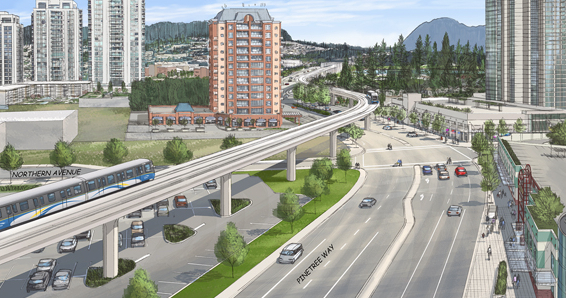
Surrey Mayor Doug McCallum won the last election, in part, by promising he could stretch the $1.6-billion in secured transit funding for 10 kilometres (of much cheaper to build) surface light rail, for 14 kilometres of much more expensive elevated Skytrain. He was, of course, proven wrong when the real costs came in. TransLink delivered the bad news last month: $1.6-billion would only pay for enough Skytrain to reach Fleetwood, about seven kilometres away – only halfway to Langley City.
Worse still, there is no funding even remotely in sight to extend the line from Fleetwood to Langley, meaning at best it might reach there some time in the late 2030s.
Sadly, the TransLink Mayor’s Council endorsed this misguided plan when Vancouver Mayor Kennedy Stewart, himself lusting for a breathtakingly expensive $7-billion Millennium Line extension to the University of British Columbia, backed up Surrey’s mayor in what could only be read as a “one hand washes the other” quid pro quo of support.
We simply cannot squander that much money, missing our chance to take intelligent action to secure a sustainable and affordable future for our region. The infrastructure funds we commit now must lay the spine for that more sustainable future.
Land use and sustainability always – and necessarily – follow our transportation infrastructure choices. In the 19th century, it was the extension of the streetcar and interurban lines that enabled transit-oriented growth. In the 20th century, it was the provincial and federal highway system that enabled explosive and sprawling auto-based growth.
But another two decades of auto-based growth will choke us in congestion and pollution. It is now both our opportunity and our responsibility to lay the spine for a more walkable, transit-based region. Fortunately, we can. And cheaply.
We can reactivate an existing 90-kilometre passenger rail line all the way from Surrey to Chilliwack for less than the cost of the seven-kilometre Fleetwood Express.
How is this possible? By reviving the still-available, provincially owned BC Hydro interurban rail line. This still-operational line connects every urban centre between Surrey and Chilliwack, as well as more than a dozen sites of higher education and a host of jobs centres employing tens of thousands.
And best of all, it was only the “freight use rights” that were sold to Southern Rail and Canadian National when passenger use ceased, while the “master agreement” protected the passenger rights for public use in perpetuity. We could literally have rail passenger service from Surrey to Chilliwack reactivated in months, rather than the many decades our present path requires.
This existing rail line is completely separated from roads, with crossing gates already installed at major intersections. The full cost of improvements, including a dozen stations, a maintenance yard, additional crossing gates and numerous passenger vehicles, would be less than the $1.6-billion already in hand. Best of all, rail companies now manufacture hydrogen-powered, zero-greenhouse gas rail cars that cost only slightly more than diesel-powered cars.
So, what will it be? A 90-kilometre rail service for North Delta, Surrey’s industrial district, Newton, Cloverdale, Langley City and Township, two Kwantlen Polytechnic University campuses, numerous campuses of the University of the Fraser Valley, Trinity Western University, Gloucester, Abbotsford, Huntington, Vedder Crossing, Sardis and Chilliwack for a grand total of $1.6-billion or the seven-kilometre Fleetwood Express, added to the already at-capacity Expo Line.
It’s your choice, B.C.
Professor Patrick M. Condon
University of British Columbia
James Taylor Chair in Landscape and Liveable Environments2357 Main Mall
Vancouver, BC – V6T 1Z4
So, it ends up being a “participation medal” of sorts that’s shuffled around to a different member city each year, give the transit staff something to feel good about, but completely meaningless from an aspirational perspective.
Brit Gardner
TransLink has won an award, but we have seen this before. In the 1990’s BC Transit won a same sort of award but the following year the transit system collapsed due to the fact BC Transit deferred maintenance to fudge the figures to win the award.
TransLink has a long record with questionable claims about ridership, etc. and the flood of news releases claiming almost impossible ridership gains in the last few months and no independent verification of said claims means that the APTA used questionable statistics with their award process.
The APTA award has just become a participation award and designed to influence the rubes, err I mean the mayor’s sitting on the Mayor’s Council On Transit to vote for over $5 billion for two very questionable transit projects which will do nothing to improve transit in the region but will keep TransLink’s ponderous bureaucracy growing.
It has worked.
The problem with TransLink is that you can never believe what it says; TransLink never produces a report based on the same set of assumptions.”
Former West Vancouver Clr. Victor Durman, Chair of the GVRD (now METRO) Finance Committee.
Scenes like this will become commonplace as the Expo Line ages
LORINC: Understanding how the TTC won North America’s top transit prize
When the TTC announced on Monday that it had won the American Public Transportation Association’s (APTA) award for outstanding achievement for 2017, many Toronto commuters and pundits had a kind of collective WTF moment, puzzling over the mystery of an Oscar conferred on a movie we all love to hate.
“A development that will raise eyebrows,” noted the Toronto Star’s Ben Spurr. “Is this some kind of joke?” The Sun fulminated rhetorically, adding that “it’s been a bad year for reality.”
“No one is saying it’s perfect,” responded TTC CEO Andy Byford, who hastened to point out that the system had “lost its way” since its last victory, back in 1986 – an observation that ignored a host of obvious achievements, like the 2003 ridership growth strategy and the execution of the TTC’s accessibility program.
As usual (and yesterday’s reaction was no exception), the TTC catches a great deal of flack that is properly directed at our elected officials. These are the folks who fail to invest in expanding a heavily-used system, shovel vast sums into hopeless projects, jack up fares to protect the delicate sensibilities of property taxpayers, and wantonly punish riders by forcing service cuts.
The politicians we send to City Hall (and Queen’s Park and Ottawa for that matter) are responsible for a lion’s share of the problems that generate all the grumbling about the TTC. And for that, we have only ourselves to blame.
Indeed, the APTA award, in some ways, sends a discrete signal, audible mainly to transit nerds, that the TTC runs a tight ship in spite of, well, everything.
Having said all that, what follows may sound like nit-picking.
My issue with the APTA’s prize is that it’s extremely difficult to figure out why, exactly, the TTC won. And against whom. And by which measures.
Strangely, the news of the prize came straight out of the TTC; the APTA didn’t formally announce it (still hasn’t). The association’s spokesperson, Virginia Miller, told me yesterday that they allow individual winners to reveal their victories at their own pace. Unlike most of the organizations that compile various city rankings, APTA doesn’t publish a list of the participating agencies, any kind of score sheet, nor a guide to its methodology for determining how the competitors are judged. In an age of open data and public sector transparency, the process is remarkably opaque.
Miller did share some details in an interview, however. The TTC’s award is for a category of transit agencies with at least 20 million trips per year (the TTC tops 500 million). That means 56 APTA member agencies are eligible, although she wouldn’t disclose which others submitted entries. The award is based on performance over a three-year period, from 2014 to 2016.
There are two categories of criteria – qualitative and quantitative. Under the former, Miller said, agencies are judged according to seemingly quantitative areas such as safety, operations, maintenance, customer service and financial management. The qualitative category also includes fields such as workforce development, minority and women participation, marketing, accessibility and community relations. Miller explained that for the latter, the TTC cited its partnerships with the National Ballet and Maple Leaf Sports and Entertainment, as well as its handling of the 2015 Pan Am Games. The TTC submitted a description of how it moved people around during the 2015 Games but the APTA, she added, didn’t verify the data provided.
As for categories with actual metrics, the TTC scored well in cost-per-vehicle hour, chalking up a 2.1% drop over the three-year period. Another was “mileage between delays,” which saw the TTC record a 30% increase (also good). The APTA lauded the TTC for its five-year modernization plan and a decision to add 700 weekly hours to its night bus service, which, truth be told, is less an accomplishment than a reinstatement of a service that had been cut during the Rob Ford era.
Finally, Miller noted that the APTA’s prize also took into account the fact that the TTC’s subsidy, 89 cents per rider, is the lowest in North America.
Which brings me back to the strange politics of a prize like this.
The TTC’s management works hard to ensure that the agency is run cost effectively, but Byford & Co. don’t, of course, make the final decision about the level of subsidy per rider. That’s a political choice, which does bear the commission’s imprimatur but is ultimately the responsibility of city council and Kathleen Wynne’s Liberals, who have studiously ignored long-standing calls to reinstate the Bill Davis-era subsidies (50% of the operating shortfall and 75% of capital outlays) that were on par with almost all other transit agencies in most large Western cities. (The current provincial operating subsidy has been nothing since Mike Harris declared transit to be an entirely local responsibility way back in 1996.)
In other words, the TTC’s shiny prize rests, in part, on a perverse incentive: the agency gets more points for starving itself.
Which begs this question: Does this award increase or decrease the political imperitive to invest in more and better transit for Toronto?
On the glass-is-half-full side, you might say that the APTA’s gold star tells politicians and the voters they answer to that the TTC is a tightly run operation, and thus worth investing in. But a cynic (!) might argue that the prize, in effect, takes the pressure off those same politicians, because North America’s largest transportation association is telling all and sundry that everything’s fine, nothing to look at here.
I’m inclined to opt for what’s behind curtain number two, especially because the APTA’s award is so wanting in the kind of transparency that would allow the public to make an informed decision about what this prize actually measures.
Don’t get me wrong: I’m not complaining about Team Byford. They are doing a solid job under perennially crappy conditions. And who could blame them for trying to get a bit of love in a city that complains endlessly about its transit system?
Let’s just hope the APTA’s gold star doesn’t turn out to be a subtle double-edged sword, one that gives the transit haters out there – and you know who they are – just one more reason to perpetuate the thin trickle that’s been dribbling out of the funding taps for lo these many years.




 In US Dollars






Recent Comments