Once again the Massey Tunnel is in the news and every political hobby-horse is in play!
Delta South MLA, farmer Ian Paton, wants the original Liberal inspired 10 lane bridge, which somehow will magically fix gridlock, while at the same time ignoring the fact that there is no new bridge crossing the North Arm of the Fraser river to South Vancouver/Burnaby. This means highway 99 in Richmond will be turned into a massive parking lot.
So, for three or four billion dollars we will have moved gridlock about 5 km.
It does not matter a bridge or tunnel unless another bridge or tunnel is built from Richmond to South Vancouver/Burnaby, gridlock will reign supreme.
The following map is nothing more than a conceptual idea what should be done as what the Ministry of Transportation wanted to do back in the 90’s before the Liberal kow-towed to the Port Authority to remove the perfectly good tunnel so Cape Max. tankers and colliers could travel up the Fraser to load Montana coal and Braken oil.
Those plans are now dead and so should the push for replacing the Massey tunnel!
The real issue is that TransLink, as incompetent as ever, has failed to provide a user friendly bus service from South Delta to Vancouver and the same is also true about buses from South Surrey/Whiterock. This is because of a very questionable agreement between TransLink and the SNC Lavalin lead consortium operating the Canada line P-3. This secret agreement forces all Richmond, South Delta, South Surrey and Whiterock buses to forcefully transfer customers onto the Canada Line at Bridgeport Station to pretend the under-built, grossly expensive Canada Line is somehow successful.
That’s right, SNC Lavalin involved in another transit fiasco. Is there not one politician who not afraid to rid ourselves of this loathsome company?
Maybe a daily 15 minute 602 service, from 6 am to midnight from Tsawwassen to downtown Vancouver, would attract a portion of car drivers from South Delta, as it is the kind of service transit customers want!
At present, TransLink and the mayor’s Council on Transit and the provincial NDP (as well as the Liberals) have shown zero interest in improving South Fraser bus service. All they care about is building a politically prestigious bridge for photo-ops before an election.
(Courtesy Integrity BC – green is the George Massey tunnel))
As one can see, the demand for traffic using the Massey tunnel has hovered around the 80,000 for over thirty years. This should pose some very interesting questions for the Bridge Lobby, which has been so successful in deliberately misstating their case to the mainstream media; especially the old saw that gridlock is growing yearly, which it is obviously not!
Is it not time for honest debate and just as honest planning?
So, despite the hype and hoopla of SkyTrain being a driver for increased density, it is now being seen as the harbinger of urban sprawl as affordable housing is demolished and in its place unaffordable condos in towers are built.
As rents exceed income and combined incomes of families (one now needs an income of $140,000 a year to afford an average new downtown condo), poorer families escape to the transit poor ‘burbs’, where housing is affordable.
The city it seems, can only get more market rentals at presumably unaffordable rates and there is no real benefit, except low income families fleeing the City Vancouver.
So, what do metro mayor’s do, they double down build more of the hugely expensive MALM proprietary light metro of course, to be used as a driver to tear down more affordable housing to build more unaffordable housing. This is called renoviction in polite society; in not so polite society it is called profiteering.
$4.6 billion to build 12.8 km of light metro on routes that do not have the ridership to sustain it, only shows the complete ignorance of our regional mayors, the Minister of Transportation, the minister responsible for TransLink, TransLink’s CEO and TransLink’s planners, and the Engineering society as a whole!
Such wilful ignoring of the facts boils down to malfeasance on a grand scale.
In just a short decade from now, civic and provincial politicians are going to wake from their transit stupor, too late, and see the City Vancouver as a vast wasteland for the very rich and the very poor, with roads and highways choked with commuters driving from where living is affordable to work where it is unaffordable and the $20 billion of taxpayer’s money spent on the light metro system will be seen as another politically driven mega-project gone wrong.
We must go back to the basics, only seven of the now called MALM proprietary railways have been sold, with only three being seriously used for urban transport. Not one has been sold in over ten years and Metro Vancouver is the only region in the world that exclusively uses light metro for urban transport.
In an age of unprecedented investment in urban transport, no one has copied Vancouver or its exclusive use of light metro and now it is embarrassing apparent why!
Mr. Villegas has a degree in architecture from UBC (B Arch); a diploma in Building Technology from BCIT; and a bachelor in Liberal Arts from SFU. He has practiced since 1985, completing several downtown revitalization projects in the Lower Mainland and throughout British Columbia worked 3 years as a consultant to LCA Portland, a new urbanism firm.
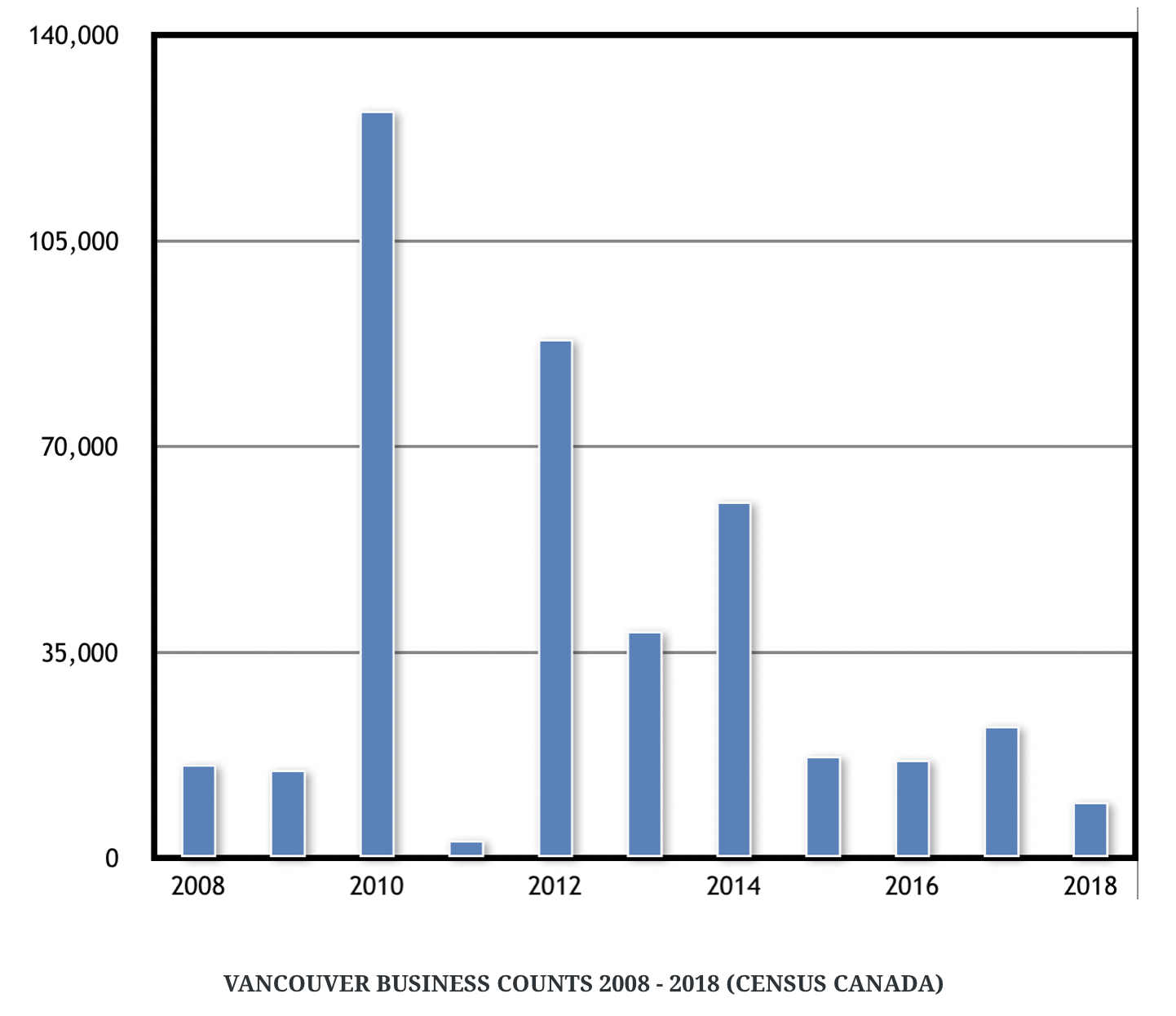
BUSINESS IN VANCOUVER AT 10 YEAR LOWS
The City of Vancouver led the way on Regional Planning for maintaining ‘our high quality of life’ building the Skytrain-and-Towers; hosting a Class B Expo (1986) and the Winter Olympics (2010). Now we are feeling the blows of serious errors in planning:
Business counts are the lowest in 10 years;
There is an out-migration of middle-income families looking for affordable housing;
Mentally ill, street-involved citizens are being housed in tents at Oppenheimer Park;
Streets and the sidewalks almost everywhere are in a bad state of disrepair; and
The school system is ‘sputtering’ at the elementary and high school levels for lack of funding.
… Could bankruptcy be next?
The Regional Plans singled out for special attention the single family house—denigrating it as the agent of sprawl—and the private automobile—berating it for polluting the air and causing congestion. Yet, the drafters of the Regional Plans completely missed identifying the electric car as the ‘Urban Innovation of the Century.’ A new technology that will clean the air and make of the ‘Age of Combustion’ a bygone era.
Cities looking to succeed in the present climate must embrace the new technology and leverage it into a bright, green future. As well, the failed ideologies of the Regional Plans must be let go.
Following on the direction of the regional government, for over 30 years, Vancouver councils went about finding ways for discouraging automobile use—including taxing fuel, hiking parking fees, and closing road lanes to cars. They also set about redrawing neighborhood plans to identify potential tower sites. The concrete-and-glass behemoths are energy hogs with huge carbon footprints that cannot compete with the vernacular building forms in the new, combustion-free era. City initiatives based on the failed Regional Plans have rained unwanted results in the neighborhoods while failing to reduce traffic congestion, or deliver clean air. Then, there is the problem that the Regional Plans—far from sustaining ‘our high quality of life’—have driven us head-long into a housing crisis. There is more pollution everyday, and more traffic congestion. Sometimes the arterials are choked all day long. But, now—and for over 20 years—median income households cannot afford to own a house in this city. That condition has now spread from the centre to blanket the entire region.
The effects of the failed Regional Plans are clearly visible in Downtown Vancouver. Here, the new restrictions and closures have hung up a big metaphorical sign proclaiming, “Downtown is Not Open for Business.” If you can’t get here by walking, or on transit, then don’t bother to come at all. In response, people have stayed away in droves. The loss of affordable housing in the downtown core has further stymied business growth. The empty luxury condominiums pay city-tax, but they don’t spend dollars at downtown shops.
Turning downtown into a residential and hotel concrete tower Nirvana for the tourism and convention trade—complete with casinos for Chinese money laundering—has caused the regional capital to lose its competitive advantage. Save for tourists and conventioneers, and office workers at lunch hour, visitors arriving downtown feel unwelcome and many have simply stopped coming. One visible result is papered-over storefronts in increasing numbers on Robson Street and Gastown.
The bars from the 2010 Olympics never closed down after the crowds went home. Granville Street Mall today is an unrecognizable mutation of its former self. Block after block of Granville Street is host to booze joints and boozers. Not exactly an exemplary model of supporting high levels of social functioning; not exactly a place to take the family. The sidewalks and the streets around Granville Mall are filthy. The trees were cut down for the Olympics. The new trees are small and scrawny. And everywhere the traffic is a mess. We did all this to build towers—to add density! Yet, Downtown the residential towers are mostly dark, setting the mood for the entire place.
Meanwhile, the same animus driving against private transportation has government falling behind on building Modern Tram and automobile infrastructure—including new highways and bridges. These missing projects are now the new drag on the economy.
As we all should know, the Caisse is the main finical backer of the Canada Line faux P-3 and using the BC Liberal P-3 process as a template, the Caisse is now funding Montreal’s highly controversial REM light metro project.
As built, the Canada Line is a dwarf metro system that uses electrical multiple units running in pairs and with the station platforms are a mere 40 metres long (half the length of the Expo and Millennium lines), gives the Canada line roughly half, the capacity as the other two light metro lines.
Has Vancouver’s mainstream media done any investigative reporting on who owns the property along the Canada line? What profits were made and by who,by building a substandard metro.
Has there been any investigation of property deals being made on the Broadway subway? Who is making substantial profits on the $3 billion transit line?
In short, NO! Our media does not do any investigative reporting on transit issues and pretends they don’t exist.
There is more investigative reporting done by the Montreal Gazette on this one issue than the Vancouver Sun has done on the SkyTrain light metro system since it was forced upon the taxpayer in the early 80’s.
Sadly, light-metro lines are built for one reason only, land development. Translation, quick profits for political insiders, land developers and land speculators.
What is being exposed in Montreal, is kept well hidden by our media.
Caisse’s stake in A40 REM station troubling, probe finds
Deep financial ties in St-Laurent industrial enclave leave critics asking: Was the stop chosen to serve transit or real estate priorities?
The future A40 station of the Réseau express métropolitain will rise on a site where its builder, the Caisse de dépôt et placement du Québec, lost money in a multi-million-dollar real estate boondoggle it tried to conceal in the mid-1990s.
But that isn’t the only thing the Caisse, the province’s largest pension fund investor, hasn’t told Quebecers about the location for the station on the $6.3-billion, 67-kilometre automated transit network it will own and operate.
Unbeknownst to the public, which is paying half of the cost to build the REM, the Caisse has been investing in the industrial enclave that surrounds the future “Station A40” for decades, an investigation by the Montreal Gazette has found.
In fact, the Caisse’s real estate ties in what’s known as the Hodge-Lebeau neighbourhood, an area hemmed in by Highways 40 and 15 and the railway tracks on the edge of St-Laurent borough, run long in terms of time span, far in terms of square footage and deep in terms of financial investment.
And yet three transportation experts consulted by the Montreal Gazette agree that the A40 stop, which the Caisse plans to shoehorn in between the existing Mont-Royal and Montpellier stations of the Deux-Montagnes rail line, isn’t even necessary. The Caisse plans the new stop as a transfer point for passengers on the Mascouche commuter train line, but the experts say the transfer can be done without adding a station.
The newspaper’s findings raise a troubling question, say critics of the REM and its model as a publicly funded, privately owned public transit project: Did the Caisse choose the path for the REM and the A40 station to serve mass transit priorities or to maximize real estate gains?
“I think there are hidden real estate interests,” said Jean-François Turcotte, a rail transportation specialist who presented a brief opposing the project at the 2016 public hearings on the REM held by the province’s independent environmental-impact assessment board, the Bureau d’audiences publiques sur l’environnement.
“You can ask whether there were other places to put a transfer station. The answer is yes. And in terms of distance, it’s much too close to the Mont-Royal and Montpellier stations to have a third station. It’s not efficient.”
“Paradoxically, in the West (Island), no REM stations are planned at St-Jean and St-Charles Blvds., two major transportation corridors. No way to develop real estate in these areas, I suppose?”
No one would guess at the Caisse’s omnipresence in the Hodge-Lebeau neighbourhood to look at the sprawling lots occupied by low-rise buildings dating mostly from the 1960s and 1970s — and neither would anyone checking the current ownership of the buildings.
Yet a property search reveals the Caisse once owned about 20 buildings in the 1.5-square-kilometre enclave through numbered companies and other subsidiaries. It has also dabbled in mortgage-lending on some others.
The records also reveal the Caisse transitioned in the late 1990s from ownership to background involvement as a mortgage lender or shareholder — or both — for the area’s two most prolific building owners.
Cominar Real Estate Investment Trust, one of the largest owners of non-residential properties in Canada, owns a numbered company that in turn owns nine of the properties that once belonged to the Caisse on the east side of the Deux-Montagnes railway tracks that cleave through the neighbourhood. The holdings include a row of buildings on Deslauriers St., directly across the street from the future station that will straddle the tracks.
The Caisse, meanwhile, owns a nearly five per cent stake in the publicly traded Cominar.
The Caisse sold the Deslauriers buildings to Dundee Real Estate in 1999 and financed Dundee’s purchase. Cominar became the owner in 2012.
The other major owner in the enclave is Olymbec, a private company with properties across Quebec and Canada. The Caisse financed Olymbec’s purchase of nine buildings in the enclave, most of them on Stinson and Hodge Sts. and on Montpellier Blvd. on the west side of the tracks, in 1996, 1997 and 1999.
Olymbec received new financing in 2016 and 2017 from the Caisse and its mortgage-lending subsidiary, Otéra Capital, for all but one of the buildings.
Olymbec also bought a building on the west side without Caisse financing in 2015.
Besides the Olymbec properties, the Caisse has had financial interests in four other buildings on the west side of the tracks near the future A40 station that its subsidiary, CDPQ Infra Inc., will build for the REM.
And SNC-Lavalin, which counts the Caisse as its largest shareholder, also owns a building in the Hodge-Lebeau enclave, on the east side. SNC-Lavalin is part of the consortium that won the engineering and construction contracts for the REM.
The upshot is that the Caisse has had financial interests in 37 buildings in the neighbourhood over the years, about one-third of all of the properties in the area.
Currently, the Caisse has financial interests in 18 buildings in the enclave through its mortgage-lending and shares in companies, including properties that are as close as can be to the future A40 station without being expropriated for it.
In real estate parlance, that’s known as “synergy.”
And a major redevelopment of the enclave tied to the REM is indeed being quietly planned, the Montreal Gazette has learned.
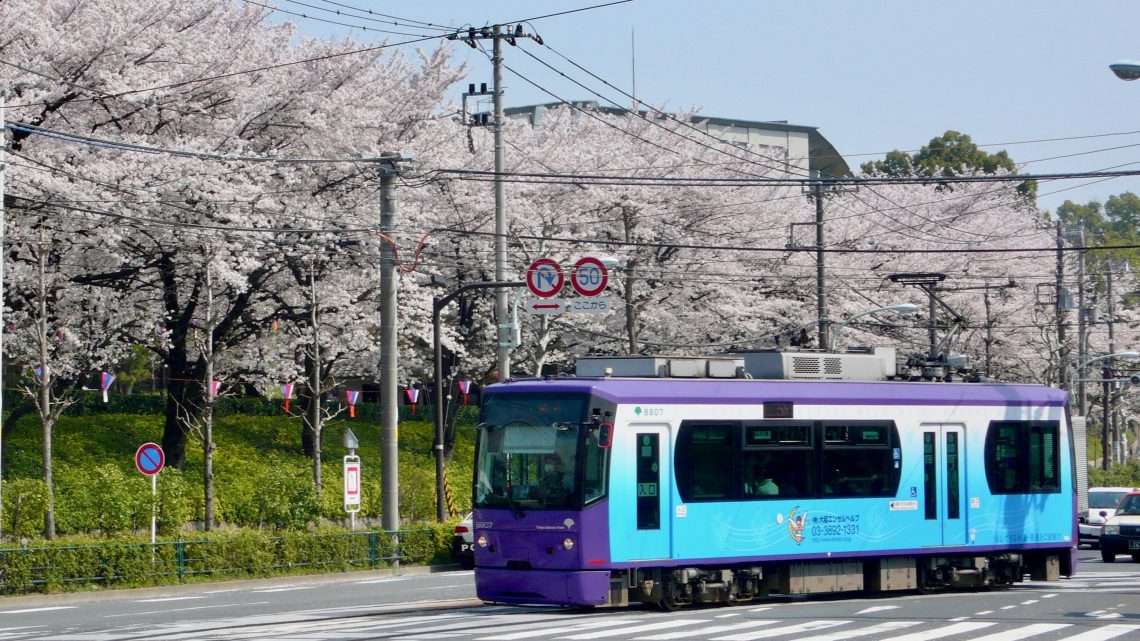
Osaka, a Japanese city famous for rugby and trams.
Hankai Tramway Co., Ltd. (Hankai Denki Kidō Kabushiki Gaisha) is a company which owns two tramway lines in the cities of Osaka and Sakai, Osaka, Japan. The parent company is Nankai Electric Railway Co., Ltd.
Osaka prefecture’s last remaining streetcar, known affectionately as “Chin Den,” is still used by the people of Osaka today. There are two lines, the Hankai Line, which runs from Ebisucho, just steps away from Tsutenkaku to the area in front of Sakai’s Hamadera Station, and the Uemachi Line which links Tennoji Station with Sumiyoshi. The Hankai Line’s predecessor, run by the former Hankai Tramway Co., Ltd. began operation in 1911. Meanwhile, the Uemachi Line’s predecessor began running in 1900 under the operation of the Osaka Carriage and Tramway Co., Ltd. As the name suggests, at the time, horse-drawn carriages ran along the rails. Along the line is Abe no Seimei Shrine, said to be the birthplace of Abe no Seimei, a famous ‘onmyoji’ yin-yang diviner, as well as Sumiyoshi Grand Shrine, also known as Settsu Ichinomiya. Along the route, you’ll also find Akiko Yosano and Sen no Rikyu’s Sakai Plaza of Rikyu and Akiko, the Sakai City Traditional Crafts Museum, Nanshuji Temple, Daianji Temple, and many other famous temples. Also recommended is the one day “Teku Teku Kippu” free pass, ¥600 for adults and ¥300 for children.
The term choo-choo, used by ill informed opponents of light rail is standard across the country but really has no basis as LRT remains one of the most effective way to move people.
The problem in North America is that our universities are still mired in the 1950’s and all subjects pertaining to urban transport support almost mythical solutions. Canadian Universities to not teach modern public transportation, nor to they offer degrees in urban transport and sadly most graduates from Canadian universities, with engineering and planning degrees largely remain ignorant of light rail.
If modern public transport was taught at universities, there would not be the misinformed angst by Engineers and Planners.
Today, light rail, in its various forms from streetcars and trams, light rail itself or tramtrain is both the most popular and safest mode of public transport in the world. Built properly the modern tram has a proven record in attracting the motorist from the car: a record envied but not matched by those championing various proprietary and more expensive transit modes.
Alas, in Vancouver our blinkered and inept band of politicians, still living in the 1950’s, continue to pursue gadgetbahen, such as Movia Automatic Light Metro (was once called ICTS; ALRT; ALM; ART; Innovia) and not allow the much cheaper and more flexible LRT from being built.
Congratulations to Ottawa on its opening of light rail.
LRT’s early champions mark bittersweet victory
‘Cuckoo choo-choo’ finally arrives, but advocates ponder what might have been
CBC News ·
As politicians cut the ribbon on Ottawa’s Confederation Line on Saturday, there were dozens of public transit advocates quietly watching from the sidelines, knowing they’d all had some small part to play in the decades-long struggle for light rail in Ottawa.
“It’s hard to believe, but it has taken 30 years,” said longtime LRT proponent and former city councillor Peter Harris, who remembers when the crusade began.
Attitudes change. It’s just an evolution of thinking.– Peter Harris, former Ottawa city councillor“That was back in 1989. The region of Ottawa-Carleton had a whole different philosophy on transportation. They were sold on the bus transitway. They had plans in the works to do expressways for cars.”
Harris believes LRT’s arrival could have come much sooner if there had been the political will.
“I opposed the bus tunnel, and I was told at the time I should know better.”
Unsung heroes
David Jeanes is the former president of Transport 2000, later renamed Transport Action Canada. (CBC)
David Jeanes, another early proponent of commuter rail, helped launch Transport 2000, later renamed Transport Action Canada, and was front and centre in 1997 when the former regional council finally decided to explore the possibility of LRT.
“Despite the 22 years that have elapsed … I am pleased that we are finally getting a viable system,” Jeanes said. “It includes many elements that I have been one of the first to promote, including the airport extension, which I had proposed back in 2000, the Parkway-Richmond Road routing, which I proposed in 2008, the location of the tunnel portals which I proposed to the task force in 2007, and the retention of a Trillium Line maintenance facility in the vicinity of Walkley Yard.”
There were others along for the ride, Jeanes said, and they became known as Friends of the O-Train.
“Tim Lane, Michael Richardson and Steven Fanjoy were the driving force behind the Friends of the O-Train opposition to a combined bus transitway/LRT across downtown, instead promoting east-west electric LRT only in the core.”
Harris added to the list of citizens who helped shepherd in the LRT era in Ottawa.
“I teamed up with Michel Haddad and Greg Ross, and we formed Citizens for Alternative Transit,” Harris said. “We did our research and had a meeting right in regional headquarters. It had about 200 people. And CP Rail sent a representative, Bombardier, Siemens, on what we could do with rail, what had been done in other cities, and I was impressed with the number of people in Ottawa that really knew about rail.”
‘A cuckoo choo-choo’
While the movement had political allies including Coun. Pierre Bourque and Mayor Bob Chiarelli, there was no shortage of opponents, among them Knoxdale-Merivale Coun. Gord Hunter, who was concerned about the cost.
“I thought it was a cuckoo idea, a cuckoo choo-choo. It just didn’t make sense to be doing it,” he said.
The City of Gatineau was planning to expand its bus network despite the opportunity to tie into Ottawa’s proposed rail system, and the National Capital Commission said it had no interest in the plan. The head of Ottawa’s airport authority showed a similar lack of enthusiasm.
“Eventually the faces changed, people retired, the head of OC Transpo moved on,” Harris said. “And now the Ottawa airport is for rail. So things change. Attitudes change. It’s just an evolution of thinking. I think support was always there, but you had to somehow facilitate the discussion, and I think that’s what the volunteers and the community have done over the years.”
Still, Harris can’t help thinking about what might have been. Growing suburbs such as Barrhaven and Greely continue to grapple with gridlock, with no relief in sight. Scrapping the previous light rail plan, which cost the city millions in legal penalties, has put any solution even further out of reach.
“The route was already there. It would have been finished a long time ago,” Harris said. “In hindsight, I think that was a mistake. But there’s not much we can do about it now.”
The new 16.2 km tramway in Caen, France has opened after a nineteen month build.
Granted the new tramway has used the the previous trouble prone, 15.7 km, TVR rubber tire guided bus line, which opened in 20o2 and abandoned in 2017.
The Euro €260 million (CAD $373 million) tramway opened six weeks earlier than forecast and now carries over 64,000 passengers a day. The previous TVR guided bus system carried 42 thousand passengers a day.
The Caen tramway operates three Lines and serves 37 stations.
Twenty of the twenty-six, 33 metre Citidis 305 are used at one time, providing a 10 minute service throughout the day on the three line system.
The 26 vehicles cost €52 million ($73.3 million) and the OHE and substations were reused from the previous TVR operation.
And just to think, Metro Vancouver is spending $4.6 billion to build 12.8 km the dated Movia automatic Light metro system.
Footnotes: The author, Adrienne Tanner, was city editor at the Sun, a newspaper that prevented any real reporting of our regional transit issues and took orders from back east to report “SkyTrain” in a positive light. As well, there was little investigative reporting on SNC-Lavalin’s B.C. operations.
Detroit’s ALRT system officially called a People Mover (locally known as the “Mugger mover”) is a 4.73 km single track loop sold as an ICTS system. Today, only about 4,300 people a day use the system.
So, what else is new.
The decision to use the then renamed ALRT system instead of LRT on the first “rapid transit” line in Metro Vancouver was a crass politcal deal between then Social Credit Premier Bill Bennett, to obtain the famous Bill Davis Blue Machine, to win an election. The Social Credit Party, at the time, held a one seat majority.
The Big Blue Machine, a cadre of advertising, public relations, and polling professionals who advised the Ontario premier during campaigns and in government and in turn, the Bill Davis Conservative government sold BC the Ontario Crown Corporation Urban Transit Development Corporation’s obsolete and unsalable Intermediate Capacity Transit System, renamed Advanced Light Rail Transit for the benefit of the Premier of BC.
The Social Credit won the next election and we have been building with ALRT or its variants ever since, except for one exception, the Canada Line, which was a Gordon Campbell driven faux P-3 project.
The NDP were induced to build more of ALRT, now called ART with the promise of jobs, jobs, jobs, with a fabrication plant built in BC.
The Canada line was phony BC Liberal P-3 project which in the end, seemed more like a giveaway to SNC Lavalin and the Quebec Caisse.
Politics dictated that LRT was not to be used.
The Evergreen line was again ART because it was the unfinished portion of the millennium line, as the mini-=metro was far too expensive to build to the Tri Cities.
More politics, more squandering of money.
The present plan to spend $4.6 billion for 12.8 km of now called MALM (Movia Automatic Light Metro, the most recent renaming of the now obsolete ICTS/ALRT system) is all about civic penis envy, as the former NDP MP, and now Vision Lite mayor of Vancouver continues the city’s quest to build subways.
“Because subways make Vancouver world class.”
The argument that there is not the ridership to justify a subway anywhere in Metro Vancouver is politely ignored, unless one works for TransLink, then you are fired if you are an employee or sent to Coventry by the mainstream media.
Tut-tut, facts you say, pity.
The Mayor of Surrey want light metro because Vancouver has three and as to the cost, who cares, he is the civic potentate and believes he can stop the tide and light rail for that matter.
Zwei was told some years ago by a European transit specialist;
“Vancouver’s approach for planning regional transit was unprofessional and extremely expensive. From our viewpoint, it seems your politicians truly believe your streets are paved with gold.”
The LRT plans for metro Vancouver. For the cost of LRT from downtown Vancouver to Richmond, Lougheed Mall and Whally, the region got ALRT to New Westminster.
In late August, at the beginning of the pre-federal election hype, TransLink’s Mayors’ Council on Regional Transportation is raising a second rallying cry for a traffic congestion relief fund.
The idea, originally pitched in the spring by the Federation of Canadian Municipalities, makes infinite sense. It calls for the federal government to stop project-by-project transit investments and instead contribute $3.4-billion annually to a fund that would be divvied up among Canadian cities based on ridership.
For TransLink, it would amount to a contribution of $375-million each year.
That amount of stable funding would allow TransLink to deliver on long-term plans and essentially strip the politics out of transportation funding. While this may
sound reasonable by any measure, it’s unlikely to happen.
Transportation funding has forever been driven by politicians seeking headlines for projects in ridings they hope to keep or win. And that’s too bad because it leaves municipalities continuing to scrounge to pay for less glamorous transit necessities from other sources.
TransLink is required by law to plan 10 years ahead, which is far longer than any election cycle. The lengthy horizon is necessary because transportation projects are so expensive that funding for any region typically only allows for one or two at a time. The SkyTrain line from Surrey to Langley is expected to cost $3.12-billion; Vancouver’s train to the University of British Columbia could top $4-billion. The price tags on both projects are so high that so far, funding is only in place to build both to the half-way mark.
While they are being built, those plum projects for Surrey and Vancouver will suck up most of the available cash, leaving other Lower Mainland mayors waiting for their turn. The mayors are only willing to be patient if they can look at a long-term plan and see their projects moving higher in the lineup.
However, transit planning is predicated on contributions from municipal, provincial and federal levels of government. And when the higher levels of government jump the queue to pick and choose projects, long-term plans fall by the wayside.
This presents challenges for the less sexy necessities, like maintenance centres for transit lines — items which need funding, but don’t lend themselves to flashy ribbon-cuttings, says Johnathan Cote, who chairs the mayors’ council. And that’s where the trouble lies. Big ticket transit projects, like trains and SeaBuses, are big hits with the public – you might recall the lineups of riders keen to try out the Canada Line on opening day in 2010. It’s understandable that federal and provincial politicians, who always have their eye on the next election, like nothing better than to announce an attention-grabbing new train line.
Buses, which form the backbone of the transit system, don’t have the same cachet, so garner less federal investment.
Vancouver Mayor Kennedy Stewart points out the opportunity for municipalities to pull together any kind of big transit or housing deal is far shorter than the four years between elections.
“It’s a very short window when all three levels of government are stable enough to sit down and plan without thinking about, ‘who’s going to vote for me.’”
Mr. Stewart supported the FCM congestion fund request even though he doubts it will come to fruition, and feels transit is still secondary to housing on Vancouver’s needs list. He lobbied for the FCM to launch a pre-election push on housing but lost because outside of Vancouver and Toronto, housing isn’t top of mind for most Canadian cities.
To be sure, transit is a key election issue in the Lower Mainland – total ridership increased by seven per cent in 2018, to reach an all-time high. Mr. Stewart, himself a former NDP MP, is using this pre-election window to meet with all parties to stress how much Vancouverites depend on transit.
The parties have all been receptive, he says. However, the real work will come post-election to make sure promises are kept.
It would be nice if the money was delivered through a beefed-up congestion relief fund. But it’s more likely that the politically motivated announcements will continue. And perhaps it doesn’t matter that much. Ultimately what counts is that transit investment continues so we can keep moving in ways that simultaneously reduce congestion and greenhouse gasses.
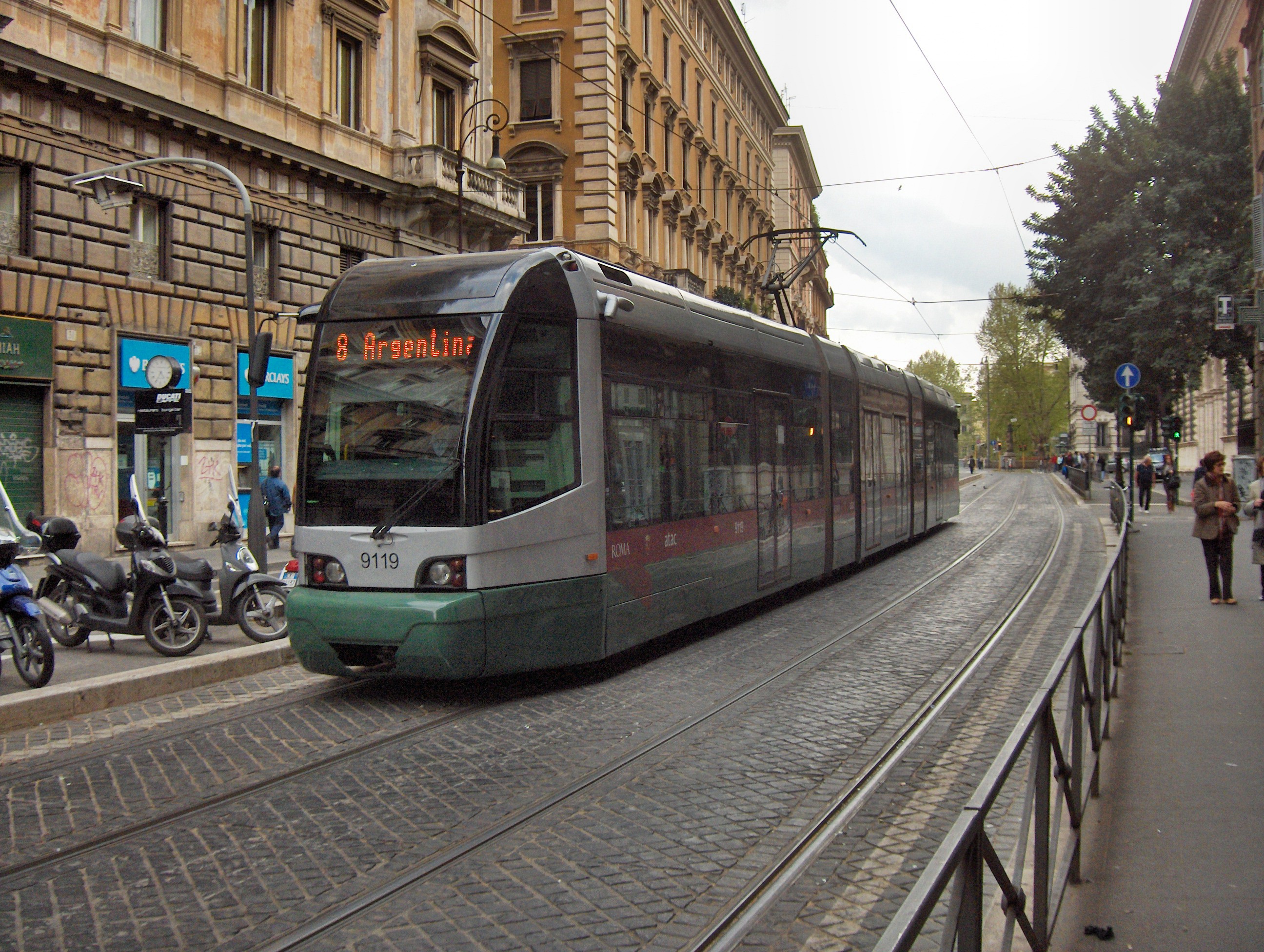
With nearly 600 tram and light rail systems in operation around the world, this is hardly surprising.
With Vancouver being the odd-ball city, insisting that the light-metro is the way to go, taxpayers have to have extremely deep pockets, to pay for the politicians foolish financial excesses.
During an era of record investment in urban transport, where success is quickly copied and failure is not duplicated, no other city in the world has copied Metro Vancouver’s transit planning and Metro Vancouver’s building strictly with light-metro, especially with the extremely dated but often renamed, Movia Automatic Light Metro.
This makes Vancouver unique, sadly unique also means expensive.
The return of trams in cities confirms the important role they play in the 21st-century urban landscape. Nearly 120 cities have introduced their own tram systems since 2000. This study published by Eurogroup Consulting, compares and ranks the performance of 32 tram systems around the world.
Three categories of tram systems were studied:
recent tram systems in large cities with more than 500,000 residents,
recent tram systems in mid-sized cities or serving neighbourhoods of large cities with under 500,000 residents,
historic tram systems that have never been retired, such as those in Vienna, Zürich, Melbourne and Berlin.
The performance criteria used for the study included multimodal integration, speed, pricing, reliability and ridership.
Lyon, Dijon and Zurich head up the comparative study
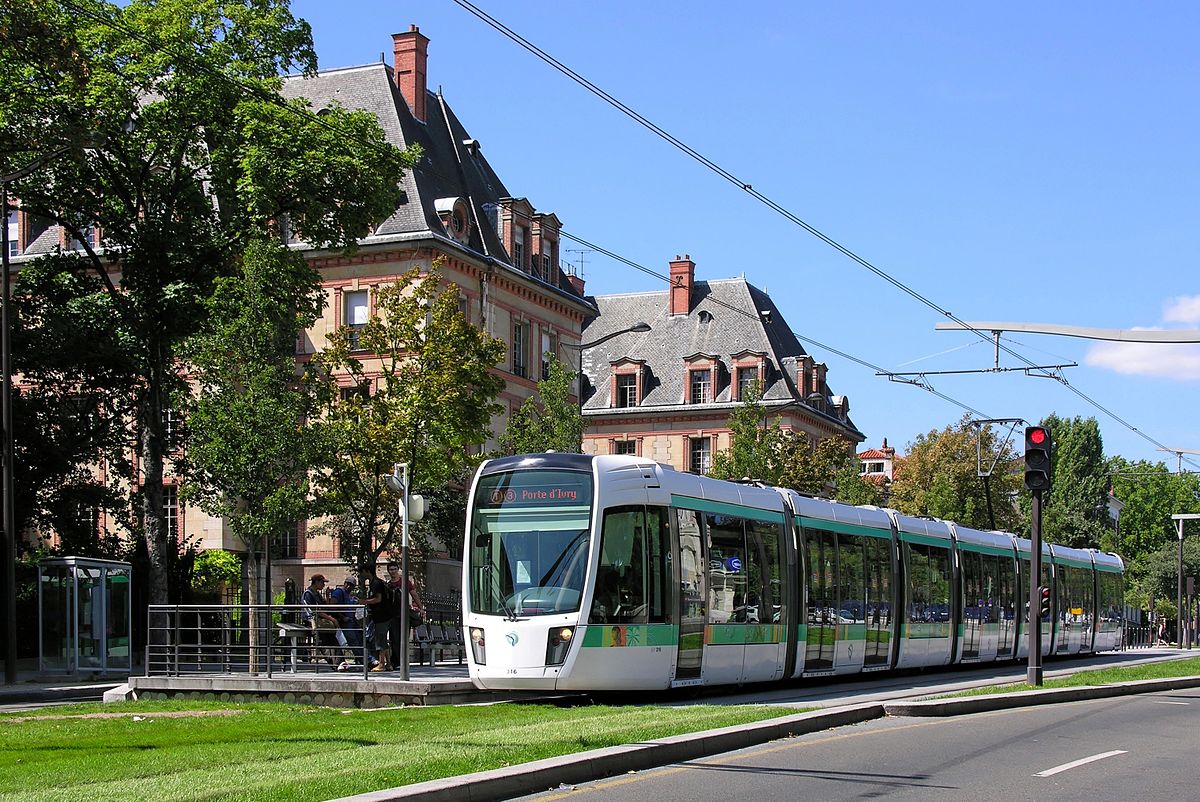
In large cities, the Lyon, Paris and Bordeaux networks top the ranking. The Lyon tram network scores highly in terms of the high level of multimodal integration that it enjoys with bus routes, the metro, stations and soft transport modes as well as the tram corridor potential with three of the network’s five lines carrying more than 100,000 passengers every day.
In mid-sized cities, Dijon and Tours in France and Bergen in Norway are distinguished. According to the study, the Dijon tram network scores above average in several criteria, notably its ticketing system where Open Payment has been introduced so passengers can now use their contactless bank cards instead of tickets. The tram’s introduction in 2012 gave a major boost to public transport usage in the city with the numbers of people using it increasing by 40% in three years.
Among historic tram systems, Zürich is distinguished in the top spot, performing well in terms of ridership as well as making good use of resources and enjoying a high level of multimodal integration. Thanks to regular investments designed to modernise the network and enhance its longevity, the Zürich tram is delivering a performance comparable to those of younger systems.
Rather than demonstrating a straightforward renewal, the results of the study show that the tram provides a mobility solution that complements structural transport networks, such as metro systems, as well as visibly revitalizing city centres in the era of green mobility.
Philipe Menesplier
Tram trends in 2019
The study also looked at tram trends in different fields including regional, management and industrial and technological trends. In regional terms, the tram is strengthening its position in a number of regions including Europe, the Middle East, North Africa, China and Australia.
Regarding management trends, although globally the public management model remains the most widespread, the study observes that transport authorities are increasingly awarding the operational management of tram systems – and more widely of their public transport networks – to private operators which are specialized in operation, maintenance and asset management. Indeed, in addition to day-to-day operational management, these operators are tasked with modernizing and transforming networks as part of long-term contracts which are sometimes longer than 10 years.
Find out about the 32 tram systems, five tram trends and the 10 keys to the success of tram networks in the attached study.
The combined naivete of regional mayors about regional transportation and the abandonment of their fiduciary duty protecting the taxpayer from ill advised “prestige projects” such as the Broadway subway and the Expo Line extension in Surrey, is just simply breathtaking!
*
Both the ill conceived Broadway subway and the now equally perverse decision to proceed extending the Expo Line, will suck precious transit monies into two hugely expensive and politically prestigious transit projects, yet not improve regional transit at all. Both projects will not take a car off the road.
*
It is simply unbelievable that regional mayors could be so collectively ill informed.
*
Let us not forget the 2015 TransLink plebiscite, which saw 62% of voters reject more funding to TransLink and now in 2019, after large tax increases in many areas in the region, I would think it foolhardy that politicians would come cap in hand for more taxes to pay for their favourite gadgets and gizmos.
*
Metro mayors have learned nothing and forgotten nothing.
*
Why is Vancouver continuing to build with light-metro and especially with a proprietary light metro, as used on the Expo and Millennium Lines?
*
Why is TransLink deliberately misinforming the public about light rail, even though it is the most popular rail mode for public transport around the world, used in one form or another in almost 600 cities around the world?
*
What is SkyTrain and why has it created such a fascination with local politicians?
*
The following may prove enlightening.
*
SkyTrain is the name of our regional light-metro system which consists of two very different railways, the Canada Line which is a conventional railway and the proprietary and now called Movia Automatic Light Metro system used on the the Expo and Millennium lines.
*
The MALM system uses Linear Induction Motors which makes it a proprietary transit system as it is not compatible in operation with any other transit system, save its own family of seven systems.
*
Automatic train control, is not proprietary but is a signalling issue and driverless trains have been around since 1927 (London’s Post Office Railway). What is now called MALM is not even the first automatic metro as London’s Victoria Line is considered the first automatic metro in the world, opening in the late 1960’s.
*
Chronology of the Movia Automatic Light Metro:
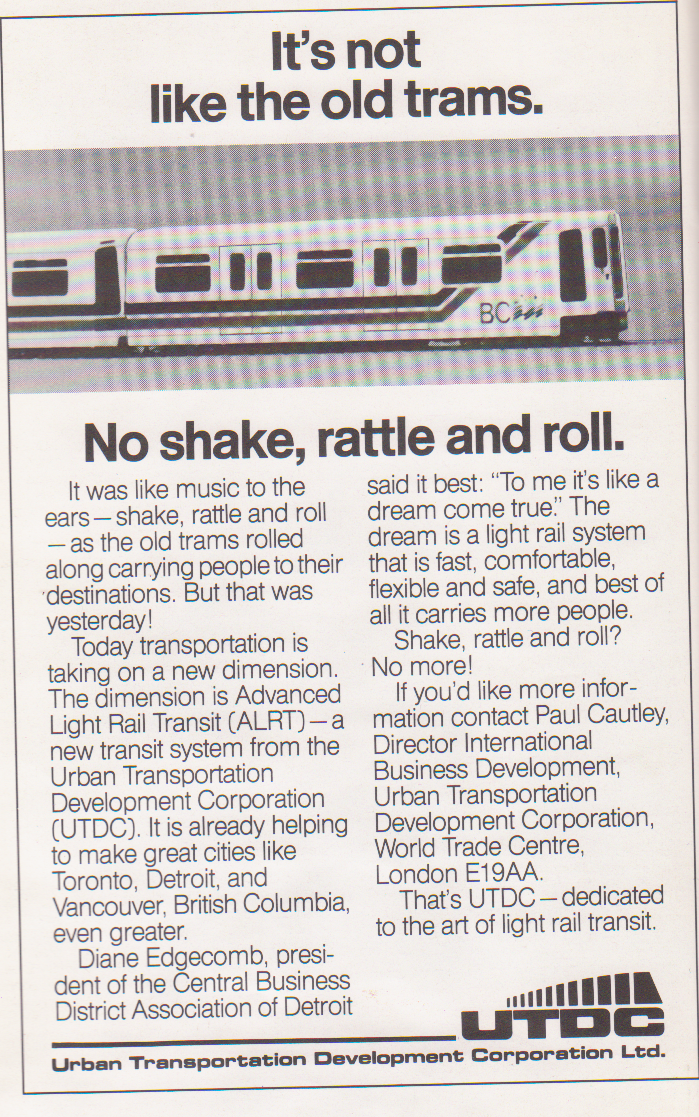
First called Intermediate Capacity Transit System (ICTS), the automatic proprietary light metro was developed by the Ontario Crown Corporation, the The Urban Transportation Development Corporation (UTDC) in the late 1970’s, using cast off technology from previously failed proprietary transit systems. The LIM’s came from the Krauss Maffei Transurban MAGLEV. Two systems were built; Detroit as a single track demonstration line and Toronto system, forced upon the TTC by the provincial government. The 1983 IBI and ART Studies commissioned by the Toronto Transit Commission found that ICTS could cost anywhere up to ten (10) times more to build than light rail for about the same capacity. The market for ICTS collapsed overnight!
The UTDC promptly changed the name from ICTS to Advanced Light Rail Transit (ALRT) and sold one system to Vancouver. The name change did not fool anyone, except for the then Social Credit Party and later the NDP. The name was altered slightly to Advanced Light Rapid Transit, which again fooled no one, except in Metro Vancouver an it still seems to fool present politicians.
Lack of sales forced the province of Ontario to sell the UTDC to Lavalin, which promptly changed the name to Advanced Light Metro (ALM) and just as promptly went bankrupt trying to sell ALM to Bangkok, Thailand. As per the agreement, the patents and assembly plants were returned to the Ontario government (except for the patents filed by Lavalin which were then absorbed by SNC when it became SNC Lavalin), which sold the lot to Bombardier Inc. at a fire sale price.
Bombardier completely rebuilt ALM, using one of their universal Innovia body-shells and renamed the proprietary light metro Advanced Rapid Transit (ART) and sold only four systems. The four, Kuala Lumpor (which has embroiled Bombardier and SNC Lavalin in massive corruption scandal); the New York Port Authority, financed by the Canadian (Liberal) government; Youngin Korea (which is suing Bombardier Inc. because it can only operate one car trains) and Beijing (where the Chinese built one to steal technical patents).
Lack of sales caused Bombardier to fold ART into their line of Innovia proprietary transit systems.
After a decade of no sales, the ART Innovia light metro was folded into the Movia metro range of product in 2018 and was renamed Movia Automatic Light Metro (MALM) with LIM’s a customer added option.
Meet the Surrey SkyTrain – B.C.’s sequel to the Scarborough Subway
Published 1 day ago
Less transit for more money – it’s the Canadian way.
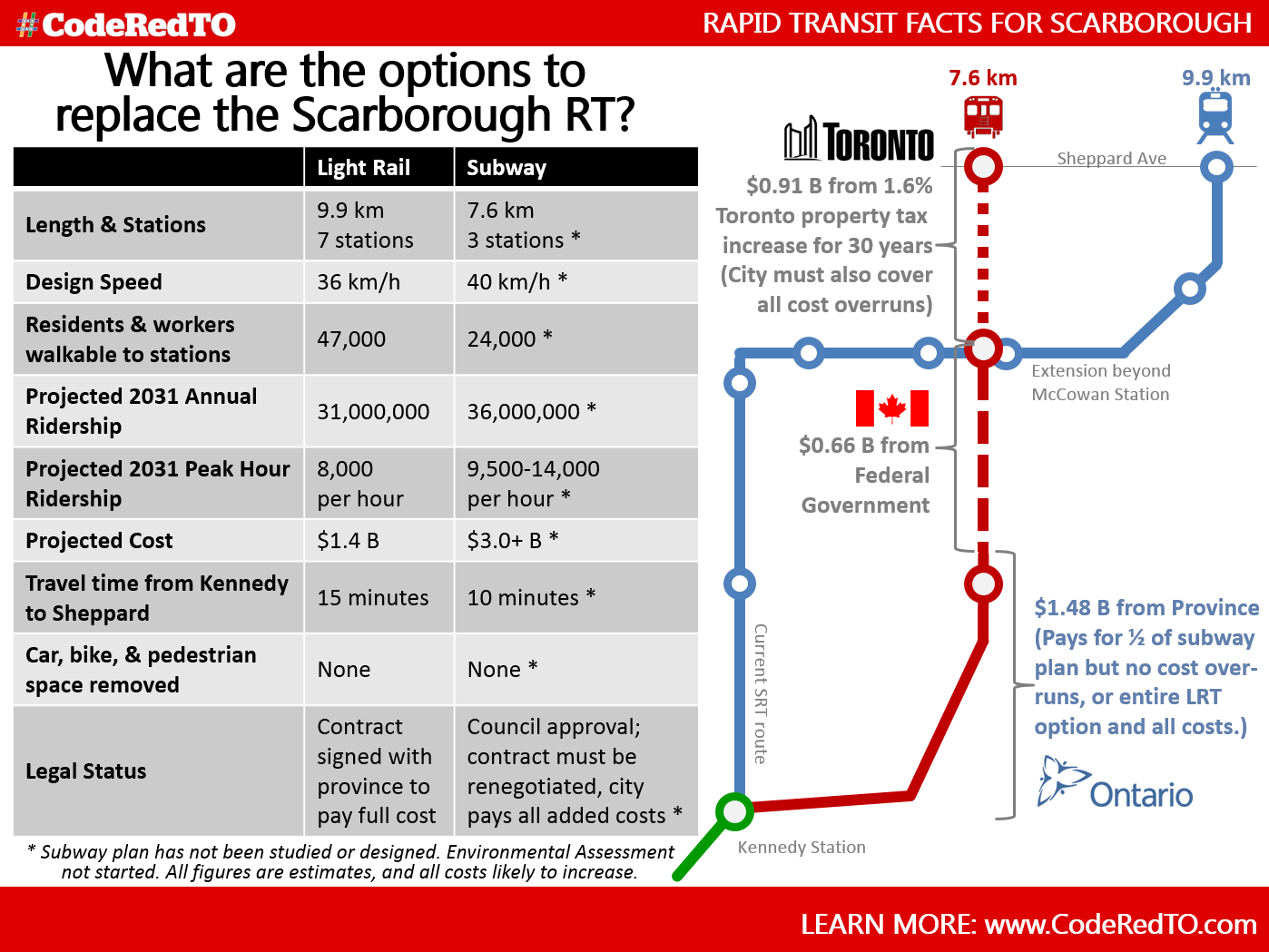
The opening instalment of what has become a movie franchise debuted in Toronto nearly a decade ago, when a plan to build light rail transit (LRT) in Scarborough was transformed into a shorter, more expensive subway, serving fewer people. Spoiler alert: nothing’s been built, and the bill is still rising.
Audiences drawn to transit tragicomedies will want to catch the sequel, “Skytrain to Nowhere,” set in the Metro Vancouver municipality of Surrey. A sprawling suburban city of more than half-a-million people, it covers about as large an area as Vancouver, Richmond and Burnaby combined.
Surrey was designed for the car. Its population density is less than a third of that of Vancouver’s, but it’s growing fast. If most trips continue to be made by car, gridlock will ensue.
In a 2012 report on transit options, a dozen scenarios involving dedicated bus lanes, LRT and SkyTrain were proposed. The best plan – a cost-effective approach for covering ground, moving people and cutting emissions – appeared to be the bus system.
However, the regional mayors’ council for transit in 2014 endorsed an 11-kilometre LRT running south and east from Surrey Centre, where the SkyTrain line from Vancouver ends. At $1.6-billion, it wasn’t cheap, and it wasn’t perfect, but it was a good second choice. It gained provincial and federal financial backing, and construction was poised to begin.
Re-enter Doug McCallum. First elected Surrey’s mayor in 1995, he won two subsequent elections but lost in 2005. Last fall, he returned to office with a promise to ditch the LRT plan in favour of the worst option – extending a SkyTrain line through Surrey to Langley. Mr. McCallum claimed this could be done for $1.6-billion.
Spoiler alert: Not even close.
This came as a shock to no one, as the transit authority, TransLink, had said the SkyTrain would be almost double the cost. It turns out the existing $1.6-billion will build less than half of the SkyTrain line Mr. McCallum imagined. This truncated version will end in Surrey’s Fleetwood neighbourhood, where only 63,000 people live. The Vancouver region’s mayors, however, voted for this plan in late July. Never mind that the 2012 report said that, built in stages, a single SkyTrain line was the worst of all ideas.
To finish the SkyTrain, a lot more money is needed. The mayors’ council has already started asking the federal and provincial governments for another handout. If Ottawa and Victoria deliver, that would not be good news. SkyTrain will suck resources away from needed improvements to other transit routes within Surrey, covering areas where the majority of the city’s people live.
In this case, a SkyTrain line simply cements suburban sprawl. It’s an expensive half-measure. Among the opponents of the plan is the Surrey Board of Trade. It wants the LRT revived – it could have already been under construction – and calls SkyTrain, an elevated subway, “antiquated, noisy and expensive.”
The fact remains that the best vehicle for a sprawled suburb like Surrey is the bus, with increases to existing service and dedicated bus lanes. But between the LRT and Skytrain, the LRT plan is clearly superior, serving more people at lower cost.
LRT is the backbone of transit in Calgary, another sprawling city. Its CTrain network is about to be nearly doubled in length by the $4.9-billion, 46-kilometre Green Line, expected to begin construction in 2020. Montreal is building a huge new light-rail network. The $6.3-billion REM project will cover 67-kilometres with 26 stations; the first leg will open in 2021, with the entire system finished by 2023.
Extending regional transit deep into Montreal’s suburbs didn’t involve extending the city’s Metro system. That would have been prohibitively expensive and time-consuming, and wasn’t justified by density.
Meanwhile in Toronto, transit has once again been upended, this time by Ontario Premier Doug Ford. His government has taken a giant eraser to a carefully drafted plan for a subway Relief Line and replaced it with a napkin sketch.
As for Surrey, it’s looking at the worst of all possible outcomes. Ottawa and Victoria should reject calls for additional funding. Instead, Vancouver-area mayors should take a hard look at their SkyTrain fantasy. This film’s plot doesn’t make sense. The script needs a rewrite.


 (Courtesy Integrity BC)
 The real issue is that TransLink, as incompetent as ever, has failed to provide a user friendly bus service from South Delta to Vancouver and the same is also true about buses from South Surrey/Whiterock. This is because of a very questionable agreement between TransLink and the SNC Lavalin lead consortium operating the Canada line P-3. This secret agreement forces all Richmond, South Delta, South Surrey and Whiterock buses to forcefully transfer customers onto the Canada Line at Bridgeport Station to pretend the under-built, grossly expensive Canada Line is somehow successful.
 (Courtesy Integrity BC – green is the George Massey tunnel))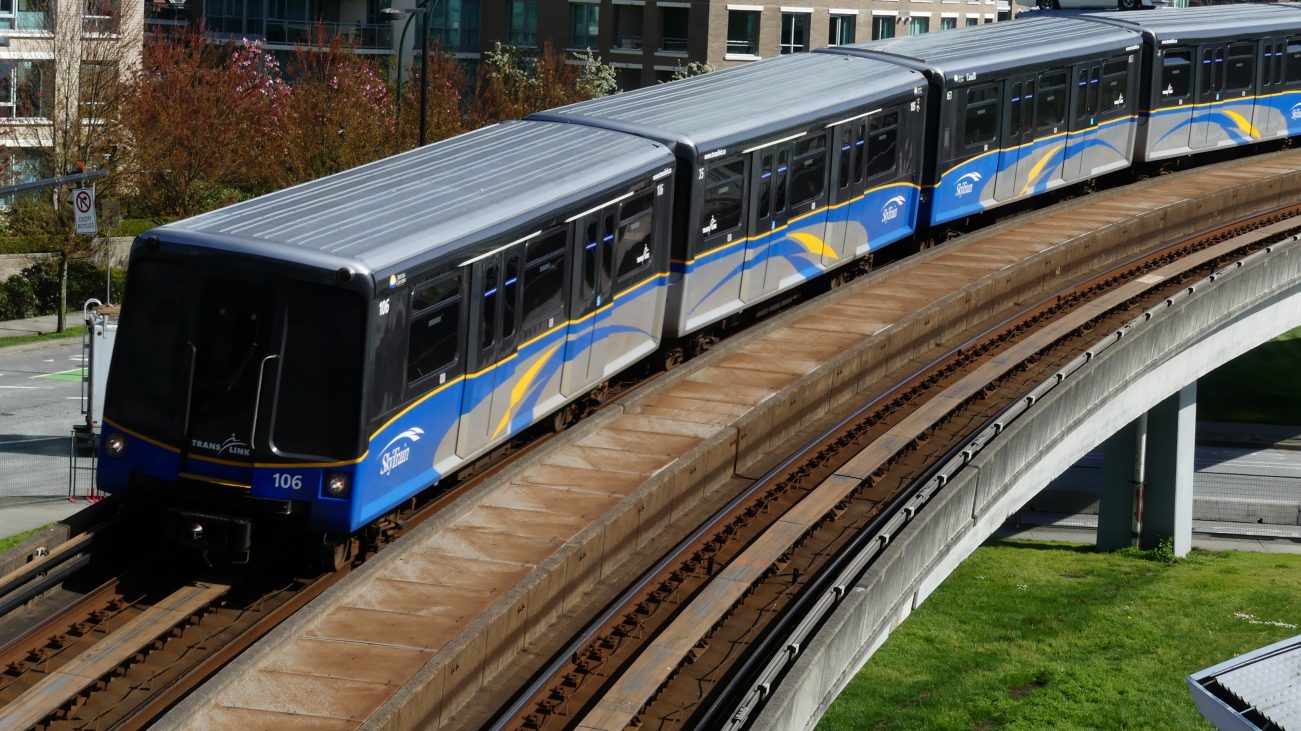


 So, what else is new.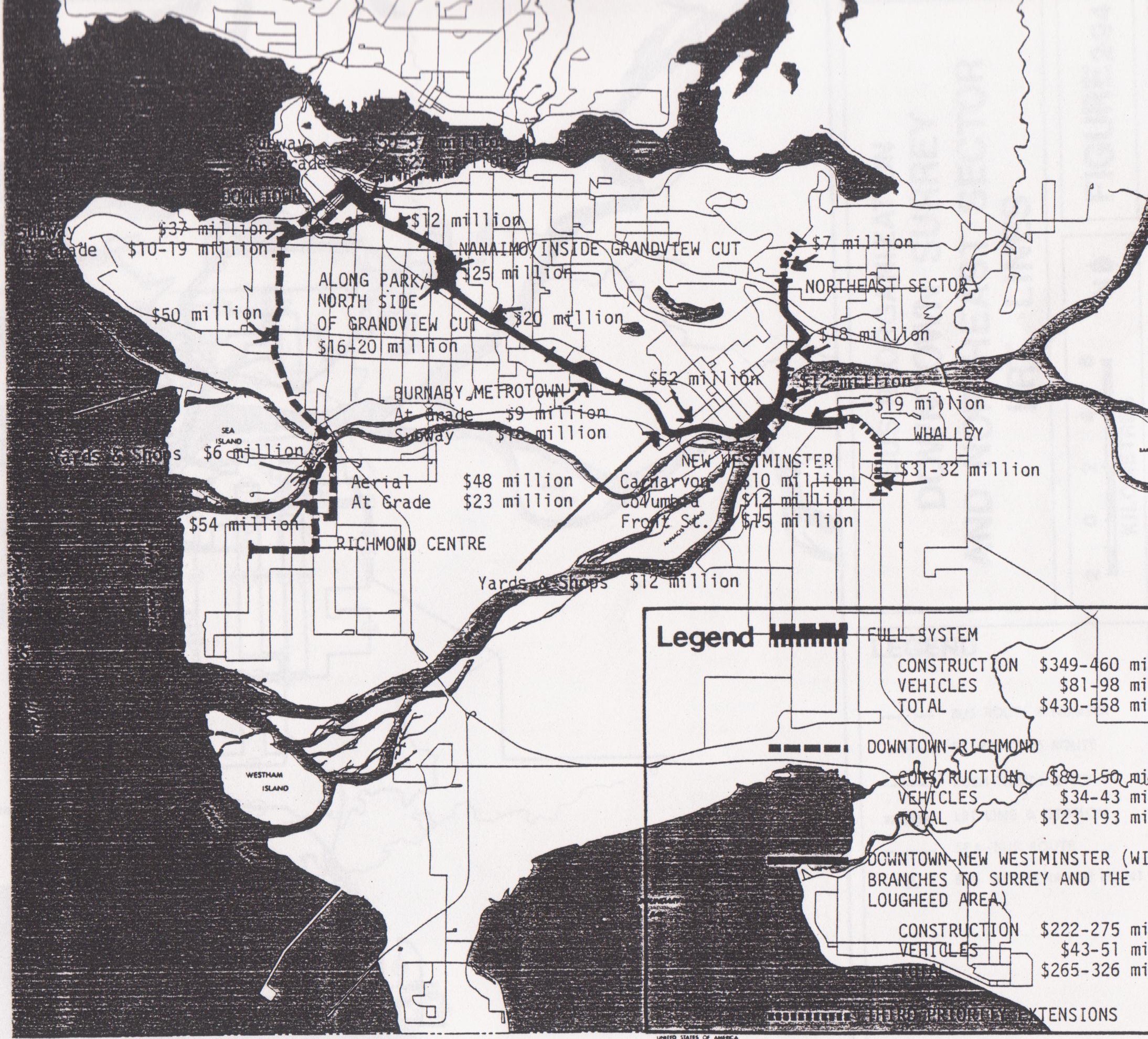





Recent Comments