Blunt title but it is time to be blunt, regional transit planning is a “shit show”.
Shit show: Noun, vulgar slang, US origin – a situation or event marked by chaos or controversy.
This aptly describes our regional transit planning, where politicians at all levels of government promote their pet transit theories and projects, using an extremely dishonest bureaucracy to carry out their wishes.
This costs money, an awful lot of money; this wastes timed, an awful lot of precious time; this costs planning paralysis and in the end politicians approve doing the same thing over again, hoping for different results.
“The definition of insanity is doing the same thing over and over again, but expecting different results.” Albert Einstein, Dec 13, 2017.
The Massey tunnel replacement project must stand out as a grand example of political manipulation; yellow journalism by the mainstream media; and a complete lack of any coherent regional transportation plan.
The Massey Tunnel does not need replacing, it is perfectly safe.
What is needed: A new bridge/tunnel crossing of the South Arm, near the vicinity 80th Ave in North Delta and a second bridge/tunnel crossing, of the North Arm, adjacent to the CN rail bridge, from Richmond to South Burnaby. This entails new highway construction, which the regional politicians are afraid to contemplate.
All the new 8 lane bridge or tunnel do, without a second crossing of the North Arm of the Fraser, is to create a parking lot on Highway 99 in Richmond because of the restricted capacity of the Laing, Oak St. Knight St., and Queensborough bridges!
There has been no capacity increase for crossings of the North Arm of the Fraser River since 1975!
Until a comprehensive transportation plan is tabled and a rational regional strategy for transportation is obtained, any new bridge will create a “shit show” for traffic.
Transit advocates say any plan for replacing the Massey Tunnel should be assessed in light of climate concerns
A Delta councillor says a seismically safe, efficient alternative is urgently needed for the crucial economic gateway
DELTA (NEWS 1130) — Transit advocates are citing climate concerns and calling for plans for the George Massey crossing to be studied further, but a Delta politician says enough is enough.
Abundant Transit Vancouver penned an open letter asking for the plan for replacing the crossing to be sent to the Regional District’s Climate Action Committee for further scrutiny.
Coun. Dylan Kruger is a member of that committee and says further study is not necessary and a new crossing is urgently needed.
“They are arguing that there should be no replacement for the George Massey Tunnel because we should not be building for car infrastructure, we should only be building for transit,” he says. “I’m fully in support of building infrastructure to get people out of their cars but there’s a fundamental concept people have to understand when it comes to the Massey tunnel: the Massey Tunnel is the economic gateway into Canada.”
Kruger says commuters aren’t the only ones who rely on the tunnel.
“At the end of the day, container trucks can’t take transit,” he explains. “We still need to build so we can get goods from point A to point B, in this region and in this country. So the notion that we should be building only for transit infrastructure here, I think really does not take into account the economic ramifications.”
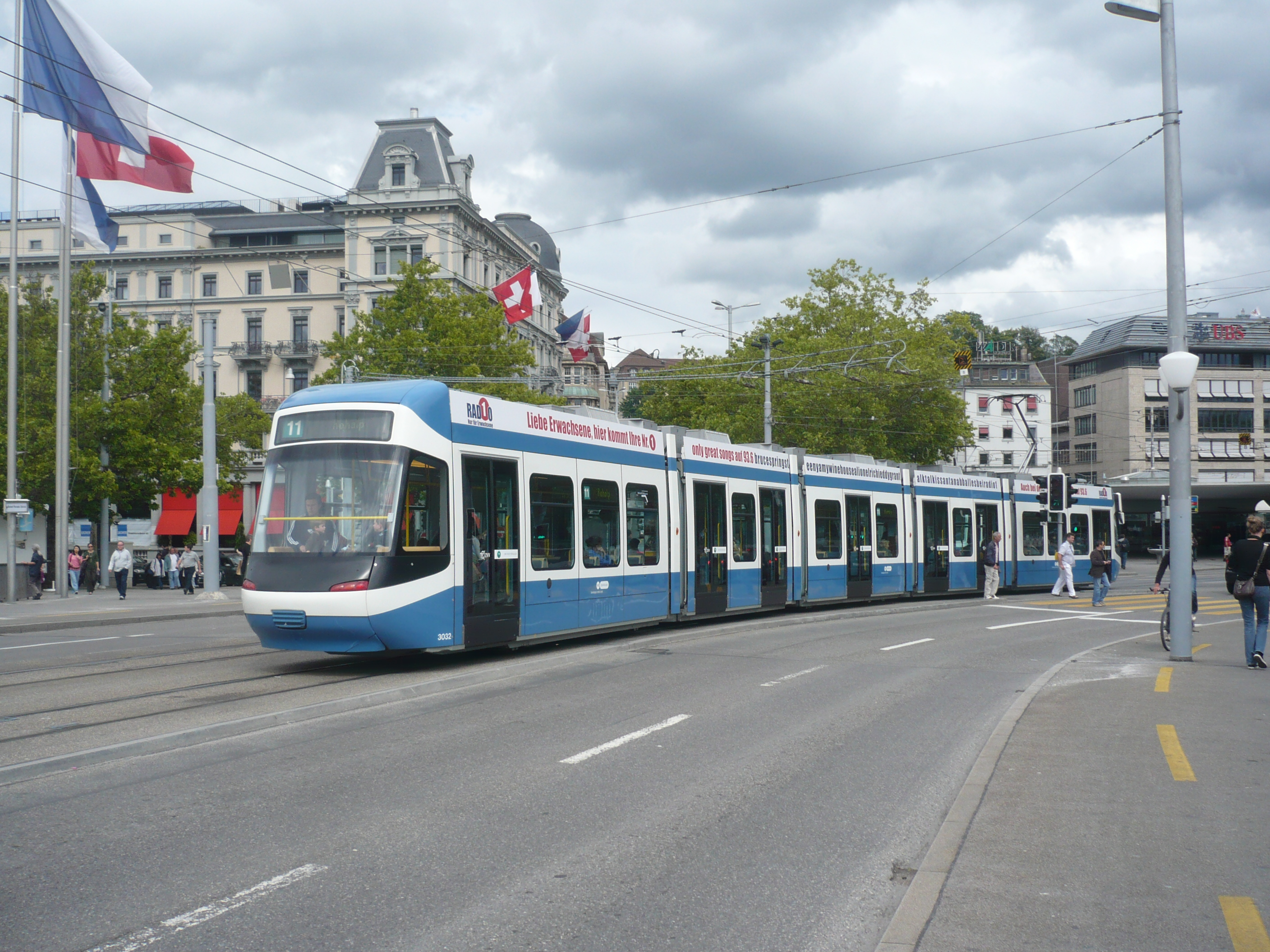
Overview: The tram network serves most city neighbourhoods, and is the backbone of public transport within the city.
Open: 1882
Cauge: Metre
Number of routes: 15
Route length: 118.7 km (73.8 mi)
Owner: Zürich
Propulsion system(s): Electric
Track length (total): 171.9 km (106.8 mi)
Track length (double): 72.9 km (45.3 mi)
Stock: 258
Passengers carried: Over 210 million annually.
Now, back to the article.
American transportation planners just cannot accept the fact that a tram line offers a capacity of in excess of 20,000 pphpd peak and capacity can be further increased in cases of special events!
What most American transportation planners fail to see (especially in BC), is that light rail transit (light meaning light in costs), has been proven in revenue operation for over 40 years. It was light rail that made light-metro obsolete.
This is what the Europeans understand with a tram, it offers a high capacity and user friendly service giving an almost door to door service. Cheaper to ,operate than buses on heavily used routes and yet able to carry passenger loads that in North America would demand a subway. A tram’s inherent flexibility means it can do most jobs asked of it at a reasonable cost to build.
Trams are given priority on the streets, not cars.
In Vancouver, we are spending $4.6 billion to build 12.8 km. of light-metro while in Caen France, they spent $373 million to build 16 km of tramway and that sums up Metro Vancouver’s big problem with transit planning.
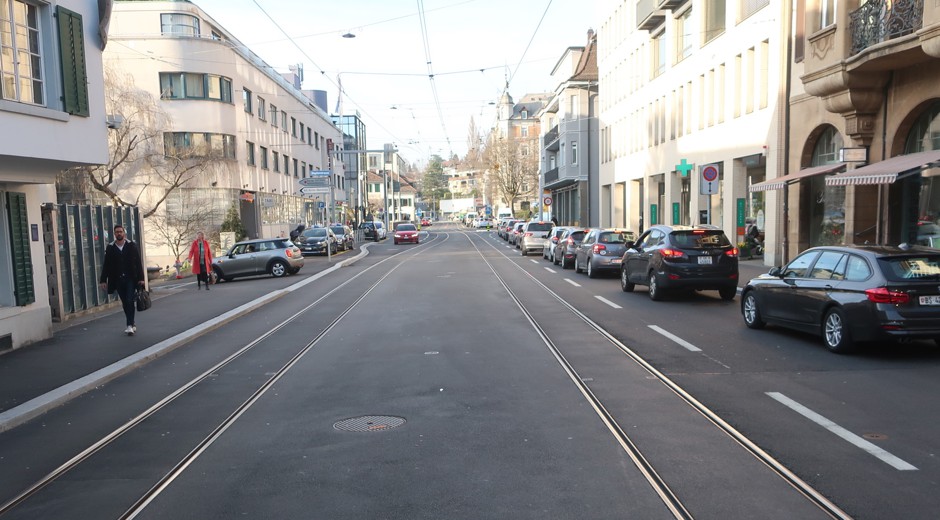
If you see how cars, streetcars, bikes, and pedestrians use this Swiss street, you can better understand what’s wrong with so many other urban thoroughfares.
Civil engineering professor and transportation planner
*
Above is a picture of a pretty typical city street in Zürich, Switzerland.What do you see?In some ways, this scene represents a kind of Rorschach Test for transportation and urban planning. If you are a passenger on a tram riding on one of the two sets of rails that take up most of the street, this scene represents freedom of movement and a sense that transit is privileged in Zürich. If you’re a pedestrian, this is a relatively comfortable street to be on, with useful services, restaurants, and a few interesting stores (check out the model train store at the corner with Haldenbachstrasse). If you’re on a bike, this, like most other streets in Zürich, is OK, but not great.*But if you’re an American tourist, your first thought might be that these Europeans are real strange: Look at that long line of car traffic on the right, and look at all that road space going to waste. And an engineer or planner trained in the conventional mode will probably agree with you, and see a picture of abject failure. In the parlance of the traffic planner, this is a street operating at Level of Service F.(Norman Garrick/CityLab)
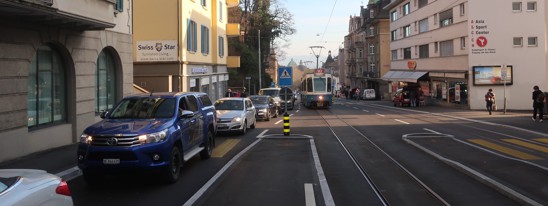
In the Rorschach Test, you get to rotate and analyze the image, so let us do that. This is a typical main thoroughfare in Zürich where, since at least 1980, space has been carved out to give transit its own right of way and in addition, transit has priority at all signalized intersections. This particular street, Universitätstrasse in the University District of Zürich, carries two tramlines—streetcars, for North Americans—and so it has trams passing on average every three to four minutes in each direction. This is also one of just four major roads carrying vehicular car traffic from the downtown to the freeway that runs out of the city to the north (the others also carry trams, with the exception of one, which is more highway-like).
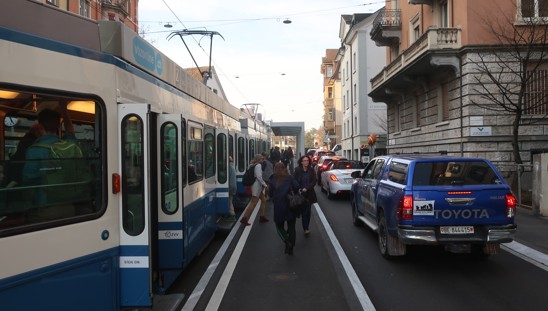
Let us first deal with the American tourist who sees inefficiency. During the peak hour, the vehicle lanes carry about 400 cars and perhaps 500 people. (I counted!) The two tramlines carry about 3,500 people per hour. So, notwithstanding the fact that at first glance the tram lanes seem empty and remarkably inefficient, the numbers tell a different story—the tram lanes are doing yeoman’s work, carrying 7 times more people than the car lanes, and they could easily carry many more. And this is before we even start to consider the environmental and economic advantages of transit over cars. (People in Zürich have unlimited access to all transit in the city for just $1,000 per year, yet the subsidy from the city, state and the nation is modest, since the fare box returns, and other revenues, pay about two-thirds of the cost of operating the system.)
(Norman Garrick/CityLab)
Now let’s get to the conventional engineer whose rule book would say that something must be done to alleviate this atrocious situation for the people in those cars. So what can be done? Well for one, we could remove the priority given to the trams in terms of travel space and at the traffic signals. That would give us one more lane of travel in each direction. With the addition of turning lanes at the intersections, that would help a great deal: Now we have the room to move 700 to 800 cars per hour. (“Voila! The model shows that we are at Level of Service C or D,” reports the engineer. “Not great, but better than before”).
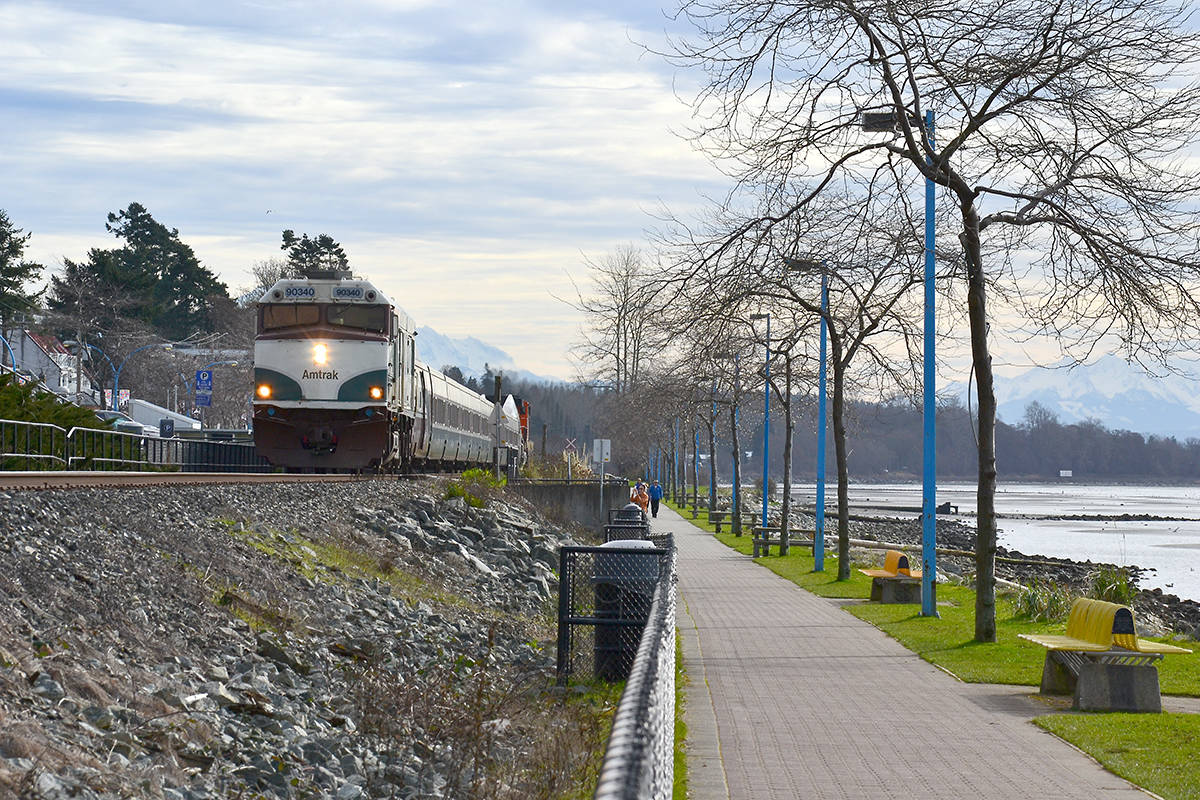
Simple question, folks; “Anyone with a spare billion or two to move the railway off the Whiterock/Surrey waterfront?
$4.6 billion is the minimum being spent to add 12.8 km to the SkyTrain network and with other cities in the region clamouring for future monies be spent in their cities and municipalities, it is doubtful government will pay a penny for this.
Simple answer; “Nope, Nada, not in my lifetime.”
Sorry folks, and just do not trespass on railway property.
Advocates launch a website, strive to inform residents on process.
A group of proponents for rail relocation on the Semiahmoo Peninsula have recently refocused their approach to start from the ground up.
Craig Harrold launched a website, railrelocation.ca, that highlights the arguments for rail relocation as well as a source of information for people to learn about the status of the movement.
Harrold and railway relocation advocate Erik Seiz met with Peace Arch News last week to discuss the website and explain how their effort is evolving.
Seiz suggested that attention on rail relocation picks up during election campaigns or shortly after election, only to fade away.
“What’s really important for a vision like this is that it needs a place where it is able to live for longer than the duration of any government,” Seiz said. “The railway loves it, because they just need to ride it out until the next guy is gone.”
“Governance is just another one of those things that you can’t necessarily rely on the current structure to bring about the change that you want.”
Rail relocation has been a political issue in South Surrey and White Rock for decades. Harrold said he has a friend that witnessed W.A.C. Bennett (B.C. premier from 1952-1972) throw his fist in the air while standing on Crescent Beach and proclaiming: “We’re going to get this railway moved for you.”
The movement gained traction following the tragic derailment in Lac Lac-Mégantic, Que. in 2013. That same year, Surrey then-mayor Dianne Watts and White Rock then-mayor Wayne Baldwin hosted a standing-room-only forum that presented four proposed routes for realigning the railway that currently follows the shoreline along White Rock and through Crescent Beach.
“We want to say to the people of the Peninsula, here’s all of the information (on the website). We’ve assembled everything we can possibly think of. The biggest thing is the present situation, this is where we’re at right now and what we are going to do about it. What’s the next step? The next step is the alignment study.”
Approximately $900,000 is required for the study and the money has not yet been secured. Surrey transportation manager Jaime Boan told PAN in 2017 that historically, projects like this are funded one-third provincially, one-third federally and one-third locally.
The split for local funding for the study, as suggested by Surrey in 2017, would call for $75,000 from White Rock to Surrey’s contribution of $225,000.
The B.C. government and federal government have not made any commitments.
Starting next year, Harrold says he will implement a private donation feature on the website which will allow Peninsula residents to chip in to the feasibility study.
“The people of the Peninsula are going to contribute to making this happen,” Harrold said.
Seiz said that it might take a disaster to prompt more swift action on rail relocation.
“You put in a crosswalk because enough people died at an intersection. That’s just how it works,” Seiz said. “That may well be how it plays out here, too. But regardless, I think there’s still value in building up a body of knowledge so at a point in time in the future, there’s at least some stuff there you can work with.”
Really? Is this the best we can expect from TransLink, deception?
Two quotes from TransLink CEO, Kevin Desmond, are very disturbing:
Desmond called the Canada Line, which just celebrated its 10th anniversary, a “smart investment”.
“But, he said, he hopes the region has learned that lesson, adding that “help is on its way” for the Canada Line in the form of larger cars being delivered next year which should increase capacity by 25 per cent.”
The Canada Line was one of former premier Campbell’s phony P-3 projects and eagerly applauded by the airport authority.
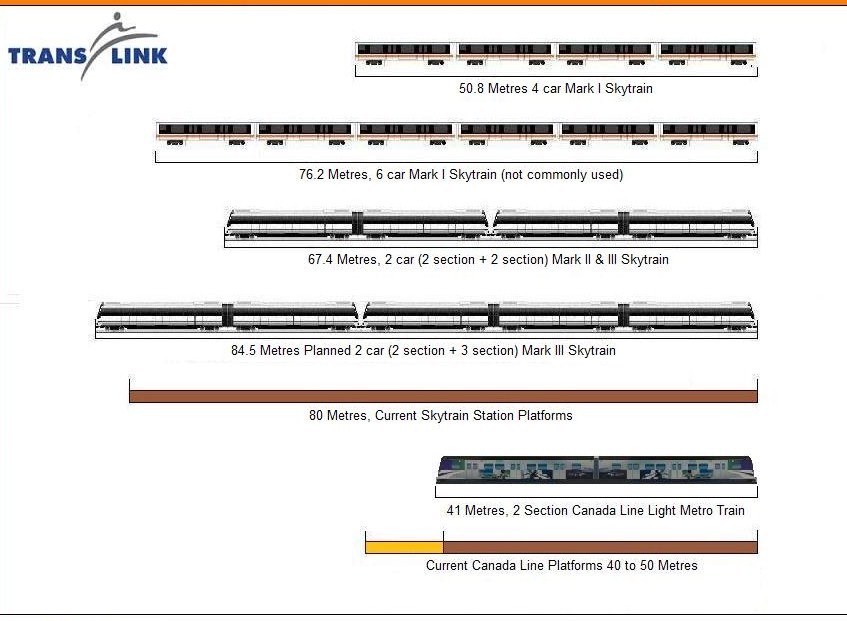
To curb spiraling costs, the scope of the project was cut back to a badly truncated mini-metro, costing around $2.4 billion (pus an additional $110 million or more operating cost, paid to the SNC Lavalin lead operating consortium annually). The Canada line with 40 metre long station platforms has roughly slightly more than half the capacity of the Expo and Millennium Lines, which station platforms are 80 metres in length.
Also ignored is that the Canadian and American standard for building a subway is a transit route with traffic flows exceeding 15,000 pphpd, yet the maximum capacity that can be achieved is around 9,000 pphpd. The Canada line was more a grift by the BC Liberal Party than a smart investment. The judge presiding over the Susan Heyes lawsuit against TransLink (failed on appeal) called the Canada line’s bidding process “a charade”.
As built, the Canada line has much less capacity than a modern tram or LRT line costing a fraction to build!
There are no new “larger cars” as quoted by Desmond, rather 3-car trains are said to be operated in the future and they will only be operated if all the station platforms are extended to 50 metres and still, there will be considerable overhang, which will be a safety concern.
This statement also ignores the fact that the maximum capacity of the Canada line is still around 9,000 pphpd and to further increase capacity beyond 9,000 pphpd, over $1.5 billion must be spent rebuilding every station with at least 80 metre long platforms and other necessary updates.
Just this summer, the city of Caen France opened a 16 km tramway costing CAD $373 million! Put another way, one can build 64 km of new tramway, based on the Caen model, compared to a no extension, capacity increase only $1.5 billion rehab!
Smart investment, you must be joking, Mr. Desmond.
As no other city or transit authority has copied building a truncated heavy-rail metro, as a light metro; especially when a further $1.5 billion or more must be spent in the future upgrading the line so capacity can match that of the present Expo and Millennium lines, shows TransLink CEO Chair, Kevin Desmond is completely out of touch with reality.
And please, stop pretending the Canada Line is successful, as the vast majority of its ridership comes from the fact all Richmond, South Delta/Surrey buses, former Cambie St. and “Airporter” bus customers are now forced to transfer onto the Canada Line. The widely distributed U-Pass and the many post secondary institutions serviced by the route, means many customers are using this expensive service on the cheap.
What should embarrass him further is that the Canada line, internationally is considered a “white elephant”.
There is no future money for the Canada Line in sight and with TransLink’s current disastrous planning, with $4.6 billion being spent to extend the Expo and Millennium line a mere 12.8 km, means that there will be no extension of the Canada line until the remaining 25 years of the 35 year concession has ended and only if funding is sourced.
TransLink CEO, Kevin Desmond, is either deluded, or purposely deceiving the taxpayer at the behest of metro mayors and the provincial government.
Canada Line to Richmond ‘underbuilt:’ TransLink CEO
Maria Rantanen / Richmond NewsOctober 25, 2019
Vancouver International Airport CEO, Craig Richmond, challenged TransLink CEO, Kevin Desmond, to think big and build more trains in the region.
Think big, stay connected and work with your partners seemed to be the theme at “Metro Vancouver on the Move,” a panel discussion organized by the Richmond Chamber of Commerce last week, where the two CEOs were joined by the Vancouver Fraser Port Authority’s president and CEO, Robin Silvester.
Richmond pointedly told TransLink’s CEO to “be bold” with their transit expansion, for example, to not just dig the tunnel halfway to UBC.
“Find the money to do this, don’t go small, go big because infrastructure is such an enabler in so many ways,” he said. He added that, looking at the example of the Canada Line, there should be four or five times trains like that in the area.
To highlight the problems that inadequate transit cause for his sector, Richmond recounted that the owner of a YVR restaurant is paying for cabs for his employees to arrive early in the morning and leave late at night because of the lack of transportation options.
The airport is also able to transport crab to Brisbane in its refrigerated cargo planes, but if the crab can’t get to the airport because of congestion, it can’t get to Australia, he said. With the congestion on Russ Baker Way increasing, this could become a greater problem.
Twenty per cent of passengers flying out of YVR come to the airport with the Canada Line, which is low globally but very high by North American standards. But people living farther out who can’t access the Canada Line will get increasingly caught up in congestion to the airport.
“If they can’t get to the airport, we can’t put them on an airplane,” Richmond said.
TransLink’s Desmond agreed the airport, the transit authority and the port are “completely and utterly connected.”
In the past year, Richmond and Delta have seen a nine per cent increase in ridership, but only a four per cent increase in service, Desmond said.
He said lessons have been learned, for example, the Canada Line is an example of infrastructure whose use was under-estimated and under-planned.
Desmond called the Canada Line, which just celebrated its 10th anniversary, a “smart investment,” but he pointed out there was discussion at the time whether it should even be built.
“At the end of the day, we underbuilt it (…) we have to think bigger, we have to think 10, 20, 30, 40 years in advance,” Desmond said.
Those planning new transit often get caught up in their smaller municipalities, asking whether people will want new transit projects, what the local impact will be, but, in the end, the Canada Line is an example of how a project was too small already at opening.
But, he said, he hopes the region has learned that lesson, adding that “help is on its way” for the Canada Line in the form of larger cars being delivered next year which should increase capacity by 25 per cent.
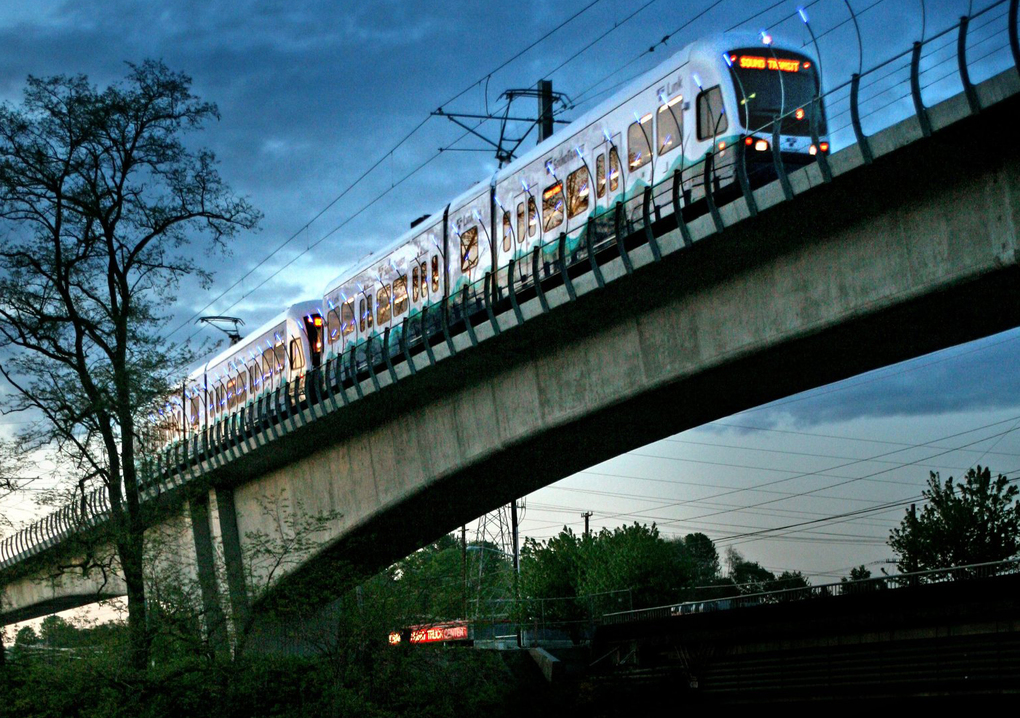
Seattle’s so called light rail system is in reality a light metro system that uses light rail vehicles. Over 90% of the system is grade separated either in subway or on elevated guide-ways.
In the United States, light rail has morphed into light metro and light metro is very expensive when compared to classic light rail.
But our neighbours to the South are finding that light metro is becoming even more expensive and now fiscal constraint is showing its hand.
Seattle’s transit planners, like their brethren to the North love subways and tunneling, but the taxpayer, well that’s another story, as transit planners and their political masters don’t give a damn about the taxpayer.
There is one troubling quote which should give pause to those who support a Broadway subway:
Transit CEO Peter Rogoff is also warning that construction inflation jumped by one-fourth just since 2016, so hard choices lie ahead.
Translation: Cost have increased 25% in just three years!
Troubling indeed, because in Vancouver the 1916 cost estimates fro the Broadway subway have probably jumped by one-fourth as well.
Just a reminder the “light” in Light Rail, means “light” in costs, something that planners in both Vancouver and Seattle have ignored.
Seattle's light-metro uses light rail vehicles, giving it the flexibility to operate on lesser rights-of-ways.
Pricier light-rail tunnels into Ballard and West Seattle fall by the wayside
In a show of urgency and fiscal restraint, Sound Transit board members Thursday abandoned ideas for a $450 million (CAD $ 569.5 million) tunnel into historic central Ballard, a $200 million (CAD $254 million) bored tunnel through West Seattle’s Pigeon Point neighborhood, and a fully elevated trackway in Sodo that would have blocked light-rail travel during construction.
Cheaper options that serve the same number of passengers and will still cost hundreds of millions of dollars will now gain momentum during environmental studies — notably a simpler Ballard tunnel to 15th Avenue Northwest, favored by Seattle Mayor Jenny Durkan.
Politicians on the 18-member board have entertained dozens of alignment concepts since 2016, when voters passed the $54 billion (CAD $ 68.4 billion) ST3 tax measure to expand regional rail and bus services. The agency promised West Seattle stations in 2030 and stations from south downtown to Seattle Center and Ballard by 2035.
As the wish list swelled, some scenarios threatened to delay grand openings, add complexity, and boost the $8 billion budget estimate by a $2 billion (2014 dollars) within the 12-mile Seattle corridor. Some of those, including 200-foot-deep train platforms for International District/Chinatown Station for an expanded station and tunnel, or a tunnel from West Seattle Golf Course to Alaska Junction, remain on the study menu. Seattle is likely to seek “third party funding,” yet to be identified, for local upgrades.
Adding pressure, Tim Eyman’s Initiative 976 on the Nov. 5 ballot seeks to slash car-tab taxes to $30 statewide. Even if voters or the courts side with Sound Transit against the Eyman ballot measure, state lawmakers may consider car-tax cuts.
Transit CEO Peter Rogoff is also warning that construction inflation jumped by one-fourth just since 2016, so hard choices lie ahead.
MAGLEV, the great Philosopher’s Stone for transportation, yet in practice, MAGLEV’s are extremely expensive and today, the high speed train is only slightly slower, much cheaper and far more flexible in operation.
Sounds familiar doesn’t it?
Rumour has it that the Conservative Ontario Government wants to make the Ontario Line a MAGLEV.
Politicians love gadgetbahns because they firmly believe it makes the voter feel that they are forward thinking and up to date, untill the bills start coming in.
So Ontario, once again, maybe, is getting into the transportation business and wants something to be built so it can be sold world wide, politely forgetting all the others ones have failed so far.
From Wolfgang (mechanical engineer who consults on transit/rail systems), from Germany.
The Germans spent 20 years developing Mag-Lev but they gave it up when they found there was no way to make it economical.
The whole maglev project (“Transrapid”) over here was based on a false assumption. And when the assumption turned out to be false, it was already to late to stop the project, because it had already been institutionalized.
The assumption was that the wheel-rail system had some kind of techno-economical speed limit at ~250 km/h. This was an idea developed in the 60s. As soon as the issue was actually scientifically investigated with roller rigs (among others, at Muenchen-Freimann) as well as on actual lines (among others, by SNCF), it turned out that the only practical limit is the density of air, resp. the traction power required to overcome aerodynamic drag.
But by that time, interested corporations (Thyssen, Siemens,…) had already founded a dedicated company, together with “public” money. So the “solution” was institutionalized before the problem had been investigated. Once it had turned out that the project was a non-starter from the technical and economical point of view, it took almost 40 years to overcome the “survival instinct” of that purpose-built institution.
In the end it turned out that the electro-magnetic suspension and guidance system had far more technical problems at high speed than the good old wheel-rail system. Essentially because it requires active control due to its inherent instability. And that control gets quite difficult with rising speed and due to aerodynamics (turbulence’s acting on the “cars”).
The Germans were able to sell it to China for their High Speed Rail program so the Chinese built Mag-Lev to the Shanghi Airport.
Just another “Gadgetbahn”. Un-technology that has no valid reason to exist.
It seems the French clearly understand the benefits of light rail, well they should, because they have studied both LRT and light-metro (VAL).
Like Vancouver’s SkyTrain, VAL was made by MATRA, the famous arms manufacturer and in the 1980’s the general political thought was, if no one used VAL for transit, it would reflect badly on MATRA’s arms sales. Thus the French government in a political diktat tried to force French cities to build with VAL, even financing the initial line.
But………..
French civic politicians (unlike BC politicians), are ever mindful of the public purse well understood the huge costs of light metro, especially future expansion and upkeep costs and in the end, only a handful were built, as study after study showed that “Le Tram”, was the the best option for both the customer and the taxpayer.
Today, Siemens owns VAL and is marketed mainly as an airport people mover and only eight such systems have been built.
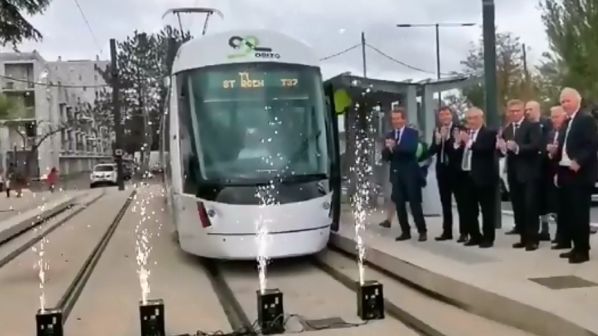
This month the City of Avignon is opening their new tramway.
The 5.2 km line cost €135 million (CAD $190.75 million) or CAD $36.7 million per km to build. Due to political interference, the line is short, thus per km costs are higher, but when one thinks that TransLink is building a 5.8 km subway under Vancouver for over $3 billion, “Le Tram” certainly seems far better value for money and far better value for the taxpayer and customer.
THE French city of Avignon inaugurated the first phase of its new light rail service on October 19, a 5.2km stretch with 10 stations from Saint Roch in the south of the city centre to Saint Chamand, the location of the mainline station in the southeast.
Journeys between the termini on Line T1 take 15 minutes and are served by 14 three-section LRVs supplied by Alstom. The 24m-long, 2.4m-wide vehicles are a shortened version of the Citadis X05 and use 750V dc traction. They have capacity for up to 140 passengers and have a maximum speed of 70km/h.
Services run at 5-6 minute frequencies between 06.00 and 00.00 and are operated by Orizo, the public transport operator in the greater Avignon area, while Grand Avignon is the line’s owner. Existing bus services have been optimised to coordinate with the new service.
Plans for the project were approved and developed in 2011-13. However, inauguration of the project was in doubt in 2014 when the newly-elected mayor vowed to cancel the scheme. The result was a modification to the plan, scaling back the project from three lines to one and the cost from €330m to €135m, with construction getting underway in October 2016.
Expansion of the network is still planned through the construction of Line T2. Construction is currently scheduled to start in 2021 and conclude in 2023. There are also plans to extend Line T1 to the north while additional sections could be added to the LRVs to meet future demand.
Avignon’s previous tram system was closed in 1932.
With the clear evidence that transportation authorities around the world opting to build with LRT, one must pose, again, the question;
Why does TransLink inflate the cost of light Rail?
The simple answer is, “they don’t want to build with light rail, so they inflate the cost to match that of SkyTrain.
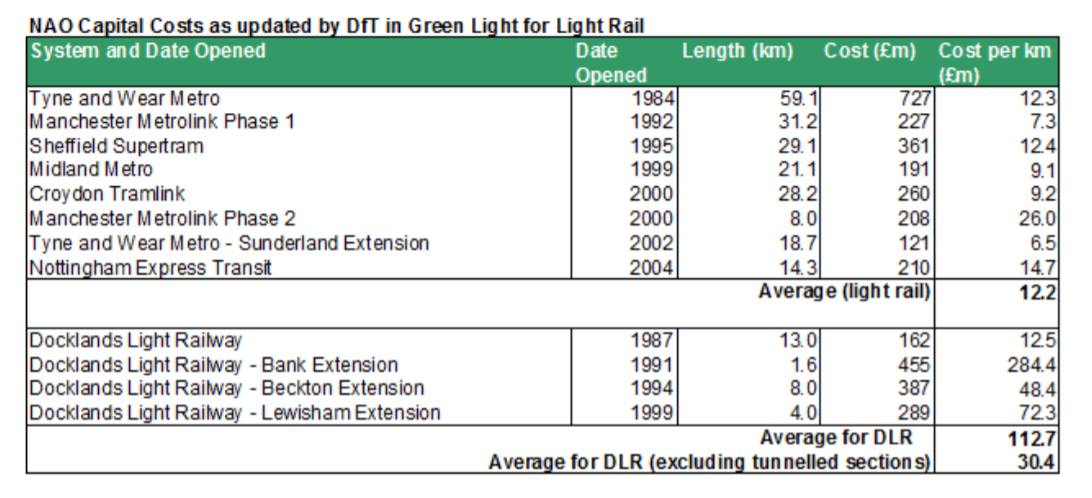
From the Briefing Paper of UK Light Rail Schemes.
Acknowledgements Richard Higgins, Arup Steve Warrener and Daniel Satizabal, Transport for Greater Manchester Roger Harrison, Keolis Rory O’Connor, Rail Procurement Agency, Dublin Alastair Richards, AMRT Consult Limited Mat Taylor and Rachel Timmis, Franklin and Andrews
A clarification: the Docklands Light Railway (DLR), used existing German Stadtbahn cars or light rail vehicles, and was built on existing but abandoned, largely elevated rights-of-ways, in the Docklands area of East London, thus the initial cost is much cheaper, compared to later extensions. The Docklands was going to be a true LRT system, like Vancouver, but then Prime Minister Margret Thatcher wanted a “automatic” (like the French VAL and Canadian ALRT) system strictly for political prestige.
Later extensions were considerably more expensive to build.
As we can see the average cost of light rail schemes was £12.2 or CAD $20.65 million. Yet TransLink’s cost for LRT in Surrey was exceeding $165 million per km.! TransLink’s cost estimate for light rail was eight times more than the average cost of light rail in the UK!
Our friend in Ottawa, Mr. Haveacow is now warning that the old formula at the federal infrastructure bank will give only 33% of the cost in future funding, with the province anteing 33%, leaving the municipal taxpayer left funding the the rest!
Regardless who wins everybody was warned this year the federal infrastructure bank will only give a maximum funding of 33% of the project cost unless, it’s a federal agency project (like VIA Rail) or its a infrastructure project that is so expensive the municipality in question can’t realistically support its 33% portion. Even Toronto will have to pay 20% on the next 2 subway projects (total cost $16.5 Billion), that’s $3.3 Billion for just the residents of the City of Toronto on the combined cost of the next 2 subway lines. For one of the projects, York Region will have to put in $530 Million or 20% as well.
The point is that, Translink is going to have to put in much more than they have been recently. The mayor’s council is going to have to find more for Stage 3 of their 10 year transit plan. The 20% they paid for Stage 2 will grow to a minimum of 33% in stage 3, regardless who wins the federal election. The 40% (Federal), 40% (Provincial) and 20% (TransLink) era for rapid transit capital funding in Vancouver is over. This means overly expensive SkyTrain projects will have to be rethought.
Even American Transportation Engineer, Gerald Fox warned us back in 2008 with his critique of the Evergreen line;
I’ve no desire to get drawn into the Vancouver transit wars, and, anyway, most of the rest of the world has moved on. To be fair, there are clear advantages in keeping with one kind of rail technology, and in through-routing service at Lougheed. But, eventually, Vancouver will need to adopt lower-cost LRT in its lesser corridors, or else limit the extent of its rail system. And that seems to make some TransLink people very nervous.
A regular corespondent (a professional) told me in earnest about the funding issues;
It is a house of cards. Madmen are in charge.
To be blunt, the region cannot continue to build with light metro and TransLink has zero credibility planning for cheaper options like LRT. The regional politicians have been groomed by TransLink like a con artist grooming a mark. It now seems the Metro mayors are heading directly into a financial iceberg, by continuing to plan for the much more costly light metro, instead of much cheaper and more effective LRT.
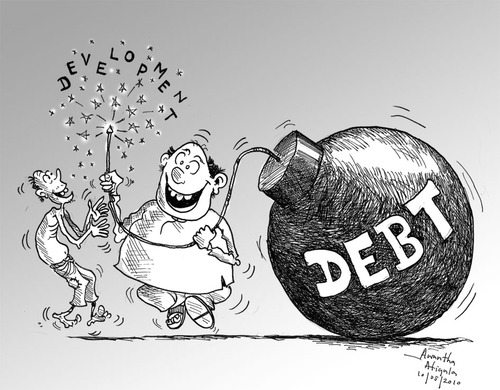
Building SkyTrain today, is leaving a debt bomb for tomorrow.
$4.6 billion is a lot of cash, but in metro Vancouver, $4.6 billion (well that is the amount funded) buys you a mere 12.8 km of the decidedly obsolete light metro system, now called Movia Automatic Light Metro, used on the Millennium and Expo Lines.
So much money, for so little transit.
It maybe impertinent to point out that the City of Caen, France opened a 16 km tramway which cost a mere CAD $373 million.
So here is a “reality check” on transit.
The public (taxpayer) has anted up over $10 billion so far for the SkyTrain light-metro system. The province/region could only afford a new transit line every decade or so. So now, we have “funded” (read, taxpayer funded) $4.6 billion, which is supposed to build 12.8 km of line. This is almost half the amount of money spent for the entire system to date.
This means the region will get 12.6 km of light metro for the next decade and counting!
So let us look at unfunded projects.
1) The Expo Line rehab, which is needed before the line is extended to Langley to increase capacity beyond its legal operating certificate of 15,000 pphpd. This cost is between $2 billion to $3 billion.
2) The UBC subway extension from Arbutus to UBC, $3 billion to $4 billion.
3) The Langley extension from Fleetwood, $1.6 to $2 billion.
A honourable mention must also be made for:
1) The Canada line rehab, to increase its capacity beyond 9,000 pphpd, $1.5 billion to $2 billion and must be done before any thought of extending the line.
2) The North Shore rapid transit transit link, $5 billion or more including a new crossing.
We are looking at a minimum of $6.6 billion to extend the light metro network to UBC and Langley
Not going to happen any time soon, as the current rate of spending around $2.5 billion every decade to build and extend the light metro network, one can see the current plans completed in about four decades! This is the fools game, the Provincial NDP and Liberals, metro mayors and their various bureaucracies and TransLink is playing with the public!
And what about the Fraser Valley, Vancouver island and the hurtlands, which is just about everywhere else in the province?
Well, it seems they can whistle in the wind, the majority of seats for the legislature are in Metro Vancouver and the Fraser Valley.
As our most decidedly dishonest Mayors and bureaucrats promise transit nirvana, the reality is that Vancouver and surrey will get light-metro extensions which will do little alleviating congestion and will further balkanize our bus system which now is designed to feed the light metro to pretend it is successful!
As the current light metro system has done little in attracting the motorist from the car, building more and expecting different results, for the taxpayer , is scary stupid.
And then there are the operating costs, which is about $400 million annually for the light metro system, no one has given a thought to that. Extending the light metro network to UBC and Langley will add at least another $100 million to the annual SkyTrain subsidy
Climate change be damned we are building light metro to placate land speculators and land developers by building light metro to act as a driver for condo towers and easy profits for political friends. Political payoffs come before the taxpayer’s ability to pay and Climate Change in BC.
I am gobsmacked at the base hypocrisy, or worse dishonesty by our regional and provincial politicians on transit.
Could the Broadway subway become another Charleroi? Huge costs to build, no money to operate it and is left to rot unused for decades.
Mott MacDonald to study major new bridge for Vancouver
7 October 2019 | By GCR Staff
UK-headquartered engineering consultant Mott MacDonald has been picked to study the technical feasibility of a major infrastructure scheme in Vancouver, Canada: a high-capacity fixed-link transit crossing over the Burrard Inlet.
Politicians believe such a link is needed to ease traffic congestion building up between Vancouver and the growing cities on the inlet’s North Shore, including West Vancouver and North Vancouver.
Urbanisation there has historically followed a single-family dwelling model with the car assumed as the dominant mode of transport. But as the cities have grown, congestion has increased on the inlet’s two road bridges, including the famous Lion’s Gate Bridge.
“Traffic is a significant problem for people on the North Shore and finding solutions is important to our government,” said Claire Trevena, Minister of Transportation and Infrastructure for the province of British Columbia (BC). “This feasibility study will explore ways to connect our communities better, shorten commute times and cut down on carbon pollution.”
Expected to finish in 2020, Mott MacDonald’s study will be undertaken in two stages.
The first will look at possible options for a new fixed link considering topography, geotechnical and structural aspects, as well as its cost and ridership projections. Out of this will emerge a short list of alignment options for the link.
The second stage would provide a more detailed engineering and planning review of the short-listed options. Affordable housing will also be evaluated.
“Years of hikes in housing costs have forced people to live further from where they work, resulting in longer commutes and traffic congestion issues,” said Bowinn Ma, a local member of BC’s legislative assembly and chair of a transportation planning committee.
Mary-Ann Booth, mayor of West Vancouver, said: “A fixed link for rapid transit will take years to implement, so we need to start thinking about it now.”
Image: Vancouver’s Burrard Inlet, with its two existing road bridges including the Lion’s Gate Bridge in the distance (Flying Penguin/CC BY-SA 3.0)


 BySeattle Times staff reporter







Recent Comments