TransLink has absolutely zero expertise with modern light rail, yet continually plans for grossly inferior light rail lines which under scrutiny shows so many flaws that their plans become laughable.
The latest was then Surrey LRT, which was so over engineered and so gold-plated, it became unafordable and was easily pushed aside by the SkyTrain Lobby.
The same is true in Vancouver, where the Vancouver Engineering Department, abetted by TransLink, have made and continue to make erroneous claims about LRT and trams, despite ample examples around the world contradicted their claims.
What has been absent from our planning process is real light rail plans designed by consultants with expertise with modern light rail.
Of course this has been done on purpose because if real light rail plans, done by real light rail experts were to be offered, it would show everyone, what the world already knew in 1986, Advanced Light Rail Transit (ALRT), now called Movia Automatic Light Metro (MALM) and mistakenly called SkyTrain is obsolete, made obsolete by light rail!
Caen's newly opened, 16 km tram system cost $373 million.
Please note, TransLink is spending a minimum of $4.6 billion to build 12.8 km of the now called Movia Automatic Light Metro, yet in Caen France, the new 16 km tram/LRT line cost $373 million.
A modern tram, built to modern standards in Caen, France.
It is salutary to compare the new transport system’s performance with that of the original Sydney trams between Circular Quay and Randwick. The CBD and South East Light Rail, or CSELR, is taking on average 50 minutes to cover the distance compared with 26 minutes for the Sydney trams in the 1950s.
This comparison is even more jarring when we consider the light rail has 14 stops and the trams had at least 18 stops between Circular Quay and Randwick. It should also be born in mind that the CSELR has modern, more powerful trams and a greater proportion of exclusive rights of ways to avoid traffic congestion.
So what has gone wrong? Basically the state government has been badly let down by Transport for NSW. In the early days of the project Transport for NSW engaged a consultant “shadow operator” to set the parameters for the new operation. This British-based consultancy’s expertise was basically the provision of heavy rail intercity services (equivalent to services between Sydney-Canberra or Sydney-Goulburn). In addition Transport for NSW turned to heavy rail and/or road traffic consultants for engineering “expertise”.
The result is the acceptance and development of operating procedures which do not make appropriate use of the modern tram and light rail infrastructure now available in Sydney.
Consider dwell times for trams at stops. Based on overseas experience these should be approximately 20 seconds, a figure that is part of the normal tramway operations in Canberra and the Gold Coast. Obviously there is considerable room for improvement here.
Priority for trams at signalled intersections is at best rudimentary. Fifteen years ago I was given a tour of the Gothenburg Tramways by senior management. They had tram priority and they demonstrated this by bringing out a vintage four-wheel tram fitted with a transponder ie the black box which signals the approaching tram to the signal control circuitry. As the tram approached the intersection, a special light signal authorised the driver to proceed at full speed up to the red traffic light, which would operate in his favour as the tram approached the intersection. In contrast, many of the CSELR procedures require the driver to slow to a walking pace or even stop before the priority light operates. Time lost, $6 million dollars of tram and 415 passengers have less priority than a handful of cars, each with an average of 1.1 occupants.
Transport for NSW senior management tells us that light rail vehicles cannot stop quickly. This is nonsense and reflects an ingrained heavy rail mentality. Anyone who has experience of an emergency-stop situation in cities such as Zurich, Brussels and even Melbourne is well aware that a tram, with three braking systems, will pull up much faster than any bus.
Operational speed limits are also a major fail. Restrictions on speed pulling into a stop and mandated slowing well before the stop are fine for heavy rail but not necessary for trams. They are not applied to buses in Sydney and are contrary to well established and regular operations across Europe where they operate professional and well-run tram systems as a matter of routine.
Any concerns the government may have about the safety of pedestrians and passengers if these procedures and restrictions are changed could be allayed by getting in experts from Europe to advise on running a system that is both safe and efficient.
It’s time we cut the PR spin and got down to doing some real system tweaking to deliver what should be a first class, modern tram system.
Greg Sutherland is an engineer with extensive experience in transport and logistics. He was the senior transport adviser to the NSW minister when the Inner West Light Rail was inaugurated in Sydney.
It is interesting, the on going debate about the SkyTrain light metro’s ridership, especially when TransLink’s spin doctors tell the truth.
This comment by a TransLink spokesperson caught me by surprise and it has been repeated in both the mainstream and electronic media.
Just has to be true!
TransLink characterized this job action as unreasonable and unacceptable noting 150,000 people use the SkyTrain each weekday.
Interesting isn’t it that TransLink claims ever higher ridership but lets slip only 150,000 actual people use both light metro lines!
Also interesting to note that if one averages 75,000 per light metro line it is about the same as European tram lines carry per route in major cities, but I digress.
SkyTrain union fires back at TransLink for ‘inaccurate’ and ‘incendiary’ comments
If no deal is reached by 5 a.m. Tuesday, the Expo and Millennium lines will be shut down until 5 a.m. Friday
TransLink characterized this job action as unreasonable and unacceptable
VANCOUVER (NEWS 1130) — The union representing SkyTrain workers who are poised to take strike action by shutting down service says it’s insulted by the words used by TransLink to describe developments in the ongoing labour dispute.
Saturday, CUPE 7000 announced if no deal is reached by 5 a.m. Tuesday, the Expo and Millennium lines will be shut down until 5 a.m. Friday. Soon after, TransLink characterized this job action as unreasonable and unacceptable noting 150,000 people use the SkyTrain each weekday.
In a statement Sunday, the union says those comments have set bargaining back.
“In my own statements to date, I have maintained a tone of respect throughout. So it is unfortunate that TransLink has chosen to go down this road. Such comments about our members do nothing to further bargaining and, on the contrary, have slowed down the process for both parties,” says CUPE 7000 President Tony Rebelo. “Our focus remains getting an agreement as the number one priority. We remain committed to negotiating for a new contract at the bargaining table and reaching a deal with no disruption of service.”
The statement says the union will remain at the table but will not be making any more statements to the media.
In response, TransLink says it is monitoring the negotiations and intends to provide updates on the bargaining process when they become available.
One would think if our politicians and bureaucrats took public transit, the system would greatly improve. Sadly this is not the case and our regional politicians and bureaucrats are woefully ignorant of public transport and spend their energies promoting their pet prestigious transit plans, without ever riding on a bus or SkyTrain
The provincial government has absolutely not shown any leadership on transit issues and most MLA’s remain aloof, surrounded by their cliques. MLA”s enjoy many travel perks and avoid any travel on regional transit systems.
So let us outlaw car allowances and free flights and compel our politicians and bureaucrats to use what is available and I could guarantee a complete change in how we plan and operate public transit in the province.
Swedish politicians have no official cars, offices, titles, use public trains
by Joseph Omotayo
As interesting as it may sounds, Sweden does not offer luxury or privileges to its politicians as they live like other ordinary citizens of the country. Swedish ministers and Members of Parliament (MPs) do not have official cars or private drivers, they travel and transport around like everyone else in crowded public buses and trains, Mail and Guardian reports.
*
Also, the Swedish ministers do not have any parliamentary immunity and are tried in court like anybody facing trail would be. Another interesting thing to note about the politicians is that they do not have private secretaries in their offices and their office are reportedly as small as 8m2. “I’m the one who pays the politicians, and I see no reason to give them a life of luxury,” Joakim Holm, a Swedish citizen said.
*
Politicians who spend public money on taxi rides instead of using the public train end on news headlines as even the speaker of the parliament has a card to use on public transport. Only the prime minister, however, has the luxury of using a car from the security forces on a permanent arrangement. The politicians also do not earn big as their salaries are just about two times more than that of an elementary school teacher. It is even way lower at the municipal level as Swedish councilors do not earn a salary or have an office, they work from home. Sweden is a country without excellences as it treats its public office holders as ordinary citizens without privileges.
Lawan, who is contesting for Senate presidency of the ninth National Assembly, said there would be no reduction of the amount if he becomes the next Senate president. According to the lawmaker representing Yobe North, there is nothing like jumbo pay for senators since each of them goes home with about N1 million monthly and allowances for oversight functions.
Like the Canada Line light-metro, REM’s funding comes from the the Caisse de dépot et placement du Québec (CDPQ) and being built by Canadian favourite, SNC Lavalin. Bombardier Inc., again got pipped at the post by a desperate Alstom/Hitachi conglomerate desperately trying to sell their light-metro system.
Like the Canada Line, is grossly under built for what it will do.
The Canada Line was a Gordon Campbell/BC Liberal P-3 sham, because no sane banker would invest in a light-metro P-3, but the Campbell government waived “risk” (which is the hall mark of a P-3) and guaranteed a return on investment to the winning bidder.
SNC Lavilin/Bombardier was bidding against SNC Lavalin ROTEM and no surprise, SNC Lavalin won.
Even though TransLink claims impossibly high ridership on the Canada line, TransLink pays $100 to $110 million annually to the SNC lead consortium (including Caisse de dépot) who operate the Canada Line.
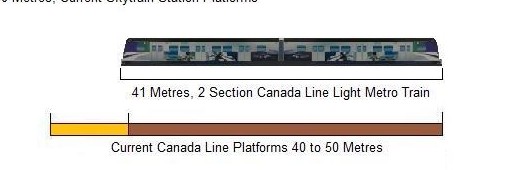
The Canada line with truncated 40 metre station platforms can only operate 2-car, 41 metre long trains, shorter than many modern trams today.
Internationally the Canada line is considered a “white elephant”, which the majority of ridership comes from Richmond, South Delta & Surrey buses, compelled by agreement to forcibly transfer their passengers onto the the mini-metro.
The judge (Hon. judge Pittfield) overseeing the Susan Heyes lawsuit against TransLink over lost business with the Canada Line construction, called the bidding process a “charade”.
With the same businesses and organizations involved, I am afraid that transit customers in Montreal will be involved in the same sort of “charade” with REM in Montreal.
Montreal from the summit of Mont Royal. Image: Getty.
The Réseau Express Métropolitain (REM) is the 67-kilometre, C$6.3bn light rail project Montreal never asked for.
It is the single largest transit project in Montreal in half a century. Not since the construction of the Métro has there been as bold a proposal: an entirely new mass-transit system that would have the effect of radically altering the city’s urban landscape.
Conceived, planned and costed by the Province of Quebec’s institutional investor, the Caisse de dépot et placement du Québec (CDPQ), the REM is currently under construction and slated to become operational between 2021 and 2023.
Once completed, it is supposed to provide high-frequency, intermediate-volume light-rail service on a regional level: connecting suburbs with the city centre along three axes and linking Montreal’s central business district with its international airport.
The REM may even connect to an as-yet unbuilt baseball stadium, and politicians have even proposed extending it over hundreds of kilometres to provide inter-city service. Indeed, the REM has been strongly endorsed – by both the federal and provincial governments that back it – as a panacea for all of Greater Montreal’s transit and traffic congestion problems.
Since it was first proposed in 2015, the REM has been championed above all else as a guaranteed-to-succeed “public-public partnership”. A win-win, where various levels of government cooperate and coordinate with an arm’s-length government agency to produce much-needed new transit and transport infrastructure.
Unlike the more commonly known public-private partnership (of which there are some notable recent failures in Quebec), the obvious insinuation is that – this time – there’s no private interest or profit to worry about.
PR aside, the pension funds managed by the CDPQ are private, not public, wealth. The CDPQ’s entire raison d’etre is to profit. It has even gone to the lengths of “mandating” the REM to provide it an annual profit of about 10 per cent, a cost to be assumed by the governments of Quebec and Canada in the event the REM isn’t profitable.
The law that has made the REM possible has other interesting components. The REM is legally distinct from and superior to other public transit agencies and the extant regional planning authority. It has exclusive access to publicly-funded transit infrastructure. There’s even a “non-compete” clause with the city’s existing mass transit services, as well as special surtax on all properties within a 1km radius of each of the 26 proposed stations.
This latter element takes on a new dimension when you consider the CDPQ’s real-estate arm, Ivanhoé-Cambridge, has a near total monopoly on the properties surrounding the future downtown nexus of the REM, and is invested in suburban shopping centres that will soon host REM stations.
It seems that Montreal isn’t so much getting a new mass transit system as a pension fund is using a new transport system to stimulate growth in a faltering if not moribund commercial and residential property sector.
Quebec’s public pensions have historically invested in suburban sprawl. As this market becomes increasingly untenable, and populations shift back towards the city centre, the REM is supposed to stimulate growth in “transit-oriented developments” centred on its future stations. The new surtaxes are likely intended to force sales of land for immediate redevelopment, so that new homes are ready to move into as soon as the system becomes operational.
It’s important here to remember that the city of Montreal wasn’t given several billion dollars by the government with which to spend developing its mass transit system. Rather, Quebec’s former premier asked the CDPQ to come up with a way to integrate several long-standing yet unrealized transit proposals. These included a light-rail system over Montreal’s new Champlain Bridge, an express train to Pierre Elliott Trudeau International Airport, and a dedicated commuter rail line for the Western suburbs. It was the CDPQ that proposed a fully-automated light-rail system that would use existing technology as well as some of Montreal’s extant railway infrastructure as an inexpensive way of uniting several different projects into an assumedly more efficient one.
So far so good. Cities need more mass transit, especially in the era of climate change, and Montreal contends with regular congestion both on its roadways and various mass transit systems. Moreover, access to the city’s already generally-high quality public transit systems is an important driver of property values and new residential development.
Considering the evident need for more transit, the REM theoretically provides an opportunity to kill several birds with one stone. Better still, the REM will in all likelihood stimulate the transit-oriented developments and re-urbanisation necessary for a more sustainable future city.
A map of the proposed network, with metro lines in colour and commuter rail in grey. Click to expand. Image: Calvin411/Wikimedia Commons.
The REM is the business “test case” on which two new government entities are based; the CDPQ’s infrastructure development arm, and the Canadian government’s infrastructure development bank.
The REM is also intended to stimulate economic activity in important economic sectors – such as engineering, construction and technology – that could soon be in high-demand internationally. Both the governments of Quebec and Canada see tremendous value in the economic potential of infrastructure mega projects at home and abroad.
This aside, the actual development of the REM has been complicated by what appears to be a bad case of over-promising and under-delivering, at least in terms of how seamlessly it could be integrated into the city’s extant transit and transport systems.
Though the train as originally conceived was intended to use an existing electrified railway line as the backbone of the network, it now appears that the REM cannot in fact be adapted to the line’s current voltage. The entire line, and the tunnel it passes through, requires a thorough overhaul, something that had last been completed in the mid-1990s. The new electrification, as well as the reconstruction of the tunnel, will cut it off from the regional commuter rail network. Rather than have different types of rail systems share existing infrastructure, the REM will force the premature (and unnecessary) retirement of a fleet of high-volume electric trains.
Consider that while the REM will connect the city with its international airport, it’s not planned to go just one kilometre farther to connect the airport with a major multi-modal transit station. Dorval Station integrates a sizeable suburban bus terminus with a train station that serves both regional commuter rail as well as the national railways network.
It’s difficult to understand how and why such an obvious and useful connection wasn’t considered. Given long-standing interest in high-speed and/or high-frequency rail service in Canada, La Presse columnist François Cardinal has noted that a REM connection between airport and a likely future rail hub would extend access to international air travel far further than just downtown Montreal.
The REM was also supposed to integrate seamlessly into the Montreal’s built environment, its promoters insisting construction could be completed with minimal inconvenience to current transit users. By the end of this year, REM-related construction will force a two-year closure of Montreal’s most-used commuter rail line, and sever the most recently-built rail line off from the transit hubs in the centre of the city. Tens of thousands of commuters throughout the Montreal region will be forced to make do with already over-saturated bus and métro service.
Though public consultations revealed these and other flaws, concerns raised by the public, by professionals and even some politicians were largely ignored. The REM also failed its environmental assessment. The provincial agency responsible for such evaluations, the BAPE, stated baldly that the project wasn’t ready for primetime and lambasted the CDPQ’s lack of transparency. In turn, the BAPE was accused of exceeding its mandate. The REM made a similarly poor impression, with transit users groups, architects and urban planners criticizing the project in whole and in part.
The main points of contention are that the REM won’t do much in the short term to alleviate congestion across the city’s existing – and comparatively expansive – mass-transit network. Quite the opposite: it is already beginning to exacerbate the problem.
Because the REM was conceived without the involvement of either the city’s main transit agency or the regional transit planning authority, its progress is hampered by a wide-variety of problems that would otherwise likely have been planned for. And because it’s a mass-transit solution to what is primarily a political consideration, the REM will provide higher-frequency service of dubious necessity to the city’s low-density suburban hinterland, much of which already has ample commuter-focused transit service. The high-density urban-core, which is most in need of transit expansion, will benefit perhaps least of all.
While it’s unlikely the REM will fail outright, it’s also unlikely to stimulate much new interest in using mass-transit services: it will first have to win back those who may abandon mass-transit while the REM is being built. Providing higher-frequency service to suburbia is the kind of thing that sounds good in theory, but doesn’t respond to commuters’ actual needs. Arguably the REM’s best feature – its real-estate development potential – has been somewhat obscured from public view because of obvious conflicts of interest. The REM’s limitations – and there are many – will for the most part only become known once the system is operational, at which point it will be too late.
The REM provides interesting theoretical avenues worthy of exploration – particularly the potential relationships between new transit development and how it may stimulate new growth in the housing sector. But building a new transit system – especially one this large and complex – ultimately requires the fullest possible degree of cooperation; with transit users, extant transit agencies and regional planning bodies.
Ignoring the recommendations of experts, the public and government assessment agencies for the sake of expediency is never a wise idea. When it comes to designing and implementing the mass-transit systems of the future, the needs, wants and opinions of users must be paramount. In Montreal, it appears as though they were an afterthought and an inconvenience.
Whether Montrealers will be able to vote with their wallets remains to be seen. Under the specific conditions set with which to integrate the REM into Montreal’s overal mass transit scheme, other types of transit have either been replaced by the REM or will have their routes and schedules modified to better serve it. The REM removes operational redundancy between different systems in an effort to be more efficient, but this will likely have the effect of forcing many Montreal transit users to use a one-size-fits-all solution that doesn’t suit anyone’s needs
It’s difficult to imagine how forcing people to use a transit system they never asked for will encourage greater use.
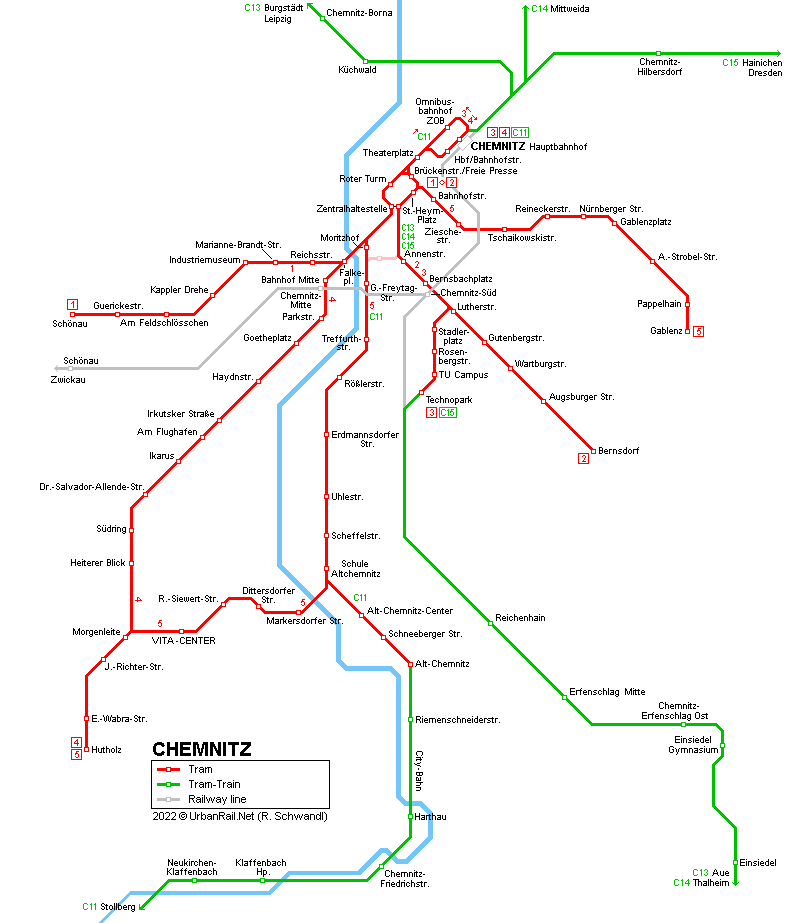
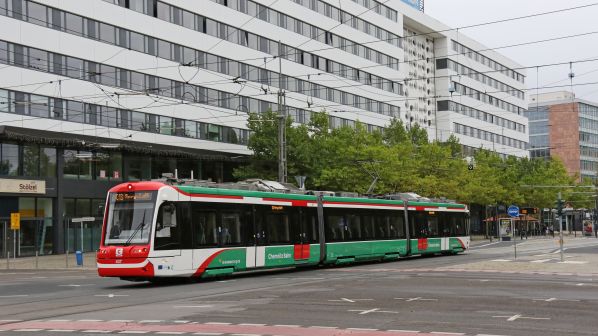
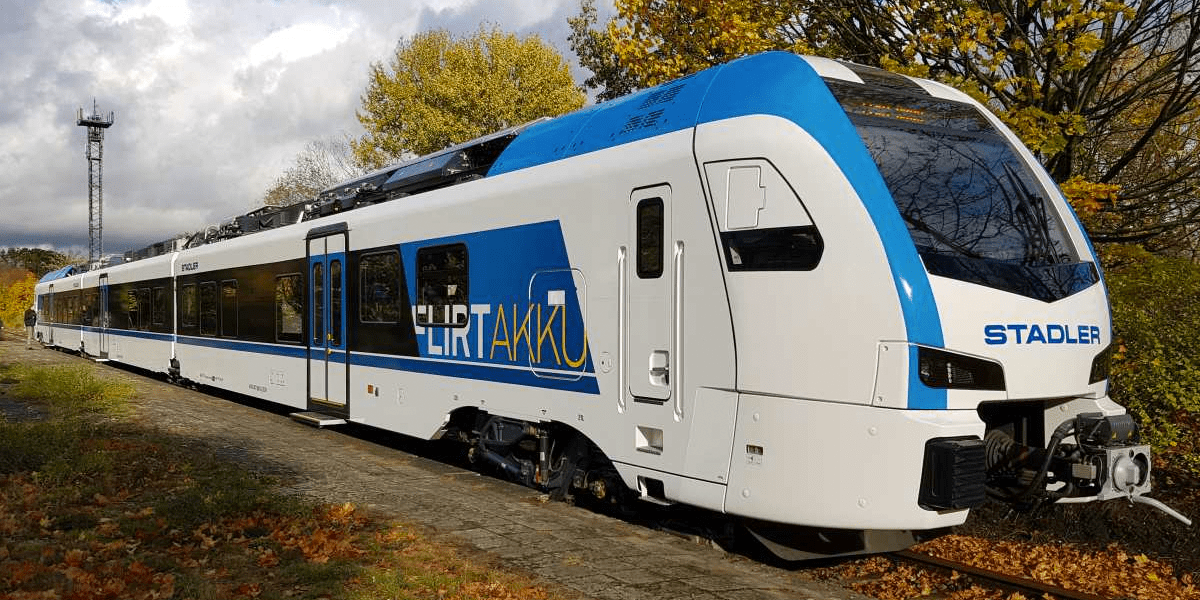
Chemitz TramTrain, using the Stadler Citylink has more than doubled ridership since operation commenced in 2016 by allowing, as in Karlsruhe, unimpeded service (no transfer) to the city centre by using light rail vehicles that can act both as a mainline EMU’s or as a streetcar.
This is the lesson TransIink doggedly refuses to learn as they continue to claim high ridership by double counting boarding’s with customers forced to transfer to the light metro system.
Verkehrsverbund Mittelsachsen ordered eight NET 2012 tram-trains, with options for two more, for planned use on the Chemnitz Bahn network from 2015. In July 2015, a further four were ordered. Testing of the first tram-trains to be delivered commenced in September 2015. The Chemnitz Citylinks are fitted with a diesel generator to enable them to operate away from electrified routes, and they can also operate from 600 V DC and 750 V DC electrified lines. The centre section is also slightly higher, due to the differing platform heights in Chemnitz, allowing the doors in the centre section to be level with the higher platforms and the other doors to be level with the lower platforms.
The first Citylink entered service on the Chemnitz Bahn on 4 April 2016.
The Stadler Citylink Tram-Trains are also used in Karlsruhe (50); Allicante (9) and Vallencia in Spain (62); Sheffield (7) and soon in Cardiff (36) ; and in Szeged, Hungary (8).
The network is now carrying 5300 passengers per day compared with 2500 at the opening, an increase of 112%, thanks to the introduction of through one-seat-ride services between regional towns and Chemnitz city centre.
The tram-train services are operated for Mid-Saxony Transport Authority (VMS) by City-Bahn Chemnitz using a fleet of eight Stadler bi-mode Citylink LRVs. They serve three routes with the vehicles running as conventional trams on the city tram network which is electrified at 750V dc and as diesel-powered LRVs on lines owned by DB Network running to the east and north of Chemnitz Main Station.
Average daily numbers supplied by City-Bahn Chemnitz before the introduction of tram-trains into the city centre in 2016 and for 2018 when the service had been in operation for more than a year, show substantial growth in passenger traffic. Line C14 from Chemnitz to Mittweida recorded growth of 146% from 650 to 1600 daily passengers. Line C13 linking Chemnitz with Burgstädt is the busiest route carrying 2000 passengers/day, representing an increase of 122%, while traffic on Line C15 Chemnitz – Hainichen, which was the busiest route when it was operated as a conventional railway using DMUs, has grown by 78% from 950 to 1700 passengers/day.
Extension
The next project involves introducing tram-trains on the 47km line running south via Thalheim to Aue. Planning permission to construct a link between Technopark and the existing railway line to Aue was granted by Germany’s Federal Railway Authority (EBA) earlier this year. However, the project was delayed during the planning process by objections from residents and environmental groups and is now unlikely to be completed until December 2020 at the earliest. VMS has ordered a further four Citylink LRVs to operate this service.
Three further extensions to the network including re-opening closed railway lines and new sections of tramway are planned by VMS during the early 2020s.
In Germany, TramTrain operates on mainline railways with mixed passenger and freight service, with little problem.
It has now been 10 years since Rail for the Valley commissioned the Leewood Study on reestablishing a passenger rail service from Vancouver to Chilliwack and all the public got was invented excuses from all levels of government.
Light rail doesn’t work; no one will take it, too circuitous a route; etc., were the excuses of TransLink’s gold plated bureaucracy, most politicians and armchair experts.
Yet, TramTrain has become a powerful tool in affordably bringing rail transit to areas otherwise undeserved by public transport.
What is TramTrain?
TramTrain is part of the light rail family that modern streetcars have the ability to operate as a streetcar or tram on-street track; as light rail transit on a reserved or dedicated rights-of-way; and on mainline railways.
First used in Karlsrhue, Germany, since 1992, TramTrain, due to its low cost, has become an essential tool in providing the all important “seamless journey” that has proven to attract the motorist from the car.
Consider the following:
Translink is spending $4.6 billion to extend the skyTrain light-metro 12.8 km.
The French city of Caen just opened a 16 km tramway for $373 million.
The region coulld spend under one billion to provide a 130 km., hourly Vancouver to Chilliwack TramTrain service, which would connect Vancouver directly to Cloverdale, Langley, Abbotsford, Sardis and Chilliwack.
To put this another way, the region could spend under $1.5 billion to build both LRT and a TramTrain that would provide a direct UBC to Chilliwack service!
Sadly, affordable transit in not in the NDP’s, TransLink’s and the regional mayors lexicon.
The UK’s first hybrid tram-train has been operating for a year. Now Glasgow, Manchester and areas in Wales are looking to build their own versions
South Yorkshire Passenger Transport Executive
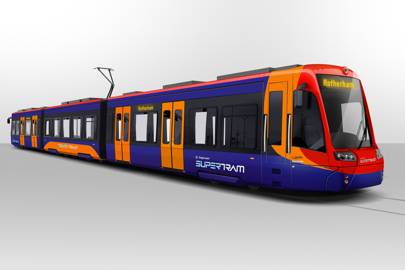
One piece of track part of the way between Meadowhall South, in Sheffield, and Rotherham Central is unique. As a tram makes the journey, it slides onto the special section of track that connects it to the main rail network. There, it switches from driver controls to rail signalling, acting not like a tram but a train.
This fusion of light and heavy rail infrastructure is the UK’s first tram-train – and if South Yorkshire’s trial continues to be as popular in the second year as the first, we could see more hybrid services across the country.
Trams are ideal for inner-city public transport: they are above ground for easy access, have clear routes that can’t be diverted like a bus, and most are electric powered for no emissions. But they aren’t great for linking together our cities, which are further apart and tend to be connected by higher speed rail networks.
To get the best of both worlds, you have to cram them together into a hybrid known as the tram-train, a vehicle that can run on tram networks as well as standard heavy rail, despite their different power, communications, signalling and safety regulations. “The benefit is that if you already have a good tram network in your city and a relatively unbusy mainline railway network around the city, you can provide direct services from the suburbs to the city centre without building too much infrastructure,” says Taku Fujiyama, a lecturer at University College London’s faculty of engineering science.
The tram-train trundling between Rochester and Sheffield city centre is the first of its kind in the UK, but the idea has long been used elsewhere, originating in the German city of Karlsruhe in 1992. (The UK does have trams that run on former train lines, but in those cases no standard train services operate as well, so they can continue to behave like trams throughout their journey.)
Britain’s first tram-train started operating on October 2018 in South Yorkshire after a six year delay and quadrupling of costs to £75 million – largely down to unrealistic costings and more work required than expected, according to the National Audit Office – but now the first half of a two-year trial is complete.
Our politicians still want expensive 1960’s transit systems; something to cut ribbons in front of at election time and not providing an affordable transit service.
Even in the transit constipated United States, hydrogen (Ballard) powered trains are now becoming a reality.
I guess, Mr. Trudeau, Horgan and regional mayors and politicians are happy spending $4.6 billion for 12.8 km of rapid transit that will look good for photo-ops but not much else.
The taxpayer, not so much, especially when cities like Caen, France can built 16 km of LRT tramway for $373 million.
Or, a 130 km. Vancouver to Chilliwack passenger interurban service for less than $1.5 billion?
Time for another plebiscite on TransLink’s spending?
US hydrogen train contract awarded
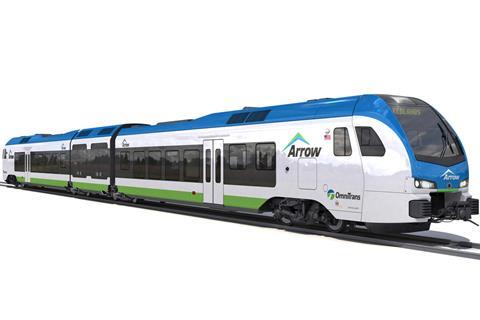
USA: Southern California’s San Bernardino County Transportation Authority has awarded Stadler a contract to supply a Flirt H2 hydrogen fuel cell powered multiple-unit to enter passenger service in 2024, with an option for a further four units.
Stadler said the contract announced on November 14 was ‘a major milestone in bringing zero-emission passenger rail technology to the USA’.
The Flirt H2 unit will have two cars with a total of 108 seats and ‘generous’ standing room, plus a central power module holding the fuel cells and the hydrogen tanks. It will have a maximum speed of 79 mile/h (127 km/h), the federal limit above which additional signalling systems are required.
It is to be deployed on the Redlands Passenger Rail Project, a 14·5 km passenger service which is being developed on a former Santa Fe freight railway alignment between the University of Redlands and the Metrolink commuter rail station in San Bernardino.
In 2017 SBCTA ordered three diesel-electric Flirt units for the line, which is currently being built by Flatiron Construction Corp. The ‘Arrow’ branded service is expected to launch in late 2021.
The order for a hydrogen unit ‘is an excellent example of how we are demonstrating our commitment to the next generation’, said SBCTA President Darcy McNaboe. ‘The hydrogen Flirt will help us address the commuting needs of today while preserving our environment for a better tomorrow.’
‘Stadler is committed to designing and building green technology for the transportation industry’, added Martin Ritter, CEO of Stadler US Inc. ‘We have an excellent relationship with SBCTA, and it is a great honour to partner with them to bring the first hydrogen-powered train to the USA.’
As Metro Vancouver blunders along opening a new light metro line every decade or so, France has just opened their 24th tramway, in just 35 years!
While Metro Vancouver is spending $4.6 billion to build 12.8 km of the obsolete Movia Automatic Light Metro system, the City of Caen, just opened a 16 km, 3 line tramway (LRT) system, costing $373 million.
A new illuminated tram for Paris. Paris or Ille-de-France 104.7 km tram system boasts 10 lines, servicng 186 stations or stops.
Bordeaux’s 66 km, 3 line network, services 116 stations or stops and carries over 300,000 customers a day.
Strasbourg’s 65 km, 6 line tram network has 82 stations/stops and has a daily ridership of 457,000.
Nice’s 16.2 tram system has 2 lines and 2 lines under construction and carries over 100,000 customers a day.
Dijon’s tramway opened in 2012, has to lines totaling 20 km in length.
Tours’s tramway opened in 2013 and today the 29 stop system carries over 55,000 customers a day.
You got to have funding to build and operate a transit line.
The Mayors Council on Transit, is a little weak on this issue, especially after a mostly federal/provincial funded $4.6 billion grant to build 12.8 km of extensions to the Expo and Millennium Lines.
They also approved an increased of salary for TransLink’s CEO, by $111 thousand, to $517 thousand a year to keep him on board and not to abandon the current charade of transit planning. A persistent rumour had it, he wanted out of the “ship of fools“.
No wonder union bus drivers and maintenance workers want a hefty pay rise, the CEO got one!
A financial reality check is soon to hit the Mayor’s Council square in the face, and that is operating costs.
The era of free money is coming rapidly to the end and with mounting operational costs (the 5.8 km Broadway subway will add about $40 million annually to TransLink’s budget) as aging infrastructure and higher wages will make current plans unobtainable.
That 2015 plebiscite result, where almost 62% of metro voters voted against additional funding for TransLink, hangs like an Albatross around regional mayor’s neck, today, I believe a larger percentage of people would vote against giving more money.
TransLink is held in high odor by more people than one would suspect.
TransLink’s financial ills are due to spending on needless ‘prestige’ projects and the public has had enough with this secret sociability planning and operating transit.
New Westminster Mayor and Mayors’ Council Chair Jonathan Coté says the idea of cutting back on transit expansion is “off the table.”
Unifor, the bus drivers’ union, has suggested scaling back transit expansion projects in order to pay for increases in a future drivers’ contract. The two sides are struggling to reach a new contract and drivers have been escalating job action.
Coté issued a statement Monday morning saying expanding transit service is crucial to Metro Vancouver.
“As Chair of the Mayors’ Council, I am disappointed that we have not been able to resolve the current labour dispute with Unifor,” he said. “It is disappointing to hear Unifor leadership suggest that bus expansion be scaled back in order to pay for their wage demands. Scaling back transit expansion in this region is completely off the table. With North American-leading ridership growth, a climate emergency and growing road congestion, now is not the time to slow down transit improvements. Cutting the funding used to buy additional buses and hire more bus drivers will also do nothing to improve the working conditions of our valuable transit operators.
“The Mayors’ Council has worked almost single-mindedly the past four years to improve and expand our transit network through its 10-Year Vision. Well over 90% of the bus service expansion we have approved in the first two phases of the Vision in 2017 and 2018 has been directed at our most overcrowded routes to provide more frequency and more passenger capacity. Over 20% of these service improvements is to add run-time to improve reliability for customers and recovery time for operators.
“If the Mayors’ Council were to roll back these bus service improvements in order to pay for what the union is asking, bus overcrowding would increase, which is exactly what union leaders claim they want to see reduced.”














Recent Comments