It is interesting indeed that Vancouver Sun columnist, Vaughn Palmer is writing about transit and the two massively expensive rapid transit projects, the Surrey LRT and the Broadway subway.
With both federal and provincial backing, these two ill conceived projects will cripple transit planning for the next quarter century. In the long term at least, Surrey’s LRT id flexible enough to have much cheaper extensions added, unlike the propitiatory SkyTrain light-metro.
Vancouver, wants a subway as a driver for major property development along Broadway, as in the city of the rich and famous, transit is strictly for the lower classes, students and the elderly.
But back to the Vancouver Sun, the great champion of SkyTrain and the Canada Line; why allow negative stories?
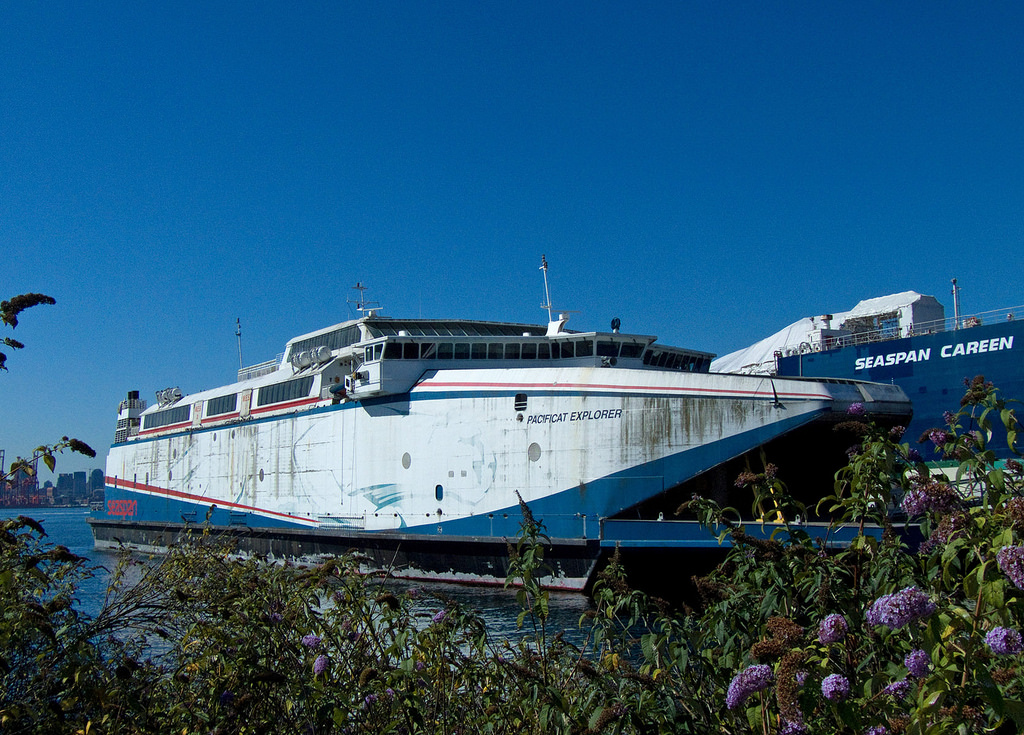
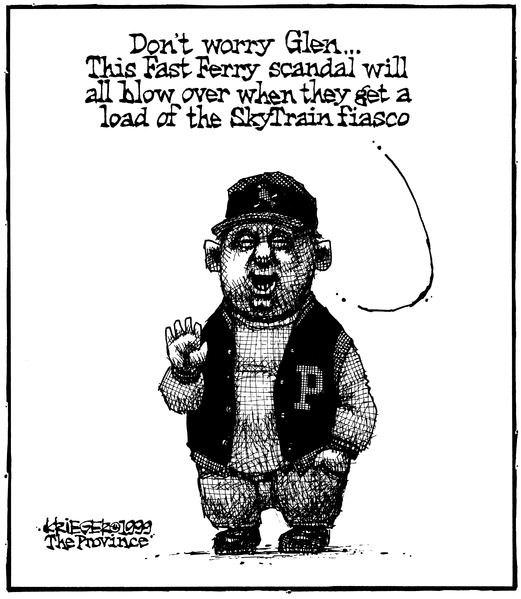
The answer I think, the media barons back east smell another FastFerry type fiasco that they can hang on the NDP.
The question I ask is; “Where was Palmer and the Sun , two, three, four years ago when the travesty of public consultations was taking place, complete with the Vision Vancouver goon squad threatening or shouting down all those questioning both transit projects?”
Yes, where were you then?
Oh yes, the Liberals were in power and reporters treating Liberal news releases as news!
Vaughn Palmer: SFU research flags costs, scrutiny, merits for B.C. transit projects
The overall impression from the SFU research is the two B.C. projects, Surrey light rail and the SkyTrain extension in Vancouver, are the most expensive in the country.
VICTORIA — As Gregor Robertson prepares to leave office after a decade as mayor of Vancouver, the timing underscores the soaring cost of his enthusiasm for extending transit across the west side of the city to the University of B.C.
Back on the eve of the 2013 provincial election, Robertson, then in his second term, released a study — jointly funded with UBC — that made a jobs and economic development case for extending SkyTrain by subway along the Broadway corridor and out to the Point Grey campus.
“What is currently a powerhouse for jobs will suffer and be choked off” by “gridlock and over-stretched transit,” Robertson told reporters as city officials distributed a report showing employment and population along the corridor would grow by 150,000 over 30 years.
Cost estimate for the entire project was $2.8 billion, which at the time seemed like a sobering amount.
Today, as Robertson comes to the end of his third term, three levels of government are preparing to spend roughly that amount — $2.83 billion — just to construct the first phase of the extension, from Clark Drive to Arbutus, a distance of 5.7 kilometres.
To get SkyTrain all the way out to UBC would mean constructing another seven to eight kilometres of line, depending on the chosen route and number of stations on campus.
Published estimates for covering the remaining distance are on the order of $2.6 billion. But I would treat that number as wishful thinking, given the cost of inflation over the last five years and the likelihood that construction won’t start until after Phase 1 is completed in 2025.
So in the space of five years, the estimated cost of getting SkyTrain to UBC has at least doubled and maybe tripled.
Yet the provincial government has provided no specific justification for the escalation, other than vague generalities about inflation and the cost of materials, labour and land, none of it backed up with detailed breakdowns.
Raising additional doubts is an email I received this week from Stephan Nieweler, a transportation instructor and doctoral researcher in the geography department at Simon Fraser University.
He and his students have produced some telling cost comparisons between transit projects elsewhere in Canada versus the Broadway SkyTrain extension and the recently approved Surrey-Newton-Guildford light rail project.
“The numbers for the Metro Vancouver projects are shocking compared to those in other cities,” wrote Nieweler.
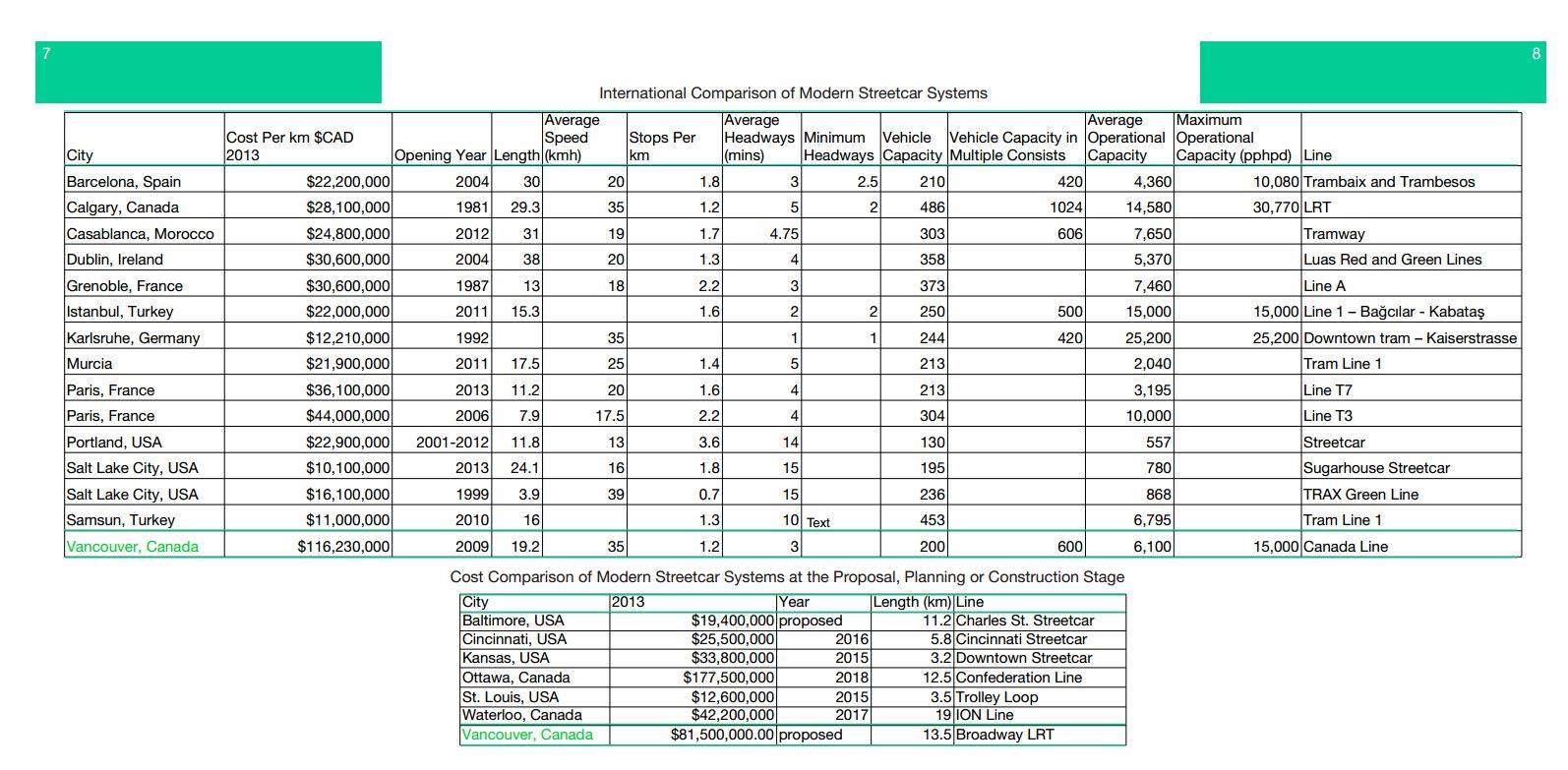
By way of example, he sent along several pages from a power point presentation showing how transit was being built for less money and/or over greater distances in Ontario (Waterloo, Ottawa, Toronto), Alberta (Calgary, Edmonton), Manitoba and Quebec.
There were differences between the types of systems and schedules for completion, making precise comparisons difficult.
Still, the overall impression from the SFU research is the two B.C. projects, Surrey light rail and the SkyTrain extension in Vancouver, are the most expensive in the country.
He also sent along details from a second research project that weighed the merits of an 11-kilometre light rail line along the North Vancouver waterfront, stretching from Capilano University in the east past Park Royal and into West Vancouver.
In terms of population and employment density along the route, Nieweler concluded there’s a better case for the North Shore light rail project than either Surrey light rail or extending SkyTrain to UBC.
He presented those findings to the integrated North Shore planning project, chaired by North Vancouver NDP MLA Bowinn Ma. In light of that, he lamented the diluted enthusiasm for North Shore light rail in the panel report released last week.
He went on to speculate that senior government officials and TransLink planners had discouraged the panel from making any recommendations on light rail that would compete with the just-approved projects in Vancouver and Surrey.
“The point being, that our governments are not engaging in performance-based investment,” wrote Nieweler, citing the “mantra” that was prevalent at TransLink when he worked for the regional transportation authority several years back.
“I think the public needs to know how these decisions are made, and why our leaders have chosen to proceed with the costliest surface light rail and Metro projects in Canadian history without the scrutiny that they deserve.”
He makes a good case for proper scrutiny. But who would undertake it at this late date, other than perhaps the independent auditor-general, is not at all apparent.
As noted here earlier this week, neither TransLink nor the provincial government is inclined to share any detailed rationalization for why it is costing half a billion dollars a kilometre to tunnel under Broadway and $160 million a kilometre to build on the surface in Surrey.
When Prime Minister Justin Trudeau and Premier John Horgan made a joint announcement on the Vancouver and Surrey transit projects earlier this month, more than a few observers noted it was not, in fact, news because both governments had endorsed those projects before.
Rather their purpose seemed to be to declare the projects a fait accompli in advance of the Oct. 20 civic elections.
“We’ve locked in this funding for the next 10 years,” declared Trudeau.
“This is about locking this down,” echoed Horgan. “This is happening. This is not being revisited. The cheque is in the mail. We are going to be building.”
The debate is over, so far as the politicians are concerned. But for taxpayers, the ordeal is just beginning.
A fiasco is brewing in Surrey, as the cost for LRT construction is now exceeding $165 million/km!
Is it by design, by TransLink, who wish to continue building with SkyTrain?
Is it by devious planning by other City of Surrey, piling on massive infrastructure costs on the light rail project?
Is it nothing more than a provincial make work project?
Is it a “St. Clair” type of transit project where the LRT is a sideshow to a massive road rebuilding scheme, paid for by funding new light rail?
*
Or, is it just plain incompetence of TransLink?
*
Take you pick because the Surrey LRT is fast becoming a poster boy for more SkyTrain!
*
It seems the City of Surrey is loading road projects (Hawthorn Park) and renewing underground utilities on the back of the LRT project.
*
The following shows the construction costs of various transit systems up to 1987.
*
I believe that these costs do not include vehicles, but rather are the raw construction costs for track and OHE.
*
It is not the cost I am looking at rather the ratio of construction costs.
SkyTrain cost 6.5 times more to build than San Diego; 3.2 times more than Portland; 2.65 times more than Nanetes (France); and 2.2 times more to build than Calgary, yet today, in Surrey, SkyTrain is mere 20% more expensive than Surrey’s new LRT, what gives?
Accounting for inflation, the construction cost in 2018 dollars:
The scope of the Surrey LRT should be comparable to Nantes at about $21.05 mil./km, plus cars and maintenance facility. The total cost should be around $35 million/km to $45 million/km.
*
As Light metro uses much more cement and rebar than LRT and it also has a very expensive reaction rail, needed for the LIM’s, for TransLink to say that LRT is about 20% less than Light metro is nothing but pure invention.
*
I would love to see what Alstom or Siemens would say!
*
Also please note, LRV’s are cheaper than SkyTrain becuase one needs three SkyTrain cars to match the capacity of a modern tram!
*
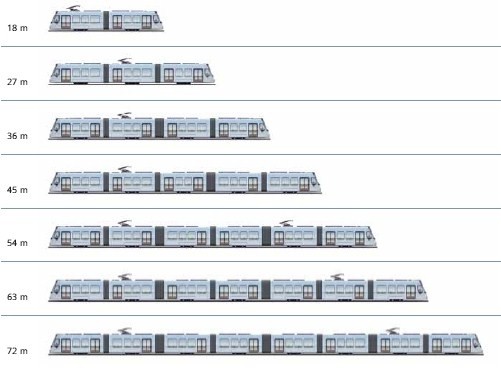
I am also puzzled why only 30 metre long trams are being used as today, trams can be bought a various lengths and capacity can be increased incrementally, as demand grows, by adding more modules in a modular car.
*
The following gives a primer on modular trams and how a small tram can have extra modules added, thus increasing capacity affordably without buying new cars.
30 metre long trams seem a tad small.
The following gives a good visual of Ottawa’s trams and SkyTrain. You need three Mk.2 SkyTrain cars to match the capacity of one modern tram that will be used in Ottawa.
What is happening in Surrey, is anybody’s guess, but at $165 mil/km, for a basic tramway is worthy of an investigation.
*
Vaughn Palmer: Rapid escalation of light rail costs in Surrey are literally taxing
The rapid escalation means surface light rail in Surrey is now costing more to build than the Evergreen SkyTrain extension to the Tri-Cities, completed two years ago for $130 million per kilometre
Vaughn Palmer
September 19, 2018
VICTORIA — The transportation ministry has provided an explanation of sorts for the soaring price tag for light rail in Surrey, now budgeted at more than double the estimated cost per kilometre from just five years ago.
The recent request for qualified bidders on the project includes an estimate of $1.65 billion to construct the 10.5 kilometre-long first phase of an L-shaped line linking the Newton and Guildford town centres to Surrey Central.
As recently as 2013, Surrey sought funding of $1.8 billion to construct the first phase as well as a second 16.5 kilometre-long link to Langley. The then-to-now difference in cost per kilometre: about $65 million versus the current $157 million.
The rapid escalation means surface light rail in Surrey is now costing more to build than the Evergreen SkyTrain extension to the Tri-Cities, completed two years ago for $130 million per kilometre.
Rendering of Light Rail Transit at Newton Station in Surrey. Rendering provided by Light Rail Transit Surrey Newton Guildford. TransLink
Seeking an explanation, I put the question to the provincial transportation ministry and got back a few points via email.
“In order to compare the cost of the Evergreen Line with Surrey-Newton-Guildford light rail, both projects should be considered on the same time basis,” it began. “Given current market conditions and cost pressures for commodities and labour, if Evergreen were built today, it would have faced these same considerations.”
Though the exploratory call for bids was issued earlier this month, the actual contract won’t be finalized until the winter of 2019 with the start of construction targeted for 2020.
“If Evergreen construction were to start in 2020, the costs would need to be inflated by seven years. On that basis the SNG LRT project is about 20 per cent less expensive than Evergreen.”
Almost one-quarter of the 11-kilometre Evergreen line was tunnelled. Construction entailed installation of the SkyTrain guideway and more elaborate stations. Shouldn’t street-level light rail be a lot less expensive?
“Surrey light rail has a number of other costs because it is a new, stand-alone at-grade system,” the ministry went on to explain. Those extras include a “full operations, maintenance and storage facility, which can service future extensions to the LRT system.”
The latter includes the still-on-the-drawing board extension to Langley, portrayed on the map that accompanied the request for qualifications. Though the extension is not part of the current procurement, would-be bidders are cautioned that “the project shall not preclude the ability to efficiently and cost effectively integrate operations of the two phases.”
At the current estimated cost per kilometre, with no allowance for inflation, the Langley extension would run to another $2.6 billion.
Other factors cited by the ministry to account for the price differential on Surrey include the acquisition of a fleet of 16 light rail vehicles, each 30 metres long.
Granted the switch to a completely different transit system entails additional costs in terms of purchasing rolling stock and establishing separate operations and maintenance facilities. But that’s one reason why critics argued for sticking with SkyTrain.
Other unique-to-light-rail factors cited by the ministry include:
“Various costs related to the at-grade nature of the system, including significant utility relocation costs (estimated to be in the order of 10 times the utility relocation costs on Evergreen) and significant requirements for traffic management during construction.”
Plus “extensive urban integration elements, including multi-use paths, bike paths, road relocations and landscaping, and related property costs, to support the urban redevelopment and livability objectives of the project.”
I was also advised to take note of the rising cost of acquiring land in Metro Vancouver. But doesn’t one of the supposed savings with light rail arise from the lines and boarding platforms being constructed on existing streets?
In any event, the ministry did not provide cost breakdowns for any of these factors, so it is not possible to gauge to what degree any of them contributed to the overall budget.
Nor does the ministry intend to provide any more detail until the contract award, with final breakdowns to be released only after construction is complete in 2024.
Perhaps a better explanation might be forthcoming during the current civic campaign in Surrey. Back in the summer of 2013, then-city councillor and chair of the transportation committee Tom Gill told the Surrey Now newspaper that light rail could be built at a cost of between $65 million and $85 million. Today, he is running for mayor on a platform touting light rail at twice the price.
Another thing that jumped out from a review of The Vancouver Sun files was a 2011 story where TransLink was claiming it could build light rail through Surrey at a cost of $27 million per kilometre. Someone, somewhere has some explaining to do on this project.
Meanwhile I would note a telling tweak in the request for qualified bidders on Surrey light rail.
The initial posting on Sept. 5 stated the project would have to be “delivered in a matter consistent with the province’s objectives in the community benefits framework,” the NDP-authored scheme that mandates preferential hiring via selected unions.
A revised posting last week stood down that specific requirement in favour of a more general commitment to apprenticeships, training, local hires and opportunities for Indigenous people and other underrepresented groups.
No explanation for the switch. But perhaps the other partners on the project — the federal government, TransLink and Surrey itself — balked at being coopted into supporting the NDP hiring hall, with its preferential treatment for selected unions.
It seems Surrey’s LRT project is in reality a road and underground utility renewal project with rails, hence the massive construction costs.
Are these road and renew weal projects needed?
Was the Hawthorne Park Road needed?
No.
Do the underground utilities need replacing?
Probably not.
It is the cancer of light rail projects in North America, where costs soar to to the political charade of masquerading road building and underground utility renewals and construction, onto the new LRT’s construction tab.
More and more, the $165 million/km Surrey LRT project looks like it is nothing more than a road building and utility upgrading project with rails.
Early work on Surrey LRT hits a snag as sewage backup shutters police station
Cleanup is underway at a Surrey RCMP building after early work on the city’s Light Rail Transit (LRT) system caused a backup of sewage.
A sanitary sewer line was being moved by construction crews near 104 Avenue and 148 Street on Tuesday when a temporary bypass pump failed, causing sewage to backup into the police station.
A claim has been submitted to the contractor and the RCMP building is closed indefinitely.
“We’re still evaluating and assessing the impacts and determining the next steps,” said LRT project director Scott Neuman.
He also said there are three projects underway right now before the ‘real’ LRT work gets going.
“TransLink and the city are working together on identifying the next round of advanced works.”
Neuman said this kind of incident is not unusual during utility construction.
Like it or not, modern public transit is coming to Surrey and the SkyTrain Lobby are kicking and screaming all the way, why?
The fear, I believe, is that there is great fear that when modern LRT operates in Metro Vancouver, “apples to apples” comparisons will be made between SkyTrain light-metro and light rail. and LRT will signal the demise of the aging proprietary light metro.
It has also been mentioned to me, that LRT will prove embarrassing for many academics, who have spent careers promoting light-metro as a tool to create high density for a more livable city.
LRT operation will also prove problematic for many city engineers, who want all transit in the air on a viaduct, or hidden away in a tunnel, to keep roads clear for cars.
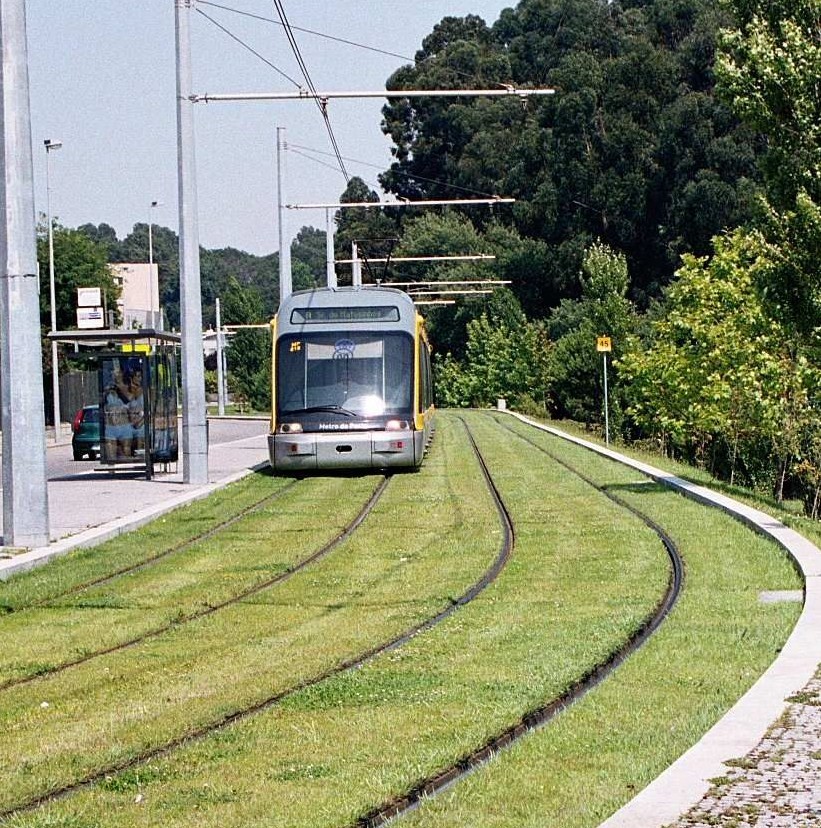
Modern LRT, with over 135 years of development behind and with its inherent flexibility, it can and will adapt to future needs.
Light rail is coming to Vancouver, some forty years since it was first planned for!
Stephan Mehr: Light rail will bring huge transit improvements to Surrey, TransLink manager says
LRT is on the way, says Stephan Mehr, director of TransLink’s Surrey-Newton-Guildford LRT Project.
Stephan Mehr
September 12, 2018
Rendering of Light Rail Transit on King George Blvd. at 76 Ave. in Surrey. See Notes / Direction / PNG
Better transportation for everyone in Surrey is one step closer to reality.
Last week, the Surrey-Newton-Guildford Light Rail Transit Project reached a critical milestone with the formal approval of the business case by the governments of Canada and B.C. The project is now fully approved and fully funded with backing by all three levels of government. The procurement process officially began last week and my team is working to have B.C.’s first light-rail project carrying passengers across Surrey by 2024.
We all know that Surrey is growing. We see it every day. More people, more jobs and yes, more traffic. There’s another 400,000 people expected to live in Surrey by 2040. That makes it B.C.’s fastest-growing city.
With this in mind, we worked with the City of Surrey to carefully study population and employment growth, detail Surrey’s transportation needs and establish its livability goals. Years of work and discussion have gone into the decision that a light-rail system would be the best solution for Surrey to reduce congestion, meet growing transit demand and support the development we all want — complete, connected and livable neighbourhoods.
People look for convenient public-transit options when deciding where to live, work and spend time. Light-rail transit in Surrey will stimulate economic development, job growth and density. This boosts transit demand but also increases employment and housing options. There will be more than 28,000 jobs within 400 metres of an LRT stop in 2024, and more than 34,000 jobs by 2033.
Surrey LRT will serve 104th Ave. and King George Blvd., connecting three of Surrey’s largest town centres. Three-quarters of all transit trips that start in Surrey end in Surrey. That confirms the need for better, more-frequent local transit services and connections.
The LRT will replace the 96 B-Line once it’s open. This B-Line is the fastest-growing B-Line in TransLink’s network. It saw about five million passenger boardings in 2017 — a 50-per-cent increase from 2014. At that rate, ridership demand will outstrip the B-Line’s capacity within a decade. LRT, which can move more than four times the number of passengers than the B-Line, will meet forecast demand well into the future while providing accessible and comfortable service along two important corridors.
Customers don’t want to have to wait long for a ride. LRT will be more frequent, with five-minute waits during peak period, and a travel time of 27 minutes or less. Travel times for the 96 B-Line during peak congestion range between 29 minutes and 50 minutes.
B.C. is joining cities and regions around the world that are choosing light-rail transit to create more vibrant, connected communities. We will learn from the experiences of the more than 400 light-rail projects around the world to make sure we can build this project in the least disruptive way.
This is a historic opportunity. The SNG LRT project is the greatest infusion of transit funding for the area south of the Fraser and the largest capital investment in Surrey. There is much work to do over the next few years before we can ride LRT in B.C., but we are closer today than ever before and are thrilled to say: LRT is on the way!
Stephan Mehr is director of TransLink’s Surrey-Newton-Guildford LRT Project.
Portend of what is going to be more and more common on SkyTrain, signal failure.
As our SkyTrain ages, more and more service is disrupted by signal or a switch failure and with almost no redundancy in our transit system, the results for the transit customer is a fiasco!
The lesson is simple, the more complicated the transit system is, the more chance of catastrophic failure!
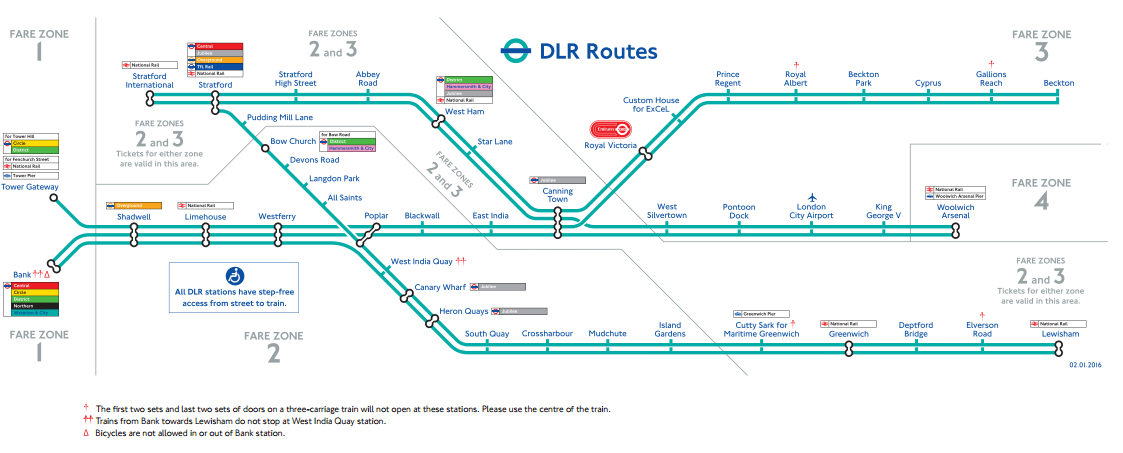
The entire length of the Docklands Light Railway (DLR) line in London is currently suspended due to a signal failure at West India Quay.
The whole line has been down since 9.15am on Tuesday 18 September, with problems first reported at 6.15am this morning.
London Underground, London Buses and Southeastern will be accepting valid DLR tickets via any reasonable route, according to Transport for London (TfL).
The failure has coincided with an event being held by the DLR this morning called “Meet the Manager”, a Q&A at Canning Town from 7.30-9.30am. Billed as an opportunity to have any DLR questions answered, it is unlikely that many people will be able to get there while the line suspension continues.
Thousands of commuters have also had their journeys disrupted by the suspension.
Rachel May Quin tweeted: “Shout out to London DLR for a catastrophic service this morning and implementing a full suspension on all routes. You always know how to brighten my day.”
Meanwhile, Lisa Terry wrote on social media: “Great start to the day. Severe delays on London DLR so follow advice and go to London Bridge to get tube to Canary Wharf. London Bridge underground closed. OK, I’ll get the train to Waterloo East. Nope, London Bridge train station had closed behind me.”
The DLR twitter account has been replying to complaints, advising that customers can claim a refund for delayed journeys online.
“Our engineers are on site and are working hard to fix this,” said one customer service advisor. “I honestly can’t say at present when this will be resolved. Sorry for the disruption.”
The DLR is used by commuters to get to stations including Canary Wharf, Custom House for ExCel and London City Airport, a key hub for business travel.
Talk nonsense; especially on a subject that one professes to be knowledgeable about but in fact is ignorant of.
This is exactly what former Surrey mayor and current morality candidate, Doug McCallum is doing.
As Mr. Cow, our expert from Ontario, said;
” You can expand SkyTrain to Langley, there is nothing stopping TransLink from doing just that. However, it’s just really, really bad idea due to the enormous cost compared to using LRT operating technology, the complete lack of funding to do it, as well as the possibility of being sued by multiple contractors!”
My estimate for McCallum’s SkyTrain to everywhere.
SkyTrain (Expo Line) rehab to increase capacity………… $3 billion
South Surrey SkyTrain extension …………………………… $3 billion+
Total …………………………………………………………….. $9 billion+
The joker in the deck; the cost of cement and steel is rising at a cost three times that of the rate of inflation. SkyTrain uses a massive amounts of steel and cement.
The offical rate of inflation in Canada is 2.5%, thus the cost of cement and steel is rising at a rate of a minimum of 7.5% annually.
Conclusion: Doug McCallum’s SkyTrain promises will cost a minimum of $10 billion!
Not going to happen.
Surrey mayoral candidate Doug McCallum wants SkyTrain extension to White Rock
He’s running for mayor in Surrey, and promising to scrap Light Rail Transit (LRT) to build a SkyTrain out to Langley along the Fraser Highway instead.
Now, Doug McCallum is proposing that the SkyTrain should also extend to South Surrey.
“To sort of complete the rapid transit part of our city, the first phase would be from our city centre out Fraser Highway to Langley,” he said.
“And the second phase that we’re proposing is to go from our city centre down King George to Newton, and then out to South Surrey.”
McCallum said he has studied the numbers, and is confident that a SkyTrain to Langley can be built for the same price as LRT: $1.65-billion.
“We can build these lines fairly quickly and I would go so far as to say that once we start construction on the SkyTrain and Fraser Highway — that we will build around the clock seven days a week.”
TransLink CEO Kevin Desmond told the Surrey Board of Trade this week that McCallum is wrong, and that the cost would be about $900-million more.
McCallum calls Desmond’s comments astonishing. “I just don’t understand his position,” he said.
Another mayoral candidate, Tom Gill, is also wading into the debate.
“It’s unfortunate that my opposition is using it as a political football,” he said. “The realities are very simple. There’s not an additional billion dollars on the table right now for us to switch technologies.”
“I think we’ve done an incredible amount of work over the last decade, since 2008, finalizing a vision for the city. The idea is to get our residents around the city not necessarily get them downtown Vancouver.”
Gill also said that LRT between Guildford and Newton is only the first phase of a project that will extend to 150 kilometers.
First published in 2011, the concept of the Whalley King George Whiterock Line, operating in conjunction with the Rail for the Valley’s Leewood Study TramTrain would bring an affordable and successful 21st century public transportation solutions to Metro Vancouver and the Fraser Valley.
It has has been seven years year since I entertained the idea of the Whalley – King George – White Rock LRT Line and in 2018 the plan is extremely sound.
Surrey needs a bold new vision for modern LRT and I believe the Whalley – King George – White Rock or WKW Line would provide the vision to implement a strategic and affordable light rail network for Surrey and communities south of the Fraser river. Failure to plan and build sustainable light rail and to continue to plan and build with the hugely expensive SkyTrain light-metro, will beggar the region with ever escalating taxes, driving out business and residents out of the region.
The goal of the new light rail line is to serve customer needs and offer the ability to provide an attractive alternative to the car, it also must serve a multitude of destinations. Building LRT as an extension of the SkyTrain light-metro system will fail to meet expectations, as LRT will not be designed to its best advantage. It is not rocket science to design a transit line to be an attractive alternative to the car.
The Light Rail Line
The 24 kilometer WKW Line would provide a solid foundation for an attractive light rail system in Surrey. The proposed light rail would be a classic LRT, operating mainly on a reserved rights-of-way (RoW), located in the median of the roads involved.
The route of the WKW Line would start at at 108th Ave. & the King George Hwy. and would continue South to the Southern RR of BC (formerly the BC Hydro R.R.) This portion of the route would service the Central City shopping district; Surrey Memorial Hospital; Queen Elizabeth Secondary School; Bear Creek Park; and the Newton shopping district.
The WKW Line would then network south-east along 4 km of the former BCE interurban line and proposed Valley Rail Vancouver to Chilliwack TramTrain route to 152nd. Traveling mainly through industrial lands, which would provide the ideal location for the Light Rail storage and maintenance yards. This portion of track would be double tracked and adequately signaled for safe freight/Interurban/tram operation.
Operating a joint operation with the RftV/Leewood interurban, would enable South Surrey and White Rock transit customers the option of a direct or no-transfer service to downtown Vancouver.
From 152nd Street, the WKW Line would go straight south to White Rock crossing the Nicomakle /Serpentine River valley basin. Along here, the line must be raised above flood plain and three new bridges across the Super Port Railway Line, and the Serpentine and Nicomakle rivers must be built. It is this portion of line that will be the most expensive.
Rising out of the small river valley the route would continue south along 152nd Ave., terminating in downtown White Rock
In the summer, the light rail line would bring congestion relief to White Rock by providing a quality transit alternative for the many thousands of people who come in cars to the popular beaches. Also close to the WKW Line is the South Surrey Athletic fields, which many fields and arenas are constantly busy with hockey, baseball, soccer, rugby, and football games, twelve months of the year. The line would also provide an excellent transportation access for the burgeoning housing estates, such as Morgana’s Crossing in South Surrey and White Rock.
An approximate map of the WKW route as Google maps do not use existing rail lines.
The the total cost of the KWK Line, including bridges and/or viaducts should cost no more than $1.5 (2018 dollars) billion, based on comparative LRT lines now being built The high cost of major engineering in the Nicomakle/Serpentine valley, would be mitigated by simple on-street construction on 152nd and the King George Highway and track sharing for 4 km on the Southern Railway of BC Line bisecting Surrey .
It is interesting to note that the total cost for the 130 km RftV/Leewood Chilliwack to Vancouver Interurban using Diesel LRT and the 23 km WKW Line would be about $2.5 billion (2018 dollars) or put another way we could build 153 km of modern LRT lines in the Fraser Valley for about $1 billion less than the 5.5 km Broadway subway and attract many more customers as well.
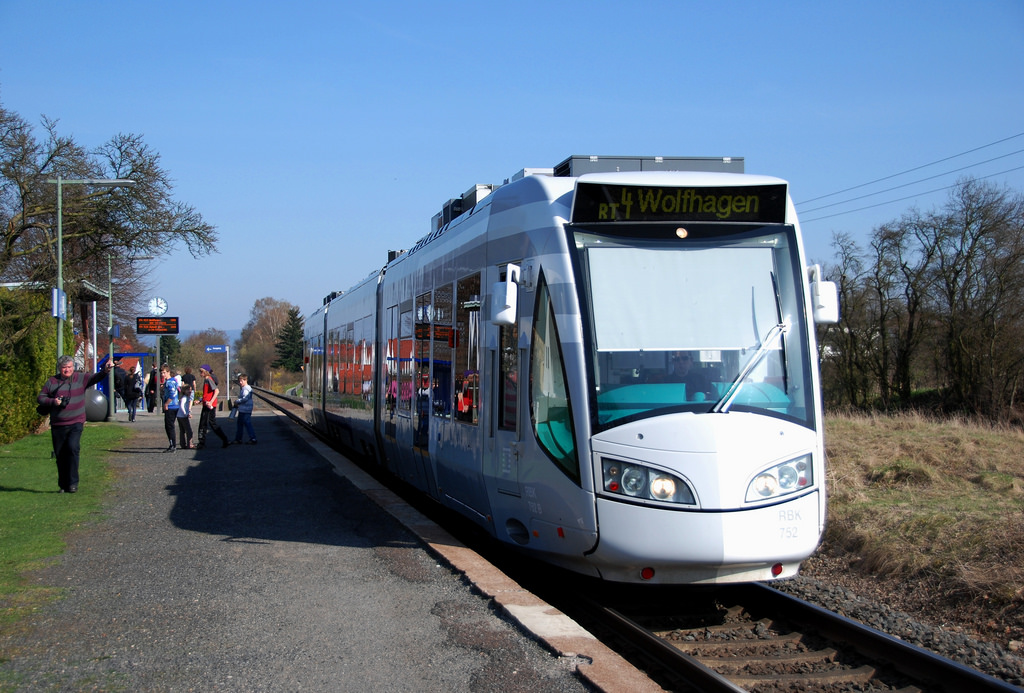
Diesel TramTrain in Kassel Germany - Could be in Surrey as well.
Unlike present light rail planning, where development is encouraged to take place along a LRT/SkyTrain route, the KWK Line can pass through sensitive agriculture and ecological areas, without the need for land development. Building the line would provide a potential capacity of 20,000 persons per hour per direction on the route, well able to handle future passenger demands, yet still can be built much cheaper than its SkyTrain/light-metro competitors. The cost for a SkyTrain along the same route? About $3.5 billion!
A modern LRT Line in Madrid, Spain. A template for the WKW Line?
Using low-floor trams, with convenient stops, ensures an obstacle free journey for all transit customers including the mobility impaired, without the need of expensive stations and equally expensive to maintain elevators and escalators.
The WKW Line can provide traffic calming where needed, yet still supply ample capacity for future transit needs. By providing a regular and efficient transit service from White Rock to Surrey Central and by servicing many destinations along its route the proposed LRT line would attract ample ridership, including the all important motorist from the car. The line would also easily integrate with the RftV TramTrain interurban service from Vancouver to Chilliwack and could provide in the not too distant future a direct White Rock to Vancouver TramTrain service, faster than the present bus and Canada line service.
The WKW Line, combined with the Leewood Study Chilliwack to Vancouver TramTrain, would bring proven 21st century transit solutions to Surrey, transit solutions that are too long overdo.
Modern LRT does have a higher capacity than SkyTrain and it looks nicer too!
You don’t have to be smart to be the Minister responsible for TransLink, rather you just to have to be a very good BS artist, that’ all.
As the LRT or SkyTrain tap dance continues south of the Fraser, many politicians reveal that their knowledge about SkyTrain comes mainly from picture books and not engineering reports.
As our friend, Mr Haveacow, has said many times in the past, SkyTrain can’t be extended to Langley until about $3 billion is spent on rehabbing the Innovia Lines.
As well, the maximum capacity of LRT is greater than SkyTrain, always has been.
In Europe, the capacity debate does not exist because modern light rail can handle passenger flows in excess of 25,000 pphpd has it has done in Karlsruhe Germany. In Europe, capacity is increased by purchasing new trams as demands warrant.
Not so in Metro Vancouver, where Transport Canada has limited capacity to a maximum of 15,000 pphpd.
It is time TransLink stop using this ruse to deceive the taxpayer and the transit customer about modern light rail.
Former minister responsible for TransLink still supports LRT — but says it’s not the best option for high volumes of people
“I believe that that was, and is, the right decision and I know there are challenges, but I think the ‘L line’ can be light rail and will work very efficiently,” Fassbender said.
If we look 30 years down the road, and the volume, and what may happen at Abbotsford airport — a system that ties into the existing rapid transit system, namely SkyTrain, probably is the most efficient system for the long term,” he said.
Fassbender said that a business case would have to be looked at for extending rapid transit, not just for the sake of what it costs to build it, but the efficiency of moving people.
However, he also said it’s a different discussion when it comes to moving people along the Fraser Highway into Langley and even further east.
As the Surrey LRT slowly gather’s steam, it seems the regional taxpayer is paying a lot of money for very little.
Despite the hype and hoopla about the Surrey LRT, does not do anything really, just provide a somewhat faster trip to the nearest SkyTrain station if you want to cross the Fraser. It has been designed as a poor man’s SkyTrain.
What is needed is a independent transit line connecting downtown Vancouver up the Fraser Valley as far as Chilliwack.
The track is in place and the former interurban route does connect the cities of Langley, Abbotsford, Sardis and Chilliwack to downtown Vancouver.
All this for around $1.5 billion, which makes a $1.9 billion 11 km Surrey LRT and a $3.5 billion 5.5 km Broadway subway just a tad too expensive for what they will do.
A Langley to downtown Vancouver in 50 minutes train service could be in operation by the start of 2020!
TransLink’s and the City of Surrey’s much ballyhooed LRT really doesn’t offer the transit customer very much, except a very inconvenient transfer to the Expo Line and a 39 minute ride (if their are no glitches) on a dinky and crowed SkyTrain car to Vancouver.The 320 Langley Centre to Surrey Central bus takes 51 minutes to complete its journey; the 395 Langley Centre to Surrey Central Express (limited stop/limited service) takes 40 minutes; the 501 Langley Centre to Surrey Central Station takes 58 minutes; thus a the time for a full transit journey from Langley to Vancouver would take anywhere from almost hour and a half to almost 2 hours, including transfer but not including total commute time.The Rail for the Valley TramTrain concept could do the trip from Langley (200th Street) to Vancouver Central Station in 50 minutes, including two stops at Braid St. and Willingdon on the West side of the Fraser River and the 10 mph speed restriction on the Fraser River rail bridge.The Leewood/Rail for the Valley Studytime matrix shows that a 23 km. journey from 200th Street in Langley to Scott Road Station, including four stops, would take 22.5 minutes and an estimation of the 22km. trip from Scott Road to Vancouver would take 27.5 minutes – 50 minutes; a full 40 minutes faster than a combined LRT/SkyTrain trip to Vancouver!The cost, around $400 million for track improvements, signalling and vehicles.$500 million, certainly looks more affordable than the $2.5 billion Surrey LRT, designed as a poor man’s SkyTrain, especially if one can get to Vancouver faster and in more comfort.
The Stadler GTW light rail car could use city streets and operate as LRT if need be.
I do not agree much with Vaughn Palmer, but I think he has twigged to the fact not all is right with current transit planning.
When Postmedia allows unpleasant news about SkyTrain, one knows things are amiss.
The realities of subway construction are coming home to roost and it will be a very unpleasant surprise for the taxpayer.
Zwei’s question is this: “Why is Horgan so stupid to let this mega project reach the FastFerry fiasco level in the first place, does it have anything to do with his inner circle which includes former Vision Vancouver Councillor and big supporter of the Broadway subway, Geoff Meggs?”
Memo to the NDP: The Broadway subway, a.k.a. FastFerry fiasco Part 2, will give you another 20 years in the wilderness for your party to contemplate life.
The price tag for Surrey light rail transit and the Vancouver Broadway subway extension is sobering, even when one makes allowance for inflation and the rising costs of labour and materials.
Vaughn Palmer
Updated: September 4, 2018
VICTORIA — For all the enthusiasm Prime Minister Justin Trudeau and Premier John Horgan brought to their announcement on transit funding Tuesday, there was no overlooking the soaring cost of building SkyTrain and light rail in Metro Vancouver.
The two leaders reiterated their support for the SkyTrain extension under Broadway in Vancouver and for a stand-alone light rail project in Surrey. They had promised much the same previously.
But both bristled at the suggestion that the event at the Surrey campus of Simon Fraser University was little more than a joint photo op, with SkyTrain itself as a backdrop.
“We’ve locked in this funding for the next 10 years,” insisted Trudeau, who took note of the looming civic elections in Vancouver and Surrey.
“This is about locking this down,” added Horgan. “This is happening. This is not being revisited. The cheque is in the mail. We are going to be building.”
Both may have protested a little too much. In the civic election race in Surrey, debate continues about whether light rail is the way to go or would a long-touted extension of SkyTrain to Langley be a better use of federal and provincial funding.
Either way the price tag is sobering, even when one makes allowance for inflation and the rising costs of labour and materials.
The SkyTrain extension in Vancouver, lately called the Broadway subway because most of the distance will be tunnelled, is priced at an estimated cost of $2.83 billion.
That amount will build 5.7 kilometres of SkyTrain, stretching from the current station at the Clark drive campus of Vancouver Community College westward to Arbutus Street.
The estimate works out to $496 million dollars a kilometre or about half a billion dollars in round figures.
For comparison’s sake, the Canada Line, completed less than 10 years ago in time for the 2010 Winter Olympics, was priced at $2.1 billion, or about $100 million for each of its 19 kilometres.
The 11-kilometre Evergreen Line, completed in late 2016 after a delay in construction, came in at $1.43 billion or $130 million a kilometre. Both lines involved some tunnelling.
Against that backdrop, Prime Minister Trudeau made a passing reference Tuesday to the long-standing proposal that the Broadway line should eventually be extended all the way to the University of B.C.
Depending on the route to be chosen, that would mean another eight kilometres or so of construction, mostly tunnelling. (Not likely would citizens or businesses on the west side of Vancouver stand for cut and cover excavation, never mind an above-ground line along Broadway and up the hill to UBC.)
Even without allowing for inflation, it would cost at least another $4 billion to extend the line from Arbutus terminus to the Point Grey campus.
Almost as shocking as the half-a-billion-dollars-a-kilometre cost of extending SkyTrain was the latest price tag for building surface light rail.
LRT, needing neither elevated guideways nor the occasional tunnel, has long been considered a much cheaper alternative to SkyTrain. That’s one reason why Surrey opted for light rail over an L-shaped line linking the city centre to the Newton and Guildford town centres.
It also explains why Surrey exercised its considerable political pull with senior governments to make light rail a priority over proposals to extend SkyTrain to Langley.
With the two senior governments now having locked in their commitments, light rail will be the transit priority for B.C.’s second most-populous city for the next few years.
Indeed, by the time light rail is scheduled to be running in 2024, 30 years will have passed since the then NDP government opened the last SkyTrain extension south of the Fraser River at the very station, King George, where Tuesday’s event unfolded.
The Surrey-Newton-Guildford project is now estimated at $1.65 billion for 10.5 kilometres of surface-level light rail. That works out to $157 million a kilometre, or 20 per cent more than the cost of the Evergreen SkyTrain line, completed just two years ago with elevated guideways, full grade separation and a tunnel.
Less than 10 years ago, TransLink estimated it could build surface light rail in Surrey for $27 million a kilometre, about a fifth of the current price tag.
How to account for that increase? No explanation was forthcoming Tuesday. But I am assured TransLink will provide a briefing later in the week.
One other question to arise from the background materials provided by the provincial government was contained in this paragraph: “The government of Canada will contribute $1.37 billion to the two projects, the government of British Columbia will contribute $1.82 billion, and TransLink, the city of Vancouver, and the city of Surrey will contribute $1.23 billion.”
Those numbers suggest Ottawa will pay 31 per cent of the cost, B.C. 41 per cent, while TransLink and local governments will cover 28 per cent.
This is not the 40-40-20 federal-provincial-regional split advertised by both the prime minister and the premier. But that too awaits further explanation.
Still, the premier says the cheque is in the mail. Unless his government can come up with a more persuasive accounting than the one in Tuesday’s press release, I’m thinking a stop payment might be in order.
Palmer: SkyTrain construction soars to $500M per Km, but why is ‘confidential?’
The NDP commissioned the detailed budget for the project, vetted the numbers, and know what each component is expected to cost. They just aren’t telling the taxpaying public anything about it.
VICTORIA — At first glance the report on the Broadway SkyTrain extension posted on the transportation ministry website holds out the hope of shedding light on how construction costs have soared to half a billion dollars per kilometre.
“Cost report,” it says, followed by a comprehensive statement of purpose: “This document details the preliminary cost estimate of the reference concept design for the Millennium Line Broadway extension project.”
But the first indication that the contents offered less than full disclosure came when I clinked on the link and learned that the copy released for public consumption had been “redacted” and, yes, “sanitized.”
I’ll say it was.
Doubtless the unsanitized and unredacted version of the 13-page report from March of this year contained a full breakdown of the cost of extending the existing SkyTrain line from the Clark Drive campus of Vancouver Community College westward along Broadway to Arbutus.
“The estimate assumes that all the work is carried out as one single project and covers costs including project management, preliminary design and technical investigations, engagement and consultation, procurement, design, construction, risk, contingencies and interest during construction,” according to the text.
The methodology was thorough. The costs include money spent to date on planning the project, through the 18 months or so it will take to put the expansion out to tender and award the contract, and then the years of construction up to a targeted in-service date of 2025.
Finally the report from the provincial Partnerships B.C. agency insists that all the numbers have been checked and double checked: “A due diligence review of the capital cost estimate was conducted, which confirmed that the budget currently carried is reasonable to design, construct and commissioning of the approximately 5.7 (kilometre) extension to the existing Millennium Line SkyTrain network.”
In short, the New Democrats commissioned the detailed budget for the project, vetted the numbers, and know what each component is expected to cost. They just aren’t telling the taxpaying public anything about it.
For when you get the dollar breakdowns on Page 9 of the report, every last detail is blanked out in the name of confidentiality and protecting the public interest.
For instance, five of the 5.7 kilometres will consist of twin, bored tunnels, hence the name Broadway Subway. The estimated cost of doing this is withheld.
The terms call for the construction of underground stations at Great Northern Way, Main, Cambie, Oak, Granville and Arbutus. Each of the six is costed as a separate entry. Each is also blanked out in the copy for public consumption.
Property purchases are one of the main cost drivers in building public infrastructure these days, though not clear how much that would be a factor with the routing more than 85 per cent underground.
The city of Vancouver has donated an estimated $100 million worth of land as its contribution. The rest is a guess, because the estimated cost of property purchases is also censored from the report.
So on through the withheld cost estimates for “roadwork, site preparation, utility relocation, landscaping, environmental mitigation, track work, train control and signalling, security, power, fare collection, engineering, public consultations and contingencies.” All suppressed.
Instead the government chose to release only the total cost estimate for the project: $2,826,458,192.
Which strikes me as a fancifully precise amount for what is said to be “a preliminary cost estimate,” based on a “reference concept design,” without benefit of a tender call or multiple bids, never mind a finalized contract.
But for what it is worth, that translates to an estimated cost of $495,869,858 per kilometre.
I was directed to this report by a government representative when I asked why the latest SkyTrain extension was costing almost four times as much per kilometre as the Evergreen line, completed less than two years ago for $130 million per kilometre.
The report doesn’t answer the question, nor much of anything else. Perhaps more detailed breakdowns will be released after the contract is awarded.


 *
*




 Surrey LRT to be up and running by 2024, cost set at $1.65 billion

 TransLink’s and the City of Surrey’s much ballyhooed LRT really doesn’t offer the transit customer very much, except a very inconvenient transfer to the Expo Line and a 39 minute ride (if their are no glitches) on a dinky and crowed SkyTrain car to Vancouver.The 320 Langley Centre to Surrey Central bus takes 51 minutes to complete its journey; the 395 Langley Centre to Surrey Central Express (limited stop/limited service) takes 40 minutes; the 501 Langley Centre to Surrey Central Station takes 58 minutes; thus a the time for a full transit journey from Langley to Vancouver would take anywhere from almost hour and a half to almost 2 hours, including transfer but not including total commute time.The Rail for the Valley TramTrain concept could do the trip from Langley (200th Street) to Vancouver Central Station in 50 minutes, including two stops at Braid St. and Willingdon on the West side of the Fraser River and the 10 mph speed restriction on the Fraser River rail bridge.The Leewood/Rail for the Valley Studytime matrix shows that a 23 km. journey from 200th Street in Langley to Scott Road Station, including four stops, would take 22.5 minutes and an estimation of the 22km. trip from Scott Road to Vancouver would take 27.5 minutes – 50 minutes; a full 40 minutes faster than a combined LRT/SkyTrain trip to Vancouver!The cost, around $400 million for track improvements, signalling and vehicles.$500 million, certainly looks more affordable than the $2.5 billion Surrey LRT, designed as a poor man’s SkyTrain, especially if one can get to Vancouver faster and in more comfort.



Recent Comments