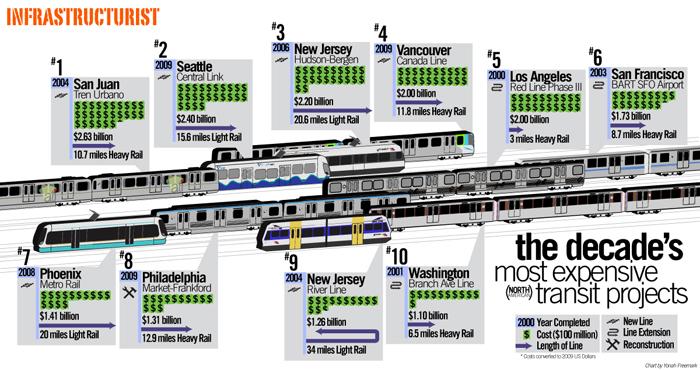
The notion that a subway is best way to solve congestion, emanates from the USA where it is considered the biggest is the best. The more expensive a transit project is, the better it is.
This is simply childish.
Subways are built on transit routes which have the ridership that demands long trains, traveling at close headway’s which in turn demand grade separation and subways are aesthetically more pleasing than elevated construction, even though they may cost three or four times more to build.
Subways are also extremely expensive to operate as each station must have elevators and escalators, lighting, ventilation, fire suppression equipment, etc.
What is missing is the key ingredient of providing good transit and that is user-friendliness, which subways just do not provide, thus they are poor in attracting new ridership.
Then there are ongoingAi?? maintenance issues which subways tend to become money-pits always sucking money from the rest of the transit operation.
The Broadway subway neither has the ridership nor the capacity to sustain itself and will be a financial black hole further driving up TransLinks costs.
The Broadway subway is only being built for one reason and one reason only: To ensure profits for Liberal/Vision Vancouver’s political friends, the Condo Kings and land speculators who will make windfall profits on assembled lands where subways stations are planned, all at the expense of taxpayers.
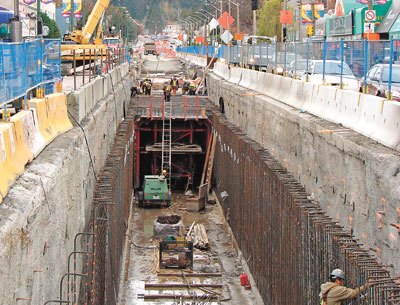
Cut and cover subway construction, a la Cambie St., coming to Broadway very soon.
A subway is not the way to prosperity for Scarborough or Toronto: James
There are much better projects council could spend taxpayersai??i?? money on. But our city politicians have put us on a path to transit bankruptcy.
There are so many misconceptions and alternate facts circulating around how pampered, or not, Toronto taxpayers have become that the subject begs another column or two.
But there is also this.
Nobody is helped ai??i?? and all taxpayers are angered and harmed ai??i?? when valuable and tight tax dollars are spent on projects that have no chance of fulfilling the stated goal.
Such is the case of the extension of the Bloor-Danforth subway up to the Scarborough Town Centre.
The project would add one new station. An aggrieved constituency of Scarborough residents who feel they get no respect will be temporarily satiated. The corridor now served by an aging RT will get the highest order of transit, even if that is an overbuild. Politicians who have peddled trumped-up claims of benefits that will never be realized in our lifetime will get re-elected.
But will the subway deliver transit benefits to Scarborough residents in keeping with its bulging price tag? No. Will it deliver what transit projects in this city are supposed to deliver? No.
The transit corridor where the Scarborough RT, above, now runs is set to get a subway.Ai??Ai??(Marcus Oleniuk / Toronto Star) | Order this photoAi??Ai??
Will it enhance the growth and viability of downtown Toronto? No. Does it improve access to work and school for the largest number of Scarborough residents? No.
And does it deliver growth and development in the corridor as promised? History says no ai??i?? though developers will make lots of money while the residents who purchase the condos have only slightly improved access to the jobs because the jobs are spread out across the region and not where the subway runs.
Are there better transit modes and better routes and better ways to spend the $2 billion, that has risen to $3.35 billion, with alerts from the same estimators that it could jump to $5.2 billion, and a near certainty it will hit $6 billion?
Yes, yes, yes.
None of that will matter next week and next month and whenever city council debates this project. This is a runaway train that cannot be stopped. And it is a sorry tale of how dangerous and useless transit planning is in our city and the GTA.
I think I am right in there with the subway lovers. And Iai??i??ve written in this space that if the city wanted $500, $1,000 from me and all its citizens to set in motion a plan to blanket the region with subways, Iai??i??d sign up.
Iai??i??d start with linking the Yonge and University lines along Sheppard. I know that area and see how stupid it is not to be able to link both ends of the city. Iai??i??d take Sheppard Subway out east to link with the above Bloor-Danforth extension at Markham Rd. or McCowan. Then Iai??i??d extend the Yonge line to Newmarket, for crying out loud. And take the Bloor-Danforth line west out to the airport. And then Iai??i??d do the downtown relief line.
Thatai??i??s the view of a regular guy who travels every now and then and gets subway envy from looking at transit maps in Paris and London and Barcelona and Washington.
But that view is so wrong. And so whack. And so uninformed. And so, so, so Toronto. It will bankrupt us, without achieving the goal of transit expansion: give commuters a better option to the car; make transit more competitive with driving; deliver new riders to transit and, by so doing, free up congested road space.
Everything else is hubris and political palaver and a colossal waste of money ai??i?? which is where we are as a city region.
The transportation experts who have been studying our travel patterns for decades ai??i?? and are not encumbered by the re-election agenda of their political masters ai??i?? say this: Torontoai??i??s subway system ai??i?? and GO rail network ai??i?? exists to deliver commuters to the downtown core where the majority of our jobs reside. In fulfilling this role, the system is a huge success. But the projects being promoted now do not address congestions and deliver new riders and support economic growth.
Much of the improvements in the suburbs should come from express buses, bus rapid transit and light rail on their own corridors.
To say this is to be branded a suburban hater, or worse. It is to go against the tide which says if the wilds of Jane and Highway 7 deserves a subway, then Scarborough Town Centre certainly deserves one. Maybe neither does. Maybe neither delivers the benefits we imagine.
Consider that 60 per cent of Scarborough residents who get around by transit are not heading downtown where the subway goes. Where is the transit for them?
Three of every four Scarborough residents heading downtown are already on transit, leaving limited growth potential for those going where the subway goes, downtown. In fact, the transit percentage use, or modal split, is higher than for East York or Etobicoke commuters heading downtown.
Yet the narrative propagated by our city politicians and believed ardently by citizens is the way to prosperity and self-worth is via the highest order transit, even if it costs $1.45 million and counting for every potential new rider ai??i?? a performance thatai??i??s sure to bankrupt the system.
At first, I thought it was an April fools joke, but no, it’s not, rather it is a reporting farce.
A chap who is a mining shill, with no expertise in public transport is calling for a subway to be built to UBC.
All he is trying to do is secure $5 billion worth of work for his engineering buddies and that is all what a $5 billion SkyTrain subway under Broadway will do!
Subways not only cost a lot of money to build, they cost a lot of money to operate and maintain and unless there is sufficient demand for a subway, at least with traffic flows in excess of 15,000 pphpd, those maintenance and operational cost will come back to haunt the taxpayer.
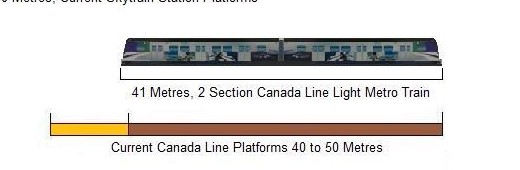
Obviously the so called expert, when he cited the Canada line being “overwhelmed” by customers, was not expert enough to know that the Canada Line’s design, because of the massive costs of subway construction, was truncated to the point it only has 40 metre long station platforms and can only operate two car trains and has effectively one half the capacity of the Expo and Millennium/Evergreen Lines, which station shave 80 metre long station platforms.
The Canada Line could barely handle the bus customers who are forced to transfer to the mini-metro, when it opened.
As for the CBC, such BS reporting, an utter disgrace.
Critics calling for a subway line extension to theAi??University of British Columbia’s Vancouver campus say a recent infusion of government cash for transit in B.C. ignores an overall lack of vision resulting from a dearth of planning.
“No subway was ever justified on the here and now,” said Mauro Chiesa, a transit development expert who has organized the financing of tunnel projects world-wide.
He says that even with the B.C. LiberalsAi??promisingAi??to match Ottawa’s $2.2 billion for projects such as the SkyTrain link along the Broadway corridor, TransLinkAi??still remains “woefully underfunded.”
“It’s a 30 to 50 year game,” said Chiesa, sayingAi??trains and tunnels sometimes need to be builtAi??ai??i??Ai??even if they’re underusedAi??at first.
30-100 year plans
A 10-year plan like TransLink’s is not enough, he said, adding that Paris plans 100 years ahead for its transit.
Many cities turn to private financing before appealing for public funding, and the arrangements are often made well in advance.
But not in B.C.
Transit projects here tend to arrive at the the station just in time, and are quickly overloaded by users.
That’s what happened on the Canada Line as it became overwhelmed at key points by the influx of Evergreen Line passengers after it opened late last year.
Zwei always is amused when photo-op divas talk transit, especially LRT and like most politicians, they now nothing what they are talking about.
The Canada Line is not LRT; rapid transit is not LRT and SkyTrain is not LRT.
What the politicos are doing is mouthing “Trump” style talking points and sound bytes to look favourably in the media and that is all.
Memo to Qualtrough and Jackson: The Canada Line and the ALRT/ART transit systems are not light rail, far from it, they are a form of “heavy” rail transit called light metro, made obsolete by LRT. The Canada Line was also built on the cheap, with 40 metre long station platforms and only able to operate two car trains. The Canada Line needs about $1.5 billion to increase its capacity to match that of the Expo and Millennium/Evergreen Lines before any thought of expansion can occur.
There is no money for this now or in the foreseeable future.
Is the proposed bridge being designed to accommodate 600 ton trains? Unless rails are laid during construction, the answer is no.
One just doesn’t add rails to the bridge at a later date.
When Diva’s talk transit, it is strictly for photo-ops and nothing more and by the way, there is no such thing called light rapid transit and only the most ignorant use that catch phrase.
The Canada Line has about one half the capacity of the Expo and the Millennium/Evergreen Lines.
Qualtrough on board with Delta’s call for light rail
Delta has an ally when it comes to promoting light rail.
That was a guarantee made by Delta Liberal MP Carla Qualtrough during her presentation to Delta council Monday afternoon as she highlighted a series of federal funding announcements and other initiatives that have benefited the riding since her party formed government.
“You have an ally in me, so I’m certainly happy to be a champion on that as well,” said Qualtrough.
Mayor Lois Jackson brought up the subject during discussion on the bridge to replace the George Massey Tunnel.
“I’m hoping it will happen one day. There’s talk of extending the lines to where the people are in Delta, in Tsawwassen, ferry terminal, White Rock was mentioned and, of course, Langley and out in the valley,” said Qualtrough. “It may be that during this next couple of years, while there’s still infrastructure money, it’s really something for us to look at in terms of light rail over the new bridge.
“I think we can get an awful lot of people out of their cars if they want to go to downtown or into Richmond, or side step to Burnaby,” she suggested.
The 10-lane bridge is to be built to accommodate rapid transit, although the province has not committed to any timeline for rapid transit coming to Delta, South Surrey and White Rock.
Qualtrough agreed having rapid transit extend to Delta and the valley one day should be a priority.
Later on Monday, during council’s evening session, Jackson reiterated her dream to see the Canada Line cross the river during her annual state of the municipality address.
“Maybe, one day,” she said.
When the budget was announced last week, Qualtrough said that while the bridge is not in the government’s infrastructure plans, the project could get assistance through Infrastructure Canada and Innovation with a new infrastructure bank, something she reiterated during her presentation this week.
Qualtrough also went over a few of the other infrastructure investments her government has made in Delta, including the Highway 91 and 72nd Avenue interchange, corridor improvements for highways 91 and 17 as well as a rush hour lane for the Alex Fraser Bridge.
– See more at: http://www.delta-optimist.com/news/qualtrough-on-board-with-delta-s-call-for-light-rail-1.13289227#sthash.JGTxYbXf.dpuf
New highways always bring the so called experts into the fray. The problem is; we don’t have any, rather the region has a hodge podge of academics, planners and engineers calling themselves experts and the result is what is happening now.
The real problem is this; the population is growing at a huge pace in the Fraser Valley and the roads are fifty years behind the times.
As the population increases more stress is placed on the Number 1 highway and it must be expanded to cater to the transportation needs.
Adding a third lane makes the highway, ‘European standard’.
As the government has rejected any sort of rail transit, including Rail for the Valley’s Leewood Study, thus expanding the highway is the only option.
The so-called expert mentioned in the following news item, has probably had more to exacerbate traffic congestion in the region, with his myopic views on regional transportation.
You can’t blacktop your way out of congestion, but you must have an affordable transit alternative in place to help solve the congestion issue.
The Rail for the Valley TramTrain will not solve congestion, but it could help alleviate congestion by providing a rail alternative. Unfortunately our so called transit experts seem to be more interested in extremely expensive prestige projects, like the proposed $3 billion Broadway SkyTrain subway and land development, than trying to formulateAi?? a practical transportation plan for the Fraser Valley.
Highway upgrade in Langley only moves the problem down the road: transportation expert
VANCOUVER (NEWS 1130) ai??i?? The plan to widen Highway 1 through Langley, unveiled yesterday by the province, may come as welcome news to drivers but not everyone is thrilled.
Gordon Price is the director of The City Program at Simon Fraser University and says the $225.5-million-dollar project only moves the traffic congestion down the road.
ai???Thereai??i??s a case where the metaphor and reality do overlap. If all you do is build roads and move the problem down the road, youai??i??re just going to create another congestion problem,ai??? says Price, adding the province sees it as fulfilling its mandate.
ai???You canai??i??t go wrong in BC politics by cutting a ribbon on a new or widened road, a big new bridge. We love that stuff and in a frontier province that kind of makes sense.ai???
ai???One doesnai??i??t have to be facetious about this. This is growth and this is change, and itai??i??s certainly associated with economic development. From the point of view of a lot of people, certainly in the Ministry of Transportation and Highways, thatai??i??s their job, they really do in fact see the future as solving one congestion problem after another even if itai??i??s their own creation. It keeps them in business, thatai??i??s what itai??i??s all about.ai???
The problem he says is that spending exclusively on road projects is only a temporary solution.
ai???We have enough experience to know that if thatai??i??s all you do, if you donai??i??t provide people with options, youai??i??re just going to create the transportation difficulty, the congestion, faster than you planned for,ai??? says Price.
He says any road expansion should be balanced by putting money into biking and walking infrastructure in addition to transit.
But he says thatai??i??s not as politically sexy as cutting the ribbon on a new bridge.
ai???You never get the sense from the Liberals that they are going to be the party of ai???yesai??i?? when it comes to transit in the city,ai??? says Price.
ai???You can really see the discrepancy now. Here we are still debating yet again over funding for transit and then just almost incidentally here comes an announcement that ai???ya weai??i??re prepared to spend a quarter-billion bucks to widen yes legitimately an important part of the transportation system.ai???
Ottawa is picking up half the cost of the Highway 1 project while BCai??i??s deputy premier Rich Coleman hopes to eventually expand the widening project to Whatcom Road in Abbotsford.
The appalling reporting on transit by the local media continues, all what is reported is sparkle ponies and fairy dust.
Here are the financial problems that TransLink faces:
Estimated cost of the Broadway subway – $3 billion+
Estimated cost to refurbish the Expo and Millennium Lines to allow higher capacity – $2 billion to $3 billion.
Ai??Estimated cost of Surrey’s LRT $2.5 billion (if SkyTrain used $4 billion to $6 billion)
Patullo bridge rebuild $1 billion+
Increased bus serviceAi?? – unknown.
Ai??Operating costs, including hidden and open subsidies – unknown. Current rapid transit subsidy in excess of $300 million annually (The Canada Line alone is $110 million).
Ai??Federal government subsidy – $220 million over 10 years ($2.2 billion)
I’m sorry, but I just do not see how the federal money will help pay for the subway.
Ai??Will TransLink’s quest for subways & light metro bankrupt TransLink and impoverish the taxpayer?
The federal government announced in its budget Wednesday that $2.2 billion will be spent on transit in the region, including partial funding for the construction of a subway along the congested Broadway corridor. Photo Dan Toulgoet
Mayor Gregor Robertson is calling the federal governmentai??i??s promise to provide $2.2 billion for transit investment in the region ai???a game changerai??? and a big step to getting a subway built along the Broadway corridor.
The mayorai??i??s comment came after the federal government revealed its 2017-2018 budget Wednesday and committed to spend $20.1 billion over 11 years on transit across the country. The spending hinges on bilateral agreements with provinces and territories. The regionai??i??s share is $2.2 billion, which builds on $370 million committed to local transit projects in 2016.
ai???Todayai??i??s historic federal investment in transit and transportation is a game changer for our region and the largest in Metro Vancouver in 20 years,ai??? said Robertson, the chairperson of the mayorsai??i?? council on regional transportation, in a statement Wednesday.
Robertson acknowledged mayors still had work to do to secure all the funding to get the subway and a light-rapid transit line built in Surrey. That work includes convincing the provincial government to match the federal governmentai??i??s $2.2 billion contribution to fund the projects, which combined will cost more than $4 billion. The $2.2 billion would also be used for other major upgrades to the region’s transit system.
If the province doesnai??i??t match the funding amount, the mayors will be forced to find ways to raise up to 27 per cent of the cost. Funding sources havenai??i??t been determined, but it could mean a hike in property taxes, road pricing, tolls or a combination.
The federal governmentai??i??s budget did not provide any details about funding the replacement of the Pattullo Bridge, which links New Westminster and Surrey. The replacement is estimated to cost $1 billion.
The mayorsai??i?? council issued a news release Wednesday saying the funding could come through the federal Infrastructure Bank or Trade Transportation Corridor Initiative. The provincial government has committed to provide one-third of the cost.
ai???The mayorsai??i?? council and TransLink are reviewing new details about these programs and will work immediately with the federal and provincial governments to finalize their investments in this project,ai??? the councilai??i??s release said.
Robertson said he was also encouraged by the Trudeau governmentai??i??s commitment to spend $11.2 billion over the next 11 years on housing across the country and maintain operating agreements for co-op housing complexes. The government said the money will be spent ai???on a range of initiatives designed to build, renew and repair Canadaai??i??s stock of affordable housing and help to ensure that Canadians have adequate and affordable housing that meets their needs.ai???
The Carnegie Community Action Project said in a release that the spending will not be enough to eradicate homelessness in the region, where more than 4,000 people are in need of housing. Vancouver alone counted 1,847 homeless people in March 2016.
ai???If you divide the $11.2 billion over 11 years, it boils down to only $1 billion a year to be spent across the whole country,ai??? the anti-poverty advocacy group said. ai???If the $1 billion were all spent on building new social housing, it would be enough to build about 5,000 social housing units across the country. B.C. alone needs 10,000 units a year.ai???
One of the most under rated tram success stories is the Dresden freight tram, which conveyed car parts between two factories, using the cities tram network.
It is easy to see why freight trams have not been talked about much in North America, because many North American LRT systems are in fact, light-metros and with portions of the line using size restricting subways or weight restricting viaducts. Not to mention trucking companies who pay a lot of money to politicians on all levels of government, to “get their own way” would see it as interference.
The auto lobby should love this idea, by taking large delivery trucks off the road, it would create more road space for cars!
In Vancouver, with UBC at the end of the “Broadway Corridor”, if light rail were to be built, a freight tram service could take many delivery trucks off the roads leading to UBC, by simply having a central receiving depot in Burnaby, where goods are places in ‘cans’, loaded on a freight tram and delivered to UBC.
Certainly the bright sparks in UBC’s engineering dept. should be able devise an economic quick on and off container solution.
Freight tram, under rated, flexible and adaptable, in local parlance, a “no-brainer”.
The epitome of modern light rail's flexibility and adaptability, a freight tram on lawned R-o-W.
CarGoTram freight services have returned to Dresdenai??i??s tram network (Photo: Volkswagen).
GERMANY: CarGoTram freight services returned to Dresdenai??i??s tram network on March 24, carrying automotive parts between the Friedrichstadt freight terminal and Volkswagenai??i??s car factory at the GroAYen GartenAi??on StraAYburger Platz.
CarGoTram was first launched in 2001 to reduce the need for lorries to pass through the city centre to reach the factory. The two dedicated freight trams were purpose-built by Schalker EisenhA?tte, and are able to carry the same load as three 18Ai??m lorries.
Operations were suspended when the production of Phaeton cars in Dresden ended in April 2016, but have now restarted to support the production of the e-Golf electric car.
One of the two CarGoTram vehicles has been returned to service for the relaunch, and the second is expected to be available by November. The blue-liveried freight trams are operated by city transport company DVB, run up to three times per day and take around 25 min to cover the 5Ai??5Ai??km route which is shared with passenger services on the cityai??i??s 1Ai??450Ai??mm gauge tram network.
The real problem with the proposed Surrey LRT is that light rail is not rapid transit, it can be designed as such, but when it is it loses its affordability and operational edge over proprietary gadgetbahnen, like ART SkyTrain light-metro.
The LRT in Surrey is being designed as a “poor man’s” SkyTrain, acting as a ‘phantom’ extension the Expo Line and not a transit line unto itself. This means only those who’s destination is the Expo line and the unfortunates who are forced off buses onto the LRT, will ride the line.
Transfers, especially forced transfers do not attract ridership. TransLink has ignored the lesson of the collapse of bus ridership from South Delta to Vancouver because transit customers lost their through (no transfer) service to one that makes a time consuming break in their journey at one of the most inhospitable stations in Canada, Bridgeport Station.
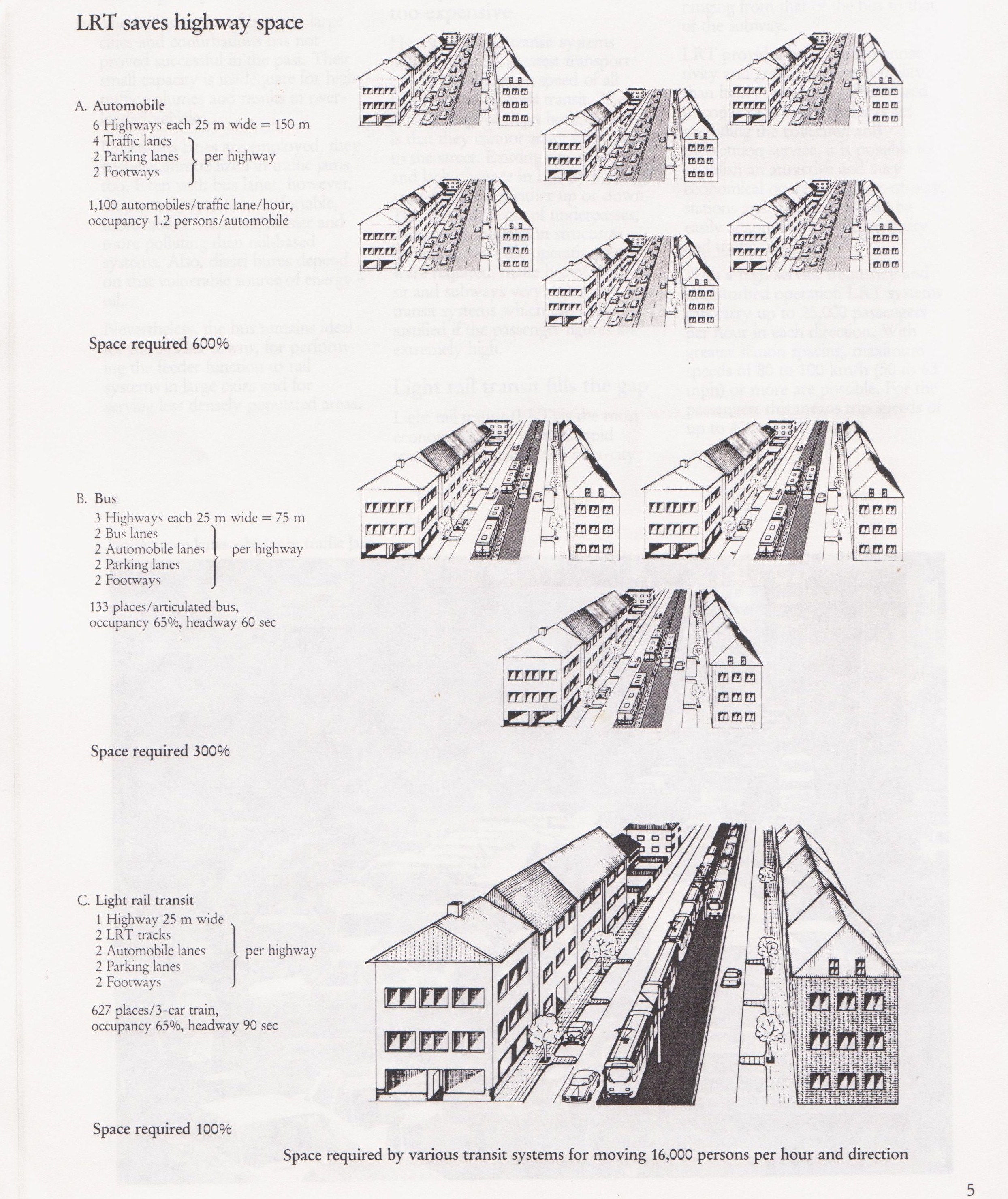
The premier reason light rail is built is that it becomes cheaper to operate than buses when ridership exceeds 2,000 pphpd on a transit route because one tram (1 driver) is as efficient as four to six buses (4 to 6 drivers) and for every tram or bus operated, one needs a minimum of three people to manage, maintain and operate them.
TransLink does not understand what modern LRT is, nor how to plan for it and Surrey’s proposed LRT well demonstrates this fact.
An artist’s conception drawing – Date unknown Artist unknown.
25 March 2017
Transforming the Future of Surrey
With Light Rail Transit
Vancouver British Columbia – An average of 10,000 people have moved to Surrey over the past five years.
As one million more people come to the Metro Vancouver region, many of them will settle in Surrey and surrounding communities south of the Fraser.
One in five Metro residents will call Surrey home and the city will surpass Vancouver as B.C.’s largest community by 2041.
At the same time, more and more high-tech, clean-tech, and health-tech businesses are also choosing to locate in Surrey.
Yet, when it comes to rapid transit, we are only served by the Expo Line built in 1986 and haven’t seen any new rapid-transit capital improvements in the city since 1994.
In 2014, the mayors council unanimously agreed on a vision that makes investing in transit and transportation a key priority for the region.
A 27 kilometre LRT network that will connect Surrey City Centre with Guildford, Newton, Fleetwood, Clayton, Cloverdale, and Langley is a key part of the plan.
This LRT network is critical to the future of Surrey.
It’s meant to create and build the community, and establish a ground-level energy and ambience that speaks to a city of the future.
With some senior government funding now in place, work is progressing on bringing the Surrey-Newton/Guildford line closer to reality.
This first phase will connect Surrey’s Innovation Boulevard and other smart-growth knowledge clusters with other commercial, cultural, and recreational hubs throughout the city.
The promise of Phase 1 LRT has already sparked a transformation in Surrey.
New housing and mixed-use development plans are already underway along the LRT corridor.
New businesses are settling here as well, bringing high-tech and high-skilled jobs to the area.
More than 180 health services are already doing business in Surrey.
LRT will improve access to and from this health/life sciences cluster and make it easier for employers to attract and retain employees.
The new LRT will make it easier for residents to live, work, and get around in the area using a quality rail system.
Soon, citizens will be able to hop the train to Newton Town Centre, Guildford Town Centre, SFU Surrey, Kwantlen Polytechnic University, Surrey Memorial Hospital, Bear Creek Park, the Surrey Art Gallery, and a growing list of destinations.
With the arrival of LRT, communities, commerce, recreation, and culture will be at our doorstep, making it easier to live, work, play, and raise a family in Metro’s fastest-growing city.
By building B.C.’s first LRT system, Surrey is being bold.
Yet, we are charting the same course as other Canadian cities like Toronto, Ottawa, and Waterloo where urban-style LRT projects are already under construction.
The suburbs are no longer sleepy, bedroom communities.
They’re becoming vibrant, accessible, and competitive places to be.
Toronto’s Eglinton Avenue LRT project, for example, spurred private investment in the redevelopment of an underdeveloped segment of Eglinton.
Located close to two LRT stations, private investors will build a 2,500 unit mid-rise residential development and over 250,000 square feet of retail, green space, and public and private amenities creating a new community around an LRT service that will soon be reality.
We are planning the same for Surrey.
LRT will expand and diversify local employment, help attract investment, and promote concentrated and sustainable growth, as we have are seeing in other parts of Canada.
With more than 400 light-rail systems operating in 50 cities around the world, LRT is a quality, cost-effective, and proven rail transit system that can move thousands of people every day, quickly and efficiently.
Massive, and sometimes intrusive, infrastructure isn’t required nor reflective of a modern, urban, 21st-century option.
Surrey is thriving and the addition of the LRT is a fundamental element in our city’s growth as a major community in B.C.
With an anticipated 100,000 new residents arriving over the next decade, now is the time to start building for the future.
Linda Hepner – Mayor of Surrey.
Quoted under the provisions in Section 29
of the Canadian Copyright Modernization Act.
Interesting article on Toronto’s transit scene which mirrors Vancouver’s.
In Vancouver, decades of bad planning, based on up-zoning properties adjacent to SkyTrain Lines to obtain higher densities, which benefits the “condo kings” and land speculators more than transit customers has lead to a litany of unintended consequences.
One of those unintended consequences has brought a new word into the transit lexicon: demovictions.
Demovictions is when affordable older apartments are torn down and replaced with unaffordable condos.forcing former tenants to cheaper accommodations, mostly in transit sparse locations. Those who most use transit are chased away.
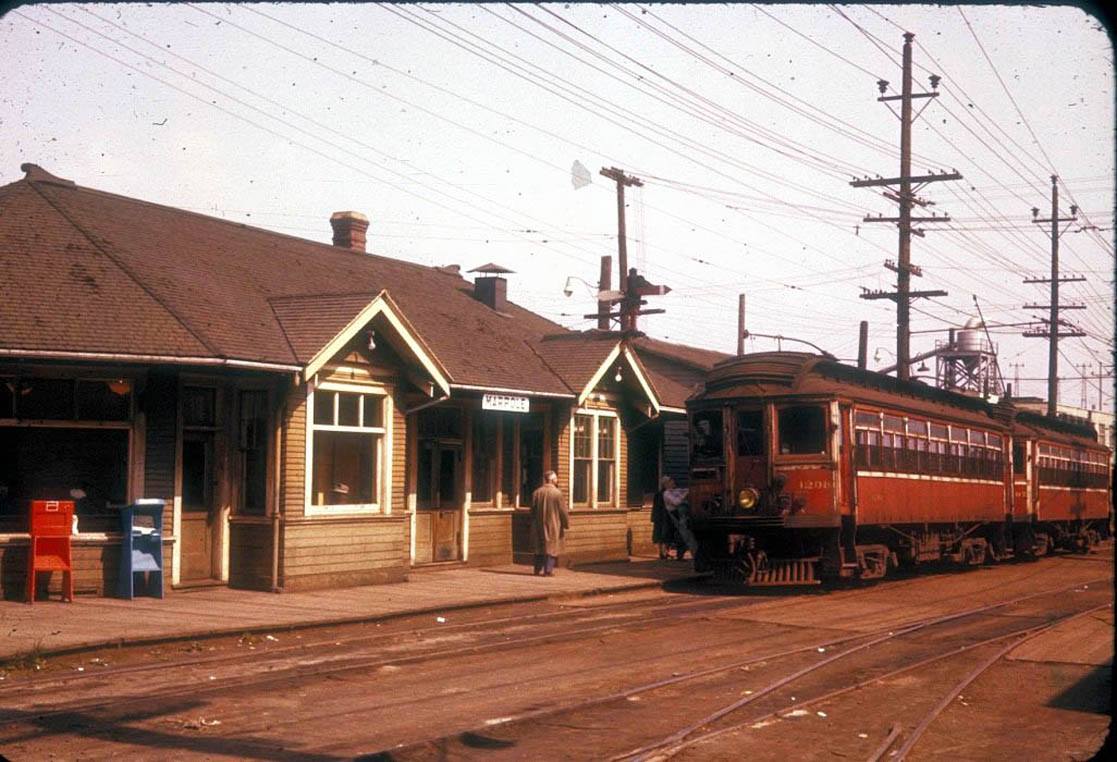
In Vancouver, the “golden age of transit” was when BC Electric ran the transit system and one was able to travel from UBC or Richmond to Chilliwack by tram and interurban.
Today, transit customers are treated as sardines, forced to take the SkyTrain mini-metro, so planning wonks and politicians can boast of the ridership numbers, while most people take the car instead.
What has gone wrong in Toronto, went wrong in Vancouver three decades ago or more!
Until the 1950's one could travel the lower mainland by tram and interurban.
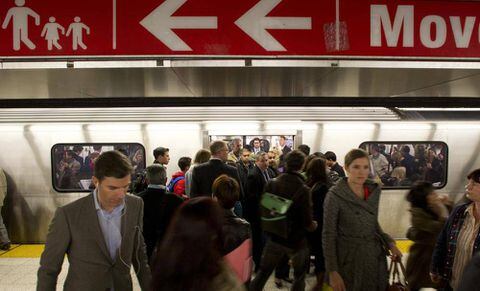
Commuters exit a subway onto the TTC subway platform at Bloor-Yonge station in Toronto.
PETER POWER/THE GLOBE AND MAIL
Stephen Wickens
Special to The Globe and Mail
Toronto’s transit system was once such a wonder that, even into the 1980s, people came from around the world to study how it planned infrastructure projects, how it executed them and how it operated.
That so-called “golden age” also produced transit experts so revered, they got to travel the globe in return. For some, their views have been valued well past retirement age ai??i?? though not so much in their hometown.
Three of them ai??i?? Richard Soberman, Ed Levy and David Crowley ai??i?? recently gathered for lunch and a gab. The Scarborough subway, which is to be voted on again March 28, was not the focus, but it came up often.
“We have to be careful; this idea there was a golden age is a bit of myth,” says Dr. Soberman, former chair of civil engineering at the University of Toronto and lead author of many seminal transportation reports dating to the early 1960s. “We did very good things ai??i?? on time, on budget ai??i?? but we made big politically driven errors back then, too. Building a subway [Spadina] on an expressway median was a huge one. Putting the Queen subway on Bloor has turned out to be a mistake.”
“Precisely,” says Mr. Levy, jumping in. Mr. Levy, a planner, engineer and author of Rapid Transit in Toronto, A Century of Plans, Projects, Politics and Paralysis, says that great cities that have been able to sustainably expand subways kept building from the middle out (and they didn’t tunnel in low-density areas).
By not doing Queen right after Yonge, “we missed a crucial starting point for network-building. We’ve never been able to get back to a logical order,” Mr. Levy says. “Call it the Queen line, relief line, whatever, the whole GTA has needed this piece of infrastructure for decades, but politicians keep wasting scarce capital on frills and vote buying.”
“Toronto’s biggest transit problem,” says Mr. Crowley, who specializes in data analysis, travel market research and demand forecasting, “is we’ve overloaded core parts of the subway. We’d basically done that on lower Yonge 30 years ago, when I was still at the TTC. We have to relearn the importance of downtown to the whole region, the whole country. We’re in danger of killing the golden goose.”
Noting that trains from Scarborough and North York are often full before crossing into the old city, Mr. Crowley says that, “data and demand patterns are telling us the stupidest thing we could do is make any of our lines longer [before putting another subway through the core].”
“Much as I like the Eglinton Crosstown idea, and it’s overdue, too,” Mr. Levy says, “I fear what it will do to Yonge-line crowding. Again, the sequence is so wrong.”
Are bureaucrats shirking their responsibility to speak truth to power?
“We sure needed [TTC chief executive] Andy Byford to be blunt about this Scarborough subway plan,” Mr. Levy says. “He should have spoken up.”
Might the reticence be what some call “the Webster effect”? (Mr. Byford’s predecessor, Gary Webster, was fired for objecting to then-mayor Rob Ford’s insistence the entire Eglinton Crosstown go underground).
“Unwillingness to speak up isn’t new,” Dr. Soberman says, citing pressure from North York politicians in the early 1970s that spurred two well-regarded TTC executives to vote for the Spadina subway in the expressway corridor “even though they knew only idiots would think it was a good idea.”
The difference is, he says, “back then politicians listened, even if they didn’t always take our advice. They respected facts. Now they only want confirmation of their preconceived ideas, and too many people [bureaucrats and private-sector consultants], who should be providing objective professional advice are playing along with the game.”
“On Scarborough,” Mr. Levy says, “you won’t find a single independent transit professional who can support this, but they won’t say so publicly. The three of us can say this stuff without recrimination; we’re retired.”
“The minute the politicians speak,” Mr. Crowley says, “the civil service and the consulting community are happy to say, ‘Oh, that’s a great idea. Yes, let’s study that.’ I started to see this trend in the 1980s at the TTC. I’d raised serious, fact-based concerns about Sheppard-subway ridership forecasts and the role of the project. It upset people. I was told, ‘You’re never supposed to do that ai??i?? you have to play along.’ “That’s when I knew it was time to get out,” says Mr. Crowley, who went on to a career with international private-sector firms. “This Scarborough boondoggle, if we were talking about gas plants, it could bring down a government, but transit is ‘special’ for reasons I don’t understand.”
“We’ve also overestimated the potential of these sub-downtowns, especially on jobs,” Mr. Levy says. “It’s twisted our spending priorities.”
“Transportation planning has become a bullshit field,” says Dr. Soberman. “A civil engineer wouldn’t say a bridge is going to be safe if his calculations show it might fall down, but a transportation planner can say anything. There’s no downside other than you waste public funds.”
“And the more we waste public funds, the harder it is to raise tax revenue for transit needs,” Mr. Levy says. “We’ve badly underfunded transit, but people don’t trust politicians to spend money well. When was the last time we did anything good? The Kipling and Kennedy extensions? That’s nearly 40 years ago. Most people recognized Sheppard was a mistake, but people who learned from it are ignored. It’s often impossible to even get good ideas considered. Politicians have a role to play, but …”
“It’s always been political ai??i?? always will be ai??i?? but we need to get smarter about where politicians join the process,” Dr. Soberman says. “If you don’t generate good ideas, you’re guaranteed bad results. If you generate good ideas and they’re ignored, you won’t do any better. Current politicians are comfortable ignoring the people most likely to generate the best ideas. And the media, you guys, haven’t always helped. This subway-versus-LRT debate was simplistic and maddening. Scarborough deserves better transit, but the best options aren’t even being considered.” (Dr. Soberman would simply buy new rolling stock for the SRT and rebuild a bend to accommodate new vehicles.)
“Maybe we’re part of the problem,” Mr. Crowley says. “If the professionals had done a better job diagnosing problems, identifying prescriptions and educating politicians and the public on issues and options, politicians wouldn’t have moved into the vacuum.”
Getting in the last word, Mr. Soberman says, “too many people in positions of power don’t seem to know what they don’t know. Whether it’s at the province and Metrolinx or at the city and TTC, if we don’t figure out new governance models, we’ll never regain the public trust and Toronto will suffer for generations.”
This article is a must read for those in Vancouver who want to debate the proposed Broadway SkyTrain subway.
Three items that need attention:
As Toronto does not operate with LRT, their capacity numbers for LRT are inaccurate. Since the 1980’s the capacity of a modern LRT line can be in excess of 20,000 pphpd.
The article restates that the minimum threshold for a subway are traffic flows in excess of 15,000 pphpd.
“RT is just a short form of ai???light rail transit.ai??? It is technology widely used in European and North American cities and in its own right-of-way can run just as fast as a subway.” As Zwei has stated over and over again, LRT when it operates on a reserved R-o-W (which makes a simple tram LRT) is as fast as a subway, at a cheaper cost.
The proposed ALRT/ART SkyTrain Broadway subway does not and will not have the ridership to justify its construction, which will means precious transit monies that were to be spent elsewhere, instead will be spent to subsidize the Broadway subway.
The subway debate in Vancouver should be about costs and funding and not how many high rises the ‘condo kings’ can build at station sites.
The debate over the future of transit in Scarborough returns to city hall with a council meeting that begins March 28. As city staff look for direction to continue studying a subway plan ai??i?? one that Mayor John Tory says will bring needed growth to the urban centre ai??i?? rising costs have raised questions about whether Scarborough is getting the most transit with the money available. With $3.56 billion in funding committed, a town hall Monday night left some residents with lingering questions about the plan on the table and whether theyai??i??ll be left on the bus. We break down the options and answer some of the major questions.
So, how many new transit stops will Scarborough be getting?
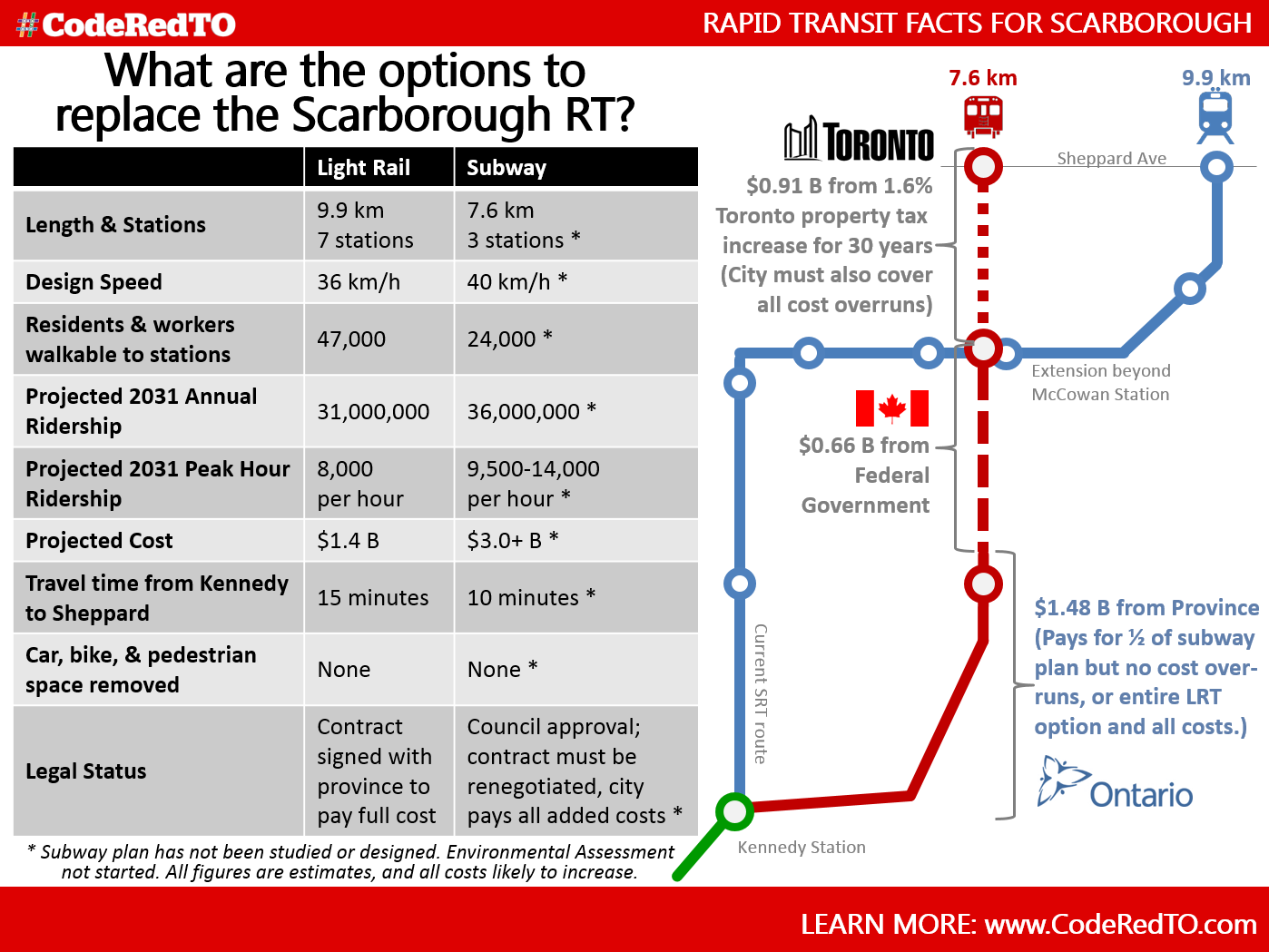
With the current funding, Scarborough will be going from five SRT stops (in addition to Kennedy) to just one subway stop at the Scarborough Town Centre. If more funding can be secured, council is looking to build an 18-stop LRT along Eglinton Ave. East. There are no additional funding commitments for that line right now. A request has been made to the federal government.
Whoai??i??s paying for the subway extension?
The province committed $1.48 billion (in 2010 dollars, with the province responsible for inflationary costs), originally pledged to the seven-stop LRT, the federal government committed $660 million, and the city will contribute $910 million for a total $3.56 billion. Of the city contribution, the majority is being raised through a special property tax from all Toronto residents that began in 2014 and will continue for the next 30 years. If instead of a subway, the seven-stop LRT was to be built with provincial money, the federal and city contributions that have been committed to Scarborough transit would almost cover the cost of the 18-stop Eglinton East LRT.
How many people will ride the subway extension?
Ridership during the rush hour in the busiest direction is expected to be 7,400 an hour in 2031 ai??i?? well below the accepted minimum threshold for a subway of 15,000 people and the maximum capacity of 36,000 people. The capacity of an LRT is 2,000 to 15,000 an hour depending on the configuration. The daily ridership of the planned subway extension is expected to be 30,800 in 2031 ai??i?? less than the SRTai??i??s current daily ridership of nearly 39,000.
Will I get where Iai??i??m going faster?
City staff confirmed with the Star this week that replacing the SRT with the proposed subway extension ai???would save customers approximately eight minutes for travel from Scarborough Centre Station to any station west of Kennedy.ai??? But that doesnai??i??t factor in the bus trips for individual users, who may spend more time on a bus getting to a rapid transit station with the one-stop plan. It also doesnai??i??t consider the time that could be saved compared to the LRT plan.
What is an LRT?
LRT is just a short form of ai???light rail transit.ai??? It is technology widely used in European and North American cities and in its own right-of-way can run just as fast as a subway. Though the Scarborough LRT has been compared to the existing streetcar network, the LRT had more in common with the Eglinton Crosstown line under construction now, using longer, higher capacity, low-floor vehicles. It would have run in the SRT corridor and never interacted with traffic. An improved transfer with a single flight of stairs was originally planned at Kennedy Station. With changes to the redesign of that station, the connection could be made by simply crossing the platform on the same level, which staff has not studied.
Will there be new stations at Centennial College or the University of Torontoai??i??s Scarborough campus?
There will be no station at Centennial. The seven-stop LRT gave the college its own station, before that plan was scrapped.
There is a station planned at UTSC on the 18-stop Eglinton East LRT, but that line is currently unfunded.
Will there be a stop at The Scarborough Hospital?
No. Former mayor Rob Fordai??i??s three-stop subway plan proposed a stop at McCowan Rd. and Lawrence Ave., but that stop has been eliminated in the revised subway plan.
Hasnai??i??t council already voted to build a subway?
Since May 2013, there have been at least seven key votes on Scarborough transit. But the subway project is not a done deal with funding agreements yet to be signed, design yet to be advanced and construction contracts yet to be tendered. Though subway proponents have tried to blame a delay on advocates for the LRT alternative, the delay has been exclusively related to staff reports not being ready on time, additional review of subway options recommended by staff and regular processes involved with billion-dollar infrastructure projects. Staff are recommending they return to council again in ai???late 2018ai??? with a more concrete cost estimate after more design work.
When is the subway extension expected to be finished?
City staff estimated construction would take approximately six years and that the earliest it could be done is the second quarter of 2026.
And just in, the following article should put to rest the notion that all transit investment is good investment. Sometimes after billions are spent to suit politcal wishes and not customer wishes, the customer stops taking transit and takes the car instead!
Metrolinx study finds Toryai??i??s Smart Track could spur auto commuting
Last updatedAi?? Thursday, Mar. 16, 2017 8:20PM EDT
Parts of Mayor John Toryai??i??s Smart Track plan will slow down transit enough to push a large number of users to drive instead, initial business cases for the regional transit agency Metrolinx has found.
The long-delayed reports undermine the argument for the three transit stations proposed for outside the city core and raise new questions about a plan that has been heavily revised since it helped win Mr. Tory the mayoralty.
The consultant reports show that stations proposed on the GO lines at St. Clair, Lawrence East and Finch East would make the trains less attractive to current users. This would push down net GO ridership over the next 60 years, resulting in more than a billion kilometres of additional driving over the same period. None of these stations ai??i?? which have an estimated total construction cost of $162.6-million ai??i?? would attract enough passengers to cover even day-to-day operating costs, the reports conclude.
The mayorai??i??s office did not respond specifically to questions about whether these stations were good transit policy or at odds with his goal of reducing congestion.
ai???Metrolinx and City Council have voted to move ahead with Smart Track. It is an investment ai??i?? that will provide much-needed transit for residents,ai??? mayoral spokesman Don Peat said in an e-mail.
ai???City staff have also made it clear that the Smart Track stations in Scarborough along with the subway extension and the Eglinton East LRT form a network that help address local transit and long-distance travel needs in that area.ai???
The other three proposed stations for GO lines within the city ai??i?? at Liberty Village, Unilever and Gerrard ai??i?? do much better in the Metrolinx analysis. Liberty Village appears to perform best on paper, attracting about 5,000 daily users by 2031 and preventing about 600-million kilometres of driving over the next 60 years.
The stark difference between the stations that emerged in the analyses could lead to questions at council about the wisdom of proceeding with all six.
ai???Itai??i??s almost like if you treat transit like a slogan instead of a network, it doesnai??i??t work well,ai??? said Councillor Gord Perks. ai???This is just further evidence that, for the last six years, transit planning has focused on glamour projects instead of an effective network.ai???
A spokeswoman for Metrolinx stressed that the analyses released Thursday were ai???just one metricai??? for assessing the projects, and that work would continue. ai???In every initial business case, emphasis is placed on both a projectai??i??s benefits and obstacles so those obstacles can be addressed as the project is refined and designed,ai??? Anne Marie Aikins said in a statement. ai???All stations are moving forward to the next stage of our work.ai???
A potential caveat about the findings is that the analysis was done assuming the current GO fare.
ai???TTC fare at the new station may increase the ridership (boardings and alightings) at the station; however, the net impact to new revenue may be negative and requires further study,ai??? reads the report dedicated to Lawrence East station.
Mr. Tory promised that people would be able to use Smart Track for a TTC fare, something the province has not agreed to. Metrolinx is currently pushing toward some form of fare integration, meaning that it is unclear what the cost to ride any transit in the city may be by the time any of these stations were to be built.
Smart Track was proposed by Mr. Tory during his election campaign. He pitched it as a 22-stop transit service running largely on existing GO rail tracks, taking advantage of provincial plans to electrify these lines and move to more frequent service. The plan has been whittled down repeatedly.
Plans for a heavy rail extension along or under Eglinton were jettisoned in favour of a light rail line on the surface. The number of stations on the GO corridors has shrunk. And the frequency of trains will be what the province decides to put on for its regional express rail plans, with no additional service because of Smart Track.
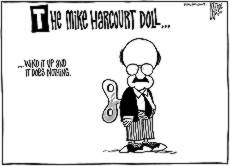
In political jargon a useful idiot is a person perceived as propagandist for a cause whose goals they are not fully aware of, and who is used cynically by the leaders of the cause.
Former premier Mike Harcourt continues to regale anyone who will listen, that subways are the only transit solution for Vancouver. Who is he speaking for?
Vision Vancouver?
Bombardier Inc./SNC Lavalin, who own the patents for the proprietary SkyTrain system?
John Horgan?
BC Liberals?
He is not speaking to real engineers, who would give him the real costs of subway construction.
Harcourt and his former NDP friends, really never understood the costs associated with light-metro and with subways they remain utterly clueless about subways.
Cost for a subway to UBC, about $5 billion to $6 billion, but hey, what else does the failed city of Vancouver going to do to pretend it’s world class?
As there is no money budgeted for subway construction, the chances are slim to none that a Broadway subway will be built anytime soon.
Mike Harcourt’s train of thought: Build a subway to UBC
Harcourt and Robertson, Two Mayors on Vancouver Past, Present and Future
Thursday, 5:30 p.m. to 7 p.m. |Ai??SFU Vancouver Campus, Fletcher Challenge Theatre
Tickets:Ai??Free admission
Imagine the Millennium Line running all the way to the University of B.C., alongside a limited-stop express subway connecting Coquitlamai??i??s United Boulevard to the planned new development at Vancouverai??i??s Jericho Lands.
Former B.C. premier and Vancouver mayor Mike Harcourt says transit authorities are thinking too small with the current plan to extend the Millennium Line underground to Arbutus Street.
ai???Itai??i??s crazy to end it there,ai??? Harcourt said. ai???You should take it to Jericho and out to UBC.ai???
Harcourt, honoured last month with the Freedom of the City, is to join current Vancouver Mayor Gregor Robertson on Thursday evening for a public lecture on where the city is going.
Weai??i??ve really done some things badly (in Metro Vancouver), like having a referendum on transit
Wherever that is, the city needs more trains to get there, Harcourt said. The Broadway subway, ai???should be like the Sixth Avenue line in New York ai??i?? two trains, four sets of tracks.ai???
Even under current zoning, the Broadway corridor from Main to Burrard could be built up to accommodate 100,000 new workers and 50,000 residents, Harcourt said. As well, the 36-hectare Jericho lands are poised for development after the federal government struck a deal turning the bulk of the land over to three First Nations. And UBC is always growing.
Harcourtai??i??s express-train idea envisions stops at Burnabyai??i??s Willingdon, and along Broadway at Commercial and Cambie to connect with existing trains. He has pitched it to TransLink, the province and First Nations, with no one biting just yet.
ai???Not right now, but Iai??i??m a persistent guy.ai???
The 74-year-old Harcourt was mayor before and during Expo 86, served a term as premier in the 1990s, and has since advised cities on sustainability.
ai???Weai??i??ve really done some things badly (in Metro Vancouver), like having a referendum on transit,ai??? he said, noting that the original Expo Line took just three years from proposal to completion.
ai???The minute they built the Canada Line, it was over capacity and the stations were too small,ai??? he said. ai???Weai??i??ve had to expand and keep expanding the Expo Line since it was built. You say, well, maybe we can learn from that. Weai??i??re going to have another two million people in the next 40 years or so, to add to the two and a half million people already here.ai???
More trains south, north and east would be needed to meet that growth, he said.
Harcourt first got into politics when he was a lawyer in the 1960s, and he was approached by community leaders to join the fight against a freeway that would have carved up east Vancouver. Next year, work is scheduled to start demolishing the last vestiges of that failed freeway plan ai??i?? the Georgia and Dunsmuir viaducts.
He will be talking with Robertson on Thursday about his ideas on other subjects ranging from high-tech industry to post-secondary education, housing and child care.
But transportation has always loomed large for Harcourt. He credits that early battle against freeways with aiding the later emergence of Vancouverai??i??s downtown as a place where people could both live and work, unlike most North American cities.
ai???We danced to a different drummer on urban renewal and freeways.ai???
The Cambie Street Bridge was built under Harcourtai??i??s tenure as mayor, so he is not entirely against bridges.
But asked about the worst-case future for the region, he cited ai???this really stupid idea of the bridge to replace the Massey Tunnel.
ai???If it gets built, all it does is shift the congestion from the tunnel to Richmond and the Oak Street Bridge. And then some blockhead is going to say, ai???Oh well, we can fix that. Letai??i??s just build an eight-lane bridge and freeway down Oak Street.ai??i??ai???








 Glen Schaefer
![Former B.C. premier Mike Harcourt at Clean Energy B.C.'s Generate 2016 conference, where he delivered a speech on Nov. 7, 2016 declaring the $9-billion Site C dam project an 'economic, environmental and aboriginal disaster' that should be mothballed. (Photo credit: Derrick Penner, PNG) [PNG Merlin Archive]](http://wpmedia.vancouversun.com/2017/03/former-b-c-premier-mike-harcourt-at-clean-energy-b-c-s-gene.jpeg?quality=55&strip=all&w=840&h=630&crop=1)



Recent Comments