Posted by zweisystem on November 29, 2013 · 3 Comments
Well, Toronto’s crack smoking Toronto’s mayor Rob Ford wants Ottawa to fund his multi billion dollar subway dream, I guess Surrey feels the feds should ante up for transit projects out west.
What the likes of UBC professor Larry Franks doesn’t realize or refuses to realize is that Skytrain is obsolete, a yesterday’s transit system for yesterdays era of massive transit mega projects. The BS (and I mean BS) about the Broadway SkyTrain subway is breathtaking, as there is no pent up demand, just very bad management on the part of TransLink in not providing adequate bus service to meet customer demand. Simply, traffic flows on Broadway do not warrant a SkyTrain subway or any subway for that matter.
It also looks like Surrey wants to freeze Translink out of the LRT planning, which would be a wise thing to do as Translink doesn’t want to build with light rail and will do anything and everything to ensure that LRT will not built. TransLink’s CEO, Bob Paddon sounds scared and he should be. Paddon’s and TransLink’s fear is simple to understand, a LRT operation in Surrey will expose TransLink’s rapid transit planning as nothing more than smoke and mirrors, providing hugely expensive transit to cater to routes with less than stellar ridership. When Paddon speaks about a business case for Skytrain, he is talking out of his hat, for only seven SkyTrain type operations have been built since the late 1970’s and only three can be seriously considered as “rapid transit”.
In the real world, there is no business case for SkyTrain, that is why no one builds with it!
ai???If you tell a SkyTrain lie big enough and keep repeating it, people will eventually come to believe it. The SkyTrain lie can be maintained only for such time as the province and TransLink can shield the people from the political and economic consequences of the SkyTrain lie. It thus becomes vitally important for the province and TransLink to use all of its powers to repress dissent, for the truth is the mortal enemy of the SkyTrain lie, and thus by extension, the truth is the greatest enemy of the province and TransLink.ai??? A reworked quote from the father of modern propaganda, the notorious Joseph Goebbels.

Direct appeal bypasses normal process, could lead to planning chaos; prof says
METRO VANCOUVER — Surrey is skirting the traditional route for regional planning by appealing directly to the federal government for $1.8 billion in funding to build three light rail lines across the city.
The pitch, made under the Building Canada Plan, underscores years of frustration by Surrey Mayor Dianne Watts and other regional mayors over TransLink decisions that have pitted municipalities against each other for transit projects.
It also comes at a time when TransLink is financially hamstrung, with no money to expand transit services while facing demands from B.C.ai??i??s largest cities ai??i?? Vancouver and Surrey ai??i?? for expanded rapid transit.
Watts and other mayors also argue a looming referendum on potential transit funding options is doomed to fail, leading to further delays on much-needed transit projects.
Surrey argues its pitch to the Building Canada Fund, which is offering $53 billion over 10 years for infrastructure improvements in Canada, including transportation, is necessary for goods movement because it will get people out of their cars and taking transit, freeing up the roads. If approved, the project would likely be based on cost-sharing between the federal, provincial and local governments.
ai???Weai??i??re coming at this from all fronts. Weai??i??ve had no expansion since Expo (1986) and 70 per cent of the future growth is coming south of the Fraser,ai??? Watts said. ai???Weai??i??ll work with TransLink and work with the province, but at the same time we still have to move the city forward. Keeping the status quo or doing nothing is not an option.ai???
City officials plan to lobby federal transportation minister Lisa Raitt, as well as local MPs, the province and TransLink, which is responsible for transportation planning in Metro Vancouver and receives funds on behalf of municipalities, to press its case for light or at-grade rail.
This isnai??i??t the first time the city has tried to bolster support for light rail. When TransLink said it preferred to extend the rapid transit line with SkyTrain technology, Surrey spent taxpayersai??i?? dollars on a cost feasibility study on at-grade light rail.
Watts argues at-grade rail ai??i?? and not the monolithic concrete SkyTrain ai??i?? is desperately needed to shape the city, which is expected to see its population swell from half a million today to more than 750,000 in the next 30 years. Surrey also contributes $41 million annually to TransLinkai??i??s coffers, yet this money has been spent on projects such as the West Coast Express and the Millennium Line, and not in the city itself.
Coun. Tom Gill says if Surrey does get federal funding, the city may go so far as to challenge legislation in the South Coast Transportation Act to ensure that TransLink honours its plans for light rail stretching from City Centre to Guildford, Langley and White Rock.
ai???Surrey has been ignored, thereai??i??s no question,ai??? said Gill, chairman of the cityai??i??s transportation and finance committees. ai???This council has been very respectful of TransLink and the province but we have short fuses now. The No. 1 issue in Surrey, by far, is transportation. We feel we should be next in terms of priorities.ai???
Given Surreyai??i??s status as the regionai??i??s second-largest city, the move could be a significant blow to TransLink, which is responsible for transportation planning across the region.
Larry Frank, a professor in sustainable transportation at the University of British Columbia, maintains itai??i??s very unusual for a municipality to make a direct application to the federal government. Such a move could lead to an ad hoc and chaotic process, he said, with any available money going to the first municipality to cut a deal and leaving the others with nothing.
The Broadway corridor, he added, has huge pent-up demand and is just as important as Surrey, as are other projects on TransLinkai??i??s priority list.
ai???Thereai??i??s been a lot of waiting for investment in other parts of the region. Surrey is not the only one waiting for transportation funding,ai??? Frank said. ai???Whatai??i??s to keep others from doing that? It further symbolizes the erosion in regional planning process.
ai???Theyai??i??re giving up and saying ai???we just want to do it any way we can.ai??i?? Iai??i??m worried about other projects in the region that are needed. We need a coherent regional planning process and framework and buy-in, so this is just more problematic.ai???
Gill said he agrees that both Vancouver and Surrey are deserving of their transit projects, but the city canai??i??t wait around for TransLink to come up with the money.
ai???From an equality perspective the folks in Vancouver are served much better than the folks in Surrey. The transit opportunities should have some equitable base for both municipalities,ai??? Gill said. ai???We are not getting value for money in terms of our contribution to TransLink and we would like to see that improved drastically.ai???
Both projects are on TransLinkai??i??s priority list along with a new or refurbished Pattullo Bridge, a gondola up Burnaby Mountain to Simon Fraser University and upgrades to the Expo Line.
TransLinkai??i??s Bob Paddon, vice-president of strategic planning, said he hasnai??i??t seen the application from Surrey and itai??i??s not yet known how much of that money would come to B.C. He noted TransLink hasnai??i??t made a decision yet on what technology to use but acknowledged there are compelling cases for both light rail and SkyTrain.
ai???We have not landed on a rapid transit plan for the region,ai??? he said. ai???What I believe this comes down to is Surrey stating its preference and itai??i??s anxious to see rapid transit investment. Itai??i??s always helpful to have municipalities say to the Government of Canada weai??i??d like to see an investment in transportation.
ai???We need to reach a collective decision on whatai??i??s best for the region as a whole and how weai??i??re going to best apply the dollars that are available to us.ai???
B.C. Transportation Minister Todd Stone was unavailable for an interview.
ksinoski@hotmail.com
Posted by zweisystem on November 28, 2013 · Leave a Comment
Every fifteen years or so, the good burghers of Whiterock and South Surrey agitate for the removal of the BNSF tracks that run on the shoreline from the international boarder to Crescent Beach. Not going to happen.
Though safety is the supposed concern, Zwei thinks that property values is the real reason as people living adjacent to the tracks wanting the line moved and of course, at someone elses expense.
The question no one will answers of course is the cost of relocating the, includingAi?? building a 6 km or more tunnel. The cost for the proposed diversion would be over $1 billion and not the claimed $350-450 million, by the time the project was completed. If a high speed passenger service is envisioned to use the new line, it will be double tracked, further increasing costs.
From Zwei’s point of view, $1 billion could by us a Vancouver to Chilliwack TramTrain, which would be money far better spent than relocating tracks used by four passenger services and a few freights a day. Sorry folks, the train was there years before the majority of people moved there and there it will stay.
When one moves next to railway tracks it is ‘caveat emptor‘.

Cities present four rail-route options to bypass White Rock
It was standing-room-only at Tuesdayai??i??s community forum on railway safety, as more than 300 people packed the Pacific Inn in South Surrey to learn more about ongoing research into relocating the train tracks off the Semiahmoo Peninsula waterfront.
Four possible options for realigning the BNSF tracks ai??i?? including three that would move the line along routes east of 176 Street ai??i?? were presented in what was described as an opportunity for public feedback.
While most attendees appeared to be in favour of relocating the tracks, the possible new routes did not sit well with everyone. Anna Dean said she was ai???seeing redai??? at the suggestion to move the problem from one community to another.
ai???We donai??i??t want your problem in our neighbourhood,ai??? Dean told a panel that included Surrey Mayor Dianne Watts, White Rock Mayor Wayne Baldwin and City of Surrey staff. ai???Whatever the alignment is, it will affect another neighbourhood.ai???
While the idea of relocating the tracks is not new ai??i?? it has been raised many times in recent decades ai??i?? the citiesai??i?? officials said, and many attendees agreed, the time is right to push for making it a reality.
ai???There is a much faster, safer and viable route available,ai??? Baldwin told the crowd, to applause.
ai???If we were starting from scratch, the present route would be the last we would take.ai???
The issue of the lineai??i??s safety has been in the forefront in recent months, following derailments in other areas of the country and the death of a White Rock jogger who was struck by a passenger train.
Baldwin announced plans for the forum at last weekai??i??s White Rock council meeting, explaining Watts contacted him in August to invite his cityai??i??s participation in Surreyai??i??s efforts ai??i?? an invitation Baldwin said added much-needed clout to the argument.
ai???It wasnai??i??t 20,000 people talking,ai??? he said Tuesday, referring to White Rockai??i??s population. ai???It was over half a million.ai??i?? This is a great thing.ai???
Watts noted 15 of the 19 kilometres of rail line eyed for re-alignment run through Surrey. From the border, it passes through the Douglas area, along four kilometres of White Rockai??i??s coastline, then through Ocean Park and Crescent Beach before heading across Mud Bay and joining the main line at Colebrook Road.
Watts cited a number of studies since 1995 that have looked at the feasibility of moving the rail line. Surrey staff revisited the 2002 Delcan Report this past June, and ai???realized very quickly that we needed to resurrectai??? the effort, she said.
Watts said a memorandum of understanding signed last year for high-speed passenger-rail service between Vancouver and Seattle further supports the argument.
ai???As I looked at that, I felt, ai???youai??i??re going to have a problem,ai??i??ai??? Watts said. ai???This current alignment will not support that in any way, shape or form.ai???
She said safety issues with the existing route include population growth in the area; slope stability and erosion that increases the risk of landslides; pedestrian risk; access; and the transportation of dangerous goods. Predictions of a two-metre rise in sea level and more wet weather must also be considered, she said.
Realignment is estimated by the cities to cost $350-450 million.
One option presented Tuesday parallels King George Boulevard and Highway 99, and would see the line tunnelled between 16 and 36 avenues. Two of the three options for east of 176 Street are envisioned as largely elevated routes.
Attendees were given ai???10 to 12 minutesai??? to formally comment or ask questions. Cost and where the funds would come from were among concerns raised. One attendee wanted to know how many fatalities have occurred along the line in its history; another asked Watts to ai???dig in your high heelsai??? to help move the concept forward.
An online survey on the project is at www.cityspeaks.ca/saferail
Posted by zweisystem on November 27, 2013 · 6 Comments
What the SkyTrain and subway lobbies fail to mention, is that Paris transit authorities are also investing heavily in light rail or tramways. Something that planners should consider, when planning for new transit lines in Vancouver.
Paris inaugurates tram Line T7
FRANCE: The latest tram line in Paris opened on November 16 with two days of free travel. Line T7 runs from Villejuif-Louis Aragon, the southern terminus of metro Line 7, to Athis-Mons with 18 stops and a depot at Vitry-sur-Seine. The end-to-end journey time on the 11Ai??2Ai??km line is 30 min.
In addition to metro Line 7, interchange is provided with the Orlyval peoplemover serving Orly Airport. Interchange will also be provided with several planned lines: RER Line C, lines 15 and 18 of the Grand Paris Express programme and the planned extension of Line 14 to Orly.
Peak frequency is currently 6Ai??min, which is planned to increase to 4Ai??min once an extension to Juvisy-sur-Orge opens in 2018. Ridership is expected to be 30Ai??000 passengers per day.
The line is operated with a fleet of 19 Alstom Citadis trams, including the 1Ai??500th Citadis delivered by Alstom. Each 32Ai??m long tram has a capacity of 200 passengers. Ile-de-France transport authority STIF ordered the vehicles in February 2011 together with 20 trams for Line T8, which will link Saint-Denis with Epinay-sur-Seine and Villetaneuse. The order includes an option for a further 31 cars.
http://www.railwaygazette.com/news/single-view/view/paris-inaugurates-tram-line-t7.html

Posted by zweisystem on November 26, 2013 · 5 Comments
Not quite a “FastFerry” debacle, but the hydrogen bus scheme was one of dreams, by a premier with very little “cred” in providing affordable public transit.
Zwei knew that the hydrogen bus would flop, because the major companies that provide buses, trams and trains, backed off hydrogen fuel cell powered transit vehicles almost a decade ago. The problem was the same as now being experienced in Whistler, the hydrogen powered bus costs a lot more to operate than conventional diesel buses.
Until major public transportation suppliers perfect an affordable platform for hydrogen fueled transit vehicles, the hydrogen bus will remain a pipe dream.
ai???It is expensive to maintain and expensive to fuel,ai??i?? BC Transit says of the buses in its hydrogen fuel cell fleet in Whistler.
The future of the Whistlerai??i??s hydrogen fuel cell buses ai??i?? the largest fleet in the world ai??i?? is in doubt after BC Transit said it cannot afford to continue to run and maintain the fleet when the $89-million demonstration program wraps up next spring.
Information obtained under a Freedom of Information Act request by the Canadian Autoworkersai??i?? Union 333 suggests Whistlerai??i??s 20 hydrogen fuel cell buses cost three times more for maintenance and fuel costs than the conventional Nova diesel buses they replaced in 2009.
BC Transit deployed the hydrogen bus fleet in 2009 as part of a grand scheme by Gordon Campbellai??i??s Liberals to showcase fuel cell technology during the 2010 Winter Olympic Games and have a ai???hydrogen highwayai??? stretching from Whistler to California.
That didnai??i??t happen and hydrogen is now trucked from Quebec every 10 days, instead of from a hoped-for fuelling station in B.C. Much-hyped plans for growth in the fuel cell market, which would have pushed down the costs for infrastructure and parts, also didnai??i??t materialize, which means BC Transit is paying a higher price for maintenance and labour for hydrogen buses compared with the diesel buses.
The buses ai??i?? which cost $2.1 million each, about four times the price of a diesel bus ai??i?? are powered by hydrogen fuel cells provided by Burnabyai??i??s Ballard Power Systems. They produce no greenhouse gas emissions and can be twice as energy-efficient as conventional buses. Eight hydrogen tanks hold in total about 60 kilograms of hydrogen, on which the bus should be able to travel 500 kilometres.
But a midterm evaluation included in the FOI information suggests the average fuel range is below the amount specified in the contract and is worse during the winter months, when water in the fuel cells can freeze and prevent the buses from starting or running efficiently. It notes hydrogen fuel costs, at an average $2.28/km, are three times the cost of diesel, while maintenance costs $1 per kilometre, compared with 65 cents/km for diesel buses.
ai???It is expensive to maintain and expensive to fuel,ai??? BC Transit spokeswoman Meribeth Burton said.
The hydrogen fleet has been integrated into the regular operations of Whistlerai??i??s transit system, accounting for two-thirds of all buses in the resort municipality. Whistler and BC Transit, which is responsible for transit systems outside Metro Vancouver, share the fleetai??i??s operating costs. The province pays another $1.8 million annually to cover the incremental costs of the hydrogen fuel cell project over the five years.
The resort municipality pays about 46 per cent of the fleet operating costs through property taxes and fares, which cost $2.50 per passenger ride.
Burton noted that while her organization had ai???anticipated surprisesai??? when the program started, it isnai??i??t sure what is going to happen next March, especially if the province decides it will no longer contribute the additional $1.8 million. If that happens, she said, the hydrogen buses could be sold and replaced with diesel or other alternatives because the hydrogen costs are too much for BC Transit and Whistler to bear.
ai???Without the annual support for the incremental costs, it would not be feasible,ai??? Burton said. ai???We will not be able to assume those costs. It will be up to the province to decide what we do next.ai???
Burton maintains BC Transit was excited about the scope and size of the project, which has recorded three million passenger trips since it started. But while many parts of the system were successful, she said, others fell short.
ai???On many levels it has been a success story,ai??? she said. ai???Weai??i??ve learned a lot about the technology and it was an opportunity to do something really unique in the market. Weai??i??ll have to see what the future holds.ai???
Ben Williams, president of CAW 333 in Victoria, maintains the hydrogen buses should be scrapped and the money used to provide transit in other areas of the province, such as Victoria. It added it doesnai??i??t make sense to haul fuel from Quebec when the idea is to run the buses to reduce carbon and greenhouse gas emissions.
ai???I wasnai??i??t surprised to be seeing this unbelievable cost when theyai??i??re actually trucking the hydrogen from Quebec,ai??? Williams said. ai???As it stands now itai??i??s not viable ai??i?? even though itai??i??s in Whistler, it affects riders in Victoria. Money is so tight when it comes to transit systems in the first place.ai???
Whistler municipal officials declined to comment, referring any questions to BC Transit.
Burton expects a decision will be made soon on whether to keep the buses after next spring, noting it will take time to order new buses, if thatai??i??s the route the province wants to take.
B.C. Transportation Minister Todd Stone was not available for an interview Monday, but ministry spokesman Robert Adam said in an email that more information should be available in a couple of weeks.
ai???We are working with BC Transit and industry partners and reviewing the demonstration pilot,ai??? he wrote.
TransLink, which runs Metro Vancouverai??i??s transit system, does not have any hydrogen buses, according to spokeswoman Jiana Ling.
ksinoski@vancouversun.com
Ai?? Copyright (c) The Vancouver Sun
Posted by zweisystem on November 23, 2013 · Leave a Comment
Ever how much it costs to build a subway?
The proposed 2.5 km (aprox.) London Northern Line extension from Kennington to Battersea Power Station will cost A?870 million or CAD $1,483.6m or put another way, the proposed subway extension will cost over $575.44m per km to build.
It seems TransLink builds its subways on the cheap, which mean two things:
- TransLink’s subways will lack capacity due lack of spending for large stations and station platforms.
- Translink is downloading massive subway construction costs onto future generations who must ante up billions of dollars in the future to retro fit the cheap subways being built today, to accommodate larger capacities.
TransLink’s grand subway plans will leave the taxpayer exposed to massive tax hikes in the future.

The public inquiry into the proposed A?870m (CAD 1,483.6m) extension of London Undergroundai??i??s Northern Line from Kennington to Battersea began this week.
It is expected to run for four weeks.
The inquiry, called for by the secretary of state for transport, is part of the Transport & Works Act Order (TWAO) process. As part of that procedure, a breakdown of estimated costs has been produced (see below).
The independent inspector will consider evidence that has been submitted by Transport for London, individuals and organizations with an interest in the project. If planning powers are obtained from the government, and funding secured, then construction of the Northern line extension could begin in 2015 with new stations at Nine Elms and Battersea Power Station opening in 2020.
Estimate of costs
- Surveying, drilling and soil sampling: A?531,769 ($906,829.12Ai??CAD)
- Acquisition of land and rights over land: A?23,105,372 ($39,401,740.64Ai??CAD)
- Earthworks (including land reclamation and landscaping): A?319,061 ($544,096.79Ai??CAD)
- Fees of professional and other advisers, in connection with the implementation of the project once authorised: A?20,236,085 ($34,508,726.92Ai??CAD)
- Tunnels and bridges: A?289,193,582 ($493,163,689.94Ai??CAD)
- Highway works, including alterations to and relocation of existing services and statutory undertakersai??i?? apparatus: A?2,127,074 ($3,627,313.08Ai??CAD)
- Permanent way or other supporting/guiding structures:Ai?? A?76,160,566 ($129,877,106.87Ai??CAD)
- Workshops, depots, stations and other buildings: A?285,092,193 ($486,169,564.69Ai??CAD)
- Electrical plant and equipment: A?43,167,471 ($73,613,768.11Ai??CAD)
- Signalling and communications: A?43,167,471 ($73,613,768.11Ai??CAD)
- Vehicles: A?68,378,149 ($116,605,700.72Ai??CAD)
- Alteration, modification and removal of existing works: A?16,811,263 ($28,668,355.76Ai??CAD)
- Total: A?868,290,056 ($1,480,700,660.75Ai??CAD)
Posted by zweisystem on November 21, 2013 · 5 Comments
In Canada transit authorities, unlike their European counterparts, tend not to do maintenance until it is absolutely necessary to do so. This means customer affecting break downs do occur and when they do, the transit customer is ill served.
Older trams need a robust maintenance routine, to prevent breakdowns and I would wager that the delays on Calgary’s C-Train is more of a management problem, rather than a tram problem.
The issue of cars running red lights and crashing into trams has a simple solution; any driver who runs a red light and crashes into a tram, will have his or hers license suspended for one year. Red lights means stop and even our Premier in BC has difficulty with this simple rule of the road. Imagine the carnage on our roads if everyone thought stopping at red lights was optional?
Cars running red lights and causing accidents is not a light rail problem (LRT is a victim) it is a driving problem and it is high time the politicians stop catering to bad drivers.
For the subway lobby, if Calgary’s LRT had to be built in a subway, there would not have been any rail transit at all in the city. Added engineering comes at a cost; a smaller transit line. The more one spends on a transit line here, means someone will not get improved transit there.
The subway lobby in Vancouver are hopping that the Metro region will pay for Vancouver’s subway and if Metro mayors sleep through that, they should be treated as electoral lepers.
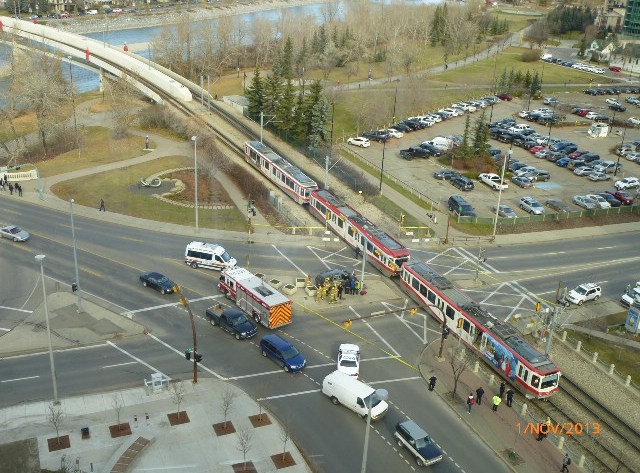 If car drivers insist in running red lights, unhappy consequences happen.
“Growing number of delays on Calgary’s LRT system leave C-Train passengers steamed
Ai??By Michael Platt ,Calgary Sun First posted: Tuesday, November 19, 2013
An electric rail system full of steamed passengers.
Itai??i??s hardly surprising when delays are a daily occurrence aboard a cityai??i??s commuter rail system, and being late or stranded is the rule rather than the exception.
ai???Easily itai??i??s the worst part of my day,ai??? said Justine Thurlow, one of 259,000 passengers who rely on Calgaryai??i??s C-Train each day ai??i?? though ai???relyai??? is increasingly a misnomer aboard the aging LRT fleet.
In the past month, starting on October 20th, Calgary Transit has officially reported 57 delays affecting the cityai??i??s 53-km (32.9 mile) long Light Rail Transit system, ranging from breakdowns to medical emergencies.
That includes at least a dozen major delays, many forcing the complete closure of LRT lines and the use of shuttle buses to ferry passengers around the mishap.
As well, the long list of stalls and slowdowns, tweeted by @calgarytransit, include 24 delays directly attributed to mechanical breakdowns.
Those train-stalling snafus have ranged from C-Train doors jamming open to track switches freezing shut or failing ai??i?? and occasionally, entire trains breaking down mid-transit.
And then thereai??i??s bad luck, including medical issues with passengers and cars stalling on tracks ai??i?? all of it adding up to trains running behind.
ai???None of that surprises me a bit,ai??? said Thurlow, who rides from Anderson Station to downtown and back every day.
For people in a rush, meaning all commuters, frequent foul-ups lead to missed meetings, irritated bosses and frustration.
Even short delays cause misery down the line.
ai???The worst part is when trains are delayed, they get even more crowded ai??i?? itai??i??s bad, and itai??i??s getting to the point where you canai??i??t even move anymore, and people still shove their way on,ai??? said Thurlow.
It seems little has improved on the LRT system since October 2011, when the Sun last added up the number of breakdowns aboard the C-Train system, and found near-daily trouble.
Then, it was 18 serious setbacks over 30 working days ai??i?? and in 2013, it seems the word ai???delayai??? is even more common, as transit officials issue public statements apologizing and explaining the stalls.
ai???The older trains are obviously at the end of their lives, and weai??i??re looking forward to retiring them once the new trains start to arrive,ai??? said Calgary Transit spokesman Ron Collins.
And thatai??i??s long been the issue for Calgaryai??i??s transit system, where a population explosion has meant maintaining 40-year-old equipment that should have been put to pasture long ago.
Said to be ai???three to four timesai??? more reliable than the crusty old U2 cars, 60 new S200 light rail vehicles worth $3.2 million each are expected to start arriving in Calgary by 2015.
But that will only solve the mechanical headache: the above ground, road-level design of Calgaryai??i??s LRT system means some delays will continue, regardless of the equipment used.
At the start of November, police and transit officials were forced to issue a plea for motorists to stop crashing into C-Trains, after three such collisions in a matter of days.
ai???Itai??i??s a stupid thing to do ai??i?? red light, donai??i??t go through it ai??i?? itai??i??s as simple as that,ai??? police traffic Sgt. Colin Foster told the Sun.
And in each case, it meant long delays along the entire LRT system, where the loss of a single track spells disaster.
At least the antique train system has high-tech social media to keep passengers informed ai??i?? and the moment a delay is noted, explanations are sent out via social media.
Of course, that gives upset riders a chance to answer back, and terse and sarcastic tweets have actually become a source of entertainment for regular riders.
ai???Gotta love waiting 40 minutes outside in -30 weather. @calgarytransit I canai??i??t feel my legs,ai??? tweeted @albertagirl03, during one of Tuesdayai??i??s many delays.
All fun aside, regular train rider Heather Laird says @calgarytransit has become her warning beacon for when to ride and when to drive to her job downtown.
ai???I keep a close eye on Twitter in the morning ai??i?? delays have become so common weai??i??re used to it,ai??? said Laird.
ai???Iai??i??d like to say itai??i??s a reliable service, but itai??i??s not.ai???
Posted by zweisystem on November 20, 2013 · 9 Comments
Sad to see that the best UBC can do is to copy failed 1950’s planning philosophy for the 21st century for Vancouver.
In North America, subways are seen as the the great transit philosopher’s stone to solve all transportation problems – if you do not have a subway, your transit system is next to useless.
This subway philosophy held sway in Europe from the late 1940′, 50’s, 60’s, 70’s until the early 80’s, when fiscal reality hit with a vengeance.
As subways were built, local surface tram lines were abandoned and though ridership numbers were high on the subway; system wide ridership fell as many former transit customers found that instead of an almost doorstop to doorstop trip with the old tram, this convenience disappeared with the new subway. Taking the car was just easier.
Although a subway replaced the tram lines, an expensive shadow bus service had to be maintained because the subway stations were too far apart to attract customers. Many transit customers thought the switch from tram to bus was unacceptable and again, turned to the car for transit.
The new subways were expensive to operate and maintain, subway stations had to be policed by a small army of attendants. Many subway systems became “no-go” areas after dark as teen gangs outnumbered the security and preyed upon transit customers, something that just did not happen with the old street operating trams.
As the subways aged, they became very costly to maintain as the subway environment played havoc with the infrastructure.
The final straw was that local taxpayers refused to pay for more subways as they were taxed out.
Today in Germany, many cities which built subways are in fiscal difficulty, where cities which avoided subway construction do not.
The fiscal problems with subways helped fuel the light rail Renaissance in Europe, for today, for a subway to be built, a transit line needs to show peak hour traffic flows in excess of 20,000 pphpd, unless that is, there is undue political interference to build a subway. A subway is still seen as a tool for political prestige, especially around election time.
Sadly in North America, most so-called transit experts are not very expert at all, except being expert to jump on the subway gravy-train, when it suits their purposes.
Let us not forget, the Canada Line subway, which construction costs are now put at about $2.5 billion, is a heavy-rail metro, built as a light metro and with its very short 50 metre station platforms has less capacity than a on-street tram! Is this the type of subway that is really being planned for Broadway?
A Broadway subway will beggar Translink and the regional taxpayer and until planning graduates truly understand the science of public transit, the regional transit system will repeat all the expensive mistakes their European counterparts made a half a century ago.

Q&A with Lawrence Frank
Transit expert Lawrence Frank on the health costs of our sedentary lifestyle, and the resale benefits of tunnelling along the Broadway corridor.
By John Burns published Apr 23, 2013
Lawrence Frank, UBC Professor of Health & PlanningAi??
Let’s jump right into transit. I commute along Broadway every day. It’s packed! What’s to be done?
We’re in an absolutely horrible situation with transit on the Broadway Corridor. I’m a good example: I used to live near Main and Broadway, tried to use the B-Line-my partner and I both work at UBC-and we were waiting for three buses just to get on. I teach transit, it’s my life, and I gave up. So we moved closer. It was literally taking an hour and a half to get to UBC versus 20 minutes by car. When you have that kind of differential in travel time, you lose people.
How dramatic is the difference between a transit stop being next to my door and a stop being a block away?
Huge. It’s called distance decay. In the ’50s, transportation adapted Newtonian physics-effectively, the gravity formula-to explain our behaviour. The effect is exponential: we’re many times less likely to go to a place two blocks away than one block away.
And your argument is that reluctance to use transit puts a burden on our system, that there’s a financial incentive to augmenting transit?
The best way to build walking into people’s lifestyles is to provide shops and services near to where they live and efficient transit service to get them to work. Transportation investment impacts our health; we need to consider how much it costs us as a society for every chronic-disease onset. There are all kinds of adverse health impacts of sedentary lifestyles, like obesity, diabetes, hypertension, cancer, that you can apply a dollar value to. So we need to put all this together-otherwise, there’s going to be no money for transportation. Or for any other ministry. The city manager, Penny Ballem, has a slide-“The Clanger,” she calls it-where you see healthcare costs going up in a straight line and education being held constant and the budgets of all the other ministries just tanking. Because once you provide heathcare and a basic education for your population, there’s nothing left.
This brings us back to Broadway. If we were to free up infrastructure costs by putting a dollar value on healthcare savings, how do we improve that corridor?
Each proposed stop along Broadway from Commercial to Arbutus generates as many trips as most other cities in the region. Without better transit, further densification on Broadway is problematic, so then the question is, Should we tunnel or should it be above-grade like a SkyTrain or a monorail that’s maybe cheaper but you end up in the long term with a less attractive city. We sold ourselves to the world based on being attractive and livable, so that’s not the best solution. For Broadway, you could have a seamless connection between UBC and downtown that would be light rail. So you take the heavy rail at Commercial and bring it all the way to Arbutus, and that stops but then there could be a light rail line that uses the Arbutus corridor to go north/south through Kerrisdale and another west to UBC, as a possible solution.
As a homeowner in that area,Ai??I want to say a monorail above-grade is not the right solution.
Sure. But the problem is people react emotionally and the debate falls apart. We need collective buy-in for a solution, and the technology will follow. Seattle got so hung up and so polarized that they couldn’t build anything for three decades. Are you a couple blocksAi??off Broadway?
Yeah.
It’s the best thingAi??that could happen to you.
So it’ll increase my property values?
It almost always does. Location, location, location.
http://www.vanmag.com/News_and_Features/QA_with_Lawrence_Frank
Posted by zweisystem on November 19, 2013 · 1 Comment
Zwei has been warning about this for several years, and now, now someone has noticed?
I’m sorry, but I just do not see any improvement in our regional transit chaos, until someone has the moral fortitude to put a wooden stake through the heart of SkyTrain.
For too long, TransLink has been recycling bus riders onto the SkyTrain mini-metro and claiming transit success, while the reality is that the percentage of the regions population that use transit has risen only by 3% in the past 20 years. Car use has remained static at 57% during the same period, this after an over $9 billion investment in our light-metro network.
It seems our mega investment in a mega expensive transit network has failed to attract the motorist from the car. Bad planning and management by TransLink’s senior managers and CEO is only part of the problem. There is a gross over emphasis on land-use and not enough emphasis in providing a consumer friendly transit system that the people want to use and here lies the problem. In the 21st century, transit is seen as a product by the consumer and if the product is poor, the consumer spends his/hers transit dollars on other modes of transportation. (Hint: Transit customers hate forced transfers) TransLink operates the transit system like the Monty Python “Dead parrot” sketch; “There’s your transit – now use it“. But for the transit consumer, the transit offered is 2nd rate, crowded and expensive. Taking the car is just the better option.
Until the UBC and SFU boys and girls come to recognize that urban transportation is a science in itself and not an add on course in planning or engineering programs, gridlock will remain endemic in the Metro Vancouver region.
UBC planning professor warns of suburban sprawl, ai???horrificai??i?? congestion
Investing in transit now will grow a healthy region, says Lawrence Frank
By MATTHEW ROBINSON, Vancouver sun November 17, 2013
VANCOUVER — Spending money on transit now will save even more money and lives down the road, says a UBC professor who will be speaking Monday on a panel alongside TransLinkai??i??s CEO. Lawrence Frank is pushing a comprehensive vision for the regionai??i??s transit future as a provincial referendum on funding the stressed system rolls into view.
More money is needed, but it has to be spent strategically and viewed differently, the professor at UBCai??i??s schools of Population and Public Health and Community and Regional planning told The Sun on Sunday. ai???Iai??i??m concerned that in the absence of some significant changes in land use planning that weai??i??re at risk of having a fairly sprawling region with horrific congestion and no way to keep up with it,ai??? he said.
Frankai??i??s plan is all about investing in transit proactively as a way to grow a sustainable and healthy region. ai???Increased time spent in cars is associated with obesity that causes chronic disease,ai??? he said, adding that transit encourages people to walk more, which helps reduce obesity and leads to cash savings for the health care system.
But transit needs to be located near peopleai??i??s work and homes, something that is difficult in outlying areas. ai???We have an incentive to build further out,ai??? he said, explaining there are few neighbours that can block developments, thereai??i??s less NIMBYism, and infrastructure in the form of roads and sewers is readily provided by governments. Frank envisions doing that by levying fees on low density or remote development projects that are far from transit corridors. Part of Frankai??i??s plan is a report card of sorts that would tie transit funding to a cityai??i??s performance on development according to Metro Vancouverai??i??s Regional Growth Strategy.
That plan is in place to manage the additional million people who are expected to live in Metro within in the next 30 years, boosting daily transit trips from 6 million to 9 million. TransLink maintains it can only afford to maintain the system and not expand it. The mayorsai??i?? council on regional transportation has previously suggested a regional sales tax, along with a vehicle levy, carbon tax and road pricing as potential funding sources for transit. The province has rejected a vehicle levy and carbon tax, and said any other funding sources must go to a referendum ahead of B.C.ai??i??s municipal elections next year.
http://www.vancouversun.com/health/planning+professor+warns+suburban+sprawl+horrific+congestion/9177868/story.html
mattrobinson@postmedia.com
Posted by zweisystem on November 15, 2013 · 1 Comment
One wonders if we had a TramTrain service from Chilliwack to Vancouver, would it reduce the chances ofAi?? major accidents, especially in icy weather?If a major closure of Hwy. 1 does happens, would not a Chilliwack to Vancouver TramTrain service offer a handy alternative for people wishing to travel to Vancouver or Surrey, or Langley, or Abbotsford?Is a TramTrain service just too simple and cost effective for politicians and bureaucrats to consider?
 A major accident on the Vedder Canal Bridge has closed Hwy 1 West bound.
Massive pileup closes Highway 1 in Chilliwack
News1130 Staff November 15, 2013
CHILLIWACK (NEWS1130) ai??i?? Highway 1 is closed westbound at the Vedder Canal Bridge and closed eastbound at No. 1 Road after a serious crash.
ai???The collision involved about 13 vehicles, including a Greyhound bus. At this point, we know that there are numerous people who have significant injuries. We donai??i??t have any reports of fatalities,ai??? says RCMP Inspector Tim Shields.
What caused the crash isnai??i??t clear; Shields believes one collision on the bridge deck led to a chain reaction.
ai???We are warning commuters to avoid the area of Highway 1 in Chilliwack and take an alternative route,ai??? adds Shields.
Eastbound traffic is expected to re-open this morning, but westbound traffic is expected to remain blocked until this afternoon.
Posted by zweisystem on November 13, 2013 · Leave a Comment
The self destructing Rob Ford, Mayor of Toronto and his all subway dream may soon fade from history, except the fiscal fallout from subway construction will last decades.
Ford’s real quest, of course, was to clear Toronto’s roads of streetcars and/or proposed light rail and even bike lanes to create more road space for cars. In the Ford nation, cars are king.
Like SkyTrain being elevated, subways are built underground with no interface with street traffic. Two immediate problems arise:
- Subways are very costly, both to build and maintain and a subway means that the operating authority can only afford short sections of subways, compared to surface operating light rail.
- Subways are very poor in attracting new ridership, as station spacing is generally much further apart, a subway becomes less convenient to use and what has proven to attract people to public transit is convenience.
If a subway must be built, the general rule of thumb in Europe for the traffic flows necessary to justify the cost of construction, is around 15,000 persons per hour per direction. In North America, where the light rail Renaissance has yet to find its way, subway construction has become one of political prestige, with many cities investing in very expensive subway lines, where much simpler, cheaper and just as efficient LRT would suffice.
This ‘subway mania’Ai?? proposed by Toronto’s Rob Ford, may garner votes in the next election, sadly financial reality of building subways instead of cheaper LRT will not be evident until 30 or 40 years hence.

Rob Fordai??i??s billion-dollar boast not worth a dime
The mayorai??i??s empty boasts reveal a man deeply out of touch with the city he leads
By: Christopher Hume Urban Issues, Published on Mon Oct 28 2013
Rob Fordai??i??s grasp on reality is flimsy even at the best of times. That was once again made clear when His Worship boasted to good buddy Jerry Agar last week that he has single-handedly pulled Toronto back from ai???the cliffai??? since being elected mayor in 2010.
The chief magistrate may live in this city, but clearly he inhabits another planet.
Touting his ai???endless and endless amounts of achievements,ai??? the barely literate Ford blithely recited select parts of his record as if they were heroic actions of a man born to save Toronto from itself. Not quite.
In fact, Fordai??i??s term has been a disaster that will endure long after he has disappeared. His recklessness dealing with issues as diverse as public transit and taxes, bike lanes and vehicle registration fees, will hobble Toronto for decades to come.
This means nothing to Ford Nation. Fuelled by a misguided sense of self-interest and their fear and loathing of anyone who believes the city is worth fighting for, not against, the mayorai??i??s supporters cheer on his every imbecility.
Ford, hard-pressed to tell the difference between LRT and BVD, has turned the cityai??i??s highest office into a shambles.
In its zeal to have a few bucks cut off its property taxes and avoid an onerous $65 vehicle registration fee, Ford Nation has bequeathed to future generations the debt it doesnai??i??t think it should have to pay now. According to the mayor, Torontonians can have the subway they ai???deserveai??? and to hell with the billions it will cost to operate and maintain, let alone build. Unlike Metrolinxai??i??s original Scarborough LRT proposal, which was fully funded, the $3-billion subway extension will serve fewer people and leave Toronto holding the bag not if but when the scheme goes over budget. The city could face cost overruns of more than $900 million. And thatai??i??s just the start.
Letai??i??s not forget that even in the unlikely event that all goes well, the Scarborough subway is expected to provide about 50,000 rides a day ai??i?? thatai??i??s what the Yonge line carries in an hour. The real price per ride would be as much as $100.
Still the Scarborough subway counts as one of Fordai??i??s great victories. For the rest of Torontonians, however, now and in the years ahead, it is anything but.
The fact is that since 2008 most residential and commercial development in the GTA has occurred downtown. As transit guru Steve Munro points out, ai???Only 8.7 per cent of all residential and 3.5 per cent of non-residential (development) proposals are in . . . Etobicoke, North York, Scarborough and Yonge/Eglinton. Scarborough Centre has almost no development planned at all.ai???
Still, Ford would have us believe that ai???downtown already has enough subways.ai??? Such a statement reveals a shocking level of ignorance and/or an outright desire to wreak havoc on the old city of Toronto to fulfil his anti-urban populist agenda.
In its first report, entitled Hard Truths, the transit advisory panel convened by Premier Kathleen Wynne last month, talked about the need for a ai???mature debate.ai??? Under Ford, that need has grown more urgent than ever.
ai???Subways,ai??? the panel reminds us, ai???are not the only good form of transit. What matters is matching the right transit mode and technology to the proposed route to avoid wasting scarce capital, reducing funds for other projects, and creating burdensome debt.ai???
As panel chair Anne Golden points out, ai???One of the consequences of making the wrong decision is that we build a subway where we donai??i??t need it and put an albatross around our neck.ai???
Christopher Hume can be reached at chume@thestar.ca
http://www.thestar.com/news/gta/2013/10/28/rob_fords_billiondollar_boast_not_worth_a_dime.html





Recent Comments