Posted by zweisystem on April 13, 2011 · 2 Comments
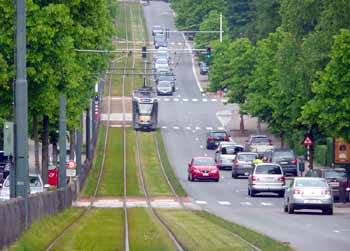
Welcome to TransLink’s worst nightmare, the mayor of Ai??Surrey (BC, Canada) wants light rail and not SkyTrain for the city. Three decades of deliberate misinformation, misleading studies, and anti-LRT rhetoric is going to come back and haunt TransLink, with this decision. TransLink’s grand economies of the truth about modern light rail, may cause such rancor that the transportation authority may split into two.
The Rail for the Valley/Leewood TramTrain report fits right in with Surrey’s light rail wishes and for a fraction of the cost of a new SkyTrain line, the Fraser Valley could have a viable light rail network servicing downtown Vancouver, Surrey, Langley, Abbotsford, and Chilliwack,Ai??all connecting withAi??a LRT network in Surrey.
What is of interest is that TransLink’s cost estimates of $127 million/km. for the the Evergreen Line and (has TransLink already made the decision for Broadway?) $223 million/km. for the proposed Broadway subway.
$27 million/km. for LRT is right in the middle of cost estimates for recently built light rail lines, but if engineering is kept to a minimum and prefabricated track is use, the cost per km could be a lot less! The long straight roads in Surrey, certainly will make pre-flab track installation a viable option.
Modern Prefabricated track installation, saves time and costs.


Rail for the Valley applauds that modern LRT is finally built in the region, butAi??we will remain somewhat skeptical until we actually see shovels in the ground.
Note to mayor Watts: Don’t trust TransLink one iota.
Surrey to push TransLink for light rail, mayor says in state of city address
By Kelly Sinoski, Vancouver Sun
April 12, 2011 5:26 PM
METRO VANCOUVER — Surrey is exploring the potential of building at-grade light rail on three of the city’s major corridors, saying an extension of the SkyTrain line is not financially feasible.
Surrey Mayor Dianne Watts said Tuesday the city will actively advocate for TransLink to build light rail across the city and is already investigating three routes: 104th Avenue between 152nd Street and City Centre; King George Highway from City Centre to Newton (and eventually South Surrey); and Fraser Highway between City Centre and Langley.
“I don’t want to have SkyTrain cutting our communities in half ai??i?? that is going to destroy our city,” Watts told nearly 500 people at her State of the City Address at the Sheraton Guildford Hotel. “It’s not just about moving people as far as you can from A to B; it’s about moving people but also building a community.
“If we don’t put in proper measures for transportation we’re going to have a mess.”
Watts argued the city, which gives $164 million a year ai??i?? $44 million of those in property taxes ai??i?? to transportation each year, hasn’t seen any transit expansion in the past 17 years despite growing from a population of less than 250,000 back then to nearly 400,000 in 2006. It still has only four SkyTrain stops after the Expo line ended at King George Station.
As Surrey develops into the region’s second downtown, she added, the city needs a cost effective and efficient transportation system to accommodate the growth.
Another one million people are expected to move to Metro Vancouver in the next 30 years with 70 per cent of those settling south of the Fraser River.
Building a SkyTrain connecting Surrey with Langley, she said, would be cost-prohibitive, compared with light rail and street cars, which would complement the existing SkyTrain and buses already in place.
TransLink has estimated the cost of light rail at $27 million per kilometre versus $127 million for the Evergreen Line and $233 million for the UBC/Broadway line.
“To get around the city of Surrey by SkyTrain is not feasible. It costs billions and billions and billions of dollars,” Watts said.
The Canada Line, linking Vancouver and Richmond, cost $2 billion to build, while the Evergreen Line is set at $1.4 billion. TransLink had tentatively proposed building a six-kilometre SkyTrain from City Centre to Guildford and is now undergoing studies for the Surrey route.
TransLink spokesman Ken Hardie said Watts’ comments mirror what’s been heard in the community so far. More public consultation sessions on rapid transit in Surrey will be held in the next month-and-a-half, with a feasiblility plan likely expected by the end of the year. “It’s very productive to have those concepts on the table,” Hardie said.
The Surrey rapid transit project is part of a region-wide transportation strategy for the Metro Vancouver region, which includes the Evergreen Line connecting Burnaby, Port Moody and Coquitlam and a proposed rapid transit along the Broadway corridor to the University of B.C.
Transit officials, the province and regional mayors continue to wrangle with ways to pay for future transit projects, including the long-awaited Evergreen Line, without raising property taxes.
Watts, who met with TransLink Tuesday afternoon, said she wants a funding strategy to be developed within the next few months, with design plans for light rail in place by next year.
“I think the general public is fed up with all of us sitting around a table trying to cobble our pennies together to pay for [transit],” she said. “I would like to see it done within a month or two. You need a sustainable transportation plan.
Light rail is the only option for Surrey and Langley, she insists, adding that White Rock Mayor Catherine Ferguson and Langley City Mayor Peter Fassbender agree. Unlike Vancouver and Burnaby, which are tight-knit communities with no more land base, Surrey is so vast and open that it needs more inter-modal types of transit, she said
Watts argued light rail would help connect Surrey’s town centres and boost economic activity, she said. while creating a “vibrancy” in the city, which aims to develop 150 kilometres of new bicycle and pedestrian trails and paths by 2016.
“Transportation is critically important as we shape growth in our town centres. In order to create healthy communities, we need to provide safe and accessible walking and cycling opportunities,” Watt said in her speech.
“At-grade rail is cost-effective and efficient, and would not only create a new transportation option, but also increase economic development and improve quality of life.”
Watts added light rail is considered a key plank in the city’s attempts to boost economic development.
Surrey is continuing to complete significant infrastructure projects in it Surrey Build program, which involves $2.8 billion in construction, including $800 million in new community projects and $2 billion worth of facilities being built in partnership with other levels of government.
The program is being funded through infrastructure fees, secondary suite fees, contributions from the Surrey City Development Corporation, gaming revenue, grant money, leaseholds, parking fee revenues from the City’s new parking authority and reserve money.
“We are re-defining Surrey and creating B.C.’s next metropolitan core by fostering a strong investment climate and implementing innovative social, economic and community initiatives for our residents and businesses,” she said.
Watts noted the city has seen more than $1 billion in construction activity in 2010, the crime rate is at a 10-year low and since 2009 Surrey has helped 356 people get off the street and into permanent housing.
Posted by zweisystem on April 12, 2011 · Leave a Comment
A few years ago TransLink came up with all sorts of reasons why LRT wasn't suitable for Coquitlam and Port Moody.
Why then, is LRT one of several viable options for the UBC transit line — especially considering that Broadway and 10th Avenue are used by far more cars and trucks than the Coquitlam and Port Moody roads where the Evergreen SkyTrain will run?
What TransLink staff forgot to mention, at open houses in 2009, is that the posts and beams of the elevated guideway will drastically cut off the view of anyone living on the second and third floors of many apartment buildings along the route.
The Bombardier LRT trial was an eyeopener for many that had previously dismissed LRT sight unseen. Interestingly, last summer I was asked on several occasions by U.S. tourists how to go to the "Olympic streetcar line."
It is not too late for TransLink to resurrect the plans they made for Evergreen LRT, as they still can't find the money needed to complete the Evergreen SkyTrain.
J-L Brussac
Coquitlam
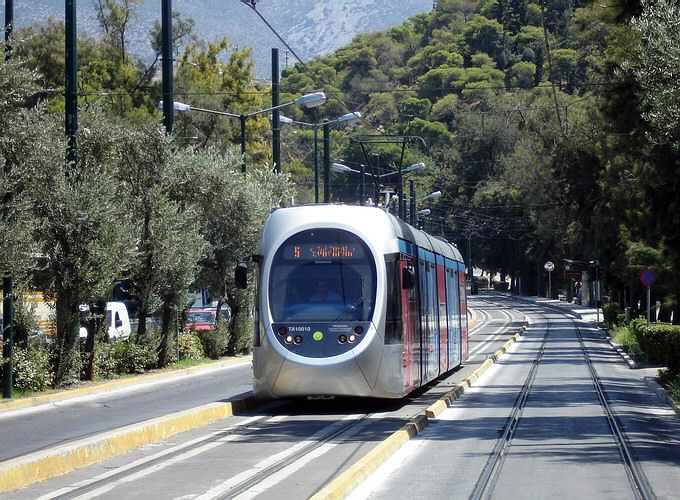
A tram in Athens Greece
Mr. Serle, a man of letter from south of the Fraser is much less read on transit and transportation issues and is one of the most ardent supporters of SkyTrain. Mr. Serle can't seem to understand the concept that SkyTrain costs up to ten times more than LRT to install and that there is only one taxpayer. He also continues the notion that being elevated is better because (in Mr. Serle words); " because it runs above and below the ground, SkyTrain, unlike the proposed non-automated LRT, does not hinder regular, fossil-fuel-powered vehicular movement."
But, if auto movement is not hindered, there is no incentive to use the elevated metro.
The convenient argument is a canard as LRT is more convenient, because operates on the pavement, where the customer wants it, than SkyTrain, where the customer must climb stairs to cold wind swept stations or descend into claustrophobic stations.
One can build all the SkyTrain one wants, but what schools and hospitals must be closed to pay for much more expensive SkyTrain.
We need more SkyTrain
Published: April 07, 2011 11:00 PM
Editor: Malcolm Johnston (The Times, April 6) should not feel at liberty to speak for the entire South Fraser region.
Most important, before it spends public transit funds on such follies as light rail (LRT), TransLink should acknowledge that not only is SkyTrain probably the safest and basically most efficient mode of public transit, but it’s also the most ecologically friendly.
Indeed, I strongly believe, most public transit funding should go towards extending SkyTrain to wherever the potential utilization of its services warrant — such as to UBC.
Such transit is simply too convenient to be denied to regular public transit utilizers. You can often count on the exact minute, if not second, that it will arrive and leave. Furthermore, because it runs above and below the ground, SkyTrain, unlike the proposed non-automated LRT, does not hinder regular, fossil-fuel-powered vehicular movement.
There are plenty of naysayers who complain about the expense of SkyTrain. However, SkyTrain’s benefits far outweigh its expense.
Frank G. Sterle, Jr.,
White Rock
The SkyTrain guideway creates is an urban blight, which despite claims to the contrary, does hinder auto traffic.

Posted by zweisystem on April 12, 2011 · 1 Comment
Of course in the Vancouver metro region, the right questions about transit have never been asked for fear of getting ‘correct’ answers.
Building Metro Vancouver’s mini-metro system has always been about land development, political prestige and vote getting and not providing the best transit choice or the most affordable transit choice for the transit customer.
The SkyTrain lobby (including most inner regional mayors),Ai??have deluded themselves about high ridership on the mini-metro system, forgetting the fact that the three current metro lines should have about 900,000 boardings a dayAi??opposed to the currentAi??381,000 boardings a day, which would make the system financially viable. With 80% of mini-metro customers forced to transfer from the bus, which means the SkyTrain/Canada line metro system has been poor in attracting the motorist from the car.
A note at this point is necessary. Buses are very poor in attracting the motorist from his/her cars, which make bus based transit modes (BRT/GLT) poor options for regional transit.
Added to the mix is the over 120,000 U-Passes now floating about in the transit system and their effect on transit ridership. Cheap fares may increaseAi??boardings (with multiple use, etc.) butAi?? not increase the number of people actually using the metro system. A persistent rumour is that a mere 30,000 U-pass holders account for almost 75,000 boardings and this before the great U-Pass expansion!
In an age where TransLink and Metro planners consistently “get it wrong“, the followingAi?? are some of theAi??right questions about regional transit that our bureaucrats just do not ask.
- Can we afford this transit option?
- Will this transit option reduce car usage?
- Is the transit option customer friendly – will it attract more ridership, enough to justify construction?
- Will this transit option attract ridership?
- Can we affordably expand this transit option in two to five years?
- Will this transit option negatively effect non-transit users, such as merchants along its route.
- How cheaply can we build this transit option, can we use existing infrastructure, such as existing railway tracks (tracksharing) or use existing street power poles or masts and span wires?
- Is expensive engineering needed or necessary?
- Can we use pre-owned equipment, to reduce cost?
- Can the transit be adaptable for other uses, such as private hire, freight haulage, heritage exhibits?
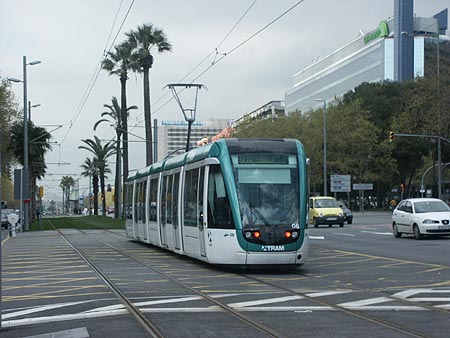
Modern Light Rail tends to have the right answers for urban transportation.
It seems those in power refrain from asking the ‘right‘ questions for fear of getting the ‘right‘ answers and the “right‘ answers means that SkyTrain and/orAi??light-metro is not the ‘right’ choice for rail transportation in the VancouverAi??Metro region.
http://www.therecord.com/opinion/columns/article/513991–without-the-right-questions-transit-plan-could-fail
Without the right questions, transit plan could fail
By Kate Daley
April 9, 2011
Regional staff and various others have been trying to answer the question of what people in Waterloo Region think about the proposed rapid transit system. Unfortunately, there are two other questions that arenai??i??t being asked, and if we donai??i??t ask them, we may end up with the worst possible system.
The first question is: Which people do we mean? The real distinction isnai??i??t age. Itai??i??s between three groups: those who use transit, those who donai??i??t currently use transit but might use it, and those who do not use transit and never will. I have met people from all three groups who are supportive of light rail transit. But I have never met anyone who is opposed to light rail transit who is a transit user.
The regional transportation master plan doesnai??i??t expect to get everyone out of their cars. The goal is to increase the percentage of travellers who use transit at peak periods to about 15 per cent by 2031, while 70 per cent will use their cars.
Itai??i??s important that the project meet the needs of current transit users. But since rapid transit is intended to encourage greater transit use and intensification, the system needs to be designed with the potential transit user in mind.
While itai??i??s crucial that all members of the community be involved and engaged in our transportation future, it is not crucial that all members of the community like the system chosen. Most wonai??i??t ride it, and thatai??i??s fine. But by designing a system for current and potential users, everyone benefits, as more transit users means fewer drivers and fewer cars on the road.
So once we identify that there are distinct groups of people whose opinions weai??i??re hearing, we need to ask a second question: What, really, are the members of these groups asking for?
I hear current transit users asking that the system they rely on continue to meet their needs in the long-term. I hear potential users talking about their desire to use a system that meets their needs, and what that system might look like. And, most encouragingly, I hear some of those who will not use transit themselves supporting light rail transit because they want their grandchildren to have real transit options, and because they donai??i??t want a future for the region that includes more sprawl, pollution, and time spent on increasingly packed roads.
But when I hear those who do not use transit, and who are clear that they have no interest in ever using transit, speak against light rail transit, they are not really asking for a rapid transit system. While many of these people say they want bus rapid transit, they often do so because they donai??i??t want light rail transit. They canai??i??t see themselves using it, so they canai??i??t understand how anyone else would want to use it. They donai??i??t want to lose road space that cars could drive on to alternative transportation. And most often, they seem to resent paying for it. Itai??i??s much easier for these people to say that they prefer cheaper buses than it is for them to say they do not support robust transit.
Unfortunately, many of those who are just supporting the cheaper option seem to think that bus rapid transit simply means buying a few more buses. For example, many are not aware that bus rapid transit not only means still losing car lanes, but also means those lanes will be up to 0.5 metres wider than for light rail transit. Bus rapid transit is still an extensive transit system and a huge structural investment, and one that will have significant costs and impacts for our future.
So when we hear people express their preferences for light rail transit or bus rapid transit, we should ask about more than what they think. We should ask whether they do or might use transit. We must also ask what their vision is for the region, and how that influences their choices. If we donai??i??t ask these questions, we may very well end up in the worst of all possible positions: We will choose a bus rapid transit system for those who donai??i??t need or want to use it, and who will be shocked by the effects, instead of choosing for those who want to use it. Itai??i??s an outcome that will make no one happy.
Posted by Cardinal Fang on April 11, 2011 · 1 Comment
Firstly a report from abc 15.com in Phoenix Arizona
http://www.abc15.com/dpp/traffic/record-light-rail-ridership-due-to-gas-price-hikes
Record light rail ridership due to gas price hikes?

Light rail ridership has hit a new record, at the same time as gas prices did the same. But Metro is being careful about drawing conclusions.
Nearly 1.2 million riders used the light rail in March, a month with a string of daily gas price hikes.Ai??
“You can’t even ask a friend to drive you somewhere because around the block costs $5,” says Sonya, a light rail rider.
On a day when some people were pumping gas at $3.67 a gallon, light rail riders were buying all-day passes good for both the rail and buses for only $3.50.
“I haven’t had a car for two years because of (gas prices),” says Rachelle, who was waiting for a light rail train on Central Avenue.
But Metro’s Hillary Foose cautions against drawing a direct connection between last month’s gas price hikes and the record light rail ridership.Ai??
“The rule of thumb for transit is that six months later we really start to see the effect of rising gas prices,” Foose says. “People start to think ‘Okay, yes, this is affecting my pocketbook. I need to figure out another way to get around.'”
Gas prices are expected to peak during the summer, with some analysts predicting they could hit $4.50 a gallon. Summer is when light rail ridership usually drops. We’ll be watching to see if that holds true this year.
to Santa Monica in California, from smmirror.com http://www.smmirror.com/?ajax#mode=single&view=32044
Thereai??i??s something about a trainai??i??
Richie Havens used to sing a little song underneath TV ads for Amtrak years ago, and the repeating chorus idea was ai???Thereai??i??s something about a trainai??i??ai??? which at that time might have engendered the response ai???Yes, itai??i??s slow and itai??i??s late.ai??? Still, compare safely rolling along on the earthai??i??s surface to the experience of suddenly having a hole appear in the roof of your 737 airliner that forces an unpleasant landing in Yuma.
There are other great things about trains, and I hope our city is ready to embrace and appreciate those things as Santa Monica moves closer to having an Expo light rail line. Last week as reported in the Mirror, the board of directors of the Expo Construction Authority approved a pair of agreements and signed off on a design-build contract, all actions moving us closer to having a train to our city.
Letai??i??s get up in the grill of one possible hang-up right now, and that is the notion that a light rail line will in any way solve or cure traffic problems. I can hear people dismissing this from across a busy street; a street jammed with traffic. There will of course be an impact on traffic, but what I think makes light rail imperative is that it works to ameliorate traffic by offering an alternative that makes affordable and practical sense. Government and voters need to embrace light rail at that level because, until they perfect that ai???Beam me up, Scottyai??? technology on ai???Star Trekai???ai??i?? itai??i??s what we have. A possible comparison might be someone saying, ai???No amount of recycling will stop the production of solid waste.ai??? What weai??i??ve done is to inculcate recycling to the point that it has become a cultural value; a good habit. And that matters.
Full disclosure: I like trains. Because of the distance involved in seeing my family, I donai??i??t get to ride them as often as Iai??i??d like. When I was a kid my father and I built model train layouts in the basement. My father drove our entire family from Milwaukee to Chicago one day because I had mentioned never riding on a subway or elevated train of the sort they have in the Windy City. My Dad was big on trains, and thought that our country was blowing it by neglecting its railway tracks because they might be desperately needed one day if America was attacked and needed the logistical help railroads offer. My sister is an advocate of a plan to move snowfall from states that have snow pack to states that suffer droughtsai??i?? by rail. Admittedly, she hasnai??i??t got all the kinks out but it makes for lively dinner conversations.
Trains are public and we are losing our public experiences as the country becomes more divided by economic class. While riding light rail, you can text or compute and not kill someone with your car. You might read a book or have a conversation with a stranger that leads to even a small but significant new understanding. You might look out the window and relax, which then leads to an epiphany that causes you to make up with your boyfriend or girlfriend. You might meet your new boyfriend or girlfriend on a train. You might have your fiancAi?? fall to his knees and present you with a ringai??i?? and then later give birth to the first child of your familyai??i??Okay, you get the idea. Trains are pleasant and good for us as a society.
Then there are the energy aspects, which are significant. Trains roll on steel wheels, and once you get them going they are thrifty on energy. If you drive a truck across the country, you would likely use three times the energy you would use if you loaded the trailer or container in your truck onto a train and sent it to the same destination. Light rail, heavy rail and commuter rail all carry thousands of daily commuters for a fraction of the energy it would take to move those same numbers by automobile. In cities with train transportation, shutting down even a portion of that system would create gridlock throughout the local road system. Or as we were arguing earlier, the building of rail systems at least works to relieve said gridlock.
The building of light rail systems also contributes to something of a public transportation renaissance. The auto industry moved to crush public transit in the late 40s and early 50s so that cars would become the preeminent means of transportation in America. Good for auto makers, tire makers, highway builders, and of course oil. Now that green is good, trains are back.
It always feels like we used to do a greater amount of sensible thinking and planning in our past, and not so much in our present and future. But supporting light rail into Santa Monica will demonstrate that we can look to tomorrow and plan just as we used to. Not that you need me to rub it in, but a greater number of citizens are getting older and they should have a way to get around that doesnai??i??t put bad eyesight and slow reaction times behind the wheel of a two-ton car. Instead of seeking the isolation of our individual autos on a jammed and ironically named ai???freeway,ai??? public transportation can remind us that weai??i??re a democracy that can interact and ride a train together. All aboard, Santa Monica.
Finally to San Diego and the North County Times http://www.nctimes.com/news/local/sdcounty/article_e2e212a9-67c5-55b2-a6e3-8cb64392141c.html

Ridership jumps for local public transit
Gas prices, fares seen as reasons for increase
As local gas prices top the $4 mark, North County’s public transit district is reporting a significant bump in ridership on its trains and buses, though officials say lower fares might be helping to fuel the trend.
Alex Wiggins, a spokesman for the North County Transit District, said Breeze buses tallied 157,336 boardings from March 27 through April 2, a 14 percent increase over the 137,694 boardings during the same week in 2010.
Coaster commuter and Sprinter light rail trains saw similar jumps.
In March, the Coaster had 120,044 boardings compared with only 105,565 in March 2010, a 13.7 percent increase. The Sprinter, which runs between Oceanside and Escondido, jumped from 170,006 in February 2010 to 179,667 in February 2011.
Wiggins said he suspects the jump can be attributed to “higher-than-usual gas prices for this time of year” and to fares that dropped on Jan. 20. Monthly passes for Coaster travel between Oceanside and Solana Beach dropped $34, from $154 to $120. Single-trip fares on local Breeze buses went from $2 to $1.75.
Still, longtime bus rider Brian Slaughter of Oceanside said Thursday that he thinks gas prices have been a bigger motivator in boosting ridership.
Sitting on a bench at the Oceanside Transit Center, Slaughter said he noticed an immediate increase in riders as soon as gas climbed past $4 per gallon. “You can see a direct correlation, absolutely.”
A MiraCosta College student, he said he was due to buy a car Friday, but would be likely to keep riding the bus with gas prices so high.
“I will probably minimize how much I use the car, and I’ll probably keep riding the (Route) 302 over to MiraCosta,” Slaughter said.
Rob Schupp, a spokesman for San Diego’s Metropolitan Transit System, said that San Diego bus boardings jumped 7.6 percent in March, from 4.5 million to 4.86 million.
Schupp noted that it is no surprise that gas prices can serve as a kind of barometer for transit patronage. He noted that most transit systems in California set ridership records when prices spiked in 2008.
Recently, Schupp said, demand has driven MTS to add trips to the express bus service that it operates on Interstate 15. The Route 810 express service will add a 7 a.m. trip starting Monday and two afternoon trips at 3:20 p.m. and 4:50 p.m.
Ai??… Light Rail is good for you; especially when gas prices spike
Posted by John Buker on April 11, 2011 · Leave a Comment
For those who are not on our mailing list, you may not have received this notice.
The Friends of Rail For the Valley Society will be holding its Annual General Meeting this Tuesday in Chilliwack.
When: Tuesday April 12th at 7:00pm
Where: University of the Fraser Valley,
Chilliwack Campus, 45635 Yale Rd
Building A, Room A 115
New members are more than welcome. (Membership costs $10/year.)
Terry Lyster (former City Planner for Abbotsford and Langley) will be at the AGM on Tuesday. He will be presenting some slides, and updating the group on progress that is being made throughout the valley towards accomplishing Interurban passenger rail. He will also have some interesting things to say about his views on politics and the current political environment… Time for an Egyptian revolution?
Hope you can make it.
Posted by zweisystem on April 7, 2011 · Leave a Comment
Good Morning
I am an avid believer of a Ground LRT System for the lower mainland and the valley.
As a previous resident of Abbotsford I daily commuted to Surrey and Vancouver with frustration and impatience,that never seemed to end.
I have like many others sent e-mails to Ken Hardie (Trans Link spokes person),and while I am not naive,I resented the complacent,condescending,attitude in his replies.
I respectfully point out that(info you are already aware of ),that TransLink is financially bleeding taxpayer dollars,to the point that I believe that if this were a private venture,bankruptcy would be imminent.
They are terrified,of stating the obvious,that TRANS LINK AND CAMPBELL MADE SERIOUS INCOMPETENT ERRORS,re P3's and the Port Mann. It is obvious that as of this morning TransLink publicly announced it is reducing commuter fares on the Golden Ears Bridge in an attempt to increase rider use. TransLink can not allow public opinion to increase over too many more instances of paying another $33,000,000.00 in payments to the P3 owners,as they have in the past re the Golden Ears.
Hardie in following up this announcement,made the statement of possibly making this fare reduction a permanent one if it is successful,which we all know its a ruse in an attempt to increase low rider use.
They are anticipating that with the completion of the Port Mann bridge and its infrastructure that commuters will then be left with no alternative but to be forced to pay for two commuter fares,namely the Port Mann and the Golden Ears bridges,costing each commuter up to $16.00/day,from the Maple Ridge area alone.
This abusive waste of taxpayer hard earned dollars is ludicrous,and I predict that angry and fed up total of a 100,000 daily number of commuters will rebel in having to pay new $200 to $300.00 more per month for new bridge commuter fares.
Hardie according to his reply to me was the possibly of a commuter bus service,for the lower mainland.
With a bus commuter service the total cost is astronomical as :-
– there will be freeway lane restrictions,(with at least one freeway commuter bus lane designation in each direction of the freeway)
– Building costs of office buildings,maintenance facilities,purchase and expropriation of properties.
– required designated drop off and pick up of locations for commuters,along freeway in both directions.
– the high cost of a high number of diesel commuter buses required to be purchased to transport and provide the services for 100,000 commuters per day,would be astronomical.
– increasing cost of fuel and high fuel consumption,(dependant of current and projected costs per litre on world fuel purchase market),will be preordained to increase as (ferries,trucking,transportation of consumer goods etc)etc increase over years.
– heavy air pollution due to the increased number of diesel buses operating daily
-Short service life of commuter buses which are required to travel at least 200 mile each trip (Chilliwack to Vancouver terminals)
– with each bus making at least 6 – 10 anticipated trips per day/bus carrying 100,000 commuters per day = 1500 to 2000 km per day/bus based on a 5 day week = 10,000 km per week = 40,000 km per month travelled for each bus. With each bus capacity = aprox.60 commuters therefore the number of buses required is extremely high.
– the fuel consumption,ultimately the cost of this fuel for this distance travelled per each bus/times the number of buses for this service is and will always be a variable increasing cost that cannot be shunted aside as the cost of doing business.
-Bus life is substantially reduced as the distance travelled each year by each bus will be high.
– one bus travelling 6 trips per day at 200 miles per trip x trips for a 5 day period x 20 days per month x 12 months per year could possibly =1,440,000 miles per year.
5 years service life = 7,200,000 miles
-It obvious that Trans Links is desperate to justify their stance of keeping commuter buses in the picture,as a commuter bus system will be required to the Trans Link 'Gold Plated'Bridges and Freeways.
TransLink knows that it would have to answer for the expenditure of 3 plus billion of taxpayer dollars for a system that will become virtually barren and under utilized,as it is anticipated that 90 plus % of all daily commuters will turn to use an LRT rail line.
Sorry for the long dissertation,but future all politicians NDP,existing MLA'S and possible a new Conservative provincial party must and should be brought on side to embarrass Trans Links actions and incompetence for any and all future unnecessary commuter services.
Name supplied upon request.
Addendum:
The picture of the letter in this post, is a letter mailed via a tram in Germany – please note Strassenbahn on the frank mark.
Posted by zweisystem on April 6, 2011 · 1 Comment
The following letter has appeared in the Postmedia press including the Vancouver Province and the Delta Optimist and should start some lively debate.
A valid question is asked; “Why is TransLink planning for transit on Broadway, when they know it will be decades before anything is done; or, is there already a secret agreement involving Vancouver, the province and TransLink to build a near $4 billion SkyTrain subway under Broadway as per the George Puil GVRD/BC Transit/Provincial Government deal that saw the birth of TransLink.”
If this is so, it is time for South Fraser municipalities to leave TransLink and fast!

Say goodbye to TransLink?
By Malcolm Johnston, The Delta Optimist
Editor:
It seems TransLink is busying itself with the Broadway corridor and one must ask ones self, why? TransLink can’t even source $400 million to complete the funding for the never to be built, Evergreen SkyTrain Line; why then waste time planning for transit options on Broadway when those plans will be stale-dated long before there is any funding for transit improvements on that route.
Transit planning is good for about five years and we build a metro line route every decade, by the time the Broadway project comes around, any planning done now will have to be redone.
What’s TransLink’s game?
The most likely answer is that TransLink’s ponderous bureaucracy must look like it’s actually doing something, lest politicians start asking uncomfortable questions about too many employees, etc.
There is no money for a subway under Broadway and TransLink continues to inflate light rail’s construction costs to the absurd, means nothing will be done to improve transit on Broadway for decades to come.
Politicians south of the Fraser should take note, instead of planning for viable planning solutions for Greater Vancouver and South of the Fraser, TransLink continues its flim-flam planning for Vancouver and should ask themselves; “Would not a South Fraser transit authority do a better job in providing a viable transit system?”
Sadly, TransLink’s planners are little more than bookworms in the library, hiding their ineptitude with dated precedents. They have made the planning process a giant machine, where an ossified central bureaucracy reigns amid mountains of paper, with a result of an expensive and dysfunctional transit system, where despite ever increasing taxes, there is little improvement to the actual transit system.
Is it time to say adiA?s to TransLink?
Malcolm Johnston
Light Rail committee/Rail for the Valley
Posted by Cardinal Fang on April 2, 2011 · Leave a Comment
cambridge-news.co.uk
http://www.cambridge-news.co.uk/Home/You-could-waste-away-waiting-for-guided-bus.htm

Let's make no bones about it – we’re all getting on a bit while we wait for the guided bus to arrive.
But two “passengers” at the busway stop in Swavesey really have reached the end of the line.
A pair of skeletons have been spotted close to the track, appropriately appearing on April Fool’s Day.
One bore a sign saying: “How long do you have to wait for a bus round here?”
The other placard said: “There’s been no buses, only a white elephant – April Fool.”
Thankfully, the skeletons were only cardboard cut-outs left near the bus stop. It is not known who put them there.
The busway is more than two years behind schedule, and the authority in charge of it, Cambridgeshire County Council, has accused contractor BAM Nuttall of dragging its feet.
But local residents reckoned the skeleton skulduggery was bona fide – and very humerus.
They gave council bosses and BAM Nuttall a right ribbing.
Richard Monk, general manager of the nearby MG Owners’ Club, said: “I saw the skeletons from my office window, and even though they’re not doing a lot, neither is anyone else.
“In the past few days, the only action we’ve seen on the busway is the odd yellow-jacketed workman sweeping the track with a broom.”
April Martin, from Swavesey, who has previously criticised the cost of the busway as well as the delay in opening it, said: “It being April 1, maybe the skeletons foolishly hoped to catch a bus.”
Over resident John Lewis said: “It’s a very funny joke, but the serious side of it is that the buses still aren’t running.
“The whole thing is terrible, and I blame the council, not the contractors.”
Let this be a warning to TransLink, misguided busways – you're having a laugh! 
Posted by Cardinal Fang on April 2, 2011 · Leave a Comment
HK order low-floor trams from Transtech
Rail.co April 1 2011
http://www.rail.co/2011/04/01/hkl-orders-low-floor-trams-from-transtech/

Helsinki City Transport (HKL) and the Finnish Rail rolling stock manufacturer Transtech signed an agreement to purchase 40 new trams on 24 March.
The contract comprises of 40 trams and a possible further 90, if the tram extensions of Helsinki go to plan. The value of the contract for the first 40 trams ai??i??113 million.
TranstechAi??specialises in building railway vehicles for extreme climatic conditions, such as those encountered in Finland. HKLai??i??s Board of Directors voted Transtech as their new supplier last December due to the ai???affordability and qualityai??i?? of the rail cars.
Following the signing of the contract, a life size model of the new tram was being planned to ensure the design and engineering of the model would be suitable.
HKL want the ai???future usability of the wagon to be the best possible fit and the appearance of the vehicle needs to fit in with the existing tram fleet. ai???
The new trams are full length, low-floor, 27.3 m long and equipped with 73 fixed seats. The trailer also has space for four wheelchairs or pushchairs.
The acquisition of the first two cars will be seen in Helsinki in 2013 for trial purposes, with the rest of the fleet beginning production in 2014 and entering service in Helskini in 2015.
Surplus Edinburgh trams set to run in London
RAILNEWS.co.uk
http://www.railnews.co.uk/news/metro/2011/03/24-surplus-edinburgh-trams-set-to.html
TEN trams which have been acquired by the City of Edinburgh may run in south London instead, because the project to develop a tram system in the Scottish capital has fallen so far behind schedule.
The council-owned tram development company TIE confirmed today that it has been shortlisted by Transport for London as one of three potential suppliers of additional trams for the lines which link Wimbledon with Croydon and other local destinations.
Paris Tramway Line T6
Railway Technology.com
http://www.railway-technology.com/projects/paris-line-t6/
The T6 is a new tramline that is being constructed in the suburbs of Paris in the General Council regions of Hauts-de-Seine and Yvelines. It will be owned by the General Councils of Hauts-de-Seine and Yvelines and the operator RAi??gie Autonome des Transports Parisiens (RATP).
It will provide improved transportation facilities between the two suburban Councils while integrating with Underground Line 13, RAi??seau Express RAi??gional (RER) Line C and lines of Transilien, the French National Railway Company.
Preconstruction works commenced in 2007 and construction works started in 2010. The project is scheduled for completion in 2015.
RATP currently operates four tramlines (T1, T2, T3 and T4) in Paris, while four more lines (T5, T6, T7 and T8) are planned to be opened by 2014.
Line routes
The 14km-long route will be between Chatillion and Viroflay, and will pass through the municipalities of Clamart, Fontenay-aux-Roses, Meudon and Velizy-Villacoublay.

In the past three months Fang has reported Light Rail & Tramway news from around Europe & the World.
From Birmingham to Berne, Detroit to Dublin, Minneapolis to Melaka and Nottingham to New Orleans
Angers, Bordeaux, Blackpool, Copenhagen, Grenoble, Istanbul, Jerusalem, Los Angeles, Lyon, Manchester, Mulhouse, Milan, Reims, Sydney, Tours, Tel Aviv, Washington & Valenciennes.
from Canada – nothing, only bad newsAi??emanating fromAi??Toronto & Vancouver.
Posted by Cardinal Fang on April 1, 2011 · Leave a Comment
Rob Ford’s Designs on Metrolinx (Update 2)
http://stevemunro.ca/?p=5061
Updated 9:45am: Environmentalists scoffed at plans to convert rail corridors to roadways. “Electrification of GO was our big chance to show the world just how green a transit system could be”, said Jamie Kirkpatrick of the Toronto Environmental Alliance. Trains would not just run with clean electricity from overhead wires, they could be covered with solar panels to provide supplementary power, and wind turbines could be mounted on every car.
“We always suspected Metrolinx didn’t believe in electrification, and Queen’s Park’s quick embrace of Ford’s scheme shows we were right”, said Kirkpatrick.
Transportation Minister Kathleen Wynne refused comment on rumours that a new “Ministry of Highways” would be unveiled in the coming provincial election campaign.
Updated 9:00am: Sources inside the Harper Campaign leaked word that Finance Minister Jim Flaherty and Peterborough MP Dean Del Mastro, eager to show Federal support for Mayor Ford, will ditch their hopes for GO rail service to Peterborough. In its place will be the “Shining Waters Expressway” linking directly into Toronto’s highway system in the Don Valley. The Harper Government, if re-elected, will support the project through PPP Canada.
Mayor Ford welcomed the early endorsement of his rail corridor plan saying that with the private sector involved, the taxpayers of Ontario and Canada will benefit from his own innovative financing for the Sheppard subway.
Original post from 8:00 am:
As illustrated on our banner, the Ford clan has secret plans for conversion of the commuter rail network to a new highway scheme.
After banishing LRT from city streets, Mayor Ford continues the hunt for public spaces that are wasted on transit. Ford argues that the rail lines are empty most of the time, and they’re a vital resource in re-establishing the balance between transit and cars.
Premier McGuinty was not available for comment, but sources tell us that he’s open to any reasonable suggestion from his friend at City Hall. The Air Rail Link may be the first candidate for this scheme, although community opposition may demand that the line be reserved for hybrid cars.
More info as this story develops.

A test run of Ford's proposals





Recent Comments