France programs CAD $31.5 billion for urban electric rail transit development

Modern LRT operating on a lawned R-O-W. 21 century light rail!
Interesting news from France, where the government is investing at least CAD $31.15 billion in urban transit projects. What should be of interest to Rail for The Valley is that France is also investing TramTrain, which “operation is currently adamantly prohibited in the USA by the Federal Railroad Administration, but it has become widespread in Europe, where it’s been operating safely and efficiently for nearly two decades“. TramTrain, the ability to operate trams safely on mainline railways is key for affordable public transit, where the transit customer comes first, not politicians and bureaucrats.
Also of note, is the cost of the proposedAi??Ai??and ambitious 130km ‘Arc Express’ automatic metro being planned for Paris. The cost estimate of ofAi??Ai??A?ai??sAi?? 15 billionAi??Ai??toAi??Ai??A?ai??sAi?? 20 billion (CAD $22.3 billion to CAD $30 billion) should give one pause to reflect on the per km cost of CAD $171.5 million/km to CAD $230 million/ kmAi??Ai??as a good indication of the cost of a proposed SkyTrain subway under Broadway. Not overlooking the fact is that subways tend to cost more to build than originally budgeted for, such as the RAV/Canada line, whereAi??Ai?? the scope of the project was reduced to fit the original budget. Even after $2.5 billion+ was spent on the RAV metro, it is still a ‘bargain basement’ job and will take another $1 billionAi??Ai??to $1.5 billion to bring it up to the performance of a regular subway!
France, which as lead Ai??Ai??the way with the light rail Renaissance, again is investing in six, ‘new starts’ tram systems on top of six other new tramways under construction, which will bring the total of 30 cities in France operating with LRT or trams.
It seems that the French government is very concerned with ‘Global Warming’ and greenhouse gas, unlike our politicians in BC and Canada, who like to ‘talk the talk’, but in no way ‘walk the walk’. Instead of a program to bring at least 300 km. of ‘rail’ transit to the region to provide an affordable alternative to the car, government is still funding politically prestigious subways, building new highways and investing as little as possible into real transit solutions.
From the Light Rail Now folks:
France programs massive investment of as much asAi??Ai??Ai??Ai??A?ai??sAi?? 21 billion (US $29 billion) for urban electric rail transit development.
The government of France has announced plans to award major capital grants to help fund investment in new public transport systems, according to a recent report in Tramways & Urban Transit (TAUT, June 2009), the authoritative international magazine about light rail and urban rail transit developments published by the British Light Rail Transit Association (LRTA). “It gives the reasons as both to improve the environment and support the national economic recovery” says the magazine’s report “adding that this new spurt of urban electric rail investment is the first stage of an announced 1500km [930 miles] of new tramway covering just provincial cities across the country.”
In what’s described as the “first stage” of a massive investment in new tramway (light rail/streetcar) development, the French government has committed funding within a “financial envelope” of A?ai??sAi??1 billion (about US $1.4 billion) to support a list of 57 tramway projects. In addition, the government also announced a commitment ofAi??Ai??A?ai??sAi?? 15 toAi??Ai??A?ai??sAi?? 20 billion (about $21 to $28 billion) for capital funding to help finance “a state-of-the-art 130km [81-mile] automated metro for the capital of Paris, which will have a total of 60 stations and be known as Arc Express.” This “ambitious project” could be completed by 2020, says the TAUT report.
France’s commitment to urban rail transit eclipses by far the USA’s rail transit funding gestures, which seem puny by comparison. Even with the Obama administration’s 2009 stimulus package, America, with about 5 times France’s population, has committed only about $8 billion and that’s for both high-speed intercity rail passenger projects and “inner-city rail”. In other words, with about 5 times France’s population, the USA has committed less than one-third as much central government spending for this crucial public transport program “despite all the “yak” about a “green economy”, reducing carbon emissions, addressing the “peak oil” crisis by reducing dependency on petroleum, and the need to shape more efficient urban development and transport patterns and reduce the ongoing costs of mobility.
In contrast, the magnitude of France’s current urban rail development program already under way is staggering:
Ai??ai??? Electric trolleybus projects in 5 cities…
Ai??ai??? Metro expansion in 2 cities (in addition to Paris)…
Ai??ai??? Electric tramway (light rail streetcar) development in 30 cities…France has been encouraging urban rail transit development, especially light rail tramways, by leaps and bounds. Over the past couple of decades, “new start” tramways have been installed and “legacy” tramway systems upgraded in more than a dozen French cities. (See, for example, our collection of articles at France Rail Transit, Light Rail, Tramway, and Public Transport Developments.)
Currently, according to the LRTA’s summary A world of trams and urban transit . A complete listing of Light Rail, Light Railway, Tramway & Metro systems throughout the World, totally new tramway projects (i.e., “new starts”) are under construction in six more French cities:
Ai??ai??? Angers Ai??ai??i?? completion scheduled for 2010…
Ai??ai??? Brest Ai??ai??i?? completion scheduled for 2012…
Ai??ai??? Le Havre Ai??ai??i?? completion scheduled for 2011…
Ai??ai??? Reims Ai??ai??i?? completion scheduled for 2011…
Ai??ai??? Toulouse Ai??ai??i?? completion scheduled for 2010…
Ai??ai??? Tours Ai??ai??i?? completion scheduled for 2013…France has also been aggressively developing tram-train operations light rail services that run as trams (streetcars or more advanced LRT systems) on urban streets and reservations, then share “heavy rail” railway lines with intercity rail passenger trains. This type of operation is currently adamantly prohibited in the USA by the Federal Railroad Administration, but it has become widespread in Europe, where it’s been operating safely and efficiently for nearly two decades.
Currently, in addition to those operating and planned, new tram-train systems are under construction in two French cities that already operate brand-new urban tramway systems:
Ai??ai??? Mulhouse Ai??ai??i?? completion scheduled for 2011..
Ai??ai??? Nantes Ai??ai??i?? completion scheduled (in stages) for 2010-2013…And, in addition to its existing new tramway system, Lyon has a more advanced, high-performance LRT system also under construction, due for completion in 2010.
Bottom line: While the United States excels among the world’s advanced countries in procrastinating, dreaming, and dithering in terms of urban rail transit development, France is moving rapidly and aggressively to actually put in place a comprehensive, efficient, cost-effective, and highly “green” network of urban electric metros, trolleybus lines, and tramways that will provide lower-cost public transport, ensure quality urban mobility, dramatically minimize petroleum dependency, and help reduce carbon emissions for generations to come.
And Just What is Rapid Transit – Has TransLink Already Decided To Build A SkyTrain Subway To UBC?

- Bay Area Rapid Transit
Over and over againAi??Ai??from media reporters and commentators, politicians and/or academics, we hear the term ‘rapid transit’, but are offered no definition to what rapid transit is. Is rapid transit a metro, rapid bus, light rail,Ai??Ai??or commuter rail?Ai??Ai??ThisAi??Ai??begs the question: “Just what is rapid transit?”
Ai??Ai??Wikipedia defines rapid transit as:
Ai??Ai??”A rapid transit, metro, subway, underground, or elevated railway system is an electric passenger railway in an urban area with high capacity and frequency, and which is grade separated from other traffic. Rapid transit systems are typically either in underground tunnels or elevated above street level. Outside urban centres, rapid transit lines sometimes run grade separated at ground level. Some systems use different types in different areas.”
What this definition shows is that rapid transit is a metro type rail system like the proprietary SkyTrain light metro and the RAV/Canada Line heavy-rail metro systems. Thus rapid transit is definitely a metro and not LRT or light rail transit!
This is extremely important, because TransLink is just but one of many planning agencies in the regionAi??Ai??that uses the term rapid transit when it plans for a ‘rail‘ transit system, when the decision has been already made to build a metro system, prior to any sham public consultation. A good example of charade public consultation is TransLink UBC Line Rapid Transit Study Stakeholder Workshop, onAi??Ai??18 January in Vancouver, where TransLink has already made the decision to build with metro on Broadway, just by announcing the term ‘rapid transit’.Ai??
The TransLink ‘dog and pony show’ for SkyTrain and metro continues!

Light Rail in Madrid - Why is TransLink so afraid of LRT?
Ai??
Well worth a read! From the Georgia Straight – Metro Vancouver’s new draft regional growth strategy raises concerns
The following article from the Georgia Straight by Elizabeth Murphy is well worth a read.
Good News Everyone – The Interurban project is inching closer to success!

Ai??Ai??Good news inAi??Ai??yesterday’s Vancouver Province, about the valley interurban projectgaining momentum with Fraser Valley politicians. If TransLink’s $400,000.00 study for valley rail doesn’t include TramTrain, then it will not worth the paper its printed on. As for TransLink’s business cases, they are not worth the paper they are printed on either, considering how easy US transit expert, Gerald Fox,Ai??Ai??shredded TransLink’s Evergreen Line business case.
Certainly the followingAi??Ai??quotes,
“I found several instances where the analysis had made assumptions that were inaccurate, or had been manipulated to make the case for SkyTrain. If the underlying assumptions are inaccurate, the conclusions may be so too.”
“It is interesting how TransLink has used this cunning method of manipulating analysis to justify SkyTrain in corridor after corridor, and has thus succeeded in keeping its proprietary rail system expanding. In the US, all new transit projects that seek federal support are now subjected to scrutiny by a panel of transit peers, selected and monitored by the federal government, to ensure that projects are analyzed honestly, and the taxpayersA?ai??i??ai??? interests are protected. No SkyTrain project has ever passed this scrutiny in the US.”,
doesn’tAi??Ai??leave TransLink with much credibility. Could it be Rail for the Valley may have more happier news in the spring?
Ai??Ai??http://railforthevalley.wordpress.com/2008/12/26/can-translinks-business-cases-be-trusted/
Mayor moves into the driver’s seat
Demonstration line set to be ‘worked out’
By Kent Spencer,Ai??Ai?? The Province January 7, 2010
Prospects for rail in the Fraser Valley are vastly enhanced by a Canadian Pacific contract that enshrines passengers’ rights, says Langley Township’s mayor.
Rick Green said Wednesday there are “free” passenger rights on a 14-kilo-metre section of CP’s line from Trinity Western University to Cloverdale.
And he said the contract clause has major implications for more than 500,000 residents in Langley and Surrey.
“There’s a real, burning need for efficient transit service. It can be done sooner rather than later,” Green said.
Passenger rights in major North American cities have usually been sold off to large corporations, he said. But in the Langley-Surrey corridor, the rights were enshrined when publicly owned B.C. Hydro sold the track to CP in 1988.
Last summer, Hydro renewed the rights, which would have lapsed, after Green discovered the clause.
“CP was chagrined. The rights are free,” Green said.
A demonstration line should begin soon, he said.
“We’ve got to show how people will flock to a rail corridor as opposed to a bus corridor. The details would have to be worked out with CP,” he added.
It could begin with several modern, fuel-efficient diesel cars and operate several times a day.
At its completion, supporters hope the line would stretch from Chilliwack to Surrey along the old interurban tracks.
CP spokesman Mike LoVecchio said he “has no idea” what the agreement means for future passenger service.
“It’s true that Hydro retains the right to operate a passenger service, but Mayor Green’s interpretation is his own,” he said.
CP rents commuter-rail space for the West Coast Express and has similar agreements in Montreal, Toronto and Chicago.
Green said Fraser Valley municipalities are acting together for the first time.
He chairs the new Fraser Valley Light Rail Task Force, which has council representatives from Abbotsford, Surrey, Delta and Langley Township.
The task force augments community groups such as the Rail for the Valley, South Fraser on Trax, the Valley Transportation Advisory Committee and the Heritage Rail Society.
John Buker, founder of Rail for the Valley, said municipal support is growing.
“Gas prices and global warming are issues that will take hold,” he said. “It’s important to do this right for the sake of the valley’s future.”
The issue is being further highlighted by exhibits, meetings and reports.
The Chilliwack Museum has a yearlong exhibit on the old B.C. Electric Railway interurban line, which celebrates its 100th anniversary on Oct. 1.
South Fraser on Trax will play host to experts from Portland, Ore., at a public meeting at 7 p.m. on Jan. 12 at township council hall.
And a $400,000 provincial study on valley rail, which focuses on whether a “business case” exists, will be completed in the spring.
Drive Out the Tax campaign – Sponsored by Vancouver’s Most Hypocritical & Inept Business Organizations!

Subways & metros cost a lot of money to build and operate.
In the Vancouver Sun today is an article about an anti-TransLink parking tax revolt, the Drive out the tax coalition, sponsored by the Downtown BIA,Ai??Ai??TheAi??Ai??Board of Trade and others. What a bunch of hypocrites; what a bunch of inept businessmen, for it was a loose coalition of the very same groups that glad-handed the almost $3 billion RAV/Canada Line subway, which has now landed TransLink in deep financial do-do. TransLink, burdened with the costs of operating a very expensive subway on a route, that does not have the ridership to sustain it, has to be heavily subsidized and TransLink has to raise the funds by increasing regional taxes and implementing parking taxes, etc.
The realities of metro only construction in the region are coming home to roost and the taxpayer is going to find out very soon that the very organizations that cheered on RAV and SkyTrain and now demanding a UBC SkyTrain subway are the very same organization THAT DO NOT WANT TO PAY FOR IT!
Zwei has a message for the Board of Trade, the Downtown Business Improvement Association: Quit your sniveling – You wanted metro; your supported metro being forced on the region; you cheered on metro construction even when it bankrupted small merchants along Cambie StreetAi??Ai??- QUIT YOUR SPOILED AND INCESSANT WHINING AND PAY YOUR FAIR SHARE OF TRANSIT TAXES- YOU WANTED METRO, NOW PAY FOR IT!
Business chiefs launch attack on parking tax
Protest campaign with mass appeal hits the streets today
By Don Cayo, Vancouver Sun January 6, 2010
Aslickly organized protest against the tripling of the provincial sales tax on parking is hitting the streets this morning.
Signs. Brochures. Anti-tax advocates manning the entrance to pay parkades throughout Metro Vancouver. A sophisticated website and social media campaign. Pre-programmed cellphones for parkade customers to inundate politicians’ and bureaucrats’ inboxes with their personalized protests.
All of this is focused to showcase some hard-hitting facts and analysis that build the case that this tax is too narrowly focused and unfair. The coalition also trains a harsh spotlight on TransLink’s performance. One poster decries how TransLink’s administrative costs have risen 101 per cent since 2002, how its debt has tripled, and how its board members are paid $1,200 a day. A background paper shows how, despite TransLink’s best efforts to get people onto transit, the number of cars in the region has been growing twice as fast as the number of people for the past 15 years.
But this campaign is also aimed at the provincial government, which has given TransLink the authority to impose the tax. And it will be hard for Victoria to ignore for at least three reasons:
– The organizers represent Metro Vancouver’s business elite — usually a B.C. Liberalfriendly crowd.
The 30 groups who’ve formed the coalition — and membership is still growing — range from the Building Owners and Managers Association, which represents owners of most of the big downtown buildings that will be hardest hit, to the Board of Trade.
– There is mass appeal to what they’re saying. E-mail response to earlier Vancouver Sun reports and columns on this subject — not to mention what parking garage staff report they’re hearing — indicates this issue has the potential to fire up a lot of voters.
– The solid base of research on which the case against the tax is based. The coalition behind the protest has marshalled the data to support its contention that this tax is unfair.
Three years ago, public outrage shot TransLink down on a parking-related tax proposal — the other infamous parking tax that would have hit every flat space owned by any business in the region. At that time, the Greater Vancouver Transit Authority Act was amended to allow a gas tax increase that was to be “balanced fairly between road users, transit riders and property taxpayers.”
Which, a lot of coalition members thought at the time, sounded reasonable. But they are a lot less happy with how the idea of “balancing” the burden between the three groups is playing out.
First, when the initial parking tax proposal was withdrawn, $9 million of additional taxes was added to the tax bills for downtown commercial properties. It remains in place.
Then the tax load to cover the remaining shortfall was divided into thirds–even though these three groups are very unequal in size, which dramatically affects the impact on each group member.
The upshot is that all of the drivers in Metro Vancouver have to chip in to pay one-third of the money TransLink needs through a 25-per-cent, or three-cent-a-litre, gas tax increase.
All transit riders will pay another third through fare increases that will total seven per cent over three years.
A couple of hundred downtown business properties with parkades will bear the brunt of the remaining third.
Of course, as Mike Bishop, the president of BOMA BC and a leader of this protest, points out, it’s the customers who park in those businesses’ parkades that ultimately pay the tax.
Hence, the mass appeal for this Drive Out the Tax campaign. And hence the risk that the decision to impose this tax will backfire in two ways.
Charles Gauthier, executive director of the Downtown Vancouver Business Improvement Association and another coalition spokesman, notes that parking operators are already reporting that some long-term customers aren’t renewing their contracts. These operators expect their total losses from long-and short-term customers to hit 20 per cent if the tax stays in place. This would mean less tax than anticipated will be collected, which in turn will hit TransLink’s revenue where it hurts.
Gauthier also points out that piling so much of the tax burden onto the people who use so few facilities adds to the pressure for businesses to flee downtown for the suburbs. This is already happening and has led to a “pickup sticks” pattern of rush-hour traffic. This kind of traffic grid is almost impossible to serve with cost-effective, efficient transit.
This trend will frustrate TransLink’s attempts to get its costs under control, as well as the broader objective of encouraging more drivers to leave their cars at home.
Bishop said a coalition website ( www.driveoutthetax.com)was going public this morning. Also, there will be new protest signs and brochures at all pay parking facilities. In addition, workers with specially programmed cell-phones would be on duty, encouraging customers to message TransLink and their local mayors to register their objections to the tax.
TramTrain to White Rock!- And on to Chilliwack!
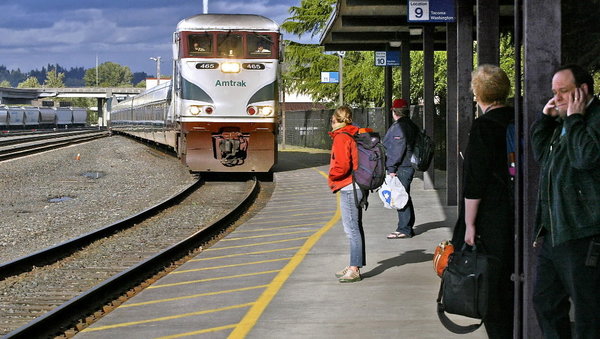
Not White Rock, but Tacoma Washington
It seems the good Burgher’s in White Rock want the AMTRAK Vancouver to Seattle – Portland train to stop at their city, to give a direct rail service to Seattle. It’s not going to happen. The Soviet style American security types will demand so much expensive infrastructure for boarder security as to make the service unfeasible, so enough of committee meetings etc. and time to plan for a real solution: A White Rock to Vancouver TramTrain service, using the existing BN & SF tracks.
Fairly easy to implement, a TramTrain service would provide a quick and reliable and affordable service, throughout the day. What is needed is a fewAi??Ai??km. of extra double track, new stations at Crescent Beach; 72nd Ave. in Delta; New Westminster; Kensington in Burnaby and Renfrew St. in Vancouver. This would give end to end travel times from White Rock to Vancouver, in the 50 minute to 60 minutes region, which is competitive with travel times with car and better than the current transit service. For added comfort, as done in Europe, Ai??Ai??’Bistro’ car, offering light refreshment could also operate on the route, offer a service unavailable to current transit users.
In Europe, TramTrain costs start at about $5 million/km. to build, depending on the quality of service that is provided. A quality hourly TramTrain service to White Rock, would cost less than 1 km. of the proposed UBC Subway!
The only impediment is the complete lack of political will to plan for anything other than expensive metros and ecologically destructive highways. Passing legislation to compel the railways to allocate ‘pathways’ for regional passenger rail services is an anathema to politico’s and the railways highly paid lobbyists. One wonders if the spectre of ‘Peak Oil’ will changer the mindset.
In a region where there is a cemented ‘metro’ ind set among planners and politicians, a White Rock to Vancouver would show case 21st century transportation, with the bonus of being in operation by 2012, if we start planning for it today! As well,Ai??Ai??a successful White rock to VancouverAi??Ai??TramTrain service would make it much easier to implement the Vancouver to Chilliwack TramTrain interurban!
By Brian Lewis, The Province
January 5, 2010
Time to lobby for the train to stop in White Rock
It’s always a challenge for the City of White Rock to raise enough tax dollars to run its micro-metropolis because there’s only about 18,800 residents and a limited business tax base within its 5.16 square kilometres to pay the bills.
Thus, as Mayor Catherine Ferguson acknowledged recently in the Peace Arch News, the city has tough choices to make in setting the 2010 budget.
But there are also opportunities for the little town to increase its economic development cash flow, and that’s why one White Rock councilor is working on the railroad (or the railway, as they’re known in Canada.)
Doug McLean, a business economist who has served on White Rock’s council since 1993, has launched an initiative to return his city to the days when its historic waterfront train station was a regular north-and southbound stop for passenger rail service between Vancouver, Seattle and U.S. points beyond.
The picturesque station was last used for regular passenger service in 1975 but that longtime practice ended due to dwindling ridership.
Currently the station houses the White Rock Museum and Archives.
However, as McLean notes, times have changed and he makes an excellent case for why passenger rail service should return to his city.
First of all, Amtrak now runs a second daily train between Vancouver and Seattle on a pilot project basis so having a stop in White Rock means that anyone south of the Fraser could catch a train for Seattle without having to start the journey in Vancouver.
“It also means you could do day trips to Seattle and be home that evening or, if it’s a weekend, you could catch a Mariners baseball game and be home in the evening.”
More importantly, it would also allow tourists from Canada or the U.S. to get off the train in White Rock and spend time — for the day, dinner or overnight at B&Bs — in the seaside resort.
Ironically, the deal to return White Rock to its glory days of passenger rail was almost done in 2001.
The city and most of the key stakeholders had even signed a memorandum of understanding to make it happen.
Those stakeholders included Amtrak, Burlington Northern and Sana Fe Railroad (it owns the rail line), Transport Canada, as well as Canadian and U.S. customs.
But the initiative fell off the rails, thanks to the Sept. 11, 2001 terrorist attacks in the U.S.
“U. S. security requirements changed immediately and that killed the initiative almost overnight,” McLean says. “But now I think it’s time to reapproach it.”
To that end, McLean recently sponsored a city council motion, which passed unanimously, to create an Amtrak passenger pail select committee to pursue the initiative once more.
This new group will likely include many from the original task force from 2001.
And so far, the reaction from both the public and rail stakeholder has been good, McLean says.
“We know getting this done won’t be easy and the major hurdle will be getting approval from U.S. security,” he adds.
“But we think it’ll benefit our whole region and over the longer-term it has potential to provide commuter rail service into Vancouver.”
Avanto TramTrain - The shape of things to come.

The hysteria of the anti-LRT lobby – Time to get real!

A mix of pedestrians and trams in Amsterdam
On other local and US blogs, there is a growing hysteria that once light rail (streetcar or tram) operates on-street, there will be general panic among pedestrians, ultimately throwing themselves under the tram! Shades of the 1820’s railway hysteria, where trains were claimed to cause insanity and sour cows milk!
I’m sorry to say, that light rail in its various forms operates quite safely in hundreds of cities around the world and mass panic and hysteria among the locals – definitely is not.
What we see is a well orchestrated lobby by the anti-LRT crowdAi??Ai??to create an aura of panic among the misinformed public, then pursuing their own interest to support more roads, highways and metros.
In Vancouver, the subway/SkyTrain Lobby is full tilt at it sowing misinformation everywhere they can so they can reap an anti-LRT backlash. Invented stories, debunked myth, and perverted statistics are the norm with this crowd as they pursue their very expensive metro agenda. The results of this effort of mass confusion isAi??Ai??of course isAi??Ai??to continueAi??Ai??our merry way of building metros on routes that do not have the ridership to sustain themAi??Ai??and creating financial chaos with TransLink; ever higher fare increases; and new road and highway building programs.
We seem to keep doing the same thing over and over again, ever hoping to achieve different results, but in the end achieving nothing but higher taxes and more congestion.
Why then does LRT operate on-street, in mixed traffic in city centres?
It is what the transit customer wants – transit, on the pavement andAi??Ai??easily accessible. It is a winning prescription to help solve our crowning traffic gridlock and associated pollution. The simple availability, affordibility and universally accessible light rail transit will define a successful city for the 21st century.

All aboard – 2010 is the 100th anniversary of the Interurban
Happy New Year!
The following is a Rail for the Valley media release to kick off 2010.

All aboard – 2010 the 100th anniversary of the Interurban
This new year is a particularly special one for advocates of passenger rail for the Fraser Valley. 2010 marks the 100th anniversary of the initial Interurban rail service that used to connect communities from Chilliwack to Vancouver. So far, the anniversary is being commemorated by the Chilliwack Museum with a special year-long Interurban exhibit. The Rail for the Valley campaign is hoping for much more.
“100 years later, we are waiting for light rail service to re-commence,” said Rail for the Valley founder John Buker, “and we have reason to be optimistic about the future, as the movement for passenger rail continues to grow and politicians begin to climb aboard. Looking back at the past year, we’ve made some large strides towards our goal.”
-On April 11 2009, ahead of the provincial elections, Rail for the Valley supporters organized a ‘historic’ Day of Action, holding up banners in support of passenger rail atop Highway 1 overpasses all the way from Chilliwack to Vancouver, on more than 20 overpasses in allAi??Ai?? – a feat never before accomplished, thus illustrating the deep and widespread public support for the cause.
[ Coverage and pictures of that event here: http://railforthevalley.wordpress.com/2009/04/13/highway-1-day-of-action-a-soaking-success/
Link to a CTV news article at the time: http://www.ctvbc.ctv.ca/servlet/an/local/CTVNews/20090411/BC_fraser_valley_rail_090411/20090411/?hub=BritishColumbiaHome ]
-During the following election campaign, the BC Liberals announced, through a Rail for the Valley pre-election Questionnaire, support in principle for a demonstration service along the Interurban corridor. (Link here: see page 11/11, BC Liberal response to Q.3.)
-Later in 2009, the South of Fraser Community Rail Task Force, headed by Langley Township Mayor Rick Green, was established to help Fraser Valley communities lobby senior levels of government for such a service in a unified way.
Buker‘s message to the public this new year is simple: “100 years ago, the first Chilliwack-Vancouver Interurban rail service began, and it fundamentally shaped the growth of the Fraser Valley. Today, we can rapidly build a new, modern light rail network for the entire Lower Mainland, starting inexpensively with track that already exists, giving the public a real alternative to the automobile. All we need is the political will.“
Rail for the Valley‘s latest online petition for passenger rail service, viewable on http://www.railforthevalley.com, has garnered more than 800 signatures so far, including hundreds of thoughtful comments posted in support.
“We must hold our politicians to account on this, or there will be backsliding. Any shift away from the status quo is naturally resisted by political inertia, and we have to be on the highest guard for it. As we pull out of this recession, the price of gasoline will likely jump dramatically again. With the way the Fraser Valley is growing and the rest of the world is changing, we absolutely must see a fundamental shift in priorities away from incremental and exorbitantly expensive Skytrain expansion, and endless highway expansion, towards beginning right now, today, to build light rail infrastructure for the Lower Mainland, for today and for the future,” declared Buker.
The Rail for the Valley Campaign would like to wish the public and all of our supporters a very Happy New Year, and all the best for 2010.

A BCE Interurban leaves Chilliwack station
All aboard – 2010 is the 100th anniversary of the Interurban
Happy New Year!
The following is a Rail for the Valley media release to kick off 2010.
All aboard – 2010 the 100th anniversary of the Interurban
This new year is a particularly special one for advocates of passenger rail for the Fraser Valley. 2010 marks the 100th anniversary of the initial Interurban rail service that used to connect communities from Chilliwack to Vancouver. So far, the anniversary is being commemorated by the Chilliwack Museum with a special year-long Interurban exhibit. The Rail for the Valley campaign is hoping for much more.
“100 years later, we are waiting for light rail service to re-commence,” said Rail for the Valley founder John Buker, “and we have reason to be optimistic about the future, as the movement for passenger rail continues to grow and politicians begin to climb aboard. Looking back at the past year, we’ve made some large strides towards our goal.”
-On April 11 2009, ahead of the provincial elections, Rail for the Valley supporters organized a ‘historic’ Day of Action, holding up banners in support of passenger rail atop Highway 1 overpasses all the way from Chilliwack to Vancouver, on more than 20 overpasses in allAi??Ai?? – a feat never before accomplished, thus illustrating the deep and widespread public support for the cause.
[ Coverage and pictures of that event here: http://railforthevalley.wordpress.com/2009/04/13/highway-1-day-of-action-a-soaking-success/
Link to a CTV news article at the time: http://www.ctvbc.ctv.ca/servlet/an/local/CTVNews/20090411/BC_fraser_valley_rail_090411/20090411/?hub=BritishColumbiaHome ]
-During the following election campaign, the BC Liberals announced, through a Rail for the Valley pre-election Questionnaire, support in principle for a demonstration service along the Interurban corridor. (Link here: see page 11/11, BC Liberal response to Q.3.)
-Later in 2009, the South of Fraser Community Rail Task Force, headed by Langley Township Mayor Rick Green, was established to help Fraser Valley communities lobby senior levels of government for such a service in a unified way.
Buker‘s message to the public this new year is simple: “100 years ago, the first Chilliwack-Vancouver Interurban rail service began, and it fundamentally shaped the growth of the Fraser Valley. Today, we can rapidly build a new, modern light rail network for the entire Lower Mainland, starting inexpensively with track that already exists, giving the public a real alternative to the automobile. All we need is the political will.“
Rail for the Valley‘s latest online petition for passenger rail service, viewable on http://www.railforthevalley.com, has garnered more than 800 signatures so far, including hundreds of thoughtful comments posted in support.
“We must hold our politicians to account on this, or there will be backsliding. Any shift away from the status quo is naturally resisted by political inertia, and we have to be on the highest guard for it. As we pull out of this recession, the price of gasoline will likely jump dramatically again. With the way the Fraser Valley is growing and the rest of the world is changing, we absolutely must see a fundamental shift in priorities away from incremental and exorbitantly expensive Skytrain expansion, and endless highway expansion, towards beginning right now, today, to build light rail infrastructure for the Lower Mainland, for today and for the future,” declared Buker.
The Rail for the Valley Campaign would like to wish the public and all of our supporters a very Happy New Year, and all the best for 2010.

Welcoming 2010 – Planning Transit For The Next Decade

HAPPY NEW YEARS!
On a rare visit to the Skyscraper blog, where SkyTrain’s strongest supporters reside, one feels sad that the SkyTrain lobby dwells so much in the past andAi??Ai??has missed the tram, so to speak. Misinformation reigns supreme as the SkyTrain loyalists desperately try to rewrite history to suit there own ends. Take away the name calling, innuendo,Ai??Ai??and the hundreds of pages devoted to SkyTrain become very thin gruel indeed.
In 2009, the Rail for the Valley blog has for the first time established a conduit ofAi??Ai??up to dateAi??Ai??information about rail transportation around the world, spiced with historical essays on early railways and forays into the fine art of signaling. This has laid a solid foundation for 2010’s campaign to secure a Vancouver to Chilliwack Interurban, using the TramTrain concept, once again seeing passenger rail servicing the valley cities.
In December’s Transit & Urban Tramways, there is a hint of the big news story for Valley Rail and RFV will be ready to promote what could be a ‘bombshell‘ story.
As for the SkyTrain lobby, like the dinosaurs of old looking for a tar-pit, their dreamworld for a SkyTrain only future for the region will disappear, especially when the financial realities of “Peak Oil” and “Global Warming” become more than a catch phrase.
SkyTrain from SurreyAi??Ai??to Langley by 2030 will seem like a joke when compared to a Vancouver to Chilliwack TramTrain by 2014, for one third the cost!
Welcome to the dawn of 21st century transit and transportation – a happy New Years indeed.



Recent Comments