THE LLANDUDNO GREAT ORME TRAMWAY – Wales almost forgotten cable car!

Another visit to the U.K. today, to the Great Orme TramwayAi??Ai??or cable car/funicular, whichAi??Ai??travels on-street for part of its journey and is located in Llandudno Wales
The GreatAi??Ai??Orme Tramway isAi??Ai??Great Britain’s only remaining cable operated street tramway and one of only three surviving in the world. Operation of the tramway differs from the famous and unique San Francisco system in that it is not a cable car but rather a street running funicular (similar to the Lisbon system), where the cars are permanently fixed to the cable and are stopped and started by stopping and starting the cable.
The tramway was built in 1902 to take passengers to the summit of the Great Orme and is in two sections. The lower section is built on or alongside the public road and has gradients as steep as 25%. The upper section is less steep with a maximum gradient of 10%.
The original power house, situated at the Halfway station between the lower and upper sections was equipped with winding gear powered by steam from coke-fired boilers. This was replaced in 1958 by electrically powered winding gear. In 2001, the entire Halfway station, its control room and its power plant were completely rebuilt and re-equipped.
The tramway uses four tramcars, which were new when the tramway was built in 1902. An overhead wire telegraph was formerly used for communication between the tram and the engineer-driver in charge of winding the drum, but this has now been replaced with a modern induction loop radio-control system.
The tramway has three main stations, the lower station, named after the hotel that formerly occupied the station site, the one in the centre aptly named ‘Halfway’ and the Great Orme Summit station. Passengers must change trams at the Halfway station.
http://www.greatormetramway.co.uk/
Ai??Ai??
A Great Wailing and Gnashing of Teeth from the SkyTrain lobby – The ignored SkyTrain Subsidy

In 1993, the GVRD (now Metro) and Transport 2021, publishedAi??Ai??the study, “The Cost of Transporting People in the BC Lower Mainland” and for the first time the annual SkyTrain subsidy was mentioned. In 1991, SkyTrain was subsidized to the tune of$157.6 million, more than half of the total subsidyAi??Ai??paid forAi??Ai??public transit in the Lower Mainland. BC Transit then, as TransLink does today,Ai??Ai??Ai??Ai??ignores this vast sum of taxpayer’s dollars subsidizing the metro and make erroneous statements that SkyTrain pays its operating costs, etc.
The portion of the SkyTrain subsidy is thus:
Gas taxAi??Ai??Ai??Ai??Ai??Ai??Ai??Ai??Ai??Ai??Ai??Ai??Ai??Ai??Ai??Ai??-Ai??Ai??Ai??Ai??Ai??Ai??Ai??Ai?? Ai??Ai??$17.8 mil. out of $47.4 mil. collected
Hydro Levy Ai??Ai?? -Ai??Ai??Ai??Ai??Ai??Ai?? $4.7 mil. out of $12.6 mil. collected
Commercial
Property Tax Ai??Ai??-Ai??Ai?? $9 mil. out of $24 mil. collected
Residential
Property Tax Ai??Ai??-Ai??Ai?? $5.2 mil. out of $14 mil collected
Provincial
Government Ai??Ai??-Ai??Ai?? $120.9 mil. out of $196.8 mil. paid
TotalAi??Ai??Ai??Ai??Ai??Ai??Ai??Ai??Ai??Ai??Ai??Ai??Ai??Ai??Ai??Ai??-Ai??Ai??Ai??Ai??Ai??Ai??Ai??Ai??Ai??Ai??Ai??Ai?? $157.6 out of $294.8 paid
With the opening of the Millennium Line, SkyTrain’s annual subsidy increased past $200 million and with the RAV/Canada Line metro, again this subsidy will once again increase.
What is interesting to note, just one years worth of SkyTrain’s annual subsidy could fund a basic Vancouver to Chilliwack InterurbanAi??Ai??demonstration service; two years worthAi??Ai??of SkyTrain’s annual subsidy could fund a hourly or better Vancouver to Chilliwack Interurban service!
From the Seattle Times, October 2002 – Vancouver’s SkyTrain: model for the monorail?

There has always been a close relationship between Vancouver’s and Seattle’s city planners and the now aborted monorail scheme seems to have been abetted by this relationship. Not mentioned of course is that despite about $8 billion now invested in our SlyTrain/RAV metro’s, TransLink’s mode share has stalled at about 11% for the almost the last decade and a half. Seattle now has a hybrid light rail/metro system, with costs rivaling SkyTrain’s and likeAi??Ai??METRO Vancouver,Ai??Ai??new highways and tunnels and bridges are actively being planned for. What is missing is any hint of real light rail planning, a mode that has proven to attract the motorist from the car. Most disconcerting is that regional transit planners in both Seattle and Vancouver, have failed to grasp any understanding of LRT and still pine away for grand metro schemes like the Evergreen Line or the five mile long subway to the University of Washington.
By Mike Lindblom
Seattle Times staff reporter
http://community.seattletimes.nwsource.com/archive/?date=20021013&slug=vancouver13m
VANCOUVER, B.C. A?ai??i??ai??? Commuters absolutely love this city’s railroad in the air.
They take an impressive 147,000 trips each weekday on the SkyTrain Expo Line, which opened for the 1986 World’s Fair and was later extended into the suburbs. A second route, the Millennium Line, was completed six weeks ago and attracts 40,000 daily boardings.
As popular as the system is, there is another group who may admire it even more A?ai??i??ai??? monorail activists who cite SkyTrain as a role model for Seattle.
“The good news is that elevated transportation generally works,” says Dick Falkenbury, the cab driver who founded the populist monorail movement in Seattle.
Like a monorail, the SkyTrain combines mountain views with the pleasure of looking down on gridlocked drivers. High-rises have grown up around the stations, boosting the clientele and reducing regional sprawl. TransLink, the local public transportation agency, says the original line now covers its own operating costs, a rarity in North America.
Yet the project had to be imposed on reluctant communities by the provincial and federal governments, and there is no consensus that the roughly $2 billion (U.S.) spent to build two lines was worth the sacrifice.
Critics call SkyTrain a boondoggle because it diverts riders from buses, and many believe surface light rail would have been cheaper than elevated tracks.
Vancouver had several advantages over Seattle in designing mass-transit projects, including a free downtown tunnel and abundant suburban rail corridors. Metro-area housing density is double that of greater Seattle, so bus stations are close to people. And no freeways reach downtown.
Despite SkyTrain, traffic congestion in metro Vancouver has worsened because of rapid population growth and increased suburb-to-suburb driving.
However, those who do use elevated rail say they save 20 to 30 minutes compared to sitting in a bus or car, and some have moved into housing around the stations.
Could a Seattle monorail move the masses like a SkyTrain? Only if the city braces for big changes.
For a closer look, let’s hop aboard SkyTrain.
Making connections
Granville Station, downtown
“Got a twonie?” asks City Councilor Gordon Price as he grabs a hat from his closet.
A $2 Canadian coin is good for a 90-minute trip on any form of transit in Vancouver. Add a “loonie,” the $1 coin with a loon on its face, and you reach the inner suburbs, while a trip across the Fraser River to outer Surrey requires $4, or $2.54 U.S.
There are links to commuter rail and passenger ferries at the waterfront and bus hubs throughout the route A?ai??i??ai??? operated by a single agency.
Seattle’s monorail route promises similar links, but four transit bureaucracies would have to cooperate or merge to avoid surcharges. The Elevated Transportation Co., which wrote the monorail plan, assumed bus riders would pay an additional $1 to hop the monorail, but that could repel users.
We walk from Price’s ninth-story condo to Granville Street, a grimy but efficient trolley corridor. We get off at a SkyTrain station, inside an old freight tunnel that SkyTrain received for free.
Coin-operated dispensers sell tickets on the honor system, without gates. Fare evasion is estimated at 6 percent, but TransLink says the high cost of electronic gating exceeds the money to be gained. Transit police perform random ticket inspections and issue $29 fines to violators. Monorail planners included gates in their cost studies but are also considering the Vancouver model.
Size matters
Broadway station
This crowded hub links SkyTrain with buses serving the west side and the University of British Columbia. There are 14,000 passengers a day for the original line and thousands arriving on a walkway from the new line.
To handle those crowds, plus a 262-foot train, requires a station the size of a city block, and it dominates the funky old neighborhood.
At 140 to 160 feet long, monorail stations would be smaller but would still be a tight squeeze in downtown Seattle. Platforms would be 22 to 27 feet wide, plus a couple feet on each side for the concrete monorail guideways; that’s wide enough to hover halfway over the streets. Columns would be leaner and farther apart than those of the existing Seattle Center Monorail.
Monorail opponent Jud Marquardt, a partner in LMN Architects, believes monorail beams would eclipse the building fronts on Second Avenue and its few open spaces, such as the Garden of Remembrance at Benaroya Hall. A monorail would also block views of the Space Needle from Second.
A partial solution involves running monorail tracks into new buildings, something Samis Land Co. has proposed for a new tower at Second and Pike. Steel columns could conceivably be used instead of bulkier concrete along Second.
Unlike the monorail, which would pass within spitting distance of apartment balconies, the Vancouver line runs over highway and freight-rail corridors, and its tunnel avoided conflicts over downtown aesthetics.
“We would never even consider elevated tracks downtown,” Price says.
How it works
Grandview Cut
Our driverless train zooms out of the city on banked tracks. Passengers can read without motion sickness, and braking is barely perceptible.
Trains can travel 55 miles an hour, while the monorail would peak at 50 mph.
At busier stops, riders often skip a train rather than squeeze into a crowded one because the next train arrives in four minutes or less. Rush-hour trains run two minutes apart or less, and the computer-controlled system is capable of a mere 72-second separation.
The makers of SkyTrain, Canada-based Bombardier, are likely bidders to build the proposed Seattle monorail, competing against Hitachi of Japan. The technology gives ETC officials confidence in their proposed four- to six-minute headways for the monorail and their ability to run successive trains for festivals and sports events.
Two recent evacuations on Seattle’s historic tourist Monorail have raised fears about being stuck 30 feet above the ground between stations. SkyTrain stalls 40 to 50 times per year, about once every 4,000 trips. When that happens, attendants and maintenance workers board the disabled train and drive it manually to the next station, where computers are reset.
In a monorail stall, the usual evacuation method is to pull another train alongside the disabled one and transfer the passengers. The Seattle Fire Department may also require escape catwalks along the 14-mile length.
Close to home A?ai??i??ai??? many homes
Metrotown station
The busiest station on the line isn’t downtown but in suburban Burnaby, with 16,000 average weekday boardings.
This vast hub illustrates how population density is wedded to ridership.
Metrotown resembles a less-elegant version of downtown Bellevue on a hill, with a huge retail mall, offices, parks, a basement-like bus station and 20-story high-rises. Shoppers and reverse commuters make SkyTrain a true two-way service, while in Seattle the trains might roll nearly empty to residential West Seattle and Crown Hill in the morning.
The ETC says its projection of 69,000 weekday riders by 2020 A?ai??i??ai??? half the Expo Line count A?ai??i??ai??? is based on existing regional and city growth plans. Those plans are very ambitious, foreseeing 43,000 new housing units in “urban villages” near the Green Line by 2014.
SkyTrain relies on similar growth of 44,000 housing units in Burnaby to support the new Millennium Line, where underused new stations are currently ringed by self-serve warehouses, car dealerships and mall parking lots.
Seattle City Council member Judy Nicastro, who chairs the land-use committee, likes the idea of transit-related housing growth, but she urges voters to think about what that would look like.
“I certainly see, if monorail passes, we will be discussing and making code changes to add a lot of height to neighborhoods that the monorail’s going to go in,” she said. “There are ways to do it where you still have open space and you don’t feel like you’re in a tunnel.”
Near downtown, the buildings might be up to 15 stories tall, she said, while a six- to eight-story height seems sensible for Ballard, mixed with four-story rooftops for variety.
“We have a duty, once you put in a $1 billion, $2 billion system, to make sure the ridership is there.”
Is it safe?
Granville to Metrotown at midnight
A man holds the station door open for tips, and another grizzled fellow begs departing passengers for their tickets and then resells them for a loonie or two.
The scene is gloomy but safe on a Monday night. Single women ride the train home from work. Police patrol some high-risk stations but are outnumbered by mop-slinging janitors.
Fear of crime has hindered ridership, SkyTrain’s own reports say.
Last year there were 100 robberies and 321 assaults reported on SkyTrain property, just over one crime per day. Of those incidents, 21 robberies involved weapons, and 49 assaults caused injuries.
Some citizens, and a security consultant’s study, have proposed that employees or police be on all trains to deter crime, assist in emergencies or to drive stalled trains. TransLink hasn’t gone that far, but it is providing better station lighting, silent alarms on trains and more employees on the platforms. Bicycle patrols have cut down on rampant car theft at park-and-ride lots.
The monorail plan A?ai??i??ai??? based on talks with SkyTrain operators A?ai??i??ai??? calls for three armed transit police roaming the line at all times, and six for special events. And there would be an average one customer-service attendant per one or two stations.
Crossing water
SkyBridge
Monorail opponents portray a half-mile Ship Canal monorail bridge as a budget-buster, but the SkyTrain bridge across the Fraser River was built in 1990 for an affordable $21 million.
The ETC’s cost plans allotted $45 million at the Ballard crossing, and an independent review lays 50-50 odds that another $10 million will be required to meet salmon-protection requirements.
Reaching the region
Scott Road
SkyBridge stretched the elevated line into the vast suburb of Surrey, equivalent to reaching Lynnwood by monorail. There are 3,000 parking spaces at Scott Road, making the line regional in a way the Green Line route is not.
“They’re different from us in that respect,” said ETC researcher Joel Horn. “We are not a regional system. We’re a citywide system.”
The ETC couldn’t afford garages or thousands of slots on its proposed $25 million parking budget. Monorail planners think they can stretch the money by leasing underused parking lots in Ballard and closer to downtown, while Nicastro recommends apartments above parking garages, as Redmond and Renton have at bus centers.
Henry Aronson of Citizens Against the Monorail has raised the question, “What regional traffic problem does the monorail solve?”
Proponents reply that it adds capacity through the hourglass-shaped downtown where there is no room for new roads. But the route effectively dead-ends on either side.
Though the monorail plan calls for four future voter-approved lines within Seattle, there seems to be greater enthusiasm among pro-monorail people to reach beyond the city. In informal chats, they mention dream destinations such as Aurora Village, Bothell, Boeing Field or Ballard-University-Redmond over an expanded Highway 520 bridge.
Such ambitions would take a new campaign, an additional public vote and more taxes.
Words of advice
Vancouver Councilman Price encourages Seattleites to build rapid transit “pronto,” before daily Everett-to-Olympia freeway backups make Interstate 5 unusable. At the same time, gives this advice about public expectations.
“The main thing about rail transit, and I would include monorail in this description, it’s mainly about land use. … We built SkyTrain and there isn’t any less congestion. You can’t overcome the brutal increase in (population) numbers and the limited amount of road space. What it gives you is an alternative form of transportation.”
From Tramways & Urban Transit – Denver receives first new FasTracks LRVs
Denver light rail system Ai??Ai??is one of America’s great success stories, so successful that the cityAi??Ai??has large expansion plans for their LRT system with over 195 miles of new lines to be built in the coming years.Ai??Ai??Denver’sAi??Ai??Ai??Ai??light rail system was the only public or privateAi??Ai??transitAi??Ai??operation that was runningAi??Ai??during the great blizzard and only ceased operationsAi??Ai??because no one could get to it to use it!

25Ai??Ai??AugustAi??Ai??2009 Denver receives first new FasTracks LRVs
Denver’s Regional Transportation District (RTD) has taken delivery of the first of 55 Siemens LRVs for its new FasTracks fleet. The vehicle arrived last week via flatbed trailer from Siemens manufacturing facility in Sacramento, California.
Some of RTD’s original Siemens LRVs, put into service in 1994 with the opening of Denver’s first light rail line, have recently reached the one-million-mile mark.The new cars will accommodate service through the future openings of the West Corridor, I-225 Corridor, Southeast and Southwest extensions. The balance of the new fleet will arrive every few weeks over the next 18 months.
FasTracks is a voter-approved transit program to expand rail and bus service by building 122 miles of commuter and light rail, 18 miles of BRT, adding 21 000 new parking spaces, redeveloping Denver Union Station and redirecting bus service to better connect the eight-county District.
VA?Ai??hicule Automatique LA?Ai??ger or VAL – SkyTrain’s real competition!

SkyTrainAi??Ai??is not in a class of its own, despite first being marketed as ICTS or Intermediate Capacity Transit System, which was more a marketing nameAi??Ai??not a transitAi??Ai??mode. SkyTrainAi??Ai??is a light-metro andAi??Ai??though SkyTrainAi??Ai??initially competed against light rail,Ai??Ai??it was soon found that SkyTrain could only compete againstAi??Ai??other light-metros that were being marketed for the modal niche. Only in Vancouver is there a light rail/light metro debate as transit planners in most other cities fully understand the role of a light-metro and light rail.
SkyTrain’s main competitor was the French VAL rubber tired light-metro. Yet VAL’s success has been checked by light rail, despite a concerted drive by the French government to build with VAL instead of LRT. Civic politicians, ever with the taxpayer in mind, largely rejected light-metro and the VAL system, like SkyTrain is used as a light-metro, airport people mover or a niche light-metro built for political prestige.
VAL is an automatic rubber-tired people mover, based on an invention by Professor Robert Gabillard (UniversitA?Ai?? Lille Nord de France). It was designed in the early 1980s by French Matra, for the then new metro system in Lille.
The acronym was originally for Villeneuve d’Ascq A?Ai?? Lille (Villeneuve d’Ascq to Lille), the route of the first line to be projected (and inaugurated). It now officially stands for VA?Ai??hicule Automatique LA?Ai??ger (automatic light vehicle).
In contrast to some other driverless metro systems like the Docklands Light Railway or Vancouver’s SkyTrain, the VAL design uses platforms that are separated from theAi??Ai??guide-way by a glass partition, to prevent waiting passengers from straying or falling onto the guide-way. Platform screen doors, which are produced by Swiss glass door manufacturer Kaba Gilgen AG, embedded in these partitions open in synchrony with the train doors when a train stops at the platform
When VAL has been introduced to Taipei, the term medium capacity system is coined to differentiate VAL from heavy rail (metro). Thus this term is being applied mainly among Asian cities and railway planners though they are not using VAL’s technology. In Siemens official site, VAL is advertised “first fully automated light metro”, in which the term “light metro” can be traced back to Moscow Metro Butovskaya Light Metro Line.
The “Super Mongy”: the Lille – RoubaixAi??Ai??- Tourcoing tram
With civicAi??Ai??finances an ever increasing problem, especially with the city’s resources being diverted to the veryAi??Ai??expensive VAL system, inAi??Ai??1991 civic politicians funded a rebuilding of the Mongy,Ai??Ai??RoubaixAi??Ai??- Tourcoing tramway, with new track, overhead (including uprating the voltage from 600 to 750 V), tram-stops and rolling stock, as it was a much cheaper proposition than building a new VAL system.

The new tram stop platformsAi??Ai??were built to allow level accessAi??Ai??for the new low floor trams ordered from Breda in Italy and styled by the famous Pininfarina design house. The 2.40 m wide trams are “one-offs” and it was somewhat surprising that Lille went outside France for it’s cars especially as Alstom was promoting a “French Standard” car for the new tramway’s being built in the country at the time. Some commentators have suggested that the cars are noisy and have poor rides and this is because of corners cut with costs on both rolling stock and track work, but operating low-floor cars of this width on metre-gauge track was, inevitably, going to involve compromises and less than perfect results. Despite this, the new trams were in operation from 1994 and Lille, for whom transport operations were vested in the TRANSPOLE company (a subsidiary of Keolis) from May of that year, got itself a new “Super Mongy” in double-quick time.
The lessons of VAL and the Mongy were not forgotten by city fathers in other French cities, where over and over again the expensive VAL mini-metro was rejected even when the French government offered to pay for the full cost of the initial line, in favour of much cheaper, modern light rail.
The Lille metro was inaugurated on April 25, 1983. VAL systems were subsequently built in several other French cities, including:
- Paris Orlyval, 1991
- Toulouse Metro, 1993 (new tram line completed)
- Rennes Metro, 2002
- Paris CDGVAL, April 2007 (3 tram lines in operation)
Outside of France, VAL systems are also used in:
- Chicago O’Hare’s Airport Transit System (opened in 1993)
- Taipei’s Muzha Line (opened in 1996, larger variant using the MAGGALY technology from Lyon Metro line D)
- Turin’s Metrotorino (opened in 2006, just before the 2006 Winter Olympics) (updated tramline)
A VAL system is in project in Uijeongbu, South Korea.
The Chicago O’Hare and Taipei lines use the wider VAL 256 version of the system.
Jacksonville had a VAL line inaugurated in 1989, which was shut down in December 1996 and replaced by a monorail, the JTA Skyway. The rolling stock was sold to O’Hare International Airport.

A press Release from the Light Rail Transit Association – Rail for the Valley asks: What is more ‘Green’, a multi lane highway or the interurban?
……………………………………………………………………………………………..
PRESS RELEASE FROM
TramForward – UK
Ai??Ai??2009
“But its provisions for improving urban transport are incomplete” said Geoff Lusher of “Although the document says much about new high speed rail routes, it does not make any mention of expanding suburban rail systems, including light rail, so that more commuters, shoppers and leisure travellers have the option of a high-quality public transport alternative to the car. To put it bluntly, we’re staggered. A word search of the entire document reveals not a single reference to “light rail” or “tram”. We believe that is simply not possible to write 117 pages on green transport strategy and yet not mention the one form of transport that has been shown to be most effective in getting people out of cars and so cutting their carbon footprints. Light rail is seen as a solution the world over to problems of traffic congestion and urban pollution, which is why the last decade has seen a huge investment in new light rail and modern tramway systems all around the world. In other European countries, including Austria, Belgium, France, Germany, Italy, Spain, Switzerland, Portugal and The Netherlands the renaissance of the tram has already made a significant contribution to a better quality of life for millions of citizens. Modern tramways have proven to be just as successful in British cities, in the relatively few places where they have been implemented, and it is clear that they have a place in many more.
Ai??Ai??
1. TramForward is the campaigning arm of the Light Rail Transit AssociationTramForward is the campaigning arm of the Light Rail Transit Association.Ai??Ai??
3. The LRTA acts through its network of local branches, which campaign for better transport in their localities.
4. Membership of the LRTA costs under 12p a day. To join, visit www.lrta.org or write to the Membership Secretary, LRTA, 38 Wolseley Road, Sale, Greater Manchester, M33 7AU. Members of the LRTA receive the monthly magazine Tramways & Urban Transit – written and read by experts in the field – and gain other benefits including discounts on videos and books, tours of transport systems and cut-price admission to selected transport sites.
5. Press enquiries – please contact:
Brian S. Lomas, Development Officer, Light Rail Transit Association
7 Crofton Avenue, Horfield, Bristol BS7 0BP
Telephone: 0117 951 7785
E-mail:
Ai??Ai??
The ULTRA LIGHT RAIL concept

A recent comment about Ultra Light Rail deserves an entry in the Rail for the Valley Blog. Though I do believe that ULT is not applicable for the 90 km. Valley Interurban, where larger vehicles are needed, Ultra light rail could have applications in specific niche areas in Metro VancouverAi??Ai??such as a downtown Vancouver to Stanley Park Link, Granville Island tram (tracks in situ), or a Davie St. Denman St. circulator. Certainly ULR could be used in tourist sensitive cities such a Victoria or Kelowna.
The following is from:Ai??Ai??Ai??Ai??Ai??
Cost-effective, Sustainable, Public Transport SystemsSustainable Transport Company Ltd(SUSTRACO)
-
ULR is a intermediate transport system that uses self-powered or externally powered trams with or without some form of energy storage.IsAi??Ai??a cost effective alternative to Light Rail, Guided Bus and Bus Ways (BRT) for many routes.
-
Carry traffic of 350 – 9,000 p/h/d and have A?ai??i??Ai??tramway, LRT, BRT and Guided Bus characteristicsA?ai??i??A? it is able to mingle with pedestrians, negotiate historic city centres with , narrow streets.
-
All this for a cost that is between 75% and 30% less then standard LRT systems.
Ai??Ai??It is low cost because:Ai??
- Vehicles use automotive and tram type technology/ economy of scale through standardisation.
- There maybe no external electrification, overhead wires, sub-stations, and cables.
- It is thus easier to route and find cheaper more attractive alignments.
- ItAi??Ai?? uses a number of lower cost innovative track technologies .
- It can use standard, off the shelf, not specifically designed components.
- Services (gas, electricity, telephone, water pipes etc.) do not have to be relocated.
- It can carry more people per driver than a bus.
- One driver can move more people in a given time than is possible with a bus on congested roads.
- It uses substantially less energy per passenger than a bus.
- Trams last a lot longer than buses.
- Stops are the same as bus stops.
- It only needs a bus type depot and bus-operating organisation.
- The public see it as a tram giving a superior quality service.
- It is a fixed link system showing commitment whilst retaining its flexibility.
- Significant environmental benefits.Ai??Ai??Ai??Ai??Ai??Ai??Ai??Ai??Ai??Ai??Ai??Ai??Ai??Ai??Ai??Ai??Ai??Ai??Ai??Ai??Ai??
- Stimulus to development.
- Easy level access to low platforms
- High safety levels.
Ai??Ai?? It also provides:Ai??
ULR is a novel concept but it uses well-established technologies. The principle is similar to the A?ai??i??Ai??streetcarA?ai??i??A? approach now being adopted in many US city centres in reaction to the high costs of conventional Light Rail, and may include the advantages of energy storage.
It can be powered by any locally produced sustainable energy such as:-
Biogas (from organic waste), Fuel Cells, Ethanol (from sugar) , Green Electricity (Wind, Wave, Sun, Hydro etc), SUSTRACO works with the local community to identify the most sustainable long term fuel .
http://www.ultralightrail.com/index.htm
The apportioned fare – what is it? Will TransLink do it?

In London England, if one wishes to travel from ones residenceAi??Ai??near Morden Road in South London to the City of London Airport in the East end, one would have to travel in three travel zones, taking a CroydonAi??Ai??Tram Link Tram to Wimbledon;Ai??Ai??transferring to a ‘Southwest Trains’ to Waterloo Station;Ai??Ai??transferring again to the Jubilee Tube; and finally transferring toAi??Ai??the Docklands Light Railway to the City of London Airport, completing ones journey. Four transfers onto four different Transportation Operating Companies, yet all done without fuss with an ‘Oyster‘ travel card, where each portion of the journey was recorded an each transportation company had their portion of the four transfer journey automatically and correctlyAi??Ai??’apportioned‘ from the 3-zone fare.
To simplify, a $12, 3-zoneAi??Ai??fare was ‘apportioned’Ai??Ai?? four ways so that each of the Transportation Operating Companies received their fair share of the 3-zone fare.
With TransLink, there is no method of apportioning fares between bus, Seabus, or SkyTrain, as there is no method in determining how a fare is used or how many transfers take place on one ticket. This suited TransLink fine because they could make all sorts of claims, such as “SkyTrain pays its operating costs“, etc. with full knowledge that they did not apportion the fares between buses and the metro, even though they do know that at least 80% of SkyTrain’s ridership first take a bus to the metro and no one knows how many transfer again to a bus.
This is about to change because the new Canada line Metro system is a Public, Private, PartnershipAi??Ai??or P-3, where the ridership potential was so bad that TransLink must subsidize the operating consortium until ridership reached a 100,000 passengers a day. There is a problem; how many people will first take a bus to the Canada line and how many more transfer again toAi??Ai??a bus afterwords? This is important because if TransLink counts full 1, 2, or 3-zone fares as strictly Canada Line fares and does not apportion them between bus and metro, the bus system will suffer great financialAi??Ai??loses.
Example: A $5.00 cashAi??Ai??3-zone fare from Whiterock to UBC involves a bus trip to the Canada line (used to be direct to Vancouver); a forced transfer to the Canada Line; and another transfer to a bus to UBC, two transfers, from bus to metro and back onto the bus. The $5.00 fare should be apportioned two ways, one third ($1.66) to the Canada line and two thirds ($3.34) to West Coast mountain Bus (bus operating company). The issue gets even trickier with Day-passes, with unlimited daily travel on all of TransLink’s services.
Concession fares again will create havoc with Canada line revenue as using the the above example, the Canada Line portion of a 3-zone concession fare would be $0.84!
More problems arise with the airport surcharge and how it will fit into the ticketing scheme of things and the cost of enforcing the Airport surcharge.
Rail for the Valley worries that transit revenue for the buses will be skimmed off to pay for the Canada Line, which will lead to cutting of services and a degradation of regional transit, just like what happened when the first SkyTrain line was opened.

Volk’s Electric Railway, the oldest operating electric railway in the world.
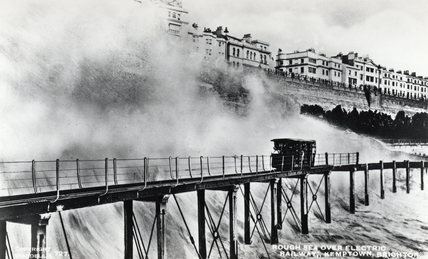
Today, a history lesson on electric railways. The Volk’s Electric Railway (VER) is the oldest operating electric railway in the world (the world’s first electric railway, in Lichterfelde from 1881, no longer operates). It’s a narrow gauge railway that runs along a length of the seafront of the English seaside resort of Brighton, built by Magnus Volk, with the first section being completed in 1883.
The Volks Electric Railway is not an interurban or a tramway, but a niche railway, built for the tourist trade, not unlike Disneyland’s monorail. That being said the Volks Electric Railway is the oldest operating railway in the world.
Today the line runs between terminal stations at Aquarium (a short distance from the Palace Pier) and Black Rock (at Black Rock, not far from Brighton Marina), with an intermediate station and depot at Paston Place. The line has a gauge of 2Ai??Ai??ft 8+1A?A?ai??z2Ai??Ai??in (825Ai??Ai??mm), It is electrified at 110 V DC using a third rail, and is just under 1+1A?A?ai??z4Ai??Ai??miles (2Ai??Ai??km) long.

The initial 1883 line was intended as a temporary summer attraction and ran for only 1A?A?ai??z4Ai??Ai??miles (402Ai??Ai??m) between Swimming Arch (opposite the main entrance to Brighton Aquarium, and adjacent to the site of the future Palace Pier) and Chain Pier. It was built to a gauge of 2Ai??Ai??ft (610Ai??Ai??mm) and electrical power at 50V DC was supplied to the cars using the two running rails. In 1884 the line was extended from Chain Pier to Paston Place, the gauge widened to 2Ai??Ai??ftAi??Ai??9Ai??Ai??in (838Ai??Ai??mm), and the electrical supply increased to 160 V DC. In 1886 a third rail was added to avoid power loss along the extended line, and the gauge tightened to its current 2Ai??Ai??ft 8+1A?A?ai??z2Ai??Ai??in (825Ai??Ai??mm). (The voltage was reduced to the present 110 V in the 1980s.)
In 1896 the unusual Brighton and Rottingdean Seashore Electric Railway was built by Volk. This was unsuccessful and closed in 1901, when the Volk’s Electric Railway was extended from Paston Place to Black Rock. In 1930 the line was cut back 200Ai??Ai??yards (183Ai??Ai??m) from Palace Pier to its present terminus, still known as Aquarium, and in 1937 the Black Rock end was also shortened by around 200Ai??Ai??yards (183Ai??Ai??m). (In 1935 a lido had been built at Black Rock.)
In 1940 the Brighton Corporation took control of the line. It was closed during the Second World War but reopened in 1948. Winter operation ceased from 1954, although the line did reopen temporarily in the winter of 1980 to cash in on the large numbers of sightseers who had come to look at the Athina B, a freighter that had beached near the Palace Pier. 2-car multiple operation was introduced in 1964. In recent years there has been a decline in visitor numbers due to package holidays. In 1995 the Volk’s Electric Railway Association was formed to help preserve the line.

Nottingham’s light rail system – a real P-3 project!

The Nottingham (city pop. 275,000) light rail project should be of interest, because it was and is a true example of a P-3 (Public/Private/Partnership), where the operating consortium, Transdev, not only went to the international banks for financing, but assumed all risk. Today, Nottingham’s NET light rail systems, operates at a profit, even after paying its debt servicing charges. The cost to build Nottingham’s light rail system was CAD $25.6 million per kiliometre and the annual ridership now exceeds 10 million passengers a year. So successful is Nottingham’s new light rail system, that a second line from Clifton to Chilwell has just been approved at the end of July, with construction starting in 2011 and completion by 2014.
Nottingham Municipality has realized that a modern LRT lineAi??Ai??would alleviateAi??Ai??the increasingAi??Ai??car congestion in the city center and to contribute to a new economical development of this area, characterized by a massive industrial closure and conversion.
The north-south Line 1 route (about 14 km), opened in 2004,Ai??Ai??links Nottingham city center to Hucknall and Bulwell suburbs, with an intermediate branch to Cinderhill and Phoenix Park. Hucknall-Wilkinson Park section runs in segregated lane alongside the so-called “Robin Hood Railway” railway line, while Cinderhill-Phoenix Park branch is set on an disused freight line. The central section (from Wilkinson Park to Station Street) runs on street, serving the very central Old Market Square, and important commercial and leisure attractions (Royal Center, Lace Market).
Tech. stuff.
| Country | United Kingdom |
| Line | Nottingham Express Transit (NET)-Line |
| Inhabitants | City 275.000, District 670.000 |
| Date opening | 2004 |
| Future development: | Line 1 potential extensions: Station Street-Chilwell, Station Street-Clifton |
| Length (km) | 14 |
| Track sections | 10 km in segregated lanes, 4 on street |
| Stops | 23, average distance m 650 |
| Platforms | — |
| Platform doors | — |
| General characteristics | — |
| n. of vehicles | 15 |
| n. of cars per vehicle | 5 |
| Type | steel wheels bi-directional |
| Vehicle dimensions (m) | length 33, width 2.40 |
| Vehicle capacity (pax) | 191 (62 seated) |
| Frequency | 5’/15′ |
| Current/Voltage | 750 V DC overhead |
| Type of guide/gauge | standard gauge rails (1435 mm) |
| Speed Km/h | Max 80 |
| Accel./Decel. (m/sec2) | 1.2/1.4 |
| System capacity | 2640 pphpd |
| Ridership | 10 millions pax/year |
| Total cost | 14.5 M Ai??A?/km |
| Staff | — |
| System builder | BOMBARDIER |
| Model | Incentro |
| NOTE | maximum vertical gradient: 8.5% |
Ai??




Recent Comments