The Last of the Interurbans #4 – The Electroliner, the last great Interurban!

The Electroliners were a pair of electric triple articulated interurban train sets operated by the Chicago North Shore and Milwaukee Railroad, which ran between Chicago, Illinois, and Milwaukee, Wisconsin. These streamlined electricAi??Ai??articulated interurban trains were built by St. Louis Car Company in 1941. Each train set carried two numbers, 801-802 and 803-804. Although the Electroliners were equipped with retractable couplers, the couplers were only used for towing purposes.

Ai??Ai??Each trainset is made up of four sections: two end units and two center units. Each end unit is divided at the side doors into a Luxury Coach, which seats 30, and a Smoking Coach section, which seats 10 and also has a restroom. Each door had steps and a trap door for boarding from street level, low-level and high-level platforms. One center unit is a coach unit that seats 40, and the other center unit is a Tavern Lounge which seats 26.

The Electroliners were cleverly designed to operate with the high platforms, sharp curves, and narrow clearances of the Chicago Loop and the Chicago ‘L’, to run at speeds of 80Ai??Ai??miles per hour (130Ai??Ai??km/h) or more on the North Shore’s main line, and to make their way up Milwaukee city streets to the North Shore Milwaukee Terminal in downtown Milwaukee. The Electroliners’ styling resembled that of the Pioneer Zephyr and influenced the styling of future electric trainsets, notably the OdakyAi??Ai?? 3000 series SE Romance Cars. Although they were streamlined, the Electroliners were not faster than the conventional equipment operated by the North Shore Line. When the Electroliners were first received in 1941, during one test run the traction motors were allowed full field shunt to determine absolute maximum speed. The Electroliner reached just over 110 mph, and North Shore personnel noted that at that speed, the train would reach highway crossings before the crossing gates could fully close, a dangerous situation. Thereafter, the Electroliners were limited to 90 mph.

The Electroliners were in a classAi??Ai??by themselvesAi??Ai??with speed, passenger comfort, and route adaptability, being able to operateAi??Ai??on, on-street trackage, mainline railways and on the elevated or “L” metro routes. What is interesting is that the Electroliners are not unlike the modern TramTrain of today and what was though of state-of-the art in customer-friendly transportation vehicles, is now again considered state-of-the-art, nearly 70 years later!
International News from Tramways & Urban Transit – Alstom wins Brasilia tramway contract
 Ai??Ai??
August 19, 2009
Alstom wins Brasilia tramway contract
The Brastram consortium, led by Alstom, has won the EUR265m (CAD$409.1 m)Ai??Ai??contract to build the 8.7km phase 1 tramway, designed to reduce car traffic by 30% on the congested Avenida W3 Sul from Asa Sul to 502 Norte. Alstom Citadis trams featuring APS surface current collection will be used on the line.
This will be Brazil’s first modern tramway and recognises that expensive metro construction is not the complete solution to the city’s mass transit needs. Finance will come from the French development agency ADF and operation will start by the end of 2010. Montpellier transport authority TAM has signed a separate EUR350 000 (CAD $540,226) contract to provide six years of technical consultancy through to project completion.
The line will be extended later to 22.6km with 24 stops in time for the FIFA World Cup in Brazil in 2014.
A note by Zweisystem: The cost of about CAD $409 million for 8.7 km of tramway can be partly explained by using the APS surface current collection system, which is extremelyAi??Ai??expensive to install, as much as five times more than overhead wiring.
The last of the interurbans #3; the last American Interurban – The Chicago, Illinois / South Bend, Indiana: The South Shore Line
The The South Shore Line, operating on both regular railway tracks and on, on-street trackage, is strong evidence that the Fraser Valley could still do the same in 2009 and beyond. In an age of expensive SkyTrain light-metro and even more expensive, glitzy subways like that RAV/Canada line, it is still interesting to noteAi??Ai??that the South Shore line still survives, working as it always had done as an interurban, taking people where they want to go affordable.
What should be of interest to ‘Rail for the Valley’ is that the South Shore Line is roughly the same distance as the Chilliwack to Vancouver Interurban and the quote “Peak speeds are now in the 65 to 70 mph range, and trains take 2 hours and 20 minutes to cover the 90 miles between Chicago and South Bend. During the Insull era, some trains managed to make the trip in just under two hours!”, indicates that the valley interurban could travel from Chilliwack to Vancouver in two hours or less. This means a 7 am departure from Chilliwack would arrive in downtown Vancouver by 9 am; not bad when comparing a 70 minute to 90 minute car trip or even longer due to congested highways.
America’s last interurban can give valuable lessons for Canada’s newest interurban!
The following is from Jon Bell’s web site. Jon Bell is anAi??Ai??Associate Professor Department of Physics and Computer ScienceAi??Ai??Presbyterian CollegeAi??Ai??Clinton, South Carolina 29325 USA

History and Description
The South Shore Line, sometimes called “America’s last electric interurban railroad,” was originally built in 1908 as the Chicago, Lake Shore & South Bend Railroad. In 1925 it became part of Samuel Insull’s transportation and utilities empire and was renamed the Chicago, South Shore & South Bend Railroad. After Insull’s empire collapsed during the Great Depression, the CSS&SB outlasted the other interurbans with the help of significant freight revenues, and survived into the era of government subsidies. The portion of the line in Indiana is now owned by the Northern Indiana Commuter Transportation District, which operates passenger service and grants a franchise for freight traffic to the Chicago SouthShore and South Bend Railroad (note no space in SouthShore!). All freight service is now hauled by diesel locomotives.

The South Shore does not use its own tracks into downtown Chicago. Instead, it shares the tracks of the Metra Electric (formerly Illinois Central) commuter rail lines between Kensington (115th Street) and the terminal at Randolph Street in downtown Chicago. Originally, the South Shore used 6600-volt alternating current power, and the Illinois Central lines were steam powered. There were some through coaches, but most passengers had to change trains at Kensington. After Insull took over the Illinois Central and the South Shore, he converted both lines to 1500-volt direct current power. Since 1926 the South Shore has run through to Randolph Street.
From its beginnings as the CLS&SB, the line was built to high standards. Most of it is on private right of way, with few sharp curves and little in-street operation mixed with automobile traffic. Peak speeds are now in the 65 to 70 mph range, and trains take 2 hours and 20 minutes to cover the 90 miles between Chicago and South Bend. During the Insull era, some trains managed to make the trip in just under two hours!

There were once three sections of in-street operation, in East Chicago (Indiana), Michigan City and South Bend. The East Chicago section was eliminated by a new route alongside the Indiana Toll Road in 1956, and the South Bend section was eliminated when the eastern end of the line was cut back to the outskirts of the city in 1970.
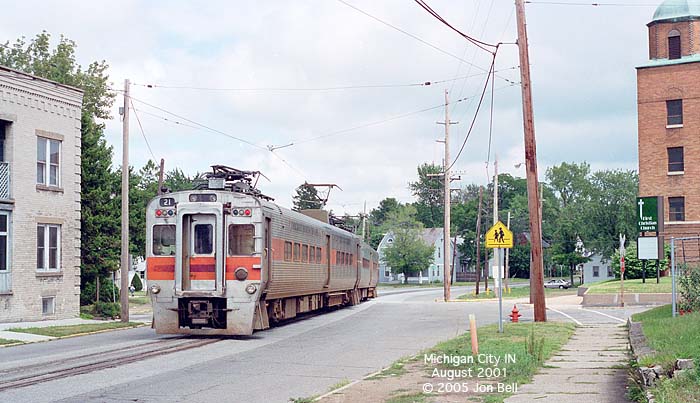
Between Gary and Chicago especially, the South Shore now feels like a suburban commuter railroad. But in Michigan City, trains still run down the middle of 10th and 11th Streets, and passengers still board electric interurban trains streetcar-style, the only place in the U.S. where this is still done. The eastern section of the line running from Michigan City to South Bend still has much of the flavor of the old rural Midwestern interurbans: a single-track line through meadows and cornfields.

From 1970 until 1992, the eastern end of the line was in the outskirts of South Bend, at a shabby concrete-block station shared with Amtrak, which uses a parallel freight line through South Bend. In 1992, the line was rerouted over a former industrial freight spur and some new trackage to the South Bend Regional Airport. The South Shore station is attached to the end of the airport terminal building, and part of the airport parking lot is set aside for railroad passengers.

Tech. stuff for light rail – The LR55 rail system
What is of interest is that the SkyTrain lobby decry any sort of LRT/streetcar installation on Broadway as catastrophic, yet tram tracks can be laid quite quickly, depending on the method used, in Nottingham, penalties were to applied against the contractor, if tram track installation were to directly affect merchants directly adjacent to the construction for more than 20 days. Susan Heyes & InTransit BC take note! It seems that planners in Vancouver and TransLink, still use the extremely old-fashioned, 19th century,Ai??Ai??tie & ballast method for streetcar installation, while ignoring developments abroad.
Not only is the LR55 rail method appropriate for Broadway or other streets in Vancouver, the LR55 could be used for the ‘Valley Interurban Project’, for on-street operations in Cloverdale, Langley, Abbotsford and Chilliwack!
The following is from NET, the New Edinburgh Tramways (NETCo) web site.
One of the major expenses of conventional tram projects is the track. This is laid on a concrete raft set under the road. In order to accomodate these rafts the underground services, like gas and water, have been diverted out of the way of the tracks. This process took a considerable amount of time and money in schemes like Manchester and Sheffield. In addition it caused disruption to inhabitants while taking place.
To avoid or reduce these problems NET proposes to use the revolutionary LR55 rail system. This is laid in the road structure itself so that there is little or no disturbance to underground services. Instead a slot is cut in the road and the track laid in. The track exploits the strength of existing highway pavements by transmitting the static and dynamic loads from the upper surface, rather than the foot of the rail as in conventional track. This results in the load on the railhead being distributed onto the sub-base of the highway, being of a sufficiently low value not to require a separate foundation. Up to 100m can be laid in a night.

The track system consists of three main components:-
LR55 RailThe rail carries the weight of the tram, steers the tram and is the return conductor for the electric power supply. The LR55 rail has a wide lip compared to conventional tram rail. This is to allow the road structure to carry the weight of the tram. The rail top surface and the trough unit are treated to provide a compatible skid resistance to the adjacent highway surface.Elastomeric GroutThis is a rubber like compound that prevents vibrations from the tram being transfered to the road and surroundings. Old fashioned trams used to rumble along the street as the tracks did not have this feature. Modern trams are very quiet because of features like this grout. It also insulates the electricity returning to the sub station, so that it does not travel through other cables buried in the road.Precast Trough UnitThis forms the base for the rail and connects it to the road structure. It is fitted into a slot cut into the road.
Track installation

Where there is a road base thicker than 225mm the Trough Unit is bedded into the base.

Where the road base is less than 225mm the Trough Unit is bedded onto the sub-base.
The track can also be laid in concrete pavements, older road construction and block paving. These are outlined in the technical specification for the track.
Should it be necessary to work on services crossing the tramway, the track is self-supporting over a distance of one metre. This allows access trenches to be dug without affecting the tram service. Safe methods of working have been developed to ensure the safety of tramway passengers and staff, as well as utility workers. These methods are already established in existing tram schemes.
There are further details of LR55 track at the LR55 web site.
For more information on LR55 for our more technical visitors:
Tech. stuff for light rail – Single track and interlaced operations
Since the proposed Interurban will run mainly on single track, with passing loops at strategic places, the following U-Tube video is instructive on the relative ease of single track operation. Of course single track operation is a lot cheaper than dual track (which can be added when demand warrants), construction and with an initial one hour headways, negates the need for more than double the investment.
[youtube=http://www.youtube.com/watch?v=jOTnmci9dJA]
Ai??
Hong Kong TramwayA?ai??i??ai???s, the wee trams (streetcars) that can!

The following is an updated version of the original January posting. The Hong Kong Tramway’s have reported an increase in ridership to about 280,000 passengers a day for 2008, showing that even little narrow gauge trams can carry large volumes of passengers for a fraction of the cost of a subway like RAV. So when the UBC SkyTrain lobby say “LRT can’t carry large volumes of ridership on Broadway“, just mention the Hong Kong Tramway!
Hong Kong TramwayA?ai??i??ai???s Ltd, which operate quaint narrow gauge double-deck tramcars on Hong KongA?ai??i??ai???s extremely busy streets give some insight on the ability of even the smallest trams (streetcars) to carry veryAi??Ai??high ridership. Hong Kong TramwayA?ai??i??ai???s Ltd. operates 163 double deck trams,Ai??Ai??running on 13 km (8 miles) long system, with a total track length of 30 km (18.6 miles), and it runs together with other vehicles on the street, carried an average of over 260,000 passenger a day in 2007!
So the next time a politician or a so-called transit planner claims that LRT/streetcar/trams do notAi??Ai??have the capacity or canA?ai??i??ai???t carry as much ridershipAi??Ai??as SkyTrain, just remind them of Hong KongA?ai??i??ai???s trams; the tramway that can!
The atmospheric railway, the original gadgetbahnen – With appologies to I. K. Brunel

The atmospheric railway can be said to be the first ‘gadgetbahnen’ as it was the first attempt to replace regular railway locomotives with atmospheric trains. On paper, the atmospheric railway was a sure winner but in revenue service a failure. What surprises myself is that this complicated transit mode ever worked at all, as the Dalkey atmospheric railway operated forAi??Ai??just overAi??Ai??a decade (29 March, 1844 to 12 April, 1854 !
Those who fail to read transportation history are doomed to repeat the same expensive mistakes!
The following is from Exeter Memories.com
Ai??Ai??http://www.exetermemories.co.uk/em/_events/atmospheric_railway.php
The concept behind an atmospheric or vacuum railway was simple. Instead of a conventional steam engine, the railway would have stationary engines at either end. A pipe ran down the middle of the rails, and the lead carriage had a piston head that fitted into this pipe. The engines would generate a vacuum in the pipe by use of suction, and the pressure change would pull the carriages from one end of the line to the other.
Theoretically this should produce a cost saving, as the engines need not move their own weight or carry fuel with them.
The Dalkey Railway
Brunel’s interest was probably peaked by the Dalkey railway in Ireland. A test for atmospheric pressure, the railway only used the pressure uphill with the downhill stretch powered by gravity.
The speeds it was capable of were highlighted in an incident. During a test, the motive carriage (the carriage with the piston) was not coupled to the train by accident. When the train was triggered it made the ascent in 1 minute fifteen seconds, at an average speed of eighty-four miles an hour. The terrified engineering student Frank Ebrington, who was the only passenger, was helped out at the far end unharmed but rather stunned. Mr. Ebrington could be considered, at the time,Ai??Ai??the fastest man in the world!
The problems with the concept
As Ebrington’s adventure proved, one of the other problems was that those in the train were being driven by people running an engine several miles away, with no idea of local conditions and at that time, no way to let them know of a problem. Also because of trains’ varying weights, the pressure needed would vary, and sometimes trains would stop short of the station or hit the buffers with a bone-rattling impact.
To drive this required huge steam engines. These would have been a fairly standard design, but Brunel was pushing the limits of engineering again, and there were frequent problems.
Creating the South Devon Railway
He persuaded the GWR board that the average life of a locomotive was only ten years, and that the stationary engines would last longer. This must not have sat well with Gooch, whose “North Star” engine worked for almost fifty years and eventually outlived the Broad Gauge rails it ran on. However since installing the pumping engines took longer than expected, Gooch’s engines ended up pulling the first trains on the rails.
Part of the problem was the length of the railway. The pipes for the centre all had to be of an exact diameter, with a slot running down them in exactly the same place. With Victorian methods this precision was not easy to achieve repeatedly over enough components to complete the route. The slots were sealed with overlapping pieces of leather to prevent the loss of pressure but permit the motive piston to pass through. At each joint the pipe rivets were reinforced with caulked yarn to prevent the air entering. Valves were needed at each station, level crossing, pumping station and more.
 Ai??Ai??
Water in the pipes from rain of condensation rotted leather and affected the seal. A breakdown in the pumping station prevented any train moving on the line, and the entire system depended on a perfect air-tight seal for miles. A nudged or misaligned valve and the trains came to a halt. In winter the leather seals in the slots froze solid.
By June 1848, the increased cost of coal, and maintenance, incurred a loss for the previous six months, of Ai??A?2,487. The actual running cost was more than 7 pence per mile higher than a locomotive hauled railway. Brunel discovered that each pumping engine required almost three times the power that he first calculated to exhaust the pipe, primarily due to leakage.
Plans were made to improve the system to prevent failure in the future and reduce running costs. A rubber valve was ordered, and the feasibility of galvanizing the valve was investigated, to prevent corrosion. The cost was estimated at Ai??A?1,160 per mile of some Ai??A?25,000 in total.
However, by August, the directors of the railway were becoming impatient with Brunel, and indeed, Brunel was becoming disillusioned with the project. Brunel had submitted a verbal report to the directors on 1 August when he outlined the difficulties so far encountered with the system. He considered that virtually the whole of the valve would need replacing, a job that would take a year, and that the underpowered pumping engines would need a good deal of work to upgrade them. As a consequence, he did not recommend that the atmospheric working be extended beyond Newton Abbot, and recommended that the expense of putting the system right could not be justified, unless Samuda would guarantee the works.
Closure
On 29 August, the Board of the South Devon Railway Company decided that atmospheric working would cease on the 9 September. From that date steam locomotives replaced the pumping houses, and the atmospheric equipment sold off. One pumping engine found its way to a lead mine near Ashburton, and some of the pipe was used to drain the marshes of Goodrington for the Dartmouth and Torbay Railway Company. The only reminder of Brunel’s Atmospheric Caper is the engine house at Starcross. Nothing can be found of the pumping houses at Turf and Countess Wear, although the Exeter St David’s pumping house had a water tower added to it before it was removed quite recently.
Brunel was heavily criticized by the board of the South Devon Railway, some of whom had questioned the fees that Brunel had negotiated. Brunel countered this charge by stating that he had reduced the fee for his workmen on the system, had not taken his own Ai??A?6,000 fee and had lost Ai??A?20,000 of his own money which had been invested in the venture.
Ai??Ai??

Sources – The South Devon Railway by R H Gregory, Exeter to Newton Abbot by Mitchell and Smith, and the Life of Isambard Kingdom Brunel by I Brunel (son of IKB)
Ai??Ai??
Why we built with LRT – first published in December 2008, updated August 17, 2009
The following was first published in December 2008 and is being reproduced here because of popular demand.

Ai??Ai??
What is Light Rail Transit or more commonly known as LRT?
According to the Light Rail Transit Association (www.lrta.org) Light rail is a mode that can deal economically with traffic flows of between 2,000 and 20,000 passengers per hour per direction, thus effectively bridging the gap between the maximum flow that can be dealt with using buses and the minimum that justifies a metro. But there is more, by track-sharing with existing railways on their rights-of-ways, means that LRT can effectively and affordably service less populated areas, with rail public transport.
Streetcars are also light rail, but operate on-street, in mixed traffic, with little or no signal priority at intersections. The main difference between LRT and a streetcar is the quality of rights-of-way, where a streetcar operates on-street, LRT operates on a reserved rights-of-way or a route that is reserved for the sole purpose of the light rail vehicle. An excellent example for a reserved rights-of-way is the Arbutus Corridor. Ai??Ai??A reserved rights-of-way can be as simple as a HOV lane with rails, to a lawned park like route with trees, hedges and flowerbeds.
LRT, in itA?ai??i??ai???s various forms is used in over 600 cities around the world and is the first choice of transit planners for affordable, customer friendly public transport. The German city of Karlsruhe (City population 275,285) has taken light rail to a new standard, by track sharing with mainline railways and operating, what is called tramtrains. In Karlsruhe, one can board a tram, on-street, on the pavement and alight, on-street in Ohringen some 210km (130 mile) later, with the tram acting as a streetcar, light rail vehicle and a passenger train! KarlsruheA?ai??i??ai???s light rail network now extends over 400 km. (250+ mile) of route, servicing scores of small towns and villages with high quality public transit at very little cost simply because the tram can use existing railway tracks.
This new form of light rail is now called TramTrain and is used in over 10 cities around the world and is being planned for, in almost 20 more.
In British Columbia, TramTrain can be a useful tool for implementing a high quality A?ai??i??E?railA?ai??i??ai??? transit service, not only in Vancouver and the Fraser Valley, but in Victoria (E & N Railway) and the Kelowna/Vernon rail corridor as well. The question is: Why does TransLink and the BC government reject modern LRT out of hand and continue to build with dated SkyTrain light metro?
The last of the interurbans #2 – Mason City, Iowa: Iowa Traction Railroad
The following is from Jon Bell’s web site. Jon Bell is anAi??Ai??Associate Professor Department of Physics and Computer ScienceAi??Ai??Presbyterian CollegeAi??Ai??Clinton, South Carolina 29325 USA

Although the Iowa Traction Railroad (IATR) hasn’t carried passengers since 1936, I’ve included it on this site because it is a link to a mode of electric passenger transport that was once common in the United States, especially in the Midwest (basically the region extending from Ohio westward to Iowa). The IATR is one of the last surviving electric interurban railroads in the U. S., and the only one that still uses electric locomotives to haul freight in regular service. (The East Troy Electric Railroad in Wisconsin also hauls freight, but only occasionally, on demand.)
The IATR extends about ten miles from Mason City westward to Clear Lake, running mostly as a single-track line next to the north side of Cerro Gordo county road B35 (19th Street SW in Mason City). A half-mile branch in Mason City connects it to the Iowa, Chicago & Eastern Railroad which runs parallel to the north. It also connects to the Union Pacific Railroad via a short interchange track at a crossing with that railroad. The IATR’s office and shops are at the hamlet of Emery, about halfway between Mason City and Clear Lake on road B35.
The IATR began life as the Mason City & Clear Lake Railway on 4 July 1897. At first, it did good business carrying passengers to the resort town of Clear Lake, who arrived in Mason City on steam railroads. It even carried passenger cars switched from those railroads, to provide a one-seat ride. As automobiles became common, this traffic decreased, and passenger service ended in 1936.

However, like several other Iowa interurbans (and unlike most interurbans elsewhere), the MC&CL had a solid base of freight traffic, switching carload freight between steam (later diesel) railroads and online customers. In 1950, new owners changed the name from “Railway” to “Railroad.” In 1961, the line changed hands again and was renamed the Iowa Terminal Railroad (ITR). The ITR acquired another nearby interurban, the Charles City Western Railway, which ended electric operations in 1968 after a tornado destroyed much of the overhead wire, and was abandoned completely some years later. Finally, in 1987 the remaining ex-MC&CL line was sold one more time, to David Johnson, its present owner, who gave it its present name.
The current working equipment consists of four small electric “steeplecab” locomotives built 1917-1923 by the Baldwin-Westinghouse partnership. The IATR’s predecessors acquired them secondhand from other interurban railroads. I think these are the only locomotives of their type that still “work for a living,” and are not part of a museum operation.
http://web.presby.edu/~jtbell/transit/MasonCity/
From Charlie Smith & The Georgia Straight – Canada Line subsidy will be felt for years to come

Charlie Smith of the Georgia Straight is probably the regions best reporter on transit issues as he has researched SkyTrain and all other transit issues for almost two decades and his insight to RAV andAi??Ai??SkyTrain issues clearly demonstrate this. What is not mentioned is that RAV will drain money away from the bus system, simply because TransLink will skim bus fares as RAV fares. In the real world of transit operations, when transit customers transfer from bus to metro or LRT, the fare is apportioned between the modes. Example if a $4.00 fare is paid and the transit customer uses bus then transfers to metro/LRT, the $4.00 fare is apportioned $2.00 for bus and $2.00 for metro/LRT. If the transit customer transfers once again tom a bus the apportioned fare should be $2.66 for buses and $1.34 for metro.
TransLink doesn’t apportion fares but collects fares in one pot and will give RAV the full fare, leaving the buses short. The same trick is used on SkyTrain, where 80% of SkyTrain ridership first take a bus to the metro, andAi??Ai??has hobbled the bus system, creating large deficits, while at the same time TransLink makes the claim that SkyTrain fares are covering operating costs. One wonders how a subsidizedAi??Ai??metro system can claim that itAi??Ai??pays its operating costs, when in fact it is subsidized?
The present SkyTrain system is subsidized by over $200 million annually and no doubt the RAV line will also be subsidized for the lifetime of the metro system.
Canada Line subsidy will be felt for years to come
By Charlie Smith
The 19-kiliometre Canada Line will open with great political fanfare on Monday (August 17).
The public will be allowed to ride for free from 1 p.m. to 9 p.m. on the line, which runs from Waterfront Station to Richmond Centre and to the airport.
But that’s when the free ride will end. TransLink has already acknowledged that it might takeAi??Ai??until 2013Ai??Ai??before the Canada Line generates 100,000 riders per day.
AndAi??Ai??that could beAi??Ai??bad news for taxpayers and transit riders.
InTransit B.C. Limited Partnership, which is the private operator, has signed a 35-year deal with TransLink. And TransLink has guaranteed to subsidize Canada Line ridership shortfalls of less than 100,000 per day.
If TransLink, as a publicly funded body, wants to maintain public trust, it should report this subsidy on a quarterly basis.
TransLink is seeking an additional $450 million per year to enhance the transportation system.Ai??Ai??If it gets its wish, thereAi??Ai??will be new vehicle-registration chargesAi??Ai??as well asAi??Ai??tolls on Metro Vancouver bridges, including those connecting Vancouver to the North Shore.
TransLink had better hope that the peak-oil theorists are wrong. Because if they’re correct, it will hit the transportation authority in three ways:
* Airport traffic will diminish, reducing ridership on the Canada Line.
* Rising fuel prices will cause people to curtail driving, which will reduce the amount of fuel taxes (12 cents a litre) rolling into TransLink’s coffers.
* Fewer people will be driving over tolled bridges including the Golden Ears Bridge. In the latter case, TransLink will have to offset this by providing greater subsidies to the private operator, just like it will do with the Canada Line if airport traffic diminishes.
The Canada Line is a primary reason whyAi??Ai??TransLink is in a financial pinch. I can recall two municipal politicians–Vision Vancouver Coun. Raymond Louie and former North Vancouver City mayor Barbara Sharp–voting in favour of the line in 2004 after a motion passed calling for a $1.35-billion cap on public financing.
The $1.35-billion figure is obviousAi??Ai??fiction after the operating subsidies are included in the equation.
Louie and Sharp cavedAi??Ai??in the face ofAi??Ai??pressure from the Vancouver Board of Trade, the Vancouver Sun editorial board, the Vancouver Airport Authority, and the provincial and federalAi??Ai??governments, which all wanted the line built.
If drivers, homeowners, and transit riders all end up payingAi??Ai??a great deal more in the coming years, they can lay part of the blame on Louie and Sharp.
But they weren’t the only TransLink directors responsible. Senator Larry Campbell, former SurreyAi??Ai??mayor Doug McCallum, Surrey councillor Marvin Hunt, former Langley City mayor Marlene Grinnell, Richmond mayor Malcom Brodie, and former Coquitlam mayor Jon Kingsbury all voted in favour of the Canada Line.Ai??Ai??
It’s worth noting that LarryAi??Ai??Campbell’s friend, SFU criminologist Neil Boyd, cast the deciding vote at the regional board in favour of a $4-billion plan that helped finance TransLink’s contribution. At the time, Boyd represented Bowen Island on the regional board.
If the Bowen Island council had left the then-mayor Lisa Barrett on the board, the transportation plan likely would never have been passed because Barrett was a staunch opponent of building the Canada LineAi??Ai??as a P3 project. Barrett, now a Bowen Island councillor, also didn’t believe the earlyAi??Ai??forecasts that 100,000 people would be riding the Canada Line in 2009.
Because of a seeminglyAi??Ai??insignificant decision–replacing a regional board director in a tinyAi??Ai??island municipality that had one vote at Metro Vancouver–the public might end up paying much higher transportation costs in the future.
http://www.straight.com/article-247732/canada-line-subsidy-will-be-felt-years-come



Recent Comments