An agreement that protects passenger rail rights in the Fraser Valley is set to expire this summer and Langley Township Mayor, Rick Green is calling for its urgent renewal.
The Master Agreement is between BC Hydro, who owns the right of way, and Canadian Pacific Railway (CPR), whom bought the tracks and the right to run trains along them.
Green says the agreementA?ai??i??ai???s renewal is critical because it guarantees the province, operating through BC Hydro, the right to run passenger service through the Pratt-Livingston Corridor, a stretch of the former interurban line between Surrey and Langley.
GreenA?ai??i??ai???s unearthing of 1988 Master Agreement comes at a time when the South Fraser region is looking to the province to provide more public transit options, with many calling for the establishment of a light-rail system along the old interurban tracks.
“Green is very wise to make that agreement public,” said Malcolm Johnston, a member of the Rail for the Valley advocacy group, which is lobbying the province to take advantage of existing rail infrastructure to upgrade the public transit system.
“This is a good thing for citizens because it establishes the ownership of rights of way and protects the statutory right of running light-rail,” Johnston said.
Though Green would not say how he obtained the confidential 1988 document, which reserves 33 per cent of traffic on the line for crown use, he released a memorandum yesterday encouraging local MLA candidates to support its renewal and commit to light-rail through the region.
Langley NDP candidate, Kathleen Stephany, said Wednesday that she supports the agreementA?ai??i??ai???s renewal and affirmed her commitment to light-rail.
“Because we stand for a comprehensive light-rail transit system for the South Fraser region, we will be very interested in any options that become available to us, including crown use of the interurban corridor and the Canadian Pacific Railway rails through Langley.”
In a joint statement released Wednesday, both local incumbent B.C. Liberal candidates, Rich Coleman and Mary Polak, announced that they also support GreenA?ai??i??ai???s request to renew the agreement, though the LiberalsA?ai??i??ai??? commitment to light-rail remains uncertain.
The party is currently undertaking a $400,000 study, which looks at transit options for the Fraser Valley, though nowhere in the LiberalsA?ai??i??ai??? platform is the light-rail option mentioned.
A?ai??i??Ai??It is important that we keep all of our transit infrastructure options open as we pursue our Fraser Valley transit study,A?ai??i??A? said Coleman, Minister of Housing and Social Development and the Liberal candidate for Fort Langley-Aldergrove.
Johnston says that while political support for the Master AgreementA?ai??i??ai???s renewal represents a positive step for passenger rail rights, he remains sceptical of the partiesA?ai??i??ai??? commitment to light-rail.
“The agreement is obviously important, but IA?ai??i??ai???m not confident that this will change anything, not with the Liberals in power or the NDP in power,” said Johnston.
“They have to pay lip service to the agreement because it would be foolish not to, but when it comes to political parties, thereA?ai??i??ai???s a big difference between what they say and what they do.”
Green hopes that BC Hydro will renew the Master Agreement for a further 21-years and said Wednesday that he “would be very hard pressed to believe that they would not renew it.”
To College, by Interurban?
The following article from the Light Rail now folks has some valuable lessons for those advocating for the Vancouver to Chilliwack Interurban. The following universities and colleges would be potential destinations for students: BCIT, Simon Fraser University, Kwantlen College (Cloverdale and Langley campuses), Trinity Western University, and the University of the Fraser Valley (Chilliwack Campus). Students attending these places of higher education, alone, could support a 30 minute Vancouver to Chilliwack Interurban service. Something to think about Mr. Falcon!

University Station in Denver Colorado. The Valley Interurban stations would be much smaller in scale.
Light Rail Now! NewsLog
20 March 2009Salt Lake: One-third of campus travel via light rail
In Salt Lake City, detractors of public transportation almost always with the aim of disparaging the impact of rail transit like to contend that public transit ridership is basically irrelevant in urban areas. To argue this, they often compare the ridership of a relatively weak transit system, or a single rail system, with virtually all the street and highway traffic of a huge region, typically much of which is outside the transit service area.
In reality, public transit in major urban areas tends to be a true workhorse, carrying much of the traffic load into concentrated, highly congested areas.
An excellent case in point would seem to be one of Salt Lake City’s TRAX light rail transit (LRT) lines that serves the University of Utah. Although TRAX ridership has somewhat “leveled off” since motor fuel prices dropped from the $4.50-per-gallon levels of last fall, an article in the Salt Lake Tribune (2009/02/16) reports that approximately 45,000 travelers a week ride the LRT systemAi??Ai?? representing 33% of total travel to the campus.
That means that even with the cost of using a car lower, and ridership down fully one-third of trips to the campus are handled by the Utah Transit Authority’s light rail service. That’s a relatively huge number of trips that would otherwise mean more private motor vehicles clogging streets and highways, and contending with one another for scarce parking … and a lot less pressure on the university administration to devote valuable real estate to providing more parking facilities.
So much for the “irrelevance” of rail transit at least in Salt Lake City.
Is LRT becoming the new Light-Metro?
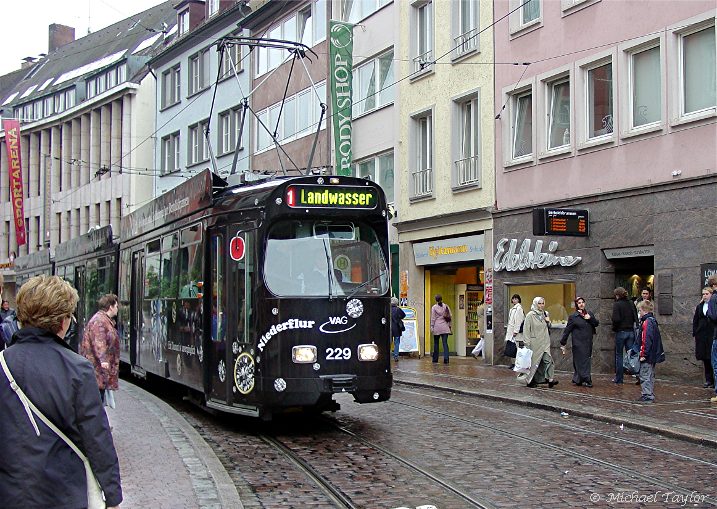
A metre gauge tram in Germany is still considered LRT.
Since theAi??Ai??early 1970’s, the term LRT or light rail transit, has been in common use describing streetcar or interurban type rail transit. The first generation of modern LRT were German ‘Stadtbahn’ (City railway) style of tram, generally articulated and heavier built than trams or streetcars of the age. The first generation of North American LRT lines used the Duewag orAi??Ai??Siemens, BN of Belgium, nowAi??Ai??Bombardier Inc.,Ai??Ai??licensed built versions of ubiquitous ‘U-2’s’. These vehicles acted both as a streetcar and as an interurban, proving very successful in operation in cities including San Diego, Portland, Calgary and Edmonton. The original concept of LRT was build it cheap and build lots and it will be successful and LRT was.
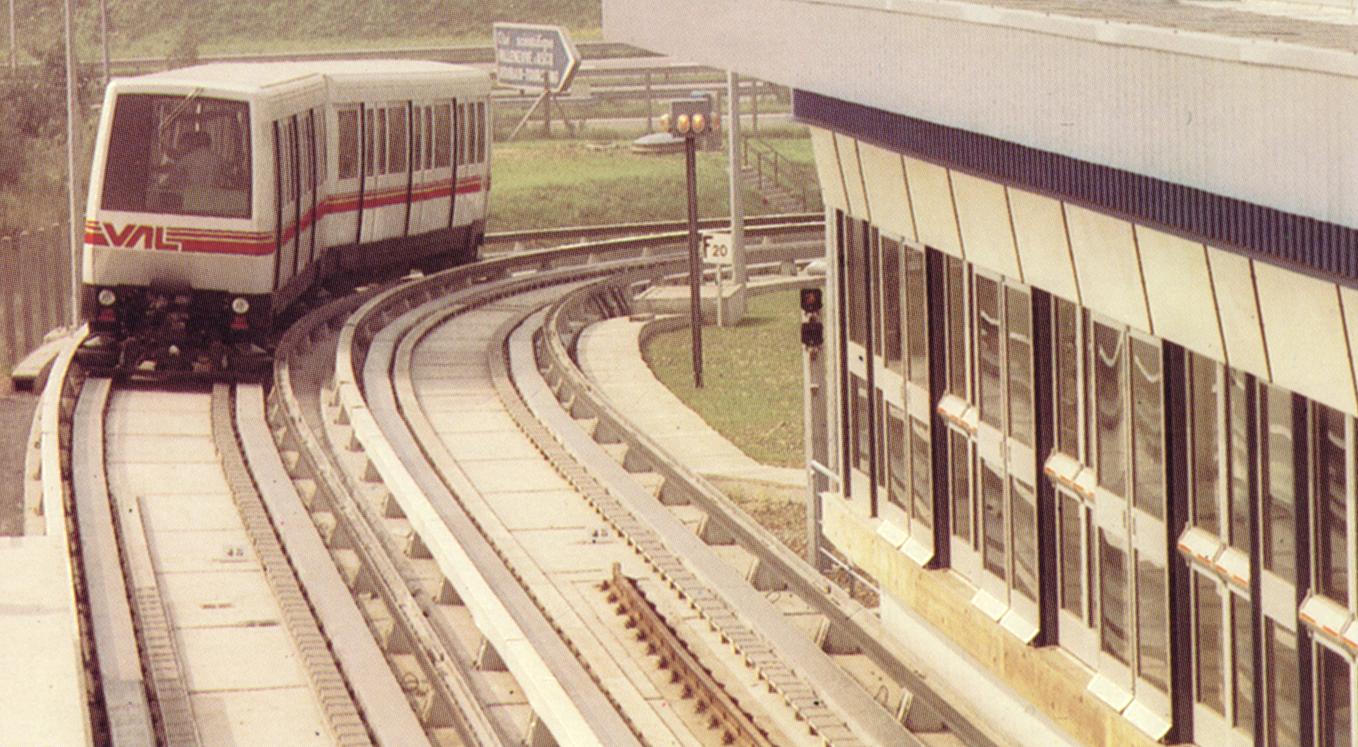
Lille VAL light-metro.
During the same period, several proprietary transit systems were developed includingAi??Ai??Ontario’s Urban Transportation Development Corporation (UTDC) ICTS andAi??Ai??France’s MATRA VAL system. These proprietary transit systems wereAi??Ai??labeled Intermediate Capacity Transportation Systems (ICTS) or simply ‘light-metro’; though poor sales led the UTDC to rename SkyTrain ALRT or Advanced Light Rail TransitAi??Ai??in the late 70’s. ICTS was supposed to bridge the gap of what a streetcar could carry and thatAi??Ai??which would justify a full fledged metro, but ended up costing as much as a heavy-rail metro, while having the same potential capacity of LRT. ICTS was designed to be elevated as speed of a transit system was the ‘flavour of the month’Ai??Ai??and thought essential for a successful transit system. Sadly for the companies developing and marketing ICTS or light-metro, LRT and with articulated cars, priority signaling at intersections, and the concept of the reserved rights-of-way,Ai??Ai?? proved superior to its much more expensive light-metro cousin. Light-metro became another dead branch on the tree of railway evolution.
The legacy of ICTS or light-metro lives on and despite overwhelming evidence that there is little benefit of very expensive grade separated transit systems, much political, bureaucratic, and academic prestige is still wedded to the notion that speedAi??Ai??trumps all for a successfulAi??Ai??transit system. To increase the commercial speed of a transit system, the number of stations per route km. must be reduced. Thus light-metro systems have one half to one third the stations or stops than a comparable LRT system.
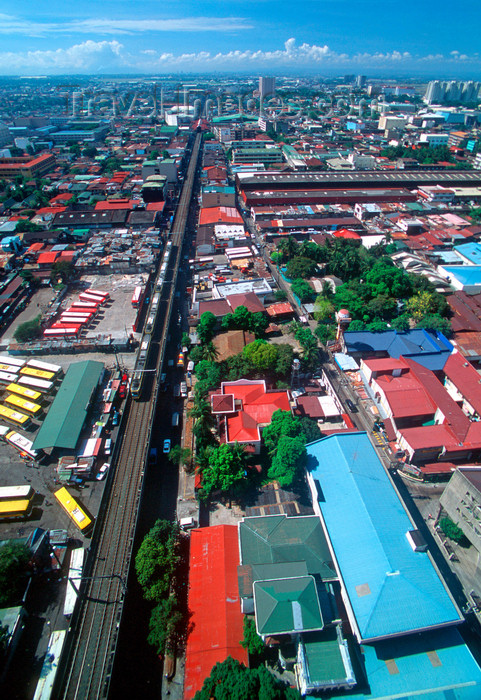
With 4-car trains and carrying over 500,000 passengers a day, Manilla’s LRT systems justifies the need for grade separation.
Grade separation of a transit lineAi??Ai??is very expensive and propels LRT into the category of light-metro, complete with its failings. Of course, when ridership demand, such as Manila, or Kuala Lumpor is very high, thenAi??Ai??it’s quite right to build LRT as a light metro;Ai??Ai??yet operating as a light-metro, the elevated (or underground) light-rail still maintains the ability to operate on much cheaper, at-grade rights-of-ways.
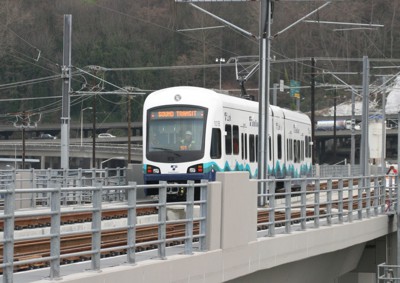
Seattle’s new LRT has more in common with light-metro, than light-rail.
There is a disturbing trend in North America to build LRT on miles of viaduct or tunnels (subways), with SeattleAi??Ai??being a good example ofAi??Ai??masquerading light-metro as light-rail! The result is aAi??Ai??very expensive transit system, which despite their much higher costs, will attract the same or fewer passengers than at-grade LRT. Many planners have blurred the definition of LRT andAi??Ai??plan for light-metro,Ai??Ai??while still calling it LRT, with TransLink’s Evergreen line light-rail proposals being a good example. More confusion is sewn, by calling ‘rail’ transit systemsAi??Ai??theAi??Ai??meaningless ‘rapid transit’ or ‘mass transit’, which do not define transitAi??Ai??mode at all.
Why?
There are several reasons:
- Because the huge sums involved, politicians turn light-rail projects into make work mega-projects, spreading the taxpayers money to many more politically friendly companies and organizations.
- Local officials desperate for funding, try to fool more frugal Senior governments by building a politically prestigiousAi??Ai??metroAi??Ai??by calling it LRT.
- The auto lobby wants all transit up in the air, out of sight, leaving the roads for cars.
- Land next to light metro lines tends to be rezoned for higher densities, giving windfall profits to landowners.
- Transit bureaucrats can hire more employees with light-metro, enhancing their departmentalAi??Ai??’prestige’.
- Planners do not understand the difference between metro, light-metro, and light-rail and lump them togetherAi??Ai??as ‘rapid transit’.
Despite the much higher cost of light-metro, there is little evidence of superior operation. Cities that build hugely expensive light-metro and/or LRT built as light-metro, tend to have smaller networksAi??Ai??with higher operating costs. Higher transit costs means new taxes must be found (carbon tax?) to fund the light-metro and taxes curbs the appetite for ‘rail’ transit expansion. Smaller ‘rail’ systems mean a much smaller modal shift from car to transit and in the time of global warming and peak oil, one wants to get the biggest bang for their transit buck.
In the U.S.A., planners now consider LRT as a variant of a metro and what once was called LRT, is now being labeled fast streetcar! In Europe, a tram can be the simplest of streetcar or a commuter train (Karlsruhe’s Two-system LRT).Ai??Ai??Ai??Ai??A dichotomy has appeared; in Europe transit planners strive to simplify and reduce costs of LRT, while in North America planners do the opposite, making LRT far more complicated and expensive than it need be!Ai??Ai??
Have American and Canadian transit planners lost their way?
One wonders ifAi??Ai??transit planners should get back to the basics and again plan for user and taxpayer friendly transit systems that were so popular, successful,Ai??Ai??and affordableAi??Ai??thirty yearsAi??Ai??ago.Ai??Ai??Maybe the old adage: “if it ain’t broke don’t fix it!” should be remembered by those advocating turning LRT into a metro.
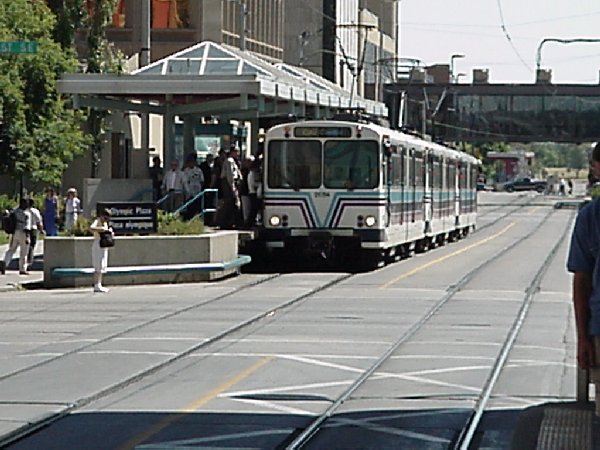
Calgary’s C-Train LRT in the transit mall. 90% of the line is at-grade.
New Hope For-Light Rail Folks ~ Brian Lewis, May 17, 2009 Province
New hope for light-rail folks
Ai??Ai??
Brian Lewis has done some research on the ‘Interurban’ project and has written another interesting and supportive article.
Discovery of a long-forgotten legal document is giving new hope to advocates for re-establishing passenger rail service in the Fraser Valley.
It’s a 21-year-old Master Agreement between B.C. Hydro and Canadian Pacific. The Township of Langley says it discloses for the first time that the B.C. government, not the railway, holds the legal rights to run passenger-rail services on a section of the old Interurban line through Langley Township and the City of Langley.
As the original owner of the Interurban service that ran from Vancouver through Surrey, Langley and Abbotsford to Chilliwack until the early 1950s, B.C. Hydro and the provincial government maintained title to the entire right-of-way, even though above-ground rail assets on the section through Langley — known as the Pratt-Livingstone Corridor — were sold to CP for its service to Deltaport.
In effect, says Langley Township Mayor Rick Green, not only does the deal mean that CP must allow passenger-rail service on its freight line, but that it must allow that service to run at no charge. This, the mayor adds, means that the economics for establishing some form of light-rail transit on the old Interurban would be enhanced considerably, unlike the West Coast Express north of the Fraser River, which pays significant fees to CP for use of those tracks.
“Our provincial government of the day deserves an abundance of credit in its efforts to protect the public’s right to passenger transportation on the Pratt-Livingston Corridor, a right previously thought not to exist,” Green adds. And the mayor says the agreement’s requirement on passenger service may also check growth in additional freight rail traffic that carries containers and coal exports through Langley if future expansions of Deltaport are completed.
The mayor says 18 heavy freight trains now run through Langley daily, but if Deltaport’s full expansion proceeds that could increase to as many as 90 trains per day. “You can’t build a healthy community under those circumstances and anyone who wouldn’t stand up and fight against that must have something wrong with them,” he adds.
Green also sees the agreement as a key to advancing establishment of rapid-rail transit in the Fraser Valley.
He says that given discovery of the agreement, the township will now ask the Fraser Valley Heritage Railway Society to expand its planned 2010 Heritage Rail Demonstration Project, which will utilize a refurbished Interurban heritage car to run a tourist service from Sullivan Station in Surrey to Cloverdale. Green wants this pilot service to extend into the township’s Milner area, where a heritage Interurban station would be constructed.
However, before any of this happens the Master Agreement must be renewed; it expires Aug. 29. The township is now seeking assurances from B.C. Hydro that it will renew the agreement in full with the railway. “Our legal team is reviewing the agreement right now and we definitely support the preservation of passenger-rail rights on the corridor,” says Hydro spokesman Dag Sharman.
As for CP, it’s being tight-lipped. “We haven’t seen the township’s analysis or its legal opinions,” says spokesman Mike LoVecchio. “At this stage, in our view whatever they’re saying is speculative.”
Stay tuned.
Track facts – Modern light-rail track

The recently built tramtrain line in Heilbron Germany
There has been much debate about the cost of track laying and the cost for new tracks for light rail or streetcars. The following will hopefully shed some light on how modern LRT (streetcar) tracks are laid on-street. With the interurban, of course, the majority of the route will be shared with other railways and the costs would be to upgrade existing tracks (relaying) and adjustments to switches. Portland Ore. give good insight on modern track laying principles.
The Portland streetcar is laid with girder rail, set in concrete, which is sturdy enough to handle the larger MAX LRV’s. The main problem is that the streetcar line has tighter turning radius, which the larger LRV’s can’t negotiate.
The continuedAi??Ai??nonsense about relocating utilities has more to do renewing utilities on the back of light rail construction, and making work for municipal employees than anything else.
Many alignments of new LRT systems are increasingly placed in public thoroughfare rights-of-way (on-street). For example:
Ai??Ai?? Portland A?ai??i??ai??? over 28%
Ai??Ai?? Sacramento A?ai??i??ai??? nearly 23%
Ai??Ai?? San Jose A?ai??i??ai??? nearly 56%
Ai??Ai?? Dallas A?ai??i??ai??? over 20%
Ai??Ai?? Salt Lake City A?ai??i??ai??? nearly 19%
Ai??Ai?? Tacoma A?ai??i??ai??? 100%
Ai??Ai?? Houston A?ai??i??ai??? 100%
Ai??Ai?? Minneapolis A?ai??i??ai??? nearly 22%
Ai??Ai?? Phoenix (planned) A?ai??i??ai??? over 95%
Ai??Ai?? Seattle (planned) A?ai??i??ai??? over 32%
As much as possible, construction methods and practices which have significant potential for lowering costs should be considered. For example, in the case of the Portland Streetcar, the shallow-slab construction method (see Figure 3) proved to be a major cost-saving technique for in-street construction. Instead of digging three and four feet deep, disrupting utilities, and rebuilding much of the street in the process, builders use a quick “cut and cover” European-style track system that goes down between 12 and 18 inches and is 6 to 7 feet wide. A pad is laid down, followed by a light layer of gravel, and then a special dual rebar side frame is laid into this shallow trench.
Each running rail is encased in a “rubber extrusion rail boot” to provide electrical isolation as a corrosion control measure. This covers the rail entirely wherever there is ground contact, and is then attached to the specially shaped rebar frame with dielectric fasteners. The boot also provides some basic level of noise/vibration attenuation. The boot-encased rails are held only by the concrete between anchor plate assemblies, which are placed at 3.0-meter intervals on straight track and broad curves, or at 1.5-meter intervals on curves sharper than 300 meters in radius. The fastener assemblies remain separated from the running rails by the rubber boots to maintain electrical isolation of the rails. There are no gauge bars.
A major advantage is the minimization of subsurface utilities relocation. Instead, a kind of “bridge” (the slab, carrying the guidance rails) is installed over utilities. This enables utilities workers to make an adjacent excavation, as necessary, to access under-street utilities for repairs or other servicing.
Slab depths are 300 mm (about 12 in) for the RI 52 girder rail used on streetcar construction for cars weighing about 30 tons empty, and 360 mm (14 inches) for RI 59 girder rail used where streetcar and “interurban” tracks cross. Prudent planning would suggest designing and building for future use of heavier, interurban-type vehicles, since these might ultimately be needed if the original system is successful. It’s far more difficult to upgrade under-designed trackage than to upgrade stations and procure larger vehicles. To accommodate the possibility of heavier, “interurban”-style LRT in the future, a slab depth of 18 inchesAi??Ai??is sufficient. If the design of the rail line is to be in a raised median, then a depth of 12 inches can be maintained, with the slab, rising in a media, six inches above the roadway.
Seems a whole lot simpler and cheaper than tearing up entire streets and moving utilities, but then, this is exactly what the SkyTrain lobby wants!
Debunking the SkyTrain myth – Part 2
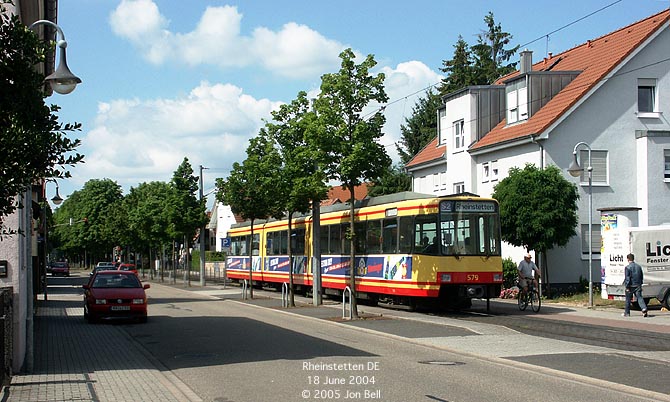
A tramtrain traveling through a village near Karlsruhe Germany.
The “Debunking the SkyTrain myth. Rail for the Valley answers the UBC SkyTrain Lobby”Ai??Ai??, post……..
…….has become the most readAi??Ai?? and commented one to date, yet no one with the SkyTrain lobby has posted a credible reply. On the various SkyTrain blog sites, the one term used over and over is “cherry-picking” and how the LRT supporters cherry pick the best about modern LRT when they comment about SkyTrain. This argument is pathetic and certainly demonstrates a lack of knowledge about light rail, SkyTrain, and public transit as a whole!
What is forgotten by the various supporters of SkyTrain, is that it is a proprietary light-metroAi??Ai??whichAi??Ai??was made obsolete by light-rail/LRT in the early 90’s. Light-metro had little advantage over LRT and cost a whole lot more to build and operate.Ai??Ai??As one could build up to ten times more light-rail for the cost of one light-metro line, the writing was on the wall so to speak for the mode.Ai??Ai??Ai??Ai??The RAV/Canada line is testament to the fact light-metro is obsolete, RAV being a regular heavy-rail metro was cheaper to build than SkyTrain light-metro! No wonder the mode disappeared into obsolescence. As SkyTrain is a proprietary (not compatible with other transit modes)Ai??Ai??light-metro, the owner, Bombardier Inc., continue to sell the mode today as a prestigious airport people mover and not an urban transit system. Unless a transit system has routes with traffic flows in excess of 500,000 passengers a day, there is no economic case to build a subway.
Light-rail is a generic transit mode and adheres to the basic operational capabilities obtained by other systems, it all interchangeable. Speed of a light rail vehicle is based on motor size; commercial speed of a LRT line is based on the quality of rights-of-ways and station or stop spacing; capacity of a transit system is a function of headway; the industry standard for LRT climbing grades is 8%, with more powerful vehicles able to climb 10% gradesAi??Ai??and so on. Light rail operating on a reserved rights-of-ways or routes reserved strictly for trams (the Arbutus Corridor is an excellent example of a reserved rights-of-ways) was found to bring a slightly superior service than light-metro, at a far cheaper cost! Except for Vancouver, no other city in the world uses the existing six SkyTrain installations solely for urban transportation. The SkyTrain lobby would have us think otherwise.
The following are general facts about modern LRT, not cherry-picked, that the SkyTrain lobby, wish the general public not to know.
- A twined tracked LRT line has the ability to carry over 20,000 persons per hour per direction.
- A light rail vehicle has a passenger capacity, based on the industry standard of all seat taken andAi??Ai??4 persons per metre/sq., depending on size of vehicle, range from 95 persons to 350 persons, depending on the size of vehicle. (Note:Ai??Ai??The SkyTrain lobbyAi??Ai??uses capacity formulas of all seats taken and standing passengers at 6 or 8 persons per metre/sq.!)
- LRT or streetcar, operating on-street, with no reservation and no preemptive signaling is still about 10% faster than a bus on the same route.
- OneAi??Ai??light rail vehicle (1 driver) is as efficient as six to eight buses (6 to 8 bus drivers).
- On-street LRT (streetcar) can be built for under $10 million/km. (not including vehicles), what drives up prices is needless add-ons, strictly for political or bureaucratic reasons!
- It is not speed that attracts customers to transit, rather it is the overall ambiance of the system including ease of use, ease of ticketing, vehicle comfort (seating) and the seamless or no transfer journey.
- Modern light-rail has a proven ability to attract the motorist from the car, where 20% to 30% modal shifts, car to LRT, are common on new systems. SkyTrain’s claimed high ridership is based on Translink management cascading every bus and bus rider it can onto the metro!
It is no great feat that a simple tram line in Hong Kong carries over 260,000 a day, or a modern LRT line in the same city carries over 25,000 pphpd in the peak hours. Yet the SkyTrain lobby bang the drums and shouts great things if SkyTrain achieves anything close to what modern LRT does in every day service. The LRT types do notAi??Ai??cherry-pick statistics, ratherAi??Ai??state operational facts that pertain to light rail.
Quoting Gerald Fox, a well respected American transit expert about SkyTrain, “……anyway, most of the world has moved on.” It’s time the SkyTrain lobby do to!
Extracts from The Regional Transport Strategy role of Tramways & Light Rail (UK)
The following give some insight how real transit planning is done and shows that health benefits should be calculated into new light rail cost analysis. Alas, for the SkyTrain lobby, with 80% of its ridership first taking buses to the metro, creates more pollution that new LRT replacing buses!
1 1. Health Impact of Airborne Pollutants
Evidence has now emerged which confirms that the long-term effects of particle air pollution are considerably more significant in damaging Public Health than heart disease.
The Committee on the Medical Effects of Air Pollutants Report published May 2001, considers that the total effect of long-term exposure on life expectancy for the whole population is about 10 times greater than that estimated for the short-term effects of Air Pollution. The Committee emphasized that although long-term health effects were larger than the short-term effects, there were more uncertainties in these calculations. More people die from respiratory disease in the UK than from coronary heart disease or cancer. In fact the UK has one of the highest death rates from respiratory disease in Europe. Death rates are nearly twice the EU average and well above the European average. A?ai??i??Ai??A significant number of deaths can now without doubt be attributed to transport; mainly tail-pipe emissions, road, brake & tyre wear related air born pollutants.A?ai??i??A? British Thoracic Society Report 2001 The relative burden of respiratory illness & death in the UK is increasing as the burden of heart disease decreases. Respiratory diseases are now killing one in four. The health impacts of pollutants are not just only restricted to individuals afflicted by respiratory disease but contribute to a whole range of other illnesses such as heart problems, liver disorder etc.
Ai??Ai??
The benefits of the tram in this arena alone, to the wider community and the nation are tremendous and should be included by Government when calculating the Cost Benefit Ratio(CBR). Currently they are excluded as is clearly demonstrated in the latest Light Rail Guidance Dec 2006 from DfT. A year-on-year reduction of demands on the National Health Service, by reducing the major respiratory demands on beds will reduce in simple terms the cost to the community. A case could be argued for allocating funds from NHS budgets towards tram schemes. This pump priming would free up NHS resources at a local and national level over the cumulative generational lifecycle of the tramway for the overall benefit of the community.
12. Health Consequences of Pollution and Congestion
Ai??Ai??
The health evidence now available when the present Air Quality Strategy Objective for particles was set focused primarily on acute health effects. Medical evidence is now emerging which suggests that the long-term effects of particle air pollution (PM 2.5 to PM 1 0s) are considerably more significant. In simple terms PMs are products of combustion soot etc.
In its report published in May 2001, the Committee on the Medical Effects of Air Pollutants considers that the total effect of long-term exposure on life expectancy for the whole population is about 10 times greater than that estimated for the short-term effects.
Ai??Ai??
The Committee emphasised that although long-term effects were larger than those in the short-term, there were more uncertainties in these calculations. A significant number of deaths (between 25% – 40% (depending on which government figures are used) can now, without the slightest doubt, be attributed to transport related pollution. The relative burden of respiratory in the UK is increasing as the burden of heart disease decreases.
1 3. Health Impacts A?ai??i??ai??? Costs to the Community
Ai??Ai??
It is not just individuals afflicted by respiratory disease who are impacted by this kind of pollution. There is a whole range of other related illnesses such as heart problems, liver disorder that are also caused by this kind of pollution. The rising level of stress (that can be seen every day in road-rage incidents) is contributing to the lowering of the quality of life for everyone. Direct annual health costs to the UK are enormous. UK health consultations in respiratory disease by General Practice (Local doctors) were over 38 million. Three quarters (76%) are consultations with a GP at the practice-base, around one fifth (22%) are with a GP at the patientA?ai??i??ai???s home, the remaining 2% are with a nurse (either at home or at a practice). Overall Inpatient hospital treatment exceeded 740, 000 inpatient cases treated for respiratory disease in National Health Service hospitals in 1999/2000. These represent 9% of all inpatient cases in men and 5% in women. In children aged 0A?ai??i??ai??? 14 years there were over 210,000 inpatient cases for respiratory disease. Indeed, 12% of all NHS hospital admissions are in this age group in 1 999/2000 Around two thirds (67%) of respiratory inpatients are emergency admissions and one-tenth (9%) day cases. In 1999, drug treatment in England alone comprised around 49 million prescriptions dispensed for the prevention and treatment of respiratory disease. Just under half of these prescriptions were for bronchodilators used in the treatment of asthma. The volume of respiratory prescription has increased in recent years. Between 1994 and 1998 the prescription rate from GPA?ai??i??ai???s rose by 13%. Is it a coincidence that this was a similar figure to the rise in car usage? In 1999/2000, there were over 10,500 operations for respiratory disease which cost the UK National Health Service Ai??A?2,576 million made up as follows Health impacts of traffic and reduction due to light rail. This paper attempts to calculate the improvements in health which result from traffic reductions caused by a modal switch to light rail.
Basic data:
I have used the input data on health effects from A?ai??i??Ai??Liveable Cities: The role of tramways and light railA?ai??i??A? (Harkins, 2007). Source: British Thoracic society Report 1998
Transport data are from Department for Transport sources. All figures are annual A?ai??i??ai??? not all from the same year but year-on-year variations are not expected to be large.
Health data
Total deaths from respiratory disease: 153,000
Costs to the nation:
NHS Costs Ai??A?2576 m
Mortality costs Ai??A?1644 m
Lost production Ai??A?3194 m
Lost working days Ai??A?2239 m
TOTAL Ai??A?9653 m
Harkins (op. cit.) says that between 25 and 40 per cent of deaths (depending on which government figures are used) can be attributed to transport-related pollution. For the purposes of this paper we take 30 per cent as being a mid-range figure. Therefore the number of fatalities and costs associated with transport-related pollution are therefore 45900 deaths and Ai??A?2896 m per annum.
Traffic data
Total road vehicle-km in 2006 was as follows (Source: Transport Statistics GB 2007):
Cars and taxis 402.4 B veh-km
Motor cycles 5.2 B veh-km
Buses and coaches 5.4 B veh-km
Light Vans 64.3 B veh-km
HGV 29.1 B veh-km
ALL MOTOR VEHICLES 506.4 B veh-km
Death rates and health costs per vehicle-km
Death rate per vehicle-km = 45900 deaths/402.4 B veh-km = 0.114 deaths per Mveh-km.
Health cost per vehicle-km = Ai??A?2896 m /402.4 B veh-km = Ai??A? 7197 per Mveh-km.
(This assumes itA?ai??i??ai???s all due to cars, but since cars are 80% of traffic this isnA?ai??i??ai???t too drastic)
Light rail data
Ai??Ai??Total light rail traffic in 2007-08: (Source: Public Transport Statistics
Bulletin GB 2008, Table D. Includes 9 systems):
Passenger boardings 201 M pass-jnys
Passenger-kilometres 1184.5 M pass-km
Modal switch: Estimates of the modal switch from cars due to light rail vary in the region of 20 to 25 per cent -that is, 20 to 25 per cent of the passengers on the light rail system formerly travelled by car. We shall take 25 per cent for these calculations, so the number of passenger-km diverted from car is 25% x 1184.5 = 296 M pass-km diverted from car.
Hence: Reduction in deaths due to modal switch = 0.114 x 296 = 33.74 deaths per year.
Reduction in health costs due to modal switch = Ai??A?7197 x 296 = Ai??A?2.1 m per year.
Impact on Road Traffic Accidents, Accident and Casualty data Number of casualties 2006: (Source: Transport Statistics GB 2007):
Killed 3172
Seriously injured 29000
Slightly injured 227000
Total 259000
Total traffic (all types, see above) 511 B veh-km Casualty rates
Hence casualty rates:
Fatality rate
0.62 per 100M veh-km
KSI rate
6.3 per 100M veh-km
All casualties 51
per 100M veh-km
Hence the following reductions in casualties due to Modal Switch: (reduction in passenger-km = 296 million per annum as above)
Fatalities = 0.62 x 296/100 = 1.8 per year
Seriously injured = 5.68 x 296/100 = 16.8 per year
Slightly injured = 131.5 per year
All severities 150 per year
Costs of Accidents,Ai??Ai?? We apply to these casualty reductions the following costs per casualty obtained from COBA section 3.1 (2002 Ai??A?) to obtain:
Fatalities: Ai??A?1,249,890 x 1.8 = Ai??A?2.25 million/a
Serious injuries: Ai??A?140,450 x 16.8 = Ai??A?2.36 million/a
Slight injuries: Ai??A?10,830 x 131.5 = Ai??A?1.42 million/a
Total cost of casualties saved = Ai??A?6.03 million/a
Total cost savings
Ai??Ai??Adding the savings in health costs (Ai??A?2.1 m/a) and accidents (Ai??A?6.0 m/a) gives a total saving of Ai??A?8.1 million per annum. Amortising Ai??A?8.1 m/a over 25 years (taken as the life of a light rail system) at 5 per cent gives: Net Present Value of health and accident savings = Ai??A? 114 million. THUS THE NPV OF SAVINGS IN HEALTH AND ACCIDENT COSTS ON THE NINE CURRENT LIGHT RAIL SYSTEMS AMOUNTS TO Ai??A?144 MILLION.
The NPV of savings in health and accident costs on a proposed new system carrying 20 million passengers a year would be one-tenth of this, say Ai??A?14 million, and this should be counted in the benefits of the new system. LRTA Development Group, 07 March 2009.
Trams in tight places
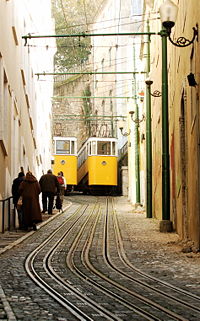
Under the department, a picture is worth a thousand words, trams, streetcars and their kin can operate in very tight places, this funicular in Portugal should dispel any notion that ‘rail’ transit can’t operate in tight locations!
Ai??Ai??
From the Tyee – Passenger rail rights at risk: Langley Mayor
From the Light Rail Transit Association – CAN LOCAL FUNDING SUPPORT A HERITAGE TYPE TRAMWAY
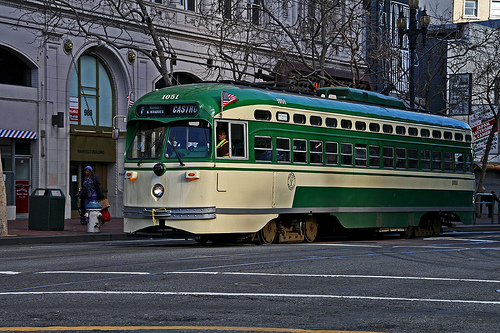
The following is a discussion document (#72 January 2009)Ai??Ai??from the Light Rail Transit Association www.lrta.org which may be interesting for those who are interested in building a ‘start-up’ heritage interurban/streetcar service.
The Federation of Small Businesses (Yorkshire and Humber) have shown concern about the need to reduce traffic congestion in Leeds. Their suggestion was that local politicians and transport professionals should adopt some lateral thinking to plan a way ahead (1). Some new lateral thinking is obviously needed despite the present lack of support from Westminster.
Britain’s five new tram systems, built from 1992, have all demonstrated a sufficient public response to quality transit. When Leeds “torched” its well developed tramway system in 1959, many soon realised that the lower cost system was actually low quality also and consequently this replacement had many faults. They soon began to vote with their feet which resulted in a road spending spree costing many times what transport modernisation would have needed. Many passengers learned for the first time the value of that standing load. Trams can swallow up a large load quickly but with buses on a busy route, a slow entry followed by that dreaded word FULL which meant a wait for the next bus. An experienced passenger would know that seats would quickly have become available even on a bus route and drivers have never been known to go back to collect those unlucky ones still waiting at the previous stop.
A close look at developments on the other side of the “pond” could well be a winner here if our politicians realised that what was scrapped about 50 years ago had the potential to give as good a performance as light rail today. “As of last year, almost 1,500 miles of tramway were either planned or opened in the American cities” (2). Many were actually heritage systems, replica first generation bodies equipped with modern electrical under gear. They have been put back to work on short lengths of track for segregation where possible. Using figures supplied by an American source, a heritage tramway is about two thirds (mile for mile) of the cost of light rail.
Returning to Leeds, many miles of tramway reservations still exist as does one of the modern looking railcars of the 1950’s If the skills are still available at the Crossgates factory in Leeds it can be seen that a heritage tram is feasible at a lower cost. The design could be modified with a low floor articulated middle section added and if all wheels were powered, hills as steep as 10% could be negotiated.
As cost becomes the final arbiter, it should be pointed out that a high passenger appeal will attract funding in its own right. For this reason, care must be exercised when choosing the first part of city to get the initial construction. It is suggested that City Square to St James hospital via Corn Exchange and the bus station could have strong passenger appeal. Although most of this route would be double track, the section along NEW YORK STREET would require special attention. This is about the same length as a narrow street in Mainz (Germany) where a closely spaced interlaced track is used by two busy routes without difficulty. As no point work is involved the operation is silent and works very successfully. A role model for Leeds could be the new tram system in Saarbrucken (Germany), especially so if the first likely extension in Leeds was to Horsforth Station, a recent suggestion by consultants.
REFERENCES
1) Regional leaders must rethink policies on transport – YORKSHIRE EVENING POST 21st October 2008.
Ai??Ai??
2) John Tagliabus – INTERNATIONAL HERALD TRIBUNE 10th November 2008.
Ai??Ai??
Ai??Ai??
Prepared by F A Andrews LRTA Assistant Publicity Officer
PROVINCIAL ELECTION QUESTIONNAIRE RESULTS
Rail For The Valley asked South of Fraser candidates where they stand on light rail.
Click here for their responses
Of particular interest is the BC Liberal party’s support in principle for a demonstration project to be launched by 2010. (See last page of Questionnaire, BC Liberal party response to Q3: Will you support a South of Fraser light rail demonstration project for 2010, the Centennial anniversary of the original Interurban passenger rail service?)
The project would encompass the communities of Chilliwack, Abbotsford, Langley and Surrey, and offer a twice-a-day excursion service for residents by the summer of 2010.



Recent Comments