During this Covid-19 emergency, getting housebound is just collateral damage, so Zwei fired up the family chariot and went on a road trip through south Surrey, Langley, Huntington, Yarrow, Vedder Crossing, and Chillwack/Rosedale and was astounded by the mass of development, especially in the Vedder, Promontory areas.
Any politician today, who states or claims or use any excuse, “that there is not the density/population to support a regional TramTrain system from Chilliwack to Vancouver, using the existing and former BC Electric interurban route” is deliberately and maliciously misleading the public!
Cultus Lake, a major tourist destination; Abbotsford Airport, including Tradex; and the many post secondary institutions along the route, would attract sufficient ridership to justify a passenger service to the upper Fraser Valley.
What is even more disheartening is that the $1.8 billion extension of the Expo Line to Fleetwood, could instead fund a deluxe version of the Rail for the Valley’s Leewood Study Vancouver to Chilliwack TramTrain service, with three trains per hour per direction (20 minute service).
The stunning abuse of power of Metro Vancouver’s Mayor’s Council on Transit is breathtaking with the major players getting heavily subsidized light metro and aerial tramways, while the smaller cities gets crumbs or nothing at all.
The city of Vancouver is getting a $2.8 billion, 5.8 km subway under Broadway, on a route, which the current 99-B Line bus route offers a maximum service of 20 buses per hour, offering a capacity of around 2,000 pphpd. A stunning 13,000 pphpd less than the industry standard for the necessary ridership needed for a subway.
Surrey flipped flopped from a city wide LRT plan to a 7 km extension of the dated Expo Line light-metro.
For Burnaby’s and SFU’s support of building more of the obsolete proprietary SkyTrain light-metro system, they are getting a glitzy $300 million aerial tramway, to service routes already survived by buses. Judas sold out for thirty pieces of silver. Burnaby council sold out the taxpayer for an aerial tram!
For $4.6 billion and change, not one car will be taken off the road and new customers will be few and far between.
*
For the now (2021) $1.5 billion, full build, Leewood/RftV TramTrain, all ridership will be new ridership and that number will be in the thousands!
*
Sadly Premier Horgan, demonstrating his and the NDP’s continued ignorance on regional transit issues, mdea very stupid politcal promise to spend a further $2 billion to extend the dated SkyTrain proprietary light-metro to Langley, to appease local politicians and win votes. His actions will destroy any competant transit planning for the Fraser Valley for decades to come. It means more cars, more roads and highways, more pollution.
The NDP has now shown everyone that winning elections is more important than the environment! Green, the NDP are not!
This transit fiasco will be over shadowed by the NDP’s continued wasting billions of dollars of the taxpayer’s money on the Site C dam, which foundation is on sinking shale. The massive $16 billion fiasco, will make a $4.6 billion SkyTrain light expansion fiasco look like small potatoes indeed.
*
Even the Fastferry’s, the bane of a former NDP government, costing under $500 million pales at a the future financial fiasco’s that await us.
*
A TramTrain or DMU service from Chilliwack to Vancouver is needed, the ridership potential is huge and if politicians get their heads out of multi billion dollar mega transit project and rubber on asphalt planning, real “Green” alternatives are ready to be built.
It only takes politcal will to do the right thing and in BC, doing the right thing is a rare currency!
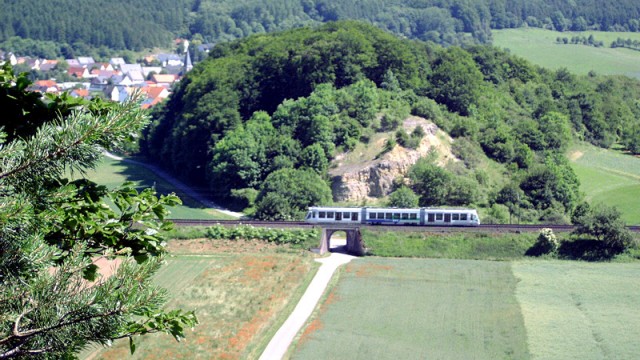
The Vedder River Rail Crossing, in place and ready to use for TramTrain.
A new TramTrain operation has opened on Feb. 22, in Hungary and all one can say is wow.
The 26.2 km Szeged-Hódmezővásárhely (please watch video) tram-train system is now open for operation in Hungary, connecting two of the cities of Szeged and Hódmezővásárhely.
Costing a total of €224 842 224 (CAD$345,750,843 or $8.6 million/km)), the diesel-electric bidirectional vehicles will travel seamlessly from Szeged and Hódmezővásárhely tram lines to the intercity railroad at speeds reaching 100 km/h!
A maximum 15 minute service (a train departing every 15 minutes from either direction) is envisioned.
From Rail for the Valley’s point of view, the $8.6 million/km. cost per km validates the cost of under $1.5 billion to buikld and operate three trains an hour on a 130 km route from downtown Vancouver to Chilliwack, using the former BC Electric route. Put another way, less than the cost of a 7 km of the Expo Line to Fleetwood!
A regional rail link, connecting downtown Vancouver to North Delta, Central Surrey, Cloverdale, downtown Langley, downtown Abbotsford, Sardis and Chilliwack costing less than the cost for a SkyTrain light-metro system to Fleetwood is a sound investment for the future, unfortunately making sound judgments on transit projects is not in the lexicon of the Mayors Council on Transit, TransLink and the Ministers of Transportation, both provincially and federally.
Hungarian TramTrain
Hungary’s first tram-train ready to roll
The diesel-electric bidirectional vehicles will switch seamlessly from Szeged and Hódmezővásárhely tram lines to the intercity railroad at speeds reaching 100 km/h
Farewell, replacement buses! From February 22, train traffic between the Hungarian cities of Szeged and Hódmezővásárhely will resume following a renovation of the intercity railway, reports szeged.hu.
What makes this event memorable is that the refurbished line will be serviced by Hungary’s first diesel-electric tram-trains, manufactured by Stadler Rail Valencia SAU. The pioneering vehicle is already doing test rides and, according to the manufacturer, the next two tram-trains are expected to arrive this spring with another five to be delivered by this summer. The overall order is for 8+4 vehicles.
Fastest intercity access
The Citylink bidirectional, dual-mode vehicles will cover the distance between Hódmezővásárhely and Szeged in about 37 minutes, so they will provide the fastest way to get from one city to the other. During peak hours, the entire fleet of railway trams, nicknamed Vasvillai (Pitchforks), can be activated to have a vehicle running every 15 minutes.
The 37-metre-long, 71-ton tram-train has a capacity of 216 passengers and 92 seats (16 of them foldable). And because it is low-floor and barrier-free, it is also friendly to persons with reduced mobility. There are two multifunctional spaces suitable for wheelchairs, bicycles and prams.
City traffic regulations confine the tram-train to a maximum speed of 50 km/h, but once out of town, the stainless steel Pitchfork can dart off at up to 100 km/h, using its diesel drive. The comfortable vehicle features a state-of-the-art passenger information system, air conditioning, spacious driver’s cabin, and on-board security camera system.
HUF 80 billion investment
The reconstruction of the large railway track between the two cities which has been underway since April 2018, is financed by the Hungarian state. The contractor Swietelsky Vasúttechnika Kft. has received HUF 25, 676 billion. The total tram-train investment will cost HUF 80 billion (EUR 224 842 224).
Italy has rediscovered “Il Tram” and a renaissance of the modern tram in eleven cities. The following are six Italian city tram and light rail systems.
A modern low-floor tram in Bergamo.
The Bergamo–Albino light rail is a 12.5-kilometre (7.8 mi) light rail line that connects the city of Bergamo, Italy, with the town of Albino, in the lower part of the Val Seriana. It was built on the right-of-way of the former Valle Seriana railway, closed in 1967. It opened for service on 24 April 2009
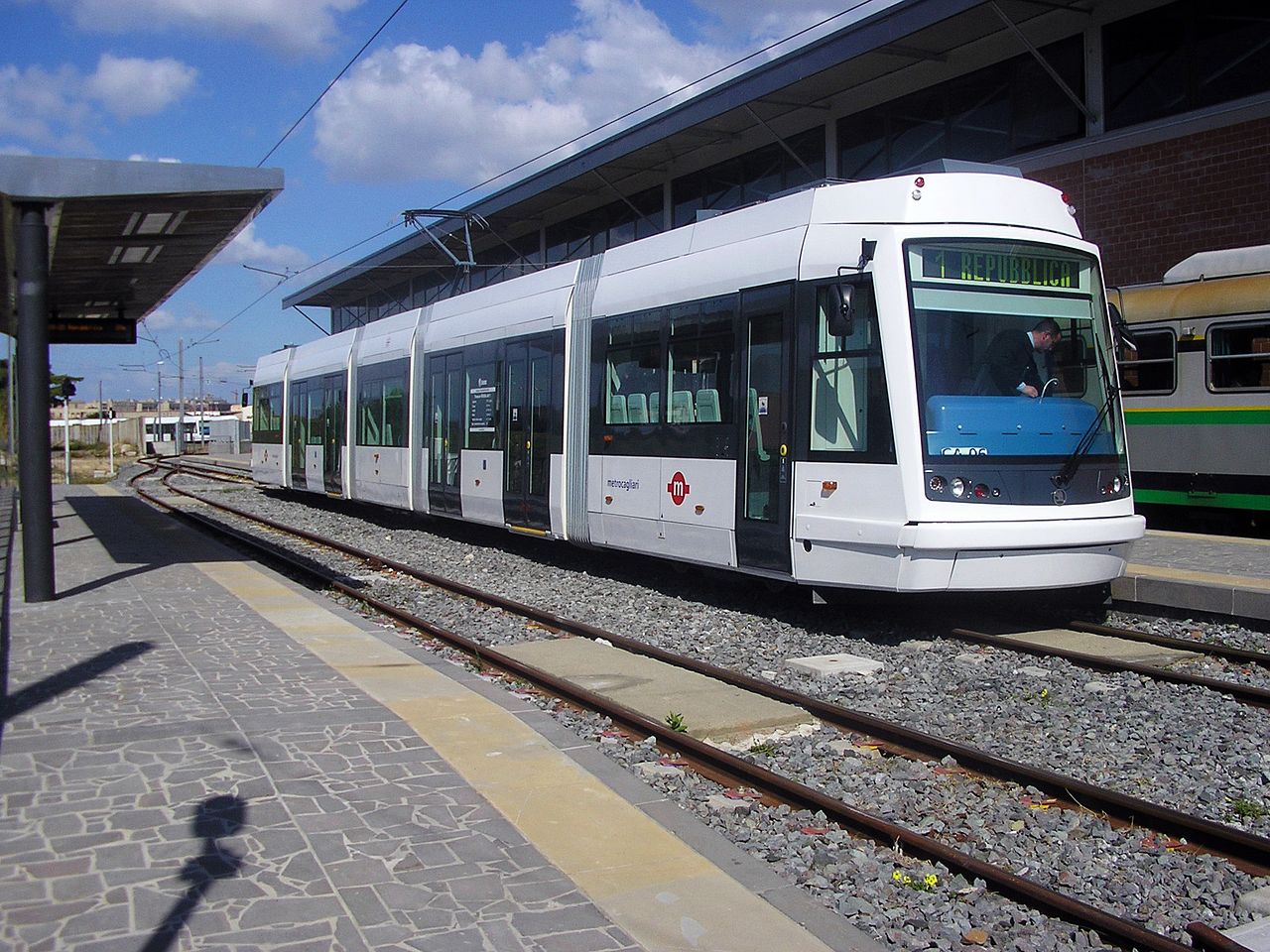
More low-floor cars for Cagliari.
The Cagliari light rail system, commercially known as Metrocagliari, is a two-line light rail system that serves the town of Cagliari and part of its metropolitan area, in Sardinia, Italy. The system was inaugurated in 2008 and has subsequently been expanded to two lines.
Narrow trams for Turin, for those ancient and narrow streets.
The Turin tramway network is an important part, along with the Turin Metro, of the public transport network of the city and comune of Turin, in the Piedmont region, northwest Italy.
In operation since 1871, the network is about 88 km (55 mi) long, and comprises 10 lines.
Milan still operates the Peter Witt style cars
Modern low-floor tram in Milan.
The Milan tramway network (Italian: Rete tranviaria di Milano) is part of the public transport network of Milan, Italy, operated by Azienda Trasporti Milanesi (ATM).
In operation since 1881, the network is currently 181.8 km (113.0 mi) long,[2] making it one of the biggest in the world. It has the unusual track gauge of 1,445 mm (4 ft 8 7⁄8 in) (Italian gauge), and comprises 17 urban lines and one interurban line.
While the Milan metro is characterized by a low level of centrality, with no more than two lines ever crossing each other at any of the interchange stations, the tram network is substantially centralized, with nearly half of the lines passing or terminating around Piazza del Duomo, the city central square.
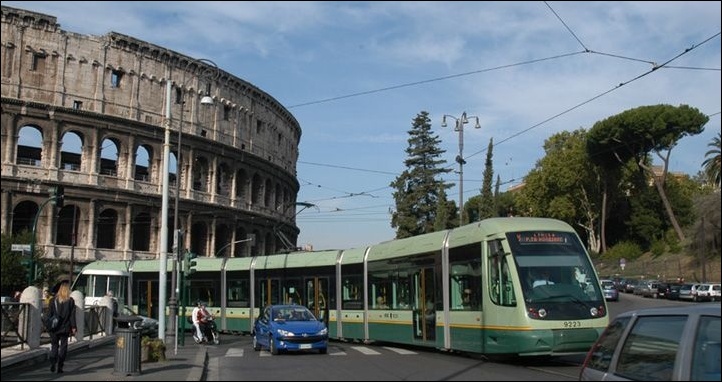
Rome!
The current Rome tram system is a leftover from what once was the largest tram system in Italy. With its fragmented structure, it does not currently function as a backbone of the city’s public transport. The system is owned and operated by Azienda Tranvie e Autobus del Comune di Roma
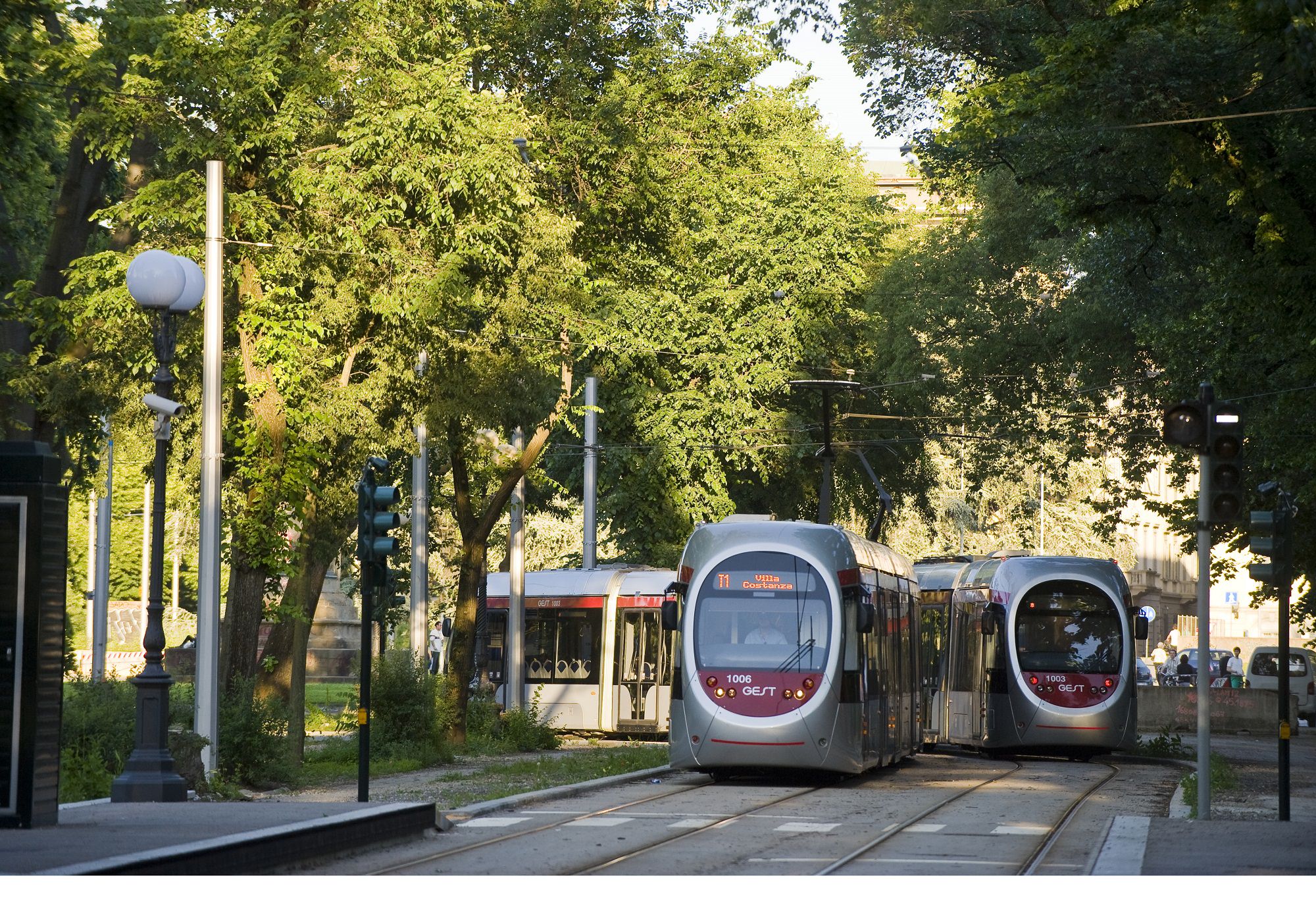
Florence trams
Florence, like many other Italian cities, closed down its old tramway network at the end of the 1950s, but has come back to trams in recent years to find a solution to the rising car traffic in the city. The first line in the present network was opened in 2010 to link the city center with the neighboring comune of Scandicci; the second line opened on February 11, 2019, linking the city center with Florence Airport.
Another suicide, another death and TransLink washes it hands of the problem.
The SkyTrain light-metro system doesn’t have an attendant on board to monitor the tracks.
This is the darker side of driverless trains.
Unlike other automatic metros, there are no sliding glass gates at stations to prevent egress onto the tracks.
This costs money and the politicians do not think it a wise investment. Not cost effective.
It is cheaper in the long term to let the disturb die by SkyTrain, rather to do what other transit authorities have been forced to do, put gates at stations to prevent people from accessing the tracks.
The TransLink, SkyTrain lobby and the Mayor’s Council on Transit seem happy with the status quo, preventing suicides is not cost effective.
Medical emergency stops service between some Vancouver SkyTrain stations
Expo Line service between some Vancouver SkyTrains has been disrupted due to a medical emergency
TransLink has set up bus bridges while service is stopped
VANCOUVER (NEWS 1130) – Expo Line service between the Stadium-Chinatown and Waterfront SkyTrain stations is currently stopped due to a medical emergency.
The shutdown started around 7 a.m. Monday morning.
Commuters needing to get to those stations will have to get off at the Main Street-Science World station for a bus bridge.
Trains are operating from Main Street Station to King George, and customers heading to or from Production Station must transfer at Columbia.
There’s no indication on when service will resume.
Despite the ongoing charade by regional mayors pretending that the now called Movia Automatic Light Metro is not a proprietary railway, the singular fact remains, it is. This Linear Induction Motor (LIM) powered bit of history has always been a proprietary railway, unable to operate with any railway, except its own family of seven such transit systems.
Even Vancouver’s versions of MALM cannot operate coupled sets of MK.1 and MK.2/3 trains.
As there is no “off the shelf” and as one overseas expert told me:
“You just cannot slap a pair of LIM’s on any bogie and expect it to work”
Thus vehicles that can operate on the MALM lines, the Expo and Millennium Lines, operate a proprietary railway and by doing so, creates many problems.
We must return to Gerald Fox’s 1991 study “A Comparison Between Light Rail And Automated Guided Transit” (AGT) to see his conclusions have proven extremely accurate. Please also remember that the two of the AGT systems used in the study, ALRT and VAL, were proprietary transit systems.
Requiring fully grade separated R-O-W and stations and higher car and equipment costs, total construction costs is higher for AGT than LRT. A city selecting AGT will tend to have a smaller rapid transit network than a city selecting LRT.
There is no evidence that automatic operation saves operating and maintenance costs compared to modern LRT operating on a comparable quality of alignment.
The rigidity imposed on operations by a centralized control system and lack of localized response options have resulted in poor levels of reliability on AGT compared to the more versatile LRT systems.
LRT and AGT have similar capacities capabilities if used on the same quality of alignment. LRT also has the option to branch out on less costly R-O-W.
Being a product of contemporary technology, AGT systems carry with them the seeds of obsolescence.
Transit agencies that buy into proprietary systems should consider their future procurement options, particularly if the original equipment manufacturer were to cease operations.
Despite boasting by TransLink and echoed by ill informed civic, provincial and federal politicians, only seven such systems have been sold and not one of the systems sold was ever allowed to compete against light rail. No one has copied Vancouver’s exclusive use of automatic light metro, no one has copied Vancouver’s use of the proprietary and now called MALM.
Toronto’s Scarborough Line was so designed not use light rail vehicles and even cannot use MK 2/3 cars is telling! Very soon there will be only six MALM systems in operation and Detroit’s wee MALM system will soon follow, being life expired.
Then there will be five.
GOLDSTEIN: Why Scarborough RT is dying and Presto’s on life-support
Author of the article:
Lorrie Goldstein
Publishing date:
Feb 12, 2021
Passengers wait for a TTC Scarborough RT Line 3 train at Scarborough Centre Station in Toronto, Ont. on Friday, March 8, 2019. Photo by Bryan Passifiume /Toronto Sun/Postmedia Network
Two City Hall stories covered in the Toronto Sun this week by reporter Bryan Passifiume illustrate perfectly why public transit in this city has been a train wreck for decades.
They are the official and long-predicted death of the ancient and creaking Scarborough RT (rapid transit) line in 2023, and the potential replacement of the Presto fare system post-2027.
Both sagas would be a comedy of errors if they weren’t costing taxpayers and transit users billions of dollars and thousands of hours in wasted travel time.
They demonstrate two enduring truths about public transit in Toronto.
First, our municipal and provincial politicians love to debate building public transit as opposed to building public transit.
Second, when they finally do something, they screw it up.
As a result, beleaguered Scarborough commuters post-2023 will be going back to the future — on buses — hoping for the completion of the three-stop Scarborough subway, supposedly to be ready by 2030, but don’t hold your breath.
We got here because of a decade-plus political battle at City Council and Queen’s Park about whether it would be better to build a seven-stop Scarborough LRT (light rail transit) or a one-stop, three-stop or four-stop Scarborough subway.
The predictable and inevitable result is that Scarborough residents will be getting neither an LRT nor a subway in time to replace the Scarborough RT, which opened in 1985 and should have been mothballed a decade ago.
Replete with cynical political grandstanding and opportunism on all sides of the debate and breathtaking and hilarious flip-flops in hopes of winning municipal and provincial elections, here are the various and sundry positions City Council has taken on an LRT versus a subway for Scarborough since 2007.
We got here because of a decade-plus political battle at City Council and Queen’s Park about whether it would be better to build a seven-stop Scarborough LRT (light rail transit) or a one-stop, three-stop or four-stop Scarborough subway.The predictable and inevitable result is that Scarborough residents will be getting neither an LRT nor a subway in time to replace the Scarborough RT, which opened in 1985 and should have been mothballed a decade ago.Replete with cynical political grandstanding and opportunism on all sides of the debate and breathtaking and hilarious flip-flops in hopes of winning municipal and provincial elections, here are the various and sundry positions City Council has taken on an LRT versus a subway for Scarborough since 2007.
Ready?
(1) We should build the LRT. (2) No, wait, we should build the subway. (3) No wait, we should build the LRT. (4) No wait, we should build the subway.
For the provincial government it’s been (1) We want you to build the LRT. (2) No wait, we want you to build the subway.
It’s like a never-ending Mad Hatter’s tea party.
Which brings us to Presto, the regional electronic fare card that was the brainchild of the provincial government starting in 2002. This should not have been the expensive fiasco it has turned into.
Presto cards at kiosks and in use at and around the Queen St. W. area and subway station on Wednesday October 23, 2019. Photo by Jack Boland /Toronto Sun/Postmedia Network
This wasn’t new technology when it was being developed.
Honk Kong has had its Octopus card and New York the MetroCard (now the OMNY card) since 1997.
London, England has had the Oyster Card since 2003, Chicago the Chicago Card, now replaced by the Ventra Card, since 2004.
Presto, has the distinction of being criticized by three — count ’em three — auditors general, two provincial and one city, going back to 2012.
That’s when then Ontario auditor general Jim McCarter described its rapidly escalating costs — more than $1 billion at the time — as “among the most expensive fare-card systems in the world.”
Its introduction into the Toronto public transit system has been a comedy of costly errors.
That includes everything from malfunctioning vending machines and fare gates, to frozen card readers, charging customers twice for the same fare, charging students and seniors adult fares, and fares being declined because of delays between the time a commuter pre-loads the card and the time it registers in the system.
As Casey Stengel famously said of the hapless 1962 New York Mets, “Can’t anybody here play this game?”
REM is a clone of the Canada Line, a faux P-3 project designed to benifit land speculators, land developers and of course the financiers, which in this case is the Caisse de dépôt et placement du Québec, or CDPQ .
The local rail advocates are now fully understanding at how REM will not provide better public transport and are desperately trying to change what the politicians, with very little public input, have agreed to do.
Like Vancouver, REM has tied Montreal transit planners to a very expensive light metro system and will stop any sort of rational transit planning in the Montreal region for decades to come. As in Vancouver with the Canada Line, the plans were scaled back, stations omitted and will offer a more limited service.
As Vancouver passes the point of no return for user friendly and affordable public transit with the current SkyTrain expansion, only benefiting the Caisse de dépôt, SNC Lavalin who lead the faux P-3 consortium and receive over $110 million annually to run it and politcal friendly land developers and land speculators, drooling at the prospect of another Vancouver land rush.
There is little real evidence that the Canada line has actually taken cars off the road or attracted people to transit, despite what TransLink and the Mayor’s Council on Transit claims.
Will REM be successful?
Only for the Caisse de dépôt and land developers and speculators but, with those wanting better public transit, they will be left waiting at the station as the money train passes them by.
“Just like the construction of the Olympic Stadium, Montrealers can do little but watch billions in public money wasted on a glamour project of dubious necessity.”
Every time there’s an announcement about the Réseau express métropolitain (REM), the pundits, politicians and PR hacks frame it like a late-night infomercial advertising some product you never knew existed but was now available to solve your and all the world’s problems. Finally, they exclaim, Montreal is getting the REM.
Ever since the government of Quebec awarded a no-bid, sole-sourced contract to the provincial pension fund (the Caisse de dépôt et placement du Québec, or CDPQ) to build a new mass transit system, I’ve been concerned this might not be the best idea. I support public transit because I believe it’s the best way to control carbon-dioxide emissions and to make cities far more liveable. Congestion, pollution and emissions all work together in depreciating our quality of life, and I often find myself wondering how we might use our public spaces differently if we only had to contend with a quarter, third or half as many cars.
That aside, the REM is behind schedule, over-budget and bits and pieces of it are being scaled back. It will open later than originally stated, have fewer stations and may not go to all the places we were told it would. Perhaps more disturbingly, both the CDPQ and the political class are now talking about extending it all over the metropolitan region, as though more of this overhyped panacea to all our transit and traffic woes will distract us from the fact that it hasn’t even gotten off the ground yet.
Much like a runaway freight train, there’s little hope of stopping the REM. Indeed, our future REM trains are supposed to be fully automated — no need for pesky unionized transit employees dipping into the profit margin — and so likely won’t have anyone aboard to hit the brakes in case of an emergency. The REM — and this cannot be forgotten — was a decision of the Quebec government in collaboration with the provincial institutional investor, the CDPQ. Neither Denis Coderre nor Valérie Plante had anything to do with it, despite what they may tell you. This was never Montreal’s decision to make, as our transit agency was never initially consulted.
The main reason why the REM won’t be stopped, no matter how many problems it produces, is because there will be incredible financial penalties to pay. Moreover, the work that’s already been done has been so expensive that no government would risk pumping the brakes to re-evaluate just what exactly it is we’re doing, or ask the question whether this is really worth it.
All we can do at this point is complete the project and try to wrestle back some control into the hands of the people who need and use public transit, rather than those who seek to profit off it.
So with all this mind, let’s consider some of the most recent developments.
Anyone who’s not too stoned to recall 2015-16 (when the REM was first announced) will doubtless remember the centrality of the airport connection. Finally — we were told so many times — Montreal would have a quick and efficient connection to the airport. Now it seems that Aeroports de Montréal is unable to come up with the estimated $600-million to build the connection. It’s a neat idea to have direct public transit connections between airports and city centres, but in Montreal’s case the passenger estimate for the new airport stop isn’t terribly impressive. One estimate prepared for the CDPQ back in 2016-2017, and based on data from 2015, put the daily average number of airport REM station boardings between 4,600 in 2021 (what was supposed to be the first year of operation) and 5,600 in 2031 (after a decade-long “ramp-up” in use). This would put the airport REM station in the same range as some of the lesser used metro stations. Some of the more optimistic pre-pandemic projections indicated 10,000 passengers will use the station per day. While it’s true the number of passengers using Trudeau airport has been steadily increasing over the years, it was still just 20 million passengers per annum, and that was before the pandemic. It may not be until the end of this decade that we get back to that level of passengers, and of course, the major reductions in flights also means major reductions in airport workers too, further sapping the number of people who may use a new REM airport station.
The airport station reveals other shortcomings of the REM. The way the system was designed, the only trains that will run directly to the airport are those leaving the McGill/Central Station nexus downtown. If your starting point is on the South Shore, in Deux Montagnes or in the West Island, you’ll have to switch trains, as none of those branches will run trains going directly to the airport.
While the estimated travel time between downtown Montreal and the airport will probably clock-in at 20-25 minutes, passengers coming from other areas can expect much longer commutes. For the majority of West Islanders, Lavalois and people living on the western side of the off-island suburbs, taking a cab or driving will unfortunately still be the most efficient way to get to the airport. And at 20-25 minutes, the REM isn’t that much more competitive on the downtown-airport run than the existing bus service.
Worse, it’s not like Montreal can take the $600-million earmarked for the airport station and use it somewhere else — like buying 600 brand-new electric buses from a local bus manufacturer (NovaBus’s fanciest, fully electric buses cost $1-million apiece). For comparison’s sake, 600 new buses, each carrying 80 passengers, just increased Montreal’s public transit capacity by 48,000 people per minute. This would be a considerable improvement over the few thousand additional passengers handled by the airport stop, but more significantly, the buses, unlike the REM, can go anywhere.
Why are we so caught up with the idea of riding the REM to the airport? It probably stems from the same minds that think a REM monorail over René-Lévesque is also a good idea. In sum, Montreal’s getting transit solutions to problems that don’t really exist, dreamt up by people who may not live here and likely haven’t used public transit in decades.
The people who are calling the shots consistently pitch the REM as a solution both to congestion as well as something that will encourage people to abandon their cars and hop on board the sustainability train. They pitch the REM as something “cool” that people will look forward to trying, and I can’t help but wonder how many of these people marvelled at the various new fangled transit technologies demoed at Expo 67, like hovercrafts (no longer will your boat be confined to water!) or gondolas (they’re not just for Switzerland anymore!).
Yes, people do need to be encouraged to take public transit, but this won’t happen if you spend several years ripping up the existing transit infrastructure. The STM’s ridership numbers were increasing steadily year over year until the Coderre administration made serious service cutbacks in 2014. Consequently, use declined, something REM construction exacerbated.
When it was originally proposed, the REM was supposed to use existing infrastructure. The public was assured that the construction of the REM would have a minimal impact on extant infrastructure. But rather than buying trains to fit extant infrastructure, the CDPQ instead decided to build everything anew, from the trains to the track to the power systems. In so doing, the most-used commuter train line in Greater Montreal was shut down, and the excessively expensive Mascouche Line was cut off from downtown Montreal, rendering it essentially useless. New double-decker trains bought less than a decade ago are no longer needed. It goes on and on like this. Just like the construction of the Olympic Stadium, Montrealers can do little but watch a white elephant get built, billions in public money wasted on glamour projects of dubious necessity.
There’s a common denominator to this mess: Montreal’s transit isn’t planned by Montreal. The REM was always a Quebec government and CDPQ project, and it’s worth pointing out that the CDPQ had no prior experience in the construction or management of mass transit systems, let alone public transit.
Montreal is actually legally prohibited from developing its own public transit systems (see item #151 here). That is to say, if Montreal had $10-billion lying around, it would still not be allowed to expand the metro.
We have no choice but to involve middlemen in our own transit planning decisions. With regards to the REM, the Quebec government handed incredible power over to the CDPQ. They were given exclusive rights to public infrastructure (like the new Champlain Bridge and the Mount Royal Tunnel) and further granted non-compete agreements with other modes and services of public transit. Looping back to the issue of the airport station, the CDPQ actually managed to get the government to agree to force the STM to cancel the 747 airport shuttle to give the REM exclusive airport access (see pp. 10-11 here).
No public transit planner would ever plan transit like this.
Once the REM becomes operational, all other transit modes and systems will be reoriented to serve it. Eliminating duplication may seem like a good idea to the number crunchers, but users and planners understand that operational redundancy is vital. A healthy transit system offers multiple ways to get between points A and B — not only does this offer users choice, it helps spread people out and offers alternatives in case of service disruptions.
What concerns me most of all about the REM — aside from the fact that we’re essentially subsidizing the CDPQ’s real-estate development plans and being used as guinea-pigs for their infrastructure development business — is that we’ve been forced to hand over control of public transit to a for-profit organization. The CDPQ included a clause stating their annual return on investment would be set at 10% irrespective of the REM’s actual revenues. If the REM doesn’t produce this return, taxpayers foot the difference.
There’s nothing really novel about the REM. It’s just another imposition on the city of Montreal by people who claim to have our best interests at heart, but are truly only interested in sucking as much money out of the public purse as they possibly can. The REM is shiny and new, and may or may not reach the airport, but it isn’t the boring old solutions that would likely have the best overall impact. There are experts, but they weren’t consulted. There were consultations, but the people were ignored. There was an environmental assessment that was highly critical of the project, and Coderre decided it had exceeded its mandate. We were given the bare minimum opportunity to speak, but no one was really listening.
So what do we do now?
It’s an election year, there’s a good chance Coderre will run, and he’ll likely position himself as the REM king. Mayor Plante, not wanting to be upstaged, will likely match or exceed whatever Coderre’s position is on transit development. Expect a lot of talk about a Blue Line extension to Anjou (finally!), more talk about a Train de l’Est and/or some kind of Pink Line/ Train de l’Est amalgam (finally!!) and monorails over René-Lévesque (finally!!!). They’ll likely each have a position on the airport connection as well, and here Montrealers may have a chance at regaining a degree of control over public transit. We can say no, we can demand the REM be subsumed into the STM and we can insist the citizens and government of Montreal be given the control they deserve over their own transit systems.
A Bonn tram on a simple, yet effective reserved rights-of-way, giving metro service at a fraction of the cost.
In the 1970’s, German trams were on the decline. Two decades of subway mania fragmented tram lines and tram routes and on the whole, ridership on German public transport was declining.
Despite eager promises from planners and politicians of futuristic rapid transit, the new subways were not attracting predicted ridership and car use increased dramatically, further putting pressure on transport authorities.
As the 1980’s approached it was common knowledge that all but a few of German tramways would not survive into the 21st century.
Then the mid life subway rehab time bomb went off, further stressing transit managers to find new monies to subsidize huge subway rehab costs and under performing bus routes.
A Berlin tram is a very user-friendly park like setting.
As the mid life rehab costs for subways began to beggar transit operators, transit managers struggled to maintain a consumer friendly transit system. Subways were not attracting the expected ridership and ongoing maintenance costs were limiting expansion. The buses that replaced the trams were far from popular and with forced transfers from bus to metro, many customers started to drive instead.
Politicians, like politicians elsewhere they thought they were grand transit experts. In Germany right wing politicians favoured metros or subways and left wing politicians favoured trams.
Sound familiar?
A modern articulated tram in mixed traffic in Heidelberg.
The 1980’s brought the low-floor articulated tram; the concept of the urban reserved or dedicated rights-of-ways; and simpler ways of ticketing.
By the early 80’s, German public transport was on the decline and in trouble.
Desperate to retain ridership, tranait managers listened directly to the transit customer and tried to provide a transit service that best fitted the needs of customers and not politicians. Transit customers did not want buses, nor subways, rather they wanted their trams because of their convenience and speed to get to their destinations. Add in new cars and new ways of operating and once was a declining transit mode, saw a massive resurgence.
The now famous Karlsruhe Zweisystem or TramTrain came from a direct result of customer input and managers thinking out of the box. Transit customers did not like the transfer from commuter train to tram at the main station and TramTrain provided a direct service to the city centre. So popular was this new concept of operating trams that ridership exploded, with a 479% increase in ridership in just a few months!
Customer first planning, quality vehicles and thinking out of the box has brought major changes on how transit is provided, including TramTrain, cargo trams, lawned rights-of-ways and much more.
The successful Car-Go-Tram in Dresden.
Today Germany operates ten light rail lines (most are Stadtbahn with extensive subway sections) and fifty-six tram/LRT lines, which is extremely positive of a transit mode that just over forty years ago was deemed obsolete.
The German tram resurgence gives many positive lessons about public transit, including giving the customer a product he wants to use, quality service to cater to destinations where the customer wants to go and not burdening the taxpayer with transit “glam”.
Lessons that have yet to be learned in metro Vancouver.
Alstom is now the owner of the proprietary Movia Automatic Light Metro (MALM) system and the big question is, will Alstom continue to produce the MK.2/3 cars or even honour Bombardier’s contracts with TransLink.
Will Alstom treat TransLink and regional politicians as rubes for the taking?
The early resignation of TransLink CEO Kevin Desmond, and the puff stories in the mainstream media about his tenure and TransLink, pure spin by all accounts, may provide an answer.
As noted here for the past several years, the Expo and Millennium lines need up to $3 billion in rehab, especially the aging Expo Line and this money has not been funded.
As the start of construction of the Broadway subway, chill financial winds are circling around TransLink as former customers are not returning to transit, which means former customers are not returning the very expensive light metro system.
Operating empty buses on empty routes can go on only for so long and politicians, as all levels of government will worry that the politically prestigious Broadway subway will slowly turn into a financial tar pit.
Another ill wind has now arisen, depite the hype and hoopla and well orchestrated news releases by TransLink about record ridership, mode share by transit has been declining.
I do not think the 2020’s will be kind to TransLink or the politicians who supported their grand schemes.
Alstom completes Bombardier Transportation acquisition to create ‘a global mobility leader’
29 January 2021
INTERNATIONAL: ‘Today is a unique moment for Alstom and the mobility sector worldwide, with the creation of a new global leader centred on smart and sustainable mobility’, said Alstom Chairman & CEO Henri Poupart-Lafarge when the acquisition of Bombardier Transportation was completed on January 29.
Valencia was the first Spanish city to reintroduce the tram, in 1994. The success of the modern tramway network in Valencia led to the extension of its lines on three occasions.
After Valencia came Bilbao (2002), Alicante (2003), Barcelona (2004) and, in October 2006, the inauguration of the 4.7 km long Vélez-Málaga Tram (which linked Vélez-Málaga with the coastal part of Torre del Mar).
These lines were followed by the Metro Ligero de Madrid (2007), in the Madrid districts of Sanchinarro and las Tablas (ML-1), and linking the capital with Boadilla del Monte and Pozuelo de Alarcón (ML2, ML3).
Then came Seville, where a tramway network named MetroCentro has been running since spring 2007, Tenerife (2007), Murcia (2007), the Madrid suburb of Parla (2007) and Vitoria (2008).
In Tenerife, the tramway is operated by the company Metropolitano de Tenerife. It runs through and connects the cities of Santa Cruz de Tenerife and San Cristóbal de La Laguna, and has a fleet of 26 Alstom Citadis trams. Line 1 (Santa Cruz interchange)–Avda. Trinidad (La Laguna) opened on 2 June 2007. The line connecting the two neighborhoods of Tincer (Santa Cruz) and La Cuesta (La Laguna) followed on 30 May 2009.
Valencia
Projects, from Wikipedia:
In Spain, 13 tram networks are currently planned to be added to the nine already operating.
There have also been plans to install a tramway in Oviedo (a project to implement this mode of transport, by the PSOE, was discarded after the PP defeated it at an election). In addition, Madrid is expanding its LRT (light rail) network on its outskirts.
Cadiz TramTrain
From Zweisystem:
Spain has shown that their politicians and transit planners understand the importance of the modern tram, especially for large cities, is alleviating gridlock, congestion and pollution.
While our politicians dither with dated transportation concepts and an almost vitriolic hate of the the modern tram, valuable monies are being wasted on politically prestigious transit projects that in the end will not achieve the success that they have been promised to be.
In Metro Vancouver, the result of this current transit planning is all too predictable,: gridlock, congestion and pollution.
A single line in Montpellier, line T1, carriess over 130,000 weekday riders! And thatai??i??s with no tunnels, mostly street running.
Systems in Nantes, Bordeaux and Montpellier have ridership at or near 260,000 riders a day! That exceeds Boston.
The French do it right! What you get is: Simple OCS systems; grassy trackways; frequent headways (7A?>10 minutes or less); most of the important urban trip-generating venues served; most systems connect with the railway stations; much peripheral development along tram lines; tram/pedestrian-only zones; and clean, attractive trams.
Compared to metro Vancouver’s poor planning, it is impressive.
Hello everyone. In this video I talk about the tramway revival in France. What are the strengths of the tram? What it can promote in terms of use of means of transport and the attractiveness of urban centers. Since the 1980s, new tram networks have flourished throughout Europe, over fifty of them. The trend was initially shy, then it has undergone a much faster pace since the 2000s, to the point that it is no exaggeration to speak of real fashion.
It was in France that this phenomenon was born and tram networks have been developed the most over the past two decades, as the graph shows you on the screen. In 1983, there was in France only three tram networks left, or rather three tram lines, one in Lille, one in Marseille and one in Saint-Etienne. There was in 2012, 24 operated networks. The first network to have been achieved is the Nantes network, which was commissioned in 1985. It was followed by the Grenoble network in 1987, and the modern tramway, which was developed in AZle-de-France in 1992, then in 1994, the Strasbourg network was born. It was the first tram networks that have been made in France again.
Why such enthusiasm for the tramway? The modern tram, as rebuilt in many European cities, is part of a double movement. The one that first aims to promote the use of other means of transport that the car as part of everyday life, but also on the other hand, the desire to reclassify urban centers to make them more attractive to frequent, as well as live in. Thus in most urban areas where it was reintroduced, the tram was accompanied by an important urban requalification in the city center and a sharing of the road favorable to other modes of transport than the car.
Research on the introduction of a tram in a public transport network, show that it allows a growing number of users. Tram Assets are indeed many for the user: a much higher speed than the bus, high frequency shift during the day, evening and weekend, a smooth ride that allows to use one’s travel time to deploy activities, provided that we have a seat, usually quality foot paths to go to stops because of efforts to improve the ergonomics of the public space, and finally, easier memorizing the path of the lines due to the materialization of the tramway in the public space via the rails.
In France, in many cities that have reintroduced trams, there is also an increase in the number of inhabitants in the city centers. On the one hand, it appears that the tram favors real estate investments in the city, through the redevelopment of public spaces that accompanies it, on the other hand, there is also that the tram contributes to make more desirable to live in the city because the tram limits the dependence on cars by the quality of transport service it offers to residents. The effect of the introduction of the tram on the use of public transport is however very variable.
Statistics on the use of public transport update consequent differences according to the considered cities, and in particular, these figures show that the increase of the number of users five years after commissioning of a tram overall a network varies for France between + 18% and + 50%. This is what you see for example for a number of cities in the table you have before you. This suggests that the use of the tram is not mechanical. That is to say it is not enough to introduce a tram that it is used, even if in all agglomerations in which it was introduced in France, there is an increase in the use of public transport.
How can we explain these differences in the use of public transport following the commissioning of a tram? There are a number of factors related to the offer and the interaction of the offer with the context and the provisions of the resident population in a city that explains these differences. In the offer, there is first of all the commercial speed, following that it is low, 14 to 16 km / h or higher, more than 20km / h, there are differences in the use of the tram network, and more generally of public transport. There are also differences depending on the frequency if the frequencies are quite low, from 8 to 10 minutes, or high, from 3 to 5 minutes. This is also a factor which has an influence on the use.
The fact that the network is unified in its quality, that is to say, we offer almost the same frequencies, the same amplitude sideboards the evenings and weekends throughout the network, or only on the tram network, and that therefore there would be a public transport offer of two speeds, a high-quality service on tram lines, and a lower quality of service on the bus network, it also has an impact on the use of public transport. Another effect that has an impact on the use of trams: is that the lines are saturated or do they offer the comfort of a seat, This allows using one’s time. This is particularly the case when using public transport during off-peak hours. Finally, the link with urban planning and urban development, the question is also to know if the tram lines that have been developed, serve the agglomeration in which the offer was extended, completely or only partially.
Or in other words: how is made the joint between the public transport system and urbanization, Can we go anywhere with public transport, or otherwise, are only some parts of the metropolitan area available? That is also a factor that plays a central role in the greater or lesser use of public transport, especially when there is introduction of a tram. And of course, last factor that plays a role: the issue of reliability. Does generaly, schedules are respected. You understood through the examples I’ve shown you, tram networks in France were often allowed to revalue cities and it is even often their main function. This is the case for example in Bordeaux, a city that is often considered as exemplary of this view. A high quality in the fields which have been cited in this video makes it possible for people to deploy its lifestyle using public transport and it makes attractive the attendance of urban spaces, whether recreational or for habitat.
In this sense, the redeployment of tramway networks in France as much about the planning issues that of transportation issues, although of course and as I noted in this video, there is also an interest in the field of transport to develop these infrastructures since in all the cities where these networks have been redeployed, there is an increase in the use of public transport.
Given by Vincent Kaufmann est professeur de sociologie urbaine et d’analyse des mobilits laEcole Polytechnique rale de Lausanne (EPFL).















Recent Comments