Coming back from a quickie holiday at Harrison Hot Springs, a few thoughts came to mind on my drive there and back.
Traveling from South of the Fraser, one is certainly aware of the mass of new housing being built and with scarce public transit or no transit at all, the only way for people to travel, other by horse and buggy, is the car. Industrial, educational, or housing nodes near the former BC Electric Interurban line certainly puts the lie often repeated, that there is no ridership potential near the line.
There is certainly the ridership potential to sustain a regional railway service.
On the North side of the Fraser, housing estates are growing in small clusters from Agassiz to Mission, but from Mission West, massive densification is taking and the die has been cast for transportation and that is multi lane highways and associated strip developments.
It seems the West Coast Express with a limited 5 trains in and 5 trains out schedule is next to useless in diminishing congestion so ever wider highways are in order.
But where is the planning?
There is no planning and despite the hype and hoopla by regional mayors, it seems planning is being dome to suit the politics of who ever is in power.
There will be no future extensions of SkyTrain light-metro up the valley, as at the present cost of about $200 million/km to build and with future lines to Langley and UBC next in line to be built. it will be at least 2050 before any extensions can be made.
South of the Fraser, the situation is much the same, with promises of “rapid transit” starting with costs of $8 billion to reach Abbotsford, means that increasing population will bring endemic congestion and gridlock to the region.
Unlike North of the Fraser, The South Fraser region has an independent rail line that once carried passenger traffic and can be operating a passenger service, from Vancouver to Chilliwack for as little as $800 million.
$800 million could buy the region an hourly passenger rail service using DMU’s from downtown Vancouver to Chilliwack.
$1.5 billion could buy the region a modern passenger rail operation with a train service leaving Chilliwack and/or Vancouver every 20 minutes!
That regional and the provincial governments, with their secret political agendas, refuse to fund what is affordable and continue to promise a SkyTrain style “rapid transit” line costing $8 billion or more, which will never be funded is nothing more than a grand betrayal of the residents of the Fraser Valley.
As predicted, Alstom is now buying Bombardier Transportation for CAD $10 billion.
The question, which may worry Translink and the hapless Mayor’s Council on Transit is:
“Will Alstom keep MALM (SkyTrain) production or abandon the proprietary light metro altogether? Will Alstom keep already expensive replacement parts available or discontinue production altogether?”
I reached out for some insight overseas and received this reply.
Alstom already has ‘form’ here.
A few years back they ‘rescued’ the Translhor, buying the rubber-tyred ‘tram’ technology off an ailing Lohr Industries. I can only assume they were pressured into the acquisition to save the Paris Translhor projects.
A few years later, after unsuccessfully marketing the Translohr as the ‘light rail solution for hilly cities’, they disbanded the Translhor division and shifted the staff working on them to the electric bus division.
They (Alstom) see a future in electric buses, they appear to see no future for the Translhor technology.
Several of the Translhor customers have banded together and called for Alstom to release the intellectual property of the Translhor so that they can get 3rd parties to manufacture parts or even entire vehicles should these systems which to expand.
If the LIM light metro has only one customer, it’s gone. They abandoned the Translhor and it has probably 6 or 7 different customers. But if there is no prospect of new customers or it eats into other products they offer…
Hardly reassuring!
To the horror of the SkyTrain Lobby, including the regional mayor’s, the NDP and Liberals, production of the now called MALM may cease and spare parts will become even more scarce (read more expensive) and the pitfalls of a proprietary railway will come home to roost.
The entire Bombardier railway business is to be in the hands of the French. The deal is scheduled to be officially made on Thursday.
Düsseldorf According to information from industrial circles, the French railway technology manufacturer Alstom buys the entire railway business from Bombardier . The transaction is expected to be announced on Thursday morning.
Alstom will take over the worldwide railway business of the Canadians, whose headquarters are in Berlin, for seven billion euros.
This creates a new large railway technology group with a turnover of around 15 billion euros. Alstom had failed just a year ago due to concerns from the European Competition Commission trying to merge with Siemens Mobility.
Premier Horgan’s Chief of Staff, ex Vision(less) Vancouver Councillor and notorious Broadway subway promoter is the last person to discuss “rail” transit for the Fraser Valley.
A West Coast Express commuter rail train with limited service will not work, nor will a prohibitively expensive rapid transit link.
Rail for the Valley had the answer over a decade ago with the Leewood Study and the “raison d’ètre” for this blog. The Leewood Study fell on deaf ears as the ‘SkyTrain mad‘ TransLink, abetted by the dishonest Vancouver Engineering Dept. sung sweet songs of subways in the ears of then Vision Vancouver Councillors, while firing those who disagreed.
Sadly, those tainted songs still resonate.
With the Master Agreement for passenger operation on the now CPR owned portion of the former BC Electric line through Langley to Cloverdale, a credible service could be operated from downtown Vancouver, within one year.
The estimated cost for an hourly service would be $800 million, but for about $1.5 billion, a deluxe three trains per hour service could be had – if, that is, the political will to make it happen.
“Political will” is an oxymoron in today’s politic, as it should be “political won’t“.
The NDP do not have the political will to do what is right and continue to listen to the tainted sweet songs sung by the Mayor’s Council on Transit, and TransLink.
All those union jobs ya’ know.
The NDP, always snatch defeat from the jaws of victory, by listening to the chorus within the NDP bubble and not do what is needed. Those dreaming of commuter trains or rapid transit are just not dealing with the real world; commuter trains would be unworkable, being only accessible by bus and rapid transit, at a cost in excess of $8 billion, unaffordable.
Mayor Braun, who is more and more looking like the CPR’s puppet, refuses to do what is affordable and dreams of trains that never will never come. The CPR, of course, do not want any sort of passenger service on their patch of track, which is covered by the Master Agreement to allow passenger service with all upgrades paid for by the CPR! Something that Mayor Braun is loath to discuss!
The Leewood Study, shows that a credible regional railway service using diesel multiple units can provide a service that could connect downtown Vancouver to North Delta/Surrey; Cloverdale; Langley Centre; downtown Abbotsford; Sardis; and Chilliwack for about half the cost of a 5.8 km subway under Broadway.
All this is damage control by the NDP, who have done little for the Fraser Valley and continue to do as little as possible.
Mr. Meggs, Premier Horgan’s chief advisor does not want an affordable rail transit for the valley because it may derail plans for his pet $3 billion Vancouver, Broadway subway and the $4 billion extension to UBC. The Vision(less) Vancouver clique promised to their land developer and land speculator friends massive land developments along the route.
The NDP’s vague promises about a passenger rail service connecting the Fraser Valley to Vancouver are more than a insult, it is political duplicity.
A Karlsruhe TramTrain deep in the countryside – Affordable transit.
NDP promises commuter rail to the Fraser Valley, but timeline remains fuzzy
Tuesday’s throne speech declares HOV lanes and commuter rail coming to Fraser Valley
Commuter rail for the Fraser Valley is on the way, the provincial government declared in Tuesday’s throne speech, but it remains unclear if locals will have to wait years – or decades – to see such promises come to fruition.
The Throne Speech included a section on how the provincial government is working on a “long-term vision for transit and transportation in the Lower Mainland.”
The speech continued: “British Columbians can look forward to more options like rapid transit, HOV lanes and commuter rail out to the Fraser Valley, and high-speed rail connections with our neighbours to the south.”
Pressed for more details, the province’s Ministry of Transportation and Infrastructure sent an emailed statement to The News that primarily focused on planning work currently underway by TransLink and the province.
“TransLink, as part of a long-term regional transportation strategy (Transport 2050), is exploring a range of options to improve the movement of people and goods across the region,” the province’s email said. “Through both direct discussions and as part of TransLink’s Transport 2050 consultations, we are also engaging leaders from Fraser Valley communities and BC Transit in building a longer-term plan for transit.”
The province also pointed to work being done to build HOV lanes in Langley from 202nd to 264th Street. The statement doesn’t give an indication as to whether commuter rail to Abbotsford is a short- or long-term priority. But Mayor Henry Braun said he hopes to see the province set aside funding for such projects soon.
“That caught my eye as well,” Braun told The News. “We are, as a city, encouraged by the direction that has been indicated in the Throne Speech, and I’m very much looking forward to the budget next week to see how the province intends to action those directions.”
Last month, Braun called for the province to borrow billions of dollars to build a rail link between Abbotsford and the rest of the Lower Mainland. Braun has also repeatedly called on the province to widen Highway 1 to address the increasingly frequent traffic jams between Abbotsford and Langley.
Geoff Meggs, the chief of staff to Premier John Horgan, has promised to meet with Braun to specifically discuss a possible rapid transit link in the Fraser Valley.
TransLink is trying to save face with recent acknowledgement that the Canada line is under built.
What TransLink does not tell you is that over 80% of the Canada line’s ridership, is forced to transfer from bus to metro at Bridgeport Station.
All Richmond, South Delta and South Surrey bus customers bound for downtown Vancouver must transfer to the mini-metro to complete their journey. All South Surrey and South Delta bus customers wishing to travel to Richmond Centre, must transfer at Bridgeport Station, doubling back to reach their destination.
The Canada line has free travel on the Sea Island portion of the line to YVR and all employees using the employee parking lot take the metro for a short hop to the main terminal – all counted as boarding’s. YVR does have a lot of employees, over 24,000!
The McArthur Glen outlet mall also is located on Sea Island and with free travel on the Sea Island portion of line, customers also travel via mini-metro to shop at YVR. TransLink does not release numbers of actual customers using this portion of line, but eagerly include them to inflate boarding’s.
The claim that the Canada line carries 20% of YVR’s daily average of 100,000 people is highly questionable.
What TransLink does not give is the number of “linked trips” or unique uses of the Compass Card to get a better understanding of real ridership.
Another item, eagerly overlooked by TransLink is that with the proliferation of the U-Pass and the many post secondary schools service by the Canada Line, multiple trips per day using the ride at will U-Pass holders are also counted.
TransLink, like BC Transit before, use this cunning method of announcing boarding’s which gives much higher numbers, to impress politicians. Politicians like using boarding’s data because it gives you very big numbers, but does not give real numbers as how many actual persons are using the Canada line.
Unfortunately these inflated numbers are used to hide other important issues that are not being dealt with. TransLink is known for doing this nationally because they are so sensitive to criticism from the highway and car lobby. You have issues with your Light Metro system that TransLink refuses to deal with, like runaway operating and capital costs. You have to be able to harshly critique transit operators and transit operations or else the road lobby wins.
How many real people use the mini-metro? How many unique uses of the Compass Card/U-Pass daily on the Canada line?
Much less than 75,000 persons per day and more like 50,000 to 60,000 actual people use the metro, as most customers make two or more boarding’s a day.
The public will never know as TransLink refuses to give real numbers.
The Canada Line, which connects Richmond, Vancouver and YVR airport, has broken records since it opened 10 years ago, according to TransLink. File photo
The Canada Line has been breaking records since it first opened ten years ago for the 2010 Winter Olympics.
Originally projected to reach just 120,000 daily boardings by 2025, it surpassed that number around 2011 or 2012, according to a TransLink spokesperson, who added that ridership was reported out less frequently then as there weren’t fare gates or Compass cards to track data.
On an average weekday last year, the Canada Line had an average of 150,000 boardings, continuing to “outperform projections,” according to TransLink.
That wasn’t the only record the line broke in 2019, according to the transit authority. For the first time in its history, the Canada Line had more than 50 million annual boardings last year, which represents a 30 per cent increase in ridership since 2010.
“We are proud to celebrate the 10-year anniversary of the Olympics today with the region,” said TransLink CEO Kevin Desmond.
“With 1.58 million trips taken each day during the Olympics, transit was an integral part of how the world experienced the Winter Games. The Olympics were a time when many people realized just how convenient public transit is.”
During the Olympic Games, there were approximately 230,000 daily trips on the Canada Line.
The system, which opened in August 2009, took four years to build and cost approximately $2.1 billion.
The Canada Line spans a 19-kilometre route between Richmond, YVR and Vancouver, with 16 stations. The route includes two bridges and nine kilometres of tunnel.
According to TransLink, 20 per cent of all YVR passengers use the Canada Line for their journey to or from the airport.
Last month, TransLink added four new train cars to the Canada Line, which increased capacity by 15 per cent or about 800 riders. An additional eight cars will be rolled out this spring, which will increase total capacity by 35 per cent, or another 1,200 riders, during peak travel periods.
Richmond will also be getting a new Canada Line station, on the northeast corner of No. 3 Road and Capstan Way, which could be completed by 2022.
It is slowly beginning to dawn on people that SkyTrain will not be coming to their community anytime soon.
It is also dawning on people that what we call SkyTrain is just much too expensive to build, that it can only can be built in small drips and drabs, 12 km to 20 km per decade.
People are realizing that the region just cannot afford dated light-metro, especially the MALM proprietary railway and are beginning to question the $4.6 billion now being spent extending the MALM system a mere 12.8 km in Vancouver and Surrey.
Just what could $4.6 billion buy us if one built with LRT?
A deluxe Leewood/RftV 130 km, diesel light rail service with a maximum of three trains power hour from Vancouver to Chilliwack.
A BCIT to UBC/Stanley Park tramway (LRT)
With money left over, transit improvement through out the Metro Vancouver area.
The following is a estimate of SkyTrain costs to come.
UBC subway completion – $4 billion.
Langley Expo Line completion – $1.6 to $2 billion.
Expo ans millennium line rehab – $2 billion to $3 billion.
Political “wish list” for rapid transit projects.
Rapid transit to the North Shore – minimum $5 billion
Canada line extension to Steveston/Ironwood Mall (including rehab) – minimum $5 billion
Rapid transit to Abbotsford – $8 to $14 billion.
Since the current SkyTrain light-metro has now cost the taxpayer over $10 billion for almost the past 40 years, a simple calculation shows that the “wish list” will be at least 40 years from now, in a region drowning in congestion.
*
LRT costing about one third the cost to install and operate than SkyTrain, will have to be planned for and sooner the better.
*
The chap at the Optimist gets it, despite the vague promises for “rapid transit” (SkyTrain), Delta will never see a train
SkyTrain is a prohibitively expensive form of rapid transit.
Photograph By file photo/Delta Optimist
Well, at least it will get you part way there.
Last week there were announcements of sorts on the region’s two SkyTrain projects and what they had in common is the depressing reality that we don’t have the money to get where we want to go. The Broadway subway will only extend as far as Arbutus, not UBC, unless senior governments cough up billions, while current funding for the Expo Line extension in Surrey will leave it nine kilometres shy of its Langley City goal.
Now, it’s not uncommon for transportation wishes to exceed our ability to pay, but when it comes to SkyTrain, that prohibitively expensive form of rapid transit to which we’ve hooked our wagon, that disappointment is magnified. It’s hard to fathom that as we begin the third decade of this century that our region’s rapid transit network is still so limited, that great swaths of this metropolis remain without anything more than bus service.
That sobering reality was on full display last week as it was announced it would be another five years before either extension becomes operational, and even if additional money materializes between now and then, getting all the way to UBC and Langley would likely be a decade away.
Should that best case scenario unfold, it would still leave the rest of the region woefully underserved by rapid transit and make debates about the benefits of density in places like Delta entirely moot exercises if we continue along our chosen path. However, if we opt to expand our rapid transit system with something other than the network that has brought us a whopping four lines in four decades, then perhaps there’s a fighting chance that other areas of the region will also share in the good fortune.
Despite its cost efficiency and worldwide popularity, light rail has become a non-starter in Greater Vancouver, somehow viewed as the poor man’s rapid transit by political leaders who cling to an outdated mode and its restrictive reach. Yet for those communities where SkyTrain is simply not viable (read South Delta), we’ll never see rapid transit if we don’t turn to light rail.
We can only hope that someday decision makers become so frustrated with the pace of SkyTrain that they have no choice but to turn to the obvious alternative.
For those who are interested in reinstating a passenger servcie on the former BC Electric interurban line from Vancouver to Chilliwack, this is essential reading.
Highlights:
“The Railway Operations Easement Area shall encompass the Tracks and an area sufficient to enable C.P. Rail to double track, construction of such double track to be at the sole cost of C.P. Rail including the cost of removal and relocation of the works of any other party on the lands required to double track.”
“This agreement does not contemplate the operation of passenger trains upon the Joint Section by any railway company other than Hydro. Hydro shall have the right to operate passenger trains over the Joint Section.”
These have been retained in order to accommodate future rail passenger, real estate or other developments along the former B.C. Electric Railway routings in the lower mainland.”
“CP Rail will at its sole cost and expense maintain and keep the Joint Section in good condition and repair and suitable for use by all parties.”
in the event Hydro’s use of the Joint Section exceeds 33% of the total annual wheelage as calculated on the basis as set out in Section 4.4…. etc.
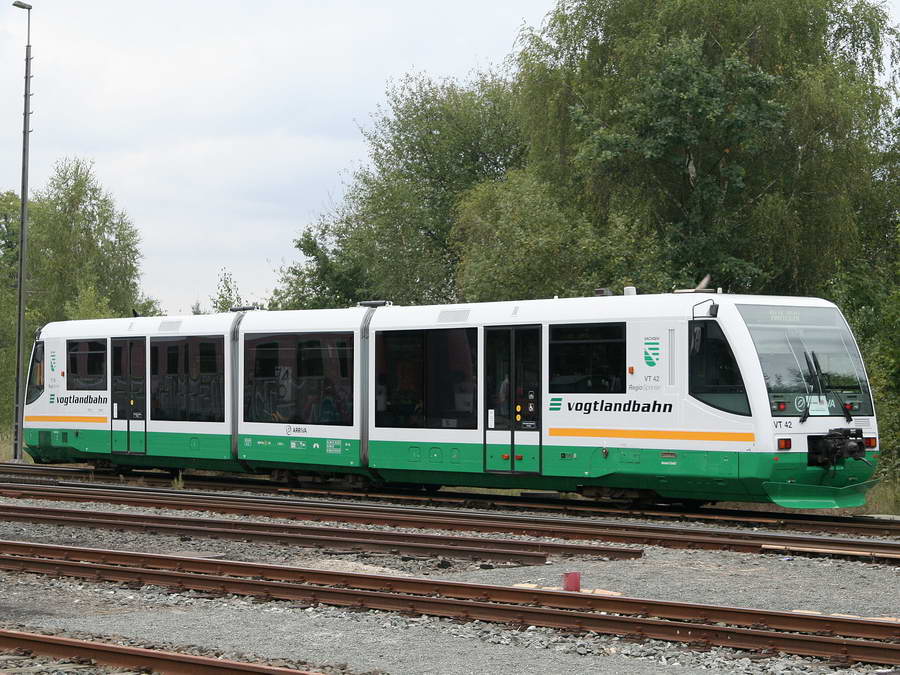
Diesel TramTrain as used in Zwikau, Germany.
What are the key points of interest found within this agreement? Excerpts follow –
Page 2 – E. “CP Rail has also agreed to grant Hydro running rights over certain tracks owned by C.P. Rail.”
Page 3 Part 1 Pratt Livingstone 1.01 – Sale of Assets on Pratt Livingston Line to C.P. Rail. “Hydro agrees to sell and C.P. Rail agrees to purchase the Tracks and Equipment free and clear of all liens, charges and encumbrances.”
Page 4 1.02 Grant of Statutory Right of Way over Pratt Livingstone to C.P. Rail.
“Hydro agrees to grant to C.P. Rail on the closing date a statutory right of way over the Railway Operations Easement Area in the form attached hereto as Annexure III.”
Page 4 1.03 Survey of Railway Operating Easement Area
“The Railway Operations Easement Area shall encompass the Tracks and an area sufficient to enable C.P. Rail to double track, construction of such double track to be at the sole cost of C.P. Rail including the cost of removal and relocation of the works of any other party on the lands required to double track.”
Page 5 1.05 Running Rights over Pratt-Livingstone Tracks to Hydro
“Hydro hereby reserves unto itself the right in perpetuity to operate a railway on the Tracks and Equipment and on the double track, when constructed. The reservation shall be in the form of running rights agreement attached hereto as Annexure V.”
Page 5 1.05(b) “if the railway operations of Hydro are sold to and operated by the Successor Rail Company, provided it is not owned or controlled by Canadian National Railway Company (“CN”) or Burlington Northern Inc. (“BN”), on a without charge basis, so long as the use thereof by the Successor Rail Company does not exceed 33% of the total annual wheelage of all trains operating trains in the Railway Operations Easement Area.”
Page 12 5.03 Regulation
“C.P. Rail will not take any action intended to bring Hydro or Successor Rail Company under the jurisdiction of the Railway Act R.S.C. 1970, c. R-2, as amended or the National Transportation Act, 1987 S.C. 1987, c. 34, as amended.”
P. 21 Entire Agreement
Section 10.07 “Each of the parties hereto acknowledges that there are no covenants, representations, warranties, agreements or conditions expressed or implied, collateral or otherwise, forming part of or in any way affecting or relating to this agreement save as expressly set out in this Agreement and this Agreement constitutes the entire agreement between the parties hereto with respect to the subject matter hereof.”
Annexure V Page 2 Sect. 1.2
“Hydro shall have the exclusive right to operate upon any Hydro trackage connected with the Joint Section to serve present or future industry from the Joint Section, to pick up or discharge passengers, freight or express business upon the Joint Section or to handle directly any passenger, freight or express business originating at or destined to points on the Joint Section.”
Page 3 Article II
Section 2.4 “CP Rail shall initially at it’s sole cost and expense, maintain and keep the Joint Section, including all mainline turnouts, in good condition and repair suitable for use by all parties.”
Section 2.5 “CP Rail shall make such reasonable rules and regulations as are from time to time customary among railways for the operation of the Joint Section. All train schedules, rules and regulations shall be reasonable among all railway companies using the Joint Section and shall not reasonably discriminate against any of them.”
Section 2.7 “This agreement does not contemplate the operation of passenger trains upon the Joint Section by any railway company other than Hydro. Hydro shall have the right to operate passenger trains over the Joint Section. The cars and engines of such passenger trains shall be included in the wheelage count made pursuant to Section 4.4.”
Summary:
The Master Agreement lays out in very specific terms the rights and conditions of the sale of the freight rights over the Joint Section (known as the Pratt Livingston Corridor) by all parties concerned. A review of the B.C. Government Press Release spells out the intent of the then B.C. Government to #1 – Continue ownership of the full Interurban Corridor in the right of the people of B.C. and #2 – protect corridor for passenger rights on said corridor. The rights were renewed by B.C. Hydro in June of 2009, two months prior to the 21-year term of expiry.
The Master Agreement and relevant additional pages number 88.
IMPORTANT – A full copy of this Master Agreement is available for review to substantiate it’s authenticity but it will not be released from our possession.
By way of another form of explanation we offer the following (Direct quotes in Yellow):
First, RE the B.C. Government Press Release: 2:00PM July 27th, 1988 – Langley B.C. by B.C.’s Energy Minister the Honorable Jack Davis which in part states the following –
“In commenting on the price paid by Itel the Minister emphasized that the sale relates, essentially, to rolling stock, trackage and rail freight running rights. It does not include land under or either side of the rail bed nor does it include air rights above Hydro’s corridor. These have been retained in order to accommodate future rail passenger, real estate or other developments along the former B.C. Electric Railway routings in the lower mainland.”
So, in response to those that are opposing this option we offer the following counters: NOTE – the first three items headed Part 1 set the stage for rights and responsibilities that follow:
One Counter would be Part 1 Pratt-Livingston – 1.02 Grant of Statutory Right of Way over Pratt Livingston to CP Rail “The right of way shall be perpetual in duration and shall be subject to all rights previously granted by Hydro to others by the agreements and other documents set out in Annexure IV whether registered against title to the lands in the Land Title Office or not”
A second counter would be Part 1 Pratt-Livingston – 1.03 Survey of Railway Operating Easement Area “The Railway Operations Easement Area shall encompass the Tracks and an area sufficient to enable C.P. Rail to double track, construction of such double track to be at the sole cost of C.P. Rail including the cost of removal and relocation of the works of any other party on the lands required to double track.”
A third counter would be Part 1 Pratt-Livingston – 1.05 Running Rights over Pratt Livingston Tracks to Hydro “Hydrohereby reserves unto itself the right in perpetuity to operate a railway on the Tracks and Equipment and on the double track, when constructed. The reservation shall be in the form of running rights agreement attached hereto as Annexure V.”
A fourth counter would be Annexure V, Article I, Section 1.2 “Hydro shall have the exclusive right to operate upon any Hydro trackage connected with the Joint Section to serve present or future industry from the Joint Section, to pick up or discharge passengers, freight or express business upon the Joint Section or to handle directly any passenger, freight or express business originating at or destined to points on the Joint Section.
A fifth counter would be Annexure V, Article II, Section 2.7 which states “This agreement does not contemplate the operation of passenger trains upon the Joint Section by any railway company other than Hydro. Hydro shall have the right to operate passenger trains over the Joint Section.”
A sixth counter would be Annexure V, Article IV, Section 4.1 (c) which states in the event Hydro’s use of the Joint Section exceeds 33% of the total annual wheelage as calculated on the basis as set out in Section 4.4…. etc.
A seventh counter would be Annexure V, Article IV, Section 4.2 which states if this agreement is assigned, provided it is not assigned to Canadian National Railway Company (hereinafter called CN) or to Burlington Northern Inc. (hereinafter called BN), the assignee shall not be required to make any of the payments prescribed by Section 4.1 unless and until the assignee’s use of the Joint Section exceeds 33% of the total annual wheelage as calculated on the basis set out in Section 4.4.
An eighth counter would be Annexure VI, Article II, Section 2.2 which states “CP Rail will at its sole cost and expense maintain and keep the Joint Section in good condition and repair and suitable for use by all parties.”
A ninth counter would be Annexure VI, Article II, Section 2.3 which states “All Train schedules, rules and regulations shall be reasonable among all railway companies using the Joint Section and shall not unreasonably discriminate against any of them.”
Again, words from a professional in the Canadian transit and transportation industry and it is a must read. Not all is what it seems, financially.
Haveacow is a professional and uses the avatar because Canada is a small market and most transit schemes are political in nature and politicians can never be wrong and having a professional telling a politician is wrong may lead to “black balling” on projects.
I have been very concerned with subway costs as a German transportation professional told me some years ago, that in the 1960’s and 70’s, the German government offered sweet subsidies to transit operators to build subways, but offered no money for extra operational and maintenance costs. As the subways aged, the operational and maintenance costs became onerous and the rest of the transit system was cannibalized to funds to keep the subway in operation. Several operators went bankrupt, others sacrificed their more productive tram lines to keep the politically prestigious subways in operation.
Will trolleybus operation in Vancouver be sacrificed to keep the politically prestigious subway in operation?
Is history repeating itself in Vancouver?
Graph prepared by Metrolinx to inform the debate on choice of modes
Two things, the graph your using from Metrolinx is actually for a full scale Metro/Subway not a Light Metro. I have no doubt however that the Skytran under Broadway would definitely fit in the middle between the Subway and elevated LRT costs. In fact, based on the raw capital costs of the Broadway Line’s first stage, it is probably a little closer to the Subway costs than the elevated LRT costs.
Second point, one of Zwei’s long term points is that, any new Skytrain line project or existing Skytrain line extension project, must be funded to a certain percentage by local Translink funding and there are serious doubts that Translink can fund more than one major project at the same time. Though even I doubted Zwei was 100% right on this issue, it was actually confirmed to me yesterday.
Yesterday, after a meeting here in Ottawa with my current major client, I ran into a very interesting ex-Translink Senior Policy Analyst and we struck up a fascinating conversation. During that conversation, which was mainly about escalating construction and risk management costs in all types of infrastructure projects (not just rapid transit related ones), he unprompted brought up the fact that, unless truly massive financial support is brought in by both the Province of B.C. and the Federal Government, there is no way that stage 2 of the Broadway Line and any other rapid transit project can occur at the same time because of the lack of local Translink funding. He seriously doubts that both B.C. and the Fed’s have both the political desire and financial capacity to fund any one rapid transit project of that size (current estimates are between $3.9 and $4.3 Billion) to almost 90% of the total cost.
He also doubts anything more than 11% – 12% local funding is possible if the Arbutus to UBC Skytrain extension is done at the same time as the extension of the Expo line to Langley. The federal government usually insists on atleast 20% – 33% local funding, unless the province is willing to pay more, like here in Ontario.
As long as Broadway extension to UBC is in play, Translink’s financial hands are tied. There is just not enough local funding unless many long term infrastructure fixes and upgrades to both bus infrastructure and existing Expo and Millennium Lines are either abandoned or put off for another decade or two. I asked about Canada Line upgrades or extensions, “not in this decade, try sometime in the 2030′s”, was his answer. The only answer is to change Translink’s current funding model and get a lot more money locally, to which he stated with current tax payer attitudes, has a,”snow ball’s chance in hell” of actually happening.
Later, Mr. Cow added:
The moral of the story is that tunnels cost a lot. As long as the people of the lower mainland of B.C. want tunnels under Broadway all the way to UBC, something financially has to give. Temporally drop the line extension from Arbutus to UBC and many other things become possible.
I recently got piece of information from Freedom of Information Request I did for my current major client. This was part of an internal Metrolinx memo compiled from information gathered by many of the national and international companies bidding on rapid transit projects in on Ontario, Quebec and B.C. This memo showed tunneling costs in Canada are increasing in about 4.78% to 4.98% per year, based on the current national basic inflation rate of 2.75%.
That means based on current estimates, the second stage of the Millennium Line on Broadway will be increasing between $181.6 Million to $201 Million a year, every year beyond 2022 (The end point of guaranteed costs from the last estimate ). So final costs will have to be confirmed by bidding on Stage 2 by 2022 or face a minimum of $182 Million per year, total cost increase to the UBC Skytrain extension. The current estimate is between $3.8 – $4.2 Billion.
These Skytrain estimates don’t include vehicle costs, or a new and desperately needed maintenance and storage yard.
One has to shake one’s head as the Broadway subway lobby desperately tries to have their way.
Reality is just not in their lexicon, as the city of Vancouver, UBC and several First Nations, all involved with land development along the route, are now lobbying for funding.
I would like to ask:
Where is the funding coming from for the about $4 billion subway?
Who will pay the added the operating costs? The cost to operate the subway to Arbutus will be around $40 million annually; around $50 million to UBC.
Who will pay for mid life rehab , 25 years down the road? In Germany, the gift of new subways, latter meant bankruptcy for transit authorities when mid life maintenance costs cannibalized monies from the rest of the transit system and they collapsed.
Important questions, that the Broadway subway lobby ignore and will ignore at the taxpayer’s peril!
*
TransLink fired its two top planners because they did not like to hear the truth that there was not the ridership on Broadway to justify a subway. So who trusts TransLink?
*
Then there are the land speculator/developers, enabled by the city of Vancouver, who is going to believe this lot of grifters, especially when there is not the ridership to justify a total $7 billion subway?
*
The mainstream media have been bribed by scarce advertising dollars to report positively on the subway and to ignore contrary opinion, thus making the mainstream media nothing more than the Canadian version of Pravda and Radio Moscow! The previous post certainly shows that!
*
As Barnum observed, there is a sucker born every minute and the Broadway subway lobby are banking on the fact they all live in Metro Vancouver!
Graph prepared by Metrolinx to inform the debate on choice of modes
VANCOUVER (NEWS 1130) – Calling it a “historic agreement,” the City of Vancouver, UBC, and the Musqueam, Squamish and Tsleil-Waututh Development Corporation say they have come together to push for a SkyTrain line that extends all the way to UBC’s Point Grey campus.
As part of their partnership, they’re asking the province and federal government to both commit to helping secure funding for the line all the way to the campus, as soon as possible. The stakeholders are also vying for regional support for the project, which would extend the Millennium Line.
Original plans had the Broadway subway stopping at Arbutus Street, forcing students, staff, and anyone else wanting to get to UBC to take a bus after the subway line.
“Building SkyTrain all the way to UBC is a regional priority that will not only help connect academic and health sciences along Broadway with the rest of the region, it will put reconciliation into practice as we work in partnership with the MST Development Corporation,” Vancouver Mayor Kennedy Stewart said on Wednesday, adding the agreement “sets a new example.”
The three groups hope the eventual connection to UBC will help improve transit around the Metro Vancouver region, as well as achieve a goal of more affordable housing, better access to post-secondaries, and increased economic growth.
The CBC has aired, what can only be said, an ill informed program on streetcars.
Why am I not surprised, as the CBC folded like a cheap deck chair and started singing hosannas about Montreal’s ill advised REM Light metro.
The CBC, cheap shots on streetcars, by someone who hasn’t a clue about the modern tram is nothing more than “yellow Journalism”.
So lets look at a few facts that eludes the CBC.
SkyTrain is fast because it has fewer stations than comparable streetcar lines and fewer stations makes the transit system user unfriendly.
As streetcars or the modern tram is far more user friendly than a bus, it attracts more ridership. In Caen France, a new 16 km tram line replaced the former guided bus (ultimate BRT) and gained 22,000 more customers a day!
Do not confuse American streetcar projects with good transit, as some are political pork barrels and nothing more.
Quote: “The study says, “new streetcar investments no longer primarily improve transit accessibility. Rather, modern streetcars are part of strategic amenity packages cities use to achieve real estate and economic development goals.”In my opinion, that’s a risky strategy. Really? This why SkyTrain is being built!
Quote: “Second, I question if more people will actually start using public transit just because the ride got more attractive.” Really, user friendliness of a transit system is the prime reason for attracting of new ridership and trams are far more user friendly than a bus. See Caen!
One tires of Vancouver’s mainstream media’s ignorance of modern public transport and their continued singing high praise at the alter of SkyTrain; a dated transit system, that has only sold seven systems in the past 40 years, and not sold one system in the past decade!
During the same period over 200 new build LRT/tram/streetcar systems have been built and many of the existing streetcar/tram lines have been rebuilt to 21st century standards!
The new 16.2 km tramway in Caen, France has opened after a nineteen month build.
Granted the new tramway has used the the previous trouble prone, 15.7 km, TVR rubber tire guided bus line, which opened in 20o2 and abandoned in 2017.
The Euro €260 million (CAD $373 million) tramway opened six weeks earlier than forecast and now carries over 64,000 passengers a day. The previous TVR guided bus system carried 42 thousand passengers a day.
The Caen tramway operates three Lines and serves 37 stations.
Not bad, when one considers that metro Vancouver is spending $4.6 billion, extending its MALM lines by 12.8 km!
For a brief moment in 2010, Vancouverites and visitors to the city could travel for free from Cambie Street to Granville Island on fancy streetcars from Brussels.
It was a city pilot project, called the Olympic demonstration line, to test and promote streetcars as a public transit alternative to buses and SkyTrains. The line attracted 550,000 passengers in 60 days.
That Olympic demonstration line was not the only time Vancouver has toyed with the idea of streetcars.
In the past, the city has considered streetcar routes from Granville Island to Waterfront Station, Yaletown, Stanley Park and even all the way down the Arbutus Greenway on the city’s west side. But a decade after the Olympics, the tracks sit empty.
Why build a streetcar?
Some consider the streetcar an intermediate level of transit. It can carry more passengers than buses, and if its tracks are separated from vehicle traffic, it can be faster too.
Streetcars may not be SkyTrain fast, but they usually cost much less.
In a 2005 study, the City of Vancouver pushed for a streetcar line. The study said it would foster economic growth, connect tourists to Granville Island and help revitalize neighbourhoods.
The study also said what I imagine a lot of people are thinking: “Streetcars are just… cooler!”
Or as the report put it, “smoother rides, easier access and better viewing often translate into more riders due to the increased level of passenger comfort.”
Why pump the brakes?
Despite its supporters, streetcars in Vancouver are going nowhere fast as the decision ultimately lies with TransLink, whose response to the idea has been a hard pass.
The first phase of a proposed streetcar route is from Granville Island to Waterfront Station.
However, the No. 50 bus already runs every 15 to 20 minutes between those stops and the streetcar would actually take about six minutes longer than the bus. Viewing it this way, the streetcar wouldn’t add much to Vancouver’s transit network.
But streetcar proponents see it as an economic and neighbourhood-building solution, as much as it is a transit solution.
This difference of opinions relates to a shift in transit planning identified in a Columbia University study analyzing recent streetcar projects across the United States.
The study says, “new streetcar investments no longer primarily improve transit accessibility. Rather, modern streetcars are part of strategic amenity packages cities use to achieve real estate and economic development goals.”
In my opinion, that’s a risky strategy.
First, the neighbourhoods that the study says will be revitalized are areas where gentrification has been controversial.
Second, I question if more people will actually start using public transit just because the ride got more attractive.
When I first started riding the SkyTrain, it was thrilling. But after 10 days, 60 days, two years? Now I’m staring at my phone just like everyone else.
I still take the SkyTrain because it’s the fastest way downtown, but I wouldn’t go out of my way to use it.
That’s a lesson many cities are learning the hard way.
There are many examples of streetcars across North America. Cities such as Cincinnati, Seattle, Detroit, Atlanta, and Dallas are examples of a few that were constructed under similar assumptions and are now struggling to attract users.
At the end of the day, people use transit because it takes them where they need to go quickly and reliably. I think that’s the truth whether we’re moving on roads or tracks. If we forget that, we risk building a transit service that’s just bells and whistles.
SNC Lavalin own engineering patents for the MALM (erroneously called SkyTrain) system used on the Expo and Millennium lines.
SNC Lavalin leads the consortium operating the Canada line. The BC Liberal government inspired Canada Line (faux) P-3 saw SNC Lavalin, bidding against SNC Lavalin.
On May 27th, 2009, after four years of litigation, BC Supreme Court Justice, Ian Pitfield, awarded $600,000 in damages to my company Susan Heyes Inc. as compensation for business losses caused by the construction of the Canada Line. The appeal of this ruling in my favour was heard April 15th, 2010.
Judge Pittfield called the bidding process for the Canada Line “a charade”.
In the past, the company enjoyed a good relationship with the BC Liberal government. Former Transport Minister Todd Stone publicly defended them. Former Premier Christy Clark was very close with SNC-Lavalin’s board chairman, Gwyn Morgan, who advised her on her leadership transition and, along with his wife Patricia Trottier and his company EnCana, was a huge donor to her party. All told, Morgan’s personal, family and corporate donations to the BC Liberals totalled more than $1.5 million.
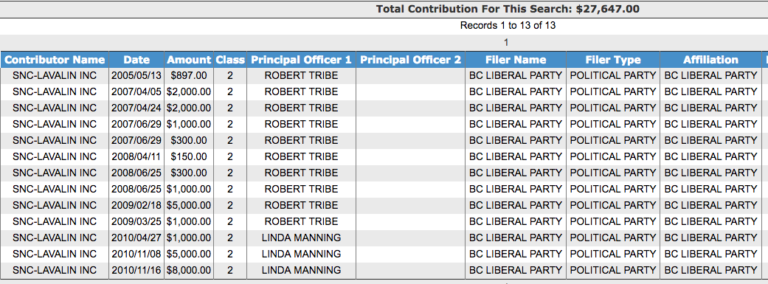
SNC-Lavalin itself donated more than $27,600 to the BC Liberals — during the same period of time that they were donating to politicians in Quebec in exchange for contracts, and circumventing federal donation laws. Of course, back then B.C. had no limits on political contributions.
During the BC Liberals’ time in office, SNC-Lavalin received a number of high profile government contracts including Kelowna’s William R. Bennett Bridge, the Canada and Evergreen Skytrain Lines (where employees say they were poorly treated), the Sea to Sky Highway and the John Hart dam in Campbell River. They were also involved in the development of the Compass Card system, as well as projects with BC Ferries, and both the Kelowna and Vancouver airports. SNC-Lavalin was also an environmental consultant for Site C, and performed the environmental assessment for the recently cancelled Fraser Surrey Docks project, during which they were accused of bias.
But the company is not in our rearview window yet. SNC-Lavalin is currently being considered by the provincial government for the contract to replace the Pattullo bridge. And Metro Vancouver mayors are alarmed by the possibility the company could still get work on the massive UBC subway project.
It seems SNC-Lavalin believes they can operate with impunity. They have been accused of bribery, embezzlement, corruption and fraud in every corner of this country and the world. It would be naive to think B.C. is exempt. We need to ask some serious questions about how SNC-Lavalin has conducted its business here.
One would think that David Eby and the premier would be very concerned with SNC Lavalin’s influence in BC and how the Mayor’s Council on Transit have been falling all over themselves approving two hugely expensive transit projects ($4.6 billion) using the now obsolete Movia Automatic Light Metro, a proprietary transit system which SNC own engineering patents?
Some Councillors are taking the weekend to absorb the newly released documents that shed light on why the city’s technical evaluation team failed SNC-Lavalin’s bid for Trillium Line Stage 2 twice. (Mathieu Fleury/Twitter)
Some Ottawa city councillors are calling for answers in the wake of revelations the city’s technical evaluation team wanted SNC-Lavalin thrown out of the bidding process for the second stage of Ottawa’s north-south rail line.
Instead, the company was eventually awarded the $1.6-billion contract for Stage 2 of the Trillium Line.
“I was absolutely shocked with how poor the proposal was,” said Coun. Carol Anne Meehan. “I was blown away that they really didn’t have a clue what they were actually bidding on and that their bid contained so many gaps in what was essential.”
CBC first reported in March 2019 that SNC-Lavalin did not achieve a minimum technical score for the project. In August the city finally admitted that the Montreal-based engineering firm failed to reach the minimum threshold not just once, but twice.
But documents released by the city this week revealed for the first time details of the technical evaluation team’s report on SNC-Lavalin’s bid.
Among other issues, the SNC-Lavalin bid failed to include a signalling and train control system, had no plan for snow removal and, at one point, referenced equipment used on an electric train system as if the current Trillium Line trains were electric, and not, in fact, diesel.
The team had reached a “unanimous consensus that the proposal should not be considered further in the evaluation process,” describing SNC-Lavalin’s proposal a “poor technical submission throughout.”
‘Thumb on the scale’
Coun. Jeff Leiper said the documents were “startling in terms of the lack of information that was provided by the bidder that you would expect to see in a professional complete bid.”
When looking at the questions from the bid evaluation steering committee, which oversaw the city’s procurement process and demanded that the technical evaluators review the bids after SNC-Lavalin originally scored only 63 per cent, Leiper said it’s difficult not to think that “someone had their thumb on the scale” for SNC-Lavalin.
“It’s hard not to read the bid evaluation committees questions as loaded, as clearly indicating that the technical evaluation committee is going to come up with a different answer,” Leiper said.
Leiper said by contrast the technical evaluation committee showed “professionalism” and “clear rigour” in their exchanges.
“I was left feeling very comfortable that the technical evaluation committee took their job seriously,” he said.
How did SNC-Lavalin win the contract for the Trillium Line extension? Councillor says it’s hard to understand
Coun. Jeff Leiper says SNC-Lavalin’s bid for the Trillium Line extension was “startling in terms of the lack of information” it contained. 0:51
Coun. Shawn Menard called for an independent public inquiry.
“It is startling to read the lucid staff descriptions of the [SNC-Lavallin] bid, knowing that our senior leadership ultimately accepted that submission,” he wrote in an email.
“I voted against Stage 2 LRT precisely because I was concerned about the procurement and rush to make a decision. My fears have now been confirmed.”
A number of councillors said privately they are taking the weekend to absorb the documents — which were released at 9 p.m. Thursday, after a marathon emergency transit meeting — and may have more to say next week.
Councillors weren’t the only ones questioning how the bid was approved. At least one resident on Twitter said he wanted to see city councillors hold city staff accountable.
Staff moved bid forward
Despite the technical evaluators’ conclusion that SNC-Lavalin be kicked out of the competition, the city’s senior management team used a discretionary power outlined in a secret clause of the request for proposals that allowed the city to move a bidder forward that did not meet the minimum technical threshold.
SNC-Lavalin was then allowed to proceed to the financial evaluation round and because its bid was so much lower than the other two finalists, it came out on top as the preferred proponent. Council awarded the company the contract last March.
The city’s auditor-general has already looked at the contract procurement process for the second stage of the LRT line and found that the city had broken no rules, a point made in statements sent out from Mayor Jim Watson and O-Train construction director Michael Morgan on Friday.
No city officials could make themselves available to speak to CBC about this story.


 A Karlsruhe TramTrain deep in the countryside – Affordable transit.
 The Canada Line, which connects Richmond, Vancouver and YVR airport, has broken records since it opened 10 years ago, according to TransLink. File photo
 SkyTrain is a prohibitively expensive form of rapid transit.Photograph By file photo/Delta Optimist






Recent Comments