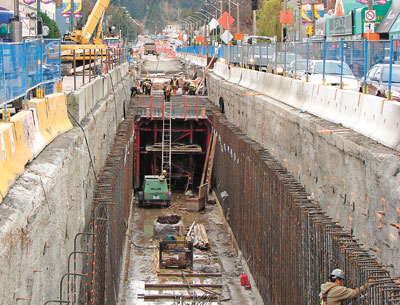
From Radio 1130 – Cambie merchants still waiting for Canada Line business boom. Not coming? Yes, Zweisystem told you so!
Well the RAV/Canada line has been open for some time now and now one wonders where is all those subway passengers that were dying to shop on Cambie St., as promised by RAVCo. and InTransit BC? Didn’t come? Well don’t hold your breathe, they’re not. It has been found in other jurisdictions where cut-and-cover subway […]

From Transit & Urban Tramways – Alstom and Dalkia win five-year, CAD $41.7 million, Luas (Dublin’s LRT) extension
There has been much ‘bumf’ in local blogs that light rail is expensive to maintain, even more expensive to maintain than metro. The following news item from T & UT gives a good example of theAi??Ai??annual operating costs of a modern light rail system. Dublin’s LUAS LRT does operate at a profit, even after paying […]

Some balance please! An independant view of the RAV/Canada line.
The following Email came Zweisystem’s way today and is certainly contrary to the hype and hoopla of other blogs claiming that the RAV Line is almost at capacity. The author of the item, who wishes to remain anonymous, is a party who worksAi??Ai??in local transit planning. Yes, the RAV/Canada line is up and running, but […]

TransLink hunts for money – From the Georgia Straight.
Ai??Ai?? Charlie Smith continues toAi??Ai??be Vancouver’s leading reporter on local and regional transit issues. Simply, he actually does research on the subject, unlike reporters in Vancouver’s mainstream media who have been reduced to printing well crafted TransLink and/or The Provincial Ministry of Transportation mews releases as facts. WhenAi??Ai?? it comes to a good analysis of […]

Is it time for the Valley to ditch TransLink? Would it lead to better regional transportation?
Martin Crilly’s report on TransLink came as no surprise, TransLink is in deep financial trouble and needs a major infusion of cash to keep it in operation. The question should be asked: “ShouldAi??Ai??the Valley MunicipalitiesAi??Ai??walk away from the transportation agency and let the chips fall where they may?” TransLink, despite all the revisionist history, was […]

Fares Fair – TransLink’s Fares Compared
The following is aAi??Ai??comparison of TransLink’s fares, with other cities in Canada and the USA with LRT/metro and bus systems. Included are cash fares only (as advertised Sept. 4/09) as every city offers weekly, monthly, annual and Tourist passes, all withAi??Ai??varying discounts. Also please note: Ai??Ai??Toronto’s cash fare & 90 minute transfer covers an area […]

From the Light Rail Now Folks: Busting "BRT" Mythology – LA’s "Orange Line" Busway A?ai??i??ai??? "Just Like Rail, But Cheaper?"
It seems the media and local politiciansAi??Ai??keep referring to Bus Rapid Transit or BRT as a transportation solutionAi??Ai??for METRO Vancouver’s ‘lesser taxpayers’ in the Fraser Valley, yet very few politicians and media types clearly understand what BRT is, or even how successful it has been in past applications. BRT despite the hype and hoopla, has […]
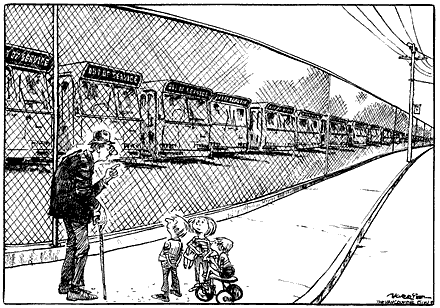
Massively inconvenienced by transit-system changes – Hell of a way to sell transit to a customer!
“It used to be something called public transit … then for reasons you’re too young to understand, they did away with the public.” The following letter, printed in today’sAi??Ai??Vancouver SunAi??Ai??(Sept.2) clearly illustrates Translink’s failure to address the wants of transit customers. The politically inspired RAV/Canada Line needed a magic 100,000 passengers a day (about 300,000 […]

A Great Wailing and Gnashing of Teeth from the SkyTrain lobby – The ignored SkyTrain Subsidy
In 1993, the GVRD (now Metro) and Transport 2021, publishedAi??Ai??the study, “The Cost of Transporting People in the BC Lower Mainland” and for the first time the annual SkyTrain subsidy was mentioned. In 1991, SkyTrain was subsidized to the tune of$157.6 million, more than half of the total subsidyAi??Ai??paid forAi??Ai??public transit in the Lower Mainland. […]

From the Seattle Times, October 2002 – Vancouver’s SkyTrain: model for the monorail?
There has always been a close relationship between Vancouver’s and Seattle’s city planners and the now aborted monorail scheme seems to have been abetted by this relationship. Not mentioned of course is that despite about $8 billion now invested in our SlyTrain/RAV metro’s, TransLink’s mode share has stalled at about 11% for the almost the […]



Recent Comments