A Conflict of Interest – The Broadway Subway

TransLink, unfortunately digs very deep holes for itself and Mr. Chris exposes what they want the public to believe as fact, is in fact pure invention.
There are two points I would like to explore, from Mr. Chris’s letter , posted on this blog on November 18.
In 1986, the Light Rail Transit Association defined LRT thus:
“LRT is a transit mode that can economically cater to traffic flows of 2,000 to 20,000 persons per hour, thus effectivelyAi?? bridging the gap between the maxim flow of what buses can carry and that of a heavy-rail metro.“
TransLink’s SNC and Steer-Davies-Gleave Study deliberately dumbs down the capacity for LRT for the Broadway, by claiming that light rail’s assumed capacity along Broadway varies between 5,800 to 7,200 persons per hour per direction, while at the same time put the assumed capacity of a Skytrain subway at 13,000 pphpd.
Really?
In Ottawa, Alstom put the capacity of a coupled set of Citadis trams at 600 persons and at 3 minute headway’s (20 trips per hour is the current B-Line bus peak hour schedule), would equal 12,000 pphpd! At two minute headway or 30 trips per hour, the capacity would be 18,000 pphpd or put another way, LRT on Broadway could have the potential to carry more than the maximum capacity of a SkyTrain subway, which is limited to 15,000 pphpd!
Obviously the study pulled numbers out of the air to make light rail look inferior when compared to SkyTrain, therefore if the TransLink study is using phoney numbers, then the entire study must be treated as suspect; in fact the transit study is phoney! Yet, TransLink has gotten away with this nonsense for over a decade and BC Transit before that!
Noted American transit planner, Gerald Fox had it right all along about TransLink’s dubious transit planning.
It is interesting how TransLink has used this cunning method of manipulating analysis to justify SkyTrain in corridor after corridor, and has thus succeeded in keeping its proprietary rail system expanding. In the US, all new transit projects that seek federal support are now subjected to scrutiny by a panel of transit peers, selected and monitored by the federal government, to ensure that projects are analyzed honestly, and the taxpayers’ interests are protected. No SkyTrain project has ever passed this scrutiny in the US.
Secondly, isn’t it a strange coincidence that SNC Lavalin which cosponsored the study also holds half the patents for the proprietary SkyTrain mini-metro system and has a financial stake if the mini-metro is built and more so, if it is built in a subway?
Let us not forget the presiding judge over the Susan Heyes lawsuit, called the Canada Line bidding process……
“a charade“.
I call that a blatant conflict of interest.
As usual for TransLink, due diligence never happens and for good reason, truly independent transit studies would never support SkyTrain.
In fact, for 35 years, no independent transit study ever has.
Ai??*****
Ai??The first paragraph of Mr. Chris’s (PE) letter………
Dear TransLink Board, Mayorsai??i?? Council and Minister Stone,
Iai??i??d appreciate an explanation (sooner than later) for TransLinkai??i??s waste of time, money and resources to produce its fraudulent study favouring s-train based on the s-train lineai??i??s supposed increased capacity over the LRT line to UBC.Ai?? TransLink is bending the truth to keep the ones who are responsible for the massive fraud (that s-train has more capacity than other modes of transit) from being jailed for the rest of their lives.Ai?? Hoaxers at TransLink are essentially bilking taxpayers of billions of dollars by circumventing fair and competitive bidding from Alstom and Siemens proposing tram or LRT lines in order to sole source contracts to Bombardier and SNC Lavalin for the s-train line to UBC, at a greatly inflated cost to taxpayers.Ai?? ai???Assumedai??? capacity of LRT ranges from 5,800 pph to 7,200 pph while ai???assumedai??? capacity of s-train (RRT) is 13,000 pph in the study by SNC Lavalin and Steer-Davies-Gleave (summary on page x)?Ai?? Whatai??i??s wrong with the ai???realai??? capacity?
Subway Stations Flood
 Some that TransLink and its allies, the Broadway subway lobby fail to mention is that subways and subway stations, by their very nature become massive sumps, if there is a flood, either by storm or by water-main breaks.
Subway station flooding is not uncommon, especially on older systems, which the underground utilities above the station age as well.
So the next time the shills and claques beat the drum for a Broadway subway, remind them of station flooding and what measures (read expensive) will be taken to prevent it.
*****
New York Metropolitan Transportation Authority [MTA] restored subway service Sunday to a flooded Bronx station, the Time Warner Cable News “NY 1” site reports:
Water main break floods Bronx subway station
“Train Service Restored at Flooded Bronx Subway Station
10:01 AM (Sunday, Nov. 23, 2014)
(VIDEO)
Play now
6 train service has been restored in the Bronx after crews finished cleaning up the mess left by Saturday’s massive water main break.
They had to pump out 800,000 gallons of water, that spilled into the East 143rd Street station.
Then crews had to clean up the muck and debris on the tracks.
That meant commuters had to find other ways to get aroundai??i??by taking shuttle buses.
No word on what caused the 48-inch water main to break.
The Le Havre Tramway
Le Havre:Ai?? Population:Ai?? City 180,000; Metro Area 300,000
Distance:Ai?? 125 miles west northwest of Paris, 125 minutes
System Length:Ai?? 13Ai?? kilometres
No. Lines:Ai?? 2
No. Stations: 23
Year Opened:Ai?? 2012
Rolling Stock:Ai?? 22 Citadis 302
Cost – Vehicles: ai??i??45m (CAD $62.62m)
Cost of project: ai??i??395m (CAD $550m) which includes a 575 metre tram tunnel
 In France, one third of construction costs go for streetscapes, parks and public amenities.
 A tram on a lawned R-o-W, just before the tunnel portal, which goes under a hill.
 A tram stop in town
 The tram runs quite safely through residential areas.
 The tram route now operates on a former six lane motorway, not unlike Broadway.
Photos courtesy of Jack May
Civic Elections Done, Now It’s Time For the TransLink Referendom
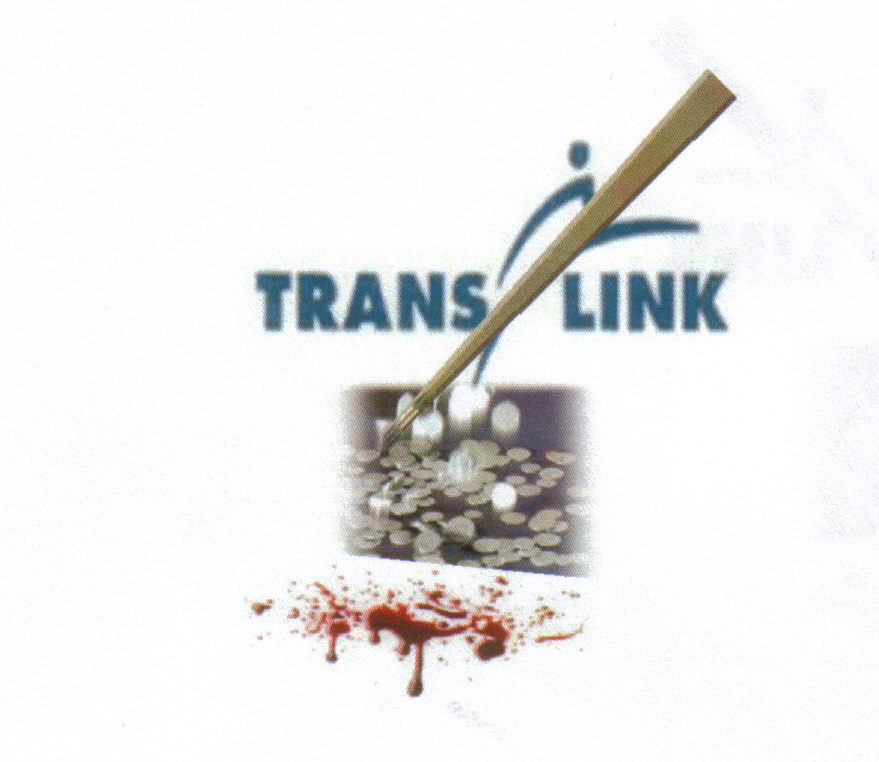
This spring’s TransLink referendum has a good chance of going off the rails, simply because the bureaucratic behemoth is sailing into very dangerous uncharted waters. Translation, the taxpayer wants to get even.
Why do I say that? TransLink has had “0” public input since its inception and today is so estranged from the public it is supposed to serve, that the organization has become a leper in the minds of the taxpayers.
There is great fear from all the piggies feeding at the TransLink trough that the gravy train is about to stop. Many regional mayors, despite having absolutely no knowledge of modern public transit and its practices, do not input from the taxpayer, rather they act as potentates and demand the ‘great unwashed’ do as they say. Such action is a clarion call for a taxpayer revolt.
The Surrey Leader has a good story, one of many to come, about the referendum, but the real story is very plain to see; TransLink operates a very expensive light metro system in the region that costs more to build, maintain and operate than light rail. By building with SkyTrain, we just keep digging TransLink into a deeper financial hole.
Kevin Falcon’s dirty little secret.
Kevin Falcon, Gordon Campbell’s Minister of Transportation has a dirty little secret which may be exposed in the upcoming referendum, the Canada Line, the only heavy-rail subway in the world that has less capacity than a streetcar!
The Canada line, which is not Skytrain and is not compatible in operation was built on the cheap, if you call $2.5 billion cheap. But the mini-metro has stations with 40 metres to 50 metres long and can only accommodate 2 car trains. Operating 2 car trains gives the illusion that the line is well patronized, but in reality it is not. I call this “Hocus-pocus” planning.
 As built, the Canada Line was at capacity and the vast majority of it’s ridership comes from from forced transfers from bus customers who wish to go to Vancouver proper. The cost to increase capacity and rebuild station platforms and guideways, $1.5 billion to $2 billion. Thus to extend the Canada line, it will cost taxpayer’s dearly.
A recent FOI showed that TransLink paid the operating consortium of the Canada LioneP-3 $145 million to operate the line in 2012, which is two to three times more than the operating costs of comparable transit lines!
This makes the $450 million cost overruns of the FastFerry fiasco seem like small potatoes, but no because Vancouver wants a subway!
Vancouver wants a subway and will hold its breathe like a spoiled child until it gets one.
Vancouver wants a subway under Broadway, even though the route does not have the ridership that comes near in the investment needed for a subway. Even TransLink’s own modelling for 2041, shows that Broadway will not have the ridership to justify a A $3 billion to $5 billion subway. Instead of affordable LRT which may cause inconvenience to car drivers, the region’s taxpayers are expected to give until it hurts and then give more.
Surrey’s Poorman’s SkyTrain
TransLink has never understood modern light rail and has spent most of its times decrying the mode, but Surrey wants LRT and so TransLink has disguised Surrey’s proposed LRT as a poorman’s SkyTrain costing two to three times more than it should to build.
SkyTrain’s $2 billion to $3 billion mid-life refurbishment.
The title says it all, but TransLink and our regional mayors have been so ever quiet about this. The present SkyTrain system needs a very expensive mid life facelift which will add further to the tax burden.
Despite the hype and hoopla of those benefiting from TransLink’s largesse, one should consider the real issues and vote accordingly, but one thing is for sure, a no vote in the referendum will put a halt in TransLink’s spending habits and put a spotlight on where the cash really goes and that is into the SkyTrain/light-metro money pit, which greatly worries TranLlink’s executives and NDP/BC Liberal party members.
The Broadway Subway – Vancouver’s Phallic Symbol
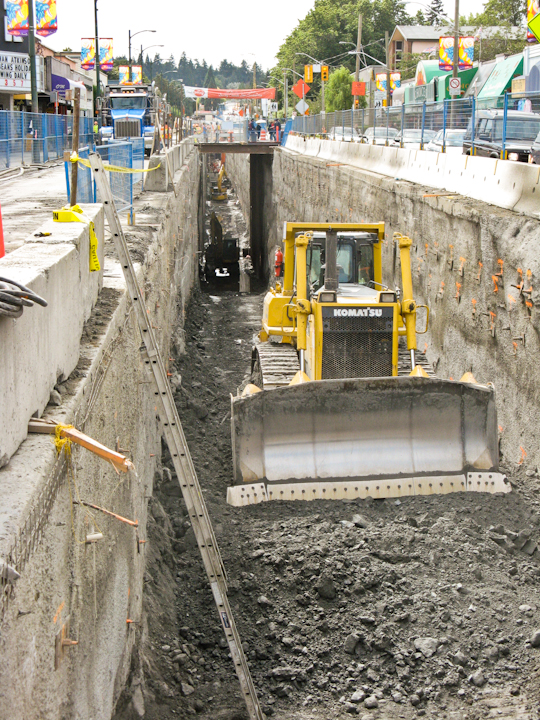
Vancouver’s politicians and elites desperately want the city to be a “world class city” and by their definition, a world class city must have subways.
The Canada Line, the only heavy rail metro in the world that operates as a light metro, runs in a subway under Vancouver’s streets because city politicos, in effect, held their breathe like a spoiled child until they got their way. The reason? Their political supporters didAi?? not want modern light rail on the Arbutus Corridor, so the region picked up the tab for construction.
Today, the Canada Line carries a sizable amount of ridership, or it seems too, because the trains are packed during peak hours. The truth is a little different.
The Canada Line’s construction costs were spiraling out of control and to curb a massive cost overrun (about three times or that of the ‘Fast Ferry’ debacle) the scope of the project was reduced to the point that the system could only operate two car trains, with stations having platforms 40 metres to 50 metres long. This means the Canada line was at capacity the day it was built! The other cost cutting measures included switching from a ‘bored tunnel’ to ‘cut-and cover’, which in turn ruined businesses and bankrupted shop owners along the route.
To counter the negative reporting about the Canada Line a professional troupe of highly paid claques were constantly interviewed by the media, spinning the story to such a degree, that those loosing their life savings by cut-and-cover construction along Cambie Street, were cast as greedy money sucking villains. This theme even entered Canada’s court system doing untold damage to those who were deliberately bankrupted by the Canada Line.
The following is what one will not hear from the SkyTrain subway lobby:
- Ai??Capacity on the Broadway subway will be limited to 15,000 pphpd, unless a further $2 billion to $3 billion is spent upgrading the millennium and Expo line stations and electrics.
- A subway will greatly increase operational costs for the Broadway route, as subways are power hogs and the power needed for escalators, elevators, lighting, ventilation, pumps, etc. will far outstrip the power needed to operate the trains.
- The electric trolleybuses will go the way the trolleybuses did on Cambie St.
- People, who’s transit journey is less than 7 km. will find they will have increased journey times.
- Cut-and-cover construction will be used as the precedent was set with the Canada line subway.
- The subway will not attract much new ridership and many people will think it user unfriendly.
- Future maintenance costs will further exacerbate TransLink’s financial position.
- Municipalities South of the Fraser may find the subway too extravagant and lobby for partitioning of TransLink.
- The high cost of subway construction/operation may do away with the U-Pass.
- Congestion along Broadway will increase as only a small percentage of people who will purchase the proposed new Condos and Apartments will use transit.
Today we have many bloggers pitching the virtue of a SkyTrain subway under Broadway, with many having close connections to those politicians who champion the subway projects. Like the claques and shills for the Canada Line a decade ago, most of the bloggers supporting a Skytrain subway will not deal with the reality of the costs today, or twenty to thirty years down the road because they are pitching the construction of what is tantamount to a massive phallic symbol to show that Vancouver is ‘world class’ to those who care and screw the rest of the region.
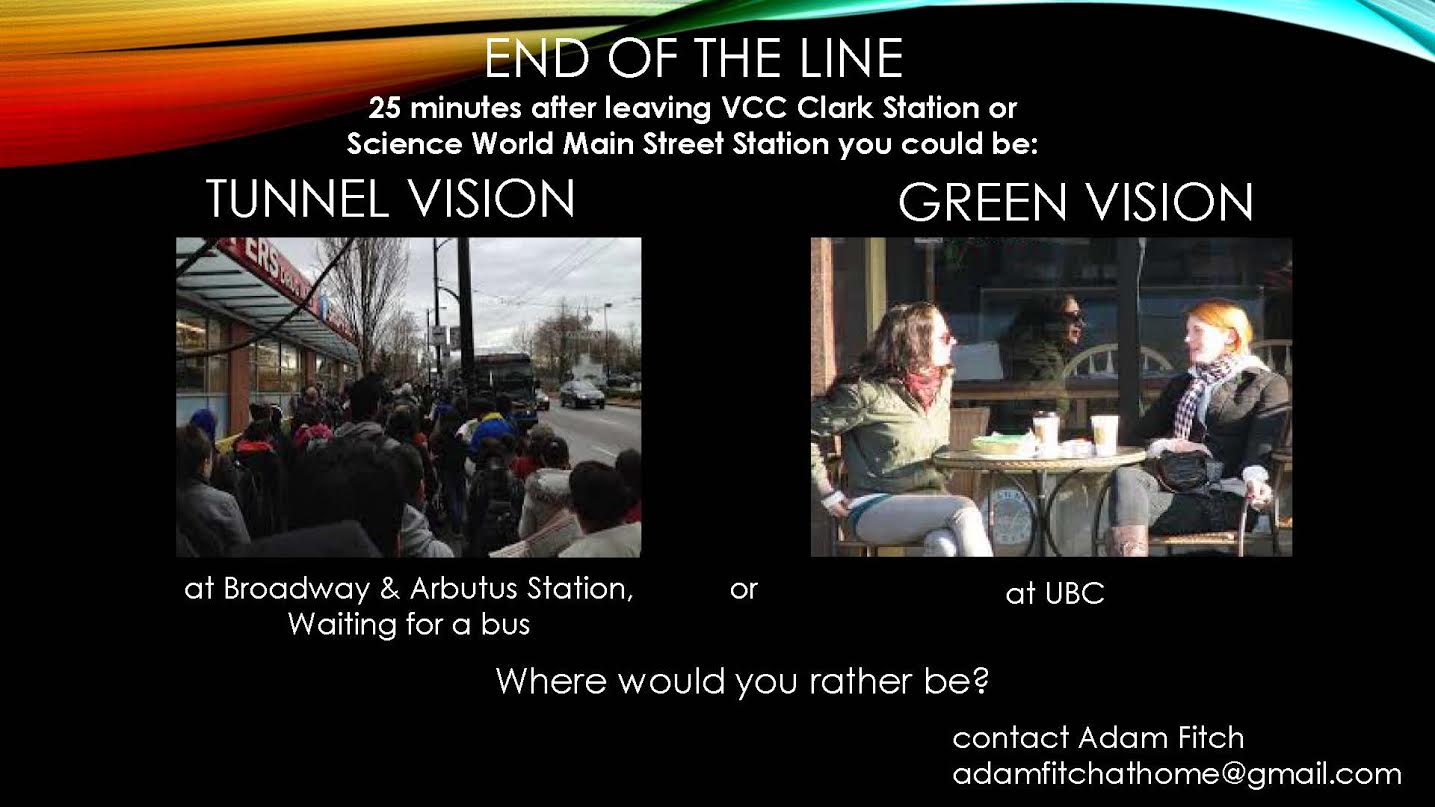
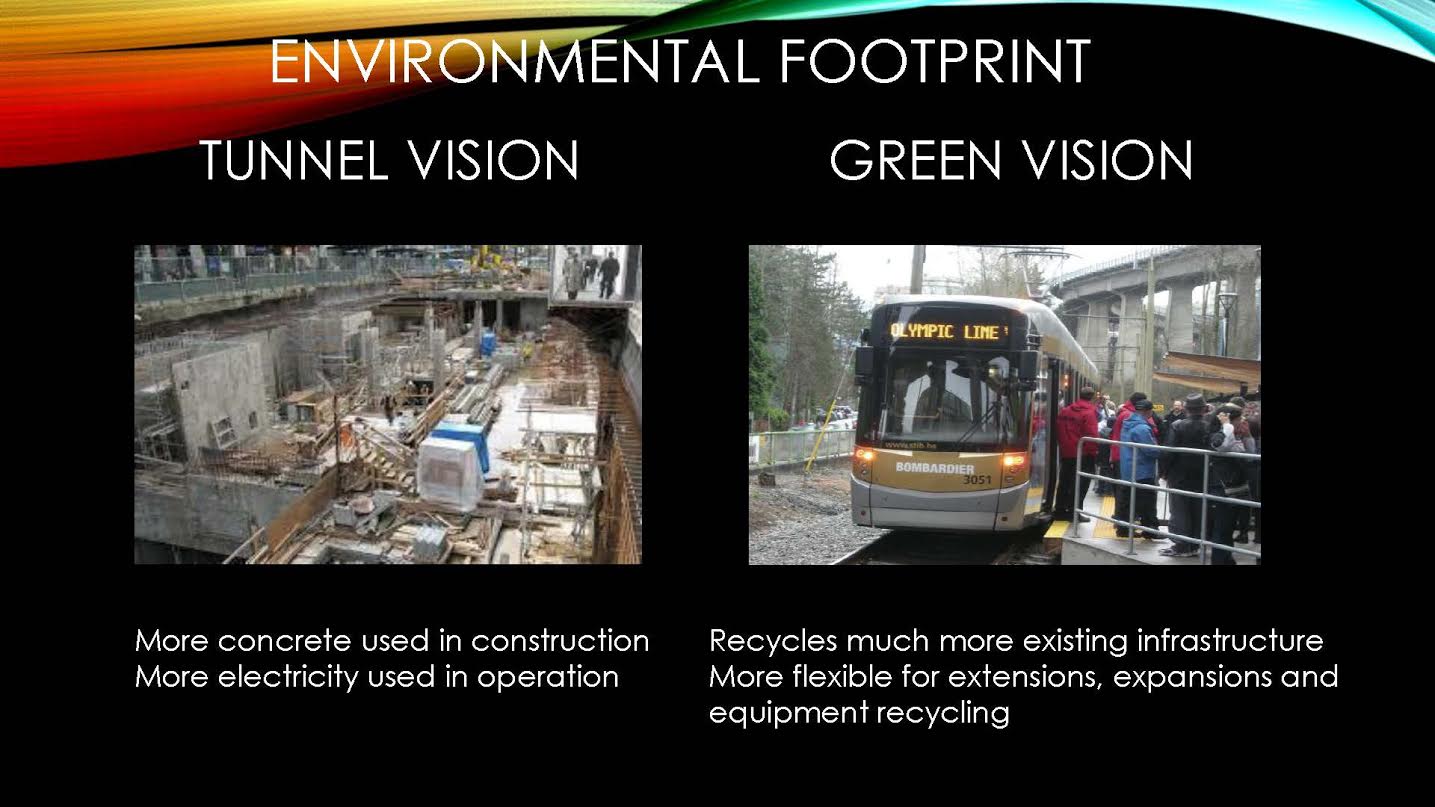
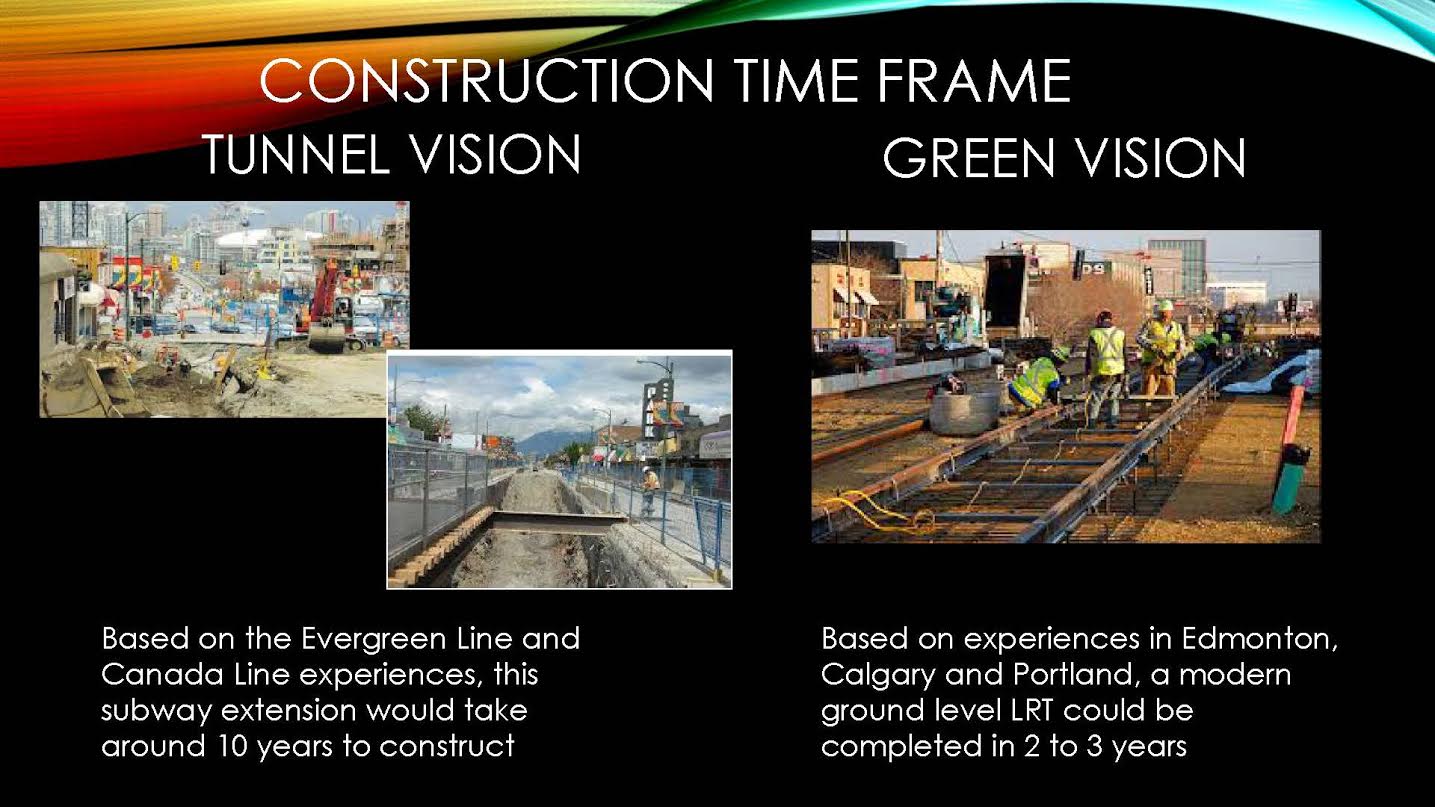
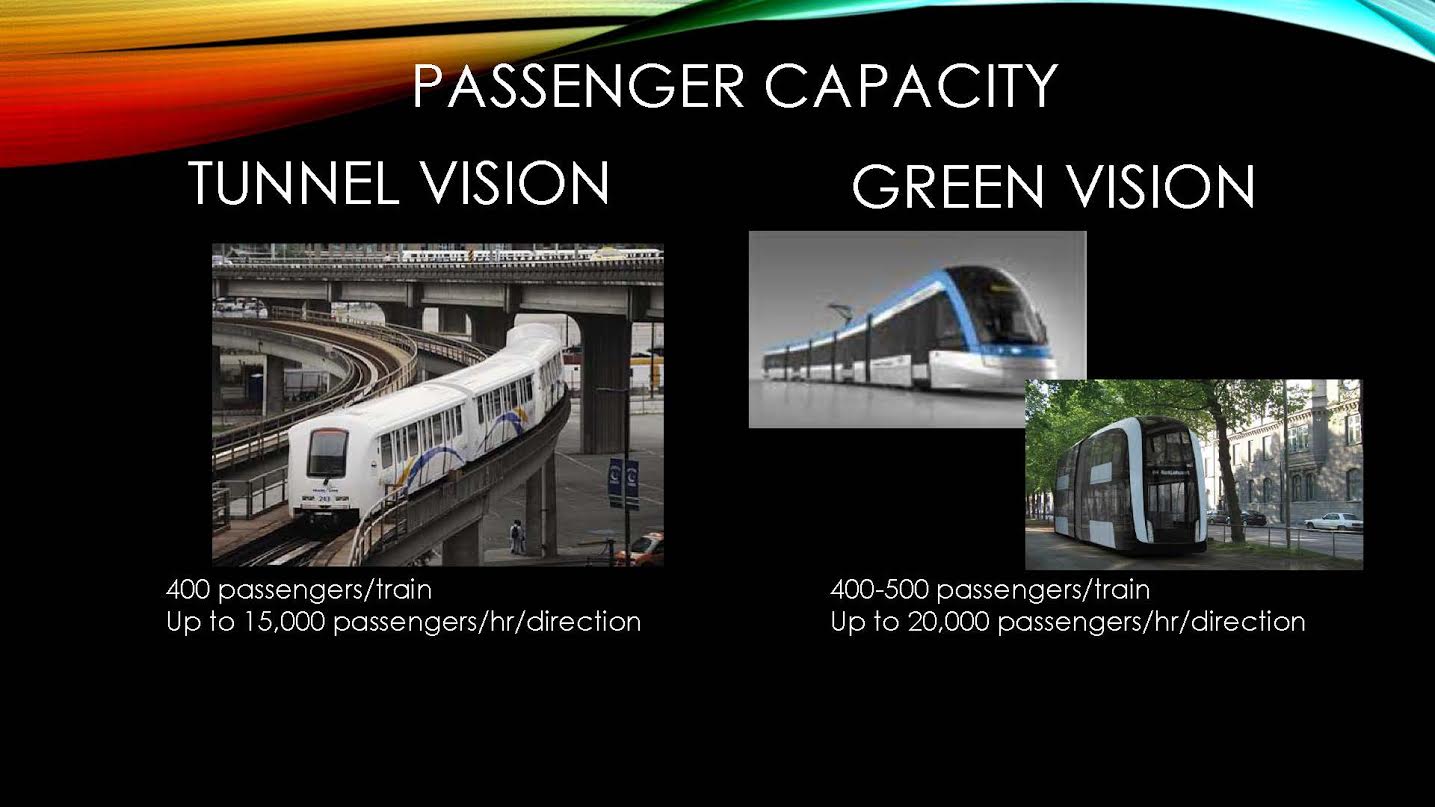
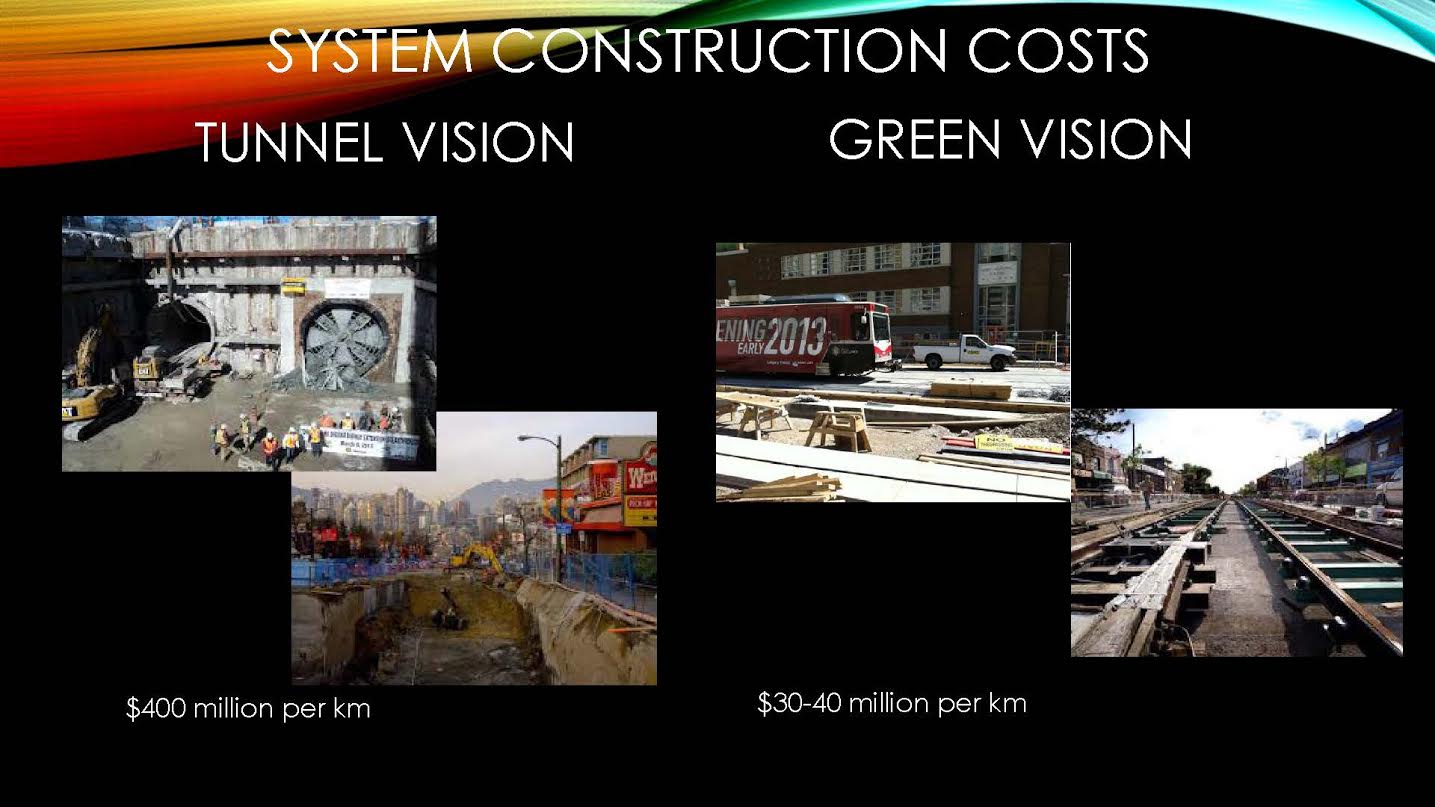
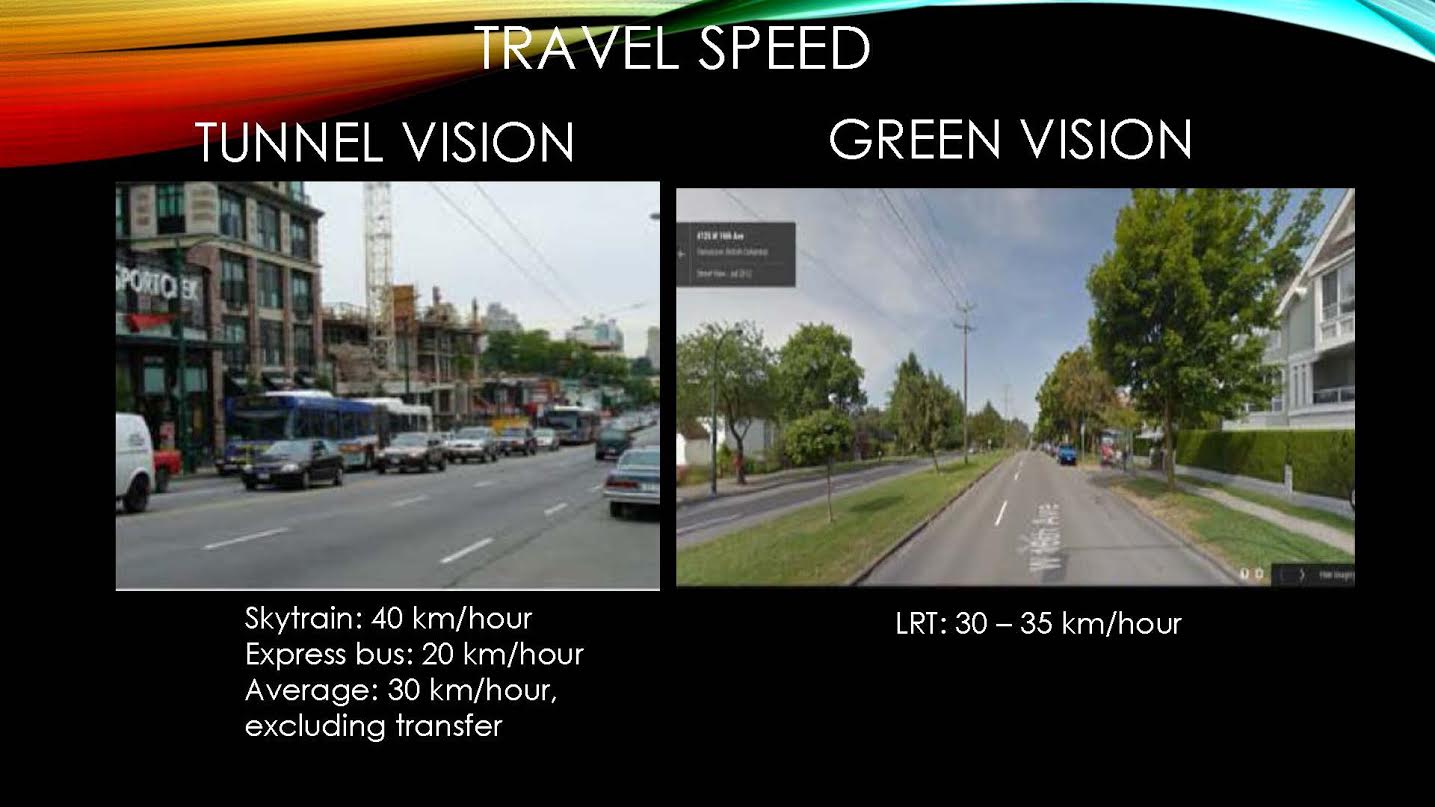
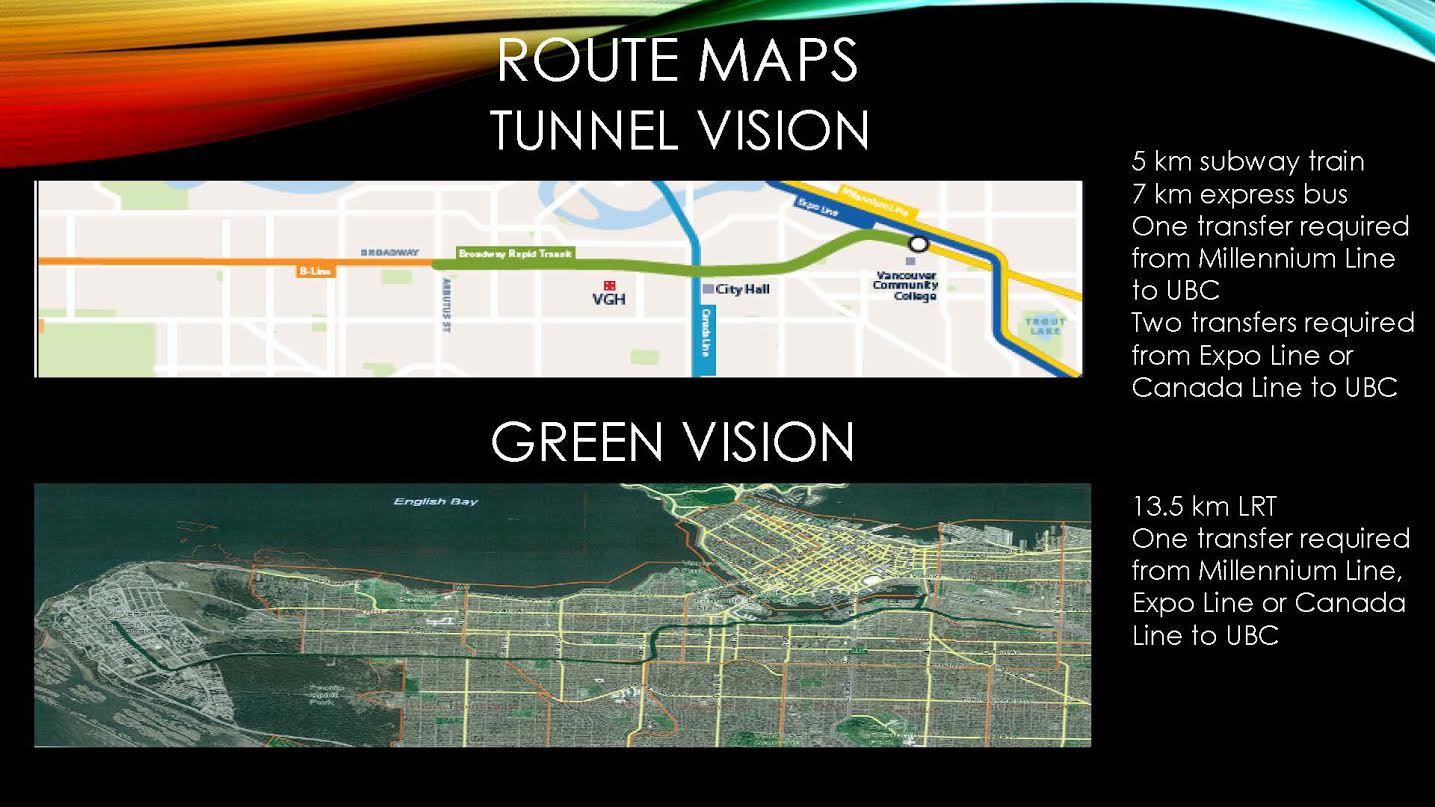
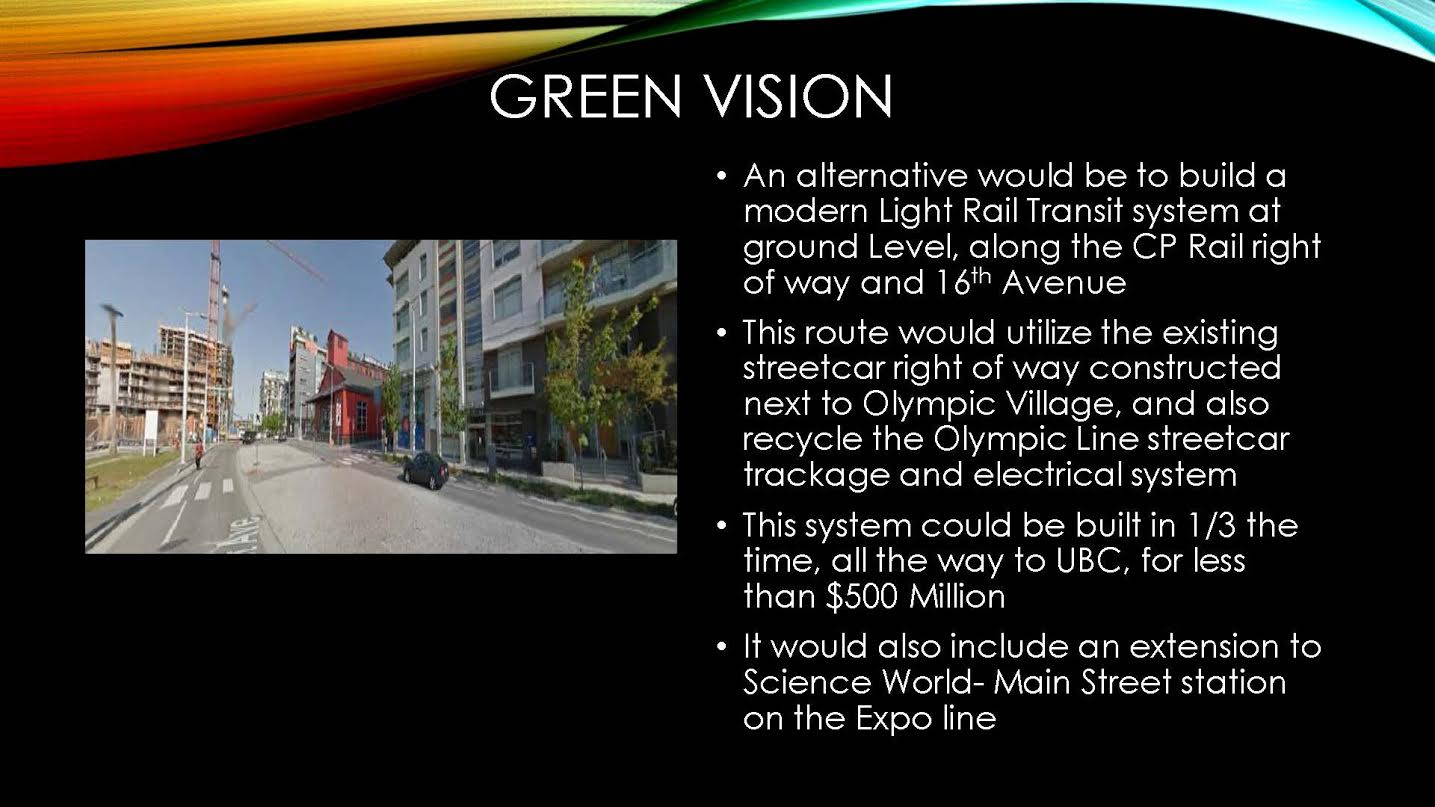
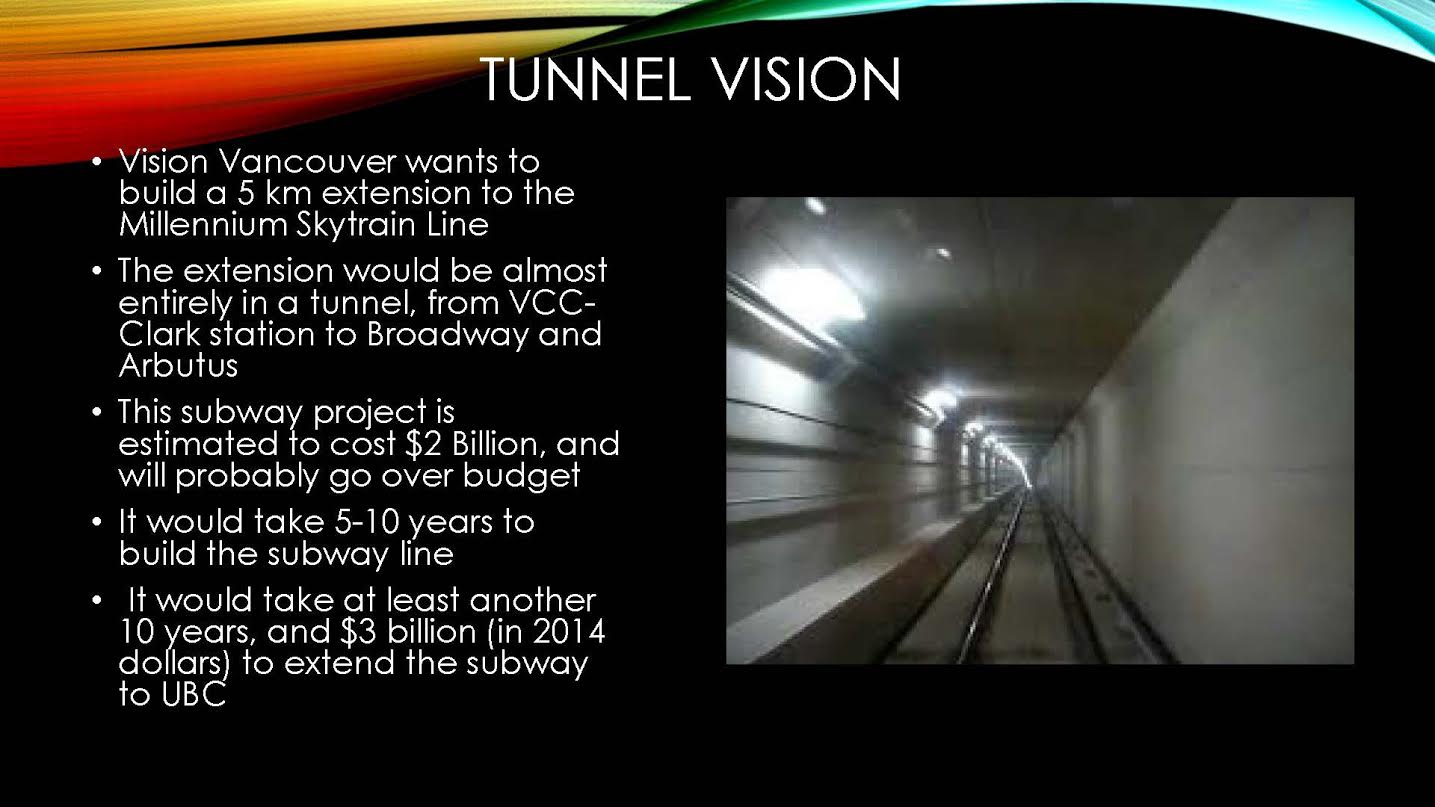
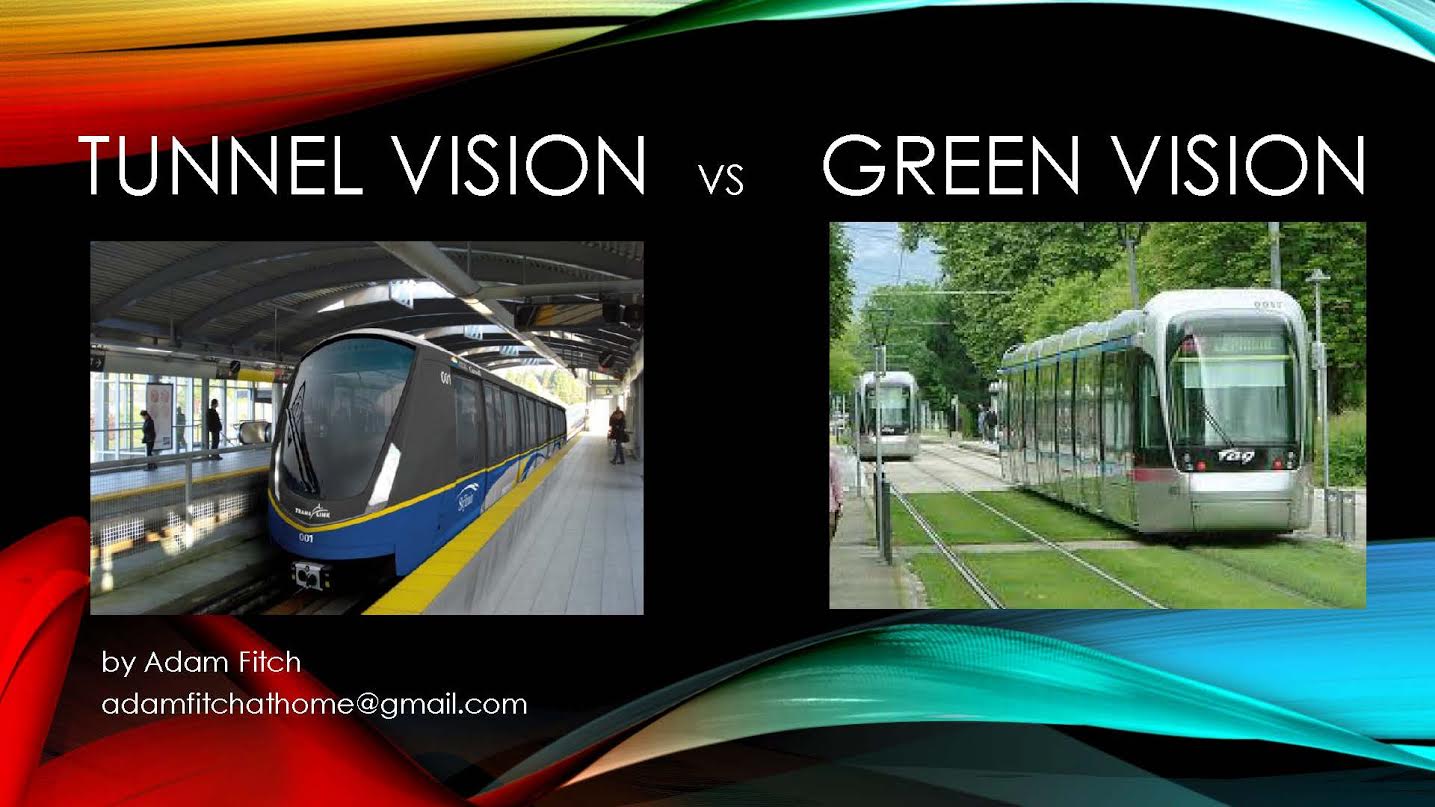
Tunnel Vision Versus Green Vision
Ai??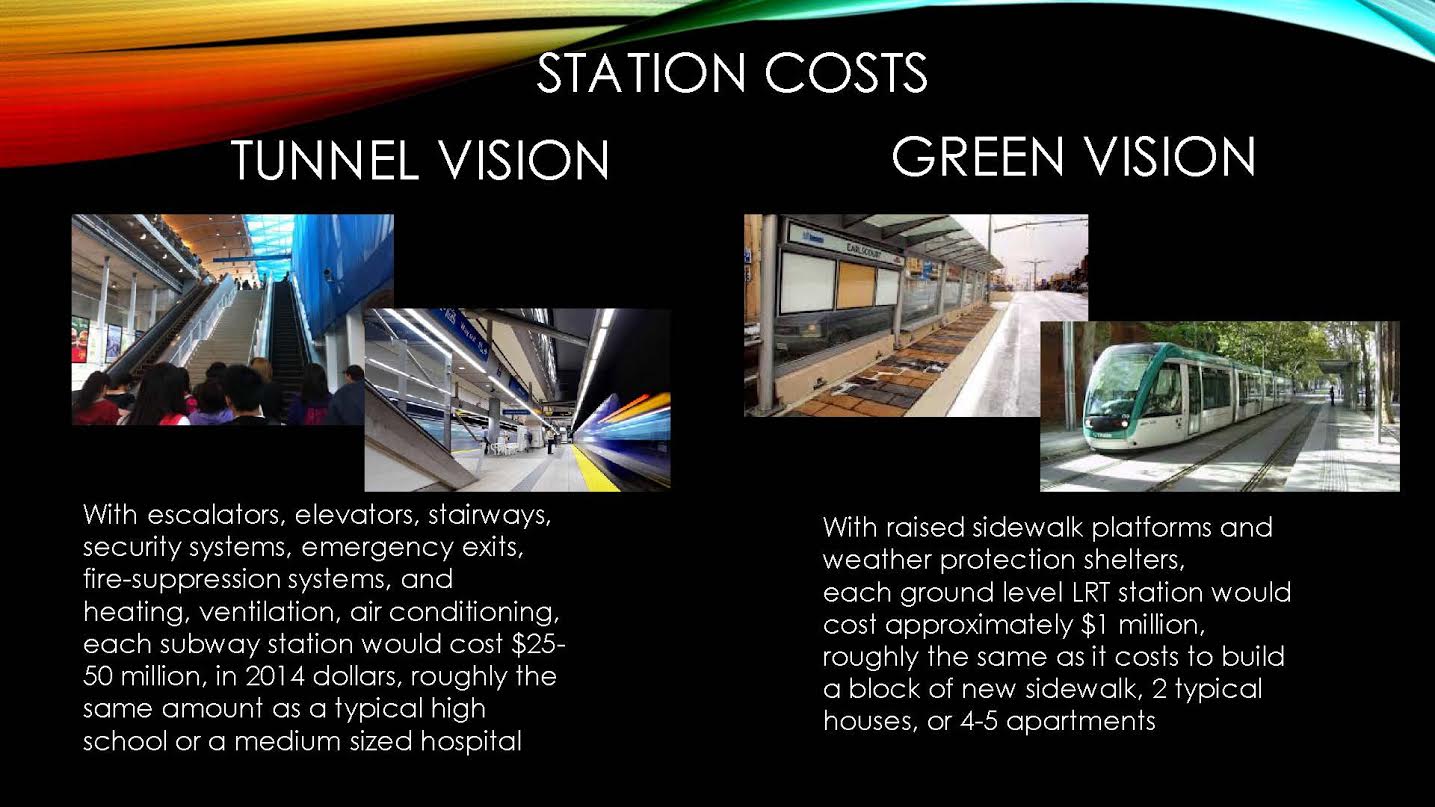
TransLink Report On SkyTrain Out
From what I can see, the problems that plagued SkyTrain last summer, were ones of very bad management and deferred maintenance.
TransLink’s bad management is legendary and the outfit continues its oppression of transit customers with gestapo like ticket checks and its general anti transit customer attitude.
The question of deferred maintenance is another matter and one that plagues many public transit systems around the world. The problem is that with a driverless system, deferred maintenance issues have a much greater effect on the traveling public than on conventional transit systems.
The study did not look at management problems and one has to assume, that major problems will still haunt the Skytrain system for years to come.

TransLink to adopt all 20 recommendations after this summerai??i??s SkyTrain shutdowns
Disruptions led to passengers walking on electrified tracks
By Jeff Lee, VANCOUVER SUN November 18, 2014
METRO VANCOUVER – TransLink said Tuesday it will adopt all 20 recommendations from an independent expert review of two critical failures of its SkyTrain system that left thousands of passengers stranded for hours.
The changes, which range from installing new emergency power supply systems to installing an auto-restart system it initially declined to buy 20 years ago, will cost TransLink $71 million. The expenditures will be phased in, but TransLink CEO Ian Jarvis said the most critical upgrades will be done first.
The review by former Toronto GO Transit president Gary McNeil, looked into the reasons for two massive and prolonged failures of the SkyTrain system on July 17 and 21. In short, he found that the causes of the two incidents were not related, but the outcome from them certainly was. In the first case a circuit board governing the SkyTrain Expo line east of Royal Oak failed. In the second case, an electrician using a non-insulated screwdriver shorted out the entire control centre, including the emergency ai???uninterruptible power supplyai???.
The failures occurred against the backdrop of a SkyTrain system increasingly pressured by maintenance costs and a growing number of alarms of the automated guideway intrusion system.
That track-level alarm system, which puts the brakes on trains, is activated by so much as a pop can, a bird, or even the weight of a newspaper. McNeil said in his report that in recent years the system was suffering from 275-300 intrusions a month. But in November, 2013, technicians adjusted the sensitivity to the point that there are now about 450 guideway intrusions recorded a month, causing trains to frequently stop.
As a result, he said, ai???this increase in delay events may give the public a general perception that the system is aging and more maintenance issues are present than reality would attest.ai???
However, SkyTrain has also been forced, it said, to do more with less. Since the system went into service in 1986 the length of the line has gone up by 223 per cent, the number of stations by 220 per cent, and the operating kilometres by 349 per cent. But over the same time, the operating budget has only increased from $55 million to $107 million, an increase of 195 per cent.
ai???Customers have every right to be angry and frustrated, especially those who were stuck on trains for a prolonged period of time,ai??? Jarvis said in a statement. ai???We have taken these incidents very seriously and we fully accept and are acting on all 20 recommendations. We have already started the work.ai???
Ai?? Copyright (c) The Vancouver Sun
Making Sense From TransLink’s Nonsense

The following is from the RftV friend, Eric Chris. Mr. Chris is a graduate engineer and he sees through TransLink and TransLink Speak.
*****
TransLink is bending the truth to keep the ones who are responsible for the massive fraud (that s-train has more capacity than other modes of transit) from being jailed for the rest of their lives. Ai??Hoaxers at TransLink are essentially stealing billions of dollars from taxpayers to circumvent fair and competitive bidding from Alstom and Siemens proposing tram or LRT lines, for instance, in order to sole source contracts to Bombardier and SNC Lavalin for s-train lines at an inflated cost. Ai??ai???Assumedai??? capacity of LRT ranges from 5,800 pph to 7,200 pph while ai???assumedai??? capacity of s-train (RRT) is 13,000 pph in the study by SNC Lavalin and Steer-Davies-Gleave (summary on page x)? Ai??Whatai??i??s wrong with the ai???realai??? capacity?
Unfortunately Vancouverites just re-elected Mayor Gregor Robertson. Ai??He is a faux pas environmentalist believing that dredging sand from the ocean floors to destroy our aquatic ecosystems is fine as long as it is to produce concrete for his subway to UBC. Ai??Heai??i??d be harmless except for his obsession with the subway to UBC. Ai??Anyhow, the voters have made up their minds and chose him over other candidates having substance ai??i?? thatai??i??s democracy for you and weai??i??ll have to make the best of it until he is hit by a bus or is hopefully defeated in the next election.
ai???Environmentalismai???
Any mode of transit whether it is LRT, s-train or tram can be designed to have the same passenger capacity ai??i?? although, Iai??i??ll concede that there are practical limits to running too many trams on roads. Ai??Broadway is wide enough to be able to manage 45 metre long trams at a frequency of every minute, in my opinion, based on the number and frequency of buses in operation on Broadway, now, and the tram line along Broadway is technically feasible. Ai??Ai??So, the contention by City of Vancouver engineers that only s-train can meet the passenger capacity (for the planned development of concrete condo towers along Broadway) for concrete firms to mine oceans and destroy ecosystems for sand is a blatant lie. Ai??Iai??i??d rather have logging firms harvest trees and replant them for modest homes along tram lines ai??i?? an eccentric environmentalistai??i??s and anti-whaling, Greenpeace sympathizerai??i??s, biased opinion.
Sparing with Gregor Robertson and his Vision council over the last six years over TransLinkai??i??s use of diesel buses for 89% to 100% of the transit service along Broadway in Vancouver on the No. 9, No. 14 and (yes) No. 99 ai???trolleybusai??? routes has made me realize that Gregor is a sham environmentalist. Ai??He is merely deceiving gullible voters who are being seduced and betrayed.
His main goal is to increase the population in Vancouver by cramming more people into condos along Broadway to collect more taxes to run the city. Ai??This is not at all an environmental political platform so he has concocted the lie that the s-train line in the subway to UBC is necessary to reduce road congestion ai??i?? saying what sounds good to appeal to naA?ve individuals, instead, in order to have an excuse to go wild with high density condo development on Broadway.
Passenger capacity of the s-train line, LRT line or tram line depends upon the number of passengers that each set of cars (s-train, LRT or tram) can carry. Ai??Siemens has tram (LRT) designs carrying up to 700 passengers (people). Ai??They are 72 metres in length.
For the 45 metre tram design carrying 300 people every minute, the passenger capacity of the tram line is 300 people / 1 minute = 18,000 people per hour per direction (abbreviated as pph as direction of travel does not matter for an intrinsic property and pph is an intrinsic property). Ai??Youai??i??d never want to run trams at this frequency, but you could if you really had to do it ai??i?? to exceed the present capacity of s-train operated by TransLink in Vancouver. Ai??Along Broadway, the tram length of about 45 metres is ideal, as it is in Sydney, Australia.
http://www.sydneylightrail.
For the 45 metre s-train or LRT design carrying 300 people every minute, the passenger capacity of the LRT line or s-train line is 300 people / 1 minute = 18,000 pph which is the same as the passenger capacity of the tram design ai??i?? obviously the study by SNC Lavalin and Steer-Davies-Gleave is wrong, and it cost TransLink millions of dollars pilfered from taxpayers to prepare.
Are you not entertained by this? Ai??Are you not entertained!
Right now from Broadway at 9:00 am in the morning during weekdays, the following buses arrive at UBC:
-Ai??Ai??Ai??Ai??Ai??Ai??Ai??Ai?? No. 9 trolleybus carrying no more than ~ 60 people every 10 minutes (360 pph)
-Ai??Ai??Ai??Ai??Ai??Ai??Ai??Ai?? No. 14 trolleybus carrying no more than ~ 60 people every 10 minutes (360 pph)
-Ai??Ai??Ai??Ai??Ai??Ai??Ai??Ai?? No. 99 ai???flagshipai??? carrying no more than ~ 100 people every 3 minutes (2,000 pph)
In total, these buses have a combined passenger capacity of ~ 2,720 pph. Ai??If trams were operated, instead of 99 B-Line diesel buses, the combined passenger capacity from transit along Broadway can reach 18,720 pph. Ai??Trams were never considered by SNC Lavalin and Steer-Davies-Gleave which focused on a myriad of impractical possibilities for transit to UBC, instead, in order to make s-train appear much less bad than it truly is. Ai??Stick it, Mick Jagger doesn’t do s-train commercials.
ai???Intrinsic and Extrinsic in the context of transitai???
When you talk about passenger capacity in pph, it is an intrinsic property such as pressure in ai???psiaai??? or enthalpy in ai???BTU per pound massai???. Ai??When you talk about the number of rail cars referred to as rolling stock (set of s-train cars, LRT cars or tram cars) required for a rail line, it is an extrinsic property. Ai??It is important to understand the difference between the number of rail cars required for the rail line (extrinsic) and the passenger capacity in pph of the rail line (intrinsic). Ai??Ask anyone at TransLink to explain what intrinsic and extrinsic mean in the context of the rail line to UBC. Ai??Youai??i??ll get plenty of confused looks. Ai??Taxpayers are entrusting billions of dollars to the planners at TransLink for their ai???expertiseai??? to design transit, nevertheless.
ai???Capacityai???
Presently along Broadway, the round trip transit time (t) for the 99 B-Line (express articulated diesel bus) service with 13 stops during peak hours is approximately 80 minutes. Ai??Consequently, if trams replace the Ai??99 B-Line service, their round trip transit time will also be 80 minutes, and 80 trams will be required for the tram line during peak hours if the trams operate at the frequency of one tram every minute (f) to achieve the 18,000 pph passenger capacity along Broadway, t/f = 80 minutes/1 minute per tram = 80 trams. Ai??With trams operated every minute, 80 drivers are necessary too during peak hours for about six hours daily, at most.
Round trip transit time for the 99 B-Line service during ai???off-peakai??? hours is approximately 60 minutes. Ai??For 14 hours of operation daily during off-peak hours, the transit demand is only about 600 pph (if that) and you can provide double this with four trams and four drivers with transit service every 15 minutes. Ai??So, on average, for 20 hours of transit service daily, there are 27 drivers working per hour on the tram line, (6 hours * 80 drivers + 14 hours * 4 drivers ) / 20 hours = 27 drivers per hour.
Automated s-train requires no drivers. Ai??However, s-train requires at least 11 people per km per 20 hours, instead. Ai??This is only 7 pseudo-drivers per hour on average for the 12.5 km UBC line (11 employees per km * 12.5 km divided by 20 hours = 7 pseudo drivers per hour). Ai??Pretty good, except that power consumption for the s-train is three times the tram’s power consumption. Ai??Forget this for a moment: Ai??the s-train for 18,000 pph in passenger capacity saves 20 drivers on average (27 drivers for the tram per hour – 7 pseudo-drivers for the s-train per hour = 20 drivers per hour on average saved by s-train). Ai??Each added driver for the tram line costs about $60,000/year for eight hour working days.Ai?? For the 20 hour transit days, the drivers cost $3 million annually in salaries (20 added drivers per hour on average by the tram * $60,000/yr per 8 hour working days per driver * 20 hour transit days = $3 million/yr).
ai???Powerai???
Linear induction motors used by s-train are power pigs. Ai??Expo Line moving no more than about 12,000 pph at peak times ate $7.4 million/yr in power in 2011 (TransLink FOI). Ai??Running more rolling stock for 18,000 pph in transit capacity on the Expo Line raises the cost of power to $11.1 million/yr ($7.4 million/yr * 18,000 pph / 12,000 pph = $11.1 million).
Adjusting the 28.9 km Expo Line power consumption for the 12.5 km UBC line brings the power cost down to $4.8 million/yr ($11.1 million/yr * 12.5 km / 28.9 km = $4.8 million/yr). Ai??Round trip transit time for the s-train line is one-half the tramai??i??s round trip transit time and the tram line requires double the rolling stock of the s-train line, therefore (rolling stock required is directly proportional to the round trip transit time).
Since the tram line to UBC uses twice as much rolling stock compared to the rolling stock for the s-train line, the power consumption of the tram line would be $9.6 million/yr (twice the s-trainai??i??s) if trams were power pigs. Ai??Trams are not power pigs and use very efficient squirrel cage motors with regenerative braking and consume one-third as much power as the crappy motors used by s-trains. Ai??So, the power for the tram line to UBC with 18,000 pph in transit capacity costs only $3.2 million/yr (33% * $9.6 million/yr = $3.2 million/yr).
ai???Costsai???
There you have it, $4.8 million/yr for s-train power minus $3.2 million/yr for tram power = $1.6 million/yr saved with the tram line to UBC. Ai??In other words, the high power costs of s-train offset savings from the s-train not having drivers. Ai??Just looking at drivers and power, the tram line to UBC adds $1.4 million/yr in operating costs ($3 million/yr cost of drivers with trams – $1.6 million/yr saved on power with trams = $1.4 million/yr net cost with trams) but there are many other s-train costs such as the $30 million/yr transit police at s-train stations and maintenance of the white elephant elevated s-train station themselves (driving up the cost of the s-train line further). Ai??Ai??For the tram line to UBC, this small added operating cost which does not consider all the added costs of the s-train, including the many bus drivers required to shuttle the many transit users to the s-train line, does not outweigh the added capital cost of the s-train line to UBC.
When you consider that the tram line costs a meagre $60 million to construct compared to the s-train line costing $5,000 million to construct, many heads have to roll at TransLink ai??i?? actually every head at TransLink. Ai??Tram lines are more convenient for users and statistically cut the commuting for users, also.Ai?? Talking about funding more s-train lines for the zombies at TransLink to continue to have jobs is not worth any sort of discussion and is distracting from the job at hand, ridding Vancouver of the zombies at TransLink, in my opinion.
Iai??i??d appreciate any comments, especially, on the math. Ai??I plan to send this to the Mayorsai??i?? Council and Todd Stone (minister of TransLink) for an explanation of TransLinkai??i??s waste of time and resources to produce its fraudulent study favouring s-train based on its supposed increased capacity.
TransLink: LRT is suitable for Broadway!

A post from our friend Mr. Haveacow deserves more attention.
Contained within is an interesting comment;
“They have chosen that overall the Skytrain is the best choice (no surprise there). The whopper comes form the admission that LRT is cheaper and does provide better service over the status quo but the cost is significantly less expensive to build than Skytrain.
This comment is followed by;
“To justify this, the following gem of a statement is included,ai??? Of the alternatives that meet the forecast demand for the corridor, capital costs range from $1.1 billion for LRT1 (100% Surface LRT) to $3.0 billion for RRT (Skytrain in a Tunnel). An assessment of affordability will be made outside this study by considering regional investment needs relative to available funding.ai???
Now Mr. Cow is quite right about this being game changer statement, but Zwei with almost fifteen years of TransLink Speak, will add this.
According to TransLink, LRT is suitable for Broadway, unless politicians can guarantee to raise the cash to build a much more expensive Skytrain subway!
*******************************************************
I am quite surprised at the Phase 2 Report for Translinkai??i??s Broadway Skyrain Subway Line.
From a quick read (about 2hrs and 155 pages plus scanning the rest) of the results I can see two really big issues one of which has not changed from the earlier reports and the other is based on questionable if not outright incorrect assumptions that would change large parts of the outcomes.When you look at the reportai??i??s conclusions there are some surprises but, most were unchanged from the last time. However there is a whopper in there that would lead to the deaths of most planners by their bosses. They have chosen that overall the Skytrain is the best choice (no surprise there). The whopper comes form the admission that LRT is cheaper and does provide better service over the status quo but the cost is significantly less expensive to build than Skytrain. To justify this, the following gem of a statement is included,ai??? Of the alternatives that meet the forecast demand for the corridor, capital costs range from $1.1 billion for LRT1 (100% Surface LRT) to $3.0 billion for RRT (Skytrain in a Tunnel). An assessment of affordability will be made outside this study by considering regional investment needs relative to available funding.ai??? This is a game changer folks. In simple terms, I could produce a report that said, ai???we believe the best choice for transit in the Broadway corridor is genetically engineered flying solid gold unicorns however, an assessment of affordability will be made outside of this study by considering regional investment needs relative to available fundingai???. The next sound I would here is the ax coming out of its sheath being wielded by the people who hired me, just before it came in contact with my neck.
Ottawa Developements

From our friend Haveacow from Ottawa
On November 7, 2014 the western tunnel segment and central tunnel segment became one segment. The tunnel for the LRT system in Ottawa is being dug in 3 individual segments, what is called the Sequential Tunneling Technique. This means faster tunneling and gives a certain amount of space in the tunneling schedule in case something goes wrong. The roadheader digging the western segment known as “Jawbreaker” will finish the cavern for the Lyon Street Station and then head east with the roadheader digging the central segment “Chewrocka” and finish the Parliament Station cavern together before movingAi??east towards the Rideau Station cavern in the Eastern Tunnel Segment being dug by “Crocodile Rouge”. The station cavern’s are the area that will occupy the space that will be the stations and the various station levels as well asAi??the LRT station platform area. This was done so that their will be a minimum of mess on the surface and shorten construction time when stations are actually being built, starting in 2016.Ai??The more common method is to build a station box and then dig down from the surface down to the already dug running tunnel and then expand the hole when you get down to the platform/track level. The normal method is easier but very messy, digging station caverns first shortens construction times but is slightly more costly. The names for the roadheaders were chosen last yearAi??(2013) by grade 4 entries from Ottawa Area Schools. Grade 4 students were chosen because they will be entering high school when the project opens in 2018.
The following updates were posted to www.confederationline.ca over the past week.
Tunnel Punch Through
Roadheader mining in the central shaft from the east segment to the west segment punched through on November 7, 2014.
Construction Summary
Central Segment
Tunnel
West Portal (Jawbreaker)
- Mining progresses toward the west entrance of LyonAi??Station.
- Cavern reinforcement continues and includes the installation of rockbolts and shot crete as well as the construction of a lower level support system.
- Roadheader mining in the central shaft from the east segment to the west segment punched through on November 7, 2014.
- Ongoing mining in drifts is anticipated until December 2014.
Central Shaft (Chewrocka)
- Mining advances west toward Lyon Station.
- Ongoing construction of a lower level support system continues as the first half of the formwork and support is complete.
- Installation of storm sewers and conduits progresses.

East Portal (Crocodile Rouge)
- Roadheader approaching transition[i] to Rideau Station cavern.
- Shotcreting and rockbolt installation occur as mining advances past Dalhousie Street.
- Cavern excavation is anticipated to begin as early as late December.

East Segment
Belfast Yard
Long-term closure of Belfast Road, south of TremblayAi??Road to TrainyardsAi??Drive and north of TremblayAi??Road to Coventry Road continues.
Belfast Yard Administration and Maintenance Building
- Steel erection on the Belfast Yard shed is nearing completion.
- Formwork advances and roofing is ongoing with parapet installation.
- Masonry work progresses in advance of building envelope works scheduled for the third week of November.
- Site utilities continue north and south of Belfast Road.
![F<br />
inal beam is placed on Belfast Yard administration building / La derniA?re poutre est mise en place sur le bA?timent de lai??i??administration de la Cour Belfast” width=”328″ height=”246″ /></a></p>
<p>Belfast Yard Connector – Works on the Belfast Yard connector, which will allow vehicles to travel to and from the Light Rail Transit (LRT) track to Belfast Yard, advance and include:</p>
<ul>
<li>Installation of whalers[ii]</li>
<li>Formwork, reinforcement, placing concrete and excavation</li>
<li>Removal of the steel bridge (Verona System) for the temporary VIA Rail track support systems (is scheduled to occur in the third week of November).</li>
</ul>
<p>Hurdman Station (Station construction is scheduled to begin as early as spring/summer 2015)</p>
<ul>
<li>Ongoing elevated guideway work for the future Hurdman Station continues until the New Year and includes piling and drilling caissons north of the existing Hurdman Station.</li>
</ul>
<p><a href=](http://www.confederationline.ca/wp-content/uploads/2014/11/Final-Beam-on-Belfast-Yard-Administration-Building.jpg)
Civic Works
Highway 417 Roadwork, Widening and Structure Rehabilitation
Roadworks
- Median barrier wall removal, excavation, drilling of median foundations, pouring median walls and sewers advances in the median lanes along Highway 417.
- Panel installation continues on the retaining wall along the highway.
- Wiring, boring[iii], and pouring of concrete footing continue for light pole installations.
- Work at St. Laurent and Lemieux intersection including, electrical work, curbs and island reconfiguration is scheduled to be completed in November.
- Roadway excavation, milling[iv], placing and compacting granular continue along the highway as grading work at Robinson Avenue advances.
- Winter preparations are underway along the highway.

Signage
- The three message signs have been installed and are expected to be operational shortly. Electrical testing is being conducted by the Ministry of Transportation.
Structures
- Widening, reconstruction and rehabilitation of various bridge structures advance along the highway. Final works are ongoing at the Lees Avenue underpass, the Vanier Par kway overpass and on the St. Laurent overpass.
Lees Avenue Underpass
- Pouring, stripping and forming of the retaining wall continue at Lees Avenue underpass and installation of precast panels[v] and other final works are ongoing for the next weeks.

Hurdman Bridge
- Ongoing demolition and reconstruction of the structureai??i??s median span advances with installation of panels at the abutments.
- The placement of reinforcing steel at the east and west footings is ongoing.
- Alternating closures of the east and west multi-use pathway continues as panel installation and headwalls[vi] progress.

Vanier Parkway Overpass
- Backfilling, forming and curing of concrete continue at Vanier Parkway overpass.
- Rehabilitation works including completing the new curb, paving and relocating the intersection lighting are ongoing until the end of November.
Coventry Pedestrian Footbridge
- Installation of the roofing system, hangers for th e suspended ceiling system[vii] and glazing panels on the east side of the footbridge continue.
- Construction on the south abutment stairs and vault ceiling also advance as well as general site cleanup in anticipation of substantial completion of works by end of the year.


Belfast Road Underpass ai??i?? Reconstruction is ongoing as long-term closure of Belfast Road, north of Tremblay Road to CoventryAi??Road continues.
- Construction on the underpassai??i?? median pier advances and curing, stripping and installation of railings occur on parapet walls.

St. Laurent Overpass
- General site clean-up and demobilization is ongoing for the next weeks on the
St. Laurent overpass.
Albert Street Civic Works
- Installation of sanitary sewer at City Centre
- Begin curb installation on Albert Street
- Placement of Granular A on Albert Street
Stay on-track with us and follow our progress by visiting the sections related to each area of construction at the top of this webpage.
[i]Transition refers to the area between the running tunnel and the station cavern.
[ii] Whalers are horizontal reinforcement used to secure upright structures, such as formwork for the pouring of concrete.
[iii] Boring refers to the act or process of enlarging a hole.
[iv] Milling refers to the process of removing asphalt pavement with a machine.
[v]Precast concreteAi??is concrete that is made in a reusableAi??moldAi??or “form” which is then transported to the construction site and lifted into place. In contrast, standard conc reteAi??is poured into site-specific forms and cured on site.
[vi]Headwall refers to the small retaining wall placed at the outlet of a culvert or stormwater pipe.
[vii]AAi??suspended ceilingAi??is a secondary ceiling, hung below the main (structural) ceiling that is used for the structureai??i??s infrastructure, including piping, wiring and/or ductwork.
Safety and Confederation Line construction
On any construction project, public and worker safety and security is a priority.
On the Confederation Line, we are proud to announce that we exceed industry standards when it comes to safety. Our staff is highly trained and vigilant, and uses the best equipment possible to increase the safety of users and of the surrounding areas.
We are pleased that since the beginning of construction of the Confederation Line, we have exceeded 1,000,000Ai??person-hours without serious accidents causing loss time injury.
This is an important achievement and one that we are very proud of.
Stay on-track with us and find out what we are building, where and when at ottawa.ca/confederationline.
Did You Know?
 Did you know ai??i?? the Confederation Line Light Rail Transit (LRT) continues to create jobs and positively impact our Cityai??i??s economy.
In fall 2013, one crew of five highly skilled miners began excavating the Confederation Line LRT downtown tunnel from the first access point at the WestAi??Portal.
One year later, seven crews of approximately ten workers each are now working on the tunnel as well as on the Lyon and Parliament Station caverns, within which the Lyon and Parliament stations will eventually be built.
It is anticipated that mining the Rideau Station cavern will begin by the end of the year, while excavation of the Lyon Station cavern will be completed in early 2015.
Tunnel excavation, support and final lining installation works are anticipated to be completed in 2016.
Stay on-track with us and follow our construction progress at www.ottawa.ca/



Recent Comments